


ISO 23537-2:2016
(Main)Requirements for sleeping bags — Part 2: Fabric and material properties
Requirements for sleeping bags — Part 2: Fabric and material properties
ISO 23537-2:2016 specifies the fabric and material properties as well as provisions for labelling of adult sized sleeping bags for use in sports and leisure time activities. Thermal and dimensional requirements are specified in ISO 23537‑1. ISO 23537-2:2016 does not apply to sleeping bags intended for specific purpose such as military use and extreme climate zone expedition. It does not apply to sleeping bags for children or babies. NOTE No prediction model exists for the determination of the limiting temperatures based on the thermal resistance of the sleeping bag for children and babies. Moreover, such a model for testing cannot be developed because the necessary controlled sleep trials with children or babies in climatic chambers are, out of ethical reasons, not permitted.
Exigences pour les sacs de couchage — Partie 2: Propriétés de l'étoffe et des matières
ISO 23537-2:2016 spécifie les propriétés de l'étoffe et des matières, ainsi que les dispositions à prendre concernant l'étiquetage des sacs de couchage pour adultes utilisés pour les sports et loisirs. Les exigences thermiques et dimensionnelles sont spécifiées dans l'ISO 23537‑1. ISO 23537-2:2016 ne s'applique pas aux sacs de couchage à usage spécifique, comme ceux destinés à un usage militaire ou utilisés dans le cadre d'expéditions dans des conditions climatiques extrêmes. Elle ne s'applique pas non plus aux sacs de couchage pour enfants ou bébés (appelés gigoteuses). NOTE Il n'existe pas de modèle de prévision pour la détermination des températures limites reposant sur la résistance thermique des sacs de couchage pour enfants et bébés (gigoteuses). En outre, un tel modèle en taille autre qu'adulte ne peut pas être développé car les essais de sommeil contrôlé nécessaires ne sont pas permis pour des raisons éthiques avec des enfants ou des bébés dans des enceintes climatiques.
General Information
- Status
- Withdrawn
- Publication Date
- 29-Sep-2016
- Technical Committee
- ISO/TC 83 - Sports and other recreational facilities and equipment
- Drafting Committee
- ISO/TC 83 - Sports and other recreational facilities and equipment
- Current Stage
- 9599 - Withdrawal of International Standard
- Start Date
- 02-Aug-2023
- Completion Date
- 12-Feb-2026
Relations
- Effective Date
- 12-Feb-2026
- Effective Date
- 06-Jun-2022
Frequently Asked Questions
ISO 23537-2:2016 is a standard published by the International Organization for Standardization (ISO). Its full title is "Requirements for sleeping bags — Part 2: Fabric and material properties". This standard covers: ISO 23537-2:2016 specifies the fabric and material properties as well as provisions for labelling of adult sized sleeping bags for use in sports and leisure time activities. Thermal and dimensional requirements are specified in ISO 23537‑1. ISO 23537-2:2016 does not apply to sleeping bags intended for specific purpose such as military use and extreme climate zone expedition. It does not apply to sleeping bags for children or babies. NOTE No prediction model exists for the determination of the limiting temperatures based on the thermal resistance of the sleeping bag for children and babies. Moreover, such a model for testing cannot be developed because the necessary controlled sleep trials with children or babies in climatic chambers are, out of ethical reasons, not permitted.
ISO 23537-2:2016 specifies the fabric and material properties as well as provisions for labelling of adult sized sleeping bags for use in sports and leisure time activities. Thermal and dimensional requirements are specified in ISO 23537‑1. ISO 23537-2:2016 does not apply to sleeping bags intended for specific purpose such as military use and extreme climate zone expedition. It does not apply to sleeping bags for children or babies. NOTE No prediction model exists for the determination of the limiting temperatures based on the thermal resistance of the sleeping bag for children and babies. Moreover, such a model for testing cannot be developed because the necessary controlled sleep trials with children or babies in climatic chambers are, out of ethical reasons, not permitted.
ISO 23537-2:2016 is classified under the following ICS (International Classification for Standards) categories: 97.200.30 - Camping equipment and camp-sites. The ICS classification helps identify the subject area and facilitates finding related standards.
ISO 23537-2:2016 has the following relationships with other standards: It is inter standard links to EN ISO 23537-2:2016, ISO 23537-2:2023. Understanding these relationships helps ensure you are using the most current and applicable version of the standard.
ISO 23537-2:2016 is available in PDF format for immediate download after purchase. The document can be added to your cart and obtained through the secure checkout process. Digital delivery ensures instant access to the complete standard document.
Standards Content (Sample)
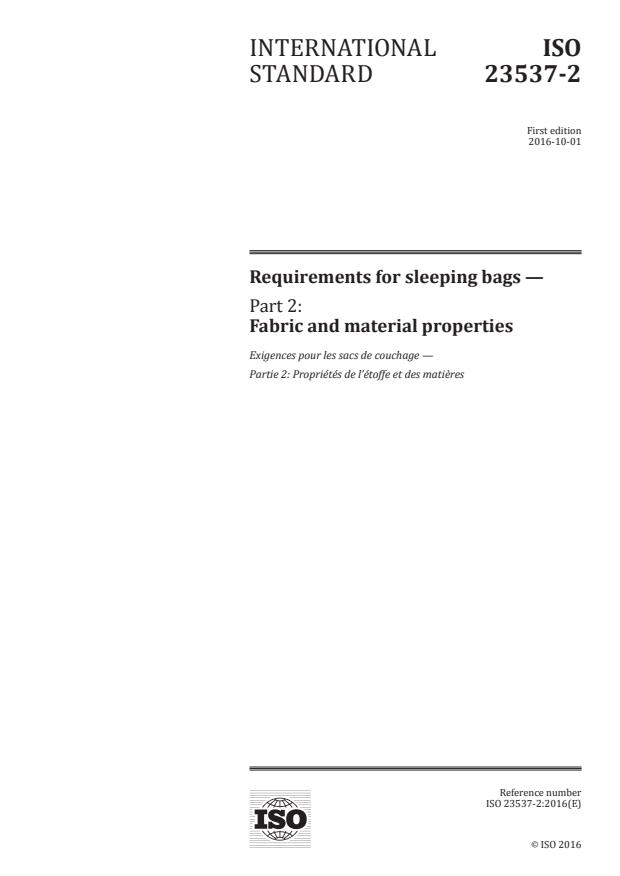
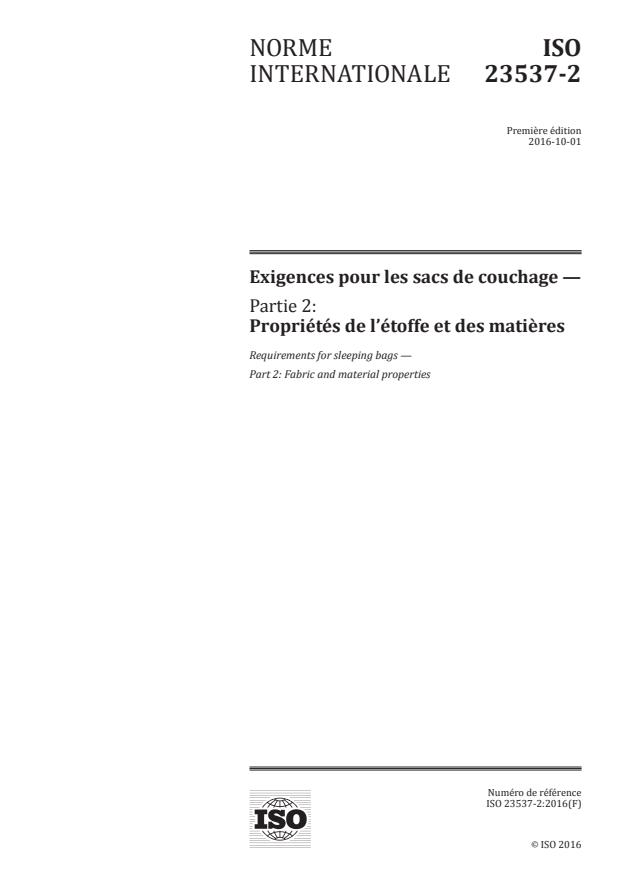
INTERNATIONAL ISO
STANDARD 23537-2
First edition
2016-10-01
Requirements for sleeping bags —
Part 2:
Fabric and material properties
Exigences pour les sacs de couchage —
Partie 2: Propriétés de l’étoffe et des matières
Reference number
©
ISO 2016
© ISO 2016, Published in Switzerland
All rights reserved. Unless otherwise specified, no part of this publication may be reproduced or utilized otherwise in any form
or by any means, electronic or mechanical, including photocopying, or posting on the internet or an intranet, without prior
written permission. Permission can be requested from either ISO at the address below or ISO’s member body in the country of
the requester.
ISO copyright office
Ch. de Blandonnet 8 • CP 401
CH-1214 Vernier, Geneva, Switzerland
Tel. +41 22 749 01 11
Fax +41 22 749 09 47
copyright@iso.org
www.iso.org
ii © ISO 2016 – All rights reserved
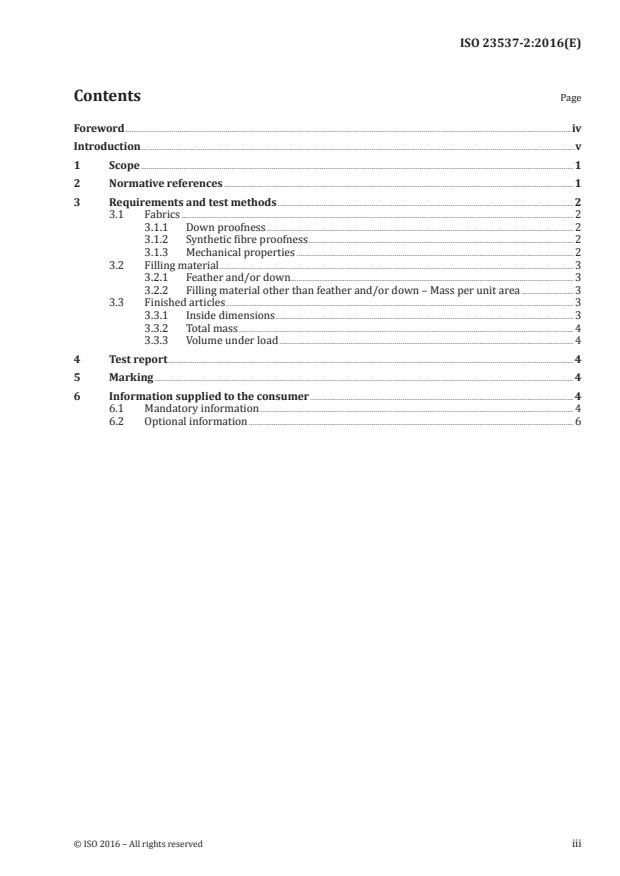
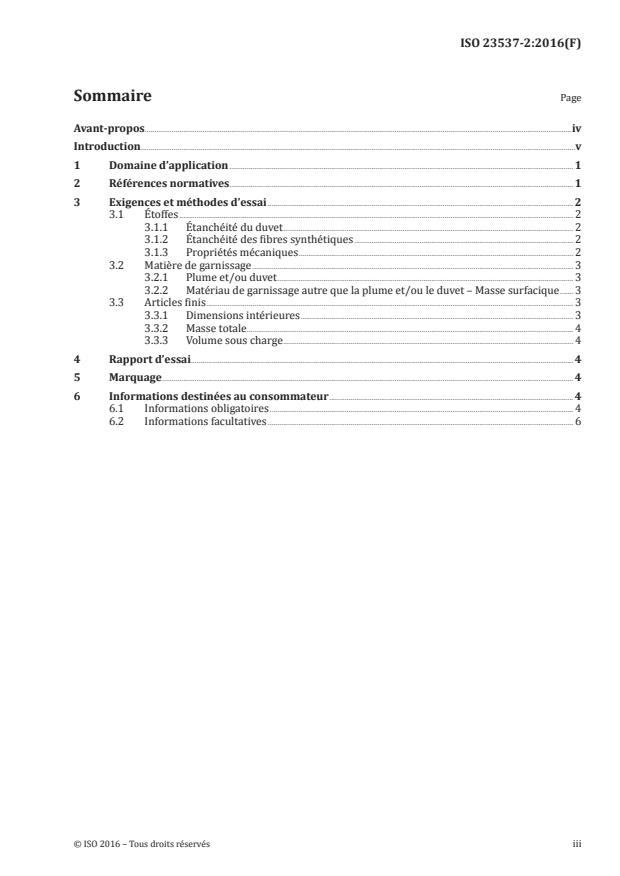
Contents Page
Foreword .iv
Introduction .v
1 Scope . 1
2 Normative references . 1
3 Requirements and test methods . 2
3.1 Fabrics . 2
3.1.1 Down proofness . 2
3.1.2 Synthetic fibre proofness . 2
3.1.3 Mechanical properties . 2
3.2 Filling material . 3
3.2.1 Feather and/or down . . 3
3.2.2 Filling material other than feather and/or down – Mass per unit area . 3
3.3 Finished articles . 3
3.3.1 Inside dimensions . 3
3.3.2 Total mass . 4
3.3.3 Volume under load . 4
4 Test report . 4
5 Marking . 4
6 Information supplied to the consumer . 4
6.1 Mandatory information . 4
6.2 Optional information . 6
Foreword
ISO (the International Organization for Standardization) is a worldwide federation of national standards
bodies (ISO member bodies). The work of preparing International Standards is normally carried out
through ISO technical committees. Each member body interested in a subject for which a technical
committee has been established has the right to be represented on that committee. International
organizations, governmental and non-governmental, in liaison with ISO, also take part in the work.
ISO collaborates closely with the International Electrotechnical Commission (IEC) on all matters of
electrotechnical standardization.
The procedures used to develop this document and those intended for its further maintenance are
described in the ISO/IEC Directives, Part 1. In particular the different approval criteria needed for the
different types of ISO documents should be noted. This document was drafted in accordance with the
editorial rules of the ISO/IEC Directives, Part 2 (see www.iso.org/directives).
Attention is drawn to the possibility that some of the elements of this document may be the subject of
patent rights. ISO shall not be held responsible for identifying any or all such patent rights. Details of
any patent rights identified during the development of the document will be in the Introduction and/or
on the ISO list of patent declarations received (see www.iso.org/patents).
Any trade name used in this document is information given for the convenience of users and does not
constitute an endorsement.
For an explanation on the meaning of ISO specific terms and expressions related to conformity assessment,
as well as information about ISO’s adherence to the World Trade Organization (WTO) principles in the
Technical Barriers to Trade (TBT) see the following URL: www.iso.org/iso/foreword.html.
ISO 23537 was prepared by the European Committee for Standardization (CEN) Technical Committee
CEN/TC 136, Sports, playground and other recreational facilities and equipment in collaboration with ISO
Technical Committee TC 83, Sports and other recreational facilities and equipment, in accordance with
the Agreement on technical cooperation between ISO and CEN (Vienna Agreement).
ISO 23537 consists of the following parts, under the general title, Requirements for sleeping bags:
— Part 1: Thermal and dimensional requirements
— Part 2: Fabric and material properties
iv © ISO 2016 – All rights reserved
Introduction
This is the first edition of this part of ISO 23537. It is based on continued development of the European
Standard, EN 13537.
This International Standard consists of two parts which allows for separate validation of thermal
properties and product and material performance. This separation of parts also allows for continued
development of new product combinations as it encourages manufacturers to consider new
combinations of materials which for example may not be suitable to test by traditional textile physical
tests, but which can still have thermal properties evaluated.
This part of ISO 23537 considers important aspects to the physical and performance properties of the
sleeping bag. The thermal properties are covered in ISO 23537-1.
INTERNATIONAL STANDARD ISO 23537-2:2016(E)
Requirements for sleeping bags —
Part 2:
Fabric and material properties
1 Scope
This part of ISO 23537 specifies the fabric and material properties as well as provisions for labelling
of adult sized sleeping bags for use in sports and leisure time activities. Thermal and dimensional
requirements are specified in ISO 23537-1.
This part of ISO 23537 does not apply to sleeping bags intended for specific purpose such as military
use and extreme climate zone expedition. It does not apply to sleeping bags for children or babies.
NOTE No prediction model exists for the determination of the limiting temperatures based on the thermal
resistance of the sleeping bag for children and babies. Moreover, such a model for testing cannot be developed
because the necessary controlled sleep trials with children
...
NORME ISO
INTERNATIONALE 23537-2
Première édition
2016-10-01
Exigences pour les sacs de couchage —
Partie 2:
Propriétés de l’étoffe et des matières
Requirements for sleeping bags —
Part 2: Fabric and material properties
Numéro de référence
©
ISO 2016
DOCUMENT PROTÉGÉ PAR COPYRIGHT
© ISO 2016, Publié en Suisse
Droits de reproduction réservés. Sauf indication contraire, aucune partie de cette publication ne peut être reproduite ni utilisée
sous quelque forme que ce soit et par aucun procédé, électronique ou mécanique, y compris la photocopie, l’affichage sur
l’internet ou sur un Intranet, sans autorisation écrite préalable. Les demandes d’autorisation peuvent être adressées à l’ISO à
l’adresse ci-après ou au comité membre de l’ISO dans le pays du demandeur.
ISO copyright office
Ch. de Blandonnet 8 • CP 401
CH-1214 Vernier, Geneva, Switzerland
Tel. +41 22 749 01 11
Fax +41 22 749 09 47
copyright@iso.org
www.iso.org
ii © ISO 2016 – Tous droits réservés
Sommaire Page
Avant-propos .iv
Introduction .v
1 Domaine d’application . 1
2 Références normatives . 1
3 Exigences et méthodes d’essai . 2
3.1 Étoffes . 2
3.1.1 Étanchéité du duvet . 2
3.1.2 Étanchéité des fibres synthétiques . 2
3.1.3 Propriétés mécaniques . 2
3.2 Matière de garnissage . 3
3.2.1 Plume et/ou duvet . 3
3.2.2 Matériau de garnissage autre que la plume et/ou le duvet – Masse surfacique . 3
3.3 Articles finis . 3
3.3.1 Dimensions intérieures . 3
3.3.2 Masse totale. 4
3.3.3 Volume sous charge . 4
4 Rapport d’essai . 4
5 Marquage . 4
6 Informations destinées au consommateur . 4
6.1 Informations obligatoires . 4
6.2 Informations facultatives . 6
Avant-propos
L’ISO (Organisation internationale de normalisation) est une fédération mondiale d’organismes
nationaux de normalisation (comités membres de l’ISO). L’élaboration des Normes internationales est
en général confiée aux comités techniques de l’ISO. Chaque comité membre intéressé par une étude
a le droit de faire partie du comité technique créé à cet effet. Les organisations internationales,
gouvernementales et non gouvernementales, en liaison avec l’ISO participent également aux travaux.
L’ISO collabore étroitement avec la Commission électrotechnique internationale (IEC) en ce qui
concerne la normalisation électrotechnique.
Les procédures utilisées pour élaborer le présent document et celles destinées à sa mise à jour sont
décrites dans les Directives ISO/IEC, Partie 1. Il convient, en particulier, de prendre note des différents
critères d’approbation requis pour les différents types de documents ISO. Le présent document a été
rédigé conformément aux règles de rédaction données dans les Directives ISO/IEC, Partie 2 (voir www.
iso.org/directives).
L’attention est appelée sur le fait que certains des éléments du présent document peuvent faire l’objet de
droits de propriété intellectuelle ou de droits analogues. L’ISO ne saurait être tenue pour responsable
de ne pas avoir identifié de tels droits de propriété et averti de leur existence. Les détails concernant
les références aux droits de propriété intellectuelle ou autres droits analogues identifiés lors de
l’élaboration du document sont indiqués dans l’Introduction et/ou dans la liste des déclarations de
brevets reçues par l’ISO (voir www.iso.org/brevets).
Les appellations commerciales éventuellement mentionnées dans le présent document sont données
pour information, par souci de commodité, à l’intention des utilisateurs et ne sauraient constituer un
engagement.
Pour une explication de la signification des termes et expressions spécifiques de l’ISO liés à l’évaluation
de la conformité, ou pour toute information au sujet de l’adhésion de l’ISO aux principes de l’Organisation
mondiale du commerce (OMC) concernant les obstacles techniques au commerce (OTC), voir le lien
suivant: http://www.iso.org/iso/fr/foreword.html.
L’ISO 23537 a été élaborée par le comité technique CEN/TC 136, Équipements et installations pour le sport,
les aires de jeux, et autres équipements et installations de loisir, du Comité européen de normalisation
(CEN), en collaboration avec le comité technique ISO/TC 83, Matériel et équipements de sports et autres
activités de loisirs, conformément à l’Accord de coopération technique entre l’ISO et le CEN (Accord de
Vienne).
L’ISO 23537 comprend les parties suivantes, présentées sous le titre général Exigences pour les sacs de
couchage:
— Partie 1: Exigences thermiques et dimensionnelles
— Partie 2: Propriétés de l’étoffe et des matières
iv © ISO 2016 – Tous droits réservés
Introduction
Il s’agit de la première édition de cette partie de l’ISO 23537. Elle repose sur le développement continu
de la Norme européenne EN 13537.
La présente Norme internationale comprend deux parties qui permettent de valider séparément les
propriétés thermiques et la performance des produits et des matériaux. Cette séparation en plusieurs
parties permet également le développement continu de nouvelles combinaisons de produits. En effet,
elle encourage les fabricants à envisager de nouvelles combinaisons de matériaux, qui ne pourraient
par exemple pas être soumises à des essais physiques textiles classiques, mais dont les propriétés
thermiques peuvent être évaluées.
Cette partie de l’ISO 23537 traite d’aspects importants pour les propriétés physiques et la performance
du sac de couchage. Les propriétés thermiques sont couvertes par l’ISO 23537-1.
NORME INTERNATIONALE ISO 23537-2:2016(F)
Exigences pour les sacs de couchage —
Partie 2:
Propriétés de l’étoffe et des matières
1 Domaine d’application
La présente partie de l’ISO 23537 spécifie les propriétés de l’étoffe et des matières, ainsi que les
dispositions à prendre concernant l’étiquetage des sacs de couchage pour adultes utilisés pour les
sports et loisirs. Les exigences thermiques et dimensionnelles sont spécifiées dans l’ISO 23537-1.
La présente partie de l’ISO 23537 ne s’applique pas aux sacs de couchage à usage spécifique, comme ceux
destinés à un usage militaire ou utilisés dans le cadre d’expéditions dans des conditions climatiques
extrêmes. Elle ne s’applique pas non plus aux sacs de couchage pour enfants ou bébés (appelés
gigoteuses).
NOTE Il n’existe pas de modèle de prévision pour la détermination des températures limites reposant sur la
résistance thermique des sacs de couchage pour enfants et bébés (gigoteuses). En outre, un tel modèle en taille
autre qu’adulte ne peut pas être développé car les essais de sommeil contrôlé nécessaires ne sont pas permis
pour des raisons éthiques avec des enfants ou des bébés dans des enceintes climatiques.
2 Références normatives
Les documents ci-après, dans leur intégralité ou non, sont des références norm
...
Questions, Comments and Discussion
Ask us and Technical Secretary will try to provide an answer. You can facilitate discussion about the standard in here.
Loading comments...