

ISO 23066:2021
(Main)Vocabulary related to rattan materials and products
General Information
- Abstract
This document defines terms relating to rattan source plants, materials, intermediate rattan products and rattan products. This document is applicable to rattan materials and products in production and trade.
- Status
- Published
- Publication Date
- 02-Feb-2021
- Technical Committee
- ISO/TC 296 - Bamboo and rattan
- Drafting Committee
- ISO/TC 296/WG 4 - Rattan
- Current Stage
- 9060 - Close of review
- Completion Date
- 02-Sep-2031
Buy Documents


ISO 23066:2021 - Vocabulary related to rattan materials and products
ISO 23066:2021 - Vocabulary related to rattan materials and products/3/2021
Overview
ISO 23066:2021 - Vocabulary related to rattan materials and products - is an international standard published by ISO/TC 296 (Bamboo and rattan) that establishes a consistent set of terms and definitions for the rattan sector. The document covers terminology for rattan source plants, rattan materials, intermediate rattan products and finished rattan products, and is applicable to rattan in both production and trade. By standardizing language, ISO 23066:2021 supports clearer communication, more consistent grading and better international trade practices for rattan cane and derived goods.
Key Topics
- Organized vocabulary covering four main areas:
- Terms for rattan harvesting (e.g., rattan, rattan stem, rattan cane, rattan cirrus, rattan petiole, green rattan cane, mature rattan cane)
- Terms for rattan cane structure (e.g., rattan node, rattan internode, rattan epidermis, rattan flesh)
- Cane diameter classes: large diameter cane (≥ 18 mm) and small diameter cane (< 18 mm)
- Terms for intermediate products (e.g., rattan pole - peeled/unpeeled, pre-processed rattan like oil-cured, fumigated, bleached cane; rattan derivatives such as cane peel and cane core in multiple shapes)
- Terms for rattan products (e.g., rattan furniture frame/component, rattan basket, mat, walking stick, takraw ball, craft products)
- Definitions for common processing and preservation methods (oil-curing, fumigation, bleaching) and intermediate product forms (half round core, flat core, hollow oval core, spline-wedge core).
- No normative references; the standard functions as a vocabulary resource to harmonize terminology across regions.
Applications
- Improves clarity in commercial contracts, product specifications, labeling, and customs documentation for the global rattan trade.
- Supports standardized grading practices, procurement, quality control and specification writing for manufacturers of rattan furniture, baskets, mats and other consumer or industrial goods.
- Useful for designers, product developers and exporters who require consistent terms for materials and components.
- Assists regulators, certification bodies, researchers and NGOs engaged in sustainable forest management, supply-chain transparency and training programs.
Who should use this standard
- Rattan producers, processors and manufacturers
- Exporters, importers and traders
- Product designers and furniture makers
- Customs officials and standardization organizations
- Forestry managers, researchers and quality assurance teams
Related standards
- Prepared by ISO/TC 296 (Bamboo and rattan). Use ISO 23066:2021 alongside other ISO/TC 296 documents and national standards on rattan and bamboo to support interoperability, grading and conformity in trade and manufacturing.
Relations
- Effective Date
- 06-Jun-2022
Buy Documents
ISO 23066:2021 - Vocabulary related to rattan materials and products
ISO 23066:2021 - Vocabulary related to rattan materials and products/3/2021
Get Certified
Connect with accredited certification bodies for this standard

Gozdarski inštitut Slovenije
Slovenian Forestry Institute. Forest management certification support, timber testing.
Sponsored listings
Frequently Asked Questions
ISO 23066:2021 is a standard published by the International Organization for Standardization (ISO). Its full title is "Vocabulary related to rattan materials and products". This standard covers: This document defines terms relating to rattan source plants, materials, intermediate rattan products and rattan products. This document is applicable to rattan materials and products in production and trade.
This document defines terms relating to rattan source plants, materials, intermediate rattan products and rattan products. This document is applicable to rattan materials and products in production and trade.
ISO 23066:2021 is classified under the following ICS (International Classification for Standards) categories: 01.040.79 - Wood technology (Vocabularies); 79.040 - Wood, sawlogs and sawn timber. The ICS classification helps identify the subject area and facilitates finding related standards.
ISO 23066:2021 has the following relationships with other standards: It is inter standard links to ISO 18674-7:2025. Understanding these relationships helps ensure you are using the most current and applicable version of the standard.
ISO 23066:2021 is available in PDF format for immediate download after purchase. The document can be added to your cart and obtained through the secure checkout process. Digital delivery ensures instant access to the complete standard document.
Standards Content (Sample)
INTERNATIONAL ISO
STANDARD 23066
First edition
2021-02
Vocabulary related to rattan materials
and products
Vocabulaire relatif aux matériaux et produits en rotin
Reference number
©
ISO 2021
© ISO 2021
All rights reserved. Unless otherwise specified, or required in the context of its implementation, no part of this publication may
be reproduced or utilized otherwise in any form or by any means, electronic or mechanical, including photocopying, or posting
on the internet or an intranet, without prior written permission. Permission can be requested from either ISO at the address
below or ISO’s member body in the country of the requester.
ISO copyright office
CP 401 • Ch. de Blandonnet 8
CH-1214 Vernier, Geneva
Phone: +41 22 749 01 11
Email: copyright@iso.org
Website: www.iso.org
Published in Switzerland
ii © ISO 2021 – All rights reserved
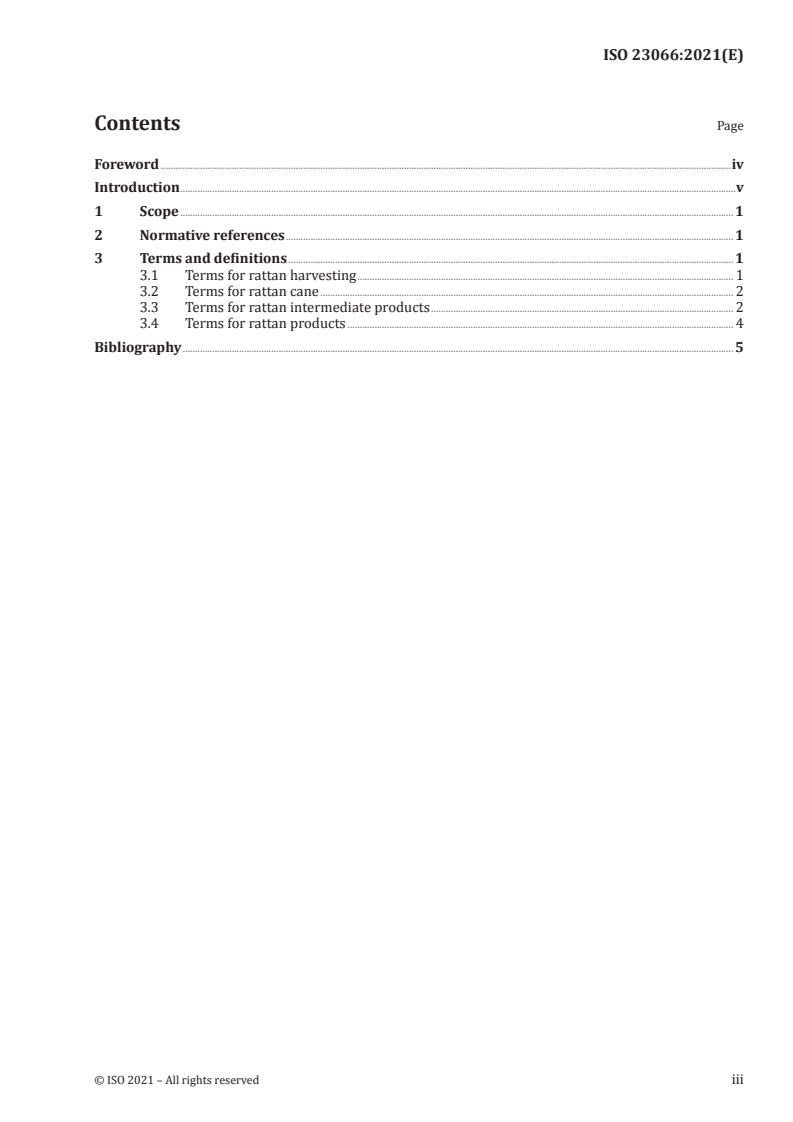
Contents Page
Foreword .iv
Introduction .v
1 Scope . 1
2 Normative references . 1
3 Terms and definitions . 1
3.1 Terms for rattan harvesting . 1
3.2 Terms for rattan cane . 2
3.3 Terms for rattan intermediate products . 2
3.4 Terms for rattan products . 4
Bibliography . 5
Foreword
ISO (the International Organization for Standardization) is a worldwide federation of national standards
bodies (ISO member bodies). The work of preparing International Standards is normally carried out
through ISO technical committees. Each member body interested in a subject for which a technical
committee has been established has the right to be represented on that committee. International
organizations, governmental and non-governmental, in liaison with ISO, also take part in the work.
ISO collaborates closely with the International Electrotechnical Commission (IEC) on all matters of
electrotechnical standardization.
The procedures used to develop this document and those intended for its further maintenance are
described in the ISO/IEC Directives, Part 1. In particular the different approval criteria needed for the
different types of ISO documents should be noted. This document was drafted in accordance with the
editorial rules of the ISO/IEC Directives, Part 2 (see www .iso .org/ directives).
Attention is drawn to the possibility that some of the elements of this document may be the subject of
patent rights. ISO shall not be held responsible for identifying any or all such patent rights. Details of
any patent rights identified during the development of the document will be in the Introduction and/or
on the ISO list of patent declarations received (see www .iso .org/ patents).
Any trade name used in this document is information given for the convenience of users and does not
constitute an endorsement.
For an explanation on the voluntary nature of standards, the meaning of ISO specific terms and
expressions related to conformity assessment, as well as information about ISO's adherence to the
World Trade Organization (WTO) principles in the Technical Barriers to Trade (TBT) see the following
URL: www .iso .org/ iso/ foreword .html.
This document is prepared by Technical Committee ISO/TC 296, Bamboo and rattan.
Any feedback or questions on this document should be directed to the user’s national standards body. A
complete listing of these bodies can be found at www .iso .org/ members .html.
iv © ISO 2021 – All rights reserved
Introduction
Rattan, a term derived from the Malay word for climbing palms, ‘rotan’, is a specialised group of scaly-
[1][2][3][4]
fruited, spiny, climbing palms which belong to the family Palmae or Arecaceae . Rattans are
monocotyledons with flexible stem and are generally found in tropical humid forest. The slender stem
of the rattan is often winding like a rope and armed with thorns or bristle. It has a diameter of less than
10 cm and reaches a length of about 30 m after ten years of growth. In rare cases some species can grow
up to 200 m long.
About 620 species of rattan occur in the tropical and subtropical rainforest ecosystems of Australia
(Queensland), India, Bangladesh, Sri Lanka, Southeast Asia (Indonesia, Malaysia, Cambodia, Philippines,
Laos, and Vietnam among others), the moist tropical forests of West and Central Africa (most especially
Central Africa, Ghana Cameroon, and Nigeria) and the Pacific (e.g., Fiji). However, South East Asian
nations primarily the Philippines, Malaysia, and Indonesia are the top producers of rattan products
and raw materials. Though a few species of rattan have been cultivated in Indonesia and a few other
countries, the greatest proportion of production originates from natural forests.
Rattan is harvested for its cane, a versatile renewable material that has been used for making various
products such as furniture, baskets, mats, walking sticks, handbags and crafts. Rattan cultivation,
processing and utilisation constitute a major topic of interest in many parts of the globe in view of its
role in poverty alleviation, employment generation and foreign exchange earnings. According to UN
comtrade 2013, imports of rattan products globally neared USD 745 million. Global demand for rattan
products is strong and new designs for rattan furniture and basketry products continue to appeal to
modern consumers. Indonesia remains the major rattan product exporter, but China and Vietnam are
increasing their share of the global rattan trade despite being short of raw rattan, whilst the Philippines,
Myanmar, Malaysia, Thailand, Cambodia and Laos have plentiful resources but export is only relatively
limited quantities.
Currently, the global trade of rattan and its products is hampered by presence of a confusing
terminology in the rattan sector. Rattan materials and produ
...
INTERNATIONAL ISO
STANDARD 23066
First edition
2021-02
Vocabulary related to rattan materials
and products
Vocabulaire relatif aux matériaux et produits en rotin
Reference number
©
ISO 2021
© ISO 2021
All rights reserved. Unless otherwise specified, or required in the context of its implementation, no part of this publication may
be reproduced or utilized otherwise in any form or by any means, electronic or mechanical, including photocopying, or posting
on the internet or an intranet, without prior written permission. Permission can be requested from either ISO at the address
below or ISO’s member body in the country of the requester.
ISO copyright office
CP 401 • Ch. de Blandonnet 8
CH-1214 Vernier, Geneva
Phone: +41 22 749 01 11
Email: copyright@iso.org
Website: www.iso.org
Published in Switzerland
ii © ISO 2021 – All rights reserved
Contents Page
Foreword .iv
Introduction .v
1 Scope . 1
2 Normative references . 1
3 Terms and definitions . 1
3.1 Terms for rattan harvesting . 1
3.2 Terms for rattan cane . 2
3.3 Terms for rattan intermediate products . 2
3.4 Terms for rattan products . 4
Bibliography . 5
Foreword
ISO (the International Organization for Standardization) is a worldwide federation of national standards
bodies (ISO member bodies). The work of preparing International Standards is normally carried out
through ISO technical committees. Each member body interested in a subject for which a technical
committee has been established has the right to be represented on that committee. International
organizations, governmental and non-governmental, in liaison with ISO, also take part in the work.
ISO collaborates closely with the International Electrotechnical Commission (IEC) on all matters of
electrotechnical standardization.
The procedures used to develop this document and those intended for its further maintenance are
described in the ISO/IEC Directives, Part 1. In particular the different approval criteria needed for the
different types of ISO documents should be noted. This document was drafted in accordance with the
editorial rules of the ISO/IEC Directives, Part 2 (see www .iso .org/ directives).
Attention is drawn to the possibility that some of the elements of this document may be the subject of
patent rights. ISO shall not be held responsible for identifying any or all such patent rights. Details of
any patent rights identified during the development of the document will be in the Introduction and/or
on the ISO list of patent declarations received (see www .iso .org/ patents).
Any trade name used in this document is information given for the convenience of users and does not
constitute an endorsement.
For an explanation on the voluntary nature of standards, the meaning of ISO specific terms and
expressions related to conformity assessment, as well as information about ISO's adherence to the
World Trade Organization (WTO) principles in the Technical Barriers to Trade (TBT) see the following
URL: www .iso .org/ iso/ foreword .html.
This document is prepared by Technical Committee ISO/TC 296, Bamboo and rattan.
Any feedback or questions on this document should be directed to the user’s national standards body. A
complete listing of these bodies can be found at www .iso .org/ members .html.
iv © ISO 2021 – All rights reserved
Introduction
Rattan, a term derived from the Malay word for climbing palms, ‘rotan’, is a specialised group of scaly-
[1][2][3][4]
fruited, spiny, climbing palms which belong to the family Palmae or Arecaceae . Rattans are
monocotyledons with flexible stem and are generally found in tropical humid forest. The slender stem
of the rattan is often winding like a rope and armed with thorns or bristle. It has a diameter of less than
10 cm and reaches a length of about 30 m after ten years of growth. In rare cases some species can grow
up to 200 m long.
About 620 species of rattan occur in the tropical and subtropical rainforest ecosystems of Australia
(Queensland), India, Bangladesh, Sri Lanka, Southeast Asia (Indonesia, Malaysia, Cambodia, Philippines,
Laos, and Vietnam among others), the moist tropical forests of West and Central Africa (most especially
Central Africa, Ghana Cameroon, and Nigeria) and the Pacific (e.g., Fiji). However, South East Asian
nations primarily the Philippines, Malaysia, and Indonesia are the top producers of rattan products
and raw materials. Though a few species of rattan have been cultivated in Indonesia and a few other
countries, the greatest proportion of production originates from natural forests.
Rattan is harvested for its cane, a versatile renewable material that has been used for making various
products such as furniture, baskets, mats, walking sticks, handbags and crafts. Rattan cultivation,
processing and utilisation constitute a major topic of interest in many parts of the globe in view of its
role in poverty alleviation, employment generation and foreign exchange earnings. According to UN
comtrade 2013, imports of rattan products globally neared USD 745 million. Global demand for rattan
products is strong and new designs for rattan furniture and basketry products continue to appeal to
modern consumers. Indonesia remains the major rattan product exporter, but China and Vietnam are
increasing their share of the global rattan trade despite being short of raw rattan, whilst the Philippines,
Myanmar, Malaysia, Thailand, Cambodia and Laos have plentiful resources but export is only relatively
limited quantities.
Currently, the global trade of rattan and its products is hampered by presence of a confusing
terminology in the rattan sector. Rattan materials and produ
...