


ISO 19123:2005
(Main)Geographic information — Schema for coverage geometry and functions
Geographic information — Schema for coverage geometry and functions
ISO 19123:2005 defines a conceptual schema for the spatial characteristics of coverages. Coverages support mapping from a spatial, temporal or spatiotemporal domain to feature attribute values where feature attribute types are common to all geographic positions within the domain. A coverage domain consists of a collection of direct positions in a coordinate space that may be defined in terms of up to three spatial dimensions as well as a temporal dimension. Examples of coverages include rasters, triangulated irregular networks, point coverages and polygon coverages. Coverages are the prevailing data structures in a number of application areas, such as remote sensing, meteorology and mapping of bathymetry, elevation, soil and vegetation. ISO 19123:2005 defines the relationship between the domain of a coverage and an associated attribute range. The characteristics of the spatial domain are defined whereas the characteristics of the attribute range are not part of ISO 19123:2005.
Information géographique — Schéma de la géométrie et des fonctions de couverture
L'ISO 19123:2005 définit un schéma conceptuel des caractéristiques spatiales des couvertures. Les couvertures servent de base à la cartographie réalisée à partir d'un domaine spatial, temporel ou spatio-emporel permettant ainsi d'obtenir les valeurs attributaires d'entités dont les types d'attributs sont communs à toutes les positions géographiques existant dans le domaine. Un domaine de couverture se compose d'un ensemble de positions directes dans un espace de coordonnées qui peut être défini comme tridimensionnel ou bien temporel. Parmi les exemples de couverture, citons les matrices, les réseaux irréguliers de triangles, les couvertures de points et les couvertures de polygones. Les couvertures sont les structures de données courantes dans divers champs d'application, notamment la télédétection, la météorologie, la bathymétrie, l'altitude, le sol et la végétation. L'ISO 19123:2005 définit la relation entre le domaine d'une couverture et une plage d'attributs associée. Les caractéristiques du domaine spatial sont définies, mais les caractéristiques des attributs ne font pas partie du domaine d'application de l'ISO 19123:2005.
Geografske informacije – Shema za geometrijo podatkovnega sloja in funkcije
General Information
- Status
- Withdrawn
- Publication Date
- 30-Aug-2005
- Technical Committee
- ISO/TC 211 - Geographic information/Geomatics
- Drafting Committee
- ISO/TC 211 - Geographic information/Geomatics
- Current Stage
- 9599 - Withdrawal of International Standard
- Start Date
- 21-Jun-2023
- Completion Date
- 12-Feb-2026
Relations
- Effective Date
- 06-Feb-2016
ISO 19123:2005 - Geographic information -- Schema for coverage geometry and functions
ISO 19123:2005 - Information géographique -- Schéma de la géométrie et des fonctions de couverture


ISO 19123:2006
Get Certified
Connect with accredited certification bodies for this standard

BSI Group
BSI (British Standards Institution) is the business standards company that helps organizations make excellence a habit.

NYCE
Mexican standards and certification body.
Sponsored listings
Frequently Asked Questions
ISO 19123:2005 is a standard published by the International Organization for Standardization (ISO). Its full title is "Geographic information — Schema for coverage geometry and functions". This standard covers: ISO 19123:2005 defines a conceptual schema for the spatial characteristics of coverages. Coverages support mapping from a spatial, temporal or spatiotemporal domain to feature attribute values where feature attribute types are common to all geographic positions within the domain. A coverage domain consists of a collection of direct positions in a coordinate space that may be defined in terms of up to three spatial dimensions as well as a temporal dimension. Examples of coverages include rasters, triangulated irregular networks, point coverages and polygon coverages. Coverages are the prevailing data structures in a number of application areas, such as remote sensing, meteorology and mapping of bathymetry, elevation, soil and vegetation. ISO 19123:2005 defines the relationship between the domain of a coverage and an associated attribute range. The characteristics of the spatial domain are defined whereas the characteristics of the attribute range are not part of ISO 19123:2005.
ISO 19123:2005 defines a conceptual schema for the spatial characteristics of coverages. Coverages support mapping from a spatial, temporal or spatiotemporal domain to feature attribute values where feature attribute types are common to all geographic positions within the domain. A coverage domain consists of a collection of direct positions in a coordinate space that may be defined in terms of up to three spatial dimensions as well as a temporal dimension. Examples of coverages include rasters, triangulated irregular networks, point coverages and polygon coverages. Coverages are the prevailing data structures in a number of application areas, such as remote sensing, meteorology and mapping of bathymetry, elevation, soil and vegetation. ISO 19123:2005 defines the relationship between the domain of a coverage and an associated attribute range. The characteristics of the spatial domain are defined whereas the characteristics of the attribute range are not part of ISO 19123:2005.
ISO 19123:2005 is classified under the following ICS (International Classification for Standards) categories: 35.240.70 - IT applications in science. The ICS classification helps identify the subject area and facilitates finding related standards.
ISO 19123:2005 has the following relationships with other standards: It is inter standard links to ISO 19123-1:2023. Understanding these relationships helps ensure you are using the most current and applicable version of the standard.
ISO 19123:2005 is available in PDF format for immediate download after purchase. The document can be added to your cart and obtained through the secure checkout process. Digital delivery ensures instant access to the complete standard document.
Standards Content (Sample)
INTERNATIONAL ISO
STANDARD 19123
First edition
2005-08-15
Geographic information — Schema for
coverage geometry and functions
Information géographique — Schéma de la géométrie et des fonctions
de couverture
Reference number
©
ISO 2005
PDF disclaimer
This PDF file may contain embedded typefaces. In accordance with Adobe's licensing policy, this file may be printed or viewed but
shall not be edited unless the typefaces which are embedded are licensed to and installed on the computer performing the editing. In
downloading this file, parties accept therein the responsibility of not infringing Adobe's licensing policy. The ISO Central Secretariat
accepts no liability in this area.
Adobe is a trademark of Adobe Systems Incorporated.
Details of the software products used to create this PDF file can be found in the General Info relative to the file; the PDF-creation
parameters were optimized for printing. Every care has been taken to ensure that the file is suitable for use by ISO member bodies. In
the unlikely event that a problem relating to it is found, please inform the Central Secretariat at the address given below.
© ISO 2005
All rights reserved. Unless otherwise specified, no part of this publication may be reproduced or utilized in any form or by any means,
electronic or mechanical, including photocopying and microfilm, without permission in writing from either ISO at the address below or
ISO's member body in the country of the requester.
ISO copyright office
Case postale 56 • CH-1211 Geneva 20
Tel. + 41 22 749 01 11
Fax + 41 22 749 09 47
E-mail copyright@iso.org
Web www.iso.org
Published in Switzerland
ii © ISO 2005 – All rights reserved
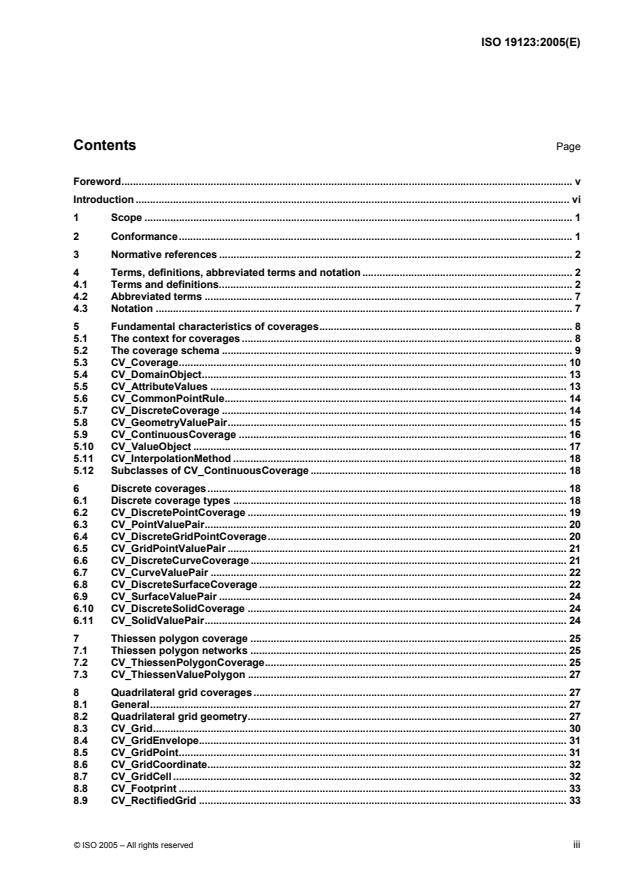
Contents Page
Foreword. v
Introduction . vi
1 Scope . 1
2 Conformance. 1
3 Normative references . 2
4 Terms, definitions, abbreviated terms and notation . 2
4.1 Terms and definitions. 2
4.2 Abbreviated terms . 7
4.3 Notation . 7
5 Fundamental characteristics of coverages.8
5.1 The context for coverages . 8
5.2 The coverage schema . 9
5.3 CV_Coverage. 10
5.4 CV_DomainObject. 13
5.5 CV_AttributeValues . 13
5.6 CV_CommonPointRule. 14
5.7 CV_DiscreteCoverage . 14
5.8 CV_GeometryValuePair. 15
5.9 CV_ContinuousCoverage . 16
5.10 CV_ValueObject . 17
5.11 CV_InterpolationMethod . 18
5.12 Subclasses of CV_ContinuousCoverage . 18
6 Discrete coverages. 18
6.1 Discrete coverage types . 18
6.2 CV_DiscretePointCoverage . 19
6.3 CV_PointValuePair. 20
6.4 CV_DiscreteGridPointCoverage. 20
6.5 CV_GridPointValuePair . 21
6.6 CV_DiscreteCurveCoverage . 21
6.7 CV_CurveValuePair . 22
6.8 CV_DiscreteSurfaceCoverage . 22
6.9 CV_SurfaceValuePair . 24
6.10 CV_DiscreteSolidCoverage . 24
6.11 CV_SolidValuePair. 24
7 Thiessen polygon coverage . 25
7.1 Thiessen polygon networks . 25
7.2 CV_ThiessenPolygonCoverage. 25
7.3 CV_ThiessenValuePolygon . 27
8 Quadrilateral grid coverages . 27
8.1 General. 27
8.2 Quadrilateral grid geometry. 27
8.3 CV_Grid. 30
8.4 CV_GridEnvelope. 31
8.5 CV_GridPoint. 31
8.6 CV_GridCoordinate. 32
8.7 CV_GridCell . 32
8.8 CV_Footprint . 33
8.9 CV_RectifiedGrid . 33
8.10 CV_ReferenceableGrid . 34
8.11 CV_ContinousQuadrilateralGridCoverage . 35
8.12 CV_GridValueCell. 36
8.13 CV_GridPointValuePair . 36
8.14 CV_GridValuesMatrix. 37
8.15 CV_SequenceRule . 38
8.16 CV_SequenceType. 38
9 Hexagonal Grid Coverages . 39
9.1 General . 39
9.2 CV_HexagonalGridCoverage . 39
9.3 CV_GridValuesMatrix. 41
9.4 CV_ValueHexagon . 41
10 Triangulated irregular network (TIN) coverages. 41
10.1 General . 41
10.2 CV_TINCoverage . 43
10.3 CV_ValueTriangle. 43
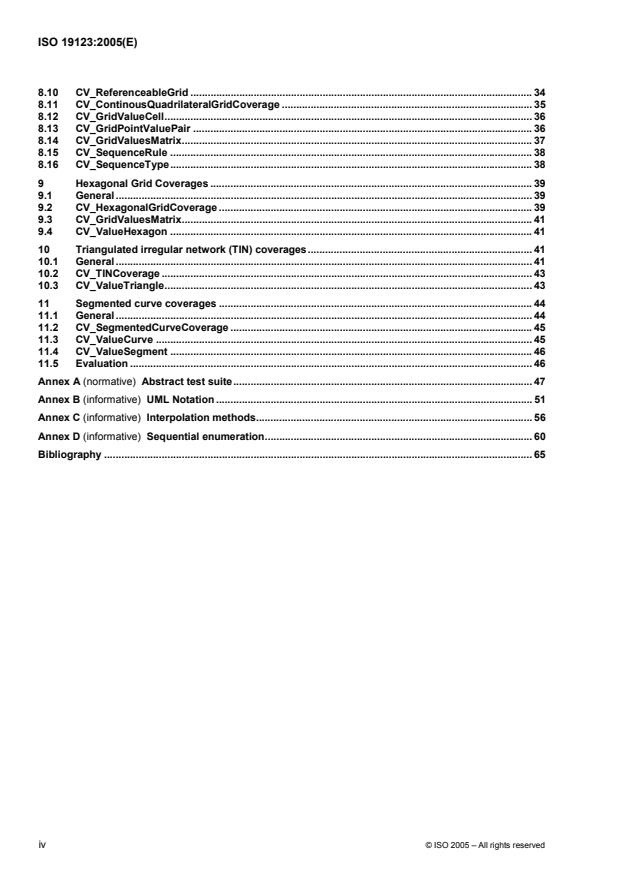
11 Segmented curve coverages . 44
11.1 General . 44
11.2 CV_SegmentedCurveCoverage . 45
11.3 CV_ValueCurve . 45
11.4 CV_ValueSegment . 46
11.5 Evaluation . 46
Annex A (normative) Abstract test suite. 47
Annex B (informative) UML Notation . 51
Annex C (informative) Interpolation methods. 56
Annex D (informative) Sequential enumeration. 60
Bibliography . 65
iv © ISO 2005 – All rights reserved
Foreword
ISO (the International Organization for Standardization) is a worldwide federation of national standards bodies
(ISO member bodies). The work of preparing International Standards is normally carried out through ISO
technical committees. Each member body interested in a subject for which a technical committee has been
established has the right to be represented on that committee. International organizations, governmental and
non-governmental, in liaison with ISO, also take part in the work. ISO collaborates closely with the
International Electrotechnical Commission (IEC) on all matters of electrotechnical standardization.
International Standards are drafted in accordance with the rules given in the ISO/IEC Directives, Part 2.
The main task of technical committees is to prepare International Standards. Draft International Standards
adopted by the technical committees are circulated to the member bodies for voting. Publication as an
International Standard requires approval by at least 75 % of the member bodies casting a vote.
Attention is drawn to the possibility that some of the elements of this document may be the subject of patent
rights. ISO shall not be held responsible for identifying any or all such patent rights.
ISO 19123 was prepared by Technical Committee ISO/TC 211, Geographic information/Geomatics.
Introduction
Geographic phenomena fall into two broad categories — discrete and continuous. Discrete phenomena are
recognizable objects that have relatively well-defined boundaries or spatial extent. Examples include buildings,
streams and measurement stations. Continuous phenomena vary over space and have no specific extent.
Examples include temperature, soil composition and elevation. A value or description of a continuous
phenomenon is only meaningful at a particular position in space (and possibly time). Temperature, for
example, takes on specific values only at defined locations, whether measured or interpolated from other
locations.
These concepts are not mutually exclusive. In fact, many components of the landscape may be viewed
alternatively as discrete or continuous. For example, a stream is a discrete entity, but its flow rate and water
quality index vary from one position to another. Similarly, a highway can be thought of as a feature or as a
collection of observations measuring accidents or traffic flow, and an agricultural field is both a spatial object
and a set of measurements of crop yield through time.
Historically, geographic information has been treated in terms of two fundamental types called vector data and
raster data.
“Vector data” deals with discrete phenomena, each of which is conceived of as a feature. The spatial
characteristics of a discrete real-world phenomenon are represented by a set of one or more geometric
primitives (points, curves, surfaces or solids). Other characteristics of the phenomenon are recorded as
feature attributes. Usually, a single feature is associated with a single set of attribute values. ISO 19107:2003
provides a schema for describing features in terms of geometric and topological primitives.
“Raster data”, on the other hand, deals with real-world phenomena that vary continuously over space. It
contains a set of values, each associated with one of the elements in a regular array of points or cells. It is
usually associated with a method for interpolating values at spatial positions between the points or within the
cells. Since this data structure is not the only one that can be used to represent phenomena that vary
continuously over space, this International Standard uses the term “coverage,” adopted from the Abstract
[1]
Specification of the Open GIS Consortium , to refer to any data representation that assigns values directly to
spatial position. A coverage is a function from a spatial, temporal or spatiotemporal domain to an attribute
range. A coverage associates a position within its domain to a record of values of defined data types.
In this International Standard, coverage is a subtype of feature. A coverage is a feature that has multiple
values for each attribute type, where each direct position within the geometric representation of the feature
has a single value for each attribute type.
Just as the concepts of discrete and continuous phenomena are not mutually exclusive, their representations
as discrete features or coverages are not mutually exclusive. The same phenomenon may be represented as
either a discrete feature or a coverage. A city may be viewed as a discrete feature that returns a single value
for each attribute, such as its name, area and total population. The city feature may also be represented as a
coverage that returns values such as population density, land value or air quality index for each position in the
city.
A coverage, moreover, can be derived from a collection of discrete features with common attributes, the
values of the coverage at each position being the values of the attributes of the feature located at that position.
Conversely, a collection of discrete features can be derived from a coverage, each discrete feature being
composed of a set of positions associated with specified attribute values.
vi © ISO 2005 – All rights reserved
INTERNATIONAL STANDARD ISO 19123:2005(E)
Geographic information — Schema for coverage geometry and
functions
1 Scope
This International Standard defines a conceptual schema for the spatial characteristics of coverages.
Coverages support mapping from a spatial, temporal or spatiotemporal domain to feature attribute values
where feature attribute types are common to all geographic positions within the domain. A coverage domain
consists of a collection of direct positions in a coordinate space that may be defined in terms of up to three
spatial dimensions as well as a temporal dimension. Examples of coverages include rasters, triangulated
irregular networks, point coverages and polygon coverages. Coverages are the prevailing data structures in a
number of application areas, such as remote sensing, meteorology and mapping of bathymetry, elevation, soil
and vegetation. This International Standard defines the relationship between the domain of a coverage and an
associated attribute range. The characteristics of the spatial domain are defined whereas the characteristics of
the attribute range are not part of this standard.
2 Conformance
This International Standard specifies interfaces for several types of coverage objects. In addition, it supports
the interchange of coverage data independently of those interfaces. Thus, it specifies two sets of conformance
classes: one for implementation of the interfaces, the other for the exchange of coverage data. Each set
includes one conformance class for each type of coverage specified in this International Standard (Table 1).
Table 1 — Conformance classes
Conformance class Subclause
Simple coverage interface A.1.1
Discrete coverage interface A.1.2
Thiessen polygon coverage interface A.1.3
Quadrilateral grid coverage interface A.1.4
Hexagonal grid coverage interface A.1.5
TIN coverage interface A.1.6
Segmented curve coverage interface A.1.7
Discrete coverage interchange A.2.1
Thiessen polygon coverage interchange A.2.2
Quadrilateral grid coverage interchange A.2.3
Hexagonal grid coverage interchange A.2.4
TIN coverage interchange A.2.5
Segmented curve coverage interchange A.2.6
In general, the interface conformance classes require implementation of all attributes, associations and
operations of relevant classes. This set includes a single conformance class (A.2.1) that supports a simple
interface for evaluation of any coverage type, but exposes none of the internal structure of the coverage. The
remainder of the set are conformance classes that support interfaces to specific coverage types that expose
additional information about the internal structure of the coverage.
The interchange conformance classes require only implementation of the attributes and associations of the
relevant classes.
The Abstract Test Suite in Annex A shows the implementation requirements necessary to conform to this
International Standard. Table 1 lists the subclauses of the Abstract Test Suite that apply for each conformance
class.
3 Normative references
The following referenced documents are indispensable for the application of this document. For dated
references, only the edition cited applies. For undated references, the latest edition of the referenced
document (including any amendments) applies.
ISO/TS 19103:2005, Geographic information — Conceptual schema language
ISO 19107:2003, Geographic information — Spatial schema
ISO 19108:2002, Geographic information — Temporal schema
ISO 19109:2005, Geographic information — Rules for application schema
ISO 19111:2003, Geographic information — Spatial referencing by coordinates
ISO 19115:2003, Geographic information — Metadata
4 Terms, definitions, abbreviated terms and notation
4.1 Terms and definitions
For the purposes of this document, the following terms and definitions apply.
4.1.1
continuous coverage
coverage that returns different values for the same feature attribute at different direct positions within a
single spatial object, temporal object or spatiotemporal object in its domain
NOTE Although the domain of a continuous coverage is ordinarily bounded in terms of its spatial and/or temporal
extent, it can be subdivided into an infinite number of direct positions.
4.1.2
convex hull
smallest convex set containing a given geometric object
[2]
[adapted from Dictionary of Computing:1996 ]
4.1.3
convex set
geometric set in which any direct position on the straight-line segment joining any two direct positions in
the geometric set is also contained in the geometric set
[2]
[Dictionary of Computing:1996 ]
2 © ISO 2005 – All rights reserved
4.1.4
coordinate
one of a sequence of n numbers designating the position of a point in n-dimensional space
[ISO 19111:2003]
4.1.5
coordinate dimension
number of measurements or axes needed to describe a position in a coordinate system
[ISO 19107:2003]
4.1.6
coordinate reference system
coordinate system that is related to the real world by a datum
[ISO 19111:2003]
41.7
coverage
feature that acts as a function to return values from its range for any direct position within its spatial,
temporal or spatiotemporal domain
EXAMPLE Examples include a raster image, polygon overlay or digital elevation matrix.
NOTE In other words, a coverage is a feature that has multiple values for each attribute type, where each direct
position within the geometric representation of the feature has a single value for each attribute type.
4.1.8
coverage geometry
configuration of the domain of a coverage described in terms of coordinates
4.1.9
curve
1-dimensional geometric primitive, representing the continuous image of a line
[ISO 19107:2003]
NOTE The boundary of a curve is the set of points at either end of the curve.
4.1.10
Delaunay triangulation
network of triangles such that the circle passing through the vertices of any triangle does not contain, in its
interior, the vertex of any other triangle
4.1.11
direct position
position described by a single set of coordinates within a coordinate reference system
[ISO 19107:2003]
4.1.12
discrete coverage
coverage that returns the same feature attribute values for every direct position within any single spatial
object, temporal object or spatiotemporal object in its domain
NOTE The domain of a discrete coverage consists of a finite set of spatial, temporal, or spatiotemporal objects.
4.1.13
domain
well-defined set
[ISO/TS 19103]
NOTE Domains are used to define the domain and range of operators and functions.
4.1.14
evaluation
〈coverage〉 determination of the values of a coverage at a direct position within the domain of the coverage
4.1.15
feature
0 abstraction of real world phenomena
[ISO 19101]
4.1.16
feature attribute
characteristic of a feature
[ISO 19101]
4.1.17
function
rule that associates each element from a domain (source or domain of the function) to a unique element in
another domain (target, co-domain or range)
[ISO 19107:2003]
4.1.18
geometric object
spatial object representing a geometric set
[ISO 19107:2003]
4.1.19
geometric primitive
geometric object representing a single, connected, homogeneous element of space
[ISO 19107:2003]
4.1.20
geometric set
set of direct positions
[ISO 19107:2003]
4.1.21
geometry value object
object composed of a set of geometry value pairs
4.1.22
geometry value pair
ordered pair composed of a spatial object, a temporal object or a spatiotemporal object and a record of
feature attribute values
4 © ISO 2005 – All rights reserved
4.1.23
grid
network composed of two or more sets of curves in which the members of each set intersect the members of
the other sets in an algorithmic way
NOTE The curves partition a space into grid cells.
4.1.24
grid point
point located at the intersection of two or more curves in a grid
4.1.25
inverse evaluation
〈coverage〉 selection of a set of objects from the domain of a coverage based on the feature attribute values
associated with the objects
4.1.26
point
0-dimensional geometric primitive, representing a position
[ISO 19107:2003]
NOTE The boundary of a point is the empty set.
4.1.27
point coverage
coverage that has a domain composed of points
4.1.28
polygon coverage
coverage that has a domain composed of polygons
4.1.29
range
〈coverage〉 set of feature attribute values associated by a function with the elements of the domain of a
coverage
4.1.30
raster
usually rectangular pattern of parallel scanning lines forming or corresponding to the display on a cathode ray
tube
NOTE A raster is a type of grid.
4.1.31
record
finite, named collection of related items (objects or values)
[ISO 19107:2003]
NOTE Logically, a record is a set of pairs .
4.1.32
rectified grid
grid for which there is an affine transformation between the grid coordinates and the coordinates of an
external coordinate reference system
NOTE If the coordinate reference system is related to the earth by a datum, the grid is a georectified grid.
4.1.33
referenceable grid
grid associated with a transformation that can be used to convert grid coordinate values to values of
coordinates referenced to an external coordinate reference system
NOTE If the coordinate reference system is related to the earth by a datum, the grid is a georeferenceable grid.
4.1.34
solid
3-dimensional geometric primitive, representing the continuous image of a region of Euclidean 3-space
[ISO 19107:2003]
NOTE A solid is realizable locally as a three-parameter set of direct positions. The boundary of a solid is the set of
oriented, closed surfaces that comprise the limits of the solid.
4.1.35
spatial object
object used for representing a spatial characteristic of a feature
[ISO 19107:2003]
4.1.36
spatiotemporal domain
〈coverage〉 domain composed of spatiotemporal objects
NOTE The spatiotemporal domain of a continuous coverage consists of a set of direct positions defined in relation to
a collection of spatiotemporal objects.
4.1.37
spatiotemporal object
object representing a set of direct positions in space and time
4.1.38
surface
2-dimensional geometric primitive, locally representing a continuous image of a region of a plane
[ISO 19107:2003]
NOTE The boundary of a surface is the set of oriented, closed curves that delineate the limits of the surface.
4.1.39
tessellation
partitioning of a space into a set of conterminous subspaces having the same dimension as the space being
partitioned
NOTE A tessellation composed of congruent regular polygons or polyhedra is a regular tessellation. One composed
of regular, but non-congruent polygons or polyhedra is a semi-regular tessellation. Otherwise, the tessellation is irregular.
EXAMPLES Graphic examples of tessellations may be found in Figures 11, 13, 20 and 22 of this International
Standard.
4.1.40
Thiessen polygon
polygon that encloses one of a set of points on a plane so as to include all direct positions that are closer to
that point than to any other point in the set
6 © ISO 2005 – All rights reserved
4.1.41
topological dimension
minimum number of free variables needed to distinguish nearby direct positions within a geometric object
from one another
[ISO 19107:2003]
4.1.42
triangulated irregular network
tessellation composed of triangles
4.1.43
vector
quantity having direction as well as magnitude
NOTE A directed line segment represents a vector if the length and direction of the line segment are equal to the
magnitude and direction of the vector. The term vector data refers to data that represents the spatial configuration of
features as a set of directed line segments.
4.2 Abbreviated terms
GIS Geographic Information System
TIN Triangulated Irregular Network
UML Unified Modelling Language
4.3 Notation
The conceptual schema specified in this International Standard is described using the Unified Modelling
[4]
Language (UML) , following the guidance of ISO/TS 19103. Annex B describes UML notation as used in this
International Standard.
Several model elements used in this schema are defined in other International Standards developed by
ISO/TC 211. By convention within ISO/TC 211, names of UML classes, with the exception of basic data type
classes, include a two-letter prefix that identifies the standard and the UML package in which the class is
defined. UML classes defined in this International Standard have the two-letter prefix of CV. Table 2 lists the
other standards and packages in which UML classes used in this International Standard have been defined.
Table 2 — Sources of externally defined UML classes
Prefix International Package
Standard
EX ISO 19115 Extent
GF ISO 19109 General Feature Model
GM ISO 19107 Geometry
SC ISO 19111 Spatial Coordinates
TM ISO 19108 Temporal Schema
5 Fundamental characteristics of coverages
5.1 The context for coverages
5.1.1 General
A coverage is a feature that associates positions within a bounded space (its domain) to feature attribute
values (its range). In other words, it is both a feature and a function. Examples include a raster image, a
polygon overlay or a digital elevation matrix.
A coverage may represent a single feature or a set of features.
5.1.2 Domain of a coverage
A coverage domain is a set of geometric objects described in terms of direct positions. It may be extended to
all of the direct positions within the convex hull of that set of geometric objects. The direct positions are
associated with a spatial or temporal coordinate reference system. Commonly used domains include point
sets, grids, collections of closed rectangles, and other collections of geometric objects. The geometric objects
may exhaustively partition the domain, and thereby form a tessellation such as a grid or a TIN. Point sets and
other sets of non-conterminous geometric objects do not form tessellations. Coverage subtypes may be
defined in terms of their domains.
Coverage domains differ in both the coordinate dimension of the space in which they exist and in the
topological dimension of the geometric objects they contain. Clearly, the geometric objects that make up a
domain cannot have a topological dimension greater than the coordinate dimension of the domain. A domain
of coordinate dimension 3 may be composed of points, curves, surfaces, or solids, while a domain of
coordinate dimension 2 may be composed only of points, curves or surfaces. ISO 19107:2003 defines a
number of geometric objects (subtypes of the UML class GM_Object) to be used for the description of
features. Many of these geometric objects can be used to define domains for coverages. In addition,
ISO 19108:2002 defines TM_GeometricPrimitives that may also be used to define domains of coverages.
Generally, the geometric objects that make up the domain of a coverage are disjoint, but this International
Standard does allow a coverage domain to contain overlapping geometric objects.
5.1.3 The range of a coverage
The range of a coverage is a set of feature attribute values. It may be either a finite or a transfinite set.
Coverages often model many associated functions sharing the same domain. Therefore, the value set is
represented as a collection of records with a common schema.
EXAMPLE A coverage might assign to each direct position in a county the temperature, pressure, humidity, and
wind velocity at noon, today, at that point. The coverage maps every direct position in the county to a record of four fields.
A feature attribute value may be of any data type. However, evaluation of a continuous coverage is usually
implemented by interpolation methods that can be applied only to numbers or vectors. Other data types are
almost always associated with discrete coverages.
Given a record from the range of a coverage, inverse evaluation is the calculation and exposure of a set of
geometric objects associated with specific values of the attributes. Inverse evaluation may return many
geometric objects associated with a single feature attribute value.
EXAMPLE Inverse evaluation is used for the extraction of contours from an elevation coverage and the extraction of
classified regions in an image.
8 © ISO 2005 – All rights reserved
5.1.4 Discrete and continuous coverages
Coverages are of two types. A discrete coverage has a domain that consists of a finite collection of geometric
objects and the direct positions contained in those geometric objects. A discrete coverage maps each
geometric object to a single record of feature attribute values. The geometric object and its associated record
form a geometry value pair. A discrete coverage is thus a discrete or step function as opposed to a continuous
coverage. Discrete functions can be explicitly enumerated as (input, output) pairs. A discrete coverage may be
represented as a collection of ordered pairs of independent and dependent variables. Each independent
variable is a geometric object and each dependent variable is a record of feature attribute values.
EXAMPLE A coverage that maps a set of polygons to the soil type found within each polygon is an example of a
discrete coverage.
A continuous coverage has a domain that consists of a set of direct positions in a coordinate space. A
continuous coverage maps direct positions to value records.
EXAMPLE Consider a coverage that maps direct positions in San Diego County to their temperature at noon today.
Both the domain and the range may take an infinite number of different values. This continuous coverage would be
associated with a discrete coverage that holds the temperature values observed at a set of weather stations.
A continuous coverage may consist of no more than a spatially bounded, but transfinite set of direct positions,
and a mathematical function that relates direct position to feature attribute value. This is called an analytical
coverage.
EXAMPLE A statistical trend surface that relates land value to position relative to a city centre is an example of a
continuous coverage.
More often, the domain of a continuous coverage consists of the direct positions in the union or in the convex
hull of a finite collection of geometric objects; it is specified by that collection. In most cases, a continuous
coverage is also associated with a discrete coverage that provides a set of control values to be used as a
basis for evaluating the continuous coverage. Evaluation of the continuous coverage at other direct positions
is done by interpolating between the geometry value pairs of the control set. This often depends upon
additional geometric objects constructed from those in the control set; these additional objects are typically of
higher topological dimension than the control objects. In this International Standard, such objects are called
geometry value objects. A geometry value object is a geometric object associated with a set of geometry
value pairs that provide the control for constructing the geometric object and for evaluating the coverage at
direct positions within the geometric object.
EXAMPLE Evaluation of a triangulated irregular network involves interpolation of values within a triangle composed
of three neighbouring point value pairs.
5.2 The coverage schema
The coverage schema is organized into seven packages with the inter-package dependencies shown in
Figure 1. The Coverage Core package is documented in this clause, and each of the other packages is
described in a separate clause as shown in Table 3.
Figure 1 — Packages of the coverage schema
Table 3 — Documentation of coverage geometry packages
Package Clause
Coverage core 5
Discrete coverages 6
Thiessen polygon 7
Quadrilateral grid 8
Hexagonal grid 9
TIN 10
Segmented curve 11
5.3 CV_Coverage
5.3.1 General
The class CV_Coverage (Figure 2) is an instance of the <> GF_FeatureType (ISO 19109), which
therefore represents a feature type. CV_Coverage shall support three attributes, five operations, and three
associations.
5.3.2 domainExtent
The attribute domainExtent[1.*]EX_Extent shall contain the extent of the domain of the coverage. The data
type EX_Extent is defined in ISO 19115:2003. Extents may be specified in space, time or space-time.
5.3.3 rangeType
The attribute rangeType: RecordType shall describe the range of the coverage. The data type RecordType is
defined in ISO/TS 19103. It consists of a list of attribute name/data type pairs. A simple list is the most
common form of rangeType, but RecordType can be used recursively to describe more complex structures.
The rangeType for a specific coverage shall be specified in an application schema.
10 © ISO 2005 – All rights reserved
5.3.4 commonPointRule
The attribute commonPointRule: CV_CommonPointRule shall identify the procedure to be used for evaluating
the CV_Coverage at a position that falls either on a boundary between geometric objects or within the
boundaries of two or more overlapping geometric objects, where the geometric objects are either
CV_DomainObjects or CV_ValueObjects. The data type CV_CommonPointRule is defined in 5.6.
5.3.5 list
The operation list(): Set shall return the dictionary of CV_GeometryValuePairs
(5.8) that contain the CV_DomainObjects in the domain of the CV_Coverage each paired with its record of
feature attribute values. In the case of an analytical coverage, the operation shall return the empty set.
5.3.6 select
The operation select (s: GM_Object, t: TM_Period): Set shall accept a GM_Object
and a TM_Period as input and return the set of CV_GeometryValuePairs that contain CV_DomainObjects that
lie within that GM_Object and TM_Period. If s is null, the operation shall return all CV_GeometryValuePairs
that contain CV_DomainObjects within t. If the value of t is null, the operation shall return all
CV_GeometryValuePairs that contain CV_DomainObjects within s. In the case of an analytical coverage, the
operation shall return the empty set.
5.3.7 find
The operation find (p: DirectPosition, limit: Integer = 1): Sequence shall accept a
DirectPosition as input and return the sequence of CV_GeometryValuePairs that includes the
CV_DomainObjects nearest to the DirectPosition and their distances from the DirectionPosition. The
sequence shall be ordered by distance from the DirectPosition, beginning with the Record containing the
CV_DomainObject nearest to the DirectPosition. The length of the sequence (the number of
CV_GeometryValuePairs returned) shall be no greater than the number specified by the parameter limit. The
default shall be to return a single CV_GeometryValuePair. The operation shall return a warning if the last
CV_DomainObject in the sequence is at a distance from the DirectPosition equal to the distance of other
CV_DomainObjects that are not included in the sequence. In the case of an analytical coverage, the operation
shall return the empty set.
NOTE This operation is useful when the domain of a coverage does not exhaustively partition the extent of the
coverage. Even in that case, the first element of the sequence returned may be the CV_GeometryValuePair that contains
the input DirectPosition.
5.3.8 evaluate
The operation evaluate(p: DirectPosition, list: Sequence ): Set shall accept a
DirectPosition as input and return a set of Records of feature attribute values for that direct position. The
parameter list is a sequence of feature attribute names each of which identifies a field of the rangeType. If list
is null, the operation shall return a value for every field of the rangeType. Otherwise, it shall return a value for
each field included in list. The data type DirectPosition is defined in ISO 19107:2003; the data type Record is
defined in ISO/TS 19103. If the direct position passed is not in the domain of the coverage, then an error
message shall be generated. If the input DirectPosition falls within two or more geometric objects within the
domain, the operation shall return records of feature attribute values computed according to the value of the
attribute commonPointRule.
NOTE Normally, the operation will return a single record of feature attribute values.
Figure 2 — CV_Coverage
5.3.9 evaluateInverse
The operation evaluateInverse (v: Record): Set shall accept a Record of feature attribute
values as input and return a set of CV_DomainObjects. Normally, this will be the set of CV_DomainObjects in
the Domain that are associated with values equal to those in the input Record. However, the operation may
return other CV_DomainObjects derived from those in the domain, as specified by the application schema.
EXAMPLE The evaluateInverse operation could return a set of contours derived from the feature attribute values
associated with the CV_GridPoints of a CV_GridCoverage.
5.3.10 Coordinate Reference System
The association Coordinate Reference System shall link the CV_Coverage
...
NORME ISO
INTERNATIONALE 19123
Première édition
2005-08-15
Information géographique — Schéma de
la géométrie et des fonctions de
couverture
Geographic information — Schema for coverage geometry and
functions
Numéro de référence
©
ISO 2005
PDF – Exonération de responsabilité
Le présent fichier PDF peut contenir des polices de caractères intégrées. Conformément aux conditions de licence d'Adobe, ce fichier
peut être imprimé ou visualisé, mais ne doit pas être modifié à moins que l'ordinateur employé à cet effet ne bénéficie d'une licence
autorisant l'utilisation de ces polices et que celles-ci y soient installées. Lors du téléchargement de ce fichier, les parties concernées
acceptent de fait la responsabilité de ne pas enfreindre les conditions de licence d'Adobe. Le Secrétariat central de l'ISO décline toute
responsabilité en la matière.
Adobe est une marque déposée d'Adobe Systems Incorporated.
Les détails relatifs aux produits logiciels utilisés pour la création du présent fichier PDF sont disponibles dans la rubrique General Info
du fichier; les paramètres de création PDF ont été optimisés pour l'impression. Toutes les mesures ont été prises pour garantir
l'exploitation de ce fichier par les comités membres de l'ISO. Dans le cas peu probable où surviendrait un problème d'utilisation,
veuillez en informer le Secrétariat central à l'adresse donnée ci-dessous.
DOCUMENT PROTÉGÉ PAR COPYRIGHT
© ISO 2005
Droits de reproduction réservés. Sauf prescription différente, aucune partie de cette publication ne peut être reproduite ni utilisée sous
quelque forme que ce soit et par aucun procédé, électronique ou mécanique, y compris la photocopie et les microfilms, sans l'accord écrit
de l'ISO à l'adresse ci-après ou du comité membre de l'ISO dans le pays du demandeur.
ISO copyright office
Case postale 56 • CH-1211 Geneva 20
Tel. + 41 22 749 01 11
Fax. + 41 22 749 09 47
E-mail copyright@iso.org
Web www.iso.org
Version française parue en 2008
Publié en Suisse
ii © ISO 2005 – Tous droits réservés
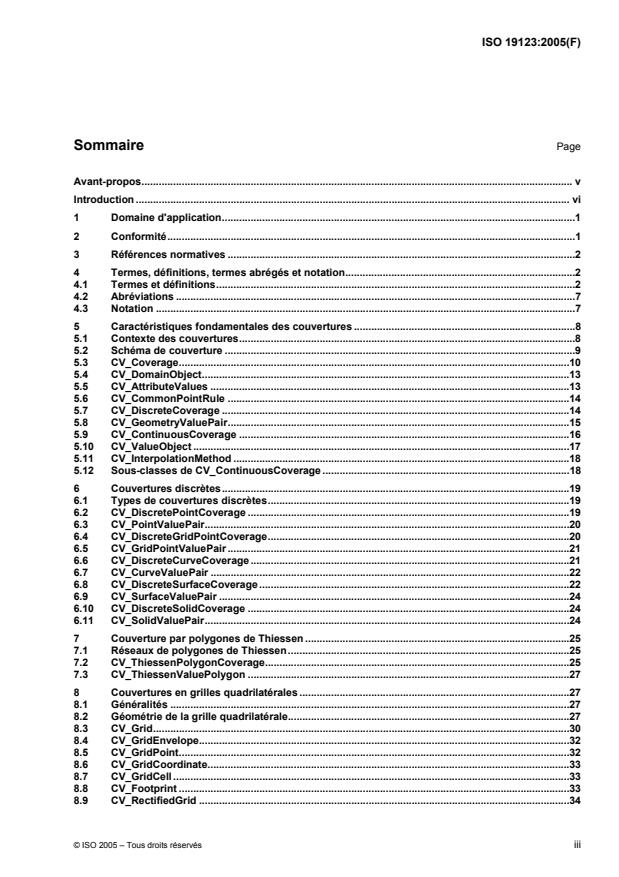
Sommaire Page
Avant-propos. v
Introduction . vi
1 Domaine d'application.1
2 Conformité.1
3 Références normatives .2
4 Termes, définitions, termes abrégés et notation.2
4.1 Termes et définitions.2
4.2 Abréviations .7
4.3 Notation .7
5 Caractéristiques fondamentales des couvertures .8
5.1 Contexte des couvertures.8
5.2 Schéma de couverture .9
5.3 CV_Coverage.10
5.4 CV_DomainObject.13
5.5 CV_AttributeValues .13
5.6 CV_CommonPointRule .14
5.7 CV_DiscreteCoverage .14
5.8 CV_GeometryValuePair.15
5.9 CV_ContinuousCoverage .16
5.10 CV_ValueObject .17
5.11 CV_InterpolationMethod .18
5.12 Sous-classes de CV_ContinuousCoverage .18
6 Couvertures discrètes.19
6.1 Types de couvertures discrètes.19
6.2 CV_DiscretePointCoverage .19
6.3 CV_PointValuePair.20
6.4 CV_DiscreteGridPointCoverage.20
6.5 CV_GridPointValuePair .21
6.6 CV_DiscreteCurveCoverage.21
6.7 CV_CurveValuePair .22
6.8 CV_DiscreteSurfaceCoverage .22
6.9 CV_SurfaceValuePair .24
6.10 CV_DiscreteSolidCoverage .24
6.11 CV_SolidValuePair.24
7 Couverture par polygones de Thiessen .25
7.1 Réseaux de polygones de Thiessen.25
7.2 CV_ThiessenPolygonCoverage.25
7.3 CV_ThiessenValuePolygon .27
8 Couvertures en grilles quadrilatérales .27
8.1 Généralités .27
8.2 Géométrie de la grille quadrilatérale.27
8.3 CV_Grid.30
8.4 CV_GridEnvelope.32
8.5 CV_GridPoint.32
8.6 CV_GridCoordinate.33
8.7 CV_GridCell .33
8.8 CV_Footprint .33
8.9 CV_RectifiedGrid .34
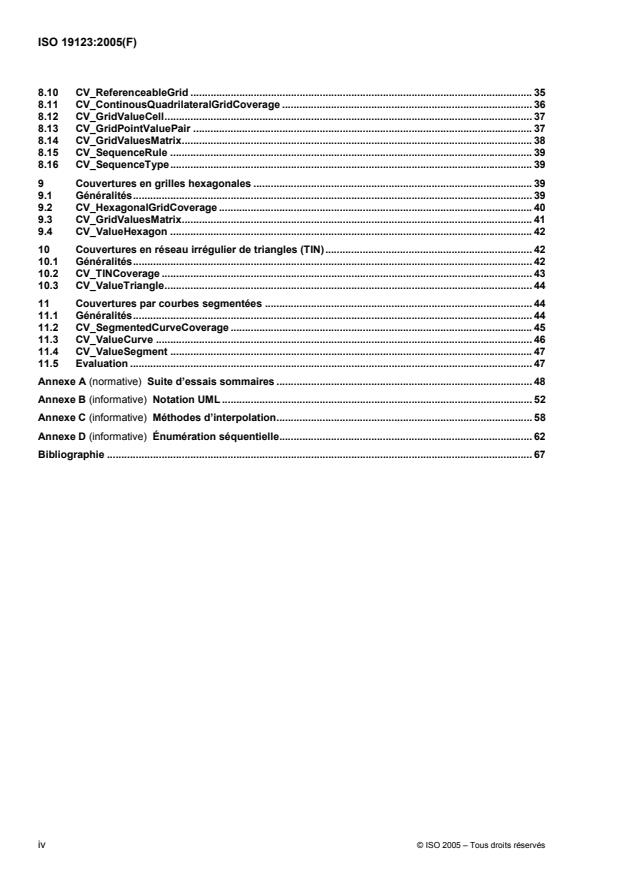
8.10 CV_ReferenceableGrid . 35
8.11 CV_ContinousQuadrilateralGridCoverage . 36
8.12 CV_GridValueCell. 37
8.13 CV_GridPointValuePair . 37
8.14 CV_GridValuesMatrix. 38
8.15 CV_SequenceRule . 39
8.16 CV_SequenceType. 39
9 Couvertures en grilles hexagonales . 39
9.1 Généralités. 39
9.2 CV_HexagonalGridCoverage . 40
9.3 CV_GridValuesMatrix. 41
9.4 CV_ValueHexagon . 42
10 Couvertures en réseau irrégulier de triangles (TIN). 42
10.1 Généralités. 42
10.2 CV_TINCoverage . 43
10.3 CV_ValueTriangle. 44
11 Couvertures par courbes segmentées . 44
11.1 Généralités. 44
11.2 CV_SegmentedCurveCoverage . 45
11.3 CV_ValueCurve . 46
11.4 CV_ValueSegment . 47
11.5 Evaluation . 47
Annexe A (normative) Suite d’essais sommaires . 48
Annexe B (informative) Notation UML . 52
Annexe C (informative) Méthodes d’interpolation. 58
Annexe D (informative) Énumération séquentielle. 62
Bibliographie . 67
iv © ISO 2005 – Tous droits réservés
Avant-propos
L'ISO (Organisation internationale de normalisation) est une fédération mondiale d'organismes nationaux de
normalisation (comités membres de l'ISO). L'élaboration des Normes internationales est en général confiée
aux comités techniques de l'ISO. Chaque comité membre intéressé par une étude a le droit de faire partie du
comité technique créé à cet effet. Les organisations internationales, gouvernementales et non
gouvernementales, en liaison avec l'ISO participent également aux travaux. L'ISO collabore étroitement avec
la Commission électrotechnique internationale (CEI) en ce qui concerne la normalisation électrotechnique.
Les Normes internationales sont rédigées conformément aux règles données dans les Directives ISO/CEI,
Partie 2.
La tâche principale des comités techniques est d'élaborer les Normes internationales. Les projets de Normes
internationales adoptés par les comités techniques sont soumis aux comités membres pour vote. Leur
publication comme Normes internationales requiert l'approbation de 75 % au moins des comités membres
votants.
L'attention est appelée sur le fait que certains des éléments du présent document peuvent faire l'objet de
droits de propriété intellectuelle ou de droits analogues. L'ISO ne saurait être tenue pour responsable de ne
pas avoir identifié de tels droits de propriété et averti de leur existence.
L'ISO 19123 a été élaborée par le comité technique ISO/TC 211, Information géographique/Géomatique.
Introduction
Les phénomènes géographiques peuvent être classés en deux grandes catégories: les phénomènes discrets
et les phénomènes continus. Les phénomènes discrets sont des objets identifiables qui présentent des limites
ou une étendue spatiale relativement bien définies. Les constructions, les cours d’eau et les stations de
mesure sont autant de phénomènes qui illustrent cette notion. Les phénomènes continus, quant à eux, se
produisent dans l'espace et n’ont pas d’étendue spécifique. Des éléments tels que la température, la
composition du sol ou l’altitude sont des exemples de phénomènes continus. Une valeur ou une description
d’un phénomène continu est seulement significative à une position particulière dans l’espace (et
éventuellement dans le temps). Les valeurs de la température, par exemple, varient d’un lieu à un autre,
qu’elles soient mesurées ou interpolées à d’autres endroits.
Ces notions ne s’excluent pas les unes les autres. En fait, de nombreux composants du paysage peuvent être
perçus tant de manière discrète que de manière continue. Ainsi, un cours d'eau se définit comme une entité
discrète, cependant le débit et l’indice de la qualité de l’eau varient d'une position à une autre. De la même
manière, une autoroute peut être considérée comme un élément ou un ensemble d'observations permettant
d’évaluer les accidents ou la densité du trafic, et une surface agricole se caractérise tant par une entité
spatiale que comme une série de mesures des rendements de récolte au fil du temps.
L’information a toujours été traitée en deux types fondamentaux: les données vectorielles et les données
matricielles.
Les «données vectorielles» se concentrent sur des phénomènes discrets, chacun d’entre eux étant considéré
comme une entité. Un ou plusieurs ensembles de primitives géométriques (points, courbes, surfaces ou
solides) représentent les caractéristiques spatiales d’un phénomène discret du monde réel. D'autres
caractéristiques du phénomène sont décrites comme des attributs de l’entité. Souvent, une seule entité est
associée à une seule série de valeurs attributaires. L’ISO 19107 fournit un schéma permettant de décrire les
entités en termes de données primitives géométriques et topologiques.
Les «données matricielles» se concentrent, quant à elles, sur les phénomènes réels qui varient en continu
dans l'espace. Elles comprennent un ensemble de valeurs, chacune associée à l’un des éléments dans un
regroupement régulier de points ou de cellules. Elles sont souvent associées à une méthode d'interpolation
des valeurs en des positions spatiales entre les points ou à l’intérieur des cellules. Étant donné qu’il existe
d’autres structures de données permettant de représenter les phénomènes qui varient en continu dans
l'espace, la présente Norme internationale emploie le terme «couverture», emprunté de la spécification
[1]
sommairee de l’Open GIS Consortium , pour se référer à toute représentation de données qui attribue
directement des valeurs à une position spatiale. Une couverture est une fonction qui assigne des attributs
d’un domaine spatial, temporel ou spatio-temporel à une plage d’attributs. Une couverture associe, dans son
domaine, une position à un enregistrement de valeurs de types de données définis.
Dans la présente Norme internationale, le terme «couverture» est un sous-type du terme «entité». Une
couverture est une entité qui prend des valeurs multiples pour chaque type d’attribut, où chaque position
directe dans la représentation géométrique de l’élément a une seule et même valeur pour chaque type
d’attribut.
De même que les concepts de phénomènes discrets et continus, leur représentation en tant qu’entités ou
couvertures discrètes ne s’exclut pas mutuellement. Le même phénomène peut être représenté comme une
entité ou une couverture discrète. Une ville peut être perçue comme une entité discrète à laquelle une seule
valeur est attribuée pour chaque attribut, par exemple le nom, la superficie et la population totale. L’entité
«ville» peut aussi être représentée comme une couverture qui correspond à la densité de population, à la
valeur du terrain ou bien à l’indice de la qualité de l’air en chaque point de la ville.
En outre, une couverture peut résulter d’un ensemble d’entités discrètes aux attributs communs, les valeurs
de la couverture en fonction de chaque position correspondant aux valeurs attributaires d’une entité située à
cette position. À l’inverse, un ensemble d’entités discrètes peut résulter d’une couverture, chacune des entités
discrètes étant composée d’une série de positions associées à des valeurs attributaires spécifiées.
vi © ISO 2005 – Tous droits réservés
NORME INTERNATIONALE ISO 19123:2005(F)
Information géographique — Schéma de la géométrie
et des fonctions de couverture
1 Domaine d'application
La présente Norme internationale définit un schéma conceptuel des caractéristiques spatiales des
couvertures. Les couvertures servent de base à la cartographie réalisée à partir d’un domaine spatial,
temporel ou spatio-temporel permettant ainsi d’obtenir les valeurs attributaires d’entités dont les types
d’attributs sont communs à toutes les positions géographiques existant dans le domaine. Un domaine de
couverture se compose d’un ensemble de positions directes dans un espace de coordonnées qui peut être
défini comme tridimensionnel ou bien temporel. Parmi les exemples de couverture, citons les matrices, les
réseaux irréguliers de triangles, les couvertures de points et les couvertures de polygones. Les couvertures
sont les structures de données courantes dans divers champs d’application, notamment la télédétection, la
météorologie, la bathymétrie, l’altitude, le sol et la végétation. La présente Norme internationale définit la
relation entre le domaine d’une couverture et une plage d’attributs associée. Les caractéristiques du domaine
spatial sont définies, mais les caractéristiques des attributs ne font pas partie du domaine d’application de la
présente Norme internationale.
2 Conformité
La présente Norme internationale spécifie les interfaces de plusieurs types d’objets de couverture. En outre,
elle prend en charge l’échange de données de couverture indépendamment de ces interfaces. Ainsi, elle
spécifie deux séries de classes de conformité: l’une relative à l’implémentation des interfaces, l’autre
concernant l’échange de données de couverture. Chaque ensemble inclut une classe de conformité pour
chaque type de couverture spécifiée dans la présente Norme internationale (voir Tableau 1).
Tableau 1 — Classes de conformité
Classe de conformité Paragraphe
Interface de couverture simple A.1.1
Interface de couverture discrète A.1.2
Interface de couverture en polygones de Thiessen A.1.3
Interface de couverture en grilles quadrilatérales A.1.4
Interface de couverture en grilles hexagonales A.1.5
Interface de couverture de type TIN A.1.6
Interface de couverture en courbes segmentées A.1.7
Échange de couverture discrète A.2.1
Échange de couverture en polygones de Thiessen A.2.2
Échange de couverture en grilles quadrilatérales A.2.3
Échange de couverture en grilles hexagonales A.2.4
Échange de couverture de type TIN A.2.5
Échange de couverture en courbes segmentées A.2.6
De manière générale, les classes de conformité de l’interface requièrent l’implémentation de tous les attributs,
associations et opérations des classes afférentes. Cet ensemble inclut une seule classe de conformité (A.2.1.)
qui prend en charge une interface simple permettant d’évaluer tout type de couverture; toutefois, elle ne
fournit aucune information sur la structure interne de la couverture. Les éléments restants de l’ensemble
correspondent aux classes de conformité qui prennent en charge des interfaces pour des types de couverture
spécifiques fournissant des informations sur la structure interne de la couverture.
Les classes de conformité relatives à «l’échange» nécessitent uniquement l’implémentation des attributs et
des associations des classes y afférentes.
La suite d’essais sommairee de l’Annexe A décrit les exigences relatives à l'implémentation requises pour
permettre la conformité avec la présente Norme internationale. Le Tableau 1 établit une liste des paragraphes
de la suite d’essais sommaires qui s’appliquent pour chaque classe.
3 Références normatives
Les documents de référence suivants sont indispensables à l'application du présent document. Pour les
références datées, seule l’édition citée s’applique. Pour les références non datées, la dernière édition du
document de référence s’applique (y compris les éventuels amendements).
ISO/TS 19103:2005, Information géographique — Schéma de langage conceptuel
ISO 19107:2003, Information géographique — Schéma spatial
ISO 19108:2002, Information géographique — Schéma temporel
ISO 19109:2005, Information géographique — Règles de schéma d'application
ISO 19111:2003, Information géographique — Système de références spatiales par coordonnées
ISO 19115:2003, Information géographique — Métadonnées
4 Termes, définitions, termes abrégés et notation
4.1 Termes et définitions
Pour les besoins du présent document, les termes et définitions suivants s’appliquent.
4.1.1
couverture continue
couverture qui assigne diverses valeurs au même attribut d’une entité en des positions directes différentes
dans un objet spatial, un objet temporel ou bien un objet spatio-temporel unique, selon le domaine
NOTE Bien que le domaine d’une couverture continue se limite, en règle générale, à son étendue spatiale et/ou
temporelle, il peut être subdivisé en un nombre infini de positions directes.
4.1.2
enveloppe convexe
le plus petit ensemble convexe contenant un objet géométrique donné
[2]
NOTE Adapté du Dictionary of Computing:1996 .
2 © ISO 2005 – Tous droits réservés
4.1.3
ensemble convexe
ensemble géométrique dans lequel toute position directe sur un segment de droite joignant deux
positions directes quelconques de l'ensemble géométrique est également contenue dans cet ensemble
géométrique
[2]
[Dictionary of Computing:1996 ]
4.1.4
coordonnée
une des séquences de n nombres désignant la position d’un point dans un espace à n dimensions
[ISO 19111:2003]
4.1.5
dimension de coordonnées
nombre de mesures ou d’axes nécessaire pour décrire une position dans un système de coordonnées
[ISO 19107:2003]
4.1.6
système de référence par coordonnées
système de coordonnées relié au monde réel par une donnée
[ISO 19111:2003]
4.1.7
couverture
entité qui agit comme une fonction en assignant des valeurs à partir de sa plage à toute position directe
dans son domaine spatial, temporel ou spatio-temporel
EXEMPLE Image matricielle, couverture de polygones, modèle numérique d’altitude.
NOTE En d’autres termes, une couverture est une entité qui prend des valeurs multiples selon le type d’attribut, où, à
chaque position directe dans la représentation géométrique de la caractéristique, chaque attribut correspond une valeur
unique.
4.1.8
géométrie de la couverture
configuration du domaine d’une couverture décrite à partir de coordonnées
4.1.9
courbe
primitive géométrique à une dimension, représentant l’image continue d’une ligne
[ISO 19107:2003]
NOTE La frontière d’une courbe correspond à l’ensemble de points à chaque extrémité de cette courbe.
4.1.10
triangulation de Delaunay
réseau de triangles, tel que le cercle passant par les sommets d’un triangle quelconque, ne circonscrit le
sommet d’aucun autre triangle
4.1.11
position directe
position décrite par un ensemble unique de coordonnées dans un système de référence par coordonnées
[ISO 19107:2003]
4.1.12
couverture discrète
couverture qui assigne les mêmes valeurs d’attribut à chaque position directe à l’intérieur d’un objet
spatial, temporel ou bien spatio-temporel unique dans son domaine
NOTE Le domaine d'une couverture discrète se compose d'un ensemble fini d'objets spatiaux, temporels ou
spatio-temporels.
4.1.13
domaine
ensemble bien défini
[ISO/TS 19103:2005]
NOTE Les domaines permettent de définir le domaine et l’étendue des opérateurs et des fonctions.
4.1.14
évaluation
〈couverture〉 détermination des valeurs d’une couverture en une position directe à l’intérieur du domaine de
la couverture
4.1.15
entité
0 abstraction de phénomènes du monde réel
[ISO 19101:2002]
4.1.16
attribut d’une entité
propriété d’une entité
[ISO 19101:2002]
4.1.17
fonction
règle qui associe chaque élément d’un domaine (source ou domaine de la fonction) à un élément unique d’un
autre domaine (cible, codomaine ou plage)
[ISO 19107:2003]
4.1.18
objet géométrique
objet spatial représentant un ensemble géométrique
[ISO 19107:2003]
4.1.19
primitive géométrique
objet géométrique représentant un élément de l'espace, défini comme unique, connexe et homogène
[ISO 19107:2003]
4.1.20
ensemble géométrique
ensemble de positions directes
[ISO 19107:2003]
4 © ISO 2005 – Tous droits réservés
4.1.21
objet à valeurs géométriques
objet composé d’un ensemble de paires à valeurs géométriques
4.1.22
paire à valeurs géométriques
paire ordonnée composée d’un objet spatial, d’un objet temporel ou d’un objet spatio-temporel ainsi que
d’un enregistrement des valeurs relatives à l’attribut de l’entité
4.1.23
grille
réseau composé de deux ensembles de courbes (ou plus) dans lequel les composants de chaque ensemble
coupent les composants des autres ensembles de manière algorithmique
NOTE Les courbes fractionnent un espace en cellules.
4.1.24
point de la grille
point situé à l’intersection d'au moins deux courbes dans une grille
4.1.25
évaluation inverse
〈couverture〉 sélection d’un ensemble d’objets provenant du domaine d’une couverture fondé sur les valeurs
de l’attribut de l’entité associées aux objets
4.1.26
point
primitive géométrique zéro-dimensionnelle, représentant une position
[ISO 19107:2003]
NOTE La frontière d’un point correspond à un ensemble vide.
4.1.27
couverture de points
couverture dont le domaine se compose de points
4.1.28
couverture de polygones
couverture dont le domaine se compose de polygones
4.1.29
plage
〈couverture〉 ensemble de valeurs attributaires d’une entité associé par une fonction aux éléments du
domaine d’une couverture
4.1.30
matrice
tracé généralement rectangulaire de lignes de balayage parallèles correspondant à un affichage de type tube
cathodique, ou le formant
NOTE Une matrice est un type de grille.
4.1.31
enregistrement
collection nommée et finie d’articles connexes (objets ou valeurs)
[ISO 19107:2003]
NOTE Logiquement, un enregistrement est un ensemble de paires .
4.1.32
grille rectifiée
grille qui se définit par une transformation affine entre les coordonnées de la grille et les coordonnées d’un
système de référence par coordonnées externes
NOTE Si le système de référence par coordonnées est relié à la Terre par un système de référence géodésique, la
grille est dite «géorectifiée».
4.1.33
grille référençable
grille associée à une transformation qui peut être utilisée pour convertir les valeurs de coordonnées d’une
grille en valeurs de coordonnées référencées dans un système externe de référence par coordonnées
NOTE Si le système de référence par coordonnées est relié à la Terre par un système géodésique de référence,
la grille est dite «géoréférencée».
4.1.34
solide
primitive géométrique tridimensionnelle représentant l’image continue d’une région d’espace euclidien
tridimensionnel
[ISO 19107:2003]
NOTE Un solide est réalisable localement comme un ensemble composé de trois paramètres de positions directes.
La frontière d’un solide est un ensemble de surfaces orientées et fermées qui comprennent les limites du solide.
4.1.35
objet spatial
objet permettant de représenter une propriété spatiale de l’entité
[ISO 19107:2003]
4.1.36
domaine spatio-temporel
〈couverture〉 domaine composé d’objets spatio-temporels
NOTE Le domaine spatio-temporel d’une couverture continue se compose d’un ensemble de positions directes
définies en fonction d'une collection d'objets spatio-temporels.
4.1.37
objet spatio-temporel
objet représentant un ensemble de positions directes dans l’espace et le temps
4.1.38
surface
primitive géométrique bidimensionnelle représentant localement l’image continue d’une région sur un plan
[ISO 19107:2003]
NOTE La frontière d’une surface se définit par un ensemble de courbes orientées et fermées qui délimitent
graphiquement la surface.
4.1.39
structure en mosaïque
fractionnement d’un espace en un ensemble de sous-espaces adjacents dont les dimensions sont identiques
à celles de l’espace fractionné
NOTE Une structure en mosaïque composée de polygones ou de polyèdres réguliers isométriques est dite
«périodique». Si elle se compose de polygones (ou polyèdres) réguliers, mais non isométriques, elle est dite «quasi
périodique». Sinon, la structure en mosaïque est apériodique.
EXEMPLES Les Figures 11, 13, 20 et 22 de la présente Norme internationale montrent des exemples graphiques de
structures en mosaïque.
6 © ISO 2005 – Tous droits réservés
4.1.40
polygone de Thiessen
polygone qui contient un point dans un ensemble de points sur un plan, de manière à inclure toutes les
positions directes qui sont plus proches de ce point que de tout autre point de l’ensemble
4.1.41
dimension topologique
nombre minimal de variables libres nécessaires pour distinguer les unes des autres des positions directes
proches à l’intérieur d’un même objet géométrique
[ISO 19107:2003]
4.1.42
réseau irrégulier de triangles
structure en mosaïque composée de triangles
4.1.43
vecteur
grandeur caractérisée par une direction et une amplitude
NOTE Un segment de droite orienté représente un vecteur si la longueur et la direction de ce segment sont égales à
l’amplitude et à la direction du vecteur. Le terme «données vectorielles» se réfère aux données représentant la
configuration spatiale des entités comme ensemble de segments de droite orienté.
4.2 Abréviations
SIG Système d’information géographique
TIN Triangulated Irregular Network (réseau irrégulier de triangles)
UML Unified Modelling Language (langage de modélisation unifié)
4.3 Notation
Le schéma conceptuel, spécifié par la présente Norme internationale, est décrit à l’aide du langage de
[4]
modélisation unifié (UML) , suivant les recommandations de l’ISO/TS 19103. L’Annexe B décrit, quant à elle,
la notation UML, telle qu'elle est utilisée dans la présente Norme internationale.
Plusieurs éléments du modèle utilisés dans ce schéma sont définis dans d’autres Normes internationales
développées par l’ISO/TC 211. Par convention, dans l’ISO/TC 211, les noms des classes UML, à l’exception
des classes relatives aux types de données élémentaires, comportent un préfixe de deux lettres permettant
d’identifier la norme ainsi que le «package UML» dans lequel la classe est définie. Les classes UML définies
par la présente Norme internationale comportent le préfixe de deux lettres «CV». Le Tableau 2 répertorie les
autres normes et «packages» dans lesquels les classes UML utilisées dans la présente Norme internationale
ont été définies.
Tableau 2 — Sources des classes UML définies extérieurement
Norme
Préfixe «Package»
internationale
EX ISO 19115 Plage
GF ISO 19109 Modèle sémantique
GM ISO 19107 Géométrie
SC ISO 19111 Coordonnées spatiales
TM ISO 19108 Schéma temporel
5 Caractéristiques fondamentales des couvertures
5.1 Contexte des couvertures
5.1.1 Généralités
Une couverture est une entité qui associe des positions dans un espace délimité (son domaine) à des valeurs
attributaires d’une entité (sa plage). En d’autres termes, une couverture est à la fois une entité et une fonction
Les exemples incluent l’image matricielle, la superposition de polygones ou bien le modèle numérique
d’altitude.
Une couverture peut représenter une seule entité ou un ensemble d’entités.
5.1.2 Domaine d’une couverture
Un domaine de couverture se compose d’un ensemble d’objets géométriques qui se définit en termes de
positions directes. Il peut être étendu à toutes les positions directes à l’intérieur de l’enveloppe convexe de cet
ensemble d’objets géométriques. Les positions directes sont associées à un système de référence spatial ou
temporel par coordonnées. Les ensembles de points, de grilles, de collections de rectangles fermés et autres
collections d’objets géométriques constituent les domaines les plus couramment utilisés. Le domaine peut
être entièrement subdivisé en objets géométriques et, par là même, former une structure en mosaïque, de
type grille ou TIN. Les ensembles de points et autres ensembles d’objets géométriques non adjacents ne
forment pas de structures en mosaïque. Les sous-types de couverture peuvent être définis selon leurs
domaines.
Les domaines de couverture diffèrent tant par la dimension des coordonnées de l'espace dans lequel ils
s’inscrivent, que par la dimension topologique des objets géométriques qu'ils contiennent. Les objets
géométriques qui constituent un domaine ne peuvent donc pas présenter de dimension topologique
supérieure à celle des coordonnées du domaine. Un domaine 3D de coordonnées peut se composer de
points, de courbes, de surfaces ou bien de solides; un domaine 2D de coordonnées ne peut, quant à lui, se
composer que de points, de courbes ou bien de surfaces. L’ISO 19107:2003 définit un nombre d’objets
géométriques (sous-types de la classe GM_Object UML) destinés à être utilisés pour la description des
entités. Un grand nombre de ces objets géométriques peuvent permettre de définir les domaines pour les
couvertures. De plus, l’ISO 19108:2002 définit les TM_GeometricPrimitives qui peuvent être également
utilisées pour définir les domaines des couvertures.
En règle générale, les objets géométriques qui constituent le domaine d’une couverture sont disjoints;
cependant, la présente Norme internationale permet à un domaine de couverture de comporter des objets
géométriques se chevauchant.
5.1.3 Plage couverte
La plage couverte est un ensemble de valeurs attributaires d’une entité. Elle peut être un ensemble fini ou
transfini. Les couvertures modélisent souvent de nombreuses fonctions associées partageant le même
domaine. Ainsi, l’ensemble de valeurs est représenté comme une collection d’enregistrements présentant un
schéma commun.
EXEMPLE Une couverture pourrait attribuer à chaque position directe dans un pays, la température, la pression,
l’humidité et la vitesse du vent à midi, le jour, considéré en ce point. La couverture établit une correspondance entre
toutes les positions directes du pays et un enregistrement composé de quatre champs distincts.
Une valeur attributaire d’une entité peut provenir de tout type de données. Toutefois, l’évaluation d’une
couverture continue est souvent implémentée au moyen de méthodes d’interpolation dont l’application se
limite à des nombres ou à des vecteurs. D’autres types de données sont presque toujours associés à des
couvertures discrètes.
8 © ISO 2005 – Tous droits réservés
Soit un enregistrement obtenu à partir de la plage couverte, l'évaluation inverse correspond au calcul et à
l'exposition d’un ensemble d’objets géométriques associé à des valeurs spécifiques des attributs. L’évaluation
inverse peut restituer de nombreux objets géométriques associés à une seule valeur attributaire d’une entité.
EXEMPLE L’évaluation inverse est utilisée pour l’extraction de niveaux à partir d’une couverture réalisée en altitude
et pour l’extraction des sites sensibles dans une image.
5.1.4 Couvertures discrètes et continues
Il existe deux types de couvertures. Une couverture discrète comprend un domaine qui se compose d'un
ensemble fini d'objets géométriques et de positions directes contenues dans ces objets géométriques. Une
couverture discrète établit une correspondance entre chaque objet géométrique et un seul enregistrement de
valeurs attributaires d’une entité. L’objet géométrique et son enregistrement afférent forment une paire de
valeurs géométriques. Une couverture discrète représente, par conséquent, une fonction discrète ou une
fonction échelon par opposition à une couverture continue. Les fonctions discrètes peuvent être explicitement
énumérées en tant que paires (entrée, sortie). Une couverture discrète peut être représentée sous forme de
collection de paires ordonnées de variables indépendantes et dépendantes. Chaque variable indépendante
est un objet géométrique et chaque variable dépendante est un enregistrement de valeurs attributaires d’une
entité.
EXEMPLE Une couverture qui établit une correspondance entre un ensemble de polygones et le type de sol de
chacun d'entre eux illustre la notion de couverture discrète.
Une couverture continue comporte un domaine qui se compose d'un ensemble de positions directes dans un
espace de coordonnées. Une couverture continue établit une correspondance entre des positions directes et
des enregistrements de valeurs.
EXEMPLE Soit une couverture qui établit une correspondance entre les positions directes de San Diego en affichant
leurs températures à midi. Le domaine et la page couverts peuvent tolérer un nombre infini de valeurs différentes. Cette
couverture continue serait associée à une couverture discrète qui conserve les valeurs de température observées dans
diverses stations météorologiques.
Une couverture continue ne peut se composer que d'un ensemble de positions directes délimitées dans
l'espace, mais transfinies, ainsi que d'une fonction mathématique qui met en relation la position directe avec
la valeur attributaire d’une entité. Il s’agit d’une «couverture analytique».
EXEMPLE Une surface présentant une tendance statistique qui met en relation une position par rapport au centre
de la ville constitue un bon exemple de couverture continue.
Plus fréquemment, le domaine d’une couverture continue se compose de positions directes dans l'union ou
dans l'enveloppe convexe d'un ensemble fini d'objets géométriques; il est spécifié par cette collection. Dans la
plupart des cas, une couverture continue est également associée à une couverture discrète qui fournit un
ensemble de valeurs de contrôle destiné à être utilisé comme une base permettant l’évaluation de la
couverture continue. L’évaluation de la couverture continue en d’autres positions directes est effectuée par
interpolation entre les paires de valeurs géométriques de l’ensemble de contrôle. Elle dépend souvent
d’objets géométriques supplémentaires construits à partir des objets géométriques existant dans l'ensemble
de contrôle; ces objets supplémentaires sont typiquement de dimension topologique supérieure à celle des
objets de contrôle. Dans la présente Norme internationale, ces objets sont appelés «objets de valeur issus de
la géométrie». Un objet de valeur issu de la géométrie est un objet géométrique dont l’ensemble de paires de
valeur géométriques fournit le contrôle pour la construction de l’objet géométrique et pour l’évaluation de la
couverture à des positions directes à l’intérieur de l’objet géométrique.
EXEMPLE L’évaluation d’une structure triangulaire implique l’interpolation de valeurs dans un triangle composé de
trois paires de valeurs de point voisines.
5.2 Schéma de couverture
Le schéma de couverture est organisé selon sept «packages» comportant des dépendances intra«package»
décrites à la Figure 1. Le «package» Coverage Core fait l’objet de cet article et chaque autre «package» est
décrit dans un article différent, tel que présenté dans le Tableau 3.
Figure 1 — «Packages» et schéma de couverture
Tableau 3 — Documentation des «packages» concernant la géométrie de la couverture
«Package» Article
Coverage core 5
Couvertures discrètes 6
Polygone de Thiessen 7
Grille quadrilatérale 8
Grille hexagonale 9
TIN 10
Courbe segmentée 11
5.3 CV_Coverage
5.3.1 Généralités
La classe CV_Coverage (Figure 2) est une instance de la <> GF_FeatureType (ISO 19109), qui
représente, par conséquent, un type d’entité. CV_Coverage doit prendre en charge trois attributs, cinq
opérations et trois associations.
5.3.2 domainExtent
L’attribut domainExtent[1.*]EX_Extent doit contenir l’étendue du domaine de la couverture. Le type de
données EX_Extent est défini dans l’ISO 19115:2003. Les étendues peuvent être spécifiées dans l’espace,
dans le temps ou dans l'espace-temps.
5.3.3 rangeType
L’attribut rangeType: RecordType doit décrire la plage de la couverture. Le type de données RecordType est
défini dans l’ISO/TS 19103. Il se compose d’une liste de paires de noms d’attribut/type de données. Une
sim
...
2003-01.Slovenski inštitut za standardizacijo. Razmnoževanje celote ali delov tega standarda ni dovoljeno.Geografske informacije – Shema za geometrijo podatkovnega sloja in funkcijeInformation géographique -- Schéma de la géométrie et des fonctions de couvertureGeographic information -- Schema for coverage geometry and functions35.240.70Uporabniške rešitve IT v znanostiIT applications in scienceICS:Ta slovenski standard je istoveten z:ISO 19123:2005oSIST ISO 19123:2006en01-oktober-2006oSIST ISO 19123:2006SLOVENSKI
STANDARD
Reference numberISO 19123:2005(E)© ISO 2005
INTERNATIONAL STANDARD ISO19123First edition2005-08-15Geographic information — Schema for coverage geometry and functions Information géographique — Schéma de la géométrie et des fonctions de couverture
©
ISO 2005 All rights reserved. Unless otherwise specified, no part of this publication may be reproduced or utilized in any form or by any means, electronic or mechanical, including photocopying and microfilm, without permission in writing from either ISO at the address below or ISO's member body in the country of the requester. ISO copyright office Case postale 56 • CH-1211 Geneva 20 Tel.
+ 41 22 749 01 11 Fax
+ 41 22 749 09 47 E-mail
copyright@iso.org Web
www.iso.org Published in Switzerland
ii © ISO 2005 – All rights reserved
Abstract test suite.47 Annex B (informative)
UML Notation.51 Annex C (informative)
Interpolation methods.56 Annex D (informative)
Sequential enumeration.60 Bibliography.65
INTERNATIONAL STANDARD ISO 19123:2005(E) © ISO 2005 – All rights reserved 1Geographic information — Schema for coverage geometry and functions 1 Scope This International Standard defines a conceptual schema for the spatial characteristics of coverages. Coverages support mapping from a spatial, temporal or spatiotemporal domain to feature attribute values where feature attribute types are common to all geographic positions within the domain. A coverage domain consists of a collection of direct positions in a coordinate space that may be defined in terms of up to three spatial dimensions as well as a temporal dimension. Examples of coverages include rasters, triangulated irregular networks, point coverages and polygon coverages. Coverages are the prevailing data structures in a number of application areas, such as remote sensing, meteorology and mapping of bathymetry, elevation, soil and vegetation. This International Standard defines the relationship between the domain of a coverage and an associated attribute range. The characteristics of the spatial domain are defined whereas the characteristics of the attribute range are not part of this standard. 2 Conformance This International Standard specifies interfaces for several types of coverage objects. In addition, it supports the interchange of coverage data independently of those interfaces. Thus, it specifies two sets of conformance classes: one for implementation of the interfaces, the other for the exchange of coverage data. Each set includes one conformance class for each type of coverage specified in this International Standard (Table 1). Table 1 — Conformance classes Conformance class Subclause Simple coverage interface A.1.1 Discrete coverage interface A.1.2 Thiessen polygon coverage interface A.1.3 Quadrilateral grid coverage interface A.1.4 Hexagonal grid coverage interface A.1.5 TIN coverage interface A.1.6 Segmented curve coverage interface A.1.7 Discrete coverage interchange A.2.1 Thiessen polygon coverage interchange A.2.2 Quadrilateral grid coverage interchange A.2.3 Hexagonal grid coverage interchange A.2.4 TIN coverage interchange A.2.5 Segmented curve coverage interchange A.2.6 oSIST ISO 19123:2006
Figure 1 — Packages of the coverage schema Table 3 — Documentation of coverage geometry packages Package Clause Coverage core 5 Discrete coverages 6 Thiessen polygon 7 Quadrilateral grid 8 Hexagonal grid 9 TIN 10 Segmented curve 11 5.3 CV_Coverage 5.3.1 General The class CV_Coverage (Figure 2) is an instance of the <> GF_FeatureType (ISO 19109), which therefore represents a feature type. CV_Coverage shall support three attributes, five operations, and three associations. 5.3.2 domainExtent The attribute domainExtent[1.*]EX_Extent shall contain the extent of the domain of the coverage. The data type EX_Extent is defined in ISO 19115:2003. Extents may be specified in space, time or space-time. 5.3.3 rangeType The attribute rangeType: RecordType shall describe the range of the coverage. The data type RecordType is defined in ISO/TS 19103. It consists of a list of attribute name/data type pairs. A simple list is the most common form of rangeType, but RecordType can be used recursively to describe more complex structures. The rangeType for a specific coverage shall be specified in an application schema. oSIST ISO 19123:2006
Figure 2 — CV_Coverage 5.3.9 evaluateInverse The operation evaluateInverse (v: Record): Set shall accept a Record of feature attribute values as input and return a set of CV_DomainObjects. Normally, this will be the set of CV_DomainObjects in the Domain that are associated with values equal to those in the input Record. However, the operation may return other CV_DomainObjects derived from those in the domain, as specified by the application schema. EXAMPLE The evaluateInverse operation could return a set of contours derived from the feature attribute values associated with the CV_GridPoints of a CV_GridCoverage. 5.3.10 Coordinate Reference System The association Coordinate Reference System shall link the CV_Coverage to the coordinate reference system to which the objects in its domain are referenced. The class SC_CRS is specified in ISO 19111:2003. The multiplicity of the CRS role in the Coordinate Reference System association is one, so a coverage with the same range but with its domain defined in a different coordinate reference system is a different coverage. 5.3.11 Domain The association Domain shall link the CV_Coverage to the set of CV_DomainObjects in the domain. oSIST ISO 19123:2006
...
Questions, Comments and Discussion
Ask us and Technical Secretary will try to provide an answer. You can facilitate discussion about the standard in here.
Loading comments...