

ISO 3669:2020
(Main)Vacuum technology — Dimensions of knife-edge flanges
General Information
- Abstract
This document specifies the dimensions of fixed or rotatable bolted knife-edge flanges used in vacuum systems for pressures ranging from atmospheric to as low as 10−11 Pa.
- Status
- Withdrawn
- Publication Date
- 06-Feb-2020
- Technical Committee
- ISO/TC 112 - Vacuum technology
- Drafting Committee
- ISO/TC 112/WG 3 - Vacuum hardware
- Current Stage
- 9599 - Withdrawal of International Standard
- Start Date
- 24-Jun-2026
- Completion Date
- 29-Aug-2026
Buy Documents

ISO 3669:2020 - Vacuum technology -- Dimensions of knife-edge flanges

ISO 3669:2020 - Vacuum technology — Dimensions of knife-edge flanges/20/2020
Overview
ISO 3669:2020 - Vacuum technology - Dimensions of knife-edge flanges specifies the dimensional requirements for fixed or rotatable bolted knife-edge flanges (often known as ConFlat® or CF-style flanges) used in vacuum systems from atmospheric pressure down to ultra-high vacuum levels (as low as 10−11 Pa). The third edition (2020) consolidates a single series of standard flange dimensions, includes detailed knife-edge sealing profiles, and provides tables and figures for flange and gasket sizes (nominal bores from common CF sizes through larger CF sizes).
Key topics and technical requirements
- Dimensional specifications: Precise outside diameters, bolt circle, bolt-hole positions, flange thickness, knife-edge geometry and seal recess dimensions are defined in figures and tables (see Figures 1–4, Table 1 and Table 2).
- Knife-edge sealing profile: Triangular knife-edge detail for metal-to-metal seals is specified; a correction in this edition updates the vertical distance from the knife-edge to the flange surface to 0.65 ± 0.05 mm.
- Gasket dimensions: Recommended metal gasket outside diameters and tolerances are given (Table 2). The standard notes that gaskets should be softer than the flange to avoid dulling the knife-edge.
- Materials guidance: Material selection should suit service temperature, sealing needs, corrosion resistance and magnetic properties. Austenitic stainless steel and OFHC copper gaskets are commonly used, but the standard does not limit material choice.
- Bolt hole options and threads: Flanges may use clearance or tapped holes; both metric and English (imperial) thread forms commonly in use are addressed.
- Leak check grooves: Recommended geometry and equidistant positioning between bolt holes to facilitate leak checking.
Applications and users
ISO 3669:2020 is essential for:
- Vacuum engineers and system integrators designing UHV and high-vacuum systems
- Manufacturers and machinists producing vacuum flanges and vacuum chambers
- Research labs (physics, accelerator facilities, fusion research), semiconductor fabs, analytical instrument OEMs and maintenance teams Practical benefits include ensuring flange interchangeability, reliable metal seals for bakeable UHV joints, and consistent specifications for procurement and quality control.
Related standards
- ISO 1609 (dimensions of non-knife edge flanges)
- ISO 965-1 (metric screw thread tolerances)
- ISO 286 (tolerances on linear sizes) Consult these referenced documents for complementary thread, tolerance and flange-type requirements.
Keywords: ISO 3669:2020, knife-edge flanges, ConFlat, vacuum technology, UHV flanges, metal gasket, flange dimensions, leak check groove, flange materials.
Relations
- Effective Date
- 02-Sep-2023
- Effective Date
- 23-Apr-2020
Buy Documents
ISO 3669:2020 - Vacuum technology -- Dimensions of knife-edge flanges
ISO 3669:2020 - Vacuum technology — Dimensions of knife-edge flanges/20/2020
Get Certified
Connect with accredited certification bodies for this standard

Institut za varilstvo d.o.o. (Welding Institute)
Slovenia's leading welding institute since 1952. ISO 3834, EN 1090, pressure equipment certification, NDT personnel, welder qualification. Only IIW Au
Sponsored listings
Frequently Asked Questions
ISO 3669:2020 is a standard published by the International Organization for Standardization (ISO). Its full title is "Vacuum technology — Dimensions of knife-edge flanges". This standard covers: This document specifies the dimensions of fixed or rotatable bolted knife-edge flanges used in vacuum systems for pressures ranging from atmospheric to as low as 10−11 Pa.
This document specifies the dimensions of fixed or rotatable bolted knife-edge flanges used in vacuum systems for pressures ranging from atmospheric to as low as 10−11 Pa.
ISO 3669:2020 is classified under the following ICS (International Classification for Standards) categories: 23.160 - Vacuum technology. The ICS classification helps identify the subject area and facilitates finding related standards.
ISO 3669:2020 has the following relationships with other standards: It is inter standard links to ISO 3669:2026, ISO 3669:2017. Understanding these relationships helps ensure you are using the most current and applicable version of the standard.
ISO 3669:2020 is available in PDF format for immediate download after purchase. The document can be added to your cart and obtained through the secure checkout process. Digital delivery ensures instant access to the complete standard document.
Standards Content (Sample)
INTERNATIONAL ISO
STANDARD 3669
Third edition
2020-02
Corrected version
2020-05
Vacuum technology — Dimensions of
knife-edge flanges
Technique du vide — Dimensions des brides à guillotine
Reference number
©
ISO 2020
© ISO 2020
All rights reserved. Unless otherwise specified, or required in the context of its implementation, no part of this publication may
be reproduced or utilized otherwise in any form or by any means, electronic or mechanical, including photocopying, or posting
on the internet or an intranet, without prior written permission. Permission can be requested from either ISO at the address
below or ISO’s member body in the country of the requester.
ISO copyright office
CP 401 • Ch. de Blandonnet 8
CH-1214 Vernier, Geneva
Phone: +41 22 749 01 11
Fax: +41 22 749 09 47
Email: copyright@iso.org
Website: www.iso.org
Published in Switzerland
ii © ISO 2020 – All rights reserved
Contents Page
Foreword .iv
Introduction .v
1 Scope . 1
2 Normative references . 1
3 Terms and definitions . 1
4 Symbols and abbreviated terms . 1
5 Requirements . 2
5.1 Materials . 2
5.1.1 Flange . 2
5.1.2 Bolt holes . 2
5.1.3 Grooves . . 2
5.1.4 Gasket . 2
5.2 Dimensions . 2
Bibliography . 7
Foreword
ISO (the International Organization for Standardization) is a worldwide federation of national standards
bodies (ISO member bodies). The work of preparing International Standards is normally carried out
through ISO technical committees. Each member body interested in a subject for which a technical
committee has been established has the right to be represented on that committee. International
organizations, governmental and non-governmental, in liaison with ISO, also take part in the work.
ISO collaborates closely with the International Electrotechnical Commission (IEC) on all matters of
electrotechnical standardization.
The procedures used to develop this document and those intended for its further maintenance are
described in the ISO/IEC Directives, Part 1. In particular, the different approval criteria needed for the
different types of ISO documents should be noted. This document was drafted in accordance with the
editorial rules of the ISO/IEC Directives, Part 2 (see www .iso .org/ directives).
Attention is drawn to the possibility that some of the elements of this document may be the subject of
patent rights. ISO shall not be held responsible for identifying any or all such patent rights. Details of
any patent rights identified during the development of the document will be in the Introduction and/or
on the ISO list of patent declarations received (see www .iso .org/ patents).
Any trade name used in this document is information given for the convenience of users and does not
constitute an endorsement.
For an explanation of the voluntary nature of standards, the meaning of ISO specific terms and
expressions related to conformity assessment, as well as information about ISO's adherence to the
World Trade Organization (WTO) principles in the Technical Barriers to Trade (TBT), see www .iso .org/
iso/ foreword .html.
This document was prepared by Technical Committee ISO/TC 112, Vacuum technology.
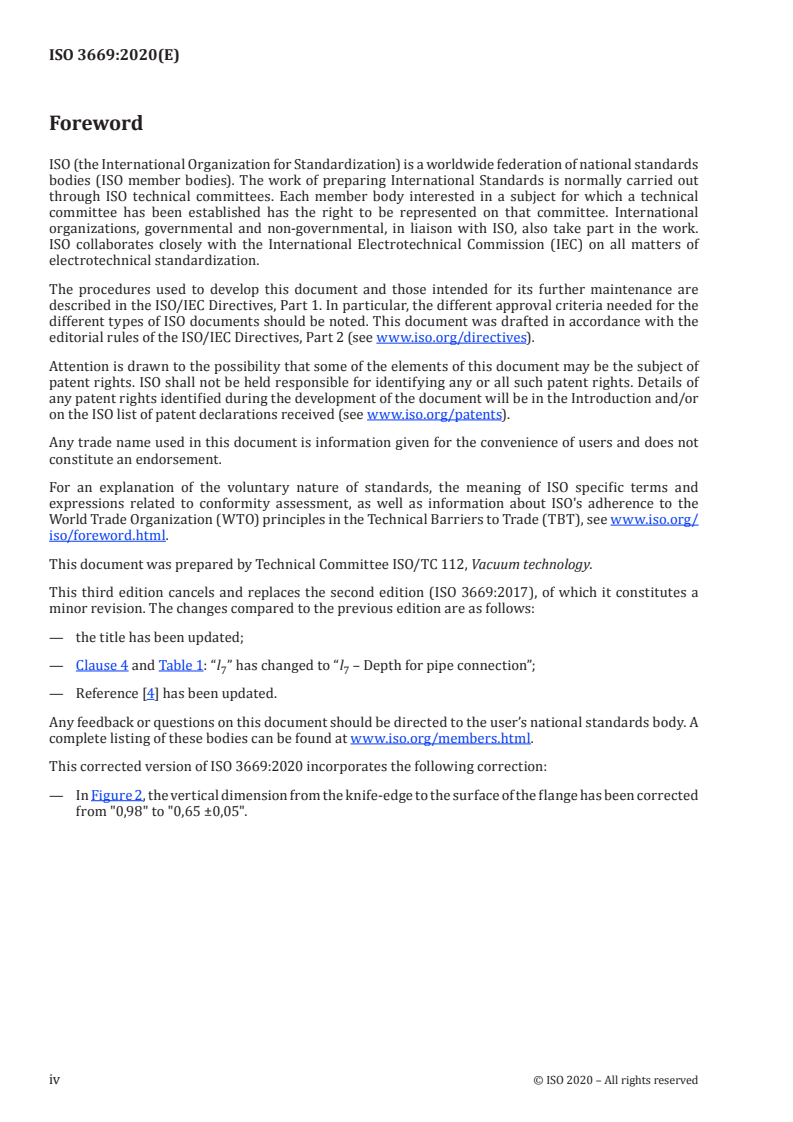
This third edition cancels and replaces the second edition (ISO 3669:2017), of which it constitutes a
minor revision. The changes compared to the previous edition are as follows:
— the title has been updated;
— Clause 4 and Table 1: “l ” has changed to “l – Depth for pipe connection”;
7 7
— Reference [4] has been updated.
Any feedback or questions on this document should be directed to the user’s national standards body. A
complete listing of these bodies can be found at www .iso .org/ members .html.
This corrected version of ISO 3669:2020 incorporates the following correction:
— In Figure 2, the vertical dimension from the knife-edge to the surface of the flange has been corrected
from "0,98" to "0,65 ±0,05".
iv © ISO 2020 – All rights reserved
Introduction
This document is a minor revision of the second edition (ISO 3669:2017) and contains significant
technical changes from the first edition (ISO 3669:1986), which defined two series of “bakeable”
flanges:
— as a preferred series, the main dimensions of which ensure compatibility with already standardized
non-bakeable flanges (see ISO 1609);
— a secondary series corresponding to flanges in common use.
This document specifies only one series and is no longer dependent on the preferred number. Effectively,
the preferred series has been made obsolete, thereby promoting the secondary series to be the one and
only set of specified dimensions. Furthermore, several dimensions in what was formerly the secondary
series, have been modified to correspond to flanges in common use. Finally, detailed dimensions for the
knife-edge sealing profile have been incorporated.
1)
It is noted, however, that the original ConFlat® flange dimensions and tolerances, as developed by
Varian, were not available during the development stage of this specification. The intent of this document
is to ensure interchangeability of flanges. It is reasonable to accept that flanges manufactured to the
original Varian specifications are compatible with flanges manufactured according to this document,
even though they might not fall within all tolerances.
1) ConFlat® is the trademark of a product supplied by Varian, Inc. This information is given for the convenience of
users of this document and does not constitute an endorsement by ISO of the product named. Equivalent products
may be used if they can be shown to lead to the same results.
INTERNATIONAL STANDARD ISO 3669:2020(E)
Vacuum technology — Dimensions of knife-edge flanges
1 Scope
This document specifies the dimensions of fixed or rotatable bolted knife-edge flanges used in vacuum
−11
systems for pressures ranging from atmospheric to as low as 10 Pa.
2 Normative references
There are no normative references in this document.
3 Terms and definitions
For the purposes of this document, the following terms and definitions apply.
ISO and IEC mainta
...
INTERNATIONAL ISO
STANDARD 3669
Third edition
2020-02
Corrected version
2020-05
Vacuum technology — Dimensions of
knife-edge flanges
Technique du vide — Dimensions des brides à guillotine
Reference number
©
ISO 2020
© ISO 2020
All rights reserved. Unless otherwise specified, or required in the context of its implementation, no part of this publication may
be reproduced or utilized otherwise in any form or by any means, electronic or mechanical, including photocopying, or posting
on the internet or an intranet, without prior written permission. Permission can be requested from either ISO at the address
below or ISO’s member body in the country of the requester.
ISO copyright office
CP 401 • Ch. de Blandonnet 8
CH-1214 Vernier, Geneva
Phone: +41 22 749 01 11
Fax: +41 22 749 09 47
Email: copyright@iso.org
Website: www.iso.org
Published in Switzerland
ii © ISO 2020 – All rights reserved
Contents Page
Foreword .iv
Introduction .v
1 Scope . 1
2 Normative references . 1
3 Terms and definitions . 1
4 Symbols and abbreviated terms . 1
5 Requirements . 2
5.1 Materials . 2
5.1.1 Flange . 2
5.1.2 Bolt holes . 2
5.1.3 Grooves . . 2
5.1.4 Gasket . 2
5.2 Dimensions . 2
Bibliography . 7
Foreword
ISO (the International Organization for Standardization) is a worldwide federation of national standards
bodies (ISO member bodies). The work of preparing International Standards is normally carried out
through ISO technical committees. Each member body interested in a subject for which a technical
committee has been established has the right to be represented on that committee. International
organizations, governmental and non-governmental, in liaison with ISO, also take part in the work.
ISO collaborates closely with the International Electrotechnical Commission (IEC) on all matters of
electrotechnical standardization.
The procedures used to develop this document and those intended for its further maintenance are
described in the ISO/IEC Directives, Part 1. In particular, the different approval criteria needed for the
different types of ISO documents should be noted. This document was drafted in accordance with the
editorial rules of the ISO/IEC Directives, Part 2 (see www .iso .org/ directives).
Attention is drawn to the possibility that some of the elements of this document may be the subject of
patent rights. ISO shall not be held responsible for identifying any or all such patent rights. Details of
any patent rights identified during the development of the document will be in the Introduction and/or
on the ISO list of patent declarations received (see www .iso .org/ patents).
Any trade name used in this document is information given for the convenience of users and does not
constitute an endorsement.
For an explanation of the voluntary nature of standards, the meaning of ISO specific terms and
expressions related to conformity assessment, as well as information about ISO's adherence to the
World Trade Organization (WTO) principles in the Technical Barriers to Trade (TBT), see www .iso .org/
iso/ foreword .html.
This document was prepared by Technical Committee ISO/TC 112, Vacuum technology.
This third edition cancels and replaces the second edition (ISO 3669:2017), of which it constitutes a
minor revision. The changes compared to the previous edition are as follows:
— the title has been updated;
— Clause 4 and Table 1: “l ” has changed to “l – Depth for pipe connection”;
7 7
— Reference [4] has been updated.
Any feedback or questions on this document should be directed to the user’s national standards body. A
complete listing of these bodies can be found at www .iso .org/ members .html.
This corrected version of ISO 3669:2020 incorporates the following correction:
— In Figure 2, the vertical dimension from the knife-edge to the surface of the flange has been corrected
from "0,98" to "0,65 ±0,05".
iv © ISO 2020 – All rights reserved
Introduction
This document is a minor revision of the second edition (ISO 3669:2017) and contains significant
technical changes from the first edition (ISO 3669:1986), which defined two series of “bakeable”
flanges:
— as a preferred series, the main dimensions of which ensure compatibility with already standardized
non-bakeable flanges (see ISO 1609);
— a secondary series corresponding to flanges in common use.
This document specifies only one series and is no longer dependent on the preferred number. Effectively,
the preferred series has been made obsolete, thereby promoting the secondary series to be the one and
only set of specified dimensions. Furthermore, several dimensions in what was formerly the secondary
series, have been modified to correspond to flanges in common use. Finally, detailed dimensions for the
knife-edge sealing profile have been incorporated.
1)
It is noted, however, that the original ConFlat® flange dimensions and tolerances, as developed by
Varian, were not available during the development stage of this specification. The intent of this document
is to ensure interchangeability of flanges. It is reasonable to accept that flanges manufactured to the
original Varian specifications are compatible with flanges manufactured according to this document,
even though they might not fall within all tolerances.
1) ConFlat® is the trademark of a product supplied by Varian, Inc. This information is given for the convenience of
users of this document and does not constitute an endorsement by ISO of the product named. Equivalent products
may be used if they can be shown to lead to the same results.
INTERNATIONAL STANDARD ISO 3669:2020(E)
Vacuum technology — Dimensions of knife-edge flanges
1 Scope
This document specifies the dimensions of fixed or rotatable bolted knife-edge flanges used in vacuum
−11
systems for pressures ranging from atmospheric to as low as 10 Pa.
2 Normative references
There are no normative references in this document.
3 Terms and definitions
For the purposes of this document, the following terms and definitions apply.
ISO and IEC mainta
...