

ISO 9803-2:2020
(Main)Vacuum technology — Mounting dimensions of pipeline fittings — Part 2: Knife-edge flange type
General Information
- Abstract
This document specifies mounting dimensions for vacuum pipeline fittings (elbows, tees and crosses) of knife-edge flanges for nominal bores from 16 mm to 200 mm.
- Status
- Published
- Publication Date
- 08-Jan-2020
- Technical Committee
- ISO/TC 112 - Vacuum technology
- Drafting Committee
- ISO/TC 112/WG 3 - Vacuum hardware
- Current Stage
- 9093 - International Standard confirmed
- Start Date
- 10-Jun-2025
- Completion Date
- 29-Aug-2026
Buy Documents


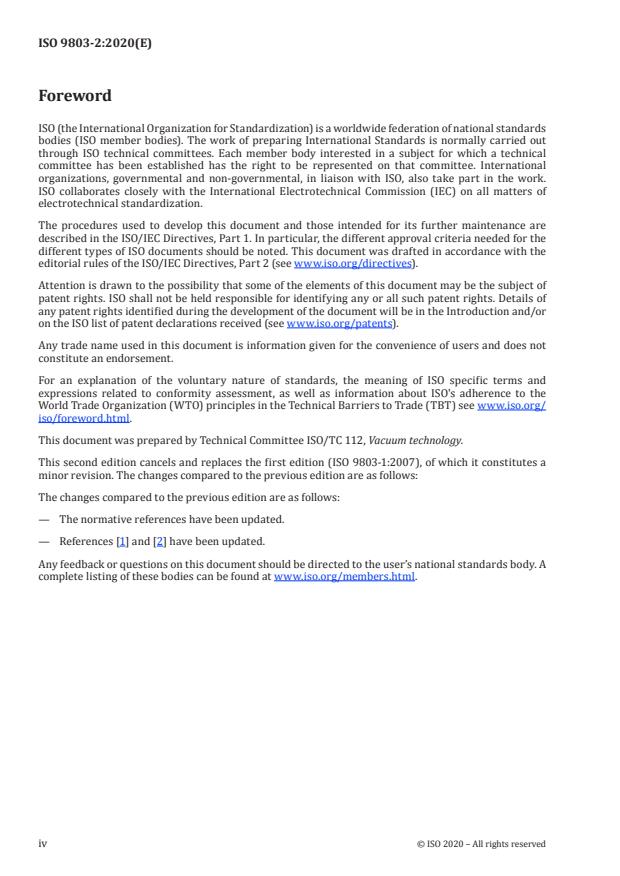
ISO 9803-2:2020 - Vacuum technology -- Mounting dimensions of pipeline fittings


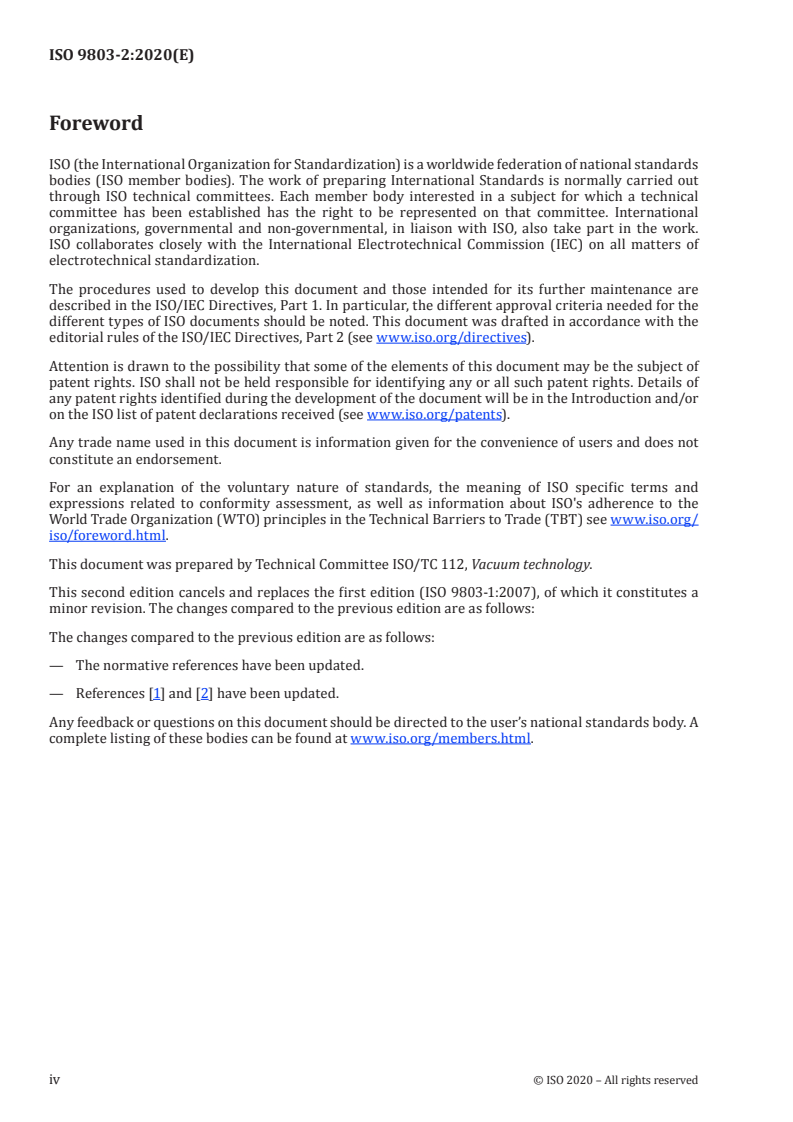
ISO 9803-2:2020 - Vacuum technology — Mounting dimensions of pipeline fittings — Part 2: Knife-edge flange type/9/2020
Overview
ISO 9803-2:2020 is an international standard developed by the International Organization for Standardization (ISO) that defines the mounting dimensions of vacuum pipeline fittings with knife-edge flange types. This standard is essential for ensuring compatibility and interchangeability of vacuum technology components, specifically for elbows, tees, and crosses with nominal bores ranging from 16 mm to 200 mm. It replaces the first edition ISO 9803-1:2007 and focuses exclusively on fittings with knife-edge flanges as specified in ISO 3669.
This standard plays a critical role in vacuum technology by providing precise dimensional guidelines that facilitate the reliable assembly and sealing of vacuum systems, minimizing leakage and enhancing system integrity.
Key Topics
Scope and Applicability
ISO 9803-2:2020 applies to vacuum pipeline fittings that use knife-edge flanges in nominal bore sizes between 16 mm and 200 mm. The document specifies the mounting dimensions necessary to ensure correct fitment and performance.Knife-Edge Flange Specifications
The knife-edge flange details align with ISO 3669, ensuring consistency with existing vacuum flange dimensions. It covers flange dimensions, bolt hole positioning, and rotatability to accommodate system design flexibility.Pipeline Fittings Covered
The standard defines dimensional requirements for common vacuum pipeline fittings:- Elbows
- Tees
- Crosses
Mounting Dimensions & Tolerances
Key dimension parameters include the edge dimension (e) and the length (H) of fittings, with clearly defined tolerances for perpendicularity and parallelism of mating faces. Bolt hole positioning uses a specific angular layout based on the number of holes, enhancing mechanical stability in vacuum pipelines.
Applications
ISO 9803-2:2020 is vital for industries and sectors relying on vacuum technology and precision assembly of vacuum pipelines, including:
Semiconductor Manufacturing
Where high vacuum conditions and contamination-free environments require highly reliable vacuum fittings.Pharmaceutical and Biotechnology
Processes dependent on sterile vacuum systems benefit from standardized fitting dimensions ensuring system integrity.Research and Development Laboratories
Scientific research setups involving vacuum apparatus utilize these dimensions to maintain compatibility among various equipment brands.Industrial Vacuum Systems
Manufacturing lines using vacuum conveyors, chambers, and other systems rely on consistent pipeline fittings to optimize performance and maintenance.
Implementing ISO 9803-2 ensures reduced downtime, improved system reliability, and easier maintenance by facilitating component interchangeability and alignment.
Related Standards
ISO 3669 – Vacuum technology: Dimensions of knife-edge flanges, providing detailed flange geometry requirements referenced in ISO 9803-2:2020.
ISO 9803-1 – Vacuum technology: Mounting dimensions of pipeline fittings – Part 1, covering non knife-edge flange types complementary to this standard.
ISO 1609 – Vacuum technology: Dimensions of non-knife edge flanges, detailing alternative flange designs for vacuum pipelines.
ISO 2861 – Vacuum technology: Dimensions of clamped-type quick release couplings, relevant for vacuum system assembly components.
Why ISO 9803-2:2020 Matters
Adherence to ISO 9803-2 ensures that vacuum pipeline fittings with knife-edge flanges meet globally recognized specifications, providing:
- Enhanced system compatibility and safety
- Improved sealing and reduced leakage
- Streamlined manufacturing and assembly processes
- Global harmonization of vacuum technology components
For engineers, technicians, and manufacturers, this standard is a fundamental reference for designing, installing, and maintaining vacuum pipelines with knife-edge flange types, supporting innovation and quality in vacuum technology solutions.
Keywords: ISO 9803-2, vacuum technology standards, knife-edge flange, vacuum pipeline fittings, mounting dimensions, vacuum elbows, vacuum tees, vacuum crosses, ISO vacuum flange, vacuum system components, vacuum sealing, vacuum pipeline assembly.
Relations
- Consolidated By
ISO 19011:2026 - Guidelines for auditing management systems - Effective Date
- 17-Feb-2024
- Effective Date
- 23-Apr-2020
Buy Documents
ISO 9803-2:2020 - Vacuum technology -- Mounting dimensions of pipeline fittings
ISO 9803-2:2020 - Vacuum technology — Mounting dimensions of pipeline fittings — Part 2: Knife-edge flange type/9/2020
Get Certified
Connect with accredited certification bodies for this standard

Institut za varilstvo d.o.o. (Welding Institute)
Slovenia's leading welding institute since 1952. ISO 3834, EN 1090, pressure equipment certification, NDT personnel, welder qualification. Only IIW Au
Sponsored listings
Frequently Asked Questions
ISO 9803-2:2020 is a standard published by the International Organization for Standardization (ISO). Its full title is "Vacuum technology — Mounting dimensions of pipeline fittings — Part 2: Knife-edge flange type". This standard covers: This document specifies mounting dimensions for vacuum pipeline fittings (elbows, tees and crosses) of knife-edge flanges for nominal bores from 16 mm to 200 mm.
This document specifies mounting dimensions for vacuum pipeline fittings (elbows, tees and crosses) of knife-edge flanges for nominal bores from 16 mm to 200 mm.
ISO 9803-2:2020 is classified under the following ICS (International Classification for Standards) categories: 23.160 - Vacuum technology. The ICS classification helps identify the subject area and facilitates finding related standards.
ISO 9803-2:2020 has the following relationships with other standards: It is inter standard links to ISO 19011:2026, ISO 9803-2:2007. Understanding these relationships helps ensure you are using the most current and applicable version of the standard.
ISO 9803-2:2020 is available in PDF format for immediate download after purchase. The document can be added to your cart and obtained through the secure checkout process. Digital delivery ensures instant access to the complete standard document.
Standards Content (Sample)
INTERNATIONAL ISO
STANDARD 9803-2
Second edition
2020-01
Vacuum technology — Mounting
dimensions of pipeline fittings —
Part 2:
Knife-edge flange type
Technique du vide — Dimensions de montage des raccords de
conduit —
Partie 2: Brides de type à guillotine
Reference number
©
ISO 2020
© ISO 2020
All rights reserved. Unless otherwise specified, or required in the context of its implementation, no part of this publication may
be reproduced or utilized otherwise in any form or by any means, electronic or mechanical, including photocopying, or posting
on the internet or an intranet, without prior written permission. Permission can be requested from either ISO at the address
below or ISO’s member body in the country of the requester.
ISO copyright office
CP 401 • Ch. de Blandonnet 8
CH-1214 Vernier, Geneva
Phone: +41 22 749 01 11
Fax: +41 22 749 09 47
Email: copyright@iso.org
Website: www.iso.org
Published in Switzerland
ii © ISO 2020 – All rights reserved
Contents Page
Foreword .iv
Introduction .v
1 Scope . 1
2 Normative references . 1
3 Terms and definitions . 1
4 Requirements . 1
Bibliography . 4
Foreword
ISO (the International Organization for Standardization) is a worldwide federation of national standards
bodies (ISO member bodies). The work of preparing International Standards is normally carried out
through ISO technical committees. Each member body interested in a subject for which a technical
committee has been established has the right to be represented on that committee. International
organizations, governmental and non-governmental, in liaison with ISO, also take part in the work.
ISO collaborates closely with the International Electrotechnical Commission (IEC) on all matters of
electrotechnical standardization.
The procedures used to develop this document and those intended for its further maintenance are
described in the ISO/IEC Directives, Part 1. In particular, the different approval criteria needed for the
different types of ISO documents should be noted. This document was drafted in accordance with the
editorial rules of the ISO/IEC Directives, Part 2 (see www .iso .org/ directives).
Attention is drawn to the possibility that some of the elements of this document may be the subject of
patent rights. ISO shall not be held responsible for identifying any or all such patent rights. Details of
any patent rights identified during the development of the document will be in the Introduction and/or
on the ISO list of patent declarations received (see www .iso .org/ patents).
Any trade name used in this document is information given for the convenience o
...
INTERNATIONAL ISO
STANDARD 9803-2
Second edition
2020-01
Vacuum technology — Mounting
dimensions of pipeline fittings —
Part 2:
Knife-edge flange type
Technique du vide — Dimensions de montage des raccords de
conduit —
Partie 2: Brides de type à guillotine
Reference number
©
ISO 2020
© ISO 2020
All rights reserved. Unless otherwise specified, or required in the context of its implementation, no part of this publication may
be reproduced or utilized otherwise in any form or by any means, electronic or mechanical, including photocopying, or posting
on the internet or an intranet, without prior written permission. Permission can be requested from either ISO at the address
below or ISO’s member body in the country of the requester.
ISO copyright office
CP 401 • Ch. de Blandonnet 8
CH-1214 Vernier, Geneva
Phone: +41 22 749 01 11
Fax: +41 22 749 09 47
Email: copyright@iso.org
Website: www.iso.org
Published in Switzerland
ii © ISO 2020 – All rights reserved
Contents Page
Foreword .iv
Introduction .v
1 Scope . 1
2 Normative references . 1
3 Terms and definitions . 1
4 Requirements . 1
Bibliography . 4
Foreword
ISO (the International Organization for Standardization) is a worldwide federation of national standards
bodies (ISO member bodies). The work of preparing International Standards is normally carried out
through ISO technical committees. Each member body interested in a subject for which a technical
committee has been established has the right to be represented on that committee. International
organizations, governmental and non-governmental, in liaison with ISO, also take part in the work.
ISO collaborates closely with the International Electrotechnical Commission (IEC) on all matters of
electrotechnical standardization.
The procedures used to develop this document and those intended for its further maintenance are
described in the ISO/IEC Directives, Part 1. In particular, the different approval criteria needed for the
different types of ISO documents should be noted. This document was drafted in accordance with the
editorial rules of the ISO/IEC Directives, Part 2 (see www .iso .org/ directives).
Attention is drawn to the possibility that some of the elements of this document may be the subject of
patent rights. ISO shall not be held responsible for identifying any or all such patent rights. Details of
any patent rights identified during the development of the document will be in the Introduction and/or
on the ISO list of patent declarations received (see www .iso .org/ patents).
Any trade name used in this document is information given for the convenience o
...