

ISO/IEC 18000-3:2010
(Main)Information technology — Radio frequency identification for item management — Part 3: Parameters for air interface communications at 13,56 MHz
General Information
- Abstract
ISO/IEC 18000 has been developed in order to: provide a framework to define common communications protocols for Internationally useable frequencies for radio frequency identification (RFID), and, where possible, to determine the use of the same protocols for all frequencies such that the problems of migrating from one to another are diminished; minimize software and implementation costs; enable system management and control and information exchange to be common as far as is possible. ISO/IEC 18000-1 provides explanation of the concepts behind ISO/IEC 18000-3:2010. ISO/IEC 18000-3:2010 has 3 MODES of operation, intended to address different applications. The detailed technical differences between the modes are shown in parameter tables. ISO/IEC 18000-3:2010 provides physical layer, collision management system and protocol values for RFID systems for item identification operating at 13,56 MHz in accordance with the requirements of ISO/IEC 18000-1. It provides definitions for systems for each MODE determined in ISO/IEC 18000-3:2010. It defines three non-interfering MODES. The MODES are not interoperable. The MODES, whilst not interoperable, are non-interfering.
- Status
- Published
- Publication Date
- 03-Nov-2010
- Technical Committee
- ISO/IEC JTC 1/SC 31 - Automatic identification and data capture techniques
- Drafting Committee
- ISO/IEC JTC 1/SC 31/WG 4 - Radio communications
- Current Stage
- 9093 - International Standard confirmed
- Start Date
- 15-Dec-2022
- Completion Date
- 29-Aug-2026
Overview
ISO/IEC 18000-3:2010 specifies air interface parameters for RFID systems operating at 13.56 MHz used in item management. Part of the ISO/IEC 18000 family, this standard defines the physical layer, collision management, and protocol values for interrogator-to-tag and tag-to-interrogator communications. It supports global interoperability goals by providing a common framework for implementation, command structure, and conformance testing while minimizing migration effort between frequencies where possible.
Key Topics and Requirements
- Frequency and scope: Parameters for RFID item identification at 13.56 MHz.
- Three MODES of operation: MODE 1, MODE 2 and MODE 3 are defined. They are non-interoperable but non‑interfering, with detailed parameter tables for each mode.
- Physical layer: Waveform, modulation, and link characteristics for both directions (interrogator→tag and tag→interrogator).
- Collision management and MAC: Methods and parameters to manage multiple tags (slot counters, Q selection, anti‑collision algorithms).
- Protocol and command structure: Mandatory, optional, custom and proprietary commands; mechanisms for inventory, access (read/write), lock, kill and other tag operations.
- Conformance and compliance: Requirements and measurement aspects for interoperable interrogators (readers) and tags.
- Error detection and integrity: CRC methods and examples (CRC‑16, CRC‑32) included in informative/normative annexes.
- Annex material: Extensive annexes covering state transitions, command responses, error codes, modulation methods (e.g., Phase Jitter Modulation), example exchanges, and known inter‑mode interference considerations.
Practical Applications and Users
ISO/IEC 18000-3:2010 is essential for organizations involved in:
- RFID reader/interrogator manufacturers - implement compliant physical and protocol layers.
- RFID tag and IC designers - ensure tag behavior, memory banks and commands meet mode specifications.
- System integrators and solution providers - design inventory, access control, supply‑chain and asset‑tracking systems that use 13.56 MHz tags.
- Retail, library, healthcare, logistics and asset management - deploy reliable item-level identification where short-range 13.56 MHz RFID is appropriate.
- Test laboratories and certification bodies - validate conformance and interoperability according to the standard.
Adoption improves interoperability, reduces implementation costs, and standardizes collision handling and command behavior across devices.
Related Standards
- ISO/IEC 18000-1 - conceptual framework and presentation for the 18000 series (referenced by Part 3).
- ISO/IEC 18000 (series) - other parts define parameters for alternative RFID frequencies and use cases.
- ISO/IEC 15962 - referenced for data protocol support in annexes.
Keywords: ISO/IEC 18000-3, RFID standard, 13.56 MHz, air interface, collision management, RFID tags, RFID readers, physical layer, RFID protocol, item management.
Relations
- Effective Date
- 17-Jun-2026
- Effective Date
- 09-Feb-2026
- Effective Date
- 09-Feb-2026
- Effective Date
- 18-Dec-2008
Get Certified
Connect with accredited certification bodies for this standard

BSI Group
BSI (British Standards Institution) is the business standards company that helps organizations make excellence a habit.

NYCE
Mexican standards and certification body.
Sponsored listings
Frequently Asked Questions
ISO/IEC 18000-3:2010 is a standard published by the International Organization for Standardization (ISO). Its full title is "Information technology — Radio frequency identification for item management — Part 3: Parameters for air interface communications at 13,56 MHz". This standard covers: ISO/IEC 18000 has been developed in order to: provide a framework to define common communications protocols for Internationally useable frequencies for radio frequency identification (RFID), and, where possible, to determine the use of the same protocols for all frequencies such that the problems of migrating from one to another are diminished; minimize software and implementation costs; enable system management and control and information exchange to be common as far as is possible. ISO/IEC 18000-1 provides explanation of the concepts behind ISO/IEC 18000-3:2010. ISO/IEC 18000-3:2010 has 3 MODES of operation, intended to address different applications. The detailed technical differences between the modes are shown in parameter tables. ISO/IEC 18000-3:2010 provides physical layer, collision management system and protocol values for RFID systems for item identification operating at 13,56 MHz in accordance with the requirements of ISO/IEC 18000-1. It provides definitions for systems for each MODE determined in ISO/IEC 18000-3:2010. It defines three non-interfering MODES. The MODES are not interoperable. The MODES, whilst not interoperable, are non-interfering.
ISO/IEC 18000 has been developed in order to: provide a framework to define common communications protocols for Internationally useable frequencies for radio frequency identification (RFID), and, where possible, to determine the use of the same protocols for all frequencies such that the problems of migrating from one to another are diminished; minimize software and implementation costs; enable system management and control and information exchange to be common as far as is possible. ISO/IEC 18000-1 provides explanation of the concepts behind ISO/IEC 18000-3:2010. ISO/IEC 18000-3:2010 has 3 MODES of operation, intended to address different applications. The detailed technical differences between the modes are shown in parameter tables. ISO/IEC 18000-3:2010 provides physical layer, collision management system and protocol values for RFID systems for item identification operating at 13,56 MHz in accordance with the requirements of ISO/IEC 18000-1. It provides definitions for systems for each MODE determined in ISO/IEC 18000-3:2010. It defines three non-interfering MODES. The MODES are not interoperable. The MODES, whilst not interoperable, are non-interfering.
ISO/IEC 18000-3:2010 is classified under the following ICS (International Classification for Standards) categories: 35.040 - Information coding; 35.040.50 - Automatic identification and data capture techniques. The ICS classification helps identify the subject area and facilitates finding related standards.
ISO/IEC 18000-3:2010 has the following relationships with other standards: It is inter standard links to EN 18220:2026, CEN/TS 17402:2020, EN 17071:2019, ISO/IEC 18000-3:2008. Understanding these relationships helps ensure you are using the most current and applicable version of the standard.
ISO/IEC 18000-3:2010 is available in PDF format for immediate download after purchase. The document can be added to your cart and obtained through the secure checkout process. Digital delivery ensures instant access to the complete standard document.
Standards Content (Sample)
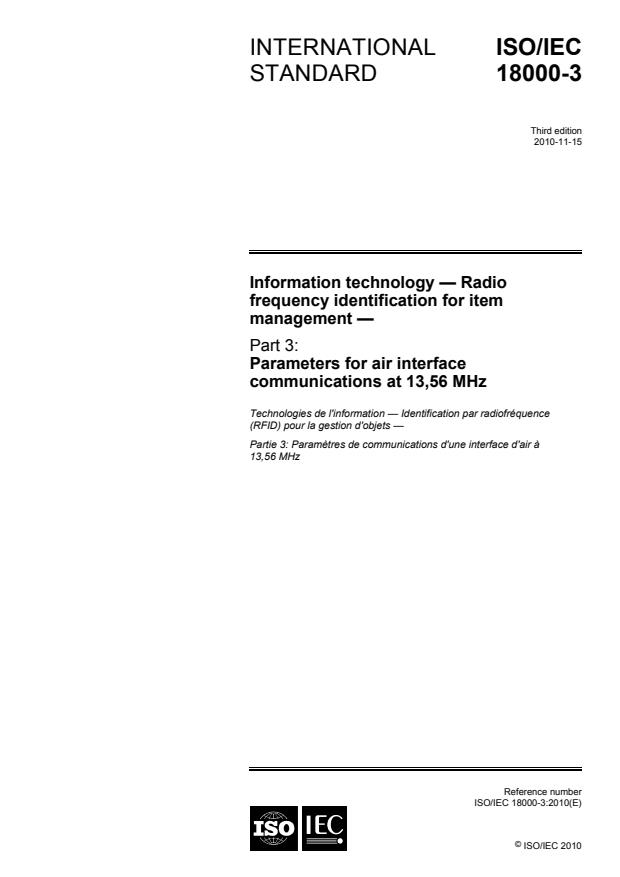
INTERNATIONAL ISO/IEC
STANDARD 18000-3
Third edition
2010-11-15
Information technology — Radio
frequency identification for item
management —
Part 3:
Parameters for air interface
communications at 13,56 MHz
Technologies de l'information — Identification par radiofréquence
(RFID) pour la gestion d'objets —
Partie 3: Paramètres de communications d'une interface d'air à
13,56 MHz
Reference number
©
ISO/IEC 2010
PDF disclaimer
This PDF file may contain embedded typefaces. In accordance with Adobe's licensing policy, this file may be printed or viewed but
shall not be edited unless the typefaces which are embedded are licensed to and installed on the computer performing the editing. In
downloading this file, parties accept therein the responsibility of not infringing Adobe's licensing policy. The ISO Central Secretariat
accepts no liability in this area.
Adobe is a trademark of Adobe Systems Incorporated.
Details of the software products used to create this PDF file can be found in the General Info relative to the file; the PDF-creation
parameters were optimized for printing. Every care has been taken to ensure that the file is suitable for use by ISO member bodies. In
the unlikely event that a problem relating to it is found, please inform the Central Secretariat at the address given below.
© ISO/IEC 2010
All rights reserved. Unless otherwise specified, no part of this publication may be reproduced or utilized in any form or by any means,
electronic or mechanical, including photocopying and microfilm, without permission in writing from either ISO at the address below or
ISO's member body in the country of the requester.
ISO copyright office
Case postale 56 • CH-1211 Geneva 20
Tel. + 41 22 749 01 11
Fax + 41 22 749 09 47
E-mail copyright@iso.org
Web www.iso.org
Published in Switzerland
ii © ISO/IEC 2010 – All rights reserved
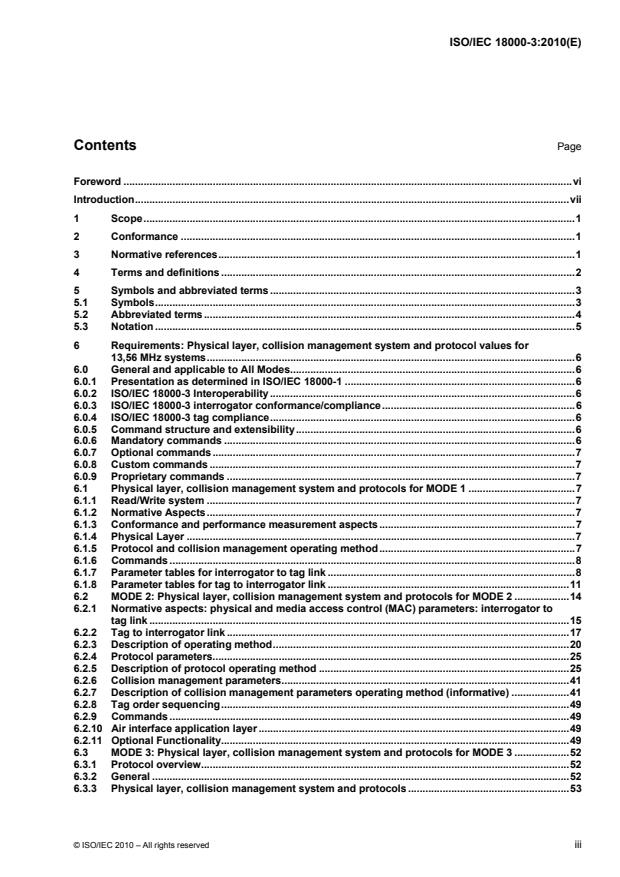
Contents Page
Foreword .vi
Introduction.vii
1 Scope.1
2 Conformance.1
3 Normative references.1
4 Terms and definitions .2
5 Symbols and abbreviated terms .3
5.1 Symbols.3
5.2 Abbreviated terms.4
5.3 Notation .5
6 Requirements: Physical layer, collision management system and protocol values for
13,56 MHz systems.6
6.0 General and applicable to All Modes.6
6.0.1 Presentation as determined in ISO/IEC 18000-1 .6
6.0.2 ISO/IEC 18000-3 Interoperability.6
6.0.3 ISO/IEC 18000-3 interrogator conformance/compliance.6
6.0.4 ISO/IEC 18000-3 tag compliance.6
6.0.5 Command structure and extensibility.6
6.0.6 Mandatory commands .6
6.0.7 Optional commands.7
6.0.8 Custom commands .7
6.0.9 Proprietary commands .7
6.1 Physical layer, collision management system and protocols for MODE 1 .7
6.1.1 Read/Write system .7
6.1.2 Normative Aspects.7
6.1.3 Conformance and performance measurement aspects.7
6.1.4 Physical Layer .7
6.1.5 Protocol and collision management operating method.7
6.1.6 Commands .8
6.1.7 Parameter tables for interrogator to tag link .8
6.1.8 Parameter tables for tag to interrogator link .11
6.2 MODE 2: Physical layer, collision management system and protocols for MODE 2 .14
6.2.1 Normative aspects: physical and media access control (MAC) parameters: interrogator to
tag link .15
6.2.2 Tag to interrogator link .17
6.2.3 Description of operating method.20
6.2.4 Protocol parameters.25
6.2.5 Description of protocol operating method .25
6.2.6 Collision management parameters.41
6.2.7 Description of collision management parameters operating method (informative) .41
6.2.8 Tag order sequencing.49
6.2.9 Commands .49
6.2.10 Air interface application layer .49
6.2.11 Optional Functionality.49
6.3 MODE 3: Physical layer, collision management system and protocols for MODE 3 .52
6.3.1 Protocol overview.52
6.3.2 General .52
6.3.3 Physical layer, collision management system and protocols .53
© ISO/IEC 2010 – All rights reserved iii
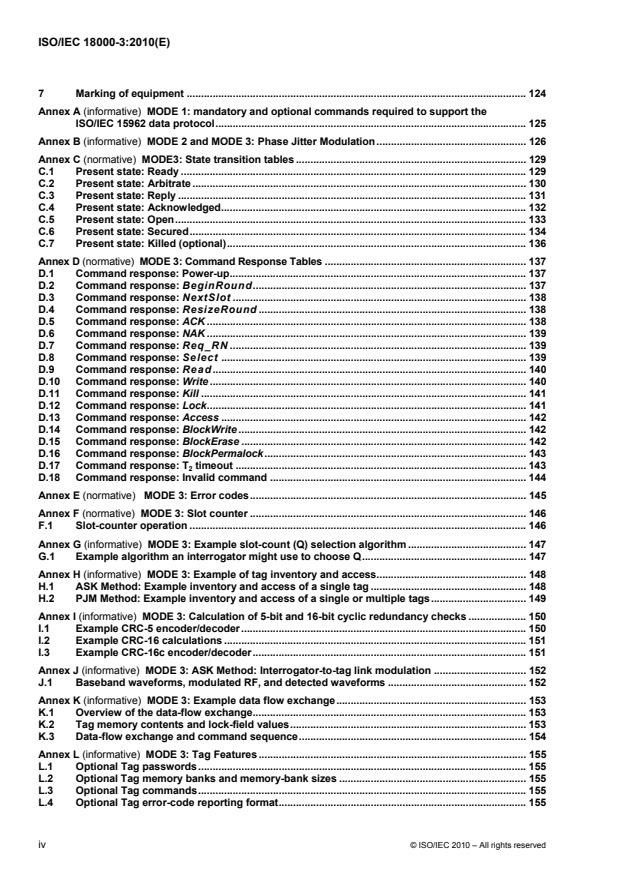
7 Marking of equipment . 124
Annex A (informative) MODE 1: mandatory and optional commands required to support the
ISO/IEC 15962 data protocol. 125
Annex B (informative) MODE 2 and MODE 3: Phase Jitter Modulation. 126
Annex C (normative) MODE3: State transition tables . 129
C.1 Present state: Ready . 129
C.2 Present state: Arbitrate . 130
C.3 Present state: Reply . 131
C.4 Present state: Acknowledged. 132
C.5 Present state: Open. 133
C.6 Present state: Secured. 134
C.7 Present state: Killed (optional). 136
Annex D (normative) MODE 3: Command Response Tables . 137
D.1 Command response: Power-up. 137
D.2 Command response: BeginRound. 137
D.3 Command response: NextSlot . 138
D.4 Command response: ResizeRound . 138
D.5 Command response: ACK . 138
D.6 Command response: NAK . 139
D.7 Command response: Req_RN . 139
D.8 Command response: Select . 139
D.9 Command response: Read . 140
D.10 Command response: Write . 140
D.11 Command response: Kill . 141
D.12 Command response: Lock. 141
D.13 Command response: Access . 142
D.14 Command response: BlockWrite . 142
D.15 Command response: BlockErase . 142
D.16 Command response: BlockPermalock. 143
D.17 Command response: T timeout . 143
D.18 Command response: Invalid command . 144
Annex E (normative) MODE 3: Error codes. 145
Annex F (normative) MODE 3: Slot counter . 146
F.1 Slot-counter operation . 146
Annex G (informative) MODE 3: Example slot-count (Q) selection algorithm . 147
G.1 Example algorithm an interrogator might use to choose Q. 147
Annex H (informative) MODE 3: Example of tag inventory and access. 148
H.1 ASK Method: Example inventory and access of a single tag . 148
H.2 PJM Method: Example inventory and access of a single or multiple tags. 149
Annex I (informative) MODE 3: Calculation of 5-bit and 16-bit cyclic redundancy checks . 150
I.1 Example CRC-5 encoder/decoder. 150
I.2 Example CRC-16 calculations . 151
I.3 Example CRC-16c encoder/decoder. 151
Annex J (informative) MODE 3: ASK Method: Interrogator-to-tag link modulation . 152
J.1 Baseband waveforms, modulated RF, and detected waveforms . 152
Annex K (informative) MODE 3: Example data flow exchange. 153
K.1 Overview of the data-flow exchange. 153
K.2 Tag memory contents and lock-field values. 153
K.3 Data-flow exchange and command sequence. 154
Annex L (informative) MODE 3: Tag Features . 155
L.1 Optional Tag passwords . 155
L.2 Optional Tag memory banks and memory-bank sizes . 155
L.3 Optional Tag commands. 155
L.4 Optional Tag error-code reporting format. 155
iv © ISO/IEC 2010 – All rights reserved
L.5 Optional Tag functionality .156
L.6 Optional Tag Feature.156
Annex M (informative) Cyclic Redundancy Check (CRC) (16 bit) .157
M.1 The CRC error detection method.157
M.2 CRC calculation example.157
Annex N (informative) Cyclic redundancy check (CRC) mode 2 (32 bit).159
N.1 The CRC 32 error detection method.159
N.2 CRC 32 calculation example .159
N.3 Practical example of CRC 32 calculation.161
Annex O (informative) Known possible interferences between the MODES determined in this part
of ISO/IEC 18000.162
Bibliography.163
© ISO/IEC 2010 – All rights reserved v
Foreword
ISO (the International Organization for Standardization) and IEC (the International Electrotechnical
Commission) form the specialized system for worldwide standardization. National bodies that are members of
ISO or IEC participate in the development of International Standards through technical committees
established by the respective organization to deal with particular fields of technical activity. ISO and IEC
technical committees collaborate in fields of mutual interest. Other international organizations, governmental
and non-governmental, in liaison with ISO and IEC, also take part in the work. In the field of information
technology, ISO and IEC have established a joint technical committee, ISO/IEC JTC 1.
International Standards are drafted in accordance with the rules given in the ISO/IEC Directives, Part 2.
The main task of the joint technical committee is to prepare International Standards. Draft International
Standards adopted by the joint technical committee are circulated to national bodies for voting. Publication as
an International Standard requires approval by at least 75 % of the national bodies casting a vote.
ISO/IEC 18000-3 was prepared by Joint Technical Committee ISO/IEC JTC 1, Information technology,
Subcommittee SC 31, Automatic identification and data capture techniques.
This third edition cancels and replaces the second edition (ISO/IEC 18000-3:2008), which has been
technically revised.
ISO/IEC 18000 consists of the following parts, under the general title Information technology — Radio
frequency identification for item management:
⎯ Part 1: Reference architecture and definition of parameters to be standardized
⎯ Part 2: Parameters for air interface communications below 135 kHz
⎯ Part 3: Parameters for air interface communications at 13,56 MHz
⎯ Part 4: Parameters for air interface communications at 2,45 GHz
⎯ Part 6: Parameters for air interface communications at 860 MHz to 960 MHz
⎯ Part 7: Parameters for active air interface communications at 433 MHz
vi © ISO/IEC 2010 – All rights reserved
Introduction
ISO/IEC 18000 has been developed in order to
⎯ provide a framework to define common communications protocols for Internationally useable frequencies
for radio frequency identification (RFID), and, where possible, to determine the use of the same protocols
for all frequencies such that the problems of migrating from one to another are diminished;
⎯ minimise software and implementation costs;
⎯ enable system management and control and information exchange to be common as far as is possible.
This part of ISO/IEC 18000 was prepared in accordance with the requirements determined in ISO/IEC 18000-1.
ISO/IEC 18000-1 provides explanation of the concepts behind this part of ISO/IEC 18000.
This part of ISO/IEC 18000 has 3 MODES of operation, intended to address different applications. The
detailed technical differences between the MODES are shown in the parameter tables.
This part of ISO/IEC 18000 relates solely to systems operating at 13,56 MHz.
The International Organization for Standardization (ISO) and International Electrotechnical Commission (IEC)
draw attention to the fact that it is claimed that compliance with this document may involve the use of patents.
The ISO and IEC take no position concerning the evidence, validity and scope of these patent rights.
The holders of these patent rights have assured the ISO and IEC that they are willing to negotiate licenses
under reasonable and non-discriminatory terms and conditions with applicants throughout the world. In this
respect, the statements of the holders of these patent rights are registered with the ISO and IEC. Information
may be obtained from the following companies.
Contact details Patent number
EM Microelectronic SA EP 97 115772.2
Mr Marc Degrauwe, IP manager EP 0 902 546
Rue des Sors 3 US 151803
CH-2074 Marin, Switzerland
(T) +41 32 755 51 11
(F) +41 32 755 54 03
info@emmicroelectronic.com
www.emmicroelectronic.com
© ISO/IEC 2010 – All rights reserved vii
Contact details Patent number
Impinj, Inc.
Chris Diorio, CTO
701 N 34th Street, suite 300
Seattle, WA 98103, USA
(T) +1 206 834 1115
(F) +1 206 517 5262
diorio@impinj.com
www.impinj.com
Intermec IP Corporation US 5673037
Phyllis T. Turner-Brim, Esq. DE 69530547.6
Legal Department EP 0702323
th
6001 – 36 Avenue West FR EP0702323
Everett, WA 98203, USA GB EP0702323
(T) +1 425-265-2480 KR 204748
(F) +1 425-501-6587 TW 318306
phyllis.turnerbrim@intermec.com US 6172596
US 6400274 (claims 1-10 only)
US 6404325
US 5550547
TW 307079
KR 210830
US 5521601
US 5777561
US 5828318
EP 1020044
US 5912632
US 5942987
TW 352492
KR 244844
US 5995019
US 6400274 (claims 11 et. Seq.)
US 6288629
US 6812841
US 6812852
US 7427912
viii © ISO/IEC 2010 – All rights reserved
Contact details Patent number
US5302954
Magellan Technology Pty. Limited
IP Manager SG37971
65 Johnston St DE3854478D
Annandale, NSW 2038, Australia EP0390822
US5485154
(T) +61 2 9562 9800
(F) +61 2 9518 7620 US10/927,957
info@magellan-technology.com US6967573
JP2002500465T
JP2006-180816
DE69835452
EP1048126
AU2006202886
AU785098
US7248145
US7259654
US11/538,271
US11/538/242
JP2003 526148
JP2006 344227
DE60119910
EP1266458
EP07013773
EP1544782
EP1544788
EP1679635
NXP B.V.
Marc Schouten
Intellectual Property & Licensing
High Tech Campus 32
5656 AE Eindhoven
The Netherlands
(T) +31 40 27 26951
(F) +31 40 27 42640
marc.schouten@nxp.com
© ISO/IEC 2010 – All rights reserved ix
Contact details Patent number
TAGSYS, SA US 6,641,036
Alastair McArthur, CTO EP 1232471
180. Chemin de Saint Lambert US 6992567
13821 La Penne sur Huveaune EP 1256083
FRANCE US 6946951
+33 491 27 57 00 EP 1358644
+33 491 27 57 01 US 6538564
alastair.mcarthur@tagsysrfrd.com.au EP 953181
www.tagsysrfid.com
Texas Instruments Inc. EP1 038257
Robby Holland, Licensing Manager US 09/315708
P.O. Box 655464, MS 3999 JP 00-560700
Dallas TX 75256 EP 1 034644
(T) +1 972 917 4367 US 6442215
(F) +1 972 917 4418 CN 1273730A
r-holland3@ti.com WO00/04686
EP 0669591B
AT-PS 401127
Zebra Technologies Corporation US 6784787
EP 1031046
Eric McAlpine, IP Counsel
Legal Department EP 1291671
333 Corporate Woods Parkway EP 05017862.3
Vernon Hills, IL 60061-3109 US 5680459
US 5557280
(T) +1 847 793 5640
(F) +1 847 955 4514 US 5699066
EP 0585132
emcalpine@zebra.com
US 6198381
JP 10-272945
US 5537105
US 5966083
US 5995017
Attention is drawn to the possibility that some of the elements of this document may be the subject of patent
rights other than those identified above. ISO and IEC shall not be held responsible for identifying any or all
such patent rights. The latest IP submissions to ISO can be found at:
http://www.iso.org/patents
x © ISO/IEC 2010 – All rights reserved
INTERNATIONAL STANDARD ISO/IEC 18000-3:2010(E)
Information technology — Radio frequency identification for
item management —
Part 3:
Parameters for air interface communications at 13,56 MHz
1 Scope
This part of ISO/IEC 18000 provides physical layer, collision management system and protocol values for
RFID systems for item identification operating at 13,56 MHz in accordance with the requirements of
ISO/IEC 18000-1.
This part of ISO/IEC 18000 provides definitions for systems for each MODE determined in Clause 6 below.
This part of ISO/IEC 18000 defines three non-interfering MODES.
⎯ The MODES are not interoperable.
⎯ The MODES, whilst not interoperable, are non-interfering.
2 Conformance
In order to claim conformance with this part of ISO/IEC 18000, it is necessary to comply with all of the relevant
clauses of this part of ISO/IEC 18000 except those marked “optional”. It is also necessary to operate within
the local national radio regulations (which may require further restrictions).
Relevant conformance test methods are defined in ISO/IEC TR 18047-3.
3 Normative references
The following referenced documents are indispensable for the application of this document. For dated
references, only the edition cited applies. For undated references, the latest edition of the referenced
document (including any amendments) applies.
ISO/IEC 13239, Information technology — Telecommunications and information exchange between
systems — High-level data link control (HDLC) procedures
ISO/IEC 7816-6, Identification cards — Integrated circuit cards — Part 6: Interindustry data elements for
interchange
ISO/IEC 15693 (all parts), Identification cards — Contactless integrated circuit cards — Vicinity cards
ISO/IEC 15961, Information technology — Radio frequency identification (RFID) for item management — Data
protocol: application interface
© ISO/IEC 2010 – All rights reserved 1
ISO/IEC 15962, Information technology — Radio frequency identification (RFID) for item management — Data
protocol: data encoding rules and logical memory functions
ISO/IEC 15963, Information technology — Radio frequency identification for item management — Unique
identification for RF tags
ISO/IEC 18000-1, Information technology — Radio frequency identification for item management — Part 1:
Reference architecture and definition of parameters to be standardized
ISO/IEC TR 18046, Information technology — Automatic identification and data capture techniques — Radio
frequency identification device performance test methods
ISO/IEC TR 18047-3, Information technology — Radio frequency identification device conformance test
methods — Part 3: Test methods for air interface communications at 13,56 MHz
ISO/IEC 19762 (all parts), Information technology — Automatic identification and data capture (AIDC)
techniques — Harmonized vocabulary
EPCglobal Tag Data Standards (Version 1.3 and above)
4 Terms and definitions
For the purposes of this document, the terms and definitions given in ISO/IEC 19762 (all parts) and the
following apply.
4.1
cover-coded text
information that is cover-coded
4.2
cover-coding
method by which an interrogator obscures information that it is transmitting to a tag
4.3
full-duplex communications
communication of data while the transceiver transmits the activation field
4.4
half-duplex communications
data transmission in either direction, one direction at a time
4.5
handle
16-bit random number (RN16) that is used to authenticate tags in the open or secured state
4.6
PacketCRC
16-bit cyclic-redundancy check (CRC) code that a tag with nonzero-valued XPC indicator (XI) dynamically
calculates over its protocol control (PC), extended protocol control (XPC), and unique item identifier (UII), and
provides by loadmodulation during inventory
cf. StoredCRC
4.7
PacketPC
protocol-control information that a tag with nonzero-valued XPC indicator dynamically calculates and provides
by loadmodulation during inventory
cf. StoredPC
2 © ISO/IEC 2010 – All rights reserved
4.8
phase jitter modulation
PJM
modulation technique that transmits data as very small phase changes in the powering field
4.9
physical layer
data coding and modulation waveforms used in interrogator-to-tag and tag-to-interrogator communication
4.10
pivot
average length of an interrogator-to-tag data symbol
NOTE See 6.3.3.3.1.2.8.
4.11
plaintext
information that is not cover-coded
4.12
recommissioning
significant altering of a tag's functionality and/or memory contents, as commanded by an interrogator
NOTE Recommissioning is typically in response to a change in the tag's usage model or purpose.
4.13
StoredCRC
16-bit cyclic-redundancy check (CRC) code that a tag calculates over its StoredPC and unique item
identifier (UII) and stores in UII memory at power-up, and can backscatter during inventory
cf. PacketCRC
4.14
StoredPC
protocol-control information stored in unique item identifier (UII) memory that a tag with zero-valued XPC
indicator provides by loadmodulation during inventory
cf. PacketPC
4.15
Tari
reference time interval for a data-0 in interrogator-to-tag communication
5 Symbols and abbreviated terms
For the purposes of this document, the symbols and abbreviated terms given in ISO/IEC 18000-1,
ISO/IEC 19762 and the following apply.
5.1 Symbols
DR ASK Method: divide ratio
PJM Method: bit 0 of the reply channel selection
F carrier frequency
c
M(ASK) tag reply modulation type
M RF signal envelope ripple (overshoot)
h
M RF signal envelope ripple (undershoot)
l
M(PJM) bit 1 and bit 2 of the reply channel selection
© ISO/IEC 2010 – All rights reserved 3
M RF signal level when OFF
s
Q slot-count parameter
(parameter that an interrogator uses to regulate the probability of tag response)
R interrogator (also sometimes called reader)
R=>T interrogator-to-tag
RTcal interrogator-to-tag calibration symbol
T tag
T time from interrogator transmission to tag response
T time from tag response to interrogator transmission
T time an interrogator waits, after T , before it issues another command
3 1
T minimum time between interrogator commands
T or T RF signal envelope fall time
f f,10-90%
T link pulse-repetition interval (T = 1/LF)
pri pri
T or T RF signal envelope rise time
r r,10-90%
TRext ASK Method: chooses whether the T=R preamble is prefixed with a pilot tone
PJM Method: bit 3 of the reply channel selection
T RF signal settling time
s
T=>R tag-to-interrogator
TRcal tag-to-interrogator calibration symbol
X floating-point value
fp
xxxx binary notation
xxxx hexadecimal notation
h
≈ MODE 1 - the value is a rounded value (e.g. ≈ 75,52 µs)
5.2 Abbreviated terms
ARIB Association of Radio Industries and Businesses
AFI application family identifier
AM amplitude modulation
ASK amplitude shift keying
BPSK binary phase shift keying
CEPT Conference of European Posts and Telecommunications
CFR Code of Federal Regulations
CRC cyclic redundancy check
NOTE: This specification uses two CRC algorithms: CRC-5 (5-bit CRC) and CRC-16 (16-bit CRC) and three
different logical CRC-16s: StoredCRC, PacketCRC and CRC-16c.
For the UII bank word 0 or ACK the following two logical CRC-16s are used:
- StoredCRC = CRC-16 calculated at startup and mapped to UII word 0
- PacketCRC = CRC-16 calculated over the response data of the tag in case of the ACK command
For all other cases and commands the following logical CRC-16 is used:
- CRC-16c = CRC-16 calculated over the response data of the tag
CW continuous wave
dBch decibels referenced to the integrated power in the reference channel
DSB double sideband
DSB-ASK double-sideband amplitude shift keying
4 © ISO/IEC 2010 – All rights reserved
DR divide ratio
ERC European Radiocommunications Committee
ERM electromagnetic compatibility and radio spectrum matters
ETSI European Telecommunications Standards Institute
FCC Federal Communications Commission
FT frequency tolerance
ITF interrogator talks first (reader talks first)
LF link frequency (LF = 1/T )
pri
MFM modified frequency modulation
N/A not applicable
NSI numbering system identifier
PIE pulse-interval encoding
PJM phase jitter modulation
ppm parts-per-million
PC protocol control
RF radio frequency
RFU reserved for future use
RN16 16-bit random or pseudo-random number
RNG random or pseudo-random number generator
SRD short range devices
TDM time-division multiplexing or time-division multiplexed (as appropriate)
TID tag identification or tag identifier, depending on context
UII unique item identifier
UMI user-memory indicator
XI XPC indicator
XPC extended protocol control
XPC_W1 XPC word 1
XPC_W2 XPC word 2
XTID extended TID indicator (see version 1.3 and above of the EPCglobal Tag Data Standards)
5.3 Notation
Mode 3 of this specification uses the following notational conventions:
• States and flags are denoted in bold. Example: ready.
• Commands are denoted in italics. Variables are also denoted in italics. Where there might be
confusion between commands and variables, this specification shall make an explicit statement.
Example: BeginRound.
• Procedures are shown as italics underline
• Command parameters are underlined. Example: Pointer.
• For logical negation, labels are preceded by ‘~’. Example: If flag is true, then ~flag is false.
• The symbol, R=>T, refers to commands or communications signal air interface from an interrogator
to a tag (reader-to-tag).
© ISO/IEC 2010 – All rights reserved 5
• The symbol, T=>R, refers to commands or communications signal air interface from a tag to an
interrogator (tag-to-reader).
6 Requirements: Physical layer, collision management system and protocol values
for 13,56 MHz systems
6.0 General and applicable to All Modes
6.0.1 Presentation as determined in ISO/IEC 18000-1
The context, form and presentation of this part, which provides physical layer, collision management system
and protocol value definitions for RFID systems for item identification operating at 13,56 MHz are in
accordance with the requirements of ISO/IEC 18000-1.
6.0.2 ISO/IEC 18000-3 Interoperability
This part of ISO/IEC 18000 specifies three MODES of operation at 13,56 MHz
These MODES are not interoperable, but they are expected to operate without causing any significant
interference with each other. Any known causes of interference are listed in Annex O.
NOTE 1 It is recommended that users select one MODE for any specific application.
NOTE 2 Local national regulations may further limit either power, frequency or bandwidth allocations and such
limitations may reduce the capability of a system within that country. Users shall have the responsibility to ensure that they
use only systems that comply with these regulations. This implies a user responsibility to obtain proofs from manufacturers,
and where appropriate have adequate tests carried out to assure that systems are in compliance.
NOTE 3 At the time of preparation of this part of ISO/IEC 18000, the interrogator to tag link and tag to interrogator link
physical layer emissions may be subject to type approval or certification. It is therefore necessary to make reference to
local or regional radio regulations and radio standards in addition to this part of ISO/IEC 18000. All systems are required to
comply with local radio regulations, which may affect performance.
6.0.3 ISO/IEC 18000-3 interrogator conformance/compliance
To claim compliance with this part of ISO/IEC 18000, an interrogator/ reader shall support either MODE 1,
MODE 2, or MODE 3. The interrogator may support any or all modes as an option (the modes are not
interoperable).
6.0.4 ISO/IEC 18000-3 tag compliance
To claim compliance with this part of ISO/IEC 18000, a tag shall support either MODE 1, MODE 2, or MODE 3.
The tag may support any or all modes as an option (the modes are not interoperable).
6.0.5 Command structure and extensibility
Clauses 6.1, 6.2, and 6.3, include definition of the structure of command codes between an interrogator and a
tag and indicate how many positions are available for future extensions. Command specification clauses
provide a full definition of the command and its presentation. Each command is labelled as being “mandatory”
or “optional”. In accordance with ISO/IEC 18000-1, the clauses of this part of ISO/IEC 18000 make provision
for “custom” and “proprietary” commands.
The types of permitted command options are defined in subclauses 6.0.6 to 6.0.9.
6.0.6 Mandatory commands
A mandatory command shall be supported by all tags that claim to be compliant. Interrogators which claim
compliance shall support all mandatory commands.
6 © ISO/IEC 2010 – All rights reserved
6.0.7 Optional commands
Optional commands are commands that are specified within the International Standard. Interrogators shall be
technically capable of performing all optional commands that are specified in the International Standard
(although need not be set up to do so). Tags may or may not support optional commands.
If an interrogator or a tag implements an optional command, it shall implement it in the manner specified in
this standard.
6.0.8 Custom commands
Custom commands may be enabled by an International Standard, but they shall not be specified in that
International Standard.
A custom command shall not solely duplicate the functionality of any mandatory or optional command defined
in the International Standard by a different method. An interrogator shall use a custom command only in
accordance with the specifications of the tag manufacturer.
6.0.9 Proprietary commands
Proprietary commands may be enabled by an International Standard, but they shall not be specified in that
International Standard.
A proprietary command shall not solely duplicate the functionality of any mandatory or optional command
defined in the International Standard by a different method. Vendors shall not provide proprietary means to
circumvent the protocol. Proprietary commands are intended for manufacturing purposes and shall not be
used in field-deployed RFID systems.
6.1 Physical layer, collision management system and protocols for MODE 1
MODE 1 is not interoperable with any other MODES defined within this International Standard.
6.1.1 Read/Write system
MODE 1 describes a read/write system using a "interrogator talks first" technique.
6.1.2 Normative Aspects
The physical, collision management and transmission protocols determined in this MODE are defined in
ISO/IEC 15693. Clauses 6.1.3 – 6.1.8 provide normative parts of MODE 1 by reference.
6.1.3 Conformance and performance measurement aspects
The performance and conformance measurement aspects for MODE 1 are given in the relevant clauses of
Technical Reports (ISO/IEC TR 18046 and ISO/IEC TR 18047-3, respectively).
6.1.4 Physical Layer
The Physical layer for the MODE 1 air interface at 13,56 MHz shall be compliant with ISO/IEC 15693-2.
6.1.5 Protocol and collision management operating method
The collision management operating method for the MODE 1 air interface at 13,56 MHz shall be compliant
with ISO/IEC 15693-3.
© ISO/IEC 2010 – All rights reserved 7
6.1.6 Commands
The commands for the MODE 1 air interface at 13,56 MHz shall be compliant with ISO/IEC 15693-3. Annex A
shows the commands that are necessary to support encoding to ISO/IEC 15962, which is required for RFID
for item management.
6.1.7 Parameter tables for interrogator to tag link
The parameter tables for interrogator to tag link for the MODE 1 air interface at 13,56 MHz shall be compliant
with ISO/IEC 15693-2. See Table 1 — Parameter Tables for interrogator to tag link for details.
Table 1 — Parameter Tables for interrogator to tag link
Ref. Parameter Description/limits Options/Comments
M1-Int: 1 Operating frequency 1 interrogator to tag link channel at (centre
range frequency) 13,56MHz ± 7 kHz
M1-Int: 1a Default operating 13,56 MHz
frequency
M1-Int: 1b Operating channels
N/A
(for spread spectrum
systems)
M1-Int: 1c Operating frequency +/- 100 parts per million
accuracy +/- 50 parts per million in Japan
M1-Int: 1d Frequency hop rate N/A
(for Frequency hopping
[FHSS] systems)
M1-Int: 1e Frequency hop N/A
sequence
(for Frequency hopping
[FHSS] systems)
M1-Int: 2 Occupied channel
13,56 MHz ± 7 kHz
bandwidth
with modulation as defined in 6.1.4
M1-Int: 2a Minimum receiver
13,56 MHz ± (423,75± 40 kHz) Centred at the sub
bandwidth carrier frequency.
13,56 MHz ± (484,28 ± 40 kHz)
M1-Int: 3 Interrogator transmit The interrogator shall not generate a field higher (Inductive coupling)
maximum Magnetic Field than 12 A/m in any part of the volume where a tuned
Strength ISO card sized tag may be present
Where Local regulations
restrict the Magnetic
Maximum operating field strength: Field Strength Limits
below those determined
Magnetic Field Strength 5 A/m for ISO card sized tags, as defined in
in this Clause, a
limits within ISO/IEC 7810. For other label form factors, the label
degradation of local
communication zone manufacturer shall specify the maximum operating
performance may be
field strength.
expected.
Test methods for
determining the
interrogator operating
field are defined in
relative clauses of the
Technical Report
ISO/IEC TR 18047-3.
8 © ISO/IEC 2010 – All rights reserved
Ref. Parameter Description/limits Options/Comments
M1-Int: 3a Minimum operating field Minimum Operating Field Strength: 150 mA/m for
strength tuned ISO card sized tags.
Application requirements may result in a different
minimum operating field strength. In that case the
minimum operating field strength shall be declared
by the tag manufacturer.
M1-Int: 4 Interrogator transmit compliant with regulations
spurious emissions
M1-Int: 4a Interrogator transmit N/A
spurious emissions, in-
band
(for Spread spectrum
systems)
M1-Int: 4b Interrogator transmit N/A
spurious emissions, out-
of-band
M1-Int: 5 Interrogator transmitter The modulation technique and bit coding enable
spectrum mask maximum tag powering within the following
regulations:
US Jurisdictions : FCC 47 Part 15
EU : EN 300 – 330
Japan : ARIB STD – T82
M1-Int:6 Timing See below.
M1-Int: 6a Transmit to receive turn <= 4320/fc
around time
M1-Int: 6b Receive to transmit Turn >= 4192/fc
around time
M1-Int: 6c Dwell time or See 6.1.4
Interrogator transmit
power on ramp
M1-Int: 6d Decay time or See 6.1.4
Interrogator transmit
power down ramp
M1-Int: 7 Modulation Carrier amplitude modulation
(ASK 100%,
...