

IEC TR 62697-3:2018
(Main)Test methods for quantitative determination of corrosive sulfur compounds in unused and used insulating liquids - Part 3: Test method for quantitative determination of elemental sulfur
General Information
- Abstract
IEC TR 62697-3:2018(E) specifies a test method for the quantitative determination of elemental sulfur in used and unused insulating liquids over a 2 mg kg–1 to 400 mg kg–1 concentration range.
- Status
- Published
- Publication Date
- 13-Feb-2018
- Technical Committee
- TC 10 - Fluids for electrotechnical applications
- Current Stage
- PPUB - Publication issued
- Start Date
- 14-Feb-2018
- Completion Date
- 12-Mar-2018
Buy Documents
IEC TR 62697-3:2018 - Test methods for quantitative determination of corrosive sulfur compounds in unused and used insulating liquids - Part 3: Test method for quantitative determination of elemental sulfur Released:2/14/2018
Overview
IEC TR 62697-3:2018 is an IEC Technical Report that specifies a validated test method for the quantitative determination of elemental sulfur in unused and used insulating liquids. Published in 2018 by IEC TC 10 (Fluids for electrotechnical applications), the report covers analysis across a concentration range of 2 mg·kg–1 to 400 mg·kg–1. It is part of the IEC 62697 series addressing corrosive sulfur compounds in insulating oils.
Key topics and requirements
- Scope and purpose: Measurement of elemental sulfur in insulating liquids to assess corrosive sulfur risk.
- Analytical methods covered:
- Gas chromatography (GC) with multiple detectors (Electron Capture Detector – ECD, Flame Photometric Detector – FPD, and Mass Spectrometer – MS).
- Differential pulse voltammetry (DPV) as an alternative electrochemical technique.
- Sampling and pre-treatment: Requirements for representative sampling and sample preparation prior to analysis.
- Apparatus and reagents:
- Basic instrumentation: analytical balance, GC system, DPV setup.
- Reference materials: elemental sulfur standards, diphenyl disulfide (DPDS), and blank oil for matrix matching.
- Solvents, high-purity gases and reagents specified for accurate measurement.
- Instrument set-up and calibration:
- GC parameters, detector settings, carrier gas and injection guidance.
- Calibration procedures, internal standard usage and response factor determination for reliable quantification.
- Interferences and matrix effects: Guidance on co-eluting compounds, detector-specific interferences, and matrix-related bias.
- Performance and reporting:
- Precision data provided: detection limit, repeatability and reproducibility assessments.
- Reporting format and result presentation, including chromatogram interpretation.
Applications and users
- Transformer and power equipment manufacturers and their quality departments use the method to ensure insulating fluids meet corrosion-safety specifications.
- Utilities and asset owners rely on elemental sulfur testing as part of condition monitoring and failure-prevention programs for transformers and switchgear.
- Independent test laboratories and chemical analysis service providers apply the procedures for routine and forensic oil analysis.
- Standards developers and regulators reference the report when setting acceptance criteria for corrosive sulfur in insulating oils.
Related standards
- Part of the IEC 62697 series:
- Part 1: Test method for dibenzyl disulfide (DBDS)
- Part 2: Test method for total corrosive sulfur (TCS)
- Useful when used alongside standards for insulating oil sampling and transformer maintenance.
Keywords: IEC TR 62697-3, elemental sulfur, insulating liquids, corrosive sulfur, gas chromatography, differential pulse voltammetry, transformer oil testing, insulating oil analysis.
Buy Documents
IEC TR 62697-3:2018 - Test methods for quantitative determination of corrosive sulfur compounds in unused and used insulating liquids - Part 3: Test method for quantitative determination of elemental sulfur Released:2/14/2018
Get Certified
Connect with accredited certification bodies for this standard

IMQ S.p.A. (Certification)
Italian electrical product certification.

SLG Prüf- und Zertifizierungs GmbH
German testing and certification body.

UL Solutions
Global safety science company with testing, inspection and certification.
Sponsored listings
Frequently Asked Questions
IEC TR 62697-3:2018 is a technical report published by the International Electrotechnical Commission (IEC). Its full title is "Test methods for quantitative determination of corrosive sulfur compounds in unused and used insulating liquids - Part 3: Test method for quantitative determination of elemental sulfur". This standard covers: IEC TR 62697-3:2018(E) specifies a test method for the quantitative determination of elemental sulfur in used and unused insulating liquids over a 2 mg kg–1 to 400 mg kg–1 concentration range.
IEC TR 62697-3:2018(E) specifies a test method for the quantitative determination of elemental sulfur in used and unused insulating liquids over a 2 mg kg–1 to 400 mg kg–1 concentration range.
IEC TR 62697-3:2018 is classified under the following ICS (International Classification for Standards) categories: 29.040.10 - Insulating oils. The ICS classification helps identify the subject area and facilitates finding related standards.
IEC TR 62697-3:2018 is available in PDF format for immediate download after purchase. The document can be added to your cart and obtained through the secure checkout process. Digital delivery ensures instant access to the complete standard document.
Standards Content (Sample)
IEC TR 62697-3 ®
Edition 1.0 2018-02
TECHNICAL
REPORT
colour
inside
Test methods for quantitative determination of corrosive sulfur compounds in
unused and used insulating liquids –
Part 3: Test method for quantitative determination of elemental sulfur
All rights reserved. Unless otherwise specified, no part of this publication may be reproduced or utilized in any form
or by any means, electronic or mechanical, including photocopying and microfilm, without permission in writing from
either IEC or IEC's member National Committee in the country of the requester. If you have any questions about IEC
copyright or have an enquiry about obtaining additional rights to this publication, please contact the address below or
your local IEC member National Committee for further information.
IEC Central Office Tel.: +41 22 919 02 11
3, rue de Varembé info@iec.ch
CH-1211 Geneva 20 www.iec.ch
Switzerland
About the IEC
The International Electrotechnical Commission (IEC) is the leading global organization that prepares and publishes
International Standards for all electrical, electronic and related technologies.
About IEC publications
The technical content of IEC publications is kept under constant review by the IEC. Please make sure that you have the
latest edition, a corrigenda or an amendment might have been published.
IEC Catalogue - webstore.iec.ch/catalogue Electropedia - www.electropedia.org
The stand-alone application for consulting the entire The world's leading online dictionary of electronic and
bibliographical information on IEC International Standards, electrical terms containing 21 000 terms and definitions in
Technical Specifications, Technical Reports and other English and French, with equivalent terms in 16 additional
documents. Available for PC, Mac OS, Android Tablets and languages. Also known as the International Electrotechnical
iPad. Vocabulary (IEV) online.
IEC publications search - webstore.iec.ch/advsearchform IEC Glossary - std.iec.ch/glossary
The advanced search enables to find IEC publications by a 67 000 electrotechnical terminology entries in English and
variety of criteria (reference number, text, technical French extracted from the Terms and Definitions clause of
committee,…). It also gives information on projects, replaced IEC publications issued since 2002. Some entries have been
and withdrawn publications. collected from earlier publications of IEC TC 37, 77, 86 and
CISPR.
IEC Just Published - webstore.iec.ch/justpublished
Stay up to date on all new IEC publications. Just Published IEC Customer Service Centre - webstore.iec.ch/csc
details all new publications released. Available online and If you wish to give us your feedback on this publication or
also once a month by email. need further assistance, please contact the Customer Service
Centre: sales@iec.ch.
IEC TR 62697-3 ®
Edition 1.0 2018-02
TECHNICAL
REPORT
colour
inside
Test methods for quantitative determination of corrosive sulfur compounds in
unused and used insulating liquids –
Part 3: Test method for quantitative determination of elemental sulfur
INTERNATIONAL
ELECTROTECHNICAL
COMMISSION
ICS 29.040.10 ISBN 978-2-8322-5361-8
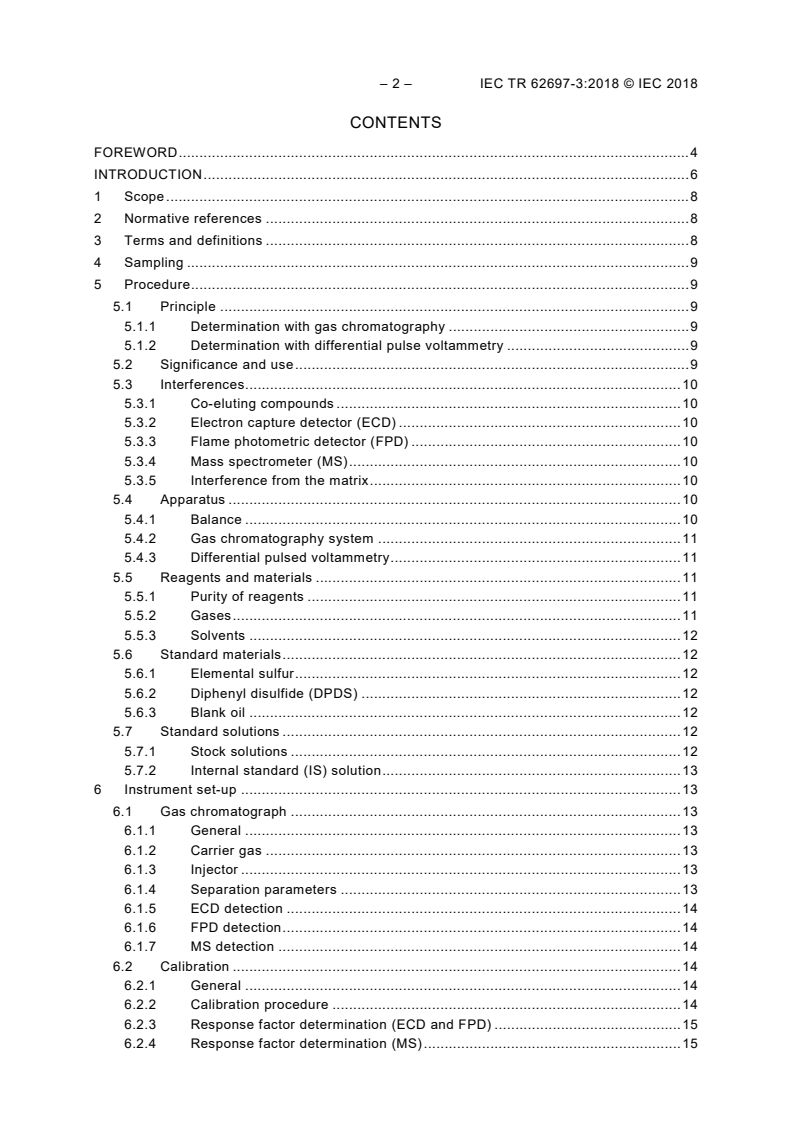
– 2 – IEC TR 62697-3:2018 © IEC 2018
CONTENTS
FOREWORD . 4
INTRODUCTION . 6
1 Scope . 8
2 Normative references . 8
3 Terms and definitions . 8
4 Sampling . 9
5 Procedure . 9
5.1 Principle . 9
5.1.1 Determination with gas chromatography . 9
5.1.2 Determination with differential pulse voltammetry . 9
5.2 Significance and use . 9
5.3 Interferences. 10
5.3.1 Co-eluting compounds . 10
5.3.2 Electron capture detector (ECD) . 10
5.3.3 Flame photometric detector (FPD) . 10
5.3.4 Mass spectrometer (MS) . 10
5.3.5 Interference from the matrix . 10
5.4 Apparatus . 10
5.4.1 Balance . 10
5.4.2 Gas chromatography system . 11
5.4.3 Differential pulsed voltammetry . 11
5.5 Reagents and materials . 11
5.5.1 Purity of reagents . 11
5.5.2 Gases . 11
5.5.3 Solvents . 12
5.6 Standard materials . 12
5.6.1 Elemental sulfur . 12
5.6.2 Diphenyl disulfide (DPDS) . 12
5.6.3 Blank oil . 12
5.7 Standard solutions . 12
5.7.1 Stock solutions . 12
5.7.2 Internal standard (IS) solution . 13
6 Instrument set-up . 13
6.1 Gas chromatograph . 13
6.1.1 General . 13
6.1.2 Carrier gas . 13
6.1.3 Injector . 13
6.1.4 Separation parameters . 13
6.1.5 ECD detection . 14
6.1.6 FPD detection . 14
6.1.7 MS detection . 14
6.2 Calibration . 14
6.2.1 General . 14
6.2.2 Calibration procedure . 14
6.2.3 Response factor determination (ECD and FPD) . 15
6.2.4 Response factor determination (MS) . 15
6.3 Analysis . 15
6.3.1 Sample pre-treatment . 15
6.3.2 Sample injection . 16
6.3.3 Chromatographic run . 16
6.3.4 Peak integration . 16
6.4 Calculations . 16
6.4.1 ECD and FPD . 16
6.4.2 Mass spectrometer (MS) . 16
6.4.3 Differential pulse voltammetry measurements . 17
6.5 Results . 17
7 Precision data . 18
7.1 Detection limit . 18
7.2 Repeatability . 18
7.3 Reproducibility . 18
8 Report . 18
Annex A (informative) Figures with typical chromatograms and results . 19
Annex B (informative) RRT results Statistical evaluation of elemental sulfur data GC-
ECD/FPD . 21
Bibliography . 23
Figure 1 – Typical peak form and concentration calculation . 17
–1
Figure A.1 – GC-ECD chromatogram of 5 mg kg elemental sulfur and (IS) in white
mineral oil . 19
–1
Figure A.2 – GC-ECD chromatogram of 100 mg kg elemental sulfur and (IS) in white
mineral oil . 20
Table 1 – Column oven temperature programming parameters . 14
Table 2 – Mass spectrometer parameters . 14
Table 3 – Repeatability limit . 18
Table 4 – Reproducibility limit . 18
Table B.1 – Reproducibility with same chemical analysis approach . 21
Table B.2 – Reproducibility with different chemical analysis approach . 21
Table B.3 – Repeatability . 22
– 4 – IEC TR 62697-3:2018 © IEC 2018
INTERNATIONAL ELECTROTECHNICAL COMMISSION
____________
TEST METHODS FOR QUANTITATIVE DETERMINATION
OF CORROSIVE SULFUR COMPOUNDS IN UNUSED
AND USED INSULATING LIQUIDS –
Part 3: Test method for quantitative determination
of elemental sulfur
FOREWORD
1) The International Electrotechnical Commission (IEC) is a worldwide organization for standardization comprising
all national electrotechnical committees (IEC National Committees). The object of IEC is to promote
international co-operation on all questions concerning standardization in the electrical and electronic fields. To
this end and in addition to other activities, IEC publishes International Standards, Technical Specifications,
Technical Reports, Publicly Available Specifications (PAS) and Guides (hereafter referred to as “IEC
Publication(s)”). Their preparation is entrusted to technical committees; any IEC National Committee interested
in the subject dealt with may participate in this preparatory work. International, governmental and non-
governmental organizations liaising with the IEC also participate in this preparation. IEC collaborates closely
with the International Organization for Standardization (ISO) in accordance with conditions determined by
agreement between the two organizations.
2) The formal decisions or agreements of IEC on technical matters express, as nearly as possible, an international
consensus of opinion on the relevant subjects since each technical committee has representation from all
interested IEC National Committees.
3) IEC Publications have the form of recommendations for international use and are accepted by IEC National
Committees in that sense. While all reasonable efforts are made to ensure that the technical content of IEC
Publications is accurate, IEC cannot be held responsible for the way in which they are used or for any
misinterpretation by any end user.
4) In order to promote international uniformity, IEC National Committees undertake to apply IEC Publications
transparently to the maximum extent possible in their national and regional publications. Any divergence
between any IEC Publication and the corresponding national or regional publication shall be clearly indicated in
the latter.
5) IEC itself does not provide any attestation of conformity. Independent certification bodies provide conformity
assessment services and, in some areas, access to IEC marks of conformity. IEC is not responsible for any
services carried out by independent certification bodies.
6) All users should ensure that they have the latest edition of this publication.
7) No liability shall attach to IEC or its directors, employees, servants or agents including individual experts and
members of its technical committees and IEC National Committees for any personal injury, property damage or
other damage of any nature whatsoever, whether direct or indirect, or for costs (including legal fees) and
expenses arising out of the publication, use of, or reliance upon, this IEC Publication or any other IEC
Publications.
8) Attention is drawn to the Normative references cited in this publication. Use of the referenced publications is
indispensable for the correct application of this publication.
9) Attention is drawn to the possibility that some of the elements of this IEC Publication may be the subject of
patent rights. IEC shall not be held responsible for identifying any or all such patent rights.
The main task of IEC technical committees is to prepare International Standards. However, a
technical committee may propose the publication of a Technical Report when it has collected
data of a different kind from that which is normally published as an International Standard, for
example "state of the art".
IEC TR 62697-3, which is a Technical Report, has been prepared by IEC technical committee
10: Fluids for electrotechnical applications.
The text of this Technical Report is based on the following documents:
Draft TR Report on voting
10/1014/DTR 10/1028/RVDTR
Full information on the voting for the approval of this Technical Report can be found in the
report on voting indicated in the above table.
This document has been drafted in accordance with the ISO/IEC Directives, Part 2.
A list of all parts in the IEC 62697 series, published under the general title Test methods for
quantitative determination of corrosive sulfur compounds in unused and used insulating
liquids, can be found on the IEC website.
The committee has decided that the contents of this document will remain unchanged until the
stability date indicated on the IEC website under "http://webstore.iec.ch" in the data related to
the specific document. At this date, the document will be
• reconfirmed,
• withdrawn,
• replaced by a revised edition, or
• amended.
A bilingual version of this publication may be issued at a later date.
IMPORTANT – The 'colour inside' logo on the cover page of this publication indicates
that it contains colours which are considered to be useful for the correct
understanding of its contents. Users should therefore print this document using a
colour printer.
– 6 – IEC TR 62697-3:2018 © IEC 2018
INTRODUCTION
During the IEC technical committee 10 plenary meeting in 2007, it was decided to set up a
working group with the aim of developing a standard on “quantitative determination of
corrosive sulfur compounds in insulating fluids”.
TC 10 decided to divide the overall task into three parts:
• Part 1: Test method for quantitative determination of dibenzyl disulfide (DBDS);
• Part 2: Test method for quantitative determination of total corrosive sulfur (TCS);
• Part 3: Test method for quantitative determination of elemental sulfur.
Part 1 was published in 2012, however the work for the preparation of Part 2 and Part 3 took
longer than anticipated. During the TC 10 plenary meeting in 2015, in order to finalize the
important work achieved, a proposal was made to complete the work and publish Part 2 and
Part 3 as Technical Reports.
Sulfur can be present in insulating liquids in various forms, including elemental sulfur,
inorganic sulfur compounds and organic sulfur compounds. The number of diverse sulphur
species comprised of different isomers and homologous can run into hundreds. The total
sulfur (TS) concentration in insulating liquids depends on the origin of the liquid, refining
processes and the degree of refining and formulation including addition of additives to the
base oils. Base oils include mineral based paraffinic and naphthenic oils, synthetic iso-
paraffins obtained through gas to liquid conversion process (GTL-Fischer-Tropsch), esters,
poly alpha olefins, poly alkylene glycols, etc. Additives can be comprised of electrostatic
discharge depressants, metal deactivators, metal passivators, phenolic and sulfur containing
antioxidants such as the polysulfides, disulfides, dibenzyl disulfide (DBDS).
Certain sulfur compounds present in the insulating liquids exhibit antioxidant and metal
deactivating properties without being corrosive, whereas other sulfur compounds have been
known to react with metal surfaces. Specifically, sulfur compounds such as mercaptans are
very corrosive to metallic components of electrical devices. Presence of these corrosive sulfur
species has been linked to failures of electrical equipment used in generation, transmission
and distribution of electrical energy for several decades. Therefore, IEC 60296 states that
corrosive sulfur compounds shall not be present in unused and used insulating liquids.
The serious detrimental impact of corrosive sulfur has also been linked to the presence of a
specific highly corrosive sulfur compound, DBDS. This compound has been found in certain
mineral insulating oils [1], [15], [16], [17] ; presence of this compound has been shown to
result in copper sulfide formation on the surfaces of copper conductors under normal
operating conditions of transformers [2]. It has been reported that elemental sulfur and other
corrosive sulfur compounds such as mercaptans may be introduced during reclamation of
mineral oil with adsorbents reactivated through a combustion process. A proposal for
inclusion of a test method for quantification elemental sulfur in IEC 62697 was made by
CIGRE WG A2.40. The proposal was approved by IEC TC 10 in 2013. Several methods for
quantification of elemental sulfur in petroleum products and other matrices have been
reported, however, methods do not directly deal with quantification of elemental sulfur in
insulating oils.
However, current standard test methods for the detection of corrosive sulfur ([11] and [13])
and potentially corrosive sulfur in used and unused insulating oil [8] are empirical and
qualitative. These methods rely on visual and subjective perception of colour profiles. The
methods do not yield quantitative results in regard to the concentration of DBDS or other
corrosive sulfur compounds present in insulating liquids.
___________
Numbers in square brackets refer to the Bibliography.
Furthermore, methods for corrosive sulfur and potentially corrosive sulfur in insulating liquids
([8] and [11]) are applicable only for mineral insulating oils that do not contain a metal
passivator additive, as these methods can otherwise yield negative results even when
corrosive sulfur compounds are present in the insulating liquids – thus providing a false
negative test result. On the other hand, the test method when used with aged insulating oils
(e.g. those with relative high acidity), may give ambiguous results and lead to a false positive
test result. Further analysis of insulating liquids is stipulated, for example IEC 62535 specifies
that if there are any doubts in the interpretation of the results of the inspection of paper, the
composition of precipitate should be analysed by other methods (e.g. by SEM-EDX).
For this reason, a working group within IEC TC 10 was set up to prepare test methods for the
unambiguous quantitative determination of corrosive sulfur compounds in unused and used
insulating liquids.
WARNING – Health and safety
This part of IEC 62697 does not purport to address all the safety problems associated with its
use. It is the responsibility of the user of this document to establish appropriate health and
safety practices and determine the applicability of regulatory limitations prior to use.
The insulating liquids which are the subject of this document should be handled with due
regard to personal hygiene. Direct contact with eyes may cause slight irritation. In the case of
eye contact, irrigation with copious quantities of clean running water should be carried out and
medical advice sought.
Some of the tests specified in this document involve the use of processes that could lead to a
hazardous situation. Attention is drawn to the relevant standard for guidance.
WARNING – Environment
This document involves mineral insulating oils, natural ester insulating liquids, chemicals and
used sample containers. The disposal of these items should be carried out in accordance with
current national legislation with regard to the impact on the environment. Every precaution
should be taken to prevent the release of chemicals used during the test into the environment.
– 8 – IEC TR 62697-3:2018 © IEC 2018
TEST METHODS FOR QUANTITATIVE DETERMINATION
OF CORROSIVE SULFUR COMPOUNDS IN UNUSED
AND USED INSULATING LIQUIDS –
Part 3: Test method for quantitative determination
of elemental sulfur
1 Scope
This part of IEC 62697 specifies a test method for the quantitative determination of elemental
–1 –1
sulfur in used and unused insulating liquids over a 2 mg kg to 400 mg kg concentration
range.
2 Normative references
The following documents are referred to in the text in such a way that some or all of their
content constitutes requirements of this document. For dated references, only the edition
cited applies. For undated references, the latest edition of the referenced document (including
any amendments) applies.
IEC 62697-1, Test methods for quantitative determination of corrosive sulfur compounds in
unused and used insulating liquids – Part 1: Test method for quantitative determination of
dibenzyldisulfide (DBDS)
IEC TR 62697-2, Test methods for quantitative determination of corrosive sulfur compounds
in unused and used insulating liquids – Part 2: Test method for quantitative determination of
total corrosive sulfur (TCS)
3 Terms and definitions
For the purposes of this document, the terms and definitions given in IEC 62697-1 and
IEC TR 62697-2 and the following apply.
ISO and IEC maintain terminological databases for use in standardization at the following
addresses:
• IEC Electropedia: available at http://www.electropedia.org/
• ISO Online browsing platform: available at http://www.iso.org/obp
3.1
elemental sulfur
unbound form of the element with atomic number 16
Note 1 to entry: Under normal conditions, sulfur atoms occur in different forms (allotropes) of which the
orthorhombic, cyclic octatomic form with chemical formula S is the most abundant. This form is a bright yellow
crystalline solid at room temperature.
3.2
allotropy
property of some chemical elements to exist in two or more different forms, in the same
physical state
3.3
sulf
...