


IEC 61996-2:2006
(Main)Maritime navigation and radiocommunication equipment and systems - Shipborne voyage data recorder (VDR) - Part 2: Simplified voyage data recorder (S-VDR) - Performance requirements, methods of testing and required test results
Maritime navigation and radiocommunication equipment and systems - Shipborne voyage data recorder (VDR) - Part 2: Simplified voyage data recorder (S-VDR) - Performance requirements, methods of testing and required test results
Specifies the minimum performance requirements, technical characteristics and methods of testing, and required test results, for simplified shipborne voyage data recorders (S-VDRs) as required by IMO MSC.163(78). Takes into account IMO resolution A.694(17) and is associated with IEC 60945.
General Information
- Status
- Published
- Publication Date
- 19-Mar-2006
- Technical Committee
- TC 80 - Maritime navigation and radiocommunication equipment and systems
- Drafting Committee
- WG 11 - TC 80/WG 11
- Current Stage
- DELPUB - Deleted Publication
- Start Date
- 21-Nov-2007
- Completion Date
- 14-Feb-2026
Relations
- Effective Date
- 05-Sep-2023
- Effective Date
- 05-Sep-2023
Overview
IEC 61996-2:2006 - "Maritime navigation and radiocommunication equipment and systems - Shipborne voyage data recorder (VDR) - Part 2: Simplified voyage data recorder (S‑VDR)" - specifies the minimum performance requirements, technical characteristics, and methods of testing (with required test results) for simplified shipborne voyage data recorders (S‑VDRs) as required by IMO MSC.163(78). It is intended primarily for retrofitting existing ships as a simplified alternative to full VDRs and is associated with general maritime equipment requirements in IEC 60945.
Key topics and technical requirements
- Scope and purpose: Defines what an S‑VDR must record, its operational behaviour, and how it shall perform in service.
- Data items and continuity: Requirements for which data to record (navigation, bridge audio, communications, radar post-display images, time/date correlation) and continuity of operation to ensure data integrity after incidents.
- Protective capsule design: Particular design and survivability requirements for both fixed and float‑free protective capsules, including location beacons and means for data extraction.
- Audio and communications testing: Bridge audio and communications audio objective tests (signal‑to‑noise, SINAD and intelligibility metrics) and test setups for reliable playback.
- Environmental and survivability testing: Methods of testing for shock, immersion, temperature and other environmental stresses to verify survivability of recorded data.
- Testing methods and required results: Detailed test procedures and pass/fail criteria for manufacturers and test houses, plus guidance on playback and data extraction for investigators (referencing IMO SN/Circ.246).
- Documentation and marking: Manufacturer documentation requirements, alarm/malfunction indicators and mandatory alarms relevant to SOLAS obligations.
Practical applications and users
IEC 61996‑2 is used by:
- Shipowners and operators planning S‑VDR retrofit installations to meet SOLAS/IMO requirements.
- Equipment manufacturers and system integrators designing, manufacturing or certifying S‑VDR units.
- Classification societies, flag administrations and test laboratories performing compliance testing against IMO MSC.163(78).
- Marine accident investigators and salvage teams relying on standardized data extraction and playback procedures.
- Shipyards and naval architects specifying bridge systems during refits.
Related standards
- IEC 61996‑1 (full VDR requirements)
- IEC 60945 (general maritime equipment requirements)
- IEC 61162 series (digital interface formats used for recorded data)
- IMO resolutions A.694(17), A.861(20) and MSC.163(78)
- IMO SN/Circ.246 (recommended means for extracting stored VDR/S‑VDR data)
Keywords: IEC 61996-2, S-VDR, voyage data recorder, IMO MSC.163(78), maritime safety, SOLAS, performance requirements, testing methods, protective capsule, bridge audio, data survivability.
Buy Documents
IEC 61996-2:2006 - Maritime navigation and radiocommunication equipment and systems - Shipborne voyage data recorder (VDR) - Part 2: Simplified voyage data recorder (S-VDR) - Performance requirements, methods of testing and required test results Released:3/20/2006 Isbn:2831885698
Get Certified
Connect with accredited certification bodies for this standard

DNV
DNV is an independent assurance and risk management provider.

Lloyd's Register
Lloyd's Register is a global professional services organisation specialising in engineering and technology.

ABS Quality Evaluations Inc.
American Bureau of Shipping quality certification.
Sponsored listings
Frequently Asked Questions
IEC 61996-2:2006 is a standard published by the International Electrotechnical Commission (IEC). Its full title is "Maritime navigation and radiocommunication equipment and systems - Shipborne voyage data recorder (VDR) - Part 2: Simplified voyage data recorder (S-VDR) - Performance requirements, methods of testing and required test results". This standard covers: Specifies the minimum performance requirements, technical characteristics and methods of testing, and required test results, for simplified shipborne voyage data recorders (S-VDRs) as required by IMO MSC.163(78). Takes into account IMO resolution A.694(17) and is associated with IEC 60945.
Specifies the minimum performance requirements, technical characteristics and methods of testing, and required test results, for simplified shipborne voyage data recorders (S-VDRs) as required by IMO MSC.163(78). Takes into account IMO resolution A.694(17) and is associated with IEC 60945.
IEC 61996-2:2006 is classified under the following ICS (International Classification for Standards) categories: 47.020.70 - Navigation and control equipment. The ICS classification helps identify the subject area and facilitates finding related standards.
IEC 61996-2:2006 has the following relationships with other standards: It is inter standard links to IEC PAS 61996-2:2005, IEC 61996-2:2007. Understanding these relationships helps ensure you are using the most current and applicable version of the standard.
IEC 61996-2:2006 is available in PDF format for immediate download after purchase. The document can be added to your cart and obtained through the secure checkout process. Digital delivery ensures instant access to the complete standard document.
Standards Content (Sample)
INTERNATIONAL IEC
STANDARD 61996-2
First edition
2006-03
Maritime navigation and radiocommunication
equipment and systems –
Shipborne voyage data recorder (VDR) –
Part 2:
Simplified voyage data recorder (S-VDR) –
Performance requirements, methods of
testing and required test results
Reference number
Publication numbering
As from 1 January 1997 all IEC publications are issued with a designation in the
60000 series. For example, IEC 34-1 is now referred to as IEC 60034-1.
Consolidated editions
The IEC is now publishing consolidated versions of its publications. For example,
edition numbers 1.0, 1.1 and 1.2 refer, respectively, to the base publication, the
base publication incorporating amendment 1 and the base publication incorporating
amendments 1 and 2.
Further information on IEC publications
The technical content of IEC publications is kept under constant review by the IEC,
thus ensuring that the content reflects current technology. Information relating to
this publication, including its validity, is available in the IEC Catalogue of
publications (see below) in addition to new editions, amendments and corrigenda.
Information on the subjects under consideration and work in progress undertaken
by the technical committee which has prepared this publication, as well as the list
of publications issued, is also available from the following:
• IEC Web Site (www.iec.ch)
• Catalogue of IEC publications
The on-line catalogue on the IEC web site (www.iec.ch/searchpub) enables you to
search by a variety of criteria including text searches, technical committees
and date of publication. On-line information is also available on recently issued
publications, withdrawn and replaced publications, as well as corrigenda.
• IEC Just Published
This summary of recently issued publications (www.iec.ch/online_news/ justpub)
is also available by email. Please contact the Customer Service Centre (see
below) for further information.
• Customer Service Centre
If you have any questions regarding this publication or need further assistance,
please contact the Customer Service Centre:
Email: custserv@iec.ch
Tel: +41 22 919 02 11
Fax: +41 22 919 03 00
INTERNATIONAL IEC
STANDARD 61996-2
First edition
2006-03
Maritime navigation and radiocommunication
equipment and systems –
Shipborne voyage data recorder (VDR) –
Part 2:
Simplified voyage data recorder (S-VDR) –
Performance requirements, methods of
testing and required test results
IEC 2006 Copyright - all rights reserved
No part of this publication may be reproduced or utilized in any form or by any means, electronic or
mechanical, including photocopying and microfilm, without permission in writing from the publisher.
International Electrotechnical Commission, 3, rue de Varembé, PO Box 131, CH-1211 Geneva 20, Switzerland
Telephone: +41 22 919 02 11 Telefax: +41 22 919 03 00 E-mail: inmail@iec.ch Web: www.iec.ch
PRICE CODE
XA
Commission Electrotechnique Internationale
International Electrotechnical Commission
МеждународнаяЭлектротехническаяКомиссия
For price, see current catalogue
– 2 – 61996-2 IEC:2006(E)
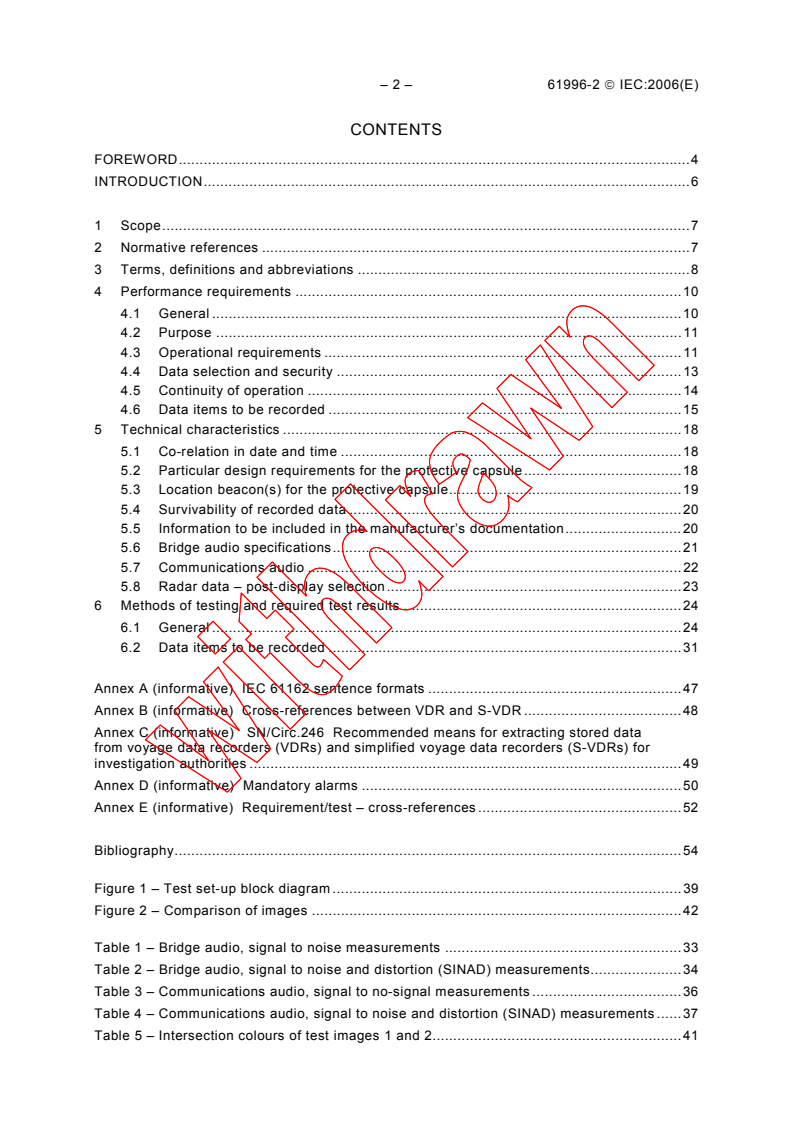
CONTENTS
FOREWORD.4
INTRODUCTION.6
1 Scope.7
2 Normative references .7
3 Terms, definitions and abbreviations .8
4 Performance requirements .10
4.1 General .10
4.2 Purpose .11
4.3 Operational requirements .11
4.4 Data selection and security .13
4.5 Continuity of operation .14
4.6 Data items to be recorded .15
5 Technical characteristics .18
5.1 Co-relation in date and time .18
5.2 Particular design requirements for the protective capsule.18
5.3 Location beacon(s) for the protective capsule.19
5.4 Survivability of recorded data .20
5.5 Information to be included in the manufacturer’s documentation.20
5.6 Bridge audio specifications.21
5.7 Communications audio .22
5.8 Radar data – post-display selection.23
6 Methods of testing and required test results .24
6.1 General .24
6.2 Data items to be recorded .31
Annex A (informative) IEC 61162 sentence formats .47
Annex B (informative) Cross-references between VDR and S-VDR .48
Annex C (informative) SN/Circ.246 Recommended means for extracting stored data
from voyage data recorders (VDRs) and simplified voyage data recorders (S-VDRs) for
investigation authorities .49
Annex D (informative) Mandatory alarms .50
Annex E (informative) Requirement/test – cross-references .52
Bibliography.54
Figure 1 – Test set-up block diagram .39
Figure 2 – Comparison of images .42
Table 1 – Bridge audio, signal to noise measurements .33
Table 2 – Bridge audio, signal to noise and distortion (SINAD) measurements.34
Table 3 – Communications audio, signal to no-signal measurements .36
Table 4 – Communications audio, signal to noise and distortion (SINAD) measurements .37
Table 5 – Intersection colours of test images 1 and 2.41
61996-2 IEC:2006(E) – 3 –
Table A.1 – References in this standard .47
Table B.1 – Subject list and clauses .48
Table D.1 – IMO instrument: SOLAS Chapter II-1 .50
Table D.2 – IMO instrument: SOLAS Chapter II-2 .51
Table D.3 – IMO instrument: Resolution A.481.51
Table E.1 – Subject list and clauses .52
– 4 – 61996-2 IEC:2006(E)
INTERNATIONAL ELECTROTECHNICAL COMMISSION
____________
MARITIME NAVIGATION AND RADIOCOMMUNICATION
EQUIPMENT AND SYSTEMS –
SHIPBORNE VOYAGE DATA RECORDER (VDR) –
Part 2: Simplified voyage data recorder (S-VDR) –
Performance requirements,
methods of testing and required test results
FOREWORD
1) The International Electrotechnical Commission (IEC) is a worldwide organization for standardization comprising
all national electrotechnical committees (IEC National Committees). The object of IEC is to promote
international co-operation on all questions concerning standardization in the electrical and electronic fields. To
this end and in addition to other activities, IEC publishes International Standards, Technical Specifications,
Technical Reports, Publicly Available Specifications (PAS) and Guides (hereafter referred to as “IEC
Publication(s)”). Their preparation is entrusted to technical committees; any IEC National Committee interested
in the subject dealt with may participate in this preparatory work. International, governmental and non-
governmental organizations liaising with the IEC also participate in this preparation. IEC collaborates closely
with the International Organization for Standardization (ISO) in accordance with conditions determined by
agreement between the two organizations.
2) The formal decisions or agreements of IEC on technical matters express, as nearly as possible, an international
consensus of opinion on the relevant subjects since each technical committee has representation from all
interested IEC National Committees.
3) IEC Publications have the form of recommendations for international use and are accepted by IEC National
Committees in that sense. While all reasonable efforts are made to ensure that the technical content of IEC
Publications is accurate, IEC cannot be held responsible for the way in which they are used or for any
misinterpretation by any end user.
4) In order to promote international uniformity, IEC National Committees undertake to apply IEC Publications
transparently to the maximum extent possible in their national and regional publications. Any divergence
between any IEC Publication and the corresponding national or regional publication shall be clearly indicated in
the latter.
5) IEC provides no marking procedure to indicate its approval and cannot be rendered responsible for any
equipment declared to be in conformity with an IEC Publication.
6) All users should ensure that they have the latest edition of this publication.
7) No liability shall attach to IEC or its directors, employees, servants or agents including individual experts and
members of its technical committees and IEC National Committees for any personal injury, property damage or
other damage of any nature whatsoever, whether direct or indirect, or for costs (including legal fees) and
expenses arising out of the publication, use of, or reliance upon, this IEC Publication or any other IEC
Publications.
8) Attention is drawn to the Normative references cited in this publication. Use of the referenced publications is
indispensable for the correct application of this publication.
9) Attention is drawn to the possibility that some of the elements of this IEC Publication may be the subject of
patent rights. IEC shall not be held responsible for identifying any or all such patent rights.
International Standard IEC 61996-2 has been prepared by IEC technical committee 80:
Maritime navigation and radiocommunication equipment and systems.
This standard cancels and replaces IEC PAS 61996-2 published in 2005. This first edition
constitutes a technical revision and additionally incorporates new IMO recommendations on
means for extracting data from the S-VDR.
61996-2 IEC:2006(E) – 5 –
The text of this standard is based on the following documents:
FDIS Report on voting
80/430/FDIS 80/439/RVD
Full information on the voting for the approval of this standard can be found in the report on
voting indicated in the above table.
This publication has been drafted in accordance with the ISO/IEC Directives, Part 2.
IEC 61996 consists of the following parts under the general title Maritime navigation and
radiocommunication equipment and systems – Shipborne voyage data recorder (VDR):
Part 1: Performance requirements, methods of testing and required test results
Part 2: Simplified voyage data recorder (S-VDR) – Performance requirements, methods of
testing and required test results.
The committee has decided that the contents of this publication will remain unchanged until
the maintenance result date indicated on the IEC web site under "http://webstore.iec.ch" in
the data related to the specific publication. At this date, the publication will be
• reconfirmed,
• withdrawn,
• replaced by a revised edition, or
• amended.
A bilingual version of this publication may be issued at a later date.
– 6 – 61996-2 IEC:2006(E)
INTRODUCTION
The S-VDR has been introduced by IMO for fitting to existing ships as a simplified alternative
to the voyage data recorder (VDR) which is required for all new ships.
This part of IEC 61996 provides information on the testing requirements for S-VDR as defined
in IMO performance standard MSC.163(78).
The specification for S-VDR differs significantly from that for VDR in two areas:
a) the requirements for monitoring certain sensors are reduced when the data is not
provided in IEC 61162 format, and
b) the requirements for the protective S-VDR capsule are different from the VDR capsule,
both for the fixed and float-free versions.
Annex B provides a cross-reference between this standard and IEC 61996-1 to aid test
houses who may already have test results for VDRs which are being submitted as S-VDRs.
Subsequent to publishing the performance standard for S-VDR, MSC.163(78), in 2004, the
IMO sub-committee on Safety of Navigation (NAV) at its fifty-first session in June 2005,
discussed the issue of download and playback of information. Recognising that after an
accident there is a need for investigators to be able to download the stored data and playback
the information from VDRs/S-VDRs without delay, the sub-committee agreed on
recommended means for extracting stored data for investigation authorities as SN/Circ.246.
This Circular is reproduced as Annex C and its recommendations are referenced in this
standard.
61996-2 IEC:2006(E) – 7 –
MARITIME NAVIGATION AND RADIOCOMMUNICATION
EQUIPMENT AND SYSTEMS –
SHIPBORNE VOYAGE DATA RECORDER (VDR) –
Part 2: Simplified voyage data recorder (S-VDR) –
Performance requirements,
methods of testing and required test results
1 Scope
This part of IEC 61996 specifies the minimum performance requirements, technical
characteristics and methods of testing, and required test results, for simplified shipborne
voyage data recorders (S-VDRs) as required by IMO MSC.163(78). It takes into account IMO
resolution A.694(17) and is associated with IEC 60945. When a requirement in this standard
is different from IEC 60945, the requirement in this standard takes precedence.
NOTE All text of this standard, whose wording is identical to that of IMO MSC.163(78) or A.861(20) is printed in
italics, and the Resolution and associated performance standard paragraph numbers are indicated in brackets.
2 Normative references
The following referenced documents are indispensable for the application of this document.
For dated references, only the edition cited applies. For undated references, the latest edition
of the referenced document (including any amendments) applies.
IEC 60068-2-27:1987, Environmental testing – Part 2: Tests – Test Ea and guidance: Shock
IEC 60268-16:2003, Sound system equipment – Part 16: Objective rating of speech
intelligibility by speech transmission index
IEC 61672-1:2002, Electroacoustics – Sound level meters – Part 1: Specifications
IEC 60945:2002, Maritime navigation and radiocommunication equipment and systems –
General requirements – Methods of testing and required test results
IEC 61097-2:2002, Global maritime distress and safety system (GMDSS) – Part 2: COSPAS
SARSAT EPIRB – Satellite emergency position-indicating radio beacon operating on 406 MHz
– Operational and performance requirements, methods of testing and required test results
IEC 61097-7:1996, Global maritime distress and safety system (GMDSS) – Part 7: Shipborne
VHF radiotelephone transmitter and receiver – Operational and performance requirements,
methods of testing and required test results
IEC 61162-1, Maritime navigation and radiocommunication equipment and systems – Digital
interfaces – Part 1: Single talker and multiple listeners
IEC 61162-2, Maritime navigation and radiocommunication equipment and systems – Digital
interfaces – Part 2: Single talker and multiple listeners, high-speed transmission
IEC 61260:1995, Electroacoustics – Octave-band and fractional-octave-band filters
– 8 – 61996-2 IEC:2006(E)
IMO A.658(16): Use and fitting of retro-reflective materials on life-saving appliances
IMO A.662(16): Performance standards for float-free release and activation arrangements for
emergency radio equipment
IMO A.694(17): General requirements for shipborne radio equipment forming part of the
Global maritime distress and safety system (GMDSS) and for electronic navigational aids
IMO A.810(19): Performance standards for float-free satellite emergency position-indicating
radio beacons (EPIRBs) operating on 406 MHz
IMO A.830(19): Code on alarms and indicators
IMO A.861(20): Performance standards for shipborne voyage data recorders (VDRs)
IMO MSC.81(70): Testing of life saving appliances
IMO MSC.163(78): Performance standards for shipborne simplified voyage data recorders
(S-VDR).
IMO:1974, International Convention for the Safety of Life at Sea (SOLAS), as amended
ITU-R M.633-3:2004, Transmission characteristics of a satellite emergency position-indicating
radiobeacon (satellite EPIRB) system operating through a low polar-orbiting satellite system
in the 406 MHz band
Eurocae: ED56A Amendment 1 – Minimum operational performance specification (MOPS) for
cockpit voice recorder system
VESA:1996, Video electronics standards association – Discrete monitor timings standard 1.0,
Revision 0.7 (DMT)
SAE AS 8045:1988, Engineering Society for advancing mobility land sea air and space –
Minimum performance standard for underwater locating devices – acoustic-self-powered
3 Terms, definitions and abbreviations
For the purposes of this document, the following terms, definitions and abbreviations apply.
3.1 Definitions
3.1.1
activation of a suitable alarm
mutable audible alarm and persistent visual indication, given according to the requirements of
IMO A.830(19) but with an audible level in the range of 55 dBA to 65 dBA
3.1.2
combined EPIRB/S-VDR capsule
a single unit which meets all the requirements of a satellite EPIRB (as required by the
carriage requirements of SOLAS IV) and all the requirements of a S-VDR (as required by the
carriage requirements of SOLAS V)
61996-2 IEC:2006(E) – 9 –
3.1.3
bridge work station
position at which a person is expected to be when performing one of the normal bridge duties
at, for example, the following work stations:
• centre line conning
• bridge wing(s)
• main radar
• chart table
• helms
• communication
3.1.4
data
any item of information received by the S-VDR for recording, including numerical values, text
and audio or radar signals, except where specifically stated or the context dictates otherwise
3.1.5
dedicated reserve power source (MSC.163(78) 4.5)
secondary battery, with suitable automatic charging arrangements, dedicated solely to the S-
VDR, of sufficient capacity to operate it as required by 4.5.3
3.1.6
final recording medium (MSC.163(78) 4.3)
any item of hardware on which the data is recorded such that access to it would enable the
data to be recovered and played back by use of suitable equipment
3.1.7
playback equipment (MSC.163(78) 4.4)
any equipment, compatible with the recording medium and the format used during recording,
employed for recovering the data. It includes also the display or presentation hardware and
software that is appropriate to the original data source equipment
3.1.8
recorder (S-VDR) (MSC.163(78) 4.1)
complete system, including any items required to interface with the sources of input data, for
processing and encoding the data, the final recording medium in its capsule, the power supply
and dedicated reserve power source
3.1.9
resolution
smallest detectable increment between two values
3.1.10
sensor (MSC.163(78) 4.2)
any unit external to the S-VDR to which the S-VDR is connected and from which it obtains
data to be recorded
3.2 Abbreviations
AIS Automatic identification system
ALR IEC 61162 sentence: Set alarm state
DPT IEC 61162 sentence: Depth relative to the transducer
DTM IEC 61162 sentence: Geodetic datum reference
EPFS Electronic position fixing system
EPIRB Emergency position-indicating radio beacon
– 10 – 61996-2 IEC:2006(E)
EUT Equipment under test
GMDSS Global maritime distress and safety system
GNS IEC 61162 sentence: GNSS fix data
GNSS Global navigation satellite system
HDG IEC 61162 sentence: Magnetic compass heading
HDT IEC 61162 sentence: True heading
HTC IEC 61162 sentence: Heading/track control command
HTD IEC 61162 sentence: Heading/track control data
IMO International Maritime Organization
INS Integrated navigation system
ITU International Telecommunication Union
MWV IEC 61162 sentence: Wind speed and angle
OOW Officer of the watch
ROV Remotely operated vehicle
RPM IEC 61162 sentence: Revolutions per minute
RSA IEC 61162 sentence: Rudder sense angle
SAR Search and rescue
SENC System electronic navigation chart
SINAD Signal to noise and distortion
STI Sound transmission index
TXT IEC 61162 sentence: Text message
UTC Coordinated universal time
VDM IEC 61162 sentence: AIS – VHF data link message
VDO IEC 61162 sentence: AIS – VHF data link own-vessel message
VHF Very high frequency
VBW IEC 61162 sentence: Dual ground water speed
XDR IEC 61162 sentence: Transducer measurements
ZDA IEC 61162 sentence: Time and date
NOTE For IEC 61162 sentences, see Annex A.
4 Performance requirements
Performance requirements described in the following clauses are specified, where relevant,
by reference to the numbered paragraphs of IMO MSC.163(78), if not otherwise indicated.
4.1 General
Requirements specified in this standard are only relevant to equipment designated as an
S-VDR and required to meet IMO MSC.163(78).
For equipment designated as a VDR to IMO Performance standards defined in resolution
A.861(20) refer to IEC 61996-1.
A table of cross-references between this standard and IEC 61996-1 is included in Annex B.
61996-2 IEC:2006(E) – 11 –
4.2 Purpose
(MSC.163(78) 1)
The purpose of a simplified voyage data recorder (S-VDR) is to maintain a store, in a secure
and retrievable form, of information concerning the position, movement, physical status,
command and control of a vessel over the period leading up to, and following, an incident
having an impact thereon. Information contained in a S-VDR shall be made available to both
the Administration and the shipowner. This information is for use during any subsequent
investigation to identify the cause(s) of the incident.
4.3 Operational requirements
(MSC.163(78) 5)
4.3.1 Design and construction
(MSC.163(78) 5.1.4)
The design and construction, which shall be in accordance with the requirements of resolution
A.694(17) and international standards acceptable to the Organization , shall take special
account of the requirements for data security and continuity of operation as detailed in
IMO MSC.163(78) 5.2 and 5.3 and in this standard 4.3, 4.4 and 4.5.
4.3.2 Maintenance of sequential records
(MSC.163(78) 5.1.1)
The S-VDR shall continuously maintain sequential records of pre-selected data items relating
to the status and output of the ship's equipment, and command and control of the ship,
referred to in 4. 6.
4.3.3 Co-relation in date and time
(MSC.163(78) 5.1.2, 5.4.1)
To permit subsequent analysis of factors surrounding an incident, the method of recording
shall ensure that the various data items can be co-related in date and time during playback on
suitable equipment.
The recording method shall be such that the timing of all other recorded data items can be
derived on playback with a resolution sufficient to reconstruct the history of an incident in
detail (see 4.6.1).
4.3.4 Protective capsule
4.3.4.1 Final recording medium
(MSC.163(78) 5.1.3)
The final recording medium shall be installed in a protective capsule. The capsule may be
designed to remain fixed to the ship in all circumstances. Alternatively, it may be designed to
float free automatically if the ship sinks (see 5.2). The fixed capsule may also comply with the
requirements of IEC 61996-1.
4.3.4.1.1 Fixed capsule
(MSC.163(78) 5.1.3.2)
The fixed type protective capsule shall comply with the requirements set out in resolution
A.861(20) and this standard with the exception of the resulting requirements for withstanding
penetration.
———————
Refer to IEC 60945: Maritime navigation and radiocommunication equipment and systems – General
requirements, methods of testing and required test results.
– 12 – 61996-2 IEC:2006(E)
4.3.4.1.2 Float-free capsule
(MSC.163(78) 5.1.3.3)
In addition to meeting the requirements of this standard, the float-free type protective capsule
shall:
a) be so constructed as to comply with the requirements specified in resolutions A.810(19)
and A.662(16);
b) be fitted with means to facilitate grappling and recovery and be designed with due regard to
preventing it from being fouled during release;
c) be so constructed as to minimise the risk of loss or damage to the final recording medium
during recovery operations; and
d) be capable of transmitting an initial locating signal and a further locating and homing
signal for at least 48 hours over a period of not less than 7 days/168 hours.
4.3.4.2 Access to capsule
(MSC.163(78) 5.1.3.1.1) (See also 5.2)
The capsule shall be capable of being accessed following an incident but secure against
tampering.
The capsule shall enclose the final recording medium. The final recording medium shall not
be accessible by standard operating procedures during normal ship operations.
A means shall be provided to retrieve stored information via an external device without
opening the protective capsule.
4.3.4.3 Location and identification
(See also 5.2)
4.3.4.3.1 Location
(MSC.163(78) 5.1.3.1.4) (See also 5.3)
The capsule shall be fitted with an appropriate device to aid location.
4.3.4.3.2 Visibility and marking
(MSC.163(78) 5.1.3.1)
The capsule, together with any outermost shell, shall be of a highly visible colour, marked
with retro-reflective materials that comply with the relevant requirements of IMO A.658(16)
and marked with the legend:
“VOYAGE DATA RECORDER – DO NOT OPEN –
REPORT TO AUTHORITIES”
4.3.5 Assessment of recording medium
Where the storage medium cannot be readily and reliably inspected after an incident, means
shall be provided to enable an accident investigator to determine, prior to an attempted
replay, whether the storage medium has been subjected to an excessive level of heat, where
the survival of the stored data may be in doubt.
61996-2 IEC:2006(E) – 13 –
4.3.6 Interfaces
(MSC.163(78) 7)
Interfacing to the various sensors required shall be in accordance with the relevant
international interface standard, IEC 61162 series, where possible (see Annex A).
The interfaces for bridge audio, communications audio and radar are defined in 5.6.1, 5.7.1
and 5.8.1 respectively.
Any interface units which may be required to convert non-IEC 61162 signals, shall conform to
the requirements of IEC 60945.
In all cases, any connection to any item of the ship's equipment shall be such that the
operation of that equipment suffers no deterioration, even if the S-VDR system develops
faults.
NOTE No loss of steering or propulsion is allowed.
4.4 Data selection and security
(MSC.163(78) 5.2)
4.4.1 Selection of data items
(MSC.163(78) 5.2.1)
The minimum selections of operational data items to be recorded by the S-VDR are specified
in 4.6. Optionally, additional items may be recorded provided that the requirements for the
recording and storage of the specified selections are not compromised.
In addition to the operational data referred to in the preceding paragraph, a data block
defining the configuration of the S-VDR and the sensors to which it is connected shall be
written into the final recording medium during commissioning of the S-VDR. This configuration
data shall be permanently retained in the final recording medium and protected from
modification other than by a duly authorised person following any change to the configuration.
Any change to the configuration of this data block shall not affect the recording of the
mandatory items.
The following system configuration information and data source identity shall be included in
this data block:
a) type approval authority and reference;
b) IMO vessel identification number;
c) software version(s) used;
d) microphone locations and recording port allocation;
NOTE This does not imply channelisation.
e) VHF communications – which VHF radio installation is recorded;
f) date and time – from which source obtained;
g) ship’s position – from which EPFS obtained and relative position on the vessel;
h) other data inputs – identification of which equipment is supplying recorded data; sign
conventions and identity of all alarm/door inputs; and
i) automatic insertion of date and time of last amendment.
– 14 – 61996-2 IEC:2006(E)
4.4.2 Resistance to tampering
(MSC.163(78) 5.2.2)
The equipment shall be so designed that, as far as is practical, it is not possible to tamper
with the selection of data being input to the equipment, the data itself nor that which has
already been recorded. Any attempt to interfere with the integrity of the data or the recording
shall be recorded.
4.4.3 Recording integrity
(MSC.163(78) 5.2.3)
The recording method shall be such that each item of the recorded data is checked for
integrity, for example, it is identical to the data being received, and an alarm given if a non-
correctable error is detected.
The S-VDR shall automatically continuously monitor the following (see 6.1.10):
a) power supply;
b) record function;
c) bit error rate;
d) microphone functionality.
Malfunction of any of the above shall generate an alarm (see 3.1.1) in accordance with the
relevant requirements of IMO A.830(19) at the position from which the vessel is normally
navigated. It shall be possible to mute the alarm but a visual indication shall remain until the
equipment is serviceable. It shall also indicate its alarm status by means of contacts of a relay
(or equivalent) which is held energised in the no-alarm condition.
4.5 Continuity of operation
4.5.1 Operation
(MSC.163(78) 6)
The unit shall be entirely automatic in normal operation. Means shall be provided to ensure
that the recorded data can be saved by an appropriate method following an incident, with
minimal interruption to the recording process and without requiring opening of the protective
capsule. Controls for use during the saving process shall be simple to use.
a) The recording process to the final recording medium shall not be interrupted for more than
10 min during the saving process. The data recorded in the final recording medium shall
not be erased.
b) The data saved shall be automatically checked to ensure that it is identical to the recorded
data on the final recording medium. Any failure shall be indicated.
c) When the saving process is completed, means shall be provided to enable copies to be
made of this or of data relating to subsequent incidents.
NOTE “Saving process” – means – preserving a copy of the data contained in the final recording medium.
d) The S-VDR shall be provided with an output port providing data in an internationally
recognised format (see Annex C) .
———————
The Sub-Committee on Safety of Navigation (NAV), at its fifty-first session (6 to 10 June 2005), recognising
that, after an accident, there is a need for the investigators to be able to download the stored data and
playback the information from VDRs/S-VDRs without delay, agreed on recommended means for extracting
stored data from voyage data recorders (VDRs) and simplified voyage data recorders (S-VDRs) for
investigation authorities as SN/Circ.246 which is reproduced as Annex C.
61996-2 IEC:2006(E) – 15 –
4.5.2 Power source
(MSC.163(78) 5.3.1)
To ensure that the S-VDR continues to record events during an incident, it shall be capable of
operating from the ship's emergency source of electrical power. Whenever electrical power is
available the S-VDR shall operate, except as permitted in 4.5.4 (see 6.1.15).
4.5.3 Dedicated reserve power source
(MSC.163(78) 5.3.2)
If the ship's emergency source of electrical power supply fails, the S-VDR shall continue to
record bridge audio (see 4.6.5) from its dedicated reserve source of power for a period of
2 h. At the end of this 2 h period all recording shall cease automatically (see 3.1.5).
4.5.4 Recording period and duration
(MSC.163(78) 5.3.3)
Recording shall be continuous unless interrupted briefly in accordance with 4. 5 . 1 or
terminated in accordance with 4.5.3. The time for which all stored data items are retained
shall be at least 12 h. Data items which are older than this may be overwritten with new data.
Recording may also be terminated, by means of a key or other secure method.
NOTE This may occur under the following circumstances:
a) during essential maintenance purposes whilst the vessel is in port;
b) when the vessel is laid up;
c) when the vessel has a marine incident.
4.6 Data items to be recorded
(MSC.163(78) 5.4)
4.6.1 Date and time
(MSC.163(78) 5.4.1)
Date and time referenced to UTC, shall be obtained from a source external to the ship (for
example, an EPFS or radio time signal if available), or from an internal clock at least once
per hour. The recording shall indicate which source is in use. The recording method shall be
such that the timing of all other recorded data items can be derived on playback with a
resolution sufficient to reconstruct the history of the incident in detail, not worse than 1 s.
4.6.2 Ship’s position
(MSC.163(78) 5.4.2)
Latitude and longitude, and the datum used, shall be derived from a designated EPFS or INS
if available. The recording shall ensure that the identity and status of the source can always
be determined on playback. The ship’s position shall be recorded, as available on the ship, up
to a resolution of 0,0001 min of arc.
4.6.3 Speed
(MSC.163(78) 5.4.3)
Speed through the water, or speed over the ground (transverse as well as longitudinal in
either case, as available on the ship), including an indication from which it is, derived from the
ship’s designated speed and distance measuring equipment, shall be recorded, as available
on the ship, up to a resolution of 0,1 kn.
– 16 – 61996-2 IEC:2006(E)
4.6.4 Heading
(MSC.163(78) 5.4.4)
As indicated by a designated ship's compass. The ship’s heading shall be recorded, as
available on the ship, up to a resolution of 0,1°.
4.6.5 Bridge audio
(MSC.163(78) 5.4.5)
One or more microphones positioned on the bridge shall be placed, such that conversation at
or near the conning stations, radar displays, chart tables etc., (for example at work stations as
defined in 3.1.9) may be adequately recorded. As far as is practicable, the positioning of
microphones shall also capture the input and output of intercom, public address systems and
the audible alarms on the bridge (bridge mounted equipment).
The audio signals at all work stations shall be recorded continuously. Optionally, means may
be provided so that the originating work station can be identified with the audio signal being
analysed during playback of the recorded information (see 5.6 for technical characteristics).
4.6.6 Communications audio
(MSC.163(78) 5.4.6)
VHF communications relating to ship operations shall be recorded, independently of the
bridge audio. The recording shall include both transmitted and received audio signals and
shall be continuous from a directly connected fixed VHF radio to be designated at installation
of the S-VDR (see 5.7 for technical characteristics).
4.6.7 Radar data – post-display selection
(MSC.163(78) 5.4.7)
This shall include electronic signal information from within one of the ship's radar installations
which records all the information which was actually being presented on the master display of
that radar at the time of recording. This shall include any range rings or markers, bearing
markers, electronic plotting symbols, radar maps, whatever parts of the SENC or other
electronic chart or map that were selected, the voyage plan, navigational data, navigational
alarms and the radar status data that were visible on the display. The recording method shall
be such that, on playback, it is possible to present a faithful replica of the entire radar display
that was on view at the time of recording, albeit within the limitations of any bandwidth
compression techniques that are essential to the working of the S-VDR (see 5.8).
4.6.8 AIS
(MSC.163(78) 5.4.8)
Where there is no commercial off-the-shelf interface available to obtain radar data then AIS
target data shall be recorded as a source of information regarding other ships; otherwise AIS
information may be recorded additionally as a beneficial secondary source of information on
both other and own ship.
The VDM message shall be recorded in such a way, that all target data available from the
onboard AIS are acquired.
If the VDO message is recorded, this shall be additional to the recording of individual sensor
data as per 4.6.1 to 4.6.4.
61996-2 IEC:2006(E) – 17 –
4.6.9 Other items
(MSC.163(78) 5.4.9)
Any additional data items listed by IMO with the requirements set out in resolution A.861(20)
(4.6.10 to 4.6.17 below) shall be recorded where the data is available in accordance with the
international digital interface standards using approved sentence formatters.
4.6.10 Echo sounder
(A.861(20) 5.4.8)
This shall include depth under keel,up to a resolution of 0,1 m as available on the ship. The
depth scale currently being displayed and other status information shall be recorded where
available.
4.6.11 Main alarms
(A.861(20) 5.4.9)
This shall include the status of all IMO mandatory alarms on the bridge.
The status of all IMO mandatory alarms shall be recorded by the bridge audio and as a data
parameter where practicable (see Annex D).
4.6.12 Rudder order and response
(A.861(20) 5.4.10)
Both rudder order and response angles shall be recorded up to a resolution of 1º as available
and permitted on the ship. Status and settings of heading or track controller, if fitted, shall
also be recorded.
4.6.13 Engine order and response
(A.861(20) 5.4.11)
This shall include the positions of any engine telegraphs or direct engine/propeller controls,
including shaft(s) (revolutions or equivalent), and feedback indications, if fitted, including
ahead/astern indicators. This shall also include status of bow and stern thrusters if fitted.
Revolutions shall be recorded up to a resolution of 1 rpm and pitch shall be recorded up to a
o
resolution of 1 .
4.6.14 Hull openings (doors) status
(A.861(20) 5.4.12)
This shall include all IMO mandatory status information required to be displayed on the
bridge.
4.6.15 Watertight and fire door status
(A.861(20) 5.4.13)
This shall include all IMO mandatory status information required to be displayed on the
bridge.
4.6.16 Accelerations and hull stresses
(A.861(20) 5.4.14)
Where a ship is fitted with IMO mandated hull stress and response monitoring equipment, all
the data items that have been pre-selected within that equipment and are available shall be
recorded.
———————
Refer to publication IEC 61162.
– 18 – 61996-2 IEC:2006(E)
4.6.17 Wind speed and direction
(A.861(20) 5.4.15)
This shall be applicable where a ship is fitted with a suitable sensor. Either relative or true
wind speed and direction may be recorded, but an indication of which it is shall be recorded.
5 Technical characteristics
5.1 Co-relation in date and time
To ensure that relative timings can be determined within a resolution of 0,1 s, all data items
shall, when sampled by the S-VDR, be recorded with a time index derived from a S-VDR
system clock with a resolution of 0,05 s. The drift of this system clock shall be not more than
1 s in 1 h.
5.2 Particular design requirements for the protective capsule
(MSC.163(78) 5.1.3)
The final recording medium shall be installed in a protective capsule of either a fixed or float-
free type, which shall meet all of the following requirements:
a) maintain the recorded data for a period of at least 2 years following termination of
recording;
b) be of a highly visible colour and marked with retro-reflective materials.
5.2.1 Fixed protective capsule
5.2.1.1 Design of the fixed capsule
The capsule containing the final recording medium shall be designed to be installed on the
external deck of the vessel.
The capsule shall be designed to protect the stored data against the following (see 5.4.2.1):
– shock;
– fire;
– deep-sea pressure and immersion.
5.2.1.2 Release mechanism
The fixed capsule shall have a release mechanism to facilitate recovery under water by a
diver or a remotely operated vehicle (ROV). Possible items to be considered are:
a) the use of break-away bolts;
b) release levers; or
c) twist lock.
To ensure that the capsule may be retrieved safely after release, suitable large pad eyes or
handles shall be incorporated.
NOTE It should be borne in mind that the manipulator jaws of typical underwater recovery machines have a
maximum opening of only 300 mm, a gripping force limit of about 1 kN, and a pulling force limit of about
...
Questions, Comments and Discussion
Ask us and Technical Secretary will try to provide an answer. You can facilitate discussion about the standard in here.
Loading comments...