

IEC 61162-2:2024
(Main)Maritime navigation and radiocommunication equipment and systems - Digital interfaces - Part 2: Single talker and multiple listeners, high-speed transmission
General Information
- Abstract
IEC 61162-2:2024 contains the requirements for data communication between maritime electronic instruments, navigation and radiocommunication equipment when interconnected via an appropriate interface. This document is intended to support one-way serial data transmission from a single talker to one or more listeners. This data is in printable ASCII form and can include any information as specified by approved sentences or information coded according to the rules for proprietary sentences. Typical messages can be from 11 to a maximum of 79 characters in length and generally require repetition rates up to once per 20 ms. The electrical definitions in this document are intended to accommodate higher data rates than are specified in IEC 61162-1. Since there is no provision for guaranteed delivery of messages and only limited error-checking capability, it is important this document is used with caution in all safety applications.
- Status
- Published
- Publication Date
- 03-Apr-2024
- Technical Committee
- TC 80 - Maritime navigation and radiocommunication equipment and systems
- Drafting Committee
- WG 6 - TC 80/WG 6
- Current Stage
- PPUB - Publication issued
- Start Date
- 04-Apr-2024
- Completion Date
- 01-Dec-2023
Buy Documents

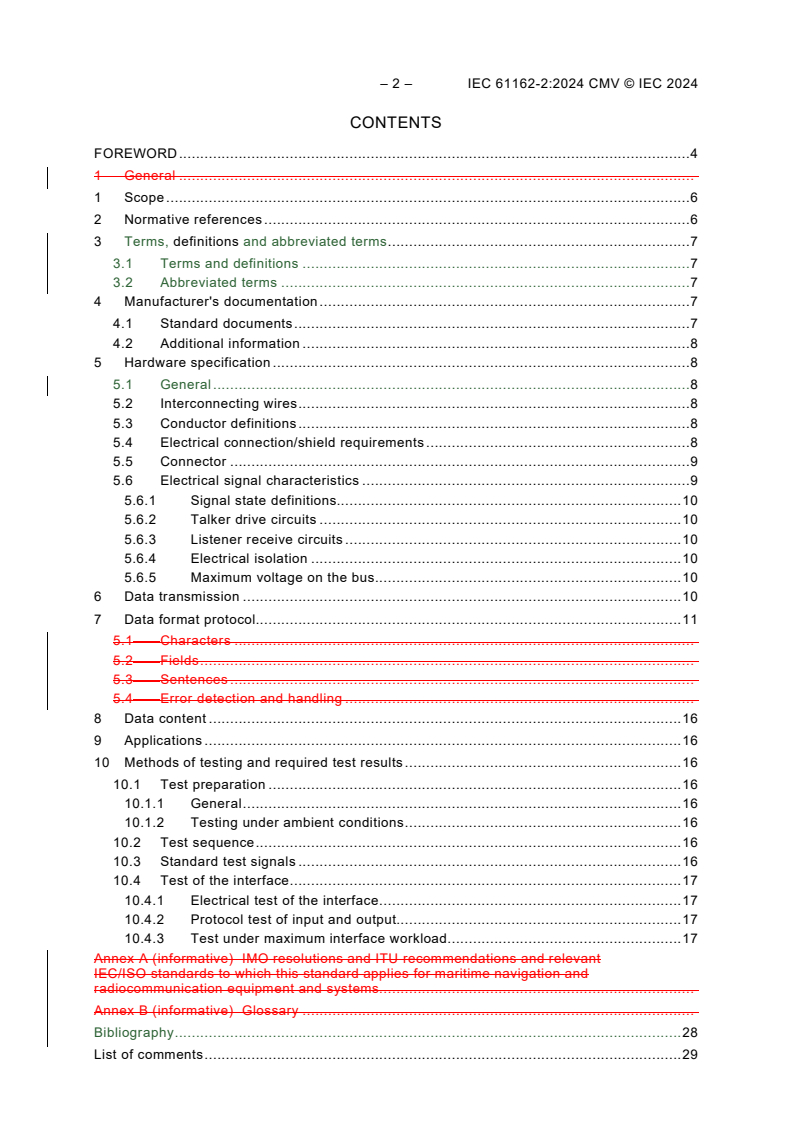
REDLINE IEC 61162-2:2024 CMV - Maritime navigation and radiocommunication equipment and systems - Digital interfaces - Part 2: Single talker and multiple listeners, high-speed transmission Released:4/4/2024
IEC 61162-2:2024 - Maritime navigation and radiocommunication equipment and systems - Digital interfaces - Part 2: Single talker and multiple listeners, high-speed transmission Released:4/4/2024
Overview
IEC 61162-2:2024 - "Maritime navigation and radiocommunication equipment and systems - Digital interfaces - Part 2: Single talker and multiple listeners, high‑speed transmission" specifies requirements for one‑way serial data communication between maritime electronic instruments, navigation and radiocommunication equipment. The standard defines a single talker / multiple listeners architecture using printable ASCII sentences (approved or proprietary), supports higher electrical data rates than IEC 61162-1, and is intended for high‑speed transmission scenarios. The 2024 edition is a technical revision (Edition 2.0) that updates hardware alternatives and makes the data transmission rate configurable (default 38 400 bit/s).
Key topics and technical requirements
- One‑way serial transmission: data flows from a single talker to one or more listeners; no multi‑talk/arbiter mechanism.
- Data format: printable ASCII sentences as per approved or proprietary sentence rules; typical messages are about 11 to 79 characters.
- Timing: messages may require repetition rates up to once per 20 ms.
- Configurable data rate: electrical definitions accommodate higher rates than IEC 61162-1; default remains 38 400 bit/s but higher rates may be used.
- Electrical and connector specifications: includes wiring, shielding, connector and isolation guidance to support high‑speed balanced circuits.
- Limited delivery guarantees: there is no guaranteed delivery mechanism and only limited error‑checking - the standard explicitly warns against using it for safety‑critical functions without caution.
- Testing and validation: methods for interface, electrical and protocol testing, including workload and ambient condition tests, are specified.
Practical applications
IEC 61162-2 is used to interconnect maritime instruments and bridge equipment where fast, one‑way data broadcast is needed. Typical applications include:
- High‑speed distribution of navigation sensor data to multiple bridge displays and subsystems
- Interconnection of radiocommunication devices with onboard loggers and monitors
- Integration of proprietary sentence streams between equipment vendors
Because error checking and delivery guarantees are limited, IEC 61162-2 is best applied to non‑safety‑critical data distribution or in architectures where higher‑level redundancy/error handling is implemented.
Who should use this standard
- Manufacturers of maritime navigation and radiocommunication equipment
- System integrators and bridge system designers
- Shipyards and vessel automation teams
- Test laboratories and certification bodies validating interface compliance
Related standards (normative / informative)
- IEC 61162-1 (Part 1: single talker and multiple listeners, baseline data format & protocols)
- IEC 60945 (general requirements and test methods for maritime equipment)
- ITU‑T X.27 / V.11 and EIA‑485 (electrical characteristics for balanced high‑speed circuits)
- NMEA 0183 (widely referenced sentence structure for maritime sensors)
Keywords: IEC 61162-2:2024, maritime digital interfaces, single talker multiple listeners, high‑speed transmission, printable ASCII, serial data transmission, 38 400 bit/s, IEC 61162-1, NMEA 0183.
Relations
- Effective Date
- 05-Sep-2023
Buy Documents
REDLINE IEC 61162-2:2024 CMV - Maritime navigation and radiocommunication equipment and systems - Digital interfaces - Part 2: Single talker and multiple listeners, high-speed transmission Released:4/4/2024
IEC 61162-2:2024 - Maritime navigation and radiocommunication equipment and systems - Digital interfaces - Part 2: Single talker and multiple listeners, high-speed transmission Released:4/4/2024
Get Certified
Connect with accredited certification bodies for this standard

DNV
DNV is an independent assurance and risk management provider.

Lloyd's Register
Lloyd's Register is a global professional services organisation specialising in engineering and technology.

FSC International
Forest Stewardship Council certification.
Sponsored listings
Frequently Asked Questions
IEC 61162-2:2024 is a standard published by the International Electrotechnical Commission (IEC). Its full title is "Maritime navigation and radiocommunication equipment and systems - Digital interfaces - Part 2: Single talker and multiple listeners, high-speed transmission". This standard covers: IEC 61162-2:2024 contains the requirements for data communication between maritime electronic instruments, navigation and radiocommunication equipment when interconnected via an appropriate interface. This document is intended to support one-way serial data transmission from a single talker to one or more listeners. This data is in printable ASCII form and can include any information as specified by approved sentences or information coded according to the rules for proprietary sentences. Typical messages can be from 11 to a maximum of 79 characters in length and generally require repetition rates up to once per 20 ms. The electrical definitions in this document are intended to accommodate higher data rates than are specified in IEC 61162-1. Since there is no provision for guaranteed delivery of messages and only limited error-checking capability, it is important this document is used with caution in all safety applications.
IEC 61162-2:2024 contains the requirements for data communication between maritime electronic instruments, navigation and radiocommunication equipment when interconnected via an appropriate interface. This document is intended to support one-way serial data transmission from a single talker to one or more listeners. This data is in printable ASCII form and can include any information as specified by approved sentences or information coded according to the rules for proprietary sentences. Typical messages can be from 11 to a maximum of 79 characters in length and generally require repetition rates up to once per 20 ms. The electrical definitions in this document are intended to accommodate higher data rates than are specified in IEC 61162-1. Since there is no provision for guaranteed delivery of messages and only limited error-checking capability, it is important this document is used with caution in all safety applications.
IEC 61162-2:2024 is classified under the following ICS (International Classification for Standards) categories: 47.020.70 - Navigation and control equipment. The ICS classification helps identify the subject area and facilitates finding related standards.
IEC 61162-2:2024 has the following relationships with other standards: It is inter standard links to IEC 61162-2:1998. Understanding these relationships helps ensure you are using the most current and applicable version of the standard.
IEC 61162-2:2024 is available in PDF format for immediate download after purchase. The document can be added to your cart and obtained through the secure checkout process. Digital delivery ensures instant access to the complete standard document.
Standards Content (Sample)
IEC 61162-2 ®
Edition 2.0 2024-04
COMMENTED VERSION
INTERNATIONAL
STANDARD
colour
inside
Maritime navigation and radiocommunication equipment and systems –
Digital interfaces –
Part 2: Single talker and multiple listeners, high-speed transmission
All rights reserved. Unless otherwise specified, no part of this publication may be reproduced or utilized in any form
or by any means, electronic or mechanical, including photocopying and microfilm, without permission in writing from
either IEC or IEC's member National Committee in the country of the requester. If you have any questions about IEC
copyright or have an enquiry about obtaining additional rights to this publication, please contact the address below or
your local IEC member National Committee for further information.
IEC Secretariat Tel.: +41 22 919 02 11
3, rue de Varembé info@iec.ch
CH-1211 Geneva 20 www.iec.ch
Switzerland
About the IEC
The International Electrotechnical Commission (IEC) is the leading global organization that prepares and publishes
International Standards for all electrical, electronic and related technologies.
About IEC publications
The technical content of IEC publications is kept under constant review by the IEC. Please make sure that you have the
latest edition, a corrigendum or an amendment might have been published.
IEC publications search - webstore.iec.ch/advsearchform IEC Products & Services Portal - products.iec.ch
The advanced search enables to find IEC publications by a Discover our powerful search engine and read freely all the
variety of criteria (reference number, text, technical publications previews, graphical symbols and the glossary.
committee, …). It also gives information on projects, replaced With a subscription you will always have access to up to date
and withdrawn publications. content tailored to your needs.
IEC Just Published - webstore.iec.ch/justpublished
Electropedia - www.electropedia.org
Stay up to date on all new IEC publications. Just Published
The world's leading online dictionary on electrotechnology,
details all new publications released. Available online and
containing more than 22 500 terminological entries in English
once a month by email.
and French, with equivalent terms in 25 additional languages.
Also known as the International Electrotechnical Vocabulary
IEC Customer Service Centre - webstore.iec.ch/csc
(IEV) online.
If you wish to give us your feedback on this publication or
need further assistance, please contact the Customer Service
Centre: sales@iec.ch.
IEC 61162-2 ®
Edition 2.0 2024-04
COMMENTED VERSION
INTERNATIONAL
STANDARD
colour
inside
Maritime navigation and radiocommunication equipment and systems –
Digital interfaces –
Part 2: Single talker and multiple listeners, high-speed transmission
INTERNATIONAL
ELECTROTECHNICAL
COMMISSION
ICS 47.020.70 ISBN 978-2-8322-8713-2
– 2 – IEC 61162-2:2024 CMV © IEC 2024
CONTENTS
FOREWORD .4
1 General .
1 Scope .6
2 Normative references .6
3 Terms, definitions and abbreviated terms .7
3.1 Terms and definitions .7
3.2 Abbreviated terms .7
4 Manufacturer's documentation .7
4.1 Standard documents .7
4.2 Additional information .8
5 Hardware specification .8
5.1 General .8
5.2 Interconnecting wires .8
5.3 Conductor definitions .8
5.4 Electrical connection/shield requirements .8
5.5 Connector .9
5.6 Electrical signal characteristics .9
5.6.1 Signal state definitions. 10
5.6.2 Talker drive circuits . 10
5.6.3 Listener receive circuits . 10
5.6.4 Electrical isolation . 10
5.6.5 Maximum voltage on the bus . 10
6 Data transmission . 10
7 Data format protocol. 11
5.1 Characters .
5.2 Fields .
5.3 Sentences .
5.4 Error detection and handling .
8 Data content . 16
9 Applications . 16
10 Methods of testing and required test results . 16
10.1 Test preparation . 16
10.1.1 General . 16
10.1.2 Testing under ambient conditions . 16
10.2 Test sequence . 16
10.3 Standard test signals . 16
10.4 Test of the interface . 17
10.4.1 Electrical test of the interface . 17
10.4.2 Protocol test of input and output. 17
10.4.3 Test under maximum interface workload . 17
Annex A (informative) IMO resolutions and ITU recommendations and relevant
IEC/ISO standards to which this standard applies for maritime navigation and
radiocommunication equipment and systems.
Annex B (informative) Glossary .
Bibliography . 28
List of comments . 29
Figure 1 – Talker/listener connections.8
Figure 2 – Cables – Electrical shield requirements .9
Figure 3 – Data transmission format . 10
Table A.1 – Navigation .
Table A.2 – Radiocommunications for the global maritime distress and safety system
(GMDSS) .
– 4 – IEC 61162-2:2024 CMV © IEC 2024
INTERNATIONAL ELECTROTECHNICAL COMMISSION
____________
MARITIME NAVIGATION AND RADIOCOMMUNICATION
EQUIPMENT AND SYSTEMS – DIGITAL INTERFACES –
Part 2: Single talker and multiple listeners,
high-speed transmission
FOREWORD
1) The International Electrotechnical Commission (IEC) is a worldwide organization for standardization comprising
all national electrotechnical committees (IEC National Committees). The object of IEC is to promote international
co-operation on all questions concerning standardization in the electrical and electronic fields. To this end and
in addition to other activities, IEC publishes International Standards, Technical Specifications, Technical Reports,
Publicly Available Specifications (PAS) and Guides (hereafter referred to as “IEC Publication(s)”). Their
preparation is entrusted to technical committees; any IEC National Committee interested in the subject dealt with
may participate in this preparatory work. International, governmental and non-governmental organizations liaising
with the IEC also participate in this preparation. IEC collaborates closely with the International Organization for
Standardization (ISO) in accordance with conditions determined by agreement between the two organizations.
2) The formal decisions or agreements of IEC on technical matters express, as nearly as possible, an international
consensus of opinion on the relevant subjects since each technical committee has representation from all
interested IEC National Committees.
3) IEC Publications have the form of recommendations for international use and are accepted by IEC National
Committees in that sense. While all reasonable efforts are made to ensure that the technical content of IEC
Publications is accurate, IEC cannot be held responsible for the way in which they are used or for any
misinterpretation by any end user.
4) In order to promote international uniformity, IEC National Committees undertake to apply IEC Publications
transparently to the maximum extent possible in their national and regional publications. Any divergence between
any IEC Publication and the corresponding national or regional publication shall be clearly indicated in the latter.
5) IEC itself does not provide any attestation of conformity. Independent certification bodies provide conformity
assessment services and, in some areas, access to IEC marks of conformity. IEC is not responsible for any
services carried out by independent certification bodies.
6) All users should ensure that they have the latest edition of this publication.
7) No liability shall attach to IEC or its directors, employees, servants or agents including individual experts and
members of its technical committees and IEC National Committees for any personal injury, property damage or
other damage of any nature whatsoever, whether direct or indirect, or for costs (including legal fees) and
expenses arising out of the publication, use of, or reliance upon, this IEC Publication or any other IEC
Publications.
8) Attention is drawn to the Normative references cited in this publication. Use of the referenced publications is
indispensable for the correct application of this publication.
9) IEC draws attention to the possibility that the implementation of this document may involve the use of (a)
patent(s). IEC takes no position concerning the evidence, validity or applicability of any claimed patent rights in
respect thereof. As of the date of publication of this document, IEC had not received notice of (a) patent(s), which
may be required to implement this document. However, implementers are cautioned that this may not represent
the latest information, which may be obtained from the patent database available at https://patents.iec.ch. IEC
shall not be held responsible for identifying any or all such patent rights.
This commented version (CMV) of the official standard IEC 61162-2:2024 edition 2.0
allows the user to identify the changes made to the previous IEC 61162-2:1998
edition 1.0. Furthermore, comments from IEC TC 80 experts are provided to explain the
reasons of the most relevant changes, or to clarify any part of the content.
A vertical bar appears in the margin wherever a change has been made. Additions are in
green text, deletions are in strikethrough red text. Experts' comments are identified by a
blue-background number. Mouse over a number to display a pop-up note with the
comment.
This publication contains the CMV and the official standard. The full list of comments is
available at the end of the CMV.
IEC 61162-2 has been prepared by IEC technical committee 80: Maritime navigation and
radiocommunication equipment and systems. It is an International Standard.
This second edition cancels and replaces the first edition published in 1998. This edition
constitutes a technical revision.
This edition includes the following significant technical changes with respect to the previous
edition:
a) alternative hardware is given in 5.1 which may now be as specified in this document or as
specified in IEC 61162-1;
b) the data transmission rate given in Clause 6 is now configurable. The default remains as
38 400 (bits/s) but higher rates may be provided;
c) the description of the data format protocol has been removed as this information is given in
IEC 61162-1;
d) former Annex A and Annex B have been deleted as now of historic interest.
The text of this International Standard is based on the following documents:
Draft Report on voting
80/1065/CDV 80/1083/RVC
Full information on the voting for its approval can be found in the report on voting indicated in
the above table.
The language used for the development of this International Standard is English.
This document was drafted in accordance with ISO/IEC Directives, Part 2, and developed in
accordance with ISO/IEC Directives, Part 1 and ISO/IEC Directives, IEC Supplement, available
at www.iec.ch/members_experts/refdocs. The main document types developed by IEC are
described in greater detail at www.iec.ch/publications.
The committee has decided that the contents of this document will remain unchanged until the
stability date indicated on the IEC website under webstore.iec.ch in the data related to the
specific document. At this date, the document will be
• reconfirmed,
• withdrawn, or
• revised.
IMPORTANT – The "colour inside" logo on the cover page of this document indicates
that it contains colours which are considered to be useful for the correct understanding
of its contents. Users should therefore print this document using a colour printer.
– 6 – IEC 61162-2:2024 CMV © IEC 2024
MARITIME NAVIGATION AND RADIOCOMMUNICATION
EQUIPMENT AND SYSTEMS – DIGITAL INTERFACES –
Part 2: Single talker and multiple listeners,
high-speed transmission
1 General
1 Scope
This part of IEC 61162 contains the requirements for data communication between maritime
electronic instruments, navigation and radiocommunication equipment when interconnected via
an appropriate interface.
This document is intended to support one-way serial data transmission from a single talker to
one or more listeners. This data is in printable ASCII form and may can include any information
as specified by approved sentences or information coded according to the rules for proprietary
sentences. Typical messages may can be from 11 to a maximum of 79 characters in length and
generally require repetition rates up to once per 20 ms.
The electrical definitions in this document are intended to accommodate higher data rates than
are specified in IEC 61162-1. Since there is no provision for guaranteed delivery of messages
and only limited error-checking capability, it is important this document should be is used with
caution in all safety applications.
Annex A contains a list of relevant IMO resolutions and ITU recommendations to which this
standard applies. 1
2 Normative references
The following documents are referred to in the text in such a way that some or all of their content
constitutes requirements of this document. For dated references, only the edition cited applies.
For undated references, the latest edition of the referenced document (including any
amendments) applies.
IEC 60945:1996, Maritime navigation and radiocommunication equipment and systems –
General requirements – Methods of testing and required test results
IEC 61162-1:1995, Maritime navigation and radiocommunication equipment and systems –
Digital interfaces – Part 1: Single talker and multiple listeners
ITU-T Recommendation X.27/V.11:1996, Electrical characteristics for balanced double-current
interchange circuits operating at data signalling rates up to 10 Mbits/s
NMEA 0183 – Version 2.30:1998, National marine electronics association (USA) – Standard for
interfacing marine electronic navigational devices 2
EIA 485:1991, Electrical characteristics of generators and receivers for use in balanced digital
multipoint systems 2
3 Terms, definitions and abbreviated terms
Common terms are defined in the glossary of annex B. Where there is a conflict, terms shall be
interpreted, wherever possible, in accordance with the references in 1.2.
For the purposes of this document, the following terms and definitions apply.
ISO and IEC maintain terminology databases for use in standardization at the following
addresses:
• IEC Electropedia: available at https://www.electropedia.org/
• ISO Online browsing platform: available at https://www.iso.org/obp
3.1 Terms and definitions
3.1.1
talker
any device which sends data to other devices
Note 1 to entry: The type of talker is identified by a two-character mnemonic as listed in IEC 61162-1.
3.1.2
listener
any device which receives data from another device
3.1.3
latency
time interval between an event and its resulting information, including time for processing,
transmission and/or reception
3.2 Abbreviated terms 3
EMC electromagnetic compatibility
EUT equipment under test
4 Manufacturer's documentation
4.1 Standard documents
Operator Installation manuals or other appropriate literature 4 provided for equipment that is
intended to meet the requirements of this document shall contain as a minimum the following
information:
a) identification of the A, B and common (C) signal lines (see Figure 1);
b) the output drive capability as a talker;
c) a list of approved sentences, noting unused fields, proprietary sentences transmitted as a
talker, data latency and transmission interval for each sentence;
d) the load requirements as a listener;
e) a list of sentences and associated data fields that are required by, or are acceptable to, a
listener;
f) the current software and hardware revision, if this is relevant to the interface;
g) an electrical description or schematic of the listener/talker input/output circuits citing actual
components and devices used, including connector type and part number;
h) the version number and date of update of the standard for which compliance is sought;
i) list of supported baud rates (bits/s) including any limitations per each baud rate supported. 5
– 8 – IEC 61162-2:2024 CMV © IEC 2024
4.2 Additional information
As latency, filtering, error handling and data transmission interval can have a serious influence
on the performance of a system, the manufacturer shall give careful consideration to consider
these aspects. Documentation should include such data where applicable.
5 Hardware specification
5.1 General
One talker and multiple listeners may be connected in parallel over interconnecting wires.
Because of EMC requirements, shielded cables are recommended. The number of listeners
depends on the output capability, the input drive requirements of the connected devices, and
on the use of termination resistors.
Two alternatives apply for the hardware:
1) method based on 5.2 to 5.6;
2) method based on IEC 61162-1. 6
5.2 Interconnecting wires
Interconnection between devices may be by means of a shielded two-conductor twisted-pair
wire (A, B) plus any means to secure common signal ground potential (C) for transmitting and
receiving devices. For this purpose, a third wire additional to the twisted pair or the inner shield
of double-shielded cable with insulated shields may be used.
Figure 1 – Talker/listener connections
5.3 Conductor definitions
The conductors referred to in this document are the signal lines A, B, C (common) and shield.
5.4 Electrical connection/shield requirements
All signal and common line connections A, B and C are connected in parallel.
With single-shielded cables and a separate wire as common line C (signal ground), the shield
shall be connected to the talker chassis and shall not be connected to any listener. However,
the shield shall be continuous (unbroken) between all listeners – see Figure 1 and Figure 2 a).
With double-shielded cables and the inner shield used as common line C (signal ground), the
outer shield shall be connected to the talker chassis and shall not be connected to any listener.
However, the outer shield shall be continuous (unbroken) between all listeners – see Figure 1
and Figure 2 b).
With double-shielded cables and a separate wire as common line C (signal ground), the inner
shield shall be connected to the talker chassis and shall not be connected to any listener.
However, the inner shield shall be continuous (unbroken) between all listeners. The outer shield
may be connected to the chassis on either side if required – see Figure 1 and Figure 2 c).
The cabling shall be designed in a way that stubs are avoided or kept as short as possible. If
long cables are necessary, termination at the end of the line according to ITU-T
Recommendation X.27/V.11 shall be considered.
a) Single-shielded cable
b) Double-shielded cable
c) Double-shielded cable with separate wire
Figure 2 – Cables – Electrical shield requirements
5.5 Connector
No standard connector is specified. Wherever possible, readily available commercial
connectors shall be used. Manufacturers shall provide means for user identification of the
connections used.
5.6 Electrical signal characteristics
This subclause describes the electrical characteristics of transmitters and receivers. 7
– 10 – IEC 61162-2:2024 CMV © IEC 2024
5.6.1 Signal state definitions
The idle, marking, logical 1, OFF or stop bit state is defined by a negative voltage on line A with
respect to line B, as in IEC 61162-1.
The active, spacing, logical 0, ON or start bit state is defined by a positive voltage on line A
with respect to line B, as in IEC 61162-1.
5.6.2 Talker drive circuits
No provision is made for more than a single talker to be connected to the bus. The drive circuit
shall meet, as a minimum, the requirements of ITU-T Recommendation X.27/V.11.
Improved and compatible driver circuits (e.g. EIA TIA-485) used in a compliant way are allowed.
5.6.3 Listener receive circuits
Multiple listeners may be connected to a single talker. The listener's receive circuit shall comply
with ITU-T Recommendation X.27/V.11. Optional termination resistors for the line shall be
provided. The input terminals A, B and C shall be electrically isolated from the remaining
electronics of the listening device. Reference is made to 5.6.4 and a sample circuit shown in
Figure 1.
5.6.4 Electrical isolation
Within a listener, there shall be no direct electrical connection between the signal lines A and
B, the signal ground C or the shield to ship's mains ground or power line. This isolation shall
be in accordance with IEC 60945.
5.6.5 Maximum voltage on the bus
The maximum applied voltage between signal lines A and B and between either line and
ground C shall be in accordance with ITU-T Recommendation X.27/V.11.
For protection against miswiring and for unintended connection to earlier talker designs, all
receive circuit devices shall be capable of withstanding 15 V between either signal lines A and
B and between either line and ground for an indefinite period.
6 Data transmission
Data is transmitted in serial asynchronous form in accordance with 1.2 IEC 61162-1 8. The first
bit is a start bit and is followed by data bits, least-significant-bit first as in Figure 3.
Figure 3 – Data transmission format
The following parameters are used:
– baud rate default and required is 38 400 (bits/s), higher baud rates are allowed based on
equipment configuration setup; 5
– data bits 8 (D7 = 0), parity none;
– stop bits 1.
7 Data format protocol
5.1 Characters
All transmitted data shall be interpreted as ASCII characters. The most significant bit of the
eight-bit character shall always be transmitted as zero (D7 = 0).
5.1.1 Reserved characters
The reserved character set consists of those ASCII characters shown in 6.1 (table 1) of
IEC 61162-1. These characters are used for specific formatting purposes, such as sentence
and field delimiting, and shall not be used in data fields.
5.1.2 Valid characters
The valid character set consists of all printable ASCII characters (HEX 20 to HEX 7E) except
those defined as reserved characters. The list of the valid character set is given in 6.1 (table 2)
of IEC 61162-1.
5.1.3 Undefined characters
ASCII values not specified as either reserved characters or valid characters are excluded and
shall not be transmitted at any time.
5.1.4 Character symbols
When individual characters are used in this standard to define units of measurement, to indicate
the type of data field, type of sentence, etc., they shall be interpreted according to the character
symbol in 6.1 (table 3) of IEC 61162-1.
5.2 Fields
A field consists of a string of valid characters, or no characters (null field), located between two
appropriate delimiter characters.
5.2.1 Address field
An address field is the first field in a sentence and follows the "$" delimiter; it serves to define
the sentence. Characters within the address field are limited to digits and upper-case letters.
The address field shall not be a null field. Only sentences with the following three types of
address fields shall be transmitted.
5.2.1.1 Approved address field
Approved address fields consist of five characters defined by this standard. The first two
characters are the talker identifier, listed in 6.2 (table 4) of IEC 61162-1. The next three
characters form the sentence formatter used to define the format and the type of data. A list of
approved sentence formatters is given in 6.2 (table 5) of IEC 61162-1.
5.2.1.2 Query address field
The query address field consists of five characters and is used for the purpose of requesting
transmission of a specific sentence on a separate bus from an identified talker.
5.2.1.3 Proprietary address field
The proprietary address field consists of the proprietary character P followed by a three-
character manufacturer's mnemonic code, used to identify the talker issuing a proprietary
sentence, and any additional characters as required. A list of valid manufacturer's mnemonic
codes may be obtained from NMEA.
– 12 – IEC 61162-2:2024 CMV © IEC 2024
5.2.2 Data fields
Data fields in approved sentences follow a "," delimiter and contain valid characters in
accordance with the formats illustrated in 6.2 (table 6) of IEC 61162-1. Data fields in proprietary
sentences contain only valid characters but are not defined by this standard.
Because of the presence of variable data fields and null fields, specific data fields shall only be
located within a sentence by observing the field delimiters ",". Therefore, it is essential for the
listener to locate fields by counting delimiters rather than counting the total number of
characters received from the start of the sentence.
5.2.2.1 Variable length fields
Although some data fields are defined to have fixed length, many are of variable length in order
to allow devices to convey information and to provide data with more or less precision,
according to the capability or requirements of a particular device.
Variable length fields may be alpha-numeric or numeric fields. Variable numeric fields may
contain a decimal point and may contain leading or trailing zeros.
5.2.2.2 Data field types
Data fields may be alpha, numeric, alphanumeric, variable length, fixed length, fixed/variable
(with a portion fixed in length while the remainder varies). Some fields are constant, with their
value dictated by a specific sentence definition. The allowable field types are summarized in
6.2 (table 6) of IEC 61162-1.
5.2.2.3 Null fields
A null field is a field of length zero, i.e. no characters are transmitted in the field. Null fields
shall be used when the value is unreliable or not available.
For example, if heading information were not available, sending data of "000" is misleading
because a user cannot distinguish between "000" meaning no data and a legitimate heading
of "000". However, a null field, with no characters at all, clearly indicates that no data is being
transmitted.
Null fields with their delimiters can have the following appearance depending on where they are
located in the sentence:
",," ",*"
The ASCII NULL character (HEX 00) shall not be used as the null field.
5.2.3 Checksum field
A checksum field shall be transmitted in any sentence. The checksum field is the last field in a
sentence and follows the checksum delimiter character "*". The checksum is the eight-bit
exclusive OR (no start or stop bits) of all characters in the sentence, including "," delimiters,
between but not including the "$" and the "*" delimiters.
The hexadecimal value of the most significant and least significant four bits of the result is
converted to two ASCII characters (0-9, A-F) for transmission. The most significant character
is transmitted first.
Examples of the checksum field are: $GPGLL,5057.970,N,00146.110,E,142451,A*27 and
$GPVTG,089.0,T,,,15.2,N,,*7F.
5.3 Sentences
This subclause describes the general structure of sentences. Details of specific sentence
formats are found in 6.3 of IEC 61162-1. Some sentences may specify restrictions beyond the
general limitations given in this part of this standard. Such restrictions may include defining
some fields as fixed length, numeric or text only, required to be non-null, transmitted with a
certain frequency, etc.
The maximum number of characters in a sentence shall be 82, consisting of a maximum of 79
characters between the starting delimiter "$" and the terminating delimiter .
The minimum number of fields in a sentence is one (1). The first field shall be an address field
containing the identity of the talker and the sentence formatter which specifies the number of
data fields in the sentence, the type of data they contain and the order in which the data fields
are transmitted. The remaining portion of the sentence may contain zero or multiple data fields.
The maximum number of fields allowed in a single sentence is limited only by the maximum
sentence length of 82 characters. Null fields may be present in the sentence and shall always
be used if data for that field is unavailable.
All sentences begin with the sentence starting delimiter character "$" and end with the sentence
terminating delimiter .
5.3.1 Description of approved sentences
Approved sentences are those designed for general use and detailed in this standard. Approved
sentences are listed in 6.3 of IEC 61162-1 and shall be used wherever possible. Other
sentences, not recommended for new designs, may be found in practice. Such sentences are
listed in NMEA 0183. Information on such sentences may be obtained from NMEA (see 5.3.3).
An approved sentence contains, in the order shown, the following elements:
ASCII HEX Description
"$" 24 – start of sentence
"," – zero or more data fields
","
"*" – checksum field
0D 0A – end of sentence
5.3.1.1 Approval sentence structure
The following provides a summary explanation of the approved sentence structure:
$aaccc, c–––c*hh
ASCII HEX Description
"$" 24 Start of sentence: starting delimiter
aaccc Address field: alphanumeric characters identifying type of talker, and
sentence formatter. The first two characters identify the talker. The
last three are the sentence formatter mnemonic code identifying the
data type and the string format of the successive fields. Mnemonics
will be used as far as possible to facilitate read-outs by users.
– 14 – IEC 61162-2:2024 CMV © IEC 2024
"," 2C Field delimiter: starts each field except address and checksum fields.
If it is followed by a null field, it is all that remains to indicate no data
in a field.
c–––c Data sentence block: follows address field and is a series of data fields
containing all of the data to be transmitted. Data field sequence is
fixed and identified by third and subsequent characters of the address
field (the sentence formatter). Data fields may be of variable length
and are preceded by delimiters ",".
"*" 2A Checksum delimiter: follows last data field of the sentence. It indicates
that the following two alphanumeric characters show the HEX value of
the checksum.
hh Checksum field: the absolute value calculated by exclusive-OR'ing the
eight data bits (no start bits or stop bits) of each character in the
sentence, between, but excluding "$" and "*". The hexadecimal value
of the most significant and least significant four bits of the result are
converted to two ASCII characters (0-9, A-F) for transmission. The
most significant character is transmitted first.
0D 0A End of sentence: sentence terminating delimiter.
5.3.2 Query sentences
Query sentences are intended to request approved sentences to be transmitted in a form of
two-way communication. The use of query sentences implies that the listener shall have the
capability of being a talker with its own bus.
The approved query sentence contains, in the order shown, the following elements:
ASCII HEX Description
"$" 24 – start of sentence
– talker identifier of requester
– talker identifier for device from which data is being
requested
"Q" – query character identifies query address
"," – data field delimiter
– approved sentence formatter of data being requested
"*" – checksum field
0D 0A – end of sentence
5.3.2.1 Reply to query sentence
The reply to a query sentence is the approved sentence that was requested. The use of query
sentences requires cooperation between the devices that are interconnected. A reply to a query
sentence is not mandatory and there is no specified time delay between the receipt of a query
and the reply.
5.3.3 Proprietary sentences
These are sentences not included within this standard; these provide a means for
manufacturers to use the sentence structure definitions of this standard to transfer data which
does not fall within the scope of approved sentences. This will generally be for one of the
following reasons.
a) Data is intended for another device from the same manufacturer, is device specific, and not
in a form or of a type of interest to the general user.
b) Data is being used for test purposes prior to the adoption of approved sentences.
c) Data is not of a type and general usefulness which merits the creation of an approved
sentence.
The manufacturer's reference list of mnemonic codes is a component of the equivalent
*
specification NMEA 0183.
A proprietary sentence contains, in the order shown, the following elements:
ASCII HEX Description
"$" 24 – start of sentence
"P" 50 – proprietary sentence ID
– manufacturer's mnemonic code
– talker identifier and sentence formatter
manufacturer's data>
"*" – checksum field
0D 0A – end of sentence
Beyond limiting overall sentence length and requiring the use of only valid characters, details
of proprietary data fields are not included in this standard. However, it is required that such
sentences be published in the manufacturer's manuals for reference.
5.3.4 Valid sentences
Approved sentences, query sentences and proprietary sentences are the only valid sentences.
Sentences of any other form are non-valid and shall not be transmitted on the bus.
5.3.5 Sentence transmission timing
Frequency of sentence transmission shall be consistent with the basic measurement or
calculation cycle but generally not more frequently than once per 20 ms.
It is desirable that sentences be transmitted with a minimum inter-character spacing, preferable
as near continuous burst, but under no circumstances shall the time to complete the
transmission of a sentence be greater than 100 ms.
5.3.6 Additions to approved sentences
In order to allow for improvements or additions, future revisions of this standard may modify
existing sentences by adding new data fields after the last data field but before the checksum
delimiter character "*" and checksum field. Listeners shall determine the end of the sentence
by recognition of " " and "*" rather than by counting field delimiters. The checksum
value shall be computed on all received characters between, but not including, "$" and "*"
whether or not the listener recognizes all fields.
5.4 Error detection and handling
Listening devices shall detect errors in data transmission including:
– checksum error;
– invalid characters;
*
The NMEA secretariat maintains the master reference list which comprises codes registered and formally adopted
by NMEA.
– 16 – IEC 61162-2:2024 CMV © IEC 2024
– incorrect length of talker identifier and/or formatter;
– time out.
Listening devices shall use only correct sentences. 9
Refer to IEC 61162-1.
8 Data content
This clause is identical with clause 6 of IEC 61162-1.
Refer to IEC 61162-1. 10
9 Applications
This clause is identical with clause 7 of IEC 61162-1. For the purpose of compatibility with that
standard, in case of modifications, no dedicated specification is made in this standard.
Refer to IEC 61162-1. 10
10 Methods of testing and required test results
10.1 Test preparation
10.1.1 General
The manufacturer shall, unless otherwise agreed, set up the EUT (equipment under test) as
well as all necessary test equipment and ensure that it is operational before testing commences.
The manufacturer shall provide sufficient technical documentation of the EUT.
10.1.2 Testing under ambient conditions
All tests shall be carried out under the ambient conditions defined in the specific standard for
the EUT. If no ambient conditions are defined, the temperature range between +10 °C and
+35 °C shall be applied.
10.2 Test sequence
Where appropriate, tests against different subclauses of this document may be carried out
simultaneously.
10.3 Standard test signals
For testing transmitting interfaces, those standard IEC 61162 sentences and proprietary
messages shall be used which the EUT transmits during normal operation.
For testing receiving interfaces of the EUT, those IEC 61162 sentences and proprietary
messages shall be applied which are received/used by the EUT during its normal operation.
10.4 Test of the interface
10.4.1 Electrical test of the interface
10.4.1.1 Normal operation range
For compatibility of the hardware, standard tests shall be used as defined in ITU-T
Recommendation X.27/V.11. The electrical isolation of input circuits shall be checked by
inspection of the manufacturer's documentation and tests according to the values given in
IEC 60945.
10.4.1.2 Ability of input circuits to withstand maximum voltage on the bus
Between the connectors 'A', 'B' and 'C' of the interface, a voltage of 15 V shall be applied for at
least 1 min. Each test shall be carried out with both polarities of the applied test voltage. After
all tests, the function and the hardware of the interface shall be checked for any reading errors
or damage.
10.4.2 Protocol test of input and output
The transmitting output of the EUT shall be checked for conformity with the coding methods of
data as specified in this document and the proprietary sentences of the manufacturer by
inspection of the manufacturer’s documentation.
The receiver of the EUT shall be tested, by connecting it to a source which transmits all
sentences which the EUT is able to receive. All sentences shall be detected and no error shall
occur. These tests shall be executed at least using the default baud rate (38 400 bits/s). If
higher baud rates are provided, then these tests shall be repeated at least for highest baud rate
at longest specified distance. If available, other baud rates and distances may be selected by
the inspector for sample testing. 5
10.4.3 Test under maximum interface workload
After activating all ports of the EUT with the maximum number of sentences to be transmitted
and/or received, the data repetition rate(s) shall not decrease under the value specified by the
manufacturer, and the data transmission time for one sentence shall not exceed 100 ms.
For input circuits, no data-reading errors shall be detected under maximum interface workload.
– 18 – IEC 61162-2:2024 CMV © IEC 2024
Annex A 1
(informative)
IMO resolutions and ITU recommendations and
relevant IEC/ISO standards to which this standard applies
for maritime navigation and radiocommunication
equipment and systems
Table A.1 – Navigation
Navigation instrument Talker Listener IMO IEC/ISO
resolution standards
IMO mandatory
Magnetic compass YES NO A.382(X) ISO 449
ISO 2269
Gyro compass YES YES A.424(XI) ISO 8728
Gyro compass (high-speed craft) YES YES A.821(19) ISO 8728**
Radar YES YES MSC 64(67) IEC 60936-1
Radar (high-speed craft) YES YES A.820(19) IEC 60936-2**
A
...
IEC 61162-2 ®
Edition 2.0 2024-04
INTERNATIONAL
STANDARD
NORME
INTERNATIONALE
Maritime navigation and radiocommunication equipment and systems – Digital
interfaces –
Part 2: Single talker and multiple listeners, high-speed transmission
Matériels et systèmes de navigation et de radiocommunication maritimes –
Interfaces numériques –
Partie 2: Emetteur unique et récepteurs multiples, transfert rapide de données
All rights reserved. Unless otherwise specified, no part of this publication may be reproduced or utilized in any form
or by any means, electronic or mechanical, including photocopying and microfilm, without permission in writing from
either IEC or IEC's member National Committee in the country of the requester. If you have any questions about IEC
copyright or have an enquiry about obtaining additional rights to this publication, please contact the address below or
your local IEC member National Committee for further information.
Droits de reproduction réservés. Sauf indication contraire, aucune partie de cette publication ne peut être reproduite ni
utilisée sous quelque forme que ce soit et par aucun procédé, électronique ou mécanique, y compris la photocopie et
les microfilms, sans l'accord écrit de l'IEC ou du Comité national de l'IEC du pays du demandeur. Si vous avez des
questions sur le copyright de l'IEC ou si vous désirez obtenir des droits supplémentaires sur cette publication, utilisez
les coordonnées ci-après ou contactez le Comité national de l'IEC de votre pays de résidence.
IEC Secretariat Tel.: +41 22 919 02 11
3, rue de Varembé info@iec.ch
CH-1211 Geneva 20 www.iec.ch
Switzerland
About the IEC
The International Electrotechnical Commission (IEC) is the leading global organization that prepares and publishes
International Standards for all electrical, electronic and related technologies.
About IEC publications
The technical content of IEC publications is kept under constant review by the IEC. Please make sure that you have the
latest edition, a corrigendum or an amendment might have been published.
IEC publications search - webstore.iec.ch/advsearchform IEC Products & Services Portal - products.iec.ch
The advanced search enables to find IEC publications by a Discover our powerful search engine and read freely all the
variety of criteria (reference number, text, technical publications previews. With a subscription you will always have
committee, …). It also gives information on projects, replaced access to up to date content tailored to your needs.
and withdrawn publications.
Electropedia - www.electropedia.org
IEC Just Published - webstore.iec.ch/justpublished
The world's leading online dictionary on electrotechnology,
Stay up to date on all new IEC publications. Just Published
containing more than 22 300 terminological entries in English
details all new publications released. Available online and once
and French, with equivalent terms in 19 additional languages.
a month by email.
Also known as the International Electrotechnical Vocabulary
(IEV) online.
IEC Customer Service Centre - webstore.iec.ch/csc
If you wish to give us your feedback on this publication or need
further assistance, please contact the Customer Service
Centre: sales@iec.ch.
A propos de l'IEC
La Commission Electrotechnique Internationale (IEC) est la première organisation mondiale qui élabore et publie des
Normes internationales pour tout ce qui a trait à l'électricité, à l'électronique et aux technologies apparentées.
A propos des publications IEC
Le contenu technique des publications IEC est constamment revu. Veuillez vous assurer que vous possédez l’édition la
plus récente, un corrigendum ou amendement peut avoir été publié.
Recherche de publications IEC - IEC Products & Services Portal - products.iec.ch
webstore.iec.ch/advsearchform Découvrez notre puissant moteur de recherche et consultez
La recherche avancée permet de trouver des publications IEC gratuitement tous les aperçus des publications. Avec un
en utilisant différents critères (numéro de référence, texte, abonnement, vous aurez toujours accès à un contenu à jour
comité d’études, …). Elle donne aussi des informations sur les adapté à vos besoins.
projets et les publications remplacées ou retirées.
Electropedia - www.electropedia.org
IEC Just Published - webstore.iec.ch/justpublished
Le premier dictionnaire d'électrotechnologie en ligne au monde,
Restez informé sur les nouvelles publications IEC. Just
avec plus de 22 300 articles terminologiques en anglais et en
Published détaille les nouvelles publications parues.
français, ainsi que les termes équivalents dans 19 langues
Disponible en ligne et une fois par mois par email.
additionnelles. Egalement appelé Vocabulaire
Electrotechnique International (IEV) en ligne.
Service Clients - webstore.iec.ch/csc
Si vous désirez nous donner des commentaires sur cette
publication ou si vous avez des questions contactez-nous:
sales@iec.ch.
IEC 61162-2 ®
Edition 2.0 2024-04
INTERNATIONAL
STANDARD
NORME
INTERNATIONALE
Maritime navigation and radiocommunication equipment and systems – Digital
interfaces –
Part 2: Single talker and multiple listeners, high-speed transmission
Matériels et systèmes de navigation et de radiocommunication maritimes –
Interfaces numériques –
Partie 2: Emetteur unique et récepteurs multiples, transfert rapide de données
INTERNATIONAL
ELECTROTECHNICAL
COMMISSION
COMMISSION
ELECTROTECHNIQUE
INTERNATIONALE
ICS 47.020.70 ISBN 978-2-8322-7756-0
– 2 – IEC 61162-2:2024 © IEC 2024
CONTENTS
FOREWORD . 3
1 Scope . 5
2 Normative references . 5
3 Terms, definitions and abbreviated terms . 5
3.1 Terms and definitions . 6
3.2 Abbreviated terms . 6
4 Manufacturer's documentation . 6
4.1 Standard documents . 6
4.2 Additional information . 6
5 Hardware specification . 6
5.1 General . 6
5.2 Interconnecting wires . 7
5.3 Conductor definitions . 7
5.4 Electrical connection/shield requirements . 7
5.5 Connector . 8
5.6 Electrical signal characteristics . 8
5.6.1 Signal state definitions . 8
5.6.2 Talker drive circuits . 8
5.6.3 Listener receive circuits . 8
5.6.4 Electrical isolation . 9
5.6.5 Maximum voltage on the bus . 9
6 Data transmission . 9
7 Data format protocol . 9
8 Data content . 9
9 Applications . 9
10 Methods of testing and required test results . 10
10.1 Test preparation. 10
10.1.1 General . 10
10.1.2 Testing under ambient conditions . 10
10.2 Test sequence . 10
10.3 Standard test signals . 10
10.4 Test of the interface . 10
10.4.1 Electrical test of the interface . 10
10.4.2 Protocol test of input and output . 10
10.4.3 Test under maximum interface workload . 11
Bibliography . 12
Figure 1 – Talker/listener connections. 7
Figure 2 – Cables – Electrical shield requirements . 8
Figure 3 – Data transmission format . 9
INTERNATIONAL ELECTROTECHNICAL COMMISSION
____________
MARITIME NAVIGATION AND RADIOCOMMUNICATION
EQUIPMENT AND SYSTEMS – DIGITAL INTERFACES –
Part 2: Single talker and multiple listeners,
high-speed transmission
FOREWORD
1) The International Electrotechnical Commission (IEC) is a worldwide organization for standardization comprising
all national electrotechnical committees (IEC National Committees). The object of IEC is to promote international
co-operation on all questions concerning standardization in the electrical and electronic fields. To this end and
in addition to other activities, IEC publishes International Standards, Technical Specifications, Technical Reports,
Publicly Available Specifications (PAS) and Guides (hereafter referred to as “IEC Publication(s)”). Their
preparation is entrusted to technical committees; any IEC National Committee interested in the subject dealt with
may participate in this preparatory work. International, governmental and non-governmental organizations liaising
with the IEC also participate in this preparation. IEC collaborates closely with the International Organization for
Standardization (ISO) in accordance with conditions determined by agreement between the two organizations.
2) The formal decisions or agreements of IEC on technical matters express, as nearly as possible, an international
consensus of opinion on the relevant subjects since each technical committee has representation from all
interested IEC National Committees.
3) IEC Publications have the form of recommendations for international use and are accepted by IEC National
Committees in that sense. While all reasonable efforts are made to ensure that the technical content of IEC
Publications is accurate, IEC cannot be held responsible for the way in which they are used or for any
misinterpretation by any end user.
4) In order to promote international uniformity, IEC National Committees undertake to apply IEC Publications
transparently to the maximum extent possible in their national and regional publications. Any divergence between
any IEC Publication and the corresponding national or regional publication shall be clearly indicated in the latter.
5) IEC itself does not provide any attestation of conformity. Independent certification bodies provide conformity
assessment services and, in some areas, access to IEC marks of conformity. IEC is not responsible for any
services carried out by independent certification bodies.
6) All users should ensure that they have the latest edition of this publication.
7) No liability shall attach to IEC or its directors, employees, servants or agents including individual experts and
members of its technical committees and IEC National Committees for any personal injury, property damage or
other damage of any nature whatsoever, whether direct or indirect, or for costs (including legal fees) and
expenses arising out of the publication, use of, or reliance upon, this IEC Publication or any other IEC
Publications.
8) Attention is drawn to the Normative references cited in this publication. Use of the referenced publications is
indispensable for the correct application of this publication.
9) IEC draws attention to the possibility that the implementation of this document may involve the use of (a)
patent(s). IEC takes no position concerning the evidence, validity or applicability of any claimed patent rights in
respect thereof. As of the date of publication of this document, IEC had not received notice of (a) patent(s), which
may be required to implement this document. However, implementers are cautioned that this may not represent
the latest information, which may be obtained from the patent database available at https://patents.iec.ch. IEC
shall not be held responsible for identifying any or all such patent rights.
IEC 61162-2 has been prepared by IEC technical committee 80: Maritime navigation and
radiocommunication equipment and systems. It is an International Standard.
This second edition cancels and replaces the first edition published in 1998. This edition
constitutes a technical revision.
This edition includes the following significant technical changes with respect to the previous
edition:
a) alternative hardware is given in 5.1 which may now be as specified in this document or as
specified in IEC 61162-1;
b) the data transmission rate given in Clause 6 is now configurable. The default remains as
38 400 (bits/s) but higher rates may be provided;
– 4 – IEC 61162-2:2024 © IEC 2024
c) the description of the data format protocol has been removed as this information is given in
IEC 61162-1;
d) former Annex A and Annex B have been deleted as now of historic interest.
The text of this International Standard is based on the following documents:
Draft Report on voting
80/1065/CDV 80/1083/RVC
Full information on the voting for its approval can be found in the report on voting indicated in
the above table.
The language used for the development of this International Standard is English.
This document was drafted in accordance with ISO/IEC Directives, Part 2, and developed in
accordance with ISO/IEC Directives, Part 1 and ISO/IEC Directives, IEC Supplement, available
at www.iec.ch/members_experts/refdocs. The main document types developed by IEC are
described in greater detail at www.iec.ch/publications.
The committee has decided that the contents of this document will remain unchanged until the
stability date indicated on the IEC website under webstore.iec.ch in the data related to the
specific document. At this date, the document will be
• reconfirmed,
• withdrawn, or
• revised.
MARITIME NAVIGATION AND RADIOCOMMUNICATION
EQUIPMENT AND SYSTEMS – DIGITAL INTERFACES –
Part 2: Single talker and multiple listeners,
high-speed transmission
1 Scope
This part of IEC 61162 contains the requirements for data communication between maritime
electronic instruments, navigation and radiocommunication equipment when interconnected via
an appropriate interface.
This document is intended to support one-way serial data transmission from a single talker to
one or more listeners. This data is in printable ASCII form and can include any information as
specified by approved sentences or information coded according to the rules for proprietary
sentences. Typical messages can be from 11 to a maximum of 79 characters in length and
generally require repetition rates up to once per 20 ms.
The electrical definitions in this document are intended to accommodate higher data rates than
are specified in IEC 61162-1. Since there is no provision for guaranteed delivery of messages
and only limited error-checking capability, it is important this document is used with caution in
all safety applications.
2 Normative references
The following documents are referred to in the text in such a way that some or all of their content
constitutes requirements of this document. For dated references, only the edition cited applies.
For undated references, the latest edition of the referenced document (including any
amendments) applies.
IEC 60945, Maritime navigation and radiocommunication equipment and systems – General
requirements – Methods of testing and required test results
IEC 61162-1, Maritime navigation and radiocommunication equipment and systems – Digital
interfaces – Part 1: Single talker and multiple listeners
ITU-T Recommendation X.27/V.11, Electrical characteristics for balanced double-current
interchange circuits operating at data signalling rates up to 10 Mbits/s
3 Terms, definitions and abbreviated terms
For the purposes of this document, the following terms and definitions apply.
ISO and IEC maintain terminology databases for use in standardization at the following
addresses:
• IEC Electropedia: available at https://www.electropedia.org/
• ISO Online browsing platform: available at https://www.iso.org/obp
– 6 – IEC 61162-2:2024 © IEC 2024
3.1 Terms and definitions
3.1.1
talker
device which sends data to other devices
Note 1 to entry: The type of talker is identified by a two-character mnemonic as listed in IEC 61162-1.
3.1.2
listener
device which receives data from another device
3.1.3
latency
time interval between an event and its resulting information, including time for processing,
transmission and/or reception
3.2 Abbreviated terms
EMC electromagnetic compatibility
EUT equipment under test
4 Manufacturer's documentation
4.1 Standard documents
Installation manuals provided for equipment that is intended to meet the requirements of this
document shall contain as a minimum the following information:
a) identification of the A, B and common (C) signal lines (see Figure 1);
b) the output drive capability as a talker;
c) a list of approved sentences, noting unused fields, proprietary sentences transmitted as a
talker, data latency and transmission interval for each sentence;
d) the load requirements as a listener;
e) a list of sentences and associated data fields that are required by, or are acceptable to, a
listener;
f) the current software and hardware revision, if this is relevant to the interface;
g) an electrical description or schematic of the listener/talker input/output circuits citing actual
components and devices used, including connector type and part number;
h) the version number and date of update of the standard for which compliance is sought;
i) list of supported baud rates (bits/s) including any limitations per each baud rate supported.
4.2 Additional information
As latency, filtering, error handling and data transmission interval can have a serious influence
on the performance of a system, the manufacturer shall consider these aspects. Documentation
should include such data where applicable.
5 Hardware specification
5.1 General
One talker and multiple listeners may be connected in parallel over interconnecting wires.
Because of EMC requirements, shielded cables are recommended. The number of listeners
depends on the output capability, the input drive requirements of the connected devices, and
on the use of termination resistors.
Two alternatives apply for the hardware:
1) method based on 5.2 to 5.6;
2) method based on IEC 61162-1.
5.2 Interconnecting wires
Interconnection between devices may be by means of a shielded two-conductor twisted-pair
wire (A, B) plus any means to secure common signal ground potential (C) for transmitting and
receiving devices. For this purpose, a third wire additional to the twisted pair or the inner shield
of double-shielded cable with insulated shields may be used.
Figure 1 – Talker/listener connections
5.3 Conductor definitions
The conductors referred to in this document are the signal lines A, B, C (common) and shield.
5.4 Electrical connection/shield requirements
All signal and common line connections A, B and C are connected in parallel.
With single-shielded cables and a separate wire as common line C (signal ground), the shield
shall be connected to the talker chassis and shall not be connected to any listener. However,
the shield shall be continuous (unbroken) between all listeners – see Figure 1 and Figure 2 a).
With double-shielded cables and the inner shield used as common line C (signal ground), the
outer shield shall be connected to the talker chassis and shall not be connected to any listener.
However, the outer shield shall be continuous (unbroken) between all listeners – see Figure 1
and Figure 2 b).
With double-shielded cables and a separate wire as common line C (signal ground), the inner
shield shall be connected to the talker chassis and shall not be connected to any listener.
However, the inner shield shall be continuous (unbroken) between all listeners. The outer shield
may be connected to the chassis on either side if required – see Figure 1 and Figure 2 c).
The cabling shall be designed in a way that stubs are avoided or kept as short as possible. If
long cables are necessary, termination at the end of the line according to ITU-T
Recommendation X.27/V.11 shall be considered.
– 8 – IEC 61162-2:2024 © IEC 2024
a) Single-shielded cable
b) Double-shielded cable
c) Double-shielded cable with separate wire
Figure 2 – Cables – Electrical shield requirements
5.5 Connector
No standard connector is specified. Wherever possible, readily available commercial
connectors shall be used. Manufacturers shall provide means for user identification of the
connections used.
5.6 Electrical signal characteristics
5.6.1 Signal state definitions
The idle, marking, logical 1, OFF or stop bit state is defined by a negative voltage on line A with
respect to line B, as in IEC 61162-1.
The active, spacing, logical 0, ON or start bit state is defined by a positive voltage on line A
with respect to line B, as in IEC 61162-1.
5.6.2 Talker drive circuits
No provision is made for more than a single talker to be connected to the bus. The drive circuit
shall meet, as a minimum, the requirements of ITU-T Recommendation X.27/V.11.
Improved and compatible driver circuits (e.g. TIA-485) used in a compliant way are allowed.
5.6.3 Listener receive circuits
Multiple listeners may be connected to a single talker. The listener's receive circuit shall comply
with ITU-T Recommendation X.27/V.11. Optional termination resistors for the line shall be
provided. The input terminals A, B and C shall be electrically isolated from the remaining
electronics of the listening device. Reference is made to 5.6.4 and a sample circuit shown in
Figure 1.
5.6.4 Electrical isolation
Within a listener, there shall be no direct electrical connection between the signal lines A and
B, the signal ground C or the shield to ship's mains ground or power line. This isolation shall
be in accordance with IEC 60945.
5.6.5 Maximum voltage on the bus
The maximum applied voltage between signal lines A and B and between either line and
ground C shall be in accordance with ITU-T Recommendation X.27/V.11.
For protection against miswiring and for unintended connection to earlier talker designs, all
receive circuit devices shall be capable of withstanding 15 V between signal lines A and B and
between either line and ground for an indefinite period.
6 Data transmission
Data is transmitted in serial asynchronous form in accordance with IEC 61162-1. The first bit is
a start bit and is followed by data bits, least-significant-bit first as in Figure 3.
Figure 3 – Data transmission format
The following parameters are used:
– baud rate default and required is 38 400 (bits/s), higher baud rates are allowed based on
equipment configuration setup;
– data bits 8 (D7 = 0), parity none;
– stop bits 1.
7 Data format protocol
Refer to IEC 61162-1.
8 Data content
Refer to IEC 61162-1.
9 Applications
Refer to IEC 61162-1.
– 10 – IEC 61162-2:2024 © IEC 2024
10 Methods of testing and required test results
10.1 Test preparation
10.1.1 General
The manufacturer shall, unless otherwise agreed, set up the EUT (equipment under test) as
well as all necessary test equipment and ensure that it is operational before testing commences.
The manufacturer shall provide sufficient technical documentation of the EUT.
10.1.2 Testing under ambient conditions
All tests shall be carried out under the ambient conditions defined in the specific standard for
the EUT. If no ambient conditions are defined, the temperature range between +10 °C and
+35 °C shall be applied.
10.2 Test sequence
Where appropriate, tests against different subclauses of this document may be carried out
simultaneously.
10.3 Standard test signals
For testing transmitting interfaces, those standard IEC 61162 sentences and proprietary
messages shall be used which the EUT transmits during normal operation.
For testing receiving interfaces of the EUT, those IEC 61162 sentences and proprietary
messages shall be applied which are received/used by the EUT during its normal operation.
10.4 Test of the interface
10.4.1 Electrical test of the interface
10.4.1.1 Normal operation range
For compatibility of the hardware, standard tests shall be used as defined in ITU-T
Recommendation X.27/V.11. The electrical isolation of input circuits shall be checked by
inspection of the manufacturer's documentation and tests according to the values given in
IEC 60945.
10.4.1.2 Ability of input circuits to withstand maximum voltage on the bus
Between the connectors 'A', 'B' and 'C' of the interface, a voltage of 15 V shall be applied for at
least 1 min. Each test shall be carried out with both polarities of the applied test voltage. After
all tests, the function and the hardware of the interface shall be checked for any reading errors
or damage.
10.4.2 Protocol test of input and output
The transmitting output of the EUT shall be chec
...