

IEC 61097-7:2025
(Main)Global maritime distress and safety system (GMDSS) - Part 7: Shipborne VHF radiotelephone transmitter and receiver - Operational and performance requirements, test methods and required test results
General Information
- Abstract
IEC 61097-7:2025 specifies the minimum performance requirements, technical characteristics and test methods with required test results for VHF radio installations capable of voice communication and digital selective calling as required by chapter IV of the International Convention for Safety of Life at Sea (SOLAS).
This document incorporates the applicable part of the performance standards included in IMO Resolution A.524(13) and MSC.511(105), the technical characteristics included in Recommendation ITU-R M.489-2 and Recommendation ITU-R M.493-16, and takes account of IMO Resolution A.694(17) which is associated with IEC 60945, and conforms with the ITU Radio Regulations where applicable.
When a requirement in this document is different from IEC 60945, the requirement in this document shall take precedence.
This edition includes the following significant technical changes with respect to the previous edition:
a) the text has been updated to incorporate the provisions of the new IMO performance standards given in Resolution MSC.511(105) and new ITU-R recommendations given in M.493-16;
b) the provisions for digital selective calling which were previously in IEC 61097-3 have been incorporated;
c) the provisions for watch keeping receivers which were previously in IEC 61097-8 have been incorporated;
d) new requirements have been added for a received signal strength indicator in 4.3.4 and for software maintenance in 4.6 in support of IMO recommendations;
e) new Annex B and Annex E have been added for bridge alert management;
f) new Annex C and Annex D have been added for digital selective calling;
g) a new Annex F has been added for remote control operation;
h) a new Annex G has been added for equipment manuals.
- Status
- Published
- Publication Date
- 10-Jun-2025
- Technical Committee
- TC 80 - Maritime navigation and radiocommunication equipment and systems
- Drafting Committee
- MT 19 - TC 80/MT 19
- Current Stage
- PPUB - Publication issued
- Start Date
- 11-Jun-2025
- Completion Date
- 27-Jun-2025
Buy Documents
IEC 61097-7:2025 - Global maritime distress and safety system (GMDSS) - Part 7: Shipborne VHF radiotelephone transmitter and receiver - Operational and performance requirements, test methods and required test results Released:6/11/2025
Overview
IEC 61097-7:2025 - Global maritime distress and safety system (GMDSS) Part 7 - defines minimum operational and performance requirements, test methods, and required test results for shipborne VHF radiotelephone transmitters and receivers that support voice communication and Digital Selective Calling (DSC) as required by SOLAS Chapter IV. The 2025 edition aligns with IMO performance standards (MSC.511(105)), ITU‑R recommendations (M.493‑16, M.489‑2), and incorporates DSC and watch‑receiver provisions formerly in IEC 61097‑3 and IEC 61097‑8. Where this standard conflicts with IEC 60945, IEC 61097‑7 takes precedence.
Key Topics
- Performance requirements for VHF transmitters and receivers: frequency accuracy, output power, modulation, transmitter protection and warming‑up, receiver sensitivity and selectivity.
- Digital Selective Calling (DSC) capabilities, message storage and DSC receiver performance.
- Test methods and required test results: normal and extreme test conditions, measurement uncertainty, transmitter and receiver test procedures (frequency error, adjacent channel power, spurious emissions, audio characteristics).
- Controls, indicators and human‑machine interface: distress controls, DSC controls, channel switching and markings.
- Watchkeeping and multiple‑watch facilities: scanning characteristics, scanning tests and DSC watch receiver requirements.
- Bridge Alert Management (BAM): new Annexes B and E for BAM implementation, alert classification, acknowledgement and reporting.
- New technical additions: received signal strength indicator (RSSI) requirements, software maintenance provisions, remote control operation (Annex F), and enhanced equipment manual requirements (Annex G).
- Compliance and measurement tools: normative annex for power measuring receiver specification (Annex A).
Applications and Users
Who uses IEC 61097-7:2025:
- Maritime radio equipment manufacturers - design and type‑approval of shipborne VHF transceivers and DSC modules.
- Test laboratories and certification bodies - perform reference test methods and verify required results for regulatory compliance.
- Shipowners, shipyards and system integrators - select, install and commission SOLAS‑compliant VHF/DSC installations and configure bridge alert management.
- Flag administrations, maritime authorities and surveyors - verify compliance with SOLAS Chapter IV and national regulations.
- Maintenance teams and software engineers - follow software maintenance and equipment manual requirements for lifecycle compliance.
Practical uses include GMDSS compliance certification, pre‑installation equipment selection, performance verification during surveys, and integration of remote control and bridge alert management into shipboard systems.
Related Standards
- IEC 60945 (general maritime equipment requirements) - note: IEC 61097‑7 takes precedence where different
- IEC 61097‑3 and IEC 61097‑8 (previous DSC and watch receiver provisions now consolidated)
- IMO Resolutions A.524(13), A.694(17), MSC.511(105) and ITU‑R Recommendations M.489‑2, M.493‑16
Keywords: IEC 61097-7:2025, GMDSS, VHF radiotelephone, DSC, SOLAS Chapter IV, bridge alert management, test methods, performance requirements, shipborne VHF.
Relations
- Effective Date
- 05-Sep-2023
- Effective Date
- 05-Sep-2023
Buy Documents
IEC 61097-7:2025 - Global maritime distress and safety system (GMDSS) - Part 7: Shipborne VHF radiotelephone transmitter and receiver - Operational and performance requirements, test methods and required test results Released:6/11/2025
Get Certified
Connect with accredited certification bodies for this standard

DNV
DNV is an independent assurance and risk management provider.

Lloyd's Register
Lloyd's Register is a global professional services organisation specialising in engineering and technology.

FSC International
Forest Stewardship Council certification.
Sponsored listings
Frequently Asked Questions
IEC 61097-7:2025 is a standard published by the International Electrotechnical Commission (IEC). Its full title is "Global maritime distress and safety system (GMDSS) - Part 7: Shipborne VHF radiotelephone transmitter and receiver - Operational and performance requirements, test methods and required test results". This standard covers: IEC 61097-7:2025 specifies the minimum performance requirements, technical characteristics and test methods with required test results for VHF radio installations capable of voice communication and digital selective calling as required by chapter IV of the International Convention for Safety of Life at Sea (SOLAS). This document incorporates the applicable part of the performance standards included in IMO Resolution A.524(13) and MSC.511(105), the technical characteristics included in Recommendation ITU-R M.489-2 and Recommendation ITU-R M.493-16, and takes account of IMO Resolution A.694(17) which is associated with IEC 60945, and conforms with the ITU Radio Regulations where applicable. When a requirement in this document is different from IEC 60945, the requirement in this document shall take precedence. This edition includes the following significant technical changes with respect to the previous edition: a) the text has been updated to incorporate the provisions of the new IMO performance standards given in Resolution MSC.511(105) and new ITU-R recommendations given in M.493-16; b) the provisions for digital selective calling which were previously in IEC 61097-3 have been incorporated; c) the provisions for watch keeping receivers which were previously in IEC 61097-8 have been incorporated; d) new requirements have been added for a received signal strength indicator in 4.3.4 and for software maintenance in 4.6 in support of IMO recommendations; e) new Annex B and Annex E have been added for bridge alert management; f) new Annex C and Annex D have been added for digital selective calling; g) a new Annex F has been added for remote control operation; h) a new Annex G has been added for equipment manuals.
IEC 61097-7:2025 specifies the minimum performance requirements, technical characteristics and test methods with required test results for VHF radio installations capable of voice communication and digital selective calling as required by chapter IV of the International Convention for Safety of Life at Sea (SOLAS). This document incorporates the applicable part of the performance standards included in IMO Resolution A.524(13) and MSC.511(105), the technical characteristics included in Recommendation ITU-R M.489-2 and Recommendation ITU-R M.493-16, and takes account of IMO Resolution A.694(17) which is associated with IEC 60945, and conforms with the ITU Radio Regulations where applicable. When a requirement in this document is different from IEC 60945, the requirement in this document shall take precedence. This edition includes the following significant technical changes with respect to the previous edition: a) the text has been updated to incorporate the provisions of the new IMO performance standards given in Resolution MSC.511(105) and new ITU-R recommendations given in M.493-16; b) the provisions for digital selective calling which were previously in IEC 61097-3 have been incorporated; c) the provisions for watch keeping receivers which were previously in IEC 61097-8 have been incorporated; d) new requirements have been added for a received signal strength indicator in 4.3.4 and for software maintenance in 4.6 in support of IMO recommendations; e) new Annex B and Annex E have been added for bridge alert management; f) new Annex C and Annex D have been added for digital selective calling; g) a new Annex F has been added for remote control operation; h) a new Annex G has been added for equipment manuals.
IEC 61097-7:2025 is classified under the following ICS (International Classification for Standards) categories: 33.060.20 - Receiving and transmitting equipment; 47.020.70 - Navigation and control equipment. The ICS classification helps identify the subject area and facilitates finding related standards.
IEC 61097-7:2025 has the following relationships with other standards: It is inter standard links to IEC 61097-7:1996, IEC 61097-7:1996/AMD1:2018. Understanding these relationships helps ensure you are using the most current and applicable version of the standard.
IEC 61097-7:2025 is available in PDF format for immediate download after purchase. The document can be added to your cart and obtained through the secure checkout process. Digital delivery ensures instant access to the complete standard document.
Standards Content (Sample)
IEC 61097-7 ®
Edition 2.0 2025-06
INTERNATIONAL
STANDARD
Global maritime distress and safety system (GMDSS) –
Part 7: Shipborne VHF radiotelephone transmitter and receiver – Operational and
performance requirements, test methods and required test results
ICS 33.060.20; 47.020.70 ISBN 978-2-8327-0464-6
All rights reserved. Unless otherwise specified, no part of this publication may be reproduced or utilized in any form or
by any means, electronic or mechanical, including photocopying and microfilm, without permission in writing from either
IEC or IEC's member National Committee in the country of the requester. If you have any questions about IEC copyright
or have an enquiry about obtaining additional rights to this publication, please contact the address below or your local
IEC member National Committee for further information.
IEC Secretariat Tel.: +41 22 919 02 11
3, rue de Varembé info@iec.ch
CH-1211 Geneva 20 www.iec.ch
Switzerland
About the IEC
The International Electrotechnical Commission (IEC) is the leading global organization that prepares and publishes
International Standards for all electrical, electronic and related technologies.
About IEC publications
The technical content of IEC publications is kept under constant review by the IEC. Please make sure that you have the
latest edition, a corrigendum or an amendment might have been published.
IEC publications search - IEC Products & Services Portal - products.iec.ch
webstore.iec.ch/advsearchform Discover our powerful search engine and read freely all the
publications previews, graphical symbols and the glossary.
The advanced search enables to find IEC publications by a
variety of criteria (reference number, text, technical With a subscription you will always have access to up to date
committee, …). It also gives information on projects, content tailored to your needs.
replaced and withdrawn publications.
Electropedia - www.electropedia.org
The world's leading online dictionary on electrotechnology,
IEC Just Published - webstore.iec.ch/justpublished
Stay up to date on all new IEC publications. Just Published containing more than 22 500 terminological entries in English
details all new publications released. Available online and and French, with equivalent terms in 25 additional languages.
once a month by email. Also known as the International Electrotechnical Vocabulary
(IEV) online.
IEC Customer Service Centre - webstore.iec.ch/csc
If you wish to give us your feedback on this publication or
need further assistance, please contact the Customer
Service Centre: sales@iec.ch.
– 2 – IEC 61097-7:2025 © IEC 2025
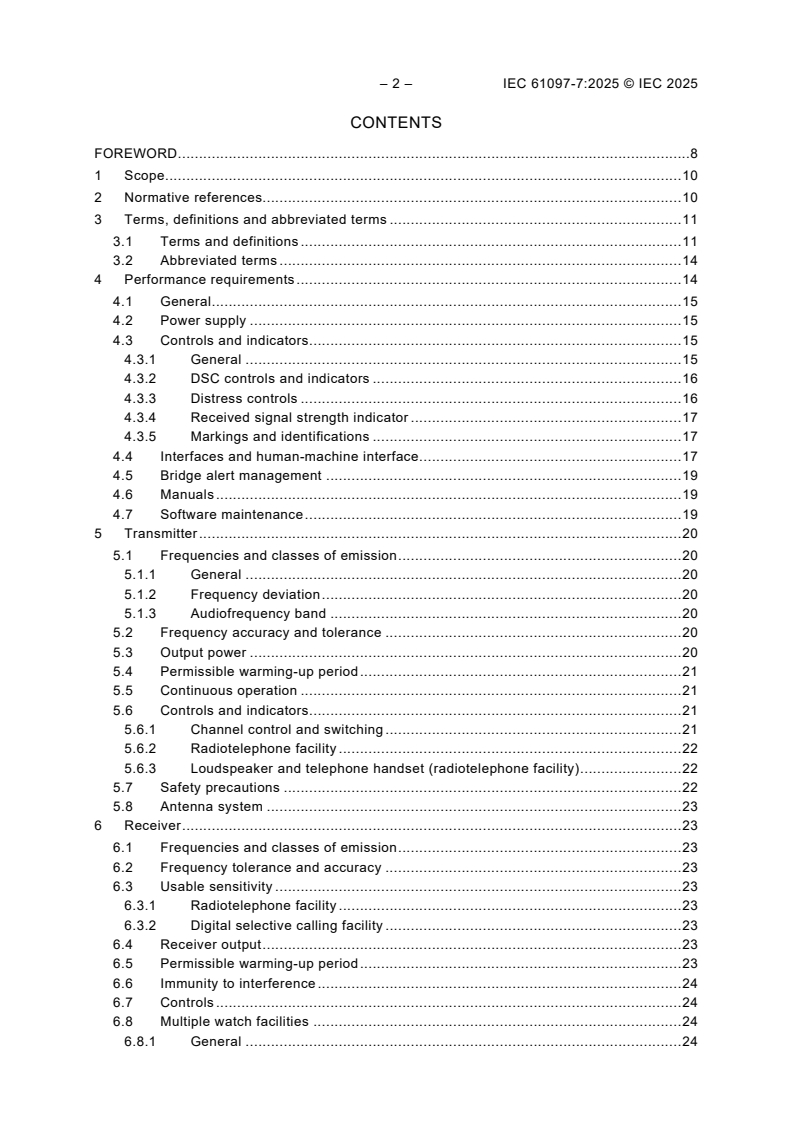
CONTENTS
FOREWORD . 8
1 Scope . 10
2 Normative references. 10
3 Terms, definitions and abbreviated terms . 11
3.1 Terms and definitions . 11
3.2 Abbreviated terms . 14
4 Performance requirements . 14
4.1 General . 15
4.2 Power supply . 15
4.3 Controls and indicators . 15
4.3.1 General . 15
4.3.2 DSC controls and indicators . 16
4.3.3 Distress controls . 16
4.3.4 Received signal strength indicator . 17
4.3.5 Markings and identifications . 17
4.4 Interfaces and human-machine interface . 17
4.5 Bridge alert management . 19
4.6 Manuals . 19
4.7 Software maintenance . 19
5 Transmitter . 20
5.1 Frequencies and classes of emission . 20
5.1.1 General . 20
5.1.2 Frequency deviation . 20
5.1.3 Audiofrequency band . 20
5.2 Frequency accuracy and tolerance . 20
5.3 Output power . 20
5.4 Permissible warming-up period . 21
5.5 Continuous operation . 21
5.6 Controls and indicators . 21
5.6.1 Channel control and switching . 21
5.6.2 Radiotelephone facility . 22
5.6.3 Loudspeaker and telephone handset (radiotelephone facility) . 22
5.7 Safety precautions . 22
5.8 Antenna system . 23
6 Receiver . 23
6.1 Frequencies and classes of emission . 23
6.2 Frequency tolerance and accuracy . 23
6.3 Usable sensitivity . 23
6.3.1 Radiotelephone facility . 23
6.3.2 Digital selective calling facility . 23
6.4 Receiver output . 23
6.5 Permissible warming-up period . 23
6.6 Immunity to interference . 24
6.7 Controls . 24
6.8 Multiple watch facilities . 24
6.8.1 General . 24
6.8.2 Scanning characteristics . 25
7 Digital selective calling facility . 25
7.1 DSC capabilities . 25
7.2 Distress message storage . 26
7.3 DSC characteristics . 26
8 Test methods and required test results . 26
8.1 Test conditions . 26
8.1.1 Normal and extreme test conditions . 26
8.1.2 Test power source . 26
8.1.3 Procedure for tests at extreme temperatures . 26
8.1.4 General requirements . 26
8.1.5 Tests by inspection . 27
8.2 General conditions of measurement . 27
8.2.1 Arrangements for test signals applied to the receiver input . 27
8.2.2 Receiver squelch facility . 27
8.2.3 Normal test modulation . 27
8.2.4 Artificial antenna . 27
8.2.5 Arrangements for test signals applied to the transmitter input . 27
8.2.6 Transmitter output power . 27
8.2.7 Test of equipment with duplex filter . 27
8.2.8 Test channels . 27
8.2.9 Measurement uncertainty . 28
8.3 Transmitter . 28
8.3.1 Switching time . 28
8.3.2 Frequency error . 29
8.3.3 Carrier power . 29
8.3.4 Frequency deviation . 30
8.3.5 Limitation characteristics of the modulator . 31
8.3.6 Sensitivity of modulator, including microphone . 32
8.3.7 Audiofrequency response . 32
8.3.8 Audiofrequency harmonic distortion of the emission . 32
8.3.9 Adjacent channel power . 33
8.3.10 Conducted spurious emissions conveyed to the antenna . 33
8.3.11 Residual modulation of the transmitter . 34
8.3.12 Transient frequency behaviour of the transmitter . 34
8.3.13 Protection of the transmitter . 38
8.3.14 Frequency error (demodulated signal) . 39
8.3.15 Modulation index . 39
8.3.16 Modulation rate . 39
8.3.17 Residual modulation . 40
8.3.18 Modulator attack time . 40
8.4 Audio general receiver . 41
8.4.1 Harmonic distortion and rated audiofrequency output power . 41
8.4.2 Audiofrequency response . 42
8.4.3 Maximum usable sensitivity . 43
8.4.4 Co-channel rejection ratio . 44
8.4.5 Adjacent channel selectivity . 44
8.4.6 Spurious response rejection . 45
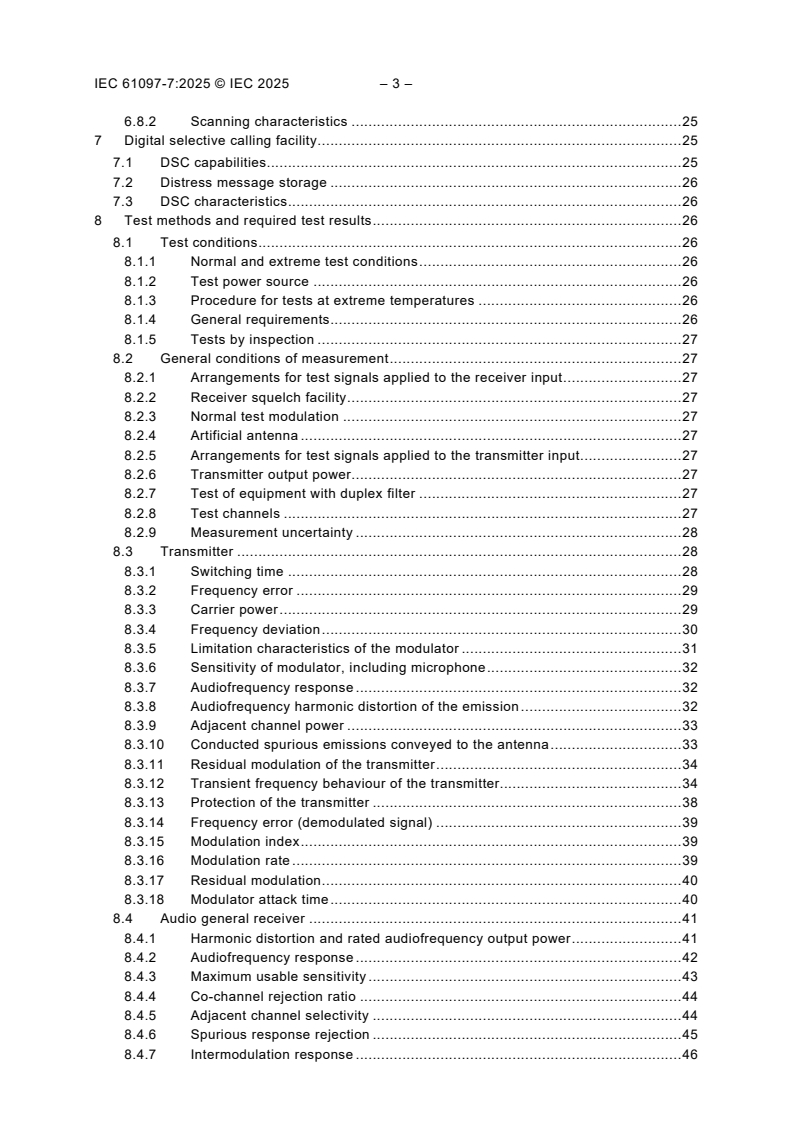
8.4.7 Intermodulation response . 46
– 4 – IEC 61097-7:2025 © IEC 2025
8.4.8 Blocking . 46
8.4.9 Conducted spurious emissions conveyed to the antenna . 47
8.4.10 Amplitude response of the receiver limiter . 47
8.4.11 Receiver hum and noise level . 48
8.4.12 Squelch operation . 48
8.4.13 Squelch hysteresis . 49
8.4.14 Scanning characteristics of multiple watch facilities . 49
8.5 DSC watch receiver . 50
8.5.1 DSC test signal . 50
8.5.2 Maximum usable sensitivity . 51
8.5.3 Adjacent channel selectivity . 51
8.5.4 Co-channel rejection ratio . 52
8.5.5 Intermodulation response . 52
8.5.6 Spurious response rejection . 52
8.5.7 Blocking . 54
8.5.8 Dynamic range . 54
8.5.9 Conducted spurious emissions conveyed to the antenna . 54
Annex A (normative) Power measuring receiver specification . 56
A.1 IF filter . 56
A.2 Attenuation indicator . 57
A.3 RMS value indicator . 57
A.4 Oscillator and amplifier . 57
Annex B (normative) Implementation of bridge alert management . 58
B.1 Classification of BAM alerts . 58
B.1.1 Requirements . 58
B.1.2 Test methods and required results . 58
B.2 Bridge alert management . 59
B.2.1 General requirements . 59
B.2.2 Unacknowledged BAM warnings . 59
B.2.3 Remote acknowledgement and silencing of BAM alerts . 59
B.3 BAM alert source identification and reporting in ALF sentences . 60
B.3.1 General requirements . 60
B.3.2 Receipt of distress or urgency call . 61
B.3.3 Receipt of calls other than distress or urgency . 62
B.3.4 Automatic positioning ceased . 63
B.3.5 Position older than 4 h . 64
B.3.6 Antenna error or failure . 65
B.3.7 Transmission power error or otherwise inhibited transmission . 66
Annex C (normative) DSC operation . 67
C.1 General . 67
C.2 Naming convention of DSC message types . 67
C.3 Test setup . 67
C.3.1 General . 67
C.3.2 Test methods . 69
C.4 Non-automated features . 69
C.4.1 Non-automated feature requirements . 69
C.4.2 Non-automated features tests . 74
C.5 Standby . 85
C.5.1 Standby requirements . 85
C.5.2 Standby tests . 86
C.6 Sending distress automated procedure . 87
C.6.1 Sending distress automated procedure requirements . 87
C.6.2 Sending distress automated procedure tests . 91
C.7 Received distress automated procedure . 98
C.7.1 Received distress automated procedure requirements . 98
C.7.2 Received distress automated procedure tests . 101
C.8 Sending non-distress automated procedure . 107
C.8.1 Sending non-distress automated procedure requirements . 107
C.8.2 Sending non-distress automated procedure tests . 110
C.9 Received non-distress automated procedure . 113
C.9.1 Received non-distress automated procedure requirements . 113
C.9.2 Received non-distress automated procedure tests . 116
C.10 Communications automated procedure . 119
C.10.1 Communications automated procedure requirements . 119
C.10.2 Communications automated procedure tests . 120
C.11 Multiple automated procedures and parallel event handling . 120
C.11.1 Multiple automated procedures and parallel event handling
requirements . 120
C.11.2 Multiple automated procedures and parallel event handling tests . 121
C.12 Error handling in the automated procedures . 131
C.12.1 Error handling requirements . 131
C.12.2 Error handling tests . 133
Annex D (normative) DSC message composition . 136
D.1 Default values . 136
D.2 The default DROBOSE . 137
D.3 Allowable non-distress DSC message parameters . 137
Annex E (normative) Audible annunciation and BAM alert signalling . 138
E.1 Audible alert specifications . 138
E.2 Alerting with critical errors . 140
E.3 Default audible alert sounds . 140
Annex F (normative) Remote control operation using DSC sentence . 142
F.1 General . 142
F.2 Requirements . 143
F.2.1 Operational requirements . 143
F.2.2 Technical requirements . 143
F.3 Method of test and required results . 143
F.3.1 General . 143
F.3.2 Test for input of DSC sentence and resulting transmission of DSC call . 144
Annex G (normative) Manufacturer's declarations and equipment manual . 145
Bibliography . 146
Figure 1 – Interfaces of the equipment . 18
Figure 2 – Transmitter permissible frequency deviation . 31
Figure 3 – Storage oscilloscope view t , t and t . 36
1 2 3
Figure 4 – Test set-up for measuring transient frequency behavior . 37
Figure 5 – Modulator attack time test configuration . 41
– 6 – IEC 61097-7:2025 © IEC 2025
Figure 6 – Receiver audiofrequency response . 43
Figure A.1 – IF filter specification . 56
Figure C.1 – Tests and error checks . 72
Figure D.1 – Loading DSC defaults . 136
Table 1 – Sentences input to the equipment for position information . 18
Table 2 – Sentences output from the equipment . 18
Table 3 – Sentences input to the equipment . 19
Table 4 – Sentences output from the equipment for BNWAS . 19
Table 5 – Sentences output from the equipment for CAM . 19
Table 6 – Sentences input to the equipment from CAM . 19
Table 7 – Transmitter transient timing (ms) . 35
Table A.1 – Selectivity characteristic . 56
Table A.2 – Attenuation points close to carrier . 56
Table A.3 – Attenuation points distant from carrier . 57
Table B.1 – Classification of GMDSS equipment alerts for BAM purposes . 58
Table B.2 – BAM alert text in ALF sentence for cause distress . 61
Table B.3 – BAM Alert text in ALF sentence for cause urgency . 62
Table B.4 – BAM alert text in ALF sentence for received calls other than distress and
urgency . 63
Table B.5 – BAM alert text in ALF sentence for cause automatic positioning ceased . 64
Table B.6 – BAM alert text in ALF sentence for cause position older than 4 h . 64
Table B.7 – BAM alert text in ALF sentence for cause antenna or antenna tuner failure . 65
Table B.8 – BAM alert text in ALF sentence for cause transmission power inhibit or
failure . 66
Table C.1 – Verification of DROBOSEs (1) to (8) . 81
Table C.2 – DSC messages to send from the EUT . 81
Table C.3 – Transmission test results . 82
Table C.4 – DSC messages to send from the TE . 122
Table C.5 – Verification of communications procedure . 123
Table C.6 – Verification required without acknowledgement . 124
Table C.7 – Verification required with acknowledgement . 124
Table C.8 – Verification required without acknowledgement . 125
Table C.9 – Verification required with acknowledgement . 125
Table C.10 – Verification required with MMSI ship station . 126
Table C.11 – Verification required with MMSI coast station . 126
Table C.12 – DSC messages . 127
Table C.13 – DSC messages to be sent from the TE . 127
Table C.14 – Verification required before activation of received distress procedure . 128
Table C.15 – Verification required after activation of received distress procedure . 128
Table C.16 – DSC messages to send from the TE . 129
Table D.1 – Default DROBOSE . 137
Table D.2 – Allowable parameter combinations . 137
Table E.1 – Audible characteristics . 138
Table E.2 – Non-configurable alarm sounds . 141
Table E.3 – Recommended alert sounds . 141
– 8 – IEC 61097-7:2025 © IEC 2025
INTERNATIONAL ELECTROTECHNICAL COMMISSION
____________
GLOBAL MARITIME DISTRESS AND SAFETY SYSTEM (GMDSS) –
Part 7: Shipborne VHF radiotelephone transmitter and receiver –
Operational and performance requirements,
test methods and required test results
FOREWORD
1) The International Electrotechnical Commission (IEC) is a worldwide organization for standardization comprising
all national electrotechnical committees (IEC National Committees). The object of IEC is to promote international
co-operation on all questions concerning standardization in the electrical and electronic fields. To this end and
in addition to other activities, IEC publishes International Standards, Technical Specifications, Technical Reports,
Publicly Available Specifications (PAS) and Guides (hereafter referred to as "IEC Publication(s)"). Their
preparation is entrusted to technical committees; any IEC National Committee interested in the subject dealt with
may participate in this preparatory work. International, governmental and non-governmental organizations liaising
with the IEC also participate in this preparation. IEC collaborates closely with the International Organization for
Standardization (ISO) in accordance with conditions determined by agreement between the two organizations.
2) The formal decisions or agreements of IEC on technical matters express, as nearly as possible, an international
consensus of opinion on the relevant subjects since each technical committee has representation from all
interested IEC National Committees.
3) IEC Publications have the form of recommendations for international use and are accepted by IEC National
Committees in that sense. While all reasonable efforts are made to ensure that the technical content of IEC
Publications is accurate, IEC cannot be held responsible for the way in which they are used or for any
misinterpretation by any end user.
4) In order to promote international uniformity, IEC National Committees undertake to apply IEC Publications
transparently to the maximum extent possible in their national and regional publications. Any divergence between
any IEC Publication and the corresponding national or regional publication shall be clearly indicated in the latter.
5) IEC itself does not provide any attestation of conformity. Independent certification bodies provide conformity
assessment services and, in some areas, access to IEC marks of conformity. IEC is not responsible for any
services carried out by independent certification bodies.
6) All users should ensure that they have the latest edition of this publication.
7) No liability shall attach to IEC or its directors, employees, servants or agents including individual experts and
members of its technical committees and IEC National Committees for any personal injury, property damage or
other damage of any nature whatsoever, whether direct or indirect, or for costs (including legal fees) and
expenses arising out of the publication, use of, or reliance upon, this IEC Publication or any other IEC
Publications.
8) Attention is drawn to the Normative references cited in this publication. Use of the referenced publications is
indispensable for the correct application of this publication.
9) IEC draws attention to the possibility that the implementation of this document may involve the use of (a)
patent(s). IEC takes no position concerning the evidence, validity or applicability of any claimed patent rights in
respect thereof. As of the date of publication of this document, IEC had not received notice of (a) patent(s), which
may be required to implement this document. However, implementers are cautioned that this may not represent
the latest information, which may be obtained from the patent database available at https://patents.iec.ch. IEC
shall not be held responsible for identifying any or all such patent rights.
IEC 61097-7 has been prepared by IEC technical committee 80: Maritime navigation and
radiocommunication equipment and systems. It is an International Standard.
This second edition cancels and replaces the first edition published in 1996, and
Amendment 1:2018. This edition constitutes a technical revision.
This edition includes the following significant technical changes with respect to the previous
edition:
a) the text has been updated to incorporate the provisions of the new IMO performance
standards given in Resolution MSC.511(105) and new ITU-R recommendations given in
M.493-16;
b) the provisions for digital selective calling which were previously in IEC 61097-3 have been
incorporated;
c) the provisions for watch keeping receivers which were previously in IEC 61097-8 have been
incorporated;
d) new requirements have been added for a received signal strength indicator in 4.3.4 and for
software maintenance in 4.6 in support of IMO recommendations;
e) new Annex B and Annex E have been added for bridge alert management;
f) new Annex C and Annex D have been added for digital selective calling;
g) a new Annex F has been added for remote control operation;
h) a new Annex G has been added for equipment manuals.
The text of this International Standard is based on the following documents:
Draft Report on voting
80/1151/FDIS 80/1157/RVD
Full information on the voting for its approval can be found in the report on voting indicated in
the above table.
The language used for the development of this International Standard is English.
This document was drafted in accordance with ISO/IEC Directives, Part 2, and developed in
accordance with ISO/IEC Directives, Part 1 and ISO/IEC Directives, IEC Supplement, available
at www.iec.ch/members_experts/refdocs. The main document types developed by IEC are
described in greater detail at www.iec.ch/standardsdev/publications.
A list of all parts in the IEC 61097 series, published under the general title Global maritime
distress and safety system (GMDSS), can be found on the IEC website.
The committee has decided that the contents of this document will remain unchanged until the
stability date indicated on the IEC website under webstore.iec.ch in the data related to the
specific document. At this date, the document will be
• reconfirmed,
• withdrawn, or
• revised.
– 10 – IEC 61097-7:2025 © IEC 2025
GLOBAL MARITIME DISTRESS AND SAFETY SYSTEM (GMDSS) –
Part 7: Shipborne VHF radiotelephone transmitter and receiver –
Operational and performance requirements,
test methods and required test results
1 Scope
This part of IEC 61097 specifies the minimum performance requirements, technical
characteristics and test methods with required test results for VHF radio installations capable
of voice communication and digital selective calling as required by chapter IV of the
International Convention for Safety of Life at Sea (SOLAS).
This document incorporates the applicable part of the performance standards included in IMO
Resolution A.524(13) and MSC.511(105), the technical characteristics included in
Recommendation ITU-R M.489-2 and Recommendation ITU-R M.493-16, and takes account of
IMO Resolution A.694(17) which is associated with IEC 60945, and conforms with the ITU Radio
Regulations where applicable.
When a requirement in this document is different from IEC 60945, the requirement in this
document shall take precedence.
This document also takes account, as appropriate, of requirements for the presentation of
navigation-related information on shipborne navigational displays given in IMO Resolution
MSC.191(79) and is associated with IEC 62288 and the requirements for bridge alert
management given in Resolution MSC.302(87) associated with IEC 62923-1 and IEC 62923-2.
NOTE 1 All text of this document, whose wording is identical to that in IMO Resolutions and ITU-R
Recommendations is printed in italics and the Resolution/Recommendation and clause numbers are indicated in
brackets.
NOTE 2 This document introduces requirements, tests and their required results in the context of digital selective
calling (DSC) as defined by ITU-R recommendations such as ITU-R M.493, and in the context of bridge alert
management (BAM) as defined by IMO MSC.302(87) and IEC 62923-1. Certain terms, such as "alert", "warning" and
"priority" can have different meanings depending on the context in which the term is used. The meaning of specific
terms used in this document is as defined in the context of DSC unless specifically expressed otherwise. For example,
the expression "BAM alert" is used to indicate that the term "alert" is used in the context of BAM in that instance.
Annex E provides further specifications on mapping of signals between the context of DSC and the context of BAM.
2 Normative references
The following documents are referred to in the text in such a way that some or all of their content
constitutes requirements of this document. For dated references, only the edition cited applies.
For undated references, the latest edition of the referenced document (including any
amendments) applies.
IEC 60945, Maritime navigation and radiocommunication equipment and systems – General
requirements – Methods of testing and required test results
IEC 61108 (all parts), Maritime navigation and radiocommunication equipment and systems –
Global navigation satellite systems (GNSS)
IEC 61162-1, Maritime navigation and radiocommunication equipment and systems – Digital
interfaces – Part 1: Single talker and multiple listeners
IEC 61162-2, Maritime navigation and radiocommunication equipment and systems – Digital
interfaces – Part 2: Single talker and multiple listeners, high-speed transmission
IEC 61162-450, Maritime navigation and radiocommunication equipment and systems – Digital
interfaces – Part 450: Multiple talkers and multiple listeners – Ethernet interconnection
IEC 62288, Maritime navigation and radiocommunication equipment and systems –
Presentation of navigation-related information on shipborne navigational displays – General
requirements, methods of testing and required test results
IEC 62923-1, Maritime navigation and radiocommunication equipment and systems – Bridge
alert management – Part 1: Operational and performance requirements, methods of testing and
required test results
ITU Radio Regulations:2024, Appendix 3: Maximum permitted power levels for unwanted
emissions in the spurious domain
ITU Radio Regulations:2024, Appendix 18: Table of transmitting frequencies in the VHF
maritime mobile band
ITU-R M.489-2:1995, Technical characteristics of radiotelephone equipment operating in the
maritime mobile service in channels spaced by 25 kHz
ITU-R M.493-16:2023, Digital selective-calling system for the use in the maritime mobile service
ITU-R M.821, Optional expansion of the digital selective calling system for use in the maritime
mobile service
3 Terms, definitions and abbreviated terms
For the purposes of this document, the following terms and definitions apply.
ISO and IEC maintain terminology databases for use in standardization at the following
addresses:
• IEC Electropedia: available at https://www.electropedia.org/
• ISO Online browsing platform: available at https://www.iso.org/obp
3.1 Terms and definitions
3.1.1
acknowledged
indication that the objective of the initial DSC call has been achieved when used to describe an
automated procedure
3.1.2
active
automated procedure which has control of the general receiver and transmitter and is thus able
to engage in subsequent communications and receive DSC calls on both the watch receiver
and general receiver
– 12 – IEC 61097-7:2025 © IEC 2025
3.1.3
audible indication
brief self-terminating sound which is repeated once every 30 s until confirmation or self-
terminating after 5 min indicating the reception of a DSC call of a category other than distress
or urgency or a repetition of a call of categories distress or urgency already received
Note 1 to entry: The purpose of this alert is to inform the operator that a DSC call is received but it does not require
immediate attention.
3.1.4
automated procedure
set of actions necessary to complete the objective of an initiating DSC call or non-DSC
communication event
3.1.5
BAM alert
alert defined by the concept of bridge alert management (BAM)
3.1.6
critical errors
set of information characters obtained from one or more received DSC calls if the automated
procedure needs information characters from that set in order to proceed or perform any task,
but the required information characters are in error
EXAMPLE An acknowledgement cannot be composed to an individual DSC call that has errors in the sender's
MMSI.
3.1.7
default
value selected or action taken by the equipment software in the absence of any operator input
3.1.8
distress alert
single distress DSC call with the format specifier symbol 112 as defined in ITU-R
Recommendation M.493
3.1.9
distress alert attempt
set of distress alerts sent by a vessel when in distress
3.1.10
distress DSC message
DSC message or acknowledgement containing the distress information
3.1.11
distress event
unique distress situation identified by two parameters of the distress information
Note 1 to entry: The parameters are the MMSI of the vessel in distress and the nature of distress.
3.1.12
distress information
symbols within a DSC call describing a distress situation consisting of the MMSI of the vessel
in distress, the nature of distress, the position of the vessel in distress, the UTC time of that
position
3.1.13
DSC word
10 bits that make up the coded entities of a transmitted DSC message
Note 1 to entry: The 10 bits consist of a seven bit "symbol" that gives the information content and a three-bit zero
count for the purposes of error testing.
3.1.14
Dx and Rx
notation used to describe the time diversity structure of DSC calls
3.1.15
engaged
indication that the equipment is busy handling an automated procedure
3.1.16
factory default
default value that is set by the manufacturer such that the field or behaviour is defined prior to
any operator intervention
3.1.17
general receiver
receiver used for the reception of all
...