

IEC 61097-9:2025
(Main)Global maritime distress and safety system (GMDSS) - Part 9: Shipborne transmitters and receivers for use in the MF and HF bands suitable for telephony, digital selective calling (DSC) and reception of maritime safety information and search and rescue related information - Operational and performance requirements, test methods and required test results
General Information
- Abstract
IEC 61097-9:2025 specifies the minimum operational and performance requirements and test methods with required test results for transmitters and receivers capable of voice communication and digital selective calling for the GMDSS operating in either the medium frequency band only or in medium and high frequency bands allocated in the ITU Radio Regulations to the Maritime Mobile Service, as required by Chapter IV of SOLAS 1974 as amended. It is based on IMO resolution MSC.512(105) and takes account of Recommendation ITU-R M.493 for digital selective calling including the automatic connection system.
This second edition cancels and replaces the first edition published in 1997. This edition constitutes a technical revision.
This edition includes the following significant technical changes with respect to the previous edition:
a) the text has been updated to incorporate the provisions of the new IMO performance standards given in Resolution MSC.512(105) and new ITU-R recommendations given in M.493-16. These provisions in particular add new requirements for reception of maritime safety information and for the automatic connection system;
b) the provisions for digital selective calling which were previously in IEC 61097-3 have been incorporated;
c) the provisions for watch keeping receivers which were previously in IEC 61097-8 have been incorporated;
d) new requirements have been added for software maintenance in 4.10 in support of IMO recommendations;
e) new Annex A, Annex B and Annex C have been added for digital selective calling;
f) new Annex D and Annex G have been added for bridge alert management;
g) new Annex E and Annex I have been added for maritime safety information;
h) a new Annex F has been added for the automatic connection system;
i) a new Annex H has been added for equipment manuals;
j) a new Annex J has been added for remote control operation;
k) previous Annex A, Annex B and Annex C have been deleted as they are no longer relevant.
- Status
- Published
- Publication Date
- 10-Jun-2025
- Technical Committee
- TC 80 - Maritime navigation and radiocommunication equipment and systems
- Drafting Committee
- MT 19 - TC 80/MT 19
- Current Stage
- PPUB - Publication issued
- Start Date
- 11-Jun-2025
- Completion Date
- 27-Jun-2025
Buy Documents
IEC 61097-9:2025 - Global maritime distress and safety system (GMDSS) - Part 9: Shipborne transmitters and receivers for use in the MF and HF bands suitable for telephony, digital selective calling (DSC) and reception of maritime safety information and search and rescue related information - Operational and performance requirements, test methods and required test results Released:6/11/2025
Overview
IEC 61097-9:2025 defines minimum operational and performance requirements and test methods for shipborne transmitters and receivers operating in the MF and HF bands for the Global Maritime Distress and Safety System (GMDSS). The standard covers equipment capable of voice (telephony), digital selective calling (DSC), reception of maritime safety information (MSI) and search and rescue related data. It implements SOLAS Chapter IV obligations and is aligned with IMO Resolution MSC.512(105) and ITU‑R Recommendation M.493-16. This second edition (2025) updates and consolidates previous IEC parts, constituting a technical revision of the 1997 edition.
Key Topics
- Scope and applicability: MF-only and MF/HF shipborne radio equipment designed for GMDSS use.
- Performance requirements: Frequency accuracy/stability, output power, modulation characteristics, spurious emissions and receiver sensitivity.
- Operational requirements: Controls, indicators, distress controls, control panel priority, labels and safety precautions.
- Digital Selective Calling (DSC): DSC capabilities, message storage, bit error testing and required DSC characteristics (newly integrated from IEC 61097-3).
- Maritime Safety Information (MSI): Reception, display, storage, alerting and test facilities for MSI and SAR information.
- Automatic Connection System (ACS): Requirements and tests for automatic call connection features (new Annex F).
- Bridge Alert Management (BAM): Annexes for integration with bridge alerting systems (new Annex D and G).
- Software maintenance: New provisions for software maintenance and lifecycle support.
- Test methods: Detailed test conditions, measurement uncertainty, transmitter and receiver test procedures and required test results.
- Additional annexes: Guidance on DSC (A–C), MSI (E, I), equipment manuals (H), remote control operation (J), and deleted obsolete annexes.
Applications
IEC 61097-9:2025 is used for:
- Type approval and certification of shipborne MF/HF radio equipment for GMDSS compliance.
- Design and manufacturing guidance for radio equipment vendors and module designers.
- Factory and laboratory testing: Conformance testing, performance verification, and acceptance tests.
- Procurement and installation: Specifying equipment for new builds and retrofits to meet SOLAS Chapter IV requirements.
- Ship operators, flag states and surveyors: Ensuring equipment meets regulatory and operational safety standards.
Who should use this standard
- Radio equipment manufacturers and test laboratories
- Classification societies, flag administrations and maritime authorities
- Shipyards, ship owners/operators and marine system integrators
- Design engineers and procurement specialists specifying GMDSS capabilities
Related Standards
- IMO Resolution MSC.512(105) - GMDSS performance standards
- ITU‑R Recommendation M.493 (incl. M.493-16) - DSC requirements
- IEC 61097 series (previous parts such as 61097-3 and 61097-8 - now incorporated)
Keywords: IEC 61097-9:2025, GMDSS, shipborne transmitters, MF HF bands, DSC, maritime safety information, MSI, SOLAS, IMO MSC.512(105), ITU‑R M.493.
Relations
- Effective Date
- 05-Sep-2023
Buy Documents
IEC 61097-9:2025 - Global maritime distress and safety system (GMDSS) - Part 9: Shipborne transmitters and receivers for use in the MF and HF bands suitable for telephony, digital selective calling (DSC) and reception of maritime safety information and search and rescue related information - Operational and performance requirements, test methods and required test results Released:6/11/2025
Get Certified
Connect with accredited certification bodies for this standard

DNV
DNV is an independent assurance and risk management provider.

Lloyd's Register
Lloyd's Register is a global professional services organisation specialising in engineering and technology.

FSC International
Forest Stewardship Council certification.
Sponsored listings
Frequently Asked Questions
IEC 61097-9:2025 is a standard published by the International Electrotechnical Commission (IEC). Its full title is "Global maritime distress and safety system (GMDSS) - Part 9: Shipborne transmitters and receivers for use in the MF and HF bands suitable for telephony, digital selective calling (DSC) and reception of maritime safety information and search and rescue related information - Operational and performance requirements, test methods and required test results". This standard covers: IEC 61097-9:2025 specifies the minimum operational and performance requirements and test methods with required test results for transmitters and receivers capable of voice communication and digital selective calling for the GMDSS operating in either the medium frequency band only or in medium and high frequency bands allocated in the ITU Radio Regulations to the Maritime Mobile Service, as required by Chapter IV of SOLAS 1974 as amended. It is based on IMO resolution MSC.512(105) and takes account of Recommendation ITU-R M.493 for digital selective calling including the automatic connection system. This second edition cancels and replaces the first edition published in 1997. This edition constitutes a technical revision. This edition includes the following significant technical changes with respect to the previous edition: a) the text has been updated to incorporate the provisions of the new IMO performance standards given in Resolution MSC.512(105) and new ITU-R recommendations given in M.493-16. These provisions in particular add new requirements for reception of maritime safety information and for the automatic connection system; b) the provisions for digital selective calling which were previously in IEC 61097-3 have been incorporated; c) the provisions for watch keeping receivers which were previously in IEC 61097-8 have been incorporated; d) new requirements have been added for software maintenance in 4.10 in support of IMO recommendations; e) new Annex A, Annex B and Annex C have been added for digital selective calling; f) new Annex D and Annex G have been added for bridge alert management; g) new Annex E and Annex I have been added for maritime safety information; h) a new Annex F has been added for the automatic connection system; i) a new Annex H has been added for equipment manuals; j) a new Annex J has been added for remote control operation; k) previous Annex A, Annex B and Annex C have been deleted as they are no longer relevant.
IEC 61097-9:2025 specifies the minimum operational and performance requirements and test methods with required test results for transmitters and receivers capable of voice communication and digital selective calling for the GMDSS operating in either the medium frequency band only or in medium and high frequency bands allocated in the ITU Radio Regulations to the Maritime Mobile Service, as required by Chapter IV of SOLAS 1974 as amended. It is based on IMO resolution MSC.512(105) and takes account of Recommendation ITU-R M.493 for digital selective calling including the automatic connection system. This second edition cancels and replaces the first edition published in 1997. This edition constitutes a technical revision. This edition includes the following significant technical changes with respect to the previous edition: a) the text has been updated to incorporate the provisions of the new IMO performance standards given in Resolution MSC.512(105) and new ITU-R recommendations given in M.493-16. These provisions in particular add new requirements for reception of maritime safety information and for the automatic connection system; b) the provisions for digital selective calling which were previously in IEC 61097-3 have been incorporated; c) the provisions for watch keeping receivers which were previously in IEC 61097-8 have been incorporated; d) new requirements have been added for software maintenance in 4.10 in support of IMO recommendations; e) new Annex A, Annex B and Annex C have been added for digital selective calling; f) new Annex D and Annex G have been added for bridge alert management; g) new Annex E and Annex I have been added for maritime safety information; h) a new Annex F has been added for the automatic connection system; i) a new Annex H has been added for equipment manuals; j) a new Annex J has been added for remote control operation; k) previous Annex A, Annex B and Annex C have been deleted as they are no longer relevant.
IEC 61097-9:2025 is classified under the following ICS (International Classification for Standards) categories: 33.060.20 - Receiving and transmitting equipment; 47.020.70 - Navigation and control equipment. The ICS classification helps identify the subject area and facilitates finding related standards.
IEC 61097-9:2025 has the following relationships with other standards: It is inter standard links to IEC 61097-9:1997. Understanding these relationships helps ensure you are using the most current and applicable version of the standard.
IEC 61097-9:2025 is available in PDF format for immediate download after purchase. The document can be added to your cart and obtained through the secure checkout process. Digital delivery ensures instant access to the complete standard document.
Standards Content (Sample)
IEC 61097-9 ®
Edition 2.0 2025-06
INTERNATIONAL
STANDARD
Global maritime distress and safety system (GMDSS) –
Part 9: Shipborne transmitters and receivers for use in the MF and HF bands
suitable for telephony, digital selective calling (DSC) and reception of maritime
safety information and search and rescue related information – Operational and
performance requirements, test methods and required test results
ICS 33.060.20; 47.020.70 ISBN 978-2-8327-0466-0
All rights reserved. Unless otherwise specified, no part of this publication may be reproduced or utilized in any form or
by any means, electronic or mechanical, including photocopying and microfilm, without permission in writing from either
IEC or IEC's member National Committee in the country of the requester. If you have any questions about IEC copyright
or have an enquiry about obtaining additional rights to this publication, please contact the address below or your local
IEC member National Committee for further information.
IEC Secretariat Tel.: +41 22 919 02 11
3, rue de Varembé info@iec.ch
CH-1211 Geneva 20 www.iec.ch
Switzerland
About the IEC
The International Electrotechnical Commission (IEC) is the leading global organization that prepares and publishes
International Standards for all electrical, electronic and related technologies.
About IEC publications
The technical content of IEC publications is kept under constant review by the IEC. Please make sure that you have the
latest edition, a corrigendum or an amendment might have been published.
IEC publications search - IEC Products & Services Portal - products.iec.ch
webstore.iec.ch/advsearchform Discover our powerful search engine and read freely all the
publications previews, graphical symbols and the glossary.
The advanced search enables to find IEC publications by a
variety of criteria (reference number, text, technical With a subscription you will always have access to up to date
committee, …). It also gives information on projects, content tailored to your needs.
replaced and withdrawn publications.
Electropedia - www.electropedia.org
The world's leading online dictionary on electrotechnology,
IEC Just Published - webstore.iec.ch/justpublished
Stay up to date on all new IEC publications. Just Published containing more than 22 500 terminological entries in English
details all new publications released. Available online and and French, with equivalent terms in 25 additional languages.
once a month by email. Also known as the International Electrotechnical Vocabulary
(IEV) online.
IEC Customer Service Centre - webstore.iec.ch/csc
If you wish to give us your feedback on this publication or
need further assistance, please contact the Customer
Service Centre: sales@iec.ch.
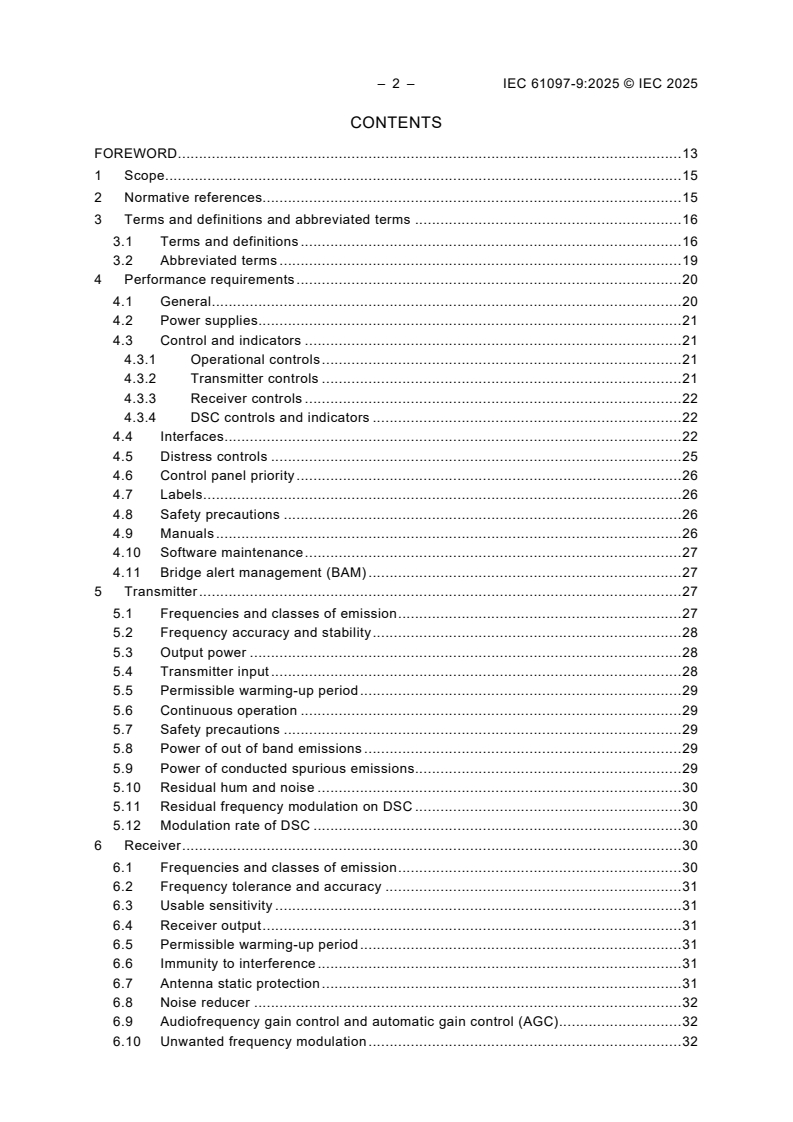
– 2 – IEC 61097-9:2025 © IEC 2025
CONTENTS
FOREWORD . 13
1 Scope . 15
2 Normative references. 15
3 Terms and definitions and abbreviated terms . 16
3.1 Terms and definitions . 16
3.2 Abbreviated terms . 19
4 Performance requirements . 20
4.1 General . 20
4.2 Power supplies . 21
4.3 Control and indicators . 21
4.3.1 Operational controls . 21
4.3.2 Transmitter controls . 21
4.3.3 Receiver controls . 22
4.3.4 DSC controls and indicators . 22
4.4 Interfaces . 22
4.5 Distress controls . 25
4.6 Control panel priority . 26
4.7 Labels . 26
4.8 Safety precautions . 26
4.9 Manuals . 26
4.10 Software maintenance . 27
4.11 Bridge alert management (BAM) . 27
5 Transmitter . 27
5.1 Frequencies and classes of emission . 27
5.2 Frequency accuracy and stability . 28
5.3 Output power . 28
5.4 Transmitter input . 28
5.5 Permissible warming-up period . 29
5.6 Continuous operation . 29
5.7 Safety precautions . 29
5.8 Power of out of band emissions . 29
5.9 Power of conducted spurious emissions . 29
5.10 Residual hum and noise . 30
5.11 Residual frequency modulation on DSC . 30
5.12 Modulation rate of DSC . 30
6 Receiver . 30
6.1 Frequencies and classes of emission . 30
6.2 Frequency tolerance and accuracy . 31
6.3 Usable sensitivity . 31
6.4 Receiver output . 31
6.5 Permissible warming-up period . 31
6.6 Immunity to interference . 31
6.7 Antenna static protection . 31
6.8 Noise reducer . 32
6.9 Audiofrequency gain control and automatic gain control (AGC) . 32
6.10 Unwanted frequency modulation . 32
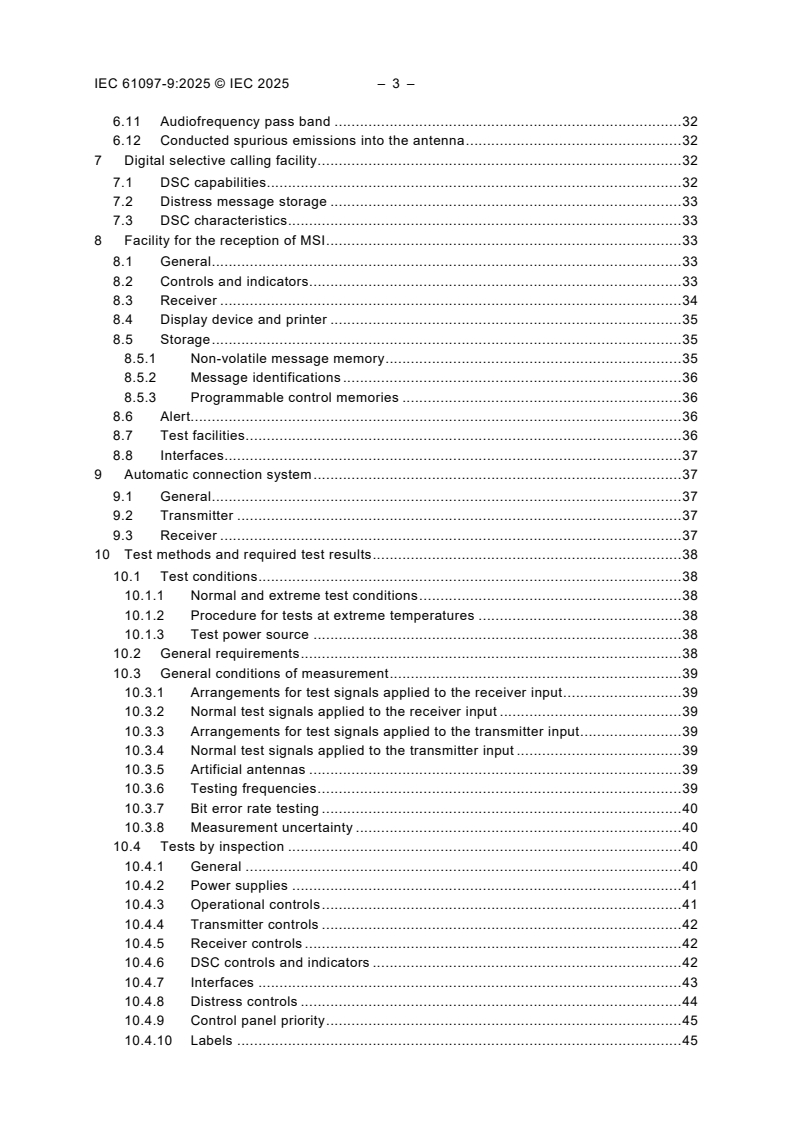
6.11 Audiofrequency pass band . 32
6.12 Conducted spurious emissions into the antenna . 32
7 Digital selective calling facility . 32
7.1 DSC capabilities . 32
7.2 Distress message storage . 33
7.3 DSC characteristics . 33
8 Facility for the reception of MSI . 33
8.1 General . 33
8.2 Controls and indicators . 33
8.3 Receiver . 34
8.4 Display device and printer . 35
8.5 Storage . 35
8.5.1 Non-volatile message memory . 35
8.5.2 Message identifications . 36
8.5.3 Programmable control memories . 36
8.6 Alert . 36
8.7 Test facilities . 36
8.8 Interfaces . 37
9 Automatic connection system . 37
9.1 General . 37
9.2 Transmitter . 37
9.3 Receiver . 37
10 Test methods and required test results . 38
10.1 Test conditions . 38
10.1.1 Normal and extreme test conditions . 38
10.1.2 Procedure for tests at extreme temperatures . 38
10.1.3 Test power source . 38
10.2 General requirements . 38
10.3 General conditions of measurement . 39
10.3.1 Arrangements for test signals applied to the receiver input . 39
10.3.2 Normal test signals applied to the receiver input . 39
10.3.3 Arrangements for test signals applied to the transmitter input . 39
10.3.4 Normal test signals applied to the transmitter input . 39
10.3.5 Artificial antennas . 39
10.3.6 Testing frequencies . 39
10.3.7 Bit error rate testing . 40
10.3.8 Measurement uncertainty . 40
10.4 Tests by inspection . 40
10.4.1 General . 40
10.4.2 Power supplies . 41
10.4.3 Operational controls . 41
10.4.4 Transmitter controls . 42
10.4.5 Receiver controls . 42
10.4.6 DSC controls and indicators . 42
10.4.7 Interfaces . 43
10.4.8 Distress controls . 44
10.4.9 Control panel priority . 45
10.4.10 Labels . 45
– 4 – IEC 61097-9:2025 © IEC 2025
10.4.11 Safety precautions . 45
10.4.12 Software maintenance . 46
10.4.13 DSC capabilities . 46
10.4.14 Distress message storage . 46
11 Transmitter . 47
11.1 Frequencies and classes of emission . 47
11.2 Frequency error . 47
11.2.1 General . 47
11.2.2 Test methods . 47
11.2.3 Required results . 47
11.3 Output power and intermodulation products . 47
11.3.1 General . 47
11.3.2 Test methods . 48
11.3.3 Required results . 48
11.4 Unwanted frequency modulation . 49
11.4.1 General . 49
11.4.2 Test methods . 49
11.4.3 Required results . 50
11.5 Sensitivity of the microphone . 50
11.5.1 General . 50
11.5.2 Test methods . 50
11.5.3 Required results . 50
11.6 Automatic level control and/or limiter for SSB telephony . 50
11.6.1 General . 50
11.6.2 Test methods . 50
11.6.3 Required results . 51
11.7 Audiofrequency response using SSB telephony . 51
11.7.1 General . 51
11.7.2 Test methods . 52
11.7.3 Required results . 52
11.8 Power of out-of-band emissions using SSB telephony . 52
11.8.1 General . 52
11.8.2 Test methods . 53
11.8.3 Required results . 53
11.9 Power of conducted spurious emissions of SSB telephony . 53
11.9.1 General . 53
11.9.2 Test methods . 53
11.9.3 Required results . 53
11.10 Residual hum and noise power using telephony . 53
11.10.1 General . 53
11.10.2 Test methods . 54
11.10.3 Required results . 54
11.11 Residual frequency modulation on DSC . 54
11.11.1 General . 54
11.11.2 Test methods . 54
11.11.3 Required results . 54
11.12 Carrier suppression . 55
11.12.1 General . 55
11.12.2 Test methods . 55
11.12.3 Required results . 55
11.13 Continuous operation . 55
11.13.1 General . 55
11.13.2 Test methods . 55
11.13.3 Required results . 55
11.14 Protection of the transmitter . 56
11.14.1 General . 56
11.14.2 Test methods . 56
11.14.3 Required results . 56
11.15 Standing wave ratio control . 56
11.15.1 General . 56
11.15.2 Test methods . 56
11.15.3 Required results . 56
11.16 Residual RF noise power . 57
11.16.1 General . 57
11.16.2 Test methods . 57
11.16.3 Required results . 57
11.17 Modulation rate of DSC . 57
11.17.1 General . 57
11.17.2 Test methods . 57
11.17.3 Required results . 58
12 Audio receiver . 58
12.1 Audiofrequency output levels . 58
12.1.1 General . 58
12.1.2 Test methods . 58
12.1.3 Required results . 58
12.2 Frequency error . 58
12.2.1 General . 58
12.2.2 Test methods . 58
12.2.3 Required results . 59
12.3 Unwanted frequency modulation . 59
12.3.1 General . 59
12.3.2 Test methods . 59
12.3.3 Required results . 59
12.4 Audiofrequency pass band . 59
12.4.1 General . 59
12.4.2 Test methods . 59
12.4.3 Required results . 60
12.5 Maximum usable sensitivity . 60
12.5.1 General . 60
12.5.2 Test methods . 60
12.5.3 Required results . 60
12.6 Harmonic content in output . 61
12.6.1 General . 61
12.6.2 Test methods . 61
12.6.3 Required results . 61
12.7 Adjacent channel selectivity . 61
12.7.1 General . 61
12.7.2 Test methods . 61
– 6 – IEC 61097-9:2025 © IEC 2025
12.7.3 Required results . 62
12.8 Blocking . 62
12.8.1 General . 62
12.8.2 Test methods . 62
12.8.3 Required results . 63
12.9 Cross-modulation . 63
12.9.1 General . 63
12.9.2 Test methods . 63
12.9.3 Required results . 63
12.10 Intermodulation . 63
12.10.1 General . 63
12.10.2 Test methods . 64
12.10.3 Required results . 64
12.11 Spurious response rejection ratio . 64
12.11.1 General . 64
12.11.2 Test methods . 64
12.11.3 Required results . 65
12.12 Audiofrequency intermodulation . 65
12.12.1 General . 65
12.12.2 Test methods . 66
12.12.3 Required results . 66
12.13 Conducted spurious emissions into the antenna . 66
12.13.1 General . 66
12.13.2 Test methods . 66
12.13.3 Required results . 66
12.14 Internally generated spurious signals . 66
12.14.1 General . 66
12.14.2 Test methods . 66
12.14.3 Required results . 67
12.15 Improvement in signal-to-noise ratio with AGC . 67
12.15.1 General . 67
12.15.2 Test methods . 67
12.15.3 Required results . 67
12.16 AGC range . 67
12.16.1 General . 67
12.16.2 Test methods . 67
12.16.3 Required results . 67
12.17 AGC time constants (attack and recovery time) . 68
12.17.1 General . 68
12.17.2 Test methods . 68
12.17.3 Required results . 68
12.18 Reciprocal mixing . 68
12.18.1 General . 68
12.18.2 Test methods . 68
12.18.3 Required results . 69
12.19 Protection of input circuits . 69
12.19.1 General . 69
12.19.2 Test methods . 69
12.19.3 Required results . 69
13 DSC receiver . 69
13.1 DSC test signals . 69
13.1.1 References to standard DSC signals . 69
13.1.2 Standard test signal No. 1 (STS-1) . 69
13.1.3 Standard test signal No. 2 (STS-2) . 69
13.1.4 Symbol error rate at the DSC receiver . 69
13.2 Maximum usable sensitivity . 70
13.2.1 General . 70
13.2.2 Test methods . 70
13.2.3 Required results . 70
13.3 Adjacent channel selectivity . 70
13.3.1 General . 70
13.3.2 Test methods . 70
13.3.3 Required results . 71
13.4 Co-channel rejection . 71
13.4.1 General . 71
13.4.2 Test methods . 71
13.4.3 Required results . 71
13.5 RF intermodulation response . 71
13.5.1 General . 71
13.5.2 Test methods . 71
13.5.3 Required results . 72
13.6 Spurious response rejection . 72
13.6.1 General . 72
13.6.2 Test methods . 72
13.6.3 Required results . 73
13.7 Blocking immunity . 73
13.7.1 General . 73
13.7.2 Test methods . 73
13.7.3 Required results . 73
13.8 Dynamic range . 73
13.8.1 General . 73
13.8.2 Test methods . 74
13.8.3 Required results . 74
13.9 Conducted spurious emissions into the antenna . 74
13.9.1 General . 74
13.9.2 Test methods . 74
13.9.3 Required results . 74
13.10 Protection of receiver antenna input circuits . 74
13.10.1 General . 74
13.10.2 Test methods . 75
13.10.3 Required results . 75
13.11 Stop/start of scanning efficiency . 75
13.11.1 General . 75
13.11.2 Test methods . 75
13.11.3 Required results . 75
14 MSI receiver . 75
15 Automatic connection system . 75
Annex A (normative) DSC operation . 76
– 8 – IEC 61097-9:2025 © IEC 2025
A.1 General . 76
A.2 Naming convention of DSC message types . 76
A.3 Test setup . 77
A.3.1 General . 77
A.3.2 Test methods . 78
A.4 Non-automated features . 78
A.4.1 Non-automated features requirements . 78
A.4.2 Non-automated features tests . 83
A.5 Standby . 97
A.5.1 Standby requirements . 97
A.5.2 Standby tests . 98
A.6 Sending distress automated procedure . 99
A.6.1 Sending distress automated procedure requirements . 99
A.6.2 Sending distress automated procedure tests . 105
A.7 Received distress automated procedure . 113
A.7.1 Received distress automated procedure requirements . 113
A.7.2 Received distress automated procedure tests . 116
A.8 Sending non-distress automated procedure . 126
A.8.1 Sending non-distress automated procedure requirements . 126
A.8.2 Sending non-distress automated procedure tests . 129
A.9 Received non-distress automated procedure . 133
A.9.1 Received non-distress automated procedure requirements . 133
A.9.2 Received non-distress automated procedure tests . 136
A.10 Communications automated procedure . 140
A.10.1 Communications automated procedure requirements . 140
A.10.2 Communications automated procedure tests . 141
A.11 Multiple automated procedures and parallel event handling . 141
A.11.1 Multiple automated procedures and parallel event handling
requirements . 141
A.11.2 Multiple automated procedures and parallel event handling tests . 142
A.12 Error handling in the automated procedures . 152
A.12.1 Error handling requirements . 152
A.12.2 Error handling tests . 154
Annex B (normative) DSC message composition . 158
B.1 Default values . 158
B.2 The default DROBOSE . 159
B.3 Allowable non-distress DSC message parameters . 159
Annex C (normative) Radius-centre point conversion and rounding algorithm . 160
C.1 Radius-centre point conversion . 160
C.2 Rounding . 161
C.3 Special cases for either form of area data entry . 161
Annex D (normative) Audible annunciation and BAM alert signalling . 162
D.1 Audible alert specifications . 162
D.2 Alerting with critical errors . 164
D.3 Default audible alert sounds . 164
Annex E (normative) MSI receiver for HF NBDP, test methods and required test
results . 166
E.1 General . 166
E.2 Test conditions . 166
E.2.1 Standard test signal . 166
E.2.2 Standard test file . 167
E.2.3 Arrangement for test signal applied to the receiver input . 167
E.2.4 Artificial antenna . 167
E.2.5 Character error rate . 167
E.3 Serial interface tests . 167
E.3.1 INS interface performance tests . 167
E.3.2 Printer tests . 168
E.4 General and signal processing tests .
...