

IEC 62065:2025
(Main)Maritime navigation and radiocommunication equipment and systems - Track control systems - Operational and performance requirements, test methods and required test results
General Information
- Abstract
IEC 62065:2025 specifies the minimum operational and performance requirements, test methods and required test results conforming to performance standards adopted by the IMO in resolution MSC.74(69) Annex 2 Recommendation on Performance Standards for Track Control Systems. In addition, it takes into account IMO resolution A.694(17) to which IEC 60945 is associated. It also takes into account IMO resolution MSC.302(87) on bridge alert management (BAM), to which IEC 62923-1 and IEC 62923-2 are associated.
This third edition cancels and replaces the second edition published in 2014. This edition constitutes a technical revision.
This edition includes the following significant technical changes with respect to the previous edition:
a) alert management has been brought in line with MSC.302(87), IEC 62923-1 and IEC 62923‑2, reducing the number of alerts for one situation and improving the information provided by alerts. An overview is provided in Annex F;
b) the previous Annex F has been removed as it was outdated and not instrumental in this document;
c) the requirements in Clause 5 have been further detailed:
d) the structure of Clause 6 has been updated.
- Status
- Published
- Publication Date
- 15-Oct-2025
- Technical Committee
- TC 80 - Maritime navigation and radiocommunication equipment and systems
- Drafting Committee
- WG 16 - TC 80/WG 16
- Current Stage
- PPUB - Publication issued
- Start Date
- 16-Oct-2025
- Completion Date
- 07-Nov-2025
Buy Documents

IEC 62065:2025 - Maritime navigation and radiocommunication equipment and systems - Track control systems - Operational and performance requirements, test methods and required test results Released:10/16/2025
IEC 62065:2025 - Matériels et systemes de navigation et de radiocommunication maritimes - Systemes de contrôle de route - Exigences opérationnelles et de fonctionnement, méthodes d'essai et résultats exigibles Released:10/16/2025

IEC 62065:2025 - Maritime navigation and radiocommunication equipment and systems - Track control systems - Operational and performance requirements, test methods and required test results Released:10/16/2025
Overview
IEC 62065:2025 - third edition - defines minimum operational and performance requirements, test methods, and required test results for maritime track control systems. It implements the IMO performance standards in MSC.74(69) Annex 2 and references IMO resolution A.694(17) (linked to IEC 60945) and IMO MSC.302(87) on bridge alert management (BAM). This technical revision reorganizes annexes, tightens Clause 5 requirements, updates the structure of Clause 6, and modernizes alert management to align with BAM and IEC 62923‑1/2.
Key topics and requirements
- Operational requirements: functionality, accuracy and performance documentation, mode behaviour, along-track speed handling and start/stop conditions.
- Test methods and required test results: standardized execution of operational tests, test setups including ship motion simulators, scenario definitions, and documented pass/fail criteria.
- Alert management: harmonized with MSC.302(87) and IEC 62923‑1/2 to reduce duplicate alerts and improve clarity (see normative Annex F classification).
- Ergonomics and presentation: operator controls, human-machine interface requirements, and information presentation for safe bridge operation.
- Interfacing and sensors: requirements for position, heading and speed inputs, use of IEC 61162 interfaces (Annex K), and fallback strategies for sensor failure.
- Fallback and failure modes: procedures for position/heading failures, backup navigator call, and change‑over between primary and backup controllers.
- Supporting annexes: ship model specification (Annex I), sensor error/noise models (Annex H), scenario plots (Annex G), along-track speed control (Annex B), and guidance for dual-controller systems (Annex C).
Practical applications and users
IEC 62065:2025 is essential for:
- Manufacturers and system integrators designing or certifying track control systems and bridge automation.
- Shipyards and vessel operators implementing automated track-following functionality and conducting sea trials.
- Testing laboratories and classification societies performing conformity assessment and type approval per IMO performance standards.
- Flag states and regulatory bodies assessing compliance with navigational safety requirements.
Implementing IEC 62065 helps ensure reliable track control, consistent test procedures, robust alert handling, and interoperability with bridge electronics - improving navigational safety and regulatory compliance.
Related standards
- IMO MSC.74(69) Annex 2 (Performance Standards for Track Control Systems)
- IMO MSC.302(87) (Bridge Alert Management)
- IEC 62923‑1 / IEC 62923‑2 (BAM-related standards)
- IEC 60945 (maritime navigation general requirements)
- IEC 61162 (marine data interfaces)
Relations
- Effective Date
- 05-Sep-2023
Buy Documents
IEC 62065:2025 - Maritime navigation and radiocommunication equipment and systems - Track control systems - Operational and performance requirements, test methods and required test results Released:10/16/2025
IEC 62065:2025 - Matériels et systemes de navigation et de radiocommunication maritimes - Systemes de contrôle de route - Exigences opérationnelles et de fonctionnement, méthodes d'essai et résultats exigibles Released:10/16/2025
IEC 62065:2025 - Maritime navigation and radiocommunication equipment and systems - Track control systems - Operational and performance requirements, test methods and required test results Released:10/16/2025
Get Certified
Connect with accredited certification bodies for this standard

DNV
DNV is an independent assurance and risk management provider.

Lloyd's Register
Lloyd's Register is a global professional services organisation specialising in engineering and technology.

FSC International
Forest Stewardship Council certification.
Sponsored listings
Frequently Asked Questions
IEC 62065:2025 is a standard published by the International Electrotechnical Commission (IEC). Its full title is "Maritime navigation and radiocommunication equipment and systems - Track control systems - Operational and performance requirements, test methods and required test results". This standard covers: IEC 62065:2025 specifies the minimum operational and performance requirements, test methods and required test results conforming to performance standards adopted by the IMO in resolution MSC.74(69) Annex 2 Recommendation on Performance Standards for Track Control Systems. In addition, it takes into account IMO resolution A.694(17) to which IEC 60945 is associated. It also takes into account IMO resolution MSC.302(87) on bridge alert management (BAM), to which IEC 62923-1 and IEC 62923-2 are associated. This third edition cancels and replaces the second edition published in 2014. This edition constitutes a technical revision. This edition includes the following significant technical changes with respect to the previous edition: a) alert management has been brought in line with MSC.302(87), IEC 62923-1 and IEC 62923‑2, reducing the number of alerts for one situation and improving the information provided by alerts. An overview is provided in Annex F; b) the previous Annex F has been removed as it was outdated and not instrumental in this document; c) the requirements in Clause 5 have been further detailed: d) the structure of Clause 6 has been updated.
IEC 62065:2025 specifies the minimum operational and performance requirements, test methods and required test results conforming to performance standards adopted by the IMO in resolution MSC.74(69) Annex 2 Recommendation on Performance Standards for Track Control Systems. In addition, it takes into account IMO resolution A.694(17) to which IEC 60945 is associated. It also takes into account IMO resolution MSC.302(87) on bridge alert management (BAM), to which IEC 62923-1 and IEC 62923-2 are associated. This third edition cancels and replaces the second edition published in 2014. This edition constitutes a technical revision. This edition includes the following significant technical changes with respect to the previous edition: a) alert management has been brought in line with MSC.302(87), IEC 62923-1 and IEC 62923‑2, reducing the number of alerts for one situation and improving the information provided by alerts. An overview is provided in Annex F; b) the previous Annex F has been removed as it was outdated and not instrumental in this document; c) the requirements in Clause 5 have been further detailed: d) the structure of Clause 6 has been updated.
IEC 62065:2025 is classified under the following ICS (International Classification for Standards) categories: 47.020.70 - Navigation and control equipment. The ICS classification helps identify the subject area and facilitates finding related standards.
IEC 62065:2025 has the following relationships with other standards: It is inter standard links to IEC 62065:2014. Understanding these relationships helps ensure you are using the most current and applicable version of the standard.
IEC 62065:2025 is available in PDF format for immediate download after purchase. The document can be added to your cart and obtained through the secure checkout process. Digital delivery ensures instant access to the complete standard document.
Standards Content (Sample)
IEC 62065 ®
Edition 3.0 2025-10
INTERNATIONAL
STANDARD
Maritime navigation and radiocommunication equipment and systems - Track
control systems - Operational and performance requirements, test methods and
required test results
ICS 47.020.70 ISBN 978-2-8327-0768-5
All rights reserved. Unless otherwise specified, no part of this publication may be reproduced or utilized in any form or
by any means, electronic or mechanical, including photocopying and microfilm, without permission in writing from either
IEC or IEC's member National Committee in the country of the requester. If you have any questions about IEC copyright
or have an enquiry about obtaining additional rights to this publication, please contact the address below or your local
IEC member National Committee for further information.
IEC Secretariat Tel.: +41 22 919 02 11
3, rue de Varembé info@iec.ch
CH-1211 Geneva 20 www.iec.ch
Switzerland
About the IEC
The International Electrotechnical Commission (IEC) is the leading global organization that prepares and publishes
International Standards for all electrical, electronic and related technologies.
About IEC publications
The technical content of IEC publications is kept under constant review by the IEC. Please make sure that you have the
latest edition, a corrigendum or an amendment might have been published.
IEC publications search - IEC Products & Services Portal - products.iec.ch
webstore.iec.ch/advsearchform Discover our powerful search engine and read freely all the
The advanced search enables to find IEC publications by a
publications previews, graphical symbols and the glossary.
variety of criteria (reference number, text, technical With a subscription you will always have access to up to date
committee, …). It also gives information on projects, content tailored to your needs.
replaced and withdrawn publications.
Electropedia - www.electropedia.org
IEC Just Published - webstore.iec.ch/justpublished The world's leading online dictionary on electrotechnology,
Stay up to date on all new IEC publications. Just Published containing more than 22 500 terminological entries in English
details all new publications released. Available online and and French, with equivalent terms in 25 additional languages.
once a month by email. Also known as the International Electrotechnical Vocabulary
(IEV) online.
IEC Customer Service Centre - webstore.iec.ch/csc
If you wish to give us your feedback on this publication or
need further assistance, please contact the Customer
Service Centre: sales@iec.ch.
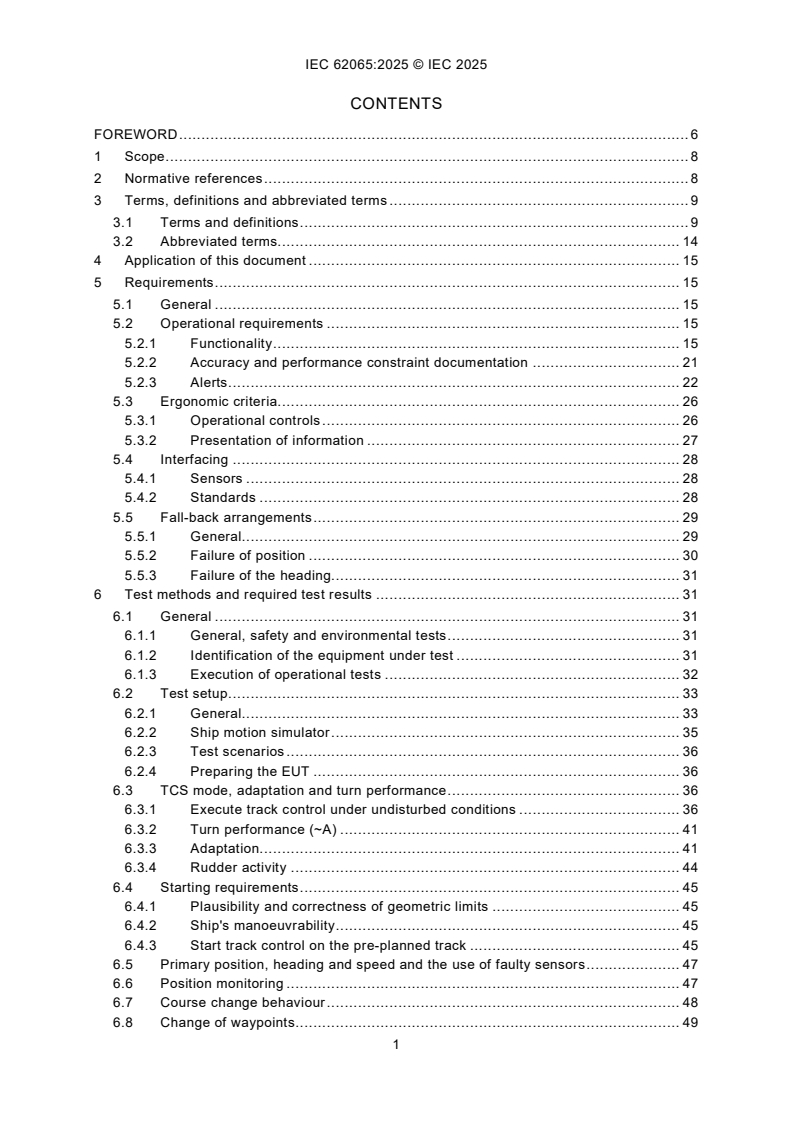
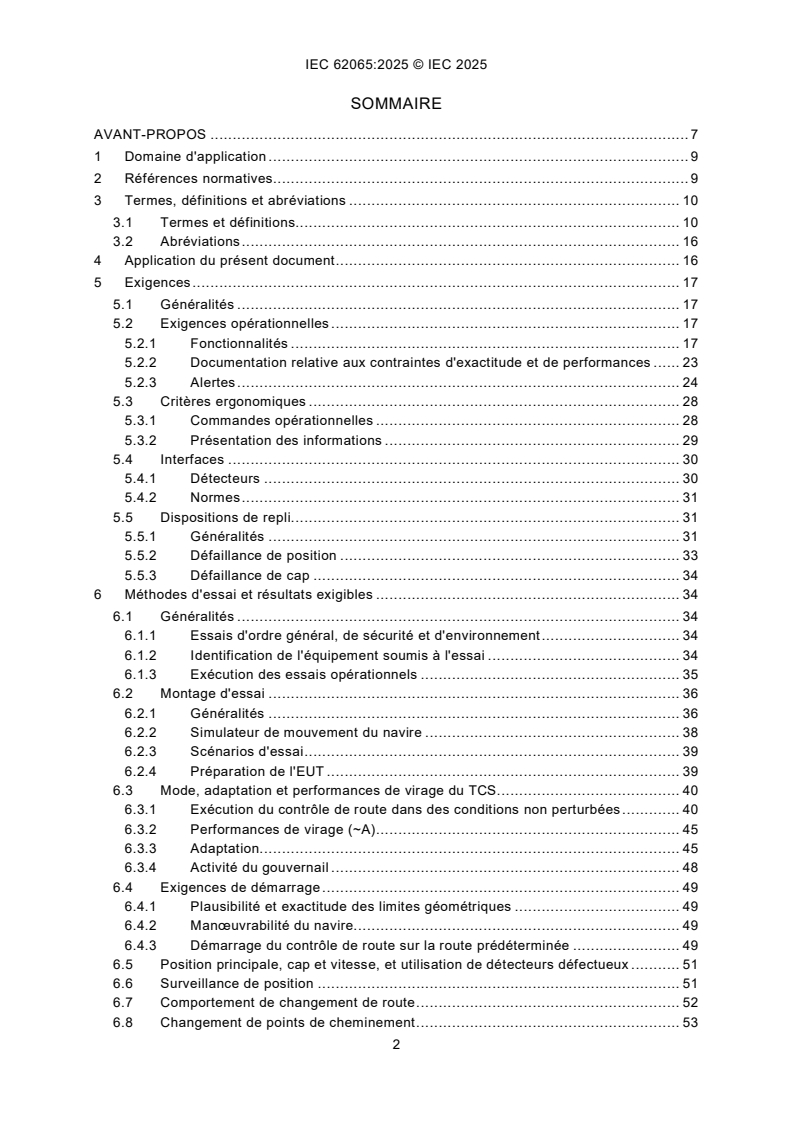
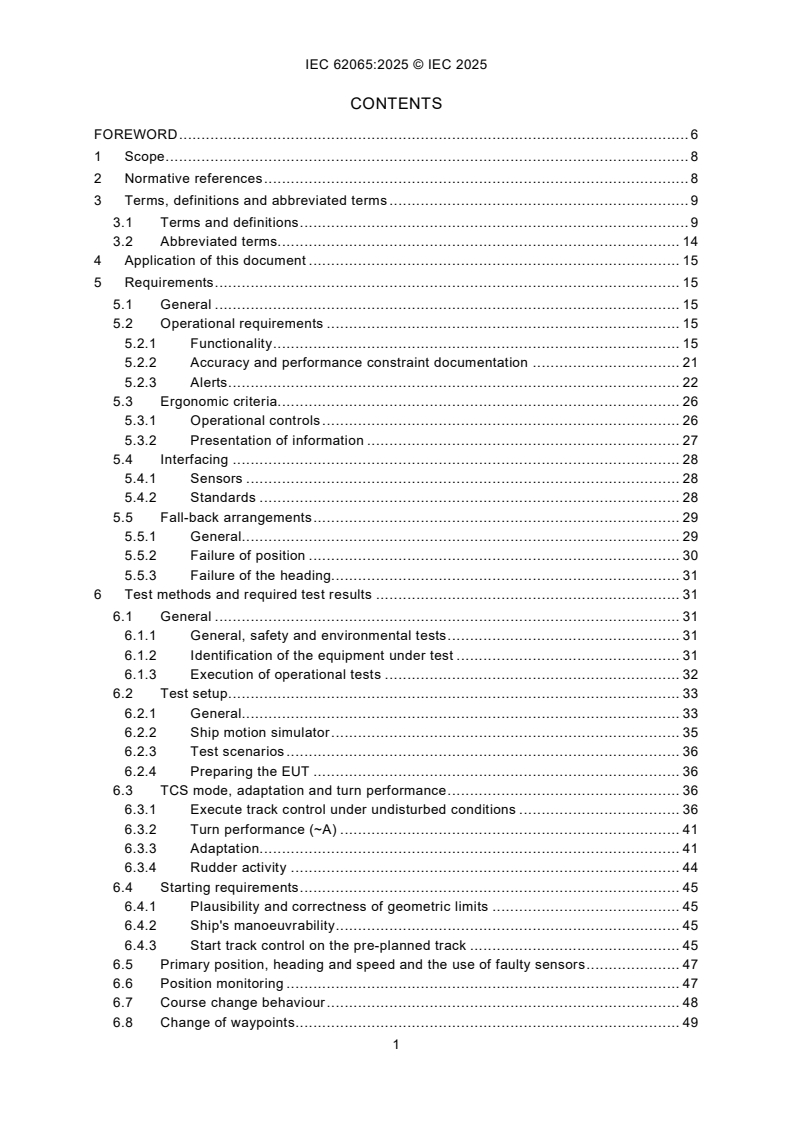
CONTENTS
FOREWORD . 6
1 Scope . 8
2 Normative references . 8
3 Terms, definitions and abbreviated terms . 9
3.1 Terms and definitions . 9
3.2 Abbreviated terms. 14
4 Application of this document . 15
5 Requirements . 15
5.1 General . 15
5.2 Operational requirements . 15
5.2.1 Functionality . 15
5.2.2 Accuracy and performance constraint documentation . 21
5.2.3 Alerts . 22
5.3 Ergonomic criteria. 26
5.3.1 Operational controls . 26
5.3.2 Presentation of information . 27
5.4 Interfacing . 28
5.4.1 Sensors . 28
5.4.2 Standards . 28
5.5 Fall-back arrangements . 29
5.5.1 General. 29
5.5.2 Failure of position . 30
5.5.3 Failure of the heading. 31
6 Test methods and required test results . 31
6.1 General . 31
6.1.1 General, safety and environmental tests . 31
6.1.2 Identification of the equipment under test . 31
6.1.3 Execution of operational tests . 32
6.2 Test setup . 33
6.2.1 General. 33
6.2.2 Ship motion simulator . 35
6.2.3 Test scenarios . 36
6.2.4 Preparing the EUT . 36
6.3 TCS mode, adaptation and turn performance . 36
6.3.1 Execute track control under undisturbed conditions . 36
6.3.2 Turn performance (~A) . 41
6.3.3 Adaptation. 41
6.3.4 Rudder activity . 44
6.4 Starting requirements . 45
6.4.1 Plausibility and correctness of geometric limits . 45
6.4.2 Ship's manoeuvrability . 45
6.4.3 Start track control on the pre-planned track . 45
6.5 Primary position, heading and speed and the use of faulty sensors . 47
6.6 Position monitoring . 47
6.7 Course change behaviour . 48
6.8 Change of waypoints . 49
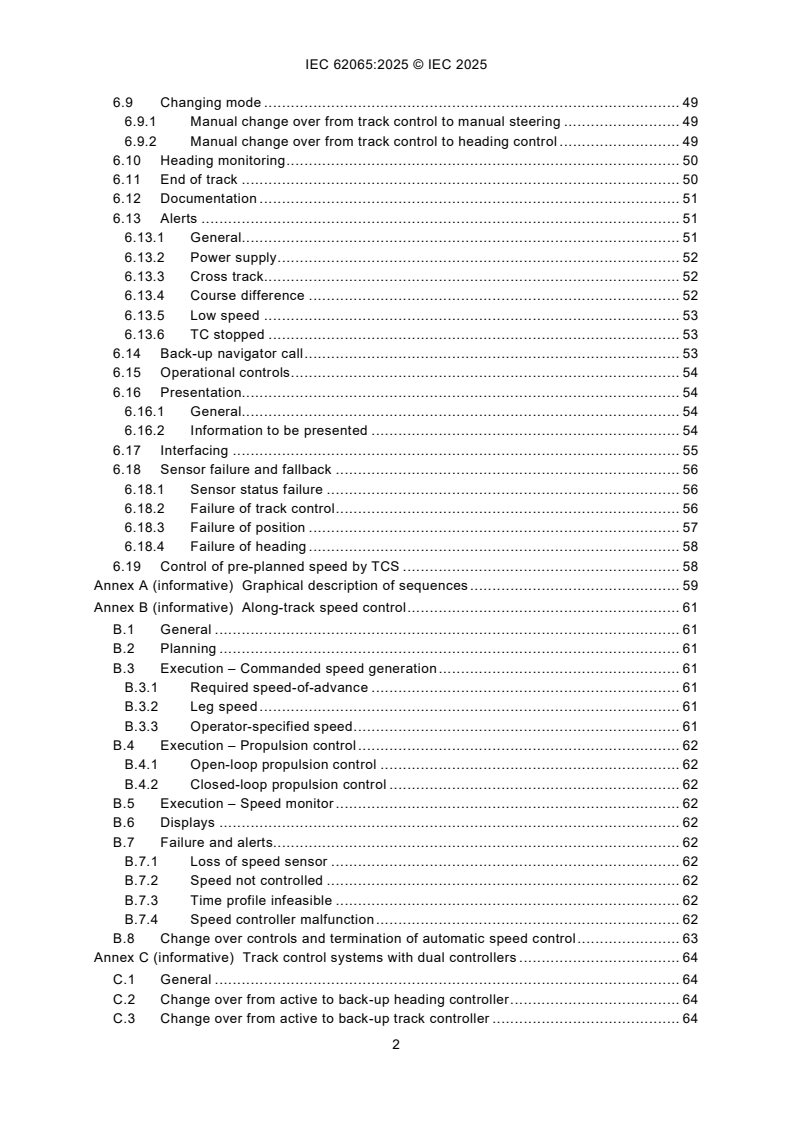
6.9 Changing mode . 49
6.9.1 Manual change over from track control to manual steering . 49
6.9.2 Manual change over from track control to heading control . 49
6.10 Heading monitoring . 50
6.11 End of track . 50
6.12 Documentation . 51
6.13 Alerts . 51
6.13.1 General. 51
6.13.2 Power supply . 52
6.13.3 Cross track . 52
6.13.4 Course difference . 52
6.13.5 Low speed . 53
6.13.6 TC stopped . 53
6.14 Back-up navigator call . 53
6.15 Operational controls . 54
6.16 Presentation. 54
6.16.1 General. 54
6.16.2 Information to be presented . 54
6.17 Interfacing . 55
6.18 Sensor failure and fallback . 56
6.18.1 Sensor status failure . 56
6.18.2 Failure of track control . 56
6.18.3 Failure of position . 57
6.18.4 Failure of heading . 58
6.19 Control of pre-planned speed by TCS . 58
Annex A (informative) Graphical description of sequences . 59
Annex B (informative) Along-track speed control . 61
B.1 General . 61
B.2 Planning . 61
B.3 Execution – Commanded speed generation . 61
B.3.1 Required speed-of-advance . 61
B.3.2 Leg speed . 61
B.3.3 Operator-specified speed . 61
B.4 Execution – Propulsion control . 62
B.4.1 Open-loop propulsion control . 62
B.4.2 Closed-loop propulsion control . 62
B.5 Execution – Speed monitor . 62
B.6 Displays . 62
B.7 Failure and alerts. 62
B.7.1 Loss of speed sensor . 62
B.7.2 Speed not controlled . 62
B.7.3 Time profile infeasible . 62
B.7.4 Speed controller malfunction . 62
B.8 Change over controls and termination of automatic speed control . 63
Annex C (informative) Track control systems with dual controllers . 64
C.1 General . 64
C.2 Change over from active to back-up heading controller . 64
C.3 Change over from active to back-up track controller . 64
C.4 Failure of track control . 64
C.5 Failure of heading controller during track control . 64
Annex D (informative) Management of static and dynamic data . 65
D.1 General . 65
D.2 Management of geographic (chart) data . 65
D.3 Management of ships' data and reference parameters . 65
D.4 Management of track-related data (planning and control) . 65
D.5 Management of sensor data . 66
Annex E (informative) Limits . 67
Annex F (normative) Classification of alerts. 68
Annex G (normative) Scenario definitions and plots . 70
Annex H (informative) Sensor errors and noise models. 75
H.1 Simulation of position sensor errors . 75
H.2 Noise model for simulated position data . 75
H.3 Simulation of heading and speed information . 76
H.4 Simulation of sea state . 76
H.4.1 General. 76
H.4.2 Model description . 77
H.4.3 Model implementation . 78
Annex I (normative) Ship model specification . 81
I.1 General . 81
I.2 Overview – Background and requirements . 81
I.3 The model – Derivation . 81
I.3.1 General. 81
I.3.2 Thrust lever response model . 82
I.3.3 Rudder response model – Derivation . 84
I.3.4 Surge response model . 85
I.3.5 Sway response model . 86
I.3.6 Yaw response model . 88
I.3.7 Integration (deduced reckoning) . 90
I.4 Summary and block diagram . 92
I.4.1 Constant inputs. 92
I.4.2 Estimating parameters for a given vessel or class . 92
I.4.3 Run-time inputs . 93
I.4.4 Outputs . 94
I.4.5 Application of the model to system testing . 94
I.4.6 Testing system only, without rudder actuators . 96
I.4.7 Testing the whole system including actuation mechanism . 96
I.4.8 Model outputs: input to system under test . 97
I.5 Ship parameter sets . 97
I.6 Manoeuvring characteristics from turning circle manoeuvres (informative
example) . 98
Annex J (informative) Explanation of adaptation tests in 6.3.3 . 103
J.1 General . 103
J.2 Adaptation to speed change. 103
J.3 Adaptation to current changes along a leg . 104
J.4 Adaptation to current changes during turn . 104
J.5 Adaptation to sea state during turn . 105
J.6 Adaptation to sea state change on a leg . 105
Annex K (normative) IEC 61162 interfaces . 106
K.1 Required interfaces . 106
K.2 Use of ALR for BNWAS . 108
Bibliography . 109
Figure 1 – EUT typical configurations . 29
Figure 2 – Functional model of track control as part of an integrated navigation system . 32
Figure 3 – Typical logical block diagram for the interaction with the ship motion
simulator . 34
Figure 4 – High level block diagram . 35
Figure A.1 – Sequence of 'course change' alerts (~A) . 59
Figure A.2 – Handling of the back-up navigator call. 60
Figure G.1 – Scenario 1 plot . 70
Figure G.2 – Scenario 2 plot . 71
Figure G.3 – Scenario 3 plot . 72
Figure G.4 – Scenario 4 plot . 74
Figure H.1 – GPS error model . 75
Figure H.2 – Spectral distribution of modelled GPS errors . 76
Figure H.3 – Wave sequence – sea state 5 . 78
Figure H.4 – Wave spectrum – sea state 5 . 78
Figure H.5 – Supertanker – sea state 5 . 79
Figure H.6 – Container ship – sea state 5 . 79
Figure H.7 – Fast ferry – sea state 5 . 79
Figure H.8 – Container ship – sea state 2 . 80
Figure I.1 – High level model block diagram . 82
Figure I.2 – Model block diagram . 95
Figure I.3 – Application with simple follow-up . 96
Figure I.4 – Control system using actuator outputs and feedback . 96
Figure I.5 – System with actuator mechanism, bypassing the rudder response model . 97
Figure I.6 – System with actuator mechanism using a fast rudder response time in the
model . 97
Figure I.7 – Turning circle manoeuvre – Ferry . 100
Figure I.8 – Turning circle manoeuvre – Container ship . 101
Figure I.9 – Turning circle manoeuvre – Tanker . 102
Figure J.1 – Adaptation to speed change . 103
Figure J.2 – Adaptation to changes along a leg . 104
Figure J.3 – Adaptation to current changes during turn . 104
Figure J.4 – Adaptation to sea state during turn . 105
Figure J.5 – Adaptation to sea state change on a leg . 105
Figure K.1 – Track control system logical interfaces . 106
Table 1 – Simulator input rate . 35
Table 2 – Simulator output rate . 36
Table E.1 – Limits. 67
Table F.1 – Classification of alerts for track control systems . 68
Table G.1 – Scenario 1 . 70
Table G.2 – Scenario 2 . 71
Table G.3 – Scenario 3 . 72
Table G.4 – Scenario 4 . 73
Table H.1 – Permitted tolerances . 75
Table H.2 – Heights and periods for half-waves . 77
Table I.1 – Relationship between thrust lever and rudder models . 84
Table I.2 – Constant parameters of the model . 92
Table I.3 – Run-time inputs. 94
Table I.4 – Model outputs . 94
Table I.5 – Parameter sets for three ships . 98
Table I.6 – Results from turning circle manoeuvres . 99
Table K.1 – IEC 61162-1 sentences transmitted by the track control system . 107
Table K.2 – IEC 61162-1 sentences received by the track control system . 108
INTERNATIONAL ELECTROTECHNICAL COMMISSION
____________
Maritime navigation and radiocommunication equipment and systems -
Track control systems -
Operational and performance requirements, test methods and required
test results
FOREWORD
1) The International Electrotechnical Commission (IEC) is a worldwide organization for standardization comprising
all national electrotechnical committees (IEC National Committees). The object of IEC is to promote international
co-operation on all questions concerning standardization in the electrical and electronic fields. To this end and
in addition to other activities, IEC publishes International Standards, Technical Specifications, Technical Reports,
Publicly Available Specifications (PAS) and Guides (hereafter referred to as "IEC Publication(s)"). Their
preparation is entrusted to technical committees; any IEC National Committee interested in the subject dealt with
may participate in this preparatory work. International, governmental and non-governmental organizations liaising
with the IEC also participate in this preparation. IEC collaborates closely with the International Organization for
Standardization (ISO) in accordance with conditions determined by agreement between the two organizations.
2) The formal decisions or agreements of IEC on technical matters express, as nearly as possible, an international
consensus of opinion on the relevant subjects since each technical committee has representation from all
interested IEC National Committees.
3) IEC Publications have the form of recommendations for international use and are accepted by IEC National
Committees in that sense. While all reasonable efforts are made to ensure that the technical content of IEC
Publications is accurate, IEC cannot be held responsible for the way in which they are used or for any
misinterpretation by any end user.
4) In order to promote international uniformity, IEC National Committees undertake to apply IEC Publications
transparently to the maximum extent possible in their national and regional publications. Any divergence between
any IEC Publication and the corresponding national or regional publication shall be clearly indicated in the latter.
5) IEC itself does not provide any attestation of conformity. Independent certification bodies provide conformity
assessment services and, in some areas, access to IEC marks of conformity. IEC is not responsible for any
services carried out by independent certification bodies.
6) All users should ensure that they have the latest edition of this publication.
7) No liability shall attach to IEC or its directors, employees, servants or agents including individual experts and
members of its technical committees and IEC National Committees for any personal injury, property damage or
other damage of any nature whatsoever, whether direct or indirect, or for costs (including legal fees) and
expenses arising out of the publication, use of, or reliance upon, this IEC Publication or any other IEC
Publications.
8) Attention is drawn to the Normative references cited in this publication. Use of the referenced publications is
indispensable for the correct application of this publication.
9) IEC draws attention to the possibility that the implementation of this document may involve the use of (a)
patent(s). IEC takes no position concerning the evidence, validity or applicability of any claimed patent rights in
respect thereof. As of the date of publication of this document, IEC had not received notice of (a) patent(s), which
may be required to implement this document. However, implementers are cautioned that this may not represent
the latest information, which may be obtained from the patent database available at https://patents.iec.ch. IEC
shall not be held responsible for identifying any or all such patent rights.
IEC 62065 has been prepared by IEC technical committee 80: Maritime navigation and
radiocommunication equipment and systems. It is an International Standard.
This third edition cancels and replaces the second edition published in 2014. This edition
constitutes a technical revision.
This edition includes the following significant technical changes with respect to the previous
edition:
a) alert management has been brought in line with MSC.302(87), IEC 62923-1 and
IEC 62923-2, reducing the number of alerts for one situation and improving the information
provided by alerts. An overview is provided in Annex F;
b) the previous Annex F has been removed as it was outdated and not instrumental in this
document;
c) the requirements in Clause 5 have been further detailed;
d) the structure of Clause 6 has been updated.
The text of this International Standard is based on the following documents:
Draft Report on voting
80/1163/FDIS 80/1168/RVD
Full information on the voting for its approval can be found in the report on voting indicated in
the above table.
The language used for the development of this International Standard is English.
This document was drafted in accordance with ISO/IEC Directives, Part 2, and developed in
accordance with ISO/IEC Directives, Part 1 and ISO/IEC Directives, IEC Supplement, available
at www.iec.ch/members_experts/refdocs. The main document types developed by IEC are
described in greater detail at www.iec.ch/publications.
NOTE The following print types are used in this document: all text of this document that is identical to that in IMO
resolution MSC.74(69), Annex 2, is printed in italics and the resolution (abbreviated to – A2) and paragraph numbers
are indicated in brackets i.e. (A2/3.3).
The committee has decided that the contents of this document will remain unchanged until the
stability date indicated on the IEC website under webstore.iec.ch in the data related to the
specific document. At this date, the document will be
– reconfirmed,
– withdrawn, or
– revised.
1 Scope
This document specifies the minimum operational and performance requirements, test methods
and required test results conforming to performance standards adopted by the IMO in resolution
MSC.74(69) Annex 2 Recommendation on Performance Standards for Track Control Systems.
In addition, it takes into account IMO resolution A.694(17) to which IEC 60945 is associated. It
also takes into account IMO resolution MSC.302(87) on bridge alert management (BAM), to
which IEC 62923-1 and IEC 62923-2 are associated.
2 Normative references
The following documents are referred to in the text in such a way that some or all of their content
constitutes requirements of this document. For dated references, only the edition cited applies.
For undated references, the latest edition of the referenced document (including any
amendments) applies.
IEC 60945, Maritime navigation and radiocommunication equipment and systems - General
requirements - Methods of testing and required test results
IEC 61162-1, Maritime navigation and radiocommunication equipment and systems - Digital
interfaces - Part 1: Single talker and multiple listeners
IEC 61162-2, Maritime navigation and radiocommunication equipment and systems - Digital
interfaces - Part 2: Single talker and multiple listeners, high-speed transmission
IEC 61162-450, Maritime navigation and radiocommunication equipment and systems - Digital
interfaces - Part 450: Multiple talkers and multiple listeners - Ethernet interconnection
IEC 62288, Maritime navigation and radiocommunication equipment and systems -
Presentation of navigation-related information on shipborne navigational displays - General
requirements, methods of testing and required test results
IEC 62616, Maritime navigation and radiocommunication equipment and systems - Bridge
navigational watch alarm system (BNWAS)
IEC 62923-1, Maritime navigation and radiocommunication equipment and systems - Bridge
alert management - Part 1: Operational and performance requirements, methods of testing and
required test results
IEC 62923-2, Maritime navigation and radiocommunication equipment and systems - Bridge
alert management - Part 2: Alert and cluster identifiers and other additional features
3 Terms, definitions and abbreviated terms
3.1 Terms and definitions
For the purposes of this document, the following terms and definitions apply.
ISO and IEC maintain terminology databases for use in standardization at the following
addresses:
– IEC Electropedia: available at https://www.electropedia.org/
– ISO Online browsing platform: available at https://www.iso.org/obp
3.1.1
active track
track activated for track control
[SOURCE: IMO Resolution MSC.74(69), Annex 2]
3.1.2
alarm
high-priority alert
condition requiring immediate attention and action by the bridge team, to maintain the safe
navigation and safe operation of the ship
[SOURCE: IMO Resolution MSC.302(87)]
3.1.3
alert
announcement of abnormal situations and conditions requiring attention
Note 1 to entry: Alerts are divided in four priorities: emergency alarms, alarms, warnings and cautions. An alert
provides information about a defined state change in connection with information about how to announce this event
in a defined way to the system and the operator.
[SOURCE: IMO Resolution MSC.302(87)]
3.1.4
assisted turn
manoeuvre of a ship automatically controlled by a pre-set radius or rate of turn, but not based
on the ship's position, to perform an approximation of a curved track
3.1.5
back-up navigator
any individual, generally an officer, who has been designated by the ships master to be on call
if assistance is needed on the bridge
[SOURCE: IMO Resolution MSC.74(69), Annex 2]
3.1.6
back-up navigator call
BNC
signal automatically sent to the BNWAS to call assistance to the bridge
3.1.7
consistent common reference system
CCRS
sub-system or function for acquisition, processing, storage, surveillance and distribution of data
and information providing identical and obligatory reference to sub-systems and subsequent
functions and to other connected equipment, if available
3.1.8
CAM system
combined functionality of CAM and CAM-HMI
Note 1 to entry: CAM means the functionality for the management of the presentation of alerts on the CAM-HMI,
the communication of alert states between CAM-HMI and navigational systems and sensors
Note 2 to entry: CAM-HMI means the human machine interface for centralized presentation and handling of alerts
on the bridge
[SOURCE: IEC 62923-1:2018, 3.1.18, modified – Notes to entry added.]
3.1.9
course
horizontal direction in which a vessel is steered or intended to be steered, expressed as angular
distance from north, usually 000° at north, clockwise through 360°
Note 1 to entry: 360° is indicated as 000°.
3.1.10
course difference limit
maximum difference between track course and heading before a warning is activated
3.1.11
cross-track distance
XTD
perpendicular distance of the ship from the track
[SOURCE: IMO Resolution MSC.74(69), Annex 2]
3.1.12
cross-track limit
maximum cross-track distance before an alarm is activated
[SOURCE: IMO Resolution MSC.74(69), Annex 2]
3.1.13
curved track
non-straight track between two straight legs
[SOURCE: IMO Resolution MSC.74(69), Annex 2]
3.1.14
FROM-waypoint
last passed waypoint
[SOURCE: IMO Resolution MSC.74(69), Annex 2]
3.1.15
great circle
GC
intersection of a sphere on the earth and a plane through its centre
Note 1 to entry: Also called orthodrome.
[SOURCE: ISO 19018:2020, 10.2.9, modified - "also called orthodrome" moved from definition
to note to entry.]
3.1.16
heading
HDG
direction in which the bow of a ship is pointing expressed as an angular displacement from
north
[SOURCE: IMO Resolution MSC.191(79)]
3.1.17
heading control
control of the ship's heading
[SOURCE: IMO Resolution MSC.74(69), Annex 2]
3.1.18
heading monitor function
monitoring of the actual heading sensor by an independent second source
[SOURCE: IMO Resolution MSC.74(69), Annex 2]
3.1.19
leg
straight line between two waypoints and/or curved track(s)
[SOURCE: IMO Resolution MSC.74(69), Annex 2]
3.1.20
main conning position
place on the bridge with a commanding view providing the necessary information and equipment
for the conning officer to carry out his functions
[SOURCE: IMO Resolution MSC.74(69), Annex 2]
3.1.21
minimum manoeuvring speed for track control
lowest alongship speed through the water at which the track control system is capable of
maintaining its performance within the specified accuracy limits
Note 1 to entry: The value depends on the ship's design and loading and on the present environmental conditions.
3.1.22
NEXT-waypoint
waypoint following the TO-waypoint
[SOURCE: IMO Resolution MSC.74(69), Annex 2]
3.1.23
override facility
control to perform the override function
[SOURCE: IMO Resolution MSC.74(69), Annex 2]
3.1.24
override function
intentional fast change-over from automatic to temporary manual control
[SOURCE: IMO Resolution MSC.74(69), Annex 2]
3.1.25
position monitor function
monitoring of the actual position sensor by an independent second source
[SOURCE: IMO Resolution MSC.74(69), Annex 2]
3.1.26
primary position-fixing system
electronic position-fixing system (EPFS) used for track control
3.1.27
radius of turn
radius of a curved track
[SOURCE: IMO Resolution MSC.74(69), Annex 2]
3.1.28
rate of turn
change of heading per time unit
[SOURCE: IMO Resolution MSC.74(69), Annex 2]
3.1.29
rhumb line
RL
line on the surface of the earth making the same angle with each meridian crossed
3.1.30
ship manoeuvring characteristics
range-of-manoeuvre possible for the ship
Note 1 to entry: Examples of the range-of-manoeuvres are: maximum rate of turn, minimum radius of turn, maximum
turn acceleration and deceleration.
3.1.31
single operator action
procedure achieved by no more than one hard-key or soft-key action, excluding any necessary
cursor movements, or voice actuation using programmed codes
[SOURCE: IMO Resolution MSC.252(83)]
3.1.32
speed
absolute value of velocity
Note 1 to entry: May either be the ship's speed through the water, or the speed made good over the ground.
3.1.33
surge
alongship component of ship motion
3.1.34
sway
athwartships component of ship motion
Note 1 to entry: Movement to starboard is indicated by a positive value.
3.1.35
temporary track
track that originates at the current position of the ship and joins the pre-planned track
Note 1 to entry: The temporary track may include temporary waypoints which can be identified as different from the
waypoints of the pre-planned track.
3.1.36
TO-waypoint
waypoint which the ship is approaching
[SOURCE: IMO Resolution MSC.74(69), Annex 2]
3.1.37
track
path to be followed over ground
Note 1 to entry: Also called route.
[SOURCE: IMO Resolution MSC.74(69), Annex 2, modified – Note to entry has been added.]
3.1.38
track control
TC
control of the ship's movement along a track, where corrections made by the controller to
compensate for wind, drift and other influences are based on the cross-track distance and not
only on the bearing to the TO-waypoint
[SOURCE: IMO Resolution MSC.74(69), Annex 2, modified – In the definition, the text in upright
type has been added.]
3.1.39
track course
direction from one waypoint to the next, a constant course on a rhumb line track and a varying
course on a great circle track
[SOURCE: IMO Resolution MSC.74(69), Annex 2, modified – In the definition, the text in upright
type has been added.]
3.1.40
warning
condition requiring immediate attention, but no immediate action by the bridge team
Note 1 to entry: Warnings are presented for precautionary reasons to make the bridge team aware of changed
conditions which are not immediately hazardous, but may become so if no action is taken.
[SOURCE: IMO Resolution MSC.302(87)]
3.1.41
waypoint
WP
geographic position on a route
3.1.42
wheel-over-line
WOL
line where the ship has to initiate a curved track to eliminate the effect of any offset with respect
to the course of the new leg, taking into consideration the distance required for the ship to build
up the necessary rate of turn
[SOURCE: IMO Resolution MSC.74(69), Annex 2, modified – In the definition, the text in upright
type has been added.]
3.1.43
wheel-over-time
WOT
point in time when the track control system initiates the course change
3.1.44
yaw
rate of turn (positive to starboard)
3.2 Abbreviated terms
~A Not applicable for category A systems
BAM Bridge alert management
BNWAS Bridge navigational watch alarm system
CAM Central alert management
CCA Course change alarm
CCW Course change warning
COG Course over ground
DGPS Differential GPS
DR Dead reckoning
ECDIS Electronic chart display and information system
EPFS Electronic position fixing system
EUT Equipment under test
FU Follow up
GPS Global positioning system
INS Integrated navigation system
NFU Non-follow up
RMS Root mean square
ROT Rate of turn
SDME Speed and distance measuring equipment
SWH Significant wave height
TCS Track control system
4 Application of this document
The application of this document is as follows.
a) (A2/1) Track control systems in conjunction with their sources of position, heading and
speed information are intended to keep a ship automatically on a pre-planned track over
ground under various conditions and within the limits related to the ship's manoeuvrability.
A track control system may additionally include or be combined with for example but not
limited to
1) heading control;
2) along-track speed control (see Annex B).
b) Planning the track by waypoints may be performed
1) as part of the track control system; or
2) by importing waypoint- and/or track data.
c) (A2/2.1) These IMO Performance Standards are applicable for track control systems
working
1) at ship's speed from minimum manoeuvring speed up to 30 kn; and
2) at ship's maximum rate of turn not greater than 10°/s.
d) This document applies to three categories of track control systems:
Category A: Single leg track contr
...
IEC 62065 ®
Edition 3.0 2025-10
NORME
INTERNATIONALE
Matériels et systèmes de navigation et de radiocommunication maritimes -
Systèmes de contrôle de route - Exigences opérationnelles et de
fonctionnement, méthodes d'essai et résultats exigibles
ICS 47.020.70 ISBN 978-2-8327-0768-5
Droits de reproduction réservés. Sauf indication contraire, aucune partie de cette publication ne peut être reproduite ni
utilisée sous quelque forme que ce soit et par aucun procédé, électronique ou mécanique, y compris la photocopie et
les microfilms, sans l'accord écrit de l'IEC ou du Comité national de l'IEC du pays du demandeur. Si vous avez des
questions sur le copyright de l'IEC ou si vous désirez obtenir des droits supplémentaires sur cette publication, utilisez
les coordonnées ci-après ou contactez le Comité national de l'IEC de votre pays de résidence.
IEC Secretariat Tel.: +41 22 919 02 11
3, rue de Varembé info@iec.ch
CH-1211 Geneva 20 www.iec.ch
Switzerland
A propos de l'IEC
La Commission Electrotechnique Internationale (IEC) est la première organisation mondiale qui élabore et publie des
Normes internationales pour tout ce qui a trait à l'électricité, à l'électronique et aux technologies apparentées.
A propos des publications IEC
Le contenu technique des publications IEC est constamment revu. Veuillez vous assurer que vous possédez l’édition la
plus récente, un corrigendum ou amendement peut avoir été publié.
Recherche de publications IEC - IEC Products & Services Portal - products.iec.ch
webstore.iec.ch/advsearchform Découvrez notre puissant moteur de recherche et consultez
La recherche avancée permet de trouver des publications gratuitement tous les aperçus des publications, symboles
IEC en utilisant différents critères (numéro de référence, graphiques et le glossaire. Avec un abonnement, vous aurez
texte, comité d’études, …). Elle donne aussi des toujours accès à un contenu à jour adapté à vos besoins.
informations sur les projets et les publications remplacées
ou retirées. Electropedia - www.electropedia.org
Le premier dictionnaire d'électrotechnologie en ligne au
IEC Just Published - webstore.iec.ch/justpublished monde, avec plus de 22 500 articles terminologiques en
Restez informé sur les nouvelles publications IEC. Just anglais et en français, ainsi que les termes équivalents
Published détaille les nouvelles publications parues. dans 25 langues additionnelles. Egalement appelé
Disponible en ligne et une fois par mois par email. Vocabulaire Electrotechnique International (IEV) en ligne.
Service Clients - webstore.iec.ch/csc
Si vous désirez nous donner des commentaires sur cette
publication ou si vous avez des questions contactez-
nous: sales@iec.ch.
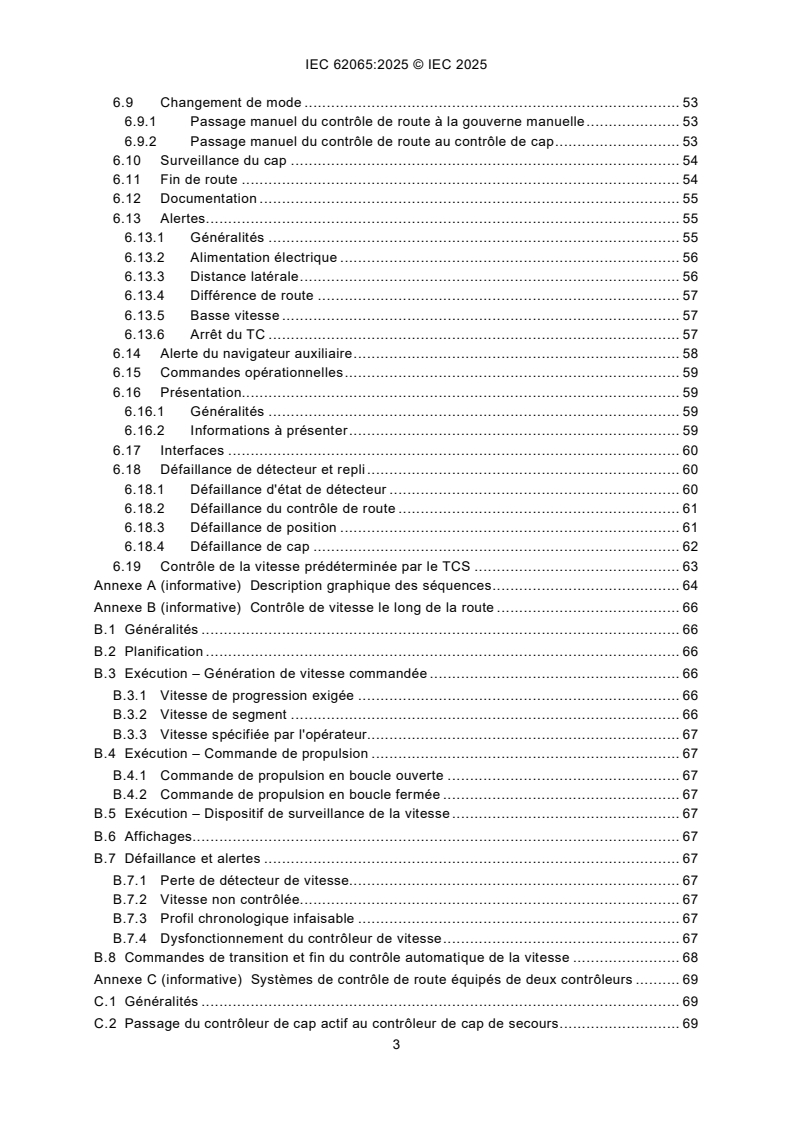
SOMMAIRE
AVANT-PROPOS . 7
1 Domaine d'application . 9
2 Références normatives . 9
3 Termes, définitions et abréviations . 10
3.1 Termes et définitions. 10
3.2 Abréviations . 16
4 Application du présent document . 16
5 Exigences . 17
5.1 Généralités . 17
5.2 Exigences opérationnelles . 17
5.2.1 Fonctionnalités . 17
5.2.2 Documentation relative aux contraintes d'exactitude et de performances . 23
5.2.3 Alertes . 24
5.3 Critères ergonomiques . 28
5.3.1 Commandes opérationnelles . 28
5.3.2 Présentation des informations . 29
5.4 Interfaces . 30
5.4.1 Détecteurs . 30
5.4.2 Normes . 31
5.5 Dispositions de repli. 31
5.5.1 Généralités . 31
5.5.2 Défaillance de position . 33
5.5.3 Défaillance de cap . 34
6 Méthodes d'essai et résultats exigibles . 34
6.1 Généralités . 34
6.1.1 Essais d'ordre général, de sécurité et d'environnement . 34
6.1.2 Identification de l'équipement soumis à l'essai . 34
6.1.3 Exécution des essais opérationnels . 35
6.2 Montage d'essai . 36
6.2.1 Généralités . 36
6.2.2 Simulateur de mouvement du navire . 38
6.2.3 Scénarios d'essai . 39
6.2.4 Préparation de l'EUT . 39
6.3 Mode, adaptation et performances de virage du TCS . 40
6.3.1 Exécution du contrôle de route dans des conditions non perturbées . 40
6.3.2 Performances de virage (~A) . 45
6.3.3 Adaptation. 45
6.3.4 Activité du gouvernail . 48
6.4 Exigences de démarrage . 49
6.4.1 Plausibilité et exactitude des limites géométriques . 49
6.4.2 Manœuvrabilité du navire. 49
6.4.3 Démarrage du contrôle de route sur la route prédéterminée . 49
6.5 Position principale, cap et vitesse, et utilisation de détecteurs défectueux . 51
6.6 Surveillance de position . 51
6.7 Comportement de changement de route . 52
6.8 Changement de points de cheminement . 53
6.9 Changement de mode . 53
6.9.1 Passage manuel du contrôle de route à la gouverne manuelle . 53
6.9.2 Passage manuel du contrôle de route au contrôle de cap . 53
6.10 Surveillance du cap . 54
6.11 Fin de route . 54
6.12 Documentation . 55
6.13 Alertes . 55
6.13.1 Généralités . 55
6.13.2 Alimentation électrique . 56
6.13.3 Distance latérale . 56
6.13.4 Différence de route . 57
6.13.5 Basse vitesse . 57
6.13.6 Arrêt du TC . 57
6.14 Alerte du navigateur auxiliaire . 58
6.15 Commandes opérationnelles . 59
6.16 Présentation. 59
6.16.1 Généralités . 59
6.16.2 Informations à présenter . 59
6.17 Interfaces . 60
6.18 Défaillance de détecteur et repli . 60
6.18.1 Défaillance d'état de détecteur . 60
6.18.2 Défaillance du contrôle de route . 61
6.18.3 Défaillance de position . 61
6.18.4 Défaillance de cap . 62
6.19 Contrôle de la vitesse prédéterminée par le TCS . 63
Annexe A (informative) Description graphique des séquences . 64
Annexe B (informative) Contrôle de vitesse le long de la route . 66
B.1 Généralités . 66
B.2 Planification . 66
B.3 Exécution – Génération de vitesse commandée . 66
B.3.1 Vitesse de progression exigée . 66
B.3.2 Vitesse de segment . 66
B.3.3 Vitesse spécifiée par l'opérateur. 67
B.4 Exécution – Commande de propulsion . 67
B.4.1 Commande de propulsion en boucle ouverte . 67
B.4.2 Commande de propulsion en boucle fermée . 67
B.5 Exécution – Dispositif de surveillance de la vitesse . 67
B.6 Affichages . 67
B.7 Défaillance et alertes . 67
B.7.1 Perte de détecteur de vitesse. 67
B.7.2 Vitesse non contrôlée. 67
B.7.3 Profil chronologique infaisable . 67
B.7.4 Dysfonctionnement du contrôleur de vitesse . 67
B.8 Commandes de transition et fin du contrôle automatique de la vitesse . 68
Annexe C (informative) Systèmes de contrôle de route équipés de deux contrôleurs . 69
C.1 Généralités . 69
C.2 Passage du contrôleur de cap actif au contrôleur de cap de secours . 69
C.3 Passage du contrôleur de route actif au contrôleur de route de secours . 69
C.4 Défaillance du contrôle de route . 69
C.5 Défaillance du contrôleur de cap pendant le contrôle de route . 69
Annexe D (informative) Gestion des données statiques et dynamiques . 70
D.1 Généralités . 70
D.2 Gestion des données géographiques (carte) . 70
D.3 Gestion des données et des paramètres de référence du navire . 70
D.4 Gestion des données relatives à la route (planification et contrôle) . 71
D.5 Gestion des données de détecteur . 71
Annexe E (informative) Limites . 72
Annexe F (normative) Classification des alertes . 73
Annexe G (normative) Définitions et tracés relatifs aux scénarios . 75
Annexe H (informative) Erreurs de détecteur et modèles de bruit. 81
H.1 Simulation des erreurs de détecteur de position . 81
H.2 Modèle de bruit pour les données de position simulées . 81
H.3 Simulation des informations de cap et de vitesse . 82
H.4 Simulation de l'état de la mer . 82
H.4.1 Généralités . 82
H.4.2 Description du modèle . 83
H.4.3 Mise en œuvre du modèle . 84
Annexe I (normative) Spécification du modèle de navire . 87
I.1 Généralités . 87
I.2 Vue d'ensemble – Contexte et exigences . 87
I.3 Modèle – Dérivation . 88
I.3.1 Généralités . 88
I.3.2 Modèle de réponse du levier de poussée . 88
I.3.2.1 Dérivation . 88
I.3.2.2 Équation transformée . 89
I.3.3 Modèle de réponse du gouvernail – Dérivation. 90
I.3.4 Modèle de réponse de la houle . 92
I.3.4.1 Dérivation . 92
I.3.4.2 Équation transformée . 92
I.3.5 Modèle de réponse d'embardée . 93
I.3.5.1 Dérivation . 93
I.3.5.2 Équation transformée . 94
I.3.6 Modèle de réponse du lacet . 94
I.3.6.1 Dérivation . 94
I.3.6.2 Équation transformée . 96
I.3.7 Intégration (navigation à l'estime déduite) . 97
I.4 Récapitulatif et schéma de principe . 99
I.4.1 Entrées constantes . 99
I.4.2 Estimation des paramètres pour un navire ou une classe donné(e) . 99
I.4.3 Entrées du temps d'exécution . 101
I.4.4 Sorties . 101
I.4.5 Application du modèle à l'essai du système . 101
I.4.6 Essai du système uniquement, sans actionneur de gouvernail . 103
I.4.6.1 Systèmes qui génèrent une demande de gouvernail absolu (suivi) . 103
I.4.6.2 Systèmes qui génèrent une commande de l'actionneur de gouvernail . 103
I.4.7 Essai de l'ensemble du système, y compris le dispositif actionneur . 103
I.4.8 Sorties du modèle: entrée dans le système soumis à l'essai . 104
I.5 Jeux de paramètres du navire . 104
I.6 Caractéristiques de manœuvre des manœuvres de braquage (exemple informatif) . 105
Annexe J (informative) Explication des essais d'adaptation du 6.3.3 . 110
J.1 Généralités . 110
J.2 Adaptation au changement de vitesse . 110
J.3 Adaptation aux changements de courant sur un segment . 110
J.4 Adaptation aux changements de courant lors d'un virage . 111
J.5 Adaptation à l'état de la mer lors d'un virage . 111
J.6 Adaptation au changement d'état de la mer sur un segment . 111
Annexe K (normative) Interfaces IEC 61162 . 112
K.1 Interfaces exigées . 112
K.2 Utilisation de la phrase ALR pour le BNWAS . 114
Bibliographie . 115
Figure 1 – Configurations types de l'EUT . 32
Figure 2 – Modèle fonctionnel du contrôle de route dans le cadre d'un système de
navigation intégré . 35
Figure 3 – Schéma de principe logique type de l'interaction avec le simulateur de
mouvement du navire . 37
Figure 4 – Schéma de principe de haut niveau . 38
Figure A.1 – Séquence d'alertes de "changement de route" (~A) . 64
Figure A.2 – Traitement de l'alerte du navigateur auxiliaire . 65
Figure G.1 – Scénario 1: tracé . 76
Figure G.2 – Scénario 2: tracé . 77
Figure G.3 – Scénario 3: tracé . 78
Figure G.4 – Scénario 4: tracé . 80
Figure H.1 – Modèle d'erreur GPS . 81
Figure H.2 – Distribution spectrale des erreurs GPS modélisées . 82
Figure H.3 – Séquence de vagues – État de la mer 5 . 84
Figure H.4 – Spectre de vague – État de la mer 5 . 84
Figure H.5 – Superpétrolier – État de la mer 5 . 85
Figure H.6 – Navire porte-conteneur – État de la mer 5 . 85
Figure H.7 – Ferry rapide – État de la mer 5 . 85
Figure H.8 – Navire porte-conteneur – État de la mer 2 . 86
Figure I.1 – Schéma de principe de haut niveau du modèle. 88
Figure I.2 – Schéma de principe du modèle . 102
Figure I.3 – Application avec suivi simple . 103
Figure I.4 – Système de contrôle qui utilise les sorties et la rétroaction de l'actionneur . 103
Figure I.5 – Système équipé d'un dispositif actionneur, contournant le modèle de
réponse du gouvernail. 104
Figure I.6 – Système équipé d'un dispositif actionneur qui utilise un temps de réponse
de gouvernail rapide dans le modèle . 104
Figure I.7 – Manœuvre de braquage – Ferry. 107
Figure I.8 – Manœuvre de braquage – Navire porte-conteneur . 108
Figure I.9 – Manœuvre de braquage – Pétrolier . 109
Figure J.1 – Adaptation au changement de vitesse . 110
Figure J.2 – Adaptation aux changements sur un segment . 110
Figure J.3 – Adaptation aux changements de courant lors d'un virage . 111
Figure J.4 – Adaptation à l'état de la mer lors d'un virage . 111
Figure J.5 – Adaptation au changement d'état de la mer sur un segment. 111
Figure K.1 – Interfaces logiques du système de contrôle de route . 112
Tableau 1 – Fréquence d'entrée du simulateur . 38
Tableau 2 – Fréquence de sortie du simulateur . 39
Tableau E.1 – Limites . 72
Tableau F.1 – Classification des alertes pour les systèmes de contrôle de route . 73
Tableau G.1 – Scénario 1 . 75
Tableau G.2 – Scénario 2 . 76
Tableau G.3 – Scénario 3 . 77
Tableau G.4 – Scénario 4 . 79
Tableau H.1 – Tolérances admises. 81
Tableau H.2 – Hauteurs et périodes des demi-ondes. 83
Tableau I.1 – Relation entre les modèles de levier de poussée et de gouvernail . 90
Tableau I.2 – Paramètres constants du modèle . 99
Tableau I.3 – Entrées du temps d'exécution . 101
Tableau I.4 – Sorties du modèle . 101
Tableau I.5 – Jeux de paramètres de trois navires . 105
Tableau I.6 – Résultats de manœuvres de braquage . 106
Tableau K.1 – Phrases de l'IEC 61162-1 transmises par le système de contrôle de
route . 113
Tableau K.2 – Phrases de l'IEC 61162-1 reçues par le système de contrôle de route . 114
COMMISSION ÉLECTROTECHNIQUE INTERNATIONALE
____________
Matériels et systèmes de navigation et de radiocommunication maritimes-
Systèmes de contrôle de route -
Exigences opérationnelles et de fonctionnement, méthodes d'essai et
résultats exigibles
AVANT-PROPOS
1) La Commission Électrotechnique Internationale (IEC) est une organisation mondiale de normalisation composée
de l'ensemble des comités électrotechniques nationaux (Comités nationaux de l'IEC). L'IEC a pour objet de
favoriser la coopération internationale pour toutes les questions de normalisation dans les domaines de
l'électricité et de l'électronique. À cet effet, l'IEC – entre autres activités – publie des Normes internationales,
des Spécifications techniques, des Rapports techniques, des Spécifications accessibles au public (PAS) et des
Guides (ci-après dénommés "Publication(s) de l'IEC"). Leur élaboration est confiée à des comités d'études, aux
travaux desquels tout Comité national intéressé par le sujet traité peut participer. Les organisations
internationales, gouvernementales et non gouvernementales, en liaison avec l'IEC, participent également aux
travaux. L'IEC collabore étroitement avec l'Organisation Internationale de Normalisation (ISO), selon des
conditions fixées par accord entre les deux organisations.
2) Les décisions ou accords officiels de l'IEC concernant les questions techniques représentent, dans la mesure du
possible, un accord international sur les sujets étudiés, étant donné que les Comités nationaux de l'IEC intéressés
sont représentés dans chaque comité d'études.
3) Les Publications de l'IEC se présentent sous la forme de recommandations internationales et sont agréées
comme telles par les Comités nationaux de l'IEC. Tous les efforts raisonnables sont entrepris afin que l'IEC
s'assure de l'exactitude du contenu technique de ses publications; l'IEC ne peut pas être tenue responsable de
l'éventuelle mauvaise utilisation ou interprétation qui en est faite par un quelconque utilisateur final.
4) Dans le but d'encourager l'uniformité internationale, les Comités nationaux de l'IEC s'engagent, dans toute la
mesure possible, à appliquer de façon transparente les Publications de l'IEC dans leurs publications nationales
et régionales. Toutes divergences entre toutes Publications de l'IEC et toutes publications nationales ou
régionales correspondantes doivent être indiquées en termes clairs dans ces dernières.
5) L'IEC elle-même ne fournit aucune attestation de conformité. Des organismes de certification indépendants
fournissent des services d'évaluation de conformité et, dans certains secteurs, accèdent aux marques de
conformité de l'IEC. L'IEC n'est responsable d'aucun des services effectués par les organismes de certification
indépendants.
6) Tous les utilisateurs doivent s'assurer qu'ils sont en possession de la dernière édition de cette publication.
7) Aucune responsabilité ne doit être imputée à l'IEC, à ses administrateurs, employés, auxiliaires ou mandataires,
y compris ses experts particuliers et les membres de ses comités d'études et des Comités nationaux de l'IEC,
pour tout préjudice causé en cas de dommages corporels et matériels, ou de tout autre dommage de quelque
nature que ce soit, directe ou indirecte, ou pour supporter les coûts (y compris les frais de justice) et les dépenses
découlant de la publication ou de l'utilisation de cette Publication de l'IEC ou de toute autre Publication de l'IEC,
ou au crédit qui lui est accordé.
8) L'attention est attirée sur les références normatives citées dans cette publication. L'utilisation de publications
référencées est obligatoire pour une application correcte de la présente publication.
9) L'IEC attire l'attention sur le fait que la mise en application du présent document peut entraîner l'utilisation d'un
ou de plusieurs brevets. L'IEC ne prend pas position quant à la preuve, à la validité et à l'applicabilité de tout
droit de brevet revendiqué à cet égard. À la date de publication du présent document, l'IEC n'avait pas reçu
notification qu'un ou plusieurs brevets pouvaient être nécessaires à sa mise en application. Toutefois, il y a lieu
d'avertir les responsables de la mise en application du présent document que des informations plus récentes
sont susceptibles de figurer dans la base de données de brevets, disponible à l'adresse https://patents.iec.ch.
L'IEC ne saurait être tenue pour responsable de ne pas avoir identifié de tels droits de brevets.
L'IEC 62065 a été établie par le comité d'études 80 de l'IEC: Matériels et systèmes de
navigation et de radiocommunication maritimes. Il s'agit d'une Norme internationale.
Cette troisième édition annule et remplace la deuxième édition parue en 2014. Cette édition
constitue une révision technique.
Cette édition inclut les modifications techniques majeures suivantes par rapport à l'édition
précédente:
a) la gestion des alertes a été alignée sur la MSC.302 (87), l'IEC 62923-1 et l'IEC 62923-2,
afin de réduire le nombre d'alertes pour une situation donnée et d'améliorer les informations
fournies par les alertes. Une vue d'ensemble est fournie à l'Annexe F;
b) l'ancienne Annexe F a été supprimée, car elle était obsolète et n'était pas pertinente dans
le présent document;
c) les exigences indiquées à l'Article 5 ont été décrites de manière plus détaillée;
d) la structure de l'Article 6 a été mise à jour.
Le texte de cette Norme internationale est issu des documents suivants:
Projet Rapport de vote
80/1163/FDIS 80/1168/RVD
Le rapport de vote indiqué dans le tableau ci-dessus donne toute information sur le vote ayant
abouti à son approbation.
La langue employée pour l'élaboration de cette Norme internationale est l'anglais.
Ce document a été rédigé selon les Directives ISO/IEC, Partie 2, il a été développé selon les
Directives ISO/IEC, Partie 1 et les Directives ISO/IEC, Supplément IEC, disponibles sous
www.iec.ch/members_experts/refdocs. Les principaux types de documents développés par
l'IEC sont décrits plus en détail sous www.iec.ch/publications.
NOTE Les caractères d'imprimerie suivants sont utilisés dans le présent document: l'ensemble du texte du présent
document dont la signification est identique à celle du texte de la Résolution MSC.74(69), Annexe 2 de l'OMI, est
imprimé en italique, et la résolution (abrégée en A2) et les numéros d'alinéa sont indiqués entre parenthèses, par
exemple (A2/3.3).
Le comité a décidé que le contenu de ce document ne sera pas modifié avant la date de stabilité
indiquée sur le site web de l'IEC sous webstore.iec.ch dans les données relatives au document
recherché. À cette date, le document sera
– reconduit,
– supprimé, ou
– révisé.
1 Domaine d'application
Le présent document spécifie les exigences opérationnelles et de fonctionnement minimales,
les méthodes d'essai et les résultats exigibles conformément aux normes de fonctionnement
adoptées dans la Résolution MSC.74(69), Annexe 2 de l'OMI, Recommandation sur les normes
de fonctionnement des systèmes de contrôle de la route. De plus, il tient compte de la
Résolution A.694(17) de l'OMI, à laquelle est associée l'IEC 60945. Il prend également en
compte la Résolution MSC.302(87) de l'OMI sur la gestion des alertes à la passerelle (BAM,
Bridge Alert Management), à laquelle sont associées l'IEC 62923-1 et l'IEC 62923-2.
2 Références normatives
Les documents suivants sont cités dans le texte de sorte qu'ils constituent, pour tout ou partie
de leur contenu, des exigences du présent document. Pour les références datées, seule
l'édition citée s'applique. Pour les références non datées, la dernière édition du document de
référence s'applique (y compris les éventuels amendements).
IEC 60945, Matériels et systèmes de navigation et de radiocommunication maritimes -
Spécifications générales - Méthodes d'essai et résultats exigibles
IEC 61162-1, Matériels et systèmes de navigation et de radiocommunication maritimes -
Interfaces numériques - Partie 1: Émetteur unique et récepteurs multiples
IEC 61162-2, Matériels et systèmes de navigation et de radiocommunication maritimes -
Interfaces numériques - Partie 2: Emetteur unique et récepteurs multiples, transfert rapide de
données
IEC 61162-450, Matériels et systèmes de navigation et de radiocommunication maritimes -
Interfaces numériques - Partie 450: Émetteurs multiples et récepteurs multiples -
Interconnexion Ethernet
IEC 62288, Matériels et systèmes de navigation et de radiocommunication maritimes -
Présentation des informations relatives à la navigation sur des affichages de navigation de bord
- Exigences générales, méthodes d'essai et résultats d'essai exigés
IEC 62616, Équipements et systèmes de navigation et de radiocommunication maritimes -
Système d'alarme pour la surveillance de l'activité de navigation sur le pont
IEC 62923-1, Matériels et systèmes de navigation et de radiocommunication maritimes -
Gestion des alertes a la passerelle - Partie 1: Exigences d'exploitation et de fonctionnement,
méthodes d'essai et résultats d'essai exigés
IEC 62923-2, Matériels et systèmes de navigation et de radiocommunication maritimes -
Gestion des alertes à la passerelle - Partie 2: Identifiants d'alerte et de groupe et autres
caractéristiques supplémentaires
3 Termes, définitions et abréviations
3.1 Termes et définitions
Pour les besoins du présent document, les termes et définitions suivants s'appliquent.
L'ISO et l'IEC tiennent à jour des bases de données terminologiques destinées à être utilisées
en normalisation, consultables aux adresses suivantes:
– IEC Electropedia: disponible à l'adresse https://www.electropedia.org/
– ISO Online browsing platform: disponible à l'adresse https://www.iso.org/obp
3.1.1
route active
route activée pour le contrôle de route
[SOURCE: Résolution MSC.74(69), Annexe 2 de l'OMI]
3.1.2
alarme
alerte de haute priorité
condition exigeant une attention et une action immédiates de l'équipe de passerelle, afin que
le navire continue à naviguer et à fonctionner en toute sécurité
[SOURCE: Résolution MSC.302(87) de l'OMI]
3.1.3
alerte
annonce de situations et de conditions anormales exigeant une attention
Note 1 à l'article: Les alertes sont divisées en quatre priorités: alarmes d'urgence, alarmes, mises en garde et
avertissements. Une alerte fournit des informations sur un changement d'état défini en lien avec les informations
relatives à la façon d'annoncer cet événement d'une manière définie au système et à l'opérateur.
[SOURCE: Résolution MSC.302(87) de l'OMI]
3.1.4
virage assisté
manœuvre d'un navire contrôlée automatiquement selon un rayon ou une vitesse angulaire
préalablement déterminé(e) indépendant(e) de la position du navire pour effectuer une
évaluation d'une route courbe
3.1.5
navigateur auxiliaire
individu, généralement un officier, désigné par le capitaine du navire pour être en alerte en cas
de nécessité d'assistance sur la passerelle
[SOURCE: Résolution MSC.74(69), Annexe 2 de l'OMI]
3.1.6
alerte du navigateur auxiliaire
BNC
signal envoyé automatiquement au système d'alarme pour la surveillance de l'activité de
navigation sur le pont (BNWAS) afin de demander de l'aide à l'équipe de passerelle
Note 1 à l'article: L'abréviation "BNC" est dérivée du terme anglais développé correspondant "back-up navigator
call".
3.1.7
système de référence commun cohérent
CCRS
sous-système ou fonction qui assure l'acquisition, le traitement, le stockage, la surveillance et
la diffusion des données et informations et qui fournit une référence identique et obligatoire aux
sous-systèmes et aux fonctions ultérieures et à d'autres équipements connectés, s'ils sont
disponibles
Note 1 à l'article: L'abréviation "CCRS" est dérivée du terme anglais développé correspondant "consistent common
reference system".
3.1.8
système CAM
fonctions combinées du CAM et de l'IHM-CAM
Note 1 à l'article: CAM désigne la fonctionnalité de gestion de la présentation des alertes sur l'IHM-CAM, de la
communication des états d'alerte entre l'IHM-CAM et les systèmes de navigation et détecteurs.
Note 2 à l'article: IHM-CAM désigne l'interface homme/machine pour la présentation et le traitement centralisés
des alertes sur la passerelle.
Note 3 à l'article: L'abréviation "CAM" est dérivée du terme anglais développé correspondant "central alert
management".
[SOURCE: IEC 62923-1:2018, 3.1.18, modifié – Les notes à l'article ont été ajoutées.]
3.1.9
route
direction horizontale vers laquelle un navire se dirige ou prévoit de se diriger, exprimée comme
une distance angulaire à partir du nord, en général dans le sens des aiguilles d'une montre
de 000° nord à 360°
Note 1 à l'article: 360° est indiqué sous la forme 000°.
3.1.10
limite de différence de route
différence maximale entre la route et le cap avant qu'une mise en garde ne soit activée
3.1.11
distance latérale
XTD
distance perpendiculaire du navire par rapport à la route
Note 1 à l'article: L'abréviation "XTD" est dérivée du terme anglais développé correspondant "cross-track distance".
[SOURCE: Résolution MSC.74(69), Annexe 2 de l'OMI]
3.1.12
limite latérale
distance latérale maximale avant qu'une alarme ne soit activée
[SOURCE: Résolution MSC.74(69), Annexe 2 de l'OMI]
3.1.13
route courbe
route non rectiligne entre deux segments rectilignes
[SOURCE: Résolution MSC.74(69), Annexe 2 de l'OMI]
3.1.14
point de cheminement À PARTIR DE
dernier point de cheminement traversé
[SOURCE: Résolution MSC.74(69), Annexe 2 de l'OMI]
3.1.15
grand cercle
GC
intersection d'une sphère sur la terre et d'un plan qui passe par son centre
Note 1 à l'article: Également appelé "orthodromie".
Note 2 à l'article: L'abréviation "GC" est dérivée du terme anglais développé correspondant "great circle".
[SOURCE: ISO 19018:2020, 10.2.9, modifié - L'expression "également appelé orthodromie" a
été déplacée de la définition dans une note à l'article.]
3.1.16
cap
HDG
direction dans laquelle pointe l'étrave d'un navire, exprimée par un écart angulaire par rapport
au nord
Note 1 à l'article: L'abréviation "HDG" est dérivée du terme anglais développé correspondant "heading".
[SOURCE: Résolution MSC.191(79) de l'OMI]
3.1.17
contrôle du cap
contrôle du cap du navire
[SOURCE: Résolution MSC.74(69), Annexe 2 de l'OMI]
3.1.18
fonction de surveillance du cap
surveillance du détecteur de cap réel par une deuxième source indépendante
[SOURCE: Résolution MSC.74(69), Annexe 2 de l'OMI]
3.1.19
segment
ligne droite entre deux points de cheminement et/ou route(s) courbe(s)
[SOURCE: Résolution MSC.74(69), Annexe 2 de l'OMI]
3.1.20
poste de direction de manœuvre
place de commandement sur la passerelle apportant les informations et équipements
nécessaires pour que l'officier dirigeant la manœuvre assure ses fonctions
[SOURCE: Résolution MSC.74(69), Annexe 2 de l'OMI]
3.1.21
vitesse de manœuvre minimale pour le contrôle de route
vitesse surface longitudinale la plus faible à laquelle le système de contrôle de route peut
maintenir ses performances dans les limites d'exactitude spécifiées
Note 1 à l'article: La valeur dépend de la conception du navire, du chargement et des conditions d'environnement
présentes.
3.1.22
point de cheminement SUIVANT
point de cheminement qui suit le point de cheminement VERS
[SOURCE: Résolution MSC.74(69), Annexe 2 de l'OMI]
3.1.23
dispositif de neutralisation
commande permettant d'exécuter la fonction de neutralisation
[SOURCE: Résolution MSC.74(69), Annexe 2 de l'OMI]
3.1.24
fonction de neutralisation
passage intentionnel rapide de la commande automatique à la commande manuelle provisoire
[SOURCE: Résolution MSC.74(69), Annexe 2 de l'OMI]
3.1.25
fonction de surveillance de position
surveillance du détecteur de position réelle par une deuxième source indépendante
[SOURCE: Résolution MSC.74(69), Annexe 2 de l'OMI]
3.1.26
système de positionnement principal
système électronique de positionnement (EPFS) utilisé pour le contrôle de route
3.1.27
rayon de virage
rayon d'une route courbe
[SOURCE: Résolution MSC.74(69), Annexe 2 de l'OMI]
3.1.28
vitesse angulaire
variation du cap par unité de temps
[SOURCE: Résolution MSC.74(69), Annexe 2 de l'OMI]
3.1.29
loxodromie
RL
ligne à la surface de la terre présentant le même angle avec chaque méridien croisé
Note 1 à l'article: L'abréviation "RL" est dérivée du terme anglais développé correspondant "rhumb line".
3.1.30
caractéristiques de manœuvre du navire
plage de manœuvre possible pour le navire
Note 1 à l'article: Exemples de plages de manœuvre: vitesse angulaire maximale, rayon de virage minimal,
accélération et décélération maximales de virage.
3.1.31
action unique de l'opérateur
procédure obtenue par une action à clé matérielle ou à clé logicielle au maximum, à l'exclusion
des mouvements d'alidade nécessaires, ou commande vocale utilisant des codes programmés
[SOURCE: Résolution MSC.252(83) de l'OMI]
...
IEC 62065 ®
Edition 3.0 2025-10
INTERNATIONAL
STANDARD
NORME
INTERNATIONALE
Maritime navigation and radiocommunication equipment and systems - Track
control systems - Operational and performance requirements, test methods and
required test results
Matériels et systèmes de navigation et de radiocommunication maritimes -
Systèmes de contrôle de route - Exigences opérationnelles et de
fonctionnement, méthodes d'essai et résultats exigibles
ICS 47.020.70 ISBN 978-2-8327-0768-5
All rights reserved. Unless otherwise specified, no part of this publication may be reproduced or utilized in any form or
by any means, electronic or mechanical, including photocopying and microfilm, without permission in writing from either
IEC or IEC's member National Committee in the country of the requester. If you have any questions about IEC copyright
or have an enquiry about obtaining additional rights to this publication, please contact the address below or your local
IEC member National Committee for further information.
Droits de reproduction réservés. Sauf indication contraire, aucune partie de cette publication ne peut être reproduite ni
utilisée sous quelque forme que ce soit et par aucun procédé, électronique ou mécanique, y compris la photocopie et
les microfilms, sans l'accord écrit de l'IEC ou du Comité national de l'IEC du pays du demandeur. Si vous avez des
questions sur le copyright de l'IEC ou si vous désirez obtenir des droits supplémentaires sur cette publication, utilisez
les coordonnées ci-après ou contactez le Comité national de l'IEC de votre pays de résidence.
IEC Secretariat Tel.: +41 22 919 02 11
3, rue de Varembé info@iec.ch
CH-1211 Geneva 20 www.iec.ch
Switzerland
About the IEC
The International Electrotechnical Commission (IEC) is the leading global organization that prepares and publishes
International Standards for all electrical, electronic and related technologies.
About IEC publications
The technical content of IEC publications is kept under constant review by the IEC. Please make sure that you have the
latest edition, a corrigendum or an amendment might have been published.
IEC publications search - IEC Products & Services Portal - products.iec.ch
webstore.iec.ch/advsearchform Discover our powerful search engine and read freely all the
The advanced search enables to find IEC publications by a publications previews, graphical symbols and the glossary.
variety of criteria (reference number, text, technical With a subscription you will always have access to up to date
committee, …). It also gives information on projects, content tailored to your needs.
replaced and withdrawn publications.
Electropedia - www.electropedia.org
IEC Just Published - webstore.iec.ch/justpublished The world's leading online dictionary on electrotechnology,
Stay up to date on all new IEC publications. Just Published containing more than 22 500 terminological entries in English
details all new publications released. Available online and and French, with equivalent terms in 25 additional languages.
once a month by email. Also known as the International Electrotechnical Vocabulary
(IEV) online.
IEC Customer Service Centre - webstore.iec.ch/csc
If you wish to give us your feedback on this publication or
need further assistance, please contact the Customer
Service Centre: sales@iec.ch.
A propos de l'IEC
La Commission Electrotechnique Internationale (IEC) est la première organisation mondiale qui élabore et publie des
Normes internationales pour tout ce qui a trait à l'électricité, à l'électronique et aux technologies apparentées.
A propos des publications IEC
Le contenu technique des publications IEC est constamment revu. Veuillez vous assurer que vous possédez l’édition la
plus récente, un corrigendum ou amendement peut avoir été publié.
Recherche de publications IEC - IEC Products & Services Portal - products.iec.ch
webstore.iec.ch/advsearchform Découvrez notre puissant moteur de recherche et consultez
La recherche avancée permet de trouver des publications gratuitement tous les aperçus des publications, symboles
IEC en utilisant différents critères (numéro de référence, graphiques et le glossaire. Avec un abonnement, vous aurez
texte, comité d’études, …). Elle donne aussi des toujours accès à un contenu à jour adapté à vos besoins.
informations sur les projets et les publications remplacées
ou retirées. Electropedia - www.electropedia.org
Le premier dictionnaire d'électrotechnologie en ligne au
IEC Just Published - webstore.iec.ch/justpublished monde, avec plus de 22 500 articles terminologiques en
Restez informé sur les nouvelles publications IEC. Just anglais et en français, ainsi que les termes équivalents
Published détaille les nouvelles publications parues. dans 25 langues additionnelles. Egalement appelé
Disponible en ligne et une fois par mois par email. Vocabulaire Electrotechnique International (IEV) en ligne.
Service Clients - webstore.iec.ch/csc
Si vous désirez nous donner des commentaires sur cette
publication ou si vous avez des questions contactez-
nous: sales@iec.ch.
CONTENTS
FOREWORD . 6
1 Scope . 8
2 Normative references . 8
3 Terms, definitions and abbreviated terms . 9
3.1 Terms and definitions . 9
3.2 Abbreviated terms. 14
4 Application of this document . 15
5 Requirements . 15
5.1 General . 15
5.2 Operational requirements . 15
5.2.1 Functionality . 15
5.2.2 Accuracy and performance constraint documentation . 21
5.2.3 Alerts . 22
5.3 Ergonomic criteria. 26
5.3.1 Operational controls . 26
5.3.2 Presentation of information . 27
5.4 Interfacing . 28
5.4.1 Sensors . 28
5.4.2 Standards . 28
5.5 Fall-back arrangements . 29
5.5.1 General. 29
5.5.2 Failure of position . 30
5.5.3 Failure of the heading. 31
6 Test methods and required test results . 31
6.1 General . 31
6.1.1 General, safety and environmental tests . 31
6.1.2 Identification of the equipment under test . 31
6.1.3 Execution of operational tests . 32
6.2 Test setup . 33
6.2.1 General. 33
6.2.2 Ship motion simulator . 35
6.2.3 Test scenarios . 36
6.2.4 Preparing the EUT . 36
6.3 TCS mode, adaptation and turn performance . 36
6.3.1 Execute track control under undisturbed conditions . 36
6.3.2 Turn performance (~A) . 41
6.3.3 Adaptation. 41
6.3.4 Rudder activity . 44
6.4 Starting requirements . 45
6.4.1 Plausibility and correctness of geometric limits . 45
6.4.2 Ship's manoeuvrability . 45
6.4.3 Start track control on the pre-planned track . 45
6.5 Primary position, heading and speed and the use of faulty sensors . 47
6.6 Position monitoring . 47
6.7 Course change behaviour . 48
6.8 Change of waypoints . 49
6.9 Changing mode . 49
6.9.1 Manual change over from track control to manual steering . 49
6.9.2 Manual change over from track control to heading control . 49
6.10 Heading monitoring . 50
6.11 End of track . 50
6.12 Documentation . 51
6.13 Alerts . 51
6.13.1 General. 51
6.13.2 Power supply . 52
6.13.3 Cross track . 52
6.13.4 Course difference . 52
6.13.5 Low speed . 53
6.13.6 TC stopped . 53
6.14 Back-up navigator call . 53
6.15 Operational controls . 54
6.16 Presentation. 54
6.16.1 General. 54
6.16.2 Information to be presented . 54
6.17 Interfacing . 55
6.18 Sensor failure and fallback . 56
6.18.1 Sensor status failure . 56
6.18.2 Failure of track control . 56
6.18.3 Failure of position . 57
6.18.4 Failure of heading . 58
6.19 Control of pre-planned speed by TCS . 58
Annex A (informative) Graphical description of sequences . 59
Annex B (informative) Along-track speed control . 61
B.1 General . 61
B.2 Planning . 61
B.3 Execution – Commanded speed generation . 61
B.3.1 Required speed-of-advance . 61
B.3.2 Leg speed . 61
B.3.3 Operator-specified speed . 61
B.4 Execution – Propulsion control . 62
B.4.1 Open-loop propulsion control . 62
B.4.2 Closed-loop propulsion control . 62
B.5 Execution – Speed monitor . 62
B.6 Displays . 62
B.7 Failure and alerts. 62
B.7.1 Loss of speed sensor . 62
B.7.2 Speed not controlled . 62
B.7.3 Time profile infeasible . 62
B.7.4 Speed controller malfunction . 62
B.8 Change over controls and termination of automatic speed control . 63
Annex C (informative) Track control systems with dual controllers . 64
C.1 General . 64
C.2 Change over from active to back-up heading controller . 64
C.3 Change over from active to back-up track controller . 64
C.4 Failure of track control . 64
C.5 Failure of heading controller during track control . 64
Annex D (informative) Management of static and dynamic data . 65
D.1 General . 65
D.2 Management of geographic (chart) data . 65
D.3 Management of ships' data and reference parameters . 65
D.4 Management of track-related data (planning and control) . 65
D.5 Management of sensor data . 66
Annex E (informative) Limits . 67
Annex F (normative) Classification of alerts. 68
Annex G (normative) Scenario definitions and plots . 70
Annex H (informative) Sensor errors and noise models. 75
H.1 Simulation of position sensor errors . 75
H.2 Noise model for simulated position data . 75
H.3 Simulation of heading and speed information . 76
H.4 Simulation of sea state . 76
H.4.1 General. 76
H.4.2 Model description . 77
H.4.3 Model implementation . 78
Annex I (normative) Ship model specification . 81
I.1 General . 81
I.2 Overview – Background and requirements . 81
I.3 The model – Derivation . 81
I.3.1 General. 81
I.3.2 Thrust lever response model . 82
I.3.3 Rudder response model – Derivation . 84
I.3.4 Surge response model . 85
I.3.5 Sway response model . 86
I.3.6 Yaw response model . 88
I.3.7 Integration (deduced reckoning) . 90
I.4 Summary and block diagram . 92
I.4.1 Constant inputs. 92
I.4.2 Estimating parameters for a given vessel or class . 92
I.4.3 Run-time inputs . 93
I.4.4 Outputs . 94
I.4.5 Application of the model to system testing . 94
I.4.6 Testing system only, without rudder actuators . 96
I.4.7 Testing the whole system including actuation mechanism . 96
I.4.8 Model outputs: input to system under test . 97
I.5 Ship parameter sets . 97
I.6 Manoeuvring characteristics from turning circle manoeuvres (informative
example) . 98
Annex J (informative) Explanation of adaptation tests in 6.3.3 . 103
J.1 General . 103
J.2 Adaptation to speed change. 103
J.3 Adaptation to current changes along a leg . 104
J.4 Adaptation to current changes during turn . 104
J.5 Adaptation to sea state during turn . 105
J.6 Adaptation to sea state change on a leg . 105
Annex K (normative) IEC 61162 interfaces . 106
K.1 Required interfaces . 106
K.2 Use of ALR for BNWAS . 108
Bibliography . 109
Figure 1 – EUT typical configurations . 29
Figure 2 – Functional model of track control as part of an integrated navigation system . 32
Figure 3 – Typical logical block diagram for the interaction with the ship motion
simulator . 34
Figure 4 – High level block diagram . 35
Figure A.1 – Sequence of 'course change' alerts (~A) . 59
Figure A.2 – Handling of the back-up navigator call. 60
Figure G.1 – Scenario 1 plot . 70
Figure G.2 – Scenario 2 plot . 71
Figure G.3 – Scenario 3 plot . 72
Figure G.4 – Scenario 4 plot . 74
Figure H.1 – GPS error model . 75
Figure H.2 – Spectral distribution of modelled GPS errors . 76
Figure H.3 – Wave sequence – sea state 5 . 78
Figure H.4 – Wave spectrum – sea state 5 . 78
Figure H.5 – Supertanker – sea state 5 . 79
Figure H.6 – Container ship – sea state 5 . 79
Figure H.7 – Fast ferry – sea state 5 . 79
Figure H.8 – Container ship – sea state 2 . 80
Figure I.1 – High level model block diagram . 82
Figure I.2 – Model block diagram . 95
Figure I.3 – Application with simple follow-up . 96
Figure I.4 – Control system using actuator outputs and feedback . 96
Figure I.5 – System with actuator mechanism, bypassing the rudder response model . 97
Figure I.6 – System with actuator mechanism using a fast rudder response time in the
model . 97
Figure I.7 – Turning circle manoeuvre – Ferry . 100
Figure I.8 – Turning circle manoeuvre – Container ship . 101
Figure I.9 – Turning circle manoeuvre – Tanker . 102
Figure J.1 – Adaptation to speed change . 103
Figure J.2 – Adaptation to changes along a leg . 104
Figure J.3 – Adaptation to current changes during turn . 104
Figure J.4 – Adaptation to sea state during turn . 105
Figure J.5 – Adaptation to sea state change on a leg . 105
Figure K.1 – Track control system logical interfaces . 106
Table 1 – Simulator input rate . 35
Table 2 – Simulator output rate . 36
Table E.1 – Limits. 67
Table F.1 – Classification of alerts for track control systems . 68
Table G.1 – Scenario 1 . 70
Table G.2 – Scenario 2 . 71
Table G.3 – Scenario 3 . 72
Table G.4 – Scenario 4 . 73
Table H.1 – Permitted tolerances . 75
Table H.2 – Heights and periods for half-waves . 77
Table I.1 – Relationship between thrust lever and rudder models . 84
Table I.2 – Constant parameters of the model . 92
Table I.3 – Run-time inputs. 94
Table I.4 – Model outputs . 94
Table I.5 – Parameter sets for three ships . 98
Table I.6 – Results from turning circle manoeuvres . 99
Table K.1 – IEC 61162-1 sentences transmitted by the track control system . 107
Table K.2 – IEC 61162-1 sentences received by the track control system . 108
INTERNATIONAL ELECTROTECHNICAL COMMISSION
____________
Maritime navigation and radiocommunication equipment and systems -
Track control systems -
Operational and performance requirements, test methods and required
test results
FOREWORD
1) The International Electrotechnical Commission (IEC) is a worldwide organization for standardization comprising
all national electrotechnical committees (IEC National Committees). The object of IEC is to promote international
co-operation on all questions concerning standardization in the electrical and electronic fields. To this end and
in addition to other activities, IEC publishes International Standards, Technical Specifications, Technical Reports,
Publicly Available Specifications (PAS) and Guides (hereafter referred to as "IEC Publication(s)"). Their
preparation is entrusted to technical committees; any IEC National Committee interested in the subject dealt with
may participate in this preparatory work. International, governmental and non-governmental organizations liaising
with the IEC also participate in this preparation. IEC collaborates closely with the International Organization for
Standardization (ISO) in accordance with conditions determined by agreement between the two organizations.
2) The formal decisions or agreements of IEC on technical matters express, as nearly as possible, an international
consensus of opinion on the relevant subjects since each technical committee has representation from all
interested IEC National Committees.
3) IEC Publications have the form of recommendations for international use and are accepted by IEC National
Committees in that sense. While all reasonable efforts are made to ensure that the technical content of IEC
Publications is accurate, IEC cannot be held responsible for the way in which they are used or for any
misinterpretation by any end user.
4) In order to promote international uniformity, IEC National Committees undertake to apply IEC Publications
transparently to the maximum extent possible in their national and regional publications. Any divergence between
any IEC Publication and the corresponding national or regional publication shall be clearly indicated in the latter.
5) IEC itself does not provide any attestation of conformity. Independent certification bodies provide conformity
assessment services and, in some areas, access to IEC marks of conformity. IEC is not responsible for any
services carried out by independent certification bodies.
6) All users should ensure that they have the latest edition of this publication.
7) No liability shall attach to IEC or its directors, employees, servants or agents including individual experts and
members of its technical committees and IEC National Committees for any personal injury, property damage or
other damage of any nature whatsoever, whether direct or indirect, or for costs (including legal fees) and
expenses arising out of the publication, use of, or reliance upon, this IEC Publication or any other IEC
Publications.
8) Attention is drawn to the Normative references cited in this publication. Use of the referenced publications is
indispensable for the correct application of this publication.
9) IEC draws attention to the possibility that the implementation of this document may involve the use of (a)
patent(s). IEC takes no position concerning the evidence, validity or applicability of any claimed patent rights in
respect thereof. As of the date of publication of this document, IEC had not received notice of (a) patent(s), which
may be required to implement this document. However, implementers are cautioned that this may not represent
the latest information, which may be obtained from the patent database available at https://patents.iec.ch. IEC
shall not be held responsible for identifying any or all such patent rights.
IEC 62065 has been prepared by IEC technical committee 80: Maritime navigation and
radiocommunication equipment and systems. It is an International Standard.
This third edition cancels and replaces the second edition published in 2014. This edition
constitutes a technical revision.
This edition includes the following significant technical changes with respect to the previous
edition:
a) alert management has been brought in line with MSC.302(87), IEC 62923-1 and
IEC 62923-2, reducing the number of alerts for one situation and improving the information
provided by alerts. An overview is provided in Annex F;
b) the previous Annex F has been removed as it was outdated and not instrumental in this
document;
c) the requirements in Clause 5 have been further detailed;
d) the structure of Clause 6 has been updated.
The text of this International Standard is based on the following documents:
Draft Report on voting
80/1163/FDIS 80/1168/RVD
Full information on the voting for its approval can be found in the report on voting indicated in
the above table.
The language used for the development of this International Standard is English.
This document was drafted in accordance with ISO/IEC Directives, Part 2, and developed in
accordance with ISO/IEC Directives, Part 1 and ISO/IEC Directives, IEC Supplement, available
at www.iec.ch/members_experts/refdocs. The main document types developed by IEC are
described in greater detail at www.iec.ch/publications.
NOTE The following print types are used in this document: all text of this document that is identical to that in IMO
resolution MSC.74(69), Annex 2, is printed in italics and the resolution (abbreviated to – A2) and paragraph numbers
are indicated in brackets i.e. (A2/3.3).
The committee has decided that the contents of this document will remain unchanged until the
stability date indicated on the IEC website under webstore.iec.ch in the data related to the
specific document. At this date, the document will be
– reconfirmed,
– withdrawn, or
– revised.
1 Scope
This document specifies the minimum operational and performance requirements, test methods
and required test results conforming to performance standards adopted by the IMO in resolution
MSC.74(69) Annex 2 Recommendation on Performance Standards for Track Control Systems.
In addition, it takes into account IMO resolution A.694(17) to which IEC 60945 is associated. It
also takes into account IMO resolution MSC.302(87) on bridge alert management (BAM), to
which IEC 62923-1 and IEC 62923-2 are associated.
2 Normative references
The following documents are referred to in the text in such a way that some or all of their content
constitutes requirements of this document. For dated references, only the edition cited applies.
For undated references, the latest edition of the referenced document (including any
amendments) applies.
IEC 60945, Maritime navigation and radiocommunication equipment and systems - General
requirements - Methods of testing and required test results
IEC 61162-1, Maritime navigation and radiocommunication equipment and systems - Digital
interfaces - Part 1: Single talker and multiple listeners
IEC 61162-2, Maritime navigation and radiocommunication equipment and systems - Digital
interfaces - Part 2: Single talker and multiple listeners, high-speed transmission
IEC 61162-450, Maritime navigation and radiocommunication equipment and systems - Digital
interfaces - Part 450: Multiple talkers and multiple listeners - Ethernet interconnection
IEC 62288, Maritime navigation and radiocommunication equipment and systems -
Presentation of navigation-related information on shipborne navigational displays - General
requirements, methods of testing and required test results
IEC 62616, Maritime navigation and radiocommunication equipment and systems - Bridge
navigational watch alarm system (BNWAS)
IEC 62923-1, Maritime navigation and radiocommunication equipment and systems - Bridge
alert management - Part 1: Operational and performance requirements, methods of testing and
required test results
IEC 62923-2, Maritime navigation and radiocommunication equipment and systems - Bridge
alert management - Part 2: Alert and cluster identifiers and other additional features
3 Terms, definitions and abbreviated terms
3.1 Terms and definitions
For the purposes of this document, the following terms and definitions apply.
ISO and IEC maintain terminology databases for use in standardization at the following
addresses:
– IEC Electropedia: available at https://www.electropedia.org/
– ISO Online browsing platform: available at https://www.iso.org/obp
3.1.1
active track
track activated for track control
[SOURCE: IMO Resolution MSC.74(69), Annex 2]
3.1.2
alarm
high-priority alert
condition requiring immediate attention and action by the bridge team, to maintain the safe
navigation and safe operation of the ship
[SOURCE: IMO Resolution MSC.302(87)]
3.1.3
alert
announcement of abnormal situations and conditions requiring attention
Note 1 to entry: Alerts are divided in four priorities: emergency alarms, alarms, warnings and cautions. An alert
provides information about a defined state change in connection with information about how to announce this event
in a defined way to the system and the operator.
[SOURCE: IMO Resolution MSC.302(87)]
3.1.4
assisted turn
manoeuvre of a ship automatically controlled by a pre-set radius or rate of turn, but not based
on the ship's position, to perform an approximation of a curved track
3.1.5
back-up navigator
any individual, generally an officer, who has been designated by the ships master to be on call
if assistance is needed on the bridge
[SOURCE: IMO Resolution MSC.74(69), Annex 2]
3.1.6
back-up navigator call
BNC
signal automatically sent to the BNWAS to call assistance to the bridge
3.1.7
consistent common reference system
CCRS
sub-system or function for acquisition, processing, storage, surveillance and distribution of data
and information providing identical and obligatory reference to sub-systems and subsequent
functions and to other connected equipment, if available
3.1.8
CAM system
combined functionality of CAM and CAM-HMI
Note 1 to entry: CAM means the functionality for the management of the presentation of alerts on the CAM-HMI,
the communication of alert states between CAM-HMI and navigational systems and sensors
Note 2 to entry: CAM-HMI means the human machine interface for centralized presentation and handling of alerts
on the bridge
[SOURCE: IEC 62923-1:2018, 3.1.18, modified – Notes to entry added.]
3.1.9
course
horizontal direction in which a vessel is steered or intended to be steered, expressed as angular
distance from north, usually 000° at north, clockwise through 360°
Note 1 to entry: 360° is indicated as 000°.
3.1.10
course difference limit
maximum difference between track course and heading before a warning is activated
3.1.11
cross-track distance
XTD
perpendicular distance of the ship from the track
[SOURCE: IMO Resolution MSC.74(69), Annex 2]
3.1.12
cross-track limit
maximum cross-track distance before an alarm is activated
[SOURCE: IMO Resolution MSC.74(69), Annex 2]
3.1.13
curved track
non-straight track between two straight legs
[SOURCE: IMO Resolution MSC.74(69), Annex 2]
3.1.14
FROM-waypoint
last passed waypoint
[SOURCE: IMO Resolution MSC.74(69), Annex 2]
3.1.15
great circle
GC
intersection of a sphere on the earth and a plane through its centre
Note 1 to entry: Also called orthodrome.
[SOURCE: ISO 19018:2020, 10.2.9, modified - "also called orthodrome" moved from definition
to note to entry.]
3.1.16
heading
HDG
direction in which the bow of a ship is pointing expressed as an angular displacement from
north
[SOURCE: IMO Resolution MSC.191(79)]
3.1.17
heading control
control of the ship's heading
[SOURCE: IMO Resolution MSC.74(69), Annex 2]
3.1.18
heading monitor function
monitoring of the actual heading sensor by an independent second source
[SOURCE: IMO Resolution MSC.74(69), Annex 2]
3.1.19
leg
straight line between two waypoints and/or curved track(s)
[SOURCE: IMO Resolution MSC.74(69), Annex 2]
3.1.20
main conning position
place on the bridge with a commanding view providing the necessary information and equipment
for the conning officer to carry out his functions
[SOURCE: IMO Resolution MSC.74(69), Annex 2]
3.1.21
minimum manoeuvring speed for track control
lowest alongship speed through the water at which the track control system is capable of
maintaining its performance within the specified accuracy limits
Note 1 to entry: The value depends on the ship's design and loading and on the present environmental conditions.
3.1.22
NEXT-waypoint
waypoint following the TO-waypoint
[SOURCE: IMO Resolution MSC.74(69), Annex 2]
3.1.23
override facility
control to perform the override function
[SOURCE: IMO Resolution MSC.74(69), Annex 2]
3.1.24
override function
intentional fast change-over from automatic to temporary manual control
[SOURCE: IMO Resolution MSC.74(69), Annex 2]
3.1.25
position monitor function
monitoring of the actual position sensor by an independent second source
[SOURCE: IMO Resolution MSC.74(69), Annex 2]
3.1.26
primary position-fixing system
electronic position-fixing system (EPFS) used for track control
3.1.27
radius of turn
radius of a curved track
[SOURCE: IMO Resolution MSC.74(69), Annex 2]
3.1.28
rate of turn
change of heading per time unit
[SOURCE: IMO Resolution MSC.74(69), Annex 2]
3.1.29
rhumb line
RL
line on the surface of the earth making the same angle with each meridian crossed
3.1.30
ship manoeuvring characteristics
range-of-manoeuvre possible for the ship
Note 1 to entry: Examples of the range-of-manoeuvres are: maximum rate of turn, minimum radius of turn, maximum
turn acceleration and deceleration.
3.1.31
single operator action
procedure achieved by no more than one hard-key or soft-key action, excluding any necessary
cursor movements, or voice actuation using programmed codes
[SOURCE: IMO Resolution MSC.252(83)]
3.1.32
speed
absolute value of velocity
Note 1 to entry: May either be the ship's speed through the water, or the speed made good over the ground.
3.1.33
surge
alongship component of ship motion
3.1.34
sway
athwartships component of ship motion
Note 1 to entry: Movement to starboard is indicated by a positive value.
3.1.35
temporary track
track that originates at the current position of the ship and joins the pre-planned track
Note 1 to entry: The temporary track may include temporary waypoints which can be identified as different from the
waypoints of the pre-planned track.
3.1.36
TO-waypoint
waypoint which the ship is approaching
[SOURCE: IMO Resolution MSC.74(69), Annex 2]
3.1.37
track
path to be followed over ground
Note 1 to entry: Also called route.
[SOURCE: IMO Resolution MSC.74(69), Annex 2, modified – Note to entry has been added.]
3.1.38
track control
TC
control of the ship's movement along a track, where corrections made by the controller to
compensate for wind, drift and other influences are based on the cross-track distance and not
only on the bearing to the TO-waypoint
[SOURCE: IMO Resolution MSC.74(69), Annex 2, modified – In the definition, the text in upright
type has been added.]
3.1.39
track course
direction from one waypoint to the next, a constant course on a rhumb line track and a varying
course on a great circle track
[SOURCE: IMO Resolution MSC.74(69), Annex 2, modified – In the definition, the text in upright
type has been added.]
3.
...