

IEC 62288:2021
(Main)Maritime navigation and radiocommunication equipment and systems - Presentation of navigation-related information on shipborne navigational displays - General requirements, methods of testing and required test results
General Information
- Abstract
IEC 62288:2021 specifies the general requirements, methods of testing, and required test results, for the presentation of navigation-related information on shipborne navigational displays in support of IMO resolutions MSC.191(79) as amended by MSC.466(101) in June 2019, and where applicable MSC.302(87). This document also supports the guidelines included in the related IMO Circulars MSC.1/Circ.1609 on the standardization of user interface design for navigation equipment and SN.1/Circ.243 as revised in June 2019 on the presentation of navigation related symbols, terms, and abbreviations. This document also specifies the presentation of AIS data reports and the AIS Application Specific Messages defined for international use in IMO SN.1/Circ.289 and intended to be received by a ship for display onboard.
- Status
- Published
- Publication Date
- 06-Nov-2024
- Technical Committee
- TC 80 - Maritime navigation and radiocommunication equipment and systems
- Drafting Committee
- MT 5 - TC 80/MT 5
- Current Stage
- PPUB - Publication issued
- Start Date
- 20-Dec-2021
- Completion Date
- 07-Jan-2022
Buy Documents


REDLINE IEC 62288:2021 CMV - Maritime navigation and radiocommunication equipment and systems - Presentation of navigation-related information on shipborne navigational displays - General requirements, methods of testing and required test results Released:12/20/2021


IEC 62288:2021+AMD1:2024 CSV - Maritime navigation and radiocommunication equipment and systems - Presentation of navigation-related information on shipborne navigational displays - General requirements, methods of testing and required test results Released:11/7/2024


IEC 62288:2021 - Maritime navigation and radiocommunication equipment and systems - Presentation of navigation-related information on shipborne navigational displays - General requirements, methods of testing and required test results Released:12/20/2021
Overview
IEC 62288:2021 defines the general requirements, methods of testing, and required test results for the presentation of navigation-related information on shipborne navigational displays. It supports IMO requirements (notably MSC.191(79) as amended by MSC.466(101) and, where applicable, MSC.302(87)) and complements IMO guidance on user interface design and symbol standardization. The standard covers presentation rules for radar, chart and INS-derived information, AIS data reports, and AIS Application Specific Messages intended for onboard display.
Key topics and technical requirements
- General display requirements: layout consistency, logical grouping, separation of operational display area, and compliance with marine environmental/ergonomic needs.
- Readability and legibility: text, icons and alphanumeric data must be readable under variable ambient light conditions; contrast and font presentation are addressed.
- Colour and symbol usage: rules for colour discrimination, intensity, and symbol sets for operational and charted information to avoid misinterpretation.
- Integrity and validity indication: marking of data source, validity and integrity status, and presentation failure indications.
- Alerts and notifications: standardized alert presentation, status indicators, CPA/TCPA alarms and multi-source alert integration (including speech output considerations).
- Target and AIS presentation: consistent graphical and textual presentation of radar and AIS targets, target trails, fusion/association of AIS and radar targets, handling of repeated/sleeping AIS reports, and capacity/processing requirements for AIS messages.
- AIS Application Specific Messages (ASM): handling and display of ASM content as defined for international use.
- Navigation tools and measurements: VRM, EBL, parallel index lines, cursors, range/bearing measurement modes on multifunction displays.
- Testing and compliance: specific methods of test and required test results to verify conformity of display systems and presentations.
Applications and who uses IEC 62288
- Marine equipment manufacturers - design and validate ECDIS, radar, multifunction and AIS display systems for SOLAS/IMO compliance.
- Shipyards and integrators - implement consistent bridge system interfaces and ergonomics.
- Classification societies and maritime authorities - assess conformance during surveys and type approvals.
- Ship operators and bridge teams - understand expected display behaviours, alerts and AIS presentation for safe navigation.
- Human factors and HMI designers - apply standardization rules to reduce operator error and improve situational awareness.
Related standards and guidance
- IMO resolutions: MSC.191(79) (as amended by MSC.466(101)), MSC.302(87)
- IMO Circulars: MSC.1/Circ.1609 (UI design), SN.1/Circ.243 (symbols/terms), SN.1/Circ.289 (AIS ASM)
- IEC marine standards (referenced): eg. IEC 60945 for environmental and general requirements
IEC 62288 is essential for ensuring consistent, safe and testable presentation of navigation information on ship bridges, improving interoperability and reducing navigational risk.
Relations
- Effective Date
- 12-Apr-2024
- Effective Date
- 05-Sep-2023
Buy Documents
REDLINE IEC 62288:2021 CMV - Maritime navigation and radiocommunication equipment and systems - Presentation of navigation-related information on shipborne navigational displays - General requirements, methods of testing and required test results Released:12/20/2021
IEC 62288:2021+AMD1:2024 CSV - Maritime navigation and radiocommunication equipment and systems - Presentation of navigation-related information on shipborne navigational displays - General requirements, methods of testing and required test results Released:11/7/2024
IEC 62288:2021 - Maritime navigation and radiocommunication equipment and systems - Presentation of navigation-related information on shipborne navigational displays - General requirements, methods of testing and required test results Released:12/20/2021
Get Certified
Connect with accredited certification bodies for this standard

DNV
DNV is an independent assurance and risk management provider.

Lloyd's Register
Lloyd's Register is a global professional services organisation specialising in engineering and technology.

FSC International
Forest Stewardship Council certification.
Sponsored listings
Frequently Asked Questions
IEC 62288:2021 is a standard published by the International Electrotechnical Commission (IEC). Its full title is "Maritime navigation and radiocommunication equipment and systems - Presentation of navigation-related information on shipborne navigational displays - General requirements, methods of testing and required test results". This standard covers: IEC 62288:2021 specifies the general requirements, methods of testing, and required test results, for the presentation of navigation-related information on shipborne navigational displays in support of IMO resolutions MSC.191(79) as amended by MSC.466(101) in June 2019, and where applicable MSC.302(87). This document also supports the guidelines included in the related IMO Circulars MSC.1/Circ.1609 on the standardization of user interface design for navigation equipment and SN.1/Circ.243 as revised in June 2019 on the presentation of navigation related symbols, terms, and abbreviations. This document also specifies the presentation of AIS data reports and the AIS Application Specific Messages defined for international use in IMO SN.1/Circ.289 and intended to be received by a ship for display onboard.
IEC 62288:2021 specifies the general requirements, methods of testing, and required test results, for the presentation of navigation-related information on shipborne navigational displays in support of IMO resolutions MSC.191(79) as amended by MSC.466(101) in June 2019, and where applicable MSC.302(87). This document also supports the guidelines included in the related IMO Circulars MSC.1/Circ.1609 on the standardization of user interface design for navigation equipment and SN.1/Circ.243 as revised in June 2019 on the presentation of navigation related symbols, terms, and abbreviations. This document also specifies the presentation of AIS data reports and the AIS Application Specific Messages defined for international use in IMO SN.1/Circ.289 and intended to be received by a ship for display onboard.
IEC 62288:2021 is classified under the following ICS (International Classification for Standards) categories: 47.020.70 - Navigation and control equipment. The ICS classification helps identify the subject area and facilitates finding related standards.
IEC 62288:2021 has the following relationships with other standards: It is inter standard links to IEC 62288:2021/AMD1:2024, IEC 62288:2014. Understanding these relationships helps ensure you are using the most current and applicable version of the standard.
IEC 62288:2021 is available in PDF format for immediate download after purchase. The document can be added to your cart and obtained through the secure checkout process. Digital delivery ensures instant access to the complete standard document.
Standards Content (Sample)
IEC 62288 ®
Edition 3.0 2021-12
COMMENTED VERSION
INTERNATIONAL
STANDARD
colour
inside
Maritime navigation and radiocommunication equipment and systems –
Presentation of navigation-related information on shipborne navigational
displays – General requirements, methods of testing and required test results
All rights reserved. Unless otherwise specified, no part of this publication may be reproduced or utilized in any form
or by any means, electronic or mechanical, including photocopying and microfilm, without permission in writing from
either IEC or IEC's member National Committee in the country of the requester. If you have any questions about IEC
copyright or have an enquiry about obtaining additional rights to this publication, please contact the address below or
your local IEC member National Committee for further information.
IEC Central Office Tel.: +41 22 919 02 11
3, rue de Varembé info@iec.ch
CH-1211 Geneva 20 www.iec.ch
Switzerland
About the IEC
The International Electrotechnical Commission (IEC) is the leading global organization that prepares and publishes
International Standards for all electrical, electronic and related technologies.
About IEC publications
The technical content of IEC publications is kept under constant review by the IEC. Please make sure that you have the
latest edition, a corrigendum or an amendment might have been published.
IEC publications search - webstore.iec.ch/advsearchform IEC online collection - oc.iec.ch
The advanced search enables to find IEC publications by a Discover our powerful search engine and read freely all the
variety of criteria (reference number, text, technical publications previews. With a subscription you will always
committee, …). It also gives information on projects, replaced have access to up to date content tailored to your needs.
and withdrawn publications.
Electropedia - www.electropedia.org
IEC Just Published - webstore.iec.ch/justpublished
The world's leading online dictionary on electrotechnology,
Stay up to date on all new IEC publications. Just Published
containing more than 22 000 terminological entries in English
details all new publications released. Available online and
and French, with equivalent terms in 18 additional languages.
once a month by email.
Also known as the International Electrotechnical Vocabulary
(IEV) online.
IEC Customer Service Centre - webstore.iec.ch/csc
If you wish to give us your feedback on this publication or
need further assistance, please contact the Customer Service
Centre: sales@iec.ch.
IEC 62288 ®
Edition 3.0 2021-12
COMMENTED VERSION
INTERNATIONAL
STANDARD
colour
inside
Maritime navigation and radiocommunication equipment and systems –
Presentation of navigation-related information on shipborne navigational
displays – General requirements, methods of testing and required test results
INTERNATIONAL
ELECTROTECHNICAL
COMMISSION
ICS 47.020.70 ISBN 978-2-8322-5297-0
– 2 – IEC 62288:2021 CMV © IEC 2021
CONTENTS
FOREWORD . 9
1 Scope . 11
2 Normative references . 11
3 Terms, definitions and abbreviated terms . 12
3.1 Terms and definitions . 12
3.2 Abbreviated terms . 19
4 General requirements for all displays on the bridge of a ship . 19
4.1 Relationship to IMO standards . 19
4.2 Application of IEC 60945 . 21
4.2.1 Remark . 21
4.2.2 General requirements . 21
4.3 Arrangement of information . 21
4.3.1 Consistency of layout and logical grouping . 21
4.3.2 Consistent presentation of information . 22
4.3.3 Separation of operational display area . 22
4.4 Readability . 22
4.4.1 Readability under all ambient light conditions . 22
4.4.2 Legibility of alphanumeric data and text . 25
4.4.3 Presentation of text and icons . 25
4.4.4 Icons .
4.5 Colours and intensity . 26
4.5.1 Discrimination of colours – Requirement . 26
4.5.2 Methods of test and required results . 27
4.6 Symbols . 27
4.6.1 Operational information . 27
4.6.2 Electronic chart information . 28
4.7 Colour coding of information . 29
4.7.1 Colour coding for discrimination . 29
4.7.2 Colour coding of information . 29
4.7.3 Colour coding in combination with other attributes . 29
4.7.4 Flashing of information . 30
4.8 Integrity marking . 30
4.8.1 Indication of source, validity and integrity status . 30
4.8.2 Colour coding of validity and integrity . 30
4.8.3 Indication of presentation failure . 31
4.9 Alerts and indications . 31
4.9.1 Operational status . 31
4.9.2 List of alerts . 32
4.9.3 Alert related information from multiple sources . 33
4.9.4 Speech output for alarms and warnings . 33
4.10 Presentation mode . 33
4.10.1 Requirement . 34
4.10.2 Methods of test and required results . 35
4.11 User manuals, instructions and reference guides . 35
4.11.1 Requirement . 35
4.11.2 Methods of test and required results . 35
5 Presentation of operational information . 35
5.1 Application . 35
5.2 Presentation of own ship information . 35
5.2.1 Graphical representation of own ship – Requirement . 35
5.2.2 Methods of test and required results . 36
5.3 Presentation of chart information . 36
5.3.1 Alteration of chart information . 36
5.3.2 Colours and symbols for charted information . 36
5.4 Presentation of radar information . 37
5.4.1 Radar video images . 37
5.4.2 Target trails . 38
5.5 Presentation of target information . 38
5.5.1 Providing target information . 38
5.5.2 Consistent user interface for target information . 39
5.5.3 Indication of exceeding target capacity . 39
5.5.4 Merging AIS targets from multiple source .
5.5.4 Presentation of repeated AIS reports . 41
5.5.5 Filtering sleeping AIS targets . 41
5.5.6 Activation of AIS targets . 43
5.5.7 Graphical presentation of targets . 43
5.5.8 Target selection . 44
5.5.9 Indication of target derivation. 45
5.5.10 Presentation of tracked radar target information . 45
5.5.11 Presentation of reported AIS target information . 46
5.5.12 Continual update of target information . 47
5.5.13 Own ship’s AIS information . 48
5.5.14 Obscuring the operational display area . 48
5.6 Operational alerts . 48
5.6.1 Alert status . 48
5.6.2 CPA/TCPA alarms . 49
5.6.3 Acquisition/activation zones warnings . 49
5.6.4 Lost target warnings . 50
5.7 AIS and radar target association . 50
5.7.1 Target association .
5.7.1 Requirement . 50
5.7.2 Methods of test and required results . 51
5.8 AIS presentation user selectors and their status indications . 51
5.8.1 Requirement . 51
5.8.2 Methods of test and required results . 52
5.9 Trial manoeuvre . 54
5.9.1 Requirement . 54
5.9.2 Methods of test and required results . 54
5.10 Measurement . 54
5.10.1 Measurement from own ship . 54
5.10.2 Bearing and range measurements . 54
5.11 Navigation tools . 55
5.11.1 General requirements . 55
5.11.2 Range rings . 55
– 4 – IEC 62288:2021 CMV © IEC 2021
5.11.3 Variable range marker (VRM) . 56
5.11.4 Bearing scale . 56
5.11.5 Electronic bearing line (EBL) . 57
5.11.6 Parallel index lines (PI) . 58
5.11.7 Offset measurement of range and bearing . 59
5.11.8 User cursor . 60
5.12 AIS data link message processing capacity . 61
5.12.1 General . 61
5.12.2 Requirements . 61
5.12.3 Methods of test and required results . 61
5.13 AIS data report . 61
5.13.1 General . 61
5.13.2 AIS data report capacity . 61
5.13.3 AIS data report display . 62
5.13.4 Graphical presentation of AIS AtoN dimensions . 65
5.14 AIS locating device . 65
5.14.1 General . 65
5.14.2 AIS locating device capacity . 66
5.14.3 AIS locating device display . 66
5.15 AIS ASM . 68
5.15.1 General . 68
5.15.2 Categories . 69
5.15.3 AIS ASM capacity . 71
5.15.4 AIS ASM display . 73
5.16 Presentation of AIS synthetic target . 75
5.16.1 Requirement . 75
5.16.2 Methods of test and required results . 76
5.17 Presentation of association of DSC received call with a displayed AIS object . 77
5.17.1 Requirement . 77
5.17.2 Methods of test and required results . 77
5.18 AIS ASM information extending reported AIS target information . 78
5.19 Received AIS safety related messages . 79
5.19.1 Requirements . 79
5.19.2 Methods of test and required results . 80
5.20 Sent AIS safety related messages. 81
5.20.1 Requirements . 81
5.20.2 Methods of test and required results . 81
6 INS, radar and chart displays . 82
6.1 General . 82
6.1.1 Application . 82
6.1.2 Multifunction displays . 82
6.1.3 Simultaneous display of radar and chart data . 82
6.1.4 Range scales . 83
6.1.5 Operational display area . 83
6.1.6 Motion display modes . 83
6.1.7 Orientation modes . 84
6.1.8 Off-centring . 84
6.1.9 Stabilisation modes . 85
6.2 Radar displays . 85
6.2.1 Application . 85
6.2.2 Radar video image . 86
6.2.3 Brightness of radar information . 86
6.2.4 Display of chart information on radar . 86
6.2.5 Priority of radar information . 87
6.2.6 Display of map graphics . 88
6.3 Chart displays . 88
6.3.1 Application . 88
6.3.2 Display of chart information . 88
6.3.3 IMO ECDIS display categories . 89
6.3.4 Adding or removing information from the display . 90
6.3.5 Safety contour . 90
6.3.6 Safety depth . 90
6.3.7 Chart scale . 90
6.3.8 Display of radar and target information . 91
6.3.9 Display of additional information . 91
6.4 Composite task-oriented presentations . 92
6.4.1 User-configured presentations . 92
6.4.2 Information associated with the task-at-hand . 92
6.5 Single and simple operator actions . 92
6.5.1 Applicability . 92
6.5.2 Requirement . 93
6.5.3 Methods of test and required results . 93
6.6 User and default settings . 93
6.6.1 General . 93
6.6.2 User-settings . 93
6.6.3 Default settings . 94
7 Physical requirements . 94
7.1 General . 94
7.2 Display adjustment. 94
7.2.1 Contrast and brightness . 94
7.2.2 Magnetic interference . 95
7.2.3 Temporal stability . 95
7.2.4 Physical controls and status indicators . 96
7.3 Screen size . 97
7.3.1 Requirement . 97
7.3.2 Method of test and required results . 97
7.4 Multicoloured display equipment . 97
7.4.1 Requirement . 97
7.4.2 Method of test and required results . 98
7.5 Screen resolution . 98
7.5.1 Requirement . 98
7.5.2 Method of test and required results . 98
7.6 Screen viewing angle . 99
7.6.1 Requirement . 99
7.6.2 Methods of test and required results . 99
– 6 – IEC 62288:2021 CMV © IEC 2021
Annex A (normative) Presentation colours and symbols . 100
A.1 Overview. 100
A.2 Purpose . 100
A.3 Scope Use . 100
A.4 Application . 100
A.5 Navigation-related symbols . 100
Annex B (normative) Guidelines for the presentation of navigation-related terminology
and abbreviations . 140
B.1 Overview. 140
B.2 Purpose . 140
B.3 Scope Use of these guidelines . 140
B.4 Application . 140
B.5 Navigation related terminology and abbreviations . 140
Annex C (informative) Guidance on display and dialogue design in IMO MSC/Circ.982 . 147
C.1 Overview. 147
C.2 General . 147
C.3 Requirements in IMO MSC/Circ.982 related to the display design . 147
Annex D (informative) Guidance on testing . 149
D.1 Methods of test derived from ISO 9241-12 . 149
D.1.1 General . 149
D.1.2 Observation . 149
D.1.3 Inspection of documented evidence . 149
D.1.4 Measurement . 150
D.1.5 Analytical evaluation . 150
D.2 Application of IEC 60945 . 150
D.2.1 Display equipment category . 150
D.2.2 Technical performance . 150
D.2.3 Pre-conditioning for environmental tests . 151
D.2.4 Methods of test derived from ISO 9241-12 applied for IEC 60945 . 151
D.3 Compliance with requirements . 152
D.4 Simulation . 153
D.5 Electronic chart data . 153
Annex E (normative) Operational controls and logical groupin. 154
E.1 Overview. 154
E.2 Logical grouping of data and control functions . 154
E.3 Navigation related terminology and icons for common function controls (hot
keys and shortcuts) . 155
Annex F (normative) Icons for presentation of the state of an alert . 173
Annex G (normative) Testing for colours, intensity and flicker . 175
G.1 Testing for colours and intensity . 175
G.1.1 General . 175
G.1.2 Test personnel . 176
G.1.3 Method of test. 176
G.2 Testing for flicker . 177
G.2.1 Overview . 177
G.2.2 Analytic model . 177
G.2.3 Decision criteria . 179
Annex H (normative) Single and simple operator actions . 181
H.1 General . 181
H.2 Tables for single and simple operator actions . 181
Annex I (normative) Default settings . 183
I.1 General . 183
I.2 ECDIS default settings . 183
I.3 Radar default settings . 185
Annex J (normative) Implementation details of AIS ASM . 186
J.1 General . 186
J.2 AIS ASM . 186
Annex K (informative) Overview of AIS Messages . 195
K.1 General . 195
K.2 Use case guidance on AIS ASM . 197
Annex L (informative) Overview of the use AIS AtoN status field bits . 198
Bibliography . 199
List of comments . 201
Table 1 – Ambient light conditions . 23
Table 2 – Operational status of indications . 32
Table 3 – User selectors for AIS presentation . 51
Table 4 – AIS status indications . 53
Table 5 – AIS data report capacity . 62
Table 6 – AIS locating devices capacity . 66
Table 7 – AIS ASM object capacity . 71
Table 8 – Extended reported AIS target information from AIS ASM . 79
Table A.1 – Own ship symbols . 101
Table A.2 – Radar and AIS symbols . 105
Table A.3 – Navigation symbols . 125
Table A.4 – Navigation tools . 130
Table A.5 – Other symbols . 131
Table A.6 – Example of possible colour scheme . 139
Table B.1 – List of standard terms and abbreviations . 141
Table B.2 – List of standard units of measurement and abbreviations . 146
Table C.1 – Paragraphs in MSC/Circ.982 associated with IEC 60945 requirements . 147
Table C.2 – Other paragraphs in MSC/Circ.982 related to display design . 148
Table C.3 – Other paragraphs in MSC/Circ.982 partially related to display design . 148
Table D.1 – Methods of test applied for IEC 60945 . 151
Table E.1 – Top-level grouping of data and control functions for radar applications .
Table E.2 – Top-level grouping of data and control functions for charting .
Table E.3 – General control icons .
Table E.4 – Task-oriented measurement control icons .
Table E.5 – Radar specific control icons .
– 8 – IEC 62288:2021 CMV © IEC 2021
Table E.1 – Logical grouping for radar, ECDIS and INS applications
(based on MSC.1/Circ.1609) . 156
Table E.2 – Examples of logical grouping for voluntary implementation . 157
Table E.3 – General controls . 160
Table E.4 – General navigation functions (based on MSC.1/Circ.1609) . 161
Table E.5 – Radar specific controls . 164
Table E.6 – Control of chart display functions (based on MSC.1/Circ.1609) . 165
Table E.7 – Control of chart functionality (based on MSC.1/Circ.1609) . 170
Table E.8 – Database functions (based on MSC.1/Circ.1609) . 170
Table E.9 – Route plan and monitoring functions (based on MSC.1/Circ.1609) . 171
Table E.10 – Groups of functions (based on MSC.1/Circ.1609) . 171
Table F.1 – Alert management icons – basic .
Table F.2 – Alert management icons – additional qualifiers .
Table G.1 – Values of predicted energy and special coefficients . 180
Table H.1 – Access to functions, as defined before June 2019
(based on MSC.1/Circ.1609) . 181
Table H.2 – Access to functions (based on MSC.1/Circ.1609) . 182
Table H.3 – Access to group of functions (based on MSC.1/Circ.1609) . 182
Table I.1 – ECDIS settings configured in response to "Default" selection (based on
MSC.1/Circ.1609) . 183
Table I.2 – Radar control settings configured in response to "Default" selection (based
on MSC.1/Circ.1609) . 185
Table J.1 – Details of AIS ASM . 186
Table K.1 – AIS Messages . 195
Table K.2 – AIS ASM Messages . 196
Table L.1 – AIS AtoN status field . 198
INTERNATIONAL ELECTROTECHNICAL COMMISSION
____________
MARITIME NAVIGATION AND RADIOCOMMUNICATION EQUIPMENT AND
SYSTEMS – PRESENTATION OF NAVIGATION-RELATED INFORMATION
ON SHIPBORNE NAVIGATIONAL DISPLAYS – GENERAL REQUIREMENTS,
METHODS OF TESTING AND REQUIRED TEST RESULTS
FOREWORD
1) The International Electrotechnical Commission (IEC) is a worldwide organization for standardization comprising
all national electrotechnical committees (IEC National Committees). The object of IEC is to promote international
co-operation on all questions concerning standardization in the electrical and electronic fields. To this end and
in addition to other activities, IEC publishes International Standards, Technical Specifications, Technical Reports,
Publicly Available Specifications (PAS) and Guides (hereafter referred to as "IEC Publication(s)"). Their
preparation is entrusted to technical committees; any IEC National Committee interested in the subject dealt with
may participate in this preparatory work. International, governmental and non-governmental organizations liaising
with the IEC also participate in this preparation. IEC collaborates closely with the International Organization for
Standardization (ISO) in accordance with conditions determined by agreement between the two organizations.
2) The formal decisions or agreements of IEC on technical matters express, as nearly as possible, an international
consensus of opinion on the relevant subjects since each technical committee has representation from all
interested IEC National Committees.
3) IEC Publications have the form of recommendations for international use and are accepted by IEC National
Committees in that sense. While all reasonable efforts are made to ensure that the technical content of IEC
Publications is accurate, IEC cannot be held responsible for the way in which they are used or for any
misinterpretation by any end user.
4) In order to promote international uniformity, IEC National Committees undertake to apply IEC Publications
transparently to the maximum extent possible in their national and regional publications. Any divergence between
any IEC Publication and the corresponding national or regional publication shall be clearly indicated in the latter.
5) IEC itself does not provide any attestation of conformity. Independent certification bodies provide conformity
assessment services and, in some areas, access to IEC marks of conformity. IEC is not responsible for any
services carried out by independent certification bodies.
6) All users should ensure that they have the latest edition of this publication.
7) No liability shall attach to IEC or its directors, employees, servants or agents including individual experts and
members of its technical committees and IEC National Committees for any personal injury, property damage or
other damage of any nature whatsoever, whether direct or indirect, or for costs (including legal fees) and
expenses arising out of the publication, use of, or reliance upon, this IEC Publication or any other IEC
Publications.
8) Attention is drawn to the Normative references cited in this publication. Use of the referenced publications is
indispensable for the correct application of this publication.
9) Attention is drawn to the possibility that some of the elements of this IEC Publication may be the subject of patent
rights. IEC shall not be held responsible for identifying any or all such patent rights.
This commented version (CMV) of the official standard IEC 62288:2021 edition 3.0 allows
the user to identify the changes made to the previous IEC 62288:2014 edition 2.0.
Futhermore, comments from IEC TC 80 experts are provided to explain the reasons of the
most relevant changes.
A vertical bar appears in the margin wherever a change has been made. Additions are in
green text, deletions are in strikethrough red text. Experts' comments are identified by a
blue-background number. Mouse over a number to display a pop-up note with the
comment.
This publication contains the CMV and the official standard. The full list of comments is
available at the end of the CMV.
– 10 – IEC 62288:2021 CMV © IEC 2021
IEC 62288 has been prepared by IEC technical committee 80: Maritime navigation and
radiocommunication equipment and systems. It is an International Standard.
This third edition cancels and replaces the second edition published in 2014. This edition
constitutes a technical revision.
This edition includes the following significant technical changes with respect to the previous
edition:
a) Clause 4 has been revised to remove requirements for indications of alerts which are now
given in IEC 62923-1;
b) Clause 5 has been extensively revised to add new requirements for AIS, ASM and DSC
presentation together with three new supporting annexes, Annex J, Annex K, Annex L;
c) Annex A and Annex B have been revised to incorporate changes to IMO circular
SN.1/Circ.243;
d) Annex E has been revised to incorporate changes to IMO resolution MSC.191(79) and
renamed as "Operational controls and logical grouping".
e) two new annexes have been added, Annex H on operator actions and Annex I on default
settings in support of IMO circular MSC.1/Circ.1609.
The text of this International Standard is based on the following documents:
Draft Report on voting
80/1013/FDIS
...
IEC 62288 ®
Edition 3.1 2024-11
CONSOLIDATED VERSION
INTERNATIONAL
STANDARD
colour
inside
Maritime navigation and radiocommunication equipment and systems –
Presentation of navigation-related information on shipborne navigational
displays – General requirements, methods of testing and required test results
All rights reserved. Unless otherwise specified, no part of this publication may be reproduced or utilized in any form
or by any means, electronic or mechanical, including photocopying and microfilm, without permission in writing from
either IEC or IEC's member National Committee in the country of the requester. If you have any questions about IEC
copyright or have an enquiry about obtaining additional rights to this publication, please contact the address below or
your local IEC member National Committee for further information.
IEC Secretariat Tel.: +41 22 919 02 11
3, rue de Varembé info@iec.ch
CH-1211 Geneva 20 www.iec.ch
Switzerland
About the IEC
The International Electrotechnical Commission (IEC) is the leading global organization that prepares and publishes
International Standards for all electrical, electronic and related technologies.
About IEC publications
The technical content of IEC publications is kept under constant review by the IEC. Please make sure that you have the
latest edition, a corrigendum or an amendment might have been published.
IEC publications search - webstore.iec.ch/advsearchform IEC Products & Services Portal - products.iec.ch
The advanced search enables to find IEC publications by a Discover our powerful search engine and read freely all the
variety of criteria (reference number, text, technical publications previews, graphical symbols and the glossary.
committee, …). It also gives information on projects, replaced With a subscription you will always have access to up to date
and withdrawn publications. content tailored to your needs.
IEC Just Published - webstore.iec.ch/justpublished
Electropedia - www.electropedia.org
Stay up to date on all new IEC publications. Just Published
The world's leading online dictionary on electrotechnology,
details all new publications released. Available online and once
containing more than 22 500 terminological entries in English
a month by email.
and French, with equivalent terms in 25 additional languages.
Also known as the International Electrotechnical Vocabulary
IEC Customer Service Centre - webstore.iec.ch/csc
(IEV) online.
If you wish to give us your feedback on this publication or need
further assistance, please contact the Customer Service
Centre: sales@iec.ch.
IEC 62288 ®
Edition 3.1 2024-11
CONSOLIDATED VERSION
INTERNATIONAL
STANDARD
colour
inside
Maritime navigation and radiocommunication equipment and systems –
Presentation of navigation-related information on shipborne navigational
displays – General requirements, methods of testing and required test results
INTERNATIONAL
ELECTROTECHNICAL
COMMISSION
ICS 47.020.70 ISBN 978-2-8327-0021-1
REDLINE VERSION – 2 – IEC 62288:2021+AMD1:2024 CSV
© IEC 2024
CONTENTS
FOREWORD . 9
INTRODUCTION to Amendment 1 . 11
1 Scope . 12
2 Normative references . 12
3 Terms, definitions and abbreviated terms . 13
3.1 Terms and definitions . 13
3.2 Abbreviated terms . 20
4 General requirements for all displays on the bridge of a ship . 20
4.1 Relationship to IMO standards . 20
4.2 Application of IEC 60945 . 22
4.2.1 Remark . 22
4.2.2 General requirements . 22
4.3 Arrangement of information . 22
4.3.1 Consistency of layout and logical grouping . 22
4.3.2 Consistent presentation of information . 23
4.3.3 Separation of operational display area . 23
4.4 Readability . 23
4.4.1 Readability under all ambient light conditions . 23
4.4.2 Legibility of alphanumeric data and text . 26
4.4.3 Presentation of text and icons . 26
4.5 Colours and intensity . 27
4.5.1 Discrimination of colours – Requirement . 27
4.5.2 Methods of test and required results . 28
4.6 Symbols . 28
4.6.1 Operational information . 28
4.6.2 Electronic chart information . 29
4.7 Colour coding . 30
4.7.1 Colour coding for discrimination . 30
4.7.2 Colour coding of information . 30
4.7.3 Colour coding in combination with other attributes . 30
4.7.4 Flashing of information . 30
4.8 Integrity marking . 31
4.8.1 Indication of source, validity and integrity status . 31
4.8.2 Colour coding of validity and integrity . 31
4.8.3 Indication of presentation failure . 31
4.9 Alerts and indications . 32
4.9.1 Operational status . 32
4.9.2 List of alerts . 32
4.9.3 Alert related information from multiple sources . 32
4.9.4 Speech output for alarms and warnings . 32
4.10 Presentation mode . 32
4.10.1 Requirement . 32
4.10.2 Methods of test and required results . 33
4.11 User manuals, instructions and reference guides . 33
4.11.1 Requirement . 33
4.11.2 Methods of test and required results . 33
5 Presentation of operational information . 33
© IEC 2024
5.1 Application . 33
5.2 Presentation of own ship information . 33
5.2.1 Graphical representation of own ship – Requirement . 33
5.2.2 Methods of test and required results . 34
5.3 Presentation of chart information . 34
5.3.1 Alteration of chart information . 34
5.3.2 Colours and symbols for charted information . 34
5.4 Presentation of radar information . 35
5.4.1 Radar video images . 35
5.4.2 Target trails . 36
5.5 Presentation of target information . 36
5.5.1 Providing target information . 36
5.5.2 Consistent user interface for target information . 37
5.5.3 Indication of exceeding target capacity . 37
5.5.4 Presentation of repeated AIS reports . 38
5.5.5 Filtering sleeping AIS targets . 39
5.5.6 Activation of AIS targets . 39
5.5.7 Graphical presentation of targets . 40
5.5.8 Target selection . 41
5.5.9 Indication of target derivation. 42
5.5.10 Presentation of tracked radar target information . 42
5.5.11 Presentation of reported AIS target information . 43
5.5.12 Continual update of target information . 44
5.5.13 Own ship’s AIS information . 44
5.5.14 Obscuring the operational display area . 45
5.6 Operational alerts . 45
5.6.1 Alert status . 45
5.6.2 CPA/TCPA alarms . 45
5.6.3 Acquisition/activation zones warnings . 46
5.6.4 Lost target warnings . 46
5.7 AIS and radar target association . 47
5.7.1 Requirement . 47
5.7.2 Methods of test and required results . 47
5.8 AIS presentation user selectors and their status indications . 48
5.8.1 Requirement . 48
5.8.2 Methods of test and required results . 49
5.9 Trial manoeuvre . 50
5.9.1 Requirement . 50
5.9.2 Methods of test and required results . 50
5.10 Measurement . 50
5.10.1 Measurement from own ship . 50
5.10.2 Bearing and range measurements . 50
5.11 Navigation tools . 51
5.11.1 General requirements . 51
5.11.2 Range rings . 51
5.11.3 Variable range marker (VRM) . 51
5.11.4 Bearing scale . 52
5.11.5 Electronic bearing line (EBL) . 53
5.11.6 Parallel index lines (PI) . 54
REDLINE VERSION – 4 – IEC 62288:2021+AMD1:2024 CSV
© IEC 2024
5.11.7 Offset measurement of range and bearing . 55
5.11.8 User cursor . 56
5.12 AIS data link message processing capacity . 57
5.12.1 General . 57
5.12.2 Requirements . 57
5.12.3 Methods of test and required results . 57
5.13 AIS data report . 57
5.13.1 General . 57
5.13.2 AIS data report capacity . 57
5.13.3 AIS data report display . 58
5.13.4 Graphical presentation of AIS AtoN dimensions . 61
5.14 AIS locating device . 61
5.14.1 General . 61
5.14.2 AIS locating device capacity . 62
5.14.3 AIS locating device display . 62
5.15 AIS ASM . 64
5.15.1 General . 64
5.15.2 Categories . 65
5.15.3 AIS ASM capacity . 67
5.15.4 AIS ASM display . 69
5.16 Presentation of AIS synthetic target . 71
5.16.1 Requirement . 71
5.16.2 Methods of test and required results . 72
5.17 Presentation of association of DSC received call with a displayed AIS object . 73
5.17.1 Requirement . 73
5.17.2 Methods of test and required results . 73
5.18 AIS ASM information extending reported AIS target information . 74
5.19 Received AIS safety related messages . 75
5.19.1 Requirements . 75
5.19.2 Methods of test and required results . 76
5.20 Sent AIS safety related messages. 77
5.20.1 Requirements . 77
5.20.2 Methods of test and required results . 77
6 INS, radar and chart displays . 77
6.1 General . 77
6.1.1 Application . 77
6.1.2 Multifunction displays . 77
6.1.3 Simultaneous display of radar and chart data . 78
6.1.4 Range scales . 78
6.1.5 Operational display area . 79
6.1.6 Motion display modes . 79
6.1.7 Orientation modes . 79
6.1.8 Off-centring . 80
6.1.9 Stabilisation modes . 80
6.2 Radar displays . 81
6.2.1 Application . 81
6.2.2 Radar video image . 81
6.2.3 Brightness of radar information . 82
6.2.4 Display of chart information on radar . 82
© IEC 2024
6.2.5 Priority of radar information . 83
6.2.6 Display of map graphics . 83
6.3 Chart displays . 84
6.3.1 Application . 84
6.3.2 Display of chart information . 84
6.3.3 IMO ECDIS display categories . 85
6.3.4 Adding or removing information from the display . 85
6.3.5 Safety contour . 86
6.3.6 Safety depth . 86
6.3.7 Chart scale . 86
6.3.8 Display of radar and target information . 87
6.3.9 Display of additional information . 87
6.4 Composite task-oriented presentations . 88
6.4.1 User-configured presentations . 88
6.4.2 Information associated with the task-at-hand . 88
6.5 Single and simple operator actions . 88
6.5.1 Applicability . 88
6.5.2 Requirement . 89
6.5.3 Methods of test and required results . 89
6.6 User and default settings . 89
6.6.1 General . 89
6.6.2 User-settings . 89
6.6.3 Default settings . 90
7 Physical requirements . 90
7.1 General . 90
7.2 Display adjustment. 90
7.2.1 Contrast and brightness . 90
7.2.2 Magnetic interference . 91
7.2.3 Temporal stability . 91
7.2.4 Physical controls and status indicators . 92
7.3 Screen size . 92
7.3.1 Requirement . 92
7.3.2 Method of test and required results . 93
7.4 Multicoloured display equipment . 93
7.4.1 Requirement . 93
7.4.2 Method of test and required results . 93
7.5 Screen resolution . 94
7.5.1 Requirement . 94
7.5.2 Method of test and required results . 94
7.6 Screen viewing angle . 94
7.6.1 Requirement . 94
7.6.2 Methods of test and required results . 94
Annex A (normative) Presentation colours and symbols . 95
A.1 Overview. 95
A.2 Purpose . 95
A.3 Use . 95
A.4 Application . 95
A.5 Navigation-related symbols . 95
REDLINE VERSION – 6 – IEC 62288:2021+AMD1:2024 CSV
© IEC 2024
Annex B (normative) Guidelines for the presentation of navigation-related terminology
and abbreviations . 131
B.1 Overview. 131
B.2 Purpose . 131
B.3 Use of these guidelines . 131
B.4 Application . 131
B.5 Navigation related terminology and abbreviations . 131
Annex C (informative) Guidance on display and dialogue design in IMO MSC/Circ.982 . 138
C.1 Overview. 138
C.2 General . 138
C.3 Requirements in IMO MSC/Circ.982 related to the display design . 138
Annex D (informative) Guidance on testing . 140
D.1 Methods of test . 140
D.1.1 General . 140
D.1.2 Observation . 140
D.1.3 Inspection of documented evidence . 140
D.1.4 Measurement . 141
D.1.5 Analytical evaluation . 141
D.2 Application of IEC 60945 . 141
D.2.1 Display equipment category . 141
D.2.2 Technical performance . 141
D.2.3 Pre-conditioning for environmental tests . 142
D.2.4 Methods of test applied for IEC 60945 . 142
D.3 Compliance with requirements . 143
D.4 Simulation . 144
D.5 Electronic chart data . 144
Annex E (normative) Operational controls and logical grouping . 145
E.1 Overview. 145
E.2 Logical grouping of data and control functions . 145
E.3 Navigation related terminology and icons for common function controls (hot
keys and shortcuts) . 147
Annex F (normative) Icons for presentation of the state of an alert . 161
Annex G (normative) Testing for colours, intensity and flicker . 162
G.1 Testing for colours and intensity . 162
G.1.1 General . 162
G.1.2 Test personnel . 163
G.1.3 Method of test. 163
G.2 Testing for flicker . 164
G.2.1 Overview . 164
G.2.2 Analytic model . 164
G.2.3 Decision criteria . 166
Annex H (normative) Single and simple operator actions . 168
H.1 General . 168
H.2 Tables for single and simple operator actions . 168
Annex I (normative) Default settings . 170
I.1 General . 170
I.2 ECDIS default settings . 170
I.3 Radar default settings . 172
© IEC 2024
Annex J (normative) Implementation details of AIS ASM . 173
J.1 General . 173
J.2 AIS ASM . 173
Annex K (informative) Overview of AIS Messages . 182
K.1 General . 182
K.2 Use case guidance on AIS ASM . 184
Annex L (informative) Overview of the use AIS AtoN status field bits . 185
Bibliography . 186
Table 1 – Ambient light conditions . 24
Table 2 – Operational status of indications . 32
Table 3 – User selectors for AIS presentation . 48
Table 4 – AIS status indications . 49
Table 5 – AIS data report capacity . 58
Table 6 – AIS locating devices capacity . 62
Table 7 – AIS ASM object capacity . 67
Table 8 – Extended reported AIS target information from AIS ASM . 74
Table A.1 – Own ship symbols . 96
Table A.2 – Radar and AIS symbols . 100
Table A.3 – Navigation symbols . 116
Table A.4 – Navigation tools . 121
Table A.5 – Other symbols . 122
Table A.6 – Example of possible colour scheme . 130
Table B.1 – List of standard terms and abbreviations . 132
Table B.2 – List of standard units of measurement and abbreviations . 137
Table C.1 – Paragraphs in MSC/Circ.982 associated with IEC 60945 requirements . 138
Table C.2 – Other paragraphs in MSC/Circ.982 related to display design . 139
Table C.3 – Other paragraphs in MSC/Circ.982 partially related to display design . 139
Table D.1 – Methods of test applied for IEC 60945 . 142
Table E.1 – Logical grouping for radar, ECDIS and INS applications
(based on MSC.1/Circ.1609) . 146
Table E.2 – Examples of logical grouping for voluntary implementation . 147
Table E.3 – General controls . 148
Table E.4 – General navigation functions (based on MSC.1/Circ.1609) . 149
Table E.5 – Radar specific controls . 152
Table E.6 – Control of chart display functions (based on MSC.1/Circ.1609) . 153
Table E.7 – Control of chart functionality (based on MSC.1/Circ.1609) . 158
Table E.8 – Database functions (based on MSC.1/Circ.1609) . 158
Table E.9 – Route plan and monitoring functions (based on MSC.1/Circ.1609) . 159
Table E.10 – Groups of functions (based on MSC.1/Circ.1609) . 159
Table G.1 – Values of predicted energy and special coefficients . 167
Table H.1 – Access to functions, as defined before June 2019
(based on MSC.1/Circ.1609) . 168
Table H.2 – Access to functions (based on MSC.1/Circ.1609) . 169
REDLINE VERSION – 8 – IEC 62288:2021+AMD1:2024 CSV
© IEC 2024
Table H.3 – Access to group of functions (based on MSC.1/Circ.1609) . 169
Table I.1 – ECDIS settings configured in response to "Default" selection (based on
MSC.1/Circ.1609) . 170
Table I.2 – Radar control settings configured in response to "Default" selection (based
on MSC.1/Circ.1609) . 172
Table J.1 – Details of AIS ASM . 173
Table K.1 – AIS Messages . 182
Table K.2 – AIS ASM Messages . 183
Table L.1 – AIS AtoN status field . 185
© IEC 2024
INTERNATIONAL ELECTROTECHNICAL COMMISSION
____________
MARITIME NAVIGATION AND RADIOCOMMUNICATION EQUIPMENT AND
SYSTEMS – PRESENTATION OF NAVIGATION-RELATED INFORMATION
ON SHIPBORNE NAVIGATIONAL DISPLAYS – GENERAL REQUIREMENTS,
METHODS OF TESTING AND REQUIRED TEST RESULTS
FOREWORD
1) The International Electrotechnical Commission (IEC) is a worldwide organization for standardization comprising
all national electrotechnical committees (IEC National Committees). The object of IEC is to promote international
co-operation on all questions concerning standardization in the electrical and electronic fields. To this end and
in addition to other activities, IEC publishes International Standards, Technical Specifications, Technical Reports,
Publicly Available Specifications (PAS) and Guides (hereafter referred to as "IEC Publication(s)"). Their
preparation is entrusted to technical committees; any IEC National Committee interested in the subject dealt with
may participate in this preparatory work. International, governmental and non-governmental organizations liaising
with the IEC also participate in this preparation. IEC collaborates closely with the International Organization for
Standardization (ISO) in accordance with conditions determined by agreement between the two organizations.
2) The formal decisions or agreements of IEC on technical matters express, as nearly as possible, an international
consensus of opinion on the relevant subjects since each technical committee has representation from all
interested IEC National Committees.
3) IEC Publications have the form of recommendations for international use and are accepted by IEC National
Committees in that sense. While all reasonable efforts are made to ensure that the technical content of IEC
Publications is accurate, IEC cannot be held responsible for the way in which they are used or for any
misinterpretation by any end user.
4) In order to promote international uniformity, IEC National Committees undertake to apply IEC Publications
transparently to the maximum extent possible in their national and regional publications. Any divergence between
any IEC Publication and the corresponding national or regional publication shall be clearly indicated in the latter.
5) IEC itself does not provide any attestation of conformity. Independent certification bodies provide conformity
assessment services and, in some areas, access to IEC marks of conformity. IEC is not responsible for any
services carried out by independent certification bodies.
6) All users should ensure that they have the latest edition of this publication.
7) No liability shall attach to IEC or its directors, employees, servants or agents including individual experts and
members of its technical committees and IEC National Committees for any personal injury, property damage or
other damage of any nature whatsoever, whether direct or indirect, or for costs (including legal fees) and
expenses arising out of the publication, use of, or reliance upon, this IEC Publication or any other IEC
Publications.
8) Attention is drawn to the Normative references cited in this publication. Use of the referenced publications is
indispensable for the correct application of this publication.
9) IEC draws attention to the possibility that the implementation of this document may involve the use of (a)
patent(s). IEC takes no position concerning the evidence, validity or applicability of any claimed patent rights in
respect thereof. As of the date of publication of this document, IEC had not received notice of (a) patent(s), which
may be required to implement this document. However, implementers are cautioned that this may not represent
the latest information, which may be obtained from the patent database available at https://patents.iec.ch. IEC
shall not be held responsible for identifying any or all such patent rights.
This consolidated version of the official IEC Standard and its amendment has been
prepared for user convenience.
IEC 62288 edition 3.1 contains the third edition (2021-12) [documents 80/1013/FDIS and
80/1017/RVD] and its amendment 1 (2024-11) [documents 80/1117/CDV and 80/1128/RVC].
In this Redline version, a vertical line in the margin shows where the technical content is
modified by amendment 1. Additions are in green text, deletions are in strikethrough red
text. A separate Final version with all changes accepted is available in this publication.
REDLINE VERSION – 10 – IEC 62288:2021+AMD1:2024 CSV
© IEC 2024
IEC 62288 has been prepared by IEC technical committee 80: Maritime navigation and
radiocommunication equipment and systems. It is an International Standard.
This third edition cancels and replaces the second edition published in 2014. This edition
constitutes a technical revision.
This edition includes the following significant technical changes with respect to the previous
edition:
a) Clause 4 has been revised to remove requirements for indications of alerts which are now
given in IEC 62923-1;
b) Clause 5 has been extensively revised to add new requirements for AIS, ASM and DSC
presentation together with three new supporting annexes, Annex J, Annex K, Annex L;
c) Annex A and Annex B have been revised to incorporate changes to IMO circular
SN.1/Circ.243;
d) Annex E has been revised to incorporate changes to IMO resolution MSC.191(79) and
renamed as "Operational controls and logical grouping".
e) two new annexes have been added, Annex H on operator actions and Annex I on default
settings in support of IMO circular MSC.1/Circ.1609.
The text of this International Standard is based on the following documents:
Draft Report on voting
80/1013/FDIS 80/1017/RVD
Full information on the voting for its approval can be found in the report on voting indicated in
the above table.
The language used for the development of this International Standard is English.
This document was drafted in accordance with ISO/IEC Directives, Part 2, and developed in
accordance with ISO/IEC Directives, Part 1 and ISO/IEC Directives, IEC Supplement, available
at www.iec.ch/members_experts/refdocs. The main document types developed by IEC are
describe
...
IEC 62288 ®
Edition 3.0 2021-12
INTERNATIONAL
STANDARD
NORME
INTERNATIONALE
colour
inside
Maritime navigation and radiocommunication equipment and systems –
Presentation of navigation-related information on shipborne navigational
displays – General requirements, methods of testing and required test results
Matériels et systèmes de navigation et de radiocommunication maritimes –
Présentation des informations relatives à la navigation sur des affichages de
navigation de bord – Exigences générales, méthodes d’essai et résultats
d’essai exigés
All rights reserved. Unless otherwise specified, no part of this publication may be reproduced or utilized in any form
or by any means, electronic or mechanical, including photocopying and microfilm, without permission in writing from
either IEC or IEC's member National Committee in the country of the requester. If you have any questions about IEC
copyright or have an enquiry about obtaining additional rights to this publication, please contact the address below or
your local IEC member National Committee for further information.
Droits de reproduction réservés. Sauf indication contraire, aucune partie de cette publication ne peut être reproduite
ni utilisée sous quelque forme que ce soit et par aucun procédé, électronique ou mécanique, y compris la photocopie
et les microfilms, sans l'accord écrit de l'IEC ou du Comité national de l'IEC du pays du demandeur. Si vous avez des
questions sur le copyright de l'IEC ou si vous désirez obtenir des droits supplémentaires sur cette publication, utilisez
les coordonnées ci-après ou contactez le Comité national de l'IEC de votre pays de résidence.
IEC Central Office Tel.: +41 22 919 02 11
3, rue de Varembé info@iec.ch
CH-1211 Geneva 20 www.iec.ch
Switzerland
About the IEC
The International Electrotechnical Commission (IEC) is the leading global organization that prepares and publishes
International Standards for all electrical, electronic and related technologies.
About IEC publications
The technical content of IEC publications is kept under constant review by the IEC. Please make sure that you have the
latest edition, a corrigendum or an amendment might have been published.
IEC publications search - webstore.iec.ch/advsearchform IEC online collection - oc.iec.ch
The advanced search enables to find IEC publications by a Discover our powerful search engine and read freely all the
variety of criteria (reference number, text, technical publications previews. With a subscription you will always
committee, …). It also gives information on projects, replaced have access to up to date content tailored to your needs.
and withdrawn publications.
Electropedia - www.electropedia.org
IEC Just Published - webstore.iec.ch/justpublished
The world's leading online dictionary on electrotechnology,
Stay up to date on all new IEC publications. Just Published
containing more than 22 000 terminological entries in English
details all new publications released. Available online and
and French, with equivalent terms in 18 additional languages.
once a month by email.
Also known as the International Electrotechnical Vocabulary
(IEV) online.
IEC Customer Service Centre - webstore.iec.ch/csc
If you wish to give us your feedback on this publication or
need further assistance, please contact the Customer Service
Centre: sales@iec.ch.
A propos de l'IEC
La Commission Electrotechnique Internationale (IEC) est la première organisation mondiale qui élabore et publie des
Normes internationales pour tout ce qui a trait à l'électricité, à l'électronique et aux technologies apparentées.
A propos des publications IEC
Le contenu technique des publications IEC est constamment revu. Veuillez vous assurer que vous possédez l’édition la
plus récente, un corrigendum ou amendement peut avoir été publié.
Recherche de publications IEC - IEC online collection - oc.iec.ch
webstore.iec.ch/advsearchform Découvrez notre puissant moteur de recherche et consultez
La recherche avancée permet de trouver des publications IEC gratuitement tous les aperçus des publications. Avec un
en utilisant différents critères (numéro de référence, texte, abonnement, vous aurez toujours accès à un contenu à jour
comité d’études, …). Elle donne aussi des informations sur adapté à vos besoins.
les projets et les publications remplacées ou retirées.
Electropedia - www.electropedia.org
IEC Just Published - webstore.iec.ch/justpublished
Le premier dictionnaire d'électrotechnologie en ligne au
Restez informé sur les nouvelles publications IEC. Just
monde, avec plus de 22 000 articles terminologiques en
Published détaille les nouvelles publications parues.
anglais et en français, ainsi que les termes équivalents dans
Disponible en ligne et une fois par mois par email.
16 langues additionnelles. Egalement appelé Vocabulaire
Electrotechnique International (IEV) en ligne.
Service Clients - webstore.iec.ch/csc
Si vous désirez nous donner des commentaires sur cette
publication ou si vous avez des questions contactez-nous:
sales@iec.ch.
IEC 62288 ®
Edition 3.0 2021-12
INTERNATIONAL
STANDARD
NORME
INTERNATIONALE
colour
inside
Maritime navigation and radiocommunication equipment and systems –
Presentation of navigation-related information on shipborne navigational
displays – General requirements, methods of testing and required test results
Matériels et systèmes de navigation et de radiocommunication maritimes –
Présentation des informations relatives à la navigation sur des affichages de
navigation de bord – Exigences générales, méthodes d’essai et résultats
d’essai exigés
INTERNATIONAL
ELECTROTECHNICAL
COMMISSION
COMMISSION
ELECTROTECHNIQUE
INTERNATIONALE
ICS 47.020.70 ISBN 978-2-8322-1059-4
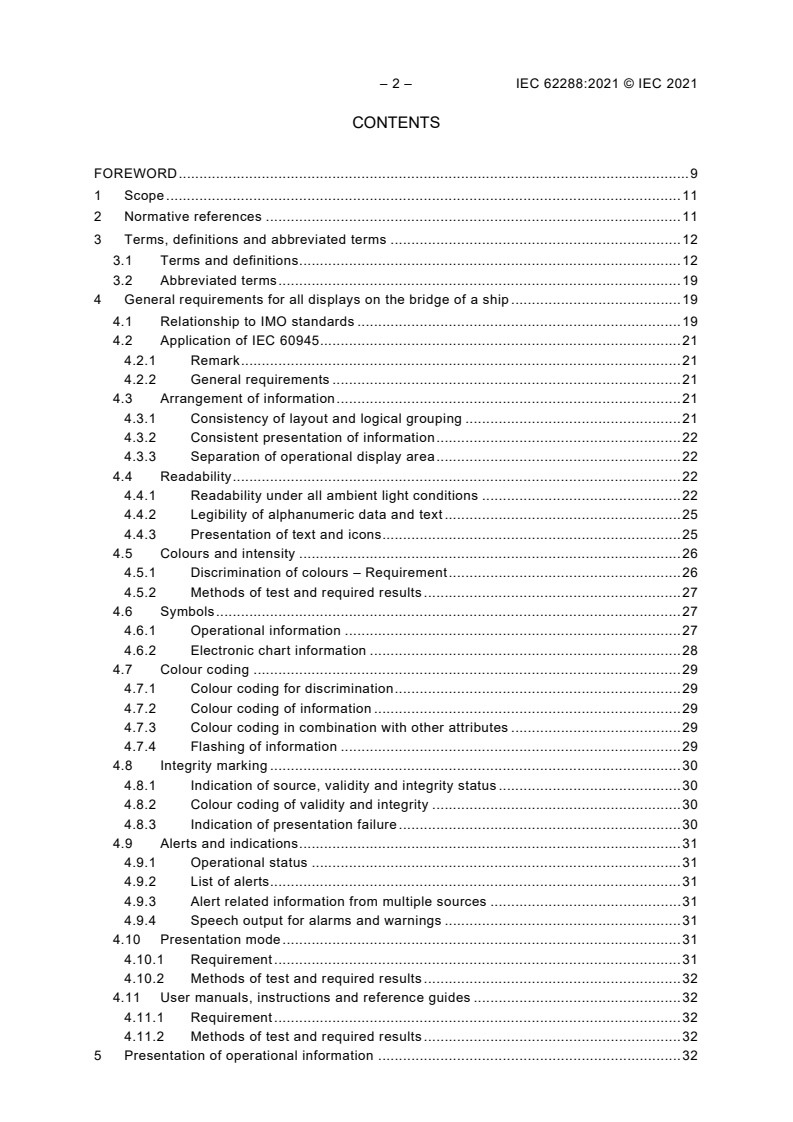
– 2 – IEC 62288:2021 © IEC 2021
CONTENTS
FOREWORD . 9
1 Scope . 11
2 Normative references . 11
3 Terms, definitions and abbreviated terms . 12
3.1 Terms and definitions . 12
3.2 Abbreviated terms . 19
4 General requirements for all displays on the bridge of a ship . 19
4.1 Relationship to IMO standards . 19
4.2 Application of IEC 60945 . 21
4.2.1 Remark . 21
4.2.2 General requirements . 21
4.3 Arrangement of information . 21
4.3.1 Consistency of layout and logical grouping . 21
4.3.2 Consistent presentation of information . 22
4.3.3 Separation of operational display area . 22
4.4 Readability . 22
4.4.1 Readability under all ambient light conditions . 22
4.4.2 Legibility of alphanumeric data and text . 25
4.4.3 Presentation of text and icons . 25
4.5 Colours and intensity . 26
4.5.1 Discrimination of colours – Requirement . 26
4.5.2 Methods of test and required results . 27
4.6 Symbols . 27
4.6.1 Operational information . 27
4.6.2 Electronic chart information . 28
4.7 Colour coding . 29
4.7.1 Colour coding for discrimination . 29
4.7.2 Colour coding of information . 29
4.7.3 Colour coding in combination with other attributes . 29
4.7.4 Flashing of information . 29
4.8 Integrity marking . 30
4.8.1 Indication of source, validity and integrity status . 30
4.8.2 Colour coding of validity and integrity . 30
4.8.3 Indication of presentation failure . 30
4.9 Alerts and indications . 31
4.9.1 Operational status . 31
4.9.2 List of alerts . 31
4.9.3 Alert related information from multiple sources . 31
4.9.4 Speech output for alarms and warnings . 31
4.10 Presentation mode . 31
4.10.1 Requirement . 31
4.10.2 Methods of test and required results . 32
4.11 User manuals, instructions and reference guides . 32
4.11.1 Requirement . 32
4.11.2 Methods of test and required results . 32
5 Presentation of operational information . 32
5.1 Application . 32
5.2 Presentation of own ship information . 32
5.2.1 Graphical representation of own ship – Requirement . 32
5.2.2 Methods of test and required results . 33
5.3 Presentation of chart information . 33
5.3.1 Alteration of chart information . 33
5.3.2 Colours and symbols for charted information . 33
5.4 Presentation of radar information . 34
5.4.1 Radar video images . 34
5.4.2 Target trails . 35
5.5 Presentation of target information . 35
5.5.1 Providing target information . 35
5.5.2 Consistent user interface for target information . 36
5.5.3 Indication of exceeding target capacity . 36
5.5.4 Presentation of repeated AIS reports . 37
5.5.5 Filtering sleeping AIS targets . 38
5.5.6 Activation of AIS targets . 38
5.5.7 Graphical presentation of targets . 39
5.5.8 Target selection . 40
5.5.9 Indication of target derivation. 41
5.5.10 Presentation of tracked radar target information . 41
5.5.11 Presentation of reported AIS target information . 42
5.5.12 Continual update of target information . 43
5.5.13 Own ship’s AIS information . 43
5.5.14 Obscuring the operational display area . 44
5.6 Operational alerts . 44
5.6.1 Alert status . 44
5.6.2 CPA/TCPA alarms . 44
5.6.3 Acquisition/activation zones warnings . 45
5.6.4 Lost target warnings . 45
5.7 AIS and radar target association . 46
5.7.1 Requirement . 46
5.7.2 Methods of test and required results . 46
5.8 AIS presentation user selectors and their status indications . 47
5.8.1 Requirement . 47
5.8.2 Methods of test and required results . 48
5.9 Trial manoeuvre . 49
5.9.1 Requirement . 49
5.9.2 Methods of test and required results . 49
5.10 Measurement . 49
5.10.1 Measurement from own ship . 49
5.10.2 Bearing and range measurements . 49
5.11 Navigation tools . 50
5.11.1 General requirements . 50
5.11.2 Range rings . 50
5.11.3 Variable range marker (VRM) . 50
5.11.4 Bearing scale . 51
5.11.5 Electronic bearing line (EBL) . 52
5.11.6 Parallel index lines (PI) . 53
– 4 – IEC 62288:2021 © IEC 2021
5.11.7 Offset measurement of range and bearing . 54
5.11.8 User cursor . 55
5.12 AIS data link message processing capacity . 56
5.12.1 General . 56
5.12.2 Requirements . 56
5.12.3 Methods of test and required results . 56
5.13 AIS data report . 56
5.13.1 General . 56
5.13.2 AIS data report capacity . 56
5.13.3 AIS data report display . 57
5.13.4 Graphical presentation of AIS AtoN dimensions . 60
5.14 AIS locating device . 60
5.14.1 General . 60
5.14.2 AIS locating device capacity . 61
5.14.3 AIS locating device display . 61
5.15 AIS ASM . 63
5.15.1 General . 63
5.15.2 Categories . 64
5.15.3 AIS ASM capacity . 66
5.15.4 AIS ASM display . 68
5.16 Presentation of AIS synthetic target . 70
5.16.1 Requirement . 70
5.16.2 Methods of test and required results . 71
5.17 Presentation of association of DSC received call with a displayed AIS object . 72
5.17.1 Requirement . 72
5.17.2 Methods of test and required results . 72
5.18 AIS ASM information extending reported AIS target information . 73
5.19 Received AIS safety related messages . 74
5.19.1 Requirements . 74
5.19.2 Methods of test and required results . 75
5.20 Sent AIS safety related messages. 76
5.20.1 Requirements . 76
5.20.2 Methods of test and required results . 76
6 INS, radar and chart displays . 76
6.1 General . 76
6.1.1 Application . 76
6.1.2 Multifunction displays . 76
6.1.3 Simultaneous display of radar and chart data . 77
6.1.4 Range scales . 77
6.1.5 Operational display area . 78
6.1.6 Motion display modes . 78
6.1.7 Orientation modes . 78
6.1.8 Off-centring . 79
6.1.9 Stabilisation modes . 79
6.2 Radar displays . 80
6.2.1 Application . 80
6.2.2 Radar video image . 80
6.2.3 Brightness of radar information . 81
6.2.4 Display of chart information on radar . 81
6.2.5 Priority of radar information . 82
6.2.6 Display of map graphics . 82
6.3 Chart displays . 83
6.3.1 Application . 83
6.3.2 Display of chart information . 83
6.3.3 IMO ECDIS display categories . 84
6.3.4 Adding or removing information from the display . 84
6.3.5 Safety contour . 85
6.3.6 Safety depth . 85
6.3.7 Chart scale . 85
6.3.8 Display of radar and target information . 86
6.3.9 Display of additional information . 86
6.4 Composite task-oriented presentations . 87
6.4.1 User-configured presentations . 87
6.4.2 Information associated with the task-at-hand . 87
6.5 Single and simple operator actions . 87
6.5.1 Applicability . 87
6.5.2 Requirement . 88
6.5.3 Methods of test and required results . 88
6.6 User and default settings . 88
6.6.1 General . 88
6.6.2 User-settings . 88
6.6.3 Default settings . 89
7 Physical requirements . 89
7.1 General . 89
7.2 Display adjustment. 89
7.2.1 Contrast and brightness . 89
7.2.2 Magnetic interference . 90
7.2.3 Temporal stability . 90
7.2.4 Physical controls and status indicators . 91
7.3 Screen size . 91
7.3.1 Requirement . 91
7.3.2 Method of test and required results . 92
7.4 Multicoloured display equipment . 92
7.4.1 Requirement . 92
7.4.2 Method of test and required results . 92
7.5 Screen resolution . 93
7.5.1 Requirement . 93
7.5.2 Method of test and required results . 93
7.6 Screen viewing angle . 93
7.6.1 Requirement . 93
7.6.2 Methods of test and required results . 93
Annex A (normative) Presentation colours and symbols . 94
A.1 Overview. 94
A.2 Purpose . 94
A.3 Use . 94
A.4 Application . 94
A.5 Navigation-related symbols . 94
– 6 – IEC 62288:2021 © IEC 2021
Annex B (normative) Guidelines for the presentation of navigation-related terminology
and abbreviations . 130
B.1 Overview. 130
B.2 Purpose . 130
B.3 Use of these guidelines . 130
B.4 Application . 130
B.5 Navigation related terminology and abbreviations . 130
Annex C (informative) Guidance on display and dialogue design in IMO MSC/Circ.982 . 137
C.1 Overview. 137
C.2 General . 137
C.3 Requirements in IMO MSC/Circ.982 related to the display design . 137
Annex D (informative) Guidance on testing . 139
D.1 Methods of test . 139
D.1.1 General . 139
D.1.2 Observation . 139
D.1.3 Inspection of documented evidence . 139
D.1.4 Measurement . 140
D.1.5 Analytical evaluation . 140
D.2 Application of IEC 60945 . 140
D.2.1 Display equipment category . 140
D.2.2 Technical performance . 140
D.2.3 Pre-conditioning for environmental tests . 141
D.2.4 Methods of test applied for IEC 60945 . 141
D.3 Compliance with requirements . 142
D.4 Simulation . 143
D.5 Electronic chart data . 143
Annex E (normative) Operational controls and logical grouping . 144
E.1 Overview. 144
E.2 Logical grouping of data and control functions . 144
E.3 Navigation related terminology and icons for common function controls (hot
keys and shortcuts) . 146
Annex F (normative) Icons for presentation of the state of an alert . 160
Annex G (normative) Testing for colours, intensity and flicker . 161
G.1 Testing for colours and intensity . 161
G.1.1 General . 161
G.1.2 Test personnel . 162
G.1.3 Method of test. 162
G.2 Testing for flicker . 163
G.2.1 Overview . 163
G.2.2 Analytic model . 163
G.2.3 Decision criteria . 165
Annex H (normative) Single and simple operator actions . 167
H.1 General . 167
H.2 Tables for single and simple operator actions . 167
Annex I (normative) Default settings . 169
I.1 General . 169
I.2 ECDIS default settings . 169
I.3 Radar default settings . 171
Annex J (normative) Implementation details of AIS ASM . 172
J.1 General . 172
J.2 AIS ASM . 172
Annex K (informative) Overview of AIS Messages . 181
K.1 General . 181
K.2 Use case guidance on AIS ASM . 183
Annex L (informative) Overview of the use AIS AtoN status field bits . 184
Bibliography . 185
Table 1 – Ambient light conditions . 23
Table 2 – Operational status of indications . 31
Table 3 – User selectors for AIS presentation . 47
Table 4 – AIS status indications . 48
Table 5 – AIS data report capacity . 57
Table 6 – AIS locating devices capacity . 61
Table 7 – AIS ASM object capacity . 66
Table 8 – Extended reported AIS target information from AIS ASM . 73
Table A.1 – Own ship symbols . 95
Table A.2 – Radar and AIS symbols . 99
Table A.3 – Navigation symbols . 115
Table A.4 – Navigation tools . 120
Table A.5 – Other symbols . 121
Table A.6 – Example of possible colour scheme . 129
Table B.1 – List of standard terms and abbreviations . 131
Table B.2 – List of standard units of measurement and abbreviations . 136
Table C.1 – Paragraphs in MSC/Circ.982 associated with IEC 60945 requirements . 137
Table C.2 – Other paragraphs in MSC/Circ.982 related to display design . 138
Table C.3 – Other paragraphs in MSC/Circ.982 partially related to display design . 138
Table D.1 – Methods of test applied for IEC 60945 . 141
Table E.1 – Logical grouping for radar, ECDIS and INS applications
(based on MSC.1/Circ.1609) . 145
Table E.2 – Examples of logical grouping for voluntary implementation . 146
Table E.3 – General controls . 147
Table E.4 – General navigation functions (based on MSC.1/Circ.1609) . 148
Table E.5 – Radar specific controls . 151
Table E.6 – Control of chart display functions (based on MSC.1/Circ.1609) . 152
Table E.7 – Control of chart functionality (based on MSC.1/Circ.1609) . 157
Table E.8 – Database functions (based on MSC.1/Circ.1609) . 157
Table E.9 – Route plan and monitoring functions (based on MSC.1/Circ.1609) . 158
Table E.10 – Groups of functions (based on MSC.1/Circ.1609) . 158
Table G.1 – Values of predicted energy and special coefficients . 166
Table H.1 – Access to functions, as defined before June 2019
(based on MSC.1/Circ.1609) . 167
Table H.2 – Access to functions (based on MSC.1/Circ.1609) . 168
– 8 – IEC 62288:2021 © IEC 2021
Table H.3 – Access to group of functions (based on MSC.1/Circ.1609) . 168
Table I.1 – ECDIS settings configured in response to "Default" selection (based on
MSC.1/Circ.1609) . 169
Table I.2 – Radar control settings configured in response to "Default" selection (based
on MSC.1/Circ.1609) . 171
Table J.1 – Details of AIS ASM . 172
Table K.1 – AIS Messages . 181
Table K.2 – AIS ASM Messages . 182
Table L.1 – AIS AtoN status field . 184
INTERNATIONAL ELECTROTECHNICAL COMMISSION
____________
MARITIME NAVIGATION AND RADIOCOMMUNICATION EQUIPMENT AND
SYSTEMS – PRESENTATION OF NAVIGATION-RELATED INFORMATION
ON SHIPBORNE NAVIGATIONAL DISPLAYS – GENERAL REQUIREMENTS,
METHODS OF TESTING AND REQUIRED TEST RESULTS
FOREWORD
1) The International Electrotechnical Commission (IEC) is a worldwide organization for standardization comprising
all national electrotechnical committees (IEC National Committees). The object of IEC is to promote international
co-operation on all questions concerning standardization in the electrical and electronic fields. To this end and
in addition to other activities, IEC publishes International Standards, Technical Specifications, Technical Reports,
Publicly Available Specifications (PAS) and Guides (hereafter referred to as "IEC Publication(s)"). Their
preparation is entrusted to technical committees; any IEC National Committee interested in the subject dealt with
may participate in this preparatory work. International, governmental and non-governmental organizations liaising
with the IEC also participate in this preparation. IEC collaborates closely with the International Organization for
Standardization (ISO) in accordance with conditions determined by agreement between the two organizations.
2) The formal decisions or agreements of IEC on technical matters express, as nearly as possible, an international
consensus of opinion on the relevant subjects since each technical committee has representation from all
interested IEC National Committees.
3) IEC Publications have the form of recommendations for international use and are accepted by IEC National
Committees in that sense. While all reasonable efforts are made to ensure that the technical content of IEC
Publications is accurate, IEC cannot be held responsible for the way in which they are used or for any
misinterpretation by any end user.
4) In order to promote international uniformity, IEC National Committees undertake to apply IEC Publications
transparently to the maximum extent possible in their national and regional publications. Any divergence between
any IEC Publication and the corresponding national or regional publication shall be clearly indicated in the latter.
5) IEC itself does not provide any attestation of conformity. Independent certification bodies provide conformity
assessment services and, in some areas, access to IEC marks of conformity. IEC is not responsible for any
services carried out by independent certification bodies.
6) All users should ensure that they have the latest edition of this publication.
7) No liability shall attach to IEC or its directors, employees, servants or agents including individual experts and
members of its technical committees and IEC National Committees for any personal injury, property damage or
other damage of any nature whatsoever, whether direct or indirect, or for costs (including legal fees) and
expenses arising out of the publication, use of, or reliance upon, this IEC Publication or any other IEC
Publications.
8) Attention is drawn to the Normative references cited in this publication. Use of the referenced publications is
indispensable for the correct application of this publication.
9) Attention is drawn to the possibility that some of the elements of this IEC Publication may be the subject of patent
rights. IEC shall not be held responsible for identifying any or all such patent rights.
IEC 62288 has been prepared by IEC technical committee 80: Maritime navigation and
radiocommunicatio
...