

IEC 61803:1999
(Main)Determination of power losses in high-voltage direct current (HVDC) converter stations
General Information
- Abstract
Applies to all line-commutated high-voltage direct current (HVDC) converter stations used for power exchange in utility systems. Presumes the use of 12-pulse thyristor converters but can also be used for 6-pulse thyristor converters. Presents procedures for determining the total losses of an HVDC converter station. Cover all parts, except synchronous compensators or static var compensators and address no-load operation and operating losses together with their methods of calculation which use, wherever possible, measured parameters. The contents of the corrigendum of October 1999 have been included in this copy.
- Status
- Published
- Publication Date
- 24-May-2016
- Current Stage
- DELPUB - Deleted Publication
- Start Date
- 19-Oct-2020
- Completion Date
- 29-Jun-2018
Buy Documents
IEC 61803:1999 - Determination of power losses in high-voltage direct current (HVDC) converter stations Released:2/26/1999

IEC 61803:1999+AMD1:2010+AMD2:2016 CSV - Determination of power losses in high-voltage direct current (HVDC)converter stations with line-commutated converters Released:5/25/2016
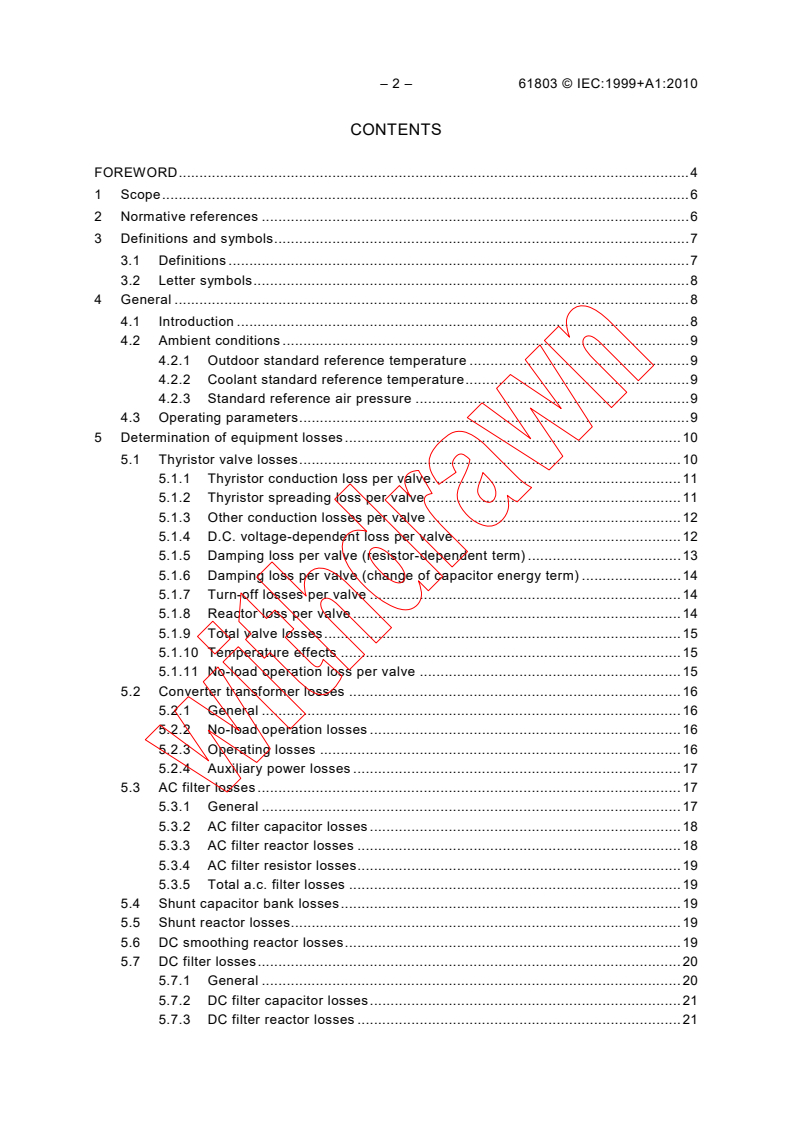
IEC 61803:1999+AMD1:2010 CSV - Determination of power losses in high-voltage direct current (HVDC) converter stations with line-commutated converters Released:3/8/2011
Overview
IEC 61803:1999 specifies procedures for determining power losses in high-voltage direct current (HVDC) converter stations utilizing line-commutated thyristor converters. Developed by the International Electrotechnical Commission (IEC), this standard is crucial for assessing the efficiency and performance of HVDC converter stations, which play a significant role in long-distance power transmission and utility system interconnections.
IEC 61803 applies to all line-commutated HVDC converter stations used for power exchange within utility grids, primarily focusing on 12-pulse thyristor converters, but is also applicable to 6-pulse configurations with appropriate adjustments. The procedures defined by the standard are designed to produce verifiable, comparable results for both manufacturers and utility purchasers.
Key Topics
Scope
The standard addresses loss determination for all parts of an HVDC converter station except synchronous compensators and static var compensators (SVC). It covers both no-load and operating losses.Calculation Methodology
Instead of relying on direct experimental measurements, IEC 61803 standardizes the calculation of HVDC converter station losses by summing losses from each item of equipment, using measurements and parameters wherever available.Ambient and Operating Conditions
The standard defines reference conditions such as temperature, coolant temperature, and air pressure for consistency in loss determination. All calculations consider nominal system voltage and frequency, as well as symmetrical operating conditions.Equipment Losses Assessed
- Thyristor valve losses (conduction, spreading, resistor losses, etc.)
- Converter transformer losses (no-load and operating)
- AC and DC filter losses
- Shunt capacitor and reactor losses
- Auxiliaries and station service losses
Definitions and Symbols
A set of standardized definitions and letter symbols is provided to ensure clarity in calculation and reporting.
Applications
IEC 61803 is essential for various stakeholders in the electricity transmission industry:
Utility Companies and Grid Operators
Use the standard to evaluate and compare HVDC converter station losses for procurement decisions, system planning, and operational efficiency.Engineers and Equipment Suppliers
Rely on the outlined procedures to calculate loss figures during the engineering, manufacturing, and commissioning stages, ensuring compliance with contractual requirements and enabling bid comparisons.Project Managers
Provide a standardized loss evaluation that helps with project risk assessments, energy accounting, and long-term O&M (operations and maintenance) planning.Regulators and Standardization Bodies
Reference IEC 61803 to harmonize requirements across international projects, supporting transparency and facilitating cross-border electricity trade.
Related Standards
IEC 61803 should be used in conjunction with the following key standards:
- IEC 60076 Series - Power transformers and reactors
- IEC 60633:1998 - Terminology for HVDC transmission
- IEC 60700-1:1998 - Thyristor valves for HVDC power transmission, electrical testing
- IEC 60871-1:1997 - Shunt capacitors for AC power systems
- IEC 60289:1988 - Reactors
These related standards provide essential technical background and testing requirements to support the correct application of IEC 61803 in HVDC converter station projects.
By following IEC 61803, utilities and manufacturers ensure standardized, accurate determination of HVDC converter station losses, facilitating optimal design, procurement, and operation of high-efficiency power transmission infrastructure.
Relations
- Effective Date
- 05-Sep-2023
- Effective Date
- 05-Sep-2023
- Effective Date
- 05-Sep-2023
- Effective Date
- 05-Sep-2023
Buy Documents
IEC 61803:1999 - Determination of power losses in high-voltage direct current (HVDC) converter stations Released:2/26/1999
IEC 61803:1999+AMD1:2010+AMD2:2016 CSV - Determination of power losses in high-voltage direct current (HVDC)converter stations with line-commutated converters Released:5/25/2016
IEC 61803:1999+AMD1:2010 CSV - Determination of power losses in high-voltage direct current (HVDC) converter stations with line-commutated converters Released:3/8/2011
Get Certified
Connect with accredited certification bodies for this standard

IMQ S.p.A. (Certification)
Italian electrical product certification.

SLG Prüf- und Zertifizierungs GmbH
German testing and certification body.

UL Solutions
Global safety science company with testing, inspection and certification.
Sponsored listings
Frequently Asked Questions
IEC 61803:1999 is a standard published by the International Electrotechnical Commission (IEC). Its full title is "Determination of power losses in high-voltage direct current (HVDC) converter stations". This standard covers: Applies to all line-commutated high-voltage direct current (HVDC) converter stations used for power exchange in utility systems. Presumes the use of 12-pulse thyristor converters but can also be used for 6-pulse thyristor converters. Presents procedures for determining the total losses of an HVDC converter station. Cover all parts, except synchronous compensators or static var compensators and address no-load operation and operating losses together with their methods of calculation which use, wherever possible, measured parameters. The contents of the corrigendum of October 1999 have been included in this copy.
Applies to all line-commutated high-voltage direct current (HVDC) converter stations used for power exchange in utility systems. Presumes the use of 12-pulse thyristor converters but can also be used for 6-pulse thyristor converters. Presents procedures for determining the total losses of an HVDC converter station. Cover all parts, except synchronous compensators or static var compensators and address no-load operation and operating losses together with their methods of calculation which use, wherever possible, measured parameters. The contents of the corrigendum of October 1999 have been included in this copy.
IEC 61803:1999 is classified under the following ICS (International Classification for Standards) categories: 01 - GENERALITIES. TERMINOLOGY. STANDARDIZATION. DOCUMENTATION; 29.200 - Rectifiers. Convertors. Stabilized power supply. The ICS classification helps identify the subject area and facilitates finding related standards.
IEC 61803:1999 has the following relationships with other standards: It is inter standard links to IEC 61803:1999/AMD1:2010, IEC 61803:1999/AMD2:2016, IEC 61803:1999/COR1:1999, IEC 61803:2020. Understanding these relationships helps ensure you are using the most current and applicable version of the standard.
IEC 61803:1999 is available in PDF format for immediate download after purchase. The document can be added to your cart and obtained through the secure checkout process. Digital delivery ensures instant access to the complete standard document.
Standards Content (Sample)
NORME
CEI
INTERNATIONALE
IEC
INTERNATIONAL
Première édition
STANDARD
First edition
1999-02
Détermination des pertes en puissance
dans les postes de conversion en courant continu
à haute tension (CCHT)
Determination of power losses in high-voltage
direct current (HVDC) converter stations
Numéro de référence
Reference number
CEI/IEC 61803:1999
Numéros des publications Numbering
Depuis le 1er janvier 1997, les publications de la CEI As from 1 January 1997 all IEC publications are
sont numérotées à partir de 60 000. issued with a designation in the 60 000 series.
Publications consolidées Consolidated publications
Les versions consolidées de certaines publications de Consolidated versions of some IEC publications
la CEI incorporant les amendements sont disponibles. including amendments are available. For example,
Par exemple, les numéros d’édition 1.0, 1.1 et 1.2 edition numbers 1.0, 1.1 and 1.2 refer, respectively, to
indiquent respectivement la publication de base, la the base publication, the base publication incor-
publication de base incorporant l’amendement 1, et porating amendment 1 and the base publication
la publication de base incorporant les amendements 1 incorporating amendments 1 and 2.
et 2.
Validité de la présente publication Validity of this publication
Le contenu technique des publications de la CEI est The technical content of IEC publications is kept under
constamment revu par la CEI afin qu'il reflète l'état constant review by the IEC, thus ensuring that the
actuel de la technique. content reflects current technology.
Des renseignements relatifs à la date de re- Information relating to the date of the reconfirmation of
confirmation de la publication sont disponibles dans the publication is available in the IEC catalogue.
le Catalogue de la CEI.
Les renseignements relatifs à des questions à l’étude et Information on the subjects under consideration and
des travaux en cours entrepris par le comité technique work in progress undertaken by the technical com-
qui a établi cette publication, ainsi que la liste des mittee which has prepared this publication, as well as
publications établies, se trouvent dans les documents the list of publications issued, is to be found at the
ci-dessous: following IEC sources:
• «Site web» de la CEI* • IEC web site*
• Catalogue des publications de la CEI • Catalogue of IEC publications
Publié annuellement et mis à jour régulièrement Published yearly with regular updates
(Catalogue en ligne)* (On-line catalogue)*
• Bulletin de la CEI • IEC Bulletin
Disponible à la fois au «site web» de la CEI* Available both at the IEC web site* and
et comme périodique imprimé as a printed periodical
Terminologie, symboles graphiques Terminology, graphical and letter
et littéraux symbols
En ce qui concerne la terminologie générale, le lecteur For general terminology, readers are referred to
se reportera à la CEI 60050: Vocabulaire Electro- IEC 60 050: International Electrotechnical Vocabulary
technique International (VEI). (IEV).
Pour les symboles graphiques, les symboles littéraux For graphical symbols, and letter symbols and signs
et les signes d'usage général approuvés par la CEI, le approved by the IEC for general use, readers are
lecteur consultera la CEI 60027: Symboles littéraux à referred to publications IEC 60027: Letter symbols to
utiliser en électrotechnique, la CEI 60417: Symboles be used in electrical technology, IEC 60417: Graphical
graphiques utilisables sur le matériel. Index, relevé et symbols for use on equipment. Index, survey and
compilation des feuilles individuelles, et la CEI 60617: compilation of the single sheets and IEC 60617:
Symboles graphiques pour schémas. Graphical symbols for diagrams.
* Voir adresse «site web» sur la page de titre. * See web site address on title page.
NORME
CEI
INTERNATIONALE
IEC
INTERNATIONAL
Première édition
STANDARD
First edition
1999-02
Détermination des pertes en puissance
dans les postes de conversion en courant continu
à haute tension (CCHT)
Determination of power losses in high-voltage
direct current (HVDC) converter stations
IEC 1999 Droits de reproduction réservés Copyright - all rights reserved
Aucune partie de cette publication ne peut être reproduite ni No part of this publication may be reproduced or utilized in
utilisée sous quelque forme que ce soit et par aucun any form or by any means, electronic or mechanical,
procédé, électronique ou mécanique, y compris la photo- including photocopying and microfilm, without permission in
copie et les microfilms, sans l'accord écrit de l'éditeur. writing from the publisher.
International Electrotechnical Commission 3, rue de Varembé Geneva, Switzerland
Telefax: +41 22 919 0300 e-mail: inmail@iec.ch IEC web site http://www.iec.ch
CODE PRIX
Commission Electrotechnique Internationale
PRICE CODE V
International Electrotechnical Commission
Pour prix, voir catalogue en vigueur
For price, see current catalogue
– 2 – 61803 © CEI:1999
SOMMAIRE
Pages
AVANT-PROPOS . 6
Articles
1 Domaine d'application . 8
2 Références normatives. 8
3 Définitions et symboles . 10
3.1 Définitions. 10
3.2 Symboles littéraux. 12
4 Généralités . 12
4.1 Introduction. 12
4.2 Conditions ambiantes. 14
4.2.1 Température extérieure de référence normalisée. 14
4.2.2 Température de référence normalisée de l'agent de refroidissement . 14
4.2.3 Pression de l'air de référence normalisée . 14
4.3 Paramètres de fonctionnement. 16
5 Détermination des pertes du matériel . 16
5.1 Pertes de valves à thyristors . 16
5.1.1 Pertes de conduction de thyristors par valve . 18
5.1.2 Affaiblissement géométrique de thyristors par valve. 20
5.1.3 Autres pertes résistives par valve . 20
5.1.4 Pertes dépendant de la tension continue par valve. 22
5.1.5 Pertes d'amortissement par valve (terme dépendant de la résistance) . 24
5.1.6 Pertes par amortissement par valve (variation du terme énergie
du condensateur) . 24
5.1.7 Pertes au blocage par valve . 26
5.1.8 Perte d'inductance par valve. 26
5.1.9 Pertes totales de valve . 28
5.1.10 Effets de la température . 28
5.1.11 Perte en fonctionnement à vide par valve . 28
5.2 Pertes d'un transformateur de conversion. 30
5.2.1 Généralités . 30
5.2.2 Pertes en fonctionnement à vide. 30
5.2.3 Pertes en fonctionnement. 30
5.2.4 Pertes de puissance auxiliaire . 32
5.3 Pertes par filtre côté alternatif . 32
5.3.1 Généralités . 32
5.3.2 Pertes au niveau d'un condensateur de filtrage à courant alternatif . 34
5.3.3 Pertes au niveau d'une inductance de filtrage à courant alternatif . 34
5.3.4 Pertes au niveau d'une résistance de filtrage à courant alternatif . 36
5.3.5 Pertes totales au niveau d'un filtre côté alternatif . 36
5.4 Pertes au niveau d'une batterie de condensateurs shunt. 36
5.5 Pertes au niveau d'une bobine d'inductance shunt . 36
5.6 Pertes au niveau d'une bobine d'inductance de lissage en courant continu. 38
61803 © IEC:1999 – 3 –
CONTENTS
Page
FOREWORD . 7
Clause
1 Scope . 9
2 Normative references . 9
3 Definitions and symbols. 11
3.1 Definitions. 11
3.2 Letter symbols . 13
4 General. 13
4.1 Introduction. 13
4.2 Ambient conditions. 15
4.2.1 Outdoor standard reference temperature . 15
4.2.2 Coolant standard reference temperature. 15
4.2.3 Standard reference air pressure . 15
4.3 Operating parameters . 17
5 Determination of equipment losses. 17
5.1 Thyristor valve losses. 17
5.1.1 Thyristor conduction loss per valve. 19
5.1.2 Thyristor spreading loss per valve . 21
5.1.3 Other conduction losses per valve . 21
5.1.4 DC voltage-dependent loss per valve. 23
5.1.5 Damping loss per valve (resistor-dependent term) . 25
5.1.6 Damping loss per valve (change of capacitor energy term). 25
5.1.7 Turn-off losses per valve . 27
5.1.8 Reactor loss per valve. 27
5.1.9 Total valve losses. 29
5.1.10 Temperature effects . 29
5.1.11 No-load operation loss per valve. 29
5.2 Converter transformer losses . 31
5.2.1 General. 31
5.2.2 No-load operation losses . 31
5.2.3 Operating losses . 31
5.2.4 Auxiliary power losses . 33
5.3 AC filter losses. 33
5.3.1 General. 33
5.3.2 AC filter capacitor losses. 35
5.3.3 AC filter reactor losses . 35
5.3.4 AC filter resistor losses . 37
5.3.5 Total a.c. filter losses . 37
5.4 Shunt capacitor bank losses. 37
5.5 Shunt reactor losses . 37
5.6 DC smoothing reactor losses. 39
– 4 – 61803 © CEI:1999
Articles Pages
5.7 Pertes au niveau d'un filtre côté continu . 38
5.7.1 Généralités . 38
5.7.2 Pertes au niveau d'un condensateur de filtrage à courant continu . 40
5.7.3 Pertes au niveau d'une inductance de filtrage à courant continu. 40
5.7.4 Pertes au niveau d'une résistance de filtrage à courant continu. 42
5.7.5 Pertes totales au niveau d'un filtre côté continu . 42
5.8 Pertes du matériel auxiliaire et du poste en service . 42
5.9 Pertes au niveau des filtres d'interférences radio/courant porteur
sur ligne d'énergie. 44
5.10 Autres pertes au niveau du matériel . 46
Figure 1 Matériel type en courant continu à haute tension (CCHT) pour un pôle . 48
Figure 2 Schéma triphasé simplifié d’un convertisseur à 12 impulsions à CCHT. 50
Figure 3 Circuit équivalent simplifié d’une valve type à thyristors . 50
Figure 4 Formes de courant et de tension d’une valve fonctionnant dans
un convertisseur à 12 impulsions . 52
Figure 5 Courbe caractéristique d'un thyristor à l'état passant . 54
Figure 6 Courant de conduction et chute de tension . 54
Figure 7 Répartition de l’inductance de commutation entre L et L . 56
1 2
Figure 8 Courant dans le thyristor durant le rétablissement inverse . 56
Annexe A (normative) Calcul des courants et tensions harmoniques . 58
A.1 Courants harmoniques dans les transformateurs de conversion. 58
A.2 Courants harmoniques dans les filtres côté alternatif. 58
A.3 Tensions harmoniques sur le côté continu. 60
A.4 Courants harmoniques dans la bobine d'inductance de lissage . 60
Annexe B (informative) Pertes typiques du poste . 62
Annexe C (informative) Bibliographie . 64
61803 © IEC:1999 – 5 –
Clause Page
5.7 DC filter losses . 39
5.7.1 General. 39
5.7.2 DC filter capacitor losses. 41
5.7.3 DC filter reactor losses. 41
5.7.4 DC filter resistor losses . 43
5.7.5 Total d.c. filter losses . 43
5.8 Auxiliaries and station service losses . 43
5.9 Radio interference/PLC filter losses. 45
5.10 Other equipment losses . 47
Figure 1 Typical high-voltage direct current (HVDC) equipment for one pole . 49
Figure 2 Simplified three-phase diagram of an HVDC 12-pulse converter . 51
Figure 3 Simplified equivalent circuit of a typical thyristor valve. 51
Figure 4 Current and voltage waveforms of a valve operating in a 12-pulse converter . 53
Figure 5 Thyristor on-state characteristic . 55
Figure 6 Conduction current and voltage drop . 55
Figure 7 Distribution of commutating inductance between L and L . 57
1 2
Figure 8 Thyristor current during reverse recovery . 57
Annex A (normative) Calculation of harmonic currents and voltages . 59
A.1 Harmonic currents in converter transformers . 59
A.2 Harmonic currents in a.c. filters . 59
A.3 Harmonic voltages on the d.c. side . 61
A.4 DC side harmonic currents in the smoothing reactor . 61
Annex B (informative) Typical station losses . 63
Annex C (informative) Bibliography . 65
– 6 – 61803 © CEI:1999
COMMISSION ÉLECTROTECHNIQUE INTERNATIONALE
––––––––––––
DÉTERMINATION DES PERTES EN PUISSANCE DANS
LES POSTES DE CONVERSION EN COURANT CONTINU
À HAUTE TENSION (CCHT)
AVANT-PROPOS
1) La CEI (Commission Electrotechnique Internationale) est une organisation mondiale de normalisation composée
de l'ensemble des comités électrotechniques nationaux (Comités nationaux de la CEI). La CEI a pour objet de
favoriser la coopération internationale pour toutes les questions de normalisation dans les domaines de
l'électricité et de l'électronique. A cet effet, la CEI, entre autres activités, publie des Normes internationales.
Leur élaboration est confiée à des comités d'études, aux travaux desquels tout Comité national intéressé par le
sujet traité peut participer. Les organisations internationales, gouvernementales et non gouvernementales, en
liaison avec la CEI, participent également aux travaux. La CEI collabore étroitement avec l'Organisation
Internationale de Normalisation (ISO), selon des conditions fixées par accord entre les deux organisations.
2) Les décisions ou accords officiels de la CEI concernant les questions techniques représentent, dans la mesure
du possible un accord international sur les sujets étudiés, étant donné que les Comités nationaux intéressés
sont représentés dans chaque comité d’études.
3) Les documents produits se présentent sous la forme de recommandations internationales. Ils sont publiés
comme normes, rapports techniques ou guides et agréés comme tels par les Comités nationaux.
4) Dans le but d'encourager l'unification internationale, les Comités nationaux de la CEI s'engagent à appliquer de
façon transparente, dans toute la mesure possible, les Normes internationales de la CEI dans leurs normes
nationales et régionales. Toute divergence entre la norme de la CEI et la norme nationale ou régionale
correspondante doit être indiquée en termes clairs dans cette dernière.
5) La CEI n’a fixé aucune procédure concernant le marquage comme indication d’approbation et sa responsabilité
n’est pas engagée quand un matériel est déclaré conforme à l’une de ses normes.
6) L’attention est attirée sur le fait que certains des éléments de la présente Norme internationale peuvent faire
l’objet de droits de propriété intellectuelle ou de droits analogues. La CEI ne saurait être tenue pour
responsable de ne pas avoir identifié de tels droits de propriété et de ne pas avoir signalé leur existence.
La Norme internationale CEI 61803 a été établie par le sous-comité 22F: Electronique de
puissance pour les réseaux électriques de transport et de distribution, du comité d’études 22
de la CEI: Electronique de puissance.
Le texte de cette norme est issu des documents suivants:
FDIS Rapport de vote
22F/51/FDIS 22F/56/RVD
Le rapport de vote indiqué dans le tableau ci-dessus donne toute information sur le vote ayant
abouti à l'approbation de cette norme.
L’annexe A fait partie intégrante de cette norme.
Les annexes B et C sont données uniquement à titre d’information.
Le contenu du corrigendum d'octobre 1999 a été pris en considération dans cet exemplaire.
61803 © IEC:1999 – 7 –
INTERNATIONAL ELECTROTECHNICAL COMMISSION
––––––––––––
DETERMINATION OF POWER LOSSES IN HIGH-VOLTAGE
DIRECT CURRENT (HVDC) CONVERTER STATIONS
FOREWORD
1) The IEC (International Electrotechnical Commission) is a worldwide organization for standardization comprising
all national electrotechnical committees (IEC National Committees). The object of the IEC is to promote
international co-operation on all questions concerning standardization in the electrical and electronic fields. To
this end and in addition to other activities, the IEC publishes International Standards. Their preparation is
entrusted to technical committees; any IEC National Committee interested in the subject dealt with may
participate in this preparatory work. International, governmental and non-governmental organizations liaising
with the IEC also participate in this preparation. The IEC collaborates closely with the International Organization
for Standardization (ISO) in accordance with conditions determined by agreement between the two
organizations.
2) The formal decisions or agreements of the IEC on technical matters express, as nearly as possible, an
international consensus of opinion on the relevant subjects since each technical committee has representation
from all interested National Committees.
3) The documents produced have the form of recommendations for international use and are published in the form
of standards, technical reports or guides and they are accepted by the National Committees in that sense.
4) In order to promote international unification, IEC National Committees undertake to apply IEC International
Standards transparently to the maximum extent possible in their national and regional standards. Any
divergence between the IEC Standard and the corresponding national or regional standard shall be clearly
indicated in the latter.
5) The IEC provides no marking procedure to indicate its approval and cannot be rendered responsible for any
equipment declared to be in conformity with one of its standards.
6) Attention is drawn to the possibility that some of the elements of this International Standard may be the subject
of patent rights. The IEC shall not be held responsible for identifying any or all such patent rights.
International Standard IEC 61803 has been prepared by subcommittee 22F: Power electronics
for electrical transmission and distribution systems, of IEC technical committee 22: Power
electronics.
The text of this standard is based on the following documents:
FDIS Report on voting
22F/51/FDIS 22F/56/RVD
Full information on the voting for the approval of this standard can be found in the report on
voting indicated in the above table.
Annex A forms an integral part of this standard.
Annexes B and C are for information only.
The contents of the corrigendum of October 1999 have been included in this copy.
– 8 – 61803 © CEI:1999
DÉTERMINATION DES PERTES EN PUISSANCE DANS
LES POSTES DE CONVERSION EN COURANT CONTINU
À HAUTE TENSION (CCHT)
1 Domaine d'application
La présente Norme internationale s'applique à tous les postes de conversion en courant
continu à haute tension (CCHT), commutés par le réseau, et utilisés pour l'échange de
puissance dans des systèmes de distribution d'énergie. Cette norme présuppose l'utilisation de
convertisseurs à thyristors à 12 impulsions mais peut également, en utilisant les précautions
appropriées, s'appliquer à des convertisseurs à thyristors à 6 impulsions.
Dans certaines applications, il est admis de connecter des compensateurs synchrones ou des
compensateurs var statiques (CVS) au noeud à courant alternatif du poste de conversion en
courant continu à haute tension (CCHT). Les procédures de détermination de pertes pour ce
type de matériel ne figurent pas dans la présente norme.
La présente norme décrit un ensemble de procédures types permettant de déterminer
l'ensemble des pertes d'un poste de conversion à CCHT. Un matériel type à CCHT est
présenté à la figure 1. Les procédures recouvrent toutes les pièces, à l'exception de celles
mentionnées ci-dessus, et considèrent les pertes en fonctionnement à vide et les pertes en
fonctionnement ainsi que leurs méthodes de calcul utilisant, dans la mesure du possible, des
paramètres mesurés.
Les conceptions de poste de conversion utilisant des composants ou configurations de circuit
originaux par rapport à la conception type considérée a priori dans la présente norme, ou des
conceptions équipées de circuits de distribution d'énergie auxiliaires inhabituels susceptibles
de modifier les pertes, doivent être évaluées selon leurs propres mérites.
2 Références normatives
Les documents normatifs suivants contiennent des dispositions qui, par suite de la référence
qui y est faite, constituent des dispositions valables pour la présente Norme internationale. Au
moment de la publication, les éditions indiquées étaient en vigueur. Tout document normatif
est sujet à révision et les parties prenantes aux accords fondés sur la présente Norme
internationale sont invitées à rechercher la possibilité d’appliquer les éditions les plus récentes
des documents normatifs indiqués ci-après. Les membres de la CEI et de l’ISO possèdent le
registre des Normes internationales en vigueur.
CEI 60076-1:1993, Transformateurs de puissance – Partie 1: Généralités
CEI 60289:1988, Bobines d'inductance
CEI 60633:1998, Terminologie pour le transport d'énergie en courant continu à haute tension
(CCHT)
CEI 60700-1:1998, Valves à thyristors pour le transport d'énergie en courant continu à haute
tension (CCHT) – Partie 1: Essais électriques
61803 © IEC:1999 – 9 –
DETERMINATION OF POWER LOSSES IN HIGH-VOLTAGE
DIRECT CURRENT (HVDC) CONVERTER STATIONS
1 Scope
This International Standard applies to all line-commutated high-voltage direct current (HVDC)
converter stations used for power exchange in utility systems. This standard presumes the use
of 12-pulse thyristor converters but can, with due care, also be used for 6-pulse thyristor
converters.
In some applications, synchronous compensators or static var compensators (SVC) may be
connected to the a.c. bus of the HVDC converter station. The loss determination procedures
for such equipment are not included in this standard.
This standard presents a set of standard procedures for determining the total losses of an
HVDC converter station. Typical HVDC equipment is shown in figure 1. The procedures cover
all parts, except as noted above, and address no-load operation and operating losses together
with their methods of calculation which use, wherever possible, measured parameters.
Converter station designs employing novel components or circuit configurations compared to
the typical design assumed in this standard, or designs equipped with unusual auxiliary circuits
that could affect the losses, shall be assessed on their own merits.
2 Normative references
The following normative documents contain provisions which, through reference in this text,
constitute provisions of this International Standard. At the time of publication, the editions
indicated were valid. All normative documents are subject to revision, and parties to
agreements based on this International Standard are encouraged to investigate the possibility
of applying the most recent editions of the normative documents indicated below. Members of
IEC and ISO maintain registers of currently valid International Standards.
IEC 60076-1:1993, Power transformers – Part 1: General
IEC 60289:1988, Reactors
IEC 60633:1998, Terminology for high-voltage direct current (HVDC) transmission
IEC 60700-1:1998, Thyristor valves for high voltage direct current (HVDC) power transmission
– Part 1: Electrical testing
– 10 – 61803 © CEI:1999
CEI 60747-6:1983, Dispositifs à semiconducteurs – Dispositifs discrets – Partie 6: Thyristors
CEI 60871-1:1997, Condensateurs shunt pour réseaux à courant alternatif de tension assignée
supérieure à 1 000 V – Partie 1: Généralités – Caractéristiques fonctionnelles, essais et
valeurs assignées – Règles de sécurité – Guide d'installation et d'exploitation
3 Définitions et symboles
Pour les besoins de la présente Norme internationale, les définitions suivantes s’appliquent:
3.1 Définitions
3.1.1
pertes auxiliaires
puissance électrique requise pour alimenter les charges auxiliaires des postes de conversion.
Les pertes auxiliaires varient selon que le poste fonctionne à vide ou en charge, auquel cas les
pertes auxiliaires dépendent du niveau de charge
3.1.2
pertes en fonctionnement à vide
pertes produites dans un élément du matériel tandis que le poste de conversion est sous
tension mais que les convertisseurs sont bloqués et que toutes les charges de poste en
service et le matériel auxiliaire sont connectés comme prescrit pour la captation immédiate
d'une charge
3.1.3
niveau de charge
ce terme spécifie le courant continu, la tension continue, l'angle d'allumage, la tension
alternative et la position du changeur de prises du transformateur de conversion selon lesquels
le poste de conversion fonctionne
3.1.4
pertes en fonctionnement
pertes produites dans un élément de matériel à un niveau de charge donné, tandis que le
poste de conversion est sous tension et les convertisseurs sont en fonctionnement
3.1.5
charge assignée
cette charge est liée au fonctionnement pour des valeurs nominales de courant continu, de
tension continue, alternative et d'angle d'allumage de convertisseur. On doit supposer que le
réseau à tension alternative est à fréquence nominale et que ses tensions triphasées sont
nominales et équilibrées. La position du changeur de prises du transformateur de conversion et
le nombre de filtres à courant alternatif et d'éléments d'inductance shunt connectés doivent
être compatibles avec un fonctionnement sous une charge assignée coïncidant avec des
conditions nominales
3.1.6
pertes totales d'un poste
la perte totale d'un poste est la somme de toutes les pertes en fonctionnement ou des pertes
en fonctionnement à vide et des pertes auxiliaires correspondantes
61803 © IEC:1999 – 11 –
IEC 60747-6:1983, Semiconductor devices – Discrete devices – Part 6: Thyristors
IEC 60871-1:1997, Shunt capacitors for a.c. power systems having a rated voltage above
1 000 V – Part 1: General performance, testing and rating – Safety requirements – Guide for
installation and operation
3 Definitions and symbols
For the purpose of this International Standard, the following definitions apply:
3.1 Definitions
3.1.1
auxiliary losses
the electric power required to feed the converter station auxiliary loads. The auxiliary losses
depend on whether the station is in no-load operation or carrying load, in which case the
auxiliary losses depend on the load level
3.1.2
no-load operation losses
the losses produced in an item of equipment with the converter station energized but with the
converters blocked and all station service loads and auxiliary equipment connected as required
for immediate pick-up of load
3.1.3
load level
this term specifies the direct current, direct voltage, firing angle, a.c. voltage, and converter
transformer tap-changer position at which the converter station is operating
3.1.4
operating losses
the losses produced in an item of equipment at a given load level with the converter station
energized and the converters operating
3.1.5
rated load
this load is related to operation at nominal values of d.c. current, d.c. voltage, a.c. voltage and
converter firing angle. The a.c. system shall be assumed to be at nominal frequency and its
3-phase voltages are nominal and balanced. The position of the tap-changer of the converter
transformer and the number of a.c. filters and shunt reactive elements connected shall be
consistent with operation at rated load, coincident with nominal conditions
3.1.6
total station losses
the total station loss is the sum of all operating or no-load operation losses and the
corresponding auxiliary losses
– 12 – 61803 © CEI:1999
3.2 Symboles littéraux
α angle de retard d'allumage, en radians (rad)
μ angle d'empiétement de commutation, en radians (rad)
f fréquence du réseau à tension alternative, en hertz (Hz)
I courant dans le montage en pont en courant continu, en ampères (A)
d
I courant efficace harmonique de rang n, en ampères (A)
n
L inductance, en henrys (H), relative à l'enroulement de la valve, entre la source de tension
de commutation et le point de couplage commun entre les enroulements connectés en
étoile et en triangle. L doit inclure toute inductance externe entre les bornes d'enroulement
de ligne du transformateur et le point de connexion des filtres d'harmoniques à courant
alternatif
L inductance, en henrys (H), relative à l'enroulement de la valve, entre le point de couplage
commun entre les enroulements connectés en étoile et en triangle, et la valve. L doit
inclure l'inductance saturée des bobines d'inductance de la valve
m facteur de couplage électromagnétique à bande étroite m = L /(L + L )
1 1 2
n rang de l'harmonique
N nombre de thyristors connectés en série par valve
t
P perte en puissance dans un élément de matériel, en watts (W)
Q facteur de qualité pour un rang d'harmonique n
n
R valeur de résistance, en ohms (Ω)
U tension continue, en volts (V)
d
U tension efficace harmonique de rang n, en volts (V)
n
U valeur efficace de la tension à vide entre phases sur le côté valve du transformateur de
v0
conversion, en volts (V)
X réactance inductive pour un rang d'harmonique n, en ohms (Ω)
n
4 Généralités
4.1 Introduction
Les fournisseurs ont besoin de savoir précisément comment et où sont générées les pertes, en
raison de leur influence sur les valeurs assignées des composants et matériels. Les acheteurs
souhaitent disposer d'une valeur de perte vérifiable permettant une comparaison équitable des
offres et, après la livraison, d'une procédure permettant de vérifier objectivement les
prescriptions de caractéristiques fonctionnelles garanties par le fournisseur.
A titre de principe général, il serait souhaitable de déterminer l'efficacité d'un poste de
conversion à CCHT en mesurant directement ses pertes d'énergie. Cependant, d'après les
tentatives faites pour déterminer les pertes de poste en soustrayant la puissance mesurée en
sortie de la puissance mesurée en entrée, il convient de reconnaître que ces mesures
présentent une inexactitude inhérente, particulièrement lorsqu'elles sont réalisées à haute
tension. Les pertes d'un poste de conversion à CCHT à pleine charge sont généralement
inférieures à 1 % de la puissance transmise. Par conséquent, il est probable que la perte
mesurée, représentant une petite différence entre deux grandes quantités, ne fournisse pas
une indication suffisamment précise des pertes réelles.
61803 © IEC:1999 – 13 –
3.2 Letter symbols
α firing delay angle, in radians (rad)
μ commutation overlap angle, in radians (rad)
f a.c. system frequency, in hertz (Hz)
I current in the bridge d.c. connection, in amperes (A)
d
I harmonic r.m.s. current of order n, in amperes (A)
n
L the inductance, in henrys (H), referred to the valve winding, between the commutating
voltage source and the point of common coupling between star- and delta-connected
windings. L shall include any external inductance between the transformer line-winding
terminals and the point of connection of the a.c. harmonic filters
L the inductance, in henrys (H), referred to the valve winding, between the point of
common coupling between star- and delta-connected windings, and the valve. L shall
include the saturated inductance of the valve reactors
m electromagnetic notch coupling factor, m = L /(L + L )
1 1 2
n harmonic order
N the number of series-connected thyristors per valve
t
P power loss in an item of equipment, in watts (W)
Q quality factor at harmonic order n
n
R resistance value, in ohms (W)
U direct voltage, in volts (V)
d
U harmonic r.m.s. voltage of order n, in volts (V)
n
U r.m.s. value of the phase-to-phase no-load voltage on the valve side of the converter
vo
transformer, in volts (V)
X inductive reactance at harmonic order n, in ohms (Ω)
n
4 General
4.1 Introduction
Suppliers need to know in detail how and where losses are generated, since this affects
component and equipment ratings. Purchasers are interested in a verifiable loss figure which
allows equitable bid comparison and in a procedure after delivery which can objectively verify
the guaranteed performance requirements of the supplier.
As a general principle, it would be desirable to determine the efficiency of an HVDC converter
station by a direct measurement of its energy losses. However, attempts to determine the
station losses by subtracting the measured output power from the measured input power
should recognize that such measurements have an inherent inaccuracy, especially if performed
at high voltage. The losses of an HVDC converter station at full load are generally less than
1 % of the transmitted power. Therefore, the loss measured as a small difference between two
large quantities is not likely to be a sufficiently accurate indication of the actual losses.
– 14 – 61803 © CEI:1999
Dans certaines circonstances particulières, il est possible, par exemple, de réaliser un
montage d'essai temporaire dans lequel deux convertisseurs fonctionnent à partir de la même
source de courant alternatif et sont également connectés l'un à l'autre par l'intermédiaire de
leurs bornes en courant continu. Dans ce branchement, la puissance issue de la source de
courant alternatif est égale aux pertes dans le circuit. Cependant, il faut également que la
source de courant alternatif fournisse un support var et une tension de commutation aux deux
convertisseurs. Là encore, on rencontre des difficultés de mesure pratique.
Pour éviter les problèmes décrits ci-dessus, la présente norme normalise une méthode de
calcul des pertes de poste de conversion à CCHT consistant à additionner les pertes calculées
pour chaque élément de matériel. La méthode de calcul normalisée aide l'acheteur à réaliser
une comparaison significative des diverses offres. Elle permet également de créer facilement
des courbes représentant les caractéristiques fonctionnelles pour une large gamme de
conditions de fonctionnement dans lesquelles il est nécessaire de connaître ces
caractéristiques. En l'absence de méthode expérimentale peu coûteuse permettant une
vérification objective des pertes au cours d'essais de type, la méthode par calcul constitue la
meilleure solution de remplacement car elle utilise, dans la mesure du possible, des données
expérimentales obtenues à partir de mesures réalisées sur un matériel et des composants
individuels dans des conditions équivalentes à celles rencontrées en fonctionnement réel.
Il est important de noter que la perte en puissance dans chaque élément de matériel dépend
des conditions ambiantes dans lesquels il fonctionne, ainsi que des conditions de fonctionnement
ou des cycles de service auxquels il est soumis. Par conséquent, les conditions ambiantes et
de fonctionnement doivent être définies pour chaque élément de matériel, sur la base des
conditions ambiantes et de fonctionnement de l'ensemble du poste de conversion à CCHT.
4.2 Conditions ambiantes
Un ensemble de conditions ambiantes de référence doit être utilisé pour déterminer les pertes
en puissance des postes de conversion à CCHT.
4.2.1 Température extérieure de référence normalisée
Une température extérieure ambiante sèche égale à 20 °C doit être utilisée comme
température de référence normalisée pour déterminer les pertes totales de poste de
conversion. La température humide équivalente (si nécessaire) doit être définie par l'acheteur.
4.2.2 Température de référence normalisée de l'agent de refroidissement
Lorsqu'un refroidissement forcé est utilisé pour le matériel, le débit et la température de l'agent
de refroidissement peuvent influencer la hausse de température et les pertes associées de ce
matériel. Par conséquent, les températures et les débits de l'agent de refroidissement établis
par l'acheteur et le fournisseur doivent servir de base pour déterminer les pertes.
4.2.3 Pression de l'air de référence normalisée
La pression de l'air de référence à utiliser pour l'évaluation des pertes totales en puissance
d'un poste de conversion doit correspondre à la pression atmosphérique normalisée
(101,3 kPa) corrigée en fonction de l'altitude de l'installation en question.
61803 © IEC:1999 – 15 –
In some special circumstances it may be possible, for example, to arrange a temporary test
connection in which two converters are operated from the same a.c. source and also
connected together via their d.c. terminals. In this connection, the power drawn from the a.c.
source equals the losses in the circuit. However, the a.c. source must also provide var support
and commutating voltage to the two converters. Once again, there are practical measurement
difficulties.
In order to avoid the problems described above, this standard standardizes a method of
calculating the HVDC converter station losses by summing the losses calculated for each item
of equipment. The standardized calculation method will help the purchaser to meaningfully
compare the competing bids. It will also allow an easy generation of performance curves for the
wide range of operating conditions in which the performance has to be known. In the absence
of an inexpensive experimental method which could be employed for an objective verification of
losses during type tests, the calculation method is the next best alternative as it uses, wherever
possible, experimental data obtained from measurements on individual equipment and
components under conditions equivalent to those encountered in real operation.
It is important to note that the power loss in each item of equipment will depend on the ambient
conditions under which it operates, as well as on the operating conditions or duty cycles to
which it is subjected. Therefore, the ambient and operating conditions shall be defined for each
item of equipment, ba
...
IEC 61803 ®
Edition 1.2 2016-05
CONSOLIDATED VERSION
INTERNATIONAL
STANDARD
NORME
INTERNATIONALE
colour
inside
Determination of power losses in high-voltage direct current (HVDC) converter
stations with line commutated converters
Détermination des pertes en puissance dans les postes de conversion en
courant continu à haute tension (CCHT) munis de convertisseurs commutés par
le réseau
All rights reserved. Unless otherwise specified, no part of this publication may be reproduced or utilized in any form
or by any means, electronic or mechanical, including photocopying and microfilm, without permission in writing from
either IEC or IEC's member National Committee in the country of the requester. If you have any questions about IEC
copyright or have an enquiry about obtaining additional rights to this publication, please contact the address below or
your local IEC member National Committee for further information.
Droits de reproduction réservés. Sauf indication contraire, aucune partie de cette publication ne peut être reproduite
ni utilisée sous quelque forme que ce soit et par aucun procédé, électronique ou mécanique, y compris la photocopie
et les microfilms, sans l'accord écrit de l'IEC ou du Comité national de l'IEC du pays du demandeur. Si vous avez des
questions sur le copyright de l'IEC ou si vous désirez obtenir des droits supplémentaires sur cette publication, utilisez
les coordonnées ci-après ou contactez le Comité national de l'IEC de votre pays de résidence.
IEC Central Office Tel.: +41 22 919 02 11
3, rue de Varembé Fax: +41 22 919 03 00
CH-1211 Geneva 20 info@iec.ch
Switzerland www.iec.ch
About the IEC
The International Electrotechnical Commission (IEC) is the leading global organization that prepares and publishes
International Standards for all electrical, electronic and related technologies.
About IEC publications
The technical content of IEC publications is kept under constant review by the IEC. Please make sure that you have the
latest edition, a corrigenda or an amendment might have been published.
IEC Catalogue - webstore.iec.ch/catalogue Electropedia - www.electropedia.org
The stand-alone application for consulting the entire The world's leading online dictionary of electronic and
bibliographical information on IEC International Standards, electrical terms containing 20 000 terms and definitions in
Technical Specifications, Technical Reports and other English and French, with equivalent terms in 15 additional
documents. Available for PC, Mac OS, Android Tablets and languages. Also known as the International Electrotechnical
iPad. Vocabulary (IEV) online.
IEC publications search - www.iec.ch/searchpub IEC Glossary - std.iec.ch/glossary
The advanced search enables to find IEC publications by a 65 000 electrotechnical terminology entries in English and
variety of criteria (reference number, text, technical French extracted from the Terms and Definitions clause of
committee,…). It also gives information on projects, replaced IEC publications issued since 2002. Some entries have been
and withdrawn publications. collected from earlier publications of IEC TC 37, 77, 86 and
CISPR.
IEC Just Published - webstore.iec.ch/justpublished
Stay up to date on all new IEC publications. Just Published IEC Customer Service Centre - webstore.iec.ch/csc
details all new publications released. Available online and If you wish to give us your feedback on this publication or
also once a month by email. need further assistance, please contact the Customer Service
Centre: csc@iec.ch.
A propos de l'IEC
La Commission Electrotechnique Internationale (IEC) est la première organisation mondiale qui élabore et publie des
Normes internationales pour tout ce qui a trait à l'électricité, à l'électronique et aux technologies apparentées.
A propos des publications IEC
Le contenu technique des publications IEC est constamment revu. Veuillez vous assurer que vous possédez l’édition la
plus récente, un corrigendum ou amendement peut avoir été publié.
Catalogue IEC - webstore.iec.ch/catalogue Electropedia - www.electropedia.org
Application autonome pour consulter tous les renseignements
Le premier dictionnaire en ligne de termes électroniques et
bibliographiques sur les Normes internationales,
électriques. Il contient 20 000 termes et définitions en anglais
Spécifications techniques, Rapports techniques et autres
et en français, ainsi que les termes équivalents dans 15
documents de l'IEC. Disponible pour PC, Mac OS, tablettes
langues additionnelles. Egalement appelé Vocabulaire
Android et iPad.
Electrotechnique International (IEV) en ligne.
Recherche de publications IEC - www.iec.ch/searchpub
Glossaire IEC - std.iec.ch/glossary
La recherche avancée permet de trouver des publications IEC
65 000 entrées terminologiques électrotechniques, en anglais
en utilisant différents critères (numéro de référence, texte,
et en français, extraites des articles Termes et Définitions des
comité d’études,…). Elle donne aussi des informations sur les
publications IEC parues depuis 2002. Plus certaines entrées
projets et les publications remplacées ou retirées.
antérieures extraites des publications des CE 37, 77, 86 et
CISPR de l'IEC.
IEC Just Published - webstore.iec.ch/justpublished
Restez informé sur les nouvelles publications IEC. Just Service Clients - webstore.iec.ch/csc
Published détaille les nouvelles publications parues. Si vous désirez nous donner des commentaires sur cette
Disponible en ligne et aussi une fois par mois par email. publication ou si vous avez des questions contactez-nous:
csc@iec.ch.
IEC 61803 ®
Edition 1.2 2016-05
CONSOLIDATED VERSION
INTERNATIONAL
STANDARD
NORME
INTERNATIONALE
colour
inside
Determination of power losses in high-voltage direct current (HVDC) converter
stations with line commutated converters
Détermination des pertes en puissance dans les postes de conversion en
courant continu à haute tension (CCHT) munis de convertisseurs commutés par
le réseau
INTERNATIONAL
ELECTROTECHNICAL
COMMISSION
COMMISSION
ELECTROTECHNIQUE
INTERNATIONALE
ICS 29.200 ISBN 978-2-8322-3438-9
IEC 61803 ®
Edition 1.2 2016-05
CONSOLIDATED VERSION
REDLINE VERSION
VERSION REDLINE
colour
inside
Determination of power losses in high-voltage direct current (HVDC) converter
stations with line commutated converters
Détermination des pertes en puissance dans les postes de conversion en
courant continu à haute tension (CCHT) munis de convertisseurs commutés par
le réseau
– 2 – IEC 61803:1999+AMD1:2010
+AMD2:2016 CSV © IEC 2016
CONTENTS
FOREWORD. 4
1 Scope . 6
2 Normative references . 6
3 Definitions and symbols . 6
3.1 Definitions . 7
3.2 Letter symbols . 7
4 General . 8
4.1 Introduction . 8
4.2 Ambient conditions . 9
4.2.1 Outdoor standard reference temperature . 9
4.2.2 Coolant standard reference temperature . 9
4.2.3 Standard reference air pressure . 9
4.3 Operating parameters . 9
5 Determination of equipment losses . 10
5.1 Thyristor valve losses . 10
5.1.1 Thyristor conduction loss per valve . 10
5.1.2 Thyristor spreading loss per valve . 11
5.1.3 Other conduction losses per valve . 11
5.1.4 D.C. voltage-dependent loss per valve . 12
5.1.5 Damping loss per valve (resistor-dependent term) . 13
5.1.6 Damping loss per valve (change of capacitor energy term) . 13
5.1.7 Turn-off losses per valve . 14
5.1.8 Reactor loss per valve . 14
5.1.9 Total valve losses . 15
5.1.10 Temperature effects . 15
5.1.11 No-load operation loss per valve . 15
5.2 Converter transformer losses . 16
5.2.1 General . 16
5.2.2 No-load operation losses . 16
5.2.3 Operating losses . 16
5.2.4 Auxiliary power losses . 17
5.3 AC filter losses . 17
5.3.1 General . 17
5.3.2 AC filter capacitor losses . 18
5.3.3 AC filter reactor losses . 18
5.3.4 AC filter resistor losses . 18
5.3.5 Total a.c. filter losses . 18
5.4 Shunt capacitor bank losses . 18
5.5 Shunt reactor losses . 19
5.6 DC smoothing reactor losses . 19
5.7 DC filter losses . 20
5.7.1 General . 20
5.7.2 DC filter capacitor losses . 20
5.7.3 DC filter reactor losses . 20
5.7.4 DC filter resistor losses . 21
5.7.5 Total d.c. filter losses . 21
+AMD2:2016 CSV © IEC 2016
5.8 Auxiliaries and station service losses . 21
5.9 Radio interference/PLC Series filter losses . 22
5.10 Other equipment losses . 23
Annex A (normative) Calculation of harmonic currents and voltages . 29
A.1 Harmonic currents in converter transformers . 29
A.2 Harmonic currents in the a.c. filters . 29
A.3 Harmonic voltages on the d.c. side . 30
A.4 DC side harmonic currents in the smoothing reactor . 30
Annex B (informative) Typical station losses . 31
Annex C (informative) Bibliography . 35
Annex D (informative) HVDC converter station loss evaluation – An illustration . 32
Figure 1 – Typical high-voltage direct current (HVDC) equipment for one pole (auxiliary
equipment is not shown) . 24
Figure 2 – Simplified three-phase diagram of an HVDC 12-pulse converter . 25
Figure 3 – Simplified equivalent circuit of a typical thyristor valve . 25
Figure 4a – Rectifier operation . 26
Figure 4b – Inverter operation . 26
Figure 4 – Current and voltage waveforms of a valve operating in a 12-pulse converter
(commutation overshoots are not shown) . 26
Figure 5 – Thyristor on-state characteristic . 27
Figure 6a – Conduction current . 27
Figure 6b – Voltage drop across an ideal thyristor A or a real thyristor B . 27
Figure 6 – Conduction current and voltage drop . 27
Figure 7 – Distribution of commutating inductance between L and L . 28
1 2
Figure 8 – Thyristor current during reverse recovery . 28
Table D.1 — Conditions for calculation of losses in Case D . 34
– 4 – IEC 61803:1999+AMD1:2010
+AMD2:2016 CSV © IEC 2016
INTERNATIONAL ELECTROTECHNICAL COMMISSION
––––––––––––
DETERMINATION OF POWER LOSSES IN HIGH-VOLTAGE
DIRECT CURRENT (HVDC) CONVERTER STATIONS WITH LINE-
COMMUTATED CONVERTERS
FOREWORD
1) The International Electrotechnical Commission (IEC) is a worldwide organization for standardization comprising
all national electrotechnical committees (IEC National Committees). The object of IEC is to promote
international co-operation on all questions concerning standardization in the electrical and electronic fields. To
this end and in addition to other activities, IEC publishes International Standards, Technical Specifications,
Technical Reports, Publicly Available Specifications (PAS) and Guides (hereafter referred to as “IEC
Publication(s)”). Their preparation is entrusted to technical committees; any IEC National Committee interested
in the subject dealt with may participate in this preparatory work. International, governmental and non-
governmental organizations liaising with the IEC also participate in this preparation. IEC collaborates closely
with the International Organization for Standardization (ISO) in accordance with conditions determined by
agreement between the two organizations.
2) The formal decisions or agreements of IEC on technical matters express, as nearly as possible, an international
consensus of opinion on the relevant subjects since each technical committee has representation from all
interested IEC National Committees.
3) IEC Publications have the form of recommendations for international use and are accepted by IEC National
Committees in that sense. While all reasonable efforts are made to ensure that the technical content of IEC
Publications is accurate, IEC cannot be held responsible for the way in which they are used or for any
misinterpretation by any end user.
4) In order to promote international uniformity, IEC National Committees undertake to apply IEC Publications
transparently to the maximum extent possible in their national and regional publications. Any divergence
between any IEC Publication and the corresponding national or regional publication shall be clearly indicated in
the latter.
5) IEC itself does not provide any attestation of conformity. Independent certification bodies provide conformity
assessment services and, in some areas, access to IEC marks of conformity. IEC is not responsible for any
services carried out by independent certification bodies.
6) All users should ensure that they have the latest edition of this publication.
7) No liability shall attach to IEC or its directors, employees, servants or agents including individual experts and
members of its technical committees and IEC National Committees for any personal injury, property damage or
other damage of any nature whatsoever, whether direct or indirect, or for costs (including legal fees) and
expenses arising out of the publication, use of, or reliance upon, this IEC Publication or any other IEC
Publications.
8) Attention is drawn to the Normative references cited in this publication. Use of the referenced publications is
indispensable for the correct application of this publication.
9) Attention is drawn to the possibility that some of the elements of this IEC Publication may be the subject of
patent rights. IEC shall not be held responsible for identifying any or all such patent rights.
This consolidated version of the official IEC Standard and its amendments has been prepared
for user convenience.
IEC 61803 edition 1.2 contains the first edition (1999-02) [documents 22F/51/FDIS and 22F/56/
RVD] and its corrigendum 1 (1999-10), its amendment 1 (2010-11) [documents 22F/214/CDV and
22F/224/RVC] and its amendment 2 (2016-05) [documents 22F/374/CDV and 22F/393A/RVC].
In this Redline version, a vertical line in the margin shows where the technical content is
modified by amendments 1 and 2. Additions are in green text, deletions are in strikethrough
red text. A separate Final version with all changes accepted is available in this publication.
+AMD2:2016 CSV © IEC 2016
International Standard IEC 61803 has been prepared by subcommittee 22F: Power
electronics for electrical transmission and distribution systems, of IEC technical committee 22:
Power electronics.
Annex A forms an integral part of this standard.
Annexes B and C are for information only.
The committee has decided that the contents of the base publication and its amendments will
remain unchanged until the stability date indicated on the IEC web site under
"http://webstore.iec.ch" in the data related to the specific publication. At this date, the
publication will be
• reconfirmed,
• withdrawn,
• replaced by a revised edition, or
• amended.
IMPORTANT – The 'colour inside' logo on the cover page of this publication indicates
that it contains colours which are considered to be useful for the correct
understanding of its contents. Users should therefore print this document using a
colour printer.
– 6 – IEC 61803:1999+AMD1:2010
+AMD2:2016 CSV © IEC 2016
DETERMINATION OF POWER LOSSES IN HIGH-VOLTAGE
DIRECT CURRENT (HVDC) CONVERTER STATIONS WITH LINE-
COMMUTATED CONVERTERS
1 Scope
This International Standard applies to all line-commutated high-voltage direct current (HVDC)
converter stations used for power exchange in utility systems. This standard presumes the
use of 12-pulse thyristor converters but can, with due care, also be used for 6-pulse thyristor
converters.
In some applications, synchronous compensators or static var compensators (SVC) may be
connected to the a.c. bus of the HVDC converter station. The loss determination procedures
for such equipment are not included in this standard.
This standard presents a set of standard procedures for determining the total losses of an
HVDC converter station. Typical HVDC equipment is shown in figure 1. The procedures cover
all parts, except as noted above, and address no-load operation and operating losses
together with their methods of calculation which use, wherever possible, measured
parameters.
Converter station designs employing novel components or circuit configurations compared to
the typical design assumed in this standard, or designs equipped with unusual auxiliary
circuits that could affect the losses, shall be assessed on their own merits.
2 Normative references
The following referenced documents are indispensable for the application of this document.
For dated references, only the edition cited applies. For undated references, the latest edition
of the referenced document (including any amendments) applies.
IEC 60076-1:1993, Power transformers – Part 1: General
IEC 60076-6, Power transformers – Part 6: Reactors
IEC 60289:1988, Reactors
IEC 60633:1998, Terminology for high-voltage direct current (HVDC) transmission
IEC 60700-1:1998, Thyristor valves for high voltage direct current (HVDC) power transmission –
Part 1: Electrical testing
IEC 60747-6:1983, Semiconductor devices – Discrete devices – Part 6: Thyristors
IEC 60871-1:1997, Shunt capacitors for a.c. power systems having a rated voltage above
1 000 V – Part 1: General performance, testing and rating – Safety requirements – Guide for
installation and operation
3 Definitions and symbols
For the purpose of this International Standard, the following definitions apply:
+AMD2:2016 CSV © IEC 2016
3.1 Definitions
3.1.1
auxiliary losses
the electric power required to feed the converter station auxiliary loads
NOTE 1 to entry: The auxiliary losses depend on the number of converter units used and whether the station is in
no-load operation or carrying load, in which case the auxiliary losses depend on the load level.
3.1.2
equipment no-load operation losses
the losses produced in an item of equipment with the converter station energised but with the
converters blocked and all station service loads and auxiliary equipment connected as
required for immediate pick-up of load to specified minimum power
3.1.3
load level
this term specifies the direct current, direct voltage, firing angle, a.c. voltage, and converter
transformer tap-changer position at which the converter station is operating
3.1.4
equipment operating losses
the losses produced in an item of equipment at a given load level with the converter station
energized and the converters operating
3.1.5
rated load
this load is related to operation at nominal values of d.c. current, d.c. voltage, a.c. voltage and
converter firing angle
Note 1 to entry: The a.c. system shall be assumed to be at nominal frequency and its 3-phase voltages are
nominal and balanced. The position of the tap-changer of the converter transformer and the number of a.c. filters
and shunt reactive elements connected shall be consistent with operation at rated load, coincident with nominal
conditions.
3.1.8
total station no-load operation losses
sum of all equipment no-load operation losses (3.1.2) and corresponding auxiliary losses
(3.1.1)
3.1.6
total station operating losses
the total station loss is the sum of all equipment operating or no-load operation losses (3.1.4)
and the corresponding auxiliary losses (3.1.1) at a particular load level
Note 1 to entry: It is recognised that some purchasers evaluate “total station no-load operation losses” (definition
3.1.8) and total station load losses individually instead of the evaluating “total station operating losses” (definition
3.1.6).
Note 2 to entry: "Operating losses” minus “no-load operation losses” may be considered as being quantitatively
equivalent to “load losses” as in conventional a.c. substation practice.
Note 3 to entry: An illustrative example to derive “load losses”, “equivalent load losses” and corresponding “loss
evaluation” is given in Annex D.
3.1.7
station essential auxiliary load
load whose failure will affect the conversion capability of the HVDC converter station (e.g.
valve cooling), as well as load that must remain working in case of complete loss of a.c.
power supply (e.g. battery chargers, operating mechanisms)
3.2 Letter symbols
α (trigger/firing) delay angle, in radians (rad)
– 8 – IEC 61803:1999+AMD1:2010
+AMD2:2016 CSV © IEC 2016
µ commutation overlap angle, in radians (rad)
f a.c. system frequency, in hertz (Hz)
I direct current, in the bridge d.c. connection, in amperes (A)
d
I harmonic r.m.s. current of order n, in amperes (A)
n
L the inductance, in henrys (H), referred to the valve winding, between the commutating
voltage source and the point of common coupling between star- and delta-connected
windings. L shall include any external inductance between the transformer line-winding
terminals and the point of connection of the a.c. harmonic filters
L the inductance, in henrys (H), referred to the valve winding, between the point of
common coupling between star- and delta-connected windings, and the valve. L shall
include the saturated inductance of the valve reactors
m electromagnetic notch coupling factor, m = L /(L + L )
1 1 2
n harmonic order
N the number of series-connected thyristors per valve
t
P power loss in an item of equipment, in watts (W)
Q quality factor at harmonic order n
n
R resistance value, in ohms (W) (Ω)
U direct voltage, in volts (V)
d
U harmonic r.m.s. voltage of order n, in volts (V)
n
U r.m.s. value of the phase-to-phase no-load voltage on the valve side of the converter
vo
transformer excluding harmonics, in volts (V)
X inductive reactance at harmonic order n, in ohms (Ω)
n
4 General
4.1 Introduction
Suppliers need to know in detail how and where losses are generated, since this affects
component and equipment ratings. Purchasers are interested in a verifiable loss figure which
allows equitable bid comparison and in a procedure after delivery which can objectively verify
the guaranteed performance requirements of the supplier.
As a general principle, it would be desirable to determine the efficiency of an HVDC converter
station by a direct measurement of its energy losses. However, attempts to determine the
station losses by subtracting the measured output power from the measured input power
should recognize that such measurements have an inherent inaccuracy, especially if
performed at high voltage. The losses of an HVDC converter station at full load are generally
less than 1 % of the transmitted power. Therefore, the loss measured as a small difference
between two large quantities is not likely to be a sufficiently accurate indication of the actual
losses.
In some special circumstances it may be possible, for example, to arrange a temporary test
connection in which two converters are operated from the same a.c. source and also
connected together via their d.c. terminals. In this connection, the power drawn from the a.c.
source equals the losses in the circuit. However, the a.c. source must also provide var
support and commutating voltage to the two converters. Once again, there are practical
measurement difficulties.
In order to avoid the problems described above, this standard standardizes a method of
calculating the HVDC converter station losses by summing the losses calculated for each item
of equipment. The standardized calculation method will help the purchaser to meaningfully
compare the competing bids. It will also allow an easy generation of performance curves for
the wide range of operating conditions in which the performance has to be known. In the
+AMD2:2016 CSV © IEC 2016
absence of an inexpensive experimental method which could be employed for an objective
verification of losses during type tests, the calculation method is the next best alternative as it
uses, wherever possible, experimental data obtained from measurements on individual
equipment and components under conditions equivalent to those encountered in real
operation.
It is important to note that the power loss in each item of equipment will depend on the
ambient conditions under which it operates, as well as on the operating conditions or duty
cycles to which it is subjected. Therefore, the ambient and operating conditions shall be
defined for each item of equipment, based on the ambient and operating conditions of the
entire HVDC converter station.
4.2 Ambient conditions
A set of standard reference ambient conditions shall be used for determining the power losses
in HVDC converter stations.
4.2.1 Outdoor standard reference temperature
An outdoor ambient dry bulb temperature of 20 °C shall be used as the standard reference
temperature for determining the total converter station losses. Corresponding valve hall
temperature may be defined by the supplier if necessary. The equivalent wet-bulb
temperature (where necessary) shall be defined by the purchaser.
NOTE If not defined, the wet-bulb temperature is recommended to be 14 °C which corresponds to approximately
50 % RH at 20 °C dry bulb temperature.
4.2.2 Coolant standard reference temperature
Where forced cooling is used for equipment, the flow rate and temperature of the coolant can
influence the temperature rise and associated losses of that equipment. Therefore, the
coolant temperatures and flow rates established by the purchaser and the supplier shall be
used as a basis for determining the losses.
4.2.3 Standard reference air pressure
The reference air pressure to be used for the evaluation of total converter station power
losses shall be the standard atmospheric pressure (101,3 kPa) corrected to the altitude of the
installation in question.
4.3 Operating parameters
The losses of an HVDC converter station depend on its operating parameters.
The losses of HVDC converter stations are classified into three two categories, termed the no-
load operation losses, operating losses and auxiliary losses referred to as operating losses
(3.1.4 and 3.1.6) and no-load operation losses (3.1.2 and 3.1.8).
The operating losses and auxiliary losses are affected by the load level of the station because
the numbers of certain types of energized equipment (for example harmonic filters and cooling
equipment) may depend upon the load level and because losses in individual items of
equipment themselves vary with the load level.
HVDC converter station losses shall be determined for nominal (balanced) a.c. system
voltage and frequency, symmetrical impedances of the converter transformer and symmetrical
firing angles. The transformer tap-changer shall be assumed to be in the position
corresponding to nominal a.c. system voltage or as decided by the control system for the
defined operating condition.
– 10 – IEC 61803:1999+AMD1:2010
+AMD2:2016 CSV © IEC 2016
The operating losses shall be determined for the load levels specified by the purchaser, or at
rated load if no such conditions are specified. For each load level, the valve-winding a.c.
voltage, d.c. current, converter firing angle, shunt compensation and harmonic filtering
equipment shall be consistent with the respective load level and other specified performance
requirements, relating, for example, to harmonic distortion and reactive power. Cooling and
other auxiliary equipment, as appropriate to the standard reference temperature (see 4.2.1
and 4.2.2), shall be assumed to be connected to support the respective load level.
For the no-load operation mode, converter transformers shall be energized and the converters
blocked. All filters and reactive power compensation equipment shall be assumed to be
disconnected except for those which are required to sustain operation at zero load in order,
for example, to meet the specified reactive power requirements. Station service loads and
auxiliary equipment (e.g. cooling-water pumps) shall be assumed to be connected as required
for immediate pick-up of load for the converter station (without waiting for tap changer
movement) to specified minimum power.
5 Determination of equipment losses
5.1 Thyristor valve losses
The loss production mechanisms applicable when the valves are blocked (no-load operation
losses) are different from those applicable in normal operation (operating losses). Operating
losses are dealt with in subclauses 5.1.1 to 5.1.10, and no-load operation losses are dealt
with in 5.1.11. Auxiliary losses are dealt with in 5.8.
A simplified three-phase diagram of an HVDC 12-pulse converter is shown in figure 2.
Individual valves are marked in the order of their conduction sequence.
A simplified equivalent circuit of a typical valve is shown in figure 3. Symbol th combines
together the effects of N thyristors connected in series in the valve. C and R are the
t AC AC
corresponding combined values of R-C damping circuits used for voltage sharing and
overvoltage suppression. R represents d.c. grading resistors and other resistive
DC
components which incur loss when the valve blocks voltage. It also includes the effects of the
thyristor leakage current (see 5.1.4 and 5.1.11). C includes both stray capacitances and
s
surge distribution capacitors (if used). L represents saturable reactors used to limit the di/dt
s
stresses to safe values and to improve the distribution of fast rising voltages. R represents
s
the resistances of the current conducting components of the valve such as the busbars,
contact resistances, resistance of the windings of the saturable reactors etc. Power losses in
the valve surge arrester (not shown) shall be neglected.
Figure 4 shows, as an example, current and voltage waveforms of valve 1 (according to figure 2)
operating in rectifier and inverter modes. In the example shown, the firing instants of the
valves of the upper bridge are delayed by 30° with respect to the valves of the lower bridge
due to the phase shift between the two secondaries. For each valve, the length of the
conduction intervals is 130° (2π/3 + µ). During commutations the valve current is assumed, for
this standard, to be changing linearly whereas in reality the valve currents follow portions of
sine waves. This simplification has negligible effect on the resulting losses, while the
trapezoidal waveform significantly simplifies the calculations. The voltage blocked by the
valve shows notches caused by commutations between individual valves.
5.1.1 Thyristor conduction loss per valve
This loss component is the product of the conduction current i(t) and the corresponding ideal
on-state voltage as shown in figures 5 and 6. Formula P shall be used provided that the
V1a
d.c. bridge current is well smoothed. In the event that the root sum square value of the d.c.
side harmonic currents, determined in accordance with clause A.4 (annex A), exceeds 5 % of
the d.c. component, formula P shall be used instead.
V1b
+AMD2:2016 CSV © IEC 2016
N ×I 2π − µ
t d
P = U + R ×I ×
V1a 0 0 d
3 2π
n=48
N ×I ×U N ×R 2π − µ
t d 0 t 0 2 2
P = + I + I
V1b n
d ∑
3 3 2π
n=12
where
U is the current-independent component of the on-state voltage of the average thyristor
(see note below), in volts;
R is the slope resistance of the on-state characteristic of the average thyristor (see note
below), in ohms;
I is the calculated r.m.s. value of the nth harmonic current in the bridge d.c. connection
n
according to clause A.4, in amperes.
NOTE U and R (see figure 5) are determined from the fully spread on-state voltage measured at the appropriate
0 0
current and junction temperature. The average value of U and R is obtained from production records of the
0 0
thyristors manufactured for the specific project at 100 % and 50 % of nominal d.c. current. The temperature
dependence of U and R is established from type tests or routine tests on a statistically significant number of the
0 0
thyristors employed, and is used, where necessary, to correct U and R to the appropriate service junction
0 0
temperature. If parallel connection of p thyristors is employed, the appropriate 100 % current is the nominal d.c.
bridge current divided by p. The calculated result is then multiplied by p.
5.1.2 Thyristor spreading loss per valve
This loss component is an additional conduction loss of the thyristors arising from the delay in
establishing full conduction of the silicon after the thyristor has been turned on. The additional
loss is the product of the current and the voltage by which the thyristor voltage exceeds the
ideal thyristor on-state voltage drop (see the hatched area in figure 6).
t1
P = N × f × [u (t )− u (t )]× i(t )dt
V2 t B A
∫
where
t is the length of the conduction interval, in seconds, which is given by:
π + µ
t = ;
2πf
u (t) is the instantaneous on-state voltage, in volts, of a thyristor whose fully spread on-state
B
voltage is typical for the thyristors used. The instantaneous on-state voltage shall be
determined for the appropriate junction temperature measured with a trapezoidal current
pulse exhibiting the correct amplitude and commutation overlap periods (see figures 5
and 6);
u (t) is the calculated instantaneous on-state voltage of the average thyristor at the same
A
junction temperature for the same current pulse but with the conducting area fully
established throughout the conduction, as derived from its on-state characteristic
represented by U and R only (see figure 6);
0 0
i(t) is the instantaneous current in the thyristor, in amperes.
NOTE Instantaneous on-state voltage data, including the effects of spreading, are usually not available from
production records. Measurements of typical thyristor on-state voltage, including spreading, should therefore be
obtained during the valve periodic firing and extinction type test (see IEC 60700-1) or, alternatively, from a
separate laboratory test on a statistically significant number of thyristors.
5.1.3 Other conduction losses per valve
These are the conduction losses in the main circuit of the valve due to components other than
the thyristors.
– 12 – IEC 61803:1999+AMD1:2010
+AMD2:2016 CSV © IEC 2016
R ⋅I
2π − µ
s
d
P =
V3
3 2π
where
R is the d.c. resistance of the valve terminal-to-terminal circuit excluding the thyristors, in
s
ohms (see figure 3).
The value of R is determined by direct measurement on a representative valve section that
s
includes all elements of the main circuit of a valve in the correct proportions, but in which the
thyristors have been replaced by copper blocks of the appropriate dimensions and with
contacts treated in the same way as for real thyristors. Alternatively, the resistance may be
calculated, in which case the calculation methods shall be documented.
5.1.4 D.C. voltage-dependent loss per valve
This loss component is the loss in the shunt resistance R of the valve (see figure 3), arising
DC
from the voltage which appears between valve terminals during the non-conducting interval
(see figure 4). It includes losses due to thyristor off-state and reverse leakage, losses in d.c.
grading resistors, other resistive circuits and elements connected in parallel with the
thyristors, resistance of the coolant in coolant pipes, resistivity effects of the structure, fibre
optics, etc.
U
4 3 6m − 12m − 7
v0
P = π + [cos(2α ) + cos(2α + 2µ)] + [sin(2α ) − sin(2α + 2µ) + 2µ]
V4
2π R 3 4 8
DC
U
4 3 6m − 12m− 7
v0
P = π + [cos (2α ) + cos (2α + 2µ)]+ [sin (2α ) − sin (2α + 2µ) + 2µ]
v4
2π R 3 4 8
DC
where
R is the effective off-state d.c. resistance of a complete valve determined by measuring
DC
the current drawn during the valve terminal-to-terminal d.c. voltage type test (see IEC
60700) in ohms. If a type test is not performed on the thyristor valve, R shall be
DC
determined by reference to a previous type test (see also note 2 below);
m = L /(L + L );
1 1 2
L is the inductance, in henrys, referred to the valve winding, between the commutating
voltage source and the point of common coupling between star- and delta-connected
windings. L shall include any external inductance between the transformer line-winding
terminals and the point of connection of the a.c. harmonic filters (see figure 7);
L is the inductance, in henrys, referred to the valve winding, between the point of common
coupling between star- and delta-connected windings, and the valve. L shall include
the saturated inductance of the valve reactors (see figure 7).
The value of L shall be the same for both secondaries (L = L ) (see notes 3 and 4 below).
2 2d 2y
NOTE 1 The equation for P is valid for µ < π/6 (30°) only.
V4
NOTE 2 Since the thyristor resistive leakage current is usually much higher at operating temperatures than at the
prevailing ambient air temperature, it is either necessary to heat the thyristors of the valve to the correct operating
temperature before the measurement of R is taken or to make later corrections to the measured value using the
DC
average thyristor data obtained separately, to include the mentioned temperature effect (see also 5.1.10). The
same pertains to the liquid coolant.
NOTE 3 The value of m quantifies the effects of inductive coupling between the two secondaries of the converter
transformer. It determines the magnitude of the notches caused by the commutation in the other bridge (notches
from 1' to 3' and from 4' to 6' in figure 4). If m = 0, then there is no coupling between the two bridges and the
notches from 1' to 3' and from 4' to 6' disappear altogether. The notches in figure 4 correspond to m = 0,2.
NOTE 4 Values of L and L are obtained from the short-circuit impedance measurements on the converter
1 2
transformers, and by adding any external inductances as required. The value of L includes any external common
inductance (such as power line carrier filters) between the point of common coupling and the commutation voltage
source. In cases where no a.c. harmonic filters are connected, L also includes the a.c. system impedance. When
+AMD2:2016 CSV © IEC 2016
separate transformers supply the star and delta bridges and no additional line-side inductance is included, L = 0,
hence m = 0. When a three-winding transformer construction is employed a common winding impedance and
mutual coupling effects of the two secondary windings give non-zero values for L , which may be either positive or
negative. For more complicated transformer arra
...
IEC 61803 ®
Edition 1.1 2011-03
INTERNATIONAL
STANDARD
NORME
INTERNATIONALE
colour
inside
Determination of power losses in high-voltage direct current (HVDC) converter
stations with line-commutated converters
Détermination des pertes en puissance dans les postes de conversion en
courant continu à haute tension (CCHT) munis de convertisseurs commutés
par le réseau
All rights reserved. Unless otherwise specified, no part of this publication may be reproduced or utilized in any form or by
any means, electronic or mechanical, including photocopying and microfilm, without permission in writing from either IEC or
IEC's member National Committee in the country of the requester.
If you have any questions about IEC copyright or have an enquiry about obtaining additional rights to this publication,
please contact the address below or your local IEC member National Committee for further information.
Droits de reproduction réservés. Sauf indication contraire, aucune partie de cette publication ne peut être reproduite
ni utilisée sous quelque forme que ce soit et par aucun procédé, électronique ou mécanique, y compris la photocopie
et les microfilms, sans l'accord écrit de la CEI ou du Comité national de la CEI du pays du demandeur.
Si vous avez des questions sur le copyright de la CEI ou si vous désirez obtenir des droits supplémentaires sur cette
publication, utilisez les coordonnées ci-après ou contactez le Comité national de la CEI de votre pays de résidence.
IEC Central Office
3, rue de Varembé
CH-1211 Geneva 20
Switzerland
Email: inmail@iec.ch
Web: www.iec.ch
About the IEC
The International Electrotechnical Commission (IEC) is the leading global organization that prepares and publishes
International Standards for all electrical, electronic and related technologies.
About IEC publications
The technical content of IEC publications is kept under constant review by the IEC. Please make sure that you have the
latest edition, a corrigenda or an amendment might have been published.
Catalogue of IEC publications: www.iec.ch/searchpub
The IEC on-line Catalogue enables you to search by a variety of criteria (reference number, text, technical committee,…).
It also gives information on projects, withdrawn and replaced publications.
IEC Just Published: www.iec.ch/online_news/justpub
Stay up to date on all new IEC publications. Just Published details twice a month all new publications released. Available
on-line and also by email.
Electropedia: www.electropedia.org
The world's leading online dictionary of electronic and electrical terms containing more than 20 000 terms and definitions
in English and French, with equivalent terms in additional languages. Also known as the International Electrotechnical
Vocabulary online.
Customer Service Centre: www.iec.ch/webstore/custserv
If you wish to give us your feedback on this publication or need further assistance, please visit the Customer Service
Centre FAQ or contact us:
Email: csc@iec.ch
Tel.: +41 22 919 02 11
Fax: +41 22 919 03 00
A propos de la CEI
La Commission Electrotechnique Internationale (CEI) est la première organisation mondiale qui élabore et publie des
normes internationales pour tout ce qui a trait à l'électricité, à l'électronique et aux technologies apparentées.
A propos des publications CEI
Le contenu technique des publications de la CEI est constamment revu. Veuillez vous assurer que vous possédez
l’édition la plus récente, un corrigendum ou amendement peut avoir été publié.
Catalogue des publications de la CEI: www.iec.ch/searchpub/cur_fut-f.htm
Le Catalogue en-ligne de la CEI vous permet d’effectuer des recherches en utilisant différents critères (numéro de référence,
texte, comité d’études,…). Il donne aussi des informations sur les projets et les publications retirées ou remplacées.
Just Published CEI: www.iec.ch/online_news/justpub
Restez informé sur les nouvelles publications de la CEI. Just Published détaille deux fois par mois les nouvelles
publications parues. Disponible en-ligne et aussi par email.
Electropedia: www.electropedia.org
Le premier dictionnaire en ligne au monde de termes électroniques et électriques. Il contient plus de 20 000 termes et
définitions en anglais et en français, ainsi que les termes équivalents dans les langues additionnelles. Egalement appelé
Vocabulaire Electrotechnique International en ligne.
Service Clients: www.iec.ch/webstore/custserv/custserv_entry-f.htm
Si vous désirez nous donner des commentaires sur cette publication ou si vous avez des questions, visitez le FAQ du
Service clients ou contactez-nous:
Email: csc@iec.ch
Tél.: +41 22 919 02 11
Fax: +41 22 919 03 00
IEC 61803 ®
Edition 1.1 2011-03
INTERNATIONAL
STANDARD
NORME
INTERNATIONALE
colour
inside
Determination of power losses in high-voltage direct current (HVDC) converter
stations with line-commutated converters
Détermination des pertes en puissance dans les postes de conversion en
courant continu à haute tension (CCHT) munis de convertisseurs commutés
par le réseau
INTERNATIONAL
ELECTROTECHNICAL
COMMISSION
COMMISSION
ELECTROTECHNIQUE
PRICE CODE
INTERNATIONALE
CODE PRIX CM
ICS 29.200 ISBN 978-2-88912-338-4
– 2 – 61803 © IEC:1999+A1:2010
CONTENTS
FOREWORD . 4
1 Scope . 6
2 Normative references . 6
3 Definitions and symbols . 7
3.1 Definitions . 7
3.2 Letter symbols . 8
4 General . 8
4.1 Introduction . 8
4.2 Ambient conditions . 9
4.2.1 Outdoor standard reference temperature . 9
4.2.2 Coolant standard reference temperature . 9
4.2.3 Standard reference air pressure . 9
4.3 Operating parameters . 9
5 Determination of equipment losses . 10
5.1 Thyristor valve losses . 10
5.1.1 Thyristor conduction loss per valve . 11
5.1.2 Thyristor spreading loss per valve . 11
5.1.3 Other conduction losses per valve . 12
5.1.4 D.C. voltage-dependent loss per valve . 12
5.1.5 Damping loss per valve (resistor-dependent term) . 13
5.1.6 Damping loss per valve (change of capacitor energy term) . 14
5.1.7 Turn-off losses per valve . 14
5.1.8 Reactor loss per valve . 14
5.1.9 Total valve losses . 15
5.1.10 Temperature effects . 15
5.1.11 No-load operation loss per valve . 15
5.2 Converter transformer losses . 16
5.2.1 General . 16
5.2.2 No-load operation losses . 16
5.2.3 Operating losses . 16
5.2.4 Auxiliary power losses . 17
5.3 AC filter losses . 17
5.3.1 General . 17
5.3.2 AC filter capacitor losses . 18
5.3.3 AC filter reactor losses . 18
5.3.4 AC filter resistor losses . 19
5.3.5 Total a.c. filter losses . 19
5.4 Shunt capacitor bank losses . 19
5.5 Shunt reactor losses . 19
5.6 DC smoothing reactor losses . 19
5.7 DC filter losses . 20
5.7.1 General . 20
5.7.2 DC filter capacitor losses . 21
5.7.3 DC filter reactor losses . 21
61803 © IEC:1999+A1:2010 – 3 –
5.7.4 DC filter resistor losses . 21
5.7.5 Total d.c. filter losses . 21
5.8 Auxiliaries and station service losses . 22
5.9 Radio interference/PLC Series filter losse . 22
5.10 Other equipment losses . 23
Annex A (normative) Calculation of harmonic currents and voltages . 29
Annex B (informative) Typical station losses . 31
Annex C (informative) Bibliography . 32
Figure 1 – Typical high-voltage direct current (HVDC) equipment for one pole (auxiliary
equipment is not shown) . 24
Figure 2 – Simplified three-phase diagram of an HVDC 12-pulse converter . 25
Figure 3 – Simplified equivalent circuit of a typical thyristor valve . 25
Figure 4 – Current and voltage waveforms of a valve operating in a 12-pulse converter
(commutation overshoots are not shown) . 26
Figure 5 – Thyristor on-state characteristic . 27
Figure 6 – Conduction current and voltage drop . 27
Figure 7 – Distribution of commutating inductance between L1 and L2 . 28
Figure 8 – Thyristor current during reverse recovery . 28
– 4 – 61803 © IEC:1999+A1:2010
INTERNATIONAL ELECTROTECHNICAL COMMISSION
––––––––––––
DETERMINATION OF POWER LOSSES IN HIGH-VOLTAGE
DIRECT CURRENT (HVDC) CONVERTER STATIONS WITH LINE-
COMMUTATED CONVERTERS
FOREWORD
1) The International Electrotechnical Commission (IEC) is a worldwide organization for standardization comprising
all national electrotechnical committees (IEC National Committees). The object of IEC is to promote
international co-operation on all questions concerning standardization in the electrical and electronic fields. To
this end and in addition to other activities, IEC publishes International Standards, Technical Specifications,
Technical Reports, Publicly Available Specifications (PAS) and Guides (hereafter referred to as “IEC
Publication(s)”). Their preparation is entrusted to technical committees; any IEC National Committee interested
in the subject dealt with may participate in this preparatory work. International, governmental and non-
governmental organizations liaising with the IEC also participate in this preparation. IEC collaborates closely
with the International Organization for Standardization (ISO) in accordance with conditions determined by
agreement between the two organizations.
2) The formal decisions or agreements of IEC on technical matters express, as nearly as possible, an international
consensus of opinion on the relevant subjects since each technical committee has representation from all
interested IEC National Committees.
3) IEC Publications have the form of recommendations for international use and are accepted by IEC National
Committees in that sense. While all reasonable efforts are made to ensure that the technical content of IEC
Publications is accurate, IEC cannot be held responsible for the way in which they are used or for any
misinterpretation by any end user.
4) In order to promote international uniformity, IEC National Committees undertake to apply IEC Publications
transparently to the maximum extent possible in their national and regional publications. Any divergence
between any IEC Publication and the corresponding national or regional publication shall be clearly indicated in
the latter.
5) IEC itself does not provide any attestation of conformity. Independent certification bodies provide conformity
assessment services and, in some areas, access to IEC marks of conformity. IEC is not responsible for any
services carried out by independent certification bodies.
6) All users should ensure that they have the latest edition of this publication.
7) No liability shall attach to IEC or its directors, employees, servants or agents including individual experts and
members of its technical committees and IEC National Committees for any personal injury, property damage or
other damage of any nature whatsoever, whether direct or indirect, or for costs (including legal fees) and
expenses arising out of the publication, use of, or reliance upon, this IEC Publication or any other IEC
Publications.
8) Attention is drawn to the Normative references cited in this publication. Use of the referenced publications is
indispensable for the correct application of this publication.
9) Attention is drawn to the possibility that some of the elements of this IEC Publication may be the subject of
patent rights. IEC shall not be held responsible for identifying any or all such patent rights.
This consolidated version of IEC 61803 consists of the first edition (1999) [documents
22F/51/FDIS and 22F/56/RVD], its amendment 1 (2010) [documents 22F/214/CDV and
22F/224/RVC] and its corrigendum of October 1999. It bears the edition number 1.1.
The technical content is therefore identical to the base edition and its amendment and
has been prepared for user convenience. A vertical line in the margin shows where the
base publication has been modified by amendment 1. Additions and deletions are
displayed in red, with deletions being struck through.
61803 © IEC:1999+A1:2010 – 5 –
International Standard IEC 61803 has been prepared by subcommittee 22F: Power
electronics for electrical transmission and distribution systems, of IEC technical committee 22:
Power electronics.
Annex A forms an integral part of this standard.
Annexes B and C are for information only.
The committee has decided that the contents of the base publication and its amendments will
remain unchanged until the stability date indicated on the IEC web site under
"http://webstore.iec.ch" in the data related to the specific publication. At this date, the
publication will be
• reconfirmed,
• withdrawn,
• replaced by a revised edition, or
• amended.
IMPORTANT – The “colour inside” logo on the cover page of this publication indicates
that it contains colours which are considered to be useful for the correct understanding
of its contents. Users should therefore print this publication using a colour printer.
– 6 – 61803 © IEC:1999+A1:2010
DETERMINATION OF POWER LOSSES IN HIGH-VOLTAGE
DIRECT CURRENT (HVDC) CONVERTER STATIONS WITH LINE-
COMMUTATED CONVERTERS
1 Scope
This International Standard applies to all line-commutated high-voltage direct current (HVDC)
converter stations used for power exchange in utility systems. This standard presumes the
use of 12-pulse thyristor converters but can, with due care, also be used for 6-pulse thyristor
converters.
In some applications, synchronous compensators or static var compensators (SVC) may be
connected to the a.c. bus of the HVDC converter station. The loss determination procedures
for such equipment are not included in this standard.
This standard presents a set of standard procedures for determining the total losses of an
HVDC converter station. Typical HVDC equipment is shown in figure 1. The procedures cover
all parts, except as noted above, and address no-load operation and operating losses
together with their methods of calculation which use, wherever possible, measured
parameters.
Converter station designs employing novel components or circuit configurations compared to
the typical design assumed in this standard, or designs equipped with unusual auxiliary
circuits that could affect the losses, shall be assessed on their own merits.
2 Normative references
The following referenced documents are indispensable for the application of this document.
For dated references, only the edition cited applies. For undated references, the latest edition
of the referenced document (including any amendments) applies.
IEC 60076-1:1993, Power transformers – Part 1: General
IEC 60076-6, Power transformers – Part 6: Reactors
IEC 60289:1988, Reactors
IEC 60633:1998, Terminology for high-voltage direct current (HVDC) transmission
IEC 60700-1:1998, Thyristor valves for high voltage direct current (HVDC) power transmission –
Part 1: Electrical testing
IEC 60747-6:1983, Semiconductor devices – Discrete devices – Part 6: Thyristors
IEC 60871-1:1997, Shunt capacitors for a.c. power systems having a rated voltage above
1 000 V – Part 1: General performance, testing and rating – Safety requirements – Guide for
installation and operation
61803 © IEC:1999+A1:2010 – 7 –
3 Definitions and symbols
For the purpose of this International Standard, the following definitions apply:
3.1 Definitions
3.1.1
auxiliary losses
the electric power required to feed the converter station auxiliary loads. The auxiliary losses
depend on whether the station is in no-load operation or carrying load, in which case the
auxiliary losses depend on the load level
3.1.2
no-load operation losses
the losses produced in an item of equipment with the converter station energized but with the
converters blocked and all station service loads and auxiliary equipment connected as
required for immediate pick-up of load
3.1.3
load level
this term specifies the direct current, direct voltage, firing angle, a.c. voltage, and converter
transformer tap-changer position at which the converter station is operating
3.1.4
operating losses
the losses produced in an item of equipment at a given load level with the converter station
energized and the converters operating
3.1.5
rated load
this load is related to operation at nominal values of d.c. current, d.c. voltage, a.c. voltage and
converter firing angle. The a.c. system shall be assumed to be at nominal frequency and its
3-phase voltages are nominal and balanced. The position of the tap-changer of the converter
transformer and the number of a.c. filters and shunt reactive elements connected shall be
consistent with operation at rated load, coincident with nominal conditions
3.1.6
total station losses
the total station loss is the sum of all operating or no-load operation losses and the
corresponding auxiliary losses
3.1.7
station essential auxiliary load
load whose failure will affect the conversion capability of the HVDC converter station (e.g.
valve cooling), as well as load that must remain working in case of complete loss of a.c.
power supply (e.g. battery chargers, operating mechanisms)
NOTE Total “operating losses” minus “no load operation losses” may be considered as being quantitatively
equivalent to “load losses” as in conventional a.c. substation practice.
– 8 – 61803 © IEC:1999+A1:2010
3.2 Letter symbols
α firing (trigger) delay angle, in radians (rad)
µ commutation overlap angle, in radians (rad)
f a.c. system frequency, in hertz (Hz)
I direct current, in the bridge d.c. connection, in amperes (A)
d
I harmonic r.m.s. current of order n, in amperes (A)
n
L the inductance, in henrys (H), referred to the valve winding, between the commutating
voltage source and the point of common coupling between star- and delta-connected
windings. L shall include any external inductance between the transformer line-winding
terminals and the point of connection of the a.c. harmonic filters
L the inductance, in henrys (H), referred to the valve winding, between the point of
common coupling between star- and delta-connected windings, and the valve. L shall
include the saturated inductance of the valve reactors
m electromagnetic notch coupling factor, m = L /(L + L )
1 1 2
n harmonic order
N the number of series-connected thyristors per valve
t
P power loss in an item of equipment, in watts (W)
Q quality factor at harmonic order n
n
R resistance value, in ohms (W) (Ω)
U direct voltage, in volts (V)
d
harmonic r.m.s. voltage of order n, in volts (V)
U
n
U r.m.s. value of the phase-to-phase no-load voltage on the valve side of the converter
vo
transformer excluding harmonics, in volts (V)
X inductive reactance at harmonic order n, in ohms (Ω)
n
4 General
4.1 Introduction
Suppliers need to know in detail how and where losses are generated, since this affects
component and equipment ratings. Purchasers are interested in a verifiable loss figure which
allows equitable bid comparison and in a procedure after delivery which can objectively verify
the guaranteed performance requirements of the supplier.
As a general principle, it would be desirable to determine the efficiency of an HVDC converter
station by a direct measurement of its energy losses. However, attempts to determine the
station losses by subtracting the measured output power from the measured input power
should recognize that such measurements have an inherent inaccuracy, especially if
performed at high voltage. The losses of an HVDC converter station at full load are generally
less than
1 % of the transmitted power. Therefore, the loss measured as a small difference between
two large quantities is not likely to be a sufficiently accurate indication of the actual losses.
In some special circumstances it may be possible, for example, to arrange a temporary test
connection in which two converters are operated from the same a.c. source and also
connected together via their d.c. terminals. In this connection, the power drawn from the a.c.
source equals the losses in the circuit. However, the a.c. source must also provide var
support and commutating voltage to the two converters. Once again, there are practical
measurement difficulties.
61803 © IEC:1999+A1:2010 – 9 –
In order to avoid the problems described above, this standard standardizes a method of
calculating the HVDC converter station losses by summing the losses calculated for each item
of equipment. The standardized calculation method will help the purchaser to meaningfully
compare the competing bids. It will also allow an easy generation of performance curves for
the wide range of operating conditions in which the performance has to be known. In the
absence of an inexpensive experimental method which could be employed for an objective
verification of losses during type tests, the calculation method is the next best alternative as it
uses, wherever possible, experimental data obtained from measurements on individual
equipment and components under conditions equivalent to those encountered in real
operation.
It is important to note that the power loss in each item of equipment will depend on the
ambient conditions under which it operates, as well as on the operating conditions or duty
cycles to which it is subjected. Therefore, the ambient and operating conditions shall be
defined for each item of equipment, based on the ambient and operating conditions of the
entire HVDC converter station.
4.2 Ambient conditions
A set of standard reference ambient conditions shall be used for determining the power losses
in HVDC converter stations.
4.2.1 Outdoor standard reference temperature
An outdoor ambient dry bulb temperature of 20 °C shall be used as the standard reference
temperature for determining the total converter station losses. Corresponding valve hall
temperature may be defined by the supplier if necessary. The equivalent wet-bulb
temperature (where necessary) shall be defined by the purchaser.
NOTE If not defined, the wet-bulb temperature is recommended to be 14 °C which corresponds to approximately
50 % RH at 20 °C dry bulb temperature.
4.2.2 Coolant standard reference temperature
Where forced cooling is used for equipment, the flow rate and temperature of the coolant can
influence the temperature rise and associated losses of that equipment. Therefore, the
coolant temperatures and flow rates established by the purchaser and the supplier shall be
used as a basis for determining the losses.
4.2.3 Standard reference air pressure
The reference air pressure to be used for the evaluation of total converter station power
losses shall be the standard atmospheric pressure (101,3 kPa) corrected to the altitude of the
installation in question.
4.3 Operating parameters
The losses of an HVDC converter station depend on its operating parameters.
The losses of HVDC converter stations are classified into three categories, termed the no-
load operation losses, operating losses and auxiliary losses.
The operating losses and auxiliary losses are affected by the load level of the station because
the numbers of certain types of energized equipment (for example harmonic filters and cooling
equipment) may depend upon the load level and because losses in individual items of
equipment themselves vary with the load level.
– 10 – 61803 © IEC:1999+A1:2010
HVDC converter station losses shall be determined for nominal (balanced) a.c. system
voltage and frequency, symmetrical impedances of the converter transformer and symmetrical
firing angles. The transformer tap-changer shall be assumed to be in the position
corresponding to nominal a.c. system voltage or as decided by the control system for the
defined operating condition.
The operating losses shall be determined for the load levels specified by the purchaser, or at
rated load if no such conditions are specified. For each load level, the valve-winding a.c.
voltage, d.c. current, converter firing angle, shunt compensation and harmonic filtering
equipment shall be consistent with the respective load level and other specified performance
requirements, relating, for example, to harmonic distortion and reactive power. Cooling and
other auxiliary equipment, as appropriate to the standard reference temperature (see 4.2.1
and 4.2.2), shall be assumed to be connected to support the respective load level.
For the no-load operation mode, converter transformers shall be energized and the converters
blocked. All filters and reactive power compensation equipment shall be assumed to be
disconnected except for those which are required to sustain operation at zero load in order,
for example, to meet the specified reactive power requirements. Station service loads and
auxiliary equipment (e.g. cooling-water pumps) shall be assumed to be connected as required
for immediate pick-up of load for the converter station.
5 Determination of equipment losses
5.1 Thyristor valve losses
The loss production mechanisms applicable when the valves are blocked (no-load operation
losses) are different from those applicable in normal operation (operating losses). Operating
losses are dealt with in subclauses 5.1.1 to 5.1.10, and no-load operation losses are dealt
with in 5.1.11. Auxiliary losses are dealt with in 5.8.
A simplified three-phase diagram of an HVDC 12-pulse converter is shown in figure 2.
Individual valves are marked in the order of their conduction sequence.
A simplified equivalent circuit of a typical valve is shown in figure 3. Symbol th combines
together the effects of N thyristors connected in series in the valve. C and R are the
t AC AC
corresponding combined values of R-C damping circuits used for voltage sharing and
overvoltage suppression. R represents d.c. grading resistors and other resistive
DC
components which incur loss when the valve blocks voltage. It also includes the effects of the
thyristor leakage current (see 5.1.4 and 5.1.11). C includes both stray capacitances and
s
surge distribution capacitors (if used). L represents saturable reactors used to limit the di/dt
s
stresses to safe values and to improve the distribution of fast rising voltages. R represents
s
the resistances of the current conducting components of the valve such as the busbars,
contact resistances, resistance of the windings of the saturable reactors etc. Power losses in
the valve surge arrester (not shown) shall be neglected.
Figure 4 shows, as an example, current and voltage waveforms of valve 1 (according to figure 2)
operating in rectifier and inverter modes. In the example shown, the firing instants of the
valves of the upper bridge are delayed by 30° with respect to the valves of the lower bridge
due to the phase shift between the two secondaries. For each valve, the length of the
conduction intervals is 130° (2π/3 + µ). During commutations the valve current is assumed, for
this standard, to be changing linearly whereas in reality the valve currents follow portions of
sine waves. This simplification has negligible effect on the resulting losses, while the
trapezoidal waveform significantly simplifies the calculations. The voltage blocked by the
valve shows notches caused by commutations between individual valves.
61803 © IEC:1999+A1:2010 – 11 –
5.1.1 Thyristor conduction loss per valve
This loss component is the product of the conduction current i(t) and the corresponding ideal
on-state voltage as shown in figures 5 and 6. Formula P shall be used provided that the
V1a
d.c. bridge current is well smoothed. In the event that the root sum square value of the d.c.
side harmonic currents, determined in accordance with clause A.4 (annex A), exceeds 5 % of
the d.c. component, formula P shall be used instead.
V1b
N ×I 2π − µ
t d
P = U + R ×I ×
V1a 0 0 d
3 2π
n=48
N ×I ×U N × R 2π − µ
t d 0 t 0 2 2
P = + I + I
V1b n
d ∑
3 3 2π
n=12
where
U is the current-independent component of the on-state voltage of the average thyristor
(see note below), in volts;
R is the slope resistance of the on-state characteristic of the average thyristor (see note
below), in ohms;
I is the calculated r.m.s. value of the nth harmonic current in the bridge d.c. connection
n
according to clause A.4, in amperes.
NOTE U and R (see figure 5) are determined from the fully spread on-state voltage measured at the appropriate
0 0
current and junction temperature. The average value of U and R is obtained from production records of the
0 0
thyristors manufactured for the specific project at 100 % and 50 % of nominal d.c. current. The temperature
dependence of U and R is established from type tests or routine tests on a statistically significant number of the
0 0
thyristors employed, and is used, where necessary, to correct U and R to the appropriate service junction
0 0
temperature. If parallel connection of p thyristors is employed, the appropriate 100 % current is the nominal d.c.
bridge current divided by p. The calculated result is then multiplied by p.
5.1.2 Thyristor spreading loss per valve
This loss component is an additional conduction loss of the thyristors arising from the delay in
establishing full conduction of the silicon after the thyristor has been turned on. The additional
loss is the product of the current and the voltage by which the thyristor voltage exceeds the
ideal thyristor on-state voltage drop (see the hatched area in figure 6).
t1
P = N × f × [u (t )− u (t )]× i(t )dt
V2 t B A
∫
where
t is the length of the conduction interval, in seconds, which is given by:
π + µ
t = ;
2πf
u (t) is the instantaneous on-state voltage, in volts, of a thyristor whose fully spread on-state
B
voltage is typical for the thyristors used. The instantaneous on-state voltage shall be
determined for the appropriate junction temperature measured with a trapezoidal current
pulse exhibiting the correct amplitude and commutation overlap periods (see figures 5
and 6);
u (t) is the calculated instantaneous on-state voltage of the average thyristor at the same
A
junction temperature for the same current pulse but with the conducting area fully
established throughout the conduction, as derived from its on-state characteristic
represented by U and R only (see figure 6);
0 0
i(t) is the instantaneous current in the thyristor, in amperes.
NOTE Instantaneous on-state voltage data, including the effects of spreading, are usually not available from
production records. Measurements of typical thyristor on-state voltage, including spreading, should therefore be
– 12 – 61803 © IEC:1999+A1:2010
obtained during the valve periodic firing and extinction type test (see IEC 60700-1) or, alternatively, from a
separate laboratory test on a statistically significant number of thyristors.
5.1.3 Other conduction losses per valve
These are the conduction losses in the main circuit of the valve due to components other than
the thyristors.
R ⋅I
2π − µ
s
d
P =
V3
3 2π
where
R is the d.c. resistance of the valve terminal-to-terminal circuit excluding the thyristors, in
s
ohms (see figure 3).
The value of R is determined by direct measurement on a representative valve section that
s
includes all elements of the main circuit of a valve in the correct proportions, but in which the
thyristors have been replaced by copper blocks of the appropriate dimensions and with
contacts treated in the same way as for real thyristors. Alternatively, the resistance may be
calculated, in which case the calculation methods shall be documented.
5.1.4 D.C. voltage-dependent loss per valve
This loss component is the loss in the shunt resistance R of the valve (see figure 3), arising
DC
from the voltage which appears between valve terminals during the non-conducting interval
(see figure 4). It includes losses due to thyristor off-state and reverse leakage, losses in d.c.
grading resistors, other resistive circuits and elements connected in parallel with the
thyristors, resistance of the coolant in coolant pipes, resistivity effects of the structure, fibre
optics, etc.
U
4 3 6m − 12m − 7
v0
P = π + [cos(2α ) + cos(2α + 2µ)] + [sin(2α ) − sin(2α + 2µ) + 2µ]
V4
2π R 3 4 8
DC
U
4 3 6m − 12m− 7
v0
P = π + [cos (2α ) + cos (2α + 2µ)]+ [sin (2α ) − sin (2α + 2µ) + 2µ]
v4
2π R 3 4 8
DC
where
R is the effective off-state d.c. resistance of a complete valve determined by measuring
DC
the current drawn during the valve terminal-to-terminal d.c. voltage type test (see IEC
60700) in ohms. If a type test is not performed on the thyristor valve, R shall be
DC
determined by reference to a previous type test (see also note 2 below);
m = L /(L + L );
1 1 2
L is the inductance, in henrys, referred to the valve winding, between the commutating
voltage source and the point of common coupling between star- and delta-connected
windings. L shall include any external inductance between the transformer line-winding
terminals and the point of connection of the a.c. harmonic filters (see figure 7);
L is the inductance, in henrys, referred to the valve winding, between the point of common
coupling between star- and delta-connected windings, and the valve. L shall include
the saturated inductance of the valve reactors (see figure 7).
The value of L shall be the same for both secondaries (L = L ) (see notes 3 and 4 below).
2 2d 2y
NOTE 1 The equation for P is valid for µ < π/6 (30°) only.
V4
61803 © IEC:1999+A1:2010 – 13 –
NOTE 2 Since the thyristor resistive leakage current is usually much higher at operating temperatures than at the
prevailing ambient air temperature, it is either necessary to heat the thyristors of the valve to the correct operating
temperature before the measurement of R is taken or to make later corrections to the measured value using the
DC
average thyristor data obtained separately, to include the mentioned temperature effect (see also 5.1.10). The
same pertains to the liquid coolant.
NOTE 3 The value of m quantifies the effects of inductive coupling between the two secondaries of the converter
transformer. It determines the magnitude of the notches caused by the commutation in the other bridge (notches
from 1' to 3' and from 4' to 6' in figure 4). If m = 0, then there is no coupling between the two bridges and the
notches from 1' to 3' and from 4' to 6' disappear altogether. The notches in figure 4 correspond to m = 0,2.
NOTE 4 Values of L and L are obtained from the short-circuit impedance measurements on the converter
1 2
transformers, and by adding any external inductances as required. The value of L includes any external common
inductance (such as power line carrier filters) between the point of common coupling and the commutation voltage
source. In cases where no a.c. harmonic filters are connected, L also includes the a.c. system impedance. When
separate transformers supply the star and delta bridges and no additional line-side inductance is included, L = 0,
hence m = 0. When a three-winding transformer construction is employed a common winding impedance and
mutual coupling effects of the two secondary windings give non-zero values for L , which may be either positive or
negative. For more complicated transformer arrangements, such as filters connected to a tertiary winding, the
values of L and L must be determined with care.
1 2
5.1.5 Damping loss per valve (resistor-dependent term)
This loss component depends on the value of the resistive elements of those circuits that are
a.c. coupled via series capacitors and on the voltage appearing between valve terminals
during the non-conduction interval.
2 2
4π 3 3 3m µ 7 9m 39m
− + + (6m −12m − 7) + + − sin2α +
3 2 8 4 8 4 32
2 2 2
P = 2πf U C R
V5 AC
v0 AC
2 2
7 3m 3m 3m 3 3m 3m
+ + sin(2α + 2µ)− + cos2α + cos(2α + 2µ)
8 4 32 16 8 16
where
C is the effective terminal-to-terminal value of valve damping capacitance, in farads (see
AC
figure 3);
R is the effective terminal-to-terminal value of the associated series-connected damping
AC
resistance, in ohms (see figure 3).
C shall be the design value of damping capacitance per level divided by the number of
AC
thyristor levels in a valve.
R shall be the design value of damping resistor per level multiplied by the number of
AC
thyristor levels in a valve.
If the valve employs more than one damping or grading network that incorporates series-
connected R-C branches, then each branch shall be evaluated separately and the results
summed.
If energy is extracted from the R-C grading network to energize the thyristor firing and/or
monitoring circuits, then either it shall be demonstrated that the additional losses are
negligible or the additional loss shall be calculated separately and added to the figure
obtained from the equation P .
V5
NOTE Notes 1, 3 and 4 in 5.1.4 also apply to P .
V5
– 14 – 61803 © IEC:1999+A1:2010
5.1.6 Damping loss per valve (change of capacitor energy term)
This loss component arises from the change in stored energy in the valve capacitances as a
result of the step changes (∆U) in the voltage blocked by the valve. Each step change incurs
energy loss which equals C × ∆U . The equation below is derived from the sum of the
energies lost due to the 12 voltage jumps which take place during one cycle of blocking
voltage (figure 4) multiplied by the system frequency.
2 2
U × f ×C × (7 + 6m )
HF
2 2
v0
P = [sin (α )+ sin (α + µ)]
V6
where
C is the sum of the effective terminal-to-terminal capacitance of all capacitive grading
HF
network branches within the valve (whether incorporating series resistors or not), plus
the total effective stray capacitance between valve terminals arising from externally
connected equipment and the vicinity of the valve to ground and/or adjacent objects
(see note 3). C = C + C (see figure 3).
HF AC S
NOTE 1 Notes 1, 3 and 4 in 5.1.4 also apply to P .
V6
NOTE 2 The equation for P produces overly pessimistic results for commutation overlaps whose length is
V6
shorter than 3 time-constants of the R-C damping network.
NOTE 3 The external stray capacitance arises predominantly from the winding and bushings of the converter
transformer (plus separate wall bushings if fitted), all of which can be measured at manufacture. Depending on the
design, stray capacitance between the valve and the earth may also have to be included. Surge arresters, busbars
and the valve structure contribute to the stray capacitance, but these contributions are small and may be neglected.
Since the effective stray capacitance is different for each row of valves, the a
...