


IEC TS 62832-1:2016
(Main)Industrial-process measurement, control and automation - Digital factory framework - Part 1: General principles
Industrial-process measurement, control and automation - Digital factory framework - Part 1: General principles
IEC 62832-1:2016(E) which is a Technical Specification, defines the general principles of the Digital Factory framework (DF framework), which is a set of model elements (DF reference model) and rules for modelling production systems.
General Information
- Status
- Replaced
- Publication Date
- 15-Dec-2016
- Technical Committee
- TC 65 - Industrial-process measurement, control and automation
- Drafting Committee
- WG 16 - TC 65/WG 16
- Current Stage
- DELPUB - Deleted Publication
- Start Date
- 27-Oct-2020
- Completion Date
- 26-Oct-2025
Relations
- Effective Date
- 05-Sep-2023
- Effective Date
- 05-Sep-2023
IEC TS 62832-1:2016 - Industrial-process measurement, control and automation - Digital factory framework - Part 1: General principles
IEC TS 62832-1:2016 - Industrial-process measurement, control and automation - Digital factory framework - Part 1: General principles Released:12/16/2016 Isbn:9782832236918
Frequently Asked Questions
IEC TS 62832-1:2016 is a technical specification published by the International Electrotechnical Commission (IEC). Its full title is "Industrial-process measurement, control and automation - Digital factory framework - Part 1: General principles". This standard covers: IEC 62832-1:2016(E) which is a Technical Specification, defines the general principles of the Digital Factory framework (DF framework), which is a set of model elements (DF reference model) and rules for modelling production systems.
IEC 62832-1:2016(E) which is a Technical Specification, defines the general principles of the Digital Factory framework (DF framework), which is a set of model elements (DF reference model) and rules for modelling production systems.
IEC TS 62832-1:2016 is classified under the following ICS (International Classification for Standards) categories: 25.040.40 - Industrial process measurement and control; 31.220.10 - Plug-and-socket devices. Connectors. The ICS classification helps identify the subject area and facilitates finding related standards.
IEC TS 62832-1:2016 has the following relationships with other standards: It is inter standard links to IEC TR 62794:2012, IEC 62832-1:2020. Understanding these relationships helps ensure you are using the most current and applicable version of the standard.
You can purchase IEC TS 62832-1:2016 directly from iTeh Standards. The document is available in PDF format and is delivered instantly after payment. Add the standard to your cart and complete the secure checkout process. iTeh Standards is an authorized distributor of IEC standards.
Standards Content (Sample)
IEC TS 62832-1 ®
Edition 1.0 2016-12
TECHNICAL
SPECIFICATION
colour
inside
Industrial-process measurement, control and automation – Digital factory
framework –
Part 1: General principles
All rights reserved. Unless otherwise specified, no part of this publication may be reproduced or utilized in any form
or by any means, electronic or mechanical, including photocopying and microfilm, without permission in writing from
either IEC or IEC's member National Committee in the country of the requester. If you have any questions about IEC
copyright or have an enquiry about obtaining additional rights to this publication, please contact the address below or
your local IEC member National Committee for further information.
IEC Central Office Tel.: +41 22 919 02 11
3, rue de Varembé Fax: +41 22 919 03 00
CH-1211 Geneva 20 info@iec.ch
Switzerland www.iec.ch
About the IEC
The International Electrotechnical Commission (IEC) is the leading global organization that prepares and publishes
International Standards for all electrical, electronic and related technologies.
About IEC publications
The technical content of IEC publications is kept under constant review by the IEC. Please make sure that you have the
latest edition, a corrigenda or an amendment might have been published.
IEC Catalogue - webstore.iec.ch/catalogue Electropedia - www.electropedia.org
The stand-alone application for consulting the entire The world's leading online dictionary of electronic and
bibliographical information on IEC International Standards, electrical terms containing 20 000 terms and definitions in
Technical Specifications, Technical Reports and other English and French, with equivalent terms in 15 additional
documents. Available for PC, Mac OS, Android Tablets and languages. Also known as the International Electrotechnical
iPad. Vocabulary (IEV) online.
IEC publications search - www.iec.ch/searchpub IEC Glossary - std.iec.ch/glossary
The advanced search enables to find IEC publications by a 65 000 electrotechnical terminology entries in English and
variety of criteria (reference number, text, technical French extracted from the Terms and Definitions clause of
committee,…). It also gives information on projects, replaced IEC publications issued since 2002. Some entries have been
and withdrawn publications. collected from earlier publications of IEC TC 37, 77, 86 and
CISPR.
IEC Just Published - webstore.iec.ch/justpublished
Stay up to date on all new IEC publications. Just Published IEC Customer Service Centre - webstore.iec.ch/csc
details all new publications released. Available online and If you wish to give us your feedback on this publication or
also once a month by email. need further assistance, please contact the Customer Service
Centre: csc@iec.ch.
IEC TS 62832-1 ®
Edition 1.0 2016-12
TECHNICAL
SPECIFICATION
colour
inside
Industrial-process measurement, control and automation – Digital factory
framework –
Part 1: General principles
INTERNATIONAL
ELECTROTECHNICAL
COMMISSION
ICS 25.040.40 ISBN 978-2-8322-3691-8
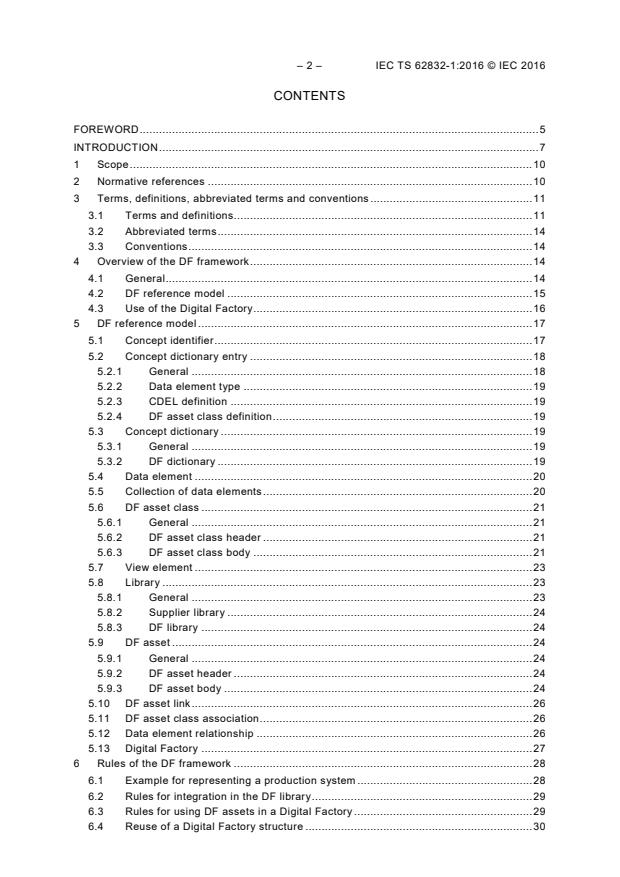
– 2 – IEC TS 62832-1:2016 © IEC 2016
CONTENTS
FOREWORD . 5
INTRODUCTION . 7
1 Scope . 10
2 Normative references . 10
3 Terms, definitions, abbreviated terms and conventions . 11
3.1 Terms and definitions . 11
3.2 Abbreviated terms . 14
3.3 Conventions . 14
4 Overview of the DF framework . 14
4.1 General . 14
4.2 DF reference model . 15
4.3 Use of the Digital Factory . 16
5 DF reference model . 17
5.1 Concept identifier . 17
5.2 Concept dictionary entry . 18
5.2.1 General . 18
5.2.2 Data element type . 19
5.2.3 CDEL definition . 19
5.2.4 DF asset class definition . 19
5.3 Concept dictionary . 19
5.3.1 General . 19
5.3.2 DF dictionary . 19
5.4 Data element . 20
5.5 Collection of data elements . 20
5.6 DF asset class . 21
5.6.1 General . 21
5.6.2 DF asset class header . 21
5.6.3 DF asset class body . 21
5.7 View element . 23
5.8 Library . 23
5.8.1 General . 23
5.8.2 Supplier library . 24
5.8.3 DF library . 24
5.9 DF asset . 24
5.9.1 General . 24
5.9.2 DF asset header . 24
5.9.3 DF asset body . 24
5.10 DF asset link . 26
5.11 DF asset class association . 26
5.12 Data element relationship . 26
5.13 Digital Factory . 27
6 Rules of the DF framework . 28
6.1 Example for representing a production system . 28
6.2 Rules for integration in the DF library . 29
6.3 Rules for using DF assets in a Digital Factory . 29
6.4 Reuse of a Digital Factory structure . 30
Annex A (informative) UML Model . 31
A.1 Concept dictionary . 31
A.2 Library . 32
A.3 Digital Factory . 34
Annex B (informative) Overview of model elements . 37
B.1 Model elements . 37
B.2 Example DF asset description . 39
Annex C (informative) UML notation. 41
C.1 General . 41
C.2 Class diagram . 41
C.3 Object diagram . 44
Bibliography . 45
Figure 1 – DF framework overview . 15
Figure 2 – Overview of the Digital Factory and example activities . 17
Figure 3 – Identification standard . 18
Figure 4 – Example of sourcing of a DF concept dictionary . 20
Figure 5 – Example of DF asset class . 22
Figure 6 – Example of composite DF asset class . 22
Figure 7 – Example of composite DF asset . 25
Figure 8 – Example of data element relationships . 27
Figure 9 – Example of DF asset and DF asset class . 28
Figure 10 – Integration with the DF library . 29
Figure A.1 – Concept dictionary and related class definitions and type . 31
Figure A.2 – Types of relationship. 32
Figure A.3 – Library . 32
Figure A.4 – DF asset class . 33
Figure A.5 – DF asset class showing origin of definitions . 33
Figure A.6 – Composed DF asset class . 34
Figure A.7 – Digital Factory structure . 34
Figure A.8 – Digital Factory . 35
Figure A.9 – Relationship between DF assets . 35
Figure A.10 – Digital Factory with composed DF asset . 36
Figure A.11 – DF asset link and DER . 36
Figure B.1 – Example structure of a DF asset . 40
Figure C.1 – Note . 41
Figure C.2 – Class . 41
Figure C.3 – Association . 41
Figure C.4 – Composition . 42
Figure C.5 – Aggregation . 42
Figure C.6 – Containment . 42
Figure C.7 – Dependency . 42
Figure C.8 – Abstract class, generalization and interface . 43
Figure C.9 – Multiplicity . 43
– 4 – IEC TS 62832-1:2016 © IEC 2016
Figure C.10 – Association class . 43
Figure C.11 – Class . 44
Figure C.12 – Link . 44
Figure C.13 – Link instantiated from composition . 44
Figure C.14 – Link instantiated from aggregation . 44
Table B.1 – Model elements of the Digital Factory . 37
Table B.2 – Model elements of libraries . 38
Table B.3 – Model elements of dictionaries . 39
INTERNATIONAL ELECTROTECHNICAL COMMISSION
____________
INDUSTRIAL-PROCESS MEASUREMENT, CONTROL
AND AUTOMATION – DIGITAL FACTORY FRAMEWORK –
Part 1: General principles
FOREWORD
1) The International Electrotechnical Commission (IEC) is a worldwide organization for standardization comprising
all national electrotechnical committees (IEC National Committees). The object of IEC is to promote
international co-operation on all questions concerning standardization in the electrical and electronic fields. To
this end and in addition to other activities, IEC publishes International Standards, Technical Specifications,
Technical Reports, Publicly Available Specifications (PAS) and Guides (hereafter referred to as “IEC
Publication(s)”). Their preparation is entrusted to technical committees; any IEC National Committee interested
in the subject dealt with may participate in this preparatory work. International, governmental and non-
governmental organizations liaising with the IEC also participate in this preparation. IEC collaborates closely
with the International Organization for Standardization (ISO) in accordance with conditions determined by
agreement between the two organizations.
2) The formal decisions or agreements of IEC on technical matters express, as nearly as possible, an international
consensus of opinion on the relevant subjects since each technical committee has representation from all
interested IEC National Committees.
3) IEC Publications have the form of recommendations for international use and are accepted by IEC National
Committees in that sense. While all reasonable efforts are made to ensure that the technical content of IEC
Publications is accurate, IEC cannot be held responsible for the way in which they are used or for any
misinterpretation by any end user.
4) In order to promote international uniformity, IEC National Committees undertake to apply IEC Publications
transparently to the maximum extent possible in their national and regional publications. Any divergence
between any IEC Publication and the corresponding national or regional publication shall be clearly indicated in
the latter.
5) IEC itself does not provide any attestation of conformity. Independent certification bodies provide conformity
assessment services and, in some areas, access to IEC marks of conformity. IEC is not responsible for any
services carried out by independent certification bodies.
6) All users should ensure that they have the latest edition of this publication.
7) No liability shall attach to IEC or its directors, employees, servants or agents including individual experts and
members of its technical committees and IEC National Committees for any personal injury, property damage or
other damage of any nature whatsoever, whether direct or indirect, or for costs (including legal fees) and
expenses arising out of the publication, use of, or reliance upon, this IEC Publication or any other IEC
Publications.
8) Attention is drawn to the Normative references cited in this publication. Use of the referenced publications is
indispensable for the correct application of this publication.
9) Attention is drawn to the possibility that some of the elements of this IEC Publication may be the subject of
patent rights. IEC shall not be held responsible for identifying any or all such patent rights.
The main task of IEC technical committees is to prepare International Standards. In
exceptional circumstances, a technical committee may propose the publication of a technical
specification when
• the required support cannot be obtained for the publication of an International Standard,
despite repeated efforts, or
• the subject is still under technical development or where, for any other reason, there is the
future but no immediate possibility of an agreement on an International Standard.
Technical specifications are subject to review within three years of publication to decide
whether they can be transformed into International Standards.
IEC TS 62832-1, which is a technical specification, has been prepared by IEC technical
committee 65: Industrial-process measurement, control and automation.
– 6 – IEC TS 62832-1:2016 © IEC 2016
This first edition cancels and replaces IEC TR 62794 published in 2012. This edition
constitutes a technical revision.
This first edition includes the following significant changes with respect to IEC TR 62794:
• initial project was split into several parts to facilitate work progress;
• contents were completely reworked based on National Committee comments.
The text of this technical specification is based on the following documents:
Enquiry draft Report on voting
65/629/DTS 65/649/RVC
Full information on the voting for the approval of this technical specification can be found in
the report on voting indicated in the above table.
This document has been drafted in accordance with the ISO/IEC Directives, Part 2.
A list of all parts in the IEC 62832 series, published under the general title, Industrial-process
measurement, control and automation – Digital factory framework can be found on the IEC
website.
The committee has decided that the contents of this document will remain unchanged until the
stability date indicated on the IEC website under "http://webstore.iec.ch" in the data related to
the specific document. At this date, the document will be
• reconfirmed,
• withdrawn,
• replaced by a revised edition, or
• amended.
A bilingual version of this publication may be issued at a later date.
IMPORTANT – The 'colour inside' logo on the cover page of this publication indicates
that it contains colours which are considered to be useful for the correct
understanding of its contents. Users should therefore print this document using a
colour printer.
INTRODUCTION
0.1 Market demand and situation
High performance, flexible dynamic processes, and agile machines and production systems
are essential to meet the demands for quality, delivery and cost of the products. This results
in an increased complexity of the plant life cycle. In addition, all existing information of a
product or a production system is described and modified through the whole life cycle of a
product or production system, for example during the planning, development process, and
operation. This situation spurs the enterprise to exchange product and production system data
in electronic form.
However, each enterprise and each department inside the enterprise describes their products
and production systems according to their own data management schemes, often using
different terms, structures, and media.
EXAMPLE Examples for data management schemes are paper-based, databases, disks, e-catalogues, cloud.
Therefore, no seamless information exchange can be found between all the actors involved in
the life cycles of both products and production systems.
Efficient exchange of data between and within enterprises can only be performed if syntax
(format) and semantics (meaning) of the information has been defined in a unanimous and
shared manner.
0.2 History of standardization in this area
Earlier work started with the initial objective to replace paper data sheets with an electronic
description of electronic components used in products, and to use it in software tools for
electronic wiring and assembly (for example, when designing electronic boards).
Additionally, concepts were developed for profiling of devices used in production systems, in
order to describe parameters and behavioural aspects to facilitate integration and reduce
engineering costs, providing guides for standards developers.
NOTE 1 See Device Profile Guideline (IEC TR 62390).
IEC 61987-10 made an important step toward this objective by defining fundamentals that aim
at describing devices used in production systems by creating lists of properties (LOPs). The
properties themselves are compiled into blocks that describe given features of a device.
Further parts of IEC 61987 and other related standards (e.g. IEC 62683) define reference
LOPs for electronic/electric components and materials used in electro-technical equipment
and systems, such as equipment for measuring flows, pressures, temperatures, levels and
densities.
NOTE 2 Although the title of IEC 62683 is “Low-voltage switchgear and controlgear – Product data and properties
for information exchange”, the intent of IEC 62832 is to use the information exchange for interoperability in
describing devices that are used in production systems.
IEC 61360-1, IEC 61360-2 and ISO 13584-42 specify the principles to be used for defining
characterization classes of parts and their properties. As a result, a database was developed,
also named IEC Common Data Dictionary (IEC CDD), which contains the reference collection
of classes and associated properties. ISO 22745 specifies open technical dictionaries (OTDs)
and their application to master data. ISO/IEC Guide 77 provides recommendations for the
description of products and their properties for the creation of these classes, catalogues and
reference dictionaries.
NOTE 3 ISO/IEC Guide 77 uses the term “product”. It is taken to include devices, processes, systems,
installations, etc.
– 8 – IEC TS 62832-1:2016 © IEC 2016
ISO 15704 specifies requirements of enterprise reference architectures and methodologies for
supporting the applications in terms of the interoperability, the integration, and the
architectures of the applications throughout the life cycle and supply chain aspects of the
systems.
A number of efforts have addressed the development of business and manufacturing
enterprise models to aid in understanding of different aspects of the enterprise to realize
improvements in enterprise operations. Additionally, models for enterprise and control
systems have been developed to support the production operations, but gaps remain in
development of models to bridge from the manufacturing system design environments to the
manufacturing operation environments, in terms of sharing information of the process,
equipment, and devices.
NOTE 4 IEC 62264 defines models of functions in the manufacturing and control domains and information
exchanged with the enterprise domain.
0.3 Purpose and benefits of IEC 62832
While the standards mentioned above provide a method for describing properties of a given
device, IEC 62832 extends this method by defining a reference model for the representation
of production systems, which include the devices.
In order to manage a production system effectively throughout its life cycle, it is very
important to have its digital representation and to maintain the contents appropriately in
response to its evolution in its life cycle. Activities related to the production system will access,
update, and use the contents of digital representation in order to support the whole life cycle
of the production system. This digital representation provides a consistent information
interchange between all processes and partners involved and makes related information
understandable, reusable and changeable through the entire production system life cycle.
Dictionaries and models can help to establish such digital representation by providing
descriptions of elements, such as equipment and devices, of the production system. However,
additional information is needed in order to achieve the intended digital representation of
production systems, such as descriptions of relationship between the elements.
IEC 62832 provides a framework used for establishing and maintaining the digital
representations of production systems, including the elements, relationships between these
elements and the exchange of information about these elements.
The framework aims at reducing the interoperability barriers for exchange of information for
the various activities related to production systems. The main advantages of this method are
that all information related to a production system is described in a standardized manner, and
it can be used and modified through its entire life cycle. The method defined in IEC 62832 is
kept as generic as possible in order to enable its use in several industrial sectors.
NOTE Enterprise modelling concepts are described in standards referenced in the Bibliography (for example
ISO 15704, ISO 11354-1).
0.4 Contents of the IEC 62832 series
The IEC 62832 series consists of multiple parts which provide:
• general introduction to the model and principles of the Digital Factory framework (DF
framework);
• detailed data model for all the model elements of the DF framework;
• description of how the DF Framework is used to manage the life cycle of a production
system;
• description of how data is migrated into the DF framework.
– 10 – IEC TS 62832-1:2016 © IEC 2016
INDUSTRIAL-PROCESS MEASUREMENT, CONTROL
AND AUTOMATION – DIGITAL FACTORY FRAMEWORK –
Part 1: General principles
1 Scope
This part of IEC 62832, which is a Technical Specification, defines the general principles of
the Digital Factory framework (DF framework), which is a set of model elements (DF reference
model) and rules for modelling production systems.
This DF framework defines:
• a model of production system assets;
• a model of relationships between different production system assets;
• the flow of information about production system assets.
The DF framework does not cover representation of building construction, input resources
(such as raw production material, assembly parts), consumables, work pieces in process, nor
end products.
It applies to the three types of production processes (continuous control, batch control or
discrete control) in any industrial sector (for example aeronautic industries, automotive,
chemicals, wood).
NOTE 1 This document does not provide an application scenario for descriptions based on ISO 15926, because
ISO 15926 uses a different methodology for describing production systems.
NOTE 2 In order to support oil and gas production systems, other methodologies for describing the assets can be
used (for example based on ISO 22745 or ISO 13584-42).
The representation of a production system according to this document is managed throughout
all phases of the production system life cycle (for example design, construction, operation or
maintenance). The requirements and specification of software tools supporting the DF
framework are out of scope of this document.
2 Normative references
The following documents are referred to in the text in such a way that some or all of their
content constitutes requirements of this document. For dated references, only the edition
cited applies. For undated references, the latest edition of the referenced document (including
any amendments) applies.
ISO/IEC 6523 (all parts), Information technology – Structure for the identification of
organizations and organization parts
ISO/IEC 11179-6, Information technology – Metadata registries (MDR) – Part 6: Registration
ISO TS 29002-5:2009, Industrial automation systems and integration – Exchange of
characteristic data – Part 5: Identification scheme
3 Terms, definitions, abbreviated terms and conventions
3.1 Terms and definitions
For the purposes of this document, the following terms and definitions apply.
ISO and IEC maintain terminological databases for use in standardization at the following
addresses:
• IEC Electropedia: available at http://www.electropedia.org/
• ISO Online browsing platform: available at http://www.iso.org/obp
NOTE Relationships between definitions are shown in Annex A.
3.1.1
activity
group of tasks that are classified as having a common objective
EXAMPLE Electrical wiring design, PLC programming, mounting, wiring, drive configuration, modelling, simulation,
monitoring.
[SOURCE: IEC 62264-1:2013, 3.1.1, modified – The example has been added.]
3.1.2
asset
physical or logical object owned by or under the custodial duties of an organization, having
either a perceived or actual value to the organization
[SOURCE: IEC TS 62443-1-1:2009, 3.2.6, modified – The note has been deleted.]
3.1.3
collection of data elements
CDEL
identified set of data elements
3.1.4
concept dictionary
collection of concept dictionary entries that allows lookup by concept identifier
Note 1 to entry: There are standardized dictionaries (e.g. IEC CDD), consortium dictionaries (e.g. eOTD® and
eCl@ss® ), supplier dictionaries and DF dictionaries.
[SOURCE: ISO TS 29002-5:2009, 3.5, modified – The note has been added.]
3.1.5
concept dictionary entry
description of a concept containing, at a minimum, an unambiguous concept identifier, a term,
and a definition
[SOURCE: ISO TS 29002-5:2009, 3.3, modified – The term "identifier" has been replaced with
"concept identifier" and the note to entry has been deleted.]
___________
eOTD® is the registered trademark of a product supplied by ECCMA (Electronic Commerce Code Management
Association). This information is given for the convenience of users of this document and does not constitute an
endorsement by IEC of the product named.
eCl@ss® is the registered trademark of a product supplied by the eCl@ss e.V. association. This information is
given for the convenience of users of this document and does not constitute an endorsement by IEC of the
product named.
– 12 – IEC TS 62832-1:2016 © IEC 2016
3.1.6
data element
unit of data consisting at least of the reference to a data element type and a corresponding
value
3.1.7
data element relationship
relationship between data elements
3.1.8
data element type
unit of data for which the identification, description and permissible values have been
specified according to a data specification
Note 1 to entry: This definition was derived from both ISO 22745-2:2010, 15.2 and ISO 13584-42:2010, 3.28.
Note 2 to entry: The concept of data element type is represented in many publications by the term "property".
3.1.9
data specification
rules for describing items belonging to a particular class using entries from a concept
dictionary and reference to a specific formal syntax
EXAMPLE An ISO TS 22745-30 compliant identification guide, ISO 13584-511 and ISO 8000-2 are data
specifications.
[SOURCE: ISO TS 29002-4:2009, 3.5, modified – Example 1 has been modified, the
reference to ISO 8000-102 has been updated and replaced by ISO 8000-2 and Example 2 has
been removed.]
3.1.10
DF asset
digital representation of a production system asset
Note 1 to entry: A DF asset is uniquely identified either by a role identifier (for role-based equipment information)
or a serial number (for physical asset information).
3.1.11
DF asset class
description of a set of DF assets that share common data element types
3.1.12
DF asset link
digital representation of a relationship between two or more PS assets
3.1.13
DF library
library owned by an enterprise for use in one or more Digital Factories
3.1.14
DF reference model
set of model elements for creating and managing a Digital Factory
3.1.15
Digital Factory
digital representation of a production system
Note 1 to entry: A Digital Factory can represent an existing or planned production system.
3.1.16
enterprise
one or more organizations sharing a definite mission, goals and objectives which provides an
output such as a product or service
[SOURCE: IEC 62264-1:2013, 3.1.10]
3.1.17
library
identified set of DF asset classes, DF asset class associations, data element relationships
and view elements
3.1.18
life cycle
evolution of a system, product, service, project or other human-made entity from conception
through retirement
EXAMPLE Typical phases of a production system life cycle are conceptual development, planning, specification,
design, engineering, construction, configuration, commissioning, operation, maintenance, decommissioning, and
disposal.
[SOURCE: ISO/IEC/IEEE 15288:2015, 4.1.22, modified – The example has been added.]
3.1.19
master data
data held by an organization that describes the entities that are both independent and
fundamental for that organization, and that it needs to reference in order to perform its
transactions
[SOURCE: ISO 8000-2:2012, 11.1, modified – The three notes and the example have been
removed.]
3.1.20
production system
system intended for production of goods
Note 1 to entry: The concept of production system includes spare parts.
Note 2 to entry: The concept of production system does not encompass the whole manufacturing facility. It
excludes in particular the supporting infrastructure (such as building, power distribution, lighting, ventilation). It
also excludes financial assets, human resources, raw process materials, energy, work pieces in process, end
products.
Note 3 to entry: Production systems can support different types of production processes (continuous, batch, or
discrete).
3.1.21
production system asset
PS asset
asset that is a constituent of a production system
Note 1 to entry: A PS asset can be a part, a device, a machine, software, a function, a control system or any
collection of PS assets. It can have physical characteristics, for example mechanical, electrical, electronic, and/or
role-based characteristics, for example function, information.
3.1.22
supplier library
library provided by a data supplier
EXAMPLE Data suppliers can be device manufacturers, machine manufacturers, vendors, distributors, system
integrators.
– 14 – IEC TS 62832-1:2016 © IEC 2016
3.1.23
technical discipline
area of technical expertise
EXAMPLE Electrical wiring, pipe layout, automation and mechanic.
3.2 Abbreviated terms
For the purposes of this document, the following abbreviated terms apply.
CDEL Collection of Data Elements
DER Data Element Relationship
DF Digital Factory (as qualifier)
ID Identifier
IEC CDD IEC Common Data Dictionary (see IEC 61360)
LOP List of Properties (see IEC 61987-10)
PLC Programmable Logic Controller
PS Production System (as qualifier)
RAI Registration Authority Identifier (see ISO/IEC 6523)
UML Unified Modeling Language (see ISO/IEC 19505-1)
VFD Variable Frequency Drive
NOTE The abbreviated term DF is only used as a qualifier for model elements specified in this document. It is not
to be understood as a replacement for the Digital Factory concept defined in 3.1.15.
3.3 Conventions
The conventions for UML notation used in this document are defined in Annex C.
4 Overview of the DF framework
4.1 General
The DF framework specifies the DF reference model and rules for a Digital Factory. The DF
reference model is a set of model elements. The rules govern the instantiation of DF assets
and the establishment of links between DF assets.
The DF framework enables each enterprise to use and develop interoperable software tools
and applications in order to support all activities within the life cycle of a production system.
These activities access and update the information in the Digital Factory.
The DF framework relies upon referencing or integrating information (master data), from
several sources, such as:
• standardized dictionaries;
• consortium dictionaries;
• supplier dictionaries;
• supplier libraries.
The DF framework also defines rules for construction of libraries based on these concept
dictionaries.
A production system (in the real world) is composed of PS assets, and is represented by a
Digital Factory (in the virtual world). The Digital Factory is composed of DF assets. DF assets
are representations of the PS assets. Relationships between PS assets are represented as
DF asset links.
The DF asset contains the role-based equipment information and/or the physical asset
information.
NOTE IEC 62264-2 describes the concepts of a role-based equipment and a physical asset.
The DF framework is illustrated in Figure 1. The arrows in the figure represent the rules for
construction of DF assets and information exchanges.
IEC
Figure 1 – DF framework overview
This document defines the concept of libraries of DF asset classes. The DF asset classes
provide the data structures for the proper representation of a production system and its
components. These DF asset classes are constructed with data elements defined in concept
dictionaries.
4.2 DF reference model
The DF reference model includes the following model elements:
• concept identifier;
• concept dictionary entry
– data element type;
– CDEL definition;
– DF asset class definition;
• concept dictionary
– 16 – IEC TS 62832-1:2016 © IEC 2016
– standardized dictionary;
– consortium dictionary;
– supplier dictionary;
– DF dictionary;
• data element;
• collection of data elements;
• DF asset class
– DF asset class header;
– DF asset class body;
• view element;
• library
– supplier library;
– DF library
• DF asset
– DF asset header;
– DF asset body;
• relationship
– DF asset link;
– DF asset class association;
– data element relationship;
• Digital Factory.
Model elements are either defined by this document or are derived from other standards.
NOTE The concept identifier is based on ISO TS 29002-5, the model elements for class, data element, concept
dictionary and library are derived from ISO/IEC 11179, the model element for collections of data elements is
derived from IEC 61360 and IEC 61987-10.
An overview of the different model elements is provided in Annex B.
4.3 Use of the Digital Factory
Throughout the life cycle of the production system, the information in the Digital Factory will
be added, deleted or changed by the various activities during the life cycle phases. In this
way, the Digital Factory will always contain up to date information of the production system
(see Figure 2).
IEC
Figure 2 – Overview of the Digital Factory and example activities
5 DF reference model
5.1 Concept identifier
For communication purposes, concept identifiers according to ISO TS 29002-5 shall be used
for identification of the following model elements (concepts) in the DF reference model: DF
asset class definitions, data element types, and CDEL definitions. An overview of the
ISO TS 29002-5 identifier and related other standards is shown in Figure 3.
– 18 – IEC TS 62832-1:2016 © IEC 2016
IEC
Key
IRDI: international registration data identifier (ISO/IEC 11179-6):
Organization:
RAI: registration authority identifier (ISO/IEC 6523)
ICD: international code designator
OI: organization identifier
OPI: organization part identifier
OPIS: organization part identifier source indicator
AI: additional information
Data:
DI: data identifier
CSI: code space identifier
IC: item code
Version:
VI: version identifier
The fields "#" and "-" are separators.
Figure 3 – Identification standard
A concept identifier consists of several parts:
• the registration authority identifier (RAI) describes the origin of the identifier;
• the data identifier (DI) identifies the concept (for example class, data element) within the
concept dictionary;
• the version identifier (VI) identifies the version of the concept description.
The DI is composed of an optional code space identifier (CSI) and a mandatory item code (IC).
NOTE 1 In ISO/IEC 11179, the term "international registration data identifier (IRDI)" is used for "concept
identifier" in ISO TS 29002-5.
NOTE 2 Within some other standards, the term “code” is used instead of “concept identifier”.
NOTE 3 Examples in this part of IEC 62832 only show the value of the item code (IC) of the identifier.
NOTE 4 ISO 29002 is a common resource used by several standards. Standards using ISO 29002 as a reference
restrict the syntax and add semantics elements to the syntax.
5.2 Concept dictionary entry
5.2.1 General
All concept di
...
IEC TS 62832-1 ®
Edition 1.0 2016-12
TECHNICAL
SPECIFICATION
colour
inside
Industrial-process measurement, control and automation – Digital factory
framework –
Part 1: General principles
All rights reserved. Unless otherwise specified, no part of this publication may be reproduced or utilized in any form
or by any means, electronic or mechanical, including photocopying and microfilm, without permission in writing from
either IEC or IEC's member National Committee in the country of the requester. If you have any questions about IEC
copyright or have an enquiry about obtaining additional rights to this publication, please contact the address below or
your local IEC member National Committee for further information.
IEC Central Office Tel.: +41 22 919 02 11
3, rue de Varembé Fax: +41 22 919 03 00
CH-1211 Geneva 20 info@iec.ch
Switzerland www.iec.ch
About the IEC
The International Electrotechnical Commission (IEC) is the leading global organization that prepares and publishes
International Standards for all electrical, electronic and related technologies.
About IEC publications
The technical content of IEC publications is kept under constant review by the IEC. Please make sure that you have the
latest edition, a corrigenda or an amendment might have been published.
IEC Catalogue - webstore.iec.ch/catalogue Electropedia - www.electropedia.org
The stand-alone application for consulting the entire The world's leading online dictionary of electronic and
bibliographical information on IEC International Standards, electrical terms containing 20 000 terms and definitions in
Technical Specifications, Technical Reports and other English and French, with equivalent terms in 15 additional
documents. Available for PC, Mac OS, Android Tablets and languages. Also known as the International Electrotechnical
iPad. Vocabulary (IEV) online.
IEC publications search - www.iec.ch/searchpub IEC Glossary - std.iec.ch/glossary
The advanced search enables to find IEC publications by a 65 000 electrotechnical terminology entries in English and
variety of criteria (reference number, text, technical French extracted from the Terms and Definitions clause of
committee,…). It also gives information on projects, replaced IEC publications issued since 2002. Some entries have been
and withdrawn publications. collected from earlier publications of IEC TC 37, 77, 86 and
CISPR.
IEC Just Published - webstore.iec.ch/justpublished
Stay up to date on all new IEC publications. Just Published IEC Customer Service Centre - webstore.iec.ch/csc
details all new publications released. Available online and If you wish to give us your feedback on this publication or
also once a month by email. need further assistance, please contact the Customer Service
Centre: csc@iec.ch.
IEC TS 62832-1 ®
Edition 1.0 2016-12
TECHNICAL
SPECIFICATION
colour
inside
Industrial-process measurement, control and automation – Digital factory
framework –
Part 1: General principles
INTERNATIONAL
ELECTROTECHNICAL
COMMISSION
ICS 25.040.40 ISBN 978-2-8322-3691-8
– 2 – IEC TS 62832-1:2016 © IEC 2016
CONTENTS
FOREWORD . 5
INTRODUCTION . 7
1 Scope . 10
2 Normative references . 10
3 Terms, definitions, abbreviated terms and conventions . 11
3.1 Terms and definitions . 11
3.2 Abbreviated terms . 14
3.3 Conventions . 14
4 Overview of the DF framework . 14
4.1 General . 14
4.2 DF reference model . 15
4.3 Use of the Digital Factory . 16
5 DF reference model . 17
5.1 Concept identifier . 17
5.2 Concept dictionary entry . 18
5.2.1 General . 18
5.2.2 Data element type . 19
5.2.3 CDEL definition . 19
5.2.4 DF asset class definition . 19
5.3 Concept dictionary . 19
5.3.1 General . 19
5.3.2 DF dictionary . 19
5.4 Data element . 20
5.5 Collection of data elements . 20
5.6 DF asset class . 21
5.6.1 General . 21
5.6.2 DF asset class header . 21
5.6.3 DF asset class body . 21
5.7 View element . 23
5.8 Library . 23
5.8.1 General . 23
5.8.2 Supplier library . 24
5.8.3 DF library . 24
5.9 DF asset . 24
5.9.1 General . 24
5.9.2 DF asset header . 24
5.9.3 DF asset body . 24
5.10 DF asset link . 26
5.11 DF asset class association . 26
5.12 Data element relationship . 26
5.13 Digital Factory . 27
6 Rules of the DF framework . 28
6.1 Example for representing a production system . 28
6.2 Rules for integration in the DF library . 29
6.3 Rules for using DF assets in a Digital Factory . 29
6.4 Reuse of a Digital Factory structure . 30
Annex A (informative) UML Model . 31
A.1 Concept dictionary . 31
A.2 Library . 32
A.3 Digital Factory . 34
Annex B (informative) Overview of model elements . 37
B.1 Model elements . 37
B.2 Example DF asset description . 39
Annex C (informative) UML notation. 41
C.1 General . 41
C.2 Class diagram . 41
C.3 Object diagram . 44
Bibliography . 45
Figure 1 – DF framework overview . 15
Figure 2 – Overview of the Digital Factory and example activities . 17
Figure 3 – Identification standard . 18
Figure 4 – Example of sourcing of a DF concept dictionary . 20
Figure 5 – Example of DF asset class . 22
Figure 6 – Example of composite DF asset class . 22
Figure 7 – Example of composite DF asset . 25
Figure 8 – Example of data element relationships . 27
Figure 9 – Example of DF asset and DF asset class . 28
Figure 10 – Integration with the DF library . 29
Figure A.1 – Concept dictionary and related class definitions and type . 31
Figure A.2 – Types of relationship. 32
Figure A.3 – Library . 32
Figure A.4 – DF asset class . 33
Figure A.5 – DF asset class showing origin of definitions . 33
Figure A.6 – Composed DF asset class . 34
Figure A.7 – Digital Factory structure . 34
Figure A.8 – Digital Factory . 35
Figure A.9 – Relationship between DF assets . 35
Figure A.10 – Digital Factory with composed DF asset . 36
Figure A.11 – DF asset link and DER . 36
Figure B.1 – Example structure of a DF asset . 40
Figure C.1 – Note . 41
Figure C.2 – Class . 41
Figure C.3 – Association . 41
Figure C.4 – Composition . 42
Figure C.5 – Aggregation . 42
Figure C.6 – Containment . 42
Figure C.7 – Dependency . 42
Figure C.8 – Abstract class, generalization and interface . 43
Figure C.9 – Multiplicity . 43
– 4 – IEC TS 62832-1:2016 © IEC 2016
Figure C.10 – Association class . 43
Figure C.11 – Class . 44
Figure C.12 – Link . 44
Figure C.13 – Link instantiated from composition . 44
Figure C.14 – Link instantiated from aggregation . 44
Table B.1 – Model elements of the Digital Factory . 37
Table B.2 – Model elements of libraries . 38
Table B.3 – Model elements of dictionaries . 39
INTERNATIONAL ELECTROTECHNICAL COMMISSION
____________
INDUSTRIAL-PROCESS MEASUREMENT, CONTROL
AND AUTOMATION – DIGITAL FACTORY FRAMEWORK –
Part 1: General principles
FOREWORD
1) The International Electrotechnical Commission (IEC) is a worldwide organization for standardization comprising
all national electrotechnical committees (IEC National Committees). The object of IEC is to promote
international co-operation on all questions concerning standardization in the electrical and electronic fields. To
this end and in addition to other activities, IEC publishes International Standards, Technical Specifications,
Technical Reports, Publicly Available Specifications (PAS) and Guides (hereafter referred to as “IEC
Publication(s)”). Their preparation is entrusted to technical committees; any IEC National Committee interested
in the subject dealt with may participate in this preparatory work. International, governmental and non-
governmental organizations liaising with the IEC also participate in this preparation. IEC collaborates closely
with the International Organization for Standardization (ISO) in accordance with conditions determined by
agreement between the two organizations.
2) The formal decisions or agreements of IEC on technical matters express, as nearly as possible, an international
consensus of opinion on the relevant subjects since each technical committee has representation from all
interested IEC National Committees.
3) IEC Publications have the form of recommendations for international use and are accepted by IEC National
Committees in that sense. While all reasonable efforts are made to ensure that the technical content of IEC
Publications is accurate, IEC cannot be held responsible for the way in which they are used or for any
misinterpretation by any end user.
4) In order to promote international uniformity, IEC National Committees undertake to apply IEC Publications
transparently to the maximum extent possible in their national and regional publications. Any divergence
between any IEC Publication and the corresponding national or regional publication shall be clearly indicated in
the latter.
5) IEC itself does not provide any attestation of conformity. Independent certification bodies provide conformity
assessment services and, in some areas, access to IEC marks of conformity. IEC is not responsible for any
services carried out by independent certification bodies.
6) All users should ensure that they have the latest edition of this publication.
7) No liability shall attach to IEC or its directors, employees, servants or agents including individual experts and
members of its technical committees and IEC National Committees for any personal injury, property damage or
other damage of any nature whatsoever, whether direct or indirect, or for costs (including legal fees) and
expenses arising out of the publication, use of, or reliance upon, this IEC Publication or any other IEC
Publications.
8) Attention is drawn to the Normative references cited in this publication. Use of the referenced publications is
indispensable for the correct application of this publication.
9) Attention is drawn to the possibility that some of the elements of this IEC Publication may be the subject of
patent rights. IEC shall not be held responsible for identifying any or all such patent rights.
The main task of IEC technical committees is to prepare International Standards. In
exceptional circumstances, a technical committee may propose the publication of a technical
specification when
• the required support cannot be obtained for the publication of an International Standard,
despite repeated efforts, or
• the subject is still under technical development or where, for any other reason, there is the
future but no immediate possibility of an agreement on an International Standard.
Technical specifications are subject to review within three years of publication to decide
whether they can be transformed into International Standards.
IEC TS 62832-1, which is a technical specification, has been prepared by IEC technical
committee 65: Industrial-process measurement, control and automation.
– 6 – IEC TS 62832-1:2016 © IEC 2016
This first edition cancels and replaces IEC TR 62794 published in 2012. This edition
constitutes a technical revision.
This first edition includes the following significant changes with respect to IEC TR 62794:
• initial project was split into several parts to facilitate work progress;
• contents were completely reworked based on National Committee comments.
The text of this technical specification is based on the following documents:
Enquiry draft Report on voting
65/629/DTS 65/649/RVC
Full information on the voting for the approval of this technical specification can be found in
the report on voting indicated in the above table.
This document has been drafted in accordance with the ISO/IEC Directives, Part 2.
A list of all parts in the IEC 62832 series, published under the general title, Industrial-process
measurement, control and automation – Digital factory framework can be found on the IEC
website.
The committee has decided that the contents of this document will remain unchanged until the
stability date indicated on the IEC website under "http://webstore.iec.ch" in the data related to
the specific document. At this date, the document will be
• reconfirmed,
• withdrawn,
• replaced by a revised edition, or
• amended.
A bilingual version of this publication may be issued at a later date.
IMPORTANT – The 'colour inside' logo on the cover page of this publication indicates
that it contains colours which are considered to be useful for the correct
understanding of its contents. Users should therefore print this document using a
colour printer.
INTRODUCTION
0.1 Market demand and situation
High performance, flexible dynamic processes, and agile machines and production systems
are essential to meet the demands for quality, delivery and cost of the products. This results
in an increased complexity of the plant life cycle. In addition, all existing information of a
product or a production system is described and modified through the whole life cycle of a
product or production system, for example during the planning, development process, and
operation. This situation spurs the enterprise to exchange product and production system data
in electronic form.
However, each enterprise and each department inside the enterprise describes their products
and production systems according to their own data management schemes, often using
different terms, structures, and media.
EXAMPLE Examples for data management schemes are paper-based, databases, disks, e-catalogues, cloud.
Therefore, no seamless information exchange can be found between all the actors involved in
the life cycles of both products and production systems.
Efficient exchange of data between and within enterprises can only be performed if syntax
(format) and semantics (meaning) of the information has been defined in a unanimous and
shared manner.
0.2 History of standardization in this area
Earlier work started with the initial objective to replace paper data sheets with an electronic
description of electronic components used in products, and to use it in software tools for
electronic wiring and assembly (for example, when designing electronic boards).
Additionally, concepts were developed for profiling of devices used in production systems, in
order to describe parameters and behavioural aspects to facilitate integration and reduce
engineering costs, providing guides for standards developers.
NOTE 1 See Device Profile Guideline (IEC TR 62390).
IEC 61987-10 made an important step toward this objective by defining fundamentals that aim
at describing devices used in production systems by creating lists of properties (LOPs). The
properties themselves are compiled into blocks that describe given features of a device.
Further parts of IEC 61987 and other related standards (e.g. IEC 62683) define reference
LOPs for electronic/electric components and materials used in electro-technical equipment
and systems, such as equipment for measuring flows, pressures, temperatures, levels and
densities.
NOTE 2 Although the title of IEC 62683 is “Low-voltage switchgear and controlgear – Product data and properties
for information exchange”, the intent of IEC 62832 is to use the information exchange for interoperability in
describing devices that are used in production systems.
IEC 61360-1, IEC 61360-2 and ISO 13584-42 specify the principles to be used for defining
characterization classes of parts and their properties. As a result, a database was developed,
also named IEC Common Data Dictionary (IEC CDD), which contains the reference collection
of classes and associated properties. ISO 22745 specifies open technical dictionaries (OTDs)
and their application to master data. ISO/IEC Guide 77 provides recommendations for the
description of products and their properties for the creation of these classes, catalogues and
reference dictionaries.
NOTE 3 ISO/IEC Guide 77 uses the term “product”. It is taken to include devices, processes, systems,
installations, etc.
– 8 – IEC TS 62832-1:2016 © IEC 2016
ISO 15704 specifies requirements of enterprise reference architectures and methodologies for
supporting the applications in terms of the interoperability, the integration, and the
architectures of the applications throughout the life cycle and supply chain aspects of the
systems.
A number of efforts have addressed the development of business and manufacturing
enterprise models to aid in understanding of different aspects of the enterprise to realize
improvements in enterprise operations. Additionally, models for enterprise and control
systems have been developed to support the production operations, but gaps remain in
development of models to bridge from the manufacturing system design environments to the
manufacturing operation environments, in terms of sharing information of the process,
equipment, and devices.
NOTE 4 IEC 62264 defines models of functions in the manufacturing and control domains and information
exchanged with the enterprise domain.
0.3 Purpose and benefits of IEC 62832
While the standards mentioned above provide a method for describing properties of a given
device, IEC 62832 extends this method by defining a reference model for the representation
of production systems, which include the devices.
In order to manage a production system effectively throughout its life cycle, it is very
important to have its digital representation and to maintain the contents appropriately in
response to its evolution in its life cycle. Activities related to the production system will access,
update, and use the contents of digital representation in order to support the whole life cycle
of the production system. This digital representation provides a consistent information
interchange between all processes and partners involved and makes related information
understandable, reusable and changeable through the entire production system life cycle.
Dictionaries and models can help to establish such digital representation by providing
descriptions of elements, such as equipment and devices, of the production system. However,
additional information is needed in order to achieve the intended digital representation of
production systems, such as descriptions of relationship between the elements.
IEC 62832 provides a framework used for establishing and maintaining the digital
representations of production systems, including the elements, relationships between these
elements and the exchange of information about these elements.
The framework aims at reducing the interoperability barriers for exchange of information for
the various activities related to production systems. The main advantages of this method are
that all information related to a production system is described in a standardized manner, and
it can be used and modified through its entire life cycle. The method defined in IEC 62832 is
kept as generic as possible in order to enable its use in several industrial sectors.
NOTE Enterprise modelling concepts are described in standards referenced in the Bibliography (for example
ISO 15704, ISO 11354-1).
0.4 Contents of the IEC 62832 series
The IEC 62832 series consists of multiple parts which provide:
• general introduction to the model and principles of the Digital Factory framework (DF
framework);
• detailed data model for all the model elements of the DF framework;
• description of how the DF Framework is used to manage the life cycle of a production
system;
• description of how data is migrated into the DF framework.
– 10 – IEC TS 62832-1:2016 © IEC 2016
INDUSTRIAL-PROCESS MEASUREMENT, CONTROL
AND AUTOMATION – DIGITAL FACTORY FRAMEWORK –
Part 1: General principles
1 Scope
This part of IEC 62832, which is a Technical Specification, defines the general principles of
the Digital Factory framework (DF framework), which is a set of model elements (DF reference
model) and rules for modelling production systems.
This DF framework defines:
• a model of production system assets;
• a model of relationships between different production system assets;
• the flow of information about production system assets.
The DF framework does not cover representation of building construction, input resources
(such as raw production material, assembly parts), consumables, work pieces in process, nor
end products.
It applies to the three types of production processes (continuous control, batch control or
discrete control) in any industrial sector (for example aeronautic industries, automotive,
chemicals, wood).
NOTE 1 This document does not provide an application scenario for descriptions based on ISO 15926, because
ISO 15926 uses a different methodology for describing production systems.
NOTE 2 In order to support oil and gas production systems, other methodologies for describing the assets can be
used (for example based on ISO 22745 or ISO 13584-42).
The representation of a production system according to this document is managed throughout
all phases of the production system life cycle (for example design, construction, operation or
maintenance). The requirements and specification of software tools supporting the DF
framework are out of scope of this document.
2 Normative references
The following documents are referred to in the text in such a way that some or all of their
content constitutes requirements of this document. For dated references, only the edition
cited applies. For undated references, the latest edition of the referenced document (including
any amendments) applies.
ISO/IEC 6523 (all parts), Information technology – Structure for the identification of
organizations and organization parts
ISO/IEC 11179-6, Information technology – Metadata registries (MDR) – Part 6: Registration
ISO TS 29002-5:2009, Industrial automation systems and integration – Exchange of
characteristic data – Part 5: Identification scheme
3 Terms, definitions, abbreviated terms and conventions
3.1 Terms and definitions
For the purposes of this document, the following terms and definitions apply.
ISO and IEC maintain terminological databases for use in standardization at the following
addresses:
• IEC Electropedia: available at http://www.electropedia.org/
• ISO Online browsing platform: available at http://www.iso.org/obp
NOTE Relationships between definitions are shown in Annex A.
3.1.1
activity
group of tasks that are classified as having a common objective
EXAMPLE Electrical wiring design, PLC programming, mounting, wiring, drive configuration, modelling, simulation,
monitoring.
[SOURCE: IEC 62264-1:2013, 3.1.1, modified – The example has been added.]
3.1.2
asset
physical or logical object owned by or under the custodial duties of an organization, having
either a perceived or actual value to the organization
[SOURCE: IEC TS 62443-1-1:2009, 3.2.6, modified – The note has been deleted.]
3.1.3
collection of data elements
CDEL
identified set of data elements
3.1.4
concept dictionary
collection of concept dictionary entries that allows lookup by concept identifier
Note 1 to entry: There are standardized dictionaries (e.g. IEC CDD), consortium dictionaries (e.g. eOTD® and
eCl@ss® ), supplier dictionaries and DF dictionaries.
[SOURCE: ISO TS 29002-5:2009, 3.5, modified – The note has been added.]
3.1.5
concept dictionary entry
description of a concept containing, at a minimum, an unambiguous concept identifier, a term,
and a definition
[SOURCE: ISO TS 29002-5:2009, 3.3, modified – The term "identifier" has been replaced with
"concept identifier" and the note to entry has been deleted.]
___________
eOTD® is the registered trademark of a product supplied by ECCMA (Electronic Commerce Code Management
Association). This information is given for the convenience of users of this document and does not constitute an
endorsement by IEC of the product named.
eCl@ss® is the registered trademark of a product supplied by the eCl@ss e.V. association. This information is
given for the convenience of users of this document and does not constitute an endorsement by IEC of the
product named.
– 12 – IEC TS 62832-1:2016 © IEC 2016
3.1.6
data element
unit of data consisting at least of the reference to a data element type and a corresponding
value
3.1.7
data element relationship
relationship between data elements
3.1.8
data element type
unit of data for which the identification, description and permissible values have been
specified according to a data specification
Note 1 to entry: This definition was derived from both ISO 22745-2:2010, 15.2 and ISO 13584-42:2010, 3.28.
Note 2 to entry: The concept of data element type is represented in many publications by the term "property".
3.1.9
data specification
rules for describing items belonging to a particular class using entries from a concept
dictionary and reference to a specific formal syntax
EXAMPLE An ISO TS 22745-30 compliant identification guide, ISO 13584-511 and ISO 8000-2 are data
specifications.
[SOURCE: ISO TS 29002-4:2009, 3.5, modified – Example 1 has been modified, the
reference to ISO 8000-102 has been updated and replaced by ISO 8000-2 and Example 2 has
been removed.]
3.1.10
DF asset
digital representation of a production system asset
Note 1 to entry: A DF asset is uniquely identified either by a role identifier (for role-based equipment information)
or a serial number (for physical asset information).
3.1.11
DF asset class
description of a set of DF assets that share common data element types
3.1.12
DF asset link
digital representation of a relationship between two or more PS assets
3.1.13
DF library
library owned by an enterprise for use in one or more Digital Factories
3.1.14
DF reference model
set of model elements for creating and managing a Digital Factory
3.1.15
Digital Factory
digital representation of a production system
Note 1 to entry: A Digital Factory can represent an existing or planned production system.
3.1.16
enterprise
one or more organizations sharing a definite mission, goals and objectives which provides an
output such as a product or service
[SOURCE: IEC 62264-1:2013, 3.1.10]
3.1.17
library
identified set of DF asset classes, DF asset class associations, data element relationships
and view elements
3.1.18
life cycle
evolution of a system, product, service, project or other human-made entity from conception
through retirement
EXAMPLE Typical phases of a production system life cycle are conceptual development, planning, specification,
design, engineering, construction, configuration, commissioning, operation, maintenance, decommissioning, and
disposal.
[SOURCE: ISO/IEC/IEEE 15288:2015, 4.1.22, modified – The example has been added.]
3.1.19
master data
data held by an organization that describes the entities that are both independent and
fundamental for that organization, and that it needs to reference in order to perform its
transactions
[SOURCE: ISO 8000-2:2012, 11.1, modified – The three notes and the example have been
removed.]
3.1.20
production system
system intended for production of goods
Note 1 to entry: The concept of production system includes spare parts.
Note 2 to entry: The concept of production system does not encompass the whole manufacturing facility. It
excludes in particular the supporting infrastructure (such as building, power distribution, lighting, ventilation). It
also excludes financial assets, human resources, raw process materials, energy, work pieces in process, end
products.
Note 3 to entry: Production systems can support different types of production processes (continuous, batch, or
discrete).
3.1.21
production system asset
PS asset
asset that is a constituent of a production system
Note 1 to entry: A PS asset can be a part, a device, a machine, software, a function, a control system or any
collection of PS assets. It can have physical characteristics, for example mechanical, electrical, electronic, and/or
role-based characteristics, for example function, information.
3.1.22
supplier library
library provided by a data supplier
EXAMPLE Data suppliers can be device manufacturers, machine manufacturers, vendors, distributors, system
integrators.
– 14 – IEC TS 62832-1:2016 © IEC 2016
3.1.23
technical discipline
area of technical expertise
EXAMPLE Electrical wiring, pipe layout, automation and mechanic.
3.2 Abbreviated terms
For the purposes of this document, the following abbreviated terms apply.
CDEL Collection of Data Elements
DER Data Element Relationship
DF Digital Factory (as qualifier)
ID Identifier
IEC CDD IEC Common Data Dictionary (see IEC 61360)
LOP List of Properties (see IEC 61987-10)
PLC Programmable Logic Controller
PS Production System (as qualifier)
RAI Registration Authority Identifier (see ISO/IEC 6523)
UML Unified Modeling Language (see ISO/IEC 19505-1)
VFD Variable Frequency Drive
NOTE The abbreviated term DF is only used as a qualifier for model elements specified in this document. It is not
to be understood as a replacement for the Digital Factory concept defined in 3.1.15.
3.3 Conventions
The conventions for UML notation used in this document are defined in Annex C.
4 Overview of the DF framework
4.1 General
The DF framework specifies the DF reference model and rules for a Digital Factory. The DF
reference model is a set of model elements. The rules govern the instantiation of DF assets
and the establishment of links between DF assets.
The DF framework enables each enterprise to use and develop interoperable software tools
and applications in order to support all activities within the life cycle of a production system.
These activities access and update the information in the Digital Factory.
The DF framework relies upon referencing or integrating information (master data), from
several sources, such as:
• standardized dictionaries;
• consortium dictionaries;
• supplier dictionaries;
• supplier libraries.
The DF framework also defines rules for construction of libraries based on these concept
dictionaries.
A production system (in the real world) is composed of PS assets, and is represented by a
Digital Factory (in the virtual world). The Digital Factory is composed of DF assets. DF assets
are representations of the PS assets. Relationships between PS assets are represented as
DF asset links.
The DF asset contains the role-based equipment information and/or the physical asset
information.
NOTE IEC 62264-2 describes the concepts of a role-based equipment and a physical asset.
The DF framework is illustrated in Figure 1. The arrows in the figure represent the rules for
construction of DF assets and information exchanges.
IEC
Figure 1 – DF framework overview
This document defines the concept of libraries of DF asset classes. The DF asset classes
provide the data structures for the proper representation of a production system and its
components. These DF asset classes are constructed with data elements defined in concept
dictionaries.
4.2 DF reference model
The DF reference model includes the following model elements:
• concept identifier;
• concept dictionary entry
– data element type;
– CDEL definition;
– DF asset class definition;
• concept dictionary
– 16 – IEC TS 62832-1:2016 © IEC 2016
– standardized dictionary;
– consortium dictionary;
– supplier dictionary;
– DF dictionary;
• data element;
• collection of data elements;
• DF asset class
– DF asset class header;
– DF asset class body;
• view element;
• library
– supplier library;
– DF library
• DF asset
– DF asset header;
– DF asset body;
• relationship
– DF asset link;
– DF asset class association;
– data element relationship;
• Digital Factory.
Model elements are either defined by this document or are derived from other standards.
NOTE The concept identifier is based on ISO TS 29002-5, the model elements for class, data element, concept
dictionary and library are derived from ISO/IEC 11179, the model element for collections of data elements is
derived from IEC 61360 and IEC 61987-10.
An overview of the different model elements is provided in Annex B.
4.3 Use of the Digital Factory
Throughout the life cycle of the production system, the information in the Digital Factory will
be added, deleted or changed by the various activities during the life cycle phases. In this
way, the Digital Factory will always contain up to date information of the production system
(see Figure 2).
IEC
Figure 2 – Overview of the Digital Factory and example activities
5 DF reference model
5.1 Concept identifier
For communication purposes, concept identifiers according to ISO TS 29002-5 shall be used
for identification of the following model elements (concepts) in the DF reference model: DF
asset class definitions, data element types, and CDEL definitions. An overview of the
ISO TS 29002-5 identifier and related other standards is shown in Figure 3.
– 18 – IEC TS 62832-1:2016 © IEC 2016
IEC
Key
IRDI: international registration data identifier (ISO/IEC 11179-6):
Organization:
RAI: registration authority identifier (ISO/IEC 6523)
ICD: international code designator
OI: organization identifier
OPI: organization part identifier
OPIS: organization part identifier source indicator
AI: additional information
Data:
DI: data identifier
CSI: code space identifier
IC: item code
Version:
VI: version identifier
The fields "#" and "-" are separators.
Figure 3 – Identification standard
A concept identifier consists of several parts:
• the registration authority identifier (RAI) describes the origin of the identifier;
• the data identifier (DI) identifies the concept (for example class, data element) within the
concept dictionary;
• the version identifier (VI) identifies the version of the concept description.
The DI is composed of an optional code space identifier (CSI) and a mandatory item code (IC).
NOTE 1 In ISO/IEC 11179, the term "int
...
Questions, Comments and Discussion
Ask us and Technical Secretary will try to provide an answer. You can facilitate discussion about the standard in here.
Loading comments...