

IEC 63510-4-1:2025
(Main)Household appliances network and grid connectivity - Part 4-1: Communication Protocol Specific Aspects: SPINE, SPINE-IoT and SHIP
General Information
- Abstract
IEC 63510-4-1:2025 This document specifies the application of relevant transport protocols for Home and Wide Area Networks as well as cloud connectivity; in this case, SPINE (Smart Premises Interoperable Neutral-Message Exchange), SPINE-IoT, and SHIP (Smart Home IP).
This document is part of the IEC 63510 series, which defines the information exchange between Smart Appliances and management systems in homes and buildings including energy management.
It is based on EN 50631-4-1:2023 and was submitted as a Fast-Track document.
- Status
- Published
- Publication Date
- 11-Jun-2025
- Technical Committee
- TC 59 - Performance of household and similar electrical appliances
- Drafting Committee
- WG 15 - TC 59/WG 15
- Current Stage
- PPUB - Publication issued
- Start Date
- 12-Jun-2025
- Completion Date
- 09-Jul-2025
Overview
IEC 63510-4-1:2025 - "Household appliances network and grid connectivity - Part 4-1: Communication Protocol Specific Aspects: SPINE, SPINE‑IoT and SHIP" specifies the application of transport and messaging protocols for Home and Wide Area Networks and cloud connectivity. It is part of the IEC 63510 series that defines information exchange between smart appliances and management systems (including energy management). This edition (Fast-Track, based on EN 50631‑4‑1:2023) covers protocol-specific aspects for SPINE, SPINE‑IoT and SHIP used in smart home and building environments.
Key topics and technical requirements
- Transport protocols and architecture: Defines how SPINE, SPINE‑IoT and SHIP operate over home and wide area networks and cloud links. (See Figures and architecture overview.)
- Device model and addressing: Device, entity and feature models for representing appliance capabilities and addresses.
- Use case model: Structure for declaring use cases, instances and interfaces used by management systems.
- Binding and subscription mechanisms: Rules for binding devices, managing subscriptions, callbacks and change requests.
- SPINE datagram: Datagram format with header and payload structure and communication modes (simple and enhanced).
- Functional commissioning & discovery: Procedures for discovery, detailed discovery, destination lists and commissioning flows.
- SHIP transport specifics: Registration, reconnection, service discovery (mDNS), TCP behavior, TLS usage and WebSocket framing.
- Message formats: JSON and XML mapping guidelines for message representation and transformations.
- Key management & security: Certificate handling, SHIP node public keys, symmetric keys, PINs, commissioning tool and QR code processes.
- Schema and normative content: SHIP XSD provided as an annex for implementers.
Practical applications and users
This standard is intended for:
- Appliance manufacturers implementing smart connectivity, firmware and device agents.
- Smart home system integrators and building management system (BMS) vendors needing interoperable messaging and commissioning.
- Energy management and grid operators integrating household appliances for demand response and grid services.
- Cloud and platform developers implementing SHIP over TLS/WebSocket and SPINE message handling.
- Test laboratories and certification bodies validating interoperability, security and protocol conformance.
Practical benefits include predictable device addressing and discovery, secure cloud and peer-to-peer connectivity, standardized subscription/binding semantics, and consistent JSON/XML message exchange for IoT and energy use cases.
Related standards
- IEC 63510 series (information exchange between smart appliances and management systems)
- EN 50631‑4‑1:2023 (basis for this Fast‑Track submission)
Keywords: IEC 63510-4-1:2025, SPINE, SPINE‑IoT, SHIP, household appliances network, grid connectivity, smart appliances, communication protocol, IoT, energy management.
Frequently Asked Questions
IEC 63510-4-1:2025 is a standard published by the International Electrotechnical Commission (IEC). Its full title is "Household appliances network and grid connectivity - Part 4-1: Communication Protocol Specific Aspects: SPINE, SPINE-IoT and SHIP". This standard covers: IEC 63510-4-1:2025 This document specifies the application of relevant transport protocols for Home and Wide Area Networks as well as cloud connectivity; in this case, SPINE (Smart Premises Interoperable Neutral-Message Exchange), SPINE-IoT, and SHIP (Smart Home IP). This document is part of the IEC 63510 series, which defines the information exchange between Smart Appliances and management systems in homes and buildings including energy management. It is based on EN 50631-4-1:2023 and was submitted as a Fast-Track document.
IEC 63510-4-1:2025 This document specifies the application of relevant transport protocols for Home and Wide Area Networks as well as cloud connectivity; in this case, SPINE (Smart Premises Interoperable Neutral-Message Exchange), SPINE-IoT, and SHIP (Smart Home IP). This document is part of the IEC 63510 series, which defines the information exchange between Smart Appliances and management systems in homes and buildings including energy management. It is based on EN 50631-4-1:2023 and was submitted as a Fast-Track document.
IEC 63510-4-1:2025 is classified under the following ICS (International Classification for Standards) categories: 97.120 - Automatic controls for household use. The ICS classification helps identify the subject area and facilitates finding related standards.
IEC 63510-4-1:2025 is available in PDF format for immediate download after purchase. The document can be added to your cart and obtained through the secure checkout process. Digital delivery ensures instant access to the complete standard document.
Standards Content (Sample)
IEC 63510-4-1 ®
Edition 1.0 2025-06
INTERNATIONAL
STANDARD
Household appliances network and grid connectivity -
Part 4-1: Communication Protocol Specific Aspects: SPINE, SPINE-IoT and SHIP
ICS 97.120 ISBN 978-2-8327-0489-9
All rights reserved. Unless otherwise specified, no part of this publication may be reproduced or utilized in any form or
by any means, electronic or mechanical, including photocopying and microfilm, without permission in writing from either
IEC or IEC's member National Committee in the country of the requester. If you have any questions about IEC copyright
or have an enquiry about obtaining additional rights to this publication, please contact the address below or your local
IEC member National Committee for further information.
IEC Secretariat Tel.: +41 22 919 02 11
3, rue de Varembé info@iec.ch
CH-1211 Geneva 20 www.iec.ch
Switzerland
About the IEC
The International Electrotechnical Commission (IEC) is the leading global organization that prepares and publishes
International Standards for all electrical, electronic and related technologies.
About IEC publications
The technical content of IEC publications is kept under constant review by the IEC. Please make sure that you have the
latest edition, a corrigendum or an amendment might have been published.
IEC publications search - IEC Products & Services Portal - products.iec.ch
webstore.iec.ch/advsearchform Discover our powerful search engine and read freely all the
publications previews, graphical symbols and the glossary.
The advanced search enables to find IEC publications by a
variety of criteria (reference number, text, technical With a subscription you will always have access to up to date
committee, …). It also gives information on projects, content tailored to your needs.
replaced and withdrawn publications.
Electropedia - www.electropedia.org
The world's leading online dictionary on electrotechnology,
IEC Just Published - webstore.iec.ch/justpublished
Stay up to date on all new IEC publications. Just Published containing more than 22 500 terminological entries in English
details all new publications released. Available online and and French, with equivalent terms in 25 additional languages.
once a month by email. Also known as the International Electrotechnical Vocabulary
(IEV) online.
IEC Customer Service Centre - webstore.iec.ch/csc
If you wish to give us your feedback on this publication or
need further assistance, please contact the Customer
Service Centre: sales@iec.ch.
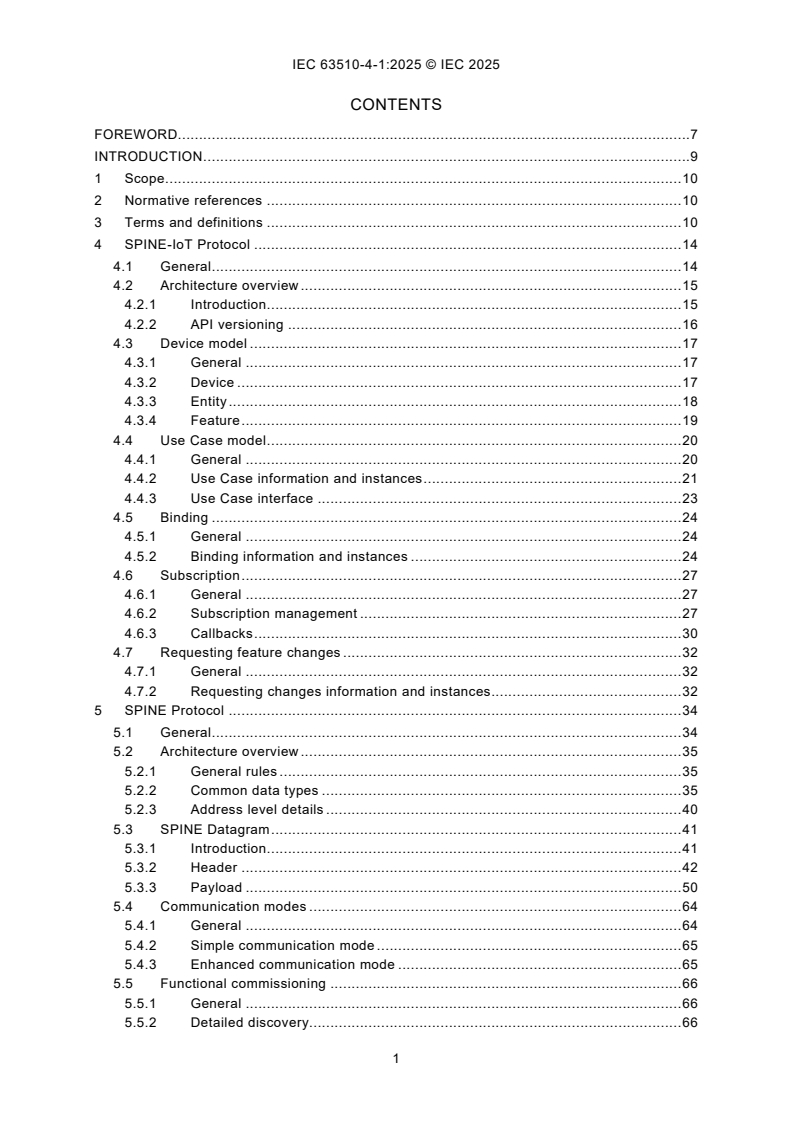
CONTENTS
FOREWORD. 7
INTRODUCTION . 9
1 Scope . 10
2 Normative references . 10
3 Terms and definitions . 10
4 SPINE-IoT Protocol . 14
4.1 General . 14
4.2 Architecture overview . 15
4.2.1 Introduction . 15
4.2.2 API versioning . 16
4.3 Device model . 17
4.3.1 General . 17
4.3.2 Device . 17
4.3.3 Entity . 18
4.3.4 Feature . 19
4.4 Use Case model . 20
4.4.1 General . 20
4.4.2 Use Case information and instances . 21
4.4.3 Use Case interface . 23
4.5 Binding . 24
4.5.1 General . 24
4.5.2 Binding information and instances . 24
4.6 Subscription . 27
4.6.1 General . 27
4.6.2 Subscription management . 27
4.6.3 Callbacks . 30
4.7 Requesting feature changes . 32
4.7.1 General . 32
4.7.2 Requesting changes information and instances . 32
5 SPINE Protocol . 34
5.1 General . 34
5.2 Architecture overview . 35
5.2.1 General rules . 35
5.2.2 Common data types . 35
5.2.3 Address level details . 40
5.3 SPINE Datagram . 41
5.3.1 Introduction . 41
5.3.2 Header . 42
5.3.3 Payload . 50
5.4 Communication modes . 64
5.4.1 General . 64
5.4.2 Simple communication mode . 65
5.4.3 Enhanced communication mode . 65
5.5 Functional commissioning . 66
5.5.1 General . 66
5.5.2 Detailed discovery. 66
5.5.3 Destination list . 81
5.5.4 Binding . 84
5.5.5 Subscription . 93
5.5.6 Use Case discovery . 101
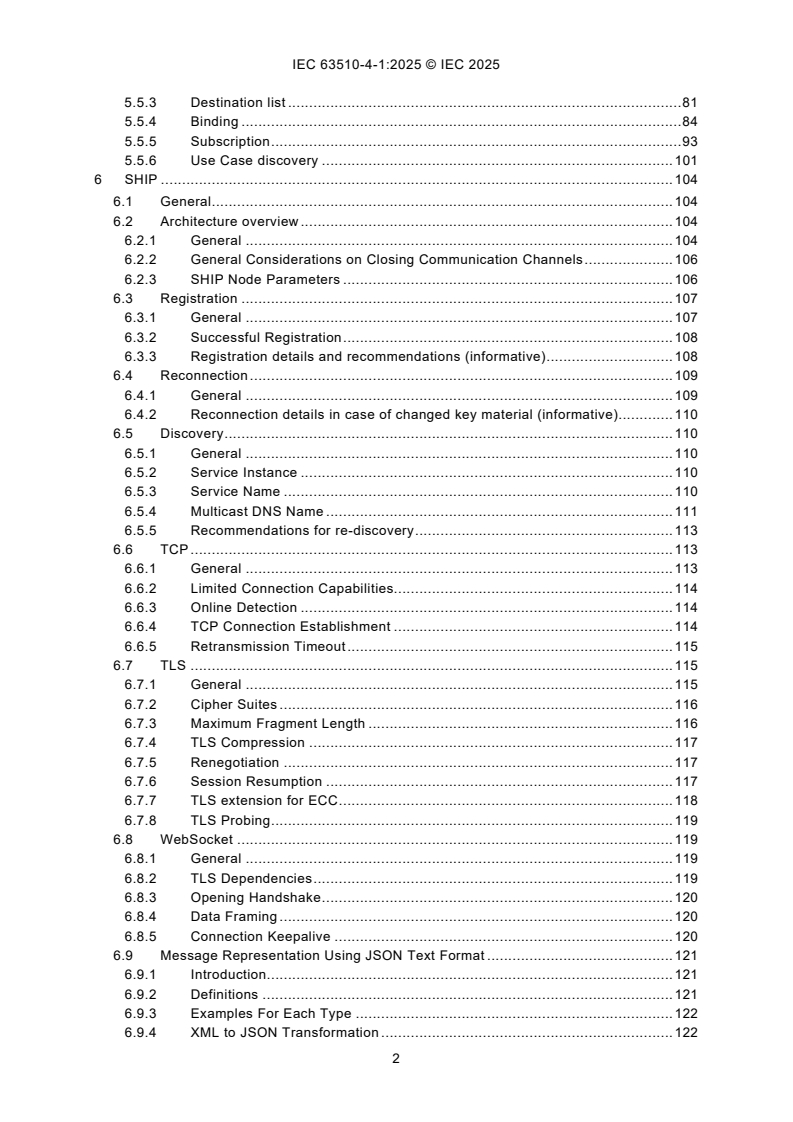
6 SHIP . 104
6.1 General . 104
6.2 Architecture overview . 104
6.2.1 General . 104
6.2.2 General Considerations on Closing Communication Channels . 106
6.2.3 SHIP Node Parameters . 106
6.3 Registration . 107
6.3.1 General . 107
6.3.2 Successful Registration . 108
6.3.3 Registration details and recommendations (informative) . 108
6.4 Reconnection . 109
6.4.1 General . 109
6.4.2 Reconnection details in case of changed key material (informative) . 110
6.5 Discovery . 110
6.5.1 General . 110
6.5.2 Service Instance . 110
6.5.3 Service Name . 110
6.5.4 Multicast DNS Name . 111
6.5.5 Recommendations for re-discovery . 113
6.6 TCP . 113
6.6.1 General . 113
6.6.2 Limited Connection Capabilities. 114
6.6.3 Online Detection . 114
6.6.4 TCP Connection Establishment . 114
6.6.5 Retransmission Timeout . 115
6.7 TLS . 115
6.7.1 General . 115
6.7.2 Cipher Suites . 116
6.7.3 Maximum Fragment Length . 116
6.7.4 TLS Compression . 117
6.7.5 Renegotiation . 117
6.7.6 Session Resumption . 117
6.7.7 TLS extension for ECC . 118
6.7.8 TLS Probing . 119
6.8 WebSocket . 119
6.8.1 General . 119
6.8.2 TLS Dependencies . 119
6.8.3 Opening Handshake . 120
6.8.4 Data Framing . 120
6.8.5 Connection Keepalive . 120
6.9 Message Representation Using JSON Text Format . 121
6.9.1 Introduction . 121
6.9.2 Definitions . 121
6.9.3 Examples For Each Type . 122
6.9.4 XML to JSON Transformation . 122
6.9.5 JSON to XML Transformation . 128
6.10 Key Management . 129
6.10.1 General . 129
6.10.2 Certificates . 129
6.10.3 SHIP Node Specific Public Key . 134
6.10.4 Verification Procedure . 136
6.10.5 Symmetric Key . 142
6.10.6 SHIP Node PIN . 143
6.10.7 SHIP Commissioning Tool . 144
6.10.8 QR Code . 146
6.11 SHIP Data Exchange . 149
6.11.1 Introduction . 149
6.11.2 Terms in the context of SHIP Data Exchange . 149
6.11.3 Protocol Architecture / Hierarchy . 151
6.11.4 SHIP Message Exchange . 153
6.12 Well-known protocolId . 195
Annex A (normative) SHIP XSD . 196
Bibliography . 203
Figure 1 – Overview of transport protocols within IEC 63510-4-1. 14
Figure 2 – Primary device model . 17
Figure 3 – Use Case instance examples . 21
Figure 4 – Announcement of potential Use Case instance . 22
Figure 5 – Potential Use Case with real instance . 22
Figure 6 – PossibleOperationsType . 38
Figure 7 – DeviceAddressType . 39
Figure 8 – EntityAddressType . 39
Figure 9 – FeatureAddressType . 39
Figure 10 – SPINE datagram . 42
Figure 11 – SPINE header . 43
Figure 12 – SPINE payload . 51
Figure 13 – Example of selectors part (extract) with entity address part . 63
Figure 14 – Communication modes of SPINE devices A, B and C . 64
Figure 15 – Discovery example . 67
Figure 16 – Hierarchy types . 67
Figure 17 – Function Discovery Example over Feature Description . 68
Figure 18 – nodeManagementDetailedDiscoveryData function overview, part 1 . 72
Figure 19 – nodeManagementDetailedDiscoveryData function overview, part 2:
deviceInformation.description . 73
Figure 20 – nodeManagementDetailedDiscoveryData function overview, part 3:
entityInformation.description . 73
Figure 21 – nodeManagementDetailedDiscoveryData function overview, part 4:
featureInformation.description . 74
Figure 22 – nodeManagementDestinationListData function overview, part 1 . 83
Figure 23 – nodeManagementDestinationListData function overview, part 2 . 83
Figure 24 – Binding request . 86
Figure 25 – nodeManagementBindingRequestCall function overview . 86
Figure 26 – nodeManagementBindingData function overview . 88
Figure 27 – nodeManagementBindingDeleteCall function overview . 90
Figure 28 – Subscription request . 95
Figure 29 – nodeManagementSubscriptionRequestCall function overview . 95
Figure 30 – nodeManagementSubscriptionData function overview . 97
Figure 31 – nodeManagementSubscriptionDeleteCall function overview . 99
Figure 32 – nodeManagementUseCaseData function . 102
Figure 33 – Physical Connections in the Overall System . 105
Figure 34 – SHIP Stack Overview . 105
Figure 35 – Full TLS 1.2 Handshake with mutual authentication . 116
Figure 36 – Quick TLS Handshake with Session Resumption . 118
Figure 37 – Easy Mutual Authentication with QR-codes and Smart Phone . 143
Figure 38 – QR Code Model 2, "low" ECC level, 0,33 mm/Module, with SKI and PIN . 148
Figure 39 – QR Code Model 2, "low" ECC level, 0,33 mm/module, with all values . 148
Figure 40 – QR Code Model 2, "low" ECC level, 0,33 mm/module, with
brainpoolP256r1 SKI and brainpoolP384r1 SKI . 149
Figure 41 – Protocol Architecture and Hierarchy . 152
Figure 42 – CMI Message Sequence Example . 156
Figure 43 – Connection State "Hello" Sequence Example Without Prolongation
Request: "A" and "B" already trust each other; "B" is slower/delayed . 163
Figure 44 – Connection State "Hello" Sequence Example With Prolongation Request . 164
Figure 45 – Connection State "Protocol Handshake" Message Sequence Example . 170
Figure 46 – Connection State "PIN verification" Message Sequence Example (Begin) . 179
Table 1 – Properties of "api" information. 17
Table 2 – Properties of "device" information . 18
Table 3 – Properties of "entity" information . 18
Table 4 – Properties of "feature" information of a single featureObjType instance . 20
Table 5 – Supported featureType-featureObjType combinations. 20
Table 6 – Properties of "Use Case" information . 23
Table 7 – Request body for POST /bindings . 24
Table 8 – Properties of bindingRequestFeatures . 25
Table 9 – Properties of bindingRequestUsecaseInterfaces . 25
Table 10 – Response body upon accepted binding request . 26
Table 11 – Renew all bindings . 26
Table 12 – Renew a single bindingId . 26
Table 13 – Request body for the deletion of one or all bindings . 27
Table 14 – Request body for POST /subscriptions . 27
Table 15 – Response body upon accepted subscription request . 29
Table 16 – Renew all subscriptions . 29
Table 17 – Renew a single subscriptionId . 29
Table 18 – Request body for the deletion of one or all subscriptions . 29
Table 19 – Properties of a "device change description" callback . 30
Table 20 – Properties of an "entity change description" callback . 31
Table 21 – Properties of a "feature change description" callback . 31
Table 22 – Properties of a "Use Case information change description" callback . 31
Table 23 – Properties of a "feature" change request . 32
Table 24 – Properties of type featureModifyCreateReplace . 33
Table 25 – Properties of type featureModifyDelete . 33
Table 26 – Properties of type featureModifyPatchUnset . 34
Table 27 – Structure of the SPINE datagram . 42
Table 28 – cmdClassifier values and kind of messages for a message "M" and the
scope of related acknowledgement messages . 46
Table 29 – Structure of the SPINE header . 49
Table 30 – Elements of the SPINE payload . 51
Table 31 – Example table (template): This template is used in the subsequent sections
for specific cmdOptions combinations. In this template, each "." is just a placeholder . 55
Table 32 – Considered cmdOptions combinations for classifier "write" . 56
Table 33 – Considered cmdOptions combinations for classifier "notify" . 57
Table 34 – Considered cmdOptions combinations for classifier "read" . 58
Table 35 – Considered cmdOptions combinations for classifier "reply" . 58
Table 36 – Address path examples . 62
Table 37 – Notify/response list of entities and their corresponding features with
nodeManagementDetailedDiscoveryData . 74
Table 38 – nodeManagementDetailedDiscoveryDataSelectors . 79
Table 39 – Notify/response of DestinationList information with
nodeManagementDestinationListData . 83
Table 40 – Binding request with nodeManagementBindingRequestCall . 86
Table 41 – nodeManagementBindingData holds list of binding entries . 89
Table 42 – Remove Binding with nodeManagementBindingDeleteCall . 91
Table 43 – Subscription request with nodeManagementSubscriptionRequestCall . 95
Table 44 – nodeManagementSubscriptionData holds list of subscription entries . 98
Table 45 – Remove subscription with nodeManagementSubscriptionDeleteCall . 100
Table 46 – nodeManagementUseCaseData . 103
Table 47 – SHIP Parameters Default Values. 106
Table 48 – Mandatory Parameters in the TXT Record . 112
Table 49 – Optional Parameters in the TXT Record . 112
Table 50 – Mapping from the XSD Types to JSON Types . 122
Table 51 – Transformation of a simple type . 123
Table 52 – Mapping from the XSD compositors to JSON Types . 123
Table 53 – Examples for XML and JSON representations . 125
Table 54 – Example transformation of several combined XSD item types . 127
Table 55 – Example for JSON to XML transformation . 129
Table 56 – Trust Levels . 142
Table 57 – MessageType Values . 154
Table 58 – Structure of SmeHelloValue of SME "hello" Message . 157
Table 59 – Structure of SmeProtocolHandshakeValue of SME "Protocol Handshake"
Message . 165
Table 60 – Structure of SmeProtocolHandshakeErrorValue of SME "Protocol
Handshake Error" Message . 166
Table 61 – Values of Sub-element "error" of messageProtocolHandshakeError . 169
Table 62 – Structure of SmeConnectionPinStateValue of SME "Pin state" message . 171
Table 63 – Structure of SmeConnectionPinInputValue of SME "Pin input" message . 172
Table 64 – Structure of SmeConnectionPinErrorValue of SME "Pin error" message . 172
Table 65 – Values of Sub-element "error" of connectionPinError . 178
Table 66 – Structure of MessageValue of "data" Message . 180
Table 67 – Structure of SmeConnectionAccessMethodsRequestValue of SME "Access
methods request" message . 183
Table 68 – Structure of SmeConnectionAccessMethodsValue of SME "Access
methods" message . 184
Table 69 – Structure of SmeConnectionCommissioningRequestValue of SME
"commissioning request" message . 186
Table 70 – Structure of SmeConnectionCommissioningResponseValue of SME
"commissioning response" message . 186
Table 71 – Structure of SmeConnectionKeyMaterialRequestValue of SME "key material
request" message . 187
Table 72 – Structure of SmeConnectionKeyMaterialValue of SME "key material"
message . 188
Table 73 – Structure of SmeConnectionKeyMaterialResponseValue of SME "key
material response" message . 189
Table 74 – Structure of SmeConnectionKeyMaterialDeleteValue of SME "key material
delete" message . 190
Table 75 – Structure of SmeConnectionKeyMaterialDeleteResponseValue of SME "key
material delete response" message . 191
Table 76 – Structure of SmeConnectionKeyMaterialStateValue of SME "key material
state" message . 192
Table 77 – Structure of SmeConnectionKeyMaterialStateResponseValue of SME "key
material state response" message . 192
Table 78 – Structure of SmeConnectionKeyMaterialStateRequestValue of SME "key
material state request" message . 193
Table 79 – Structure of SmeCloseValue of SME "close" Message . 194
INTERNATIONAL ELECTROTECHNICAL COMMISSION
____________
Household appliances network and grid connectivity –
Part 4-1: Communication Protocol Specific Aspects:
SPINE, SPINE-IoT and SHIP
FOREWORD
1) The International Electrotechnical Commission (IEC) is a worldwide organization for standardization comprising
all national electrotechnical committees (IEC National Committees). The object of IEC is to promote
international co-operation on all questions concerning standardization in the electrical and electronic fields. To
this end and in addition to other activities, IEC publishes International Standards, Technical Specifications,
Technical Reports, Publicly Available Specifications (PAS) and Guides (hereafter referred to as "IEC
Publication(s)"). Their preparation is entrusted to technical committees; any IEC National Committee interested
in the subject dealt with may participate in this preparatory work. International, governmental and non-
governmental organizations liaising with the IEC also participate in this preparation. IEC collaborates closely
with the International Organization for Standardization (ISO) in accordance with conditions determined by
agreement between the two organizations.
2) The formal decisions or agreements of IEC on technical matters express, as nearly as possible, an international
consensus of opinion on the relevant subjects since each technical committee has representation from all
interested IEC National Committees.
3) IEC Publications have the form of recommendations for international use and are accepted by IEC National
Committees in that sense. While all reasonable efforts are made to ensure that the technical content of IEC
Publications is accurate, IEC cannot be held responsible for the way in which they are used or for any
misinterpretation by any end user.
4) In order to promote international uniformity, IEC National Committees undertake to apply IEC Publications
transparently to the maximum extent possible in their national and regional publications. Any divergence
between any IEC Publication and the corresponding national or regional publication shall be clearly indicated in
the latter.
5) IEC itself does not provide any attestation of conformity. Independent certification bodies provide conformity
assessment services and, in some areas, access to IEC marks of conformity. IEC is not responsible for any
services carried out by independent certification bodies.
6) All users should ensure that they have the latest edition of this publication.
7) No liability shall attach to IEC or its directors, employees, servants or agents including individual experts and
members of its technical committees and IEC National Committees for any personal injury, property damage or
other damage of any nature whatsoever, whether direct or indirect, or for costs (including legal fees) and
expenses arising out of the publication, use of, or reliance upon, this IEC Publication or any other IEC
Publications.
8) Attention is drawn to the Normative references cited in this publication. Use of the referenced publications is
indispensable for the correct application of this publication.
9) IEC draws attention to the possibility that the implementation of this document may involve the use of (a)
patent(s). IEC takes no position concerning the evidence, validity or applicability of any claimed patent rights in
respect thereof. As of the date of publication of this document, IEC had not received notice of (a) patent(s),
which may be required to implement this document. However, implementers are cautioned that this may not
represent the latest information, which may be obtained from the patent database available at
https://patents.iec.ch. IEC shall not be held responsible for identifying any or all such patent rights.
IEC 63510-4-1 has been prepared by IEC technical committee 59: Performance of household
and similar electrical appliances. It is an International Standard.
It is based on EN 50631-4-1:2023 and was submitted as a Fast-Track document.
The text of this International Standard is based on the following documents:
Draft Report on voting
59/820/CDV 59/836/RVC
Full information on the voting for its approval can be found in the report on voting indicated in
the above table.
The language used for the development of this International Standard is English
The structure and editorial rules used in this publication reflect the practice of the
organization which submitted it.
This document was developed in accordance with ISO/IEC Directives, Part 1 and ISO/IEC
Directives, IEC Supplement, available at www.iec.ch/members_experts/refdocs. The main
document types developed by IEC are described in greater detail at www.iec.ch/publications.
A list of all parts in the IEC 63510 series, published under the general title Household
appliances network and grid connectivity, can be found on the IEC website.
The committee has decided that the contents of this document will remain unchanged until the
stability date indicated on the IEC website under webstore.iec.ch in the data related to the
specific document. At this date, the document will be
• reconfirmed,
• withdrawn, or
• revised.
INTRODUCTION
Energy management systems will more and more become necessary due to change from
fossil and nuclear to renewable production and the associated decentralization. Since an
appropriate standard for a home and building management is in preparation this document
specifies how sets of products from multiple manufacturers can exchange information with
Home and Building / Customer Energy Management Systems, located in a home network or in
the cloud.
This document focuses on interoperability of household appliances and describes the
necessary control and monitoring. It defines a set of functions of household and similar
electrical appliances. The functions in this document cover next to energy-management main
remote-control and – monitoring use cases.
This document does not deal with safety and security requirements. Safety requirements have
been set in the IEC 60335 series [1] .
IEC 63510 series provides interoperability on information exchange among various appliances
in the home. The IEC 63510 series is split into 4 parts:
– IEC 63510-1, Household appliances network and grid connectivity – Part 1: General
requirements, generic data modelling and neutral messages
– IEC 63510-2, Household appliances network and grid connectivity – Part 2: Product
Specific mappings, details, requirements and deviations
– IEC 63510-3-x, Household appliances network and grid connectivity – Part 3: Specific
Data Model Mapping
– IEC 63510-4-x, Household appliances network and grid connectivity – Part 4:
Communication Protocol Specific Aspects
Data communication heavily depends on the environment of appliances. Sometimes low
bitrate or energy efficient communication puts strict requirements to selected communication
technologies. Therefore, popular and de facto standards had been and will be developed by
the industry to fulfil such requirements. To not influence common data modelling for
appliances because of such restrictions, the standardized data models and neutral message
structures need to be applied to communication technologies.
This standard series therefore is intended to separate data modelling and neutral message
structure from the attached communication.
Part 1 defines general requirements, generic data modelling and generic neutral messages
without relation to any specific communication technology or any product specific layout.
Part 2 lists and specifies product specific requirements and implementation guidance based
on the generic data model and generic neutral messages.
Part 3 defines the mapping of neutral messages to examples of typical data models like
SPINE, OCF, and so forth. These data models are neither mandatory nor to be seen as
complete spectrum of data models.
Part 4 defines the mapping of neutral messages to examples of typical communication
protocols. These communication protocols are neither mandatory, nor do they provide an
exhaustive list of communication protocols.
___________
Numbers is square brackets refer to the Bibliography.
1 Scope
This document specifies the application of relevant transport protocols for Home and Wide
Area Networks as well as cloud connectivity; in this case, SPINE (Smart Premises
Interoperable Neutral-Message Exchange), SPINE-IoT, and SHIP (Smart Home IP).
This document is part of the IEC 63510 series, which defines the information exchange
between Smart Appliances and management systems in homes and buildings including
energy management.
2 Normative references
The following documents are referred to in the text in such a way that some or all of their
content constitutes requirements of this document. For dated references, only the edition
cited applies. For undated references, the latest edition of the referenced document (including
any amendments) applies.
IETF RFC 793:1981, Transmission Control Protocol
IETF RFC 3280:2002, Internet X.509 Public Key Infrastructure Certificate Revocation List
(CRL) Profile
IETF RFC 6455:2011, The WebSocket Protocol
IETF RFC 6763, DNS-Based Service Discovery
3 Terms and definitions
For the purposes of this document, the following terms and definitions apply.
ISO and IEC maintain terminology databases for use in standardization at the following
addresses:
• IEC Electropedia: available at https://www.electropedia.org/
• ISO Online browsing platform: available at https://www.iso.org/obp
3.1
CA
Certificate Authority
Certification Authority
entity which can provide a digital signature for certificates
Note 1 to entry: Other SHIP nodes can check this digital signature with the certificate from the CA itself, the "CA-
certificate".
3.2
Commissioning Tool
instrument to establish the trust between different devices in the smart home
installation, e.g. distribute trustworthy credentials from some SHIP nodes to other SHIP nodes
Note 1 to entry: E.g. a smart phone, a web server or a dedicated device can embody the role of a commissioning
tool. So far, the SHIP specification does not specify a commissioning tool; an interoperable protocol for
commissioning can be used on the layer above SHIP.
Note 2 to entry: A manufacturer may also use their own solutions.
3.3
DNS
Domain Name System
[SOURCE: IETF RFC 1035]
3.4
DNS host name
fully qualified domain name used within DNS as host name to get the IP address of the
corresponding internet host
3.5
DNS-SD
Domain Name System – Service discovery
[SOURCE: IETF RFC 6763]
3.6
EUI
Extended Unique Identifier
Note 1 to entry: https://standards.ieee.org/develop/regauth/tut/eui64.pdf
3.7
factory default
setting that allows the user to reset the SHIP node to the as-new condition
Note 1 to entry: This means that all data that has been provided and stored by the SHIP node during its operation
time SHALL be deleted.
3.8
IANA
Internet Assigned Numbers Authority
3.9
IP
Internet Protocol
3.10
LAN
Local Area Network
3.11
MAC
Media Access Control
3.12
mDNS
multicast DNS host name
fully qualified domain name used within mDNS as host name to get the IP address of the
corresponding local SHIP node
3.13
M/O/NV/C
abbreviations which refer to:
1. M = mandatory
2. O = optional
3. NV = not valid
4. C = choice, i.e. a presence or support depends also on the selection from multiple
possibilities
and which are primarily used within specific definition tables describing c
...