


IEC 60730-2-23:2025
(Main)Automatic electrical controls - Part 2-23: Particular requirements for electrical sensors and sensing elements
Automatic electrical controls - Part 2-23: Particular requirements for electrical sensors and sensing elements
IEC 60730-2-23:2025 applies to the safety of electrical, electro-mechanical and electronic sensors including sensing elements and any conditioning circuitry. Sensors covered under the scope of this document serve only to transform an activating quantity into a usable output and do not perform a control operation as defined in IEC 60730-1. This document applies to sensors in so far as defining the reliability and accuracy of their inherent operating characteristics and corresponding response under normal and abnormal conditions within the sensor. Sensors, as defined herein, are used in or as part of an automatic electrical control or as independently mounted devices in connection with controls and control systems. The use of this document for other applications in which sensors are used is possible provided that the appropriate safety is maintained as defined by the end product standard. This document applies to discrete sensors constructed of, but not limited to, conductive, semi-conductive, or substrate, for the detection of activating quantities such as voltage, current, temperature, pressure, humidity, light (e.g. optical), gasoline vapours, and the like.
NOTE 1 Future consideration will be given to other sensor technologies constructed of other materials such as chemical, mechanical and micro-electromechanical systems (MEMS), along with other activating quantities like mass flow, liquid, movement, weight, vibration, or other as needed.
This document applies to sensing element(s) as well as any electronic hardware, software, or other conditioning circuits that are inherent to the sensor and relied upon to reliably transform the input signal into a useable response signal (output) for functional safety purposes. Conditioning circuits that are inseparable from the control for which the sensing element relies upon to perform its desired function are evaluated by the requirements of the relevant control Part 2 standard and/or IEC 60730-1.
NOTE 2 Additional requirements can be also applied by the application standard in which the sensor is used.
Throughout this document, whenever it is indicated that the IEC 60730-1 requirements are applicable, the term "control(s)", is replaced by the term "sensor(s)", and the term "equipment" is replaced by the term "control", as they are used in IEC 60730-1, respectively, unless otherwise specified herein.
This document does not apply to sensors explicitly described in another relevant part 2 of the IEC 60730 series.
NOTE 3 For example, a flame sensor as described in IEC 60730-2-5.
Dispositifs de commande électrique automatiques - Partie 2-23: Exigences particulières pour les capteurs électriques et les éléments sensibles
L'IEC 60730-2-23:2025 s'applique à la sécurité des capteurs électriques, électromécaniques et électroniques, y compris les éléments sensibles et les circuits de conditionnement éventuels. Les capteurs couverts par le domaine d'application du présent document permettent uniquement de transformer une grandeur de manœuvre en sortie utilisable et n'effectuent aucune opération de commande définie dans l'IEC 60730-1. Le présent document s'applique aux capteurs dans la mesure où il définit la fiabilité et l'exactitude de leurs caractéristiques de fonctionnement intrinsèques et leur réponse correspondante dans des conditions normales et anormales à l'intérieur du capteur. Les capteurs définis dans le présent document sont utilisés dans un dispositif de commande électrique automatique ou comme partie de celui-ci, ou comme des dispositifs à montage indépendant connectés à des dispositifs et systèmes de commande. L'application du présent document dans le cadre d'autres utilisations des capteurs est possible sous réserve d'assurer la sécurité adéquate, selon la définition donnée dans la norme du produit final. Le présent document s'applique aux capteurs discrets composés notamment d'un conducteur ou d'un substrat semiconducteur, pour la détection de grandeurs de manœuvre comme la tension, le courant, la température, la pression, l'humidité, la lumière (optique, par exemple), les vapeurs d'essence, etc.
NOTE 1 D'autres technologies de capteurs seront envisagées à l'avenir comme les systèmes chimiques, mécaniques et microélectromécaniques (MEMS) ainsi que d'autres grandeurs de manœuvre comme le débit massique, le liquide, le mouvement, le poids, les vibrations, etc.
Le présent document s'applique à l'élément ou aux éléments sensibles, ainsi qu'aux matériels électroniques, logiciels ou autres circuits de conditionnement qui sont intrinsèques au capteur et qui permettent de transformer de manière fiable le signal d'entrée en un signal de réponse (sortie) utilisable à des fins de sécurité fonctionnelle. Les circuits de conditionnement qui sont inséparables du dispositif de commande sur lequel repose l'élément sensible pour accomplir sa fonction souhaitée sont évalués conformément aux exigences de la Partie 2 applicable au dispositif de commande et/ou de l'IEC 60730-1.
NOTE 2 Des exigences supplémentaires peuvent également s'appliquer au titre de la norme d'application dans laquelle le capteur est utilisé.
Dans l'ensemble du présent document, s'il est indiqué que les exigences de l'IEC 60730-1 s'appliquent, le terme "dispositif(s) de commande" est remplacé par le terme "capteur(s)" et le terme "équipement" est remplacé par le terme "dispositif de commande", lorsque ces termes sont respectivement utilisés dans l'IEC 60730-1, sauf spécification contraire dans le présent document.
Le présent document ne s'applique pas aux capteurs décrits de manière explicite dans une autre partie 2 pertinente de la série IEC 60730.
NOTE 3 Par exemple, un capteur de flamme décrit dans l'IEC 60730-2-5.
General Information
- Status
- Published
- Publication Date
- 11-May-2025
- Technical Committee
- TC 72 - Automatic electrical controls
- Drafting Committee
- WG 12 - TC 72/WG 12
- Current Stage
- PPUB - Publication issued
- Start Date
- 12-May-2025
- Completion Date
- 30-May-2025
Overview
IEC 60730-2-23:2025 - "Automatic electrical controls - Part 2-23: Particular requirements for electrical sensors and sensing elements" is an international standard that defines safety, reliability and performance requirements for electrical, electro-mechanical and electronic sensors and sensing elements used in automatic electrical controls. It covers discrete sensors that transform an activating quantity (voltage, current, temperature, pressure, humidity, light, gasoline vapours, etc.) into a usable output and the inherent conditioning circuitry relied on for that transformation. The standard applies when sensors are used in or with automatic controls and can be applied to other applications when the end-product safety is maintained.
Key technical topics and requirements
IEC 60730-2-23 complements IEC 60730-1 and focuses on sensor-specific requirements including:
- Scope and definitions specific to sensors and sensing elements (including RTDs and thermistors)
- Required technical information: marking, documentation and warning/cautionary markings
- Protection against electric shock and provision for protective earthing (Class I/II/III considerations)
- Terminals, terminations and constructional requirements for safe mounting and operation
- Components: expectations for transformers, capacitors, relays, fuses, thermistors, etc.
- Fault assessment for inherent and functional safety of electronic circuits
- Environmental and mechanical tests: moisture/dust resistance, mechanical strength, heating, endurance, manufacturing deviation and drift
- Insulation and dielectric strength: creepage, clearances and solid insulation
- Electromagnetic compatibility (EMC): emission and immunity requirements and test plans
- Normal and abnormal operation tests and conditioning tests for sensors
- Software and conditioning circuitry: requirements when software or inseparable conditioning circuits are inherent to a sensor
The document also notes future consideration of other sensor technologies (chemical, mechanical, MEMS) and additional application-specific requirements may be mandated by the relevant end-product standard.
Practical applications
IEC 60730-2-23 is applicable to sensors used in:
- Household appliances and building automation (temperature, humidity, light sensors)
- HVAC, refrigeration and boiler control systems
- Gas and vapour detection systems
- Industrial control and safety systems where sensors provide inputs to automatic controls
- Independently mounted sensors connected to controls and control systems
Adoption of this standard helps ensure sensor safety, predictable performance, EMI resilience and long-term reliability.
Who should use this standard
- Sensor manufacturers and designers
- Control system and appliance manufacturers
- Compliance engineers and testing laboratories
- Product certifiers and regulatory bodies
- R&D and quality assurance teams working on sensor integration
Related Standards
- IEC 60730-1 (general requirements for automatic electrical controls) - normative reference
- Other IEC 60730 Part 2 documents (e.g., IEC 60730-2-5 for flame sensors) - sensors explicitly covered elsewhere are excluded from this part
Keywords: IEC 60730-2-23, electrical sensors, sensing elements, sensor safety, automatic electrical controls, EMC, insulation, fault assessment, conditioning circuits.
Frequently Asked Questions
IEC 60730-2-23:2025 is a standard published by the International Electrotechnical Commission (IEC). Its full title is "Automatic electrical controls - Part 2-23: Particular requirements for electrical sensors and sensing elements". This standard covers: IEC 60730-2-23:2025 applies to the safety of electrical, electro-mechanical and electronic sensors including sensing elements and any conditioning circuitry. Sensors covered under the scope of this document serve only to transform an activating quantity into a usable output and do not perform a control operation as defined in IEC 60730-1. This document applies to sensors in so far as defining the reliability and accuracy of their inherent operating characteristics and corresponding response under normal and abnormal conditions within the sensor. Sensors, as defined herein, are used in or as part of an automatic electrical control or as independently mounted devices in connection with controls and control systems. The use of this document for other applications in which sensors are used is possible provided that the appropriate safety is maintained as defined by the end product standard. This document applies to discrete sensors constructed of, but not limited to, conductive, semi-conductive, or substrate, for the detection of activating quantities such as voltage, current, temperature, pressure, humidity, light (e.g. optical), gasoline vapours, and the like. NOTE 1 Future consideration will be given to other sensor technologies constructed of other materials such as chemical, mechanical and micro-electromechanical systems (MEMS), along with other activating quantities like mass flow, liquid, movement, weight, vibration, or other as needed. This document applies to sensing element(s) as well as any electronic hardware, software, or other conditioning circuits that are inherent to the sensor and relied upon to reliably transform the input signal into a useable response signal (output) for functional safety purposes. Conditioning circuits that are inseparable from the control for which the sensing element relies upon to perform its desired function are evaluated by the requirements of the relevant control Part 2 standard and/or IEC 60730-1. NOTE 2 Additional requirements can be also applied by the application standard in which the sensor is used. Throughout this document, whenever it is indicated that the IEC 60730-1 requirements are applicable, the term "control(s)", is replaced by the term "sensor(s)", and the term "equipment" is replaced by the term "control", as they are used in IEC 60730-1, respectively, unless otherwise specified herein. This document does not apply to sensors explicitly described in another relevant part 2 of the IEC 60730 series. NOTE 3 For example, a flame sensor as described in IEC 60730-2-5.
IEC 60730-2-23:2025 applies to the safety of electrical, electro-mechanical and electronic sensors including sensing elements and any conditioning circuitry. Sensors covered under the scope of this document serve only to transform an activating quantity into a usable output and do not perform a control operation as defined in IEC 60730-1. This document applies to sensors in so far as defining the reliability and accuracy of their inherent operating characteristics and corresponding response under normal and abnormal conditions within the sensor. Sensors, as defined herein, are used in or as part of an automatic electrical control or as independently mounted devices in connection with controls and control systems. The use of this document for other applications in which sensors are used is possible provided that the appropriate safety is maintained as defined by the end product standard. This document applies to discrete sensors constructed of, but not limited to, conductive, semi-conductive, or substrate, for the detection of activating quantities such as voltage, current, temperature, pressure, humidity, light (e.g. optical), gasoline vapours, and the like. NOTE 1 Future consideration will be given to other sensor technologies constructed of other materials such as chemical, mechanical and micro-electromechanical systems (MEMS), along with other activating quantities like mass flow, liquid, movement, weight, vibration, or other as needed. This document applies to sensing element(s) as well as any electronic hardware, software, or other conditioning circuits that are inherent to the sensor and relied upon to reliably transform the input signal into a useable response signal (output) for functional safety purposes. Conditioning circuits that are inseparable from the control for which the sensing element relies upon to perform its desired function are evaluated by the requirements of the relevant control Part 2 standard and/or IEC 60730-1. NOTE 2 Additional requirements can be also applied by the application standard in which the sensor is used. Throughout this document, whenever it is indicated that the IEC 60730-1 requirements are applicable, the term "control(s)", is replaced by the term "sensor(s)", and the term "equipment" is replaced by the term "control", as they are used in IEC 60730-1, respectively, unless otherwise specified herein. This document does not apply to sensors explicitly described in another relevant part 2 of the IEC 60730 series. NOTE 3 For example, a flame sensor as described in IEC 60730-2-5.
IEC 60730-2-23:2025 is classified under the following ICS (International Classification for Standards) categories: 97.120 - Automatic controls for household use. The ICS classification helps identify the subject area and facilitates finding related standards.
IEC 60730-2-23:2025 is available in PDF format for immediate download after purchase. The document can be added to your cart and obtained through the secure checkout process. Digital delivery ensures instant access to the complete standard document.
Standards Content (Sample)
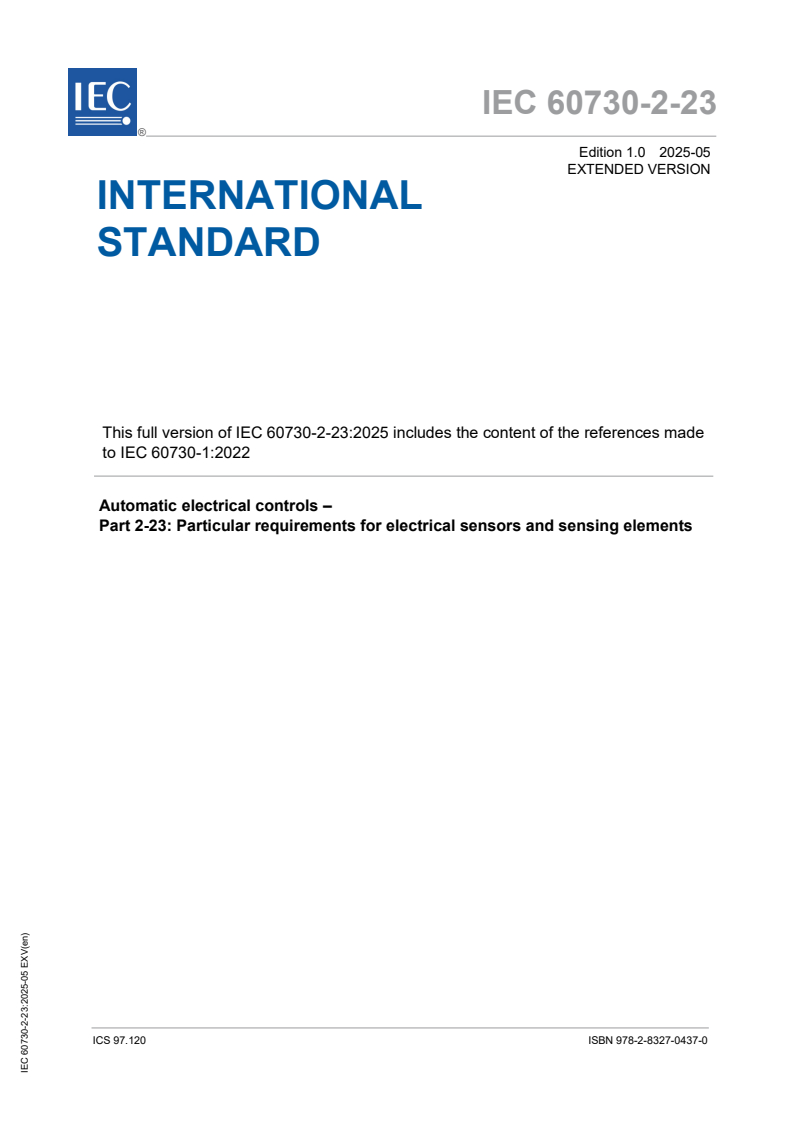
IEC 60730-2-23 ®
Edition 1.0 2025-05
EXTENDED VERSION
INTERNATIONAL
STANDARD
This full version of IEC 60730-2-23:2025 includes the content of the references made
to IEC 60730-1:2022
Automatic electrical controls –
Part 2-23: Particular requirements for electrical sensors and sensing elements
ICS 97.120 ISBN 978-2-8327-0437-0
All rights reserved. Unless otherwise specified, no part of this publication may be reproduced or utilized in any form or
by any means, electronic or mechanical, including photocopying and microfilm, without permission in writing from either
IEC or IEC's member National Committee in the country of the requester. If you have any questions about IEC copyright
or have an enquiry about obtaining additional rights to this publication, please contact the address below or your local
IEC member National Committee for further information.
IEC Secretariat Tel.: +41 22 919 02 11
3, rue de Varembé info@iec.ch
CH-1211 Geneva 20 www.iec.ch
Switzerland
About the IEC
The International Electrotechnical Commission (IEC) is the leading global organization that prepares and publishes
International Standards for all electrical, electronic and related technologies.
About IEC publications
The technical content of IEC publications is kept under constant review by the IEC. Please make sure that you have the
latest edition, a corrigendum or an amendment might have been published.
IEC publications search - IEC Products & Services Portal - products.iec.ch
webstore.iec.ch/advsearchform Discover our powerful search engine and read freely all the
The advanced search enables to find IEC publications by a publications previews, graphical symbols and the glossary.
variety of criteria (reference number, text, technical With a subscription you will always have access to up to date
committee, …). It also gives information on projects, content tailored to your needs.
replaced and withdrawn publications.
Electropedia - www.electropedia.org
The world's leading online dictionary on electrotechnology,
IEC Just Published - webstore.iec.ch/justpublished
Stay up to date on all new IEC publications. Just Published containing more than 22 500 terminological entries in English
details all new publications released. Available online and and French, with equivalent terms in 25 additional languages.
once a month by email. Also known as the International Electrotechnical Vocabulary
(IEV) online.
IEC Customer Service Centre - webstore.iec.ch/csc
If you wish to give us your feedback on this publication or
need further assistance, please contact the Customer
Service Centre: sales@iec.ch.
– 2 – IEC 60730-2-23:2025 EXV © IEC 2025
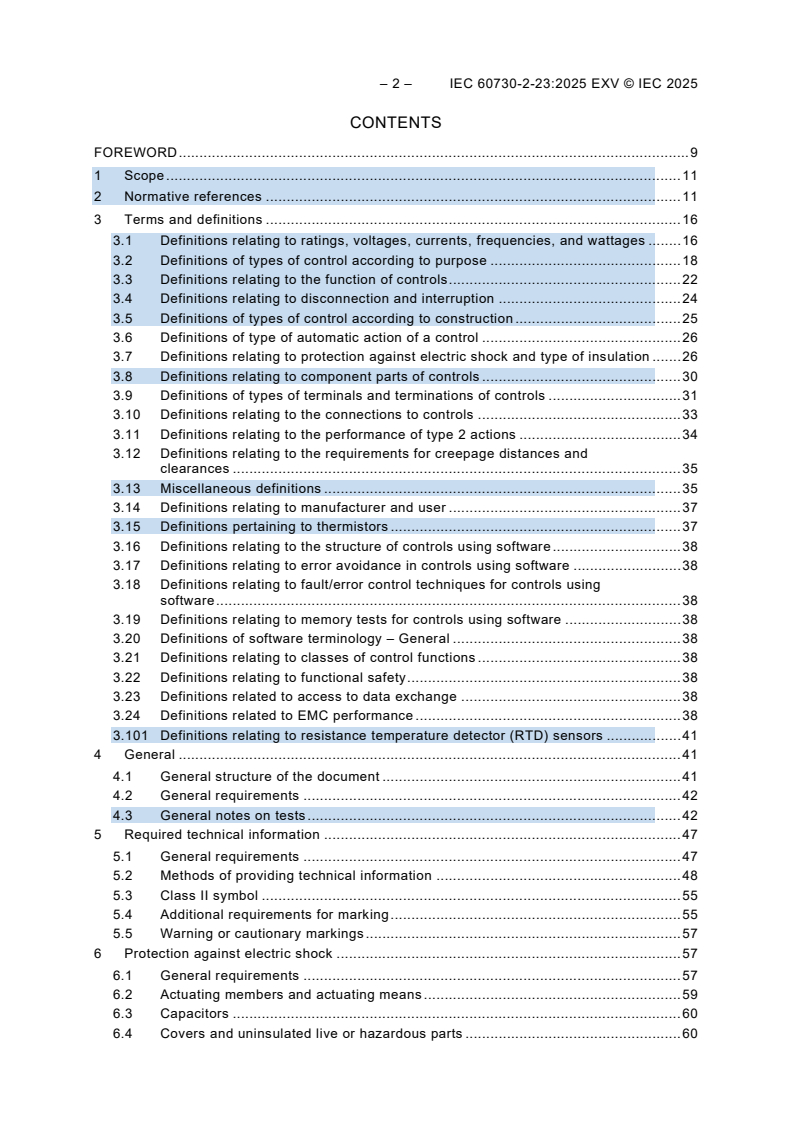
CONTENTS
FOREWORD . 9
1 Scope . 11
2 Normative references . 11
3 Terms and definitions . 16
3.1 Definitions relating to ratings, voltages, currents, frequencies, and wattages . 16
3.2 Definitions of types of control according to purpose . 18
3.3 Definitions relating to the function of controls . 22
3.4 Definitions relating to disconnection and interruption . 24
3.5 Definitions of types of control according to construction . 25
3.6 Definitions of type of automatic action of a control . 26
3.7 Definitions relating to protection against electric shock and type of insulation . 26
3.8 Definitions relating to component parts of controls . 30
3.9 Definitions of types of terminals and terminations of controls . 31
3.10 Definitions relating to the connections to controls . 33
3.11 Definitions relating to the performance of type 2 actions . 34
3.12 Definitions relating to the requirements for creepage distances and
clearances . 35
3.13 Miscellaneous definitions . 35
3.14 Definitions relating to manufacturer and user . 37
3.15 Definitions pertaining to thermistors . 37
3.16 Definitions relating to the structure of controls using software . 38
3.17 Definitions relating to error avoidance in controls using software . 38
3.18 Definitions relating to fault/error control techniques for controls using
software . 38
3.19 Definitions relating to memory tests for controls using software . 38
3.20 Definitions of software terminology – General . 38
3.21 Definitions relating to classes of control functions . 38
3.22 Definitions relating to functional safety . 38
3.23 Definitions related to access to data exchange . 38
3.24 Definitions related to EMC performance . 38
3.101 Definitions relating to resistance temperature detector (RTD) sensors . 41
4 General . 41
4.1 General structure of the document . 41
4.2 General requirements . 42
4.3 General notes on tests . 42
5 Required technical information . 47
5.1 General requirements . 47
5.2 Methods of providing technical information . 48
5.3 Class II symbol . 55
5.4 Additional requirements for marking . 55
5.5 Warning or cautionary markings . 57
6 Protection against electric shock . 57
6.1 General requirements . 57
6.2 Actuating members and actuating means . 59
6.3 Capacitors . 60
6.4 Covers and uninsulated live or hazardous parts . 60
6.5 Battery operated controls provided with a user accessible mains supply input
connector . 60
7 Provision for protective earthing . 61
7.1 Class 0I and Class I controls . 61
7.2 Class II and class III controls . 61
7.3 Adequacy of earth connections . 61
7.4 Corrosion resistance . 62
7.5 Other requirements . 63
7.6 Protective equipotential bonding . 63
8 Terminals and terminations . 63
8.1 Terminals and terminations for external copper conductors . 63
8.2 Terminals and terminations for internal conductors . 68
8.3 Terminals and terminations for integrated conductors . 70
9 Constructional requirements . 70
9.1 Materials . 70
9.2 Protection against electric shock . 70
9.3 Actuation and operation . 72
9.4 Actions . 73
9.5 Openings in enclosures . 75
9.6 Mounting of controls . 75
9.7 Attachment of cords . 76
9.8 Size of cords – non-detachable . 77
9.9 Inlet openings . 78
9.10 Equipment inlets and socket-outlets . 78
9.11 Requirements during mounting, use, maintenance and servicing. 78
9.12 Controls using software . 81
9.13 Protective controls and components of protective control systems . 83
10 Threaded parts and connections . 85
10.1 Threaded parts moved during mounting or servicing . 85
10.2 Current-carrying connections and connections providing protective earthing
continuity . 87
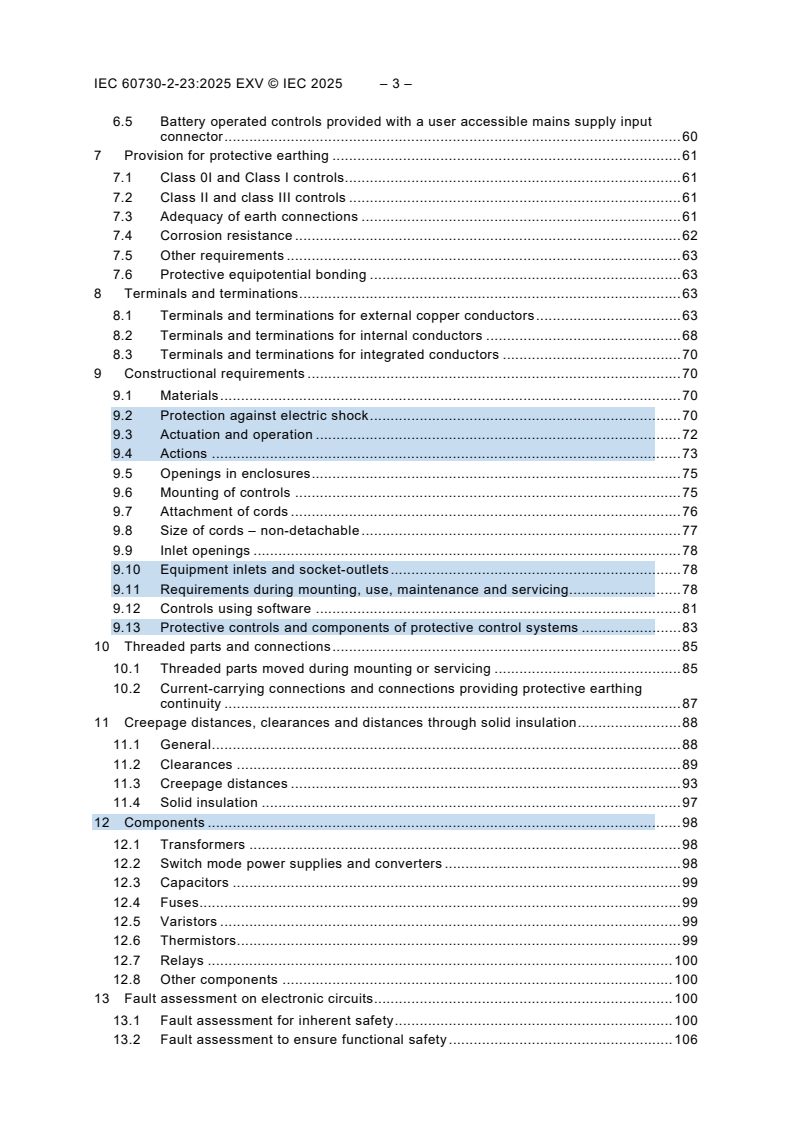
11 Creepage distances, clearances and distances through solid insulation . 88
11.1 General . 88
11.2 Clearances . 89
11.3 Creepage distances . 93
11.4 Solid insulation . 97
12 Components . 98
12.1 Transformers . 98
12.2 Switch mode power supplies and converters . 98
12.3 Capacitors . 99
12.4 Fuses. 99
12.5 Varistors . 99
12.6 Thermistors . 99
12.7 Relays . 100
12.8 Other components . 100
13 Fault assessment on electronic circuits. 100
13.1 Fault assessment for inherent safety . 100
13.2 Fault assessment to ensure functional safety . 106
– 4 – IEC 60730-2-23:2025 EXV © IEC 2025
14 Moisture and dust resistance . 106
14.1 Protection against ingress of water and dust . 106
14.2 Protection against humid conditions . 107
14.3 Touch current test for in-line cord controls and free-standing controls . 108
15 Electric strength and insulation resistance . 109
15.1 Insulation resistance . 109
15.2 Electric strength . 109
15.3 Additional tests for in-line cord and free-standing controls . 111
16 Heating . 112
17 Manufacturing deviation and drift . 116
18 Environmental stress . 116
19 Endurance . 116
19.101 Conditioning tests for sensors . 116
20 Mechanical strength . 120
20.1 General requirements . 120
20.2 Impact resistance . 120
20.3 Free-standing controls . 121
20.4 In-line cord controls . 121
20.5 Pull-cord actuated controls . 122
20.6 Foot actuated controls . 122
20.7 Actuating member and actuating means . 122
20.8 Flexing – test . 122
20.9 Cord anchorages – test . 123
20.101 Drop test . 124
21 Resistance to heat, fire and tracking . 124
21.1 General requirements . 124
21.2 Integrated, incorporated and in-line cord controls . 124
21.3 Independently mounted, free-standing controls . 125
22 Resistance to corrosion . 126
22.1 Resistance to rusting . 126
23 Electromagnetic compatibility (EMC) requirements – Emission . 126
23.1 General requirement . 126
23.2 High frequency emission . 126
23.3 Low frequency emission . 130
24 Normal operation . 130
25 Electromagnetic compatibility (EMC) requirements – Immunity . 130
25.1 General . 130
25.2 EMC test plan and report . 131
25.3 Immunity requirements . 132
25.4 Performance criteria . 135
25.5 Surge immunity test . 136
25.6 Electrical fast transient immunity test . 136
25.7 Radio-frequency electromagnetic field immunity. 137
25.8 Electrostatic discharge . 137
25.9 Immunity to power-frequency magnetic fields . 137
25.10 Test of the influence of voltage dips and voltage interruption in the power
supply network . 137
26 Abnormal operation tests . 137
Annex A (normative) Indelibility of markings. 156
Annex B (normative) Measurement of creepage distances and clearances in air . 158
Annex C (informative) Nominal voltages of supply systems for different modes of
overvoltage control . 162
Annex D (normative) Overvoltage categories . 164
Annex E (informative) Typical usage of controls and related overvoltage categories . 165
Annex F (normative) Pollution degrees . 166
Annex G (normative) Resistance to heat, fire and tracking tests . 167
Annex H (normative) Requirements related to functional safety . 169
Annex I (normative) Requirements for certain types of DC supplied controls . 223
Annex J (normative) Requirements for thermistor elements and controls using
thermistors . 225
Annex K (normative) Circuit for measuring touch current . 242
Annex L (normative) Printed circuit board coating performance test . 243
Annex M (normative) Printed circuit board protection . 245
Annex N (informative) Explanatory notes for surge immunity test . 248
Annex O (informative) Guidance for applying Clause 11 . 252
Annex P (normative) Requirements for SELV and PELV . 255
Annex Q (informative) Regional differences relevant for the member countries of
Cenelec . 258
Annex R (informative) National differences relevant in the United States of America . 262
Annex S (informative) National differences relevant in Japan . 263
Annex T (informative) National differences relevant in Canada . 264
Bibliography . 265
Figure 101 – Schematic diagram of a typical sensor . 21
Figure 1 – Example of ports . 39
Figure 2 – Structure of the document with respect to inherent safety and functional
safety. 42
Figure 3 – Example of an electronic circuit with low power points . 101
Figure 4 – Test pin probe 13 of IEC 61032:1997 . 138
Figure 5 – Test finger probe B of IEC 61032:1997 . 139
Figure 6 – Test fingernail . 140
Figure 7 – Impact test for free-standing controls . 141
Figure 8 – Tumbling barrel . 141
Figure 9 – Apparatus for testing durability of markings on rating labels . 142
Figure 10 – Apparatus for flexing test . 143
Figure 11 – Screw terminals and stud terminals . 144
Figure 12 – Pillar terminals . 145
Figure 13 – Mantle terminals . 146
Figure 14 – Saddle and lug terminals . 147
Figure 15 – Tabs . 148
Figure 16 – Tabs for non-reversible connectors . 149
Figure 17 – Receptacles . 150
– 6 – IEC 60730-2-23:2025 EXV © IEC 2025
Figure 18 – Measurement of creepage distance and clearance . 151
Figure 19 – Diagram for touch current measurement at operating temperature for
single-phase connection of class II controls . 152
Figure 20 – Diagram for touch current measurement at operating temperature for
single-phase connection of controls other than class II . 152
Figure 21 – Diagram for touch current measurement at operating temperature for
three-phase connection of class II controls . 153
Figure 22 – Diagram for touch current measurement at operating temperature for
three-phase connection of controls other than class II. 154
Figure 23 – Diagram for touch current measurement at operating temperature for
single-phase connection of controls to three-wire, ground neutral supply other than
class II . 154
Figure 24 – Diagram for touch current measurement at operating temperature for
two‑phase connection of controls to three-wire, ground neutral supply other
than class II . 155
Figure B.1 – Narrow groove . 159
Figure B.2 – Wide groove . 159
Figure B.3 – V-shaped groove . 159
Figure B.4 – Rib . 159
Figure B.5 – Uncemented joint with narrow groove . 160
Figure B.6 – Uncemented joint with wide groove . 160
Figure B.7 – Uncemented joint with narrow and wide grooves . 160
Figure B.8 – Diverging side walls . 161
Figure B.9 – Narrow recess . 161
Figure B.10 – Wide recess . 161
Figure B.11 – Conductive floating part . 161
Figure H.1 – V-Model for the software life cycle . 189
Figure H.101 – Typical flammable vapor sensor test chamber (side view external wall) . 208
Figure H.102 – Typical flammable vapor sensor test chamber (side view internal
cutout) . 208
Figure H.103 – Typical flammable vapor sensor test chamber (top view) . 209
Figure H.2 – Voltage variation test . 214
Figure J.1 – Generic test circuit for inrush-current limiting thermistor endurance test . 241
Figure K.1 – Circuit for measuring touch currents . 242
Figure L.1 – Test sample . 244
Figure M.1 – Example of type 1 protection . 246
Figure M.2 – Example of type 2 protection . 247
Figure N.1 – Example of surge protection by shielding in buildings with common earth
reference systems . 250
Figure N.2 – Example of secondary surge protection in buildings with separate
common earth reference systems . 251
Figure N.3 – Example of primary and secondary surge protection of indoor/outdoor
equipment . 251
Figure O.1 – Guidance flowchart for application of requirements of Clause 11 . 253
Table 101 – Samples and test sequence for sensors . 44
Table 102 – Electrical and thermal ratings of a sensor . 46
Table 1 – Required technical information and methods of providing these information . 50
Table 2 – Cross-sectional area of conductors . 64
Table 3 – Terminal conductors . 66
Table 4 – Conductor pull test values . 66
Table 5 – Nominal cross-sectional areas of conductors . 68
Table 6 – Axial force values for tab insertion and withdrawal . 69
Table 7 – Minimum cord conductor sizes . 77
Table 8 – Data exchange . 82
Table 9 – Threaded parts torque test values . 87
Table 10 – Rated impulse voltage for equipment energized directly from the supply
mains (from IEC 60664-1:2007, Table F.1) . 90
Table 11 – Clearances for insulation co-ordination (from IEC 60664-1:2007, Table F.2) . 91
Table 12 – Minimum creepage distances for basic insulation . 95
Table 13 – Minimum creepage distances for functional insulation . 96
Table 14 – Electrical/electronic component fault modes . 102
Table 15 – Minimum insulation resistance . 109
Table 16 – Insulation or disconnection test voltages . 110
Table 17 – Maximum heating temperatures . 114
Table 103 – Number of cycles for endurance test . 118
Table 22 – Pull and torque values . 123
Table 23 – Emission limit for residential electromagnetic environment . 128
Table 24 – Emission limit for industrial electromagnetic environment . 129
Table 25 – The applicable EMC test in relation to the class of control function and type
of Action . 130
Table 26 – Immunity test requirements for residential electromagnetic environments . 133
Table 27 – Immunity test requirements for industrial electromagnetic environment . 134
Table 28 – Performance criteria . 136
Table B.1 – Value of X . 158
Table C.1 – Inherent control or equivalent protective control . 162
Table C.2 – Cases where protective control is necessary and control is provided by
surge arresters having a ratio of clamping voltage to rated voltage not smaller than
that specified by IEC 60099-1 . 163
Table E.1 – Typical usage . 165
Table H.1 – Additional items to Table 1 . 180
a
Table H.2 – Acceptable measures to address fault/errors . 183
Table H.3 – Examples of techniques/measures for semi-formal methods . 190
Table H.4 – Examples of techniques/measures for software architecture specification . 190
Table H.5 – Examples of techniques/measures for module design specification . 191
Table H.6 – Examples of techniques/measures for design and coding standards . 191
Table H.7 – Examples of techniques/measures for software module testing . 192
Table H.8 – Examples of techniques/measures for software integration testing . 193
Table H.9 – Examples of techniques/measures for software safety validation . 193
Table H.10 – Combinations of analytical measures during hardware development . 195
– 8 – IEC 60730-2-23:2025 EXV © IEC 2025
Table H.11 – Examples of defences against unauthorised access and transmission
failure modes . 196
Table H.101 – Calibration tests and compliance criteria for sensors . 204
Table H.102 – Calibration classes for sensors . 205
Table H.103 – Temperature/relative humidity conditions . 209
Table H.104 – Specifications for vapour measurement test equipment . 209
Table H.105 – Specifications for vapour measurement test chamber . 210
Table H.12 – Applicable test levels in addition to Clause 25 . 211
Table H.13 – Voltage dips, short interruptions and voltage variations . 213
Table H.14 – Test values for voltage variations . 214
Table H.15 – Test voltages for test level 2 (depending on the installation class
conditions) . 216
Table H.16 – Test level for electrical fast transient burst test . 217
Table H.17 – Test levels for conducted disturbances on mains and I/O lines . 218
Table H.18 – Test level for immunity to radiated electromagnetic fields . 219
Table H.19 – Increased test level for radiated immunity . 220
Table H.20 – Test level for supply frequency variations . 221
Table H.21 – Test level for continuous fields . 221
Table I.1 – Electrical transient conduction immunity in accordance with ISO 7637-2 . 223
Table I.2 – Electrical transient conduction immunity in accordance with ISO 7637-3 . 224
Table J.1 – Maximum current . 227
Table J.2 – Normal operating conditions . 228
Table J.3 – Samples for the test (clause reference) . 229
Table J.4 – Electrical and thermal ratings of a thermistor . 230
Table J.5 – Additional items to Table 1 . 231
Table J.6 – Sequence of calibration and conditioning tests for PTC thermistors . 233
Table J.7 – Classes for PTC sensing thermistors . 234
Table J.8 – Sequence of calibration and conditioning tests for NTC thermistors . 235
Table J.9 – Classes for NTC sensing thermistors . 235
Table J.10 – Number of cycles for endurance test . 239
Table J.11 – Ageing test temperature . 239
Table J.12 – Number of cycles for endurance test . 240
Table L.1 – Environmental cycling conditions . 243
Table M.1 – IEC 60664-3 test levels or conditions. 245
Table O.1 – Example A – Using Annex O guidance for applying Clause 11 . 254
Table O.2 – Example B – Using Annex O guidance for applying Clause 11 . 254
Table Q.1 – Additional aging parameters for windings . 259
INTERNATIONAL ELECTROTECHNICAL COMMISSION
____________
AUTOMATIC ELECTRICAL CONTROLS –
Part 2-23: Particular requirements for electrical sensors and
sensing elements
FOREWORD
1) The International Electrotechnical Commission (IEC) is a worldwide organization for standardization comprising
all national electrotechnical committees (IEC National Committees). The object of IEC is to promote international
co-operation on all questions concerning standardization in the electrical and electronic fields. To this end and
in addition to other activities, IEC publishes International Standards, Technical Specifications, Technical Reports,
Publicly Available Specifications (PAS) and Guides (hereafter referred to as “IEC Publication(s)”). Their
preparation is entrusted to technical committees; any IEC National Committee interested in the subject dealt with
may participate in this preparatory work. International, governmental and non-governmental organizations liaising
with the IEC also participate in this preparation. IEC collaborates closely with the International Organization for
Standardization (ISO) in accordance with conditions determined by agreement between the two organizations.
2) The formal decisions or agreements of IEC on technical matters express, as nearly as possible, an international
consensus of opinion on the relevant subjects since each technical committee has representation from all
interested IEC National Committees.
3) IEC Publications have the form of recommendations for international use and are accepted by IEC National
Committees in that sense. While all reasonable efforts are made to ensure that the technical content of IEC
Publications is accurate, IEC cannot be held responsible for the way in which they are used or for any
misinterpretation by any end user.
4) In order to promote international uniformity, IEC National Committees undertake to apply IEC Publications
transparently to the maximum extent possible in their national and regional publications. Any divergence between
any IEC Publication and the corresponding national or regional publication shall be clearly indicated in the latter.
5) IEC itself does not provide any attestation of conformity. Independent certification bodies provide conformity
assessment services and, in some areas, access to IEC marks of conformity. IEC is not responsible for any
services carried out by independent certification bodies.
6) All users should ensure that they have the latest edition of this publication.
7) No liability shall attach to IEC or its directors, employees, servants or agents including individual experts and
members of its technical committees and IEC National Committees for any personal injury, property damage or
other damage of any nature whatsoever, whether direct or indirect, or for costs (including legal fees) and
expenses arising out of the publication, use of, or reliance upon, this IEC Publication or any other IEC
Publications.
8) Attention is drawn to the Normative references cited in this publication. Use of the referenced publications is
indispensable for the correct application of this publication.
9) IEC draws attention to the possibility that the implementation of this document may involve the use of (a)
patent(s). IEC takes no position concerning the evidence, validity or applicability of any claimed patent rights in
respect thereof. As of the date of publication of this document, IEC had not received notice of (a) patent(s), which
may be required to implement this document. However, implementers are cautioned that this may not represent
the latest information, which may be obtained from the patent database available at https://patents.iec.ch. IEC
shall not be held responsible for identifying any or all such patent rights.
This extended version (EXV) of the official IEC Standard provides the user with the full
content of the Standard.
made to IEC 60730-1:2022.
The specific content of IEC 60730-2-23:2025 is displayed on a blue background.
– 10 – IEC 60730-2-23:2025 EXV © IEC 2025
IEC 60730-2-23 has been prepared by IEC technical Committee 72: Automatic electrical
controls. It is an International Standard.
The text of this International Standard is based on the following documents:
Draft Report on voting
72/1477/FDIS 72/1481/RVD
Full information on the voting for its approval can be found in the report on voting indicated in
the above table.
The language used for the development of this International Standard is English.
This document was drafted in accordance with ISO/IEC Directives, Part 2, and developed in
accordance with ISO/IEC Directives, Part 1 and ISO/IEC Directives, IEC Supplement, available
at www.iec.ch/members_experts/refdocs. The main document types developed by IEC are
described in greater detail at www.iec.ch/publications.
A list of all parts of the IEC 60730 series, under the general title: Automatic electrical controls,
can be found on the IEC website.
This part 2-23 is intended to be used in conjunction with IEC 60730-1. It was established on the
basis of the publication of the sixth edition of IEC 60730-1:2022.
This part 2-23 supplements or modifies the corresponding clauses in 60730-1:2022, so as t
...
Questions, Comments and Discussion
Ask us and Technical Secretary will try to provide an answer. You can facilitate discussion about the standard in here.
Loading comments...