

IEC 60227-1:2024
(Main)Polyvinyl chloride insulated cables of rated voltages up to and including 450/750 V - Part 1: General requirements
General Information
- Abstract
IEC 60227-1:2024 applies to rigid and flexible cables with insulation, and sheath if any, based on polyvinyl chloride, of rated voltages Uo/U up to and including 450/750 V used in power installations of nominal voltage not exceeding 450/750 V AC.
NOTE For some types of flexible cables the term "cord" is used.
The particular types of cables are specified in IEC 60227-3, IEC 60227-4, IEC 60227-5, IEC 60227-6 and IEC 60227-7. The code designations of these types of cables are provided in this document. The test methods specified in this document, IEC 60227-3, IEC 60227-4, IEC 60227-5, IEC 60227-6 and IEC 60227-7 are given in IEC 63294, IEC 60332-1-2 and in the relevant parts of the IEC 60811 series.
- Status
- Published
- Publication Date
- 21-Feb-2024
- Technical Committee
- TC 20 - Electric cables
- Drafting Committee
- WG 17 - TC 20/WG 17
- Current Stage
- PPUB - Publication issued
- Start Date
- 22-Feb-2024
- Completion Date
- 15-Mar-2024
Buy Documents
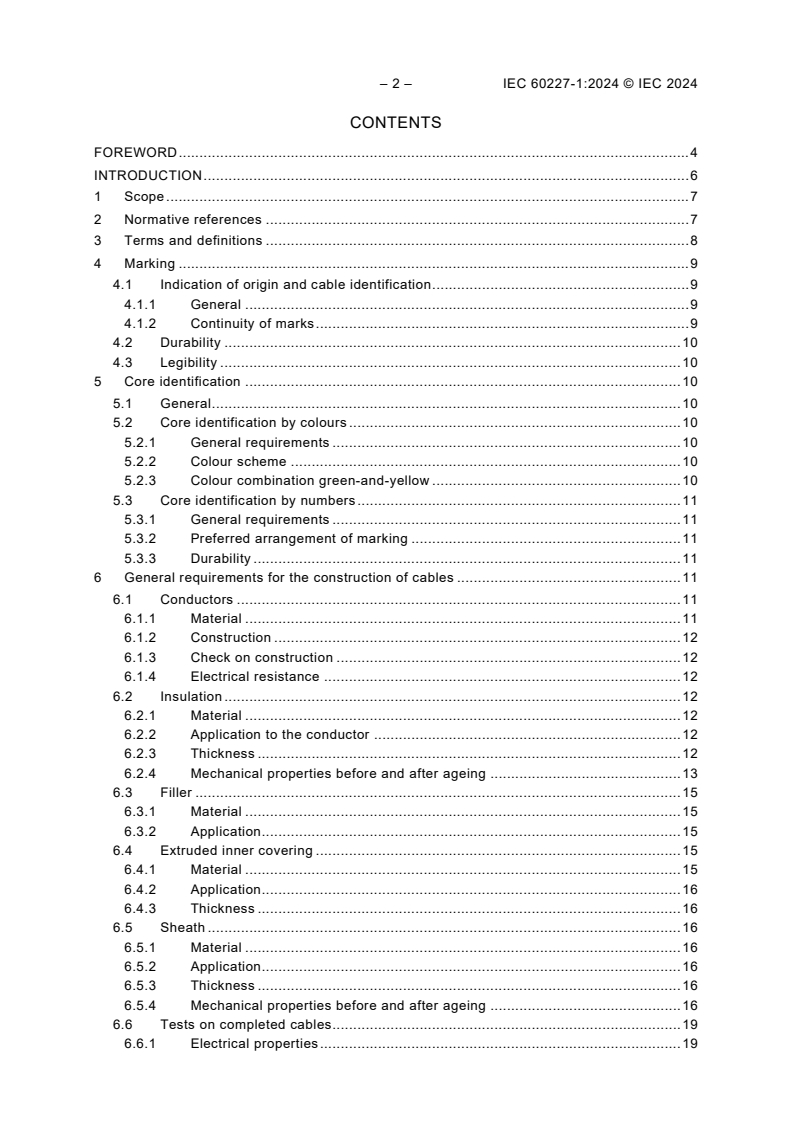
IEC 60227-1:2024 - Polyvinyl chloride insulated cables of rated voltages up to and including 450/750 V - Part 1: General requirements Released:2/22/2024
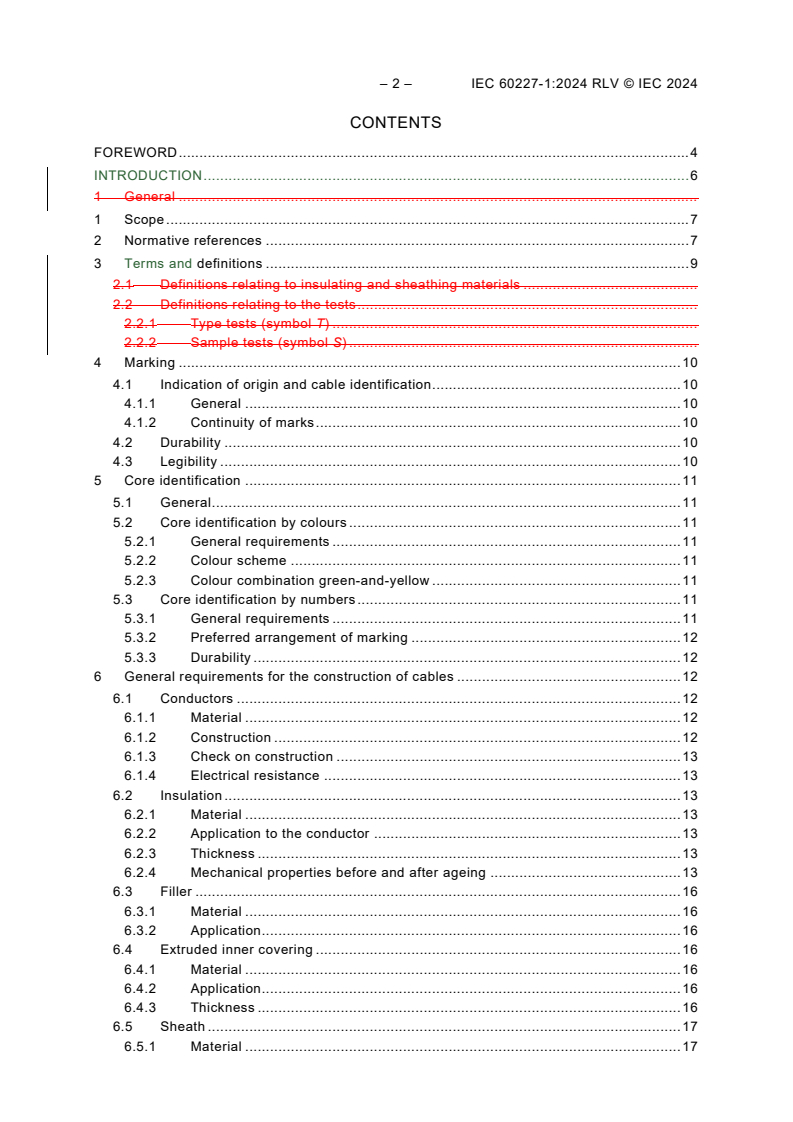
IEC 60227-1:2024 RLV - Polyvinyl chloride insulated cables of rated voltages up to and including 450/750 V - Part 1: General requirements Released:2/22/2024
Overview - IEC 60227-1:2024 (PVC insulated cables, 450/750 V)
IEC 60227-1:2024 is the International Electrotechnical Commission (IEC) general requirements standard for polyvinyl chloride (PVC) insulated cables rated up to and including 450/750 V. It applies to both rigid and flexible PVC‑insulated cables (and sheaths where present) used in power installations with nominal voltages not exceeding 450/750 V AC. For some flexible types the term “cord” is used. IEC 60227-1 is the framework document for the IEC 60227 series and references specific type standards (Parts 3–7) and up‑to‑date test methods (e.g., IEC 63294, IEC 60332‑1‑2 and relevant IEC 60811 parts).
Key topics and technical requirements
The standard defines core technical and conformity requirements, including:
- Scope and normative references - links to IEC 60227 Parts 3–7, IEC 60228, IEC 63294, IEC 60332‑1‑2 and IEC 60811 test methods.
- Marking and identification - requirements for cable identification, continuity, durability and legibility of marks.
- Core identification - colour codes and numeric marking arrangements (including green-and-yellow earth convention).
- Conductor requirements - conductor material and construction, checks on construction and electrical resistance in accordance with IEC 60228.
- Insulation and sheath - PVC material requirements, application to conductors, thickness rules, mechanical properties before and after ageing.
- Accessory components - requirements for fillers, extruded inner coverings and sheaths where applicable.
- Tests on completed cables - electrical tests, overall dimensions, mechanical strength for flexible cables and flame retardance. Tables in the standard set pass/fail criteria and test conditions.
- Code designations - standardized type codes for the various cable families covered by the IEC 60227 series.
Applications - who uses IEC 60227-1 and why
IEC 60227-1 is used by:
- Cable manufacturers for product design, type designation and production quality control.
- Testing laboratories and certification bodies to verify compliance with electrical, mechanical and ageing tests.
- Specifiers and procurement teams (engineers, consultants, utilities) to write clear technical specifications for fixed wiring, cords, lift cables and flexible connections.
- Electrical contractors and installers to ensure correct cable selection (insulation/sheath type, core identification, flame retardance) for installations up to 450/750 V.
- Regulators and standards writers for harmonizing national or industry regulations with international best practice.
Related standards (IEC 60227 series and test methods)
- IEC 60227-3, -4, -5, -6, -7 (specific cable types)
- IEC 60228 (conductors)
- IEC 63294 (replaces IEC 60227-2 for test methods)
- IEC 60332‑1‑2 (vertical flame test)
- Relevant parts of IEC 60811 (non‑metallic materials test methods)
IEC 60227-1:2024 is essential for consistent, safe and testable specification of PVC‑insulated cables used in low‑voltage power installations.
Relations
- Effective Date
- 05-Sep-2023
Buy Documents
IEC 60227-1:2024 - Polyvinyl chloride insulated cables of rated voltages up to and including 450/750 V - Part 1: General requirements Released:2/22/2024
IEC 60227-1:2024 RLV - Polyvinyl chloride insulated cables of rated voltages up to and including 450/750 V - Part 1: General requirements Released:2/22/2024
Get Certified
Connect with accredited certification bodies for this standard

IMQ S.p.A. (Certification)
Italian electrical product certification.

SLG Prüf- und Zertifizierungs GmbH
German testing and certification body.

UL Solutions
Global safety science company with testing, inspection and certification.
Sponsored listings
Frequently Asked Questions
IEC 60227-1:2024 is a standard published by the International Electrotechnical Commission (IEC). Its full title is "Polyvinyl chloride insulated cables of rated voltages up to and including 450/750 V - Part 1: General requirements". This standard covers: IEC 60227-1:2024 applies to rigid and flexible cables with insulation, and sheath if any, based on polyvinyl chloride, of rated voltages Uo/U up to and including 450/750 V used in power installations of nominal voltage not exceeding 450/750 V AC. NOTE For some types of flexible cables the term "cord" is used. The particular types of cables are specified in IEC 60227-3, IEC 60227-4, IEC 60227-5, IEC 60227-6 and IEC 60227-7. The code designations of these types of cables are provided in this document. The test methods specified in this document, IEC 60227-3, IEC 60227-4, IEC 60227-5, IEC 60227-6 and IEC 60227-7 are given in IEC 63294, IEC 60332-1-2 and in the relevant parts of the IEC 60811 series.
IEC 60227-1:2024 applies to rigid and flexible cables with insulation, and sheath if any, based on polyvinyl chloride, of rated voltages Uo/U up to and including 450/750 V used in power installations of nominal voltage not exceeding 450/750 V AC. NOTE For some types of flexible cables the term "cord" is used. The particular types of cables are specified in IEC 60227-3, IEC 60227-4, IEC 60227-5, IEC 60227-6 and IEC 60227-7. The code designations of these types of cables are provided in this document. The test methods specified in this document, IEC 60227-3, IEC 60227-4, IEC 60227-5, IEC 60227-6 and IEC 60227-7 are given in IEC 63294, IEC 60332-1-2 and in the relevant parts of the IEC 60811 series.
IEC 60227-1:2024 is classified under the following ICS (International Classification for Standards) categories: 29.060.20 - Cables. The ICS classification helps identify the subject area and facilitates finding related standards.
IEC 60227-1:2024 has the following relationships with other standards: It is inter standard links to IEC 60227-1:2007. Understanding these relationships helps ensure you are using the most current and applicable version of the standard.
IEC 60227-1:2024 is available in PDF format for immediate download after purchase. The document can be added to your cart and obtained through the secure checkout process. Digital delivery ensures instant access to the complete standard document.
Standards Content (Sample)
IEC 60227-1 ®
Edition 4.0 2024-02
INTERNATIONAL
STANDARD
Polyvinyl chloride insulated cables of rated voltages up to and including
450/750 V –
Part 1: General requirements
All rights reserved. Unless otherwise specified, no part of this publication may be reproduced or utilized in any form
or by any means, electronic or mechanical, including photocopying and microfilm, without permission in writing from
either IEC or IEC's member National Committee in the country of the requester. If you have any questions about IEC
copyright or have an enquiry about obtaining additional rights to this publication, please contact the address below or
your local IEC member National Committee for further information.
IEC Secretariat Tel.: +41 22 919 02 11
3, rue de Varembé info@iec.ch
CH-1211 Geneva 20 www.iec.ch
Switzerland
About the IEC
The International Electrotechnical Commission (IEC) is the leading global organization that prepares and publishes
International Standards for all electrical, electronic and related technologies.
About IEC publications
The technical content of IEC publications is kept under constant review by the IEC. Please make sure that you have the
latest edition, a corrigendum or an amendment might have been published.
IEC publications search - webstore.iec.ch/advsearchform IEC Products & Services Portal - products.iec.ch
The advanced search enables to find IEC publications by a Discover our powerful search engine and read freely all the
variety of criteria (reference number, text, technical publications previews, graphical symbols and the glossary.
committee, …). It also gives information on projects, replaced With a subscription you will always have access to up to date
and withdrawn publications. content tailored to your needs.
IEC Just Published - webstore.iec.ch/justpublished
Electropedia - www.electropedia.org
Stay up to date on all new IEC publications. Just Published
The world's leading online dictionary on electrotechnology,
details all new publications released. Available online and once
containing more than 22 500 terminological entries in English
a month by email.
and French, with equivalent terms in 25 additional languages.
Also known as the International Electrotechnical Vocabulary
IEC Customer Service Centre - webstore.iec.ch/csc
(IEV) online.
If you wish to give us your feedback on this publication or need
further assistance, please contact the Customer Service
Centre: sales@iec.ch.
IEC 60227-1 ®
Edition 4.0 2024-02
INTERNATIONAL
STANDARD
Polyvinyl chloride insulated cables of rated voltages up to and including
450/750 V –
Part 1: General requirements
INTERNATIONAL
ELECTROTECHNICAL
COMMISSION
ICS 29.060.20 ISBN 978-2-8322-8245-8
– 2 – IEC 60227-1:2024 © IEC 2024
CONTENTS
FOREWORD . 4
INTRODUCTION . 6
1 Scope . 7
2 Normative references . 7
3 Terms and definitions . 8
4 Marking . 9
4.1 Indication of origin and cable identification . 9
4.1.1 General . 9
4.1.2 Continuity of marks . 9
4.2 Durability . 10
4.3 Legibility . 10
5 Core identification . 10
5.1 General . 10
5.2 Core identification by colours . 10
5.2.1 General requirements . 10
5.2.2 Colour scheme . 10
5.2.3 Colour combination green-and-yellow . 10
5.3 Core identification by numbers . 11
5.3.1 General requirements . 11
5.3.2 Preferred arrangement of marking . 11
5.3.3 Durability . 11
6 General requirements for the construction of cables . 11
6.1 Conductors . 11
6.1.1 Material . 11
6.1.2 Construction . 12
6.1.3 Check on construction . 12
6.1.4 Electrical resistance . 12
6.2 Insulation . 12
6.2.1 Material . 12
6.2.2 Application to the conductor . 12
6.2.3 Thickness . 12
6.2.4 Mechanical properties before and after ageing . 13
6.3 Filler . 15
6.3.1 Material . 15
6.3.2 Application . 15
6.4 Extruded inner covering . 15
6.4.1 Material . 15
6.4.2 Application . 16
6.4.3 Thickness . 16
6.5 Sheath . 16
6.5.1 Material . 16
6.5.2 Application . 16
6.5.3 Thickness . 16
6.5.4 Mechanical properties before and after ageing . 16
6.6 Tests on completed cables . 19
6.6.1 Electrical properties . 19
6.6.2 Overall dimensions . 20
6.6.3 Mechanical strength of flexible cables . 20
6.6.4 Flame retardance . 21
7 Guidance on the use of cables. 21
Annex A (normative) Code designations . 22
Bibliography . 23
Figure 1 – Arrangement of marking by numbers . 11
Table 1 – Requirements for the non-electrical tests for polyvinyl chloride (PVC)
insulation . 13
Table 2 – Requirements for the non-electrical test for polyvinyl chloride (PVC) sheaths . 17
Table 3 – Requirements for electrical tests for PVC insulated cables . 19
– 4 – IEC 60227-1:2024 © IEC 2024
INTERNATIONAL ELECTROTECHNICAL COMMISSION
____________
POLYVINYL CHLORIDE INSULATED CABLES OF
RATED VOLTAGES UP TO AND INCLUDING 450/750 V –
Part 1: General requirements
FOREWORD
1) The International Electrotechnical Commission (IEC) is a worldwide organization for standardization comprising
all national electrotechnical committees (IEC National Committees). The object of IEC is to promote international
co-operation on all questions concerning standardization in the electrical and electronic fields. To this end and
in addition to other activities, IEC publishes International Standards, Technical Specifications, Technical Reports,
Publicly Available Specifications (PAS) and Guides (hereafter referred to as “IEC Publication(s)”). Their
preparation is entrusted to technical committees; any IEC National Committee interested in the subject dealt with
may participate in this preparatory work. International, governmental and non-governmental organizations liaising
with the IEC also participate in this preparation. IEC collaborates closely with the International Organization for
Standardization (ISO) in accordance with conditions determined by agreement between the two organizations.
2) The formal decisions or agreements of IEC on technical matters express, as nearly as possible, an international
consensus of opinion on the relevant subjects since each technical committee has representation from all
interested IEC National Committees.
3) IEC Publications have the form of recommendations for international use and are accepted by IEC National
Committees in that sense. While all reasonable efforts are made to ensure that the technical content of IEC
Publications is accurate, IEC cannot be held responsible for the way in which they are used or for any
misinterpretation by any end user.
4) In order to promote international uniformity, IEC National Committees undertake to apply IEC Publications
transparently to the maximum extent possible in their national and regional publications. Any divergence between
any IEC Publication and the corresponding national or regional publication shall be clearly indicated in the latter.
5) IEC itself does not provide any attestation of conformity. Independent certification bodies provide conformity
assessment services and, in some areas, access to IEC marks of conformity. IEC is not responsible for any
services carried out by independent certification bodies.
6) All users should ensure that they have the latest edition of this publication.
7) No liability shall attach to IEC or its directors, employees, servants or agents including individual experts and
members of its technical committees and IEC National Committees for any personal injury, property damage or
other damage of any nature whatsoever, whether direct or indirect, or for costs (including legal fees) and
expenses arising out of the publication, use of, or reliance upon, this IEC Publication or any other IEC
Publications.
8) Attention is drawn to the Normative references cited in this publication. Use of the referenced publications is
indispensable for the correct application of this publication.
9) IEC draws attention to the possibility that the implementation of this document may involve the use of (a)
patent(s). IEC takes no position concerning the evidence, validity or applicability of any claimed patent rights in
respect thereof. As of the date of publication of this document, IEC had not received notice of (a) patent(s), which
may be required to implement this document. However, implementers are cautioned that this may not represent
the latest information, which may be obtained from the patent database available at https://patents.iec.ch. IEC
shall not be held responsible for identifying any or all such patent rights.
IEC 60227-1 has been prepared by IEC technical committee 20: Electric cables. It is an
International Standard.
This fourth edition cancels and replaces the third edition published in 2007. This edition
constitutes a technical revision.
This edition includes the following significant technical changes with respect to the previous
edition:
a) the reference to tests according to IEC 60227-2 has been withdrawn and replaced with a
reference to IEC 63294;
b) normative references have been updated.
The text of this International Standard is based on the following documents:
Draft Report on voting
20/2145/FDIS 20/2153/RVD
Full information on the voting for its approval can be found in the report on voting indicated in
the above table.
The language used for the development of this International Standard is English.
This document was drafted in accordance with ISO/IEC Directives, Part 2, and developed in
accordance with ISO/IEC Directives, Part 1 and ISO/IEC Directives, IEC Supplement, available
at www.iec.ch/members_experts/refdocs. The main document types developed by IEC are
described in greater detail at www.iec.ch/publications.
A list of all parts in the IEC 60227 series, published under the general title Polyvinyl chloride
insulated cables of rated voltages up to and including 450/750 V, can be found on the IEC
website.
The committee has decided that the contents of this document will remain unchanged until the
stability date indicated on the IEC website under webstore.iec.ch in the data related to the
specific document. At this date, the document will be
• reconfirmed,
• withdrawn, or
• revised.
– 6 – IEC 60227-1:2024 © IEC 2024
INTRODUCTION
The IEC 60227 series, published under the general title Polyvinyl chloride insulated cables of
rated voltages up to and including 450/750 V, consists of the following parts:
IEC 60227-1: General requirements;
IEC 60227-2: Test methods (withdrawn and replaced by IEC 63294);
IEC 60227-3: Non-sheathed cables for fixed wiring;
IEC 60227-4: Sheathed cables for fixed wiring;
IEC 60227-5: Flexible cables (cords);
IEC 60227-6: Lift cables and cables for flexible connections;
IEC 60227-7: Flexible cables screened and unscreened with two or more conductors and of
rated voltages up to and including 300/500 V.
This part of IEC 60227, when used in conjunction with each of the other parts of the IEC 60227
series, forms the complete standard for the type of cable specified in the specific part.
POLYVINYL CHLORIDE INSULATED CABLES OF
RATED VOLTAGES UP TO AND INCLUDING 450/750 V –
Part 1: General requirements
1 Scope
This part of IEC 60227 applies to rigid and flexible cables with insulation, and sheath if any,
based on polyvinyl chloride, of rated voltages U /U up to and including 450/750 V used in power
o
installations of nominal voltage not exceeding 450/750 V AC.
NOTE For some types of flexible cables the term "cord" is used.
The particular types of cables are specified in IEC 60227-3, IEC 60227-4, IEC 60227-5,
IEC 60227-6 and IEC 60227-7. The code designations of these types of cables are provided in
this document.
The test methods specified in this document, IEC 60227-3, IEC 60227-4, IEC 60227-5,
IEC 60227-6 and IEC 60227-7 are given in IEC 63294, IEC 60332-1-2 and in the relevant parts
of the IEC 60811 series.
2 Normative references
The following documents are referred to in the text in such a way that some or all of their content
constitutes requirements of this document. For dated references, only the edition cited applies.
For undated references, the latest edition of the referenced document (including any
amendments) applies.
IEC 60227-3, Polyvinyl chloride insulated cables of rated voltages up to and including
450/750 V – Part 3: Non-sheathed cables for fixed wiring
IEC 60227-4, Polyvinyl chloride insulated cables of rated voltages up to and including
450/750 V – Part 4: Sheathed cables for fixed wiring
IEC 60227-5, Polyvinyl chloride insulated cables of rated voltages up to and including
450/750 V – Part 5: Flexible cables (cords)
IEC 60227-6, Polyvinyl chloride insulated cables of rated voltages up to and including
450/750 V – Part 6: Lift cables and cables for flexible connections
IEC 60227-7, Polyvinyl chloride insulated cables of rated voltages up to and including
450/750 V – Part 7: Flexible cables screened and unscreened with two or more conductors and
of rated voltages up to and including 300/500 V
IEC 60228, Conductors of insulated cables
IEC 60332-1-2, Tests on electric and optical fibre cables under fire conditions – Part 1-2: Test
for vertical flame propagation for a single insulated wire or cable – Procedure for 1 kW
pre-mixed flame
IEC 60811-401:2012, Electric and optical fibre cables – Test methods for non-metallic materials
– Part 401: Miscellaneous tests – Thermal ageing methods – Ageing in an air oven
IEC 60811-401:2012/AMD1:2017
– 8 – IEC 60227-1:2024 © IEC 2024
IEC 60811-404, Electric and optical fibre cables – Test methods for non-metallic materials –
Part 404: Miscellaneous tests – Mineral oil immersion tests for sheaths
IEC 60811-405, Electric and optical fibre cables – Test methods for non-metallic materials –
Part 405: Miscellaneous tests – Thermal stability test for PVC insulations and PVC sheaths
IEC 60811-409, Electric and optical fibre cables – Test methods for non-metallic materials –
Part 409: Miscellaneous tests – Loss of mass test for thermoplastic insulations and sheaths
IEC 60811-501, Electric and optical fibre cables – Test methods for non-metallic materials –
Part 501: Mechanical tests – Tests for determining the mechanical properties of insulating and
sheathing compounds
IEC 60811-504, Electric and optical fibre cables – Test methods for non-metallic materials –
Part 504: Mechanical tests – Bending tests at low temperature for insulation and sheaths
IEC 60811-505, Electric and optical fibre cables – Test methods for non-metallic materials –
Part 505: Mechanical tests – Elongation at low temperature for insulations and sheaths
IEC 60811-506, Electric and optical fibre cables – Test methods for non-metallic materials –
Part 506: Mechanical tests – Impact test at low temperature for insulations and sheaths
IEC 60811-508, Electric and optical fibre cables – Test methods for non-metallic materials –
Part 508: Mechanical tests – Pressure test at high temperature for insulation and sheaths
IEC 60811-509, Electric and optical fibre cables – Test methods for non-metallic materials –
Part 509: Mechanical tests – Test for resistance of insulations and sheaths to cracking (heat
shock test)
IEC 62440, Electric cables with a rated voltage not exceeding 450/750 V – Guide to use
IEC 63294:2021, Test methods for electric cables with rated voltages up to and including
450/750 V
3 Terms and definitions
For the purposes of this document, the following terms and definitions apply.
ISO and IEC maintain terminology databases for use in standardization at the following
addresses:
• IEC Electropedia: available at https://www.electropedia.org/
• ISO Online browsing platform: available at https://www.iso.org/obp
3.1
polyvinyl chloride compound
PVC
combination of materials suitably selected, proportioned and treated, of which the characteristic
constituent is the plastomer polyvinyl chloride or one of its copolymers
Note 1 to entry: PVC also designates compounds containing both polyvinyl chloride and certain of its polymers.
3.2
type of compound
category in which a compound is placed according to its properties, as determined by specific
tests
Note 1 to entry: The type designation is not directly related to the composition of the compound.
3.3
rated voltage
reference voltage for which the cable is designed and which serves to define the electrical tests
Note 1 to entry: The rated voltage is expressed by the combination of two values U /U, expressed in volts:
o
U being the RMS value between any insulated conductor and "earth" (metal covering of the cable or the surrounding
o
medium);
U being the RMS value between any two-phase conductors of a multicore cable or of a system of single-core cables.
In an alternating current system, the rated voltage of a cable shall be at least equal to the nominal voltage of the
system for which it is intended.
This condition applies both to the value U and to the value U.
o
In a direct current system, the rated nominal voltage between conductor and "earth" shall be not higher than 1,5 times
the rated AC value of U .
o
Note 2 to entry: The operating voltage of a system can permanently exceed the nominal voltage of such a system
by 10 %. A cable can be used at a 10 % higher operating voltage than its rated voltage if the latter is at least equal
to the nominal voltage of the system.
3.4
code designation
code used to designate a specific type of cable
Note 1 to entry: The code designations for the cables specified in the IEC 60227 series are listed in Annex A.
4 Marking
4.1 Indication of origin and cable identification
4.1.1 General
Cables shall be provided with an indication of the manufacturer, which shall be either an
identification thread or a repetitive marking of the manufacturer's name or trademark.
Cables for use at a conductor temperature exceeding 70 °C shall also be marked either with
the code designation according to Annex A or with the maximum conductor temperature.
Marking may be by printing or by reproduction in relief on or in the insulation or sheath.
4.1.2 Continuity of marks
Each specified mark shall be regarded as continuous if the distance between the end of the
mark and the beginning of the next identical mark does not exceed
– 550 mm if the marking is on the outer sheath of the cable;
– 275 mm if the marking is
a) on the insulation of an unsheathed cable;
b) on the insulation of a sheathed cable;
c) on a tape within a sheathed cable.
– 10 – IEC 60227-1:2024 © IEC 2024
4.2 Durability
Printed markings shall be durable. Compliance with this requirement shall be checked by the
test given in IEC 63294:2021, 6.1.
4.3 Legibility
All markings shall be legible.
The colours of the identification threads shall be easy to recognize or easily made recognizable,
if necessary, by cleaning with petrol or other suitable solvent.
5 Core identification
5.1 General
Each core shall be identified as follows:
– in cables having up to and including five cores by colour, see 5.2;
– in cables having more than five cores by number, see 5.3.
NOTE The colour scheme, and in particular the scheme for rigid multicore cables, is under consideration.
5.2 Core identification by colours
5.2.1 General requirements
Identification of the cores of a cable shall be achieved by the use of coloured insulation or other
suitable method.
Each core of a cable shall have only one colour, except the core identified by the colour
combination green-and-yellow.
The colours green and yellow, when not in
...
IEC 60227-1 ®
Edition 4.0 2024-02
REDLINE VERSION
INTERNATIONAL
STANDARD
colour
inside
Polyvinyl chloride insulated cables of rated voltages up to and including
450/750 V –
Part 1: General requirements
All rights reserved. Unless otherwise specified, no part of this publication may be reproduced or utilized in any form
or by any means, electronic or mechanical, including photocopying and microfilm, without permission in writing from
either IEC or IEC's member National Committee in the country of the requester. If you have any questions about IEC
copyright or have an enquiry about obtaining additional rights to this publication, please contact the address below or
your local IEC member National Committee for further information.
IEC Secretariat Tel.: +41 22 919 02 11
3, rue de Varembé info@iec.ch
CH-1211 Geneva 20 www.iec.ch
Switzerland
About the IEC
The International Electrotechnical Commission (IEC) is the leading global organization that prepares and publishes
International Standards for all electrical, electronic and related technologies.
About IEC publications
The technical content of IEC publications is kept under constant review by the IEC. Please make sure that you have the
latest edition, a corrigendum or an amendment might have been published.
IEC publications search - webstore.iec.ch/advsearchform IEC Products & Services Portal - products.iec.ch
The advanced search enables to find IEC publications by a Discover our powerful search engine and read freely all the
variety of criteria (reference number, text, technical publications previews, graphical symbols and the glossary.
committee, …). It also gives information on projects, replaced With a subscription you will always have access to up to date
and withdrawn publications. content tailored to your needs.
IEC Just Published - webstore.iec.ch/justpublished
Electropedia - www.electropedia.org
Stay up to date on all new IEC publications. Just Published
The world's leading online dictionary on electrotechnology,
details all new publications released. Available online and once
containing more than 22 500 terminological entries in English
a month by email.
and French, with equivalent terms in 25 additional languages.
Also known as the International Electrotechnical Vocabulary
IEC Customer Service Centre - webstore.iec.ch/csc
(IEV) online.
If you wish to give us your feedback on this publication or need
further assistance, please contact the Customer Service
Centre: sales@iec.ch.
IEC 60227-1 ®
Edition 4.0 2024-02
REDLINE VERSION
INTERNATIONAL
STANDARD
colour
inside
Polyvinyl chloride insulated cables of rated voltages up to and including
450/750 V –
Part 1: General requirements
INTERNATIONAL
ELECTROTECHNICAL
COMMISSION
ICS 29.060.20 ISBN 978-2-8322-8368-4
– 2 – IEC 60227-1:2024 RLV © IEC 2024
CONTENTS
FOREWORD . 4
INTRODUCTION . 6
1 General .
1 Scope . 7
2 Normative references . 7
3 Terms and definitions . 9
2.1 Definitions relating to insulating and sheathing materials .
2.2 Definitions relating to the tests .
2.2.1 Type tests (symbol T) .
2.2.2 Sample tests (symbol S) .
4 Marking . 10
4.1 Indication of origin and cable identification . 10
4.1.1 General . 10
4.1.2 Continuity of marks . 10
4.2 Durability . 10
4.3 Legibility . 10
5 Core identification . 11
5.1 General . 11
5.2 Core identification by colours . 11
5.2.1 General requirements . 11
5.2.2 Colour scheme . 11
5.2.3 Colour combination green-and-yellow . 11
5.3 Core identification by numbers . 11
5.3.1 General requirements . 11
5.3.2 Preferred arrangement of marking . 12
5.3.3 Durability . 12
6 General requirements for the construction of cables . 12
6.1 Conductors . 12
6.1.1 Material . 12
6.1.2 Construction . 12
6.1.3 Check on construction . 13
6.1.4 Electrical resistance . 13
6.2 Insulation . 13
6.2.1 Material . 13
6.2.2 Application to the conductor . 13
6.2.3 Thickness . 13
6.2.4 Mechanical properties before and after ageing . 13
6.3 Filler . 16
6.3.1 Material . 16
6.3.2 Application . 16
6.4 Extruded inner covering . 16
6.4.1 Material . 16
6.4.2 Application . 16
6.4.3 Thickness . 16
6.5 Sheath . 17
6.5.1 Material . 17
6.5.2 Application . 17
6.5.3 Thickness . 17
6.5.4 Mechanical properties before and after ageing . 17
6.6 Tests on completed cables . 20
6.6.1 Electrical properties . 20
6.6.2 Overall dimensions . 21
6.6.3 Mechanical strength of flexible cables . 21
6.6.4 Flame retardance . 22
7 Guidance on the use of cables. 22
Annex A (normative) Code designations . 23
Bibliography . 24
Figure 1 – Arrangement of marking by numbers . 12
Table 1 – Requirements for the non-electrical tests for polyvinyl chloride (PVC)
insulation . 14
Table 2 – Requirements for the non-electrical test for polyvinyl chloride (PVC) sheaths . 18
Table 3 – Requirements for electrical tests for PVC insulated cables . 20
– 4 – IEC 60227-1:2024 RLV © IEC 2024
INTERNATIONAL ELECTROTECHNICAL COMMISSION
____________
POLYVINYL CHLORIDE INSULATED CABLES OF
RATED VOLTAGES UP TO AND INCLUDING 450/750 V –
Part 1: General requirements
FOREWORD
1) The International Electrotechnical Commission (IEC) is a worldwide organization for standardization comprising
all national electrotechnical committees (IEC National Committees). The object of IEC is to promote international
co-operation on all questions concerning standardization in the electrical and electronic fields. To this end and
in addition to other activities, IEC publishes International Standards, Technical Specifications, Technical Reports,
Publicly Available Specifications (PAS) and Guides (hereafter referred to as “IEC Publication(s)”). Their
preparation is entrusted to technical committees; any IEC National Committee interested in the subject dealt with
may participate in this preparatory work. International, governmental and non-governmental organizations liaising
with the IEC also participate in this preparation. IEC collaborates closely with the International Organization for
Standardization (ISO) in accordance with conditions determined by agreement between the two organizations.
2) The formal decisions or agreements of IEC on technical matters express, as nearly as possible, an international
consensus of opinion on the relevant subjects since each technical committee has representation from all
interested IEC National Committees.
3) IEC Publications have the form of recommendations for international use and are accepted by IEC National
Committees in that sense. While all reasonable efforts are made to ensure that the technical content of IEC
Publications is accurate, IEC cannot be held responsible for the way in which they are used or for any
misinterpretation by any end user.
4) In order to promote international uniformity, IEC National Committees undertake to apply IEC Publications
transparently to the maximum extent possible in their national and regional publications. Any divergence between
any IEC Publication and the corresponding national or regional publication shall be clearly indicated in the latter.
5) IEC itself does not provide any attestation of conformity. Independent certification bodies provide conformity
assessment services and, in some areas, access to IEC marks of conformity. IEC is not responsible for any
services carried out by independent certification bodies.
6) All users should ensure that they have the latest edition of this publication.
7) No liability shall attach to IEC or its directors, employees, servants or agents including individual experts and
members of its technical committees and IEC National Committees for any personal injury, property damage or
other damage of any nature whatsoever, whether direct or indirect, or for costs (including legal fees) and
expenses arising out of the publication, use of, or reliance upon, this IEC Publication or any other IEC
Publications.
8) Attention is drawn to the Normative references cited in this publication. Use of the referenced publications is
indispensable for the correct application of this publication.
9) IEC draws attention to the possibility that the implementation of this document may involve the use of (a)
patent(s). IEC takes no position concerning the evidence, validity or applicability of any claimed patent rights in
respect thereof. As of the date of publication of this document, IEC had not received notice of (a) patent(s), which
may be required to implement this document. However, implementers are cautioned that this may not represent
the latest information, which may be obtained from the patent database available at https://patents.iec.ch. IEC
shall not be held responsible for identifying any or all such patent rights.
This redline version of the official IEC Standard allows the user to identify the changes
made to the previous edition IEC 60227-1:2017. A vertical bar appears in the margin
wherever a change has been made. Additions are in green text, deletions are in
strikethrough red text.
IEC 60227-1 has been prepared by IEC technical committee 20: Electric cables. It is an
International Standard.
This fourth edition cancels and replaces the third edition published in 2007. This edition
constitutes a technical revision.
This edition includes the following significant technical changes with respect to the previous
edition:
a) the reference to tests according to IEC 60227-2 has been withdrawn and replaced with a
reference to IEC 63294;
b) normative references have been updated.
The text of this International Standard is based on the following documents:
Draft Report on voting
20/2145/FDIS 20/2153/RVD
Full information on the voting for its approval can be found in the report on voting indicated in
the above table.
The language used for the development of this International Standard is English.
This document was drafted in accordance with ISO/IEC Directives, Part 2, and developed in
accordance with ISO/IEC Directives, Part 1 and ISO/IEC Directives, IEC Supplement, available
at www.iec.ch/members_experts/refdocs. The main document types developed by IEC are
described in greater detail at www.iec.ch/publications.
A list of all parts in the IEC 60227 series, published under the general title Polyvinyl chloride
insulated cables of rated voltages up to and including 450/750 V, can be found on the IEC
website.
The committee has decided that the contents of this document will remain unchanged until the
stability date indicated on the IEC website under webstore.iec.ch in the data related to the
specific document. At this date, the document will be
• reconfirmed,
• withdrawn, or
• revised.
IMPORTANT – The "colour inside" logo on the cover page of this document indicates
that it contains colours which are considered to be useful for the correct understanding
of its contents. Users should therefore print this document using a colour printer.
– 6 – IEC 60227-1:2024 RLV © IEC 2024
INTRODUCTION
The IEC 60227 series, published under the general title Polyvinyl chloride insulated cables of
rated voltages up to and including 450/750 V, consists of the following parts:
IEC 60227-1: General requirements;
IEC 60227-2: Test methods (withdrawn and replaced by IEC 63294);
IEC 60227-3: Non-sheathed cables for fixed wiring;
IEC 60227-4: Sheathed cables for fixed wiring;
IEC 60227-5: Flexible cables (cords);
IEC 60227-6: Lift cables and cables for flexible connections;
IEC 60227-7: Flexible cables screened and unscreened with two or more conductors and of
rated voltages up to and including 300/500 V.
This part of IEC 60227, when used in conjunction with each of the other parts of the IEC 60227
series, forms the complete standard for the type of cable specified in the specific part.
POLYVINYL CHLORIDE INSULATED CABLES OF
RATED VOLTAGES UP TO AND INCLUDING 450/750 V –
Part 1: General requirements
1 General
1 Scope
This part of IEC 60227 applies to rigid and flexible cables with insulation, and sheath if any,
based on polyvinyl chloride, of rated voltages U /U up to and including 450/750 V used in power
o
installations of nominal voltage not exceeding 450/750 V AC.
NOTE For some types of flexible cables the term "cord" is used.
The particular types of cables are specified in IEC 60227-3, IEC 60227-4, IEC 60227-5,
IEC 60227-6 and IEC 60227-7. The code designations of these types of cables are provided in
this document.
The test methods specified in this document, IEC 60227-3, IEC 60227-4, IEC 60227-5,
IEC 60227-6 and IEC 60227-7 are given in IEC 60227-2 IEC 63294, IEC 60332-1-2 and in the
relevant parts of the IEC 60811 series.
2 Normative references
The following documents are referred to in the text in such a way that some or all of their content
constitutes requirements of this document. For dated references, only the edition cited applies.
For undated references, the latest edition of the referenced document (including any
amendments) applies.
IEC 60173, Colours of the cores of flexible cables and cords
IEC 60227-2, Polyvinyl chloride insulated cables of rated voltage up to and including
450/750 V – Part 2: Test methods
IEC 60227-3, Polyvinyl chloride insulated cables of rated voltages up to and including
450/750 V – Part 3: Non-sheathed cables for fixed wiring
IEC 60227-4, Polyvinyl chloride insulated cables of rated voltages up to and including
450/750 V – Part 4: Sheathed cables for fixed wiring
IEC 60227-5, Polyvinyl chloride insulated cables of rated voltages up to and including
450/750 V – Part 5: Flexible cables (cords)
IEC 60227-6, Polyvinyl chloride insulated cables of rated voltages up to and including
450/750 V – Part 6: Lift cables and cables for flexible connections
IEC 60227-7, Polyvinyl chloride insulated cables of rated voltages up to and including
450/750 V – Part 7: Flexible cables screened and unscreened with two or more conductors and
of rated voltages up to and including 300/500 V
IEC 60228, Conductors of insulated cables
– 8 – IEC 60227-1:2024 RLV © IEC 2024
IEC 60332-1-2, Tests on electric and optical fibre cables under fire conditions – Part 1-2: Test
for vertical flame propagation for a single insulated wire or cable – Procedure for 1 kW
pre-mixed flame
IEC 60811-1-1, Common test methods for insulating and sheathing materials of electric
cables and optical cables – Part 1: Methods for general application –Measuring of thickness
and overall dimensions – Tests for determining the mechanical properties
IEC 60811-1-2, Common test methods for insulating and sheathing materials of electric
cables – Part 1: Methods for general application – Section Two: Thermal ageing methods
IEC 60811-1-4, Common test methods for insulating and sheathing materials of electric
cables – Part 1: Methods for general application – Section Four: Tests at low temperature
IEC 60811-3-1, Common test methods for insulating and sheathing materials of electric
cables – Part 3: Methods specific to PVC compounds – Section One: Pressure test at high
temperature – Tests for resistance to cracking
IEC 60811-3-2, Common test methods for insulating and sheathing materials of electric
cables – Part 3: Methods specific to PVC compounds – Section Two: Loss of mass test –
Thermal stability tests
IEC 60811-401:2012, Electric and optical fibre cables – Test methods for non-metallic materials
– Part 401: Miscellaneous tests – Thermal ageing methods – Ageing in an air oven
IEC 60811-401:2012/AMD1:2017
IEC 60811-404, Electric and optical fibre cables – Test methods for non-metallic materials –
Part 404: Miscellaneous tests – Mineral oil immersion tests for sheaths
IEC 60811-405, Electric and optical fibre cables – Test methods for non-metallic materials –
Part 405: Miscellaneous tests – Thermal stability test for PVC insulations and PVC sheaths
IEC 60811-409, Electric and optical fibre cables – Test methods for non-metallic materials –
Part 409: Miscellaneous tests – Loss of mass test for thermoplastic insulations and sheaths
IEC 60811-501, Electric and optical fibre cables – Test methods for non-metallic materials –
Part 501: Mechanical tests – Tests for determining the mechanical properties of insulating and
sheathing compounds
IEC 60811-504, Electric and optical fibre cables – Test methods for non-metallic materials –
Part 504: Mechanical tests – Bending tests at low temperature for insulation and sheaths
IEC 60811-505, Electric and optical fibre cables – Test methods for non-metallic materials –
Part 505: Mechanical tests – Elongation at low temperature for insulations and sheaths
IEC 60811-506, Electric and optical fibre cables – Test methods for non-metallic materials –
Part 506: Mechanical tests – Impact test at low temperature for insulations and sheaths
IEC 60811-508, Electric and optical fibre cables – Test methods for non-metallic materials –
Part 508: Mechanical tests – Pressure test at high temperature for insulation and sheaths
IEC 60811-509, Electric and optical fibre cables – Test methods for non-metallic materials –
Part 509: Mechanical tests – Test for resistance of insulations and sheaths to cracking (heat
shock test)
IEC 62440, Electric cables with a rated voltage not exceeding 450/750 V – Guide to use for
cables with a rated voltage not exceeding 450/750V
IEC 63294:2021, Test methods for electric cables with rated voltages up to and including
450/750 V
3 Terms and definitions
For the purposes of this document, the following terms and definitions shall apply.
ISO and IEC maintain terminology databases for use in standardization at the following
addresses:
• IEC Electropedia: available at https://www.electropedia.org/
• ISO Online browsing platform: available at https://www.iso.org/obp
2.1 Definitions relating to insulating and sheathing materials
3.1
polyvinyl chloride compound
PVC
combination of materials suitably selected, proportioned and treated, of which the characteristic
constituent is the plastomer polyvinyl chloride or one of its copolymers
Note 1 to entry: PVC also designates compounds containing both polyvinyl chloride and certain of its polymers.
3.2
type of compound
category in which a compound is placed according to its properties, as determined by specific
tests
Note 1 to entry: The type designation is not directly related to the composition of the compound.
3.3
rated voltage
reference voltage for which the cable is designed and which serves to define the electrical tests
Note 1 to entry: The rated voltage is expressed by the combination of two values U /U, expressed in volts:
o
U being the RMS value between any insulated conductor and "earth" (metal covering of the cable or the surrounding
o
medium);
U being the RMS value between any two-phase conductors of a multicore cable or of a system of single-core cables.
In an alternating current system, the rated voltage of a cable shall be at least equal to the nominal voltage of the
system for which it is intended.
This condition applies both to the value U and to the value U.
o
In a direct current system, the rated nominal voltage of the system between conductor and "earth" shall be not higher
than 1,5 times the rated voltage AC value of the cable U .
o
Note 2 to entry: The operating voltage of a system may can permanently exceed the nominal voltage of such a
system by 10 %. A cable can be used at a 10 % higher operating voltage than its rated voltage if the latter is at least
equal to the nominal voltage of the system.
___________
In preparation.
– 10 – IEC 60227-1:2024 RLV © IEC 2024
3.4
code designation
code used to designate a specific type of cable
Note 1 to entry: The code designations for the cables specified in the IEC 60227 series are listed in Annex A.
2.2 Definitions relating to the tests
2.2.1 Type tests (symbol T)
Tests required to be made before supplying a type of cable covered by this standard on a
general commercial basis in order to demonstrate satisfactory performance characteristics to
meet the intended application. These tests are of such a nature that, after they have been made,
they need not be repeated unless changes are made in the cable materials or design which
might change the performance characteristics.
2.2.2 Sample tests (symbol S)
Tests made on samples of completed cable or components taken from a completed cable,
adequate to verify that the finished product meets the design specifications.
4 Marking
4.1 Indication of origin and cable identification
4.1.1 General
Cables shall be provided with an indication of the manufacturer, which shall be either an
identification thread or a repetitive marking of the manufacturer's name or trademark.
Cables for use at a conductor temperature exceeding 70 °C shall also be marked either with
the code designation according to Annex A or with the maximum conductor temperature.
Marking may be by printing or by reproduction in relief on or in the insulation or sheath.
4.1.2 Continuity of marks
Each specified mark shall be regarded as continuous if the distance between the end of the
mark and the beginning of the next identical mark does not exceed
– 550 mm if the marking is on the outer sheath of the cable;
– 275 mm if the marking is
a) on the insulation of an unsheathed cable;
b) on the insulation of a sheathed cable;
c) on a tape within a sheathed cable.
4.2 Durability
Printed markings shall be durable. Compliance with this requirement shall be checked by the
test given in 1.8 of IEC 60227-2 IEC 63294:2021, 6.1.
4.3 Legibility
All markings shall be legible.
The colours of the identification threads shall be easy to recognize or easily made recognizable,
if necessary, by cleaning with petrol or other suitable solvent.
5 Core identification
5.1 General
Each core shall be identified as follows:
– in cables having up to and including five cores by colour, see 5.2;
– in cables having more than five cores by number, see 5.3.
NOTE The colour scheme, and in particular the scheme for rigid multicore cables, is under consideration.
5.2 Core identification by colours
5.2.1 General requirements
Identification of the cores of a cable shall be achieved by the use of coloured insulation or other
suitable method.
Each core of a cable shall have only one colour, except the core identified by the colour
combination green-and-yellow.
The colours green and yellow, when not in combination, shall not be used for any multicore
cable.
NOTE The colours red and white should are preferably be avoided.
5.2.2 Colour scheme
The preferred colour scheme for flexible cables and single-core cables is:
– single-core cable: no preferred colour scheme;
– two-core cable: no preferred colour scheme;
– three-core cable: either green-and-yellow, blue, brown, or, brown, black, grey;
– four-core cable: either green-and-yellow, brown, black, grey,
or blue, brown, black, grey;
– five-core cable: either green-and-yellow, blue, brown, black, grey,
or blue, brown, black, grey, black.
The colours shall be clearly identifiable and durable. Durability shall be checked by the test
given in 1.8 of IEC 60227-2 IEC 63294:2021, 6.1.
5.2.3 Colour combination green-and-yellow
The distribution of the colours for the core coloured green-and-yellow shall comply with the
following condition (which is in accordance with IEC 60173): for every 15 mm length of core,
either one of these the colours green and yellow shall cover at least 30 % and not more than
70 % of the surface of the core, the other colour covering the remainder.
NOTE Information on the use of the colours green-and-yellow and blue: It is understood that the colours green and
yellow, when they are combined as specified above, are recognized exclusively as a means of identification of the
core intended for use as earth connection or similar protection, and that the colour blue is intended for the
identification of the core intended to be connected to neutral. If, however, there is no neutral, blue can be used to
identify any core except the earthing or protective conductor.
5.3 Core identification by numbers
5.3.1 General requirements
The insulation of the cores shall be of the same colour and numbered sequentially, except for
the core coloured green-and-yellow, if one is included.
– 12 – IEC 60227-1:2024 RLV © IEC 2024
The green-and-yellow core, if any, shall comply with the requirement of 5.2.3 and shall be in
the outer layer.
The numbering shall start with number 1 in the inner layer.
The numbers shall be printed in Arabic numerals on the outer surfaces of the cores. All the
numbers shall be of the same colour, which shall contrast with the colour of the insulation. The
numerals shall be legible.
5.3.2 Preferred arrangement of marking
The numbers shall be repeated, at regular intervals along the core, consecutive numbers being
inverted in relation to each other.
When the number is a single numeral, a dash shall be placed underneath it. If the number
consists of two numerals, these shall be disposed positioned one below the other and a dash
placed below the lower numeral. The spacing d between consecutive numbers shall not exceed
50 mm.
The arrangement of the marks is shown in Figure 1 below.
Figure 1 – Arrangement of marking by numbers
5.3.3 Durability
Printed numerals shall be durable. Compliance with this requirement shall be checked by the
test given in 1.8 of IEC 60227-2 IEC 63294:2021, 6.1.
6 General requirements for the construction of cables
6.1 Conductors
6.1.1 Material
The conductors shall consist of annealed copper, except for the wires of tinsel cords, for which
a copper alloy may be used. The wires may be plain or tinned.
6.1.2 Construction
The maximum diameters of the wires of flexible conductors – other than the conductors of tinsel
cords – and the minimum number of the wires of rigid conductors shall be in accordance with
IEC 60228.
The classes of the conductors relevant to the various types of cables are given in the particular
standards (see IEC 60227-3, IEC 60227-4, IEC 60227-5, IEC 60227-6, IEC 60227-7).
Conductors of cables for fixed installations shall be circular solid, circular stranded or
compacted circular stranded conductors.
For tinsel cords each conductor shall comprise a number of strands or groups of strands, twisted
together, each strand being composed of one or more flattened wires of copper or copper alloy,
helically wound on a thread of cotton, polyamide or similar material.
6.1.3 Check on construction
Compliance with the requirements of 6.1.1 and 6.1.2, including the requirements of IEC 60228,
shall be checked by inspection and by measurement.
6.1.4 Electrical resistance
For cables – other than tinsel cords – the resistance of each conductor at 20 °C shall be in
accordance with the requirements of IEC 60228 for the given class of the conductor.
Compliance shall be checked by the test given in 2.1 of IEC 60227-2 IEC 63294:2021, 5.1.
6.2 Insulation
6.2.1 Material
The insulation shall be polyvinyl chloride compound of the type specified for each type of cable
in the particular standards (see IEC 60227-3, IEC 60227-4, IEC 60227-5, IEC 60227-6,
IEC 60227-7):
– type PVC/C in the case of cables for fixed installation;
– type PVC/D in the case of flexible cables;
– type PVC/E in the case of heat-resistant cables for internal wiring.
The test requirements for these compounds are specified in Table 1.
The maximum operating temperatures for cables insulated with any of the above types of
compound and covered by the particular standards (see IEC 60227-3, IEC 60227-4,
IEC 60227-5, IEC 60227-6, IEC 60227-7) are given in those publications.
6.2.2 Application to the conductor
The insulation shall be so applied that it fits closely on the conductor, but for cables other than
tinsel cords, it shall be possible to remove it without damage to the insulation itself, to the
conductor or to the tin coating if any. Compliance shall be checked by inspection and by manual
test.
6.2.3 Thickness
The mean value of the thickness of insulation shall be not less than the specified value for each
type and size of cable shown in the tables of the particular standards (IEC 60227-3,
IEC 60227-4, IEC 60227-5, IEC 60227-6, IEC 60227-7).
However, the thickness at any place point may be less than the specified value provided that
the difference does not exceed 0,1 mm + 10 % of the specified value.
Compliance shall be checked by the test given in 1.9 of IEC 60227-2 IEC 63294:2021, 6.2.
6.2.4 Mechanical properties before and after ageing
The insulation shall have adequate mechanical strength and elasticity within the temperature
limits to which it may be exposed in normal use.
Compliance shall be checked by carrying out the tests specified in Table 1.
– 14 – IEC 60227-1:2024 RLV © IEC 2024
The applicable test methods and the results to be obtained are specified in Table 1.
Table 1 – Requirements for the non-electrical tests
for polyvinyl chloride (PVC) insulation
1 2 3 4 5 6 7
Reference Test Unit Type of component Test method
No. described in
PVC/C PVC/D PVC/E
1 Tensile strength and elongation 60811-1-1 IEC 60811-
at break 501
1.1 Properties in the state as
delivered
1.1.1 Values to be obtained for the
tensile strength:
– median, min. 12,5 10 15
N/mm
1.1.2 Values to be obtained for the
elongation at break:
– median, min. % 125 150 150
1.2 Properties after ageing in air 60811-1-2 and 60811-
oven 1-1 IEC 60811-401
and IEC 60811-501
1.2.1 Ageing conditions:
– temperature °C 80 ± 2 80 ± 2 135 ± 2
– duration of treatment h 7 × 24 7 × 24 10 × 24
1.2.2 Values to be obtained for the
tensile strength:
– median, min. 12,5 10 15
N/mm
a
% ±20 ±20 ±25
– variation , max.
1.2.3 Values to be obtained for the
elongation at break:
– median, min. % 125 150 150
a
% ±20 ±20 ±25
– variation , max.
2 Loss of mass test 60811-3-2 IEC 60811-
2.1 Ageing conditions:
– temperature °C 80 ± 2 80 ± 2 115 ± 2
– duration of treatment h 7 × 24 7 × 24 10 × 24
2.2 Values to be obtained for the 2 2 2
mg/cm
loss of mass, max.
b
3 60811-1-2 IEC 60811-
Compatibility test
3.1 Ageing conditions °C 80 ± 2 80 ± 2 100 ± 2
h 7 × 24 7 × 24 10 × 24
3.2 Mechanical properties after As in reference
ageing Nos. 1.2.2 and 1.2.3
Values to be obtained
4 Heat shock test 60811-3-1 IEC 60811-
4.1 Test conditions:
– temperature °C 150 ± 2 150 ± 2 150 ± 2
– duration of treatment h 1 1 1
1 2 3 4 5 6 7
Reference Test Unit Type of component Test method
No. described in
PVC/C PVC/D PVC/E
4.2 Results to be obtained Absence of cracks
5 Pressure test at high 60811-3-1 IEC 60811-
temperature 508
5.1 Test conditions:
– force exercised by the blade See IEC 60811-3-1 IEC 60811-508
– duration of heating under See IEC 60811-3-1 IEC 60811-508
load
– temperature °C 80 ± 2 70 ± 2 90 ± 2
5.2 Results to be obtained:
– median of the depth of % 50 50 50
penetration, max.
6 Bending test at low temperature 60811-1-4 IEC 60811-
6.1 Test conditions:
1)
– temperature °C –15 ± 2 –15 ± 2 –15 ± 2
– period of application of low See IEC 60811-1-4 IEC 60811-504
temperature
6.2 Results to be obtained Absence of cracks
7 Elongation test at low 60811-1-4 IEC 60811-
temperature 505
7.1 Test conditions:
1)
– temperature °C –15 ± 2 –15 ± 2 –
– period of application of low See IEC 60811-1-4 IEC 60811-505
temperature
7.2 Result to be obtained:
– elongation without break, % 20 20 –
min.
c
8 60811-1-4 IEC 60811-
Impact test at low temperature
8.1 Test conditions:
1)
– temperature °C –15 ± 2 –15 ± 2 –
– period of application of low See IEC 60811-1-4 IEC 60811-506
temperature
– mass of hammer See IEC 60811-1-4 IEC 60811-506
8.2 Results to be obtained See IEC 60811-1-4 IEC 60811-506
9 Thermal stability test 60811-3-2 IEC 60811-
9.1 Test conditions:
– temperature °C – – 200 ± 0,5
9.2 Results to be obtained:
– mean value of the thermal min – – 180
stability time, min.
1)
Due to climatic conditions, national standards may require a lower test temperature to be used.
a
Variation: difference between the median value after ageing and the median value without ageing, expressed
as a percentage of the latter.
b
If applicable, see 6.3.1.
c
If specified in the particular standards (IEC 60227-3, IEC 60227-4, IEC 60227-5, IEC 60227-6, IEC 60227-7).
– 16 – IEC 60227-1:2024 RLV © IEC 2024
6.3 Filler
6.3.1 Material
The fillers shall be composed of one of the following or of any combination of the following,
unless otherwise specified in the particular standards (IEC 60227-3, IEC 60227-4, IEC 60227-5,
IEC 60227-6, IEC 60227-7):
– a compound based on unvulcanized rubber or plastics; or
– natural or synthetic textiles; or
– paper.
When the filler is composed of unvulcanized rubber, there shall be no harmful interactions
between its constituents and either insulation or sheath or both. Compliance with this
requirement shall be checked by the test given in 8.1.4 of IEC 60811-1-2 IEC 60811-401:2012,
Annex C and IEC 60811-401:2012/AMD1:2017, Annex C.
6.3.2 Application
For each type of cable, the particular standards (IEC 60227-3, IEC 60227-4, IEC 60227-5,
IEC 60227-6, IEC 60227-7) specify whether that cable includes fillers or whether the sheath or
inner covering may penetrate between the cores, thus forming a filling.
The fillers shall fill the spaces between the cores giving the assembly a practically circular
shape. The fillers shall not adhere to the cores. The assembly of cores and fillers may be held
together by a film or tape.
6.4 Extruded inner covering
6.4.1 Material
The extruded inner covering shall be composed of a compound based on unvulcanized rubber
or plastics, unless otherwise specified in the particular standards (IEC 60227-4, IEC 60227-5,
IEC 60227-6, IEC 60227-7).
Where the inner covering is composed of unvulcanized rubber, there shall be no harmful
interactions between its constituents and either insulation or sheath or both.
Compliance with this requirement shall be checked by the test given in 8.1.4 of IEC 60811-1-2
IEC 60811-401:2012, Annex C and IEC 60811-401:2012/AMD1:2017, Annex C.
6.4.2 Application
The extruded inner covering shall surround the cores and may penetrate the spaces between
them giving the assembly a practical circular shape. The extruded inner covering shall not
adhere to the cores.
For each type of cable, the particular standards (IEC 60227-4, IEC 60227-5, IEC 60227-6,
IEC 60227-7) indicate whether that cable includes an extruded inner covering or not, or whether
the outer sheath may penetrate between the cores, thus forming a filling.
6.4.3 Thickness
No measurement is required for the extruded inner covering, unless otherwise specified in the
particular standards (IEC 60227-4, IEC 60227-5, IEC 60227-6, IEC 60227-7).
6.5 Sheath
6.5.1 Material
The sheath shall be polyvinyl chloride compound of the type specified for each type of cable in
the particular standards (see IEC 60227-4, IEC 60227-5, IEC 60227-6, IEC 60227-7):
– type PVC/ST4 in the case of cables for fixed installations;
– type PVC/ST5 in the case of flexible cables;
– type PVC/ST9 in the case of oil-resistant flexible cables;
– type PVC/ST10 in the case of cables sheathed with a 90 °C polyvinyl chloride compound.
The test requirements for these compounds are specified in Table 2.
6.5.2 Application
The sheath shall be extruded in a single layer:
a) on the core, in the case of single-core cables;
b) on the assembly of cores and fillers or inner covering, if any, in the case of other cables.
The sheath shall not adhere to the cores. A separator, consisting of a film or tape, may be
placed under the sheath.
In certain cases, indicated in the particular standards (IEC 60227-4, IEC 60227-5, IEC 60227-6,
IEC 60227-7), the sheath may penetrate into the spaces between the cores, thus forming a
filling (see 6.4.2).
6.5.3 Thickness
The mean value of the thickness shall not be less than the specified value for each type and
size of cable shown in the tables of the particular standards (IEC 60227-4, IEC 60227-5,
IEC 60227-6, IEC 60227-7).
However, the thickness at any place may be less than the specified value provided that the
difference does not exceed 0,1 mm + 15 % of the specified value, unless otherwise specified.
Compliance shall be checked by the test given in 1.10 of IEC 60227-2 IEC 63294:2021, 6.3.
6.5.4 Mechanical properties before and after ageing
The sheath shall have adequate mechanical strength and elasticity within the temperature limits
to which it may can be exposed in normal use.
Compliance shall be checked by carrying out the tests specified in Table 2.
The applicable test values and the results to be obtained are specified in Table 2.
– 18 – IEC 60227-1:2024 RLV © IEC 2024
Table 2 – Requirements for the non-electrical test for polyvinyl chloride (PVC) sheaths
1 2 3 4 5 6 7 8
Reference Test Unit Type of compound Test method
No. described in
PVC/ PVC/ PVC/ PVC/
ST4 ST5 ST9 ST10
1 Tensile strength and elongation at 60811-1-1
break IEC 60811-501
1.1 Properties in the state as delivered
1.1.1 Values to be obtained for the
tensile strength:
– median, min. 12,5 10 10 10
N/mm
1.1.2 Values to
...