

IEC 60331-4:2024
(Main)Tests for electric cables under fire conditions – Circuit integrity – Part 4: Test method for fire with shock at a temperature of at least 830 °C for cables of rated voltage higher than 1 kV up to and including 30 kV
General Information
- Abstract
IEC 60331-4:2024 specifies the test apparatus and procedure, and gives the performance requirements, including recommended flame application times and flame temperatures, for power cables of rated voltage higher than 0,6/1,0 kV up to and including 18/30 kV for maintaining circuit integrity when subject to fire and mechanical shock under specified conditions.
The test method in this document is restricted to conductor sizes up to and including 120 mm2. The test results for 120 mm2 size conductors constructions qualify larger cross-sections of the same cable construction.
In the case of preassembled three-core cables, then the complete cable is considered as tested when a complete single-core of the cable has been tested.
This document includes details for the specific point of failure, continuity checking arrangement, test sample, test procedure and test report relevant to electric power cables with a rated voltage higher than 0,6/1,0 kV up to and including 18/30 kV.
Annex A provides the method of verification of the burner and control system used for the test.
Annex B provides a choice of the recommended test apparatus.
Annex C provides, as an option, guidance for using either water spray or water jet protocols.
Annex D provides, as an option, the flame temperature of 1 000 °C, which is applicable for special applications.
Requirements are stated for an identification that can optionally be marked on the cable to signify compliance with this document.
This group safety publication focusing on the test method for circuit integrity safety for power cables of rated voltage higher than 1 kV up to and including 30 kV under fire conditions, is primarily intended to be used as a product safety standard for the products mentioned in the scope, but is also intended to be used by TCs in the preparation of publications for products similar to those mentioned in the scope of this group safety publication, in accordance with the principles laid down in IEC Guide 104 and lSO/lEC Guide 51.
One of the responsibilities of a TC is, wherever applicable, to make use of either BSPs or GSPs, or both, in the preparation of its publications.
WARNING – The test given in this document can involve the use of dangerous voltages and temperatures. Suitable precautions should be taken against the risk of shock, burning, fire and explosion that can arise, and against any noxious fumes that can be produced.
- Status
- Published
- Publication Date
- 08-Dec-2024
- Technical Committee
- TC 20 - Electric cables
- Drafting Committee
- WG 18 - TC 20/WG 18
- Current Stage
- PPUB - Publication issued
- Start Date
- 09-Dec-2024
- Completion Date
- 03-Jan-2025
Buy Documents
IEC 60331-4:2024 - Tests for electric cables under fire conditions – Circuit integrity – Part 4: Test method for fire with shock at a temperature of at least 830 °C for cables of rated voltage higher than 1 kV up to and including 30 kV Released:12/9/2024
Overview
IEC 60331-4:2024 is an international standard developed by the International Electrotechnical Commission (IEC) that specifies the test method for evaluating the circuit integrity of electric power cables under fire and shock conditions. This part of the IEC 60331 series is focused on cables with rated voltages higher than 1 kV up to and including 30 kV. The standard outlines detailed procedures for subjecting cables to fire at temperatures of at least 830 °C, combined with mechanical shock, in order to assess their ability to maintain circuit integrity during such extreme events.
Maintaining circuit integrity in high voltage cables during fire is critical in ensuring the continued operation of essential safety systems and minimizing risk in critical infrastructure. IEC 60331-4:2024 provides a robust framework and reproducible methodology to verify cable performance under challenging fire and mechanical shock conditions.
Key Topics
Scope and Applicability
- Applies to power cables rated higher than 0.6/1.0 kV up to 18/30 kV.
- Test method is restricted to cables with conductor sizes up to 120 mm². Successful testing at 120 mm² qualifies larger sizes of the same construction.
- Relevant for single-core and preassembled three-core cables.
Test Apparatus and Procedure
- Specifies use of a steel test ladder, ribbon-type propane gas burner, shock-producing device, and voltage supply arrangement.
- Details on specimen preparation, cable mounting, sample conditioning, and environmental requirements.
- Includes guidance for testing with optional water spray or water jet protocols for enhanced realism.
Performance Requirements
- Recommends flame application times (typically 30, 60, 90, or 120 minutes) and flame temperature (minimum 830 °C, with an option for 1,000 °C for special applications).
- Outlines acceptance criteria: continuity of circuit without voltage breakdown and verification of conductor integrity after test completion.
Documentation and Marking
- Specifies detailed requirements for test reporting, including test setup, conditions, and observations.
- Allows optional marking on cables to demonstrate compliance with IEC 60331-4 and duration of flame application, enhancing traceability in procurement and installations.
Applications
Critical Infrastructure
- Suitable for testing and qualifying cables used in power stations, substations, tunnels, hospitals, airports, and other facilities where maintaining power during fire is essential.
- Supports regulatory compliance for building safety and emergency systems.
Product Development and Certification
- Provides manufacturers and testing laboratories with a harmonized international test method for circuit integrity under fire conditions.
- Used as a benchmark for qualifying new cable designs and ensuring consistency across product ranges.
Standardization and Regulatory Reference
- Acts as a group safety publication for use by IEC technical committees in the development and harmonization of related product standards.
- Offers guidance in preparation of standards for similar products, following IEC Guide 104 and ISO/IEC Guide 51 principles.
Related Standards
- IEC 60331-1: Tests for electric cables under fire conditions - Circuit integrity (for cables up to 0.6/1.0 kV, overall diameter exceeding 20 mm)
- IEC 60331-2: For cables up to 0.6/1.0 kV with a diameter not exceeding 20 mm
- IEC 60331-3: For cables up to 0.6/1.0 kV tested in a metal enclosure
- IEC 60331-11, -21, -23, -25: Addressing apparatus and procedures for different cable types (power, data, optical fiber) at lower voltages
- IEC 60584-1: Thermocouples - Reference for temperature measurement apparatus
- IEC Guide 104: Preparation of safety publications and use as group safety publications
IEC 60331-4:2024 provides vital assurance for the fire safety performance of high voltage cables, supporting risk mitigation and regulatory compliance in power and safety-critical environments. Following this standard helps ensure continued service of essential systems during fire emergencies.
Buy Documents
IEC 60331-4:2024 - Tests for electric cables under fire conditions – Circuit integrity – Part 4: Test method for fire with shock at a temperature of at least 830 °C for cables of rated voltage higher than 1 kV up to and including 30 kV Released:12/9/2024
Get Certified
Connect with accredited certification bodies for this standard

IMQ S.p.A. (Certification)
Italian electrical product certification.

SLG Prüf- und Zertifizierungs GmbH
German testing and certification body.

UL Solutions
Global safety science company with testing, inspection and certification.
Sponsored listings
Frequently Asked Questions
IEC 60331-4:2024 is a standard published by the International Electrotechnical Commission (IEC). Its full title is "Tests for electric cables under fire conditions – Circuit integrity – Part 4: Test method for fire with shock at a temperature of at least 830 °C for cables of rated voltage higher than 1 kV up to and including 30 kV". This standard covers: IEC 60331-4:2024 specifies the test apparatus and procedure, and gives the performance requirements, including recommended flame application times and flame temperatures, for power cables of rated voltage higher than 0,6/1,0 kV up to and including 18/30 kV for maintaining circuit integrity when subject to fire and mechanical shock under specified conditions. The test method in this document is restricted to conductor sizes up to and including 120 mm2. The test results for 120 mm2 size conductors constructions qualify larger cross-sections of the same cable construction. In the case of preassembled three-core cables, then the complete cable is considered as tested when a complete single-core of the cable has been tested. This document includes details for the specific point of failure, continuity checking arrangement, test sample, test procedure and test report relevant to electric power cables with a rated voltage higher than 0,6/1,0 kV up to and including 18/30 kV. Annex A provides the method of verification of the burner and control system used for the test. Annex B provides a choice of the recommended test apparatus. Annex C provides, as an option, guidance for using either water spray or water jet protocols. Annex D provides, as an option, the flame temperature of 1 000 °C, which is applicable for special applications. Requirements are stated for an identification that can optionally be marked on the cable to signify compliance with this document. This group safety publication focusing on the test method for circuit integrity safety for power cables of rated voltage higher than 1 kV up to and including 30 kV under fire conditions, is primarily intended to be used as a product safety standard for the products mentioned in the scope, but is also intended to be used by TCs in the preparation of publications for products similar to those mentioned in the scope of this group safety publication, in accordance with the principles laid down in IEC Guide 104 and lSO/lEC Guide 51. One of the responsibilities of a TC is, wherever applicable, to make use of either BSPs or GSPs, or both, in the preparation of its publications. WARNING – The test given in this document can involve the use of dangerous voltages and temperatures. Suitable precautions should be taken against the risk of shock, burning, fire and explosion that can arise, and against any noxious fumes that can be produced.
IEC 60331-4:2024 specifies the test apparatus and procedure, and gives the performance requirements, including recommended flame application times and flame temperatures, for power cables of rated voltage higher than 0,6/1,0 kV up to and including 18/30 kV for maintaining circuit integrity when subject to fire and mechanical shock under specified conditions. The test method in this document is restricted to conductor sizes up to and including 120 mm2. The test results for 120 mm2 size conductors constructions qualify larger cross-sections of the same cable construction. In the case of preassembled three-core cables, then the complete cable is considered as tested when a complete single-core of the cable has been tested. This document includes details for the specific point of failure, continuity checking arrangement, test sample, test procedure and test report relevant to electric power cables with a rated voltage higher than 0,6/1,0 kV up to and including 18/30 kV. Annex A provides the method of verification of the burner and control system used for the test. Annex B provides a choice of the recommended test apparatus. Annex C provides, as an option, guidance for using either water spray or water jet protocols. Annex D provides, as an option, the flame temperature of 1 000 °C, which is applicable for special applications. Requirements are stated for an identification that can optionally be marked on the cable to signify compliance with this document. This group safety publication focusing on the test method for circuit integrity safety for power cables of rated voltage higher than 1 kV up to and including 30 kV under fire conditions, is primarily intended to be used as a product safety standard for the products mentioned in the scope, but is also intended to be used by TCs in the preparation of publications for products similar to those mentioned in the scope of this group safety publication, in accordance with the principles laid down in IEC Guide 104 and lSO/lEC Guide 51. One of the responsibilities of a TC is, wherever applicable, to make use of either BSPs or GSPs, or both, in the preparation of its publications. WARNING – The test given in this document can involve the use of dangerous voltages and temperatures. Suitable precautions should be taken against the risk of shock, burning, fire and explosion that can arise, and against any noxious fumes that can be produced.
IEC 60331-4:2024 is classified under the following ICS (International Classification for Standards) categories: 13.220.40 - Ignitability and burning behaviour of materials and products; 29.060.20 - Cables. The ICS classification helps identify the subject area and facilitates finding related standards.
IEC 60331-4:2024 is available in PDF format for immediate download after purchase. The document can be added to your cart and obtained through the secure checkout process. Digital delivery ensures instant access to the complete standard document.
Standards Content (Sample)
IEC 60331-4 ®
Edition 1.0 2024-12
INTERNATIONAL
STANDARD
colour
inside
GROUP SAFETY PUBLICATION
Tests for electric cables under fire conditions – Circuit integrity –
Part 4: Test method for fire with shock at a temperature of at least 830 °C for
cables of rated voltage higher than 1kV up to and including 30 kV
All rights reserved. Unless otherwise specified, no part of this publication may be reproduced or utilized in any form
or by any means, electronic or mechanical, including photocopying and microfilm, without permission in writing from
either IEC or IEC's member National Committee in the country of the requester. If you have any questions about IEC
copyright or have an enquiry about obtaining additional rights to this publication, please contact the address below or
your local IEC member National Committee for further information.
IEC Secretariat Tel.: +41 22 919 02 11
3, rue de Varembé info@iec.ch
CH-1211 Geneva 20 www.iec.ch
Switzerland
About the IEC
The International Electrotechnical Commission (IEC) is the leading global organization that prepares and publishes
International Standards for all electrical, electronic and related technologies.
About IEC publications
The technical content of IEC publications is kept under constant review by the IEC. Please make sure that you have the
latest edition, a corrigendum or an amendment might have been published.
IEC publications search - webstore.iec.ch/advsearchform IEC Products & Services Portal - products.iec.ch
The advanced search enables to find IEC publications by a Discover our powerful search engine and read freely all the
variety of criteria (reference number, text, technical publications previews, graphical symbols and the glossary.
committee, …). It also gives information on projects, replaced With a subscription you will always have access to up to date
and withdrawn publications. content tailored to your needs.
IEC Just Published - webstore.iec.ch/justpublished
Electropedia - www.electropedia.org
Stay up to date on all new IEC publications. Just Published
The world's leading online dictionary on electrotechnology,
details all new publications released. Available online and once
containing more than 22 500 terminological entries in English
a month by email.
and French, with equivalent terms in 25 additional languages.
Also known as the International Electrotechnical Vocabulary
IEC Customer Service Centre - webstore.iec.ch/csc
(IEV) online.
If you wish to give us your feedback on this publication or need
further assistance, please contact the Customer Service
Centre: sales@iec.ch.
IEC 60331-4 ®
Edition 1.0 2024-12
INTERNATIONAL
STANDARD
colour
inside
Tests for electric cables under fire conditions – Circuit integrity –
Part 4: Test method for fire with shock at a temperature of at least 830 °C for
cables of rated voltage higher than 1kV up to and including 30 kV
INTERNATIONAL
ELECTROTECHNICAL
COMMISSION
ICS 29.060.20; 13.220.40 ISBN 978-2-8327-0072-3
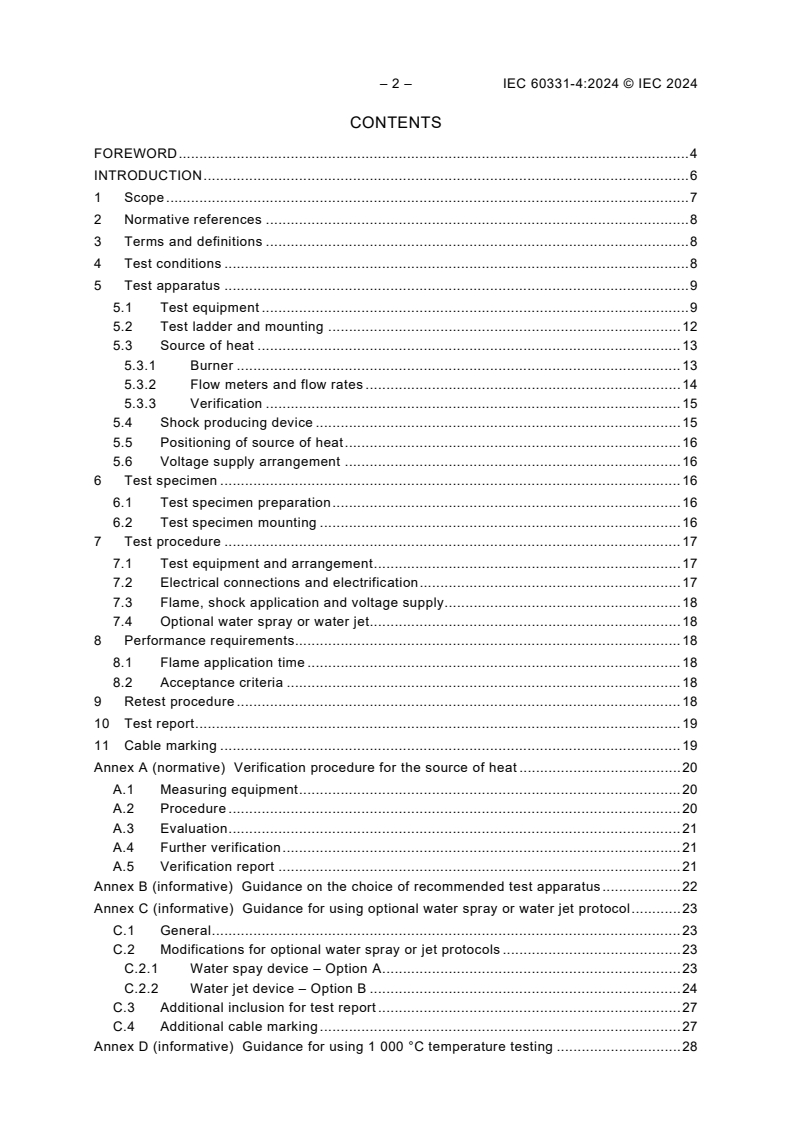
– 2 – IEC 60331-4:2024 © IEC 2024
CONTENTS
FOREWORD . 4
INTRODUCTION . 6
1 Scope . 7
2 Normative references . 8
3 Terms and definitions . 8
4 Test conditions . 8
5 Test apparatus . 9
5.1 Test equipment . 9
5.2 Test ladder and mounting . 12
5.3 Source of heat . 13
5.3.1 Burner . 13
5.3.2 Flow meters and flow rates . 14
5.3.3 Verification . 15
5.4 Shock producing device . 15
5.5 Positioning of source of heat . 16
5.6 Voltage supply arrangement . 16
6 Test specimen . 16
6.1 Test specimen preparation . 16
6.2 Test specimen mounting . 16
7 Test procedure . 17
7.1 Test equipment and arrangement . 17
7.2 Electrical connections and electrification . 17
7.3 Flame, shock application and voltage supply. 18
7.4 Optional water spray or water jet. 18
8 Performance requirements. 18
8.1 Flame application time . 18
8.2 Acceptance criteria . 18
9 Retest procedure . 18
10 Test report . 19
11 Cable marking . 19
Annex A (normative) Verification procedure for the source of heat . 20
A.1 Measuring equipment . 20
A.2 Procedure . 20
A.3 Evaluation . 21
A.4 Further verification . 21
A.5 Verification report . 21
Annex B (informative) Guidance on the choice of recommended test apparatus . 22
Annex C (informative) Guidance for using optional water spray or water jet protocol . 23
C.1 General . 23
C.2 Modifications for optional water spray or jet protocols . 23
C.2.1 Water spay device – Option A . 23
C.2.2 Water jet device – Option B . 24
C.3 Additional inclusion for test report . 27
C.4 Additional cable marking . 27
Annex D (informative) Guidance for using 1 000 °C temperature testing . 28
D.1 General . 28
D.2 Test apparatus . 28
D.3 Verification procedure for the source of heat . 28
D.4 Additional marking . 28
Bibliography . 29
Figure 1 – Schematic diagram of test configuration (not to scale) . 10
Figure 2 – Plan view of fire test equipment . 11
Figure 3 – End elevation of fire test equipment (not to scale) . 12
Figure 4 – Typical rubber bush for supporting the test ladder . 13
Figure 5 – Burner face . 14
Figure 6 – Schematic diagram of an example of a burner control system . 15
Figure 7 – Method of mounting test specimen . 17
Figure A.1 – Temperature measuring arrangement . 20
Figure C.1 – Water spray tube . 24
Figure C.2 – Water spray application . 24
Figure C.3 – Hose nozzle . 25
Figure C.4 – Water jet application . 26
Figure C.5 – End elevation of water jet application . 26
– 4 – IEC 60331-4:2024 © IEC 2024
INTERNATIONAL ELECTROTECHNICAL COMMISSION
____________
TESTS FOR ELECTRIC CABLES UNDER FIRE CONDITIONS –
CIRCUIT INTEGRITY –
Part 4 – Test method for fire with shock at a temperature of at least 830 °C
for cables of rated voltage higher than 1 kV up to and including 30 kV
FOREWORD
1) The International Electrotechnical Commission (IEC) is a worldwide organization for standardization comprising
all national electrotechnical committees (IEC National Committees). The object of IEC is to promote international
co-operation on all questions concerning standardization in the electrical and electronic fields. To this end and
in addition to other activities, IEC publishes International Standards, Technical Specifications, Technical Reports,
Publicly Available Specifications (PAS) and Guides (hereafter referred to as "IEC Publication(s)"). Their
preparation is entrusted to technical committees; any IEC National Committee interested in the subject dealt with
may participate in this preparatory work. International, governmental and non-governmental organizations liaising
with the IEC also participate in this preparation. IEC collaborates closely with the International Organization for
Standardization (ISO) in accordance with conditions determined by agreement between the two organizations.
2) The formal decisions or agreements of IEC on technical matters express, as nearly as possible, an international
consensus of opinion on the relevant subjects since each technical committee has representation from all
interested IEC National Committees.
3) IEC Publications have the form of recommendations for international use and are accepted by IEC National
Committees in that sense. While all reasonable efforts are made to ensure that the technical content of IEC
Publications is accurate, IEC cannot be held responsible for the way in which they are used or for any
misinterpretation by any end user.
4) In order to promote international uniformity, IEC National Committees undertake to apply IEC Publications
transparently to the maximum extent possible in their national and regional publications. Any divergence between
any IEC Publication and the corresponding national or regional publication shall be clearly indicated in the latter.
5) IEC itself does not provide any attestation of conformity. Independent certification bodies provide conformity
assessment services and, in some areas, access to IEC marks of conformity. IEC is not responsible for any
services carried out by independent certification bodies.
6) All users should ensure that they have the latest edition of this publication.
7) No liability shall attach to IEC or its directors, employees, servants or agents including individual experts and
members of its technical committees and IEC National Committees for any personal injury, property damage or
other damage of any nature whatsoever, whether direct or indirect, or for costs (including legal fees) and
expenses arising out of the publication, use of, or reliance upon, this IEC Publication or any other IEC
Publications.
8) Attention is drawn to the Normative references cited in this publication. Use of the referenced publications is
indispensable for the correct application of this publication.
9) IEC draws attention to the possibility that the implementation of this document may involve the use of (a)
patent(s). IEC takes no position concerning the evidence, validity or applicability of any claimed patent rights in
respect thereof. As of the date of publication of this document, IEC had not received notice of (a) patent(s), which
may be required to implement this document. However, implementers are cautioned that this may not represent
the latest information, which may be obtained from the patent database available at https://patents.iec.ch. IEC
shall not be held responsible for identifying any or all such patent rights.
IEC 60331-4 has been prepared by IEC technical committee 20: Electric cables. It is an
International Standard.
The text of this International Standard is based on the following documents:
Draft Report on voting
20/2194/FDIS 20/2215/RVD
Full information on the voting for its approval can be found in the report on voting indicated in
the above table.
The language used for the development of this International Standard is English.
This document was drafted in accordance with ISO/IEC Directives, Part 2, and developed in
accordance with ISO/IEC Directives, Part 1 and ISO/IEC Directives, IEC Supplement, available
at www.iec.ch/members_experts/refdocs. The main document types developed by IEC are
described in greater detail at www.iec.ch/publications.
It has the status of a group safety publication in accordance with IEC Guide 104.
A list of all parts in the IEC 60331 series, published under the general title Tests for electric
cables under fire conditions – Circuit integrity, can be found on the IEC website.
The committee has decided that the contents of this document will remain unchanged until the
stability date indicated on the IEC website under webstore.iec.ch in the data related to the
specific document. At this date, the document will be
• reconfirmed,
• withdrawn, or
• revised.
IMPORTANT – The "colour inside" logo on the cover page of this document indicates
that it contains colours which are considered to be useful for the correct understanding
of its contents. Users should therefore print this document using a colour printer.
– 6 – IEC 60331-4:2024 © IEC 2024
INTRODUCTION
The IEC 60331 series consists of the following parts:
IEC 60331-1, Tests for electric cables under fire conditions – Circuit integrity – Part 1: Test
method for fire with shock at a temperature of at least 830 °C for cables of rated voltage up to
and including 0,6/1,0 kV and with an overall diameter exceeding 20 mm
IEC 60331-2, Tests for electric cables under fire conditions – Circuit integrity – Part 2: Test
method for fire with shock at a temperature of at least 830 °C for cables of rated voltage up to
and including 0,6/1,0 kV and with an overall diameter not exceeding 20 mm
IEC 60331-3, Tests for electric cables under fire conditions – Circuit integrity – Part 3: Test
method for fire with shock at a temperature of at least 830 °C for cables of rated voltage up to
and including 0,6/1,0 kV tested in a metal enclosure
IEC 60331-4, Tests for electric cables under fire conditions – Circuit integrity – Part 4: Test
method for fire with shock at a temperature of at least 830 °C for cables of rated voltage higher
than 1 kV up to and including 30 kV
IEC 60331-11, Tests for electric cables under fire conditions – Circuit integrity – Part 11:
Apparatus – Fire alone at a flame temperature of at least 750 °C
IEC 60331-21, Tests for electric cables under fire conditions – Circuit integrity – Part 21:
Procedures and requirements – Cables of rated voltage up to and including 0,6/1,0 kV
IEC 60331-23, Tests for electric cables under fire conditions – Circuit integrity – Part 23:
Procedures and requirements – Electric data cables
IEC 60331-25, Tests for electric cables under fire conditions – Circuit integrity – Part 25:
Procedures and requirements – Optical fibre cables
NOTE 1 IEC 60331-21, IEC 60331-23 and IEC 60331-25 relate to fire-only conditions at a flame temperature of at
least 750 °C.
NOTE 2 IEC 60331-11, IEC 60331-21, IEC 60331-23 and IEC 60331-25 are no longer subject to maintenance. The
relevant test procedures are given in IEC 60331-1 and IEC 60331-2.
Since its first edition (1970), the IEC 60331 series has been extended and has introduced a
range of test apparatus in order that a test can be carried out on large and small power, control,
data and optical fibre cables.
Successful tests carried out in accordance with this document will enable an identification to be
marked on the product.
TESTS FOR ELECTRIC CABLES UNDER FIRE CONDITIONS –
CIRCUIT INTEGRITY –
Part 4 – Test method for fire with shock at a temperature of at least 830 °C
for cables of rated voltage higher than 1 kV up to and including 30 kV
1 Scope
This part of the IEC 60331 series specifies the test apparatus and procedure, and gives the
performance requirements, including recommended flame application times and flame
temperatures, for power cables of rated voltage higher than 0,6/1,0 kV up to and including
18/30 kV for maintaining circuit integrity when subject to fire and mechanical shock under
specified conditions.
The test method in this document is restricted to conductor sizes up to and including 120 mm .
The test results for 120 mm size conductors constructions qualify larger cross-sections of the
same cable construction.
In the case of preassembled three-core cables, then the complete cable is considered as tested
when a complete single-core of the cable has been tested.
This document includes details for the specific point of failure, continuity checking arrangement,
test sample, test procedure and test report relevant to electric power cables with a rated voltage
higher than 0,6/1,0 kV up to and including 18/30 kV.
Annex A provides the method of verification of the burner and control system used for the test.
Annex B provides a choice of the recommended test apparatus.
Annex C provides, as an option, guidance for using either water spray or water jet protocols.
Annex D provides, as an option, the flame temperature of 1 000 °C, which is applicable for
special applications.
Requirements are stated for an identification that can optionally be marked on the cable to
signify compliance with this document.
This group safety publication focusing on the test method for circuit integrity safety for power
cables of rated voltage higher than 1 kV up to and including 30 kV under fire conditions, is
primarily intended to be used as a product safety standard for the products mentioned in the
scope, but is also intended to be used by TCs in the preparation of publications for products
similar to those mentioned in the scope of this group safety publication, in accordance with the
principles laid down in IEC Guide 104 and lSO/lEC Guide 51.
One of the responsibilities of a TC is, wherever applicable, to make use of either BSPs or GSPs,
or both, in the preparation of its publications.
WARNING – The test given in this document can involve the use of dangerous voltages and
temperatures. Suitable precautions should be taken against the risk of shock, burning, fire and
explosion that can arise, and against any noxious fumes that can be produced.
– 8 – IEC 60331-4:2024 © IEC 2024
2 Normative references
The following documents are referred to in the text in such a way that some or all of their content
constitutes requirements of this document. For dated references, only the edition cited applies.
For undated references, the latest edition of the referenced document (including any
amendments) applies.
IEC 60584-1, Thermocouples – Part 1: EMF specifications and tolerances
3 Terms and definitions
For the purposes of this document, the following terms and definitions apply.
ISO and IEC maintain terminology databases for use in standardization at the following
addresses:
• IEC Electropedia: available at https://www.electropedia.org/
• ISO Online browsing platform: available at https://www.iso.org/obp
3.1
circuit integrity
ability of an electric cable to continue to operate in a designated manner whilst subjected to a
specified flame source for a specified period of time under specified conditions
3.2
draught-free environment
space in which the results of tests are not significantly affected by the local air speed
4 Test conditions
The test shall be carried out in a draught-free environment within a suitable chamber, of
minimum volume 20 m , with facilities for disposing of any noxious gases resulting from the
burning. Sufficient ventilation shall be available to sustain the flame for the duration of the test.
Air inlets and the exhaust chimney should be located in such a way that the burner flame
remains stable during the verification procedure and test. If necessary, the burner shall be
shielded from any draughts by the use of draught shields. Windows may be installed in the walls
of the chamber in order to observe the behaviour of the cable during the test. Fume exhaust
should be achieved by means of natural draught through a chimney located at least 1 m from
the burner. A damper may be used for adjustment of ventilation conditions.
NOTE Experience has shown a chamber similar to the "3 m cube" specified in IEC 61034-1 to be suitable, although
other chambers of suitable volume can be used.
The chamber and test apparatus shall be at a temperature of between 10 °C and 40 °C at the
start of each test.
The same ventilation and shielding conditions shall be used in the chamber during both the
verification and cable test procedures.
5 Test apparatus
5.1 Test equipment
The test equipment shall consist of the following:
a) a test ladder, onto which the test specimen is mounted, comprising a steel framework
fastened to a rigid support as described in 5.2;
b) a source of heat comprising a horizontally mounted ribbon burner as described in 5.3;
c) a shock-producing device as described in 5.4;
d) a test wall equipped with thermocouples for verification of the source of heat as described
in Annex A;
e) a voltage supply arrangement as described in 5.6;
f) and optionally: a water spray or water jet as described in Annex C.
A general arrangement of the test equipment is shown in Figure 1, Figure 2 and Figure 3.
---------------------- P
...