

CISPR 36:2020
(Main)Electric and hybrid electric road vehicles - Radio disturbance characteristics - Limits and methods of measurement for the protection of off-board receivers below 30 MHz
General Information
- Abstract
CISPR 36:2020 defines limits for 3 m measurement distance and methods of measurement that are designed to provide protection for off-board receivers (at 10 m distance) in the frequency range of 150 kHz to 30 MHz when used in the residential environment.
NOTE Protection of receivers used on board the same vehicle as the disturbance source(s) is covered by CISPR 25.
This document applies to the emission of electromagnetic energy which might cause interference to radio reception and which is emitted from electric and hybrid electric vehicles propelled by an internal traction battery (see 3.2 and 3.3) when operated on the road. This document applies to vehicles that have a traction battery voltage between 100 V and 1 000 V.
Electric vehicles to which CISPR 14-1 applies are not in the scope of this document. This document applies only to road vehicles where an electric propulsion is used for sustained speed of more than 6 km/h. Vehicles where the electric motor is only used to start up the internal combustion engine (e.g. "micro hybrid") and vehicles where the electric motor is used for additional propulsion only during acceleration (e.g. "48 V mild hybrid vehicles") are not in the scope of this document. The radiated emission requirements in this document are not applicable to the intentional transmissions from a radio transmitter as defined by the ITU including their spurious emissions. Annex C lists work being considered for future revisions.
- Status
- Published
- Publication Date
- 16-May-2023
- Current Stage
- PPUB - Publication issued
- Start Date
- 22-Jul-2020
- Completion Date
- 20-Aug-2020
Buy Documents
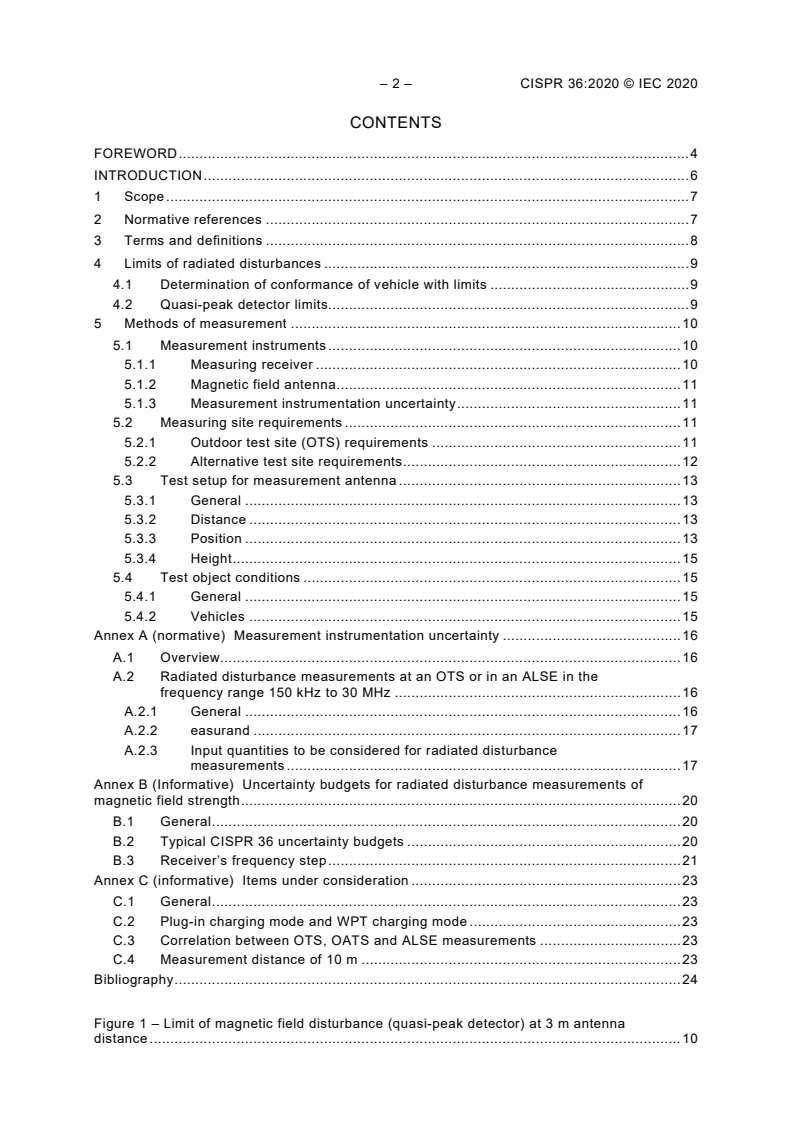
CISPR 36:2020 - Electric and hybrid electric road vehicles - Radio disturbance characteristics - Limits and methods of measurement for the protection of off-board receivers below 30 MHz Released:7/22/2020

CISPR 36:2020+AMD1:2023 CSV - Electric and hybrid electric road vehicles - Radio disturbance characteristics - Limits and methods of measurement for the protection of off-board receivers below 30 MHz Released:5/17/2023
Overview
CISPR 36:2020, published by the International Electrotechnical Commission (IEC), is a vital international standard addressing the radio disturbance characteristics of electric and hybrid electric road vehicles. This standard establishes limits and measurement methods for electromagnetic emissions below 30 MHz, focusing specifically on protecting off-board radio receivers at a 10-meter distance in residential environments. By defining limits based on a 3-meter measurement distance and specifying robust test procedures, CISPR 36:2020 ensures that electric and hybrid vehicles powered by traction batteries (ranging from 100 V to 1,000 V) operate within guidelines that minimize radio interference, enhancing coexistence with sensitive radio receiver equipment.
Notably, this standard applies exclusively to road vehicles with electric propulsion systems engaged for sustained speeds above 6 km/h, excluding micro hybrids and mild hybrids with limited electric assistance. It complements but is distinct from CISPR 25, which addresses onboard receiver protection, and excludes vehicles covered by CISPR 14-1. CISPR 36:2020 thereby caters to the evolving market of electric mobility, ensuring electromagnetic compatibility (EMC) at low frequencies to protect public and residential radio communications.
Key Topics
Scope and Applicability
CISPR 36 focuses on electromagnetic emissions in the frequency range of 150 kHz to 30 MHz from electric and hybrid electric vehicles. It excludes emissions from intentional radio transmitters and ensures that interference protection is relevant for off-board radio receivers, especially in residential settings.Emission Limits
The standard provides limits based on quasi-peak detector measurements at a 3-meter antenna distance. These limits are designed to ensure minimal disturbance to off-board radio receivers located at 10 meters from the vehicle, covering radio frequency interference (RFI) caused by vehicle systems.Measurement Methods
CISPR 36 outlines detailed measurement procedures including:- Use of magnetic field antennas with specific loop orientations (transverse and radial)
- Test site requirements such as Outdoor Test Sites (OTS) and alternatives conforming to CISPR standards
- Instrumentation characteristics including spectrum analyzers, scanning receivers, and measurement uncertainty analysis
- Test setup instructions covering antenna height, position, and measurement distances
Uncertainty and Conformance
The standard includes annexes addressing measurement uncertainty budgets and provides guidelines on determining conformance with the specified emission limits. This ensures reliable assessment of vehicle emissions under realistic environmental and testing conditions.
Practical Applications
CISPR 36:2020 is essential for manufacturers, test laboratories, and regulatory bodies involved with electric and hybrid electric road vehicles. Its implementation contributes to:
Ensuring Electromagnetic Compatibility (EMC)
By adhering to CISPR 36 limits, manufacturers can reduce radio disturbances that may affect nearby radio communication systems, especially in residential zones where susceptibility is high.Product Development and Compliance Testing
Electric vehicle developers can incorporate CISPR 36 requirements early in the design phase to minimize costly redesigns due to radio interference issues. Testing according to the standard supports market approval and regulatory compliance.Protecting Off-Board Receiver Functionality
Ensuring that road vehicles operating at low frequencies do not degrade radio systems such as AM broadcasting, longwave communication, or other receivers operating below 30 MHz.Supporting Sustainable Electric Mobility
As electric vehicle adoption grows, CISPR 36 helps maintain the integrity and reliability of radio spectrum use by mitigating electromagnetic disturbances from vehicles, fostering consumer confidence and regulatory acceptance.
Related Standards
- CISPR 25 – Addresses RF disturbance limits and measurement methods for onboard receivers in vehicles.
- CISPR 14-1 – Applies to electric vehicles with different emission characteristics and is outside the scope of CISPR 36.
- IEC 61000 series – General EMC standards applicable to electrical and electronic equipment.
- ITU Radio Regulations – Provide definitions and regulations for intentional radio transmissions, which CISPR 36 excludes from its scope.
Conclusion
CISPR 36:2020 serves as a critical framework for controlling low-frequency radio disturbances from electric and hybrid road vehicles, ensuring that off-board radio receivers in residential environments are protected against interference. Its comprehensive measurement protocols, clear emission limits, and focus on real-world scenarios make it a cornerstone document supporting electromagnetic compatibility in the growing electric mobility sector. Adherence to CISPR 36 enhances product compliance, protects ecosystem communication infrastructure, and advances the sustainable integration of electric vehicles worldwide.
Relations
- Effective Date
- 05-Sep-2023
Buy Documents
CISPR 36:2020 - Electric and hybrid electric road vehicles - Radio disturbance characteristics - Limits and methods of measurement for the protection of off-board receivers below 30 MHz Released:7/22/2020
CISPR 36:2020+AMD1:2023 CSV - Electric and hybrid electric road vehicles - Radio disturbance characteristics - Limits and methods of measurement for the protection of off-board receivers below 30 MHz Released:5/17/2023
Get Certified
Connect with accredited certification bodies for this standard

ANCE
Mexican certification and testing association.

Intertek Slovenia
Intertek testing, inspection, and certification services in Slovenia.

LNE (Laboratoire National de Métrologie et d'Essais)
French national laboratory for metrology and testing.
Sponsored listings
Frequently Asked Questions
CISPR 36:2020 is a standard published by the International Electrotechnical Commission (IEC). Its full title is "Electric and hybrid electric road vehicles - Radio disturbance characteristics - Limits and methods of measurement for the protection of off-board receivers below 30 MHz". This standard covers: CISPR 36:2020 defines limits for 3 m measurement distance and methods of measurement that are designed to provide protection for off-board receivers (at 10 m distance) in the frequency range of 150 kHz to 30 MHz when used in the residential environment. NOTE Protection of receivers used on board the same vehicle as the disturbance source(s) is covered by CISPR 25. This document applies to the emission of electromagnetic energy which might cause interference to radio reception and which is emitted from electric and hybrid electric vehicles propelled by an internal traction battery (see 3.2 and 3.3) when operated on the road. This document applies to vehicles that have a traction battery voltage between 100 V and 1 000 V. Electric vehicles to which CISPR 14-1 applies are not in the scope of this document. This document applies only to road vehicles where an electric propulsion is used for sustained speed of more than 6 km/h. Vehicles where the electric motor is only used to start up the internal combustion engine (e.g. "micro hybrid") and vehicles where the electric motor is used for additional propulsion only during acceleration (e.g. "48 V mild hybrid vehicles") are not in the scope of this document. The radiated emission requirements in this document are not applicable to the intentional transmissions from a radio transmitter as defined by the ITU including their spurious emissions. Annex C lists work being considered for future revisions.
CISPR 36:2020 defines limits for 3 m measurement distance and methods of measurement that are designed to provide protection for off-board receivers (at 10 m distance) in the frequency range of 150 kHz to 30 MHz when used in the residential environment. NOTE Protection of receivers used on board the same vehicle as the disturbance source(s) is covered by CISPR 25. This document applies to the emission of electromagnetic energy which might cause interference to radio reception and which is emitted from electric and hybrid electric vehicles propelled by an internal traction battery (see 3.2 and 3.3) when operated on the road. This document applies to vehicles that have a traction battery voltage between 100 V and 1 000 V. Electric vehicles to which CISPR 14-1 applies are not in the scope of this document. This document applies only to road vehicles where an electric propulsion is used for sustained speed of more than 6 km/h. Vehicles where the electric motor is only used to start up the internal combustion engine (e.g. "micro hybrid") and vehicles where the electric motor is used for additional propulsion only during acceleration (e.g. "48 V mild hybrid vehicles") are not in the scope of this document. The radiated emission requirements in this document are not applicable to the intentional transmissions from a radio transmitter as defined by the ITU including their spurious emissions. Annex C lists work being considered for future revisions.
CISPR 36:2020 is classified under the following ICS (International Classification for Standards) categories: 33.100.10 - Emission; 33.100.20 - Immunity. The ICS classification helps identify the subject area and facilitates finding related standards.
CISPR 36:2020 has the following relationships with other standards: It is inter standard links to CISPR 36:2020/AMD1:2023. Understanding these relationships helps ensure you are using the most current and applicable version of the standard.
CISPR 36:2020 is available in PDF format for immediate download after purchase. The document can be added to your cart and obtained through the secure checkout process. Digital delivery ensures instant access to the complete standard document.
Standards Content (Sample)
CISPR 36 ®
Edition 1.0 2020-07
INTERNATIONAL
STANDARD
NORME
INTERNATIONALE
colour
inside
INT ERNATIONAL SPECIAL COMMITTEE ON RADIO INTERFERENCE
C OMITÉ INTERNATIONAL SPÉCIAL DES PERTURBATIONS RADIOÉLECTRIQUES
Electric and hybrid electric road vehicles – Radio disturbance characteristics –
Limits and methods of measurement for the protection of off-board receivers
below 30 MHz
Véhicules routiers électriques et hybrides électriques – Caractéristiques de
perturbations radioélectriques – Limites et méthodes de mesure pour la
protection des récepteurs exterieurs en dessous de 30 MHz
All rights reserved. Unless otherwise specified, no part of this publication may be reproduced or utilized in any form
or by any means, electronic or mechanical, including photocopying and microfilm, without permission in writing from
either IEC or IEC's member National Committee in the country of the requester. If you have any questions about IEC
copyright or have an enquiry about obtaining additional rights to this publication, please contact the address below or
your local IEC member National Committee for further information.
Droits de reproduction réservés. Sauf indication contraire, aucune partie de cette publication ne peut être reproduite ni
utilisée sous quelque forme que ce soit et par aucun procédé, électronique ou mécanique, y compris la photocopie et
les microfilms, sans l'accord écrit de l'IEC ou du Comité national de l'IEC du pays du demandeur. Si vous avez des
questions sur le copyright de l'IEC ou si vous désirez obtenir des droits supplémentaires sur cette publication, utilisez
les coordonnées ci-après ou contactez le Comité national de l'IEC de votre pays de résidence.
IEC Central Office Tel.: +41 22 919 02 11
3, rue de Varembé info@iec.ch
CH-1211 Geneva 20 www.iec.ch
Switzerland
About the IEC
The International Electrotechnical Commission (IEC) is the leading global organization that prepares and publishes
International Standards for all electrical, electronic and related technologies.
About IEC publications
The technical content of IEC publications is kept under constant review by the IEC. Please make sure that you have the
latest edition, a corrigendum or an amendment might have been published.
IEC publications search - webstore.iec.ch/advsearchform Electropedia - www.electropedia.org
The advanced search enables to find IEC publications by a The world's leading online dictionary on electrotechnology,
variety of criteria (reference number, text, technical containing more than 22 000 terminological entries in English
committee,…). It also gives information on projects, replaced and French, with equivalent terms in 16 additional languages.
and withdrawn publications. Also known as the International Electrotechnical Vocabulary
(IEV) online.
IEC Just Published - webstore.iec.ch/justpublished
Stay up to date on all new IEC publications. Just Published IEC Glossary - std.iec.ch/glossary
details all new publications released. Available online and once 67 000 electrotechnical terminology entries in English and
a month by email. French extracted from the Terms and definitions clause of IEC
publications issued between 2002 and 2015. Some entries
IEC Customer Service Centre - webstore.iec.ch/csc have been collected from earlier publications of IEC TC 37, 77,
If you wish to give us your feedback on this publication or need 86 and CISPR.
further assistance, please contact the Customer Service
Centre: sales@iec.ch.
A propos de l'IEC
La Commission Electrotechnique Internationale (IEC) est la première organisation mondiale qui élabore et publie des
Normes internationales pour tout ce qui a trait à l'électricité, à l'électronique et aux technologies apparentées.
A propos des publications IEC
Le contenu technique des publications IEC est constamment revu. Veuillez vous assurer que vous possédez l’édition la
plus récente, un corrigendum ou amendement peut avoir été publié.
Recherche de publications IEC - Le premier dictionnaire d'électrotechnologie en ligne au monde,
webstore.iec.ch/advsearchform avec plus de 22 000 articles terminologiques en anglais et en
La recherche avancée permet de trouver des publications IEC français, ainsi que les termes équivalents dans 16 langues
en utilisant différents critères (numéro de référence, texte, additionnelles. Egalement appelé Vocabulaire
comité d’études,…). Elle donne aussi des informations sur les Electrotechnique International (IEV) en ligne.
projets et les publications remplacées ou retirées.
Glossaire IEC - std.iec.ch/glossary
IEC Just Published - webstore.iec.ch/justpublished 67 000 entrées terminologiques électrotechniques, en anglais
Restez informé sur les nouvelles publications IEC. Just et en français, extraites des articles Termes et définitions des
Published détaille les nouvelles publications parues. publications IEC parues entre 2002 et 2015. Plus certaines
Disponible en ligne et une fois par mois par email. entrées antérieures extraites des publications des CE 37, 77,
86 et CISPR de l'IEC.
Service Clients - webstore.iec.ch/csc
Si vous désirez nous donner des commentaires sur cette
publication ou si vous avez des questions contactez-nous:
sales@iec.ch.
Electropedia - www.electropedia.org
CISPR 36 ®
Edition 1.0 2020-07
INTERNATIONAL
STANDARD
NORME
INTERNATIONALE
colour
inside
INT ERNATIONAL SPECIAL COMMITTEE ON RADIO INTERFERENCE
C OMITÉ INTERNATIONAL SPÉCIAL DES PERTURBATIONS RADIOÉLECTRIQUES
Electric and hybrid electric road vehicles – Radio disturbance characteristics –
Limits and methods of measurement for the protection of off-board receivers
below 30 MHz
Véhicules routiers électriques et hybrides électriques – Caractéristiques de
perturbations radioélectriques – Limites et méthodes de mesure pour la
protection des récepteurs exterieurs en dessous de 30 MHz
INTERNATIONAL
ELECTROTECHNICAL
COMMISSION
COMMISSION
ELECTROTECHNIQUE
INTERNATIONALE
ICS 33.100.10; 33.100.20 ISBN 978-2-8322-8655-5
– 2 – CISPR 36:2020 © IEC 2020
CONTENTS
FOREWORD . 4
INTRODUCTION . 6
1 Scope . 7
2 Normative references . 7
3 Terms and definitions . 8
4 Limits of radiated disturbances . 9
4.1 Determination of conformance of vehicle with limits . 9
4.2 Quasi-peak detector limits. 9
5 Methods of measurement . 10
5.1 Measurement instruments . 10
5.1.1 Measuring receiver . 10
5.1.2 Magnetic field antenna . 11
5.1.3 Measurement instrumentation uncertainty . 11
5.2 Measuring site requirements . 11
5.2.1 Outdoor test site (OTS) requirements . 11
5.2.2 Alternative test site requirements . 12
5.3 Test setup for measurement antenna . 13
5.3.1 General . 13
5.3.2 Distance . 13
5.3.3 Position . 13
5.3.4 Height . 15
5.4 Test object conditions . 15
5.4.1 General . 15
5.4.2 Vehicles . 15
Annex A (normative) Measurement instrumentation uncertainty . 16
A.1 Overview. 16
A.2 Radiated disturbance measurements at an OTS or in an ALSE in the
frequency range 150 kHz to 30 MHz . 16
A.2.1 General . 16
A.2.2 easurand . 17
A.2.3 Input quantities to be considered for radiated disturbance
measurements . 17
Annex B (Informative) Uncertainty budgets for radiated disturbance measurements of
magnetic field strength . 20
B.1 General . 20
B.2 Typical CISPR 36 uncertainty budgets . 20
B.3 Receiver’s frequency step . 21
Annex C (informative) Items under consideration . 23
C.1 General . 23
C.2 Plug-in charging mode and WPT charging mode . 23
C.3 Correlation between OTS, OATS and ALSE measurements . 23
C.4 Measurement distance of 10 m . 23
Bibliography . 24
Figure 1 – Limit of magnetic field disturbance (quasi-peak detector) at 3 m antenna
distance . 10
Figure 2 – Measuring site (OTS) for vehicles . 12
Figure 3 – Magnetic field measurement – transverse loop orientation . 14
Figure 4 – Magnetic field measurement – radial loop orientation . 14
Figure 5 – Magnetic field antenna height – Elevation view (radial loop orientation) . 15
Figure A.1 – Sources of measurement instrumentation uncertainty . 17
Figure B.1 – Example of measurement for frequency step uncertainty evaluation . 22
Table 1 – Limit of disturbance (quasi-peak detector at 3 m antenna distance) . 9
Table 2 – Spectrum analyser parameters . 11
Table 3 – Scanning receiver parameters . 11
Table A.1 – Input quantities to be considered for radiated disturbance measurements . 18
Table B.1 – Typical uncertainty budget – 3 m distance – loop antenna . 20
– 4 – CISPR 36:2020 © IEC 2020
INTERNATIONAL ELECTROTECHNICAL COMMISSION
INTERNATIONAL SPECIAL COMMITTEE ON RADIO INTERFERENCE
____________
ELECTRIC AND HYBRID ELECTRIC ROAD VEHICLES –
RADIO DISTURBANCE CHARACTERISTICS –
LIMITS AND METHODS OF MEASUREMENT FOR
THE PROTECTION OF OFF-BOARD RECEIVERS BELOW 30 MHz
FOREWORD
1) The International Electrotechnical Commission (IEC) is a worldwide organization for standardization comprising
all national electrotechnical committees (IEC National Committees). The object of IEC is to promote international
co-operation on all questions concerning standardization in the electrical and electronic fields. To this end and
in addition to other activities, IEC publishes International Standards, Technical Specifications, Technical Reports,
Publicly Available Specifications (PAS) and Guides (hereafter referred to as "IEC Publication(s)"). Their
preparation is entrusted to technical committees; any IEC National Committee interested in the subject dealt with
may participate in this preparatory work. International, governmental and non-governmental organizations liaising
with the IEC also participate in this preparation. IEC collaborates closely with the International Organization for
Standardization (ISO) in accordance with conditions determined by agreement between the two organizations.
2) The formal decisions or agreements of IEC on technical matters express, as nearly as possible, an international
consensus of opinion on the relevant subjects since each technical committee has representation from all
interested IEC National Committees.
3) IEC Publications have the form of recommendations for international use and are accepted by IEC National
Committees in that sense. While all reasonable efforts are made to ensure that the technical content of IEC
Publications is accurate, IEC cannot be held responsible for the way in which they are used or for any
misinterpretation by any end user.
4) In order to promote international uniformity, IEC National Committees undertake to apply IEC Publications
transparently to the maximum extent possible in their national and regional publications. Any divergence between
any IEC Publication and the corresponding national or regional publication shall be clearly indicated in the latter.
5) IEC itself does not provide any attestation of conformity. Independent certification bodies provide conformity
assessment services and, in some areas, access to IEC marks of conformity. IEC is not responsible for any
services carried out by independent certification bodies.
6) All users should ensure that they have the latest edition of this publication.
7) No liability shall attach to IEC or its directors, employees, servants or agents including individual experts and
members of its technical committees and IEC National Committees for any personal injury, property damage or
other damage of any nature whatsoever, whether direct or indirect, or for costs (including legal fees) and
expenses arising out of the publication, use of, or reliance upon, this IEC Publication or any other IEC
Publications.
8) Attention is drawn to the Normative references cited in this publication. Use of the referenced publications is
indispensable for the correct application of this publication.
9) Attention is drawn to the possibility that some of the elements of this IEC Publication may be the subject of patent
rights. IEC shall not be held responsible for identifying any or all such patent rights.
International Standard CISPR 36 has been prepared by CISPR subcommittee D:
Electromagnetic disturbances related to electric/electronic equipment on vehicles and internal
combustion engine powered devices.
The text of this International Standard is based on the following documents:
CDV Report on voting
CISPR/D/462/CDV CISPR/D/464A/RVC
Full information on the voting for the approval of this International Standard can be found in the
report on voting indicated in the above table.
This document has been drafted in accordance with the ISO/IEC Directives, Part 2.
The committee has decided that the contents of this document will remain unchanged until the
stability date indicated on the IEC website under "http://webstore.iec.ch" in the data related to
the specific document. At this date, the document will be
• reconfirmed,
• withdrawn,
• replaced by a revised edition, or
• amended.
IMPORTANT – The 'colour inside' logo on the cover page of this publication indicates
that it contains colours which are considered to be useful for the correct understanding
of its contents. Users should therefore print this document using a colour printer.
– 6 – CISPR 36:2020 © IEC 2020
INTRODUCTION
There is a specific need for documents to define acceptable low frequency performance of all
electrical/electronic products. CISPR 36 has been developed to serve the electric and hybrid
electric road vehicle and related industries with test methods and limits that provide satisfactory
protection for radio reception.
Compliance with this document is sometimes insufficient for the protection of receivers used in
the residential environment nearer than 10 m to the vehicle. It also sometimes does not provide
sufficient protection for new types of radio transmissions.
ELECTRIC AND HYBRID ELECTRIC ROAD VEHICLES –
RADIO DISTURBANCE CHARACTERISTICS –
LIMITS AND METHODS OF MEASUREMENT FOR
THE PROTECTION OF OFF-BOARD RECEIVERS BELOW 30 MHz
1 Scope
This document defines limits for 3 m measurement distance and methods of measurement that
are designed to provide protection for off-board receivers (at 10 m distance) in the frequency
range of 150 kHz to 30 MHz when used in the residential environment.
NOTE Protection of receivers used on board the same vehicle as the disturbance source(s) is covered by CISPR 25.
This document applies to the emission of electromagnetic energy which might cause
interference to radio reception and which is emitted from electric and hybrid electric vehicles
propelled by an internal traction battery (see 3.2 and 3.3) when operated on the road.
This document applies to vehicles that have a traction battery voltage between 100 V and
1 000 V.
Electric vehicles to which CISPR 14-1 applies are not in the scope of this document.
This document applies only to road vehicles where an electric propulsion is used for sustained
speed of more than 6 km/h.
Vehicles where the electric motor is only used to start up the internal combustion engine
(e.g. "micro hybrid") and vehicles where the electric motor is used for additional propulsion only
during acceleration (e.g. "48 V mild hybrid vehicles") are not in the scope of this document.
The radiated emission requirements in this document are not applicable to the intentional
transmissions from a radio transmitter as defined by the ITU including their spurious emissions.
Annex C lists work being considered for future revisions.
2 Normative references
The following documents are referred to in the text in such a way that some or all of their content
constitutes requirements of this document. For dated references, only the edition cited applies.
For undated references, the latest edition of the referenced document (including any
amendments) applies.
CISPR 16-1-1:2015, Specification for radio disturbance and immunity measuring apparatus and
methods – Part 1-1: Radio disturbance and immunity measuring apparatus – Measuring
apparatus
CISPR 16-1-4:2019, Specification for radio disturbance and immunity measuring apparatus and
methods – Part 1-4: Radio disturbance and immunity measuring apparatus – Antennas and test
sites for radiated disturbance measurements
CISPR 16-2-3:2016, Specification for radio disturbance and immunity measuring apparatus and
methods – Part 2-3: Methods of measurement of disturbances and immunity – Radiated
disturbance measurements
CISPR 16-2-3:2016/AMD1:2019
– 8 – CISPR 36:2020 © IEC 2020
3 Terms and definitions
For the purposes of this document, the following terms and definitions apply.
ISO and IEC maintain terminological databases for use in standardization at the following
addresses:
• IEC Electropedia: available at http://www.electropedia.org/
• ISO Online browsing platform: available at http://www.iso.org/obp
3.1
absorber lined shielded enclosure
ALSE
shielded enclosure in which the ceiling and walls are covered with material that absorbs
electromagnetic energy (i.e. RF absorber)
3.2
electric vehicle
vehicle propelled exclusively by electric motor(s) powered by on-board traction battery or
batteries
Note 1 to entry: Vehicles equipped with an additional power source (e.g. auxiliary combustion engine, fuel cell)
used to provide electric power to the electric motor/traction battery only, without contributing to the mechanical
propulsion of the vehicle, are considered as electric vehicles for the purposes of this document.
3.3
hybrid electric vehicle
vehicle propelled by electric motor(s) and internal combustion engine
Note 1 to entry: The two propulsion systems can operate individually or in a combined mode depending on the
hybrid system.
3.4
open-area test site
OATS
facility for measurements and calibrations in which the ground reflection is made reproducible
by a large flat electrically conducting ground plane
Note 1 to entry: An OATS can be used for radiated disturbance measurements, where it is also designated as a
COMTS. An OATS can also be used for antenna calibrations, where it is designated as a CALTS.
Note 2 to entry: An OATS is an uncovered outdoor site, and is far enough away from buildings, electric lines, fences,
trees, underground cables, pipelines, and other potentially reflective objects, so that the effects due to such objects
are negligible. See CISPR 16-1-4 for guidance on the construction of an OATS.
[SOURCE CISPR 16-2-3:2016, 3.1.20]
3.5
outdoor test site
OTS
measurement site similar to an open-area test site as specified in CISPR 16-1-4, but without
any type of metallic ground plane and with different dimensions
Note 1 to entry: Specific requirements are defined in this document.
3.6
residential environment
environment having a 10 m protection distance between the source and the point of radio
reception
Note 1 to entry: Examples of a residential environment include rooming houses, private dwellings, entertainment
halls, theatres, schools, public streets, shopping centres / malls, etc.
3.7
traction battery
battery used for the propulsion of electric vehicle or hybrid electric vehicle
3.8
vehicle
machine operating on land which is intended to carry persons or goods
Note 1 to entry: Vehicles include, but are not limited to, cars, trucks, buses and mopeds.
4 Limits of radiated disturbances
4.1 Determination of conformance of vehicle with limits
The vehicle shall comply with the quasi-peak detector magnetic field strength limits specified in
4.2, when it is in "Propulsion" mode of operation, as per 5.4.2.2.
The limits given in this document take into account uncertainties.
4.2 Quasi-peak detector limits
The limit for emissions measured with quasi-peak detector at 3 m antenna distance is given in
Table 1 and is shown graphically in Figure 1. It is expressed in dB(µA/m). For more accurate
determination, the formula given in Table 1 shall be used.
Table 1 – Limit of disturbance (quasi-peak detector at 3 m antenna distance)
Frequency H field
MHz dB(µA/m)
0,15 to 4 26,11 − 15,64 × lg(f )
MHz
4 to 15 33,17 − 27,35 × lg(f )
MHz
15 to 30 16,63 − 13,29 × lg(f )
MHz
– 10 – CISPR 36:2020 © IEC 2020
Figure 1 – Limit of magnetic field disturbance (quasi-peak detector)
at 3 m antenna distance
5 Methods of measurement
5.1 Measurement instruments
5.1.1 Measuring receiver
5.1.1.1 General
The measuring receiver (including FFT-based measurement instruments) shall comply with the
requirements of CISPR 16-1-1:2015. Either manual or automatic frequency scanning may be
used.
A preamplifier can be used between the antenna and measuring receiver in order to achieve
the 6 dB noise floor requirements (see 5.2.1.2). If a preamplifier is used to achieve the 6 dB
noise floor requirement, the laboratory should establish a procedure to avoid overload of the
preamplifier, such as using a step attenuator. The laboratory should also ensure the receiver is
not overloaded in all measurement scenarios, with or without an external preamplifier.
5.1.1.2 Spectrum analyser parameters
The scan rate of the spectrum analyser shall be adjusted for the CISPR frequency band and
detection mode used. The maximum scan rate shall comply with the requirements of
CISPR 16-2-3.
Spectrum analysers may be used for performing compliance measurements to this document
providing the precautions cited in CISPR 16-1-1:2015 on the use of spectrum analysers are
adhered to and that the broadband emissions from the product being tested have a repetition
frequency greater than 20 Hz.
The minimum scan time and resolution bandwidth (RBW) are listed in Table 2.
Table 2 – Spectrum analyser parameters
Quasi-peak detector
Frequency range
MHz
RBW at −6 dB Scan time
0,15 to 30 9 kHz 200 s/MHz
When a spectrum analyser is used for measurements, the video bandwidth shall be at least
three times the RBW.
5.1.1.3 Scanning receiver parameters
The measurement time of the scanning receiver shall be adjusted for the CISPR frequency band
and detection mode used. The minimum measurement time, maximum step size and bandwidth
(BW) are listed in Table 3.
Table 3 – Scanning receiver parameters
Quasi-peak detector
Frequency range
Minimum
MHz
BW at −6 dB Step size measurement
time
0,15 to 30 9 kHz 5 kHz 1 s
5.1.2 Magnetic field antenna
For measuring the magnetic field, an electrically-screened loop antenna shall be used (see
CISPR 16-1-4:2019, 4.4.2).
5.1.3 Measurement instrumentation uncertainty
The measurement instrumentation uncertainty shall be calculated as described in Annex A.
Measurement instrumentation uncertainty shall not be taken into account in the determination
of compliance.
Examples of uncertainty budgets are given in Annex B. If the calculated expanded
measurement instrumentation uncertainty exceeds that of the corresponding example in
Annex B, the value of the expanded uncertainty shall be documented in the test report.
NOTE The provisions for measurement instrumentation uncertainty (MIU) in this document do not follow
CISPR 16-4-2 for considering MIU. The deviation from policy is justified due to the missing site validation method
which will be covered in a future revision of CISPR 36. An estimation of the uncertainty contribution caused by site
imperfections cannot be made without site validation criterion.
5.2 Measuring site requirements
5.2.1 Outdoor test site (OTS) requirements
5.2.1.1 OTS for vehicles
The test site shall be a clear area, free from electromagnetic reflecting surfaces (except the
floor) within a circle of minimum radius of 20 m measured from a point midway between the
vehicle and the antenna. As an exception, the measuring equipment and test hut or vehicle in
which the measuring equipment is located (when used) may be within the test site, but only in
the permitted region indicated by the crosshatched area of Figure 2.
– 12 – CISPR 36:2020 © IEC 2020
Dimensions in metres
Figure 2 – Measuring site (OTS) for vehicles
5.2.1.2 Ambient magnetic field requirements
To ensure that there is no extraneous noise or signals of sufficient magnitude or density to
affect materially the vehicle measurement, ambient measurements shall be taken before and
after the main test, but without the vehicle under test running. In both of these measurements,
the ambient noise shall be at least 6 dB below the limits of disturbance given in Clause 4,
excluding intentional radiators.
5.2.2 Alternative test site requirements
5.2.2.1 General
Absorber lined shielded enclosures (ALSE) and open area test sites (OATS) may be used. An
ALSE has the advantage of all-weather testing, a controlled environment and improved
repeatability because of the stable chamber electrical characteristics.
NOTE There is ongoing work on an appropriate correlation method (see Annex C)
5.2.2.2 Ambient magnetic field requirements
The ambient noise level shall be at least 6 dB below the limits of disturbance given in Clause 4.
The ambient level shall be verified periodically or when test results indicate the possibility of
non-compliance.
5.3 Test setup for measurement antenna
5.3.1 General
At each measurement frequency (including the start and end frequencies), measurements shall
be taken for two loop orientations (H radial and H transverse).
Electrical interaction between the antenna elements and the antenna support/guy system
should be avoided.
Sheath current chokes and ferrite (e.g. sheath-current suppressor in CISPR 25:2016, Annex C)
should be loaded to the cable to reduce the common mode current (e.g. placing ferrite with a
minimum impedance of 50 Ω at 25 MHz on the antenna cable every 200 mm along its entire
length within the ALSE).
5.3.2 Distance
The projected horizontal distance along the measurement axis (i.e. along the vehicle body
longitudinal axis, for front and rear antenna positions, and along the vehicle body transversal
axis, for left and right antenna locations) between the centre of the loop antenna and the nearest
part of the vehicle body shall be 3,00 m ± 0,05 m for all antenna positions.
5.3.3 Position
Four antenna positions are required. The same positions shall be used for both loop orientations
measurements (see Figure 3 and Figure 4):
– front of the vehicle with the centre of the loop aligned with the vehicle body longitudinal axis;
– rear of the vehicle with the centre of the loop aligned with the vehicle body longitudinal axis;
– left of the vehicle with the centre of the loop aligned with the vehicle body transversal axis;
– right of the vehicle with the centre of the loop aligned with the vehicle body transversal axis.
If the measurements are performed in an ALSE, the minimum distance between any portion of
the loop antenna and the absorber material shall be 1 m.
– 14 – CISPR 36:2020 © IEC 2020
Dimensions in metres
Key
1 vehicle under test
2 antenna (four positions)
Figure 3 – Magnetic field measurement – transverse loop orientation
Dimensions in metres
Key
1 vehicle under test
2 antenna (four positions)
Figure 4 – Magnetic field measurement – radial loop orientation
5.3.4 Height
The height of the loop centre shall be 1,30 m ± 0,05 m above the ground level for all antenna
positions defined in 5.3.3.
Antenna height conditions are represented in Figure 5 for right and left positions.
Dimensions in metres
Key
1 vehicle under test (front view)
2 loop antenna
Figure 5 – Magnetic field antenna height – Elevation view (radial loop orientation)
5.4 Test object conditions
5.4.1 General
Measurements made while the vehicle is dry or made more than 10 min after precipitation has
stopped falling are preferred.
5.4.2 Vehicles
5.4.2.1 General
During testing all equipment which is automatically switched on together with the propulsion
system shall be operated in a manner which is as representative of normal operation as
possible. The electric propulsion system shall be at normal operating temperature.
5.4.2.2 "Propulsion" mode operating conditions
The electric vehicle or hybrid electric vehicle shall be tested on a dynamometer without a load,
or on non-conductive axle-stands, propelled by the electric motor only.
The electric vehicle or hybrid electric vehicle equipped with an auxiliary internal combustion
engine shall be tested with the combustion engine disabled. If this is not possible, the vehicle
shall be tested with the combustion engine enabled in addition.
The electric vehicle or hybrid electric vehicle shall be tested with a constant speed of
40 km/h ± 20 %, or the maximum speed if this is less than 40 km/h. If this is not appropriate
(e.g. in case of buses, trucks, two- and three-wheel vehicles), transmission shafts, belts or
chains may be disconnected to achieve the same operation condition for the propulsion.
The value of the vehicle speed shall be recorded in the test report.
– 16 – CISPR 36:2020 © IEC 2020
Annex A
(normative)
Measurement instrumentation uncertainty
A.1 Overview
The purpose of Annex A is to provide guidance in the evaluation of the measurement
instrumentation uncertainty for the measurement method described in this document. The
relevant input quantities are listed and estimations for the calculation of the uncertainty budget
are made.
The estimation of the overall uncertainty for CISPR 36 measurements should consider input
quantities due to measurement method, measurement instrumentation, operators, EUT and
environment.
Annex A only considers the measurement instrumentation for uncertainty evaluation. Some
other input quantities are not taken into consideration such as:
• site imperfection because site validation is under study;
• vehicle to antenna distance because it is not considered in measurement instrumentation
but rather in method.
A.2 Radiated disturbance measurements at an OTS or in an ALSE in the
frequency range 150 kHz to 30 MHz
A.2.1 General
The various uncertainty sources are presented in Figure A.1 and are mainly based on
CISPR 16-4-2.
Figure A.1 – Sources of measurement instrumentation uncertainty
A.2.2 Measurand
Maximum magnetic field strength, in dB(µA/m), in transverse and radial orientations
H
measured at the specified horizontal distance from the vehicle and the specified
height above the ground/floor, from the specified sides of the vehicle.
A.2.3 Input quantities to be considered for radiated disturbance measurements
The various quantities to be considered for radiated disturbance measurements are listed in
Table A.1 with a description of:
– the used symbol,
– the probability distribution function,
– the rationale for the estimation of the input quantity.
The measurand H is calculated using:
HV= + L + M + M + F+δV+δV+δV+δV+δF+δL+δF (A.1)
R CAB FR AF a sw pa pr nf stp FI a,f
– 18 – CISPR 36:2020 © IEC 2020
Table A.1 – Input quantities to be considered for radiated disturbance measurements
Probability
Quantity Symbol distribution Rationale for the estimates
function
Receiver readings will vary for reasons that include
measuring system instability and meter scale
normal interpolation errors. The estimate is the mean of many
V
Receiver reading
R
(k = 1) readings (sample size larger than 10) of a stable signal,
with a standard uncertainty given by the experimental
(1)
standard deviation of the mean (k = 1).
An estimate of the correction for receiver sine-wave
voltage accuracy is assumed to be available from a
Receiver corrections normal
δV
sw
calibration report, along with an expanded uncertainty
– Sine wave voltage (k = 2)
(1)
and a coverage factor.
A verification report stating that the receiver pulse
amplitude response complies with the CISPR 16-1-1
Receiver correction
tolerance of ±1,5 dB for peak, quasi-peak or average
δV
– Pulse amplitude Rectangular
pa
detection is assumed to be available. The correction
response
δV is estimated to be zero with a rectangular
pa
(1)
probability distribution having a half-width of 1,5 dB.
The CISPR 16-1-1 tolerance for pulse repetition rate
response varies with repetition rate and detector type. A
verification report stating that the receiver pulse
repetition rate responses comply with the CISPR 16-1-1
Receiver correction
δV tolerances is assumed to be available. The correction
– Pulse repetition Rectangular
pr
δV is estimated to be zero with a rectangular
rate response
pr
probability distribution having a half-width of 1,5 dB, a
value considered to be representative of the various
(1)
CISPR 16-1-1 tolerances.
For radiated disturbance measurement below 1 GHz,
the deviation is estimated to be between zero and +1,1
dB. The correction is estimated to be zero as if the
Receiver correction deviation would be symmetric around the value to be
δV
– Noise floor Rectangular measured with a rectangular probability distribution
nf
proximity having a half-width of 1,1 dB. Any correction for the
effect of the noise floor would depend on the signal type
(e.g. impulsive or unmodulated) and the signal to noise
(1)
ratio and would change the noise level indication.
This correction concerns the error which depends on
the frequency step size used on the measuring receiver
as a function of the used measurement bandwidth.
This correction can be evaluated experimentally with a
Receiver correction
δF
Rectangular
stp
frequency generator and the receiver used for the
– Frequency step
actual measurements by means of adjusting the
receiver’s tuning frequency with a variation of plus half
and minus half the step size and noting the amplitude
change on the receiver (see Clause B.3)
The cable(s) loss(es) values with associated expanded
uncertainty and coverage factor are normally available
from calibration reports.
Normal
(2)
L Cable(s) loss(es) values are usually included in the
Cable(s) loss(es)
CAB
(k = 2)
measurement software to make the corrections in the
measurement; therefore, only the uncertainty value
should be kept for the measurement system uncertainty
evaluation.
This parameter concerns the frequency interpolation
used by the measurement software to evaluate cable(s)
loss(es) between the frequencies for which cable(s)
loss(es) values are available.
Cable(s) loss(es)
If cable loss is measured for an important number of
δL
frequency Rectangular
FI
(3)
frequency points and if the data do not show any
interpolation
significant rough variation between two consecutive
frequencies, the uncertainty can be considered to be
equal to the maximum half amplitude variation between
two consecutive cable loss measurement data.
Probability
Quantity Symbol distribution Rationale for the estimates
function
This parameter concerns the impedance mismatch
between the bulkhead connector and the measuring
Bulkhead connector
receiver input.
M
/ receiver
U-shaped
FR
(4) Mismatch uncertainty can be evaluated through
mismatch
theoretical formula and measurements data
(see CISPR 16-4-2:2011, Clause A.2, note A7).
This parameter concerns the impedance mismatch
between the antenna and the bulkhead connector.
Antenna / bulkhead
connector M
U-shaped
AF
Mismatch uncertainty can be evaluated through
(4)
mismatch
theoretical formula and measurements data
(see CISPR 16-4-2:2011, Clause A.2, note A7).
The antenna factor values with associated expanded
uncertainty and coverage factor are normally available
from a calibration report.
Normal
Antenna factor values are usually included in the
F
Antenna factor
a
(k = 2)
measurement software to make the voltage to field
corrections in the measurement; therefore, only the
uncertainty value should be kept for the measurement
system uncertainty evaluation.
This parameter concerns the frequency interpolation
used by the measurement software to evaluate antenna
factor between the frequencies for which antenna factor
values are available.
AF frequency
δF If antenna factor is measured for an important number
Rectangular
a,f
interpolation
of frequency points and if the data do not show any
significant rough variation between two consecutive
frequencies, the uncertainty can be considered to be
equal to the maximum half amplitude variation between
two consecutive antenna factor measurement data.
(1)
Based on CISPR 16-4-2.
(2)
Single parameter for cable loss value (and bulkhead connector loss value) which includes all the different
cables (and bulkhead connector) in the measuring system. If cable losses (and bulkhead connector) are
measured separately for each cable (and bulkhead connector), the table should include one separate
line for cable loss value per cable (and bulkhead connector).
(3)
Single parameter for cable loss frequency interpolation which includes all the different cables in the
measuring system. If cable losses frequency interpolation are considered separately for each cable, the
table should include one separate line for cable loss frequency interpolation per cable.
(4)
The worst configuration (in ALSE with one mismatch between receiver and chamber bulkhead connector
and one mismatch between chamber bulkhead connector and antenna) has been considered for
mismatches. When the measurements are performed without feedthrough (e.g. in OTS), only one
mismatch (between receiver and antenna) can be considered.
– 20 – CISPR 36:2020 © IEC 2020
Annex B
(Informative)
Uncertainty budgets for radiated disturbance
measurements of magnetic field strength
B.1 General
Annex B gives typical uncertainty budgets for the measurement instrumentation uncertainty for
radiated disturbance measurements.
B.2 Typical CISPR 36 uncertainty budgets
Uncertainty related to site imperfections (OTS or ALSE) is not considered in these budgets.
Table B.1 – Typical uncertainty budget – 3 m distance – loop antenna
3 m distance measurement – loop antenna
Uncertainty of x
i
Quantity x c u(x )
Symbol Probability Comment
i i i
dB distribution
function
(1)
V
Receiver reading k = 1 0,1
±0,1
R
Receiver corrections –
(1)
δV
±1 k = 2 0,5
sw
Sine wave voltage
Receiver correction –
(1)
δV
Pulse amplitude Rectangular 0,87
±1,5
pa
response
Receiver correction –
(1)
δV
Pulse repetition rate ±1,5 Rectangular 0,87
pr
response
+05,
Receiver correction –
(2)
δV
Rectangular 0,14
See
nf
−19,
Noise floor proximity
Receiver correction –
+0
δF
Rectangular 0,55
stp
−19,
Frequency step
(3)
L
Cable(s) loss(es) ±0,5 k = 2 0,25
See
CAB
Cable(s) loss(es)
(4)
δL
frequency ±0,25 Rectangular 0,14 See
FI
interpolation
+0,34
Bulkhead connector /
(5)
M
U-shaped 0,25
See
FR
−0,36
receiver mismatch
Antenna / bulkhead +1,54
(6)
M
U-shaped 1,21 See
AF
−1,87
connector mismat
...
CISPR 36 ®
Edition 1.1 2023-05
CONSOLIDATED VERSION
INTERNATIONAL
STANDARD
NORME
INTERNATIONALE
colour
inside
INTERNATIONAL SPECIAL COMMITTEE ON RADIO INTERFERENCE
COMITÉ INTERNATIONAL SPÉCIAL DES PERTURBATIONS RADIOÉLECTRIQUES
Electric and hybrid electric road vehicles – Radio disturbance characteristics –
Limits and methods of measurement for the protection of off-board receivers
below 30 MHz
Véhicules routiers électriques et hybrides électriques – Caractéristiques de
perturbations radioélectriques – Limites et méthodes de mesure pour la
protection des récepteurs extérieurs en dessous de 30 MHz
All rights reserved. Unless otherwise specified, no part of this publication may be reproduced or utilized in any form
or by any means, electronic or mechanical, including photocopying and microfilm, without permission in writing from
either IEC or IEC's member National Committee in the country of the requester. If you have any questions about IEC
copyright or have an enquiry about obtaining additional rights to this publication, please contact the address below or
your local IEC member National Committee for further information.
Droits de reproduction réservés. Sauf indication contraire, aucune partie de cette publication ne peut être reproduite ni
utilisée sous quelque forme que ce soit et par aucun procédé, électronique ou mécanique, y compris la photocopie et
les microfilms, sans l'accord écrit de l'IEC ou du Comité national de l'IEC du pays du demandeur. Si vous avez des
questions sur le copyright de l'IEC ou si vous désirez obtenir des droits supplémentaires sur cette publication, utilisez
les coordonnées ci-après ou contactez le Comité national de l'IEC de votre pays de résidence.
IEC Secretariat Tel.: +41 22 919 02 11
3, rue de Varembé info@iec.ch
CH-1211 Geneva 20 www.iec.ch
Switzerland
About the IEC
The International Electrotechnical Commission (IEC) is the leading global organization that prepares and publishes
International Standards for all electrical, electronic and related technologies.
About IEC publications
The technical content of IEC publications is kept under constant review by the IEC. Please make sure that you have the
latest edition, a corrigendum or an amendment might have been published.
IEC publications search - webstore.iec.ch/advsearchform IEC Products & Services Portal - products.iec.ch
The advanced search enables to find IEC publications by a Discover our powerful search engine and read freely all the
variety of criteria (reference number, text, technical publications previews. With a subscription you will always have
committee, …). It also gives information on projects, replaced access to up to date content tailored to your needs.
and withdrawn publications.
Electropedia - www.electropedia.org
IEC Just Published - webstore.iec.ch/justpublished
The world's leading online dictionary on electrotechnology,
Stay up to date on all new IEC publications. Just Published
containing more than 22 300 terminological entries in English
details all new publications released. Available online and once
and French, with equivalent terms in 19 additional languages.
a month by email.
Also known as the International Electrotechnical Vocabulary
(IEV) online.
IEC Customer Service Centre - webstore.iec.ch/csc
If you wish to give us your feedback on this publication or need
further assistance, please contact the Customer Service
Centre: sales@iec.ch.
A propos de l'IEC
La Commission Electrotechnique Internationale (IEC) est la première organisation mondiale qui élabore et publie des
Normes internationales pour tout ce qui a trait à l'électricité, à l'électronique et aux technologies apparentées.
A propos des publications IEC
Le contenu technique des publications IEC est constamment revu. Veuillez vous assurer que vous possédez l’édition la
plus récente, un corrigendum ou amendement peut avoir été publié.
Recherche de publications IEC - Découvrez notre puissant moteur de recherche et consultez
webstore.iec.ch/advsearchform gratuitement tous les aperçus des publications. Avec un
La recherche avancée permet de trouver des publications IEC abonnement, vous aurez toujours accès à un contenu à jour
en utilisant différents critères (numéro de référence, texte, adapté à vos besoins.
comité d’études, …). Elle donne aussi des informations sur les
projets et les publications remplacées ou retirées. Electropedia - www.electropedia.org
Le premier dictionnaire d'électrotechnologie en ligne au monde,
IEC Just Published - webstore.iec.ch/justpublished
avec plus de 22 300 articles terminologiques en anglais et en
Restez informé sur les nouvelles publications IEC. Just
français, ainsi que les termes équivalents dans 19 langues
Published détaille les nouvelles publications parues.
additionnelles. Egalement appelé Vocabulaire
Disponible en ligne et une fois par mois par email.
Electrotechnique International (IEV) en ligne.
Service Clients - webstore.iec.ch/csc
Si vous désirez nous donner des commentaires sur cette
publication ou si vous avez des questions contactez-nous:
sales@iec.ch.
IEC Products & Services Portal - products.iec.ch
CISPR 36 ®
Edition 1.1 2023-05
CONSOLIDATED VERSION
INTERNATIONAL
STANDARD
NORME
INTERNATIONALE
colour
inside
INTERNATIONAL SPECIAL COMMITTEE ON RADIO INTERFERENCE
COMITÉ INTERNATIONAL SPÉCIAL DES PERTURBATIONS RADIOÉLECTRIQUES
Electric and hybrid electric road vehicles – Radio disturbance characteristics –
Limits and methods of measurement for the protection of off-board receivers
below 30 MHz
Véhicules routiers électriques et hybrides électriques – Caractéristiques de
perturbations radioélectriques – Limites et méthodes de mesure pour la
protection des récepteurs extérieurs en dessous de 30 MHz
INTERNATIONAL
ELECTROTECHNICAL
COMMISSION
COMMISSION
ELECTROTECHNIQUE
INTERNATIONALE
ICS 33.100.10; 33.100.20 ISBN 978-2-8322-7055-4
CISPR 36 ®
Edition 1.1 2023-05
CONSOLIDATED VERSION
REDLINE VERSION
VERSION REDLINE
colour
inside
INTERNATIONAL SPECIAL COMMITTEE ON RADIO INTERFERENCE
COMITÉ INTERNATIONAL SPÉCIAL DES PERTURBATIONS RADIOÉLECTRIQUES
Electric and hybrid electric road vehicles – Radio disturbance characteristics –
Limits and methods of measurement for the protection of off-board receivers
below 30 MHz
Véhicules routiers électriques et hybrides électriques – Caractéristiques de
perturbations radioélectriques – Limites et méthodes de mesure pour la
protection des récepteurs extérieurs en dessous de 30 MHz
– 2 – CISPR 36:2020+AMD1:2023 CSV
© IEC 2023
CONTENTS
FOREWORD . 4
INTRODUCTION . 6
1 Scope . 7
2 Normative references . 7
3 Terms and definitions . 8
4 Limits of radiated disturbances . 9
4.1 Determination of conformance of vehicle with limits . 9
4.2 Quasi-peak detector limits. 10
5 Methods of measurement . 11
5.1 Measurement instruments . 11
5.1.1 Measuring receiver . 11
5.1.2 Magnetic field antenna . 12
5.1.3 Measurement instrumentation uncertainty . 12
5.2 Measuring site requirements . 13
5.2.1 Outdoor test site (OTS) requirements . 13
5.2.2 Alternative test site requirements . 14
5.3 Test setup for measurement antenna . 14
5.3.1 General . 14
5.3.2 Distance . 14
5.3.3 Position . 14
5.3.4 Height . 16
5.4 Test object conditions . 16
5.4.1 General . 16
5.4.2 Vehicles . 16
Annex A (normativeinformative) Measurement instrumentation uncertainty . 17
A.1 Overview. 17
A.2 Radiated disturbance measurements at an OTS or in an ALSE in the
frequency range 150 kHz to 30 MHz . 17
A.2.1 General . 17
A.2.2 Measurand . 18
A.2.3 Input quantities to be considered for radiated disturbance
measurements . 18
Annex B (informative) Uncertainty budgets for radiated disturbance measurements of
magnetic field strength . 21
B.1 General . 21
B.2 Typical CISPR 36 uncertainty budgets . 21
B.3 Receiver’s frequency step . 22
Annex C (informative) Items under consideration . 25
C.1 General . 25
C.2 Plug-in charging mode and WPT charging mode . 25
C.3 Correlation between OTS, OATS and ALSE measurements . 25
C.4 Measurement distance of 10 m . 25
Bibliography . 26
Figure 6 – Determination of conformance when using a peak detector prescan . 10
© IEC 2023
Figure 1 – Limit of magnetic field disturbance (quasi-peak detector) at 3 m antenna
distance . 11
Figure 2 – Measuring site (OTS) for vehicles . 13
Figure 3 – Magnetic field measurement – transverse loop orientation . 15
Figure 4 – Magnetic field measurement – radial loop orientation . 15
Figure 5 – Magnetic field antenna height – Elevation view (radial loop orientation) . 16
Figure A.1 – Sources of measurement instrumentation uncertainty (e.g., for ALSE) . 18
Figure B.1 – Example of measurement for frequency step uncertainty evaluation . 24
Table 1 – Limit of disturbance (quasi-peak detector at 3 m antenna distance) . 10
Table 2 – Spectrum analyser parameters . 12
Table 3 – Scanning receiver parameters . 12
Table A.1 – Input quantities to be considered for radiated disturbance measurements . 19
Table B.1 – Typical uncertainty budget – 3 m distance – loop antenna (e.g. for ALSE) . 21
– 4 – CISPR 36:2020+AMD1:2023 CSV
© IEC 2023
INTERNATIONAL ELECTROTECHNICAL COMMISSION
INTERNATIONAL SPECIAL COMMITTEE ON RADIO INTERFERENCE
____________
ELECTRIC AND HYBRID ELECTRIC ROAD VEHICLES –
RADIO DISTURBANCE CHARACTERISTICS –
LIMITS AND METHODS OF MEASUREMENT FOR
THE PROTECTION OF OFF-BOARD RECEIVERS BELOW 30 MHz
FOREWORD
1) The International Electrotechnical Commission (IEC) is a worldwide organization for standardization comprising
all national electrotechnical committees (IEC National Committees). The object of IEC is to promote international
co-operation on all questions concerning standardization in the electrical and electronic fields. To this end and
in addition to other activities, IEC publishes International Standards, Technical Specifications, Technical Reports,
Publicly Available Specifications (PAS) and Guides (hereafter referred to as "IEC Publication(s)"). Their
preparation is entrusted to technical committees; any IEC National Committee interested in the subject dealt with
may participate in this preparatory work. International, governmental and non-governmental organizations liaising
with the IEC also participate in this preparation. IEC collaborates closely with the International Organization for
Standardization (ISO) in accordance with conditions determined by agreement between the two organizations.
2) The formal decisions or agreements of IEC on technical matters express, as nearly as possible, an international
consensus of opinion on the relevant subjects since each technical committee has representation from all
interested IEC National Committees.
3) IEC Publications have the form of recommendations for international use and are accepted by IEC National
Committees in that sense. While all reasonable efforts are made to ensure that the technical content of IEC
Publications is accurate, IEC cannot be held responsible for the way in which they are used or for any
misinterpretation by any end user.
4) In order to promote international uniformity, IEC National Committees undertake to apply IEC Publications
transparently to the maximum extent possible in their national and regional publications. Any divergence between
any IEC Publication and the corresponding national or regional publication shall be clearly indicated in the latter.
5) IEC itself does not provide any attestation of conformity. Independent certification bodies provide conformity
assessment services and, in some areas, access to IEC marks of conformity. IEC is not responsible for any
services carried out by independent certification bodies.
6) All users should ensure that they have the latest edition of this publication.
7) No liability shall attach to IEC or its directors, employees, servants or agents including individual experts and
members of its technical committees and IEC National Committees for any personal injury, property damage or
other damage of any nature whatsoever, whether direct or indirect, or for costs (including legal fees) and
expenses arising out of the publication, use of, or reliance upon, this IEC Publication or any other IEC
Publications.
8) Attention is drawn to the Normative references cited in this publication. Use of the referenced publications is
indispensable for the correct application of this publication.
9) Attention is drawn to the possibility that some of the elements of this IEC Publication may be the subject of patent
rights. IEC shall not be held responsible for identifying any or all such patent rights.
This consolidated version of the official IEC Standard and its amendment has been
prepared for user convenience.
CISPR 36 edition 1.1 contains the first edition (2020-07) [documents CISPR/D/462/CDV
and CISPR/D/464A/RVC] and its amendment 1 (2023-05) [documents CIS/D/483/CDV and
CIS/D/490A/RVC].
In this Redline version, a vertical line in the margin shows where the technical content
is modified by amendment 1. Additions are in green text, deletions are in strikethrough
red text. A separate Final version with all changes accepted is available in this
publication.
© IEC 2023
International Standard CISPR 36 has been prepared by CISPR subcommittee D:
Electromagnetic disturbances related to electric/electronic equipment on vehicles and internal
combustion engine powered devices.
This document has been drafted in accordance with the ISO/IEC Directives, Part 2.
The committee has decided that the contents of the base publication and its amendment will
remain unchanged until the stability date indicated on the IEC web site under webstore.iec.ch
in the data related to the specific publication. At this date, the publication will be
• reconfirmed,
• withdrawn,
• replaced by a revised edition, or
• amended.
IMPORTANT – The 'colour inside' logo on the cover page of this publication indicates
that it contains colours which are considered to be useful for the correct understanding
of its contents. Users should therefore print this document using a colour printer.
– 6 – CISPR 36:2020+AMD1:2023 CSV
© IEC 2023
INTRODUCTION
There is a specific need for documents to define acceptable low frequency performance of all
electrical/electronic products. CISPR 36 has been developed to serve the electric and hybrid
electric road vehicle and related industries with test methods and limits that provide satisfactory
protection for radio reception.
Compliance with this document is sometimes insufficient for the protection of receivers used in
the residential environment nearer than 10 m to the vehicle. It also sometimes does not provide
sufficient protection for new types of radio transmissions.
© IEC 2023
ELECTRIC AND HYBRID ELECTRIC ROAD VEHICLES –
RADIO DISTURBANCE CHARACTERISTICS –
LIMITS AND METHODS OF MEASUREMENT FOR
THE PROTECTION OF OFF-BOARD RECEIVERS BELOW 30 MHz
1 Scope
This document defines limits for 3 m measurement distance and methods of measurement that
are designed to provide protection for off-board receivers (at 10 m distance) in the frequency
range of 150 kHz to 30 MHz when used in the residential environment.
NOTE Protection of receivers used on board the same vehicle as the disturbance source(s) is covered by CISPR 25.
This document applies to the emission of electromagnetic energy which might cause
interference to radio reception and which is emitted from electric and hybrid electric vehicles
(see 3.2 and 3.3) propelled by an internal traction battery (see 3.2 and 3.3) electric motor
supplied with electric energy by internal rechargeable energy storage system (with voltages
above 60 V) when operated on the road.
This document applies to vehicles that have a traction battery voltage between 100 V and
1 000 V.
Electric vehicles to which CISPR 14-1 applies are not in the scope of this document.
This document applies only to road vehicles where an electric propulsion is used for sustained
speed of more than 6 km/h.
Vehicles where the electric motor is only used to start up the internal combustion engine
(e.g. "micro hybrid") and vehicles where the electric motor is used for additional propulsion only
during acceleration (e.g. "48 V mild hybrid vehicles") are not in the scope of this document.
The radiated emission requirements in this document are not intended to be applicable to the
intentional transmissions from a radio transmitter as defined by the ITU-R, including their
spurious emissions.
Annex C lists work being considered for future revisions.
2 Normative references
The following documents are referred to in the text in such a way that some or all of their content
constitutes requirements of this document. For dated references, only the edition cited applies.
For undated references, the latest edition of the referenced document (including any
amendments) applies.
CISPR 16-1-1:2015, Specification for radio disturbance and immunity measuring apparatus and
methods – Part 1-1: Radio disturbance and immunity measuring apparatus – Measuring
apparatus
CISPR 16-1-4:2019, Specification for radio disturbance and immunity measuring apparatus and
methods – Part 1-4: Radio disturbance and immunity measuring apparatus – Antennas and test
sites for radiated disturbance measurements
– 8 – CISPR 36:2020+AMD1:2023 CSV
© IEC 2023
CISPR 16-2-3:2016, Specification for radio disturbance and immunity measuring apparatus and
methods – Part 2-3: Methods of measurement of disturbances and immunity – Radiated
disturbance measurements
CISPR 16-2-3:2016/AMD1:2019
3 Terms and definitions
For the purposes of this document, the following terms and definitions apply.
ISO and IEC maintain terminological databases for use in standardization at the following
addresses:
• IEC Electropedia: available at http://www.electropedia.org/
• ISO Online browsing platform: available at http://www.iso.org/obp
3.1
absorber lined shielded enclosure
ALSE
shielded enclosure in which the ceiling and walls are covered with material that absorbs
electromagnetic energy (i.e. RF absorber)
3.2
electric vehicle
vehicle propelled exclusively by electric motor(s) powered by on-board traction battery or
batteries REESS
Note 1 to entry: Vehicles equipped with an additional power source (e.g. auxiliary combustion engine, fuel cell)
used to provide electric power to the electric motor/traction batteryREESS only, without contributing to the
mechanical propulsion of the vehicle, are considered as electric vehicles for the purposes of this document.
3.3
hybrid electric vehicle
vehicle propelled by electric motor(s) and internal combustion engine
Note 1 to entry: The two propulsion systems can operate individually or in a combined mode depending on the
hybrid system.
3.4
open-area test site
OATS
facility for measurements and calibrations in which the ground reflection is made reproducible
by a large flat electrically conducting ground plane
Note 1 to entry: An OATS can be used for radiated disturbance measurements, where it is also designated as a
COMTS. An OATS can also be used for antenna calibrations, where it is designated as a CALTS.
Note 2 to entry: An OATS is an uncovered outdoor site, and is far enough away from buildings, electric lines, fences,
trees, underground cables, pipelines, and other potentially reflective objects, so that the effects due to such objects
are negligible. See CISPR 16-1-4 for guidance on the construction of an OATS.
[SOURCE CISPR 16-2-3:2016, 3.1.20]
3.5
outdoor test site
OTS
measurement site similar to an open-area test site as specified in CISPR 16-1-4, but without
any type of metallic ground plane and with different dimensions
Note 1 to entry: Specific requirements are defined in this document.
© IEC 2023
3.6
residential environment
environment having a 10 m protection distance between the source and the point of radio
reception
Note 1 to entry: Examples of a residential environment include rooming houses, private dwellings, entertainment
halls, theatres, schools, public streets, shopping centres / malls, etc.
3.7
traction battery
battery used for the propulsion of electric vehicle or hybrid electric vehicle
rechargeable energy storage system
REESS
storage system that provides electric energy for electric propulsion, which can be recharged
Note 1 to entry: Components of the REESS can be high voltage (HV) batteries.
3.8
vehicle
machine operating on land which is intended to carry persons or goods
Note 1 to entry: Vehicles include, but are not limited to, cars, trucks, buses and mopeds.
3.9
high voltage
HV
operating voltage above 60 V
Note 1 to entry: The term high voltage can be defined with a different voltage range in other standards.
4 Limits of radiated disturbances
4.1 Determination of conformance of vehicle with limits
The vehicle shall comply with the quasi-peak detector magnetic field strength limits specified in
4.2, when it is in "Propulsion" mode of operation, operated as per 5.4.2.2.
The limits given in this document take into account uncertainties.
If an initial peak detector prescan is performed (i.e., before any quasi peak detector
measurements), then the compliance shall be determined based on the flowchart in Figure 6.
– 10 – CISPR 36:2020+AMD1:2023 CSV
© IEC 2023
a Because the measurement result with peak detector is always higher than or equal to the measurement result
with quasi-peak detector, this single detector measurement can lead to a simplified and quicker conformance
process.
b This flow-chart is applicable for each individual frequency, i.e. only the emissions that are above the limit when
measured with peak detector need to be remeasured with quasi-peak detector.
Figure 6 – Determination of conformance when using a peak detector prescan
4.2 Quasi-peak detector limits
The limit for emissions measured with quasi-peak detector at 3 m antenna distance is given in
Table 1 and is shown graphically in Figure 1. It is expressed in dB(µA/m). For more accurate
determination, the formula given in Table 1 shall be used.
Table 1 – Limit of disturbance (quasi-peak detector at 3 m antenna distance)
Frequency H field
MHz dB(µA/m)
0,15 to 4 26,11 − 15,64 × lg(f )
MHz
4 to 15 33,17 − 27,35 × lg(f )
MHz
15 to 30 16,63 − 13,29 × lg(f )
MHz
© IEC 2023
Figure 1 – Limit of magnetic field disturbance (quasi-peak detector)
at 3 m antenna distance
5 Methods of measurement
5.1 Measurement instruments
5.1.1 Measuring receiver
5.1.1.1 General
The measuring receiver (including FFT-based measurement instruments) shall comply with the
requirements of CISPR 16-1-1:2015. Either manual or automatic frequency scanning may be
used.
A preamplifier can be used between the antenna and measuring receiver in order to achieve
the 6 dB noise floor requirements (see 5.2.1.2). If a preamplifier is used to achieve the 6 dB
noise floor requirement, the laboratory should establish a procedure to avoid overload of the
preamplifier, such as using a step attenuator. The laboratory should also ensure the receiver is
not overloaded in all measurement scenarios, with or without an external preamplifier.
5.1.1.2 Spectrum analyser parameters
The scan rate of the spectrum analyser shall be adjusted for the CISPR frequency band and
detection mode used. The maximum scan rate shall comply with the requirements of
CISPR 16-2-3.
Spectrum analysers may be used for performing compliance measurements to this document
providing the precautions cited in CISPR 16-1-1:2015 on the use of spectrum analysers are
adhered to and that the broadband emissions from the product being tested have a repetition
frequency greater than 20 Hz.
The minimum scan time and resolution bandwidth (RBW) are listed in Table 2.
– 12 – CISPR 36:2020+AMD1:2023 CSV
© IEC 2023
Table 2 – Spectrum analyser parameters
Quasi-peak detector
Frequency range
MHz
RBW at −6 dB Scan time
0,15 to 30 9 kHz 200 s/MHz
Quasi-peak detector Peak detector
Frequency
range
Minimum Minimum
RBW at −6 dB RBW at −6 dB
MHz scan time scan time
0,15 to 30 9 kHz 200 s/MHz 9 kHz 10 s/MHz
When a spectrum analyser is used for measurements, the video bandwidth shall be at least
three times the RBW.
5.1.1.3 Scanning receiver parameters
The measurement time of the scanning receiver shall be adjusted for the CISPR frequency band
and detection mode used. The bandwidth (BW), minimum measurement time, and maximum
step size and bandwidth (BW) are listed in Table 3.
Table 3 – Scanning receiver parameters
Quasi-peak detector
Frequency range
Minimum
MHz
BW at −6 dB Step size measurement
time
0,15 to 30 9 kHz 5 kHz 1 s
Frequency Quasi-peak detector Peak detector
range
BW at Maximum Minimum BW at Maximum Minimum
MHz −6 dB step size measurement time −6 dB step size measurement time
0,15 to 30 9 kHz 5 kHz 1 s 9 kHz 5 kHz 50 ms
NOTE The minimum dwell time for FFT based measurements should be 1 s. For further guidance on FFT-based
measurement settings, see CISPR 16-2-3.
5.1.2 Magnetic field antenna
For measuring the magnetic field, an electrically-screened loop antenna shall be used (see
CISPR 16-1-4:2019, 4.4.2).
5.1.3 Measurement instrumentation uncertainty
The measurement instrumentation uncertainty shall be calculated as described in Annex A.
Measurement instrumentation uncertainty shall not be taken into account in the determination
of compliance.
Examples of uncertainty budgets are given in Annex B. If the calculated expanded
measurement instrumentation uncertainty exceeds that of the corresponding example in
Annex B, the value of the expanded uncertainty shall be documented in the test report.
© IEC 2023
NOTE The provisions for measurement instrumentation uncertainty (MIU) in this document do not follow
CISPR 16-4-2 for considering MIU. The deviation from policy is justified due to the missing site validation method
which will be covered in a future revision of CISPR 36. An estimation of the uncertainty contribution caused by site
imperfections cannot be made without site validation criterion.
5.2 Measuring site requirements
5.2.1 Outdoor test site (OTS) requirements
5.2.1.1 OTS for vehicles
The test site shall be a clear area, free from electromagnetic reflecting surfaces (except the
floor) within a circle of minimum radius of 20 m measured from a point midway between the
vehicle and the antenna. As an exception, the measuring equipment and test hut or vehicle in
which the measuring equipment is located (when used) may be within the test site, but only in
the permitted region indicated by the crosshatched area of Figure 2.
Dimensions in metres
Figure 2 – Measuring site (OTS) for vehicles
5.2.1.2 Ambient magnetic field requirements
To ensure that there is no extraneous noise or signals of sufficient magnitude or density to
affect materially the vehicle measurement, ambient measurements shall be taken before and
after the main test, but without the vehicle under test running. In both of these measurements,
– 14 – CISPR 36:2020+AMD1:2023 CSV
© IEC 2023
the ambient noise shall be at least 6 dB below the limits of disturbance given in Clause 4,
excluding intentional radiators.
5.2.2 Alternative test site requirements
5.2.2.1 General
Absorber lined shielded enclosures (ALSE) and open area test sites (OATS) may be used. An
ALSE has the advantage of all-weather testing, a controlled environment and improved
repeatability because of the stable chamber electrical characteristics.
NOTE There is ongoing work on an appropriate correlation method (see Annex C)
5.2.2.2 Ambient magnetic field requirements
The ambient noise level shall be at least 6 dB below the limits of disturbance given in Clause 4
or, otherwise, the combination of emissions from the vehicle (while operating as specified in
this document) and ambient noise shall comply with those limits. The ambient level shall be
verified periodically or when test results indicate the possibility of non-compliance.
5.3 Test setup for measurement antenna
5.3.1 General
At each measurement frequency (including the start and end frequencies), measurements shall
be taken for two loop orientations (H radial and H transverse).
Electrical interaction between the antenna elements and the antenna support/guy system
should be avoided.
Sheath current chokes and ferrite (e.g. sheath-current suppressor in CISPR 25:2016, Annex C)
should be loaded to the cable to reduce the common mode current (e.g. placing ferrite with a
minimum impedance of 50 Ω at 25 MHz on the antenna cable every 200 mm along its entire
length within the ALSE).
5.3.2 Distance
The projected horizontal distance along the measurement axis (i.e. along the vehicle body
longitudinal axis, for front and rear antenna positions, and along the vehicle body transversal
axis, for left and right antenna locations) between the centre of the loop antenna and the nearest
part of the vehicle body shall be 3,00 m ± 0,05 m for all antenna positions.
5.3.3 Position
Four antenna positions are required. The same positions shall be used for both loop orientations
measurements (see Figure 3 and Figure 4):
– front of the vehicle with the centre of the loop aligned with the vehicle body longitudinal axis;
– rear of the vehicle with the centre of the loop aligned with the vehicle body longitudinal axis;
– left of the vehicle with the centre of the loop aligned with the vehicle body transversal axis;
– right of the vehicle with the centre of the loop aligned with the vehicle body transversal axis.
If the measurements are performed in an ALSE, the minimum distance between any portion of
the loop antenna and the absorber material shall be 1 m.
© IEC 2023
Dimensions in metres
Key
1 vehicle under test
2 antenna (four positions)
Figure 3 – Magnetic field measurement – transverse loop orientation
Dimensions in metres
Key
1 vehicle under test
2 antenna (four positions)
Figure 4 – Magnetic field measurement – radial loop orientation
– 16 – CISPR 36:2020+AMD1:2023 CSV
© IEC 2023
5.3.4 Height
The height of the loop centre shall be 1,30 m ± 0,05 m above the ground level for all antenna
positions defined in 5.3.3.
Antenna height conditions are represented in Figure 5 for right and left positions.
Dimensions in metres
Key
1 vehicle under test (front view)
2 loop antenna
Figure 5 – Magnetic field antenna height – Elevation view (radial loop orientation)
5.4 Test object conditions
5.4.1 General
Measurements made while the vehicle is dry or made more than 10 min after precipitation has
stopped falling are preferred.
5.4.2 Vehicles
5.4.2.1 General
During testing all equipment which is automatically switched on together with the propulsion
system shall be operated in a manner which is as representative of normal operation as
possible. The electric propulsion system shall be at normal operating temperature.
5.4.2.2 "Propulsion" mode operating conditions
The electric vehicle or hybrid electric vehicle shall be tested on a dynamometer without a load,
or on non-conductive axle-stands, propelled by the electric motor only.
The electric vehicle or hybrid electric vehicle equipped with an auxiliary internal combustion
engine shall be tested with the combustion engine disabled. If this is not possible, the vehicle
shall be tested with the combustion engine enabled in addition.
The electric vehicle or hybrid electric vehicle shall be tested with a constant speed of
40 km/h ± 20 %, or the maximum speed if this is less than 40 km/h. If this is not appropriate
(e.g. in case of buses, trucks, two- and three-wheel vehicles), transmission shafts, belts or
chains may be disconnected to achieve the same operation condition for the propulsion.
The value of the vehicle speed shall be recorded in the test report.
© IEC 2023
Annex A
(normativeinformative)
Measurement instrumentation uncertainty
A.1 Overview
The purpose of Annex A is to provide guidance in the evaluation of the measurement
instrumentation uncertainty for the measurement method described in this document. The
relevant input quantities are listed and estimations for the calculation of the uncertainty budget
are made.
The estimation of the overall uncertainty for CISPR 36 measurements should consider input
quantities due to measurement method, measurement instrumentation, operators, EUT and
environment.
Annex A only considers the measurement instrumentation for uncertainty evaluation. Some
other input quantities are not taken into consideration such as:
• site imperfection because site validation is under study;
• vehicle to antenna distance because it is not considered in measurement instrumentation
but rather in method.
• loop antenna factor variations due to antenna imperfections are under study.
A.2 Radiated disturbance measurements at an OTS or in an ALSE in the
frequency range 150 kHz to 30 MHz
A.2.1 General
The various uncertainty sources are presented in Figure A.1 and are mainly based on
CISPR 16-4-2.
– 18 – CISPR 36:2020+AMD1:2023 CSV
© IEC 2023
Figure A.1 – Sources of measurement instrumentation uncertainty (e.g., for ALSE)
A.2.2 Measurand
Maximum magnetic field strength, in dB(µA/m), in transverse and radial orientations
H
measured at the specified horizontal distance from the vehicle and the specified
height above the ground/floor, from the specified sides of the vehicle.
A.2.3 Input quantities to be considered for radiated disturbance measurements
The various quantities to be considered for radiated disturbance measurements are listed in
Table A.1 with a description of:
– the used symbol,
– the probability distribution function,
– the rationale for the estimation of the input quantity.
The measurand H is calculated using:
HV= + L + M + M + F+δV+δV+δV+δV+δF+δL+δF (A.1)
R CAB FR AF a sw pa pr nf stp FI a,f
© IEC 2023
Table A.1 – Input quantities to be considered for radiated disturbance measurements
Probability
Quantity Symbol distribution Rationale for the estimates
function
Receiver readings will vary for reasons that include
measuring system instability and meter scale
normal interpolation errors. The estimate is the mean of many
V
Receiver reading
R
(k = 1) readings (sample size larger than 10) of a stable signal,
with a standard uncertainty given by the experimental
(1)
standard deviation of the mean (k = 1).
An estimate of the correction for receiver sine-wave
voltage accuracy is assumed to be available from a
Receiver corrections normal
δV
sw
calibration report, along with an expanded uncertainty
– Sine wave voltage (k = 2)
(1)
and a coverage factor.
A verification report stating that the receiver pulse
amplitude response complies with the CISPR 16-1-1
Receiver correction
tolerance of ±1,5 dB for peak, quasi-peak or average
δV
– Pulse amplitude Rectangular
pa
detection is assumed to be available. The correction
response
δV is estimated to be zero with a rectangular
pa
(1)
probability distribution having a half-width of 1,5 dB.
The CISPR 16-1-1 tolerance for pulse repetition rate
response varies with repetition rate and detector type. A
verification report stating that the receiver pulse
repetition rate responses comply with the CISPR 16-1-1
Receiver correction
δV tolerances is assumed to be available. The correction
– Pulse repetition Rectangular
pr
δV is estimated to be zero with a rectangular
rate response
pr
probability distribution having a half-width of 1,5 dB, a
value considered to be representative of the various
(1)
CISPR 16-1-1 tolerances.
For radiated disturbance measurement below 1 GHz,
the deviation is estimated to be between zero and +1,1
dB. The correction is estimated to be zero as if the
Receiver correction deviation would be symmetric around the value to be
δV
– Noise floor Rectangular measured with a rectangular probability distribution
nf
proximity having a half-width of 1,1 dB. Any correction for the
effect of the noise floor would depend on the signal type
(e.g. impulsive or unmodulated) and the signal to noise
(1)
ratio and would change the noise level indication.
This correction concerns the error which depends on
the frequency step size used on the measuring receiver
as a function of the used measurement bandwidth.
This correction can be evaluated experimentally with a
Receiver correction
δF
Rectangular
stp
frequency generator and the receiver used for the
– Frequency step
actual measurements by means of adjusting the
receiver’s tuning frequency with a variation of plus half
and minus half the step size and noting the amplitude
change on the receiver (see Clause B.3)
The cable(s) loss(es) values with associated expanded
uncertainty and coverage factor are normally available
from calibration reports.
Cable(s) loss(es) values are usually included in the
measurement software to make the corrections in the
measurement; therefore, only the uncertainty value
should be kept for the measurement system uncertainty
Normal
(2)
L
Cable(s) loss(es)
CAB
evaluation. The expanded uncertainty value and the
(k = 2)
corresponding probability distribution, as specified in
the calibration report, shall be included here. In case
the cable loss value is not corrected for during the
measurement, another contributor shall be included,
with a value between zero and the highest cable loss
value within 150 kHz to 30 MHz, combined with a
rectangular probability distribution.
– 20 – CISPR 36:2020+AMD1:2023 CSV
© IEC 2023
Probability
Quantity Symbol distribution Rationale for the estimates
function
This parameter concerns the frequency interpolation
used by the measurement software to evaluate cable(s)
loss(es) between the frequencies for which cable(s)
loss(es) values are available.
Cable(s) loss(es)
If cable loss is measured for an important number of
δL
frequency Rectangular
FI
(3)
frequency points and if the data do not show any
interpolation
significant rough variation between two consecutive
frequencies, the uncertainty can be considered to be
equal to the maximum half amplitude variation between
two consecutive cable loss measurement data.
This parameter concerns the impedance mismatch
between the bulkhead connector and the measuring
Bulkhead connector
receiver input.
M
/ receiver U-shaped
FR
(4)
Mismatch uncertainty can be evaluated through
mismatch
theoretical formula and measurements data
(see CISPR 16-4-2:2011, Clause A.2, note A7).
This parameter concerns the impedance mismatch
between the
...