

CISPR 25:2008
(Main)Vehicles, boats and internal combustion engines - Radio disturbance characteristics - Limits and methods of measurement for the protection of on-board receivers
General Information
- Abstract
CISPR 25:2008 contains limits and procedures for the measurement of radio disturbances in the frequency range of 150 kHz to 2 500 MHz. The standard applies to any electronic/electrical component intended for use in vehicles, trailers and devices. Refer to International Telecommunications Union (ITU) publications for details of frequency allocations. The limits are intended to provide protection for receivers installed in a vehicle from disturbances produced by components/modules in the same vehicle. The method and limits for a complete vehicle are in Clause 5 and the methods and limits for components/modules are in Clause 6. Only a complete vehicle test can be used to determine the component compatibility with respect to a vehicle's limit. The receiver types to be protected are, for example, broadcast receivers (sound and television), land mobile radio, radio telephone, amateur, citizens' radio, Satellite Navigation (GPS, etc.) and Bluetooth. For the purpose of this standard, a vehicle is a machine, which is self-propelled. Vehicles include (but are not limited to) passenger cars, trucks, agricultural tractors and snowmobiles. Annex A provides guidance in determining whether this standard is applicable to particular equipment. The limits in this standard are recommended and subject to modification as agreed between the vehicle manufacturer and the component supplier. This standard is also intended to be applied by manufacturers and suppliers of components and equipment which are to be added and connected to the vehicle harness or to an on-board power connector after delivery of the vehicle. This third edition cancels and replaces the second edition published in 2002. The following significant changes were made with respect to the previous edition:
- addition of required measurements with both an average detector and a peak or quasi-peak detector;
- addition of methods and limits for the protection of new analogue and digital radio services, which cover the frequency range up to 2 500 MHz;
- addition of a new measurement method for components (stripline) as an informative Annex G;
- addition of the contents of CISPR 21 as Annex H; CISPR 21 in its entirety now becomes obsolete;
- deletion of narrowband / broadband determination;
- deletion of the Annex on rod antenna characterisation (this is now covered by CISPR 16-1-4);
- deletion of the Annex on characterisation of shielded enclosure (CISPR 25 will be amended when the CISPR/D / CISPR/A Joint Task Force on chamber validation finishes its work). The contents of the corrigendum of January 2009 have been included in this copy.
- Status
- Published
- Publication Date
- 25-Mar-2008
- Current Stage
- DELPUB - Deleted Publication
- Start Date
- 27-Oct-2016
- Completion Date
- 28-Aug-2026
Buy Documents
CISPR 25:2008 - Vehicles, boats and internal combustion engines - Radio disturbance characteristics - Limits and methods of measurement for the protection of on-board receivers Released:3/26/2008
Overview
CISPR 25:2008 is an international standard developed by the IEC (International Electrotechnical Commission) that defines the limits and measurement methods for radio disturbance emissions from vehicles, boats, and internal combustion engines. This standard focuses on protecting on-board receivers from electromagnetic interference (EMI) caused by electrical and electronic components within the vehicle environment. Covering frequencies from 150 kHz to 2,500 MHz, CISPR 25 ensures that components and modules used in self-propelled vehicles such as passenger cars, trucks, agricultural tractors, and snowmobiles comply with strict electromagnetic compatibility (EMC) criteria.
The standard provides detailed procedures for measuring conducted and radiated disturbances from both complete vehicles and individual components/modules. By adhering to CISPR 25, manufacturers can optimize the electromagnetic environment of vehicles, safeguarding critical receivers like GPS, Bluetooth, broadcast radios, and land mobile radios from disruptive interference.
Key Topics
- Scope and Applicability: CISPR 25 applies broadly to electronic and electrical components in vehicles and trailers, emphasizing complete vehicle testing to verify component compatibility.
- Frequency Range: Specifies test procedures and limits for disturbances within 150 kHz to 2,500 MHz, including newer digital and analogue radio services.
- Measurement Methods: Includes:
- Conducted emissions testing through voltage and current probe methods.
- Radiated emissions testing using absorber-lined shielded enclosures (ALSE), TEM cells, and stripline measurement techniques.
- Use of both average and peak/quasi-peak detectors for accurate measurement.
- Test Environments and Equipment: Defines requirements for shielded enclosures, power supply configurations, antenna measuring systems, and standardized artificial networks for line filtering.
- Component vs. Complete Vehicle Testing: Differentiates test methods and limits for modules/components from full vehicle emissions, highlighting the importance of comprehensive vehicle testing for certification.
- Receiver Protection: Designed to protect a broad range of on-board receivers, including satellite navigation systems (GPS), Bluetooth devices, radio telephones, and citizens' band radios.
- Updates over Previous Editions:
- Addition of peak and average detector measurements.
- Inclusion of new radio service protection.
- Introduction of stripline measurement method for components.
- Integration of CISPR 21 content and obsolescence of previous CISPR 21 standard.
- Removal of previous narrowband/broadband distinction and rod antenna characterization annex.
Applications
- Automotive Manufacturers: Ensures that all electronic components integrated into vehicles meet electromagnetic disturbance limits, enabling seamless operation of RF-based systems.
- Component Suppliers: Facilitate compliance verification of electronic modules designed for connection post-vehicle delivery, reducing EMI risks.
- Boat and Internal Combustion Engine Producers: Apply vehicle-specific EMC limits to protect marine and engine-based electrical systems.
- Receiver Designers & Installers: Utilize CISPR 25 limits as benchmarks to design robust receiving equipment resistant to on-board interference.
- Testing Laboratories: Adopt standardized measurement methods specified in CISPR 25 for consistent EMI assessment in the automotive sector.
Related Standards
- CISPR 21: Included as Annex H in CISPR 25:2008 and now obsolete, this standard covered radio disturbance measurement methods and is integrated to streamline EMC testing practices.
- CISPR 16-1-4: Governs rod antenna characterization, previously part of CISPR 25 annex but now managed separately.
- ITU Publications: Reference for frequency allocation details complementing CISPR 25’s disturbance limits.
- IEC 61000 Series: Covering electromagnetic compatibility requirements that complement CISPR 25 with immunity and generic EMC guidelines.
- Other Automotive EMC Standards: For holistic EMC management, standards like ISO 11452 (EMC immunity), ISO 7637 (transient disturbance) are often used alongside CISPR 25.
Keywords: CISPR 25, IEC standard, vehicle EMC, radio disturbance limits, on-board receivers, electromagnetic interference, automotive EMC testing, radiated emissions, conducted emissions, absorber-lined shielded enclosure, TEM cell, stripline method, GPS interference protection, Bluetooth EMC, component compatibility, automotive electronic components, radio disturbance characteristics, EMI measurement methods.
Relations
- Effective Date
- 05-Sep-2023
- Effective Date
- 25-Aug-2026
- Effective Date
- 25-Aug-2026
- Effective Date
- 25-Aug-2026
- Effective Date
- 05-Sep-2023
- Effective Date
- 05-Sep-2023
- Effective Date
- 05-Sep-2023
- Effective Date
- 05-Sep-2023
- Effective Date
- 05-Sep-2023
Buy Documents
CISPR 25:2008 - Vehicles, boats and internal combustion engines - Radio disturbance characteristics - Limits and methods of measurement for the protection of on-board receivers Released:3/26/2008
Get Certified
Connect with accredited certification bodies for this standard

ANCE
Mexican certification and testing association.

Intertek Slovenia
Intertek testing, inspection, and certification services in Slovenia.

LNE (Laboratoire National de Métrologie et d'Essais)
French national laboratory for metrology and testing.
Sponsored listings
Frequently Asked Questions
CISPR 25:2008 is a standard published by the International Electrotechnical Commission (IEC). Its full title is "Vehicles, boats and internal combustion engines - Radio disturbance characteristics - Limits and methods of measurement for the protection of on-board receivers". This standard covers: CISPR 25:2008 contains limits and procedures for the measurement of radio disturbances in the frequency range of 150 kHz to 2 500 MHz. The standard applies to any electronic/electrical component intended for use in vehicles, trailers and devices. Refer to International Telecommunications Union (ITU) publications for details of frequency allocations. The limits are intended to provide protection for receivers installed in a vehicle from disturbances produced by components/modules in the same vehicle. The method and limits for a complete vehicle are in Clause 5 and the methods and limits for components/modules are in Clause 6. Only a complete vehicle test can be used to determine the component compatibility with respect to a vehicle's limit. The receiver types to be protected are, for example, broadcast receivers (sound and television), land mobile radio, radio telephone, amateur, citizens' radio, Satellite Navigation (GPS, etc.) and Bluetooth. For the purpose of this standard, a vehicle is a machine, which is self-propelled. Vehicles include (but are not limited to) passenger cars, trucks, agricultural tractors and snowmobiles. Annex A provides guidance in determining whether this standard is applicable to particular equipment. The limits in this standard are recommended and subject to modification as agreed between the vehicle manufacturer and the component supplier. This standard is also intended to be applied by manufacturers and suppliers of components and equipment which are to be added and connected to the vehicle harness or to an on-board power connector after delivery of the vehicle. This third edition cancels and replaces the second edition published in 2002. The following significant changes were made with respect to the previous edition: - addition of required measurements with both an average detector and a peak or quasi-peak detector; - addition of methods and limits for the protection of new analogue and digital radio services, which cover the frequency range up to 2 500 MHz; - addition of a new measurement method for components (stripline) as an informative Annex G; - addition of the contents of CISPR 21 as Annex H; CISPR 21 in its entirety now becomes obsolete; - deletion of narrowband / broadband determination; - deletion of the Annex on rod antenna characterisation (this is now covered by CISPR 16-1-4); - deletion of the Annex on characterisation of shielded enclosure (CISPR 25 will be amended when the CISPR/D / CISPR/A Joint Task Force on chamber validation finishes its work). The contents of the corrigendum of January 2009 have been included in this copy.
CISPR 25:2008 contains limits and procedures for the measurement of radio disturbances in the frequency range of 150 kHz to 2 500 MHz. The standard applies to any electronic/electrical component intended for use in vehicles, trailers and devices. Refer to International Telecommunications Union (ITU) publications for details of frequency allocations. The limits are intended to provide protection for receivers installed in a vehicle from disturbances produced by components/modules in the same vehicle. The method and limits for a complete vehicle are in Clause 5 and the methods and limits for components/modules are in Clause 6. Only a complete vehicle test can be used to determine the component compatibility with respect to a vehicle's limit. The receiver types to be protected are, for example, broadcast receivers (sound and television), land mobile radio, radio telephone, amateur, citizens' radio, Satellite Navigation (GPS, etc.) and Bluetooth. For the purpose of this standard, a vehicle is a machine, which is self-propelled. Vehicles include (but are not limited to) passenger cars, trucks, agricultural tractors and snowmobiles. Annex A provides guidance in determining whether this standard is applicable to particular equipment. The limits in this standard are recommended and subject to modification as agreed between the vehicle manufacturer and the component supplier. This standard is also intended to be applied by manufacturers and suppliers of components and equipment which are to be added and connected to the vehicle harness or to an on-board power connector after delivery of the vehicle. This third edition cancels and replaces the second edition published in 2002. The following significant changes were made with respect to the previous edition: - addition of required measurements with both an average detector and a peak or quasi-peak detector; - addition of methods and limits for the protection of new analogue and digital radio services, which cover the frequency range up to 2 500 MHz; - addition of a new measurement method for components (stripline) as an informative Annex G; - addition of the contents of CISPR 21 as Annex H; CISPR 21 in its entirety now becomes obsolete; - deletion of narrowband / broadband determination; - deletion of the Annex on rod antenna characterisation (this is now covered by CISPR 16-1-4); - deletion of the Annex on characterisation of shielded enclosure (CISPR 25 will be amended when the CISPR/D / CISPR/A Joint Task Force on chamber validation finishes its work). The contents of the corrigendum of January 2009 have been included in this copy.
CISPR 25:2008 is classified under the following ICS (International Classification for Standards) categories: 33.100.10 - Emission; 33.100.20 - Immunity. The ICS classification helps identify the subject area and facilitates finding related standards.
CISPR 25:2008 has the following relationships with other standards: It is inter standard links to CISPR 21:1999, EN ISO 13766-1:2018, EN 13309:2010, EN 15194:2009+A1:2011, CISPR 25:2008/COR1:2009, CISPR 25:2016, CISPR 25:2002, CISPR 25:2002/ISH1:2007, CISPR 25:2002/COR1:2004. Understanding these relationships helps ensure you are using the most current and applicable version of the standard.
CISPR 25:2008 is available in PDF format for immediate download after purchase. The document can be added to your cart and obtained through the secure checkout process. Digital delivery ensures instant access to the complete standard document.
Standards Content (Sample)
CISPR 25
Edition 3.0 2008-03
INTERNATIONAL
STANDARD
NORME
INTERNATIONALE
INTERNATIONAL SPECIAL COMMITTEE ON RADIO INTERFERENCE
COMITÉ INTERNATIONAL SPÉCIAL DES PERTURBATIONS RADIOÉLECTRIQUES
Vehicles, boats and internal combustion engines – Radio disturbance
characteristics – Limits and methods of measurement for the protection of
on-board receivers
Véhicules, bateaux et moteurs à combustion interne – Caractéristiques des
perturbations radioélectriques – Limites et méthodes de mesure pour la
protection des récepteurs embarqués
All rights reserved. Unless otherwise specified, no part of this publication may be reproduced or utilized in any form or by
any means, electronic or mechanical, including photocopying and microfilm, without permission in writing from either IEC or
IEC's member National Committee in the country of the requester.
If you have any questions about IEC copyright or have an enquiry about obtaining additional rights to this publication,
please contact the address below or your local IEC member National Committee for further information.
Droits de reproduction réservés. Sauf indication contraire, aucune partie de cette publication ne peut être reproduite
ni utilisée sous quelque forme que ce soit et par aucun procédé, électronique ou mécanique, y compris la photocopie
et les microfilms, sans l'accord écrit de la CEI ou du Comité national de la CEI du pays du demandeur.
Si vous avez des questions sur le copyright de la CEI ou si vous désirez obtenir des droits supplémentaires sur cette
publication, utilisez les coordonnées ci-après ou contactez le Comité national de la CEI de votre pays de résidence.
IEC Central Office
3, rue de Varembé
CH-1211 Geneva 20
Switzerland
Email: inmail@iec.ch
Web: www.iec.ch
About the IEC
The International Electrotechnical Commission (IEC) is the leading global organization that prepares and publishes
International Standards for all electrical, electronic and related technologies.
About IEC publications
The technical content of IEC publications is kept under constant review by the IEC. Please make sure that you have the
latest edition, a corrigenda or an amendment might have been published.
ƒ Catalogue of IEC publications: www.iec.ch/searchpub
The IEC on-line Catalogue enables you to search by a variety of criteria (reference number, text, technical committee,…).
It also gives information on projects, withdrawn and replaced publications.
ƒ IEC Just Published: www.iec.ch/online_news/justpub
Stay up to date on all new IEC publications. Just Published details twice a month all new publications released. Available
on-line and also by email.
ƒ Electropedia: www.electropedia.org
The world's leading online dictionary of electronic and electrical terms containing more than 20 000 terms and definitions
in English and French, with equivalent terms in additional languages. Also known as the International Electrotechnical
Vocabulary online.
ƒ Customer Service Centre: www.iec.ch/webstore/custserv
If you wish to give us your feedback on this publication or need further assistance, please visit the Customer Service
Centre FAQ or contact us:
Email: csc@iec.ch
Tel.: +41 22 919 02 11
Fax: +41 22 919 03 00
A propos de la CEI
La Commission Electrotechnique Internationale (CEI) est la première organisation mondiale qui élabore et publie des
normes internationales pour tout ce qui a trait à l'électricité, à l'électronique et aux technologies apparentées.
A propos des publications CEI
Le contenu technique des publications de la CEI est constamment revu. Veuillez vous assurer que vous possédez
l’édition la plus récente, un corrigendum ou amendement peut avoir été publié.
ƒ Catalogue des publications de la CEI: www.iec.ch/searchpub/cur_fut-f.htm
Le Catalogue en-ligne de la CEI vous permet d’effectuer des recherches en utilisant différents critères (numéro de référence,
texte, comité d’études,…). Il donne aussi des informations sur les projets et les publications retirées ou remplacées.
ƒ Just Published CEI: www.iec.ch/online_news/justpub
Restez informé sur les nouvelles publications de la CEI. Just Published détaille deux fois par mois les nouvelles
publications parues. Disponible en-ligne et aussi par email.
ƒ Electropedia: www.electropedia.org
Le premier dictionnaire en ligne au monde de termes électroniques et électriques. Il contient plus de 20 000 termes et
définitions en anglais et en français, ainsi que les termes équivalents dans les langues additionnelles. Egalement appelé
Vocabulaire Electrotechnique International en ligne.
ƒ Service Clients: www.iec.ch/webstore/custserv/custserv_entry-f.htm
Si vous désirez nous donner des commentaires sur cette publication ou si vous avez des questions, visitez le FAQ du
Service clients ou contactez-nous:
Email: csc@iec.ch
Tél.: +41 22 919 02 11
Fax: +41 22 919 03 00
CISPR 25
Edition 3.0 2008-03
INTERNATIONAL
STANDARD
NORME
INTERNATIONALE
INTERNATIONAL SPECIAL COMMITTEE ON RADIO INTERFERENCE
COMITÉ INTERNATIONAL SPÉCIAL DES PERTURBATIONS RADIOÉLECTRIQUES
Vehicles, boats and internal combustion engines – Radio disturbance
characteristics – Limits and methods of measurement for the protection of
on-board receivers
Véhicules, bateaux et moteurs à combustion interne – Caractéristiques des
perturbations radioélectriques – Limites et méthodes de mesure pour la
protection des récepteurs embarqués
INTERNATIONAL
ELECTROTECHNICAL
COMMISSION
COMMISSION
ELECTROTECHNIQUE
PRICE CODE
INTERNATIONALE
XC
CODE PRIX
ICS 33.100.10; 33.100.20 ISBN 2-8318-9664-9
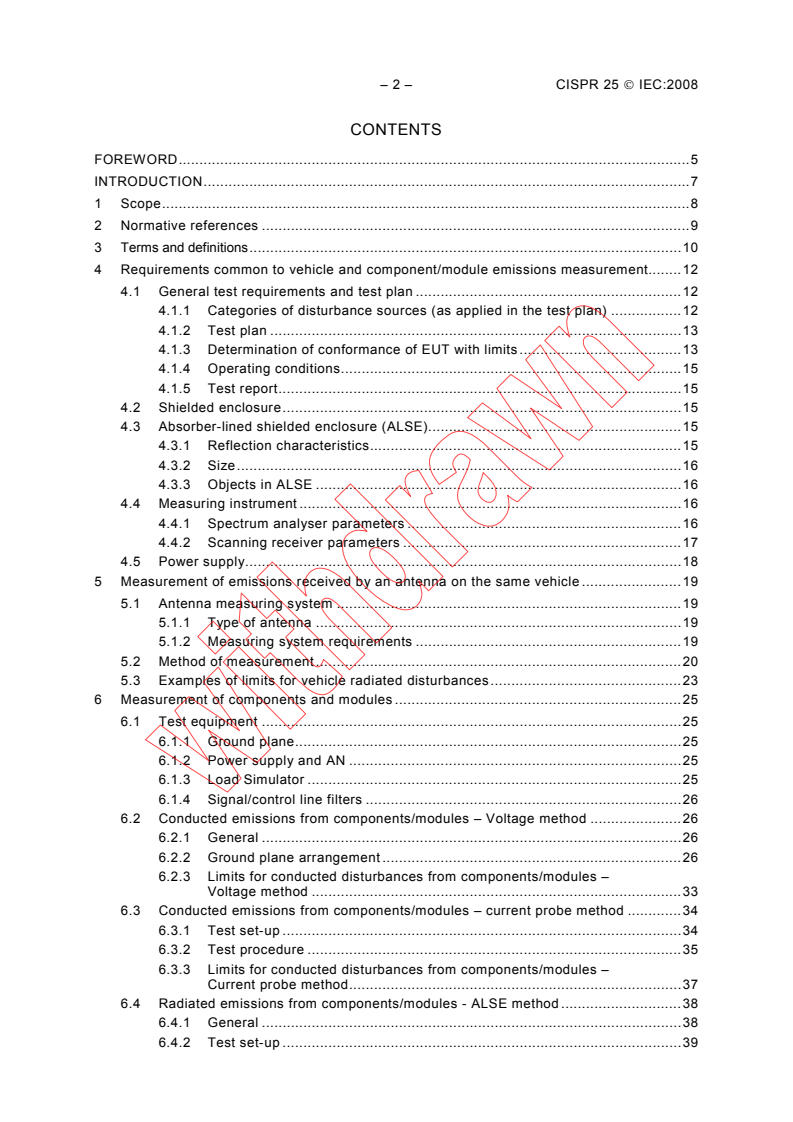
– 2 – CISPR 25 © IEC:2008
CONTENTS
FOREWORD.5
INTRODUCTION.7
1 Scope.8
2 Normative references .9
3 Terms and definitions.10
4 Requirements common to vehicle and component/module emissions measurement.12
4.1 General test requirements and test plan .12
4.1.1 Categories of disturbance sources (as applied in the test plan) .12
4.1.2 Test plan .13
4.1.3 Determination of conformance of EUT with limits .13
4.1.4 Operating conditions.15
4.1.5 Test report.15
4.2 Shielded enclosure.15
4.3 Absorber-lined shielded enclosure (ALSE).15
4.3.1 Reflection characteristics.15
4.3.2 Size.16
4.3.3 Objects in ALSE .16
4.4 Measuring instrument .16
4.4.1 Spectrum analyser parameters .16
4.4.2 Scanning receiver parameters .17
4.5 Power supply.18
5 Measurement of emissions received by an antenna on the same vehicle .19
5.1 Antenna measuring system .19
5.1.1 Type of antenna .19
5.1.2 Measuring system requirements .19
5.2 Method of measurement .20
5.3 Examples of limits for vehicle radiated disturbances.23
6 Measurement of components and modules .25
6.1 Test equipment .25
6.1.1 Ground plane.25
6.1.2 Power supply and AN .25
6.1.3 Load Simulator .25
6.1.4 Signal/control line filters .26
6.2 Conducted emissions from components/modules – Voltage method .26
6.2.1 General .26
6.2.2 Ground plane arrangement .26
6.2.3 Limits for conducted disturbances from components/modules –
Voltage method .33
6.3 Conducted emissions from components/modules – current probe method .34
6.3.1 Test set-up .34
6.3.2 Test procedure .35
6.3.3 Limits for conducted disturbances from components/modules –
Current probe method.37
6.4 Radiated emissions from components/modules - ALSE method .38
6.4.1 General .38
6.4.2 Test set-up .39
CISPR 25 © IEC:2008 – 3 –
6.4.3 Test procedure .41
6.4.4 Limits for radiated disturbances from components/modules – ALSE
method .47
6.5 Radiated emissions from components/modules – TEM cell method .49
6.5.1 General .49
6.5.2 Test set-up .51
6.5.3 Test procedure .52
6.5.4 Limits for radiated disturbances from components/modules – TEM
cell method.54
6.6 Radiated emissions from components/modules – Stripline method .56
Annex A (informative) Flow chart for checking the applicability of CISPR 25 .57
Annex B (normative) Antenna matching unit – Vehicle test .58
Annex C (informative) Sheath-current suppressor .60
Annex D (informative) Guidance for the determination of the noise floor of active
vehicle antennas in the AM and FM Range .61
Annex E (normative) Artificial network .64
Annex F (informative) TEM cell dimensions .66
Annex G (informative) Radiated emissions from components/modules – Stripline
method .68
Annex H (informative) Interference to mobile radio communication in the presence of
impulsive noise – Methods of judging degradation .76
Annex I (informative) Items Under Consideration .80
Bibliography.81
Figure 1 – Method of determination of conformance for all frequency bands .14
Figure 2 – Example of gain curve.20
Figure 3 – Vehicle-radiated emissions – Example for test layout (end view with
monopole antenna) .22
Figure 4 – Average limit for radiated disturbances from vehicles GPS band 1 567,42 to
1 583,42 MHz .24
Figure 5 – Example for the required minimum attenuation of the signal / control line
filters .26
Figure 6 – Conducted emissions – EUT with power return line remotely grounded. .29
Figure 7 – Conducted emissions – EUT with power return line locally grounded.30
Figure 8 – Conducted emissions – Test layout for alternators and generators.31
Figure 9 – Conducted emissions – Test layout for ignition system components .32
Figure 10 – Conducted emissions – Example of test layout for current probe
measurements .36
Figure 11 – Test harness bending requirements.40
Figure 12 – Example of test set-up – rod antenna .43
Figure 13 – Example of test set-up – biconical antenna .44
Figure 14 – Example of test set-up – log-periodic antenna.45
Figure 15 – Example of test set-up – above 1 GHz .46
Figure 16 – Example of average limit for radiated disturbances from components GPS
band 1 567,42 to 1 583,42 MHz – Class 5.49
Figure 17 – TEM cell (example) .50
– 4 – CISPR 25 © IEC:2008
Figure 18 – Example of arrangement of leads in the TEM cell and to the connector
panel .51
Figure 19 – Example of the arrangement of the connectors, the lead frame and the
dielectric support .52
Figure 20 – Example of the TEM cell method test layout .53
Figure B.1 –Verification set-up.59
Figure C.1 – Attenuation vs. frequency .60
Figure D.1 – Vehicle test set up for equipment noise measurement in the AM/FM range .62
Figure D.2 – Vehicle test set up for antenna noise measurement in the AM/FM range.63
Figure E.1 – Characteristics of the AN impedance .64
Figure E.2 – Example of 5 μH AN schematic.65
Figure F.1 – TEM cell .66
Figure G.1 – Example of a basic stripline test setup in a shielded enclosure.70
Figure G.2 – Example for a 50 Ω stripline .74
Figure G.3 – Example for a 90 Ω stripline .75
Table 1 – Spectrum analyser parameters.17
Table 2 – Scanning receiver parameters .18
Table 3 – Antenna types .19
Table 4 – Example for limits of disturbance – Complete vehicle .23
Table 5 – Examples of quasi-peak or peak limits for conducted disturbances – Voltage
Method .33
Table 6 – Examples of average limits for conducted disturbances – Voltage Method.34
Table 7 – Examples of quasi-peak and peak limits for conducted disturbances -
control/signal lines – Current probe method .37
Table 8 – Examples of average limits for conducted disturbances - control/signal lines
– Current probe method .38
Table 9 – Examples of quasi-peak or peak limits for radiated disturbances – ALSE .47
Table 10 – Examples of average limits for radiated disturbances – ALSE.48
Table 11 – Examples of quasi-peak or peak limits for radiated disturbances – TEM cell.55
Table 12 – Examples of average limits for radiated disturbances – TEM Cell .56
Table F.1 – Dimensions for TEM cells.67
Table G.1 – Examples of quasi-peak or peak limits for radiated disturbances –
Stripline .71
Table G.2 – Examples of average limits for radiated disturbances – Stripline.72
CISPR 25 © IEC:2008 – 5 –
INTERNATIONAL ELECTROTECHNICAL COMMISSION
INTERNATIONAL SPECIAL COMMITTEE ON RADIO INTERFERENCE
____________
VEHICLES, BOATS AND INTERNAL COMBUSTION ENGINES –
RADIO DISTURBANCE CHARACTERISTICS –
LIMITS AND METHODS OF MEASUREMENT FOR
THE PROTECTION OF ON-BOARD RECEIVERS
FOREWORD
1) The International Electrotechnical Commission (IEC) is a worldwide organization for standardization comprising
all national electrotechnical committees (IEC National Committees). The object of IEC is to promote
international co-operation on all questions concerning standardization in the electrical and electronic fields. To
this end and in addition to other activities, IEC publishes International Standards, Technical Specifications,
Technical Reports, Publicly Available Specifications (PAS) and Guides (hereafter referred to as “IEC
Publication(s)”). Their preparation is entrusted to technical committees; any IEC National Committee interested
in the subject dealt with may participate in this preparatory work. International, governmental and non-
governmental organizations liaising with the IEC also participate in this preparation. IEC collaborates closely
with the International Organization for Standardization (ISO) in accordance with conditions determined by
agreement between the two organizations.
2) The formal decisions or agreements of IEC on technical matters express, as nearly as possible, an international
consensus of opinion on the relevant subjects since each technical committee has representation from all
interested IEC National Committees.
3) IEC Publications have the form of recommendations for international use and are accepted by IEC National
Committees in that sense. While all reasonable efforts are made to ensure that the technical content of IEC
Publications is accurate, IEC cannot be held responsible for the way in which they are used or for any
misinterpretation by any end user.
4) In order to promote international uniformity, IEC National Committees undertake to apply IEC Publications
transparently to the maximum extent possible in their national and regional publications. Any divergence
between any IEC Publication and the corresponding national or regional publication shall be clearly indicated in
the latter.
5) IEC provides no marking procedure to indicate its approval and cannot be rendered responsible for any
equipment declared to be in conformity with an IEC Publication.
6) All users should ensure that they have the latest edition of this publication.
7) No liability shall attach to IEC or its directors, employees, servants or agents including individual experts and
members of its technical committees and IEC National Committees for any personal injury, property damage or
other damage of any nature whatsoever, whether direct or indirect, or for costs (including legal fees) and
expenses arising out of the publication, use of, or reliance upon, this IEC Publication or any other IEC
Publications.
8) Attention is drawn to the Normative references cited in this publication. Use of the referenced publications is
indispensable for the correct application of this publication.
9) Attention is drawn to the possibility that some of the elements of this IEC Publication may be the subject of
patent rights. IEC shall not be held responsible for identifying any or all such patent rights.
International Standard CISPR 25 has been prepared by CISPR subcommittee D:
Electromagnetic disturbances related to electric/electronic equipment on vehicles and internal
combustion engine powered devices.
This third edition cancels and replaces the second edition published in 2002. This edition
constitutes a technical revision.
The following significant changes were made with respect to the previous edition:
– addition of required measurements with both an average detector and a peak or quasi-
peak detector;
– addition of methods and limits for the protection of new analogue and digital radio
services, which cover the frequency range up to 2 500 MHz;
– addition of a new measurement method for components (stripline) as an informative
Annex G;
– 6 – CISPR 25 © IEC:2008
– addition of the contents of CISPR 21 as Annex H; CISPR 21 in its entirety now becomes
obsolete.
– deletion of narrowband / broadband determination;
– deletion of the Annex on rod antenna characterisation (this is now covered by
CISPR 16-1-4);
– deletion of the Annex on characterisation of shielded enclosure (CISPR 25 will be
amended when the CISPR/D / CISPR/A Joint Task Force on chamber validation finishes
its work).
The text of this standard is based on the following documents:
Enquiry draft Report on voting
CISPR/D/344/CDV CISPR/D/352/RVC
Full information on the voting for the approval of this standard can be found in the report on
voting indicated in the above Table.
This publication has been drafted in accordance with the ISO/IEC Directives, Part 2.
The committee has decided that the contents of this publication will remain unchanged until
the maintenance result date indicated on the IEC web site under "http://webstore.iec.ch" in
the data related to the specific publication. At this date, the publication will be
• reconfirmed,
• withdrawn,
• replaced by a revised edition, or
• amended.
The contents of the corrigendum of January 2009 have been included in this copy.
CISPR 25 © IEC:2008 – 7 –
INTRODUCTION
This International Standard is designed to protect on-board receivers from disturbances
produced by conducted and radiated emissions arising in a vehicle.
Test procedures and limits given are intended to provide provisional control of vehicle
radiated emissions, as well as component/module conducted/radiated emissions of long and
short duration.
To accomplish this end, this standard:
– establishes a test method for measuring the electromagnetic emissions from the
electrical system of a vehicle;
– sets limits for the electromagnetic emissions from the electrical system of a vehicle;
– establishes test methods for testing on-board components and modules independent
from the vehicle;
– sets limits for electromagnetic emissions from components to prevent objectionable
disturbance to on-board receivers;
– classifies automotive components by disturbance duration to establish a range of
limits.
NOTE Component tests are not intended to replace vehicle tests. Exact correlation between component and vehicle test
performance is dependent on component mounting location, harness length, routing and grounding, as well as antenna location.
Component testing, however, permits components to be evaluated prior to actual vehicle availability.
– 8 – CISPR 25 © IEC:2008
VEHICLES, BOATS AND INTERNAL COMBUSTION ENGINES –
RADIO DISTURBANCE CHARACTERISTICS –
LIMITS AND METHODS OF MEASUREMENT FOR
THE PROTECTION OF ON-BOARD RECEIVERS
1 Scope
This International Standard contains limits and procedures for the measurement of radio
disturbances in the frequency range of 150 kHz to 2 500 MHz. The standard applies to any
electronic/electrical component intended for use in vehicles, trailers and devices. Refer to
International Telecommunications Union (ITU) publications for details of frequency
allocations. The limits are intended to provide protection for receivers installed in a vehicle
from disturbances produced by components/modules in the same vehicle. The method and
limits for a complete vehicle are in Clause 5 and the methods and limits for
components/modules are in Clause 6. Only a complete vehicle test can be used to determine
the component compatibility with respect to a vehicle’s limit.
The receiver types to be protected are, for example, broadcast receivers (sound and
television), land mobile radio, radio telephone, amateur, citizens' radio, Satellite Navigation
(GPS, etc.) and Bluetooth. For the purpose of this standard, a vehicle is a machine, which is
self-propelled. Vehicles include (but are not limited to) passenger cars, trucks, agricultural
tractors and snowmobiles. Annex A provides guidance in determining whether this standard is
applicable to particular equipment.
The limits in this standard are recommended and subject to modification as agreed between
the vehicle manufacturer and the component supplier. This standard is also intended to be
applied by manufacturers and suppliers of components and equipment which are to be added
and connected to the vehicle harness or to an on-board power connector after delivery of the
vehicle.
This International Standard does not include protection of electronic control systems from
radio frequency (RF) emissions, or from transient or pulse-type voltage fluctuations. These
subjects are included in ISO publications.
Since the mounting location, vehicle body construction and harness design can affect the
coupling of radio disturbances to the on-board radio, Clause 6 of this standard defines
multiple limit levels. The level class to be used (as a function of frequency band) is agreed
upon between the vehicle manufacturer and the component supplier.
CISPR 25 defines test methods for use by vehicle manufacturers and suppliers, to assist in
the design of vehicles and components and ensure controlled levels of on-board radio
frequency emissions.
Vehicle test limits are provided for guidance and are based on a typical radio receiver using
the antenna provided as part of the vehicle, or a test antenna if a unique antenna is not
specified. The frequency bands that are defined are not applicable to all regions or countries
of the world. For economic reasons, the vehicle manufacturer must be free to identify what
frequency bands are applicable in the countries in which a vehicle will be marketed and which
radio services are likely to be used in that vehicle.
CISPR 25 © IEC:2008 – 9 –
As an example, many vehicle models will probably not have a television receiver installed; yet
the television bands occupy a significant portion of the radio spectrum. Testing and mitigating
noise sources in such vehicles is not economically justified.
The vehicle manufacturer should define the countries in which the vehicle is to be marketed,
then choose the applicable frequency bands and limits. Component test parameters can then
be selected from CISPR 25 to support the chosen marketing plan.
The World Administrative Radio communications Conference (WARC) lower frequency limit in
region 1 was reduced to 148,5 kHz in 1979. For vehicular purposes, tests at 150 kHz are
considered adequate. For the purposes of this standard, test frequency ranges have been
generalized to cover radio services in various parts of the world. Protection of radio reception
at adjacent frequencies can be expected in most cases.
Annex H defines a qualitative method of judging the degradation of radio communication in
the presence of impulsive noise.
Annex I lists work being considered for future revisions.
2 Normative references
The following referenced documents are indispensable for the application of this document.
For dated references, only the edition cited applies. For undated references, the latest edition
of the referenced document (including any amendments) applies.
IEC 60050-161:1990, International Electrotechnical Vocabulary (IEV) – Chapter 161:
Electromagnetic compatibility
Amendment 1:1997
Amendment 2:1998
CISPR 12:2007, Vehicles, motorboats, and internal combustion engine-driven devices – Radio
disturbance characteristics – Limits and methods of measurement for the protection of
receivers except those installed in the vehicle/boat/device itself or in adjacent
vehicles/boats/devices.
CISPR 16-1-1:2006, Specification for radio disturbance and immunity measuring apparatus
and methods – Part 1-1: Radio disturbance and immunity measuring apparatus – Measuring
apparatus
Amendment 1:2006
Amendment 2:2007
CISPR 16-1-2:2003, Specification for radio disturbance and immunity measuring apparatus
and methods – Part 1-2: Radio disturbance and immunity measuring apparatus – Ancillary
equipment – Conducted disturbances
Amendment 1:2004
Amendment 2:2006
CISPR 16-1-4:2007, Specification for radio disturbance and immunity measuring apparatus
and methods – Part 1-4: Radio disturbance and immunity measuring apparatus – Ancillary
equipment – Radiated disturbances
Amendment 1:2007
CISPR 16-2-3:2006, Specification for radio disturbance and immunity measuring apparatus
and methods – Part 2-3: Methods of measurement of disturbances and immunity – Radiated
disturbance measurements
– 10 – CISPR 25 © IEC:2008
ISO 11452-4:2005 - Road vehicles – Component test methods for electrical disturbances from
narrowband radiated electromagnetic energy – Part 4: Bulk current injection (BCI)
SAE ARP 958.1 Rev D:2003-02 – Electromagnetic Interference Measurement Antennas;
Standard Calibration Method
3 Terms and definitions
For the purposes of this document, the following terms and definitions apply.
3.1
absorber lined shielded enclosure (ALSE)
shielded enclosure/screened room with radio frequency-absorbing material on its internal
ceiling and walls
3.2
antenna factor
the factor which is applied to the voltage measured at the input connector of the measuring
instrument to give the field strength at the antenna
3.3
antenna matching unit
a unit for matching the impedance of an antenna to that of the 50 Ω measuring instrument
over the antenna measuring frequency range
3.4
class
a performance level agreed upon by the purchaser and the supplier and documented in the
test plan
3.5
component continuous conducted emissions
the noise voltages/currents of a steady-state nature existing on the supply or other leads of a
component/module which may cause disturbance to reception in an on-board receiver.
3.6
compression point
the input signal level at which the gain of the measuring system becomes non-linear such that
the indicated output deviates from an ideal linear receiving system's output by the specified
increment in dB
3.7
device
a machine driven by an internal combustion engine which is not primarily intended to carry
persons or goods.
NOTE Devices include, but are not limited to, chainsaws, irrigation pumps, snow blowers, air compressors, and
landscaping equipment.
3.8
receiver terminal voltage (antenna voltage)
the voltage generated by a source of radio disturbance and measured in dB (μV) by a radio
disturbance measuring instrument conforming to the requirements of CISPR 16
CISPR 25 © IEC:2008 – 11 –
3.9
RF boundary
an element of an EMC test set-up that determines what part of the harness and/or peripherals
are included in the RF environment and what is excluded. It may consist of, for example,
ANs, filter feed-through pins, RF absorber coated wire, and/or RF shielding
3.10
artificial network (AN) ; line impedance stabilization network (LISN )
a network inserted in the supply lead or signal/load lead of apparatus to be tested which
provides, in a given frequency range, a specified load impedance for the measurement of
disturbance voltages and which may isolate the apparatus from the supply or signal
sources/loads in that frequency range
[IEV 161-04-05, modified]
3.11
average detector
a detector, the output voltage of which is the average value of the envelope of an applied
signal
NOTE The average value must be taken over a specified time interval.
[IEV 161-04-26]
3.12
bandwidth
3.12.1
bandwidth (of an equipment)
the width of a frequency band over which a given characteristic of an equipment or
transmission channel does not differ from its reference value by more than a specified amount
or ratio
NOTE The given characteristic may be, for example, the amplitude/frequency characteristic, the phase/frequency
characteristic or the delay/frequency characteristic.
[IEV 161-06-09, modified]
3.12.2
bandwidth (of an emission or signal)
the width of the frequency band outside which the level of any spectral component does not
exceed a specified percentage of a reference level
[IEV 161-06-10]
3.13
broadband emission
an emission which has a bandwidth greater than that of a particular measuring apparatus or
receiver
[IEV 161-06-11, modified]
NOTE An emission which has a pulse repetition rate (in Hz) less than the bandwidth of a particular measuring
instrument can also be considered as a broadband emission.
3.14
disturbance suppression
action which reduces or eliminates electromagnetic disturbance
[IEV 161-03-22]
—————————
USA
– 12 – CISPR 25 © IEC:2008
3.15
disturbance voltage; interference voltage (deprecated in this sense)
voltage produced between two points on two separate conductors by an electromagnetic
disturbance, measured under specified conditions
[IEV 161-04-01]
3.16
electromagnetic environment
the totality of electromagnetic phenomena existing at a given location
[IEV 161-01-01]
3.17
ground (reference) plane
a flat conductive surface whose potential is used as a common reference.
[IEV 161-04-36]
3.18
narrowband emission
an emission which has a bandwidth less than that of a particular measuring apparatus or
receiver
[IEV 161-06-13]
NOTE An emission which has a pulse repetition rate (in Hz) greater than the bandwidth of a particular measuring
instrument can also be considered as a narrowband emission.
3.19
peak detector
a detector, the output voltage of which is the peak value of an applied signal
[IEV 161-04-24]
3.20
quasi-peak detector
a detector having specified electrical time constants which, when regularly repeated identical
pulses are applied to it, delivers an output voltage which is a fraction of the peak value of the
pulses, the fraction increasing towards unity as the pulse repetition rate is increased
[IEV 161-04-21]
3.21
shielded enclosure; screened room
a mesh or sheet metallic housing designed expressly for the purpose of separating
electromagnetically the internal and the external environment
[IEV 161-04-37]
4 Requirements common to vehicle and component/module emissions
measurement
4.1 General test requirements and test plan
4.1.1 Categories of disturbance sources (as applied in the test plan)
Electromagnetic disturbance sources can be divided into two main types:
CISPR 25 © IEC:2008 – 13 –
• Narrowband sources (examples of narrowband disturbance sources are vehicle electronic
components which include clocks, oscillators, digital logic from microprocessors and
displays).
• Broadband sources (examples of broadband disturbance sources are electrical motors
and ignition system).
NOTE 1 While most vehicle or electrical/electronic components are a source of both narrowband and broadband
disturbances, some may be a source of only one type of disturbance.
NOTE 2 Broadband sources can be classified in short-duration broadband (examples are washer pump, door
mirror, electrical windows) and long-duration broadband (examples are front wiper motor, heater blower, engine
cooling).
For the purposes of this standard, categorization of the disturbance type is used only in
simplifying the testing demands by potentially reducing the number of detectors that shall be
used (i.e. eliminating the average detector if the device is known to be broadband-type of
source, such as a d.c. brush commutated motor). Otherwise, this standard requires that
sources comply with limits based upon both types of measurement detectors and not the type
of disturbance.
4.1.2 Test plan
A test plan shall be established for each item to be tested. The test plan shall specify the
• frequency range to be tested,
• the emissions limits,
• antenna types and locations,
• test report requirements,
• supply voltage and other relevant parameters.
The test plan shall define for each frequency band whether the conformance can be obtained
with average and peak limits or with average and quasi-peak limits.
4.1.3 Determination of conformance of EUT with limits
In all cases the EUT shall conform with the average limit.
The EUT shall also conform with either peak or quasi-peaks limits as follows.
• For frequencies where both peak and quasi-peak limits are defined, the EUT shall conform
with either the peak or the quasi-peak limits (as defined in the test plan).
• For frequencies where only peak limits are defined, the EUT shall conform with the peak
limit.
The general procedure applicable for all frequency bands is described in Figure 1.
The limits given in this standard take into account uncertainties.
– 14 – CISPR 25 © IEC:2008
Start
(1)
Applicable limits :
Average and peak Average and quasi-peak
average and peak or
average and quasi-peak?
Measurement with
Measurement with
peak detector peak detector
(2) (2)
Are the peak Are the peak
Yes Yes
data below the data below the
average limit? average limit?
No No
Are the peak
Are the peak Yes Yes
data below the
data below the
quasi-peak limit?
peak limit?
No
No
Measurement with
(3)
quasi-peak detector
Are the quasi-peak
Yes
data below the
quasi-peak limit?
No
Measurement with Measurement with
(3) (3)
average detector average detector
No Are the average Yes Yes Are the average No
data below the data below the
average limit? average limit?
Fail Pass Fail
IEC 051/09
NOTE 1 The conformance should normally be obtained by compliance to both average and peak limits or both
average and quasi-peak limits unless the test plan defines that conformance can be obtained by compliance to the
single appropriate limit) (depending on the case, peak, or average, or quasi-peak).
NOTE 2 Because measurement with peak detector is always higher or equal to measurement with average
detector and applicable peak limit is always higher or equal to applicable average limit, this single detector
measurement can lead to a simplified and quicker conformance process.
NOTE 3 This flow-chart is applicable for each individual frequency, e.g. only frequencies that are above the
applicable limit need be remeasured with average or quasi-peak detector.
Figure 1 – Method of determination of conformance for all frequency bands
CISPR 25 © IEC:2008 – 15 –
4.1.4 Operating conditions
Different operating conditions of the EUT can influence emission measurement results. When
performing component/module tests, the EUT shall be made to operate under typical loading
and other conditions as in the vehicle such that the maximum emission state occurs. The
operating conditions shall be specified in the test plan.
To ensure correct operation of components/modules during test, a peripheral interface unit
shall be used which simulates the vehicle installation. Depending on the intended operating
modes, all significant sensor and actuator leads of the EUT shall be connected to a peripheral
interface unit. The peripheral interface unit shall be capable of controlling the EUT in
accordance with the test plan.
The peripheral interface unit may be located internal or external to the shielded enclosure. If
located in the shielded enclosure, the disturbance levels generated by the peripheral interface
unit shall be at least 6 dB below the test limits specified in the test plan.
4.1.5 Test report
The report shall contain the information agreed upon by the customer and the supplier, e.g.
• sample identification,
• date and time of test,
• bandwidth,
• step size,
• required test limit,
• ambient data
• test data.
4.2 Shielded enclosure
The ambient electromagnetic noise levels shall be at least 6 dB below the limits specified in
the test plan for each test to be performed. The shielding effectiveness of the shielded
enclosure shall be sufficient to ensure that the required ambient electromagnetic noise level
requirement is met.
NOTE Although there will be reflected energy from the interior surfaces of the shielded enclosure, this is of
minimal concern for the measurement of conducted disturbances because of the direct coupling of the measuring
instrument to the leads of the EUT. The shielded enclosure may be as simple as a suitably grounded bench-top
screened cage.
4.3 Absorber-lined shielded enclosure (ALSE)
For radiated emission measurements, however, the reflected energy can cause errors of as
much as 20 dB. Therefore, it is necessary to apply RF absorber material to the wal
...