CISPR 25:2002/COR1:2004
(Corrigendum)Corrigendum 1 - Radio disturbance characteristics for the protection of receivers used on board vehicles, boats, and on devices - Limits and methods of measurement
Corrigendum 1 - Radio disturbance characteristics for the protection of receivers used on board vehicles, boats, and on devices - Limits and methods of measurement
Corrigendum 1 - Caractéristiques des perturbations radioélectriques pour la protection des récepteurs utilisés à bord des véhicules, des bateaux et des engins - Limites et méthodes de mesure
General Information
Relations
Standards Content (Sample)
CISPR 25 CISPR 25
(Deuxième édition – 2002-08) (Second edition – 2002-08)
Caractéristiques des perturbations Radio disturbance characteristics for the
radioélectriques pour la protection des protection of receivers used on board
récepteurs utilisés à bord des véhicules, vehicles, boats, and on devices -
des bateaux et des engins - Limits and methods of measurement
Limites et méthodes de mesure
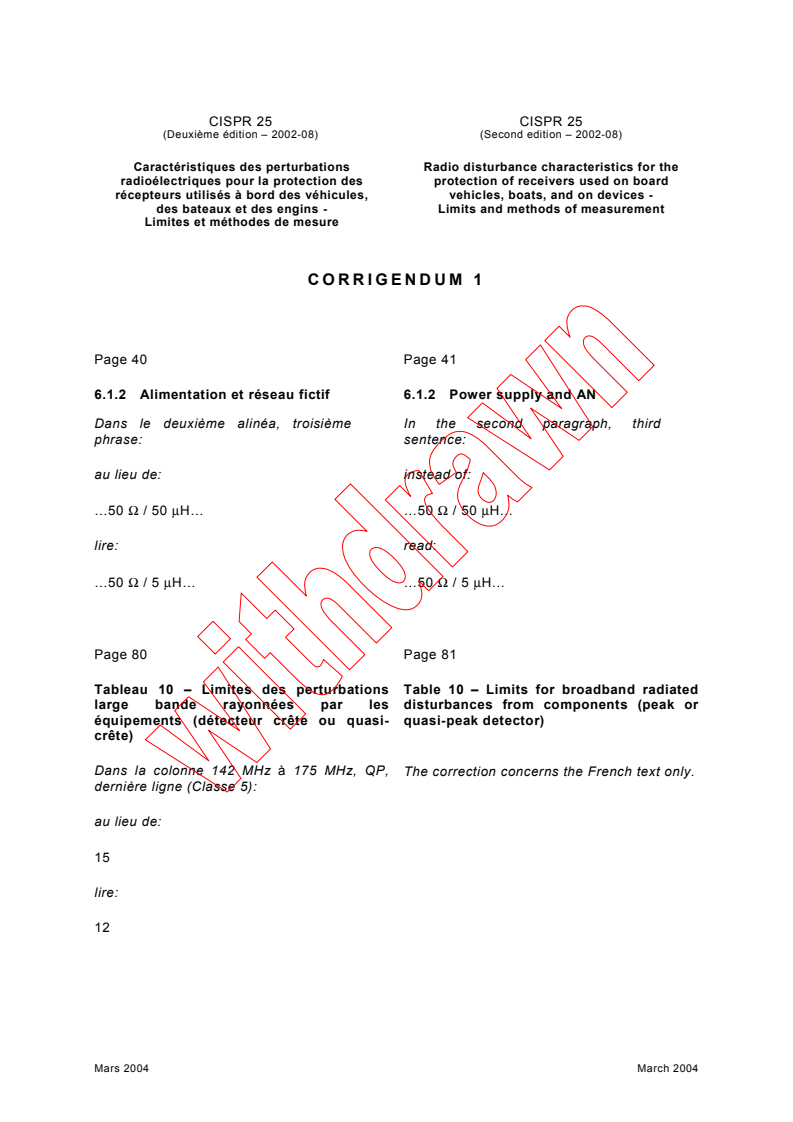
CORRIGENDUM 1
Page 40 Page 41
6.1.2 Alimentation et réseau fictif 6.1.2 Power supply and AN
Dans le deuxième alinéa, troisième In the second paragraph,
...
This May Also Interest You
- Standard22 pagesEnglish and French languagesale 15% off
CISPR 36:2020 defines limits for 3 m measurement distance and methods of measurement that are designed to provide protection for off-board receivers (at 10 m distance) in the frequency range of 150 kHz to 30 MHz when used in the residential environment.
NOTE Protection of receivers used on board the same vehicle as the disturbance source(s) is covered by CISPR 25.
This document applies to the emission of electromagnetic energy which might cause interference to radio reception and which is emitted from electric and hybrid electric vehicles propelled by an internal traction battery (see 3.2 and 3.3) when operated on the road. This document applies to vehicles that have a traction battery voltage between 100 V and 1 000 V.
Electric vehicles to which CISPR 14-1 applies are not in the scope of this document. This document applies only to road vehicles where an electric propulsion is used for sustained speed of more than 6 km/h. Vehicles where the electric motor is only used to start up the internal combustion engine (e.g. "micro hybrid") and vehicles where the electric motor is used for additional propulsion only during acceleration (e.g. "48 V mild hybrid vehicles") are not in the scope of this document. The radiated emission requirements in this document are not applicable to the intentional transmissions from a radio transmitter as defined by the ITU including their spurious emissions. Annex C lists work being considered for future revisions.
- Standard48 pagesEnglish and French languagesale 15% off
- Standard104 pagesEnglish and French languagesale 15% off
CISPR 25:2021 contains limits and procedures for the measurement of radio disturbances in the frequency range of 150 kHz to 5 925 MHz. This document applies to vehicles, boats, internal combustion engines, trailers, devices and any electronic/electrical component intended for use in vehicles, boats, trailers and devices. Refer to International Telecommunications Union (ITU) publications for details of frequency allocations. The limits are intended to provide protection for on-board receivers installed (per the manufacturer’s guidelines) in a vehicle from disturbances produced by components/modules in the same vehicle. The receiver types to be protected are, for example, broadcast receivers (sound and television), land mobile radio, radio telephone, amateur, citizens' radio, Satellite Navigation (GPS etc.), Wi-Fi, V2X, and Bluetooth. This document does not include protection of electronic control systems from radio frequency (RF) emissions or from transient or pulse-type voltage fluctuations. These subjects are included in ISO publications. The limits in this document are recommended and subject to modification as agreed between the customer (e.g. vehicle manufacturer) and the supplier (e.g. component manufacturer). This document is also intended to be applied by vehicle manufacturers and suppliers which are to be added and connected to the vehicle harness or to an on-board power connector after delivery of the vehicle. This document defines test methods for use by vehicle manufacturers and suppliers, to assist in the design of vehicles and components and ensure controlled levels of on-board radio frequency emissions. The emission requirements in this document are not intended to be applicable to the intentional transmissions from a radio transmitter as defined by the ITU including their spurious emissions.
NOTE 1 This exclusion is limited to those intended transmitter emissions, which leave the EUT as radiated emissions and are coupled onto the wire line in the measurement setup. For conducted transmissions on frequencies intentionally produced by the radio part of an EUT, this exclusion does not apply.
NOTE 2 It is usual for customers and suppliers to use radio regulation standards to manage the effect of spurious emissions from a radio transmitter unless limits of spurious emission are agreed in the test plan.
This fifth edition cancels and replaces the fourth edition published in 2016. This edition constitutes a technical revision. This edition includes the following significant technical changes with respect to the previous edition:
inclusion of new frequency bands,
deletion of the annex on TEM cells,
inclusion of annexes on measurement uncertainty,
overall improvement.
- Standard372 pagesEnglish and French languagesale 15% off
- Standard4 pagesEnglish and French languagesale 15% off
CISPR 25:2016 contains limits and procedures for the measurement of radio disturbances in the frequency range of 150 kHz to 2 500 MHz. The standard applies to any electronic/electrical component intended for use in vehicles, trailers and devices. Refer to International Telecommunications Union (ITU) publications for details of frequency allocations. The limits are intended to provide protection for receivers installed in a vehicle from disturbances produced by components/modules in the same vehicle. The method and limits for a complete vehicle (whether connected to the power mains for charging purposes or not) are in Clause 5 and the methods and limits for components/modules are in Clause 6. Only a complete vehicle test can be used to determine the component compatibility with respect to a vehicle's limit. The receiver types to be protected are, for example, broadcast receivers (sound and television), land mobile radio, radio telephone, amateur, citizens' radio, Satellite Navigation (GPS etc.), Wi-Fi and Bluetooth. For the purpose of this standard, a vehicle is a machine, which is self-propelled by an internal combustion engine, electric means, or both. Vehicles include (but are not limited to) passenger cars, trucks, agricultural tractors and snowmobiles. Annex A provides guidance in determining whether this standard is applicable to particular equipment. This fourth edition cancels and replaces the third edition published in 2008. This edition constitutes a technical revision. This edition includes the following significant technical changes with respect to the previous edition:
- inclusion of charging mode for electric vehicles (EV) and plug-in electric vehicles (PHEV),
- the methods for chamber validation have been included,
- test methods for shielded power supply systems for high voltages for electric and hybrid electric vehicles have been included,
- overall improvement.
The contents of the corrigendum of October 2017 have been included in this copy.
- Standard320 pagesEnglish and French languagesale 15% off
- Standard10 pagesEnglish and French languagesale 15% off
CISPR 25:2008 contains limits and procedures for the measurement of radio disturbances in the frequency range of 150 kHz to 2 500 MHz. The standard applies to any electronic/electrical component intended for use in vehicles, trailers and devices. Refer to International Telecommunications Union (ITU) publications for details of frequency allocations. The limits are intended to provide protection for receivers installed in a vehicle from disturbances produced by components/modules in the same vehicle. The method and limits for a complete vehicle are in Clause 5 and the methods and limits for components/modules are in Clause 6. Only a complete vehicle test can be used to determine the component compatibility with respect to a vehicle's limit. The receiver types to be protected are, for example, broadcast receivers (sound and television), land mobile radio, radio telephone, amateur, citizens' radio, Satellite Navigation (GPS, etc.) and Bluetooth. For the purpose of this standard, a vehicle is a machine, which is self-propelled. Vehicles include (but are not limited to) passenger cars, trucks, agricultural tractors and snowmobiles. Annex A provides guidance in determining whether this standard is applicable to particular equipment. The limits in this standard are recommended and subject to modification as agreed between the vehicle manufacturer and the component supplier. This standard is also intended to be applied by manufacturers and suppliers of components and equipment which are to be added and connected to the vehicle harness or to an on-board power connector after delivery of the vehicle. This third edition cancels and replaces the second edition published in 2002. The following significant changes were made with respect to the previous edition:
- addition of required measurements with both an average detector and a peak or quasi-peak detector;
- addition of methods and limits for the protection of new analogue and digital radio services, which cover the frequency range up to 2 500 MHz;
- addition of a new measurement method for components (stripline) as an informative Annex G;
- addition of the contents of CISPR 21 as Annex H; CISPR 21 in its entirety now becomes obsolete;
- deletion of narrowband / broadband determination;
- deletion of the Annex on rod antenna characterisation (this is now covered by CISPR 16-1-4);
- deletion of the Annex on characterisation of shielded enclosure (CISPR 25 will be amended when the CISPR/D / CISPR/A Joint Task Force on chamber validation finishes its work). The contents of the corrigendum of January 2009 have been included in this copy.
- Standard168 pagesEnglish and French languagesale 15% off
- Standard10 pagesEnglish languagesale 15% off
This standard is designed to protect receivers from disturbances produced by conducted and radiated emissions arising in a vehicle. Test procedures and limits given are intended to provide provisional control of vehicle-radiated emissions, as well as component/module conducted/radiated emissions of long and short duration. The standard: - establishes a test method for measuring the electromagnetic emissions from the electrical system of a vehicle; - sets limits for the electromagnetic emissions from the electrical system of a vehicle; - establishes test methods for testing on-board components and modules independent from the vehicle; - sets limits for electromagnetic emissions from components to prevent objectionable disturbance to on-board receivers; - classifies automotive components by disturbance duration to establish a range of limits. The contents of the corrigendum of March 2004 and the interpretation sheet of February 2007 have been included in this copy.
- Standard62 pagesEnglish languagesale 15% off
- Standard62 pagesFrench languagesale 15% off
- Standard123 pagesEnglish and French languagesale 15% off
CISPR TR 16-4-4:2025 which is a Technical Report, establishes the CISPR model for the calculation of limits for the protection of radio services, based on data from the IEC Radio Services Database (RSD) and estimations of the input values for related probabilistic factors. This is part of the process of the derivation of disturbance limits in the radio frequency spectrum for use in publications containing emission requirements Application of this document leads to a frequency dependent limit result for a particular disturbance phenomenon and the considered product or product type establishing the technical basis in the CISPR limit specification procedure.
NOTE Non-technical parameters and terms that can be considered to influence a limit for inclusion in IEC publications are excluded from the modelling (see also Clause 4.6.5.3).
This third edition cancels and replaces the second edition published in 2007, Amendment 1:2017 and Amendment 2:2020. This edition constitutes a technical revision. This edition includes the following significant technical changes with respect to the previous edition:
a) full revision of the limit calculation model;
b) the content on statistics of complaints was taken from this publication and published as separate document (CISPR TR 16-4-6);
c) application cases/rationales were separated from the model and will be handled in another document to be drafted.
- Technical report57 pagesEnglish languagesale 15% off


Questions, Comments and Discussion
Ask us and Technical Secretary will try to provide an answer. You can facilitate discussion about the standard in here.
Loading comments...