


IEC 60335-2-29:2016/AMD1:2019
(Amendment)Amendment 1 - Household and similar electrical appliances - Safety - Part 2-29: Particular requirements for battery chargers
Amendment 1 - Household and similar electrical appliances - Safety - Part 2-29: Particular requirements for battery chargers
Amendement 1 - Appareils électrodomestiques et analogues - Sécurité - Partie 2-29: Exigences particulières pour les chargeurs de batterie
General Information
- Status
- Published
- Publication Date
- 28-Mar-2019
- Technical Committee
- TC 61 - Safety of household and similar electrical appliances
- Drafting Committee
- MT 37 - TC 61/MT 37
- Current Stage
- PPUB - Publication issued
- Start Date
- 29-Mar-2019
- Completion Date
- 26-Apr-2019
Relations
- Effective Date
- 05-Sep-2023
Overview
IEC 60335-2-29:2016/AMD1:2019 is an important amendment to the international safety standard specifically addressing household and similar electrical appliances-focusing on battery chargers. Developed by IEC Technical Committee 61, this amendment updates the particular requirements to ensure enhanced safety, reliability, and performance of battery chargers used in residential and related environments. It supplements the base edition IEC 60335-2-29:2016, specifying revised voltage limits, construction norms, marking requirements, and testing protocols essential for manufacturers, testing bodies, and regulators.
This document plays a vital role in defining safety thresholds and operational guidelines for battery chargers, supporting harmonization in global manufacturing and compliance assessment. By adhering to this amendment, manufacturers can help protect users from electrical hazards, ensure product interoperability, and comply with international laws and directives.
Key Topics
Scope Revision
The amendment extends the permissible output voltage limit from 120 V to 250 V DC for certain battery charger categories, broadening the applicability to higher voltage devices.Normative References
Addition of IEC 61558-2-4:2009, which specifies safety requirements for isolating transformers and power supply units, ensuring that these critical components within battery chargers meet rigorous standards.Technical Definitions and Classifications
Revised terms include clearly defined operational states, like "normal operation," rated DC output voltage/current, and distinctions between type 1 (safety isolating transformer supplied) and type 2 (isolating transformer supplied) battery chargers.Marking and Instruction Improvements
New mandatory signs and instructions improve user awareness:- Advisories such as “Before charging, read the instructions” or relevant ISO/IEC symbols.
- Indoor use or “Do not expose to moisture” warnings.
- Specific instructions for battery placement during charging, safe usage, and warnings against recharging non-rechargeable batteries.
Electrical Safety Enhancements
Requirements updated for:- Protection against access to live parts, especially for type 2 chargers.
- Voltage and current accuracy limits, ensuring output does not exceed rated values by more than ±10%.
- Insulation standards involving reinforced or double insulation for sections operating at extra-low voltages.
Construction and Component Specifications
- Mandatory use of isolating or safety isolating transformers subject to testing per IEC 61558-2-4.
- Reinforced insulation between live parts and accessible metallic parts.
- New annex (Annex BB) detailing specific tests and clearances for isolating transformers to enhance electrical safety and reliability.
Applications
IEC 60335-2-29:2016/AMD1:2019 is critical for:
Manufacturers of Battery Chargers
Integrating the amendment ensures that chargers designed for lead-acid or other rechargeable batteries meet the latest international safety and performance standards, reducing liability and enhancing market acceptance.Product Testing and Certification Bodies
Adopting these updated testing methods and definitions enables accurate verification of compliance for both type 1 and type 2 battery chargers, facilitating global certification and regulatory approval.End Users and Importers
Guidance on labeling and instructions helps consumers use battery chargers safely-avoiding hazards related to improper usage, inadequate ventilation, or incompatible battery types.Design Engineers and Quality Controllers
Defining clear safety margins, transformer performance, voltage limits, and construction materials supports improved product design, ensuring longevity and safety during normal operation.
Related Standards
IEC 60335-2-29:2016
The base standard for safety of household and similar electrical appliances-battery chargers; this amendment modifies and extends particular requirements.IEC 61558-2-4:2009
Safety specifications for isolating transformers and power supply units, now referenced for transformer testing and performance criteria.IEC 60417 and ISO 7000 Symbols
Provides internationally recognized graphical symbols for user instructions and appliance markings related to indoor use and care requirements.IEC 60664-4
Pertains to clearances and creepage distances for electrical insulation tested for higher-frequency voltage stresses, referenced in transformer insulation requirements.
By implementing IEC 60335-2-29:2016/AMD1:2019 fully, stakeholders in the battery charger ecosystem will achieve greater safety compliance, enhanced product reliability, and alignment with evolving global electrical safety expectations. This amendment supports safer battery charging technologies critical for modern household and industrial applications.
Get Certified
Connect with accredited certification bodies for this standard

Intertek Testing Services NA Inc.
Intertek certification services in North America.

UL Solutions
Global safety science company with testing, inspection and certification.

ANCE
Mexican certification and testing association.
Sponsored listings
Frequently Asked Questions
IEC 60335-2-29:2016/AMD1:2019 is a standard published by the International Electrotechnical Commission (IEC). Its full title is "Amendment 1 - Household and similar electrical appliances - Safety - Part 2-29: Particular requirements for battery chargers". This standard covers: Amendment 1 - Household and similar electrical appliances - Safety - Part 2-29: Particular requirements for battery chargers
Amendment 1 - Household and similar electrical appliances - Safety - Part 2-29: Particular requirements for battery chargers
IEC 60335-2-29:2016/AMD1:2019 is classified under the following ICS (International Classification for Standards) categories: 29.200 - Rectifiers. Convertors. Stabilized power supply; 97.180 - Miscellaneous domestic and commercial equipment. The ICS classification helps identify the subject area and facilitates finding related standards.
IEC 60335-2-29:2016/AMD1:2019 has the following relationships with other standards: It is inter standard links to IEC 60335-2-29:2016. Understanding these relationships helps ensure you are using the most current and applicable version of the standard.
IEC 60335-2-29:2016/AMD1:2019 is available in PDF format for immediate download after purchase. The document can be added to your cart and obtained through the secure checkout process. Digital delivery ensures instant access to the complete standard document.
Standards Content (Sample)
IEC 60335-2-29 ®
Edition 5.0 2019-03
INTERNATIONAL
STANDARD
NORME
INTERNATIONALE
A MENDMENT 1
AM ENDEMENT 1
Household and similar electrical appliances – Safety –
Part 2-29: Particular requirements for battery chargers
Appareils électrodomestiques et analogues – Sécurité –
Partie 2-29: Exigences particulières pour les chargeurs de batterie
IEC 60335-2-29:2016-06/AMD1:2019-03(en-fr)
All rights reserved. Unless otherwise specified, no part of this publication may be reproduced or utilized in any form
or by any means, electronic or mechanical, including photocopying and microfilm, without permission in writing from
either IEC or IEC's member National Committee in the country of the requester. If you have any questions about IEC
copyright or have an enquiry about obtaining additional rights to this publication, please contact the address below or
your local IEC member National Committee for further information.
Droits de reproduction réservés. Sauf indication contraire, aucune partie de cette publication ne peut être reproduite
ni utilisée sous quelque forme que ce soit et par aucun procédé, électronique ou mécanique, y compris la photocopie
et les microfilms, sans l'accord écrit de l'IEC ou du Comité national de l'IEC du pays du demandeur. Si vous avez des
questions sur le copyright de l'IEC ou si vous désirez obtenir des droits supplémentaires sur cette publication, utilisez
les coordonnées ci-après ou contactez le Comité national de l'IEC de votre pays de résidence.
IEC Central Office Tel.: +41 22 919 02 11
3, rue de Varembé info@iec.ch
CH-1211 Geneva 20 www.iec.ch
Switzerland
About the IEC
The International Electrotechnical Commission (IEC) is the leading global organization that prepares and publishes
International Standards for all electrical, electronic and related technologies.
About IEC publications
The technical content of IEC publications is kept under constant review by the IEC. Please make sure that you have the
latest edition, a corrigendum or an amendment might have been published.
IEC publications search - webstore.iec.ch/advsearchform Electropedia - www.electropedia.org
The advanced search enables to find IEC publications by a The world's leading online dictionary on electrotechnology,
variety of criteria (reference number, text, technical containing more than 22 000 terminological entries in English
committee,…). It also gives information on projects, replaced and French, with equivalent terms in 16 additional languages.
and withdrawn publications. Also known as the International Electrotechnical Vocabulary
(IEV) online.
IEC Just Published - webstore.iec.ch/justpublished
Stay up to date on all new IEC publications. Just Published IEC Glossary - std.iec.ch/glossary
details all new publications released. Available online and 67 000 electrotechnical terminology entries in English and
once a month by email. French extracted from the Terms and Definitions clause of
IEC publications issued since 2002. Some entries have been
IEC Customer Service Centre - webstore.iec.ch/csc collected from earlier publications of IEC TC 37, 77, 86 and
If you wish to give us your feedback on this publication or CISPR.
need further assistance, please contact the Customer Service
Centre: sales@iec.ch.
A propos de l'IEC
La Commission Electrotechnique Internationale (IEC) est la première organisation mondiale qui élabore et publie des
Normes internationales pour tout ce qui a trait à l'électricité, à l'électronique et aux technologies apparentées.
A propos des publications IEC
Le contenu technique des publications IEC est constamment revu. Veuillez vous assurer que vous possédez l’édition la
plus récente, un corrigendum ou amendement peut avoir été publié.
Recherche de publications IEC - Electropedia - www.electropedia.org
webstore.iec.ch/advsearchform Le premier dictionnaire d'électrotechnologie en ligne au
La recherche avancée permet de trouver des publications IEC monde, avec plus de 22 000 articles terminologiques en
en utilisant différents critères (numéro de référence, texte, anglais et en français, ainsi que les termes équivalents dans
comité d’études,…). Elle donne aussi des informations sur les 16 langues additionnelles. Egalement appelé Vocabulaire
projets et les publications remplacées ou retirées. Electrotechnique International (IEV) en ligne.
IEC Just Published - webstore.iec.ch/justpublished Glossaire IEC - std.iec.ch/glossary
Restez informé sur les nouvelles publications IEC. Just 67 000 entrées terminologiques électrotechniques, en anglais
Published détaille les nouvelles publications parues. et en français, extraites des articles Termes et Définitions des
Disponible en ligne et une fois par mois par email. publications IEC parues depuis 2002. Plus certaines entrées
antérieures extraites des publications des CE 37, 77, 86 et
Service Clients - webstore.iec.ch/csc CISPR de l'IEC.
Si vous désirez nous donner des commentaires sur cette
publication ou si vous avez des questions contactez-nous:
sales@iec.ch.
IEC 60335-2-29 ®
Edition 5.0 2019-03
INTERNATIONAL
STANDARD
NORME
INTERNATIONALE
A MENDMENT 1
AM ENDEMENT 1
Household and similar electrical appliances – Safety –
Part 2-29: Particular requirements for battery chargers
Appareils électrodomestiques et analogues – Sécurité –
Partie 2-29: Exigences particulières pour les chargeurs de batterie
INTERNATIONAL
ELECTROTECHNICAL
COMMISSION
COMMISSION
ELECTROTECHNIQUE
INTERNATIONALE
ICS 29.200; 97.180 ISBN 978-2-8322-6690-8
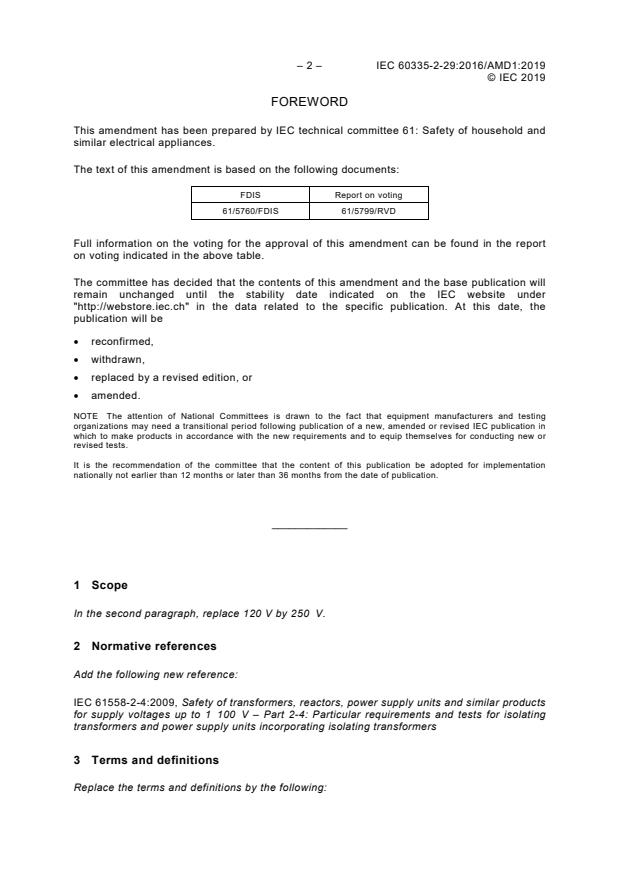
– 2 – IEC 60335-2-29:2016/AMD1:2019
© IEC 2019
FOREWORD
This amendment has been prepared by IEC technical committee 61: Safety of household and
similar electrical appliances.
The text of this amendment is based on the following documents:
FDIS Report on voting
61/5760/FDIS 61/5799/RVD
Full information on the voting for the approval of this amendment can be found in the report
on voting indicated in the above table.
The committee has decided that the contents of this amendment and the base publication will
remain unchanged until the stability date indicated on the IEC website under
"http://webstore.iec.ch" in the data related to the specific publication. At this date, the
publication will be
• reconfirmed,
• withdrawn,
• replaced by a revised edition, or
• amended.
NOTE The attention of National Committees is drawn to the fact that equipment manufacturers and testing
organizations may need a transitional period following publication of a new, amended or revised IEC publication in
which to make products in accordance with the new requirements and to equip themselves for conducting new or
revised tests.
It is the recommendation of the committee that the content of this publication be adopted for implementation
nationally not earlier than 12 months or later than 36 months from the date of publication.
_____________
1 Scope
In the second paragraph, replace 120 V by 250 V.
2 Normative references
Add the following new reference:
IEC 61558-2-4:2009, Safety of transformers, reactors, power supply units and similar products
for supply voltages up to 1 100 V – Part 2-4: Particular requirements and tests for isolating
transformers and power supply units incorporating isolating transformers
3 Terms and definitions
Replace the terms and definitions by the following:
© IEC 2019
3.1 Definitions relating to physical characteristics
3.1.1 Addition:
Note 1 to entry: The rated voltage is the rated input voltage.
3.1.6 Addition:
Note 2 to entry: The rated current is the rated input current.
3.1.9 Replacement:
normal operation
operation of the appliance under the following conditions:
Battery chargers for charging lead-acid batteries, and other battery chargers having a rated
DC output current not exceeding 20 A, are connected to the circuit of Figure 101. The
variable resistor is adjusted so that the current in the circuit is the rated DC output current
when the battery charger is supplied at rated voltage.
When the charging current is controlled by the state of charge of the battery, the variable
resistor and the capacitor are replaced by a discharged battery of the type and having the
largest capacity specified in the instructions.
Other battery chargers are connected to a discharged battery of the type and having the
largest capacity specified in the instructions.
3.1.101
rated DC output voltage
output voltage assigned to the battery charger by the manufacturer
3.1.102
rated DC output current
output current assigned to the battery charger by the manufacturer
3.2 Definitions relating to means of connection
3.2.2 Addition:
Output flexible cords are not considered to be interconnection cords.
3.4.3 Replacement:
safety isolating transformer
transformer, the input winding of which is electrically separated from the output winding by an
insulation at least equivalent to double insulation or reinforced insulation, that is intended
to supply a battery charging circuit having an output voltage not exceeding 120 V ripple-free
direct current
Note 1 to entry: Ripple-free means an r.m.s. ripple voltage not exceeding 10 % of the DC component.
3.5 Definitions relating to types of appliances
3.5.101
DC distribution board
panel having circuits for distributing DC power to socket-outlets or terminals
– 4 – IEC 60335-2-29:2016/AMD1:2019
© IEC 2019
3.5.102
type 1 battery charger
battery charger the output circuit of which is supplied through a safety isolating transformer
3.5.103
type 2 battery charger
battery charger the output circuit of which is supplied through an isolating transformer
3.6 Definitions relating to parts of an appliance
3.6.101
isolating transformer
transformer, the input winding of which is electrically separated from the output winding by an
insulation at least equivalent to double insulation or reinforced insulation, that is intended
to supply a battery charging circuit having an output voltage not exceeding 250 V
ripple-free DC
Note 1 to entry: Ripple-free means an RMS ripple voltage not exceeding 10 % of the DC component.
7 Marking and instructions
7.1 Replace the sixth dashed item by the following:
– “Before charging, read the instructions” or symbol ISO 7000-0790 (2004-01); (not required
if the battery charger output is less than 20 VA);
– “For indoor use” or symbol IEC 60417-5957 (2004-12) or “Do not expose to rain” or symbol
IEC 60417-6062 (2011-05); (not required if the battery charger output is less than 20 VA or
the battery charger has a degree of protection against harmful ingress of water of at least
IPX4);
7.6 Add the following symbols to the addition:
[symbol IEC 60417-5957 (2004-12)] for indoor use only
[symbol IEC 60417-6062 (2011-05)] do not expose to moisture
7.12 Replace the first paragraph of the addition by the following:
The instructions shall
– state that during charging, the battery must be placed in a well-ventilated area (for
chargers for batteries that release gases into the atmosphere during normal charging);
– state that the battery charger must only be plugged into an earthed socket-outlet (for
portable class I battery chargers for outdoor use);
– explain the automatic function, stating any limitation (for automatic battery chargers).
The instructions for type 1 battery chargers shall also
– specify the types, the number of batteries and the rated capacity of the batteries that can
be charged;
– include a warning against recharging non-rechargeable batteries.
The instructions for type 2 battery chargers shall also
– specify the batteries intended to be charged, such as by a catalogue number, series
identification or the equivalent;
© IEC 2019
– specify the ambient temperature range for the charger during charging.
Add the following text as a new last paragraph to the addition:
If symbol IEC 60417-5957 (2004-12) or symbol IEC 60417-6062 (2011-05) is used, its
meaning shall be explained.
8 Protection against access to live parts
Add the following new subclause:
8.1.4 Addition:
For type 2 battery chargers, voltages and currents are also measured between relevant
accessible parts of opposite polarity.
10 Power input and current
10.101 Replace the existing text by the following:
The DC output voltage of type 1 battery chargers shall not exceed 120 V. The DC output
voltage of type 2 battery chargers shall not exceed 250 V.
Compliance is checked by supplying the battery charger at rated voltage and measuring the
DC output voltage.
10.102 Replace the existing text by the following:
For type 1 battery chargers, the arithmetic mean value of the output current shall not deviate
from the rated DC output current by more than 10 %.
For type 2 battery chargers, the arithmetic mean value of the output current shall not exceed
the rated DC output current by more than 10 %.
Compliance is checked by connecting the battery charger to the circuit of Figure 101. The
battery charger is supplied at rated voltage and the variable resistor is adjusted to obtain the
rated DC output voltage. The output current is then measured. A battery of the largest
voltage and a battery with the largest capacity (if different) for each battery chemistry may be
used instead of the circuit of Figure 101.
11 Heating
11.5 Delete the modification.
22 Construction
22.26 Replace the requirement by the following:
The output circuit of a type 1 battery charger shall be supplied through a safety isolating
transformer and shall not be connected to accessible metal parts or an earthing terminal.
The insulation between parts operating at safety extra-low voltage and live parts shall
comply with the requirements for double insulation or reinforced insulation.
...
Questions, Comments and Discussion
Ask us and Technical Secretary will try to provide an answer. You can facilitate discussion about the standard in here.
Loading comments...