

IEC 60287-2-1:2015
(Main)Electric cables - Calculation of the current rating - Part 2-1: Thermal resistance - Calculation of the thermal resistance
General Information
- Abstract
IEC 60287-2-1:2015 is solely applicable to the conditions of steady-state operation of cables at all alternating voltages, and direct voltages up to 5 kV, buried directly in the ground, in ducts, in troughs or in steel pipes, both with and without partial drying-out of the soil, as well as cables in air. The term "steady state" is intended to mean a continuous constant current (100 % load factor) just sufficient to produce asymptotically the maximum conductor temperature, the surrounding ambient conditions being assumed constant. This part of IEC 60287 provides formulae for thermal resistance. This second edition of IEC 60287-2-1 cancels and replaces the first edition, published in 1994, Amendment 1:2001, Amendment 2:2006 and Corrigendum 1:2008. This edition includes the following significant technical changes with respect to the previous edition:
a) inclusion of a reference to the use of finite element methods where analytical methods are not available for the calculation of external thermal resistance;
b) explanation about SL and SA type cables;
c) calculation method for T3 for unarmoured three-core cables with extruded insulation and individual copper tape screens on each core;
d) change of condition for X in 5.4;
e) inclusion of constants or installation conditions for water filled ducts in Table 4.
- Status
- Published
- Publication Date
- 08-Apr-2015
- Technical Committee
- TC 20 - Electric cables
- Drafting Committee
- WG 19 - TC 20/WG 19
- Current Stage
- DELPUB - Deleted Publication
- Start Date
- 22-May-2023
- Completion Date
- 29-Jan-2021
Buy Documents
IEC 60287-2-1:2015 RLV - Electric cables - Calculation of the current rating - Part 2-1: Thermal resistance - Calculation of thermal resistance Released:4/9/2015
IEC 60287-2-1:2015 - Electric cables - Calculation of the current rating - Part 2-1: Thermal resistance - Calculation of the thermal resistance Released:4/9/2015
Overview
IEC 60287-2-1:2015 - part of the IEC 60287 series - defines methods to calculate the thermal resistance of electric cables for steady-state operation. It applies to cables at all alternating voltages and direct voltages up to 5 kV, installed buried (directly, in ducts, troughs or steel pipes) or in air, and covers situations with and without partial drying-out of the soil. The standard supplies formulae, tables and graphical data needed when determining cable thermal resistances used in ampacity (current rating) calculations.
Key topics
- Scope and steady-state assumption: calculations assume a continuous constant current (100% load factor) and constant ambient conditions leading to the maximum conductor temperature.
- Internal and external thermal resistance: methods for thermal resistance of cable constituents (conductor–sheath–armour–serving) and external thermal resistance for cables in free air, ducts, pipes, troughs and buried installations.
- Installation cases: single buried cables, groups of buried cables (touching and not touching), cables in ducts, pipes and troughs, pipe-type cables and cables in air.
- Graphical and digital methods: guidance for converting graphical data to numerical results; geometric factor G for two- and three-core belted cables; curves for screened cables and filling materials (SL and SA types).
- Updated technical provisions (2015 edition): reference to finite element methods (FEM) where analytical solutions are not available; clarification on SL and SA cable types; method for T3 (unarmoured three-core extruded-insulation cables with individual copper tape screens); revised condition for parameter X in clause 5.4; added constants for water-filled ducts in Table 4.
- Supporting data: tables of thermal resistivities, heat dissipation coefficients, solar absorption and constants used in calculation formulae.
Applications and users
- Cable designers and manufacturers calculating conductor temperatures and ampacity (current rating).
- Power utilities and network planners selecting cable types and installation methods for reliable load capacity.
- Consulting engineers and system integrators assessing thermal performance for buried or ducted cable routes.
- Standards writers and test labs using the standard as the reference for uniform thermal-resistance inputs. This standard is used together with IEC 60287 Part 1 (ratings and power losses) and Part 3 (operating conditions) for full ampacity calculations.
Related standards
- IEC 60287 series - Electric cables - Calculation of the current rating
- IEC 60287-1 (Part 1: formulae of ratings and power losses) and IEC 60287-3-1 (guidance on parameter selection and operating conditions)
Keywords: IEC 60287-2-1, thermal resistance, cable ampacity, current rating, buried cables, ducts, finite element methods, SL SA cables, water-filled ducts.
Relations
- Effective Date
- 05-Sep-2023
- Effective Date
- 05-Sep-2023
- Effective Date
- 05-Sep-2023
- Effective Date
- 05-Sep-2023
- Effective Date
- 05-Sep-2023
Buy Documents
IEC 60287-2-1:2015 RLV - Electric cables - Calculation of the current rating - Part 2-1: Thermal resistance - Calculation of thermal resistance Released:4/9/2015
IEC 60287-2-1:2015 - Electric cables - Calculation of the current rating - Part 2-1: Thermal resistance - Calculation of the thermal resistance Released:4/9/2015
Get Certified
Connect with accredited certification bodies for this standard

IMQ S.p.A. (Certification)
Italian electrical product certification.

SLG Prüf- und Zertifizierungs GmbH
German testing and certification body.

UL Solutions
Global safety science company with testing, inspection and certification.
Sponsored listings
Frequently Asked Questions
IEC 60287-2-1:2015 is a standard published by the International Electrotechnical Commission (IEC). Its full title is "Electric cables - Calculation of the current rating - Part 2-1: Thermal resistance - Calculation of the thermal resistance". This standard covers: IEC 60287-2-1:2015 is solely applicable to the conditions of steady-state operation of cables at all alternating voltages, and direct voltages up to 5 kV, buried directly in the ground, in ducts, in troughs or in steel pipes, both with and without partial drying-out of the soil, as well as cables in air. The term "steady state" is intended to mean a continuous constant current (100 % load factor) just sufficient to produce asymptotically the maximum conductor temperature, the surrounding ambient conditions being assumed constant. This part of IEC 60287 provides formulae for thermal resistance. This second edition of IEC 60287-2-1 cancels and replaces the first edition, published in 1994, Amendment 1:2001, Amendment 2:2006 and Corrigendum 1:2008. This edition includes the following significant technical changes with respect to the previous edition: a) inclusion of a reference to the use of finite element methods where analytical methods are not available for the calculation of external thermal resistance; b) explanation about SL and SA type cables; c) calculation method for T3 for unarmoured three-core cables with extruded insulation and individual copper tape screens on each core; d) change of condition for X in 5.4; e) inclusion of constants or installation conditions for water filled ducts in Table 4.
IEC 60287-2-1:2015 is solely applicable to the conditions of steady-state operation of cables at all alternating voltages, and direct voltages up to 5 kV, buried directly in the ground, in ducts, in troughs or in steel pipes, both with and without partial drying-out of the soil, as well as cables in air. The term "steady state" is intended to mean a continuous constant current (100 % load factor) just sufficient to produce asymptotically the maximum conductor temperature, the surrounding ambient conditions being assumed constant. This part of IEC 60287 provides formulae for thermal resistance. This second edition of IEC 60287-2-1 cancels and replaces the first edition, published in 1994, Amendment 1:2001, Amendment 2:2006 and Corrigendum 1:2008. This edition includes the following significant technical changes with respect to the previous edition: a) inclusion of a reference to the use of finite element methods where analytical methods are not available for the calculation of external thermal resistance; b) explanation about SL and SA type cables; c) calculation method for T3 for unarmoured three-core cables with extruded insulation and individual copper tape screens on each core; d) change of condition for X in 5.4; e) inclusion of constants or installation conditions for water filled ducts in Table 4.
IEC 60287-2-1:2015 is classified under the following ICS (International Classification for Standards) categories: 01 - GENERALITIES. TERMINOLOGY. STANDARDIZATION. DOCUMENTATION; 29.060.20 - Cables. The ICS classification helps identify the subject area and facilitates finding related standards.
IEC 60287-2-1:2015 has the following relationships with other standards: It is inter standard links to IEC 60287-2-1:1994/AMD2:2006, IEC 60287-2-1:1994/AMD2:2006/COR1:2008, IEC 60287-2-1:2023, IEC 60287-2-1:1994, IEC 60287-2-1:1994/AMD1:2001. Understanding these relationships helps ensure you are using the most current and applicable version of the standard.
IEC 60287-2-1:2015 is available in PDF format for immediate download after purchase. The document can be added to your cart and obtained through the secure checkout process. Digital delivery ensures instant access to the complete standard document.
Standards Content (Sample)
IEC 60287-2-1 ®
Edition 2.0 2015-04
REDLINE VERSION
INTERNATIONAL
STANDARD
colour
inside
Electric cables – Calculation of the current rating –
Part 2-1: Thermal resistance – Calculation of thermal resistance
All rights reserved. Unless otherwise specified, no part of this publication may be reproduced or utilized in any form
or by any means, electronic or mechanical, including photocopying and microfilm, without permission in writing from
either IEC or IEC's member National Committee in the country of the requester. If you have any questions about IEC
copyright or have an enquiry about obtaining additional rights to this publication, please contact the address below or
your local IEC member National Committee for further information.
IEC Central Office Tel.: +41 22 919 02 11
3, rue de Varembé Fax: +41 22 919 03 00
CH-1211 Geneva 20 info@iec.ch
Switzerland www.iec.ch
About the IEC
The International Electrotechnical Commission (IEC) is the leading global organization that prepares and publishes
International Standards for all electrical, electronic and related technologies.
About IEC publications
The technical content of IEC publications is kept under constant review by the IEC. Please make sure that you have the
latest edition, a corrigenda or an amendment might have been published.
IEC Catalogue - webstore.iec.ch/catalogue Electropedia - www.electropedia.org
The stand-alone application for consulting the entire The world's leading online dictionary of electronic and
bibliographical information on IEC International Standards, electrical terms containing more than 30 000 terms and
Technical Specifications, Technical Reports and other definitions in English and French, with equivalent terms in 15
documents. Available for PC, Mac OS, Android Tablets and additional languages. Also known as the International
iPad. Electrotechnical Vocabulary (IEV) online.
IEC publications search - www.iec.ch/searchpub IEC Glossary - std.iec.ch/glossary
The advanced search enables to find IEC publications by a More than 60 000 electrotechnical terminology entries in
variety of criteria (reference number, text, technical English and French extracted from the Terms and Definitions
committee,…). It also gives information on projects, replaced clause of IEC publications issued since 2002. Some entries
and withdrawn publications. have been collected from earlier publications of IEC TC 37,
77, 86 and CISPR.
IEC Just Published - webstore.iec.ch/justpublished
Stay up to date on all new IEC publications. Just Published IEC Customer Service Centre - webstore.iec.ch/csc
details all new publications released. Available online and If you wish to give us your feedback on this publication or
also once a month by email. need further assistance, please contact the Customer Service
Centre: csc@iec.ch.
IEC 60287-2-1 ®
Edition 2.0 2015-04
REDLINE VERSION
INTERNATIONAL
STANDARD
colour
inside
Electric cables – Calculation of the current rating –
Part 2-1: Thermal resistance – Calculation of thermal resistance
INTERNATIONAL
ELECTROTECHNICAL
COMMISSION
ICS 29.060.20 ISBN 978-2-8322-2618-6
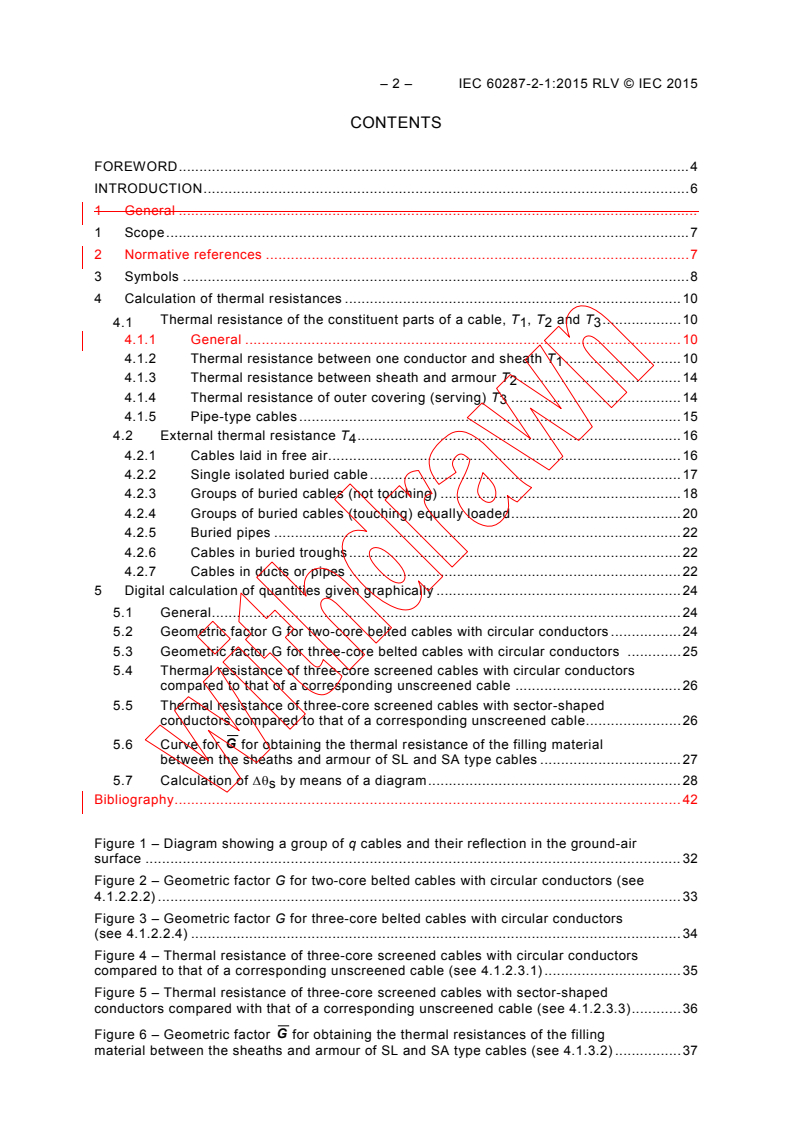
– 2 – IEC 60287-2-1:2015 RLV © IEC 2015
CONTENTS
FOREWORD . 4
INTRODUCTION . 6
1 General .
1 Scope . 7
2 Normative references . 7
3 Symbols . 8
4 Calculation of thermal resistances . 10
Thermal resistance of the constituent parts of a cable, T , T and T . 10
4.1 1 2 3
4.1.1 General . 10
4.1.2 Thermal resistance between one conductor and sheath T . 10
4.1.3 Thermal resistance between sheath and armour T . 14
4.1.4 Thermal resistance of outer covering (serving) T . 14
4.1.5 Pipe-type cables . 15
4.2 External thermal resistance T . 16
4.2.1 Cables laid in free air. 16
4.2.2 Single isolated buried cable . 17
4.2.3 Groups of buried cables (not touching) . 18
4.2.4 Groups of buried cables (touching) equally loaded . 20
4.2.5 Buried pipes . 22
4.2.6 Cables in buried troughs . 22
4.2.7 Cables in ducts or pipes . 22
5 Digital calculation of quantities given graphically . 24
5.1 General . 24
5.2 Geometric factor G for two-core belted cables with circular conductors . 24
5.3 Geometric factor G for three-core belted cables with circular conductors . 25
5.4 Thermal resistance of three-core screened cables with circular conductors
compared to that of a corresponding unscreened cable . 26
5.5 Thermal resistance of three-core screened cables with sector-shaped
conductors compared to that of a corresponding unscreened cable. 26
G
5.6 Curve for for obtaining the thermal resistance of the filling material
between the sheaths and armour of SL and SA type cables . 27
5.7 Calculation of ∆θ by means of a diagram . 28
s
Bibliography . 42
Figure 1 – Diagram showing a group of q cables and their reflection in the ground-air
surface . 32
Figure 2 – Geometric factor G for two-core belted cables with circular conductors (see
4.1.2.2.2) . 33
Figure 3 – Geometric factor G for three-core belted cables with circular conductors
(see 4.1.2.2.4) . 34
Figure 4 – Thermal resistance of three-core screened cables with circular conductors
compared to that of a corresponding unscreened cable (see 4.1.2.3.1) . 35
Figure 5 – Thermal resistance of three-core screened cables with sector-shaped
conductors compared with that of a corresponding unscreened cable (see 4.1.2.3.3) . 36
G
Figure 6 – Geometric factor for obtaining the thermal resistances of the filling
material between the sheaths and armour of SL and SA type cables (see 4.1.3.2) . 37
Figure 7 – Heat dissipation coefficient for black surfaces of cables in free air, laying
condition #1 to #4 . 38
Figure 8 – Heat dissipation coefficient for black surfaces of cables in free air, laying
condition #5 to #8 . 39
Figure 9 – Heat dissipation coefficient for black surfaces of cables in free air, laying
condition #9 to #10 . 40
Figure 10 – Graph for the calculation of external thermal resistance of cables in air . 41
Table 1 – Thermal resistivities of materials . 29
Table 2 – Values for constants Z, E and g for black surfaces of cables in free air . 30
Table 3 – Absorption coefficient of solar radiation for cable surfaces . 31
Table 4 – Values of constants U, V and Y . 31
– 4 – IEC 60287-2-1:2015 RLV © IEC 2015
INTERNATIONAL ELECTROTECHNICAL COMMISSION
______________
ELECTRIC CABLES –
CALCULATION OF THE CURRENT RATING –
Part 2-1: Thermal resistance –
Calculation of thermal resistance
FOREWORD
1) The International Electrotechnical Commission (IEC) is a worldwide organization for standardization comprising
all national electrotechnical committees (IEC National Committees). The object of IEC is to promote
international co-operation on all questions concerning standardization in the electrical and electronic fields. To
this end and in addition to other activities, IEC publishes International Standards, Technical Specifications,
Technical Reports, Publicly Available Specifications (PAS) and Guides (hereafter referred to as “IEC
Publication(s)”). Their preparation is entrusted to technical committees; any IEC National Committee interested
in the subject dealt with may participate in this preparatory work. International, governmental and non-
governmental organizations liaising with the IEC also participate in this preparation. IEC collaborates closely
with the International Organization for Standardization (ISO) in accordance with conditions determined by
agreement between the two organizations.
2) The formal decisions or agreements of IEC on technical matters express, as nearly as possible, an international
consensus of opinion on the relevant subjects since each technical committee has representation from all
interested IEC National Committees.
3) IEC Publications have the form of recommendations for international use and are accepted by IEC National
Committees in that sense. While all reasonable efforts are made to ensure that the technical content of IEC
Publications is accurate, IEC cannot be held responsible for the way in which they are used or for any
misinterpretation by any end user.
4) In order to promote international uniformity, IEC National Committees undertake to apply IEC Publications
transparently to the maximum extent possible in their national and regional publications. Any divergence
between any IEC Publication and the corresponding national or regional publication shall be clearly indicated in
the latter.
5) IEC itself does not provide any attestation of conformity. Independent certification bodies provide conformity
assessment services and, in some areas, access to IEC marks of conformity. IEC is not responsible for any
services carried out by independent certification bodies.
6) All users should ensure that they have the latest edition of this publication.
7) No liability shall attach to IEC or its directors, employees, servants or agents including individual experts and
members of its technical committees and IEC National Committees for any personal injury, property damage or
other damage of any nature whatsoever, whether direct or indirect, or for costs (including legal fees) and
expenses arising out of the publication, use of, or reliance upon, this IEC Publication or any other IEC
Publications.
8) Attention is drawn to the Normative references cited in this publication. Use of the referenced publications is
indispensable for the correct application of this publication.
9) Attention is drawn to the possibility that some of the elements of this IEC Publication may be the subject of
patent rights. IEC shall not be held responsible for identifying any or all such patent rights.
This redline version of the official IEC Standard allows the user to identify the changes
made to the previous edition. A vertical bar appears in the margin wherever a change
has been made. Additions are in green text, deletions are in strikethrough red text.
International Standard IEC 60287-2-1 has been prepared by IEC technical committee 20:
Electric cables.
This second edition of IEC 60287-2-1 cancels and replaces the first edition, published in
1994, Amendment 1:2001, Amendment 2:2006 and Corrigendum 1:2008. The document
20/1448/CDV, circulated to the National Committees as Amendment 3, led to the publication
of this new edition. This edition constitutes a technical revision.
This edition includes the following significant technical changes with respect to the previous
edition:
a) inclusion of a reference to the use of finite element methods where analytical methods are
not available for the calculation of external thermal resistance;
b) explanation about SL and SA type cables;
c) calculation method for T3 for unarmoured three-core cables with extruded insulation and
individual copper tape screens on each core;
d) change of condition for X in 5.4;
e) inclusion of constants or installation conditions for water filled ducts in Table 4.
The text of this standard is based on the following documents:
FDIS Report on voting
20/1561/FDIS 20/1588/RVD
Full information on the voting for the approval of this standard can be found in the report on
voting indicated in the above table.
This publication has been drafted in accordance with the ISO/IEC Directives, Part 2.
A list of all parts in the IEC 60287 series, published under the general title Electric cables –
Calculation of the current rating, can be found on the IEC website.
The committee has decided that the contents of this publication will remain unchanged until
the stability date indicated on the IEC website under "http://webstore.iec.ch" in the data
related to the specific publication. At this date, the publication will be
• reconfirmed,
• withdrawn,
• replaced by a revised edition, or
• amended.
IMPORTANT – The “colour inside” logo on the cover page of this publication indicates
that it contains colours which are considered to be useful for the correct understanding
of its contents. Users should therefore print this publication using a colour printer.
– 6 – IEC 60287-2-1:2015 RLV © IEC 2015
INTRODUCTION
IEC 60287 has been divided into three parts and sections so that revisions of, and additions
to the document can be carried out more conveniently.
Each part is subdivided into sections subparts which are published as separate standards.
Part 1: Formulae of ratings and power losses
Part 2: Formulae for thermal resistance
Part 3: Sections on Operating conditions
This part of IEC 60287-2 contains methods for calculating the internal thermal resistance of
cables and the external thermal resistance for cables laid in free air, ducts and buried.
The formulae in this standard contain quantities which vary with cable design and materials
used. The values given in the tables are either internationally agreed, for example, electrical
resistivities and resistance temperature coefficients, or are those which are generally
accepted in practice, for example, thermal resistivities and permittivities of materials. In this
latter category, some of the values given are not characteristic of the quality of new cables
but are considered to apply to cables after a long period of use. In order that uniform and
comparable results may be obtained, the current ratings should be calculated with the values
given in this standard. However, where it is known with certainty that other values are more
appropriate to the materials and design, then these may be used, and the corresponding
current rating declared in addition, provided that the different values are quoted.
Quantities related to the operating conditions of cables are liable to vary considerably from
one country to another. For instance, with respect to the ambient temperature and soil thermal
resistivity, the values are governed in various countries by different considerations.
Superficial comparisons between the values used in the various countries may lead to
erroneous conclusions if they are not based on common criteria: for example, there may be
different expectations for the life of the cables, and in some countries design is based on
maximum values of soil thermal resistivity, whereas in others average values are used.
Particularly, in the case of soil thermal resistivity, it is well known that this quantity is very
sensitive to soil moisture content and may vary significantly with time, depending on the soil
type, the topographical and meteorological conditions, and the cable loading.
The following procedure for choosing the values for the various parameters should, therefore,
be adopted:
Numerical values should preferably be based on results of suitable measurements. Often
such results are already included in national specifications as recommended values, so that
the calculation may be based on these values generally used in the country in question; a
survey of such values is given in IEC 60287-3-1.
A suggested list of the information required to select the appropriate type of cable is given in
IEC 60287-3-1.
ELECTRIC CABLES –
CALCULATION OF THE CURRENT RATING –
Part 2-1: Thermal resistance –
Calculation of thermal resistance
1 General
1 Scope
This part of IEC 60287 is solely applicable to the conditions of steady-state operation of
cables at all alternating voltages, and direct voltages up to 5 kV, buried directly in the ground,
in ducts, in troughs or in steel pipes, both with and without partial drying-out of the soil, as
well as cables in air. The term "steady state" is intended to mean a continuous constant
current (100 % load factor) just sufficient to produce asymptotically the maximum conductor
temperature, the surrounding ambient conditions being assumed constant.
This part of IEC 60287 provides formulae for thermal resistance.
The formulae given are essentially literal and designedly leave open the selection of certain
important parameters. These may be divided into three groups:
– parameters related to construction of a cable (for example, thermal resistivity of insulating
material) for which representative values have been selected based on published work;
– parameters related to the surrounding conditions which may vary widely, the selection of
which depends on the country in which the cables are used or are to be used;
– parameters which result from an agreement between manufacturer and user and which
involve a margin for security of service (for example, maximum conductor temperature).
Equations given in this part of IEC 60287 for calculating the external thermal resistance of a
cable buried directly in the ground or in a buried duct are for a limited number of installation
conditions. Where analytical methods are not available for calculation of external thermal
resistance finite element methods may be used. Guidance on the use of finite element
methods for calculating cable current ratings is given in IEC TR 62095.
2 Normative references
The following documents, in whole or in part, are normatively referenced in this document and
are indispensable for its application. For dated references, only the edition cited applies. For
undated references, the latest edition of the referenced document (including any
amendments) applies.
IEC 60287-1-1:2006, Electric cables – Calculation of the current rating – Part 1-1: Current
rating equations (100 % load factor) and calculation of losses – General
IEC 60287-1-1:2006/AMD1:2014
IEC 60853-2, Calculation of the cyclic and emergency current rating of cables – Part 2:
Cyclic rating of cables greater than 18/30 (36) kV and emergency ratings for cables of all
voltages
– 8 – IEC 60287-2-1:2015 RLV © IEC 2015
3 Symbols
The symbols used in this part of IEC 60287 and the quantities which they represent are given
in the following list:
′
D external diameter of armour mm
a
D internal diameter of duct mm
d
D external diameter of cable, or equivalent diameter of a group of
e
cores in pipe-type cable mm
*
D external diameter of cable (used in 4.2.1) m
e
D external diameter of duct mm
o
D external diameter of metal sheath mm
s
D the diameter of the imaginary coaxial cylinder which just touches
oc
the crests of a corrugated sheath mm
D the diameter of the imaginary coaxial cylinder which would just touch the
ot
outside surface of the troughs of a corrugated sheath = D + 2t mm
it s
D the diameter of the imaginary cylinder which would just touch the
ic
inside surface of the crests of a corrugated sheath = D – 2t mm
oc s
D the diameter of the imaginary cylinder which just touches the
it
inside surface of the troughs of a corrugated sheath mm
E constant used in 4.2.1.1
F coefficient for belted cables defined in 4.1.2.2.3
coefficient for belted cables defined in 4.1.2.2.6
F
G geometric factor for belted cables
G
geometric factor for SL and SA type cables
H intensity of solar radiation (see 4.2.1.2) W/m
K screening factor for the thermal resistance of screened cables
K coefficient used in 4.2.1
A
L depth of laying, to cable axis or centre of trefoil mm
L distance from the soil surface to the centre of a duct bank mm
G
N number of loaded cables in a duct bank (see 4.2.7.4)
thermal resistance per core between conductor and sheath K∙m/W
T
T thermal resistance between sheath and armour K∙m/W
T thermal resistance of external serving K∙m/W
thermal resistance of surrounding medium (ratio of cable
T
surface temperature rise above ambient to the losses
per unit length) K∙m/W
*
T external thermal resistance in free air, adjusted for
solar radiation K∙m/W
′
T thermal resistance between cable and duct (or pipe) K∙m/W
′′
T thermal resistance of the duct (or pipe) K∙m/W
′′′
T thermal resistance of the medium surrounding the duct (or pipe) K∙m/W
U constant used in 4.2.7.2
V constant used in 4.2.7.2
W dielectric losses per unit length per phase W/m
d
W losses dissipated by cable k W/m
k
W total power dissipated in the trough per unit length W/m
TOT
Y coefficient used in 4.2.7.2
Z coefficient used in 4.2.1.1
d external diameter of belt insulation mm
a
d external diameter of conductor mm
c
d minor diameter of an oval conductor mm
cm
d major diameter of an oval conductor mm
cM
d major diameter of screen or sheath of an oval conductor mm
M
d minor diameter of screen or sheath of an oval conductor mm
m
d diameter of an equivalent circular conductor having the same
x
cross-sectional area and degree of compactness as the shaped one mm
g coefficient used in 4.2.1.1
2 5/4
h heat dissipation coefficient W/m K
ln natural logarithm (logarithm to base e)
n number of conductors in a cable
p the part of the perimeter of the cable trough which is effective for
heat dissipation (see 4.2.6.2) m
r circumscribing radius of two or three-sector shaped
conductors mm
s axial separation of two adjacent cables in a horizontal group
of three, not touching mm
t insulation thickness between conductors mm
t insulation thickness between conductors and sheath mm
t thickness of the bedding mm
t thickness of the serving mm
t thickness of core insulation, including screening tapes plus half the
i
thickness of any non-metallic tapes over the laid up cores mm
t thickness of the sheath mm
s
2L
u in 4.2.
D
e
L
G
u in 4.2.7.4
r
b
x, y sides of duct bank (y>x) (see 4.2.7.4) mm
θ mean temperature of medium between a cable and duct or pipe °C
m
∆θ permissible temperature rise of conductor above ambient temperature K
∆θ factor to account for dielectric loss for calculating T for cables
d 4
in free air K
∆θ factor to account for both dielectric loss and direct solar radiation
ds
*
for calculating T for cables in free air using Figure 10 K
∆θ difference between the mean temperature of air in a duct and
duct
ambient temperature K
∆θ difference between the surface temperature of a cable in air and
s
ambient temperature K
∆θ temperature rise of the air in a cable trough K
tr
– 10 – IEC 60287-2-1:2015 RLV © IEC 2015
λ , λ ratio of the total losses in metallic sheaths and armour respectively
1 2
to the total conductor losses (or losses in one sheath or armour
to the losses in one conductor)
λ′ loss factor for the middle cable
1m
Three cables in flat forma-
λ′ loss factor for the outer cable
tion without transposition,
with the greater losses
with sheaths bonded at both
ends
λ′ loss factor for the outer cable with
the least losses
ρ thermal resistivity of the insulation K∙m/W
i
ρ thermal resistivity of the filler material K∙m/W
f
ρ thermal resistivity of earth surrounding a duct bank K∙m/W
e
ρ thermal resistivity of concrete used for a duct bank K∙m/W
c
ρ thermal resistivity of metallic screens on multicore cables K∙m/W
m
ρ thermal resistivity of material K∙m/W
T
σ absorption coefficient of solar radiation for the cable surface
4 Calculation of thermal resistances
Thermal resistance of the constituent parts of a cable, T , T and T
4.1 1 2 3
4.1.1 General
Clause 4 gives the formulae for calculating the thermal resistances per unit length of the
different parts of the cable T , T and T (see 1.4 of part 1 IEC 60287-1-1:2006 and
1 2 3
IEC 60287-1-1:2006/AMD1:2014). The thermal resistivities of materials used for insulation
and for protective coverings are given in Table 1.
Where screening layers are present, for thermal calculations metallic tapes are considered to
be part of the conductor or sheath while semi-conducting layers (including metallized carbon
paper tapes) are considered as part of the insulation. The appropriate component dimensions
must shall be modified accordingly.
4.1.2 Thermal resistance between one conductor and sheath T
4.1.2.1 Single-core cables
The thermal resistance between one conductor and the sheath T is given by:
ρ 2 t
T 1
T = In 1+
2π d
c
where
ρ is the thermal resistivity of insulation (K∙m/W);
T
d is the diameter of conductor (mm);
c
is the thickness of insulation between conductor and sheath mm).
t
NOTE For corrugated sheaths, t is based on the mean internal diameter of the sheath which is given by:
D + D
it oc
− t
s
4.1.2.2 Belted cables
4.1.2.2.1 General
The thermal resistance T between one conductor and sheath is given by:
ρ
T
T = G
2π
where
G is the geometric factor
NOTE For corrugated sheaths, t is based on the mean internal diameter of the sheath which is given by:
D + D
it oc
− t
s
4.1.2.2.2 Two-core belted cables with circular conductors
The geometric factor G is given in Figure 2.
4.1.2.2.3 Two-core belted cables with sector-shaped conductors
The geometric factor G is given by:
d
a
G = 2 F ln
2 r
where
2,2 t
F = 1+
2π (d + t) − t
x
is the external diameter of the belt insulation (mm);
d
a
r is the radius of the circle circumscribing the conductors (mm);
is the diameter of a circular conductor having the same cross-sectional area and degree of
d
x
compaction as the shaped one (mm);
t is the insulation thickness between conductors (mm).
4.1.2.2.4 Three-core belted cables with circular conductors
For three-core belted cables with circular conductors
t
0,67
ρ
d
i
c
T = G + 0,031(ρ −ρ )e
1 f i
2π
where
ρ is the thermal resistivity of the insulation (K∙m/W);
i
ρ is the thermal resistivity of the filler material (K∙m/W).
f
The geometric factor G is given in Figure 3.
NOTE For paper-insulated cables ρ = ρ and, hence, the second term on the right hand side of the above
f i
equation can be ignored.
For cables with extruded insulation, the thermal resistivity of the filler material is likely to be between 6 K∙m/W and
13 K∙m/W, depending on the filler material and its compaction. A value of 10 K∙m/W is suggested for fibrous
polypropylene fillers.
– 12 – IEC 60287-2-1:2015 RLV © IEC 2015
The above equation is applicable to cables with extruded insulation where each core has an individual screen of
spaced wires and to cables with a common metallic screen over all three cores. For unarmoured cables of this
design t is taken to be the thickness of the material between the conductors and outer covering (serving).
4.1.2.2.5 Three-core belted cables with oval conductors
The cable shall be treated as an equivalent circular conductor cable with an equivalent
diameter d = d × d (mm)
c cM cm
where
d is the major diameter of the oval conductor (mm);
cM
d is the minor diameter of the oval conductor (mm).
cm
4.1.2.2.6 Three-core belted cables with sector-shaped conductors
The geometric factor G for these cables depends on the shape of the sectors, which varies
from one manufacturer to another. A suitable formula is:
d
a
G = 3F ln
2
2 r
1
where
3 t
F = 1+
2π (d + t) − t
x
d is the external diameter of the belt insulation (mm);
a
r is the radius of the circle circumscribing the conductors (mm);
d is the diameter of a circular conductor having the same cross-sectional area and degree of
x
compaction as the shaped one (mm);
t is the insulation thickness between conductors (mm).
4.1.2.3 Three-core cables, metal tape screened type
4.1.2.3.1 Screened cables with circular conductors
t
Cables Paper insulated of this type may be first considered as belted cables for which is
t
0,5. Then, in order to take account of the thermal conductivity of the metallic screens, the
result shall be multiplied by a factor K, called the screening factor, which is given in Figure 4
t
for different values of and different cable specifications.
d
c
ρ
T
Thus: T = K G
2π
Three-core cables with extruded insulation and individual copper tape screens on each core
should be treated as SL type cables (see 4.1.2.5 and 4.1.3.2).
See 4.1.2.2.4 for three-core cables with extruded insulation and an individual screen of
spaced copper wires on each core or a common metallic screen over all three cores.
4.1.2.3.2 Screened cables with oval-shaped conductors
The cable shall be treated as an equivalent circular conductor cable with an equivalent
diameter d = d ⋅d .
c cM cm
4.1.2.3.3 Screened cables with sector-shaped conductors
T is calculated for these cables in the same way as for belted cables with sector-shaped
conductors, but d is taken as the diameter of a circle which circumscribes the core assembly.
a
The result is multiplied by a screening factor given in Figure 5.
4.1.2.4 Oil-filled cables
4.1.2.4.1 Three-core cables with circular conductors and metallized paper core
screens and circular oil ducts between the cores
The thermal resistance between one conductor and the sheath T is given by:
2 t
i
T = 0,385ρ
1 T
d + 2 t
c i
where
d is the conductor diameter (mm);
c
t is the thickness of core insulation including carbon black and metallized paper tapes plus
i
half of any non-metallic tapes over the three laid up cores (mm);
ρ is the thermal resistivity of insulation (K∙m/W).
T
This formula assumes that the space occupied by the metal ducts and the oil inside them has
a thermal conductance very high compared with the insulation, it therefore applies
irrespective of the metal used to form the duct or its thickness.
4.1.2.4.2 Three-core cables with circular conductors and metal tape core screens
and circular oil ducts between the cores
The thermal resistance T between one conductor and the sheath is given by:
d
c
T = 0,35ρ 0,923 −
1 T
d + 2 t
c i
where
t is the thickness of core insulation including the metal screening tapes and half on any
i
non-metallic tapes over the three laid up cores (mm).
NOTE This formula is independent of the metals used for the screens and for the oil ducts.
4.1.2.4.3 Three-core cables with circular conductors, metal tape core screens,
without fillers and oil ducts, having a copper woven fabric tape binding the
cores together and a corrugated aluminium sheath
The thermal resistance T between one conductor and the sheath is given by:
0,62
ρ
t
d − 2 d
475 g
T c 1
T = + In
1,74
D 2π d
D c c
c
where
D + D
it ic
t = 0,5 − 2,16 D
g c
D is the diameter of a core over its metallic screen tapes (mm);
c
– 14 – IEC 60287-2-1:2015 RLV © IEC 2015
t is the average nominal clearance between the core metallic screen tapes and the average
g
inside diameter of the sheath (mm);
d is the thickness of metallic tape core screen (mm).
NOTE The formula is independent of the metal used for the screen tapes.
4.1.2.5 SL and SA type cables
An SL or SA type cable is a three-core cable where each core has an individual lead or
aluminium sheath. The sheath is considered to be sufficiently substantial so as to provide an
isotherm at the outer surface of the insulation.
The thermal resistance T is calculated in the same way as for single-core cables.
4.1.3 Thermal resistance between sheath and armour T
4.1.3.1 Single-core, two-core and three-core cables having a common metallic
sheath
The thermal resistance between sheath and armour, T , is given by:
1 2 t
ρ
T = In 1+
T
2π D
s
where
is the thickness of the bedding (mm);
t
D is the external diameter of the sheath (mm).
s
NOTE For unarmoured cables with extruded insulation where each core has an individual screen of spaced wires
and for unarmoured cables with a common metallic screen over all three cores T = 0.
4.1.3.2 SL and SA type cables
The thermal resistance of fillers and bedding under the armour is given by:
ρ
T
T = G
6π
where
G
is the geometric factor given in Figure 6.
4.1.4 Thermal resistance of outer covering (serving) T
4.1.4.1 General case
The external servings are generally in the form of concentric layers and the thermal resis-
tance T is given by:
2 t
ρ
T = In 1+
T
2π
D′
a
where
t is the thickness of serving (mm);
D′ is the external diameter of the armour (mm).
a
′
NOTE For unarmoured cables D is taken as the external diameter of the component immediately beneath it, i.e.
a
sheath, screen or bedding.
For corrugated sheaths:
1 D + 2 t
oc 3
T = ρ ln
3 T
2π D + D
oc it
+ t
s
4.1.4.2 Unarmoured three-core cables with extruded insulation and individual
copper tape screens on each core
The thermal resistance of the fillers, binder and external serving is given by:
ρ 2t ρ
T 3 f
T = ln 1+ + G
′
2π D 6π
a
where
ρ is the thermal resistivity of filler (K∙m/W);
f
is the geometric factor given in Figure 6 based on the thickness of material between the
copper tape screen and the outer covering (serving);
D’ is taken as the diameter over the binder tape.
a
4.1.5 Pipe-type cables
For these three-core cables, we have:
a) The thermal resistance T of the insulation of each core between the conductor and the
screen. This is calculated by the method set out in 4.1.2 for single-core cables.
b) The thermal resistance T is made up of two parts:
1) The thermal resistance of any serving over the screen or sheath of each core. The
value to be substituted for part of T in the rating equation of 1.4 of part 1
IEC 60287-1-1:2006 and IEC 60287-1-1:2006/AMD1:2014 is the value per cable, i.e.
the value for a three-core cable is one-third the value of a single core.
The value per core is calculated by the method given in 4.1.3 for the bedding of single-
core cables. For oval cores, the geometric mean of the major and minor diameter
d ⋅d shall be used in place of the diameter for a circular core assembly.
M m
2) The thermal resistance of the gas or oil between the surface of the cores and the pipe.
This resistance is calculated in the same way as that part of T which is between a
cable and the internal surface of a duct, as given in 4.2.7.2.
The value calculated will be per cable and should be added to the quantity calculated
in 4.1.5 b) above, before substituting for T in the rating equation of 1.4 of part 1
IEC 60287-1-1:2006 and IEC 60287-1-1:2006/AMD1:2014.
c) The thermal resistance T of any external covering on the pipe is dealt with as in 4.1.4.
The thermal resistance of the metallic pipe itself is negligible.
– 16 – IEC 60287-2-1:2015 RLV © IEC 2015
4.2 External thermal resistance T
4.2.1 Cables laid in free air
4.2.1.1 Cables protected from direct solar radiation
The thermal resistance T of the surroundings of a cable in air and protected from solar
radiation is given by the formula:
T =
* 1/4
π D h (Δθ )
e s
where
Z
h = + E
* g
(D )
e
*
D is the external diameter of cable (m)
e
*
–3
for corrugated sheaths D = (D + 2 t ) ⋅ 10 (m);
e oc 3
*
NOTE Throughout 4.2.1 D is expressed in metres.
e
h is the heat dissipation coefficient obtained either from the above formula using the
appropriate values of constants Z, E and g given in Table 2, or from the curves in Figures
5/4
7, 8 and 9, which are reproduced for convenience (W/m² (K) );
served cables and cables having a non-metallic surface should be considered to have a
black surface. Unserved cables, either plain lead or armoured should be given a value
of h equal to 88 % of the value for a black surface;
∆θ is the excess of cable surface temperature above ambient temperature (see hereinafter
s
for method of calculation) (K).
For cables in unfilled troughs, see 4.2.6.
Calculation of (∆θ )¼:
s
A simple iterative method of calculating (∆θ )¼ is given below. The alternative graphical
s
method is described in 5.7.
Calculate
*
π D h T
e 1
K = +T (1+ λ ) +T (1+ λ + λ )
A 2 1 3 1 2
(1+ λ + λ ) n
1 2
then
0,25
∆θ + ∆θ
1/4
d
(∆θ ) =
s
n+1
1/4
1+ K (∆θ )
A s n
1/4 1/4
Set the initial value of (∆θ )¼ = 2 and reiterate until (∆θ ) – (∆θ ) ≤ 0,001
s s s n
n + 1
where
n λ T
1 1 2 2
∆θ = W − T −
d d 1
1+ λ + λ 2 1+ λ + λ
1 2 1 2
This is a factor, having the dimensions of temperature difference, accounts for the dielectric
losses. If the dielectric losses are neglected, ∆θ = 0.
d
∆θ is the permissible conductor temperature rise above ambient temperature.
*
4.2.1.2 Cables directly exposed to solar radiation – External thermal resistance T
*
Where cables are directly exposed to solar radiation, T is calculated by the method given in
4.2.1.1 except that in the iterative method (∆θ )¼ is calculated using the following formula:
s
0,25
∆θ + ∆θ + ∆θ
1/4
d ds
(∆θ ) =
s
n+1
1/4
1+ K (∆θ )
A s
n
where
*
σ D H T
e 1
∆θ = + T (1+ λ ) + T (1+ λ + λ )
ds 2 1 3 1 2
(1+ λ + λ ) n
1 2
This is a factor which, having the dimensions of temperature difference, accounts for direct
solar radiation.
where
σ is the absorption coefficient of solar radiation for the cable surface (see Table 3);
H is the intensity of solar radiation which should be taken as 10³ W/m² for most latitudes; it
is recommended that the local value should be obtained where possible;
*
D is the external diameter of cable (m)
e
* –3
for corrugated sheaths D = (D + 2 t ) ⋅ 10 (m).
e oc 3
The alternative graphical method is included in Figure 10.
4.2.2 Single isolated buried cable
T = ρ In u + u −1
4 T
2π
where
ρ is the thermal resistivity of the soil (K∙m/W);
T
2 L
u = ;
D
e
L is the distance from the surface of the ground to the cable axis (mm);
D is the external diameter of the cable (mm)
e
for corrugated sheaths D = D + 2 t
e oc 3.
When the value of u exceeds 10, a good approximation (closer than 1 part in 1 000) is:
( )
T = ρ In 2 u
4 T
2π
For cable circuits installed at laying depths of more than 10 m, an alternative approach for
calculating the current rating is to determine the continuous current rating for a designated
time period (usually 40 years) by applying the formulae given in IEC 60853-2, taking into
account as far as is practical seasonal variations in load and ground conditions, if any. Finite
– 18 – IEC 60287-2-1:2015 RLV © IEC 2015
element modelling may provide a more versatile model for such a lifetime assessment. This
subject is under consideration.
4.2.3 Groups of buried cables (not touching)
4.2.3.1 General
Such cases may be solved by using superposition, assuming that each cable acts as a line
source and does not distort the heat field due to the other cables.
These cables are of two main types: the first, and most general type, is a group of unequally
loaded cables of different construction, and for this problem a general indication of the
method only can be given. The second type, which is a more particular one, is a group of
equally loaded identical cables, and for this problem a fairly simple solution can be derived.
4.2.3.2 Unequally loaded cables
The method suggested for groups of unequally loaded dissimilar cables is to calculate the
temperature rise at the surface of the cable under consideration caused by the other cables of
the group, and to subtract this rise from the value of ∆θ used in the equation for the rated
current in 1.4 of part 1 IEC 60287-1-1:2006 and IEC 60287-1-1:2006/AMD1:2014. An estimate
of the power dissipated per unit length of each cable must shall be made beforehand, and this
can be subsequently amended as a result of the calculation where this becomes necessary.
th
Thus, the temperature rise ∆θ above ambient at the surface of the p
...
IEC 60287-2-1 ®
Edition 2.0 2015-04
INTERNATIONAL
STANDARD
NORME
INTERNATIONALE
Electric cables – Calculation of the current rating –
Part 2-1: Thermal resistance – Calculation of thermal resistance
Câbles électriques – Calcul du courant admissible –
Partie 2-1: Résistance thermique – Calcul de la résistance thermique
All rights reserved. Unless otherwise specified, no part of this publication may be reproduced or utilized in any form
or by any means, electronic or mechanical, including photocopying and microfilm, without permission in writing from
either IEC or IEC's member National Committee in the country of the requester. If you have any questions about IEC
copyright or have an enquiry about obtaining additional rights to this publication, please contact the address below or
your local IEC member National Committee for further information.
Droits de reproduction réservés. Sauf indication contraire, aucune partie de cette publication ne peut être reproduite
ni utilisée sous quelque forme que ce soit et par aucun procédé, électronique ou mécanique, y compris la photocopie
et les microfilms, sans l'accord écrit de l'IEC ou du Comité national de l'IEC du pays du demandeur. Si vous avez des
questions sur le copyright de l'IEC ou si vous désirez obtenir des droits supplémentaires sur cette publication, utilisez
les coordonnées ci-après ou contactez le Comité national de l'IEC de votre pays de résidence.
IEC Central Office Tel.: +41 22 919 02 11
3, rue de Varembé Fax: +41 22 919 03 00
CH-1211 Geneva 20 info@iec.ch
Switzerland www.iec.ch
About the IEC
The International Electrotechnical Commission (IEC) is the leading global organization that prepares and publishes
International Standards for all electrical, electronic and related technologies.
About IEC publications
The technical content of IEC publications is kept under constant review by the IEC. Please make sure that you have the
latest edition, a corrigenda or an amendment might have been published.
IEC Catalogue - webstore.iec.ch/catalogue Electropedia - www.electropedia.org
The stand-alone application for consulting the entire The world's leading online dictionary of electronic and
bibliographical information on IEC International Standards, electrical terms containing more than 30 000 terms and
Technical Specifications, Technical Reports and other definitions in English and French, with equivalent terms in 15
documents. Available for PC, Mac OS, Android Tablets and additional languages. Also known as the International
iPad. Electrotechnical Vocabulary (IEV) online.
IEC publications search - www.iec.ch/searchpub IEC Glossary - std.iec.ch/glossary
The advanced search enables to find IEC publications by a More than 60 000 electrotechnical terminology entries in
variety of criteria (reference number, text, technical English and French extracted from the Terms and Definitions
committee,…). It also gives information on projects, replaced clause of IEC publications issued since 2002. Some entries
and withdrawn publications. have been collected from earlier publications of IEC TC 37,
77, 86 and CISPR.
IEC Just Published - webstore.iec.ch/justpublished
Stay up to date on all new IEC publications. Just Published IEC Customer Service Centre - webstore.iec.ch/csc
details all new publications released. Available online and If you wish to give us your feedback on this publication or
also once a month by email. need further assistance, please contact the Customer Service
Centre: csc@iec.ch.
A propos de l'IEC
La Commission Electrotechnique Internationale (IEC) est la première organisation mondiale qui élabore et publie des
Normes internationales pour tout ce qui a trait à l'électricité, à l'électronique et aux technologies apparentées.
A propos des publications IEC
Le contenu technique des publications IEC est constamment revu. Veuillez vous assurer que vous possédez l’édition la
plus récente, un corrigendum ou amendement peut avoir été publié.
Catalogue IEC - webstore.iec.ch/catalogue Electropedia - www.electropedia.org
Application autonome pour consulter tous les renseignements
Le premier dictionnaire en ligne de termes électroniques et
bibliographiques sur les Normes internationales,
électriques. Il contient plus de 30 000 termes et définitions en
Spécifications techniques, Rapports techniques et autres
anglais et en français, ainsi que les termes équivalents dans
documents de l'IEC. Disponible pour PC, Mac OS, tablettes
15 langues additionnelles. Egalement appelé Vocabulaire
Android et iPad.
Electrotechnique International (IEV) en ligne.
Recherche de publications IEC - www.iec.ch/searchpub
Glossaire IEC - std.iec.ch/glossary
Plus de 60 000 entrées terminologiques électrotechniques, en
La recherche avancée permet de trouver des publications IEC
en utilisant différents critères (numéro de référence, texte, anglais et en français, extraites des articles Termes et
comité d’études,…). Elle donne aussi des informations sur les Définitions des publications IEC parues depuis 2002. Plus
projets et les publications remplacées ou retirées. certaines entrées antérieures extraites des publications des
CE 37, 77, 86 et CISPR de l'IEC.
IEC Just Published - webstore.iec.ch/justpublished
Service Clients - webstore.iec.ch/csc
Restez informé sur les nouvelles publications IEC. Just
Published détaille les nouvelles publications parues. Si vous désirez nous donner des commentaires sur cette
Disponible en ligne et aussi une fois par mois par email. publication ou si vous avez des questions contactez-nous:
csc@iec.ch.
IEC 60287-2-1 ®
Edition 2.0 2015-04
INTERNATIONAL
STANDARD
NORME
INTERNATIONALE
Electric cables – Calculation of the current rating –
Part 2-1: Thermal resistance – Calculation of thermal resistance
Câbles électriques – Calcul du courant admissible –
Partie 2-1: Résistance thermique – Calcul de la résistance thermique
INTERNATIONAL
ELECTROTECHNICAL
COMMISSION
COMMISSION
ELECTROTECHNIQUE
INTERNATIONALE
ICS 29.060.20 ISBN 978-2-8322-2583-7
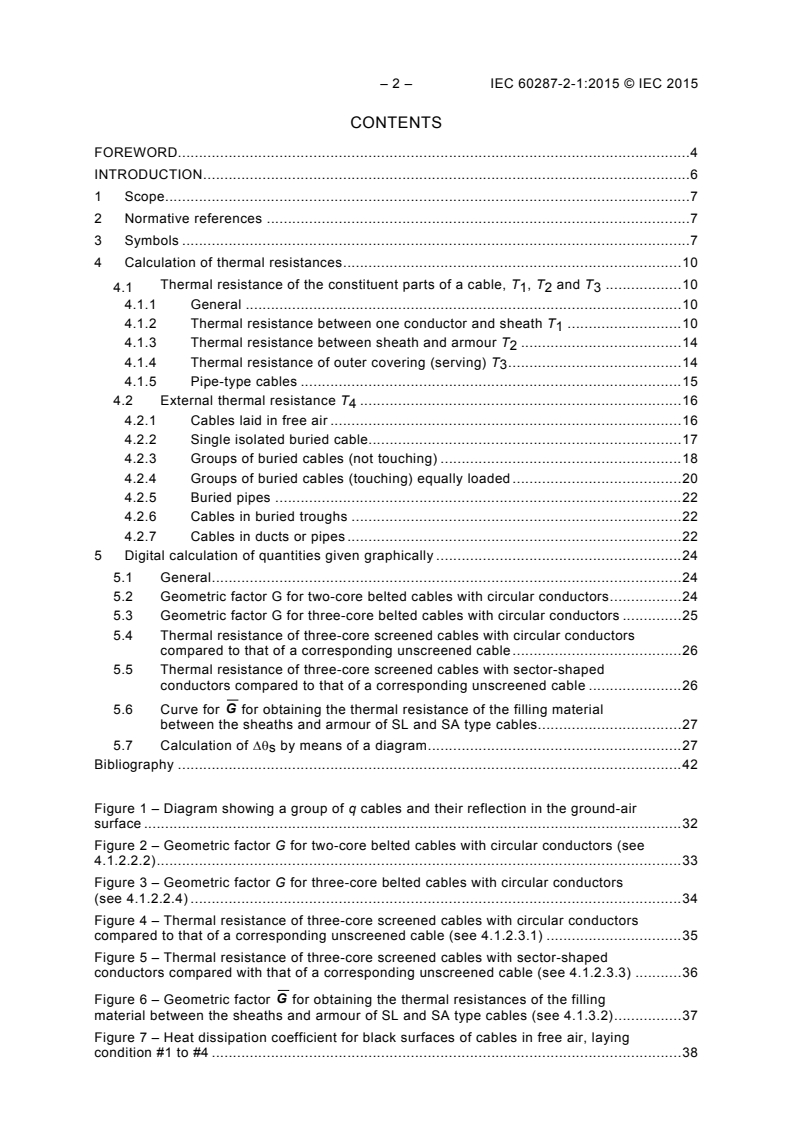
– 2 – IEC 60287-2-1:2015 © IEC 2015
CONTENTS
FOREWORD. 4
INTRODUCTION . 6
1 Scope . 7
2 Normative references . 7
3 Symbols . 7
4 Calculation of thermal resistances . 10
Thermal resistance of the constituent parts of a cable, T , T and T . 10
4.1 1 2 3
4.1.1 General . 10
4.1.2 Thermal resistance between one conductor and sheath T . 10
4.1.3 Thermal resistance between sheath and armour T . 14
4.1.4 Thermal resistance of outer covering (serving) T . 14
4.1.5 Pipe-type cables . 15
4.2 External thermal resistance T . 16
4.2.1 Cables laid in free air . 16
4.2.2 Single isolated buried cable. 17
4.2.3 Groups of buried cables (not touching) . 18
4.2.4 Groups of buried cables (touching) equally loaded . 20
4.2.5 Buried pipes . 22
4.2.6 Cables in buried troughs . 22
4.2.7 Cables in ducts or pipes . 22
5 Digital calculation of quantities given graphically . 24
5.1 General . 24
5.2 Geometric factor G for two-core belted cables with circular conductors . 24
5.3 Geometric factor G for three-core belted cables with circular conductors . 25
5.4 Thermal resistance of three-core screened cables with circular conductors
compared to that of a corresponding unscreened cable . 26
5.5 Thermal resistance of three-core screened cables with sector-shaped
conductors compared to that of a corresponding unscreened cable . 26
G
5.6 Curve for for obtaining the thermal resistance of the filling material
between the sheaths and armour of SL and SA type cables . 27
5.7 Calculation of ∆θ by means of a diagram . 27
s
Bibliography . 42
Figure 1 – Diagram showing a group of q cables and their reflection in the ground-air
surface . 32
Figure 2 – Geometric factor G for two-core belted cables with circular conductors (see
4.1.2.2.2) . 33
Figure 3 – Geometric factor G for three-core belted cables with circular conductors
(see 4.1.2.2.4) . 34
Figure 4 – Thermal resistance of three-core screened cables with circular conductors
compared to that of a corresponding unscreened cable (see 4.1.2.3.1) . 35
Figure 5 – Thermal resistance of three-core screened cables with sector-shaped
conductors compared with that of a corresponding unscreened cable (see 4.1.2.3.3) . 36
G
Figure 6 – Geometric factor for obtaining the thermal resistances of the filling
material between the sheaths and armour of SL and SA type cables (see 4.1.3.2) . 37
Figure 7 – Heat dissipation coefficient for black surfaces of cables in free air, laying
condition #1 to #4 . 38
Figure 8 – Heat dissipation coefficient for black surfaces of cables in free air, laying
condition #5 to #8 . 39
Figure 9 – Heat dissipation coefficient for black surfaces of cables in free air, laying
condition #9 to #10 . 40
Figure 10 – Graph for the calculation of external thermal resistance of cables in air . 41
Table 1 – Thermal resistivities of materials . 29
Table 2 – Values for constants Z, E and g for black surfaces of cables in free air . 30
Table 3 – Absorption coefficient of solar radiation for cable surfaces . 31
Table 4 – Values of constants U, V and Y . 31
– 4 – IEC 60287-2-1:2015 © IEC 2015
INTERNATIONAL ELECTROTECHNICAL COMMISSION
______________
ELECTRIC CABLES –
CALCULATION OF THE CURRENT RATING –
Part 2-1: Thermal resistance –
Calculation of thermal resistance
FOREWORD
1) The International Electrotechnical Commission (IEC) is a worldwide organization for standardization comprising
all national electrotechnical committees (IEC National Committees). The object of IEC is to promote
international co-operation on all questions concerning standardization in the electrical and electronic fields. To
this end and in addition to other activities, IEC publishes International Standards, Technical Specifications,
Technical Reports, Publicly Available Specifications (PAS) and Guides (hereafter referred to as “IEC
Publication(s)”). Their preparation is entrusted to technical committees; any IEC National Committee interested
in the subject dealt with may participate in this preparatory work. International, governmental and non-
governmental organizations liaising with the IEC also participate in this preparation. IEC collaborates closely
with the International Organization for Standardization (ISO) in accordance with conditions determined by
agreement between the two organizations.
2) The formal decisions or agreements of IEC on technical matters express, as nearly as possible, an international
consensus of opinion on the relevant subjects since each technical committee has representation from all
interested IEC National Committees.
3) IEC Publications have the form of recommendations for international use and are accepted by IEC National
Committees in that sense. While all reasonable efforts are made to ensure that the technical content of IEC
Publications is accurate, IEC cannot be held responsible for the way in which they are used or for any
misinterpretation by any end user.
4) In order to promote international uniformity, IEC National Committees undertake to apply IEC Publications
transparently to the maximum extent possible in their national and regional publications. Any divergence
between any IEC Publication and the corresponding national or regional publication shall be clearly indicated in
the latter.
5) IEC itself does not provide any attestation of conformity. Independent certification bodies provide conformity
assessment services and, in some areas, access to IEC marks of conformity. IEC is not responsible for any
services carried out by independent certification bodies.
6) All users should ensure that they have the latest edition of this publication.
7) No liability shall attach to IEC or its directors, employees, servants or agents including individual experts and
members of its technical committees and IEC National Committees for any personal injury, property damage or
other damage of any nature whatsoever, whether direct or indirect, or for costs (including legal fees) and
expenses arising out of the publication, use of, or reliance upon, this IEC Publication or any other IEC
Publications.
8) Attention is drawn to the Normative references cited in this publication. Use of the referenced publications is
indispensable for the correct application of this publication.
9) Attention is drawn to the possibility that some of the elements of this IEC Publication may be the subject of
patent rights. IEC shall not be held responsible for identifying any or all such patent rights.
International Standard IEC 60287-2-1 has been prepared by IEC technical committee 20:
Electric cables.
This second edition of IEC 60287-2-1 cancels and replaces the first edition, published in
1994, Amendment 1:2001, Amendment 2:2006 and Corrigendum 1:2008. The document
20/1448/CDV, circulated to the National Committees as Amendment 3, led to the publication
of this new edition. This edition constitutes a technical revision.
This edition includes the following significant technical changes with respect to the previous
edition:
a) inclusion of a reference to the use of finite element methods where analytical methods are
not available for the calculation of external thermal resistance;
b) explanation about SL and SA type cables;
c) calculation method for T3 for unarmoured three-core cables with extruded insulation and
individual copper tape screens on each core;
d) change of condition for X in 5.4;
e) inclusion of constants or installation conditions for water filled ducts in Table 4.
The text of this standard is based on the following documents:
FDIS Report on voting
20/1561/FDIS 20/1588/RVD
Full information on the voting for the approval of this standard can be found in the report on
voting indicated in the above table.
This publication has been drafted in accordance with the ISO/IEC Directives, Part 2.
A list of all parts in the IEC 60287 series, published under the general title Electric cables –
Calculation of the current rating, can be found on the IEC website.
The committee has decided that the contents of this publication will remain unchanged until
the stability date indicated on the IEC website under "http://webstore.iec.ch" in the data
related to the specific publication. At this date, the publication will be
• reconfirmed,
• withdrawn,
• replaced by a revised edition, or
• amended.
– 6 – IEC 60287-2-1:2015 © IEC 2015
INTRODUCTION
IEC 60287 has been divided into three parts so that revisions of, and additions to the
document can be carried out more conveniently.
Each part is subdivided into subparts which are published as separate standards.
Part 1: Formulae of ratings and power losses
Part 2: Formulae for thermal resistance
Part 3: Operating conditions
This part of IEC 60287-2 contains methods for calculating the internal thermal resistance of
cables and the external thermal resistance for cables laid in free air, ducts and buried.
The formulae in this standard contain quantities which vary with cable design and materials
used. The values given in the tables are either internationally agreed, for example, electrical
resistivities and resistance temperature coefficients, or are those which are generally
accepted in practice, for example, thermal resistivities and permittivities of materials. In this
latter category, some of the values given are not characteristic of the quality of new cables
but are considered to apply to cables after a long period of use. In order that uniform and
comparable results may be obtained, the current ratings should be calculated with the values
given in this standard. However, where it is known with certainty that other values are more
appropriate to the materials and design, then these may be used, and the corresponding
current rating declared in addition, provided that the different values are quoted.
Quantities related to the operating conditions of cables are liable to vary considerably from
one country to another. For instance, with respect to the ambient temperature and soil thermal
resistivity, the values are governed in various countries by different considerations.
Superficial comparisons between the values used in the various countries may lead to
erroneous conclusions if they are not based on common criteria: for example, there may be
different expectations for the life of the cables, and in some countries design is based on
maximum values of soil thermal resistivity, whereas in others average values are used.
Particularly, in the case of soil thermal resistivity, it is well known that this quantity is very
sensitive to soil moisture content and may vary significantly with time, depending on the soil
type, the topographical and meteorological conditions, and the cable loading.
The following procedure for choosing the values for the various parameters should, therefore,
be adopted:
Numerical values should preferably be based on results of suitable measurements. Often
such results are already included in national specifications as recommended values, so that
the calculation may be based on these values generally used in the country in question; a
survey of such values is given in IEC 60287-3-1.
A suggested list of the information required to select the appropriate type of cable is given in
IEC 60287-3-1.
ELECTRIC CABLES –
CALCULATION OF THE CURRENT RATING –
Part 2-1: Thermal resistance –
Calculation of thermal resistance
1 Scope
This part of IEC 60287 is solely applicable to the conditions of steady-state operation of
cables at all alternating voltages, and direct voltages up to 5 kV, buried directly in the ground,
in ducts, in troughs or in steel pipes, both with and without partial drying-out of the soil, as
well as cables in air. The term "steady state" is intended to mean a continuous constant
current (100 % load factor) just sufficient to produce asymptotically the maximum conductor
temperature, the surrounding ambient conditions being assumed constant.
This part of IEC 60287 provides formulae for thermal resistance.
The formulae given are essentially literal and designedly leave open the selection of certain
important parameters. These may be divided into three groups:
– parameters related to construction of a cable (for example, thermal resistivity of insulating
material) for which representative values have been selected based on published work;
– parameters related to the surrounding conditions which may vary widely, the selection of
which depends on the country in which the cables are used or are to be used;
– parameters which result from an agreement between manufacturer and user and which
involve a margin for security of service (for example, maximum conductor temperature).
Equations given in this part of IEC 60287 for calculating the external thermal resistance of a
cable buried directly in the ground or in a buried duct are for a limited number of installation
conditions. Where analytical methods are not available for calculation of external thermal
resistance finite element methods may be used. Guidance on the use of finite element
methods for calculating cable current ratings is given in IEC TR 62095.
2 Normative references
The following documents, in whole or in part, are normatively referenced in this document and
are indispensable for its application. For dated references, only the edition cited applies. For
undated references, the latest edition of the referenced document (including any
amendments) applies.
IEC 60287-1-1:2006, Electric cables – Calculation of the current rating – Part 1-1: Current
rating equations (100 % load factor) and calculation of losses – General
IEC 60287-1-1:2006/AMD1:2014
IEC 60853-2, Calculation of the cyclic and emergency current rating of cables – Part 2:
Cyclic rating of cables greater than 18/30 (36) kV and emergency ratings for cables of all
voltages
3 Symbols
The symbols used in this part of IEC 60287 and the quantities which they represent are given
in the following list:
– 8 – IEC 60287-2-1:2015 © IEC 2015
′
D external diameter of armour mm
a
D internal diameter of duct mm
d
D external diameter of cable, or equivalent diameter of a group of
e
cores in pipe-type cable mm
*
D external diameter of cable (used in 4.2.1) m
e
D external diameter of duct mm
o
D external diameter of metal sheath mm
s
D the diameter of the imaginary coaxial cylinder which just touches
oc
the crests of a corrugated sheath mm
D the diameter of the imaginary coaxial cylinder which would just touch the
ot
outside surface of the troughs of a corrugated sheath = D + 2t mm
it s
D the diameter of the imaginary cylinder which would just touch the
ic
inside surface of the crests of a corrugated sheath = D – 2t mm
oc s
D the diameter of the imaginary cylinder which just touches the
it
inside surface of the troughs of a corrugated sheath mm
E constant used in 4.2.1.1
F coefficient for belted cables defined in 4.1.2.2.3
F coefficient for belted cables defined in 4.1.2.2.6
G geometric factor for belted cables
G
geometric factor for SL and SA type cables
H intensity of solar radiation (see 4.2.1.2) W/m
K screening factor for the thermal resistance of screened cables
K coefficient used in 4.2.1
A
L depth of laying, to cable axis or centre of trefoil mm
L distance from the soil surface to the centre of a duct bank mm
G
N number of loaded cables in a duct bank (see 4.2.7.4)
T thermal resistance per core between conductor and sheath K∙m/W
T thermal resistance between sheath and armour K∙m/W
T thermal resistance of external serving K∙m/W
T thermal resistance of surrounding medium (ratio of cable
surface temperature rise above ambient to the losses
per unit length) K∙m/W
*
T external thermal resistance in free air, adjusted for
solar radiation K∙m/W
′
T thermal resistance between cable and duct (or pipe) K∙m/W
′′
T thermal resistance of the duct (or pipe) K∙m/W
′′′
T thermal resistance of the medium surrounding the duct (or pipe) K∙m/W
U constant used in 4.2.7.2
V constant used in 4.2.7.2
W dielectric losses per unit length per phase W/m
d
W losses dissipated by cable k W/m
k
W total power dissipated in the trough per unit length W/m
TOT
Y coefficient used in 4.2.7.2
Z coefficient used in 4.2.1.1
d external diameter of belt insulation mm
a
d external diameter of conductor mm
c
d minor diameter of an oval conductor mm
cm
d major diameter of an oval conductor mm
cM
d major diameter of screen or sheath of an oval conductor mm
M
d minor diameter of screen or sheath of an oval conductor mm
m
d diameter of an equivalent circular conductor having the same
x
cross-sectional area and degree of compactness as the shaped one mm
g coefficient used in 4.2.1.1
2 5/4
h heat dissipation coefficient W/m K
ln natural logarithm (logarithm to base e)
n number of conductors in a cable
p the part of the perimeter of the cable trough which is effective for
heat dissipation (see 4.2.6.2) m
r circumscribing radius of two or three-sector shaped
conductors mm
s axial separation of two adjacent cables in a horizontal group
of three, not touching mm
t insulation thickness between conductors mm
t insulation thickness between conductors and sheath mm
t thickness of the bedding mm
t thickness of the serving mm
t thickness of core insulation, including screening tapes plus half the
i
thickness of any non-metallic tapes over the laid up cores mm
t thickness of the sheath mm
s
2L
u in 4.2.
D
e
L
G
u in 4.2.7.4
r
b
x, y sides of duct bank (y>x) (see 4.2.7.4) mm
θ mean temperature of medium between a cable and duct or pipe °C
m
∆θ permissible temperature rise of conductor above ambient temperature K
∆θ factor to account for dielectric loss for calculating T for cables
d 4
in free air K
∆θ factor to account for both dielectric loss and direct solar radiation
ds
*
for calculating for cables in free air using Figure 10 K
T
∆θ difference between the mean temperature of air in a duct and
duct
ambient temperature K
∆θ difference between the surface temperature of a cable in air and
s
ambient temperature K
∆θ temperature rise of the air in a cable trough K
tr
λ , λ ratio of the total losses in metallic sheaths and armour respectively
1 2
to the total conductor losses (or losses in one sheath or armour
to the losses in one conductor)
– 10 – IEC 60287-2-1:2015 © IEC 2015
λ′ loss factor for the middle cable
1m
Three cables in flat forma-
λ′ loss factor for the outer cable
tion without transposition,
with the greater losses
with sheaths bonded at both
ends
λ′ loss factor for the outer cable with
the least losses
ρ thermal resistivity of the insulation K∙m/W
i
ρ thermal resistivity of the filler material K∙m/W
f
ρ thermal resistivity of earth surrounding a duct bank K∙m/W
e
ρ thermal resistivity of concrete used for a duct bank K∙m/W
c
ρ thermal resistivity of metallic screens on multicore cables K∙m/W
m
ρ thermal resistivity of material K∙m/W
T
σ absorption coefficient of solar radiation for the cable surface
4 Calculation of thermal resistances
Thermal resistance of the constituent parts of a cable, T , T and T
4.1 1 2 3
4.1.1 General
Clause 4 gives the formulae for calculating the thermal resistances per unit length of the
different parts of the cable T , T and T (see 1.4 of IEC 60287-1-1:2006 and
1 2 3
IEC 60287-1-1:2006/AMD1:2014). The thermal resistivities of materials used for insulation
and for protective coverings are given in Table 1.
Where screening layers are present, for thermal calculations metallic tapes are considered to
be part of the conductor or sheath while semi-conducting layers (including metallized carbon
paper tapes) are considered as part of the insulation. The appropriate component dimensions
shall be modified accordingly.
4.1.2 Thermal resistance between one conductor and sheath T
4.1.2.1 Single-core cables
The thermal resistance between one conductor and the sheath T is given by:
ρ 2 t
T 1
T = In 1+
1
2π d
c
where
ρ is the thermal resistivity of insulation (K∙m/W);
T
d is the diameter of conductor (mm);
c
t is the thickness of insulation between conductor and sheath mm).
NOTE For corrugated sheaths, t is based on the mean internal diameter of the sheath which is given by:
D + D
it oc
− t
s
4.1.2.2 Belted cables
4.1.2.2.1 General
The thermal resistance T between one conductor and sheath is given by:
ρ
T
T = G
2π
where
G is the geometric factor
NOTE For corrugated sheaths, t is based on the mean internal diameter of the sheath which is given by:
D + D
it oc
− t
s
4.1.2.2.2 Two-core belted cables with circular conductors
The geometric factor G is given in Figure 2.
4.1.2.2.3 Two-core belted cables with sector-shaped conductors
The geometric factor G is given by:
d
a
G = 2 F ln
1
2 r
1
where
2,2 t
F = 1+
2π (d + t) − t
x
d is the external diameter of the belt insulation (mm);
a
r is the radius of the circle circumscribing the conductors (mm);
d is the diameter of a circular conductor having the same cross-sectional area and degree of
x
compaction as the shaped one (mm);
t is the insulation thickness between conductors (mm).
4.1.2.2.4 Three-core belted cables with circular conductors
For three-core belted cables with circular conductors
t
0,67
ρ
d
i
c
T = G + 0,031(ρ −ρ )e
1 f i
2π
where
ρ is the thermal resistivity of the insulation (K∙m/W);
i
ρ is the thermal resistivity of the filler material (K∙m/W).
f
The geometric factor G is given in Figure 3.
NOTE For paper-insulated cables ρ = ρ and, hence, the second term on the right hand side of the above
f i
equation can be ignored.
For cables with extruded insulation, the thermal resistivity of the filler material is likely to be between 6 K∙m/W and
13 K∙m/W, depending on the filler material and its compaction. A value of 10 K∙m/W is suggested for fibrous
polypropylene fillers.
The above equation is applicable to cables with extruded insulation where each core has an individual screen of
spaced wires and to cables with a common metallic screen over all three cores. For unarmoured cables of this
design t is taken to be the thickness of the material between the conductors and outer covering (serving).
– 12 – IEC 60287-2-1:2015 © IEC 2015
4.1.2.2.5 Three-core belted cables with oval conductors
The cable shall be treated as an equivalent circular conductor cable with an equivalent
diameter d = d × d (mm)
c cM cm
where
d is the major diameter of the oval conductor (mm);
cM
d is the minor diameter of the oval conductor (mm).
cm
4.1.2.2.6 Three-core belted cables with sector-shaped conductors
The geometric factor G for these cables depends on the shape of the sectors, which varies
from one manufacturer to another. A suitable formula is:
d
a
G = 3F ln
2
2 r
1
where
3 t
F = 1+
2π (d + t) − t
x
d is the external diameter of the belt insulation (mm);
a
r is the radius of the circle circumscribing the conductors (mm);
d is the diameter of a circular conductor having the same cross-sectional area and degree of
x
compaction as the shaped one (mm);
t is the insulation thickness between conductors (mm).
4.1.2.3 Three-core cables, metal tape screened type
4.1.2.3.1 Screened cables with circular conductors
t
Paper insulated of this type may be first considered as belted cables for which is 0,5.
t
Then, in order to take account of the thermal conductivity of the metallic screens, the result
shall be multiplied by a factor K, called the screening factor, which is given in Figure 4 for
t
different values of and different cable specifications.
d
c
ρ
T
Thus: T = K G
2π
Three-core cables with extruded insulation and individual copper tape screens on each core
should be treated as SL type cables (see 4.1.2.5 and 4.1.3.2).
See 4.1.2.2.4 for three-core cables with extruded insulation and an individual screen of
spaced copper wires on each core or a common metallic screen over all three cores.
4.1.2.3.2 Screened cables with oval-shaped conductors
The cable shall be treated as an equivalent circular conductor cable with an equivalent
diameter d = d ⋅d .
c cM cm
4.1.2.3.3 Screened cables with sector-shaped conductors
T is calculated for these cables in the same way as for belted cables with sector-shaped
conductors, but d is taken as the diameter of a circle which circumscribes the core assembly.
a
The result is multiplied by a screening factor given in Figure 5.
4.1.2.4 Oil-filled cables
4.1.2.4.1 Three-core cables with circular conductors and metallized paper core
screens and circular oil ducts between the cores
The thermal resistance between one conductor and the sheath T is given by:
2 t
i
T = 0,385ρ
1 T
d + 2 t
c i
where
d is the conductor diameter (mm);
c
t is the thickness of core insulation including carbon black and metallized paper tapes plus
i
half of any non-metallic tapes over the three laid up cores (mm);
ρ is the thermal resistivity of insulation (K∙m/W).
T
This formula assumes that the space occupied by the metal ducts and the oil inside them has
a thermal conductance very high compared with the insulation, it therefore applies
irrespective of the metal used to form the duct or its thickness.
4.1.2.4.2 Three-core cables with circular conductors and metal tape core screens
and circular oil ducts between the cores
The thermal resistance T between one conductor and the sheath is given by:
d
c
T = 0,35ρ 0,923 −
1 T
d + 2 t
c i
where
t is the thickness of core insulation including the metal screening tapes and half on any
i
non-metallic tapes over the three laid up cores (mm).
NOTE This formula is independent of the metals used for the screens and for the oil ducts.
4.1.2.4.3 Three-core cables with circular conductors, metal tape core screens,
without fillers and oil ducts, having a copper woven fabric tape binding the
cores together and a corrugated aluminium sheath
The thermal resistance T between one conductor and the sheath is given by:
0,62
t ρ
475 d − 2 d
g
T c 1
T = + In
1,74
D 2π d
D
c c
c
where
D + D
it ic
t = 0,5 − 2,16 D
g c
D is the diameter of a core over its metallic screen tapes (mm);
c
– 14 – IEC 60287-2-1:2015 © IEC 2015
t is the average nominal clearance between the core metallic screen tapes and the average
g
inside diameter of the sheath (mm);
d is the thickness of metallic tape core screen (mm).
NOTE The formula is independent of the metal used for the screen tapes.
4.1.2.5 SL and SA type cables
An SL or SA type cable is a three-core cable where each core has an individual lead or
aluminium sheath. The sheath is considered to be sufficiently substantial so as to provide an
isotherm at the outer surface of the insulation.
The thermal resistance T is calculated in the same way as for single-core cables.
4.1.3 Thermal resistance between sheath and armour T
4.1.3.1 Single-core, two-core and three-core cables having a common metallic
sheath
The thermal resistance between sheath and armour, T , is given by:
1 2 t
ρ 2
T = In 1+
T
2π D
s
where
t is the thickness of the bedding (mm);
D is the external diameter of the sheath (mm).
s
NOTE For unarmoured cables with extruded insulation where each core has an individual screen of spaced wires
and for unarmoured cables with a common metallic screen over all three cores T = 0.
4.1.3.2 SL and SA type cables
The thermal resistance of fillers and bedding under the armour is given by:
ρ
T
T = G
6π
where
G
is the geometric factor given in Figure 6.
4.1.4 Thermal resistance of outer covering (serving) T
4.1.4.1 General case
The external servings are generally in the form of concentric layers and the thermal resis-
tance T is given by:
2 t
ρ
T = In 1+
T
2π
D′
a
where
t is the thickness of serving (mm);
D′ is the external diameter of the armour (mm).
a
′
NOTE For unarmoured cables D is taken as the external diameter of the component immediately beneath it, i.e.
a
sheath, screen or bedding.
For corrugated sheaths:
1 D + 2 t
oc 3
T = ρ ln
3 T
2π D + D
oc it
+ t
s
4.1.4.2 Unarmoured three-core cables with extruded insulation and individual
copper tape screens on each core
The thermal resistance of the fillers, binder and external serving is given by:
ρ 2t ρ
T 3 f
T = ln 1+ + G
′
2π D 6π
a
where
ρ is the thermal resistivity of filler (K∙m/W);
f
G is the geometric factor given in Figure 6 based on the thickness of material between the
copper tape screen and the outer covering (serving);
D’ is taken as the diameter over the binder tape.
a
4.1.5 Pipe-type cables
For these three-core cables, we have:
a) The thermal resistance T of the insulation of each core between the conductor and the
screen. This is calculated by the method set out in 4.1.2 for single-core cables.
b) The thermal resistance T is made up of two parts:
1) The thermal resistance of any serving over the screen or sheath of each core. The
value to be substituted for part of T in the rating equation of 1.4 of
IEC 60287-1-1:2006 and IEC 60287-1-1:2006/AMD1:2014 is the value per cable, i.e.
the value for a three-core cable is one-third the value of a single core.
The value per core is calculated by the method given in 4.1.3 for the bedding of single-
core cables. For oval cores, the geometric mean of the major and minor diameter
d ⋅d shall be used in place of the diameter for a circular core assembly.
M m
2) The thermal resistance of the gas or oil between the surface of the cores and the pipe.
This resistance is calculated in the same way as that part of T which is between a
cable and the internal surface of a duct, as given in 4.2.7.2.
The value calculated will be per cable and should be added to the quantity calculated
in 4.1.5 b)1) above, before substituting for T in the rating equation of 1.4 of
IEC 60287-1-1:2006 and IEC 60287-1-1:2006/AMD1:2014.
c) The thermal resistance T of any external covering on the pipe is dealt with as in 4.1.4.
The thermal resistance of the metallic pipe itself is negligible.
– 16 – IEC 60287-2-1:2015 © IEC 2015
4.2 External thermal resistance T
4.2.1 Cables laid in free air
4.2.1.1 Cables protected from direct solar radiation
The thermal resistance T of the surroundings of a cable in air and protected from solar
radiation is given by the formula:
T =
* 1/4
π D h (Δθ )
e s
where
Z
h = + E
* g
(D )
e
*
D is the external diameter of cable (m)
e
* –3
for corrugated sheaths D = (D + 2 t ) ⋅ 10 (m);
e oc 3
*
NOTE Throughout 4.2.1 D is expressed in metres.
e
h is the heat dissipation coefficient obtained either from the above formula using the
appropriate values of constants Z, E and g given in Table 2, or from the curves in Figures
5/4
7, 8 and 9, which are reproduced for convenience (W/m² (K) );
served cables and cables having a non-metallic surface should be considered to have a
black surface. Unserved cables, either plain lead or armoured should be given a value
of h equal to 88 % of the value for a black surface;
∆θ is the excess of cable surface temperature above ambient temperature (see hereinafter
s
for method of calculation) (K).
For cables in unfilled troughs, see 4.2.6.
Calculation of (∆θ )¼:
s
A simple iterative method of calculating (∆θ )¼ is given below. The alternative graphical
s
method is described in 5.7.
Calculate
*
π D h T
e 1
K = +T (1+ λ ) +T (1+ λ + λ )
A 2 1 3 1 2
(1+ λ + λ ) n
1 2
then
0,25
∆θ + ∆θ
1/4
d
(∆θ ) =
s
n+1
1/4
1+ K (∆θ )
A s n
1/4 1/4
Set the initial value of (∆θ )¼ = 2 and reiterate until (∆θ ) – (∆θ ) ≤ 0,001
s s s n
n + 1
where
n λ T
1 1
2 2
∆θ = W − T −
d d 1
1+ λ + λ 2 1+ λ + λ
1 2 1 2
This is a factor, having the dimensions of temperature difference, accounts for the dielectric
losses. If the dielectric losses are neglected, ∆θ = 0.
d
∆θ is the permissible conductor temperature rise above ambient temperature.
*
4.2.1.2 Cables directly exposed to solar radiation – External thermal resistance T
*
Where cables are directly exposed to solar radiation, T is calculated by the method given in
4.2.1.1 except that in the iterative method (∆θ )¼ is calculated using the following formula:
s
0,25
∆θ + ∆θ + ∆θ
1/4
d ds
(∆θ ) =
s
n+1
1/4
1+ K (∆θ )
A s
n
where
*
σ D H T
e 1
∆θ = + T (1+ λ ) + T (1+ λ + λ )
ds 2 1 3 1 2
n
(1+ λ + λ )
1 2
This is a factor which, having the dimensions of temperature difference, accounts for direct
solar radiation.
where
σ is the absorption coefficient of solar radiation for the cable surface (see Table 3);
H is the intensity of solar radiation which should be taken as 10³ W/m² for most latitudes; it
is recommended that the local value should be obtained where possible;
*
D is the external diameter of cable (m)
e
* –3
for corrugated sheaths D = (D + 2 t ) ⋅ 10 (m).
e oc 3
The alternative graphical method is included in Figure 10.
4.2.2 Single isolated buried cable
T = ρ In u + u −1
4 T
2π
where
ρ is the thermal resistivity of the soil (K∙m/W);
T
2 L
u = ;
D
e
L is the distance from the surface of the ground to the cable axis (mm);
D is the external diameter of the cable (mm)
e
for corrugated sheaths D = D + 2 t
e oc 3.
When the value of u exceeds 10, a good approximation (closer than 1 part in 1 000) is:
T = ρ In (2 u)
4 T
2π
For cable circuits installed at laying depths of more than 10 m, an alternative approach for
calculating the current rating is to determine the continuous current rating for a de
...