

IEC 60287-2-1:2023
(Main)Electric cables - Calculation of the current rating - Part 2-1: Thermal resistance - Calculation of thermal resistance
General Information
- Abstract
IEC 60287-2-1:2023 is solely applicable to the conditions of steady-state operation of cables at all alternating voltages, and direct voltages up to 5 kV, buried directly in the ground, in ducts, in troughs or in steel pipes, both with and without partial drying-out of the soil, as well as cables in air. The term "steady state" is intended to mean a continuous constant current (100 % load factor) just sufficient to produce asymptotically the maximum conductor temperature, the surrounding ambient conditions being assumed constant.
- Status
- Published
- Publication Date
- 21-May-2023
- Technical Committee
- TC 20 - Electric cables
- Drafting Committee
- WG 19 - TC 20/WG 19
- Current Stage
- PPUB - Publication issued
- Start Date
- 22-May-2023
- Completion Date
- 09-Jun-2023
Buy Documents
IEC 60287-2-1:2023 - Electric cables - Calculation of the current rating - Part 2-1: Thermal resistance - Calculation of thermal resistance Released:5/22/2023
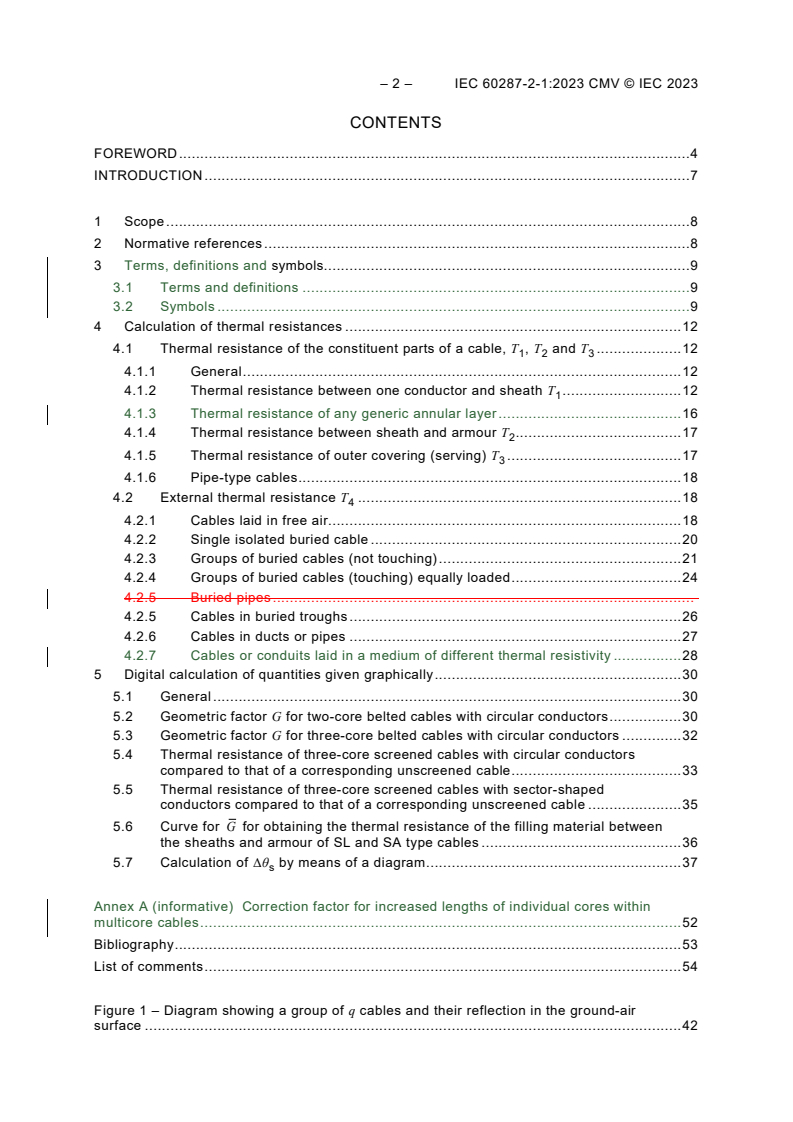
REDLINE IEC 60287-2-1:2023 CMV - Electric cables - Calculation of the current rating - Part 2-1: Thermal resistance - Calculation of thermal resistance Released:5/22/2023
Overview
IEC 60287-2-1:2023 - “Electric cables - Calculation of the current rating - Part 2-1: Thermal resistance - Calculation of thermal resistance” is an IEC international standard that defines methods to calculate the thermal resistance of electric cables under steady-state conditions. It applies to cables at all alternating voltages and to direct voltages up to 5 kV, for installations buried directly in ground, in ducts, in troughs or steel pipes (with or without partial soil drying‑out), and for cables in air. “Steady‑state” is taken as a continuous constant current (100% load factor) producing the maximum conductor temperature with fixed ambient conditions.
Key topics
- Internal thermal resistance: modelling of constituent cable parts (conductor-to-sheath, annular layers, sheath-to-armour, outer serving, pipe‑type construction).
- External thermal resistance: methods for cables in free air, single buried cables, groups of buried cables (touching and non‑touching), cables in troughs, ducts, pipes and different surrounding media.
- Geometric factors and graphical data: digital calculation procedures for quantities provided graphically (geometric factor G, diagrams for Δθ calculation).
- Material data and constants: tabulated thermal resistivities, heat dissipation coefficients, solar absorption and other constants to ensure consistent cable ampacity calculations.
- Corrections and special cases: corrective factors for increased lengths of individual cores within multicore cables (Annex A), treatment of multilayer/annular geometries and improved formulations for duct banks and backfills.
- Edition updates: 3rd edition (2023) includes redefined symbols, added materials, generic annular layer modelling and improved calculation methods.
Applications
- Calculate cable thermal resistance as an input to cable current rating (ampacity) and power‑loss assessments.
- Perform thermal modelling for cable route design: direct burial, duct banks, troughs and aerial installations.
- Support selection and specification of cable types, backfill materials and installation spacing to meet thermal limits.
- Aid thermal risk assessment for utilities, industrial power distribution, renewable energy and transmission projects.
Who uses this standard
- Electrical and cable design engineers, thermal analysts and consultants
- Cable manufacturers and test laboratories
- Transmission & distribution utilities and asset owners
- Contractors specifying installation methods and backfill materials
- Standards committees and regulatory bodies for interoperability and safety compliance
Related standards
- Other parts of the IEC 60287 series (Part 1: rating formulae; Part 3: operating conditions)
- IEC 60287-3-1 (guidance on selecting environmental and soil parameters)
Keywords: IEC 60287-2-1, electric cables, current rating, thermal resistance, steady‑state operation, buried cables, cables in ducts, cable ampacity, thermal modelling.
Relations
- Effective Date
- 05-Sep-2023
Buy Documents
IEC 60287-2-1:2023 - Electric cables - Calculation of the current rating - Part 2-1: Thermal resistance - Calculation of thermal resistance Released:5/22/2023
REDLINE IEC 60287-2-1:2023 CMV - Electric cables - Calculation of the current rating - Part 2-1: Thermal resistance - Calculation of thermal resistance Released:5/22/2023
Get Certified
Connect with accredited certification bodies for this standard

IMQ S.p.A. (Certification)
Italian electrical product certification.

SLG Prüf- und Zertifizierungs GmbH
German testing and certification body.

UL Solutions
Global safety science company with testing, inspection and certification.
Sponsored listings
Frequently Asked Questions
IEC 60287-2-1:2023 is a standard published by the International Electrotechnical Commission (IEC). Its full title is "Electric cables - Calculation of the current rating - Part 2-1: Thermal resistance - Calculation of thermal resistance". This standard covers: IEC 60287-2-1:2023 is solely applicable to the conditions of steady-state operation of cables at all alternating voltages, and direct voltages up to 5 kV, buried directly in the ground, in ducts, in troughs or in steel pipes, both with and without partial drying-out of the soil, as well as cables in air. The term "steady state" is intended to mean a continuous constant current (100 % load factor) just sufficient to produce asymptotically the maximum conductor temperature, the surrounding ambient conditions being assumed constant.
IEC 60287-2-1:2023 is solely applicable to the conditions of steady-state operation of cables at all alternating voltages, and direct voltages up to 5 kV, buried directly in the ground, in ducts, in troughs or in steel pipes, both with and without partial drying-out of the soil, as well as cables in air. The term "steady state" is intended to mean a continuous constant current (100 % load factor) just sufficient to produce asymptotically the maximum conductor temperature, the surrounding ambient conditions being assumed constant.
IEC 60287-2-1:2023 is classified under the following ICS (International Classification for Standards) categories: 29.060.20 - Cables. The ICS classification helps identify the subject area and facilitates finding related standards.
IEC 60287-2-1:2023 has the following relationships with other standards: It is inter standard links to IEC 60287-2-1:2015. Understanding these relationships helps ensure you are using the most current and applicable version of the standard.
IEC 60287-2-1:2023 is available in PDF format for immediate download after purchase. The document can be added to your cart and obtained through the secure checkout process. Digital delivery ensures instant access to the complete standard document.
Standards Content (Sample)
IEC 60287-2-1 ®
Edition 3.0 2023-05
INTERNATIONAL
STANDARD
Electric cables – Calculation of the current rating –
Part 2-1: Thermal resistance – Calculation of thermal resistance
All rights reserved. Unless otherwise specified, no part of this publication may be reproduced or utilized in any form
or by any means, electronic or mechanical, including photocopying and microfilm, without permission in writing from
either IEC or IEC's member National Committee in the country of the requester. If you have any questions about IEC
copyright or have an enquiry about obtaining additional rights to this publication, please contact the address below or
your local IEC member National Committee for further information.
IEC Secretariat Tel.: +41 22 919 02 11
3, rue de Varembé info@iec.ch
CH-1211 Geneva 20 www.iec.ch
Switzerland
About the IEC
The International Electrotechnical Commission (IEC) is the leading global organization that prepares and publishes
International Standards for all electrical, electronic and related technologies.
About IEC publications
The technical content of IEC publications is kept under constant review by the IEC. Please make sure that you have the
latest edition, a corrigendum or an amendment might have been published.
IEC publications search - webstore.iec.ch/advsearchform IEC Products & Services Portal - products.iec.ch
The advanced search enables to find IEC publications by a Discover our powerful search engine and read freely all the
variety of criteria (reference number, text, technical publications previews. With a subscription you will always have
committee, …). It also gives information on projects, replaced access to up to date content tailored to your needs.
and withdrawn publications.
Electropedia - www.electropedia.org
IEC Just Published - webstore.iec.ch/justpublished
The world's leading online dictionary on electrotechnology,
Stay up to date on all new IEC publications. Just Published
containing more than 22 300 terminological entries in English
details all new publications released. Available online and once
and French, with equivalent terms in 19 additional languages.
a month by email.
Also known as the International Electrotechnical Vocabulary
(IEV) online.
IEC Customer Service Centre - webstore.iec.ch/csc
If you wish to give us your feedback on this publication or need
further assistance, please contact the Customer Service
Centre: sales@iec.ch.
IEC 60287-2-1 ®
Edition 3.0 2023-05
INTERNATIONAL
STANDARD
Electric cables – Calculation of the current rating –
Part 2-1: Thermal resistance – Calculation of thermal resistance
INTERNATIONAL
ELECTROTECHNICAL
COMMISSION
ICS 29.060.20 ISBN 978-2-8322-6981-7
– 2 – IEC 60287-2-1:2023 © IEC 2023
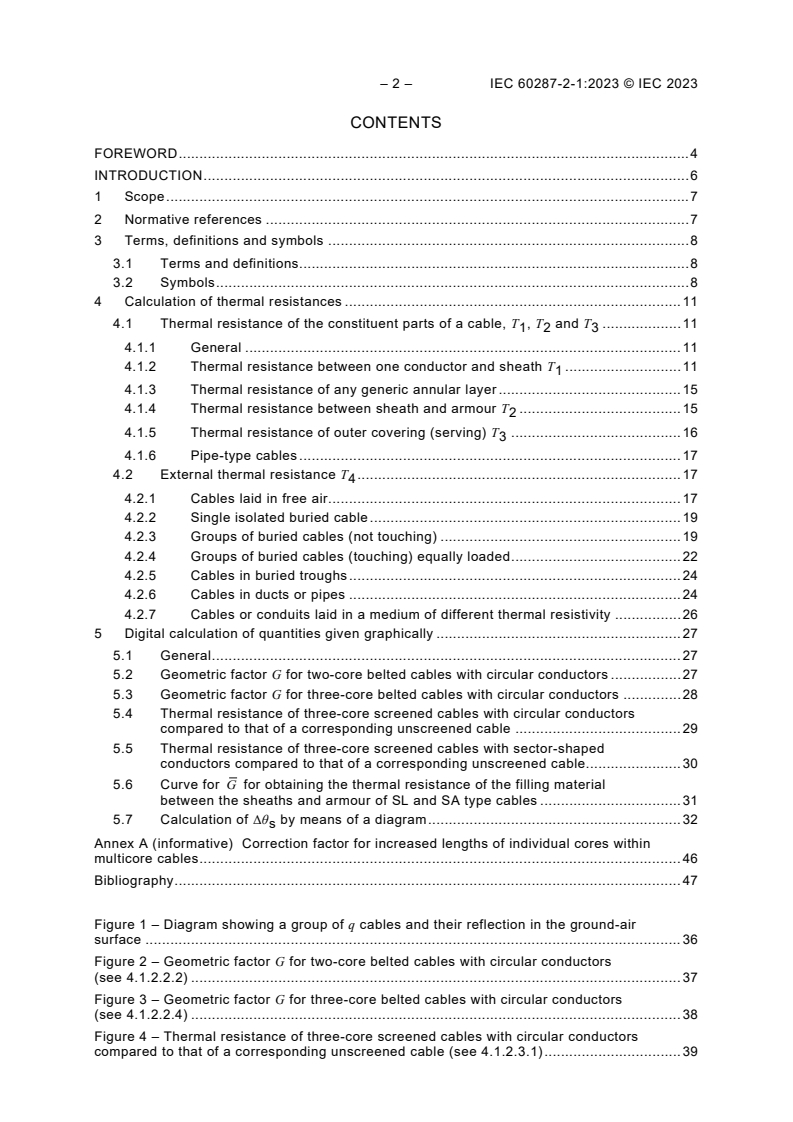
CONTENTS
FOREWORD . 4
INTRODUCTION . 6
1 Scope . 7
2 Normative references . 7
3 Terms, definitions and symbols . 8
3.1 Terms and definitions. 8
3.2 Symbols . 8
4 Calculation of thermal resistances . 11
4.1 Thermal resistance of the constituent parts of a cable, T , T and T . 11
1 2 3
4.1.1 General . 11
4.1.2 Thermal resistance between one conductor and sheath T . 11
4.1.3 Thermal resistance of any generic annular layer . 15
4.1.4 Thermal resistance between sheath and armour T . 15
4.1.5 Thermal resistance of outer covering (serving) T . 16
4.1.6 Pipe-type cables . 17
4.2 External thermal resistance T . 17
4.2.1 Cables laid in free air. 17
4.2.2 Single isolated buried cable . 19
4.2.3 Groups of buried cables (not touching) . 19
4.2.4 Groups of buried cables (touching) equally loaded . 22
4.2.5 Cables in buried troughs . 24
4.2.6 Cables in ducts or pipes . 24
4.2.7 Cables or conduits laid in a medium of different thermal resistivity . 26
5 Digital calculation of quantities given graphically . 27
5.1 General . 27
5.2 Geometric factor G for two-core belted cables with circular conductors . 27
5.3 Geometric factor G for three-core belted cables with circular conductors . 28
5.4 Thermal resistance of three-core screened cables with circular conductors
compared to that of a corresponding unscreened cable . 29
5.5 Thermal resistance of three-core screened cables with sector-shaped
conductors compared to that of a corresponding unscreened cable. 30
5.6 Curve for G for obtaining the thermal resistance of the filling material
between the sheaths and armour of SL and SA type cables . 31
5.7 Calculation of Δθ by means of a diagram . 32
s
Annex A (informative) Correction factor for increased lengths of individual cores within
multicore cables . 46
Bibliography . 47
Figure 1 – Diagram showing a group of q cables and their reflection in the ground-air
surface . 36
Figure 2 – Geometric factor G for two-core belted cables with circular conductors
(see 4.1.2.2.2) . 37
Figure 3 – Geometric factor G for three-core belted cables with circular conductors
(see 4.1.2.2.4) . 38
Figure 4 – Thermal resistance of three-core screened cables with circular conductors
compared to that of a corresponding unscreened cable (see 4.1.2.3.1) . 39
Figure 5 – Thermal resistance of three-core screened cables with sector-shaped
conductors compared to that of a corresponding unscreened cable (see 4.1.2.3.3) . 40
Figure 6 – Geometric factor G for obtaining the thermal resistances of the filling
material between the sheaths and armour of SL and SA type cables (see 4.1.2.5) . 41
Figure 7 – Heat dissipation coefficient for black surfaces of cables in free air, laying
conditions 1 to 4 . 42
Figure 8 – Heat dissipation coefficient for black surfaces of cables in free air, laying
conditions 5 to 8 . 43
Figure 9 – Heat dissipation coefficient for black surfaces of cables in free air, laying
conditions 9 and 10 . 44
Figure 10 – Graph for the calculation of external thermal resistance of cables in air . 45
Table 1 – Thermal resistivities of materials . 33
Table 2 – Extended values of the geometric factor for duct banks and backfills. 34
Table 3 – Values for constants Z, E and C for black surfaces of cables in free air . 35
g
Table 4 – Absorption coefficient of solar radiation for cable surfaces . 36
Table 5 – Values of constants U, V and Y . 36
Table A.1 – Values of C for different cases . 46
fL
– 4 – IEC 60287-2-1:2023 © IEC 2023
INTERNATIONAL ELECTROTECHNICAL COMMISSION
____________
ELECTRIC CABLES –
CALCULATION OF THE CURRENT RATING –
Part 2-1: Thermal resistance –
Calculation of thermal resistance
FOREWORD
1) The International Electrotechnical Commission (IEC) is a worldwide organization for standardization comprising
all national electrotechnical committees (IEC National Committees). The object of IEC is to promote international
co-operation on all questions concerning standardization in the electrical and electronic fields. To this end and
in addition to other activities, IEC publishes International Standards, Technical Specifications, Technical Reports,
Publicly Available Specifications (PAS) and Guides (hereafter referred to as "IEC Publication(s)"). Their
preparation is entrusted to technical committees; any IEC National Committee interested in the subject dealt with
may participate in this preparatory work. International, governmental and non-governmental organizations liaising
with the IEC also participate in this preparation. IEC collaborates closely with the International Organization for
Standardization (ISO) in accordance with conditions determined by agreement between the two organizations.
2) The formal decisions or agreements of IEC on technical matters express, as nearly as possible, an international
consensus of opinion on the relevant subjects since each technical committee has representation from all
interested IEC National Committees.
3) IEC Publications have the form of recommendations for international use and are accepted by IEC National
Committees in that sense. While all reasonable efforts are made to ensure that the technical content of IEC
Publications is accurate, IEC cannot be held responsible for the way in which they are used or for any
misinterpretation by any end user.
4) In order to promote international uniformity, IEC National Committees undertake to apply IEC Publications
transparently to the maximum extent possible in their national and regional publications. Any divergence between
any IEC Publication and the corresponding national or regional publication shall be clearly indicated in the latter.
5) IEC itself does not provide any attestation of conformity. Independent certification bodies provide conformity
assessment services and, in some areas, access to IEC marks of conformity. IEC is not responsible for any
services carried out by independent certification bodies.
6) All users should ensure that they have the latest edition of this publication.
7) No liability shall attach to IEC or its directors, employees, servants or agents including individual experts and
members of its technical committees and IEC National Committees for any personal injury, property damage or
other damage of any nature whatsoever, whether direct or indirect, or for costs (including legal fees) and
expenses arising out of the publication, use of, or reliance upon, this IEC Publication or any other IEC
Publications.
8) Attention is drawn to the Normative references cited in this publication. Use of the referenced publications is
indispensable for the correct application of this publication.
9) Attention is drawn to the possibility that some of the elements of this IEC Publication may be the subject of patent
rights. IEC shall not be held responsible for identifying any or all such patent rights.
IEC 60287-2-1 has been prepared by IEC technical committee 20: Electric cables. It is an
International Standard.
This third edition cancels and replaces the second edition published in 2015. This edition
constitutes a technical revision.
This edition includes the following significant technical changes with respect to the previous
edition:
a) thorough redefinition of symbols used across the IEC 60287 and IEC 60853 series to realign
and unify definitions, eliminate inconsistencies and to improve cross-use of the different
parts of both IEC 60287 and IEC 60853 series;
b) improvement in the identification of tabulated materials and introduction of new materials in
the tables;
c) introduction of generic annular layers to improve thermal modelling of existing and future
cables designs;
d) improved calculation of T in the case of directly buried cables;
e) introduction of corrective factors, on relevant calculated physical characteristics to take into
account the effect of multicore lay-lengths; a dedicated annex to highlight correction factors
for different number of cores has been introduced (Annex A);
f) improved description and formulation for the case of cables in pipe and backfill;
g) redefinition of the calculation method of T for duct banks where y/x > 3, the new table based
method eliminates errors, extends the usability of the new formulation while keeping a
suitable conservative margin in the calculation.
The text of this International Standard is based on the following documents:
Draft Report on voting
20/2099/FDIS 20/2106/RVD
Full information on the voting for its approval can be found in the report on voting indicated in
the above table.
The language used for the development of this International Standard is English.
This document was drafted in accordance with ISO/IEC Directives, Part 2, and developed in
accordance with ISO/IEC Directives, Part 1 and ISO/IEC Directives, IEC Supplement, available
at www.iec.ch/members_experts/refdocs. The main document types developed by IEC are
described in greater detail at www.iec.ch/publications.
A list of all parts in the IEC 60287 series, published under the general title Electric cables –
Calculation of the current rating, can be found on the IEC website.
The committee has decided that the contents of this document will remain unchanged until the
stability date indicated on the IEC website under webstore.iec.ch in the data related to the
specific document. At this date, the document will be
• reconfirmed,
• withdrawn,
• replaced by a revised edition, or
• amended.
– 6 – IEC 60287-2-1:2023 © IEC 2023
INTRODUCTION
The IEC 60287 series has been divided into three parts so that revisions of, and additions to
the document can be carried out more conveniently.
Each part is subdivided into subparts which are published as separate standards.
Part 1: Formulae of ratings and power losses;
Part 2: Formulae for thermal resistance;
Part 3: Operating conditions.
This part of IEC 60287-2 contains methods for calculating the internal thermal resistance of
cables and the external thermal resistance for cables laid in free air, ducts and buried.
The formulae in this document contain quantities which vary with cable design and materials
used. The values given in the tables are either internationally agreed, for example, electrical
resistivities and resistance temperature coefficients, or are those which are generally accepted
in practice, for example, thermal resistivities and permittivities of materials. In this latter
category, some of the values given are not characteristic of the quality of new cables but are
considered to apply to cables after a long period of use. In order that uniform and comparable
results can be obtained, the current ratings should be calculated with the values given in this
document. However, where it is known with certainty that other values are more appropriate to
the materials and design, then these may be used, and the corresponding current rating
declared in addition, provided that the different values are quoted.
Quantities related to the operating conditions of cables are liable to vary considerably from one
country to another. For instance, with respect to the ambient temperature and soil thermal
resistivity, the values are governed in various countries by different considerations. Superficial
comparisons between the values used in the various countries can lead to erroneous
conclusions if they are not based on common criteria: for example, there can be different
expectations for the life of the cables, and in some countries design is based on maximum
values of soil thermal resistivity, whereas in others average values are used. Particularly, in the
case of soil thermal resistivity, it is well known that this quantity is very sensitive to soil moisture
content and can vary significantly with time, depending on the soil type, the topographical and
meteorological conditions, and the cable loading.
The following procedure for choosing the values for the various parameters should, therefore,
be adopted:
Numerical values should preferably be based on results of suitable measurements. Often such
results are already included in national specifications as recommended values, so that the
calculation may be based on these values generally used in the country in question; a survey
of such values is given in IEC 60287-3-1.
A suggested list of the information required to select the appropriate type of cable is given in
IEC 60287-3-1.
ELECTRIC CABLES –
CALCULATION OF THE CURRENT RATING –
Part 2-1: Thermal resistance –
Calculation of thermal resistance
1 Scope
This part of IEC 60287 is solely applicable to the conditions of steady-state operation of cables
at all alternating voltages, and direct voltages up to 5 kV, buried directly in the ground, in ducts,
in troughs or in steel pipes, both with and without partial drying-out of the soil, as well as cables
in air. The term "steady state" is intended to mean a continuous constant current (100 % load
factor) just sufficient to produce asymptotically the maximum conductor temperature, the
surrounding ambient conditions being assumed constant.
This document provides formulae for thermal resistance.
The formulae given are essentially literal and designedly leave open the selection of certain
important parameters. These can be divided into three groups:
– parameters related to construction of a cable (for example, thermal resistivity of insulating
material) for which representative values have been selected based on published work;
– parameters related to the surrounding conditions which can vary widely, the selection of
which depends on the country in which the cables are used or will be used;
– parameters which result from an agreement between manufacturer and user and which
involve a margin for security of service (for example, maximum conductor temperature).
Equations given in this document for calculating the external thermal resistance of a cable
buried directly in the ground or in a buried duct are for a limited number of installation
conditions. Where analytical methods are not available for calculation of external thermal
resistance finite element methods can be used. Guidance on the use of finite element methods
for calculating cable current ratings is given in IEC TR 62095.
2 Normative references
The following documents are referred to in the text in such a way that some or all of their content
constitutes requirements of this document. For dated references, only the edition cited applies.
For undated references, the latest edition of the referenced document (including any
amendments) applies.
IEC 60287-1-1:2023, Electric cables – Calculation of the current rating – Part 1-1: Current rating
equations (100 % load factor) and calculation of losses – General
IEC 60853-2, Calculation of the cyclic and emergency current rating of cables – Part 2: Cyclic
rating of cables greater than 18/30 (36) kV and emergency ratings for cables of all voltages
– 8 – IEC 60287-2-1:2023 © IEC 2023
3 Terms, definitions and symbols
3.1 Terms and definitions
No terms and definitions are listed in this document.
ISO and IEC maintain terminology databases for use in standardization at the following
addresses:
• IEC Electropedia: available at https://www.electropedia.org/
• ISO Online browsing platform: available at https://www.iso.org/obp
3.2 Symbols
The symbols used in this document and the quantities which they represent are given in the
following list:
C factor to take into account the position of the neutral axis of the helically
fL
wound cores
screening factor for the thermal resistance of screened cables
C
K1
C length correction factor for considering laying up of cores
LL
external diameter of armour mm
′
D
a
D internal diameter of duct mm
d
D external diameter of cable, or equivalent diameter of a group of cores in mm
e
pipe-type cable
*
external diameter of cable (used in 4.2.1) m
D
e
D external diameter of duct mm
o
D external diameter of metal sheath mm
s
D diameter of the imaginary coaxial cylinder which just touches the crests mm
oc
of a corrugated sheath
D diameter of the imaginary coaxial cylinder which would just touch the mm
ot
outside surface of the troughs of a corrugated sheath = D + 2t
it s
D diameter of the imaginary cylinder which would just touch the inside mm
ic
surface of the crests of a corrugated sheath = D – 2t
oc s
D diameter of the imaginary cylinder which just touches the inside surface mm
it
of the troughs of a corrugated sheath
D the inner diameter of any generic annular concentric cable element layer mm
l
E constant used for the heat dissipation in air coefficient in 4.2.1.1
E intensity of solar radiation
W/m
e
F coefficient for belted cables defined in 4.1.2.2.3
F coefficient for belted cables defined in 4.1.2.2.6
G geometric factor for belted cables
geometric factor for SL and SA type cables
G
K coefficient used in 4.2.1
A
L depth of laying, to cable axis or centre of trefoil mm
L distance from the soil surface to the centre of a duct bank mm
G
∗
axial cable length over which the cores make one full helical turn (m)
L
L
N number of loaded cables in a duct bank (see 4.2.7)
L
P part of the perimeter of the cable trough which is effective for heat m
h
dissipation (see 4.2.5.2)
T thermal resistance per core between conductor and sheath K · m/W
T thermal resistance between sheath and armour K · m/W
T thermal resistance of external serving K ∙ m/W
T thermal resistance of surrounding medium (ratio of cable surface K ∙ m/W
temperature rise above ambient to the losses per unit length)
* external thermal resistance in free air, adjusted for solar radiation K ∙ m/W
T
T ′
thermal resistance between cable and duct (or pipe) K ∙ m/W
′′
T thermal resistance of the duct (or pipe) K ∙ m/W
T ′′′ thermal resistance of the medium surrounding the duct (or pipe) K ∙ m/W
U constant used in 4.2.6.3
V constant used in 4.2.6.3
W dielectric losses per unit length per phase W/m
d
W losses dissipated by cable k W/m
k
W total power dissipated in the trough per unit length W/m
TOT
Y coefficient used in 4.2.6.3
Z coefficient used in 4.2.1.1
C coefficient used in 4.2.1.1
g
d external diameter of belt insulation mm
a
d external diameter of conductor mm
c
d minor diameter of an oval conductor mm
cm
d major diameter of an oval conductor mm
cM
d major diameter of screen or sheath of an oval conductor mm
M
d minor diameter of screen or sheath of an oval conductor mm
m
d diameter of an equivalent circular conductor having the same cross- mm
x
sectional area and degree of compactness as the shaped one
2 5/4
h heat dissipation coefficient
W/m K
h height of the duct bank or backfill mm
b
ln natural logarithm (logarithm to base e)
n number of conductors in a cable
r circumscribing radius of two- or three-sector shaped conductors mm
s axial separation of two adjacent cables in a horizontal group of three, not mm
touching
t insulation thickness between conductors mm
t insulation thickness between conductors and sheath mm
t thickness of the bedding mm
– 10 – IEC 60287-2-1:2023 © IEC 2023
t thickness of the serving mm
t thickness of core insulation, including screening tapes plus half the mm
i
thickness of any non-metallic tapes over the laid-up cores
t thickness of any generic annular concentric cable element layer mm
l
t thickness of the sheath mm
s
u symbol used throughout the document e.g. in 4.2
U symbol used throughout the document e.g. in 4.2.6.5
w width of the duct bank or backfill mm
b
θ mean temperature of medium between a cable and duct or pipe °C
m
Δθ permissible temperature rise of conductor above ambient temperature K
Δθ factor to account for dielectric loss for calculating T for cables in free air K
d0 4
Δθ factor to account for both dielectric loss and direct solar radiation for K
ds
*
calculating T for cables in free air using Figure 10
Δθ difference between the mean temperature of air in a duct and ambient K
duct
temperature
Δθ difference between the surface temperature of a cable in air and ambient K
s
temperature
Δθ temperature rise of the air in a cable trough K
tr
λ ratio of the total losses in metallic sheaths to the total conductor losses
(or losses in one sheath to the losses in one conductor)
λ′ loss factor for the middle cable
1m
Three cables in flat formation
loss factor for the outer cable with the
λ′
without transposition, with
greater losses
sheaths bonded at both ends
loss factor for the outer cable with the
λ′
least losses
λ ratio of the total losses in armour to the total conductor losses (or losses
in one armour to the losses in one conductor)
ρ thermal resistivity of the soil K ∙ m/W
ρ thermal resistivity of the insulation K ∙ m/W
i
ρ thermal resistivity of the filler material K ∙ m/W
f
ρ thermal resistivity of earth surrounding a duct bank K ∙ m/W
e
ρ thermal resistivity of concrete used for a duct bank K ∙ m/W
c
ρ thermal resistivity of metallic screens on multicore cables K ∙ m/W
m
ρ thermal resistivity of material K ∙ m/W
T
Σ absorption coefficient of solar radiation for the cable surface
4 Calculation of thermal resistances
4.1 Thermal resistance of the constituent parts of a cable, T , T and T
1 2 3
4.1.1 General
Clause 4 gives the formulae for calculating the thermal resistances per unit length of the
different parts of the cable T , T and T (see IEC 60287-1-1:2023, Clause 4). The thermal
1 2 3
resistivities of materials used for insulation and for protective coverings are given in Table 1.
Subject to agreement between the manufacturer and user, measured values of the thermal
resistivities may be used both for tabulated or new materials.
Where screening layers are present, for thermal calculations, metallic tapes are considered to
be part of the conductor or sheath while semi-conducting layers (including metallized carbon
paper tapes) are considered as part of the insulation. The appropriate component dimensions
shall be modified accordingly.
4.1.2 Thermal resistance between one conductor and sheath T
4.1.2.1 Single-core cables
The thermal resistance between one conductor and the sheath T is given by:
ρt 2
T In 1+⋅
2π dC
c LL
where
ρ is the thermal resistivity of insulation (K ∙ m/W);
d is the diameter of the conductor (mm);
c
t is the thickness of insulation between the conductor and sheath (mm);
C is the length correction factor for considering laying up cores. A proposal for its calculation
LL
is given in Annex A.
In case more detailed evaluation of T is preferred, for concentric annular layers as in the case
where the conductor screen and the insulation screen are to be considered separately, the
formulation of 4.1.3 should be used for each separate layer.
NOTE For corrugated sheaths, t is based on the mean internal diameter of the sheath which is given by:
DD+
it oc
− t
s
4.1.2.2 Belted cables
4.1.2.2.1 General
The thermal resistance T between one conductor and sheath is given by:
ρ
T
TG=
2π
=
– 12 – IEC 60287-2-1:2023 © IEC 2023
where
G is the geometric factor.
NOTE For corrugated sheaths, t is based on the mean internal diameter of the sheath which is given by:
DD+
it oc
− t
s
4.1.2.2.2 Two-core belted cables with circular conductors
The geometric factor G is given in Figure 2.
4.1.2.2.3 Two-core belted cables with sector-shaped conductors
The geometric factor G is given by:
d
a
GF= 2 ln
2 r
1
where
2,2 t
F 1+ ;
2(πd +−t) t
x
d is the external diameter of the belt insulation (mm);
a
r is the radius of the circle circumscribing the conductors (mm);
d is the diameter of a circular conductor having the same cross-sectional area and degree of
x
compaction as the shaped one (mm);
t is the insulation thickness between conductors (mm).
4.1.2.2.4 Three-core belted cables with circular conductors
For three-core belted cables with circular conductors
t
0,67
ρ
i d
(1)
c
TG=+−0,031 ρρ e
( )
1 f i
2π
where
ρ is the thermal resistivity of the insulation (K ∙ m/W);
i
ρ is the thermal resistivity of the filler material (K ∙ m/W).
f
The geometric factor G is given in Figure 3.
For paper-insulated cables ρ = ρ and, hence, the second term on the right hand side of
f i
Equation (1) can be ignored.
For cables with extruded insulation, the thermal resistivity of the filler material is likely to be
between 6 K ∙ m/W and 13 K ∙ m/W, depending on the filler material and its compaction. A value
of 10 K ∙ m/W is suggested for fibrous polypropylene fillers.
=
The above Equation (1) is applicable to cables with extruded insulation where each core has
an individual screen of spaced wires and to cables with a common metallic screen over all three
cores. For unarmoured cables of this design t is taken to be the thickness of the material
between the conductors and outer covering (serving).
4.1.2.2.5 Three-core belted cables with oval conductors
The cable shall be treated as an equivalent circular conductor cable with an equivalent diameter
d = dd× (mm)
c cM cm
where
d is the major diameter of the oval conductor (mm);
cM
d is the minor diameter of the oval conductor (mm).
cm
4.1.2.2.6 Three-core belted cables with sector-shaped conductors
The geometric factor G for these cables depends on the shape of the sectors, which varies from
one manufacturer to another. A suitable formula is:
d
a
GF= 3 ln
2 r
1
where
3 t
F 1+ ;
2(πd +−t) t
x
d is the external diameter of the belt insulation (mm);
a
r is the radius of the circle circumscribing the conductors (mm);
d is the diameter of a circular conductor having the same cross-sectional area and degree of
x
compaction as the shaped one (mm);
t is the insulation thickness between conductors (mm).
4.1.2.3 Three-core cables, metal tape screened type
4.1.2.3.1 Screened cables with circular conductors
t
Paper insulated of this type may be first considered as belted cables for which is 0,5. Then,
t
in order to take account of the thermal conductivity of the metallic screens, the result shall be
multiplied by a factor C , called the screening factor, which is given in Figure 4 for different
K1
t
values of and different cable specifications.
d
c
ρ
T
Thus: TC= G
11K
2π
Three-core cables with extruded insulation and individual copper tape screens on each core
should be treated as SL type cables (see 4.1.2.5 and 4.1.4.2).
See 4.1.2.2.4 for three-core cables with extruded insulation and an individual screen of spaced
copper wires on each core or a common metallic screen over all three cores.
=
– 14 – IEC 60287-2-1:2023 © IEC 2023
4.1.2.3.2 Screened cables with oval-shaped conductors
The cable shall be treated as an equivalent circular conductor cable with an equivalent diameter
d dd⋅ .
c cM cm
4.1.2.3.3 Screened cables with sector-shaped conductors
T is calculated for these cables in the same way as for belted cables with sector-shaped
conductors, but d is taken as the diameter of a circle which circumscribes the core assembly.
a
The result is multiplied by a screening factor given in Figure 5.
4.1.2.4 Oil-filled cables
4.1.2.4.1 Three-core cables with circular conductors and metallized paper core
screens and circular oil ducts between the cores
The thermal resistance between one conductor and the sheath, T , is given by:
2 t
i
T = 0,385ρ
1T
dt+ 2
ci
where
d is the conductor diameter (mm);
c
t is the thickness of the core insulation including carbon black and metallized paper tapes
i
plus half of any non-metallic tapes over the three laid-up cores (mm);
ρ is the thermal resistivity of insulation (K ∙ m/W).
T
This formula assumes that the space occupied by the metal ducts and the oil inside them has
a thermal conductance very high compared with the insulation, it therefore applies irrespective
of the metal used to form the duct or its thickness.
4.1.2.4.2 Three-core cables with circular conductors and metal tape core screens
and circular oil ducts between the cores
The thermal resistance T between one conductor and the sheath is given by:
d
c
T 0,35ρ 0,923−
1 T
dt+ 2
ci
where
t is the thickness of the core insulation including the metal screening tapes and half on any
i
non-metallic tapes over the three laid-up cores (mm).
NOTE This formula is independent of the metals used for the screens and for the oil ducts.
4.1.2.4.3 Three-core cables with circular conductors, metal tape core screens,
without fillers and oil ducts, having a copper woven fabric tape binding the
cores together and a corrugated aluminium sheath
The thermal resistance T between one conductor and the sheath is given by:
0,62
t ρ
475 d − 2δ
g
T c 1
T + In
1,74
D 2π d
D
cc
c
=
=
=
where
DD+
it ic
;
tD0,5 − 2,16
gc
D is the diameter of a core over its metallic screen tapes (mm);
c
t is the average nominal clearance between the core metallic screen tapes and the average
g
inside diameter of the sheath (mm);
δ is the thickness of the metallic tape core screen (mm).
NOTE The formula is independent of the metal used for the screen tapes.
4.1.2.5 SL and SA type cables
An SL or SA type cable is a three-core cable where each core has an individual lead or
aluminium sheath. The sheath is considered to be sufficiently substantial so as to provide an
isotherm at the outer surface of the insulation.
The thermal resistance T is calculated in the same way as for single-core cables.
4.1.3 Thermal resistance of any generic annular layer
In the general case of any concentric annular layer (e.g. semi-conductive screening elements
and single or multiple insulation layers) the thermal resistance of said annular layer can be
computed by the generic formula:
112 t
ρ l
T In 1+⋅
l T
2π DC
l LL
where
t is the thickness of the generic concentric annular layer (mm);
l
D is the internal diameter of the generic concentric annular layer to be evaluated (mm);
l
C is the length correction factor for considering laying up cores. A proposal for its calculation
LL
is given in Annex A.
The overall thermal resistance of any cable element composed by several concentric annular
layers can be computed as the algebraic sum of each single annular sub-layer thermal
resistance evaluated by the above generic formula.
4.1.4 Thermal resistance between sheath and armour T
4.1.4.1 Single-core, two-core and three-core cables having a common metallic
sheath
The thermal resistance between sheath and armour, T , is given by:
1 2 t
ρ 2
T In 1+
2T
2π D
s
where
t is the thickness of the bedding (mm);
D is the external diameter of the sheath (mm).
s
=
=
=
– 16 – IEC 60287-2-1:2023 © IEC 2023
NOTE For unarmoured cables with extruded insulation where each core has an individual screen of spaced wires
and for unarmoured cables with a common metallic screen over all three cores T = 0.
4.1.4.2 SL and SA type cables
The thermal resistance of fillers and bedding under the armour is given by:
ρ
T
TG=
6π
where
G is the geometric factor given in Figure 6.
If a protective jacket is applied over the single phase, the additional thermal resistance shall be
evaluated as that of an additional generic annular layer (see 4.1.3).
4.1.5 Thermal resistance of outer covering (serving) T
4.1.5.1 General case
The external servings are generally in the form of concentric layers and the thermal resistance
T is given by:
1 2 t
ρ 3
T In 1+
3T
2π
′
D
a
where
t is the thickness of the serving (mm);
D′ is the external diameter of the armour (mm).
a
NOTE For unarmoured cables D′ is taken as the external diameter of the component immediately beneath it, i.e.
a
sheath, screen or bedding.
For corrugated sheaths:
Dt+ 2
oc 3
T = ρ ln
3T
2π DD+
oc it
+ t
s
4.1.5.2 Unarmoured three-core cables with extruded insulation and individual
copper tape screens on each core
The thermal resistance of the fillers, binder and external serving is given by:
ρρ2t
Tf
TGln 1++
′
26π Dπ
a
where
ρ is the thermal resistivity of the filler (K ∙ m/W);
f
G is the geometric factor given in Figure 6 based on the thickness of material between the
copper tape screen and the outer covering (serving);
=
=
D′ is taken as the diameter over the binder tape.
a
4.1.6 Pipe-type cables
For these three-core cables, the following are generally present:
a) The thermal resistance T of the insulation of each core between the conductor and the
screen. This is calculated by the method set out in 4.1.2 for single-core cables.
b) The thermal resistance T is made up of two parts:
1) The thermal resistance of any serving over the screen or sheath of each core. The value
to be substituted for part of T in the rating equation of IEC 60287-1-1:2023, Clause 4 is
the value per cable, i.e. the value for a three-core cable is one-third the value of a single
core.
The value per core is calculated by the method given in 4.1.3 for the bedding of single-
core cables. For oval cores, the geometric mean of the major and minor diameter
shall be used in place of the diameter for a circular core assembly.
dd⋅
Mm
2) The thermal resistance of the gas or oil between the surface of the cores and the pipe.
This resistance is calculated in the same way as that part of T which is between a cable
and the internal surface of a duct, as given in 4.2.6.3.
The value calculated will be per cable and should be added to the quantity calculated in
4.1.6 b)1) above, before substituting for T in the rating equation of IEC 60287-1-1:2023,
Clause 4.
c) The thermal resistance T of any external covering on the pipe is dealt with as in 4.1.4. The
thermal resistance of the metallic pipe itself is negligible.
4.2 External thermal resistance T
4.2.1 Cables laid in free air
4.2.1.1 Cables protected from direct solar radiation
The thermal resistance T of the surroundings of a cable in air and protected from solar radiation
is given by the formula:
T =
* 1/4
πD h ()Δθ
es
with
Z
hE+
C (2)
g
*
D
( )
e
where
*
is the external diameter of the cable (m)
D
e
*
−3
for corrugated sheaths D = (D + 2 t ) · 10 (m);
e oc 3
*
NOTE Throughout 4.2.1 is expressed in metres.
D
e
=
– 18 – IEC 60287-2-1:2023 © IEC 2023
h is the heat dissipation coefficient obtained either from Formula (2) using the appropriate
values of constants Z, E and C given in Table 3, or from the curves in Figure 7, Figure 8
g
2 5/4
and Figure 9, which are reproduced for convenience (W/m (K) );
Served cables and cables having a non-metallic surface should be considered to have a
black surface. Unserved cables, either plain lead or armoured should be given a value
of h equal to 88 % of the value for a black surface;
Δθ is the excess of the cable surface temperature above the ambient temperature (see
s
hereinafter for method of calculation) (K).
For cables in unfilled troughs, see 4.2.5.2
Calculation of (Δθ )¼:
s
A simple iterative method of calculating (Δθ )¼ is given below. The alternative graphical method
s
is described in 5.7.
Calculate
*
πD h T
e 1
K ++T (1 λ )++T (1 λλ+ )
A 2 1 3 12
(1++λλ ) n
then
0,25
ΔΔθ + θ
1/4
d
()Δθ =
s
n+1
1/4
1+ K ()Δθ
As n
1/4
1/4
Set the initial value of (Δθ )¼ = 2 and reiterate until (Δθ ) – (Δθ ) ≤ 0,001
s s s n
n + 1
where
11 nλT
.
ΔθW − T−
d d 1
1++λλ 21++λλ
12 12
This is a factor which, having the dimensions of temperature difference, accounts for the
dielectric losses. If the dielectric losses are neglected, Δθ = 0.
d
Δθ is the permissible conductor temperature rise above the ambient temperature.
*
4.2.1.2 Cables directly exposed to solar radiation – External thermal resistance T
*
Where cables are directly exposed to solar radiation, T is calculated by the method given in
¼
4.2.1.1 except that in the iterative method (Δθ ) is calculated using the following formula:
s
0,25
ΔΔθ ++θ Δθ
1/4
d ds
()Δθ =
s
n+1
1/4
1+ K ()Δθ
As n
=
=
where
*
σD E
T
ee 1
.
Δθ ++Tλ(1 )++Tλ(1+λ )
ds 2 1 3 1 2
1++λλ n
( )
This is a factor which, having the dimensions of temperature difference, accounts for direct
solar radiation.
where
σ is the absorption coefficient of solar radiation for the cable surface (see Table 4);
3 2
is the intensity of solar radiation which should be taken as 10 W/m for most latitudes; it
E
e
is recommended that the local value should be obtained where possible;
*
is the external diameter of the cable (m)
D
e
*
−3
for corrugated she
...
IEC 60287-2-1 ®
Edition 3.0 2023-05
COMMENTED VERSION
INTERNATIONAL
STANDARD
colour
inside
Electric cables – Calculation of the current rating –
Part 2-1: Thermal resistance – Calculation of thermal resistance
All rights reserved. Unless otherwise specified, no part of this publication may be reproduced or utilized in any form
or by any means, electronic or mechanical, including photocopying and microfilm, without permission in writing from
either IEC or IEC's member National Committee in the country of the requester. If you have any questions about IEC
copyright or have an enquiry about obtaining additional rights to this publication, please contact the address below or
your local IEC member National Committee for further information.
IEC Secretariat Tel.: +41 22 919 02 11
3, rue de Varembé info@iec.ch
CH-1211 Geneva 20 www.iec.ch
Switzerland
About the IEC
The International Electrotechnical Commission (IEC) is the leading global organization that prepares and publishes
International Standards for all electrical, electronic and related technologies.
About IEC publications
The technical content of IEC publications is kept under constant review by the IEC. Please make sure that you have the
latest edition, a corrigendum or an amendment might have been published.
IEC publications search - webstore.iec.ch/advsearchform IEC Products & Services Portal - products.iec.ch
The advanced search enables to find IEC publications by a
Discover our powerful search engine and read freely all the
variety of criteria (reference number, text, technical publications previews. With a subscription you will always have
committee, …). It also gives information on projects, replaced access to up to date content tailored to your needs.
and withdrawn publications.
Electropedia - www.electropedia.org
IEC Just Published - webstore.iec.ch/justpublished
The world's leading online dictionary on electrotechnology,
Stay up to date on all new IEC publications. Just Published
containing more than 22 300 terminological entries in English
details all new publications released. Available online and once
and French, with equivalent terms in 19 additional languages.
a month by email.
Also known as the International Electrotechnical Vocabulary
(IEV) online.
IEC Customer Service Centre - webstore.iec.ch/csc
If you wish to give us your feedback on this publication or need
further assistance, please contact the Customer Service
Centre: sales@iec.ch.
IEC 60287-2-1 ®
Edition 3.0 2023-05
COMMENTED VERSION
INTERNATIONAL
STANDARD
colour
inside
Electric cables – Calculation of the current rating –
Part 2-1: Thermal resistance – Calculation of thermal resistance
INTERNATIONAL
ELECTROTECHNICAL
COMMISSION
ICS 29.060.20 ISBN 978-2-8322-7061-5
– 2 – IEC 60287-2-1:2023 CMV © IEC 2023
CONTENTS
FOREWORD .4
INTRODUCTION .7
1 Scope .8
2 Normative references .8
3 Terms, definitions and symbols.9
3.1 Terms and definitions .9
3.2 Symbols .9
4 Calculation of thermal resistances . 12
4.1 Thermal resistance of the constituent parts of a cable, T , T and T . 12
1 2 3
4.1.1 General . 12
4.1.2 Thermal resistance between one conductor and sheath T . 12
4.1.3 Thermal resistance of any generic annular layer . 16
4.1.4 Thermal resistance between sheath and armour T . 17
4.1.5 Thermal resistance of outer covering (serving) T . 17
4.1.6 Pipe-type cables . 18
4.2 External thermal resistance T . 18
4.2.1 Cables laid in free air. 18
4.2.2 Single isolated buried cable . 20
4.2.3 Groups of buried cables (not touching) . 21
4.2.4 Groups of buried cables (touching) equally loaded . 24
4.2.5 Buried pipes .
4.2.5 Cables in buried troughs . 26
4.2.6 Cables in ducts or pipes . 27
4.2.7 Cables or conduits laid in a medium of different thermal resistivity . 28
5 Digital calculation of quantities given graphically . 30
5.1 General . 30
5.2 Geometric factor G for two-core belted cables with circular conductors . 30
5.3 Geometric factor G for three-core belted cables with circular conductors . 32
5.4 Thermal resistance of three-core screened cables with circular conductors
compared to that of a corresponding unscreened cable . 33
5.5 Thermal resistance of three-core screened cables with sector-shaped
conductors compared to that of a corresponding unscreened cable . 35
5.6 Curve for G for obtaining the thermal resistance of the filling material between
the sheaths and armour of SL and SA type cables . 36
5.7 Calculation of Δθ by means of a diagram . 37
s
Annex A (informative) Correction factor for increased lengths of individual cores within
multicore cables . 52
Bibliography . 53
List of comments . 54
Figure 1 – Diagram showing a group of q cables and their reflection in the ground-air
surface . 42
Figure 2 – Geometric factor G for two-core belted cables with circular conductors
(see 4.1.2.2.2) . 43
Figure 3 – Geometric factor G for three-core belted cables with circular conductors
(see 4.1.2.2.4) . 44
Figure 4 – Thermal resistance of three-core screened cables with circular conductors
compared to that of a corresponding unscreened cable (see 4.1.2.3.1) . 45
Figure 5 – Thermal resistance of three-core screened cables with sector-shaped
conductors compared to that of a corresponding unscreened cable (see 4.1.2.3.3) . 46
Figure 6 – Geometric factor G for obtaining the thermal resistances of the filling material
between the sheaths and armour of SL and SA type cables (see 4.1.2.5) . 47
Figure 7 – Heat dissipation coefficient for black surfaces of cables in free air, laying
conditions 1 to 4. 48
Figure 8 – Heat dissipation coefficient for black surfaces of cables in free air, laying
conditions 5 to 8. 49
Figure 9 – Heat dissipation coefficient for black surfaces of cables in free air, laying
conditions 9 and 10 . 50
Figure 10 – Graph for the calculation of external thermal resistance of cables in air . 51
Table 1 – Thermal resistivities of materials . 39
Table 2 – Extended values of the geometric factor for duct banks and backfills . 40
Table 3 – Values for constants Z, E and gC for black surfaces of cables in free air . 40
g
Table 4 – Absorption coefficient of solar radiation for cable surfaces . 41
Table 5 – Values of constants U, V and Y . 42
Table A.1 – Values of C for different cases . 52
fL
– 4 – IEC 60287-2-1:2023 CMV © IEC 2023
INTERNATIONAL ELECTROTECHNICAL COMMISSION
____________
ELECTRIC CABLES –
CALCULATION OF THE CURRENT RATING –
Part 2-1: Thermal resistance –
Calculation of thermal resistance
FOREWORD
1) The International Electrotechnical Commission (IEC) is a worldwide organization for standardization comprising
all national electrotechnical committees (IEC National Committees). The object of IEC is to promote international
co-operation on all questions concerning standardization in the electrical and electronic fields. To this end and
in addition to other activities, IEC publishes International Standards, Technical Specifications, Technical Reports,
Publicly Available Specifications (PAS) and Guides (hereafter referred to as "IEC Publication(s)"). Their
preparation is entrusted to technical committees; any IEC National Committee interested in the subject dealt with
may participate in this preparatory work. International, governmental and non-governmental organizations liaising
with the IEC also participate in this preparation. IEC collaborates closely with the International Organization for
Standardization (ISO) in accordance with conditions determined by agreement between the two organizations.
2) The formal decisions or agreements of IEC on technical matters express, as nearly as possible, an international
consensus of opinion on the relevant subjects since each technical committee has representation from all
interested IEC National Committees.
3) IEC Publications have the form of recommendations for international use and are accepted by IEC National
Committees in that sense. While all reasonable efforts are made to ensure that the technical content of IEC
Publications is accurate, IEC cannot be held responsible for the way in which they are used or for any
misinterpretation by any end user.
4) In order to promote international uniformity, IEC National Committees undertake to apply IEC Publications
transparently to the maximum extent possible in their national and regional publications. Any divergence between
any IEC Publication and the corresponding national or regional publication shall be clearly indicated in the latter.
5) IEC itself does not provide any attestation of conformity. Independent certification bodies provide conformity
assessment services and, in some areas, access to IEC marks of conformity. IEC is not responsible for any
services carried out by independent certification bodies.
6) All users should ensure that they have the latest edition of this publication.
7) No liability shall attach to IEC or its directors, employees, servants or agents including individual experts and
members of its technical committees and IEC National Committees for any personal injury, property damage or
other damage of any nature whatsoever, whether direct or indirect, or for costs (including legal fees) and
expenses arising out of the publication, use of, or reliance upon, this IEC Publication or any other IEC
Publications.
8) Attention is drawn to the Normative references cited in this publication. Use of the referenced publications is
indispensable for the correct application of this publication.
9) Attention is drawn to the possibility that some of the elements of this IEC Publication may be the subject of patent
rights. IEC shall not be held responsible for identifying any or all such patent rights.
This commented version (CMV) of the official standard IEC 60287-2-1:2023 edition 3.0
allows the user to identify the changes made to the previous IEC 60287-2-1:2015
edition 2.0. Furthermore, comments from IEC TC 20 experts are provided to explain the
reasons of the most relevant changes, or to clarify any part of the content.
A vertical bar appears in the margin wherever a change has been made. Additions are in
green text, deletions are in strikethrough red text. Experts' comments are identified by a
blue-background number. Mouse over a number to display a pop-up note with the
comment.
This publication contains the CMV and the official standard. The full list of comments is
available at the end of the CMV.
IEC 60287-2-1 has been prepared by IEC technical committee 20: Electric cables. It is an
International Standard.
This third edition cancels and replaces the second edition published in 2015. This edition
constitutes a technical revision.
This edition includes the following significant technical changes with respect to the previous
edition:
a) thorough redefinition of symbols used across the IEC 60287 and IEC 60853 series to realign
and unify definitions, eliminate inconsistencies and to improve cross-use of the different
parts of both IEC 60287 and IEC 60853 series; 1
b) improvement in the identification of tabulated materials and introduction of new materials in
the tables;
c) introduction of generic annular layers to improve thermal modelling of existing and future
cables designs;
d) improved calculation of T in the case of directly buried cables;
e) introduction of corrective factors, on relevant calculated physical characteristics to take into
account the effect of multicore lay-lengths; a dedicated annex to highlight correction factors
for different number of cores has been introduced (Annex A);
f) improved description and formulation for the case of cables in pipe and backfill;
g) redefinition of the calculation method of T for duct banks where y/x > 3, the new table based
method eliminates errors, extends the usability of the new formulation while keeping a
suitable conservative margin in the calculation.
The text of this International Standard is based on the following documents:
Draft Report on voting
20/2099/FDIS 20/2106/RVD
Full information on the voting for its approval can be found in the report on voting indicated in
the above table.
The language used for the development of this International Standard is English.
This document was drafted in accordance with ISO/IEC Directives, Part 2, and developed in
accordance with ISO/IEC Directives, Part 1 and ISO/IEC Directives, IEC Supplement, available
at www.iec.ch/members_experts/refdocs. The main document types developed by IEC are
described in greater detail at www.iec.ch/publications.
A list of all parts in the IEC 60287 series, published under the general title Electric cables –
Calculation of the current rating, can be found on the IEC website.
– 6 – IEC 60287-2-1:2023 CMV © IEC 2023
The committee has decided that the contents of this document will remain unchanged until the
stability date indicated on the IEC website under webstore.iec.ch in the data related to the
specific document. At this date, the document will be
• reconfirmed,
• withdrawn,
• replaced by a revised edition, or
• amended.
IMPORTANT – The "colour inside" logo on the cover page of this document indicates that it
contains colours which are considered to be useful for the correct understanding of its
contents. Users should therefore print this document using a colour printer.
INTRODUCTION
The IEC 60287 series has been divided into three parts so that revisions of, and additions to
the document can be carried out more conveniently.
Each part is subdivided into subparts which are published as separate standards.
Part 1: Formulae of ratings and power losses;
Part 2: Formulae for thermal resistance;
Part 3: Operating conditions.
This part of IEC 60287-2 contains methods for calculating the internal thermal resistance of
cables and the external thermal resistance for cables laid in free air, ducts and buried.
The formulae in this document contain quantities which vary with cable design and materials
used. The values given in the tables are either internationally agreed, for example, electrical
resistivities and resistance temperature coefficients, or are those which are generally accepted
in practice, for example, thermal resistivities and permittivities of materials. In this latter
category, some of the values given are not characteristic of the quality of new cables but are
considered to apply to cables after a long period of use. In order that uniform and comparable
results may can be obtained, the current ratings should be calculated with the values given in
this document. However, where it is known with certainty that other values are more appropriate
to the materials and design, then these may be used, and the corresponding current rating
declared in addition, provided that the different values are quoted.
Quantities related to the operating conditions of cables are liable to vary considerably from one
country to another. For instance, with respect to the ambient temperature and soil thermal
resistivity, the values are governed in various countries by different considerations. Superficial
comparisons between the values used in the various countries may can lead to erroneous
conclusions if they are not based on common criteria: for example, there may can be different
expectations for the life of the cables, and in some countries design is based on maximum
values of soil thermal resistivity, whereas in others average values are used. Particularly, in the
case of soil thermal resistivity, it is well known that this quantity is very sensitive to soil moisture
content and may can vary significantly with time, depending on the soil type, the topographical
and meteorological conditions, and the cable loading.
The following procedure for choosing the values for the various parameters should, therefore,
be adopted:
Numerical values should preferably be based on results of suitable measurements. Often such
results are already included in national specifications as recommended values, so that the
calculation may be based on these values generally used in the country in question; a survey
of such values is given in IEC 60287-3-1.
A suggested list of the information required to select the appropriate type of cable is given in
IEC 60287-3-1.
– 8 – IEC 60287-2-1:2023 CMV © IEC 2023
ELECTRIC CABLES –
CALCULATION OF THE CURRENT RATING –
Part 2-1: Thermal resistance –
Calculation of thermal resistance
1 Scope
This part of IEC 60287 is solely applicable to the conditions of steady-state operation of cables
at all alternating voltages, and direct voltages up to 5 kV, buried directly in the ground, in ducts,
in troughs or in steel pipes, both with and without partial drying-out of the soil, as well as cables
in air. The term "steady state" is intended to mean a continuous constant current (100 % load
factor) just sufficient to produce asymptotically the maximum conductor temperature, the
surrounding ambient conditions being assumed constant.
This document provides formulae for thermal resistance.
The formulae given are essentially literal and designedly leave open the selection of certain
important parameters. These may can be divided into three groups:
– parameters related to construction of a cable (for example, thermal resistivity of insulating
material) for which representative values have been selected based on published work;
– parameters related to the surrounding conditions which may can vary widely, the selection
of which depends on the country in which the cables are used or are to will be used;
– parameters which result from an agreement between manufacturer and user and which
involve a margin for security of service (for example, maximum conductor temperature).
Equations given in this document for calculating the external thermal resistance of a cable
buried directly in the ground or in a buried duct are for a limited number of installation
conditions. Where analytical methods are not available for calculation of external thermal
resistance finite element methods may can be used. Guidance on the use of finite element
methods for calculating cable current ratings is given in IEC TR 62095.
2 Normative references
The following documents are referred to in the text in such a way that some or all of their content
constitutes requirements of this document. For dated references, only the edition cited applies.
For undated references, the latest edition of the referenced document (including any
amendments) applies.
IEC 60287-1-1:20062023, Electric cables – Calculation of the current rating – Part 1-1: Current
rating equations (100 % load factor) and calculation of losses – General
IEC 60287-1-1:2006/AMD1:2014
IEC 60853-2, Calculation of the cyclic and emergency current rating of cables – Part 2: Cyclic
rating of cables greater than 18/30 (36) kV and emergency ratings for cables of all voltages
3 Terms, definitions and symbols
3.1 Terms and definitions
No terms and definitions are listed in this document.
ISO and IEC maintain terminology databases for use in standardization at the following
addresses:
• IEC Electropedia: available at https://www.electropedia.org/
• ISO Online browsing platform: available at https://www.iso.org/obp
3.2 Symbols
The symbols used in this document and the quantities which they represent are given in the
following list:
C factor to take into account the position of the neutral axis of the helically
fL
wound cores
screening factor for the thermal resistance of screened cables
C
K1
C length correction factor for considering laying up of cores
LL
external diameter of armour mm
′
D
a
D internal diameter of duct mm
d
D external diameter of cable, or equivalent diameter of a group of cores in mm
e
pipe-type cable
*
external diameter of cable (used in 4.2.1) m
D
e
D external diameter of duct mm
o
D external diameter of metal sheath mm
s
D diameter of the imaginary coaxial cylinder which just touches the crests mm
oc
of a corrugated sheath
D diameter of the imaginary coaxial cylinder which would just touch the mm
ot
outside surface of the troughs of a corrugated sheath = D + 2t
it s
D diameter of the imaginary cylinder which would just touch the inside mm
ic
surface of the crests of a corrugated sheath = D – 2t
oc s
D diameter of the imaginary cylinder which just touches the inside surface mm
it
of the troughs of a corrugated sheath
D the inner diameter of any generic annular concentric cable element layer mm
l
E constant used for the heat dissipation in air coefficient in 4.2.1.1
E intensity of solar radiation
W/m
e
F coefficient for belted cables defined in 4.1.2.2.3
F coefficient for belted cables defined in 4.1.2.2.6
G geometric factor for belted cables
geometric factor for SL and SA type cables
G
intensity of solar radiation (see 4.2.1.2)
W/m
H
screening factor for the thermal resistance of screened cables
K
– 10 – IEC 60287-2-1:2023 CMV © IEC 2023
K coefficient used in 4.2.1
A
L depth of laying, to cable axis or centre of trefoil mm
L distance from the soil surface to the centre of a duct bank mm
G
∗
axial cable length over which the cores make one full helical turn (m)
L
L
N number of loaded cables in a duct bank (see 4.2.7)
L
P part of the perimeter of the cable trough which is effective for heat m
h
dissipation (see 4.2.5.2)
T thermal resistance per core between conductor and sheath K · m/W
T thermal resistance between sheath and armour K · m/W
T thermal resistance of external serving K ∙ m/W
T thermal resistance of surrounding medium (ratio of cable surface K ∙ m/W
temperature rise above ambient to the losses per unit length)
* external thermal resistance in free air, adjusted for solar radiation K ∙ m/W
T
T ′ thermal resistance between cable and duct (or pipe) K ∙ m/W
T ′′ thermal resistance of the duct (or pipe) K ∙ m/W
′′′ thermal resistance of the medium surrounding the duct (or pipe) K ∙ m/W
T
U constant used in 4.2.6.3
V constant used in 4.2.6.3
W dielectric losses per unit length per phase W/m
d
W losses dissipated by cable k W/m
k
W total power dissipated in the trough per unit length W/m
TOT
Y coefficient used in 4.2.6.3
Z coefficient used in 4.2.1.1
C coefficient used in 4.2.1.1
g
d external diameter of belt insulation mm
a
d external diameter of conductor mm
c
d minor diameter of an oval conductor mm
cm
d major diameter of an oval conductor mm
cM
d major diameter of screen or sheath of an oval conductor mm
M
d minor diameter of screen or sheath of an oval conductor mm
m
d diameter of an equivalent circular conductor having the same cross- mm
x
sectional area and degree of compactness as the shaped one
g coefficient used in 4.2.1.1
2 5/4
h heat dissipation coefficient
W/m K
h height of the duct bank or backfill mm
b
ln natural logarithm (logarithm to base e)
n number of conductors in a cable
p the part of the perimeter of the cable trough which is effective for m
heat dissipation (see 4.2.6.2)
r circumscribing radius of two- or three-sector shaped conductors mm
s axial separation of two adjacent cables in a horizontal group of three, not mm
touching
t insulation thickness between conductors mm
t insulation thickness between conductors and sheath mm
t thickness of the bedding mm
t thickness of the serving mm
t thickness of core insulation, including screening tapes plus half the mm
i
thickness of any non-metallic tapes over the laid-up cores
t thickness of any generic annular concentric cable element layer mm
l
t thickness of the sheath mm
s
u
2L
in 4.2.
D
e
u
L
G
in 4.2.7.4
r
b
x, y sides of duct bank (y>x) (see 4.2.7.4) mm
u symbol used throughout the document e.g. in 4.2
U symbol used throughout the document e.g. in 4.2.6.5
w width of the duct bank or backfill mm
b
θ mean temperature of medium between a cable and duct or pipe °C
m
Δθ permissible temperature rise of conductor above ambient temperature K
Δθ factor to account for dielectric loss for calculating T for cables in free air K
d0 4
Δθ factor to account for both dielectric loss and direct solar radiation for K
ds
*
T
calculating for cables in free air using Figure 10
Δθ difference between the mean temperature of air in a duct and ambient K
duct
temperature
Δθ difference between the surface temperature of a cable in air and ambient K
s
temperature
Δθ temperature rise of the air in a cable trough K
tr
ratio of the total losses in metallic sheaths and armour respectively to the
λ , λ
total conductor losses (or losses in one sheath or armour to the losses in
one conductor)
loss factor for the middle cable
λ′
1m
Three cables in flat formation
λ′ loss factor for the outer cable with the
without transposition, with
greater losses
sheaths bonded at both ends
λ′ loss factor for the outer cable with the
least losses
λ ratio of the total losses in armour to the total conductor losses (or losses
in one armour to the losses in one conductor)
ρ thermal resistivity of the soil K ∙ m/W
ρ thermal resistivity of the insulation K ∙ m/W
i
ρ thermal resistivity of the filler material K ∙ m/W
f
ρ thermal resistivity of earth surrounding a duct bank K ∙ m/W
e
ρ thermal resistivity of concrete used for a duct bank K ∙ m/W
c
– 12 – IEC 60287-2-1:2023 CMV © IEC 2023
ρ thermal resistivity of metallic screens on multicore cables K ∙ m/W
m
ρ thermal resistivity of material K ∙ m/W
T
absorption coefficient of solar radiation for the cable surface
σΣ
4 Calculation of thermal resistances
4.1 Thermal resistance of the constituent parts of a cable, T , T and T
1 2 3
4.1.1 General
Clause 4 gives the formulae for calculating the thermal resistances per unit length of the
different parts of the cable T , T and T (see IEC 60287-1-1:2006 and
1 2 3
IEC 60287-1-1:2006/AMD1:20142023, Clause 4). The thermal resistivities of materials used for
insulation and for protective coverings are given in Table 1.
Subject to agreement between the manufacturer and user, measured values of the thermal
resistivities may be used both for tabulated or new materials.
Where screening layers are present, for thermal calculations, metallic tapes are considered to
be part of the conductor or sheath while semi-conducting layers (including metallized carbon
paper tapes) are considered as part of the insulation. The appropriate component dimensions
shall be modified accordingly.
4.1.2 Thermal resistance between one conductor and sheath T
4.1.2.1 Single-core cables
The thermal resistance between one conductor and the sheath T is given by:
ρ 2 t
T 1
T = In 1+
1
2π d
c
ρt2 1
T In 1+⋅
2π dC
c LL
where
ρ is the thermal resistivity of insulation (K ∙ m/W);
T1
d is the diameter of the conductor (mm);
c
t is the thickness of insulation between the conductor and sheath (mm);
C is the length correction factor for considering laying up cores. A proposal for its calculation
LL
is given in Annex A. 2
In case more detailed evaluation of T is preferred, for concentric annular layers as in the case
where the conductor screen and the insulation screen are to be considered separately, the
formulation of 4.1.3 should be used for each separate layer. 3
NOTE For corrugated sheaths, t is based on the mean internal diameter of the sheath which is given by:
DD+
it oc
− t
s
=
4.1.2.2 Belted cables
4.1.2.2.1 General
The thermal resistance T between one conductor and sheath is given by:
ρ
T
TG=
2π
where
G is the geometric factor.
NOTE For corrugated sheaths, t is based on the mean internal diameter of the sheath which is given by:
DD+
it oc
− t
s
4.1.2.2.2 Two-core belted cables with circular conductors
The geometric factor G is given in Figure 2.
4.1.2.2.3 Two-core belted cables with sector-shaped conductors
The geometric factor G is given by:
d
a
GF= 2 ln
2 r
1
where
2,2 t
F 1+ ;
2(πd +−t) t
x
d is the external diameter of the belt insulation (mm);
a
r is the radius of the circle circumscribing the conductors (mm);
d is the diameter of a circular conductor having the same cross-sectional area and degree of
x
compaction as the shaped one (mm);
t is the insulation thickness between conductors (mm).
4.1.2.2.4 Three-core belted cables with circular conductors
For three-core belted cables with circular conductors
t
0,67
ρ
d
i
c (1)
TG=+−0,031 ρρ e
( )
1 f i
2π
where
ρ is the thermal resistivity of the insulation (K ∙ m/W);
i
ρ is the thermal resistivity of the filler material (K ∙ m/W).
f
=
– 14 – IEC 60287-2-1:2023 CMV © IEC 2023
The geometric factor G is given in Figure 3.
NOTE For paper-insulated cables ρ = ρ and, hence, the second term on the right hand side of
f i
Equation (1) can be ignored.
For cables with extruded insulation, the thermal resistivity of the filler material is likely to be
between 6 K ∙ m/W and 13 K ∙ m/W, depending on the filler material and its compaction. A value
of 10 K ∙ m/W is suggested for fibrous polypropylene fillers.
The above Equation (1) is applicable to cables with extruded insulation where each core has
an individual screen of spaced wires and to cables with a common metallic screen over all three
cores. For unarmoured cables of this design t is taken to be the thickness of the material
between the conductors and outer covering (serving).
4.1.2.2.5 Three-core belted cables with oval conductors
The cable shall be treated as an equivalent circular conductor cable with an equivalent diameter
d = dd× (mm)
c cM cm
where
d is the major diameter of the oval conductor (mm);
cM
d is the minor diameter of the oval conductor (mm).
cm
4.1.2.2.6 Three-core belted cables with sector-shaped conductors
The geometric factor G for these cables depends on the shape of the sectors, which varies from
one manufacturer to another. A suitable formula is:
d
a
GF= 3 ln
2 r
1
where
3 t
F 1+ ;
2(πd +−t) t
x
d is the external diameter of the belt insulation (mm);
a
r is the radius of the circle circumscribing the conductors (mm);
d is the diameter of a circular conductor having the same cross-sectional area and degree of
x
compaction as the shaped one (mm);
t is the insulation thickness between conductors (mm).
4.1.2.3 Three-core cables, metal tape screened type
4.1.2.3.1 Screened cables with circular conductors
t
Paper insulated of this type may be first considered as belted cables for which is 0,5. Then,
t
in order to take account of the thermal conductivity of the metallic screens, the result shall be
multiplied by a factor K C , called the screening factor, which is given in Figure 4 for different
K1
t
values of and different cable specifications.
d
c
=
ρ
T
Thus: T = K G
2π
ρ
T
TC= G
11K
2π
Three-core cables with extruded insulation and individual copper tape screens on each core
should be treated as SL type cables (see 4.1.2.5 and 4.1.4.2).
See 4.1.2.2.4 for three-core cables with extruded insulation and an individual screen of spaced
copper wires on each core or a common metallic screen over all three cores.
4.1.2.3.2 Screened cables with oval-shaped conductors
The cable shall be treated as an equivalent circular conductor cable with an equivalent diameter
d dd⋅ .
c cM cm
4.1.2.3.3 Screened cables with sector-shaped conductors
T is calculated for these cables in the same way as for belted cables with sector-shaped
conductors, but d is taken as the diameter of a circle which circumscribes the core assembly.
a
The result is multiplied by a screening factor given in Figure 5.
4.1.2.4 Oil-filled cables
4.1.2.4.1 Three-core cables with circular conductors and metallized paper core
screens and circular oil ducts between the cores
The thermal resistance between one conductor and the sheath, T , is given by:
2 t
i
T = 0,385ρ
1T
dt+ 2
ci
where
d is the conductor diameter (mm);
c
t is the thickness of the core insulation including carbon black and metallized paper tapes
i
plus half of any non-metallic tapes over the three laid-up cores (mm);
ρ is the thermal resistivity of insulation (K ∙ m/W).
T
This formula assumes that the space occupied by the metal ducts and the oil inside them has
a thermal conductance very high compared with the insulation, it therefore applies irrespective
of the metal used to form the duct or its thickness.
4.1.2.4.2 Three-core cables with circular conductors and metal tape core screens
and circular oil ducts between the cores
The thermal resistance T between one conductor and the sheath is given by:
d
c
T 0,35ρ 0,923−
1 T
dt+ 2
ci
where
=
=
– 16 – IEC 60287-2-1:2023 CMV © IEC 2023
t is the thickness of the core insulation including the metal screening tapes and half on any
i
non-metallic tapes over the three laid-up cores (mm).
NOTE This formula is independent of the metals used for the screens and for the oil ducts.
4.1.2.4.3 Three-core cables with circular conductors, metal tape core screens,
without fillers and oil ducts, having a copper woven fabric tape binding the
cores together and a corrugated aluminium sheath
The thermal resistance T between one conductor and the sheath is given by:
0,62
ρ
t
d − 2δ
g
T c 1
T + In
1,74
D 2π d
D
cc
c
where
DD+
it ic
;
tD0,5 − 2,16
gc
D is the diameter of a core over its metallic screen tapes (mm);
c
t is the average nominal clearance between the core metallic screen tapes and the average
g
inside diameter of the sheath (mm);
δ is the thickness of the metallic tape core screen (mm).
NOTE The formula is independent of the metal used for the screen tapes.
4.1.2.5 SL and SA type cables
An SL or SA type cable is a three-core cable where each core has an individual lead or
aluminium sheath. The sheath is considered to be sufficiently substantial so as to provide an
isotherm at the outer surface of the insulation.
The thermal resistance T is calculated in the same way as for single-core cables.
4.1.3 Thermal resistance of any generic annular layer 4
In the general case of any concentric annular layer (e.g. semi-conductive screening elements
and single or multiple insulation layers) the thermal resistance of said annular layer can be
computed by the generic formula:
112 t
ρ l
T In 1+⋅
l T
2π DC
l LL
where
t is the thickness of the generic concentric annular layer (mm);
l
D is the internal diameter of the generic concentric annular layer to be evaluated (mm);
l
C is the length correction factor for considering laying up cores. A proposal for its calculation
LL
is given in Annex A.
ent composed by several concentric annular
The overall thermal resistance of any cable elem
layers can be computed as the algebraic sum of each single annular sub-layer thermal
resistance evaluated by the above generic formula.
=
=
=
4.1.4 Thermal resistance between sheath and armour T
4.1.4.1 Single-core, two-core and three-core cables having a common metallic
sheath
The thermal resistance between sheath and armour, T , is given by:
1 2 t
ρ
T In 1+
2T
2π D
s
where
t is the thickness of the bedding (mm);
D is the external diameter of the sheath (mm).
s
NOTE For unarmoured cables with extruded insulation where each core has an individual screen of spaced wires
and for unarmoured cables with a common metallic screen over all three cores T = 0.
4.1.4.2 SL and SA type cables
The thermal resistance of fillers and bedding under the armour is given by:
ρ
T
TG=
6π
where
G is the geometric factor given in Figure 6.
If a protective jacket is applied over the single phase, the additional thermal resistance shall be
evaluated as that of an additional generic annular layer (see 4.1.3).
4.1.5 Thermal resistance of outer covering (serving) T
4.1.5.1 General case
The external servings are generally in the form of concentric layers and the thermal resistance
T is given by:
1 2 t
ρ 3
T In 1+
3T
2π
′
D
a
where
t is the thickness of the serving (mm);
D′ is the external diameter of the armour (mm).
a
NOTE For unarmoured cables D′ is taken as the external diameter of the component immediately beneath it, i.e.
a
sheath, screen or bedding.
For corrugated sheaths:
=
=
– 18 – IEC 60287-2-1:2023 CMV © IEC 2023
1 Dt+ 2
oc 3
T = ρ ln
3T
2π DD+
oc it
+ t
s
4.1.5.2 Unarmoured three-core cables with extruded insulation and individual
copper tape screens on each core
The thermal resistance of the fillers, binder and external serving is given by:
2t
ρρ
Tf3
TGln 1++
′
26π Dπ
a
where
ρ is the thermal resistivity of the filler (K ∙ m/W);
f
G is the geometric factor given in Figure 6 based on the thickness of material between the
copper tape screen and the outer covering (serving);
is taken as the diameter over the binder tape.
D′
a
4.1.6 Pipe-type cables
For these three-core cables, the following are generally present:
a) The thermal resistance T of the insulation of each core between the conductor and the
screen. This is calculated by the method set out in 4.1.2 for single-core cables.
b) The thermal resistance T is made up of two parts:
1) The thermal resistance of any serving over the screen or sheath of each core. The value
to be substituted for part of T in the rating equation of IEC 60287-1-1:2006 and
IEC 60287-1-1:2006/AMD1:20142023, Clause 4 is the value per cable, i.e. the value for
a three-core cable is one-third the value of a single core.
The value per core is calculated by the method given in 4.1.3 for the bedding of single-
core cables. For oval cores, the geometric mean of the major and minor diameter
shall be used in place of the diameter for a circular core assembly.
dd⋅
Mm
2) The thermal resistance of the gas or oil between the surface of the cores and the pipe.
This resistance is calculated in the same way as that part of T which is between a cable
and the internal surface of a duct, as given in 4.2.6.3.
The value calculated will be per cable and should be added to the quantity calculated in
4.1.6 b)1) above, before substituting for T in the rating equation of IEC 60287-1-1:2006
and IEC 60287-1-1:2006/AMD1:20142023, Clause 4.
c) The thermal resistance T of any external covering on the pipe is dealt with as in 4.1.4. The
thermal resistance of the metallic pipe itself is negligible.
4.2 External thermal resistance T
4.2.1 Cables laid in free air
4.2.1.1 Cables protected from direct solar radiation
The thermal resistance T of the surroundings of a cable in air and protected from solar radiation
is given by the formula:
=
T =
* 1/4
πD h ()Δθ
es
where with
Z
h = + E
* g
(D )
e
Z
hE+
C (2)
g
*
D
( e )
where
*
D is the external diameter of the cable (m)
e
* −3
for corrugated sheaths = (D + 2 t ) · 10 (m);
D
e oc 3
*
NOTE Throughout 4.2.1 is expressed in metres.
D
e
h is the heat dissipation coefficient obtained either from Formula (2) using the appropriate
values of constants Z, E and gC given in Table 3, or from the curves in Figure 7, Figure 8
g
2 5/4
and Figure 9, which are reproduced for convenience (W/m (K) );
Served cables and cables having a non-metallic surface should be considered to have a
black surface. Unserved cables, either plain lead or armoured should be given a valu
...