


IEC 60118-1:1995
(Main)Hearing aids - Part 1: Hearing aids with induction pick-up coil input
General Information
- Abstract
Specifies a method of determining the electroacoustic performance of hearing aids fitted with an induction pick-up coil and used in an audio-frequency magnetic field. The induction pick-up performance is measured in a loop simulating conditions of use in room applications.
- Status
- Replaced
- Publication Date
- 20-Jan-1999
- Technical Committee
- TC 29 - Electroacoustics
- Drafting Committee
- WG 13 - TC 29/WG 13
- Current Stage
- DELPUB - Deleted Publication
- Start Date
- 09-Jun-2015
- Completion Date
- 28-Aug-2026
Relations
- Effective Date
- 05-Sep-2023
- Effective Date
- 05-Sep-2023
Get Certified
Connect with accredited certification bodies for this standard

ANCE
Mexican certification and testing association.

BSMI (Bureau of Standards, Metrology and Inspection)
Taiwan's standards and inspection authority.

Intertek Slovenia
Intertek testing, inspection, and certification services in Slovenia.
Sponsored listings
Frequently Asked Questions
IEC 60118-1:1995 is a standard published by the International Electrotechnical Commission (IEC). Its full title is "Hearing aids - Part 1: Hearing aids with induction pick-up coil input". This standard covers: Specifies a method of determining the electroacoustic performance of hearing aids fitted with an induction pick-up coil and used in an audio-frequency magnetic field. The induction pick-up performance is measured in a loop simulating conditions of use in room applications.
Specifies a method of determining the electroacoustic performance of hearing aids fitted with an induction pick-up coil and used in an audio-frequency magnetic field. The induction pick-up performance is measured in a loop simulating conditions of use in room applications.
IEC 60118-1:1995 is classified under the following ICS (International Classification for Standards) categories: 17.140.50 - Electroacoustics; 33.060.20 - Receiving and transmitting equipment. The ICS classification helps identify the subject area and facilitates finding related standards.
IEC 60118-1:1995 has the following relationships with other standards: It is inter standard links to IEC 60118-0:2015, IEC 60118-1:1995/AMD1:1998. Understanding these relationships helps ensure you are using the most current and applicable version of the standard.
IEC 60118-1:1995 is available in PDF format for immediate download after purchase. The document can be added to your cart and obtained through the secure checkout process. Digital delivery ensures instant access to the complete standard document.
Standards Content (Sample)
IEC 60118-1
Edition 3.1 1999-01
INTERNATIONAL
STANDARD
NORME
INTERNATIONALE
Hearing aids –
Part 1: Hearing aids with induction pick-up coil input
Appareils de correction auditive –
Partie 1: Appareils de correction auditive comportant une entrée à bobine
d'induction captrice
Copyright © 1999 IEC, Geneva, Switzerland
All rights reserved. Unless otherwise specified, no part of this publication may be reproduced or utilized in any form or by
any means, electronic or mechanical, including photocopying and microfilm, without permission in writing from either IEC or
IEC's member National Committee in the country of the requester.
If you have any questions about IEC copyright or have an enquiry about obtaining additional rights to this publication,
please contact the address below or your local IEC member National Committee for further information.
Droits de reproduction réservés. Sauf indication contraire, aucune partie de cette publication ne peut être reproduite
ni utilisée sous quelque forme que ce soit et par aucun procédé, électronique ou mécanique, y compris la photocopie
et les microfilms, sans l'accord écrit de la CEI ou du Comité national de la CEI du pays du demandeur.
Si vous avez des questions sur le copyright de la CEI ou si vous désirez obtenir des droits supplémentaires sur cette
publication, utilisez les coordonnées ci-après ou contactez le Comité national de la CEI de votre pays de résidence.
IEC Central Office
3, rue de Varembé
CH-1211 Geneva 20
Switzerland
Email: inmail@iec.ch
Web: www.iec.ch
About the IEC
The International Electrotechnical Commission (IEC) is the leading global organization that prepares and publishes
International Standards for all electrical, electronic and related technologies.
About IEC publications
The technical content of IEC publications is kept under constant review by the IEC. Please make sure that you have the
latest edition, a corrigenda or an amendment might have been published.
ƒ Catalogue of IEC publications: www.iec.ch/searchpub
The IEC on-line Catalogue enables you to search by a variety of criteria (reference number, text, technical committee,…).
It also gives information on projects, withdrawn and replaced publications.
ƒ IEC Just Published: www.iec.ch/online_news/justpub
Stay up to date on all new IEC publications. Just Published details twice a month all new publications released. Available
on-line and also by email.
ƒ Electropedia: www.electropedia.org
The world's leading online dictionary of electronic and electrical terms containing more than 20 000 terms and definitions
in English and French, with equivalent terms in additional languages. Also known as the International Electrotechnical
Vocabulary online.
ƒ Customer Service Centre: www.iec.ch/webstore/custserv
If you wish to give us your feedback on this publication or need further assistance, please visit the Customer Service
Centre FAQ or contact us:
Email: csc@iec.ch
Tel.: +41 22 919 02 11
Fax: +41 22 919 03 00
A propos de la CEI
La Commission Electrotechnique Internationale (CEI) est la première organisation mondiale qui élabore et publie des
normes internationales pour tout ce qui a trait à l'électricité, à l'électronique et aux technologies apparentées.
A propos des publications CEI
Le contenu technique des publications de la CEI est constamment revu. Veuillez vous assurer que vous possédez
l’édition la plus récente, un corrigendum ou amendement peut avoir été publié.
ƒ Catalogue des publications de la CEI: www.iec.ch/searchpub/cur_fut-f.htm
Le Catalogue en-ligne de la CEI vous permet d’effectuer des recherches en utilisant différents critères (numéro de référence,
texte, comité d’études,…). Il donne aussi des informations sur les projets et les publications retirées ou remplacées.
ƒ Just Published CEI: www.iec.ch/online_news/justpub
Restez informé sur les nouvelles publications de la CEI. Just Published détaille deux fois par mois les nouvelles
publications parues. Disponible en-ligne et aussi par email.
ƒ Electropedia: www.electropedia.org
Le premier dictionnaire en ligne au monde de termes électroniques et électriques. Il contient plus de 20 000 termes et
définitions en anglais et en français, ainsi que les termes équivalents dans les langues additionnelles. Egalement appelé
Vocabulaire Electrotechnique International en ligne.
ƒ Service Clients: www.iec.ch/webstore/custserv/custserv_entry-f.htm
Si vous désirez nous donner des commentaires sur cette publication ou si vous avez des questions, visitez le FAQ du
Service clients ou contactez-nous:
Email: csc@iec.ch
Tél.: +41 22 919 02 11
Fax: +41 22 919 03 00
IEC 60118-1
Edition 3.1 1999-01
INTERNATIONAL
STANDARD
NORME
INTERNATIONALE
Hearing aids –
Part 1: Hearing aids with induction pick-up coil input
Appareils de correction auditive –
Partie 1: Appareils de correction auditive comportant une entrée à bobine
d'induction captrice
INTERNATIONAL
ELECTROTECHNICAL
COMMISSION
COMMISSION
ELECTROTECHNIQUE
PRICE CODE
INTERNATIONALE
CB
CODE PRIX
ICS 17.140.50 ISBN 2-8318-4601-3
– 2 – 60118-1 © CEI:1995+A.1:1998
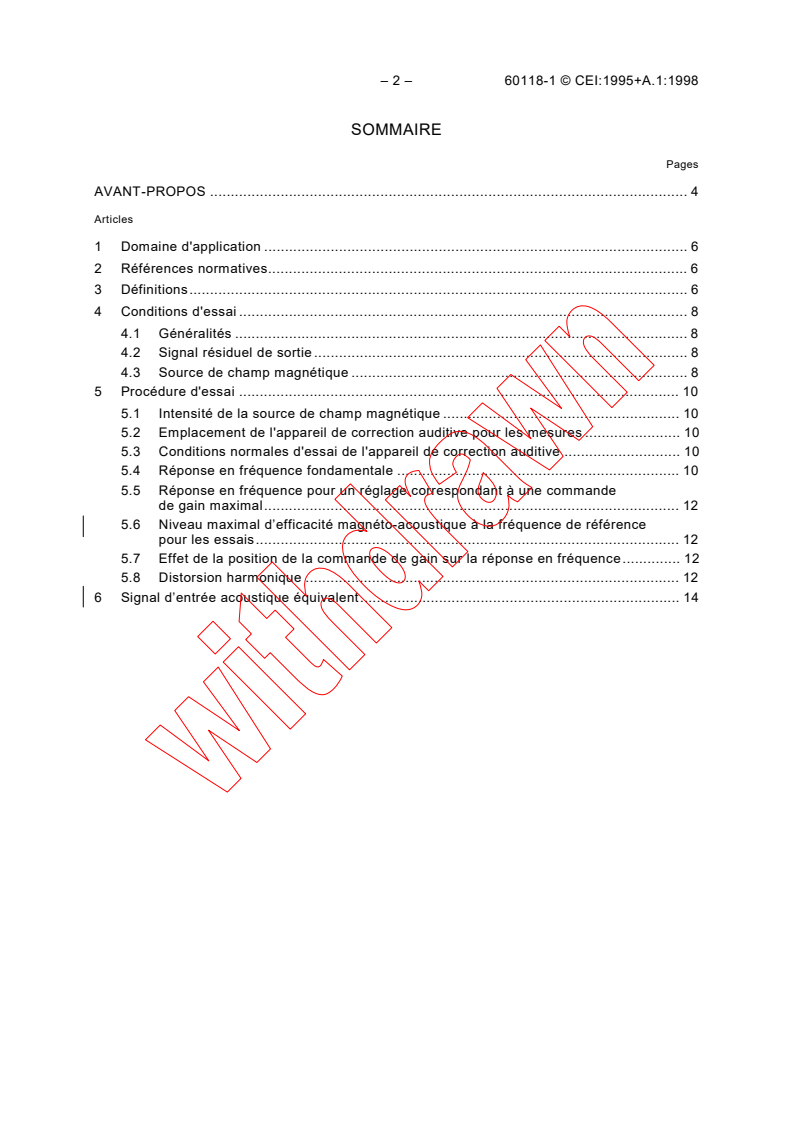
SOMMAIRE
Pages
AVANT-PROPOS . 4
Articles
1 Domaine d'application . 6
2 Références normatives. 6
3 Définitions. 6
4 Conditions d'essai . 8
4.1 Généralités . 8
4.2 Signal résiduel de sortie . 8
4.3 Source de champ magnétique . 8
5 Procédure d'essai . 10
5.1 Intensité de la source de champ magnétique . 10
5.2 Emplacement de l'appareil de correction auditive pour les mesures . 10
5.3 Conditions normales d'essai de l'appareil de correction auditive . 10
5.4 Réponse en fréquence fondamentale . 10
5.5 Réponse en fréquence pour un réglage correspondant à une commande
de gain maximal. 12
5.6 Niveau maximal d’efficacité magnéto-acoustique à la fréquence de référence
pour les essais. 12
5.7 Effet de la position de la commande de gain sur la réponse en fréquence. 12
5.8 Distorsion harmonique . 12
6 Signal d’entrée acoustique équivalent. 14
60118-1 © IEC:1995+A.1:1998 – 3 –
CONTENTS
Page
FOREWORD . 5
Clause
1 Scope . 7
2 Normative references . 7
3 Definitions. 7
4 Test conditions. 9
4.1 General. 9
4.2 Residual output level. 9
4.3 Magnetic field source . 9
5 Test procedure. 11
5.1 Strength of magnetic field source . 11
5.2 Locating the hearing aid for test . 11
5.3 Normal operating conditions for the hearing aid . 11
5.4 Basic frequency response . 11
5.5 Frequency response with full-on gain control setting . 13
5.6 Maximum magneto-acoustical sensitivity level at the reference test frequency . 13
5.7 Effect of gain control position on frequency response . 13
5.8 Harmonic distortion . 13
6 Equivalent acoustic input. 15
– 4 – 60118-1 © CEI:1995+A.1:1998
COMMISSION ÉLECTROTECHNIQUE INTERNATIONALE
–––––––––––––
APPAREILS DE CORRECTION AUDITIVE –
Partie 1: Appareils de correction auditive comportant une entrée
à bobine d'induction captrice
AVANT-PROPOS
1) La CEI (Commission Electrotechnique Internationale) est une organisation mondiale de normalisation composée
de l'ensemble des comités électrotechniques nationaux (Comités nationaux de la CEI). La CEI a pour objet de
favoriser la coopération internationale pour toutes les questions de normalisation dans les domaines de
l'électricité et de l'électronique. A cet effet, la CEI, entre autres activités, publie des Normes internationales.
Leur élaboration est confiée à des comités d'études, aux travaux desquels tout Comité national intéressé par le
sujet traité peut participer. Les organisations internationales, gouvernementales et non gouvernementales, en
liaison avec la CEI, participent également aux travaux. La CEI collabore étroitement avec l'Organisation
Internationale de Normalisation (ISO), selon des conditions fixées par accord entre les deux organisations.
2) Les décisions ou accords officiels de la CEI concernant les questions techniques représentent, dans la mesure
du possible un accord international sur les sujets étudiés, étant donné que les Comités nationaux intéressés
sont représentés dans chaque comité d’études.
3) Les documents produits se présentent sous la forme de recommandations internationales. Ils sont publiés
comme normes, rapports techniques ou guides et agréés comme tels par les Comités nationaux.
4) Dans le but d'encourager l'unification internationale, les Comités nationaux de la CEI s'engagent à appliquer de
façon transparente, dans toute la mesure possible, les Normes internationales de la CEI dans leurs normes
nationales et régionales. Toute divergence entre la norme de la CEI et la norme nationale ou régionale
correspondante doit être indiquée en termes clairs dans cette dernière.
5) La CEI n’a fixé aucune procédure concernant le marquage comme indication d’approbation et sa responsabilité
n’est pas engagée quand un matériel est déclaré conforme à l’une de ses normes.
6) L’attention est attirée sur le fait que certains des éléments de la présente Norme internationale peuvent faire
l’objet de droits de propriété intellectuelle ou de droits analogues. La CEI ne saurait être tenue pour
responsable de ne pas avoir identifié de tels droits de propriété et de ne pas avoir signalé leur existence.
La présente partie de la Norme internationale CEI 60118 a été établie par le comité d'études
29 de la CEI: Electroacoustique.
La présente version consolidée de la CEI 60118-1 comprend la troisième édition (1995)
[documents 29(BC)213 et 29(BC)217] et son amendement 1 (1998) [documents 29/403/FDIS et
29/413/RVD].
Le contenu technique de cette version consolidée est donc identique à celui de l'édition de
base et à son amendement; cette version a été préparée par commodité pour l'utilisateur.
Elle porte le numéro d'édition 3.1.
Une ligne verticale dans la marge indique où la publication de base a été modifiée par
l'amendement 1.
60118-1 © IEC:1995+A.1:1998 – 5 –
INTERNATIONAL ELECTROTECHNICAL COMMISSION
–––––––––––
HEARING AIDS –
Part 1: Hearing aids with induction pick-up coil input
FOREWORD
1) The IEC (International Electrotechnical Commission) is a worldwide organization for standardization comprising
all national electrotechnical committees (IEC National Committees). The object of the IEC is to promote
international co-operation on all questions concerning standardization in the electrical and electronic fields. To
this end and in addition to other activities, the IEC publishes International Standards. Their preparation is
entrusted to technical committees; any IEC National Committee interested in the subject dealt with may
participate in this preparatory work. International, governmental and non-governmental organizations liaising
with the IEC also participate in this preparation. The IEC collaborates closely with the International Organization
for Standardization (ISO) in accordance with conditions determined by agreement between the two
organizations.
2) The formal decisions or agreements of the IEC on technical matters express, as nearly as possible, an
international consensus of opinion on the relevant subjects since each technical committee has representation
from all interested National Committees.
3) The documents produced have the form of recommendations for international use and are published in the form
of standards, technical reports or guides and they are accepted by the National Committees in that sense.
4) In order to promote international unification, IEC National Committees undertake to apply IEC International
Standards transparently to the maximum extent possible in their national and regional standards. Any
divergence between the IEC Standard and the corresponding national or regional standard shall be clearly
indicated in the latter.
5) The IEC provides no marking procedure to indicate its approval and cannot be rendered responsible for any
equipment declared to be in conformity with one of its standards.
6) Attention is drawn to the possibility that some of the elements of this International Standard may be the subject
of patent rights. The IEC shall not be held responsible for identifying any or all such patent rights.
This part of International Standard IEC 60118 has been prepared by IEC technical committee
29: Electroacoustics.
This consolidated version of IEC 60118-1 consists of the third edition (1995) [documents
29(CO)213 and 29(CO)217] and its amendment 1 (1998) [documents 29/403/FDIS and
29/413/RVD].
The technical content is therefore identical to the base edition and its amendment and has
been prepared for user convenience.
It bears the edition number 3.1.
A vertical line in the margin shows where the base publication has been modified by
amendment 1.
– 6 – 60118-1 © CEI:1995+A.1:1998
APPAREILS DE CORRECTION AUDITIVE –
Partie 1: Appareils de correction auditive comportant une entrée
à bobine d'induction captrice
1 Domaine d'application
La présente norme spécifie une méthode pour déterminer les caractéristiques électroacoustiques
des appareils de correction auditive équipés d'une bobine d'induction captrice et utilisés dans
un champ magnétique audiofréquence. Les caractéristiques de la bobine d'induction sont
mesurées dans une boucle simulant les conditions d’utilisation applicables aux salles équipées
d’une boucle.
NOTE – Les caractéristiques des bobines d'induction captrices dans des champs magnétiques téléphoniques
peuvent différer des résultats obtenus en utilisant la présente norme.
2 Références normatives
Les documents normatifs suivants contiennent des dispositions qui, par suite de la référence
qui y est faite, constituent des dispositions valables pour la présente partie de la CEI 60118.
Au moment de la publication, les éditions indiquées étaient en vigueur. Tout document normatif
est sujet à révision et les parties prenantes aux accords fondés sur la présente partie de la
CEI 60118 sont invitées à rechercher la possibilité d'appliquer les éditions les plus récentes
des documents normatifs indiqués ci-après. Les membres de la CEI et de l'ISO possèdent le
registre des Normes internationales en vigueur.
CEI 60118-0:1983, Appareils de correction auditive – Partie 0: Méthodes de mesure des
caractéristiques électroacoustiques
Amendement 1 (1994)
CEI 60711:1981, Simulateur d'oreille occluse pour la mesure des écouteurs couplés à l'oreille
par des embouts
3 Définitions
Les termes et les définitions autres que ceux qui sont définis ci-dessous sont spécifiés dans la
CEI 60118-0 et la CEI 60711.
3.1
point de mesure
emplacement où l'intensité du champ magnétique est définie
3.2
volume d'essai
volume qui contient le point de mesure où l'appareil de correction auditive doit être placé pour
l'essai
3.3
réponse en fréquence
niveau de pression acoustique mesuré dans le simulateur d'oreille, exprimé en fonction de la
fréquence dans des conditions d'essai spécifiées
60118-1 © IEC:1995+A.1:1998 – 7 –
HEARING AIDS –
Part 1: Hearing aids with induction pick-up coil input
1 Scope
This standard specifies a method of determining the electroacoustic performance of hearing
aids fitted with an induction pick-up coil and used in an audio-frequency magnetic field. The
induction pick-up performance is measured in a loop simulating conditions of use in room
applications.
NOTE – Performance of induction pick-up coils in telephone magnetic fields may differ from results obtained using
this standard.
2 Normative references
The following normative documents contain provisions which, through reference in this text,
constitute provisions of this part of IEC 60118. At the time of publication, the editions indicated
were valid. All normative documents are subject to revision, and parties to agreements based
on this part of IEC 60118 are encouraged to investigate the possibility of applying the most
recent editions of the normative documents indicated below. Members of IEC and ISO maintain
registers of currently valid International Standards.
IEC 60118-0:1983, Hearing aids – Part 0: Measurement of electroacoustical characteristics
Amendment 1 (1994)
IEC 60711:1981, Occluded-ear simulator for the measurement of earphones coupled to the ear
by ear inserts
3 Definitions
Terms and definitions other than those below are specified in IEC 60118-0 and IEC 60711.
3.1
test point
the position at which the strength of the magnetic field is defined
3.2
test space
a space which contains the test point where the hearing aid is to be placed for testing
3.3
frequency response
the sound pressure level measured in the ear simulator expressed as a function of frequency
under specified test conditions
– 8 – 60118-1 © CEI:1995+A.1:1998
3.4
efficacité magnéto-acoustique
pour une fréquence spécifiée et dans des conditions de fonctionnement sensiblement linéaires
entre l’entrée et la sortie, rapport entre la pression acoustique produite par l’appareil de
correction auditive dans le simulateur d’oreille, exprimée en pascals (Pa), et l’intensité du
champ magnétique au point de mesure, exprimée en milliampères par mètre (mA/m)
3.5
niveau d’efficacité magnéto-acoustique (MASL en abrégé, selon le terme anglais)
vingt fois le logarithme décimal du rapport entre l’efficacité magnéto-acoustique et l’efficacité
magnéto-acoustique de référence de 20 μPa/(1 mA/m). Ce niveau est exprimé en décibels
NOTE – Le niveau d’efficacité magnéto-acoustique peut se calculer dan
...