


IEC 60749-20:2020
(Main)Semiconductor devices - Mechanical and climatic test methods - Part 20: Resistance of plastic encapsulated SMDs to the combined effect of moisture and soldering heat
General Information
- Abstract
IEC 60749-20:2020 provides a means of assessing the resistance to soldering heat of semiconductors packaged as plastic encapsulated surface mount devices (SMDs). This test is destructive. This edition includes the following significant technical changes with respect to the previous edition:
- incorporation of a technical corrigendum to IEC 60749-20:2008 (second edition );
- inclusion of new Clause 3;
- inclusion of explanatory notes.
- Status
- Published
- Publication Date
- 30-Aug-2020
- Technical Committee
- TC 47 - Semiconductor devices
- Drafting Committee
- WG 2 - TC 47/WG 2
- Current Stage
- PPUB - Publication issued
- Start Date
- 31-Aug-2020
- Completion Date
- 28-Aug-2020
Buy Documents
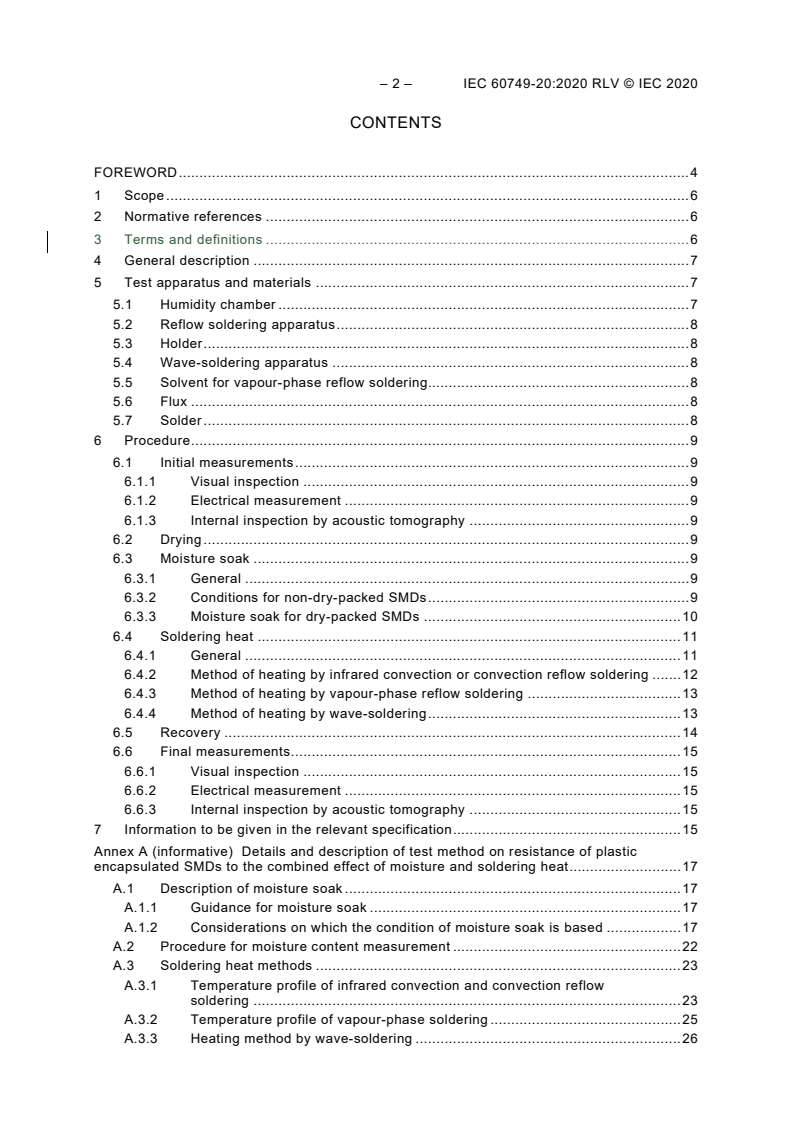
IEC 60749-20:2020 RLV - Semiconductor devices - Mechanical and climatic test methods - Part 20: Resistance of plastic encapsulated SMDs to the combined effect of moisture and soldering heat Released:8/31/2020
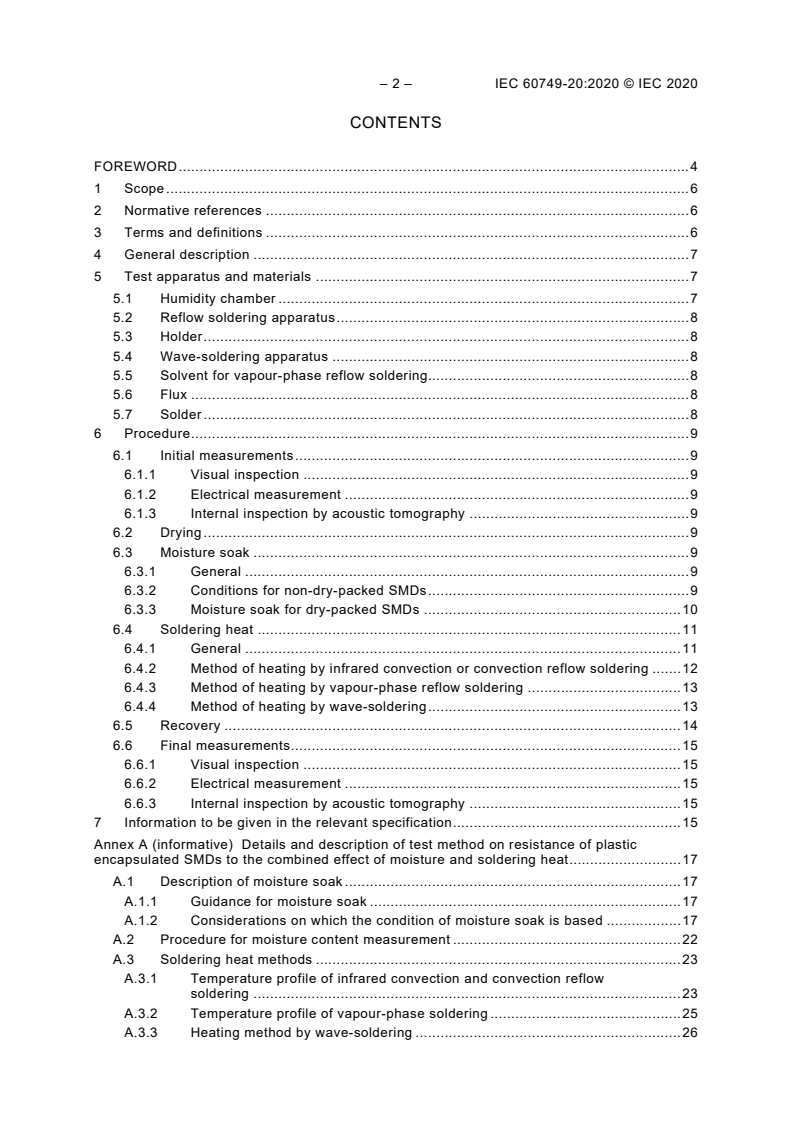
IEC 60749-20:2020 - Semiconductor devices - Mechanical and climatic test methods - Part 20: Resistance of plastic encapsulated SMDs to the combined effect of moisture and soldering heat Released:8/31/2020
Overview - IEC 60749-20:2020 (Resistance of plastic encapsulated SMDs to moisture and soldering heat)
IEC 60749-20:2020 is the International Electrotechnical Commission standard that defines a destructive test method to assess the resistance to soldering heat of plastic‑encapsulated surface‑mount devices (SMDs) when they are exposed to the combined effects of moisture and soldering heat. The third edition (2020) updates the previous edition by incorporating a technical corrigendum, adding a new Clause 3 (terms and definitions), and including explanatory notes to improve clarity.
Key topics and technical requirements
- Scope and applicability: Applies to plastic‑encapsulated, non‑hermetic SMDs; used as a precondition or qualification test before reliability evaluation.
- Test flow: Initial inspections and electrical measurements → drying → controlled moisture soak → exposure to soldering heat → recovery → final inspections and measurements.
- Test apparatus and materials: Humidity chamber, reflow/infrared/convective soldering equipment, vapour‑phase and wave‑soldering apparatus, holders, solvents, fluxes and solder materials.
- Moisture soak conditions: Standardized moisture soak regimes (including common soak conditions such as 85 °C/85 % RH shown in annex) and methods for dry‑packed versus non‑dry‑packed SMDs to achieve representative internal moisture levels.
- Soldering heat methods: Classification reflow profiles for Sn–Pb and Pb‑free processes, vapour‑phase reflow and wave‑soldering immersion methods. The standard defines how to measure and report specimen temperature profiles.
- Measurements and inspection: Visual and electrical checks plus acoustic tomography (acoustic microscopy) for internal inspection both before and after testing.
- Destructive nature: The test is explicitly destructive; failure modes and acceptance criteria are defined in the relevant product specification.
Practical applications and who uses IEC 60749-20:2020
- Semiconductor manufacturers - to qualify packages against moisture‑induced soldering failures (popcorning, delamination, cracking).
- Reliability and qualification engineers - to design preconditioning and stress tests before reliability testing.
- Contract manufacturers and PCB assemblers - to validate soldering processes and reflow/wave profiles relative to moisture sensitivity.
- Test labs and compliance bodies - to perform standardized destructive assessments and generate repeatable data for product datasheets and supplier agreements.
- OEMs and procurement - to specify component requirements and ensure components meet assembly thermal‑moisture resilience.
Related standards
- IEC 60068-2-20 (solderability / resistance to soldering heat)
- IEC 60749-3 (visual inspection)
- IEC 60749-30 (preconditioning of non‑hermetic SMDs)
- IEC 60749-35 (acoustic microscopy for plastic encapsulated components)
Keywords: IEC 60749-20:2020, resistance to soldering heat, plastic encapsulated SMDs, moisture soak, reflow soldering, vapour‑phase, wave‑soldering, acoustic tomography, moisture sensitivity, preconditioning.
Relations
- Effective Date
- 05-Sep-2023
Buy Documents
IEC 60749-20:2020 RLV - Semiconductor devices - Mechanical and climatic test methods - Part 20: Resistance of plastic encapsulated SMDs to the combined effect of moisture and soldering heat Released:8/31/2020
IEC 60749-20:2020 - Semiconductor devices - Mechanical and climatic test methods - Part 20: Resistance of plastic encapsulated SMDs to the combined effect of moisture and soldering heat Released:8/31/2020
Frequently Asked Questions
IEC 60749-20:2020 is a standard published by the International Electrotechnical Commission (IEC). Its full title is "Semiconductor devices - Mechanical and climatic test methods - Part 20: Resistance of plastic encapsulated SMDs to the combined effect of moisture and soldering heat". This standard covers: IEC 60749-20:2020 provides a means of assessing the resistance to soldering heat of semiconductors packaged as plastic encapsulated surface mount devices (SMDs). This test is destructive. This edition includes the following significant technical changes with respect to the previous edition: - incorporation of a technical corrigendum to IEC 60749-20:2008 (second edition ); - inclusion of new Clause 3; - inclusion of explanatory notes.
IEC 60749-20:2020 provides a means of assessing the resistance to soldering heat of semiconductors packaged as plastic encapsulated surface mount devices (SMDs). This test is destructive. This edition includes the following significant technical changes with respect to the previous edition: - incorporation of a technical corrigendum to IEC 60749-20:2008 (second edition ); - inclusion of new Clause 3; - inclusion of explanatory notes.
IEC 60749-20:2020 is classified under the following ICS (International Classification for Standards) categories: 31.080.01 - Semiconductor devices in general. The ICS classification helps identify the subject area and facilitates finding related standards.
IEC 60749-20:2020 has the following relationships with other standards: It is inter standard links to IEC 60749-20:2008. Understanding these relationships helps ensure you are using the most current and applicable version of the standard.
IEC 60749-20:2020 is available in PDF format for immediate download after purchase. The document can be added to your cart and obtained through the secure checkout process. Digital delivery ensures instant access to the complete standard document.
Standards Content (Sample)
IEC 60749-20 ®
Edition 3.0 2020-08
REDLINE VERSION
INTERNATIONAL
STANDARD
colour
inside
Semiconductor devices – Mechanical and climatic test methods –
Part 20: Resistance of plastic encapsulated SMDs to the combined effect
of moisture and soldering heat
All rights reserved. Unless otherwise specified, no part of this publication may be reproduced or utilized in any form
or by any means, electronic or mechanical, including photocopying and microfilm, without permission in writing from
either IEC or IEC's member National Committee in the country of the requester. If you have any questions about IEC
copyright or have an enquiry about obtaining additional rights to this publication, please contact the address below or
your local IEC member National Committee for further information.
IEC Central Office Tel.: +41 22 919 02 11
3, rue de Varembé info@iec.ch
CH-1211 Geneva 20 www.iec.ch
Switzerland
About the IEC
The International Electrotechnical Commission (IEC) is the leading global organization that prepares and publishes
International Standards for all electrical, electronic and related technologies.
About IEC publications
The technical content of IEC publications is kept under constant review by the IEC. Please make sure that you have the
latest edition, a corrigendum or an amendment might have been published.
IEC publications search - webstore.iec.ch/advsearchform Electropedia - www.electropedia.org
The advanced search enables to find IEC publications by a The world's leading online dictionary on electrotechnology,
variety of criteria (reference number, text, technical containing more than 22 000 terminological entries in English
committee,…). It also gives information on projects, replaced and French, with equivalent terms in 16 additional languages.
and withdrawn publications. Also known as the International Electrotechnical Vocabulary
(IEV) online.
IEC Just Published - webstore.iec.ch/justpublished
Stay up to date on all new IEC publications. Just Published IEC Glossary - std.iec.ch/glossary
details all new publications released. Available online and 67 000 electrotechnical terminology entries in English and
once a month by email. French extracted from the Terms and Definitions clause of
IEC publications issued since 2002. Some entries have been
IEC Customer Service Centre - webstore.iec.ch/csc collected from earlier publications of IEC TC 37, 77, 86 and
If you wish to give us your feedback on this publication or CISPR.
need further assistance, please contact the Customer Service
Centre: sales@iec.ch.
IEC 60749-20 ®
Edition 3.0 2020-08
REDLINE VERSION
INTERNATIONAL
STANDARD
colour
inside
Semiconductor devices – Mechanical and climatic test methods –
Part 20: Resistance of plastic encapsulated SMDs to the combined effect
of moisture and soldering heat
INTERNATIONAL
ELECTROTECHNICAL
COMMISSION
ICS 31.080.01 ISBN 978-2-8322-8834-4
– 2 – IEC 60749-20:2020 RLV © IEC 2020
CONTENTS
FOREWORD . 4
1 Scope . 6
2 Normative references . 6
3 Terms and definitions . 6
4 General description . 7
5 Test apparatus and materials . 7
5.1 Humidity chamber . 7
5.2 Reflow soldering apparatus . 8
5.3 Holder . 8
5.4 Wave-soldering apparatus . 8
5.5 Solvent for vapour-phase reflow soldering. 8
5.6 Flux . 8
5.7 Solder . 8
6 Procedure . 9
6.1 Initial measurements . 9
6.1.1 Visual inspection . 9
6.1.2 Electrical measurement . 9
6.1.3 Internal inspection by acoustic tomography . 9
6.2 Drying . 9
6.3 Moisture soak . 9
6.3.1 General . 9
6.3.2 Conditions for non-dry-packed SMDs . 9
6.3.3 Moisture soak for dry-packed SMDs . 10
6.4 Soldering heat . 11
6.4.1 General . 11
6.4.2 Method of heating by infrared convection or convection reflow soldering . 12
6.4.3 Method of heating by vapour-phase reflow soldering . 13
6.4.4 Method of heating by wave-soldering . 13
6.5 Recovery . 14
6.6 Final measurements . 15
6.6.1 Visual inspection . 15
6.6.2 Electrical measurement . 15
6.6.3 Internal inspection by acoustic tomography . 15
7 Information to be given in the relevant specification . 15
Annex A (informative) Details and description of test method on resistance of plastic
encapsulated SMDs to the combined effect of moisture and soldering heat . 17
A.1 Description of moisture soak . 17
A.1.1 Guidance for moisture soak . 17
A.1.2 Considerations on which the condition of moisture soak is based . 17
A.2 Procedure for moisture content measurement . 22
A.3 Soldering heat methods . 23
A.3.1 Temperature profile of infrared convection and convection reflow
soldering . 23
A.3.2 Temperature profile of vapour-phase soldering . 25
A.3.3 Heating method by wave-soldering . 26
Figure 1 – Method of measuring the temperature profile of a specimen . 8
Figure 2 – Heating by wave-soldering . 14
Figure A.1 – Process of moisture diffusion at 85 °C, 85 % RH. 18
Figure A.2 – Definition of resin thickness and the first interface . 18
Figure A.3 – Moisture soak time to saturation at 85 °C as a function of resin thickness . 18
Figure A.4 – Temperature dependence of saturated moisture content of resin . 19
Figure A.5 – Dependence of moisture content of resin at the first interface on resin
thickness under various soak conditions . 20
Figure A.6 – Dependence of moisture content of resin at the first interface on resin
thickness related to method A of moisture soak . 20
Figure A.7 – Dependence of the moisture content of resin at the first interface on resin
thickness related to method B of moisture soak . 21
Figure A.8 – Dependence of moisture content of resin at the first interface on resin
thickness related to condition B2 of method B of moisture soak . 22
Figure A.9 – Temperature profile of infrared convection and convection reflow
soldering for Sn-Pb eutectic assembly . 23
Figure A.10 – Temperature profile of infrared convection and convection reflow
soldering for lead-free assembly . 24
Figure A.11 – Classification profile . 25
Figure A.12 – Temperature profile of vapour-phase soldering (condition II-A) . 25
Figure A.13 – Immersion method into solder bath . 26
Figure A.14 – Relation between the infrared convection reflow soldering and wave-
soldering . 27
Figure A.15 – Temperature in the body of the SMD during wave-soldering . 27
Table 1 – Moisture soak conditions for non-dry-packed SMDs . 9
Table 2 – Moisture soak conditions for dry-packed SMDs (method A) . 10
Table 3 – Moisture soak conditions for dry-packed SMDs (method B) . 11
Table 4 – SnPb eutectic process – Classification reflow temperatures (T ) . 12
c
Table 5 – Pb-free process – Classification reflow temperatures (T ) . 13
c
Table 6 – Heating condition for vapour-phase soldering . 13
Table 7 – Immersion conditions for wave-soldering . 14
Table A.1 – Comparison of actual storage conditions and equivalent moisture soak
conditions before soldering heat . 19
Table A.2 – Classification profiles . 24
– 4 – IEC 60749-20:2020 RLV © IEC 2020
INTERNATIONAL ELECTROTECHNICAL COMMISSION
____________
SEMICONDUCTOR DEVICES –
MECHANICAL AND CLIMATIC TEST METHODS –
Part 20: Resistance of plastic encapsulated SMDs to
the combined effect of moisture and soldering heat
FOREWORD
1) The International Electrotechnical Commission (IEC) is a worldwide organization for standardization comprising
all national electrotechnical committees (IEC National Committees). The object of IEC is to promote
international co-operation on all questions concerning standardization in the electrical and electronic fields. To
this end and in addition to other activities, IEC publishes International Standards, Technical Specifications,
Technical Reports, Publicly Available Specifications (PAS) and Guides (hereafter referred to as “IEC
Publication(s)”). Their preparation is entrusted to technical committees; any IEC National Committee interested
in the subject dealt with may participate in this preparatory work. International, governmental and non-
governmental organizations liaising with the IEC also participate in this preparation. IEC collaborates closely
with the International Organization for Standardization (ISO) in accordance with conditions determined by
agreement between the two organizations.
2) The formal decisions or agreements of IEC on technical matters express, as nearly as possible, an international
consensus of opinion on the relevant subjects since each technical committee has representation from all
interested IEC National Committees.
3) IEC Publications have the form of recommendations for international use and are accepted by IEC National
Committees in that sense. While all reasonable efforts are made to ensure that the technical content of IEC
Publications is accurate, IEC cannot be held responsible for the way in which they are used or for any
misinterpretation by any end user.
4) In order to promote international uniformity, IEC National Committees undertake to apply IEC Publications
transparently to the maximum extent possible in their national and regional publications. Any divergence
between any IEC Publication and the corresponding national or regional publication shall be clearly indicated in
the latter.
5) IEC itself does not provide any attestation of conformity. Independent certification bodies provide conformity
assessment services and, in some areas, access to IEC marks of conformity. IEC is not responsible for any
services carried out by independent certification bodies.
6) All users should ensure that they have the latest edition of this publication.
7) No liability shall attach to IEC or its directors, employees, servants or agents including individual experts and
members of its technical committees and IEC National Committees for any personal injury, property damage or
other damage of any nature whatsoever, whether direct or indirect, or for costs (including legal fees) and
expenses arising out of the publication, use of, or reliance upon, this IEC Publication or any other IEC
Publications.
8) Attention is drawn to the Normative references cited in this publication. Use of the referenced publications is
indispensable for the correct application of this publication.
9) Attention is drawn to the possibility that some of the elements of this IEC Publication may be the subject of
patent rights. IEC shall not be held responsible for identifying any or all such patent rights.
This redline version of the official IEC Standard allows the user to identify the changes
made to the previous edition. A vertical bar appears in the margin wherever a change
has been made. Additions are in green text, deletions are in strikethrough red text.
International Standard IEC 60749-20 has been prepared by IEC technical committee 47:
Semiconductor devices.
This third edition cancels and replaces the second edition published in 2008. This edition
constitutes a technical revision.
This edition includes the following significant technical changes with respect to the previous
edition:
a) incorporation of a technical corrigendum to IEC 60749-20:2008 (second edition );
b) inclusion of new Clause 3;
c) inclusion of explanatory notes.
The text of this International Standard is based on the following documents:
FDIS Report on voting
47/2634/FDIS 47/2646/RVD
Full information on the voting for the approval of this International Standard can be found in
the report on voting indicated in the above table.
This document has been drafted in accordance with the ISO/IEC Directives, Part 2.
A list of all parts in the IEC 60749 series, published under the general title Semiconductor
devices – Mechanical and climatic test methods, can be found on the IEC website.
The committee has decided that the contents of this document will remain unchanged until the
stability date indicated on the IEC website under "http://webstore.iec.ch" in the data related to
the specific document. At this date, the document will be
• reconfirmed,
• withdrawn,
• replaced by a revised edition, or
• amended.
IMPORTANT – The 'colour inside' logo on the cover page of this publication indicates
that it contains colours which are considered to be useful for the correct
understanding of its contents. Users should therefore print this document using a
colour printer.
– 6 – IEC 60749-20:2020 RLV © IEC 2020
SEMICONDUCTOR DEVICES –
MECHANICAL AND CLIMATIC TEST METHODS –
Part 20: Resistance of plastic encapsulated SMDs to
the combined effect of moisture and soldering heat
1 Scope
This part of IEC 60749 provides a means of assessing the resistance to soldering heat of
semiconductors packaged as plastic encapsulated surface mount devices (SMDs). This test is
destructive.
2 Normative references
The following documents are referred to in the text in such a way that some or all of their
content constitutes requirements of this document. For dated references, only the edition
cited applies. For undated references, the latest edition of the referenced document (including
any amendments) applies.
IEC 60068-2-20:2008, Environmental testing – Part 2-20: Tests – Test T: Test methods for
solderability and resistance to soldering heat of devices with leads
IEC 60749-3, Semiconductor devices – Mechanical and climatic test methods – Part 3:
External visual inspection examination
IEC 60749-30, Semiconductor devices – Mechanical and climatic test methods – Part 30:
Preconditioning of non-hermetic surface mount devices prior to reliability testing
IEC 60749-35, Semiconductor devices – Mechanical and climatic test methods – Part 35:
Acoustic microscopy for plastic encapsulated electronic components
3 Terms and definitions
For the purposes of this document, the following terms and definitions apply.
ISO and IEC maintain terminological databases for use in standardization at the following
addresses:
• IEC Electropedia: available at http://www.electropedia.org/
• ISO Online browsing platform: available at http://www.iso.org/obp
3.1
acoustic tomography
determination of the physical qualities of a known substance by measuring how long it takes
sound to travel through it
3.2
classification reflow temperature
T
c
maximum body temperature for which the component moisture sensitivity level (MSL) is
verified by the component manufacturer and as noted on the caution and/or bar code label
3.3
crack
separation within a bulk material
Note 1 to entry: See also delamination (3.5).
3.4
dead-bug orientation
orientation of a package with the terminals facing upwards
3.5
delamination
interfacial separation between two materials intended to be bonded
Note 1 to entry: See also crack (3.3).
3.6
floor life
allowable time period after removal from a moisture barrier bag, dry storage, or dry bake and
before the solder reflow process
Note 1 to entry: For the purposes of this document "‘unlimited" floor life only refers to moisture/reflow related
failures and does not take into consideration other failure mechanisms or shelf life issues due to long term storage.
3.7
live-bug orientation
orientation of a package when resting on its terminals
3.8
moisture sensitivity level
MSL
rating indicating a component’s susceptibility to damage due to absorbed moisture when
subjected to reflow soldering
3.9
soak
exposure of a component for a specified time at a specified temperature and humidity
4 General description
Package cracking and electrical failure in plastic encapsulated SMDs can result when
soldering heat raises the vapour pressure of moisture which has been absorbed into SMDs
during storage. These problems are assessed. In this test method, SMDs are evaluated for
heat resistance after being soaked in an environment which simulates moisture being
absorbed while under storage in a warehouse or dry pack. Moisture sensitivity level (MSL)
ratings generated by this document are utilized to determine the soak conditions for
preconditioning in accordance with IEC 60749-30.
5 Test apparatus and materials
5.1 Humidity chamber
The humidity chamber shall provide an environment complying with the temperature and
relative humidity defined in 6.3.
– 8 – IEC 60749-20:2020 RLV © IEC 2020
5.2 Reflow soldering apparatus
The infrared convection, the convection and the vapour-phase reflow soldering apparatus
shall provide temperature profiles complying with the conditions of soldering heat defined in
6.4.2 and 6.4.3. The settings of the reflow soldering apparatus shall be adjusted by
temperature profiling of the top surface of the specimen while it is undergoing the soldering
heat process, measured as shown in Figure 1.
NOTE The adhesive agent or thin tape should have good thermal conductivity.
Figure 1 – Method of measuring the temperature profile of a specimen
5.3 Holder
Unless otherwise detailed in the relevant specification, any board material, such as epoxy
fibreglass or polyimide, may be used for the holder. The specimen shall be placed on the
holder by the usual means and in a position as shown in Figure 1. If the position of the
specimen, as shown in Figure 1, necessitates changing the shape of terminations and results
in subsequent electrical measurement anomalies, a position that avoids changing the shape
of terminations may be chosen, and this shall be specified in the relevant specification.
5.4 Wave-soldering apparatus
The wave-soldering apparatus shall comply with conditions given in 6.4.4. Molten solder shall
usually be flowed.
5.5 Solvent for vapour-phase reflow soldering
Perfluorocarbon (perfluoroisobutylene) shall be used.
5.6 Flux
Unless otherwise detailed in the relevant specification, the flux shall consist of 25 % by weight
of colophony in 75 % by weight of isopropyl alcohol, both as specified in Annex B of
IEC 60068-2-20:2008.
5.7 Solder
A solder of the composition as specified in Table 1 of IEC 60068-2-20:2008 shall be used.
6 Procedure
6.1 Initial measurements
6.1.1 Visual inspection
Visual inspection, as specified in IEC 60749-3, shall be performed before the test. Special
attention shall be paid to external cracks and swelling, which will be looked for under a
magnification of 40X.
6.1.2 Electrical measurement
Electrical testing shall be performed as required by the relevant specification.
6.1.3 Internal inspection by acoustic tomography
Unless otherwise detailed in the relevant specification, internal cracks and delamination in the
specimen shall be inspected by acoustic tomography in accordance with IEC 60749-35.
6.2 Drying
Unless otherwise detailed in the relevant specification, the specimen shall be baked at
125 °C ± 5 °C for at least 24 h.
NOTE 1 This time/temperature is modified if desorption data on the particular device under test shows that a
different condition is required to obtain a "dry" package when starting in the wet condition for 85 °C/85 % RH.
NOTE 2 If a bake test is interrupted for more than 15 min, then the total time of the interruption is excluded from
the bake time. The interruption time is taken into account (if no greater than 1 h) then re-incorporated to ensure a
minimum of 24 h. For instance, if the interruption was 45 min, then the total bake test time would be 24 h and
45 min. If greater than 1 h the bake is restarted for a full 24 h.
6.3 Moisture soak
6.3.1 General
Unless otherwise detailed in the relevant specification, moisture soak conditions shall be
selected on the basis of the packing method of the specimen (see A.1.1, Annex A). If baking
the specimen before soldering is detailed in the relevant specification, the specimen shall be
baked instead of being subjected to moisture soak.
6.3.2 Conditions for non-dry-packed SMDs
The moisture soak condition shall be selected from Table 1, in accordance with the
permissible limit of actual storage (see A.1.2.1).
Table 1 – Moisture soak conditions for non-dry-packed SMDs
Temperature Relative humidity Duration time
Permissible limit on
Condition
actual storage
°C % h
A1 or B1 85 ± 2 85 ± 5 168 ± 24 < 30 °C, 85 % RH
RH: relative humidity
NOTE Conditions A1 and B1 indicate moisture soak for non-dry-packed SMDs under either method A or B.
– 10 – IEC 60749-20:2020 RLV © IEC 2020
6.3.3 Moisture soak for dry-packed SMDs
6.3.3.1 General
Moisture soak conditions for dry-packed SMDs may be used as specified in method A, Table 2,
or method B, Table 3. Moisture soak conditioning for dry-packed SMDs consists of two stages.
The first stage of conditioning is intended to simulate moisturizing SMDs before opening the
dry pack/dry cabinet. The second stage of conditioning is to simulate moisturizing SMDs
during storage after opening the dry pack for soldering (floor life). Moisture soak conditioning
for dry-packed SMDs shall be selected from method A or B. Method A shall be used when the
relative humidity in the dry pack or dry cabinet is specified by the manufacturer as being
between 10 % and 30 %. Method B shall be used when the relative humidity in the dry pack or
dry cabinet is specified by the manufacturer as being below 10 %.
6.3.3.2 Method A
Unless otherwise detailed in the relevant specification, the first stage conditioning of A2, as
shown in Table 2, shall be performed. Subsequently, the second stage conditioning of A2, as
shown in Table 2, shall be performed within 4 h of finishing the first stage of conditioning
(see A.1.2.2).
The relative humidity of the first stage conditioning must shall be the same as the upper limit
of the relative humidity inside the moisture barrier bag. The relative humidity of the second
stage conditioning must shall be the same as the conditions of floor life.
Where required in the relevant specification, test conditions other than those of the moisture
barrier bag and floor life conditions may be specified in the moisture soak conditions of
Table 2.
Table 2 – Moisture soak conditions for dry-packed SMDs (method A)
Permissible storage
Condition Moisture soak conditions conditions in the dry Condition of floor life
pack and the dry cabinet
A2 first-stage conditioning (85 ± 2) °C, (30 ± 5) % RH,
< 30 °C, 30 % RH, 1 year –
168 h
−0
A2 second-stage (30 ± 2) °C, (70 ± 5) % RH,
– < 30 °C, 70 % RH, 168 h
conditioning
168 h
−0
RH: Relative humidity
NOTE 1 The first stage of conditioning represents storage conditions in the dry pack and the dry cabinet, as well
as increasing relative humidity in the dry pack, by repacking the SMDs at the distributor's facility and the user's
inspection facility. When condition A2 is applied, the SMDs should be are packed into a moisture-proof bag with IC
trays and desiccants within a few weeks of drying. They may can then be subjected to multiple temporary openings
of the moisture-proof bag (for several hours at a time). Repack and inspection of SMDs are possible while the
humidity indicator in the dry pack indicates less than 30 % RH since SMDs will recover the initial condition of
absorbed moisture within a few days of repacking. In this case, the moisture content measurement of SMDs (see
Clause A.2) is not needed as a moisture control of the dry pack. A check of the moisture indicator is sufficient for
moisture control.
NOTE 2 When moisture soak of the first-stage conditioning does not result in saturation, the soak time is
extended to 336 h, because SMDs in a dry pack or dry cabinet will become saturated with moisture during long-
term storage. When moisture soak of the first stage of conditioning reaches saturation, the soak time is shortened.
6.3.3.3 Method B
The condition of moisture soak conditioning shall be selected from Table 3 in accordance with
the condition of the floor life detailed in the relevant specification (see A.1.2.3).
Table 3 – Moisture soak conditions for dry-packed SMDs (method B)
Total conditions from
baking to dry packing and
Condition Moisture soak conditions Condition of floor life
temporary opening of the
dry pack
(85 ± 2) °C, (60 ± 5) % RH,
< 30 °C, 60 % RH,
B2 < 30 °C, 60 % RH, 24 h
+24
1 year
−24
168 h
(30 ± 2) °C, (60 ± 5) % RH,
< 30 °C, 60 % RH,
B2a < 30 °C, 60 % RH, 24 h
+24
4 weeks
696 h
−24
(30 ± 2) °C, (60 ± 5) % RH,
B3 < 30 °C, 60 % RH, 24 h < 30 °C, 60 % RH, 168 h
+24
192 h
−0
(30 ± 2) °C, (60 ± 5) % RH,
B4 < 30 °C, 60 % RH, 24 h < 30 °C, 60 % RH, 72 h
+24
96 h
−0
(30 ± 2) °C, (60 ± 5) % RH,
B5 < 30 °C, 60 % RH, 24 h < 30 °C, 60 % RH, 48 h
+24
72 h
−0
(30 ± 2) °C, (60 ± 5) % RH,
B5a < 30 °C, 60 % RH, 24 h < 30 °C, 60 % RH, 24 h
+24
48 h
−0
(30 ± 2) °C, (60 ± 5) % RH,
B6 < 30 °C, 60 % RH, 6 h
+24
6 h
−0
RH: relative humidity
NOTE 1 Moisture soak conditions from B2 to B6 consist of the first-stage conditioning (30 °C, 60 % RH, 24 h) and
the second-stage conditioning (floor life).
NOTE 2 Contents in the dry pack of SMDs, IC trays and other materials, should be fully dried
just before packing into the moisture-proof bag and the desiccant should be completely dry.
This is because moist materials and degraded desiccants give off water vapour, causing the
relative humidity in the dry pack to exceed 10 %. The relative humidity in the dry pack should
be verified by the humidity indicator and the moisture content measurement of the SMDs, as
shown in Clause A.2.
NOTE 3 Storage of SMDs in a dry cabinet instead of a dry pack is not recommended because
very low relative humidity cannot be obtained in a dry cabinet.
NOTE 4 The individual conditions of method B should cover total storage condition from
baking the SMDs to soldering them, and this should include the duration time of room storage
from baking the SMDs to packing them into the dry pack, temporary opening of the dry pack
and the floor life.
6.4 Soldering heat
6.4.1 General
Unless otherwise detailed in the relevant specification, the specimen shall be subjected to
soldering heat within 4 h of finishing the moisture soak or baking. The method and condition
of soldering heat shall be selected from 6.4.2 to 6.4.4 according to the relevant specification.
Whichever method is chosen, the soldering heat cycles shall be a minimum of one and a
maximum of three. Unless otherwise detailed in the relevant specification, one cycle of
soldering heat shall be used. If more than one cycle is selected, the specimen shall be cooled
down to below 50 °C before the second, and subsequent, soldering heat.
– 12 – IEC 60749-20:2020 RLV © IEC 2020
NOTE If the specimen is not affected by moisture soak and drying, which takes place during room storage of over
4 h, a storage time exceeding 4 h following the completion of moisture soak or the baking may can be detailed in
the relevant specification.
6.4.2 Method of heating by infrared convection or convection reflow soldering
6.4.2.1 Preparation
The specimen shall be put on the holder.
6.4.2.2 Preheating
Unless otherwise specified in the relevant specification, the specimen shall be preheated at a
temperature conditions range shown in A.3.1 for 60 s to 120 s in the reflow soldering
apparatus.
6.4.2.3 Solder heating
Following preheating, the temperature of the specimen shall be raised to peak temperature
and then lowered to room temperature. The heating condition shall be selected from Table 4
or Table 5 in accordance with the relevant specification depending on the actual soldering
conditions. Tolerances of temperature and time are shown in A.3.1.
NOTE 1 In Table 4 and Table 5, the conditions of method A are applied for actual soldering on condition of short
temperature profile, and the conditions of method B are applied for actual soldering on condition of long
temperature profile.
NOTE 2 Following preheating, the temperature of the specimen should will follow the values as indicated in the
profile given in Figure A.9, Figure A.10 or Table A.2.
NOTE 3 Package ‘‘volume’’ excludes external terminals (e.g., balls, bumps, lands, leads) and/or non-integral heat
sinks. Package volume includes the external dimensions of the package body, regardless of whether it has a cavity
or is a passive package style.
NOTE 4 At the discretion of the device manufacturer, but not the board assembler/user, the maximum peak
package body temperature (T ) can exceed the values specified in Table 4 or Table 5. The use of a higher T does not
p p
change the classification temperature (T ).
c
NOTE 5 The maximum component temperature reached during reflow depends on package thickness and volume.
The use of convection reflow processes reduces the thermal gradients between packages. However, thermal
gradients due to differences in thermal mass of SMD packages can still exist.
NOTE 6 Moisture sensitivity levels of components intended for use in a Pb-free assembly process are evaluated
using the Pb-free classification temperatures and profiles defined in Table 4 and Table 5, whether or not the
process is Pb-free.
Table 4 – SnPb eutectic process – Classification reflow temperatures (T )
c
Temperature for volume
Time within 5 °C of
Package specified
mm
Method
thickness classification
temperature
< 350 350 to 2 000 ≥ < 2 000
mm s °C °C °C
< 2,5 Method A 10 240 240 225
Method B 20 240 225 225
≥ 2,5 Method A 10 240 240 225
Method B 20 225 225 225
Table 5 – Pb-free process – Classification reflow temperatures (T )
c
Temperature for volume
Time within 5 °C of
Package specified
mm
Method
thickness classification
temperature
<350 350 to 2 000 > 2 000
mm s °C °C °C
Method A
< 1,6 20 260 260 260
Method B 30
Method A
1,6 to 2,5 20 260 250 245
Method B 30
Method A
> 2,5 20 250 245 245
Method B 30
6.4.3 Method of heating by vapour-phase reflow soldering
6.4.3.1 Preparation
The specimen shall be put on the holder.
6.4.3.2 Preheating
Unless otherwise specified in the relevant specification, the specimen shall be preheated at a
temperature from 100 °C to 160 °C for 1 min to 2 min in the vapour-phase soldering apparatus.
6.4.3.3 Solder heating
The temperature of the specimen shall be raised after preheating. When the temperature of
the specimen has reached 215 °C ± 5 °C, it shall be maintained for 40 s ± 4 s as shown in
Table 6 (refer to A.3.2).
Table 6 – Heating condition for vapour-phase soldering
Temperature Time
Condition
°C s
II-A 215 ± 5 40 ± 4
6.4.4 Method of heating by wave-soldering
6.4.4.1 Preparation
The bottom surface of the specimen shall be fixed to the holder by an adhesive agent
specified in the relevant specification. Unless otherwise detailed in the relevant specification,
flux shall not be applied to the specimen and holder.
NOTE 1 If flux is applied, vaporization of solvent in the flux could affect the temperature rise of
the specimen. Flux should not, therefore, be applied to the body of the specimen and should
only be applied to lead pins as sparingly as possible.
– 14 – IEC 60749-20:2020 RLV © IEC 2020
NOTE 2 Where SMDs have a stand-off (height between the bottom of the SMD body and the
bottom of the lead pin) of less than 0,5 mm (except lower thermal resistance SMDs with a
heat sink and whose body thickness exceeds 2,0 mm), they should be tested by the soldering
heat of methods A and B. SMDs whose body thickness exceeds 3,0 mm are tested by
soldering heat by condition I-B. Wave-soldering of conditions III-A and III-B should be omitted
because methods A and B are more severe than conditions III-A and III-B for these SMDs
(refer to A.3.3).
6.4.4.2 Preheating
Unless otherwise detailed in the relevant specification, the specimen shall be preheated at a
temperature of 80 °C to 140 °C for 30 s to 60 s in the soldering apparatus.
6.4.4.3 Solder heating
Following preheating, the specimen and the holder shall be immersed into flowing molten
solder, as shown in Figure 2. The immersion condition shall be selected from Table 7.
a) Start of immersion b) End of immersion
Figure 2 – Heating by wave-soldering
Table 7 – Immersion conditions for wave-soldering
Temperature of solder Immersing time
Condition Actual soldering method
°C s
III-A 260 ± 5 5 ± 1 Single-wave
III-B 260 ± 5 10 ± 1 Double-wave
6.4.4.4 Cleaning
If the flux is applied, it shall be removed by a cleaning method detailed in the relevant
specification.
6.5 Recovery
If recovery is detailed in the relevant specification, the specimen shall be stored under
standard atmospheric conditions for the time given in the specification.
NOTE Wave-soldering is not commonly available to the semiconductor manufacturer. Where
the manufacturer does not have access to such equipment, the method should be specified
only by agreement between the manufacturer and the customer.
6.6 Final measurements
6.6.1 Visual inspection
Visual inspection, as specified in IEC 60749-3, shall be performed after the test. Special
attention shall be paid to external cracks and swelling which will be looked for under a
magnification of 40X.
6.6.2 Electrical measurement
Electrical testing shall be performed as required by the relevant specification.
NOTE Lead oxidation or other mechanisms caused by baking can affect the electrical testing of the devices.
6.6.3 Internal inspection by acoustic tomography
Unless otherwise specified in the relevant specification, internal cracks and delamination in
the specimen shall be inspected by acoustic tomography in accordance with IEC 60749-35.
7 Information to be given in the relevant specification
Clause/subclause
a) Material of holder 5.3
b) Position of specimen on the holder 5.3
c) Composition of flux 5.6
d) Number of test specimens 6
e) Item and failure criteria for initial measurement 6.1
f) Preconditioning 6.2
g) Method of moisture soak 6.3
h) Conditions of drying 6.2
i) Baking conditions instead of the moisture soak 6.3
j) Method of moisture soak for dry packed SMDs 6.3.3
k) Period between the stages of moisture soak conditioning 6.3.3.2
l) Conditions of first-stage and second-stage conditioning and 6.3.3.2
whether another condition is needed
m) Soak time of the first-stage conditioning if 168 h of soak time is 6.3.3.2
insufficient
n) Moisture soak conditions for SMDs stored in completely dried dry 6.3.3.3
pack
o) Moisture soak conditions for non-dry-packed SMDs 6.3.2
p) Period between finish of moisture soak and soldering heat 6.4.1
q) Method and condition of soldering heat 6.4.1
r) Number of cycles of soldering heat 6.4.1
s) Preheat conditions for infrared convection and convection reflow 6.4.2.2
soldering
t) Heating conditions for infrared convection and convection reflow 6.4.3.3
soldering
u) Preheat conditions for vapour-phase reflow soldering 6.4.3.2
v) Adhesion method 6.4.4.1
w) Preheat conditions for wave-soldering 6.4.4.2
– 16 – IEC 60749-20:2020 RLV © IEC 2020
Clause/subclause
x) Cleaning method for flux 6.4.4.4
y) Recovery conditions 6.5
z) Item and failure criteria for final measurement 6.6
Annex A
(informative)
Details and description of test method on resistance
of plastic encapsulated SMDs to the combined
effect of moisture and soldering heat
A.1 Description of moisture soak
A.1.1 Guidance for moisture soak
Method A and method B of moisture soak of 6.3 are intended to be used for dry-packed SMDs,
whereas the conditions in Table 1 are intended for use with non-dry-packed SMDs which have
been stored under room conditions.
Where package cracking is generated by soldering heat after the moisture soak of the
conditions found in Table 1, it is recommended that devices be dry-packed or stored in a dry
atmosphere.
If the cracking is generated by solder heating after the moisture soak of method A and
method B, it is recommended that SMDs be pre-baked before being soldered on to the PCBs.
A.1.2 Considerations on which the condition of moisture soak is based
A.1.2.1 General description of moisture soak
The presence of moisture in SMDs is caused by diffusion of water vapour into the resin. The
moisture content of the resin needs to be examined, since package cracking during soldering
emanates from near the die pad or the die. Examples of characteristics for moisture soak at
85 °C, 85 % relative humidity, are shown in Figure A.1. In the case where the resin thickness
from the bottom surface of the package to the die pad is 1 mm, Figure A.1 indicates that over
168 h are needed for saturation to take place.
Moisture soak characteristics, such as that of the resin in Figure A.3, show a slow moisture
soak speed which is nevertheless considered significant. Figure A.1 and Figure A.4 to
Figure A.8 represent moisture soak characteristics of the resin.
Saturation is needed for soldering heat tests in order to simulate long-time storage of, for
example, one year which occurs when SMDs are dry-packed or warehoused. The diffusion
speed of water vapour into resin depends only on temperature. Given the resin thickness as
defined in Figure A.2, saturating moisture time at 85 °C depends on the resin thickness
as shown in Figure A.3. It would appear that, for a normal SMD whose resin thickness is
from 0,5 mm to 1,0 mm, 168 h of moisture soak time are required.
The saturated moisture content of resin depends on temperature and relative humidity as
shown in Figure A.4. The relative humidity required for moisture soak can be determined from
Figure A.4 (for example, so that the content of moisture at 85 °C can be made to correspond
with the content of moisture at 30 °C, the actual storage temperature). Conditions of moisture
soak for soldering heat tests are derived from Figure A.4 as shown in Table A.1.
Figure A.5 shows the moisture content in resin at the first interface (top surface of die or
bottom surface of die pad) under conditions of moisture soak and real storage conditions.
– 18 – IEC 60749-20:2020 RLV © IEC 2020
Figure A.1 – Process of moisture diffusion at 85 °C, 85 % RH
NOTE "a" or "b": the thicker of the two is defined as the resin thickness and the top surface of the die or the
bottom surface of the die pad is defined as
...
IEC 60749-20 ®
Edition 3.0 2020-08
INTERNATIONAL
STANDARD
NORME
INTERNATIONALE
Semiconductor devices – Mechanical and climatic test methods –
Part 20: Resistance of plastic encapsulated SMDs to the combined effect of
moisture and soldering heat
Dispositifs à semiconducteurs – Méthodes d’essais mécaniques
et climatiques –
Partie 20: Résistance des CMS à boîtier plastique à l’effet combiné
de l’humidité et de la chaleur de brasage
All rights reserved. Unless otherwise specified, no part of this publication may be reproduced or utilized in any form
or by any means, electronic or mechanical, including photocopying and microfilm, without permission in writing from
either IEC or IEC's member National Committee in the country of the requester. If you have any questions about IEC
copyright or have an enquiry about obtaining additional rights to this publication, please contact the address below or
your local IEC member National Committee for further information.
Droits de reproduction réservés. Sauf indication contraire, aucune partie de cette publication ne peut être reproduite
ni utilisée sous quelque forme que ce soit et par aucun procédé, électronique ou mécanique, y compris la photocopie
et les microfilms, sans l'accord écrit de l'IEC ou du Comité national de l'IEC du pays du demandeur. Si vous avez des
questions sur le copyright de l'IEC ou si vous désirez obtenir des droits supplémentaires sur cette publication, utilisez
les coordonnées ci-après ou contactez le Comité national de l'IEC de votre pays de résidence.
IEC Central Office Tel.: +41 22 919 02 11
3, rue de Varembé info@iec.ch
CH-1211 Geneva 20 www.iec.ch
Switzerland
About the IEC
The International Electrotechnical Commission (IEC) is the leading global organization that prepares and publishes
International Standards for all electrical, electronic and related technologies.
About IEC publications
The technical content of IEC publications is kept under constant review by the IEC. Please make sure that you have the
latest edition, a corrigendum or an amendment might have been published.
IEC publications search - webstore.iec.ch/advsearchform Electropedia - www.electropedia.org
The advanced search enables to find IEC publications by a The world's leading online dictionary on electrotechnology,
variety of criteria (reference number, text, technical containing more than 22 000 terminological entries in English
committee,…). It also gives information on projects, replaced and French, with equivalent terms in 16 additional languages.
and withdrawn publications. Also known as the International Electrotechnical Vocabulary
(IEV) online.
IEC Just Published - webstore.iec.ch/justpublished
Stay up to date on all new IEC publications. Just Published IEC Glossary - std.iec.ch/glossary
details all new publications released. Available online and 67 000 electrotechnical terminology entries in English and
once a month by email. French extracted from the Terms and Definitions clause of
IEC publications issued since 2002. Some entries have been
IEC Customer Service Centre - webstore.iec.ch/csc collected from earlier publications of IEC TC 37, 77, 86 and
If you wish to give us your feedback on this publication or CISPR.
need further assistance, please contact the Customer Service
Centre: sales@iec.ch.
A propos de l'IEC
La Commission Electrotechnique Internationale (IEC) est la première organisation mondiale qui élabore et publie des
Normes internationales pour tout ce qui a trait à l'électricité, à l'électronique et aux technologies apparentées.
A propos des publications IEC
Le contenu technique des publications IEC est constamment revu. Veuillez vous assurer que vous possédez l’édition la
plus récente, un corrigendum ou amendement peut avoir été publié.
Recherche de publications IEC - Electropedia - www.electropedia.org
webstore.iec.ch/advsearchform Le premier dictionnaire d'électrotechnologie en ligne au
La recherche avancée permet de trouver des publications IEC monde, avec plus de 22 000 articles terminologiques en
en utilisant différents critères (numéro de référence, texte, anglais et en français, ainsi que les termes équivalents dans
comité d’études,…). Elle donne aussi des informations sur les 16 langues additionnelles. Egalement appelé Vocabulaire
projets et les publications remplacées ou retirées. Electrotechnique International (IEV) en ligne.
IEC Just Published - webstore.iec.ch/justpublished Glossaire IEC - std.iec.ch/glossary
Restez informé sur les nouvelles publications IEC. Just 67 000 entrées terminologiques électrotechniques, en anglais
Published détaille les nouvelles publications parues. et en français, extraites des articles Termes et Définitions des
Disponible en ligne et une fois par mois par email. publications IEC parues depuis 2002. Plus certaines entrées
antérieures extraites des publications des CE 37, 77, 86 et
Service Clients - webstore.iec.ch/csc CISPR de l'IEC.
Si vous désirez nous donner des commentaires sur cette
publication ou si vous avez des questions contactez-nous:
sales@iec.ch.
IEC 60749-20 ®
Edition 3.0 2020-08
INTERNATIONAL
STANDARD
NORME
INTERNATIONALE
Semiconductor devices – Mechanical and climatic test methods –
Part 20: Resistance of plastic encapsulated SMDs to the combined effect of
moisture and soldering heat
Dispositifs à semiconducteurs – Méthodes d’essais mécaniques
et climatiques –
Partie 20: Résistance des CMS à boîtier plastique à l’effet combiné
de l’humidité et de la chaleur de brasage
INTERNATIONAL
ELECTROTECHNICAL
COMMISSION
COMMISSION
ELECTROTECHNIQUE
INTERNATIONALE
ICS 31.080.01 ISBN 978-2-8322-8727-9
– 2 – IEC 60749-20:2020 © IEC 2020
CONTENTS
FOREWORD . 4
1 Scope . 6
2 Normative references . 6
3 Terms and definitions . 6
4 General description . 7
5 Test apparatus and materials . 7
5.1 Humidity chamber . 7
5.2 Reflow soldering apparatus . 8
5.3 Holder . 8
5.4 Wave-soldering apparatus . 8
5.5 Solvent for vapour-phase reflow soldering. 8
5.6 Flux . 8
5.7 Solder . 8
6 Procedure . 9
6.1 Initial measurements . 9
6.1.1 Visual inspection . 9
6.1.2 Electrical measurement . 9
6.1.3 Internal inspection by acoustic tomography . 9
6.2 Drying . 9
6.3 Moisture soak . 9
6.3.1 General . 9
6.3.2 Conditions for non-dry-packed SMDs . 9
6.3.3 Moisture soak for dry-packed SMDs . 10
6.4 Soldering heat . 11
6.4.1 General . 11
6.4.2 Method of heating by infrared convection or convection reflow soldering . 12
6.4.3 Method of heating by vapour-phase reflow soldering . 13
6.4.4 Method of heating by wave-soldering . 13
6.5 Recovery . 14
6.6 Final measurements . 15
6.6.1 Visual inspection . 15
6.6.2 Electrical measurement . 15
6.6.3 Internal inspection by acoustic tomography . 15
7 Information to be given in the relevant specification . 15
Annex A (informative) Details and description of test method on resistance of plastic
encapsulated SMDs to the combined effect of moisture and soldering heat . 17
A.1 Description of moisture soak . 17
A.1.1 Guidance for moisture soak . 17
A.1.2 Considerations on which the condition of moisture soak is based . 17
A.2 Procedure for moisture content measurement . 22
A.3 Soldering heat methods . 23
A.3.1 Temperature profile of infrared convection and convection reflow
soldering . 23
A.3.2 Temperature profile of vapour-phase soldering . 25
A.3.3 Heating method by wave-soldering . 26
Figure 1 – Method of measuring the temperature profile of a specimen . 8
Figure 2 – Heating by wave-soldering . 14
Figure A.1 – Process of moisture diffusion at 85 °C, 85 % RH. 18
Figure A.2 – Definition of resin thickness and the first interface . 18
Figure A.3 – Moisture soak time to saturation at 85 °C as a function of resin thickness . 18
Figure A.4 – Temperature dependence of saturated moisture content of resin . 19
Figure A.5 – Dependence of moisture content of resin at the first interface on resin
thickness under various soak conditions . 20
Figure A.6 – Dependence of moisture content of resin at the first interface on resin
thickness related to method A of moisture soak . 20
Figure A.7 – Dependence of the moisture content of resin at the first interface on resin
thickness related to method B of moisture soak . 21
Figure A.8 – Dependence of moisture content of resin at the first interface on resin
thickness related to condition B2 of method B of moisture soak . 22
Figure A.9 – Temperature profile of infrared convection and convection reflow
soldering for Sn-Pb eutectic assembly . 23
Figure A.10 – Temperature profile of infrared convection and convection reflow
soldering for lead-free assembly . 24
Figure A.11 – Classification profile . 25
Figure A.12 – Temperature profile of vapour-phase soldering (condition II-A) . 25
Figure A.13 – Immersion method into solder bath . 26
Figure A.14 – Relation between the infrared convection reflow soldering and wave-
soldering . 27
Figure A.15 – Temperature in the body of the SMD during wave-soldering . 27
Table 1 – Moisture soak conditions for non-dry-packed SMDs . 9
Table 2 – Moisture soak conditions for dry-packed SMDs (method A) . 10
Table 3 – Moisture soak conditions for dry-packed SMDs (method B) . 11
Table 4 – SnPb eutectic process – Classification reflow temperatures (T ) . 12
c
Table 5 – Pb-free process – Classification reflow temperatures (T ) . 13
c
Table 6 – Heating condition for vapour-phase soldering . 13
Table 7 – Immersion conditions for wave-soldering . 14
Table A.1 – Comparison of actual storage conditions and equivalent moisture soak
conditions before soldering heat . 19
Table A.2 – Classification profiles . 24
– 4 – IEC 60749-20:2020 © IEC 2020
INTERNATIONAL ELECTROTECHNICAL COMMISSION
____________
SEMICONDUCTOR DEVICES –
MECHANICAL AND CLIMATIC TEST METHODS –
Part 20: Resistance of plastic encapsulated SMDs to
the combined effect of moisture and soldering heat
FOREWORD
1) The International Electrotechnical Commission (IEC) is a worldwide organization for standardization comprising
all national electrotechnical committees (IEC National Committees). The object of IEC is to promote
international co-operation on all questions concerning standardization in the electrical and electronic fields. To
this end and in addition to other activities, IEC publishes International Standards, Technical Specifications,
Technical Reports, Publicly Available Specifications (PAS) and Guides (hereafter referred to as “IEC
Publication(s)”). Their preparation is entrusted to technical committees; any IEC National Committee interested
in the subject dealt with may participate in this preparatory work. International, governmental and non-
governmental organizations liaising with the IEC also participate in this preparation. IEC collaborates closely
with the International Organization for Standardization (ISO) in accordance with conditions determined by
agreement between the two organizations.
2) The formal decisions or agreements of IEC on technical matters express, as nearly as possible, an international
consensus of opinion on the relevant subjects since each technical committee has representation from all
interested IEC National Committees.
3) IEC Publications have the form of recommendations for international use and are accepted by IEC National
Committees in that sense. While all reasonable efforts are made to ensure that the technical content of IEC
Publications is accurate, IEC cannot be held responsible for the way in which they are used or for any
misinterpretation by any end user.
4) In order to promote international uniformity, IEC National Committees undertake to apply IEC Publications
transparently to the maximum extent possible in their national and regional publications. Any divergence
between any IEC Publication and the corresponding national or regional publication shall be clearly indicated in
the latter.
5) IEC itself does not provide any attestation of conformity. Independent certification bodies provide conformity
assessment services and, in some areas, access to IEC marks of conformity. IEC is not responsible for any
services carried out by independent certification bodies.
6) All users should ensure that they have the latest edition of this publication.
7) No liability shall attach to IEC or its directors, employees, servants or agents including individual experts and
members of its technical committees and IEC National Committees for any personal injury, property damage or
other damage of any nature whatsoever, whether direct or indirect, or for costs (including legal fees) and
expenses arising out of the publication, use of, or reliance upon, this IEC Publication or any other IEC
Publications.
8) Attention is drawn to the Normative references cited in this publication. Use of the referenced publications is
indispensable for the correct application of this publication.
9) Attention is drawn to the possibility that some of the elements of this IEC Publication may be the subject of
patent rights. IEC shall not be held responsible for identifying any or all such patent rights.
International Standard IEC 60749-20 has been prepared by IEC technical committee 47:
Semiconductor devices.
This third edition cancels and replaces the second edition published in 2008. This edition
constitutes a technical revision.
This edition includes the following significant technical changes with respect to the previous
edition:
a) incorporation of a technical corrigendum to IEC 60749-20:2008 (second edition );
b) inclusion of new Clause 3;
c) inclusion of explanatory notes.
The text of this International Standard is based on the following documents:
FDIS Report on voting
47/2634/FDIS 47/2646/RVD
Full information on the voting for the approval of this International Standard can be found in
the report on voting indicated in the above table.
This document has been drafted in accordance with the ISO/IEC Directives, Part 2.
A list of all parts in the IEC 60749 series, published under the general title Semiconductor
devices – Mechanical and climatic test methods, can be found on the IEC website.
The committee has decided that the contents of this document will remain unchanged until the
stability date indicated on the IEC website under "http://webstore.iec.ch" in the data related to
the specific document. At this date, the document will be
• reconfirmed,
• withdrawn,
• replaced by a revised edition, or
• amended.
– 6 – IEC 60749-20:2020 © IEC 2020
SEMICONDUCTOR DEVICES –
MECHANICAL AND CLIMATIC TEST METHODS –
Part 20: Resistance of plastic encapsulated SMDs to
the combined effect of moisture and soldering heat
1 Scope
This part of IEC 60749 provides a means of assessing the resistance to soldering heat of
semiconductors packaged as plastic encapsulated surface mount devices (SMDs). This test is
destructive.
2 Normative references
The following documents are referred to in the text in such a way that some or all of their
content constitutes requirements of this document. For dated references, only the edition
cited applies. For undated references, the latest edition of the referenced document (including
any amendments) applies.
IEC 60068-2-20:2008, Environmental testing – Part 2-20: Tests – Test T: Test methods for
solderability and resistance to soldering heat of devices with leads
IEC 60749-3, Semiconductor devices – Mechanical and climatic test methods – Part 3:
External visual examination
IEC 60749-30, Semiconductor devices – Mechanical and climatic test methods – Part 30:
Preconditioning of non-hermetic surface mount devices prior to reliability testing
IEC 60749-35, Semiconductor devices – Mechanical and climatic test methods – Part 35:
Acoustic microscopy for plastic encapsulated electronic components
3 Terms and definitions
For the purposes of this document, the following terms and definitions apply.
ISO and IEC maintain terminological databases for use in standardization at the following
addresses:
• IEC Electropedia: available at http://www.electropedia.org/
• ISO Online browsing platform: available at http://www.iso.org/obp
3.1
acoustic tomography
determination of the physical qualities of a known substance by measuring how long it takes
sound to travel through it
3.2
classification reflow temperature
T
c
maximum body temperature for which the component moisture sensitivity level (MSL) is
verified by the component manufacturer and as noted on the caution and/or bar code label
3.3
crack
separation within a bulk material
Note 1 to entry: See also delamination (3.5).
3.4
dead-bug orientation
orientation of a package with the terminals facing upwards
3.5
delamination
interfacial separation between two materials intended to be bonded
Note 1 to entry: See also crack (3.3).
3.6
floor life
allowable time period after removal from a moisture barrier bag, dry storage, or dry bake and
before the solder reflow process
Note 1 to entry: For the purposes of this document "‘unlimited" floor life only refers to moisture/reflow related
failures and does not take into consideration other failure mechanisms or shelf life issues due to long term storage.
3.7
live-bug orientation
orientation of a package when resting on its terminals
3.8
moisture sensitivity level
MSL
rating indicating a component’s susceptibility to damage due to absorbed moisture when
subjected to reflow soldering
3.9
soak
exposure of a component for a specified time at a specified temperature and humidity
4 General description
Package cracking and electrical failure in plastic encapsulated SMDs can result when
soldering heat raises the vapour pressure of moisture which has been absorbed into SMDs
during storage. These problems are assessed. In this test method, SMDs are evaluated for
heat resistance after being soaked in an environment which simulates moisture being
absorbed while under storage in a warehouse or dry pack. Moisture sensitivity level (MSL)
ratings generated by this document are utilized to determine the soak conditions for
preconditioning in accordance with IEC 60749-30.
5 Test apparatus and materials
5.1 Humidity chamber
The humidity chamber shall provide an environment complying with the temperature and
relative humidity defined in 6.3.
– 8 – IEC 60749-20:2020 © IEC 2020
5.2 Reflow soldering apparatus
The infrared convection, the convection and the vapour-phase reflow soldering apparatus
shall provide temperature profiles complying with the conditions of soldering heat defined in
6.4.2 and 6.4.3. The settings of the reflow soldering apparatus shall be adjusted by
temperature profiling of the top surface of the specimen while it is undergoing the soldering
heat process, measured as shown in Figure 1.
The adhesive agent or thin tape should have good thermal conductivity.
Figure 1 – Method of measuring the temperature profile of a specimen
5.3 Holder
Unless otherwise detailed in the relevant specification, any board material, such as epoxy
fibreglass or polyimide, may be used for the holder. The specimen shall be placed on the
holder by the usual means and in a position as shown in Figure 1. If the position of the
specimen, as shown in Figure 1, necessitates changing the shape of terminations and results
in subsequent electrical measurement anomalies, a position that avoids changing the shape
of terminations may be chosen, and this shall be specified in the relevant specification.
5.4 Wave-soldering apparatus
The wave-soldering apparatus shall comply with conditions given in 6.4.4. Molten solder shall
usually be flowed.
5.5 Solvent for vapour-phase reflow soldering
Perfluorocarbon (perfluoroisobutylene) shall be used.
5.6 Flux
Unless otherwise detailed in the relevant specification, the flux shall consist of 25 % by weight
of colophony in 75 % by weight of isopropyl alcohol, both as specified in Annex B of
IEC 60068-2-20:2008.
5.7 Solder
A solder of the composition as specified in Table 1 of IEC 60068-2-20:2008 shall be used.
6 Procedure
6.1 Initial measurements
6.1.1 Visual inspection
Visual inspection, as specified in IEC 60749-3, shall be performed before the test. Special
attention shall be paid to external cracks and swelling, which will be looked for under a
magnification of 40X.
6.1.2 Electrical measurement
Electrical testing shall be performed as required by the relevant specification.
6.1.3 Internal inspection by acoustic tomography
Unless otherwise detailed in the relevant specification, internal cracks and delamination in the
specimen shall be inspected by acoustic tomography in accordance with IEC 60749-35.
6.2 Drying
Unless otherwise detailed in the relevant specification, the specimen shall be baked at
125 °C ± 5 °C for at least 24 h.
NOTE 1 This time/temperature is modified if desorption data on the particular device under test shows that a
different condition is required to obtain a "dry" package when starting in the wet condition for 85 °C/85 % RH.
NOTE 2 If a bake test is interrupted for more than 15 min, then the total time of the interruption is excluded from
the bake time. The interruption time is taken into account (if no greater than 1 h) then re-incorporated to ensure a
minimum of 24 h. For instance, if the interruption was 45 min, then the total bake test time would be 24 h and
45 min. If greater than 1 h the bake is restarted for a full 24 h.
6.3 Moisture soak
6.3.1 General
Unless otherwise detailed in the relevant specification, moisture soak conditions shall be
selected on the basis of the packing method of the specimen (see A.1.1, Annex A). If baking
the specimen before soldering is detailed in the relevant specification, the specimen shall be
baked instead of being subjected to moisture soak.
6.3.2 Conditions for non-dry-packed SMDs
The moisture soak condition shall be selected from Table 1, in accordance with the
permissible limit of actual storage (see A.1.2.1).
Table 1 – Moisture soak conditions for non-dry-packed SMDs
Temperature Relative humidity Duration time
Permissible limit on
Condition
actual storage
°C % h
A1 or B1 85 ± 2 85 ± 5 168 ± 24 < 30 °C, 85 % RH
RH: relative humidity
NOTE Conditions A1 and B1 indicate moisture soak for non-dry-packed SMDs under either method A or B.
– 10 – IEC 60749-20:2020 © IEC 2020
6.3.3 Moisture soak for dry-packed SMDs
6.3.3.1 General
Moisture soak conditions for dry-packed SMDs may be used as specified in method A, Table 2,
or method B, Table 3. Moisture soak conditioning for dry-packed SMDs consists of two stages.
The first stage of conditioning is intended to simulate moisturizing SMDs before opening the
dry pack/dry cabinet. The second stage of conditioning is to simulate moisturizing SMDs
during storage after opening the dry pack for soldering (floor life). Moisture soak conditioning
for dry-packed SMDs shall be selected from method A or B. Method A shall be used when the
relative humidity in the dry pack or dry cabinet is specified by the manufacturer as being
between 10 % and 30 %. Method B shall be used when the relative humidity in the dry pack or
dry cabinet is specified by the manufacturer as being below 10 %.
6.3.3.2 Method A
Unless otherwise detailed in the relevant specification, the first stage conditioning of A2, as
shown in Table 2, shall be performed. Subsequently, the second stage conditioning of A2, as
shown in Table 2, shall be performed within 4 h of finishing the first stage of conditioning
(see A.1.2.2).
The relative humidity of the first stage conditioning shall be the same as the upper limit of the
relative humidity inside the moisture barrier bag. The relative humidity of the second stage
conditioning shall be the same as the conditions of floor life.
Where required in the relevant specification, test conditions other than those of the moisture
barrier bag and floor life conditions may be specified in the moisture soak conditions of
Table 2.
Table 2 – Moisture soak conditions for dry-packed SMDs (method A)
Permissible storage
Condition Moisture soak conditions conditions in the dry Condition of floor life
pack and the dry cabinet
A2 first-stage conditioning (85 ± 2) °C, (30 ± 5) % RH,
< 30 °C, 30 % RH, 1 year –
168 h
−0
A2 second-stage (30 ± 2) °C, (70 ± 5) % RH,
conditioning – < 30 °C, 70 % RH, 168 h
168 h
−0
RH: Relative humidity
NOTE 1 The first stage of conditioning represents storage conditions in the dry pack and the dry cabinet, as well
as increasing relative humidity in the dry pack, by repacking the SMDs at the distributor's facility and the user's
inspection facility. When condition A2 is applied, the SMDs are packed into a moisture-proof bag with IC trays and
desiccants within a few weeks of drying. They can then be subjected to multiple temporary openings of the
moisture-proof bag (for several hours at a time). Repack and inspection of SMDs are possible while the humidity
indicator in the dry pack indicates less than 30 % RH since SMDs will recover the initial condition of absorbed
moisture within a few days of repacking. In this case, the moisture content measurement of SMDs (see Clause A.2)
is not needed as a moisture control of the dry pack. A check of the moisture indicator is sufficient for moisture
control.
NOTE 2 When moisture soak of the first-stage conditioning does not result in saturation, the soak time is
extended to 336 h, because SMDs in a dry pack or dry cabinet will become saturated with moisture during long-
term storage. When moisture soak of the first stage of conditioning reaches saturation, the soak time is shortened.
6.3.3.3 Method B
The condition of moisture soak conditioning shall be selected from Table 3 in accordance with
the condition of the floor life detailed in the relevant specification (see A.1.2.3).
Table 3 – Moisture soak conditions for dry-packed SMDs (method B)
Total conditions from
baking to dry packing and
Condition Moisture soak conditions Condition of floor life
temporary opening of the
dry pack
(85 ± 2) °C, (60 ± 5) % RH,
< 30 °C, 60 % RH,
B2 < 30 °C, 60 % RH, 24 h
+24
1 year
−24
168 h
(30 ± 2) °C, (60 ± 5) % RH,
< 30 °C, 60 % RH,
B2a < 30 °C, 60 % RH, 24 h
+24
4 weeks
696 h
−24
(30 ± 2) °C, (60 ± 5) % RH,
B3 < 30 °C, 60 % RH, 24 h < 30 °C, 60 % RH, 168 h
+24
192 h
−0
(30 ± 2) °C, (60 ± 5) % RH,
B4 < 30 °C, 60 % RH, 24 h < 30 °C, 60 % RH, 72 h
+24
96 h
−0
(30 ± 2) °C, (60 ± 5) % RH,
B5 < 30 °C, 60 % RH, 24 h < 30 °C, 60 % RH, 48 h
+24
72 h
−0
(30 ± 2) °C, (60 ± 5) % RH,
B5a < 30 °C, 60 % RH, 24 h < 30 °C, 60 % RH, 24 h
+24
48 h
−0
(30 ± 2) °C, (60 ± 5) % RH,
B6 < 30 °C, 60 % RH, 6 h
+24
6 h
−0
RH: relative humidity
NOTE Moisture soak conditions from B2 to B6 consist of the first-stage conditioning (30 °C, 60 % RH, 24 h) and
the second-stage conditioning (floor life).
Contents in the dry pack of SMDs, IC trays and other materials, should be fully dried just
before packing into the moisture-proof bag and the desiccant should be completely dry. This
is because moist materials and degraded desiccants give off water vapour, causing the
relative humidity in the dry pack to exceed 10 %. The relative humidity in the dry pack should
be verified by the humidity indicator and the moisture content measurement of the SMDs, as
shown in Clause A.2.
Storage of SMDs in a dry cabinet instead of a dry pack is not recommended because very low
relative humidity cannot be obtained in a dry cabinet.
The individual conditions of method B should cover total storage condition from baking the
SMDs to soldering them, and this should include the duration time of room storage from
baking the SMDs to packing them into the dry pack, temporary opening of the dry pack and
the floor life.
6.4 Soldering heat
6.4.1 General
Unless otherwise detailed in the relevant specification, the specimen shall be subjected to
soldering heat within 4 h of finishing the moisture soak or baking. The method and condition
of soldering heat shall be selected from 6.4.2 to 6.4.4 according to the relevant specification.
Whichever method is chosen, the soldering heat cycles shall be a minimum of one and a
maximum of three. Unless otherwise detailed in the relevant specification, one cycle of
soldering heat shall be used. If more than one cycle is selected, the specimen shall be cooled
down to below 50 °C before the second, and subsequent, soldering heat.
– 12 – IEC 60749-20:2020 © IEC 2020
NOTE If the specimen is not affected by moisture soak and drying, which takes place during room storage of over
4 h, a storage time exceeding 4 h following the completion of moisture soak or the baking can be detailed in the
relevant specification.
6.4.2 Method of heating by infrared convection or convection reflow soldering
6.4.2.1 Preparation
The specimen shall be put on the holder.
6.4.2.2 Preheating
Unless otherwise specified in the relevant specification, the specimen shall be preheated at a
temperature conditions range shown in A.3.1 for 60 s to 120 s in the reflow soldering
apparatus.
6.4.2.3 Solder heating
Following preheating, the temperature of the specimen shall be raised to peak temperature
and then lowered to room temperature. The heating condition shall be selected from Table 4
or Table 5 in accordance with the relevant specification depending on the actual soldering
conditions. Tolerances of temperature and time are shown in A.3.1.
NOTE 1 In Table 4 and Table 5, the conditions of method A are applied for actual soldering on condition of short
temperature profile, and the conditions of method B are applied for actual soldering on condition of long
temperature profile.
NOTE 2 Following preheating, the temperature of the specimen will follow the values as indicated in the profile
given in Figure A.9, Figure A.10 or Table A.2.
NOTE 3 Package ‘‘volume’’ excludes external terminals (e.g., balls, bumps, lands, leads) and/or non-integral heat
sinks. Package volume includes the external dimensions of the package body, regardless of whether it has a cavity
or is a passive package style.
NOTE 4 At the discretion of the device manufacturer, but not the board assembler/user, the maximum peak
package body temperature (T ) can exceed the values specified in Table 4 or Table 5. The use of a higher T does not
p p
change the classification temperature (T ).
c
NOTE 5 The maximum component temperature reached during reflow depends on package thickness and volume.
The use of convection reflow processes reduces the thermal gradients between packages. However, thermal
gradients due to differences in thermal mass of SMD packages can still exist.
NOTE 6 Moisture sensitivity levels of components intended for use in a Pb-free assembly process are evaluated
using the Pb-free classification temperatures and profiles defined in Table 4 and Table 5, whether or not the
process is Pb-free.
Table 4 – SnPb eutectic process – Classification reflow temperatures (T )
c
Temperature for volume
Time within 5 °C of
Package specified
mm
Method
thickness classification
temperature
< 350 350 to 2 000 < 2 000
mm s °C °C °C
< 2,5 Method A 10 240 240 225
Method B 20 240 225 225
≥ 2,5 Method A 10 240 240 225
Method B 20 225 225 225
Table 5 – Pb-free process – Classification reflow temperatures (T )
c
Temperature for volume
Time within 5 °C of
Package specified
mm
Method
thickness classification
temperature
<350 350 to 2 000 > 2 000
mm s °C °C °C
Method A
< 1,6 20 260 260 260
Method B 30
Method A
1,6 to 2,5 20 260 250 245
Method B 30
Method A
> 2,5 20 250 245 245
Method B 30
6.4.3 Method of heating by vapour-phase reflow soldering
6.4.3.1 Preparation
The specimen shall be put on the holder.
6.4.3.2 Preheating
Unless otherwise specified in the relevant specification, the specimen shall be preheated at a
temperature from 100 °C to 160 °C for 1 min to 2 min in the vapour-phase soldering apparatus.
6.4.3.3 Solder heating
The temperature of the specimen shall be raised after preheating. When the temperature of
the specimen has reached 215 °C ± 5 °C, it shall be maintained for 40 s ± 4 s as shown in
Table 6 (refer to A.3.2).
Table 6 – Heating condition for vapour-phase soldering
Temperature Time
Condition
°C s
II-A 215 ± 5 40 ± 4
6.4.4 Method of heating by wave-soldering
6.4.4.1 Preparation
The bottom surface of the specimen shall be fixed to the holder by an adhesive agent
specified in the relevant specification. Unless otherwise detailed in the relevant specification,
flux shall not be applied to the specimen and holder.
If flux is applied, vaporization of solvent in the flux could affect the temperature rise of the
specimen. Flux should not, therefore, be applied to the body of the specimen and should only
be applied to lead pins as sparingly as possible.
– 14 – IEC 60749-20:2020 © IEC 2020
Where SMDs have a stand-off (height between the bottom of the SMD body and the bottom of
the lead pin) of less than 0,5 mm (except lower thermal resistance SMDs with a heat sink and
whose body thickness exceeds 2,0 mm), they should be tested by the soldering heat of
methods A and B. SMDs whose body thickness exceeds 3,0 mm are tested by soldering heat
by condition B. Wave-soldering of conditions III-A and III-B should be omitted because
methods A and B are more severe than conditions III-A and III-B for these SMDs (refer to
A.3.3).
6.4.4.2 Preheating
Unless otherwise detailed in the relevant specification, the specimen shall be preheated at a
temperature of 80 °C to 140 °C for 30 s to 60 s in the soldering apparatus.
6.4.4.3 Solder heating
Following preheating, the specimen and the holder shall be immersed into flowing molten
solder, as shown in Figure 2. The immersion condition shall be selected from Table 7.
a) Start of immersion b) End of immersion
Figure 2 – Heating by wave-soldering
Table 7 – Immersion conditions for wave-soldering
Temperature of solder Immersing time
Condition Actual soldering method
°C s
III-A 260 ± 5 5 ± 1 Single-wave
III-B 260 ± 5 10 ± 1 Double-wave
6.4.4.4 Cleaning
If the flux is applied, it shall be removed by a cleaning method detailed in the relevant
specification.
6.5 Recovery
If recovery is detailed in the relevant specification, the specimen shall be stored under
standard atmospheric conditions for the time given in the specification.
Wave-soldering is not commonly available to the semiconductor manufacturer. Where the
manufacturer does not have access to such equipment, the method should be specified only
by agreement between the manufacturer and the customer.
6.6 Final measurements
6.6.1 Visual inspection
Visual inspection, as specified in IEC 60749-3, shall be performed after the test. Special
attention shall be paid to external cracks and swelling which will be looked for under a
magnification of 40X.
6.6.2 Electrical measurement
Electrical testing shall be performed as required by the relevant specification.
NOTE Lead oxidation or other mechanisms caused by baking can affect the electrical testing of the devices.
6.6.3 Internal inspection by acoustic tomography
Unless otherwise specified in the relevant specification, internal cracks and delamination in
the specimen shall be inspected by acoustic tomography in accordance with IEC 60749-35.
7 Information to be given in the relevant specification
Clause/subclause
a) Material of holder 5.3
b) Position of specimen on the holder 5.3
c) Composition of flux 5.6
d) Number of test specimens 6
e) Item and failure criteria for initial measurement 6.1
f) Preconditioning 6.2
g) Method of moisture soak 6.3
h) Conditions of drying 6.2
i) Baking conditions instead of the moisture soak 6.3
j) Method of moisture soak for dry packed SMDs 6.3.3
k) Period between the stages of moisture soak conditioning 6.3.3.2
l) Conditions of first-stage and second-stage conditioning and 6.3.3.2
whether another condition is needed
m) Soak time of the first-stage conditioning if 168 h of soak time is 6.3.3.2
insufficient
n) Moisture soak conditions for SMDs stored in completely dried dry 6.3.3.3
pack
o) Moisture soak conditions for non-dry-packed SMDs 6.3.2
p) Period between finish of moisture soak and soldering heat 6.4.1
q) Method and condition of soldering heat 6.4.1
r) Number of cycles of soldering heat 6.4.1
s) Preheat conditions for infrared convection and convection reflow 6.4.2.2
soldering
t) Heating conditions for infrared convection and convection reflow 6.4.3.3
soldering
u) Preheat conditions for vapour-phase reflow soldering 6.4.3.2
v) Adhesion method 6.4.4.1
w) Preheat conditions for wave-soldering 6.4.4.2
– 16 – IEC 60749-20:2020 © IEC 2020
Clause/subclause
x) Cleaning method for flux 6.4.4.4
y) Recovery conditions 6.5
z) Item and failure criteria for final measurement 6.6
Annex A
(informative)
Details and description of test method on resistance
of plastic encapsulated SMDs to the combined
effect of moisture and soldering heat
A.1 Description of moisture soak
A.1.1 Guidance for moisture soak
Method A and method B of moisture soak of 6.3 are intended to be used for dry-packed SMDs,
whereas the conditions in Table 1 are intended for use with non-dry-packed SMDs which have
been stored under room conditions.
Where package cracking is generated by soldering heat after the moisture soak of the
conditions found in Table 1, it is recommended that devices be dry-packed or stored in a dry
atmosphere.
If the cracking is generated by solder heating after the moisture soak of method A and
method B, it is recommended that SMDs be pre-baked before being soldered on to the PCBs.
A.1.2 Considerations on which the condition of moisture soak is based
A.1.2.1 General description of moisture
...