

IEC 61788-5:2000
(Main)Superconductivity - Part 5: Matrix to superconductor volume ratio measurement - Copper to superconductor volume ratio of Cu/Nb-Ti composite superconductors
General Information
- Abstract
Covers a test method for the determination of copper to superconductor volume ratio of Cu/Nb-Ti composite superconducting wire. The Cu/Nb-Ti composite test conductor discussed in this method has a monolithic structure with a round or rectangular cross-section. This test method is carried out by dissolving the copper with nitric acid. Deviations from this test method that are allowed for routine tests and other specific restrictions are given in this standard.
- Status
- Published
- Publication Date
- 13-Dec-2000
- Technical Committee
- TC 90 - Superconductivity
- Drafting Committee
- WG 6 - TC 90/WG 6
- Current Stage
- DELPUB - Deleted Publication
- Start Date
- 28-May-2013
- Completion Date
- 28-Aug-2026
Overview
IEC 61788-5:2000 - “Superconductivity - Part 5: Matrix to superconductor volume ratio measurement - Copper to superconductor volume ratio of Cu/Nb‑Ti composite superconductors” - specifies a laboratory test method to determine the copper-to-superconductor volume ratio of Cu/Nb‑Ti composite superconducting wire. The method is based on selective dissolution of the copper matrix in nitric acid while leaving Nb‑Ti filaments (and Nb barriers) intact, followed by mass measurement and conversion to volume using known material densities.
Key topics and technical requirements
- Scope and conductor limits
- Intended for Cu/Nb‑Ti monolithic composite wires with round or rectangular cross-sections.
- Typical applicable ranges: cross-sectional area ≈ 0.1 mm² to 3 mm², filament diameters 2 µm to 200 µm, and copper-to-superconductor volume ratio ≥ 0.5.
- Principle
- Dissolve copper with a nitric acid solution; weigh specimen before and after etch to determine copper and Nb‑Ti masses and convert to volumes.
- Chemicals and safety
- Nitric acid (recommended mass fraction 50–65 %) diluted with distilled water as required.
- Use of draft chamber, gloves, eye protection and precautions against nitrite fumes mandated.
- Apparatus and measurement precision
- Balance resolution of 0.1 mg recommended.
- Specimen mass typically 1 g to 10 g.
- Drying procedures: ≤60 °C after alcohol rinse (≤100 °C if alcohol not used).
- Repeat weighings to verify drying; mass difference threshold ±0.5 %.
- Etch conditions
- Etch 30 min to 1 h at nitric acid temperature 20 °C to 50 °C; visual confirmation required.
- Annex D recommends a second etch for very fine filaments (<10 µm).
- Documentation and alternatives
- Annex A describes a copper-mass-based method if Nb‑Ti specific mass or barrier fraction is unknown.
- Informative annexes provide guidance on Nb‑Ti specific mass, mechanical removal of insulation, and re-etching.
Applications and users
- Primary uses
- Calculation of critical current density (Jc) for superconducting wires.
- Quality control, acceptance testing and research characterization of Cu/Nb‑Ti composites.
- Typical users
- Superconducting wire manufacturers, materials and metallurgical testing labs, magnet and cryogenic system designers, and R&D groups developing Nb‑Ti conductors.
Related standards
- Normative reference: IEC 60050‑815 (IEV Part 815: Superconductivity).
- IEC 61788 is a series covering superconductivity measurement methods; users should consult other parts of IEC 61788 for complementary test methods and terminology.
This standard provides a reproducible, safety-conscious laboratory procedure for accurate measurement of the copper-to-superconductor volume ratio in Cu/Nb‑Ti wires - a key parameter for wire performance assessment and process control.
Relations
- Effective Date
- 05-Sep-2023
Get Certified
Connect with accredited certification bodies for this standard

IMQ S.p.A. (Certification)
Italian electrical product certification.

SLG Prüf- und Zertifizierungs GmbH
German testing and certification body.

UL Solutions
Global safety science company with testing, inspection and certification.
Sponsored listings
Frequently Asked Questions
IEC 61788-5:2000 is a standard published by the International Electrotechnical Commission (IEC). Its full title is "Superconductivity - Part 5: Matrix to superconductor volume ratio measurement - Copper to superconductor volume ratio of Cu/Nb-Ti composite superconductors". This standard covers: Covers a test method for the determination of copper to superconductor volume ratio of Cu/Nb-Ti composite superconducting wire. The Cu/Nb-Ti composite test conductor discussed in this method has a monolithic structure with a round or rectangular cross-section. This test method is carried out by dissolving the copper with nitric acid. Deviations from this test method that are allowed for routine tests and other specific restrictions are given in this standard.
Covers a test method for the determination of copper to superconductor volume ratio of Cu/Nb-Ti composite superconducting wire. The Cu/Nb-Ti composite test conductor discussed in this method has a monolithic structure with a round or rectangular cross-section. This test method is carried out by dissolving the copper with nitric acid. Deviations from this test method that are allowed for routine tests and other specific restrictions are given in this standard.
IEC 61788-5:2000 is classified under the following ICS (International Classification for Standards) categories: 29.050 - Superconductivity and conducting materials. The ICS classification helps identify the subject area and facilitates finding related standards.
IEC 61788-5:2000 has the following relationships with other standards: It is inter standard links to IEC 61788-5:2013. Understanding these relationships helps ensure you are using the most current and applicable version of the standard.
IEC 61788-5:2000 is available in PDF format for immediate download after purchase. The document can be added to your cart and obtained through the secure checkout process. Digital delivery ensures instant access to the complete standard document.
Standards Content (Sample)
INTERNATIONAL IEC
STANDARD
61788-5
First edition
2000-12
Superconductivity –
Part 5:
Matrix to superconductor volume ratio
measurement – Copper to superconductor volume
ratio of Cu/Nb-Ti composite superconductors
Supraconductivité –
Partie 5:
Mesure du rapport volumique matrice/supraconducteur –
Rapport volumique cuivre/supraconducteur des composites
supraconducteurs de Cu/Nb-Ti
Reference number
Publication numbering
As from 1 January 1997 all IEC publications are issued with a designation in the
60000 series. For example, IEC 34-1 is now referred to as IEC 60034-1.
Consolidated editions
The IEC is now publishing consolidated versions of its publications. For example,
edition numbers 1.0, 1.1 and 1.2 refer, respectively, to the base publication, the
base publication incorporating amendment 1 and the base publication incorporating
amendments 1 and 2.
Further information on IEC publications
The technical content of IEC publications is kept under constant review by the IEC,
thus ensuring that the content reflects current technology. Information relating to
this publication, including its validity, is available in the IEC Catalogue of
publications (see below) in addition to new editions, amendments and corrigenda.
Information on the subjects under consideration and work in progress undertaken
by the technical committee which has prepared this publication, as well as the list
of publications issued, is also available from the following:
• IEC Web Site (www.iec.ch)
• Catalogue of IEC publications
The on-line catalogue on the IEC web site (www.iec.ch/catlg-e.htm) enables
you to search by a variety of criteria including text searches, technical
committees and date of publication. On-line information is also available on
recently issued publications, withdrawn and replaced publications, as well as
corrigenda.
• IEC Just Published
This summary of recently issued publications (www.iec.ch/JP.htm) is also
available by email. Please contact the Customer Service Centre (see below) for
further information.
• Customer Service Centre
If you have any questions regarding this publication or need further assistance,
please contact the Customer Service Centre:
Email: custserv@iec.ch
Tel: +41 22 919 02 11
Fax: +41 22 919 03 00
INTERNATIONAL IEC
STANDARD
61788-5
First edition
2000-12
Superconductivity –
Part 5:
Matrix to superconductor volume ratio
measurement – Copper to superconductor volume
ratio of Cu/Nb-Ti composite superconductors
Supraconductivité –
Partie 5:
Mesure du rapport volumique matrice/supraconducteur –
Rapport volumique cuivre/supraconducteur des composites
supraconducteurs de Cu/Nb-Ti
IEC 2000 Copyright - all rights reserved
No part of this publication may be reproduced or utilized in any form or by any means, electronic or
mechanical, including photocopying and microfilm, without permission in writing from the publisher.
International Electrotechnical Commission 3, rue de Varembé Geneva, Switzerland
Telefax: +41 22 919 0300 e-mail: inmail@iec.ch IEC web site http://www.iec.ch
Commission Electrotechnique Internationale
PRICE CODE
N
International Electrotechnical Commission
For price, see current catalogue
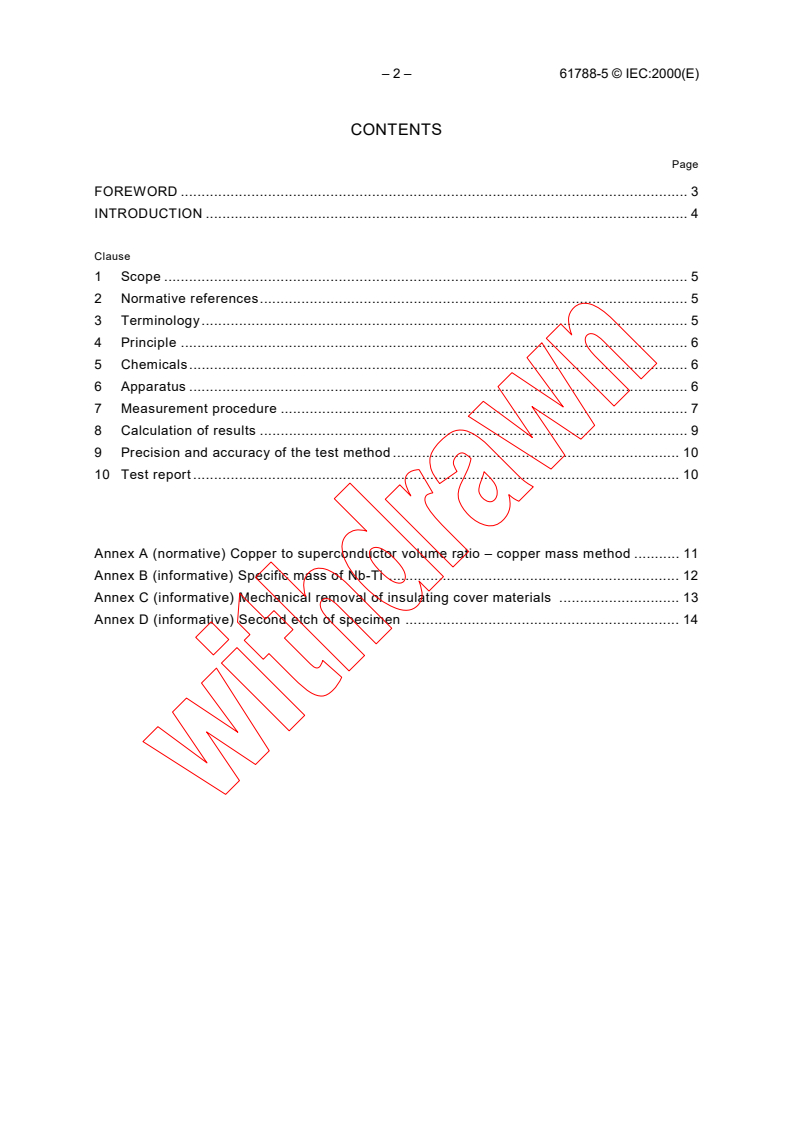
– 2 – 61788-5 © IEC:2000(E)
CONTENTS
Page
FOREWORD . 3
INTRODUCTION .4
Clause
1 Scope . 5
2 Normative references. 5
3 Terminology. 5
4 Principle . 6
5 Chemicals. 6
6 Apparatus . 6
7 Measurement procedure . 7
8 Calculation of results . 9
9 Precision and accuracy of the test method . 10
10 Test report . 10
Annex A (normative) Copper to superconductor volume ratio – copper mass method . 11
Annex B (informative) Specific mass of Nb-Ti . 12
Annex C (informative) Mechanical removal of insulating cover materials . 13
Annex D (informative) Second etch of specimen . 14
61788-5 © IEC:2000(E) – 3 –
INTERNATIONAL ELECTROTECHNICAL COMMISSION
___________
SUPERCONDUCTIVITY –
Part 5: Matrix to superconductor volume ratio measurement –
Copper to superconductor volume ratio of
Cu/Nb-Ti composite superconductors
FOREWORD
1) The IEC (International Electrotechnical Commission) is a world-wide organization for standardization
comprising all national electrotechnical committees (IEC National Committees). The object of the IEC is to
promote international cooperation on all questions concerning standardization in the electrical and electronic
fields. To this end and in addition to other activities, the IEC publishes International Standard. Their
preparation is entrusted to technical committees; any IEC National Committee interested in the subject dealt
with may participate in this preparatory work. International governmental and non-governmental organizations
liaising with the IEC also participate in this preparation. The IEC collaborates closely with the International
Organization for Standardization (ISO) in accordance with conditions determined by agreement between the
two organizations.
2) The formal decisions or agreements of the IEC on technical matters, prepared by technical committees on
which all the National Committees have a special interest therein are represented, express, as nearly as
possible, an international consensus of opinion on the subjects dealt with.
3) They have the form of recommendations for international use published in the form of standards, technical
specifications, technical reports or guides and they are accepted by the National Committees in that sense.
4) In order to promote international unification, IEC National Committees undertake to apply IEC International
Standards transparently to the maximum extent possible in their national and regional standards. Any
divergence between the IEC Standards and the corresponding national or regional standard shall be clearly
indicated in the latter.
5) The IEC provided no marking procedure to indicate its approval and cannot be rendered responsible for any
equipment declared to be in conformity with one of its standards.
6) Attention is drawn to the possibility that some of the elements of this International Standard may be the
subject of patent rights. The IEC shall not be held responsible for identifying any or all such patent rights.
International Standard IEC 61788-5 has been prepared by IEC technical committee 90:
Superconductivity.
The text of this standard is based on the following documents:
FDIS Report on voting
90/81/FDIS 90/87/RVD
Full information on the voting for the approval of this standard can be found in the report on
voting indicated in the above table.
This publication has been drafted in accordance with the ISO/IEC Directives, Part 3.
Annex A forms an integral part of this standard.
Annexes B, C and D are for information only.
The committee has decided that the contents of this publication will remain unchanged until
2005. At this date, the publication will be
• confirmed;
• withdrawn;
• replaced by a revised edition, or
• amended.
A bilingual version of this standard may be issued at a later date.
– 4 – 61788-5 © IEC:2000(E)
INTRODUCTION
The copper to superconductor volume ratio of composite superconductors is used mainly to
calculate the critical current density of superconducting wires. The test with the method given
in this International Standard may be used to provide part of the information needed to
determine the suitability of a specific superconductor. Moreover, this method is useful for
quality control, acceptance or research testing if the precautions given in this standard are
observed.
The test method given in this International Standard is based on the condition that the specific
mass of Nb-Ti is known. If the specific mass of Nb-Ti and/or the fraction of Nb barrier are
unknown, another method to determine the copper to superconductor volume ratio of
composite superconductors is described in annex A.
61788-5 © IEC:2000(E) – 5 –
SUPERCONDUCTIVITY –
Part 5: Matrix to superconductor volume ratio measurement –
Copper to superconductor volume ratio of
Cu/Nb-Ti composite superconductors
1 Scope
This part of IEC 61788 covers a test method for the determination of copper to super-
conductor volume ratio of Cu/Nb-Ti composite superconducting wire.
This test method is intended for use with Cu/Nb-Ti composite superconducting wires with a
2 2
cross-sectional area of 0,1 mm to 3 mm , a diameter of the Nb-Ti filament(s) of 2 µm to
200 µm, and a copper to superconductor volume ratio of 0,5 or more.
The Cu/Nb-Ti composite test conductor discussed in this method has a monolithic structure
with a round or rectangular cross-section. This test method is carried out by dissolving the
copper with nitric acid. Deviations from this test method that are allowed for routine tests and
other specific restrictions are given in this standard.
Cu/Nb-Ti conductors beyond the limits in the cross-sectional area, the filament diameter and
the copper to superconductor volume ratio could be measured with this present method with
an anticipated reduction in precision. Other, more specialized, specimen test geometries may
be more appropriate for conductors beyond the limits and have been omitted from this present
standard for simplicity and to retain precision.
The test method given in this standard is expected to apply to other superconducting
composite wires after some appropriate modifications.
2 Normative references
The following normative documents contain provisions which, through reference in this text,
constitute provisions of this part of IEC 61788. For dated references, subsequent
amendments to, or revisions of, any of these publications do not apply. However, parties to
agreements based on this part of IEC 61788 are encouraged to investigate the possibility of
applying the most recent edition of the normative document indicated below. For undated
references, the latest edition of the normative document referred to applies. Members of IEC
and ISO maintain registers of currently valid International Standards.
IEC 60050-815:2000, International Electrotechnical Vocabulary (IEV) – Part 815: Super-
conductivity
3 Terminology
For the purposes of this part of IEC 61788, the definitions given in IEC 60050-815 and the
following definition are applicable.
3.1
copper to superconductor volume ratio
the ratio of the area of the copper stabilizing material to the area without copper consisting of
Nb-Ti filaments and their Nb barriers.
– 6 – 61788-5 © IEC:2000(E)
4 Principle
The test method utilizes the nature of the Cu/Nb-Ti composite superconducting wire whereby
the copper dissolves in nitric acid solution but the Nb-Ti filaments and Nb barriers do not.
After measuring its mass, dip the specimen in the nitric acid solution to dissolve only the
copper.
Then measure the mass of the remaining Nb-Ti filaments and their Nb barriers.
Convert the ratio of masses to the ratio of volumes by dividing the respective masses of the
copper and filaments by the respective specific mass of the copper and filaments.
5 Chemicals
The following chemicals shall be prepared for sample preparation.
− Nitric acid solution consisting of nitric acid (a mass fraction of 50 % to 65 %
recommended) and distilled water
− Organic solvent
− Degreasing solvent
− Ethyl alcohol
− Distilled (pure) water
NOTE When nitric acid of more than a mass fraction of 65 % is used, the acid shall be diluted with distilled water
within the range of the above content.
6 Apparatus
Draft chamber
Balance
A balance should have a measuring resolution of 0,1 mg.
Dryer or drying oven
A dryer or a drying oven shall be used for evaporating moisture after washing the specimen.
− 300-ml beaker
− Watch-glass
− Plastic tweezers
− Filter papers
− Thermometer
Rubber gloves, protection spectacles and draft chamber
Rubber gloves and protection spectacles shall be used for protecting the human body from
the harmful acid liquid or fumes. The dissolution of the specimen shall be performed in a draft
chamber in order to protect the human body.
61788-5 © IEC:2000(E) – 7 –
7 Measurement procedure
7.1 Quantity of specimen
Take a specimen of around 1 g to 10 g in mass from the base test material.
7.2 Removal of insulating cover material
An appropriate organic solvent, which does not erode the copper, shall be used to remove
any insulating cover material of the specimen. Finally, it shall be visually checked that the
insulating cover material no longer remain
...