

IEC 61892-4:2019
(Main)Mobile and fixed offshore units - Electrical installations - Part 4: Cables
General Information
- Abstract
IEC 61892-4:2019 is applicable to the selection of electrical cables intended for fixed electrical systems in mobile and fixed offshore units, including pipeline, pumping or "pigging" stations, compressor stations and single buoy moorings, used in the offshore petroleum industry for drilling, production, accommodation, processing, storage and offloading purposes.
This document specifies requirements such as those concerning
– types of cables,
– voltage rating of cables,
– cables and wiring for interconnection of equipment,
– current-carrying capacities for continuous service,
– correction factors for different ambient temperature and for short time duty, and
– short-circuit withstand capacity.
This document also gives information on the jet fire test for hydrocarbon (HCF) fire resistant cables.
The reference to fixed electrical systems includes those subjected to vibration due to the movement of the unit, for example, cables installed on a drag chain, and not those intended for repeated flexing. This document does not cover flexible cables, for example, those used on drilling decks for top-drive, or cables for portable equipment.
This document is applicable for cables with a rated voltage up to and including 18/30 kV AC and makes reference to cable standards developed by SC 18A.
For higher voltages, relevant standards developed by TC 20 are applicable.
This document does not apply to
– optical fibre cables,
– sub-sea and umbilical cables;,
– cables supplying downhole pumps, and
– data, telecommunication and radio frequency cables.
This second edition cancels and replaces the first edition published in 2007. This edition constitutes a technical revision.
This edition includes the following significant technical changes with respect to the previous edition:
a) construction requirements for cables have been removed; reference is made to relevant standards from Subcommittee (SC) 18A;
b) reference is made to standards from IEC TC 20 for cables with rated voltage above 30 kV;
c) tables for current-carrying capacities for defined installations have been removed; reference is made to relevant standards from IEC TC 64;
d) requirements as to the sizes of earth continuity conductors not contained in a cable have been moved to IEC 61892-6;
e) requirements as to fire stops have been deleted;
f) requirements as to tests for cables exposed to drilling fluids have been removed; reference is made to relevant standards from IEC SC 18A;
g) the procedure for tests of jet fire resistant cables has been updated;
h) requirements as to the design of cable systems have been moved to IEC 61892-2;
i) requirements in relation to the installation of cables have been moved to IEC 61892-6.
- Status
- Published
- Publication Date
- 08-Apr-2019
- Drafting Committee
- MT 18 - TC 18/MT 18
- Current Stage
- PPUB - Publication issued
- Start Date
- 09-Apr-2019
- Completion Date
- 19-Apr-2019
Overview
IEC 61892-4:2019 is an international standard published by the International Electrotechnical Commission (IEC) that focuses on the selection and specification of electrical cables used in fixed electrical installations for mobile and fixed offshore units. These units support critical operations in the offshore petroleum industry, including drilling, production, accommodation, processing, storage, and offloading. The standard applies to cables with rated voltages up to and including 18/30 kV AC and references cable standards developed by IEC Subcommittee 18A (SC 18A).
This 2019 edition forms part 4 in the IEC 61892 series and provides requirements relevant to cable type, voltage ratings, current-carrying capacity, correction factors for environmental conditions, and short-circuit withstand capability. It also offers guidance on jet fire tests for hydrocarbon fire-resistant cables, ensuring safety in hazardous offshore conditions.
Key Topics
- Types of Cables: Defines appropriate cable types for fixed offshore installations, excluding flexible cables and those installed on moving parts intended for repeated flexing.
- Voltage Ratings: Provides specifications for cables with rated voltages up to 18/30 kV AC. For higher voltages, IEC TC 20 standards are referenced.
- Interconnection Wiring: Covers cables and wiring used for equipment interconnections within offshore units.
- Current-Carrying Capacity: Details current-carrying capacities for continuous service under specific ambient conditions, including temperature correction factors and adjustments for short-time duty.
- Short-Circuit Withstand Capacity: Sets out requirements ensuring cables can tolerate short-circuit events without failure.
- Fire Resistance Testing: Updates the procedure for jet fire testing of hydrocarbon fire-resistant (HCF) cables in line with offshore fire safety regulations.
The standards exclude optical fiber cables, subsea and umbilical cables, cables supplying downhole pumps, and data or telecommunication cables, focusing solely on fixed electrical systems where vibration is a factor rather than repeated mechanical flexing.
Applications
IEC 61892-4:2019 is critical for:
- Offshore Petroleum Facilities – Ensuring electrical systems in drilling rigs, production platforms, and pipeline stations use the right cable types and meet safety and operational requirements.
- Single Buoy Moorings (SBMs) – Selecting cables that withstand harsh marine environments and mechanical stresses.
- Pipeline and Compressor Stations – Designing cable installations that maintain electrical integrity under varying temperatures and mechanical loading.
- Accommodation and Processing Units – Specifying cables that comply with fire safety and electrical performance standards.
By adhering to IEC 61892-4, offshore unit operators and engineers benefit from enhanced safety, reliability, and regulatory compliance in electrical installations, minimizing downtime and risk in high-stakes offshore environments.
Related Standards
- IEC 61892 Series – Other parts cover different aspects of offshore electrical installations, including cable system design (IEC 61892-2) and installation practices (IEC 61892-6).
- IEC SC 18A Cable Standards – For detailed cable construction and testing beyond scope exclusions.
- IEC TC 20 Standards – Governing cables with rated voltages above 30 kV AC.
- IEC TC 64 Standards – For current carrying capacity tables and thermal considerations.
- International Maritime Organization (IMO) Regulations – IEC 61892 aligns closely with IMO guidelines ensuring international alignment in maritime and offshore electrical safety.
Summary
IEC 61892-4:2019 provides a comprehensive framework for selecting and specifying electrical cables in offshore fixed installations. This standard is vital for maintaining electrical safety, fire resistance, and operational efficiency within the critical infrastructure of the offshore petroleum sector. Applying this standard helps ensure compliance with international best practices and supports the safe, reliable operation of complex offshore units amid challenging marine and industrial conditions.
Relations
- Revises
IEC 61892-4:2007 - Mobile and fixed offshore units - Electrical installations - Part 4: Cables - Effective Date
- 05-Sep-2023
Get Certified
Connect with accredited certification bodies for this standard

DNV
DNV is an independent assurance and risk management provider.

Lloyd's Register
Lloyd's Register is a global professional services organisation specialising in engineering and technology.

FSC International
Forest Stewardship Council certification.
Sponsored listings
Frequently Asked Questions
IEC 61892-4:2019 is a standard published by the International Electrotechnical Commission (IEC). Its full title is "Mobile and fixed offshore units - Electrical installations - Part 4: Cables". This standard covers: IEC 61892-4:2019 is applicable to the selection of electrical cables intended for fixed electrical systems in mobile and fixed offshore units, including pipeline, pumping or "pigging" stations, compressor stations and single buoy moorings, used in the offshore petroleum industry for drilling, production, accommodation, processing, storage and offloading purposes. This document specifies requirements such as those concerning – types of cables, – voltage rating of cables, – cables and wiring for interconnection of equipment, – current-carrying capacities for continuous service, – correction factors for different ambient temperature and for short time duty, and – short-circuit withstand capacity. This document also gives information on the jet fire test for hydrocarbon (HCF) fire resistant cables. The reference to fixed electrical systems includes those subjected to vibration due to the movement of the unit, for example, cables installed on a drag chain, and not those intended for repeated flexing. This document does not cover flexible cables, for example, those used on drilling decks for top-drive, or cables for portable equipment. This document is applicable for cables with a rated voltage up to and including 18/30 kV AC and makes reference to cable standards developed by SC 18A. For higher voltages, relevant standards developed by TC 20 are applicable. This document does not apply to – optical fibre cables, – sub-sea and umbilical cables;, – cables supplying downhole pumps, and – data, telecommunication and radio frequency cables. This second edition cancels and replaces the first edition published in 2007. This edition constitutes a technical revision. This edition includes the following significant technical changes with respect to the previous edition: a) construction requirements for cables have been removed; reference is made to relevant standards from Subcommittee (SC) 18A; b) reference is made to standards from IEC TC 20 for cables with rated voltage above 30 kV; c) tables for current-carrying capacities for defined installations have been removed; reference is made to relevant standards from IEC TC 64; d) requirements as to the sizes of earth continuity conductors not contained in a cable have been moved to IEC 61892-6; e) requirements as to fire stops have been deleted; f) requirements as to tests for cables exposed to drilling fluids have been removed; reference is made to relevant standards from IEC SC 18A; g) the procedure for tests of jet fire resistant cables has been updated; h) requirements as to the design of cable systems have been moved to IEC 61892-2; i) requirements in relation to the installation of cables have been moved to IEC 61892-6.
IEC 61892-4:2019 is applicable to the selection of electrical cables intended for fixed electrical systems in mobile and fixed offshore units, including pipeline, pumping or "pigging" stations, compressor stations and single buoy moorings, used in the offshore petroleum industry for drilling, production, accommodation, processing, storage and offloading purposes. This document specifies requirements such as those concerning – types of cables, – voltage rating of cables, – cables and wiring for interconnection of equipment, – current-carrying capacities for continuous service, – correction factors for different ambient temperature and for short time duty, and – short-circuit withstand capacity. This document also gives information on the jet fire test for hydrocarbon (HCF) fire resistant cables. The reference to fixed electrical systems includes those subjected to vibration due to the movement of the unit, for example, cables installed on a drag chain, and not those intended for repeated flexing. This document does not cover flexible cables, for example, those used on drilling decks for top-drive, or cables for portable equipment. This document is applicable for cables with a rated voltage up to and including 18/30 kV AC and makes reference to cable standards developed by SC 18A. For higher voltages, relevant standards developed by TC 20 are applicable. This document does not apply to – optical fibre cables, – sub-sea and umbilical cables;, – cables supplying downhole pumps, and – data, telecommunication and radio frequency cables. This second edition cancels and replaces the first edition published in 2007. This edition constitutes a technical revision. This edition includes the following significant technical changes with respect to the previous edition: a) construction requirements for cables have been removed; reference is made to relevant standards from Subcommittee (SC) 18A; b) reference is made to standards from IEC TC 20 for cables with rated voltage above 30 kV; c) tables for current-carrying capacities for defined installations have been removed; reference is made to relevant standards from IEC TC 64; d) requirements as to the sizes of earth continuity conductors not contained in a cable have been moved to IEC 61892-6; e) requirements as to fire stops have been deleted; f) requirements as to tests for cables exposed to drilling fluids have been removed; reference is made to relevant standards from IEC SC 18A; g) the procedure for tests of jet fire resistant cables has been updated; h) requirements as to the design of cable systems have been moved to IEC 61892-2; i) requirements in relation to the installation of cables have been moved to IEC 61892-6.
IEC 61892-4:2019 is classified under the following ICS (International Classification for Standards) categories: 47.020.60 - Electrical equipment of ships and of marine structures. The ICS classification helps identify the subject area and facilitates finding related standards.
IEC 61892-4:2019 has the following relationships with other standards: It is inter standard links to IEC 61892-4:2007. Understanding these relationships helps ensure you are using the most current and applicable version of the standard.
IEC 61892-4:2019 is available in PDF format for immediate download after purchase. The document can be added to your cart and obtained through the secure checkout process. Digital delivery ensures instant access to the complete standard document.
Standards Content (Sample)
IEC 61892-4 ®
Edition 2.0 2019-04
INTERNATIONAL
STANDARD
NORME
INTERNATIONALE
colour
inside
Mobile and fixed offshore units – Electrical installations –
Part 4: Cables
Unités mobiles et fixes en mer – Installations électriques –
Partie 4: Câbles
All rights reserved. Unless otherwise specified, no part of this publication may be reproduced or utilized in any form
or by any means, electronic or mechanical, including photocopying and microfilm, without permission in writing from
either IEC or IEC's member National Committee in the country of the requester. If you have any questions about IEC
copyright or have an enquiry about obtaining additional rights to this publication, please contact the address below or
your local IEC member National Committee for further information.
Droits de reproduction réservés. Sauf indication contraire, aucune partie de cette publication ne peut être reproduite
ni utilisée sous quelque forme que ce soit et par aucun procédé, électronique ou mécanique, y compris la photocopie
et les microfilms, sans l'accord écrit de l'IEC ou du Comité national de l'IEC du pays du demandeur. Si vous avez des
questions sur le copyright de l'IEC ou si vous désirez obtenir des droits supplémentaires sur cette publication, utilisez
les coordonnées ci-après ou contactez le Comité national de l'IEC de votre pays de résidence.
IEC Central Office Tel.: +41 22 919 02 11
3, rue de Varembé info@iec.ch
CH-1211 Geneva 20 www.iec.ch
Switzerland
About the IEC
The International Electrotechnical Commission (IEC) is the leading global organization that prepares and publishes
International Standards for all electrical, electronic and related technologies.
About IEC publications
The technical content of IEC publications is kept under constant review by the IEC. Please make sure that you have the
latest edition, a corrigendum or an amendment might have been published.
IEC publications search - webstore.iec.ch/advsearchform Electropedia - www.electropedia.org
The advanced search enables to find IEC publications by a The world's leading online dictionary on electrotechnology,
variety of criteria (reference number, text, technical containing more than 22 000 terminological entries in English
committee,…). It also gives information on projects, replaced and French, with equivalent terms in 16 additional languages.
and withdrawn publications. Also known as the International Electrotechnical Vocabulary
(IEV) online.
IEC Just Published - webstore.iec.ch/justpublished
Stay up to date on all new IEC publications. Just Published IEC Glossary - std.iec.ch/glossary
details all new publications released. Available online and 67 000 electrotechnical terminology entries in English and
once a month by email. French extracted from the Terms and Definitions clause of
IEC publications issued since 2002. Some entries have been
IEC Customer Service Centre - webstore.iec.ch/csc collected from earlier publications of IEC TC 37, 77, 86 and
If you wish to give us your feedback on this publication or CISPR.
need further assistance, please contact the Customer Service
Centre: sales@iec.ch.
A propos de l'IEC
La Commission Electrotechnique Internationale (IEC) est la première organisation mondiale qui élabore et publie des
Normes internationales pour tout ce qui a trait à l'électricité, à l'électronique et aux technologies apparentées.
A propos des publications IEC
Le contenu technique des publications IEC est constamment revu. Veuillez vous assurer que vous possédez l’édition la
plus récente, un corrigendum ou amendement peut avoir été publié.
Recherche de publications IEC - Electropedia - www.electropedia.org
webstore.iec.ch/advsearchform Le premier dictionnaire d'électrotechnologie en ligne au
La recherche avancée permet de trouver des publications IEC monde, avec plus de 22 000 articles terminologiques en
en utilisant différents critères (numéro de référence, texte, anglais et en français, ainsi que les termes équivalents dans
comité d’études,…). Elle donne aussi des informations sur les 16 langues additionnelles. Egalement appelé Vocabulaire
projets et les publications remplacées ou retirées. Electrotechnique International (IEV) en ligne.
IEC Just Published - webstore.iec.ch/justpublished Glossaire IEC - std.iec.ch/glossary
Restez informé sur les nouvelles publications IEC. Just 67 000 entrées terminologiques électrotechniques, en anglais
Published détaille les nouvelles publications parues. et en français, extraites des articles Termes et Définitions des
Disponible en ligne et une fois par mois par email. publications IEC parues depuis 2002. Plus certaines entrées
antérieures extraites des publications des CE 37, 77, 86 et
Service Clients - webstore.iec.ch/csc CISPR de l'IEC.
Si vous désirez nous donner des commentaires sur cette
publication ou si vous avez des questions contactez-nous:
sales@iec.ch.
IEC 61892-4 ®
Edition 2.0 2019-04
INTERNATIONAL
STANDARD
NORME
INTERNATIONALE
colour
inside
Mobile and fixed offshore units – Electrical installations –
Part 4: Cables
Unités mobiles et fixes en mer – Installations électriques –
Partie 4: Câbles
INTERNATIONAL
ELECTROTECHNICAL
COMMISSION
COMMISSION
ELECTROTECHNIQUE
INTERNATIONALE
ICS 47.020.60 ISBN 978-2-8322-6669-4
– 2 – IEC 61892-4:2019 © IEC 2019
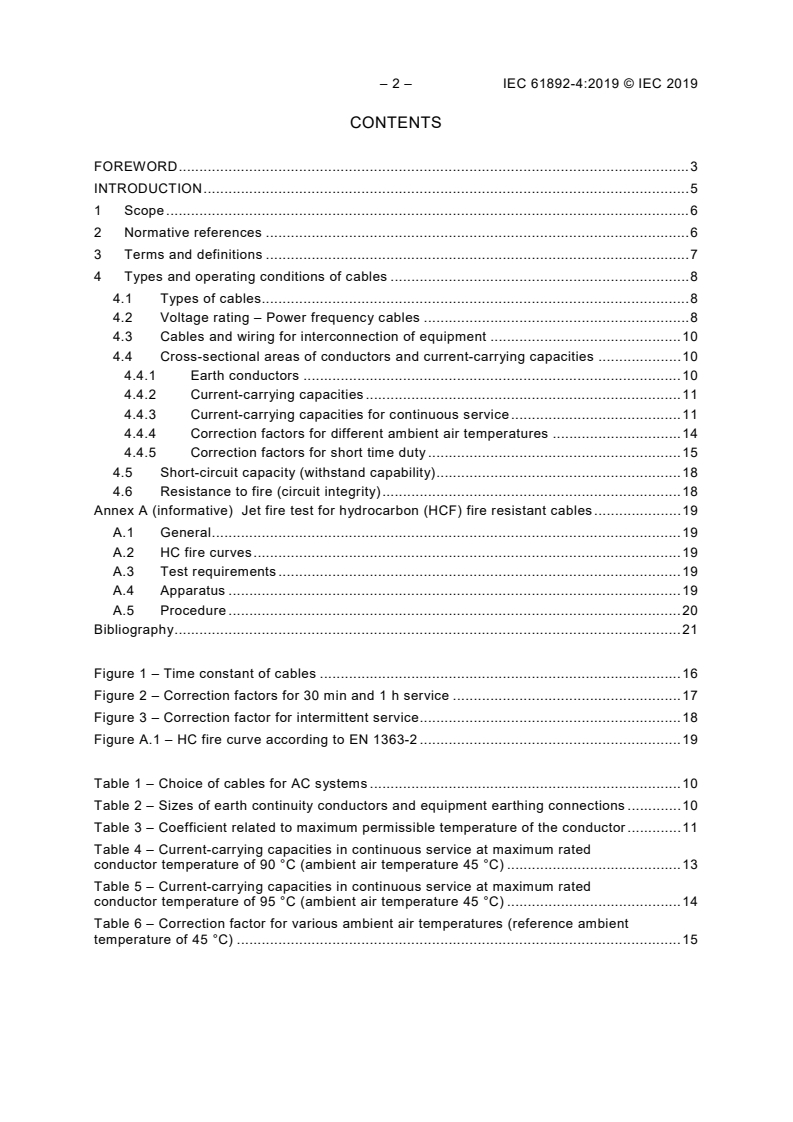
CONTENTS
FOREWORD . 3
INTRODUCTION . 5
1 Scope . 6
2 Normative references . 6
3 Terms and definitions . 7
4 Types and operating conditions of cables . 8
4.1 Types of cables. 8
4.2 Voltage rating – Power frequency cables . 8
4.3 Cables and wiring for interconnection of equipment . 10
4.4 Cross-sectional areas of conductors and current-carrying capacities . 10
4.4.1 Earth conductors . 10
4.4.2 Current-carrying capacities . 11
4.4.3 Current-carrying capacities for continuous service . 11
4.4.4 Correction factors for different ambient air temperatures . 14
4.4.5 Correction factors for short time duty . 15
4.5 Short-circuit capacity (withstand capability) . 18
4.6 Resistance to fire (circuit integrity) . 18
Annex A (informative) Jet fire test for hydrocarbon (HCF) fire resistant cables . 19
A.1 General . 19
A.2 HC fire curves . 19
A.3 Test requirements . 19
A.4 Apparatus . 19
A.5 Procedure . 20
Bibliography . 21
Figure 1 – Time constant of cables . 16
Figure 2 – Correction factors for 30 min and 1 h service . 17
Figure 3 – Correction factor for intermittent service . 18
Figure A.1 – HC fire curve according to EN 1363-2 . 19
Table 1 – Choice of cables for AC systems . 10
Table 2 – Sizes of earth continuity conductors and equipment earthing connections . 10
Table 3 – Coefficient related to maximum permissible temperature of the conductor . 11
Table 4 – Current-carrying capacities in continuous service at maximum rated
conductor temperature of 90 °C (ambient air temperature 45 °C) . 13
Table 5 – Current-carrying capacities in continuous service at maximum rated
conductor temperature of 95 °C (ambient air temperature 45 °C) . 14
Table 6 – Correction factor for various ambient air temperatures (reference ambient
temperature of 45 °C) . 15
INTERNATIONAL ELECTROTECHNICAL COMMISSION
____________
MOBILE AND FIXED OFFSHORE UNITS –
ELECTRICAL INSTALLATIONS –
Part 4: Cables
FOREWORD
1) The International Electrotechnical Commission (IEC) is a worldwide organization for standardization comprising
all national electrotechnical committees (IEC National Committees). The object of IEC is to promote
international co-operation on all questions concerning standardization in the electrical and electronic fields. To
this end and in addition to other activities, IEC publishes International Standards, Technical Specifications,
Technical Reports, Publicly Available Specifications (PAS) and Guides (hereafter referred to as "IEC
Publication(s)"). Their preparation is entrusted to technical committees; any IEC National Committee interested
in the subject dealt with may participate in this preparatory work. International, governmental and non-
governmental organizations liaising with the IEC also participate in this preparation. IEC collaborates closely
with the International Organization for Standardization (ISO) in accordance with conditions determined by
agreement between the two organizations.
2) The formal decisions or agreements of IEC on technical matters express, as nearly as possible, an international
consensus of opinion on the relevant subjects since each technical committee has representation from all
interested IEC National Committees.
3) IEC Publications have the form of recommendations for international use and are accepted by IEC National
Committees in that sense. While all reasonable efforts are made to ensure that the technical content of IEC
Publications is accurate, IEC cannot be held responsible for the way in which they are used or for any
misinterpretation by any end user.
4) In order to promote international uniformity, IEC National Committees undertake to apply IEC Publications
transparently to the maximum extent possible in their national and regional publications. Any divergence
between any IEC Publication and the corresponding national or regional publication shall be clearly indicated in
the latter.
5) IEC itself does not provide any attestation of conformity. Independent certification bodies provide conformity
assessment services and, in some areas, access to IEC marks of conformity. IEC is not responsible for any
services carried out by independent certification bodies.
6) All users should ensure that they have the latest edition of this publication.
7) No liability shall attach to IEC or its directors, employees, servants or agents including individual experts and
members of its technical committees and IEC National Committees for any personal injury, property damage or
other damage of any nature whatsoever, whether direct or indirect, or for costs (including legal fees) and
expenses arising out of the publication, use of, or reliance upon, this IEC Publication or any other IEC
Publications.
8) Attention is drawn to the Normative references cited in this publication. Use of the referenced publications is
indispensable for the correct application of this publication.
9) Attention is drawn to the possibility that some of the elements of this IEC Publication may be the subject of
patent rights. IEC shall not be held responsible for identifying any or all such patent rights.
International Standard IEC 61892-4 has been prepared by IEC technical committee 18:
Electrical installations of ships and of mobile and fixed offshore units.
This second edition cancels and replaces the first edition published in 2007. This edition
constitutes a technical revision.
This edition includes the following significant technical changes with respect to the previous
edition:
a) construction requirements for cables have been removed; reference is made to relevant
standards from Subcommittee (SC) 18A;
b) reference is made to standards from IEC TC 20 for cables with rated voltage above 30 kV;
c) tables for current-carrying capacities for defined installations have been removed;
reference is made to relevant standards from IEC TC 64;
– 4 – IEC 61892-4:2019 © IEC 2019
d) requirements as to the sizes of earth continuity conductors not contained in a cable have
been moved to IEC 61892-6;
e) requirements as to fire stops have been deleted;
f) requirements as to tests for cables exposed to drilling fluids have been removed;
reference is made to relevant standards from IEC SC 18A;
g) the procedure for tests of jet fire resistant cables has been updated;
h) requirements as to the design of cable systems have been moved to IEC 61892-2;
i) requirements in relation to the installation of cables have been moved to IEC 61892-6.
The text of this International Standard is based on the following documents:
FDIS Report on voting
18/1652/FDIS 18/1662/RVD
Full information on the voting for the approval of this International Standard can be found in
the report on voting indicated in the above table.
This document has been drafted in accordance with the ISO/IEC Directives, Part 2.
A list of all parts in the IEC 61892 series, published under the general title Mobile and fixed
offshore units – Electrical installations, can be found on the IEC website.
The committee has decided that the contents of this document will remain unchanged until the
stability date indicated on the IEC website under "http://webstore.iec.ch" in the data related to
the specific document. At this date, the document will be
• reconfirmed,
• withdrawn,
• replaced by a revised edition, or
• amended.
IMPORTANT – The 'colour inside' logo on the cover page of this publication indicates
that it contains colours which are considered to be useful for the correct
understanding of its contents. Users should therefore print this document using a
colour printer.
INTRODUCTION
IEC 61892 forms a series of International Standards for safety in the design, selection,
installation, maintenance and use of electrical equipment for the generation, transmission,
storage, distribution and utilization of electrical energy for all purposes in offshore units which
are used for the purpose of exploration or exploitation of petroleum resources.
This part of IEC 61892 incorporates and coordinates, as far as possible, existing rules and
forms a code of interpretation, where applicable, of the requirements of the International
Maritime Organization (IMO), and constitutes a guide for future regulations which may be
prepared and a statement of practice for offshore unit owners, designers, installers and
appropriate organizations.
This document is based on solutions and methods which are in current use, but it is not
intended to impede the development of new or improved techniques.
In this revision, voltage limitations have been removed. However, voltage limitations may be
given in the referenced equipment standards. The removal of voltage limitations is considered
necessary due to the interconnection of, and supply from shore to offshore units. In such
cases, transmission voltages up to 132 kV AC and 150 kV DC are used and higher voltages
are being planned.
The IEC 61892 series aims to constitute a set of International Standards for the offshore
petroleum industry, but it is not intended to prevent their use beyond petroleum installations.
– 6 – IEC 61892-4:2019 © IEC 2019
MOBILE AND FIXED OFFSHORE UNITS –
ELECTRICAL INSTALLATIONS –
Part 4: Cables
1 Scope
This part of IEC 61892 is applicable to the selection of electrical cables intended for fixed
electrical systems in mobile and fixed offshore units, including pipeline, pumping or "pigging"
stations, compressor stations and single buoy moorings, used in the offshore petroleum
industry for drilling, production, accommodation, processing, storage and offloading purposes.
This document specifies requirements such as those concerning
– types of cables,
– voltage rating of cables,
– cables and wiring for interconnection of equipment,
– current-carrying capacities for continuous service,
– correction factors for different ambient temperature and for short time duty, and
– short-circuit withstand capacity.
This document also gives information on the jet fire test for hydrocarbon (HCF) fire resistant
cables.
The reference to fixed electrical systems includes those subjected to vibration due to the
movement of the unit, for example, cables installed on a drag chain, and not those intended
for repeated flexing. This document does not cover flexible cables, for example, those used
on drilling decks for top-drive, or cables for portable equipment.
This document is applicable for cables with a rated voltage up to and including 18/30 kV AC
and makes reference to cable standards developed by SC 18A.
For higher voltages, relevant standards developed by TC 20 are applicable.
This document does not apply to
– optical fibre cables,
– sub-sea and umbilical cables;,
– cables supplying downhole pumps, and
– data, telecommunication and radio frequency cables.
2 Normative references
The following documents are referred to in the text in such a way that some or all of their
content constitutes requirements of this document. For dated references, only the edition
cited applies. For undated references, the latest edition of the referenced document (including
any amendments) applies.
IEC 60092-350:2014, Electrical installations in ships – Part 350: General construction and test
methods of power, control and instrumentation cables for shipboard and offshore applications
IEC 60092-353, Electrical installations in ships – Part 353: Power cables for rated voltages
1 kV and 3 kV
IEC 60092-354:2014, Electrical installations in ships – Part 354: Single and three-core power
cables with extruded solid insulation for rated voltages 6 kV (U = 7,2 kV) up to 30 kV
m
(U = 36 kV)
m
IEC 60092-360:2014, Electrical installations in ships – Part 360: Insulating and sheathing
materials for shipboard and offshore units, power, control, instrumentation and
telecommunication cables
IEC 60092-376, Electrical installations in ships – Part 376: Cables for control and
instrumentation circuits 150/250 V (300 V)
IEC 61892-1, Mobile and fixed offshore units – Electrical installations – Part 1: General
requirements and conditions
IEC 61892-5, Mobile and fixed offshore units – Electrical installations – Part 5: Mobile units
EN 1363-2:1999, Fire resistance tests – Part 2: Alternative and additional procedures
3 Terms and definitions
For the purposes of this document, the terms and definitions given in IEC 61892-1 and the
following apply.
ISO and IEC maintain terminological databases for use in standardization at the following
addresses:
• IEC Electropedia: available at http://www.electropedia.org/
• ISO Online browsing platform: available at http://www.iso.org/obp
3.1
braid armour
covering formed from braided metal wires used to protect a cable from external mechanical
effects
[SOURCE: IEC 60092-350:2014, 3.3, modified – The notes to entry have been deleted.]
3.2
armour
covering consisting of metal tape(s) or wires, generally used to protect the cable from external
mechanical effects
[SOURCE: IEC 60050-461:2008, 461-05-06]
3.3
screen
conducting layer or assembly of conducting layers having the function of control of the electric
field within the insulation
Note 1 to entry: It may also provide smooth surfaces at the boundaries of the insulation and assist in the
elimination of spaces at these boundaries
[SOURCE: IEC 60050-461:2008, 461-03-01]
– 8 – IEC 61892-4:2019 © IEC 2019
4 Types and operating conditions of cables
4.1 Types of cables
Cables constructed in accordance with IEC 60092-353, IEC 60092-354, and IEC 60092-376
shall be used on mobile and fixed offshore units. All cables shall be low smoke and halogen
free, using materials according to IEC 60092-360. For voltages higher than 30 kV (nominal),
standards from IEC TC 20 shall be used.
NOTE 1 Relevant standard from TC 20 is IEC 60840.
When cables according to standards from TC 20 are used, the cables shall meet the minimum
requirements in IEC 60092-354:2014, Table 3 "Flame spread tests" and Table 4.
In the case of single-core cables for AC systems or cables for circuits with a high content of
harmonics, such as SCR circuits, non-magnetic braid armour or armour shall be used.
Test requirements for cables exposed to drilling fluid are given in IEC 60092-360:2014,
Annex D.
NOTE 2 IEC 60092-350, IEC 60092-353, IEC 60092-354 and IEC 60092-376 specify braid armour only. However,
in some countries, cables with armour are also used for offshore applications.
4.2 Voltage rating – Power frequency cables
The maximum rated voltage (U) considered in this document for power frequency cables is
30 kV.
In the voltage designation of cables U / U / (U ):
0 m
– U is the rated power frequency voltage between conductor and earth or the metallic
screen for which the cable is designed;
– U is the rated power frequency voltage between conductors for which the cable is
designed;
– U is the maximum value of the highest system voltage which may be sustained under
m
normal operating conditions at any time and at any point in the system. It excludes
transient voltage conditions and rapid disconnection of loads.
is chosen to be equal to or greater than the highest voltage of the three-phase system.
U
m
Where cables are permitted for use on circuits where the nominal system voltage exceeds the
rated voltage of the cables, the nominal system voltage shall not exceed the highest system
voltage (U ) of the cable.
m
Careful consideration shall be given to cables subjected to voltage surges associated with
highly inductive circuits to ensure that they are of a suitable voltage rating.
The choice of standard cables of appropriate voltage designations for particular systems
depends upon the system voltage and the system earthing arrangements.
The rated voltage of any cable shall not be lower than the nominal voltage of the circuit for
which it is used. To facilitate the choice of the cable, the values of U recommended for cables
to be used in three-phase systems are listed in Table 1 in which systems are divided into the
following three categories.
• Category A
This category comprises those systems in which any phase conductor that comes into contact
with earth or an earth conductor is automatically disconnected from the system.
• Category B
This category comprises those systems that, under fault conditions, are operated for a short
time, not exceeding 8 h on any occasion, with one phase earthed.
For example, for a 13,8 kV system of Category A or B, the cable should have a rated voltage
not less than 8,7/15 kV.
In a system where an earth fault is not automatically and promptly eliminated, the increased
stresses on the insulation of cables during the earth fault are likely to affect the life of the
cables to a certain degree. If the system is expected to be operated fairly often with a
sustained earth fault, it may be preferable to use cables suitable for Category C. In any case,
for classification as Category B, the expected total duration of earth faults in any year should
not exceed 125 h.
• Category C
This category comprises all systems that do not fall into Categories A and B.
The nominal system voltages from 3,3 kV to 30 kV shown in Table 1 are generally in
accordance with IEC 60038:2009, series I. For nominal system voltages intermediate between
these standard voltages and also between 0,6/1 kV and 1,8/3,3 kV, the cables should be
selected with a rated voltage not less than the next higher standard value. For example: a first
earth fault with one phase earthed causes a √3 higher voltage between the phases and earth
during the fault. If the duration of this earth fault exceeds the times given for Category B, then
according to Table 1, for a 17,5 kV system, the cable is to have a rated voltage not less than
12/20 kV.
A DC voltage to earth of up to a maximum of 1,5 times the AC U voltage may be used.
However, consideration should be given to the peak value when determining the voltage of
DC systems derived from rectifiers, bearing in mind that smoothing does not modify the peak
value when the semiconductors are operating on an open circuit.
– 10 – IEC 61892-4:2019 © IEC 2019
Table 1 – Choice of cables for AC systems
System voltage System Minimum rated voltage
category of cable
U /U
Nominal voltage Maximum Unscreened Single-core or
sustained screened
U
voltage
U
m
kV kV kV kV
up to 0,25 0,30 A, B or C 0,15 / 0,25 −
1 1,2 A, B or C 0,6 / 1,0 0,6 / 1,0
3 3,6 A or B 1,8 / 3,0 1,8 / 3,0
3 3,6 C 3,6 / 6,0
6 7,2 A or B 3,6 / 6,0
6 7,2 C 6,0 / 10
10 12 A or B 6,0 / 10
10 12 C 8,7 / 15
15 17,5 A or B 8,7 / 15
15 17,5 C 12 /20
20 24 A or B 12 / 20
20 24 C 18 / 30
30 36 A or B 18 / 30
4.3 Cables and wiring for interconnection of equipment
Cables external to an enclosure shall comply with the requirements of this document.
The minimum size for conductors in IEC 60092-350:2014, Table 1, shall be used. Smaller
cable sizes may be considered; however, the mechanical strength and insulation qualities of
such cables and wiring shall not affect the reliability and safety of the system of which they
form a part.
4.4 Cross-sectional areas of conductors and current-carrying capacities
4.4.1 Earth conductors
The cross-sectional area of an earth conductor contained in a cable is given in Table 2.
Table 2 – Sizes of earth continuity conductors and equipment earthing connections
Arrangement of earth conductor Cross-section Q Minimum cross-section
of associated of earth conductor
current-carrying
conductor (one
phase or pole)
mm
Insulated earth conductor in cable for fixed installation. Q ≤ 16 Q
Copper braid armour of cable for fixed installation according Q > 16 50 % of the
to IEC 60092-350:2014, 4.8.1. current-carrying
conductor, but not less
than 16 mm
For earth conductors not incorporated in a cable, see IEC 61892-6:2019, Table 5.
4.4.2 Current-carrying capacities
The procedure for cable selection employs rating factors to adjust the current-carrying
capacities for different ambient temperatures, short time duty, the mutual heating effects of
grouping with other cables, and methods of installation. Guidance on the use of these factors
is given in 4.4.3 to 4.4.5.
4.4.3 Current-carrying capacities for continuous service
Continuous service for a cable shall be considered, for the purpose of this document, as a
current-carrying service with constant load having a duration longer than three times the
thermal time constant of the cable, i.e., longer than the critical duration (see Figure 1).
The current to be carried by any conductor for sustained periods during normal operation shall
be such that the maximum permissible conductor temperature limit is not exceeded.
Current ratings for use generally for continuous service shown in Table 4 and Table 5 are
recommended as being applicable to both cables with and without braid armour or armour,
laid in free air as a group of six bunched together.
These ratings may be considered applicable, without correction factors, for cables bunched
together on cable trays, in cable conduits, pipes or trunking, unless more than six cables,
which may be expected to operate simultaneously at their full rated capacity, are laid close
together in a cable bunch in such a way that there is an absence of free air circulation around
them. In this case, a correction factor of 0,85 should be applied.
NOTE 1 Cables are said to be bunched when two or more are contained within a single conduit, trunking or duct,
or if not enclosed, are not separated from each other.
These ratings have been calculated using the basis given below for an ambient temperature
of 45 °C and a conductor temperature that is assumed to be equal to the maximum rated
temperature of the insulation and continuously maintained.
The basis for the calculation of the ratings in Table 4 and Table 5 is as follows.
The current ratings I, in amperes, have been calculated for each nominal cross-sectional area
A, in square millimetres, with the formula:
0,625
I = α A
where
α is a coefficient related to the maximum permissible service temperature of the conductor,
as given in Table 3.
Table 3 – Coefficient related to maximum permissible temperature of the conductor
Maximum permissible temperature of the 90 °C 95 °C
conductor
≥ 2,5 mm 17 18
Values of α for nominal cross-
sectional area 2
< 2,5 mm 18 20
For two-, three- and four-conductor cables, the current ratings derived from Table 3 should be
multiplied by the following (approximate) correction factors:
• 0,85 for two-core cables;
• 0,70 for three- and four-core cables.
– 12 – IEC 61892-4:2019 © IEC 2019
The ambient temperature of 45 °C, on which the current ratings in Table 4 and Table 5 are
based, is considered as a standard value for the ambient air temperature, generally applicable
for any kind of offshore unit in any climate.
When, however, fixed offshore units are installed in locations where the ambient temperature
is known to be permanently lower than 45 °C, it is permitted to increase the current ratings
from those in the tables, but in no case shall the ambient temperature be considered to be
lower than 25 °C.
When, on the other hand, it is to be expected that the air temperature around the cables could
be higher than 45 °C (for instance, when a cable is wholly or partly installed in spaces or
compartments where heat is produced or higher cable temperatures could be reached due to
heat transfer), the current ratings from Table 4 and Table 5 shall be reduced.
The correction factors for these different ambient air temperatures are given in Table 6.
The tables incorporated in this document for the current ratings give only average values;
these are not exactly applicable to all cable constructions and all installation conditions
existing in practice. They are nevertheless recommended for general application, considering
that the errors (a few degrees Celsius in the estimated operating temperature) are of little
importance against the advantages of having a single International Standard for the
evaluation of the current ratings. In particular cases, however, a more precise evaluation shall
be permitted, based on experimental or calculated data acceptable to all interested parties.
An alternative method for calculation of the current rating is given in IEC 60364-5-52. That
standard gives current-carrying capacity for various reference methods of installation. When
the tables given in IEC 60364-5-52 are used, the values shall be adjusted for the relevant
ambient temperature, as given in IEC 61892-1 and IEC 61892-5.
NOTE 2 IEC 60364-5-52 is applicable for land-based installations up to and including 1 kV.
NOTE 3 General information regarding calculation of the current rating of cables is given in IEC 60287-1-1.
Table 4 – Current-carrying capacities in continuous service at maximum rated
conductor temperature of 90 °C (ambient air temperature 45 °C)
Nominal cross-sectional area Single-core 2-core 3- or 4-core
mm A A A
1 18 15 13
1,5 23 20 16
2,5 30 26 21
4 40 34 28
6 52 44 36
10 72 61 50
16 96 82
127 108 89
35 157 133 110
50 196 167 137
70 242 206 169
95 293 249
339 288 237
150 389 331 273
185 444 377 311
240 522 444 366
300 601 511 420
DC / AC DC / AC DC / AC
400 690 / 670 587 / 570 483 / 469
500 780 / 720 663 / 612 546 / 504
630 890 / 780 757 / 663 623 / 546
– 14 – IEC 61892-4:2019 © IEC 2019
Table 5 – Current-carrying capacities in continuous service at maximum rated
conductor temperature of 95 °C (ambient air temperature 45 °C)
Nominal cross-sectional area Single-core 2-core 3- or 4-core
mm A A A
1 20 17 14
1,5 26 22 18
2,5 32 27 22
43 36 30
6 55 47 39
10 76 65 53
16 102 87 71
25 135 115 95
166 141 116
50 208 176 145
70 256 218 179
95 310 264 217
120 359 305 251
150 412
351 289
185 470 400 329
240 553 470 387
300 636 541 445
AC / DC AC / DC AC / DC
400 760 / 725 646 / 616 532 / 508
500 875 / 810 744 / 689 612 / 567
630 1 010 / 900 859 / 765 707 / 630
4.4.4 Correction factors for different ambient air temperatures
The ambient temperature is the temperature of the surrounding medium when the cable(s) or
insulated conductor(s) under consideration are not loaded.
The current-carrying capacity given in Table 4 and Table 5 assumes a reference ambient
temperature for insulated conductors and cables in air, irrespective of the method of
installation, of 45 °C for standard situations, generally applicable for any kind of unit and in
any climate.
Where the ambient temperature in the intended location of the insulated conductors or cables
differs from the reference ambient temperature, the appropriate correction factors specified in
Table 6 shall be applied to the values of current-carrying capacity given in Table 4 and
Table 5.
NOTE The air temperature around the cables can be higher than 45 °C when, for instance, a cable is wholly or
partly installed in spaces or compartments where heat is produced or due to heat transfer.
Table 6 – Correction factor for various ambient air temperatures
(reference ambient temperature of 45 °C)
Maximum
conductor Correction factors for ambient air temperatures
temperature
°C 25 °C 30 °C 35 °C 40 °C 45 °C 50 °C 55 °C 60 °C 65 °C 70 °C 75 °C 80 °C 85 °C
90 1,20 1,15 1,10 1,05 1,00 0,94 0,88 0,82 0,74 0,67 0,58 0,47 -
95 1,18 1,14 1,10 1,05 1,00 0,95 0,89 0,84 0,77 0,71 0,63 0,55 0,45
4.4.5 Correction factors for short time duty
If a cable is intended to supply a motor or equipment operating for periods of 30 min or 1 h, its
current rating, as given by the relevant table, may be increased using the relevant correction
factors given by Figure 2. These correction factors are applicable only if the intermediate
periods of rest are longer than the critical duration (which is equal to three times the time
constant of the cable), given in Figure 1 as a function of the cable diameter.
For cables supplying a single motor or other equipment intended to operate in an intermittent
service, as is generally the case for engine room cranes and similar devices, the current
ratings as given in Table 4 and Table 5 may be increased by applying the correction factor
given by Figure 3.
NOTE 1 The correction factors given in Figure 2 are approximate and depend mainly upon the diameter of the
cable. In general, the 30 min service is applicable to mooring winches. The 30 min rating might not be adequate for
automatic tensioning mooring winches.
NOTE 2 The correction factor given in Figure 3 has been roughly calculated for periods of 10 min, of which 4 min
are with a constant load and 6 min without load.
– 16 – IEC 61892-4:2019 © IEC 2019
Figure 1 – Time constant of cables
t = service time
s
Figure 2 – Correction factors for 30 min and 1 h service
– 18 – IEC 61892-4:2019 © IEC 2019
Intermittence period = 10 min Intermittence ratio = 40 %
Figure 3 – Correction factor for intermittent service
4.5 Short-circuit capacity (withstand capability)
Cables and their insulated conductors shall be capable of withstanding the mechanical and
thermal effects of the maximum short-circuit current which can flow in any part of the circuit in
which they are installed, taking into consideration not only the time/current characteristics of
the circuit protective device, but also the peak value of the prospective short-circuit current
during the first half cycle.
NOTE Further information is given in IEC 60724, IEC 60986 and IEC 61443.
4.6 Resistance to fire (circuit integrity)
Requirements relating to cables required to maintain electrical circuit integrity are given in
IEC 61892-2:2019, 9.1.
NOTE Cables tested according to standards in the IEC 60331 series are tested at a temperature of 830 °C, while
the temperature in a hydrocarbon fire can reach temperatures of approximately 1 100°C. No International
Standards exist for testing of cables at this temperature. Guidance for testing of cables at this temperature is given
in Annex A of this document.
Annex A
(informative)
Jet fire test for hydrocarbon (HCF) fire resistant cables
A.1 General
The fire curve for hydrocarbon (HCF) fire resistant cables shall be according to
EN 1363-2:1999, 4.2. See Figure A.1.
Temperature tolerances shall be according to EN 1363-2:1999, 4.3.
NOTE The test will be included in the next revision of IEC 60092-350, issued by SC 18A. Annex A will be deleted
when the next revision of IEC 60092-350 is issued.
A.2 HC fire curves
Figure A.1 – HC fire curve according to EN 1363-2
A.3 Test requirements
There shall be no breakdown for a minimum of 30 min when connected to rated voltage or
until the measured insulation resistance at operating voltage drops to cause an earth fault or
the short-circuit current to exceed 30 mA.
A.4 Apparatus
The oven shall consist of a mineral fibre insulated combustion chamber with the dimensions
450 mm × 450 mm × 900 mm. The chamber volume shall be approximately 180 l.
The oven shall be fired with propane.
Ten burners shall be placed in two rows (five in each row) in the bottom of the combustion
chamber.
The total rating of the burners shall be 88 kW (300 000 Btu) which can give temperatures up
to 1 400 ºC and a minimum heat flux of 200 kW/m .
The burners shall have programmable controllers to set and measure temperature and time.
– 20 – IEC 61892-4:2019 © IEC 2019
A.5 Procedure
The cable specimen shall be placed horizontally in the oven and the part of cable that is
exposed to the fire shall be approximately 900 mm. The cable specimen shall be positioned in
the middle of the combustion chamber and approximately 300 mm over the burners.
Cables intended for fixed installation may be supported by appropriate means inside the
combustion chamber. The support shall not reduce the exposed length of the cable by more
than 100 mm in total.
Bibliography
IEC 60038:2009, IEC standard voltages
IEC 60050 (all parts), International Electrotechnical Vocabulary
(available at http://www.electropedia.org)
IEC 60287-1-1, Electric cables – Calculation of the current rating – Part 1-1: Current rating
equations (100 % load factor) and calculation of losses – General
IEC 60331 (all parts), Tests for electric cables under fire conditions – Circuit integrity
IEC 60364-5-52, Low-voltage electrical installations – Part 5-52: Selection and erection of
electrical equipment – Wiring systems
IEC 60724, Short-circuit temperature limits of electric cables with rated voltages of 1 kV
(U = 1,2 kV) and 3 kV (U = 3,6 kV)
m m
IEC 60840, Power cables with extruded insulation and their accessories for rated voltages
above 30 kV (U = 36 kV) up to 150 kV (U = 170 kV) – Test methods and requirements
m m
IEC 60986, Short-circuit temperature limits of electric cables with rated voltages from 6 kV
(U = 7,2 kV) up to 30 kV (U = 36 kV)
m m
IEC 61443, Short-circuit temperature limits of electric cables with rated voltages above 30 kV
= 36 kV)
(U
m
IEC 61892-2:2019, Mobile and fixed offshore units – Electrical installations – Part 2: System
design
IEC 61892-6:2019, Mobile and fixed offshore units – Electrical installations – Part 6:
Installation
___________
– 22 – IEC 61892-4:2019 © IEC 2019
SOMMAIRE
AVANT-PROPOS . 23
INTRODUCTION . 25
1 Domaine d'application . 26
2 Références normatives . 27
3 Termes et définitions . 27
4 Types et conditions d'exploitation des câbles . 28
4.1 Types de câbles . 28
4.2 Tension assignée – Câbles à fréquence industrielle . 28
4.3 Câbles et câblage d'interconnexion des équipements . 30
4.4 Sections des conducteurs et courants admissibles . 30
4.4.1 Conducteurs de terre . 30
4.4.2 Courants admissibles .
...