


IEC PAS 61512-4:2007
(Main)Batch control - Part 4: Batch production records
General Information
- Abstract
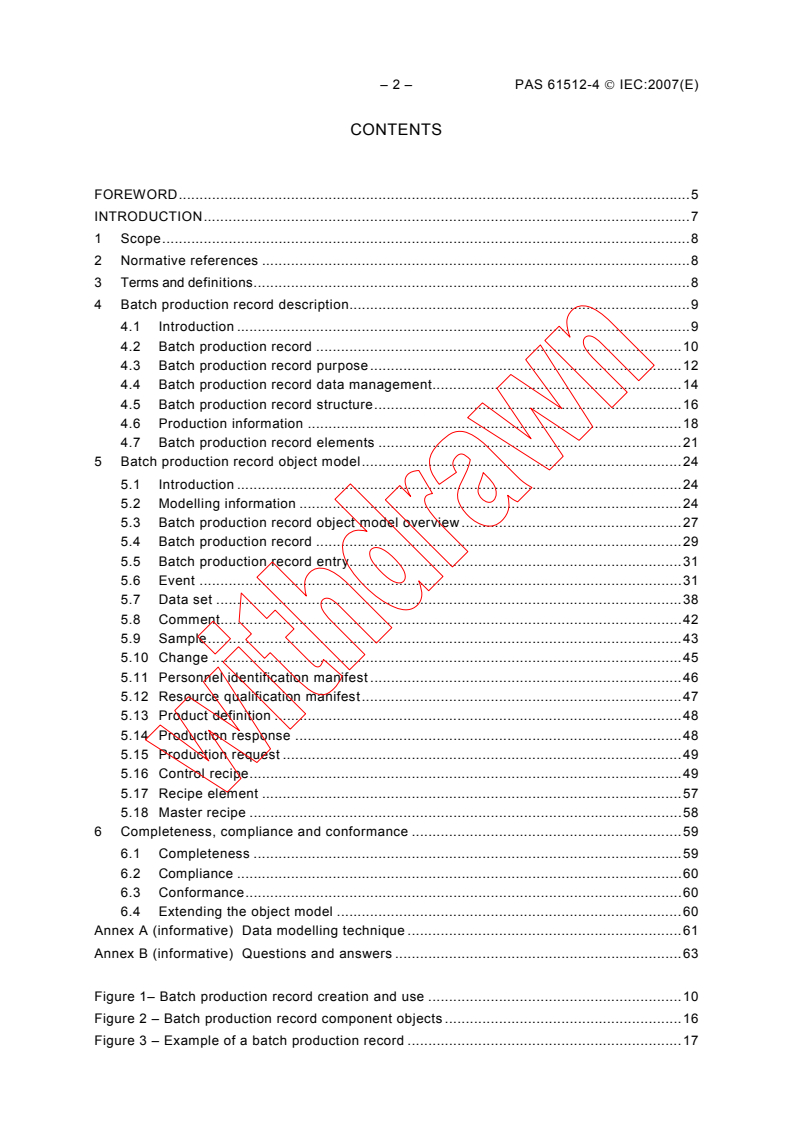
It defines a reference model for batch production records containing information about production of batches or elements of batch production. This PAS is intended for batch processes.
- Status
- Replaced
- Publication Date
- 26-Nov-2007
- Technical Committee
- SC 65A - System aspects
- Drafting Committee
- MT 61512 - TC 65/SC 65A/MT 61512
- Current Stage
- DELPUB - Deleted Publication
- Start Date
- 13-Oct-2009
- Completion Date
- 28-Aug-2026
Relations
- Effective Date
- 05-Sep-2023
Get Certified
Connect with accredited certification bodies for this standard

DVS-ZERT GmbH
German welding certification society.
CARES (UK Certification Authority for Reinforcing Steels)
UK certification for reinforcing steels and construction.
EWF/IIW (European/International Welding Federation)
International welding personnel certification.
Sponsored listings
Frequently Asked Questions
IEC PAS 61512-4:2007 is a technical specification published by the International Electrotechnical Commission (IEC). Its full title is "Batch control - Part 4: Batch production records". This standard covers: It defines a reference model for batch production records containing information about production of batches or elements of batch production. This PAS is intended for batch processes.
It defines a reference model for batch production records containing information about production of batches or elements of batch production. This PAS is intended for batch processes.
IEC PAS 61512-4:2007 is classified under the following ICS (International Classification for Standards) categories: 25.040.40 - Industrial process measurement and control. The ICS classification helps identify the subject area and facilitates finding related standards.
IEC PAS 61512-4:2007 has the following relationships with other standards: It is inter standard links to IEC 61512-4:2009. Understanding these relationships helps ensure you are using the most current and applicable version of the standard.
IEC PAS 61512-4:2007 is available in PDF format for immediate download after purchase. The document can be added to your cart and obtained through the secure checkout process. Digital delivery ensures instant access to the complete standard document.
Standards Content (Sample)
IEC/PAS 61512-4
Edition 1.0 2007-11
PUBLICLY AVAILABLE
SPECIFICATION
PRE-STANDARD
Batch control – Part 4: Batch production records
IEC/PAS 61512-4:2007(E)
All rights reserved. Unless otherwise specified, no part of this publication may be reproduced or utilized in any form
or by any means, electronic or mechanical, including photocopying and microfilm, without permission in writing from
either IEC or IEC's member National Committee in the country of the requester.
If you have any questions about IEC copyright or have an enquiry about obtaining additional rights to this publication,
please contact the address below or your local IEC member National Committee for further information.
IEC Central Office
3, rue de Varembé
CH-1211 Geneva 20
Switzerland
Email: inmail@iec.ch
Web: www.iec.ch
About the IEC
The International Electrotechnical Commission (IEC) is the leading global organization that prepares and publishes
International Standards for all electrical, electronic and related technologies.
About IEC publications
The technical content of IEC publications is kept under constant review by the IEC. Please make sure that you have the
latest edition, a corrigenda or an amendment might have been published.
ƒ Catalogue of IEC publications: www.iec.ch/searchpub
The IEC on-line Catalogue enables you to search by a variety of criteria (reference number, text, technical committee,…).
It also gives information on projects, withdrawn and replaced publications.
ƒ IEC Just Published: www.iec.ch/online_news/justpub
Stay up to date on all new IEC publications. Just Published details twice a month all new publications released. Available
on-line and also by email.
ƒ Electropedia: www.electropedia.org
The world's leading online dictionary of electronic and electrical terms containing more than 20 000 terms and definitions
in English and French, with equivalent terms in additional languages. Also known as the International Electrotechnical
Vocabulary online.
ƒ Customer Service Centre: www.iec.ch/webstore/custserv
If you wish to give us your feedback on this publication or need further assistance, please visit the Customer Service
Centre FAQ or contact us:
Email: csc@iec.ch
Tel.: +41 22 919 02 11
Fax: +41 22 919 03 00
IEC/PAS 61512-4
Edition 1.0 2007-11
PUBLICLY AVAILABLE
SPECIFICATION
PRE-STANDARD
Batch control – Part 4: Batch production records
INTERNATIONAL
ELECTROTECHNICAL
COMMISSION
PRICE CODE
XB
ICS 25.040.40 ISBN 2-8318-9407-7
– 2 – PAS 61512-4 © IEC:2007(E)
CONTENTS
FOREWORD.5
INTRODUCTION.7
1 Scope.8
2 Normative references .8
3 Terms and definitions.8
4 Batch production record description.9
4.1 Introduction .9
4.2 Batch production record .10
4.3 Batch production record purpose.12
4.4 Batch production record data management.14
4.5 Batch production record structure.16
4.6 Production information .18
4.7 Batch production record elements .21
5 Batch production record object model.24
5.1 Introduction .24
5.2 Modelling information .24
5.3 Batch production record object model overview .27
5.4 Batch production record .29
5.5 Batch production record entry.31
5.6 Event .31
5.7 Data set .38
5.8 Comment.42
5.9 Sample.43
5.10 Change .45
5.11 Personnel identification manifest .46
5.12 Resource qualification manifest.47
5.13 Product definition .48
5.14 Production response .48
5.15 Production request .49
5.16 Control recipe.49
5.17 Recipe element .57
5.18 Master recipe .58
6 Completeness, compliance and conformance .59
6.1 Completeness .59
6.2 Compliance .60
6.3 Conformance.60
6.4 Extending the object model .60
Annex A (informative) Data modelling technique .61
Annex B (informative) Questions and answers .63
Figure 1– Batch production record creation and use .10
Figure 2 – Batch production record component objects .16
Figure 3 – Example of a batch production record .17
PAS 61512-4 © IEC:2007(E) – 3 –
Figure 4 – Example of elements referencing another element .18
Figure 5 – Example of internal and referenced data .18
Figure 6 – Sample batch production record for a recipe element.20
Figure 7 – Batch production record with non-batch specific data .21
Figure 8 – Object reference model .27
Figure 9 – Batch production record top level model.28
Figure 10 – Batch production record object model .29
Figure 11 – Event model .32
Figure 12 – Example of event element relationships .33
Figure 13 – Data set model.38
Figure 14 – Sample time series data set .39
Figure 15 – Elements of a time series data set.39
Figure 16 – Sample correlated data set.39
Figure 17 – Elements of a correlated data set.39
Figure 18 – Sample model .43
Figure 19 – Control recipe model .50
Figure 20 – Sample batch production record with two control recipe copies .50
Figure 21 – Recipe element model.58
Figure 22 – Master recipe model.59
Table 1 – Batch production record categories .21
Table 2 – Table example.27
Table 3 – Batch production record attributes.29
Table 4 – Batch production record entry attributes .31
Table 5 – Event attributes .33
Table 6 – Alarm event attributes .34
Table 7 – Standard event types .35
Table 8 – User-defined attribute attributes .37
Table 9 – Event association attributes .38
Table 10 – Data set attributes .40
Table 11 – Time specification attributes .40
Table 12 – Tag identification attributes .41
Table 13 – Data value attributes .42
Table 14 – Time value attributes .42
Table 15 – Comment attributes .43
Table 16 – Sample attributes .44
Table 17 – Sample test attributes.45
Table 18 – Sample test result attributes .45
Table 19 – Change attributes .46
Table 20 – Personnel identification manifest attributes .47
Table 21 – Qualification manifest attributes .48
Table 22 – Control recipe attributes .51
Table 23 – Control recipe header attributes .52
– 4 – PAS 61512-4 © IEC:2007(E)
Table 24 – Equipment requirement attributes .53
Table 25 – Constraint attributes .53
Table 26 – Parameter attributes.54
Table 27 – Parameter value attributes .54
Table 28 – Link attributes .55
Table 29 – Step attributes.56
Table 30 – Transition attributes.56
Table 31 – Other information attributes .57
Table 32 – Other information value attributes.57
Table 33 – Recipe element attributes.58
Table 34 – Master recipe attributes.59
Table A.1 – UML notation .61
PAS 61512-4 © IEC:2007(E) – 5 –
INTERNATIONAL ELECTROTECHNICAL COMMISSION
____________
BATCH CONTROL –
Part 4: Batch production records
FOREWORD
1) The International Electrotechnical Commission (IEC) is a worldwide organization for standardization comprising
all national electrotechnical committees (IEC National Committees). The object of IEC is to promote
international co-operation on all questions concerning standardization in the electrical and electronic fields. To
this end and in addition to other activities, IEC publishes International Standards, Technical Specifications,
Technical Reports, and Guides (hereafter referred to as “IEC Publication(s)”). Their preparation is entrusted to
technical committees; any IEC National Committee interested in the subject dealt with may participate in this
preparatory work. International, governmental and non-governmental organizations liaising with the IEC also
participate in this preparation. IEC collaborates closely with the International Organization for Standardization
(ISO) in accordance with conditions determined by agreement between the two organizations.
2) The formal decisions or agreements of IEC on technical matters express, as nearly as possible, an international
consensus of opinion on the relevant subjects since each technical committee has representation from all
interested IEC National Committees.
3) IEC Publications have the form of recommendations for international use and are accepted by IEC National
Committees in that sense. While all reasonable efforts are made to ensure that the technical content of IEC
Publications is accurate, IEC cannot be held responsible for the way in which they are used or for any
misinterpretation by any end user.
4) In order to promote international uniformity, IEC National Committees undertake to apply IEC Publications
transparently to the maximum extent possible in their national and regional publications. Any divergence
between any IEC Publication and the corresponding national or regional publication shall be clearly indicated in
the latter.
5) IEC provides no marking procedure to indicate its approval and cannot be rendered responsible for any
equipment declared to be in conformity with an IEC Publication.
6) All users should ensure that they have the latest edition of this publication.
7) No liability shall attach to IEC or its directors, employees, servants or agents including individual experts and
members of its technical committees and IEC National Committees for any personal injury, property damage or
other damage of any nature whatsoever, whether direct or indirect, or for costs (including legal fees) and
expenses arising out of the publication, use of, or reliance upon, this IEC Publication or any other IEC
Publications.
8) Attention is drawn to the Normative references cited in this publication. Use of the referenced publications is
indispensable for the correct application of this publication.
9) Attention is drawn to the possibility that some of the elements of this IEC Publication may be the subject of
patent rights. IEC shall not be held responsible for identifying any or all such patent rights.
A PAS is a technical specification not fulfilling the requirements for a standard but made
available to the public.
IEC-PAS 61512-4 has been processed by subcommittee 65A: System aspects, of IEC
technical committee 65: Industrial-process measurement, control and automation. This PAS is
*
an ANSI/ISA publication 88.00.04 .
The text of this PAS is based on the This PAS was approved for
following document: publication by the P-members of the
committee concerned as indicated in
the following document
Draft PAS Report on voting
65A/497A/PAS 65A502/RVN
—————————
*
resale. Printed in the United States of America. No part of this publication may be reproduced, stored in a
retrieval system, or transmitted in any form or by any means (electronic, mechanical, photocopying, recording,
or otherwise), without the prior written permission of the Publisher.
ISA
67 Alexander Drive
P.O. Box 12277
Research Triangle Park, North Carolina 27709
– 6 – PAS 61512-4 © IEC:2007(E)
Following publication of this PAS, which is a pre-standard publication, the technical committee
or subcommittee concerned will transform it into an International Standard.
This PAS shall remain valid for an initial maximum period of three years starting from
2007-11. The validity may be extended for a single three-year period, following which it shall
be revised to become another type of normative document or shall be withdrawn.
PAS 61512-4 © IEC:2007(E) – 7 –
INTRODUCTION
ANSI-ISA-88.01-1995 (referred to as Part 1 throughout this PAS) provides models and
terminology applicable to batch control. Subclause 5.5 of Part 1 defines product information
concepts and 6.4 defines production information management activities and functions.
ANSI/ISA-88.00.02-2001 (referred to as Part 2 throughout this PAS) provides, in Clause 4, an
object model of production information and, in Clause 5, defines batch history exchange
tables. The Clause 5 batch history exchange tables are one implementation for production
information.
Whereas Parts 1 and 2 provide significant information concerning batch history and
production information, they are not sufficient for use as specifications for implementing
specific technologies and are lacking in scope and content.
ANSI-ISA-88.00.03 (this PAS) provides a detailed definition for batch production records.
This consists of a description and object model of batch production record contents.
The intended use of this batch production record standard is to provide a reference model for
developing applications for the storage and/or exchange of batch production records.
Implementations based upon this standard will allow retrieval, analysis, and reporting of
selected batch production record data.
This batch production record standard is compliant with the batch data model in Clause 4 of
ANSI/ISA88.00.02-2001 as well as with ANSI/ISA-88.01-1995.
Although this standard is intended primarily for batch processes, it may be of considerable
value for other types of processes.
– 8 – PAS 61512-4 © IEC:2007(E)
BATCH CONTROL –
Part 4: Batch production records
1 Scope
This PAS defines a reference model for batch production records containing information about
production of batches or elements of batch production. This PAS is intended for batch
processes.
2 Normative references
The following referenced documents are indispensable for the application of this document.
For dated references, only the edition cited applies. For undated references, the latest edition
of the referenced document (including any amendments) applies.
IEC 60050-351:2006, International Electrotechnical Vocabulary – Part 351: Control
technology
IEC 61512-1 (all parts), Batch control – Part 1: General examination
IEC 62264-1:2003, Enterprise-control system integration – Part 1: Models and terminology
ISO/IEC 19501:2005, Information technology – Open Distributed Processing – Unified
Modeling Language (UML) Version 1.4.2
ANSI/ISA-88.01:1995, Batch control – Part 1: Models and terminology
ANSI/ISA-88.00.02:2001, Batch control – Part 2: Data structures and guidelines for languages
ANSI/ISA-88.00.03:2003, Batch control – Part 3: General and site recipe models and
representation
ANSI/ISA-95.00.01:2000, Enterprise-control system integration – Part 1: Models and
terminology
ANSI/ISA-95.00.02:2001, Enterprise-control system integration – Part 2: Object model
attributes
ANSI/ISA-95.00.03:2005, Enterprise-control system integration – Part 3: Models of
manufacturing operations management
3 Terms and definitions
For the purposes of this document, the following terms and definitions apply.
NOTE Terms, definitions and concepts expressed in Part 1 apply, except where differences are explicitly stated in
this PAS.
3.1
batch history
all execution information collected pertaining to the production of a single batch may include
common (non-batch-specific) information
3.2
batch production record
subset of the execution and business information that is retained on the basis of business
requirements identified by the batch production record specification
NOTE This information could include the recipe procedural element execution information, both specific
equipment information, operator comments, batch-related alarms, elements related to the definition of a batch
PAS 61512-4 © IEC:2007(E) – 9 –
(such as control recipe, master recipe, site and/or general recipe, batch schedule information), and information
important to the batch (such as training logs, maintenance records, and environmental conditions).
3.3
batch production record report
extraction of information from one or more batch production record(s) that is(are) formatted
for printing, displaying, or sending to a collaborating system
3.4
batch production record specification
a) definition of the data to be included in the batch production record and specification if data
is to be referenced or extracted.
b) identification of the requirements of execution business information used for generation of
a batch production record.
NOTE This information could include the contents, calculations, and other rules needed to identify the pertinent
information.
3.5
batch production information
execution information that is recorded during the course of batch production and business
information relating to batch production.
NOTE Batch production information may be batch-specific or it may be common to several batches.
4 Batch production record description
4.1 Introduction
This clause provides an informative overview of a batch production record as defined in
Clause 5 of this PAS. This PAS defines a standard reference model for batch production
records. A batch production record contains batch production information and related
business information. A batch production record is created to meet a business requirement,
and the contents of a batch production record are determined by the business requirement.
For example, a batch production record may be created to document
– production of a batch;
– storage and handling of a material lot or sublot;
– production-related activities of a person or group of persons or of a piece of equipment or
set of equipment.
NOTE Parts 1 and 2 define production information and batch history functions, provide lists of the types of data
they encompass and abstract models. However, Parts 1 and 2 do not define a formal and precise model of
production information and batch history data. This PAS does not further define these terms and does not define
production information or batch history system functions.
This PAS defines an object model, object attributes, and relationships between object
instances that can be used to implement data structures used for the exchange of a subset of
a production information and batch history data. The object model is called a batch
production record. This standard is intended to be used as a reference model for the creation
of technology-specific specifications for the data that make up batch production records.
Batch production may require the involvement of multiple control systems, related computer
systems, and manual actions. Therefore, it is possible that the information making up batch
production information may be distributed among multiple computer systems and also contain
components in paper form.
NOTE “Production” implies batch production in all cases unless otherwise stated.
– 10 – PAS 61512-4 © IEC:2007(E)
A standard batch production record is intended to enable development of solutions that
support specific interfaces and repositories that can be used and supported by multiple
operating companies and vendors. The existence of a batch production record standard may
also enable improved communication within a single company, between different companies,
and between companies and government or regulatory agencies.
Figure 1 illustrates data flows associated with creating, maintaining, and using a batch
production record. Of these functions and data items, only the batch production record is
defined in this PAS. The other functions and data items are shown to illustrate the
environment in which batch production records are used. Not all sources of data, functions
performed on, or uses of, batch production records are illustrated in this figure.
Figure 1 – Batch production record creation and use
4.2 Batch production record
A batch production record is a subset of the production execution and business information
that is retained on the basis of pre-defined business requirements identified by the batch
production record specification. The structure of the batch production record is based on the
logical object model defined in Clause 5.
A batch production record consists of data about the manufacture of the product plus all
supporting data required to meet the business requirements of the record. The data may
come from multiple sources and may be either extracted (captured into the record) or
referenced in the source system.
Example 1: The business need may be a record of production quality.
Example 2: The business need may be a record of equipment maintenance such as cleaning
or sterilization.
Each batch production record is created to satisfy the specific business requirements as
defined by a unique batch production record specification.
PAS 61512-4 © IEC:2007(E) – 11 –
Example 3: The system may create a batch production record for the operational execution of
an element of batch production.
Example 4: The system may create a batch production record for the personnel efficiency of
an element of batch production.
NOTE An element of batch production may be a batch, lot, campaign or other batch activity such as pre-weigh.
A batch production record may reference other batch production records.
Example 5: A batch production record may reference the records for intermediate materials.
Example 6: A batch production record may include the records received with purchased
ingredients.
Example 7: A batch production record may be the union of all batch production records for all
processing segments that create a final product.
Individual batch production records may be combined into a larger batch production record.
Multiple batch production records may be created for a single element of production.
Multiple batch production records may contain the same and/or mutually exclusive data.
Example 8: A control system may create a batch production record for the execution of an
element of batch production and an MES/ERP system may create another batch production
record for the same element of batch production that includes some of the same data included
in the control system record and additional data known only to the MES/ERP system.
A key factor that differentiates batch production records from traditional time-based plant
history records is that batch production records are stored and retrieved on an element of
batch production basis, such as on batch basis or on a control recipe’s unit procedure,
operation, or phase basis.
4.2.1 Business information
Business information is data from non-production business systems.
Example: Business information may include material, training, or safety data.
4.2.2 Production execution information
Production execution information is data about production resources (equipment, materials,
and personnel), recipe execution, and information from the processing environment.
Example 1: Production execution information may include equipment status, material
consumption, the definition of production rules, or production history.
Example 2: Production execution information may include environmental monitoring, utilities
status or other information on the processing environment.
4.2.3 Batch production record specification
A batch production record specification is the information that may be used to define a batch
production record. The content and format for batch production record specifications are not
defined in this PAS.
– 12 – PAS 61512-4 © IEC:2007(E)
There may be any number of batch production record specifications per element of batch
production.
Each batch production record is based upon a single batch production record specification.
The same batch production record specification may be used to produce batch production
records for multiple batches, multiple executions of similar elements of batch production,
different material lots/sublots, equipment or personnel use.
Example 1: A single batch production record specification may be used to generate multiple
batch production records, one for each batch of product XYZ produced.
Example 2: A single batch production record specification may be used to generate a single
batch production record for all batches of product XYZ.
Example 3: A batch production record specification may be used to generate a batch
production record for all production done during a shift.
Example 4: A batch production record specification may be used to generate a batch
production record for a lot of intermediate material in order to track its storage and handling
between its production and consumption in different batches.
4.2.4 Batch production record reports
A batch production record report is an extraction of production information that is formatted
for printing, displaying, or sending to a collaborating system. The definition of the format and
data content for batch production record reports is outside the scope of this PAS.
Example: A batch production record report may be a computer-displayed shift report, a
printed batch end report, or an XML message containing production performance information
sent from a batch control system to a business system.
Batch reports are defined in Part 1 as an extraction of data related to one or more batches.
A batch production record report is a specific type of batch report that is based on the
information from one or more batch production records for one or more elements of batch
production.
4.3 Batch production record purpose
Each batch production record meets one or more business requirements. Batch production
records may be useful to support business functions such as:
– process and/or production analysis, optimization and reporting
This function includes analysis of bad batches or runs to determine the root cause, and
the analysis of exceptional quality batches (golden batch) to determine optimal running
conditions or achieving pre-defined business objectives.
Example 1: Process analysis provides feedback about specific manufacturing processes for a
single element of batch production or across multiple elements of batch production. This
information is used to optimize or modify specific production processes.
Example 2: The analysis may be performed for the improvement of production processes,
scheduling, or equipment utilization.
Example 3: The collection of key parameters may enable observation and/or detection of
trends within or across batches. For example, this may be done to detect future quality
problems, observe if a plant is performing consistently, or observe yield management.
PAS 61512-4 © IEC:2007(E) – 13 –
Example 4: A batch production record may be generated for tracking of material consumption,
production, losses, and corrections for mass balances or inventory updates. This may apply
to consumables, intermediates, raw materials, and finished products.
NOTE This may include calculated or aggregate values such as averages, minimums, maximums, etc.
– regulatory compliance
Batch production records may contain the information used to generate formal documents
to meet the needs of regulatory compliance (such as U.S. FDA, OSHA, USDA, EPA, TUV,
etc.). A batch production record may be used to document the fact that processes are
under control, the quality of the product, the conditions under which it was produced, or
the work process of producing and/or releasing the product.
Example 5: In a regulated industry, there may be one batch production record to meet
predicate rule requirements and additional batch production records used to perform non-
regulated production-related actions.
– production release
Batch production records can be defined for production release processes, such that all of
the information, or at least most of the information, needed for release of the batch by a
quality group, is available in the batch production record. In some industries, the
production release sign-off information may also be included in the batch production
record.
– deviation management
Batch production records may be used in deviation management to document information
about a batch. Usually the batch production record will include alarm and event
information associated with the deviations. In some industries, the batch production
record may also contain the resolution information of the deviation.
– quality management
Batch production records may be retained to meet one or more requirements, such as
internal quality programmes or to guard against future product liability claims.
– material tracking and tracing
Batch production records may be used to document which input materials contributed to
the production of a lot. This may include which lots are produced from specific lots of
material, and which lots were consumed in the production of a material lot.
– equipment tracking and tracing
Batch production records may be used to document which equipment contributed to the
production of a batch. This may include the status of the equipment, such as its cleaning
status or maintenance status, and may include location information about equipment.
This may include which material lots are produced from specific equipment.
– personnel tracking
Batch production records may be used to document which personnel contributed to the
production of a batch. This may include the qualification status of the personnel.
Example 6: Hazardous environment exposure tracking, hours spent in the operation,
compliance to work rules, location of work.
– complying with contractual requirements
Batch production records may be used to document the information required to meet
contractual requirements.
Example 7: A manufacturer may need to document product quality information in a COA
(certificate of analysis), or equipment information such as sterility periods, or cleaning
verification of equipment.
Example 8: A manufacturer may produce one batch production record to meet contractual
requirements and a second one to satisfy internal record-keeping requirements.
– 14 – PAS 61512-4 © IEC:2007(E)
– costing:
Batch production records may contain the information about the resources (material,
equipment, and personnel) used in the production of the batch. This information may be
required to allocate costs associated with specific activities or costs associated with
specific products.
– production knowledge base
A batch production record may be used to create batch production record reports that
answer questions about production.
Example 9: Production questions may be:
• who was involved?
• what actions were taken?
• when was it produced?
• where was it produced?
• why was it produced?
• Hhow was it produced?
• what was the status of equipment used?
• what was consumed?
• what was produced?
• what were the deviations?
4.4 Batch production record data management
4.4.1 Data retention
The retention period of a batch production record and the referenced data is determined by
business needs.
Definitions of standards for data archiving and retrieving are outside the scope of this PAS.
Most batch production records and the data they reference have a finite life, at the end of
which they may be deleted from storage based on established business processes.
Example 1: There may be a regulatory requirement to maintain information for a period of
three years after the production of a batch. After that period, there may be a business
process that specifies that the batch production records and referenced data are automatically
deleted.
Example 2: Batch production records may be destroyed upon the end of the legally mandated
record retention period or their destruction may require a review and/or approval process.
Example 3: In some industries and companies, there is a requirement to retain batch
production data for long periods (such as 10 to 20 years) and for different business or legal
purposes.
NOTE If the retained data is moved to new versions of a storage system or a new storage system, then the batch
production record’s references to that data may need to be updated to reflect the new storage location.
4.4.2 Data integrity
If data is copied into a batch production record, care should be taken to ensure its integrity.
The integrity of the data in the batch production record is intended to be ensured throughout
the lifecycle of a batch production record.
PAS 61512-4 © IEC:2007(E) – 15 –
NOTE The precise requirements for data integrity are determined by business rules, which are often created to
meet regulatory, contractual, quality and other requirements.
4.4.3 Creating batch production records
A batch production record is populated by copying, moving, or referencing entries from
production execution and business information and placing them in a batch production record
according to the batch production record specification.
A batch production record may be created at any time before, during, or after execution. The
time a batch production record is created, or the event that causes it to be created, is
ultimately determined by a business rule. There is no requirement for a batch or other element
of batch production to be started, a batch ID to be assigned, or a batch to be completed in
order to create a batch production record.
A batch production record may also be built when no formal batch production record
specification exists. When this occurs a person or computer programme serves as the batch
production record specification. In these cases there may be no permanent batch production
record specification unless a manual or computer record is made to document the
specification.
NOTE There is often some kind of standard operating procedure (SOP), business rule or specification for
manually or programmatically creating batch production records.
4.4.4 Updating batch production records
After the initial creation and population of a batch production record, additional data may need
to be added, changed or deleted from a batch production record. This may involve the
addition of postproduction or product history data to the batch production record.
Example 1: A one-time addition of data that was previously collected and stored in other
systems.
Example 2: Addition of data obtained after release of the material produced in the batch.
Example 3: Modification of data in the batch production record after recalibrating an
instrument.
Example 4: Deletion of data in the batch production record that is no longer relevant.
The addition, modification, and deletion of data in a batch production record may have to
comply with applicable corporate and legal requirements and government regulations. In this
case any change to a batch production record is intended to be done according to change
control procedures and audit trail recording procedures based on business requirements and
government regulations.
Depending upon business rules, records in the batch production record may be manually or
programmatically added to a batch production record even if they are not in the batch
production record specification.
Example 5: In the pharmaceutical industry, if batch data is used to determine whether a
product can be released, then that data is required to be available for later inspection, even if
the data is not in the batch production record specification.
4.4.5 Life-cycle states
A batch production record may be assigned states that identify its status. The states are
intended to be used in conjunction with business rules and authorizations to identify the
permitted operations that may be carried out on the batch production record.
– 16 – PAS 61512-4 © IEC:2007(E)
The possible states and state transitions of a batch production record are specified by
business
...