


IEC 63287-1:2021
(Main)Semiconductor devices - Generic semiconductor qualification guidelines - Part 1: Guidelines for IC reliability qualification
General Information
- Abstract
IEC 63287-1:2021 gives guidelines for reliability qualification plans of semiconductor integrated circuit products. This document is not intended for military- and space-related applications.
NOTE 1 The manufacturer can use flexible sample sizes to reduce cost and maintain reasonable reliability by this guideline adaptation based on EDR-4708, AEC Q100, JESD47 or other relevant document can also be applicable if it is specified.
NOTE 2 The Weibull distribution method used in this document is one of several methods to calculate the appropriate sample size and test conditions of a given reliability project.
This first edition of IEC 63287-1 cancels and replaces the first edition of IEC 60749-43 published in 2017. This edition constitutes a technical revision.
This edition includes the following significant technical changes with respect to the previous edition:
the document has been renamed and renumbered to distinguish it from the IEC 60749 (all parts);
a new section concerning the concept of "family" has been added with appropriate renumbering of the existing text.
- Status
- Published
- Publication Date
- 24-Aug-2021
- Technical Committee
- TC 47 - Semiconductor devices
- Drafting Committee
- WG 2 - TC 47/WG 2
- Current Stage
- PPUB - Publication issued
- Start Date
- 25-Aug-2021
- Completion Date
- 24-Sep-2021
Overview
IEC 63287-1:2021 is an international standard published by the International Electrotechnical Commission (IEC) that provides generic guidelines for the reliability qualification of semiconductor integrated circuit (IC) products. Aimed at semiconductor manufacturers and users, this standard outlines key considerations for designing and implementing comprehensive IC reliability qualification plans. It is applicable across a wide range of IC applications but is not intended for military or space-related products. By offering adaptable reliability testing strategies and referencing recognized methods (such as the Weibull distribution), IEC 63287-1:2021 helps organizations ensure the reliability and quality of their semiconductor products while maintaining flexibility and cost-effectiveness.
Key Topics
- Reliability Qualification Planning: Guidance on creating reliability qualification plans tailored to various IC applications and operating environments.
- Product Categories: Classification of IC applications including automotive (safety-related and non-safety-related) and consumer or industrial electronics, each with distinct reliability requirements and use conditions.
- Failure Modes and Mechanisms: An overview of failure types, including early failures (caused mainly by manufacturing defects), random failures, and wear-out failures, with recommended strategies for their identification and mitigation.
- Screening and Testing Methods: Use of screening techniques (such as burn-in) to detect and eliminate latent defects before products reach end users, alongside the application of statistical models to estimate reliability metrics.
- Weibull Distribution: Use of the Weibull distribution method as one approach to determine sample sizes, test durations, and predict reliability in qualification tests.
- Adaptable Sample Sizes: Recommendations for flexible sample sizing, enabling manufacturers to balance cost and reliability assurance.
- Family Concept: Introduction of a new approach for grouping similar device types (“family”) for qualification, streamlining the testing process.
Applications
IEC 63287-1:2021 supports a broad range of semiconductor industry stakeholders focused on developing robust qualification plans for ICs, including those in:
- Automotive Electronics: Ensuring the reliability of ICs in critical safety-related systems (e.g., powertrains, braking, airbags) as well as non-safety automotive electronics (e.g., infotainment, climate control).
- Consumer and Industrial Electronics: Addressing reliability expectations for ICs in home electronics, appliances, toys, and server applications.
- General Semiconductor Manufacturing: Providing a flexible framework for reliability testing that can be tailored for high-volume production and various market needs.
This standard enables manufacturers to:
- Improve IC reliability and reduce field failures.
- Optimize the balance between test coverage and production cost.
- Meet the reliability expectations of different markets and end users.
- Reference established industry practices (such as AEC Q100, JESD47, and EDR-4708) when appropriate.
- Implement reliability test plans that consider real-world usage profiles and environmental stress conditions.
Related Standards
IEC 63287-1:2021 is part of a broader set of international standards for semiconductor device reliability and testing. Relevant associated standards include:
- IEC 60749 Series: A comprehensive collection covering mechanical and climatic test methods for semiconductor devices (including temperature cycling, high temperature storage, humidity bias life, electrostatic discharge, and latch-up tests).
- AEC Q100: Automotive industry standard for integrated circuit qualification, often referenced for automotive-grade products.
- JESD47: Joint industry guidelines for qualification and reliability testing of semiconductor devices.
- EDR-4708: Reliability assurance guidelines for electronic components.
By aligning with IEC 63287-1:2021 and related standards, organizations can build robust, harmonized, and internationally recognized qualification programs that enhance product quality and customer confidence in semiconductor device reliability.
Keywords: IEC 63287-1:2021, IC reliability qualification, semiconductor reliability, integrated circuit testing, reliability qualification plan, automotive IC, consumer electronics, Weibull distribution, semiconductor standards, screening methods, IEC standards.
Relations
- Effective Date
- 05-Sep-2023
Frequently Asked Questions
IEC 63287-1:2021 is a standard published by the International Electrotechnical Commission (IEC). Its full title is "Semiconductor devices - Generic semiconductor qualification guidelines - Part 1: Guidelines for IC reliability qualification". This standard covers: IEC 63287-1:2021 gives guidelines for reliability qualification plans of semiconductor integrated circuit products. This document is not intended for military- and space-related applications. NOTE 1 The manufacturer can use flexible sample sizes to reduce cost and maintain reasonable reliability by this guideline adaptation based on EDR-4708, AEC Q100, JESD47 or other relevant document can also be applicable if it is specified. NOTE 2 The Weibull distribution method used in this document is one of several methods to calculate the appropriate sample size and test conditions of a given reliability project. This first edition of IEC 63287-1 cancels and replaces the first edition of IEC 60749-43 published in 2017. This edition constitutes a technical revision. This edition includes the following significant technical changes with respect to the previous edition: the document has been renamed and renumbered to distinguish it from the IEC 60749 (all parts); a new section concerning the concept of "family" has been added with appropriate renumbering of the existing text.
IEC 63287-1:2021 gives guidelines for reliability qualification plans of semiconductor integrated circuit products. This document is not intended for military- and space-related applications. NOTE 1 The manufacturer can use flexible sample sizes to reduce cost and maintain reasonable reliability by this guideline adaptation based on EDR-4708, AEC Q100, JESD47 or other relevant document can also be applicable if it is specified. NOTE 2 The Weibull distribution method used in this document is one of several methods to calculate the appropriate sample size and test conditions of a given reliability project. This first edition of IEC 63287-1 cancels and replaces the first edition of IEC 60749-43 published in 2017. This edition constitutes a technical revision. This edition includes the following significant technical changes with respect to the previous edition: the document has been renamed and renumbered to distinguish it from the IEC 60749 (all parts); a new section concerning the concept of "family" has been added with appropriate renumbering of the existing text.
IEC 63287-1:2021 is classified under the following ICS (International Classification for Standards) categories: 31.080.01 - Semiconductor devices in general. The ICS classification helps identify the subject area and facilitates finding related standards.
IEC 63287-1:2021 has the following relationships with other standards: It is inter standard links to IEC 60749-43:2017. Understanding these relationships helps ensure you are using the most current and applicable version of the standard.
IEC 63287-1:2021 is available in PDF format for immediate download after purchase. The document can be added to your cart and obtained through the secure checkout process. Digital delivery ensures instant access to the complete standard document.
Standards Content (Sample)
IEC 63287-1 ®
Edition 1.0 2021-08
INTERNATIONAL
STANDARD
NORME
INTERNATIONALE
colour
inside
Semiconductor devices – Generic semiconductor qualification guidelines –
Part 1: Guidelines for IC reliability qualification
Dispositifs à semiconducteurs – Lignes directrices génériques concernant la
qualification des semiconducteurs –
Partie 1: Lignes directrices concernant la qualification de la fiabilité des circuits
intégrés
All rights reserved. Unless otherwise specified, no part of this publication may be reproduced or utilized in any form
or by any means, electronic or mechanical, including photocopying and microfilm, without permission in writing from
either IEC or IEC's member National Committee in the country of the requester. If you have any questions about IEC
copyright or have an enquiry about obtaining additional rights to this publication, please contact the address below or
your local IEC member National Committee for further information.
Droits de reproduction réservés. Sauf indication contraire, aucune partie de cette publication ne peut être reproduite
ni utilisée sous quelque forme que ce soit et par aucun procédé, électronique ou mécanique, y compris la photocopie
et les microfilms, sans l'accord écrit de l'IEC ou du Comité national de l'IEC du pays du demandeur. Si vous avez des
questions sur le copyright de l'IEC ou si vous désirez obtenir des droits supplémentaires sur cette publication, utilisez
les coordonnées ci-après ou contactez le Comité national de l'IEC de votre pays de résidence.
IEC Central Office Tel.: +41 22 919 02 11
3, rue de Varembé info@iec.ch
CH-1211 Geneva 20 www.iec.ch
Switzerland
About the IEC
The International Electrotechnical Commission (IEC) is the leading global organization that prepares and publishes
International Standards for all electrical, electronic and related technologies.
About IEC publications
The technical content of IEC publications is kept under constant review by the IEC. Please make sure that you have the
latest edition, a corrigendum or an amendment might have been published.
IEC publications search - webstore.iec.ch/advsearchform IEC online collection - oc.iec.ch
The advanced search enables to find IEC publications by a Discover our powerful search engine and read freely all the
variety of criteria (reference number, text, technical publications previews. With a subscription you will always
committee, …). It also gives information on projects, replaced have access to up to date content tailored to your needs.
and withdrawn publications.
Electropedia - www.electropedia.org
IEC Just Published - webstore.iec.ch/justpublished
The world's leading online dictionary on electrotechnology,
Stay up to date on all new IEC publications. Just Published
containing more than 22 000 terminological entries in English
details all new publications released. Available online and
and French, with equivalent terms in 18 additional languages.
once a month by email.
Also known as the International Electrotechnical Vocabulary
(IEV) online.
IEC Customer Service Centre - webstore.iec.ch/csc
If you wish to give us your feedback on this publication or
need further assistance, please contact the Customer Service
Centre: sales@iec.ch.
A propos de l'IEC
La Commission Electrotechnique Internationale (IEC) est la première organisation mondiale qui élabore et publie des
Normes internationales pour tout ce qui a trait à l'électricité, à l'électronique et aux technologies apparentées.
A propos des publications IEC
Le contenu technique des publications IEC est constamment revu. Veuillez vous assurer que vous possédez l’édition la
plus récente, un corrigendum ou amendement peut avoir été publié.
Recherche de publications IEC - IEC online collection - oc.iec.ch
webstore.iec.ch/advsearchform Découvrez notre puissant moteur de recherche et consultez
La recherche avancée permet de trouver des publications IEC gratuitement tous les aperçus des publications. Avec un
en utilisant différents critères (numéro de référence, texte, abonnement, vous aurez toujours accès à un contenu à jour
comité d’études, …). Elle donne aussi des informations sur adapté à vos besoins.
les projets et les publications remplacées ou retirées.
Electropedia - www.electropedia.org
IEC Just Published - webstore.iec.ch/justpublished
Le premier dictionnaire d'électrotechnologie en ligne au
Restez informé sur les nouvelles publications IEC. Just
monde, avec plus de 22 000 articles terminologiques en
Published détaille les nouvelles publications parues.
anglais et en français, ainsi que les termes équivalents dans
Disponible en ligne et une fois par mois par email.
16 langues additionnelles. Egalement appelé Vocabulaire
Electrotechnique International (IEV) en ligne.
Service Clients - webstore.iec.ch/csc
Si vous désirez nous donner des commentaires sur cette
publication ou si vous avez des questions contactez-nous:
sales@iec.ch.
IEC 63287-1 ®
Edition 1.0 2021-08
INTERNATIONAL
STANDARD
NORME
INTERNATIONALE
colour
inside
Semiconductor devices – Generic semiconductor qualification guidelines –
Part 1: Guidelines for IC reliability qualification
Dispositifs à semiconducteurs – Lignes directrices génériques concernant la
qualification des semiconducteurs –
Partie 1: Lignes directrices concernant la qualification de la fiabilité des circuits
intégrés
INTERNATIONAL
ELECTROTECHNICAL
COMMISSION
COMMISSION
ELECTROTECHNIQUE
INTERNATIONALE
ICS 31.080.01 ISBN 978-2-8322-1017-2
– 2 – IEC 63287-1:2021 © IEC 2021
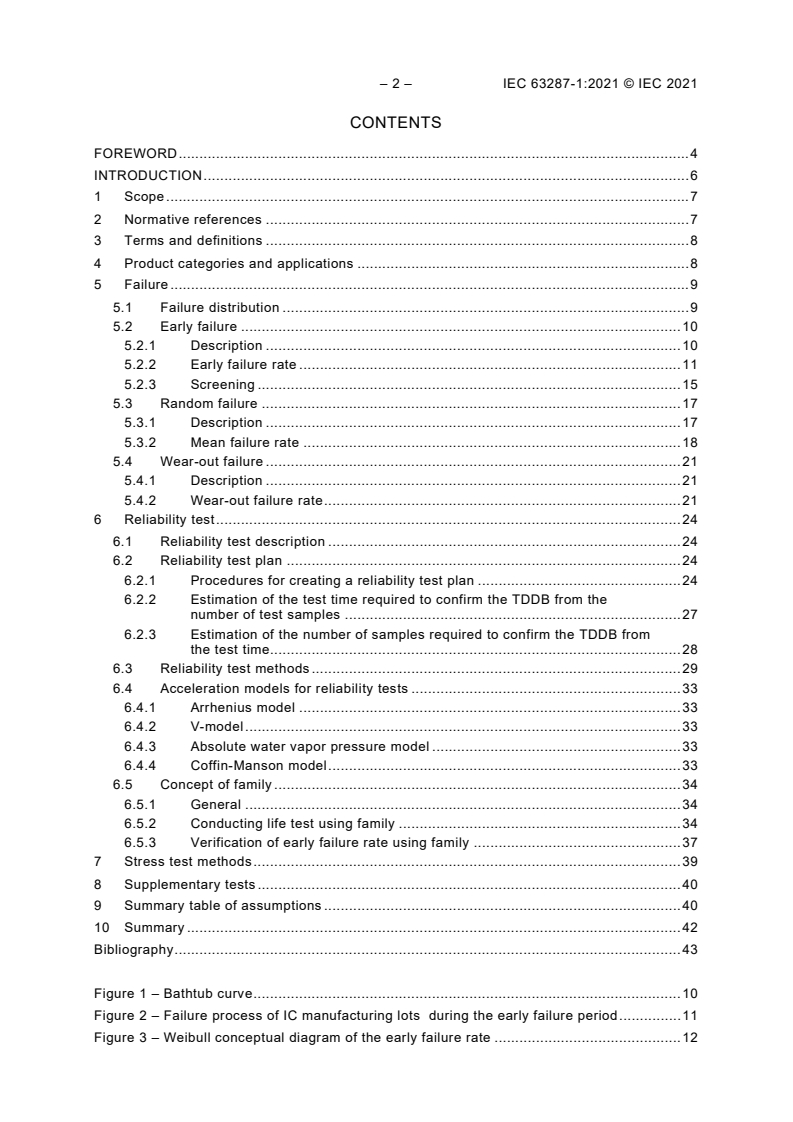
CONTENTS
FOREWORD . 4
INTRODUCTION . 6
1 Scope . 7
2 Normative references . 7
3 Terms and definitions . 8
4 Product categories and applications . 8
5 Failure . 9
5.1 Failure distribution . 9
5.2 Early failure . 10
5.2.1 Description . 10
5.2.2 Early failure rate . 11
5.2.3 Screening . 15
5.3 Random failure . 17
5.3.1 Description . 17
5.3.2 Mean failure rate . 18
5.4 Wear-out failure . 21
5.4.1 Description . 21
5.4.2 Wear-out failure rate . 21
6 Reliability test . 24
6.1 Reliability test description . 24
6.2 Reliability test plan . 24
6.2.1 Procedures for creating a reliability test plan . 24
6.2.2 Estimation of the test time required to confirm the TDDB from the
number of test samples . 27
6.2.3 Estimation of the number of samples required to confirm the TDDB from
the test time. 28
6.3 Reliability test methods . 29
6.4 Acceleration models for reliability tests . 33
6.4.1 Arrhenius model . 33
6.4.2 V-model . 33
6.4.3 Absolute water vapor pressure model . 33
6.4.4 Coffin-Manson model . 33
6.5 Concept of family . 34
6.5.1 General . 34
6.5.2 Conducting life test using family . 34
6.5.3 Verification of early failure rate using family . 37
7 Stress test methods . 39
8 Supplementary tests . 40
9 Summary table of assumptions . 40
10 Summary . 42
Bibliography . 43
Figure 1 – Bathtub curve . 10
Figure 2 – Failure process of IC manufacturing lots during the early failure period . 11
Figure 3 – Weibull conceptual diagram of the early failure rate . 12
Figure 4 – Example of a failure ratio: α (in hundreds) and the number of failures for CL
of 60 % . 14
Figure 5 – Screening and estimated early fail rate in Weibull diagram . 16
Figure 6 – Bathtub curve setting the point immediately after production as the origin . 17
Figure 7 – Bathtub curve setting the point after screening as the origin. 17
Figure 8 – Conceptual diagram of calculation method for the mean failure rate from the
exponential distribution . 18
Figure 9 – Conceptual diagram of calculation method for the mean failure rate as an
extension of early failure . 19
Figure 10 – Conceptual diagram of the wear-out failure . 21
Figure 11 – Conceptual diagram describing the concept of the acceleration test . 22
Figure 12 – Concept of the reliability test in a Weibull diagram (based on sample size) . 26
Figure 13 – Concept of the reliability test in a Weibull diagram (based on test time) . 29
Figure 14 – Difference in sampling sizes according to the m value (image) . 30
Figure 15 – How the screening defect rate is seen depending on the difference of chip
size (example) . 37
Table 1 – Examples of product categories . 9
–6
Table 2 – Cumulative failure probability 0,1 % over 10 years [×10 ] for the third, fifth
and seventh years . 26
Table 3 – Major reliability (life) test methods and purposes . 31
Table 4 – Examples of the number of test samples and the test time in typical reliability
(life) test methods . 32
Table 5 – Concept of family (example) . 34
Table 6 – Concept of difference/failure mechanism/corresponding test item (examples). 36
Table 7 – Factors for calculation examples of early failure rate using family data . 38
Table 8 – LTPD sampling table for acceptance number Ac = 0 . 39
Table 9 – Major reliability (strength) test methods and purposes . 39
Table 10 – Supplementary tests . 40
a
Table 11 – Accelerating factors, calculation formulae and numerical values . 41
– 4 – IEC 63287-1:2021 © IEC 2021
INTERNATIONAL ELECTROTECHNICAL COMMISSION
____________
SEMICONDUCTOR DEVICES –
GENERIC SEMICONDUCTOR QUALIFICATION GUIDELINES –
Part 1: Guidelines for IC reliability qualification
FOREWORD
1) The International Electrotechnical Commission (IEC) is a worldwide organization for standardization comprising
all national electrotechnical committees (IEC National Committees). The object of IEC is to promote
international co-operation on all questions concerning standardization in the electrical and electronic fields. To
this end and in addition to other activities, IEC publishes International Standards, Technical Specifications,
Technical Reports, Publicly Available Specifications (PAS) and Guides (hereafter referred to as "IEC
Publication(s)"). Their preparation is entrusted to technical committees; any IEC National Committee interested
in the subject dealt with may participate in this preparatory work. International, governmental and non-
governmental organizations liaising with the IEC also participate in this preparation. IEC collaborates closely
with the International Organization for Standardization (ISO) in accordance with conditions determined by
agreement between the two organizations.
2) The formal decisions or agreements of IEC on technical matters express, as nearly as possible, an international
consensus of opinion on the relevant subjects since each technical committee has representation from all
interested IEC National Committees.
3) IEC Publications have the form of recommendations for international use and are accepted by IEC National
Committees in that sense. While all reasonable efforts are made to ensure that the technical content of IEC
Publications is accurate, IEC cannot be held responsible for the way in which they are used or for any
misinterpretation by any end user.
4) In order to promote international uniformity, IEC National Committees undertake to apply IEC Publications
transparently to the maximum extent possible in their national and regional publications. Any divergence
between any IEC Publication and the corresponding national or regional publication shall be clearly indicated in
the latter.
5) IEC itself does not provide any attestation of conformity. Independent certification bodies provide conformity
assessment services and, in some areas, access to IEC marks of conformity. IEC is not responsible for any
services carried out by independent certification bodies.
6) All users should ensure that they have the latest edition of this publication.
7) No liability shall attach to IEC or its directors, employees, servants or agents including individual experts and
members of its technical committees and IEC National Committees for any personal injury, property damage or
other damage of any nature whatsoever, whether direct or indirect, or for costs (including legal fees) and
expenses arising out of the publication, use of, or reliance upon, this IEC Publication or any other IEC
Publications.
8) Attention is drawn to the Normative references cited in this publication. Use of the referenced publications is
indispensable for the correct application of this publication.
9) Attention is drawn to the possibility that some of the elements of this IEC Publication may be the subject of
patent rights. IEC shall not be held responsible for identifying any or all such patent rights.
International Standard IEC 63287-1 has been prepared by IEC technical committee 47:
Semiconductor devices.
This first edition of IEC 63287-1 cancels and replaces the first edition of IEC 60749-43
published in 2017. This edition constitutes a technical revision.
This edition includes the following significant technical changes with respect to the previous
edition:
a) the document has been renamed and renumbered to distinguish it from the IEC 60749
(all parts);
b) a new section concerning the concept of "family" has been added with appropriate
renumbering of the existing text.
The text of this International Standard is based on the following documents:
DRAFT Report on voting
47/2703/FDIS 47/2720/RVD
Full information on the voting for its approval can be found in the report on voting indicated in
the above table.
The language used for the development of this International Standard is English.
This document was drafted in accordance with ISO/IEC Directives, Part 2, and developed in
accordance with ISO/IEC Directives, Part 1 and ISO/IEC Directives, IEC Supplement,
available at www.iec.ch/members_experts/refdocs. The main document types developed by
IEC are described in greater detail at www.iec.ch/standardsdev/publications.
A list of all parts in the IEC 63287 series, published under the general title Semiconductor,
devices – Generic semiconductor qualification guidelines, can be found on the IEC website.
The committee has decided that the contents of this document will remain unchanged until the
stability date indicated on the IEC website under webstore.iec.ch in the data related to the
specific document. At this date, the document will be
• reconfirmed,
• withdrawn,
• replaced by a revised edition, or
• amended.
IMPORTANT – The 'colour inside' logo on the cover page of this publication indicates that it
contains colours which are considered to be useful for the correct understanding of its
contents. Users should therefore print this document using a colour printer.
– 6 – IEC 63287-1:2021 © IEC 2021
INTRODUCTION
This document provides guidelines for semiconductor IC vendors in the preparation of
detailed reliability test plans for device qualification. Such plans are intended to be prepared
before commencing qualification tests and after consultation with the user of their
semiconductor integrated circuit product.
The guideline gives some examples for creating reliability qualification test plans to determine
appropriate reliability test conditions based on the use conditions and requirements for each
application of semiconductor integrated circuits. Categories are set for automotive
applications and for general applications as a target of reliability. The grade for automotive
use is further classified into two grades according to applications. The guideline assumes
annual operating hours, useful life, etc. for each grade, and defines the verification methods
for early failure rate and wear-out failure to propose appropriate reliability tests, and at the
same time, presents concepts to properly ensure the quality of semiconductor integrated
circuits using screening techniques which are designed to reduce the early failure rate.
The test conditions and the values of acceleration factors presented in this guideline are
shown to provide examples of calculations for obtaining reliability test conditions in order to
verify the required quality standards and are not designed to define the standards to ensure
reliability of semiconductor integrated circuits.
NOTE Qualification tests are tests in which the semiconductor vendor takes account of the reliability required by
its product users.
SEMICONDUCTOR DEVICES –
GENERIC SEMICONDUCTOR QUALIFICATION GUIDELINES –
Part 1: Guidelines for IC reliability qualification
1 Scope
This part of IEC 63287 gives guidelines for reliability qualification plans of semiconductor
integrated circuit products. This document is not intended for military- and space-related
applications.
NOTE 1 The manufacturer can use flexible sample sizes to reduce cost and maintain reasonable reliability by this
guideline adaptation based on EDR-4708, AEC Q100, JESD47 or other relevant document can also be applicable if
it is specified.
NOTE 2 The Weibull distribution method used in this document is one of several methods to calculate the
appropriate sample size and test conditions of a given reliability project.
2 Normative references
The following documents are referred to in the text in such a way that some or all of their
content constitutes requirements of this document. For dated references, only the edition
cited applies. For undated references, the latest edition of the referenced document (including
any amendments) applies.
IEC 60749-5, Semiconductor devices – Mechanical and climatic test methods – Part 5:
Steady-state temperature humidity bias life test
IEC 60749-6, Semiconductor devices – Mechanical and climatic test methods – Part 6:
Storage at high temperature
IEC 60749-15, Semiconductor devices – Mechanical and climatic test methods – Part 15:
Resistance to soldering temperature for through-hole mounted devices
IEC 60749-20, Semiconductor devices – Mechanical and climatic test methods – Part 20:
Resistance of plastic encapsulated SMDs to the combined effect of moisture and soldering
heat
IEC 60749-21, Semiconductor devices – Mechanical and climatic test methods – Part 21:
Solderability
IEC 60749-23, Semiconductor devices – Mechanical and climatic test methods – Part 23: High
temperature operating life
IEC 60749-25, Semiconductor devices – Mechanical and climatic test methods – Part 25:
Temperature cycling
IEC 60749-26, Semiconductor devices – Mechanical and climatic test methods – Part 26:
Electrostatic discharge (ESD) sensitivity testing – Human body model (HBM)
IEC 60749-28, Semiconductor devices – Mechanical and climatic test methods – Part 28:
Electrostatic discharge (ESD) sensitivity testing – Charged device model (CDM) – Device
level
– 8 – IEC 63287-1:2021 © IEC 2021
IEC 60749-29, Semiconductor devices – Mechanical and climatic test methods – Part 29:
Latch-up test
IEC 60749-42, Semiconductor devices – Mechanical and climatic test methods – Part 42:
Temperature and humidity storage
3 Terms and definitions
For the purposes of this document, the following terms and definitions apply.
ISO and IEC maintain terminological databases for use in standardization at the following
addresses:
• IEC Electropedia: available at http://www.electropedia.org/
• ISO Online browsing platform: available at http://www.iso.org/obp
3.1
failure mode
classification of a fault phenomenon which causes product failure
Note 1 to entry: Disconnection, a short circuit, occasional loss, abrasion, characteristic deterioration, etc. are
typical items considered as failure modes.
3.2
failure mechanism
physical, chemical or other process that results in a product failure to meet functional
requirements (or failure modes)
3.3
integrated circuit
IC
microcircuit in which all or some of the circuit elements are inseparably associated and
electrically interconnected so that it is considered to be indivisible for the purpose of
construction and commerce
Note 1 to entry: IEV:521-10-03
4 Product categories and applications
Quality-related requirements, operating hours, and field operating condition of ICs depend on
the applications of products in which they are used. As an example of creating scientific test
plans, their applications are broadly classified into three product categories: Automotive Use
A; Automotive Use B; and Consumer Use. Table 1 shows a list of quality-related requirements
according to each product category and the definition of their use conditions.
Table 1 – Examples of product categories
Category Automotive Use A Automotive Use B Consumer Use
Criteria for Applications for automotive Applications for automotive Home or office electronics,
category use directly relating to safety. use not directly relating to toys, appliances and server
(Failures can cause
safety. applications.
accidents.)
Examples of Powertrains, brakes, driving Navigation systems, car air- Home electronics, toys,
applications support systems, airbags conditioners, audio systems appliances
Annual 500 h 500 h Up to 8 760 h
operating hours
Differs depending on whether Differs among applications.
or not to work with KEY
ON/OFF.
Useful life 15 years (cumulative failure 15 years (cumulative failure Up to 10 years (cumulative
probability: 0,1 %) probability: 0,1 %) failure probability: 0,1 %)
Differs among applications.
Assumed Example of engine compartment
operating
T = −40 °C/ T = 125 °C T = 0 °C / T = 70 °C
conditions a,min a,max a,min a,max
T = 100 °C/ T = 150 °C T = 70 °C/105 °C (max.)
(examples of j,typ j,max j
conditions which
RH = 10 (min.)/80 % (max.)
min. RH: 0 / max. RH: 100 %,
differ among
RH (during 20 % power on)
applications) RH (during 10 % driving) (during 70 % stop)
(during 60 % power off)
Example of interior environment
T = -40 °C (min.)/85 °C (max.)
a
T = 85 °C (typ.)/125 °C (max.)
j
RH = 0 (min.)/100 % (max.),
RH (during 10 % driving) (during 70 % stop)
−6 −6 −6
Early failure rate 1 × 10 or below per annum 50 × 10 or below per Up to 500 × 10 per annum
annum
Differs among applications.
Random failure 10 FIT or below 50 FIT or below >50 FIT (typical)
rate
Differs among applications.
NOTE These are examples of application conditions and requirements that do not have to all be met to be
relevant for each use case.
5 Failure
5.1 Failure distribution
Failure distribution of ICs can be broadly divided into three regions: early failure portion
(e.g., t = 1 year), random failure portion, and wear-out failure portion. Figure 1 shows the
ELF
relationship between the field use time and the instantaneous failure rate (bathtub curve).
Failure distributions for each region are described in detail in 5.2 to 5.4.
Most early failures are screened within manufacturing processes of IC vendors. However, ICs
not fully screened can expose problems in a relatively short period after their operation starts
in the field.
– 10 – IEC 63287-1:2021 © IEC 2021
Random failure has been considered to achieve a certain failure rate with respect to time, but
actually, it is appropriate to consider as an extension of the early failure region where the
failure rate continues to decline. Potentially induced failures outside of the supplier’s control,
such as ESD, EOS and soft errors, should not be included in the failure rate calculations
unless a total fail rate that includes these types of fail modes is intended.
Wear-out failure is a failure which occurs due to the end of life of IC components such as
transistors and interconnections, and indicates the life of the ICs themselves. Wear-out failure
is a failure which depends on the usage load profile (time windows may be different). The
number of failures increases with time, and every IC will eventually cause a failure beyond the
intended design life of the part. Wear-out failures are not considered in the same manner,
because they have a totally different mechanism and therefore also a different mathematical
description (failure distribution). Therefore, it is important to prevent this failure during the
durable period. For ICs, the time to reach the cumulative failure probability of 0,15 over the
design life of the part in the given application is generally defined as their design lifetime.
Figure 1 – Bathtub curve
5.2 Early failure
5.2.1 Description
Since ICs contain very small feature sizes and are dense and complex, they are susceptible
to defects generated in manufacturing processes. For this reason, good devices which satisfy
required characteristics and functions are sorted out at the final stage of manufacturing
processes. The ratio of good devices to the total amount produced and tested in this process
is called yield. When sorting good devices, they are measured for as many items as possible
including characteristics and functions required. However, some of these sorted good devices
can include those with built-in latent defects or weaknesses which does not influence
electrical characteristics, and they operate properly during sorting. When the yield is high,
devices with these potential defects are less likely to be included. In contrast, when the yield
is relatively low, there is a high possibility of mixture of these latent defect devices with good
ones. Devices with these potential defects can eventually fail during use due to the shortened
lifetime or the intensity of the user application.
A small amount of tested good devices which contain such defects is included in the
manufacturing lot and, as such, its failure rate decreases with time. This is because non-
defective ICs which are unlikely to cause a failure remain when defective ICs are removed
after they cause a failure. In such a case, the shape parameter of the Weibull distribution: m is
less than 1 (m < 1).
To be more specific, when a manufacturing lot has good devices with a potential defect as
shown in Figure 2, electronic products using such devices may cause a failure during use,
and faulty ICs are removed by application screening, repair (component replacement) or
disposition. This leaves reliable ICs.
NOTE It is much preferred to screen out these failures, latent or otherwise, at the IC manufacturer rather than
have them reach the user, where it is more expensive to correct.
Figure 2 – Failure process of IC manufacturing lots
during the early failure period
For this reason, reducing defects generated in manufacturing processes is the major
countermeasure against such failures. Another possible countermeasure is to change the
design to a structure not susceptible to defects if it is feasible.
There are also screening techniques such as burn-in, which operate ICs under relatively
harsh conditions of temperature and/or voltage to induce the defects to fail in advance and
remove them by sorting. This acts to consume the early failure period of ICs before shipment,
which can reduce impacts of the early failure after shipment. Screening can be optimized if
the effect of the above defect reduction is confirmed.
5.2.2 Early failure rate
5.2.2.1 Early failure rate definition
The early failure rate indicates the probability of degradation failures resulting from
manufacturing defects which occur within one year (defined early failure period) after
shipment by IC manufacturers and the operation starts in the field (within assembly
manufacturers’ processes and in end user applications).
The early failure rate is often expressed as "cumulative failure probability", where the failure
rate which occurs during the defined early failure period is numerically expressed in
−6
percentage (%) or parts per million (10 ).
– 12 – IEC 63287-1:2021 © IEC 2021
5.2.2.2 Cumulative fail probability
In general, the cumulative failure probability is expressed as follows.
When the Weibull distribution shape parameter is expressed as m, scale parameter η and time
t, the cumulative failure probability F(t): from 0 to t is defined by Formula (1).
m
t
F(t) =1−exp−
(1)
m
η
Figure 3 shows the concept of the early failure rate using a Weibull distribution chart.
Key
t : Field use time;
b
t : Value converting the time between screening period to shipment into field use time;
s
P: Operating ratio (0 < P ≤ 1).
Figure 3 – Weibull conceptual diagram of the early failure rate
The following sections describe how to calculate the early failure rate from the confirmation
result of the cumulative failure convergence at screening test.
5.2.2.3 Calculation of the early failure rate
Suppose that the cumulative failure probability F(t ) with the field use time t was obtained as
b b
the confirmation result of the cumulative failure convergence at screening test. The Weibull
scale parameter η is obtained from the following formula:
t
b
η = (2)
m
[−ln(1− F(t ))]
b
Where m indicates the value obtained from the experiment result or an estimated value.
However, in the above formula, if there are zero failures, then F(t ) = 0, and the scale
b
parameter η is undefined, as the denominator goes to 0.
For this reason, the χ (chi-squared) distribution shall be used to define the cumulative failure
probability F (t ) taking account of the confidence level.
c b
However, this is based on the premise that the number of samples N is sufficiently large.
NOTE Typical confidence level used in failure rate calculations for semiconductor devices is 60 %.
The cumulative failure probability at the specified confidence level and at the field use time
F (t ) is given by Formula (3).
c b
F (t ) =χ (3)
c b d
g
g,
2×N
where
χ is Chi-square distribution;
g is the confidence level (CL in %);
d is the degree of freedom = (2 × f) + 2;
f is the number of failures;
N is the number of samples.
Substituting (3) into (2) yields the scale parameter taking account of the confidence level:
t
b
η =
(4)
c
[− ln(1− F (t ))]
m
c b
When the value converting the screening period until shipment into field use time t and the
s
calculated value η are used, the early failure rate taking account of the confidence level after
c
shipment: F (t ,t ) is given by the following.
c 1 s
η is used instead of η and the early failure
If failures are found during the early failure period,
c
rate takes no account of the confidence level after shipment. F(t ,t ) is given by the following:
1 s
m
(t − t )
1 s
F (t ,t ) = 1− exp−
(5)
c 1 s
m
η
c
m
(t − t )
1 s
F(t ,t ) = 1− exp−
(6)
1 s
m
η
For both Formulae (5) and (6), t = 365 × 24 × P
where
P is the operating ratio ranged from 0 (always off) to 1 (always on);
t is the time point of 1 year after operation start measured in hours (constant
on = 8 760 hours).
– 14 – IEC 63287-1:2021 © IEC 2021
5.2.2.4 Calculation of a failure rate ratio
The failure rate ratio: α between the early failure rate F taking account of a confidence level
c
with g (in %) and the early failure rate F taking no account of the confidence level is
expressed by the following formulae:
F =χ (7)
c
d
g,
2×N
f
F = (8)
N
where f = Number of failures in N = Number of samples.
χ
d
g,
2×N
F
c 2
α = = = (N/f)χ
(9)
d
F f
g,
2×N
N
Figure 4 – Example of a failure ratio: α (in hundreds)
and the number of failures for CL of 60 %
F is determined by the number of failures, not by the number of test samples: N.
As the number of failures increases, the ratio between the rates taking account of and without
taking account of the confidence level comes closer to 1.
From Figure 4, when the cumulative number of failures is 50, the failure rate difference
between the early failure rate taking account of the confidence level: F and the early failure
c
rate taking no account of the confidence level: F is 5 % (α = 105 for
N = 50 versus α = 100 for large N).
Therefore, if the difference in the early failure rate depends on the number of failures and the
incorporation of the confidence level is allowable, the early failure rate can be used without
accounting for the confidence level.
EXAMPLE:
When a confirmation result of the cumulative failure convergence at screening test is obtained using:
m = 0,3; t = 70 298 hours; N = 2 000; and f = 69,
b
and the early failure rate F (t ,t ) using:
c 1 s
CL of 60 %; t = 70 298 hours; P = 1
s
The scale parameter with confidence level is calculated as η = 5,57 × 10 from Formula (4).
c
−6
The early failure rate with confidence level is calculated as F (t :t ) = 129 × 10 from Formula (5).
c 1 s
The scale parameter taking no account of the confidence level η = 2,15 × 10 from Formula (2).
−6
The early failure rate taking no account of the confidence level F(t :t ) = 124 × 10 from Formula (6).
1 s
Thus, in this example, the failure rate difference between the early failure rate taking account of the confidence
level F and the early failure rate without taking account of the confidence level F is (129 − 124)/124 = 4 %.
c
5.2.3 Screening
Since ICs contain very small feature sizes and are dense with complex geometry, they are
susceptible to defects generated in manufacturing processes. Therefore, some lots classified
as ‘good devices’ contain potential failures with a minor intrinsic defect which does not
influence measured electrical characteristics. This allows the device to operate to
specification during the sorting process. Removing potential failures before shipment and thus
reducing or eliminating the early field failure rate is called screening.
General screening methods to remove devices containing such minor intrinsic defects include
the application of stricter stresses such as voltage and temperature than those under actual
use conditions, combining a product test and burn-in, methods to remove initial defects in
packages using X-ray inspections and visual inspections and combining mounting stress and
stresses under a temperature cycle test, etc. Screening conditions need to be adjusted when
necessary depending on the target early failure rate. They should be examined in a manner
that the screening itself will not influence the useful life significantly, i.e. reduce the time to
wear out. By stabilizing the product manufacturing lines and manufacturing the product
carefully to reduce intrinsic manufacturing defects, the product early failure rate can also be
reduced.
Burn-in has generally been conducted after packaging, but recently, it is common to conduct it
to die on wafers. Both methods will produce the same effect in terms of the purpose of
removing manufacturing defects in device die. Figure 5 shows the relationship between the
screening and the early failure rate which can be statistically estimated.
– 16 – IEC 63287-1:2021 © IEC 2021
Figure 5 – Screening and estimated early fail rate in Weibull diagram
Figure 5 shows the verification method for the early failure rate after screening which can be
estimated statistically. In some cases, burn-in is repeated until no actual burn-in failure occurs
to confirm the convergence of the screening but, as shown in Figure 5, the early failure
always occurs even at a slight rate when it is statistically estimated in the Weibull distribution.
For this reason, the sampling becomes meaningless unless data is statistically analysed
taking account of the experimental parameter, acceleration factor, and failure mode even
when the burn-in is unreasonably repeated until no burn-in failure occurs.
The m value calculated with the failure probability of the burn-in process does not reflect the
failures which occurred and were removed in the test processes before the burn-in process. If
the m value is calculated without considering failures in the test processes before burn-in, it
becomes larger. Therefore, the early failure rate estimated from the m value tends to become
a poorer estimate than the actual quality. In general, it is necessary to calculate the m -value
taking account of the failure probability before and after burn-in as shown in Figure 5 to
estimate the early failure.
Verification of the early failure distribution and rate based on this concept should be
incorporated into the verification of the product reliability, which is also the most effective
means to improve the actual delivery quality.
Since the early failure depends on the intrinsic manufacturing defect rate of the manufacturing
line, the early failure rate of other products in the same manufacturing line and with the same
design standard can also be estimated easily as long as the manufacturing defect rate and
the convergent characteristics (m -value of the Weibull distribution) of the early failure are
understood.
EXAMPLE:
Calculation method for the early failure probability in the field:
When t is the time until shipment taking account of the screening (converted into the time in the use environment
per Figure 6), then the cumulative failure probability after shipment is:
m m
(t + t ) − t
1 1
( )
F t : t = 1− exp
(10)
m
η
and the failure rate after shipment (see Figure 7) is:
(m−1)
m × (t + t )
λ(t : t ) = (11)
m
η
Note that the cumulative failure probability for one year after shipment is F(8 760 h: t ) where 1 year = 8 760 h.
When m and η are obtained from the screening data, quantitative calculations are enabled.
Figure 6 – Bathtub curve setting the point immediately after production as the origin
Figure 7 – Bathtub curve setting the point after screening as the origin
5.3 Random failure
5.3.1 Description
Random failure generally indicates a failure which occurs between the end of the defined
early failure period (in this case, 1 year) and the end of the useful life or onset of the wearout
period. It is appropriate to estimate that failures which occur after the defined early failure
period are caused by the exposure of surviving early failures which were not completely
removed by screening, and in most cases, the Weibull distribution shape parameter: m is not
exactly 1. It is sometimes consider
...