


IEC 60730-2-5:1993/AMD2:1997
(Amendment)Amendment 2 - Automatic electrical controls for household and similar use - Part 2: Particular requirements for automatic electrical burner control systems
Amendment 2 - Automatic electrical controls for household and similar use - Part 2: Particular requirements for automatic electrical burner control systems
Amendement 2 - Dispositifs de commande électrique automatiques à usage domestique et analogue - Partie 2: Règles particulières pour les systèmes de commande électrique automatiques des brûleurs
General Information
- Status
- Published
- Publication Date
- 06-Nov-1997
- Technical Committee
- TC 72 - Automatic electrical controls
- Current Stage
- DELPUB - Deleted Publication
- Start Date
- 28-Apr-2000
- Completion Date
- 13-Feb-2026
Relations
- Effective Date
- 05-Sep-2023
Overview
IEC 60730-2-5:1993/AMD2:1997 is an essential amendment to the international standard governing automatic electrical controls for household and similar use. Specifically, this amendment addresses particular requirements for automatic electrical burner control systems. It was developed by IEC Technical Committee 72, which specializes in automatic controls for household appliances. The amendment ensures enhanced safety, reliability, and performance of burner control systems used in household heating and cooking equipment.
Key Topics
This amendment introduces specific technical updates and clarifications, focusing on:
- Fault Modes and Safety Tests: Detailed regulations for how burner control systems must handle simulated electrical faults in components, including resistors, capacitors, diodes, transistors, relays, and integrated circuits. The controls must prevent hazardous outcomes such as flames, explosions, or excessive temperature rises during abnormal operation.
- Definitions Update: Introduction of precise terminology related to electronic components, notably the hybrid circuit definition, detailing circuits produced with thick/thin film or surface mounted devices on ceramic substrates, highlighting integration and safety features.
- Temperature and Insulation Requirements: Stringent limits on temperatures for supplementary and reinforced insulation materials, with specific provisions for thermoplastic materials used in controls.
- Enclosure Safety Testing: Procedures to ensure burner control enclosures do not ignite surrounding materials during fault conditions, using tests involving tissue or cheesecloth wrapping.
- Software Requirements: Application of software class C safety requirements for burner control systems employing electronic components, underlining the role of embedded software reliability in safety-critical applications.
- Failure Mode Analysis: Normative annex K outlines electrical and electronic component failure modes such as short circuits, open circuits, and operational anomalies, with special instructions on how these failures affect the burner control system's compliance with safety standards.
Applications
The IEC 60730-2-5:1993/AMD2:1997 amendment is primarily applied in:
- Household heating appliances: Enhancing safety of automatic burner controls for gas or oil-fired water heaters, boilers, and furnaces.
- Domestic cooking equipment: Ensuring burner controls in stoves and ovens operate reliably without risk of flame failure or hazardous electrical faults.
- Similar electrical appliances: Equipment with embedded automatic burner controls benefiting from standardized fault handling and safety responses.
- Manufacturing and quality assurance: Guiding appliance manufacturers in designing, testing, and certifying burner control systems to meet international safety criteria.
Compliance with this amendment helps reduce risk of fire, explosions, and electrical hazards, improving consumer safety and aligning with regulatory requirements.
Related Standards
To fully implement these requirements, referencing the following related IEC standards is valuable:
- IEC 60384-16: Fixed metallized polypropylene film dielectric DC capacitors part, critical for component reliability in burner controllers.
- IEC 60730-1: General requirements for automatic electrical controls for household appliances, covering overarching safety and performance criteria.
- IEC 60335 Series: Safety of household and similar electrical appliances, providing complementary safety benchmarks especially concerning optocouplers and electronic components.
- Other IEC 60730 Part 2 standards: Covering distinct appliance control categories, such as thermal motor protectors (60730-2-2) and electrical household appliance controls (60730-2-1).
Following these interconnected standards ensures a comprehensive safety and performance framework for automatic electrical burner control systems, fostering product reliability and consumer confidence across global markets.
Keywords: IEC 60730-2-5 amendment, automatic electrical burner control systems, household appliance safety, burner control fault modes, hybrid circuits, insulation temperature limits, IEC safety standards, electronic component failure modes, automatic controls for household use, electrical burner control standards.
IEC 60730-2-5:1993/AMD2:1997 - Amendment 2 - Automatic electrical controls for household and similar use - Part 2: Particular requirements for automatic electrical burner control systems Released:11/7/1997 Isbn:2831841100
Frequently Asked Questions
IEC 60730-2-5:1993/AMD2:1997 is a standard published by the International Electrotechnical Commission (IEC). Its full title is "Amendment 2 - Automatic electrical controls for household and similar use - Part 2: Particular requirements for automatic electrical burner control systems". This standard covers: Amendment 2 - Automatic electrical controls for household and similar use - Part 2: Particular requirements for automatic electrical burner control systems
Amendment 2 - Automatic electrical controls for household and similar use - Part 2: Particular requirements for automatic electrical burner control systems
IEC 60730-2-5:1993/AMD2:1997 is classified under the following ICS (International Classification for Standards) categories: 97.120 - Automatic controls for household use. The ICS classification helps identify the subject area and facilitates finding related standards.
IEC 60730-2-5:1993/AMD2:1997 has the following relationships with other standards: It is inter standard links to IEC 60730-2-5:2000. Understanding these relationships helps ensure you are using the most current and applicable version of the standard.
IEC 60730-2-5:1993/AMD2:1997 is available in PDF format for immediate download after purchase. The document can be added to your cart and obtained through the secure checkout process. Digital delivery ensures instant access to the complete standard document.
Standards Content (Sample)
NORME
CEI
INTERNATIONALE
IEC
60730-2-5
INTERNATIONAL
STANDARD
AMENDEMENT 2
AMENDMENT 2
1997-11
Amendement 2
Dispositifs de commande électrique
automatiques à usage domestique et analogue
Partie 2-5:
Règles particulières pour les systèmes de commande
électrique automatiques des brûleurs
Amendment 2
Automatic electrical controls
for household and similar use
Part 2-5:
Particular requirements for automatic electrical
burner control systems
IEC 1997 Droits de reproduction réservés Copyright - all rights reserved
International Electrotechnical Commission 3, rue de Varembé Geneva, Switzerland
Telefax: +41 22 919 0300 e-mail: inmail@iec.ch IEC web site http: //www.iec.ch
CODE PRIX
Commission Electrotechnique Internationale
PRICE CODE E
International Electrotechnical Commission
Pour prix, voir catalogue en vigueur
For price, see current catalogue
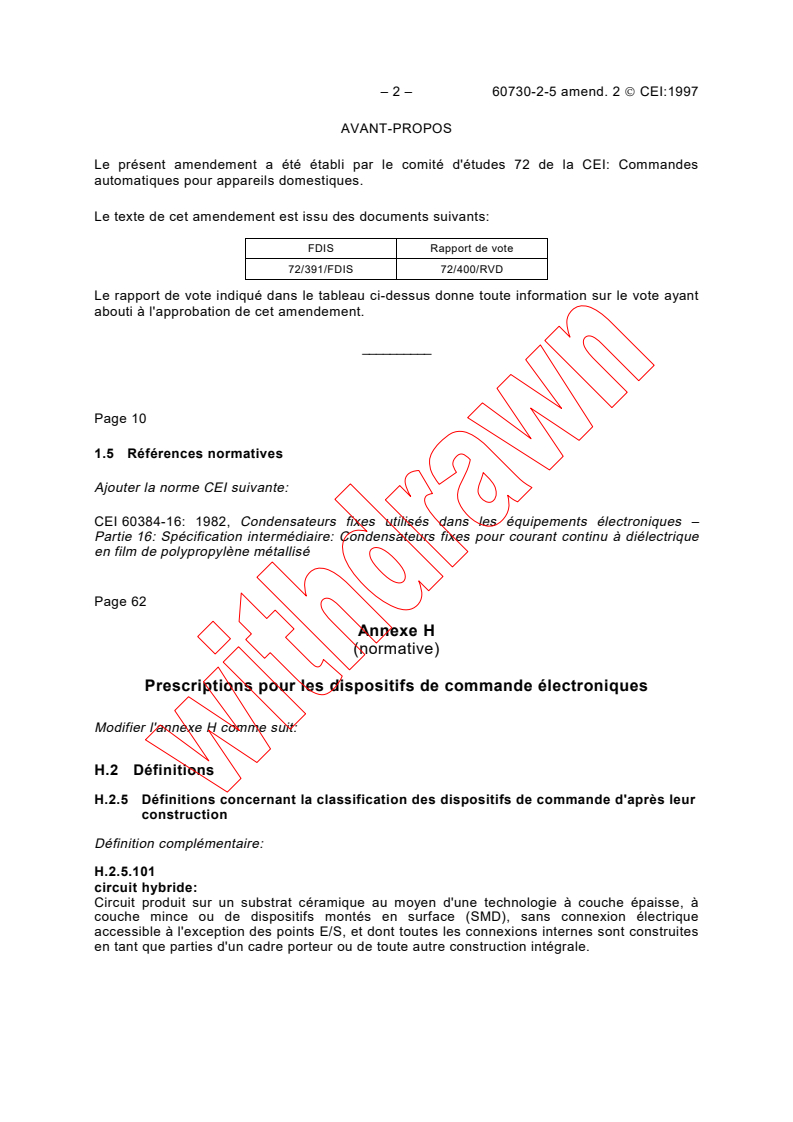
– 2 – 60730-2-5 amend. 2 CEI:1997
AVANT-PROPOS
Le présent amendement a été établi par le comité d'études 72 de la CEI: Commandes
automatiques pour appareils domestiques.
Le texte de cet amendement est issu des documents suivants:
FDIS Rapport de vote
72/391/FDIS 72/400/RVD
Le rapport de vote indiqué dans le tableau ci-dessus donne toute information sur le vote ayant
abouti à l'approbation de cet amendement.
__________
Page 10
1.5 Références normatives
Ajouter la norme CEI suivante:
CEI 60384-16: 1982, Condensateurs fixes utilisés dans les équipements électroniques –
Partie 16: Spécification intermédiaire: Condensateurs fixes pour courant continu à diélectrique
en film de polypropylène métallisé
Page 62
Annexe H
(normative)
Prescriptions pour les dispositifs de commande électroniques
Modifier l'annexe H comme suit:
H.2 Définitions
H.2.5 Définitions concernant la classification des dispositifs de commande d'après leur
construction
Définition complémentaire:
H.2.5.101
circuit hybride:
Circuit produit sur un substrat céramique au moyen d'une technologie à couche épaisse, à
couche mince ou de dispositifs montés en surface (SMD), sans connexion électrique
accessible à l'exception des points E/S, et dont toutes les connexions internes sont construites
en tant que parties d'un cadre porteur ou de toute autre construction intégrale.
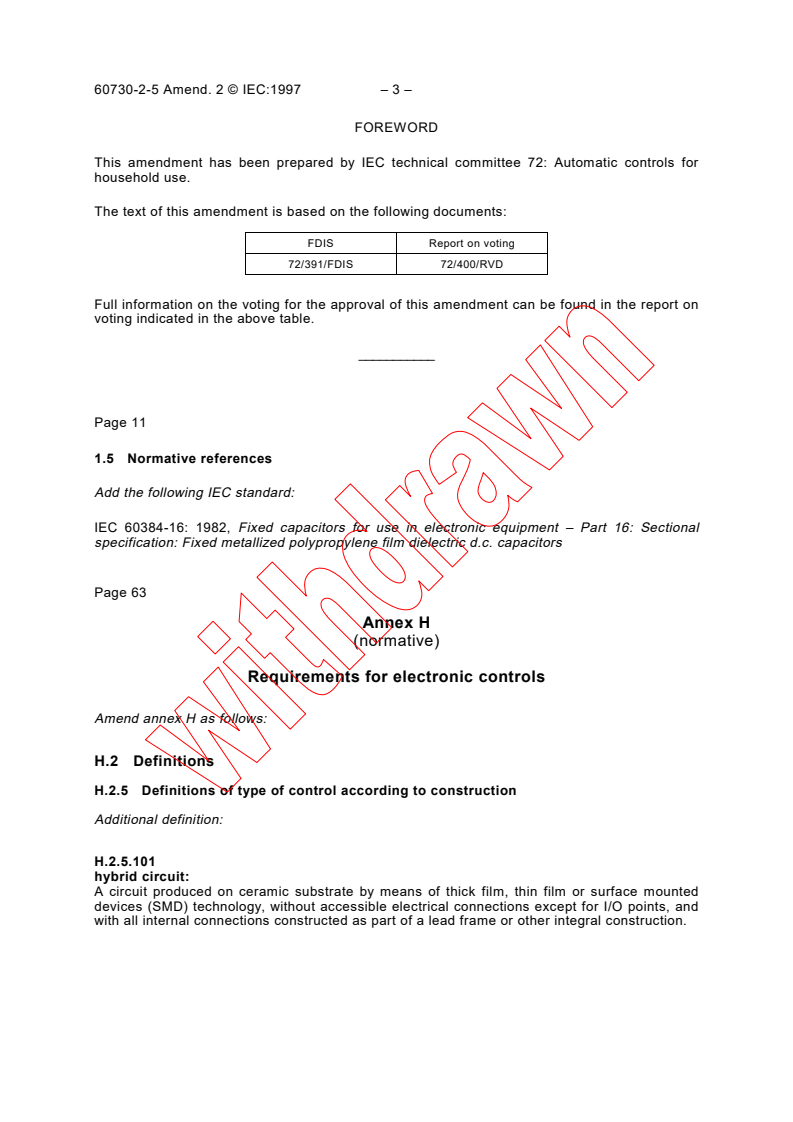
60730-2-5 Amend. 2 © IEC:1997 – 3 –
FOREWORD
This amendment has been prepared by IEC technical committee 72: Automatic controls for
household use.
The text of this amendment is based on the following documents:
FDIS Report on voting
72/391/FDIS 72/400/RVD
Full information on the voting for the approval of this amendment can be found in the report on
voting indicated in the above table.
___________
Page 11
1.5 Normative references
Add the following IEC standard:
IEC 60384-16: 1982, Fixed capacitors for use in electronic equipment – Part 16: Sectional
specification: Fixed metallized polypropylene film dielectric d.c. capacitors
Page 63
Annex H
(normative)
Requirements for electronic controls
Amend annex H as follows:
H.2 Definitions
H.2.5 Definitions of type of control according to construction
Additional definition:
H.2.5.101
hybrid circuit:
A circuit produced on ceramic substrate by means of thick film, thin film or surface mounted
devices (SMD) technology, without accessible electrical connections except for I/O points, and
with all internal connections constructed as part of a lead frame or other integral construction.
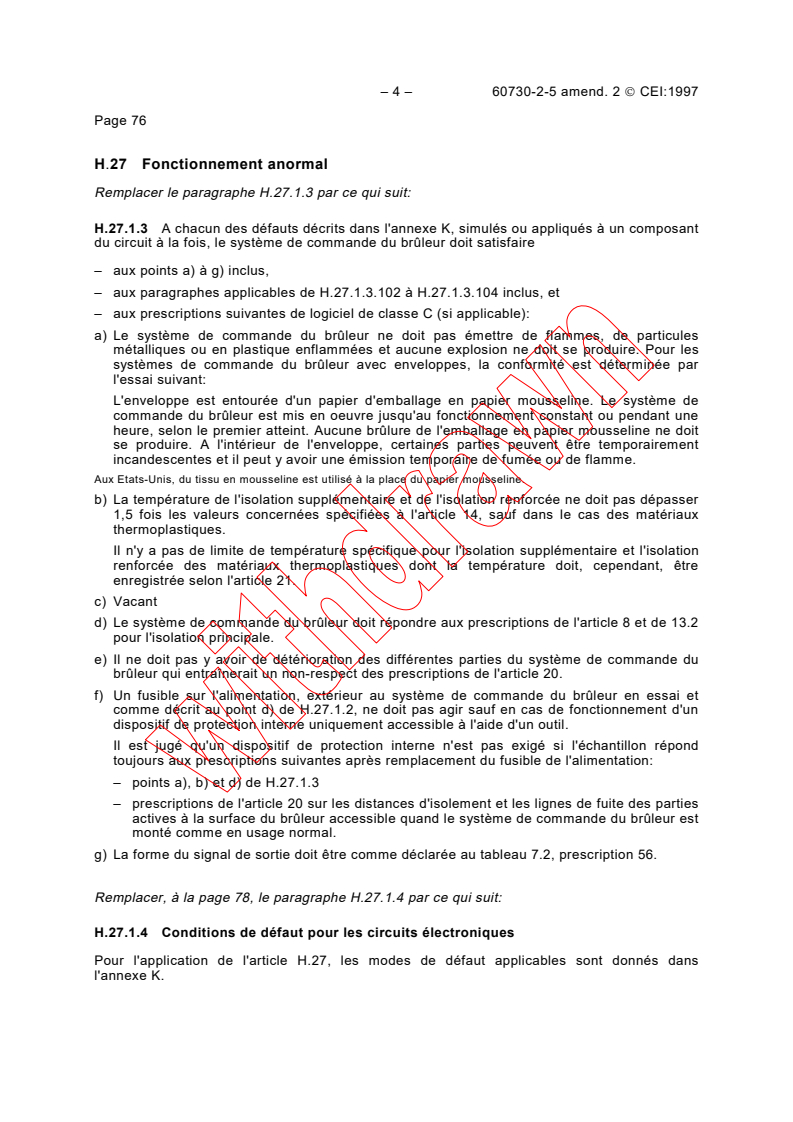
– 4 – 60730-2-5 amend. 2 CEI:1997
Page 76
H.27 Fonctionnement anormal
Remplacer le paragraphe H.27.1.3 par ce qui suit:
H.27.1.3 A chacun des défauts décrits dans l'annexe K, simulés ou appliqués à un composant
du circuit à la fois, le système de commande du brûleur doit satisfaire
– aux points a) à g) inclus,
– aux paragraphes applicables de H.27.1.3.102 à H.27.1.3.104 inclus, et
– aux prescriptions suivantes de logiciel de classe C (si applicable):
a) Le système de commande du brûleur ne doit pas émettre de flammes, de particules
métalliques ou en plastique enflammées et aucune explosion ne doit se produire. Pour les
systèmes de commande du brûleur avec enveloppes, la conformité est déterminée par
l'essai suivant:
L'enveloppe est entourée d'un papier d'emballage en papier mousseline. Le système de
commande du brûleur est mis en oeuvre jusqu'au fonctionnement constant ou pendant une
heure, selon le premier atteint. Aucune brûlure de l'emballage en papier mousseline ne doit
se produire. A l'intérieur de l'enveloppe, certaines parties peuvent être temporairement
incandescentes et il peut y avoir une émission temporaire de fumée ou de flamme.
Aux Etats-Unis, du tissu en mousseline est utilisé à la place du papier mousseline.
b) La température de l'isolation supplémentaire et de l'isolation renforcée ne doit pas dépasser
1,5 fois les valeurs concernées spécifiées à l'article 14, sauf dans le cas des matériaux
thermoplastiques.
Il n'y a pas de limite de température spécifique pour l'isolation supplémentaire et l'isolation
renforcée des matériaux thermoplastiques dont la température doit, cependant, être
enregistrée selon l'article 21.
c) Vacant
d) Le système de commande du brûleur doit répondre aux prescriptions de l'article 8 et de 13.2
pour l'isolation principale.
e) Il ne doit pas y avoir de détérioration des différentes parties du système de commande du
brûleur qui entraînerait un non-respect des prescriptions de l'article 20.
f) Un fusible sur l'alimentation, extérieur au système de commande du brûleur en essai et
comme décrit au point d) de H.27.1.2, ne doit pas agir sauf en cas de fonctionnement d'un
dispositif de protection interne uniquement accessible à l'aide d'un outil.
Il est jugé qu'un dispositif de protection interne n'est pas exigé si l'échantillon répond
toujours aux prescriptions suivantes après remplacement du fusible de l'alimentation:
– points a), b) et d) de H.27.1.3
– prescriptions de l'article 20 sur les distances d'isolement et les lignes de fuite des parties
actives à la surface du brûleur accessible quand le système de commande du brûleur est
monté comme en usage normal.
g) La forme du signal de sortie doit être comme déclarée au tableau 7.2, prescription 56.
Remplacer, à la page 78, le paragraphe H.27.1.4 par ce qui suit:
H.27.1.4 Conditions de défaut pour les circuits électroniques
Pour l'application de l'article H.27, les modes de défaut applicables sont donnés dans
l'annexe K.
60730-2-5 Amend. 2 © IEC:1997 – 5 –
Page 77
H.27 Abnormal operation
Replace subclause H.27.1.3 by the following:
H.27.1.3 With each fault described in annex K, simulated or applied to one circuit component
at a time, the burner control system shall comply with
– items a) to g) inclusive,
– the applicable subclauses of H.27.1.3.102 to H.27.1.3.104, inclusive, and
– the following requirements of software class C (if applicable):
a) The burner control system shall not emit flames, hot metal or hot plastics, and no explosion
shall result. For burner control systems with enclosures, compliance is determined by the
following test;
The enclosure is wrapped in tissue wrapping paper. The burner control system is operated
to steady state or for one hour, whichever occurs first. There shall be no burning of the
wrapped tissue paper. Inside the enclosure some parts may temporarily glow, and there may
be a temporary emission of smoke or flame.
In the USA, cheesecloth is used instead of tissue wrapping paper.
b) The temperature for supplementary insulation and reinforced insulation shall not exceed 1,5
times the relevant values specified in clause 14, except in the case of thermoplastic
material.
There is no specific temperature limit for supplementary insulation and reinforced insulation
of thermoplastic material, the temperature of which shall, however, be recorded for the
purpose of clause 21.
c) Void
d) The burner control system shall comply with the requirements of clause 8 and of 13.2 for
basic insulation.
e) There shall be no deterioration of the various parts of the burner control system that would
result in non-compliance with the requirements of clause 20.
f) A fuse in the supply, external to the burner control system under test and as described in
item d) of H.27.1.2, shall not rupture unless an internal protective device also operates that
is accessible only after the use of a tool.
An internal protective device is deemed not to be required if the sample still complies with
the following requirements after replacement of the fuse of the supply:
– items a), b) and d) of H.27.1.3
– the requirements of clause 20 for the clearances and creepage distances from active
parts to the surfaces of the burner control system that are accessible when the burner
control system is mounted as for its intended use.
g) The output waveform shall be as declared in table 7.2, requirement 56.
Replace, on page 79, subclause H.27.1.4 by the following:
H.27.1.4 Electronic circuit fault conditions
For the purpose of clause H.27, the applicable failure modes are given in annex K.
– 6 – 60730-2-5 amend. 2 CEI:1997
Page 80
Ajouter, après l'annexe J, la nouvelle annexe K suivante:
Annexe K
(normative)
Modes de défaut des composants électriques/électroniques
1)
Type de composant Court-circuit Ouverture Remarques
Résistances fixes:
Couche mince (filament enroulé) X Inclut le type SMD
Couche épaisse (plate) X Inclut le type SMD
Enroulement (simple couche) X
Tout autre type X X
Résistances variables:
(par exemple potentiomètre/trimmer)
Enroulement (simple couche) X
2)
Tout autre type X X
Condensateurs:
Types X1 et Y selon la CEI 60384-14 X
Couche métallisée selon la CEI 60384-16 X
Tout autre type X X
Diodes:
Tous les types XX
Transistors:
3)
2)
Tous types (par exemple bipolaire; LF; RF; X X
micro-onde; FET; thyristor; diac; triac;
uni-jonction)
4) 4)
Circuits hybrides
Circuits intégrés:
5) 3)
X X Pour les CI, la note est
Tous les types non couverts par H.11.12
applicable
Optocoupleurs
6)
Selon la CEI 60335-1 X X
Relais:
Enroulements X
7) 8)
Contacts X X
7) 8)
Relais à lames souples X X Contacts seulement
X
Inducteurs bobinés
XX
Tout autre inducteur
Transformateurs:
X
Selon la CEI 60742
2)
X X
Tout autre type
9)
XX
Cristaux
10)
Interrupteurs XX
11)
Connexions (fil de liaison) X
Câbles et câblage X
13) 12)
Conducteurs de circuits imprimés X X
(Notes, voir page 8)
60730-2-5 Amend. 2 © IEC:1997 – 7 –
Page 81
Add, after annex J, the new annex K as follows:
Annex K
(normative)
Failure modes of electrical/electronic components
1)
Component type Short Open Remarks
Fixed resistors:
Thin film (wound filament) X Includes SMD type
Thick film (flat) X Includes SMD type
Wire-wound (single layer) X
All other types X X
Variable resistors:
(e.g. potentiometer/trimmer)
Wire-wound (single layer) X
2)
All other types X X
Capacitors:
X1 and Y types according to IEC 60384-14 X
Metallized film according to IEC 60384-16 X
All other types X X
Diodes:
All types XX
Transistors:
2) 3)
X X
All types (e.g. bipolar; LF; RF; microwave;
FET; thyristor; diac; triac; uni junction)
4) 4)
Hybrid circuits
Integrated circuits:
5) 3)
X X For IC outputs note applies
All types not covered by H.11.12
Opto-couplers:
6)
X X
According to IEC 60335-1
Relays:
X
Coils
7) 8)
X X
Contacts
7) 8)
Reed-relays X X Contacts only
Wire-wound inductors X
All other inductors XX
Transformers:
According to IEC 60742 X
2)
All other types X X
9)
Crystals XX
10)
Switches XX
11)
Connections (jumper wire) X
Cable and wiring X
13) 12)
Printed circuit board conductors X X
(Notes, see page 9)
– 8 – 60730-2-5 amend. 2 CEI:1997
NOTES
1)
Ouverture seulement d'une broche à la fois.
2)
Court-circuit d'une broche tour à tour avec chacune des autres broches; seulement deux broches à la fois.
3)
L'effet de tout type d'alternance complète de composant, tel qu'une triac allant dans une condition de demi-
alternance, commandée ou non commandée (thyristor ou diode, respectivement) doit être considéré.
4)
Les modes de défaut des composants individuels du circuit hybride sont applicables comme décrit pour les
composants individuels de ce ta
...
Questions, Comments and Discussion
Ask us and Technical Secretary will try to provide an answer. You can facilitate discussion about the standard in here.
Loading comments...