

IEC 60730-2-15:2026
(Main)Automatic electrical controls - Part 2-15: Particular requirements for automatic electrical air flow, water flow and water level sensing controls
General Information
- Abstract
IEC 60730-2-15:2026 applies to automatic electrical air flow, water flow and water level sensing controls
- for use in, on, or in association with boilers with a maximum pressure rating of 2 000 kPA (20 bar) and equipment for general household and similar use including controls for heating, air-conditioning and similar applications;
NOTE 1 Throughout this document, the word "equipment" means "appliance and equipment" and "controls" means "automatic electrical air flow, water flow and water level sensing controls".
EXAMPLE 1 Water flow and water level sensing controls of the float or electrode-sensor type used in boiler applications and air flow, water flow and water level sensing controls for swimming pool pumps, water tank pumps, cooling towers, dishwashers, washing machines, air conditioning chillers and ventilation applications.
- for building automation within the scope of ISO 16484 series and IEC 63044 series (HBES/BACS);
EXAMPLE 2 Independently mounted air flow, water flow and water level sensing controls in smart grid systems and controls for building automation systems within the scope of ISO 16484-2.
- for equipment that is used by the public, such as equipment intended to be used in shops, offices, hospitals, farms and commercial and industrial applications;
EXAMPLE 3 Controls for commercial boilers, heating and air-conditioning equipment.
- that are smart enabled controls;
EXAMPLE 4 Smart grid control, remote interfaces/control of energy-consuming equipment including computer or smart phone.
- that are AC or DC powered controls with a rated voltage not exceeding 690 V AC or 600 V DC;
- used in, on, or in association with equipment that use electricity, gas, oil, solid fuel, solar thermal energy, etc., or a combination thereof;
- utilized as part of a control system or controls which are mechanically integral with multifunctional controls having non-electrical outputs;
- using NTC or PTC thermistors and to discrete thermistors, requirements for which are contained in Annex J;
- that are mechanically or electrically operated, responsive to or controlling air flow, water flow and water level;
- as well as manual controls when such are electrically and/or mechanically integral with automatic controls.
NOTE 2 Requirements for manually actuated mechanical switches not forming part of an automatic control are contained in IEC 61058-1-1.
This document applies to
- the inherent safety of automatic electrical air flow, water flow and water level sensing controls, and
- functional safety of automatic air flow, water flow and water level sensing electrical controls and safety related systems,
- controls where the performance (for example the effect of EMC phenomena) of the product can impair the overall safety and performance of the controlled system,
- the operating values, operating times, and operating sequences where such are associated with equipment safety.
This document specifies the requirements for construction, operation and testing of automatic electrical air flow, water flow and water level sensing controls used in, on, or in association with an equipment.
This document takes into account the response value of an automatic action of a control where such a response value is dependent upon the method of mounting the control. Where a response value is of significant purpose for the protection of the user, or surroundings, the value defined in the appropriate household equipment standard or as determined by the manufacturer applies.
This document does not
- apply to air flow, water flow and water level sensing controls intended exclusively for industrial process applications unless explicitly mentioned in the relevant part 2 or the equipment standard. However, this document can be applied to evaluate air flow, water flow and water level sensing controls intended specifically for industrial applications in cases where no relevant safety standard exists;
- address the integrity of the output sign
- Status
- Published
- Publication Date
- 09-Apr-2026
- Technical Committee
- TC 72 - Automatic electrical controls
- Drafting Committee
- WG 6 - TC 72/WG 6
- Current Stage
- PPUB - Publication issued
- Start Date
- 10-Apr-2026
- Completion Date
- 27-Mar-2026
Buy Documents
IEC 60730-2-15:2026 EXV - Automatic electrical controls - Part 2-15: Particular requirements for automatic electrical air flow, water flow and water level sensing controls
iec60730-2-15{ed4.0}en - Automatic electrical controls - Part 2-15: Particular requirements for automatic electrical air flow, water flow and water level sensing controls
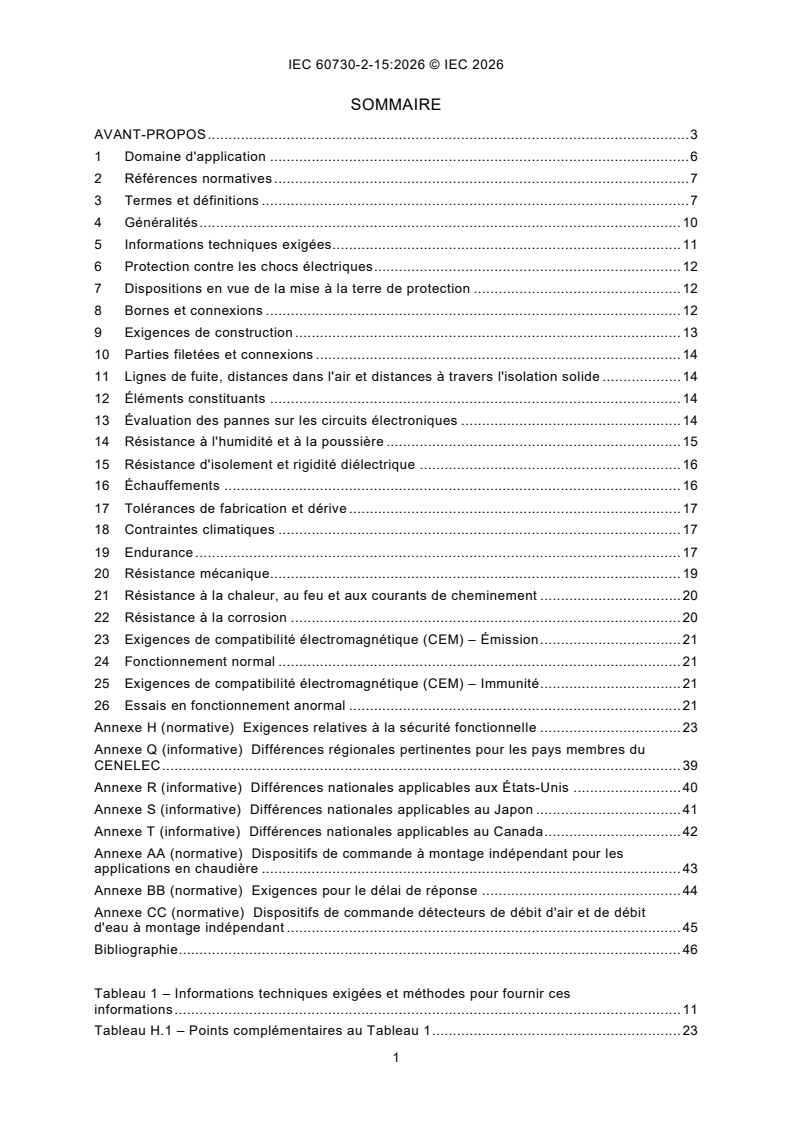
iec60730-2-15{ed4.0}fr - Dispositifs de commande électrique automatiques - Partie 2-15: Exigences particulieres pour les dispositifs de commande électrique automatiques détecteurs de débit d'air, de débit d'eau et de niveau d'eau
Overview
IEC 60730-2-15:2026 is an international standard developed by the International Electrotechnical Commission (IEC) for automatic electrical air flow, water flow, and water level sensing controls. This standard provides essential requirements for the design, construction, and testing of such controls used in various applications, including household appliances, boilers, building automation, and commercial equipment. The goal is to ensure both the inherent safety and functional safety of automatic electrical controls that sense or regulate air and water flows or water levels.
Key Topics
Scope and Application
IEC 60730-2-15:2026 applies to automatic controls for:- Boilers with a maximum pressure of 2,000 kPa (20 bar)
- Household appliances such as dishwashers, washing machines, and air conditioning equipment
- Building automation and smart-enabled systems within ISO 16484 and IEC 63044 series
- Equipment used in public buildings, offices, hospitals, farms, and commercial facilities
Types of Controls Covered
- Air flow sensors
- Water flow sensors
- Water level sensors, including float and electrode-based designs
- Mechanically or electrically operated controls
- Controls integrated with manual elements if electrically/mechanically combined
- Controls using NTC or PTC thermistors (requirements in Annex J)
Safety and Performance Requirements
- Protection against electric shock
- Mechanical and electrical endurance
- Resistance to environmental factors (humidity, dust)
- Functional safety, including response times and action sequences related to equipment safety
- Constructional robustness, including secure cable attachment and the reliability of components
Exclusions
- Not intended for controls used exclusively in industrial process applications (unless no relevant standard exists)
- Not applicable to pressure-sensitive controls (addressed by IEC 60730-2-6)
- Not addressing output signal integrity to networked devices unless specifically evaluated
Applications
Implementing IEC 60730-2-15:2026 ensures consistent performance and safety for automatic electrical sensing controls across various sectors:
Residential and Commercial Appliances
- Ensures reliable and safe operation of washing machines, dishwashers, and air-conditioning chillers
- Protects users and property by ensuring accurate water level detection in boilers and tanks
Building Automation
- Supports integration within Building Automation and Control Systems (BACS) and Home and Building Electronic Systems (HBES)
- Facilitates smart grid integration and remote operation, including smartphone and computer interfaces
Public and Institutional Facilities
- Provides safety and functionality for controls in offices, hospitals, retail stores, and commercial kitchens
- Addresses the unique needs of applications such as farm irrigation systems, cooling towers, and water pumps
Smart and Connected Systems
- Enables remote management and monitoring of HVAC and water systems
- Enhances the reliability of controls in energy management and networked building systems
Related Standards
IEC 60730-1: General requirements for automatic electrical controls for household and similar use
- IEC 60730-2-15 is intended to be used alongside the latest edition of IEC 60730-1.
IEC 60529: Degrees of protection provided by enclosures (IP Code)
- Reference for protection against immersion (IPX8) for controls that may be submerged.
ISO 16484 series: Building automation and control systems
- Relevant for building automation applications in line with IEC 60730-2-15.
IEC 63044 series: Home and building electronic systems (HBES) and building automation and control systems (BACS)
IEC 61058-1-1: Switches for appliances, particularly for requirements on mechanically actuated manual switches
IEC 60730-2-6: Particular requirements for pressure sensing controls (for pressure-based applications, not covered by -2-15)
Practical Value
By adhering to IEC 60730-2-15:2026, manufacturers and system integrators can demonstrate compliance with global safety and performance requirements. This helps streamline access to international markets, reduces the risk of system failures, and increases user confidence in the reliability and safety of automatic electrical air flow, water flow, and water level sensing controls across diverse environments.
Relations
- Effective Date
- 10-May-2024
Buy Documents
IEC 60730-2-15:2026 EXV - Automatic electrical controls - Part 2-15: Particular requirements for automatic electrical air flow, water flow and water level sensing controls
iec60730-2-15{ed4.0}en - Automatic electrical controls - Part 2-15: Particular requirements for automatic electrical air flow, water flow and water level sensing controls
iec60730-2-15{ed4.0}fr - Dispositifs de commande électrique automatiques - Partie 2-15: Exigences particulieres pour les dispositifs de commande électrique automatiques détecteurs de débit d'air, de débit d'eau et de niveau d'eau
Frequently Asked Questions
IEC 60730-2-15:2026 is a standard published by the International Electrotechnical Commission (IEC). Its full title is "Automatic electrical controls - Part 2-15: Particular requirements for automatic electrical air flow, water flow and water level sensing controls". This standard covers: IEC 60730-2-15:2026 applies to automatic electrical air flow, water flow and water level sensing controls - for use in, on, or in association with boilers with a maximum pressure rating of 2 000 kPA (20 bar) and equipment for general household and similar use including controls for heating, air-conditioning and similar applications; NOTE 1 Throughout this document, the word "equipment" means "appliance and equipment" and "controls" means "automatic electrical air flow, water flow and water level sensing controls". EXAMPLE 1 Water flow and water level sensing controls of the float or electrode-sensor type used in boiler applications and air flow, water flow and water level sensing controls for swimming pool pumps, water tank pumps, cooling towers, dishwashers, washing machines, air conditioning chillers and ventilation applications. - for building automation within the scope of ISO 16484 series and IEC 63044 series (HBES/BACS); EXAMPLE 2 Independently mounted air flow, water flow and water level sensing controls in smart grid systems and controls for building automation systems within the scope of ISO 16484-2. - for equipment that is used by the public, such as equipment intended to be used in shops, offices, hospitals, farms and commercial and industrial applications; EXAMPLE 3 Controls for commercial boilers, heating and air-conditioning equipment. - that are smart enabled controls; EXAMPLE 4 Smart grid control, remote interfaces/control of energy-consuming equipment including computer or smart phone. - that are AC or DC powered controls with a rated voltage not exceeding 690 V AC or 600 V DC; - used in, on, or in association with equipment that use electricity, gas, oil, solid fuel, solar thermal energy, etc., or a combination thereof; - utilized as part of a control system or controls which are mechanically integral with multifunctional controls having non-electrical outputs; - using NTC or PTC thermistors and to discrete thermistors, requirements for which are contained in Annex J; - that are mechanically or electrically operated, responsive to or controlling air flow, water flow and water level; - as well as manual controls when such are electrically and/or mechanically integral with automatic controls. NOTE 2 Requirements for manually actuated mechanical switches not forming part of an automatic control are contained in IEC 61058-1-1. This document applies to - the inherent safety of automatic electrical air flow, water flow and water level sensing controls, and - functional safety of automatic air flow, water flow and water level sensing electrical controls and safety related systems, - controls where the performance (for example the effect of EMC phenomena) of the product can impair the overall safety and performance of the controlled system, - the operating values, operating times, and operating sequences where such are associated with equipment safety. This document specifies the requirements for construction, operation and testing of automatic electrical air flow, water flow and water level sensing controls used in, on, or in association with an equipment. This document takes into account the response value of an automatic action of a control where such a response value is dependent upon the method of mounting the control. Where a response value is of significant purpose for the protection of the user, or surroundings, the value defined in the appropriate household equipment standard or as determined by the manufacturer applies. This document does not - apply to air flow, water flow and water level sensing controls intended exclusively for industrial process applications unless explicitly mentioned in the relevant part 2 or the equipment standard. However, this document can be applied to evaluate air flow, water flow and water level sensing controls intended specifically for industrial applications in cases where no relevant safety standard exists; - address the integrity of the output sign
IEC 60730-2-15:2026 applies to automatic electrical air flow, water flow and water level sensing controls - for use in, on, or in association with boilers with a maximum pressure rating of 2 000 kPA (20 bar) and equipment for general household and similar use including controls for heating, air-conditioning and similar applications; NOTE 1 Throughout this document, the word "equipment" means "appliance and equipment" and "controls" means "automatic electrical air flow, water flow and water level sensing controls". EXAMPLE 1 Water flow and water level sensing controls of the float or electrode-sensor type used in boiler applications and air flow, water flow and water level sensing controls for swimming pool pumps, water tank pumps, cooling towers, dishwashers, washing machines, air conditioning chillers and ventilation applications. - for building automation within the scope of ISO 16484 series and IEC 63044 series (HBES/BACS); EXAMPLE 2 Independently mounted air flow, water flow and water level sensing controls in smart grid systems and controls for building automation systems within the scope of ISO 16484-2. - for equipment that is used by the public, such as equipment intended to be used in shops, offices, hospitals, farms and commercial and industrial applications; EXAMPLE 3 Controls for commercial boilers, heating and air-conditioning equipment. - that are smart enabled controls; EXAMPLE 4 Smart grid control, remote interfaces/control of energy-consuming equipment including computer or smart phone. - that are AC or DC powered controls with a rated voltage not exceeding 690 V AC or 600 V DC; - used in, on, or in association with equipment that use electricity, gas, oil, solid fuel, solar thermal energy, etc., or a combination thereof; - utilized as part of a control system or controls which are mechanically integral with multifunctional controls having non-electrical outputs; - using NTC or PTC thermistors and to discrete thermistors, requirements for which are contained in Annex J; - that are mechanically or electrically operated, responsive to or controlling air flow, water flow and water level; - as well as manual controls when such are electrically and/or mechanically integral with automatic controls. NOTE 2 Requirements for manually actuated mechanical switches not forming part of an automatic control are contained in IEC 61058-1-1. This document applies to - the inherent safety of automatic electrical air flow, water flow and water level sensing controls, and - functional safety of automatic air flow, water flow and water level sensing electrical controls and safety related systems, - controls where the performance (for example the effect of EMC phenomena) of the product can impair the overall safety and performance of the controlled system, - the operating values, operating times, and operating sequences where such are associated with equipment safety. This document specifies the requirements for construction, operation and testing of automatic electrical air flow, water flow and water level sensing controls used in, on, or in association with an equipment. This document takes into account the response value of an automatic action of a control where such a response value is dependent upon the method of mounting the control. Where a response value is of significant purpose for the protection of the user, or surroundings, the value defined in the appropriate household equipment standard or as determined by the manufacturer applies. This document does not - apply to air flow, water flow and water level sensing controls intended exclusively for industrial process applications unless explicitly mentioned in the relevant part 2 or the equipment standard. However, this document can be applied to evaluate air flow, water flow and water level sensing controls intended specifically for industrial applications in cases where no relevant safety standard exists; - address the integrity of the output sign
IEC 60730-2-15:2026 is classified under the following ICS (International Classification for Standards) categories: 97.120 - Automatic controls for household use. The ICS classification helps identify the subject area and facilitates finding related standards.
IEC 60730-2-15:2026 has the following relationships with other standards: It is inter standard links to IEC 60730-2-15:2017. Understanding these relationships helps ensure you are using the most current and applicable version of the standard.
IEC 60730-2-15:2026 is available in PDF format for immediate download after purchase. The document can be added to your cart and obtained through the secure checkout process. Digital delivery ensures instant access to the complete standard document.
Standards Content (Sample)
IEC 60730-2-15 ®
Edition 4.0 2026-04
INTERNATIONAL
STANDARD
EXTENDED VERSION
This full version of IEC 60730-2-15:2026 includes the content of the references made
to IEC 60730-1:2022
Automatic electrical controls -
Part 2-15: Particular requirements for automatic electrical air flow, water flow
and water level sensing controls
ICS 97.120 ISBN 978-2-8327-1204-7
All rights reserved. Unless otherwise specified, no part of this publication may be reproduced or utilized in any form or
by any means, electronic or mechanical, including photocopying and microfilm, without permission in writing from either
IEC or IEC's member National Committee in the country of the requester. If you have any questions about IEC copyright
or have an enquiry about obtaining additional rights to this publication, please contact the address below or your local
IEC member National Committee for further information.
IEC Secretariat Tel.: +41 22 919 02 11
3, rue de Varembé info@iec.ch
CH-1211 Geneva 20 www.iec.ch
Switzerland
About the IEC
The International Electrotechnical Commission (IEC) is the leading global organization that prepares and publishes
International Standards for all electrical, electronic and related technologies.
About IEC publications
The technical content of IEC publications is kept under constant review by the IEC. Please make sure that you have the
latest edition, a corrigendum or an amendment might have been published.
IEC publications search - IEC Products & Services Portal - products.iec.ch
webstore.iec.ch/advsearchform Discover our powerful search engine and read freely all the
The advanced search enables to find IEC publications by a publications previews, graphical symbols and the glossary.
variety of criteria (reference number, text, technical With a subscription you will always have access to up to date
committee, …). It also gives information on projects, content tailored to your needs.
replaced and withdrawn publications.
Electropedia - www.electropedia.org
The world's leading online dictionary on electrotechnology,
IEC Just Published - webstore.iec.ch/justpublished
Stay up to date on all new IEC publications. Just Published containing more than 22 500 terminological entries in English
details all new publications released. Available online and and French, with equivalent terms in 25 additional languages.
once a month by email. Also known as the International Electrotechnical Vocabulary
(IEV) online.
IEC Customer Service Centre - webstore.iec.ch/csc
If you wish to give us your feedback on this publication or
need further assistance, please contact the Customer
Service Centre: sales@iec.ch.
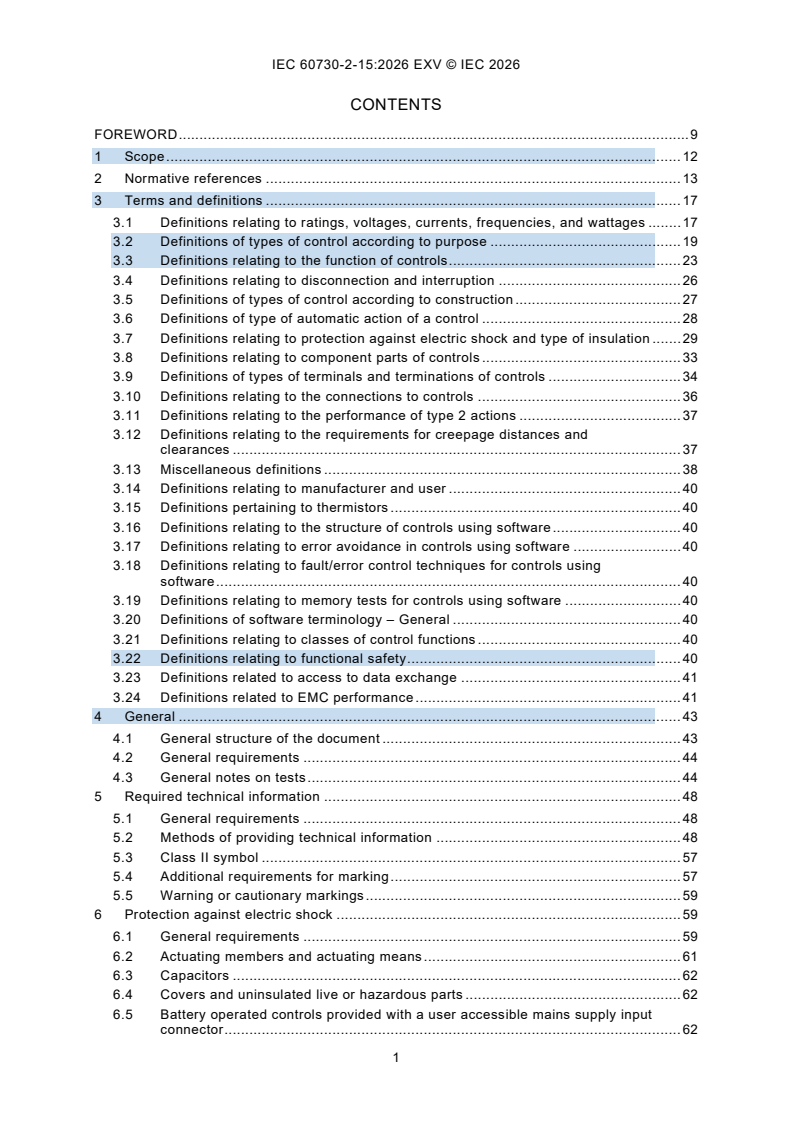
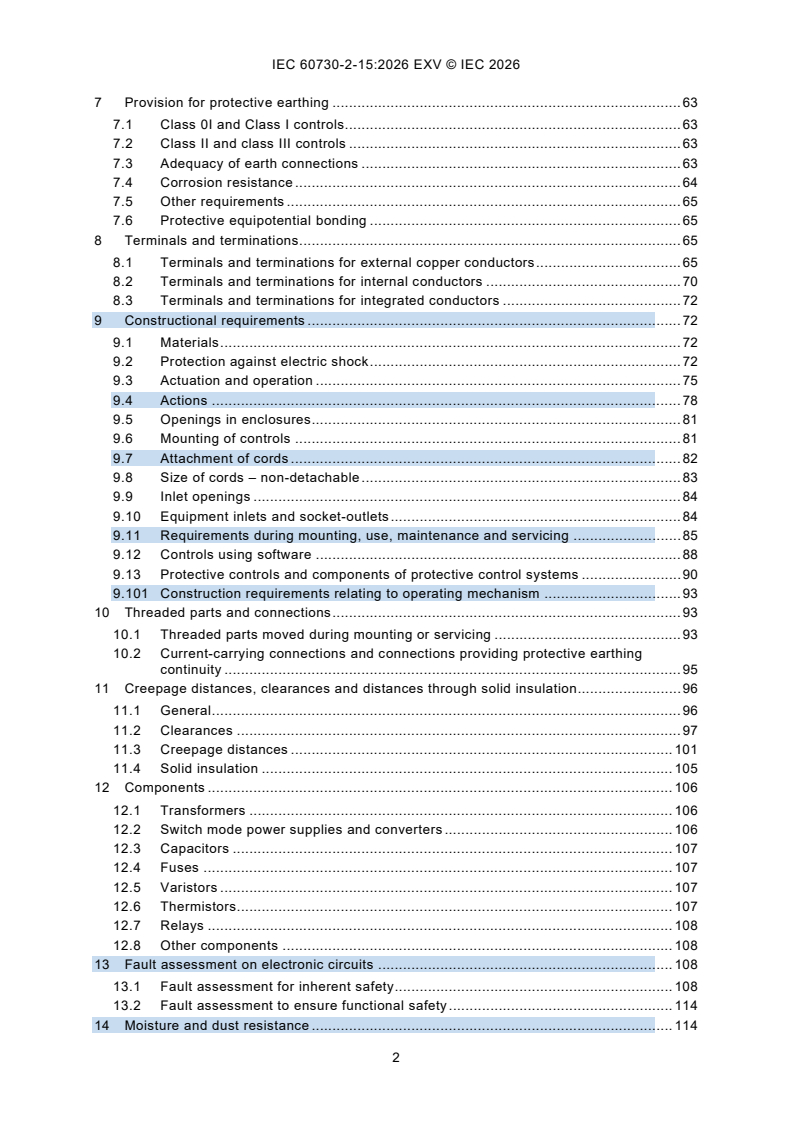
CONTENTS
FOREWORD . 9
1 Scope . 12
2 Normative references . 13
3 Terms and definitions . 17
3.1 Definitions relating to ratings, voltages, currents, frequencies, and wattages . 17
3.2 Definitions of types of control according to purpose . 19
3.3 Definitions relating to the function of controls . 23
3.4 Definitions relating to disconnection and interruption . 26
3.5 Definitions of types of control according to construction . 27
3.6 Definitions of type of automatic action of a control . 28
3.7 Definitions relating to protection against electric shock and type of insulation . 29
3.8 Definitions relating to component parts of controls . 33
3.9 Definitions of types of terminals and terminations of controls . 34
3.10 Definitions relating to the connections to controls . 36
3.11 Definitions relating to the performance of type 2 actions . 37
3.12 Definitions relating to the requirements for creepage distances and
clearances . 37
3.13 Miscellaneous definitions . 38
3.14 Definitions relating to manufacturer and user . 40
3.15 Definitions pertaining to thermistors . 40
3.16 Definitions relating to the structure of controls using software . 40
3.17 Definitions relating to error avoidance in controls using software . 40
3.18 Definitions relating to fault/error control techniques for controls using
software . 40
3.19 Definitions relating to memory tests for controls using software . 40
3.20 Definitions of software terminology – General . 40
3.21 Definitions relating to classes of control functions . 40
3.22 Definitions relating to functional safety . 40
3.23 Definitions related to access to data exchange . 41
3.24 Definitions related to EMC performance . 41
4 General . 43
4.1 General structure of the document . 43
4.2 General requirements . 44
4.3 General notes on tests . 44
5 Required technical information . 48
5.1 General requirements . 48
5.2 Methods of providing technical information . 48
5.3 Class II symbol . 57
5.4 Additional requirements for marking . 57
5.5 Warning or cautionary markings . 59
6 Protection against electric shock . 59
6.1 General requirements . 59
6.2 Actuating members and actuating means . 61
6.3 Capacitors . 62
6.4 Covers and uninsulated live or hazardous parts . 62
6.5 Battery operated controls provided with a user accessible mains supply input
connector . 62
7 Provision for protective earthing . 63
7.1 Class 0I and Class I controls. 63
7.2 Class II and class III controls . 63
7.3 Adequacy of earth connections . 63
7.4 Corrosion resistance . 64
7.5 Other requirements . 65
7.6 Protective equipotential bonding . 65
8 Terminals and terminations. 65
8.1 Terminals and terminations for external copper conductors . 65
8.2 Terminals and terminations for internal conductors . 70
8.3 Terminals and terminations for integrated conductors . 72
9 Constructional requirements . 72
9.1 Materials . 72
9.2 Protection against electric shock . 72
9.3 Actuation and operation . 75
9.4 Actions . 78
9.5 Openings in enclosures . 81
9.6 Mounting of controls . 81
9.7 Attachment of cords . 82
9.8 Size of cords – non-detachable . 83
9.9 Inlet openings . 84
9.10 Equipment inlets and socket-outlets . 84
9.11 Requirements during mounting, use, maintenance and servicing . 85
9.12 Controls using software . 88
9.13 Protective controls and components of protective control systems . 90
9.101 Construction requirements relating to operating mechanism . 93
10 Threaded parts and connections . 93
10.1 Threaded parts moved during mounting or servicing . 93
10.2 Current-carrying connections and connections providing protective earthing
continuity . 95
11 Creepage distances, clearances and distances through solid insulation . 96
11.1 General . 96
11.2 Clearances . 97
11.3 Creepage distances . 101
11.4 Solid insulation . 105
12 Components . 106
12.1 Transformers . 106
12.2 Switch mode power supplies and converters . 106
12.3 Capacitors . 107
12.4 Fuses . 107
12.5 Varistors . 107
12.6 Thermistors. 107
12.7 Relays . 108
12.8 Other components . 108
13 Fault assessment on electronic circuits . 108
13.1 Fault assessment for inherent safety . 108
13.2 Fault assessment to ensure functional safety . 114
14 Moisture and dust resistance . 114
14.1 Protection against ingress of water and dust . 114
14.2 Protection against humid conditions . 116
14.3 Touch current test for in-line cord controls and free-standing controls . 116
15 Electric strength and insulation resistance . 117
15.1 Insulation resistance . 117
15.2 Electric strength . 118
15.3 Additional tests for in-line cord and free-standing controls . 120
15.101 Electric strength of probes . 121
16 Heating . 121
17 Manufacturing deviation and drift . 125
18 Environmental stress . 125
18.1 Transportation and storage . 125
18.2 Environmental stress of temperature . 125
19 Endurance . 126
19.1 General requirements . 126
19.2 Electrical conditions for the tests . 127
19.3 Thermal conditions for the tests . 133
19.4 Manual and mechanical conditions for the tests . 133
19.5 Dielectric strength requirements. 134
19.6 Ageing test . 134
19.7 Overvoltage test or overload test in all countries using an overload test of
automatic action at accelerated rate . 134
19.8 Test of automatic action at accelerated rate . 135
19.9 Test of automatic action at slow rate . 135
19.10 Overvoltage test or overload test in all countries that use the overload test of
manual action at accelerated speed . 136
19.11 Test of manual action at slow speed . 136
19.12 Test of manual action at high speed which has multiple poles, and where
polarity reversal occurs during the action . 136
19.13 Test of manual action at accelerated speed . 136
19.14 Evaluation of compliance . 137
19.15 Test for particular purpose controls . 137
20 Mechanical strength . 138
20.1 General requirements . 138
20.2 Impact resistance . 139
20.3 Free-standing controls . 140
20.4 In-line cord controls . 140
20.5 Pull-cord actuated controls . 141
20.6 Foot actuated controls . 141
20.7 Actuating member and actuating means . 141
20.8 Flexing – test . 142
20.9 Cord anchorages – test . 142
20.101 Boiler pressure test . 143
20.102 Strength of parts (hydrostatic) . 144
21 Resistance to heat, fire and tracking . 144
21.1 General requirements . 144
21.2 Integrated, incorporated and in-line cord controls. 145
21.3 Independently mounted, free-standing controls . 146
22 Resistance to corrosion . 146
22.1 Resistance to rusting . 146
23 Electromagnetic compatibility (EMC) requirements – Emission . 147
23.1 General requirement . 147
23.2 High frequency emission . 147
23.3 Low frequency emission . 151
24 Normal operation . 151
25 Electromagnetic compatibility (EMC) requirements – Immunity . 151
25.1 General . 151
25.2 EMC test plan and report . 152
25.3 Immunity requirements . 154
25.4 Performance criteria . 157
25.5 Surge immunity test . 158
25.6 Electrical fast transient immunity test . 158
25.7 Radio-frequency electromagnetic field immunity . 159
25.8 Electrostatic discharge . 159
25.9 Immunity to power-frequency magnetic fields . 159
25.10 Test of the influence of voltage dips and voltage interruption in the power
supply network . 159
26 Abnormal operation tests . 160
26.1 Abnormal temperature test . 160
26.2 Overload tests . 161
26.3 Battery short-circuit test . 162
Annex A (normative) Indelibility of markings . 179
Annex B (normative) Measurement of creepage distances and clearances in air . 181
Annex C (informative) Nominal voltages of supply systems for different modes of
overvoltage control . 185
Annex D (normative) Overvoltage categories . 187
Annex E (informative) Typical usage of controls and related overvoltage categories . 188
Annex F (normative) Pollution degrees . 189
F.1 Pollution . 189
F.2 Degrees of pollution in the micro-environment . 189
Annex G (normative) Resistance to heat, fire and tracking tests . 190
G.1 Glow-wire test . 190
G.2 Proof tracking test . 190
G.3 Ball pressure test . 190
Annex H (normative) Requirements related to functional safety . 192
H.3 Terms and definitions. 192
H.5 Information . 203
H.9 Constructional requirements . 205
H.13 Fault assessment on electronic circuits . 221
H.17 Manufacturing deviation and drift . 226
H.19 Endurance . 228
H.25 Electromagnetic compatibility (EMC) requirements – Immunity. 228
Annex I (normative) Requirements for certain types of DC supplied controls . 249
I.1 Scope . 249
Annex J (normative) Requirements for thermistor elements and controls using
thermistors. 251
J.1 Scope . 251
Annex K (normative) Circuit for measuring touch current . 268
Annex L (normative) Printed circuit board coating performance test . 269
Annex M (normative) Printed circuit board protection . 271
Annex N (informative) Explanatory notes for surge immunity test . 274
N.1 Different source impedances . 274
N.2 Application of the tests. 274
N.3 Installation classification . 275
Annex O (informative) Guidance for applying Clause 11 . 278
Annex P (normative) Requirements for SELV and PELV . 281
P.1 Overview of the requirements for SELV and PELV . 281
P.2 Protection against electric shock by SELV system or PELV system . 281
P.3 Protective measures for SELV system and PELV system . 282
Annex Q (informative) Regional differences relevant for the member countries of
Cenelec . 284
Annex R (informative) National differences relevant in the United States of America . 289
R.2 Normative references . 289
Annex S (informative) National differences relevant in Japan . 290
S.2 Normative references . 290
Annex T (informative) National differences relevant in Canada . 291
T.2 Normative references . 291
Annex AA (normative) Independently mounted controls for boiler applications . 292
Annex BB (normative) Requirements for response delay . 293
Annex CC (normative) Independently mounted air flow and water flow sensing controls . 294
Bibliography . 295
Figure 1 – Example of ports . 41
Figure 2 – Structure of the document with respect to inherent safety and functional
safety . 44
Figure 3 – Example of an electronic circuit with low power points . 109
Figure 4 – Test pin probe 13 of IEC 61032:1997 . 162
Figure 5 – Test finger probe B of IEC 61032:1997 . 163
Figure 6 – Test fingernail . 164
Figure 7 – Impact test for free-standing controls . 165
Figure 8 – Tumbling barrel . 165
Figure 9 – Apparatus for testing durability of markings on rating labels . 166
Figure 10 – Apparatus for flexing test . 166
Figure 11 – Screw terminals and stud terminals . 167
Figure 12 – Pillar terminals . 168
Figure 13 – Mantle terminals . 169
Figure 14 – Saddle and lug terminals . 170
Figure 15 – Tabs. 171
Figure 16 – Tabs for non-reversible connectors . 172
Figure 17 – Receptacles . 173
Figure 18 – Measurement of creepage distance and clearance . 174
Figure 19 – Diagram for touch current measurement at operating temperature for
single-phase connection of class II controls . 175
Figure 20 – Diagram for touch current measurement at operating temperature for
single-phase connection of controls other than class II . 175
Figure 21 – Diagram for touch current measurement at operating temperature for
three-phase connection of class II controls . 176
Figure 22 – Diagram for touch current measurement at operating temperature for
three-phase connection of controls other than class II . 177
Figure 23 – Diagram for touch current measurement at operating temperature for
single-phase connection of controls to three-wire, ground neutral supply other than
class II . 177
Figure 24 – Diagram for touch current measurement at operating temperature for
two‑phase connection of controls to three-wire, ground neutral supply other
than class II . 178
Figure B.1 – Narrow groove . 182
Figure B.2 – Wide groove . 182
Figure B.3 – V-shaped groove . 182
Figure B.4 – Rib . 182
Figure B.5 – Uncemented joint with narrow groove . 183
Figure B.6 – Uncemented joint with wide groove . 183
Figure B.7 – Uncemented joint with narrow and wide grooves . 183
Figure B.8 – Diverging side walls . 184
Figure B.9 – Narrow recess . 184
Figure B.10 – Wide recess . 184
Figure B.11 – Conductive floating part . 184
Figure H.1 – V-Model for the software life cycle . 213
Figure H.2 – Voltage variation test . 233
Figure J.1 – Generic test circuit for inrush-current limiting thermistor endurance test . 267
Figure K.1 – Circuit for measuring touch currents . 268
Figure L.1 – Test sample . 270
Figure M.1 – Example of type 1 protection . 272
Figure M.2 – Example of type 2 protection . 273
Figure N.1 – Example of surge protection by shielding in buildings with common earth
reference systems . 276
Figure N.2 – Example of secondary surge protection in buildings with separate
common earth reference systems . 277
Figure N.3 – Example of primary and secondary surge protection of indoor/outdoor
equipment . 277
Figure O.1 – Guidance flowchart for application of requirements of Clause 11 . 279
Table 1 – Required technical information and methods of providing these information . 51
Table 2 – Cross-sectional area of conductors . 66
Table 3 – Terminal conductors . 68
Table 4 – Conductor pull test values . 68
Table 5 – Nominal cross-sectional areas of conductors . 70
Table 6 – Axial force values for tab insertion and withdrawal . 71
Table 7 – Minimum cord conductor sizes . 83
Table 8 – Data exchange . 89
Table 9 – Threaded parts torque test values . 95
Table 10 – Rated impulse voltage for equipment energized directly from the supply
mains (from IEC 60664-1:2007, Table F.1) . 98
Table 11 – Clearances for insulation co-ordination (from IEC 60664-1:2007, Table F.2). 99
Table 12 – Minimum creepage distances for basic insulation . 103
Table 13 – Minimum creepage distances for functional insulation . 104
Table 14 – Electrical/electronic component fault modes . 110
Table 15 – Minimum insulation resistance . 118
Table 16 – Insulation or disconnection test voltages . 119
Table 17 – Maximum heating temperatures . 123
Table 18 – Electrical conditions for the overvoltage and endurance tests . 129
Table 19 – Electrical conditions for the overload tests of 19.7 and 19.10 . 131
Table 20 – Electrical conditions for the endurance tests of 19.8, 19.9, 19.11, 19.12 and
19.13 . 132
Table 21 – Pull-cord force test values . 141
Table 22 – Pull and torque values . 143
Table 23 – Emission limit for residential electromagnetic environment . 149
Table 24 – Emission limit for industrial electromagnetic environment . 150
Table 25 – The applicable EMC test in relation to the class of control function and type
of Action . 152
Table 26 – Immunity test requirements for residential electromagnetic environments . 154
Table 27 – Immunity test requirements for industrial electromagnetic environment . 156
Table 28 – Performance criteria . 158
Table 29 – Maximum winding temperature (for test of mechanical blocked output
conditions) . 161
Table B.1 – Value of X . 181
Table C.1 – Inherent control or equivalent protective control . 185
Table C.2 – Cases where protective control is necessary and control is provided by
surge arresters having a ratio of clamping voltage to rated voltage not smaller than
that specified by IEC 60099-1 . 186
Table E.1 – Typical usage. 188
Table H.1 – Additional items to Table 1 . 203
a
Table H.2 – Acceptable measures to address fault/errors . 206
Table H.3 – Examples of techniques/measures for semi-formal methods . 213
Table H.4 – Examples of techniques/measures for software architecture specification . 214
Table H.5 – Examples of techniques/measures for module design specification . 215
Table H.6 – Examples of techniques/measures for design and coding standards . 215
Table H.7 – Examples of techniques/measures for software module testing . 216
Table H.8 – Examples of techniques/measures for software integration testing . 217
Table H.9 – Examples of techniques/measures for software safety validation . 217
Table H.10 – Combinations of analytical measures during hardware development . 218
Table H.11 – Examples of defences against unauthorised access and transmission
failure modes . 220
Table H.12 – Applicable test levels in addition to Clause 25. 229
Table H.13 – Voltage dips, short interruptions and voltage variations . 231
Table H.14 – Test values for voltage variations . 233
Table H.15 – Test voltages for test level 2 (depending on the installation class
conditions) . 237
Table H.16 – Test level for electrical fast transient burst test . 239
Table H.17 – Test levels for conducted disturbances on mains and I/O lines . 242
Table H.18 – Test level for immunity to radiated electromagnetic fields . 243
Table H.19 – Increased test level for radiated immunity . 244
Table H.20 – Test level for supply frequency variations . 246
Table H.21 – Test level for continuous fields . 247
Table I.1 – Electrical transient conduction immunity in accordance with ISO 7637-2 . 249
Table I.2 – Electrical transient conduction immunity in accordance with ISO 7637-3 . 250
Table J.1 – Maximum current . 253
Table J.2 – Normal operating conditions . 254
Table J.3 – Samples for the test (clause reference) . 255
Table J.4 – Electrical and thermal ratings of a thermistor . 256
Table J.5 – Additional items to Table 1 . 257
Table J.6 – Sequence of calibration and conditioning tests for PTC thermistors . 259
Table J.7 – Classes for PTC sensing thermistors . 260
Table J.8 – Sequence of calibration and conditioning tests for NTC thermistors . 261
Table J.9 – Classes for NTC sensing thermistors . 261
Table J.10 – Number of cycles for endurance test . 265
Table J.11 – Ageing test temperature . 265
Table J.12 – Number of cycles for endurance test . 266
Table L.1 – Environmental cycling conditions . 269
Table M.1 – IEC 60664-3 test levels or conditions . 271
Table O.1 – Example A – Using Annex O guidance for applying Clause 11 . 280
Table O.2 – Example B – Using Annex O guidance for applying Clause 11 . 280
Table Q.1 – Additional aging parameters for windings . 285
Table AA.1 – Number of cycles . 292
Table BB.1 – Deviation and drift limits . 293
Table CC.1 – Number of cycles.
...
IEC 60730-2-15 ®
Edition 4.0 2026-04
INTERNATIONAL
STANDARD
Automatic electrical controls -
Part 2-15: Particular requirements for automatic electrical air flow, water flow
and water level sensing controls
ICS 97.120 ISBN 978-2-8327-1112-5
All rights reserved. Unless otherwise specified, no part of this publication may be reproduced or utilized in any form or
by any means, electronic or mechanical, including photocopying and microfilm, without permission in writing from either
IEC or IEC's member National Committee in the country of the requester. If you have any questions about IEC copyright
or have an enquiry about obtaining additional rights to this publication, please contact the address below or your local
IEC member National Committee for further information.
IEC Secretariat Tel.: +41 22 919 02 11
3, rue de Varembé info@iec.ch
CH-1211 Geneva 20 www.iec.ch
Switzerland
About the IEC
The International Electrotechnical Commission (IEC) is the leading global organization that prepares and publishes
International Standards for all electrical, electronic and related technologies.
About IEC publications
The technical content of IEC publications is kept under constant review by the IEC. Please make sure that you have the
latest edition, a corrigendum or an amendment might have been published.
IEC publications search - IEC Products & Services Portal - products.iec.ch
webstore.iec.ch/advsearchform Discover our powerful search engine and read freely all the
The advanced search enables to find IEC publications by a publications previews, graphical symbols and the glossary.
variety of criteria (reference number, text, technical With a subscription you will always have access to up to date
committee, …). It also gives information on projects, content tailored to your needs.
replaced and withdrawn publications.
Electropedia - www.electropedia.org
The world's leading online dictionary on electrotechnology,
IEC Just Published - webstore.iec.ch/justpublished
Stay up to date on all new IEC publications. Just Published containing more than 22 500 terminological entries in English
details all new publications released. Available online and and French, with equivalent terms in 25 additional languages.
once a month by email. Also known as the International Electrotechnical Vocabulary
(IEV) online.
IEC Customer Service Centre - webstore.iec.ch/csc
If you wish to give us your feedback on this publication or
need further assistance, please contact the Customer
Service Centre: sales@iec.ch.
CONTENTS
FOREWORD . 3
1 Scope . 6
2 Normative references . 7
3 Terms and definitions . 7
4 General . 9
5 Required technical information . 10
6 Protection against electric shock . 11
7 Provision for protective earthing . 11
8 Terminals and terminations. 12
9 Constructional requirements . 12
10 Threaded parts and connections . 13
11 Creepage distances, clearances and distances through solid insulation . 13
12 Components . 13
13 Fault assessment on electronic circuits . 13
14 Moisture and dust resistance . 14
15 Electric strength and insulation resistance . 15
16 Heating . 15
17 Manufacturing deviation and drift . 15
18 Environmental stress . 15
19 Endurance . 16
20 Mechanical strength . 17
21 Resistance to heat, fire and tracking . 19
22 Resistance to corrosion . 19
23 Electromagnetic compatibility (EMC) requirements – Emission . 19
24 Normal operation . 19
25 Electromagnetic compatibility (EMC) requirements – Immunity . 19
26 Abnormal operation tests . 20
Annex H (normative) Requirements related to functional safety . 21
Annex Q (informative) Regional differences relevant for the member countries of
CENELEC . 35
Annex R (informative) National differences relevant in the United States of America . 36
Annex S (informative) National differences relevant in Japan . 37
Annex T (informative) National differences relevant in Canada . 38
Annex AA (normative) Independently mounted controls for boiler applications . 39
Annex BB (normative) Requirements for response delay . 40
Annex CC (normative) Independently mounted air flow and water flow sensing controls . 41
Bibliography . 42
Table 1 – Required technical information and methods of providing these information . 10
Table H.1 – Additional items to Table 1 . 21
Table AA.1 – Number of cycles . 39
Table BB.1 – Deviation and drift limits . 40
Table CC.1 – Number of cycles. 41
INTERNATIONAL ELECTROTECHNICAL COMMISSION
____________
Automatic electrical controls -
Part 2-15: Particular requirements for automatic electrical air flow,
water flow and water level sensing controls
FOREWORD
1) The International Electrotechnical Commission (IEC) is a worldwide organization for standardization comprising
all national electrotechnical committees (IEC National Committees). The object of IEC is to promote international
co-operation on all questions concerning standardization in the electrical and electronic fields. To this end and
in addition to other activities, IEC publishes International Standards, Technical Specifications, Technical Reports,
Publicly Available Specifications (PAS) and Guides (hereafter referred to as “IEC Publication(s)”). Their
preparation is entrusted to technical committees; any IEC National Committee interested in the subject dealt with
may participate in this preparatory work. International, governmental and non-governmental organizations liaising
with the IEC also participate in this preparation. IEC collaborates closely with the International Organization for
Standardization (ISO) in accordance with conditions determined by agreement between the two organizations.
2) The formal decisions or agreements of IEC on technical matters express, as nearly as possible, an international
consensus of opinion on the relevant subjects since each technical committee has representation from all
interested IEC National Committees.
3) IEC Publications have the form of recommendations for international use and are accepted by IEC National
Committees in that sense. While all reasonable efforts are made to ensure that the technical content of IEC
Publications is accurate, IEC cannot be held responsible for the way in which they are used or for any
misinterpretation by any end user.
4) In order to promote international uniformity, IEC National Committees undertake to apply IEC Publications
transparently to the maximum extent possible in their national and regional publications. Any divergence between
any IEC Publication and the corresponding national or regional publication shall be clearly indicated in the latter.
5) IEC itself does not provide any attestation of conformity. Independent certification bodies provide conformity
assessment services and, in some areas, access to IEC marks of conformity. IEC is not responsible for any
services carried out by independent certification bodies.
6) All users should ensure that they have the latest edition of this publication.
7) No liability shall attach to IEC or its directors, employees, servants or agents including individual experts and
members of its technical committees and IEC National Committees for any personal injury, property damage or
other damage of any nature whatsoever, whether direct or indirect, or for costs (including legal fees) and
expenses arising out of the publication, use of, or reliance upon, this IEC Publication or any other IEC
Publications.
8) Attention is drawn to the Normative references cited in this publication. Use of the referenced publications is
indispensable for the correct application of this publication.
9) IEC draws attention to the possibility that the implementation of this document may involve the use of (a)
patent(s). IEC takes no position concerning the evidence, validity or applicability of any claimed patent rights in
respect thereof. As of the date of publication of this document, IEC had not received notice of (a) patent(s), which
may be required to implement this document. However, implementers are cautioned that this may not represent
the latest information, which may be obtained from the patent database available at https://patents.iec.ch. IEC
shall not be held responsible for identifying any or all such patent rights.
IEC 60730-2-15 has been prepared by IEC technical committee 72: Automatic electrical
controls. It is an International Standard.
This fourth edition cancels and replaces the third edition published in 2017. This edition
constitutes a technical revision.
This edition includes the following significant technical changes with respect to the previous
edition:
a) adoption to IEC 60730-1:2022 with all of its significant changes to IEC 60730-1:2013,
IEC 60730-1:2013/AMD1:2015 and IEC 60730-1:2013/AMD2:2020.
The text of this International Standard is based on the following documents:
Draft Report on voting
72/1524/FDIS 72/1533/RVD
Full information on the voting for its approval can be found in the report on voting indicated in
the above table.
The language used for the development of this International Standard is English.
This document was drafted in accordance with ISO/IEC Directives, Part 2, and developed in
accordance with ISO/IEC Directives, Part 1 and ISO/IEC Directives, IEC Supplement, available
at www.iec.ch/members_experts/refdocs. The main document types developed by IEC are
described in greater detail at www.iec.ch/publications.
This part 2-15 is intended to be used in conjunction with IEC 60730-1. It was established on the
basis of the sixth edition of that standard (2022). Consideration may be given to future editions
of, or amendments to, IEC 60730-1.
This part 2-15 supplements or modifies the corresponding clauses in IEC 60730-1, so as to
convert that publication into the IEC standard: Particular requirements for automatic electrical
air flow, water flow and water level sensing controls.
Where this part 2-15 states "addition", "modification" or "replacement", the relevant require-
ment, test specification or explanatory matter in Part 1 should be adapted accordingly.
When a particular subclause of Part 1 is not mentioned in this Part 2, that subclause applies.
In the development of a fully international standard it has been necessary to take into
consideration the differing requirements resulting from practical experience in various parts of
the world and to recognize the variation in national electrical systems and wiring rules.
The reader's attention is drawn to the fact that Annex Q, Annex R, Annex S, and Annex T list
all of the "in-some-country" clauses on differing practices of a less permanent nature relating
to the subject of this document.
In this publication, the following print types are used:
– requirements proper: in roman type;
– test specifications: in italic type;
– explanatory matter: in smaller roman type.
– Defined terms: bold type.
Subclauses, notes or items which are additional to those in Part 1 are numbered starting from
101, additional annexes are lettered AA, BB, etc.
A list of all parts of the IEC 60730 series, under the general title: Automatic electrical controls,
can be found on the IEC website.
The committee has decided that the contents of this document will remain unchanged until the
stability date indicated on the IEC website under webstore.iec.ch in the data related to the
specific document. At this date, the document will be
– reconfirmed,
– withdrawn, or
– revised.
1 Scope
This clause of Part 1 is replaced by the following:
This part of IEC 60730 applies to automatic electrical air flow, water flow and water level sensing
controls
– for use in, on, or in association with boilers with a maximum pressure rating of 2 000 kPa
(20 bar) and equipment for general household and similar use including controls for heating,
air-conditioning and similar applications;
NOTE 1 Throughout this document, the word "equipment" means "appliance and equipment" and "controls" means
"automatic electrical air flow, water flow and water level sensing controls".
EXAMPLE 1 Water flow and water level sensing controls of the float or electrode-sensor type used in boiler
applications and air flow, water flow and water level sensing controls for swimming pool pumps, water tank pumps,
cooling towers, dishwashers, washing machines, air conditioning chillers and ventilation applications.
– for building automation within the scope of ISO 16484 series and IEC 63044 series
(HBES/BACS);
EXAMPLE 2 Independently mounted air flow, water flow and water level sensing controls in smart grid systems and
controls for building automation systems within the scope of ISO 16484-2.
– for equipment that is used by the public, such as equipment intended to be used in shops,
offices, hospitals, farms and commercial and industrial applications;
EXAMPLE 3 Controls for commercial boilers, heating and air-conditioning equipment.
– that are smart enabled controls;
EXAMPLE 4 Smart grid control, remote interfaces/control of energy-consuming equipment including computer or
smart phone.
– that are AC or DC powered controls with a rated voltage not exceeding 690 V AC or 600 V
DC;
– used in, on, or in association with equipment that use electricity, gas, oil, solid fuel, solar
thermal energy, etc., or a combination thereof;
– utilized as part of a control system or controls which are mechanically integral with
multifunctional controls having non-electrical outputs;
– using NTC or PTC thermistors and to discrete thermistors, requirements for which are
contained in Annex J;
– that are mechanically or electrically operated, responsive to or controlling air flow, water
flow and water level;
– as well as manual controls when such are electrically and/or mechanically integral with
automatic controls.
NOTE 2 Requirements for manually actuated mechanical switches not forming part of an automatic control are
contained in IEC 61058-1-1.
This document applies to
– the inherent safety of automatic electrical air flow, water flow and water level sensing
controls, and
– functional safety of automatic air flow, water flow and water level sensing electrical controls
and safety related systems,
– controls where the performance (for example the effect of EMC phenomena) of the product
can impair the overall safety and performance of the controlled system,
– the operating values, operating times, and operating sequences where such are associated
with equipment safety.
This document specifies the requirements for construction, operation and testing of automatic
electrical air flow, water flow and water level sensing controls used in, on, or in association with
an equipment.
This document takes into account the response value of an automatic action of a control where
such a response value is dependent upon the method of mounting the control. Where a
response value is of significant purpose for the protection of the user, or surroundings, the
value defined in the appropriate household equipment standard or as determined by the
manufacturer applies.
This document does not
– apply to air flow, water flow and water level sensing controls intended exclusively for
industrial process applications unless explicitly mentioned in the relevant part 2 or the
equipment standard. However, this document can be applied to evaluate air flow, water flow
and water level sensing controls intended specifically for industrial applications in cases
where no relevant safety standard exists;
– address the integrity of the output signal to the network devices, such as interoperability
with other devices unless it has been evaluated as part of the control system;
– apply to pressure sensing controls, the requirements for which are contained in
IEC 60730-2-6.
2 Normative references
This clause of Part 1 is applicable.
3 Terms and definitions
This clause of Part 1 is applicable except as follows:
3.2 Definitions of types of control according to purpose
Additional definitions:
3.2.101
boiler water level cut-out
water level sensing control of the float or electrode-sensor type for boiler applications intended
to respond to a low water level during abnormal operating conditions and which has no provision
for setting by the user
Note 101 to entry: A water level cut-out can be of the automatic or of the manual reset type. A boiler water level
cutout has a type 2 action, it is a type of water level protective control (see 3.2.105).
3.2.102
boiler water level limiter
water level sensing control of the float or electrode-sensor type for boiler applications which
is intended to keep a water level below or above one particular value during normal operating
conditions and which can have provision for setting by the user
Note 101 to entry: A boiler water level limiter has a type 2 action and is normally of the automatic reset type.
3.2.103
boiler water feed control
water level sensing control of the float or electrode-sensor type for boiler applications which
is intended to keep the water level in a boiler above one particular value during normal operating
conditions and which can have provision for setting by the user
Note 101 to entry: A boiler water feed control is of the automatic reset type and has a type 1 action. A boiler
water feed control is used on a boiler to cycle a feeder pump or feeder water valve. For the purposes of this
document, a type 2 boiler water feed control is considered to be a boiler water level limiter.
3.2.104
water level operating control
control which is intended to keep the water level below or above one particular value during
normal operating conditions and which can have provision for setting by the user
Note 101 to entry: A water level operating control is of the automatic reset type.
3.2.105
water level protective control
control which is intended to prevent a hazardous situation during abnormal operation of the
equipment either by
a) keeping the water level below or above one or more particular values, or by
b) energizing or de-energizing the associated equipment at one or more particular values of
water level
3.2.106
water flow operating control
flow sensing control intended to sense or maintain the water flow between two particular
values during normal operating conditions and which can have provision for setting by the
user
Note 101 to entry: A water flow operating control is of the automatic reset type.
3.2.107
air flow operating control
flow sensing control intended to sense or maintain the air flow between two particular values
during normal operating conditions and which can have provision for setting by the user
Note 101 to entry: An air flow operating control is of the automatic reset type.
3.2.108
water flow cut-out
flow sensing control intended to respond to a lack of water flow during abnormal operating
conditions and which has no provision for setting by the user
Note 101 to entry: A water flow cut-out is of the automatic or manual reset type.
3.2.109
air flow cut-out
flow sensing control intended to respond to a lack of air flow during abnormal operating
conditions and which has no provision for setting by the user
Note 101 to entry: An air flow cut-out is of the automatic or manual reset type.
3.3 Definitions relating to the function of controls
Additional definition:
3.3.101
response delay
delay provided to increase the response value of a water level operating control for the
purpose of preventing unnecessary cycling of the equipment due to fluctuating liquid level
Note 101 to entry: This is usually expressed in units of time.
3.22 Definitions relating to functional safety
Additional definitions:
3.22.101
permanent operation
continuous monitoring of the protective function during the operation of the appliance or system
for longer than 24 h
Note 101 to entry: 24 h is considered the typical time interval between a first and a second fault.
3.22.102
non-permanent operation
continuous monitoring of the protective function during the operation of the appliance or system
for less than 24 h
Note 101 to entry: 24 h is considered the typical time interval between a first and a second fault.
4 General
This clause of Part 1 is applicable except as follows:
4.3 General notes on tests
4.3.2 Conditions of test
4.3.2.7 Addition:
The rates of change of level or flow declared in Table 1, requirement 31 and used in Clause 19
(i.e. α , β , α , β ) shall have test tolerances as declared by the manufacturer.
1 1 2 2
4.3.4 Instructions for test
4.3.4.1 According to submission
Additional subclause:
4.3.4.1.101 The values in Annex AA, Table AA.1 apply for the testing of independently
mounted water level sensing controls used in boiler applications in Clause 19 unless a higher
number is declared. The values in Annex CC, Table CC.1 apply for the testing of independently
mounted air and water flow sensing controls in Clause 19 unless otherwise declared. Values
for integrated and incorporated controls are specified in the appropriate equipment standard.
4.3.4.5 According to purpose
4.3.4.5.1 Modification:
Replace the second sentence with the following text:
For multi-purpose controls other than combinations of boiler water level sensing controls using
a common sensing mechanism, during the tests for any one purpose, the activating quantities
and prime movers applicable to all other purposes shall be maintained constant at the most
arduous value or position within the declared range or ranges.
5 Required technical information
This clause of Part 1 is applicable except as follows:
5.2 Methods of providing technical information
Table 1 – Required technical information and methods of providing these information
Clause or
Information Method
subclause
Replacement:
16 Temperature limits of mounting surfaces (T ) 19.3 D
s
20 13.1.3.3, X
Number of automatic cycles (A) for each automatic action.
Table 14,
Preferred values are: 300 000 cycles; 200 000 cycles; 100 000 cycles;
19.7.6, 19.8.4
30 000 cycles; 20 000 cycles; 10 000 cycles; 6 000 cycles; 3 000
1) 1) 2) 2)4) 3)
cycles ; 1 000 cycles ; 300 cycles ; 30 cycles ; 1 cycle .
1)
Not applicable to thermostats or to other fast cycling actions.
2)
Applicable only to manual reset.
3)
Applicable only to actions which require the replacement of a part
after each operation.
4)
Can only be reset during manufacturer servicing.
NOTE For controls having more than one automatic action, a different
value can be declared for each.
29 Not applicable
38 Not applicable
Additional items:
101 Maximum fluid temperature (T ) in °C 16.5 a),
L
D
20.101.2
102 Response time, if applicable, for boiler water level sensing controls H.17 C
103 Maximum working pressure, if applicable 3.3.28,
C/D
20.101.1
104 Method of determining response time for boiler water level sensing H.17.6.101
X
controls
105 Test method for 20.101.3 for boiler water level sensing controls 20.101.1,
X
20.101.3
Clause or
Information Method
subclause
106 Any special environmental conditions in which the control is intended to 14.1.101,
14.1.102,
be used (other than declared in Table 1, requirement 9)
20.8.101,
H.25.4.101.2,
H.25.5.1.101.2,
H.25.5.2.101.2,
H.25.6.101.2, D
H.25.8.101.2,
H.25.9.101.2,
H.25.10.101.2,
H.25.11.101.2,
H.25.12.101.2,
H.25.13.101.2
107 Cord-connected float control which can be wholly or partially submerged 9.7.1.1, 9.7.1.2,
in water or any other special environmental conditions declared in 14.1.101, D
requirement 106 20.8.101
108 Response delay 3.3.101,
9.4.101,
D
Annex BB,
Table BB.1
109 9.6.3.1
Unique or common type reference of special mounting means, if any C
110 Levelling indication for mounting, if any 9.11.101 C
111 The output condition of air flow cut-outs, water flow cut-outs and 13.1.3.2,
boiler water level cut-outs and limiters after operation
H.25.4.101.2,
H.25.5.1.101.2,
H.25.5.2.2,
H.25.5.2.101.2,
H.25.6.101.2,
H.25.8.3,
H.25.8.101.2,
H.25.8.101.3,
H.25.9.1,
X
H.25.9.101.2,
H.25.9.101.3,
H.25.10.101.2,
H.25.11.2.2,
H.25.11.3.2,
H.25.11.101.2,
H.25.12.3,
H.25.12.101.2,
H.25.13.3,
H.25.13.101.2
Additional footnotes:
The minimum number of automatic cycles is 6 000 for water level sensing controls of the float type.
This information can be taken from the appropriate IEC equipment standard or can be as declared by the
manufacturer.
The unique or common type reference(s) shall be marked on both the mounting means and the control.
Method C is required for air flow, water flow and boiler water level sensing controls.
For example, conducting or non-conducting, as applicable.
6 Protection against electric shock
This clause of Part 1 is applicable.
7 Provision for protective earthing
This clause of Part 1 is applicable.
8 Terminals and terminations
This clause of Part 1 is applicable.
9 Constructional requirements
This clause of Part 1 is applicable except as follows:
9.4 Actions
9.4.11 Type 1.H or 2.H action (a trip-free mechanism in which the contacts cannot be
prevented from opening and which can automatically be reset to the "closed" position
after normal operation conditions have been restored if the reset means is held in the
"reset" position)
Modification:
Delete the last sentence of the first paragraph.
9.4.12 Type 1.J or 2.J action (a trip-free mechanism in which the contacts cannot be
prevented from opening and the control is not permitted to function as an automatic reset
device if the reset means is held in the "reset" or "on" position)
Modification:
Delete the last sentence of the first paragraph.
Additional subclauses:
9.4.101 Type 1.AJ or 2.AJ action
A type 1.AJ or 2.AJ action shall be designed such that a response delay, as declared, is
provided.
For type 2.AJ action, response delay is checked by the test of H.17.5.
9.4.102 Type 2.D, 2.H or 2.J action
Manual reset boiler water level sensing controls within the scope of this document shall have a
trip-free mechanism classified as type 2.D, 2.H or 2.J action.
9.7 Attachment of cords
9.7.1 Flexible cords
9.7.1.1 Addition:
For controls declared in Table 1, requirement 107, the appropriate test identified by 9.7.1.2
shall be conducted.
9.7.1.2 Replacement:
Compliance is checked by subjecting the control, fitted with the flexible cord or range of flexible
cords for which it is designed, to the test of 20.8 or for controls declared in Table 1, requirement
107, to the test of 20.8.101.
9.11 Requirements during mounting, use, maintenance and servicing
Additional subclause:
9.11.101 Levelling indicators
If the operation of a type 2 water level control of the float type is affected by its being placed
out of level, the control shall be provided with a levelling indicator (e.g. a bubble, pendulum,
horizontal or vertical line).
Compliance is checked by inspection and the test of H.17.5.
Additional subclauses:
9.101 Construction requirements relating to operating mechanism
9.101.1 Screws and nuts which attach parts to movable members shall be swaged or
otherwise locked.
NOTE 101 For example, this would apply to the float hinge pivot of a water level sensing control.
9.101.2 Operating parts shall be separated by barriers or by their physical location from
conductors to be connected to the control to avoid interference with the movement of such
parts by the conductors.
Compliance with 9.101.1 and 9.101.2 is checked by inspection.
10 Threaded parts and connections
This clause of Part 1 is applicable.
11 Creepage distances, clearances and distances through solid insulation
This clause of Part 1 is applicable.
12 Components
This clause of Part 1 is applicable.
13 Fault assessment on electronic circuits
This clause of Part 1 is applicable except as follows:
13.1.3.2 Test procedure
Modification:
Add the following after the first sentence:
In addition, controls declared under Table 1, requirement 111, shall be tested when the control
is in the declared condition and when it is not.
Add the following sentence to the end of item h):
A further option for integrated and incorporated controls is to require, for example, further
shielding, in the appliance or equipment.
13.1.3.8 Compliance criteria
Modification:
Replace item c) with the following:
c) Not applicable.
14 Moisture and dust resistance
This clause of Part 1 is applicable except as follows:
14.1 Protection against ingress of water and dust
14.1.1 Addition:
Controls declared in Table 1, requirement 107, to be wholly or partially submerged in water
during usage shall have enclosures classified as IPX8 which provide protection against
continuous immersion in water as specified in IEC 60529.
For controls declared in Table 1, requirement 107, and having enclosures classified as IPX8,
the requirements of 14.1.2 to 14.1.6, are not applicable.
Compliance is checked by the tests 14.1.101.
Additional subclauses:
14.1.101 Prior to subjecting three samples of the cord-connected float control to the following
immersion test, the control shall be subjected to the impact resistance test in 20.2.
The controls are to be immersed and maintained in the test medium or other special
environmental condition as declared in Table 1, requirements 106 and 107, at T for seven days
L
such that the test medium, or other environmental condition, is at least 1 m above the highest
point of the float control.
After the test, the control shall comply with the requirements of Clauses 6 and 15 and 14.3 for
basic insulation, and there shall be no evidence of ingress of the test medium when compliance
is checked by inspection.
14.1.102 Air flow, water flow and water level operating controls which are declared in
Table 1, requirement 106, for use in a special environmental condition shall be evaluated further
for use in this environment.
Compliance is checked by the appropriate tests for the declared environment described in the
relevant IEC standard or by a test method agreed between manufacturer and testing authority.
After the test, the control is deemed to comply if:
– there is no evidence of ingress of the test medium;
– all actions function automatically and manually in the intended and declared manner, and
– the requirements of 19.5 are still met.
15 Electric strength and insulation resistance
This clause of Part 1 is applicable except as follows:
Additional subclause:
15.101 Electric strength of probes
Probes of electrode-sensor type boiler water level sensing controls shall be subjected to the
following test:
NOTE 101 The purpose of this test is to evaluate degradation of probe insulating material as a result of exposure
to conditions in the boiler.
Three samples of the probe shall be conditioned for 10 days in a test boiler operating at the
manufacturer's declared maximum working pressure and water temperature. The samples are
then removed from the test boiler and any surface contamination is removed.
The conditioned samples and three unconditioned samples are then immediately subjected to
an increasing voltage until dielectric breakdown occurs.
The average breakdown voltage of the conditioned samples shall be not less than 50 % of the
breakdown voltage of the unconditioned samples and, furthermore, shall be not less than the
appropriate value in Table 16.
16 Heating
This clause of Part 1 is applicable except as follows:
16.4 Modification:
Replace item c)1) with the following:
1) Not applicable.
16.5 Modification:
Replace item a) with the following:
a) For water flow and water level sensing controls, the control is mounted in the declared
manner with the water maintained at T (Table 1, requirement 101) and, if applicable, at
L
maximum working pressure. The test is conducted with the switch head in an ambient
temperature maintained between T and either (T + 5) °C or 1,05 times T ,
max max max
whichever is greater. For water flow sensing controls, the test is conducted with and without
water flowing.
17 Manufacturing deviation and drift
This clause of Part 1 is applicable.
18 Environmental stress
This clause of Part 1 is applicable.
19 Endurance
This clause of Part 1 is applicable except as follows:
19.1 General requirements
19.1.2 All controls
Addition:
Air and water flow sensing controls shall operate as intended. When subjecting the controls
to the requirements of Clause 19, the flow sensing controls shall be actuated and cycled by
means simulating the actual applications. The simulated mechanical cycling means shall be
agreed to between the manufacturer and the test authority. The specified fluid and/or specific
flow rate are not required.
19.1.5 Compliance criteria
Replacement:
Compliance with 19.1.2 and 19.1.3 is checked by the tests of 19.15.
19.15 Test for particular purpose controls
Additional subclauses:
19.15.101 Boiler water level cut-out
– Subclauses 19.1 to 19.5 inclusive are applicable;
– Subclause 19.6 is applicable to actions classified as type 2.M, the value of "X" being as
small as practicable;
– Subclauses 19.7 and 19.8 are applicable except that, where necessary, the reset operation
is obtained by actuation. This actuation shall be as specified in 19.4 for accelerated speed,
as soon as permitted by the mechanism, or as declared by the manufacturer in Table 1;
– Subclauses 19.9, 19.11 and 19.12 are not applicable;
– Subclauses 19.10 and 19.13 do not apply to the normal reset manual action which is tested
during the automatic test of 19.7 and 19.8. If the water level cut-out has other manual actions
which are not tested during the automatic tests, then these subclauses are applicable;
– Subclause 19.14 is applicable.
19.15.102 Boiler water level limiter
– Subclauses 19.1 to 19.5 inclusive are applicable;
– Subclause 19.6 is applicable to actions classified as type 2.M, the value of "X" being as
small as practicable;
– Subclauses 19.7 and 19.8 are applicable except that, where necessary, the reset operation
is obtained by actuation. This actuation shall be as specified in 19.4 for accelerated speed,
as soon as permitted by the mechanism, or as declared by the manufacturer in Table 1;
– Subclauses 19.9 to 19.13 inclusive are not applicable;
– Subclause 19.14 is applicable.
19.15.103 Boiler water feed controls
– Subclauses 19.1 to 19.5 inclusive are applicable;
– Subclause 19.6 is applicable to actions classified as type 2.M, the value of "X" being as
small as practicable;
– Subclauses 19.7 and 19.8 are applicable except that, where necessary, the reset operation
is obtained by actuation. This actuation shall be as specified in 19.4 for accelerated speed,
as soon as permitted by the mechanism, or as declared by the manufacturer in Table 1;
– Subclause 19.9 is applicable;
– Subclause 19.10 to 19.13 are not applicable;
– Subclause 19.14 is applicable.
19.15.104 Water level operating controls
– Subclauses 19.1 to 19.5 inclusive are applicable;
– Subclause 19.6 is not applicable;
– Subclauses 19.7 and 19.8 are applicable;
– Subclauses 19.9 to 19.13 are not applicable;
– Subclause 19.14 is applicable.
19.15.105 Water level protective controls
– Subclauses 19.1 to 19.5 inclusive are applicable;
– Subclause 19.6 is not applicable;
– Subclauses 19.7 and 19.8 are applicable;
– Subclauses 19.9 to 19.13 are not applicable;
– 19.14 is applicable.
19.15.106 Air and water flow sensing controls
– Subclauses 19.1 to 19.5 inclusive are applicable;
– Subclause 19.6 is not applicable;
– Subclauses 19.7 and 19.8 are applicable except that, where necessary, the reset operation
is obtained by actuation. This actuation shall be as specified in 19.4 for accelerated speed,
as permitted by the mechanism, or as declared by the manufacturer in Table 1;
– Subclauses 19.9 to 19.14 inclusive are applicable.
20 Mechanical strength
This clause of Part 1 is applicable except as follows:
20.8 Flexing – test
Additional subclauses:
20.8.101 Controls declared in Table 1, requirement 107, are subjected to the following test
only.
Three samples of controls declared in Table 1, requirement 107, shall be subjected to a flexing
test while mounted in the flexing apparatus shown in Figure 10. The cord, without any additional
weight, shall be subjected to a minimum backward and forward movement through an angle of
90°. The cord shall be conducting the maximum rated current at maximum rated voltage. The
number of flexings (that is one movement through 90°) shall be 30 000 at a rate of 60 flexings
per minute.
Immediately following the flexing test, the control shall be subjected to the following immersion
test:
The controls, including their cords, shall be immersed and maintained in water or other special
environmental condition as declared in Table 1, requirements 106 and 107 at T for seven days
L
such that the water, or other environmental condition, is at least 1 m above the highest point of
the float control.
20.8.102 After the test, the control shall comply with the requirements of Clause 6, 14.3 and
Clause 15 for basic insulation, and there shall be no evidence of ingress of the test medium,
compliance for which is checked by inspection.
Additional subclauses:
20.101 Boiler pressure test
20.101.1 Those parts of a boiler water level sensing control which are exposed to boiler
pressure shall be capable of withstanding for 1 min, without bursting, a hydraulic pressure equal
to 400 % of the maximum working pressure declared in Table 1, requirement 103.
The float assembly of a float-operated boiler water level sensing control shall withstand 200 %
of the maximum working pressure declared in Table 1, requirement 103, when tested as
declared in Table 1, requirement 105.
Compliance is checked by the tests of 20.101.2 and 20.101.3.
20.101.2 Except for electrode-sensor type boiler water level sensing controls, one sample is
subjected to the test.
For electrode-sensor type boiler water level sensing controls, one sample subjected to the test
of 13.101 shall be used. In addition, a second previously untested sample of the electrode-
sensor type is used after being conditioned for 30 days in an oven maintained at a temperature
between 102 % and 105 % of the declared maximum water temperature (Table 1,
requirement 101).
The boiler water level sensing control is to be fitted to a tank filled with water and connected to
a hydraulic pump. The pressure is to be raised gradually to 400 % of the declared maximum
working pressure and held for 1 min.
Leakage at a gasket or fitting is permitted provided the leakage does not occur below 200 % of
the declared maximum working pressure.
20.101.3 The float assembly of a float-operated boiler water level sensing control shall
withstand 200 % of the declared maximum working pressure when tested as declared in
Table 1, requirement 105.
20.102 Strength of parts (hydrostatic)
20.102.1 A flow sensing control employing a Bourdon tube, a flexible metal bellows, a
diaphragm or the like rated 2 000 kPa or more which is not contained within an enclosure shall
withstand for 1 min without bursting a hydraulic pressure equal to four times the maximum
working pressure of the control.
The control under test is to be filled with water to exclude air and is connected to a hydraulic
pump. The pressure is to be raised gradually to the required test pressure.
Leakage at a gasket or fitting during this test is permitted provided the l
...
IEC 60730-2-15 ®
Edition 4.0 2026-04
NORME
INTERNATIONALE
Dispositifs de commande électrique automatiques -
Partie 2-15: Exigences particulières pour les dispositifs de commande électrique
automatiques détecteurs de débit d'air, de débit d'eau et de niveau d'eau
ICS 97.120 ISBN 978-2-8327-1112-5
Droits de reproduction réservés. Sauf indication contraire, aucune partie de cette publication ne peut être reproduite ni
utilisée sous quelque forme que ce soit et par aucun procédé, électronique ou mécanique, y compris la photocopie et
les microfilms, sans l'accord écrit de l'IEC ou du Comité national de l'IEC du pays du demandeur. Si vous avez des
questions sur le copyright de l'IEC ou si vous désirez obtenir des droits supplémentaires sur cette publication, utilisez
les coordonnées ci-après ou contactez le Comité national de l'IEC de votre pays de résidence.
IEC Secretariat Tel.: +41 22 919 02 11
3, rue de Varembé info@iec.ch
CH-1211 Geneva 20 www.iec.ch
Switzerland
A propos de l'IEC
La Commission Electrotechnique Internationale (IEC) est la première organisation mondiale qui élabore et publie des
Normes internationales pour tout ce qui a trait à l'électricité, à l'électronique et aux technologies apparentées.
A propos des publications IEC
Le contenu technique des publications IEC est constamment revu. Veuillez vous assurer que vous possédez l’édition la
plus récente, un corrigendum ou amendement peut avoir été publié.
Recherche de publications IEC - IEC Products & Services Portal - products.iec.ch
webstore.iec.ch/advsearchform Découvrez notre puissant moteur de recherche et consultez
La recherche avancée permet de trouver des publications gratuitement tous les aperçus des publications, symboles
IEC en utilisant différents critères (numéro de référence, graphiques et le glossaire. Avec un abonnement, vous aurez
texte, comité d’études, …). Elle donne aussi des toujours accès à un contenu à jour adapté à vos besoins.
informations sur les projets et les publications remplacées
ou retirées. Electropedia - www.electropedia.org
Le premier dictionnaire d'électrotechnologie en ligne au
IEC Just Published - webstore.iec.ch/justpublished monde, avec plus de 22 500 articles terminologiques en
Restez informé sur les nouvelles publications IEC. Just anglais et en français, ainsi que les termes équivalents
dans 25 langues additionnelles. Egalement appelé
Published détaille les nouvelles publications parues.
Disponible en ligne et une fois par mois par email. Vocabulaire Electrotechnique International (IEV) en ligne.
Service Clients - webstore.iec.ch/csc
Si vous désirez nous donner des commentaires sur cette
publication ou si vous avez des questions contactez-
nous: sales@iec.ch.
SOMMAIRE
AVANT-PROPOS . 3
1 Domaine d'application . 6
2 Références normatives . 7
3 Termes et définitions . 7
4 Généralités . 10
5 Informations techniques exigées . 11
6 Protection contre les chocs électriques . 12
7 Dispositions en vue de la mise à la terre de protection . 12
8 Bornes et connexions . 12
9 Exigences de construction . 13
10 Parties filetées et connexions . 14
11 Lignes de fuite, distances dans l'air et distances à travers l'isolation solide . 14
12 Éléments constituants . 14
13 Évaluation des pannes sur les circuits électroniques . 14
14 Résistance à l'humidité et à la poussière . 15
15 Résistance d'isolement et rigidité diélectrique . 16
16 Échauffements . 16
17 Tolérances de fabrication et dérive . 17
18 Contraintes climatiques . 17
19 Endurance . 17
20 Résistance mécanique. 19
21 Résistance à la chaleur, au feu et aux courants de cheminement . 20
22 Résistance à la corrosion . 20
23 Exigences de compatibilité électromagnétique (CEM) – Émission . 21
24 Fonctionnement normal . 21
25 Exigences de compatibilité électromagnétique (CEM) – Immunité . 21
26 Essais en fonctionnement anormal . 21
Annexe H (normative) Exigences relatives à la sécurité fonctionnelle . 23
Annexe Q (informative) Différences régionales pertinentes pour les pays membres du
CENELEC . 39
Annexe R (informative) Différences nationales applicables aux États-Unis . 40
Annexe S (informative) Différences nationales applicables au Japon . 41
Annexe T (informative) Différences nationales applicables au Canada . 42
Annexe AA (normative) Dispositifs de commande à montage indépendant pour les
applications en chaudière . 43
Annexe BB (normative) Exigences pour le délai de réponse . 44
Annexe CC (normative) Dispositifs de commande détecteurs de débit d'air et de débit
d'eau à montage indépendant . 45
Bibliographie . 46
Tableau 1 – Informations techniques exigées et méthodes pour fournir ces
informations . 11
Tableau H.1 – Points complémentaires au Tableau 1 . 23
Tableau AA.1 – Nombre de cycles . 43
Tableau BB.1 – Tolérances et écarts de dérive . 44
Tableau CC.1 – Nombre de cycles . 45
COMMISSION ÉLECTROTECHNIQUE INTERNATIONALE
____________
Dispositifs de commande électrique automatiques -
Partie 2-15: Exigences particulières pour les dispositifs de commande
électrique automatiques détecteurs de débit d'air,
de débit d'eau et de niveau d'eau
AVANT-PROPOS
1) La Commission Électrotechnique Internationale (IEC) est une organisation mondiale de normalisation composée
de l'ensemble des comités électrotechniques nationaux (Comités nationaux de l'IEC). L'IEC a pour objet de
favoriser la coopération internationale pour toutes les questions de normalisation dans les domaines de
l'électricité et de l'électronique. À cet effet, l'IEC – entre autres activités – publie des Normes internationales,
des Spécifications techniques, des Rapports techniques, des Spécifications accessibles au public (PAS) et des
Guides (ci-après dénommés "Publication(s) de l'IEC"). Leur élaboration est confiée à des comités d'études, aux
travaux desquels tout Comité national intéressé par le sujet traité peut participer. Les organisations
internationales, gouvernementales et non gouvernementales, en liaison avec l'IEC, participent également aux
travaux. L'IEC collabore étroitement avec l'Organisation Internationale de Normalisation (ISO), selon des
conditions fixées par accord entre les deux organisations.
2) Les décisions ou accords officiels de l'IEC concernant les questions techniques représentent, dans la mesure du
possible, un accord international sur les sujets étudiés, étant donné que les Comités nationaux de l'IEC intéressés
sont représentés dans chaque comité d'études.
3) Les Publications de l'IEC se présentent sous la forme de recommandations internationales et sont agréées
comme telles par les Comités nationaux de l'IEC. Tous les efforts raisonnables sont entrepris afin que l'IEC
s'assure de l'exactitude du contenu technique de ses publications; l'IEC ne peut pas être tenue responsable de
l'éventuelle mauvaise utilisation ou interprétation qui en est faite par un quelconque utilisateur final.
4) Dans le but d'encourager l'uniformité internationale, les Comités nationaux de l'IEC s'engagent, dans toute la
mesure possible, à appliquer de façon transparente les Publications de l'IEC dans leurs publications nationales
et régionales. Toutes divergences entre toutes Publications de l'IEC et toutes publications nationales ou
régionales correspondantes doivent être indiquées en termes clairs dans ces dernières.
5) L'IEC elle-même ne fournit aucune attestation de conformité. Des organismes de certification indépendants
fournissent des services d'évaluation de conformité et, dans certains secteurs, accèdent aux marques de
conformité de l'IEC. L'IEC n'est responsable d'aucun des services effectués par les organismes de certification
indépendants.
6) Tous les utilisateurs doivent s'assurer qu'ils sont en possession de la dernière édition de cette publication.
7) Aucune responsabilité ne doit être imputée à l'IEC, à ses administrateurs, employés, auxiliaires ou mandataires,
y compris ses experts particuliers et les membres de ses comités d'études et des Comités nationaux de l'IEC,
pour tout préjudice causé en cas de dommages corporels et matériels, ou de tout autre dommage de quelque
nature que ce soit, directe ou indirecte, ou pour supporter les coûts (y compris les frais de justice) et les dépenses
découlant de la publication ou de l'utilisation de cette Publication de l'IEC ou de toute autre Publication de l'IEC,
ou au crédit qui lui est accordé.
8) L'attention est attirée sur les références normatives citées dans cette publication. L'utilisation de publications
référencées est obligatoire pour une application correcte de la présente publication.
9) L'IEC attire l'attention sur le fait que la mise en application du présent document peut entraîner l'utilisation d'un
ou de plusieurs brevets. L'IEC ne prend pas position quant à la preuve, à la validité et à l'applicabilité de tout
droit de brevet revendiqué à cet égard. À la date de publication du présent document, l'IEC n'avait pas reçu
notification qu'un ou plusieurs brevets pouvaient être nécessaires à sa mise en application. Toutefois, il y a lieu
d'avertir les responsables de la mise en application du présent document que des informations plus récentes
sont susceptibles de figurer dans la base de données de brevets, disponible à l'adresse https://patents.iec.ch.
L'IEC ne saurait être tenue pour responsable de ne pas avoir identifié de tels droits de brevets.
L'IEC 60730-2-15 a été établie par le comité d'études 72 de l'IEC: Commandes électriques
automatiques. Il s'agit d'une Norme internationale.
Cette quatrième édition annule et remplace la troisième édition parue en 2017. Cette édition
constitue une révision technique.
Cette édition inclut les modifications techniques majeures suivantes par rapport à l'édition
précédente:
a) adoption de l'IEC 60730-1:2022 avec toutes les modifications majeures par rapport à
l'IEC 60730-1:2013, l'IEC 60730-1:2013/AMD1:2015 et l'IEC 60730-1:2013/AMD2:2020.
Le texte de cette Norme internationale est issu des documents suivants:
Projet Rapport de vote
72/1524/FDIS 72/1533/RVD
Le rapport de vote indiqué dans le tableau ci-dessus donne toute information sur le vote ayant
abouti à son approbation.
La langue employée pour l'élaboration de cette Norme internationale est l'anglais.
Ce document a été rédigé selon les Directives ISO/IEC, Partie 2, il a été développé selon les
Directives ISO/IEC, Partie 1 et les Directives ISO/IEC, Supplément IEC, disponibles sous
www.iec.ch/members_experts/refdocs. Les principaux types de documents développés par
l'IEC sont décrits plus en détail sous www.iec.ch/publications.
La présente partie 2-15 est destinée à être utilisée conjointement avec l'IEC 60730-1. Elle a
été établie sur la base de la sixième édition de cette norme (2022). Les éditions futures de
l'IEC 60730-1 ou ses amendements pourront être pris en considération.
La présente partie 2-15 complète ou modifie les articles correspondants de l'IEC 60730-1, de
façon à transformer cette publication en norme IEC: Exigences particulières pour les dispositifs
de commande électrique automatiques détecteurs de débit d'air, de débit d'eau et de niveau
d'eau.
Lorsque la présente partie 2-15 spécifie "addition", "modification" ou "remplacement", il
convient d'adapter l'exigence, la modalité d'essai ou la note correspondante de la Partie 1 en
conséquence.
Lorsqu'un paragraphe particulier de la Partie 1 n'est pas mentionné dans cette Partie 2, ce
paragraphe s'applique.
Pour les besoins d'élaboration d'une Norme internationale, il a été nécessaire d'examiner les
différentes exigences en s'appuyant sur l'expérience pratique acquise dans différentes régions
du monde et d'identifier les variantes nationales au niveau des réseaux d'alimentation
électrique et des règles d'installation.
L'attention du lecteur est attirée sur le fait que l'Annexe Q, l'Annexe R, l'Annexe S et l'Annexe T
donnent une liste de tous les articles qui traitent des différences de pratiques à caractère moins
permanent qui existent dans certains pays dans le domaine couvert par le présent document.
Dans la présente publication, les caractères d'imprimerie suivants sont utilisés:
– exigences proprement dites: caractères romains;
– modalités d'essais: caractères italiques;
– notes: petits caractères romains;
– termes définis: caractères gras.
Les paragraphes, notes ou articles qui s'ajoutent à ceux de la Partie 1 sont numérotés à partir
de 101 et les annexes qui sont ajoutées sont désignées AA, BB, etc.
Une liste de toutes les parties de la série IEC 60730, publiées sous le titre général: Dispositifs
de commande électrique automatiques, se trouve sur le site web de l'IEC.
Le comité a décidé que le contenu de ce document ne sera pas modifié avant la date de stabilité
indiquée sur le site web de l'IEC sous webstore.iec.ch dans les données relatives au document
recherché. À cette date, le document sera
– reconduit,
– supprimé, ou
– révisé.
1 Domaine d'application
L'article de la Partie 1 est remplacé par le texte suivant:
La présente partie de l'IEC 60730 s'applique aux dispositifs de commande électrique
automatiques détecteurs de débit d'air, de débit d'eau et de niveau d'eau
– pour usage dans, sur ou en association avec des chaudières dont la pression maximale
assignée est de 2 000 kPa (20 bar) et des matériels à usage domestique général et
analogue, y compris des dispositifs de commande pour le chauffage, l'air conditionné et les
applications analogues;
NOTE 1 Dans le présent document, le terme "matériel" signifie "appareil et matériel" et "dispositifs de commande"
signifie "dispositifs de commande électrique automatiques détecteurs de débit d'air, de débit d'eau et de niveau
d'eau".
EXEMPLE 1 Les dispositifs de commande détecteurs de débit d'eau et de niveau d'eau du type à flotteur ou à
électrode utilisés dans les applications de chaudières et les dispositifs de commande détecteurs de débit d'air, de
débit d'eau et de niveau d'eau pour les pompes de piscine, les pompes de réservoir d'eau, les tours de
refroidissement, les lave-vaisselles, les machines à laver le linge, les réfrigérants de conditionnement d'air et les
applications de ventilation.
– pour l'automatisation des bâtiments qui relèvent du domaine d'application de la série
ISO 16484 et de la série IEC 63044 (HBES/BACS);
EXEMPLE 2 Dispositifs de commande détecteurs de débit d'air, de débit d'eau et de niveau d'eau montés
indépendamment, les dispositifs de commande des systèmes de réseau intelligent et les dispositifs de commande
des systèmes d'automatisation des bâtiments qui relèvent du domaine d'application de l'ISO 16484-2.
– pour des matériels utilisés par le public, tels que les matériels destinés à être utilisés dans
des magasins, des bureaux, des hôpitaux, des fermes et des applications commerciales et
industrielles;
EXEMPLE 3 Les dispositifs de commande pour les installations de chaudière, de chauffage et d'air conditionné.
– qui sont des dispositifs de commande activés intelligents;
EXEMPLE 4 Les dispositifs de commande de réseau intelligent, les interfaces distantes/dispositifs de commande
de matériels utilisateurs d'énergie électrique, y compris les ordinateurs ou les mobiles multifonctions.
– qui sont des dispositifs de commande à courant alternatif ou continu dont la tension
assignée ne dépasse pas 690 V en courant alternatif ou 600 V en courant continu;
– qui sont utilisés dans, sur ou avec des matériels qui utilisent l'électricité, le gaz, le pétrole,
des combustibles solides, l'énergie thermique solaire, etc. ou une combinaison de ces
sources d'énergie;
– qui sont utilisés dans le cadre d'un système de commande ou de dispositifs de commande
qui sont mécaniquement intégrés à des dispositifs de commande multifonctions comportant
des sorties non électriques;
– qui utilisent des thermistances CTN ou CTP ainsi qu'aux dispositifs à thermistances
discrètes, dont les exigences sont fournies à l'Annexe J;
– qui sont actionnés mécaniquement ou électriquement, qui sont sensibles à, ou
commandent, un débit d'air, un débit d'eau et un niveau d'eau;
– ainsi qu'aux dispositifs de commande manuels qui sont électriquement et/ou
mécaniquement intégrés à des dispositifs de commande automatique.
NOTE 2 Les exigences relatives aux interrupteurs mécaniques à action manuelle qui ne font pas partie d'un
dispositif de commande automatique sont contenues dans l'IEC 61058-1-1.
Le présent document s'applique
– à la sécurité intrinsèque des dispositifs de commande électrique automatiques détecteurs
de débit d'air, de débit d'eau et de niveau d'eau; et
– à la sécurité fonctionnelle des dispositifs de commande électrique automatiques détecteurs
de débit d'air, de débit d'eau et de niveau d'eau et des systèmes de sécurité;
– aux dispositifs de commande pour lesquels les performances (par exemple, l'effet des
phénomènes CEM) du produit peuvent compromettre la sécurité et les performances
globales du système commandé;
– aux valeurs de fonctionnement, aux temps de fonctionnement et aux séquences de
fonctionnement lorsque ces éléments interviennent dans la sécurité du matériel;
Le présent document spécifie les exigences relatives à la construction, au fonctionnement et
aux essais des dispositifs de commande électrique automatiques détecteurs de débit d'air, de
débit d'eau et de niveau d'eau utilisés dans, sur ou avec du matériel.
Le présent document prend en compte la valeur de réponse d'une action automatique d'un
dispositif de commande lorsque cette valeur de réponse dépend de la méthode de montage du
dispositif de commande. Dans le cas où une telle valeur de réponse est importante du point de
vue de la protection de l'utilisateur ou de l'environnement, la valeur spécifiée dans la norme
appropriée du matériel domestique ou déterminée par le fabricant s'applique.
Le présent document
– ne s'applique pas aux dispositifs de commande détecteurs de débit d'air, de débit d'eau
et de niveau d'eau destinés exclusivement à des applications de processus industriels, sauf
mention particulière dans la partie 2 applicable ou la norme du matériel. Toutefois, le
présent document peut être utilisé pour évaluer les dispositifs de commande détecteurs
de débit d'air, de débit d'eau et de niveau d'eau destinés spécifiquement aux applications
industrielles lorsqu'il n'existe aucune norme de sécurité pertinente;
– ne traite pas de l'intégrité du signal de sortie transmis aux dispositifs de réseau, comme
l'interopérabilité avec d'autres dispositifs, à moins qu'elle ait été évaluée comme partie
intégrante du système de commande;
– ne s'applique pas aux dispositifs de commande sensibles à la pression, dont les exigences
sont fournies dans l'IEC 60730-2-6.
2 Références normatives
L'article de la Partie 1 s'applique.
3 Termes et définitions
L'article de la Partie 1 s'applique, avec les exceptions suivantes:
3.2 Définitions des différents types de dispositifs de commande en fonction de
l'application
Définitions supplémentaires:
3.2.101
coupe-circuit à niveau d'eau pour chaudière
dispositif de commande détecteur de niveau d'eau du type à flotteur ou à électrode pour des
applications de chaudières qui est prévu pour répondre à un niveau d'eau bas en conditions de
fonctionnement anormal et qui ne dispose pas de moyens de réglage par l'utilisateur
Note 101 à l'article: Un coupe-circuit à niveau d'eau peut être du type à réarmement automatique ou manuel. Un
coupe-circuit à niveau d'eau pour chaudière a une action de type 2; il s'agit d'un type de dispositif de commande
de protection à niveau d'eau (voir 3.2.105).
3.2.102
limiteur de niveau d'eau pour chaudière
dispositif de commande détecteur de niveau d'eau du type à flotteur ou à électrode pour des
applications de chaudières qui est prévu pour conserver un niveau d'eau au-dessous ou
au-dessus d'une valeur particulière en conditions de fonctionnement normal et qui peut disposer
de moyens de réglage par l'utilisateur
Note 101 à l'article: Un limiteur de niveau d'eau pour chaudière a une action de type 2 et est normalement du
type à réarmement automatique.
3.2.103
dispositif de commande d'alimentation en eau pour chaudière
dispositif de commande détecteur de niveau d'eau du type à flotteur ou à électrode pour des
applications de chaudières qui est prévu pour conserver le niveau d'eau d'une chaudière au-
dessus d'une valeur particulière en conditions de fonctionnement normal et qui peut disposer
de moyens de réglage par l'utilisateur
Note 101 à l'article: Un dispositif de commande d'alimentation en eau pour chaudière est du type à réarmement
automatique et a une action de type 1. Un dispositif de commande d'alimentation en eau pour chaudière est
utilisé sur une chaudière pour le fonctionnement cyclique d'une pompe d'alimentation ou d'une vanne d'alimentation
en eau. Pour les besoins du présent document, un dispositif de commande d'alimentation en eau pour chaudière
de type 2 est considéré comme un limiteur de niveau d'eau pour chaudière.
3.2.104
dispositif de commande réglant le niveau d'eau
dispositif de commande prévu pour conserver le niveau d'eau au-dessous ou au-dessus d'une
valeur particulière en conditions de fonctionnement normal et qui peut disposer de moyens de
réglage par l'utilisateur
Note 101 à l'article: Un dispositif de commande réglant le niveau d'eau est du type à réarmement automatique.
3.2.105
dispositif de commande de protection à niveau d'eau
dispositif de commande prévu pour empêcher une situation dangereuse lors d'un
fonctionnement anormal du matériel soit par
a) conservation du niveau d'eau au-dessous ou au-dessus d'une ou de plusieurs valeurs
particulières, soit par
b) alimentation ou non-alimentation électrique du matériel associé pour une ou plusieurs
valeurs particulières du niveau d'eau
3.2.106
dispositif de commande réglant le débit d'eau
dispositif de commande détecteur de débit prévu pour détecter ou maintenir le débit d'eau
entre deux valeurs particulières en conditions de fonctionnement normal et qui peut disposer
de moyens de réglage par l'utilisateur
Note 101 à l'article: Un dispositif de commande réglant le débit d'eau est du type à réarmement automatique.
3.2.107
dispositif de commande réglant le débit d'air
dispositif de commande détecteur de débit prévu pour détecter ou maintenir le débit d'air
entre deux valeurs particulières en conditions de fonctionnement normal et qui peut disposer
de moyens de réglage par l'utilisateur
Note 101 à l'article: Un dispositif de commande réglant le débit d'air est du type à réarmement automatique.
3.2.108
interrupteur de débit d'eau
dispositif de commande détecteur de débit prévu pour répondre à un manque de débit d'eau
en conditions de fonctionnement anormal et qui ne dispose pas de moyens de réglage par
l'utilisateur
Note 101 à l'article: Un interrupteur de débit d'eau est du type à réarmement automatique ou manuel.
3.2.109
interrupteur de débit d'air
dispositif de commande détecteur de débit prévu pour répondre à un manque de débit d'air
en conditions de fonctionnement anormal et qui ne dispose pas de moyens de réglage par
l'utilisateur
Note 101 à l'article: Un interrupteur de débit d'air est du type à réarmement automatique ou manuel.
3.3 Définitions concernant les fonctions des dispositifs de commande
Définition supplémentaire:
3.3.101
délai de réponse
délai destiné à augmenter la valeur de réponse d'un dispositif de commande réglant le
niveau d'eau dans le but d'empêcher un fonctionnement cyclique non nécessaire du matériel
dû à la fluctuation du niveau du liquide
Note 101 à l'article: Le délai de réponse est habituellement exprimé en unités de temps.
3.22 Définitions concernant la sécurité fonctionnelle
Définitions supplémentaires:
3.22.101
fonctionnement permanent
surveillance continue de la fonction de protection au cours du fonctionnement de l'appareil ou
du système pendant plus de 24 h
Note 101 à l'article: Une durée de 24 h est considérée comme l'intervalle de temps type entre une première et une
deuxième panne.
3.22.102
fonctionnement non permanent
surveillance continue de la fonction de protection au cours du fonctionnement de l'appareil ou
du système pendant moins de 24 h
Note 101 à l'article: Une durée de 24 h est considérée comme l'intervalle de temps type entre une première et une
deuxième panne.
4 Généralités
L'article de la Partie 1 s'applique, avec les exceptions suivantes:
4.3 Généralités sur les essais
4.3.2 Conditions d'essai
4.3.2.7 Addition:
Les taux de variation de niveau ou de débit déclarés dans l'exigence 31 du Tableau 1 et utilisés
dans l'Article 19 (c'est-à-dire α , β , α , β ) doivent comporter les tolérances d'essai déclarées
1 1 2 2
par le fabricant.
4.3.4 Instructions pour les essais
4.3.4.1 Selon les échantillons soumis
Paragraphe supplémentaire:
4.3.4.1.101 Les valeurs dans l'Annexe AA, Tableau AA.1, s'appliquent à l'essai des
dispositifs de commande détecteurs de niveau d'eau à montage indépendant utilisés dans les
applications de chaudières, selon l'Article 19, sauf si un nombre plus élevé est déclaré. Les
valeurs dans l'Annexe CC, Tableau CC.1, s'appliquent à l'essai des dispositifs de commande
détecteurs de débit d'air et de débit d'eau à montage indépendant selon l'Article 19, sauf
déclaration contraire. Les valeurs relatives aux dispositifs de commande intégrés et incorporés
sont spécifiées dans la norme de matériel appropriée.
4.3.4.5 Selon la fonction
4.3.4.5.1 Modification:
Remplacer la deuxième phrase par le texte suivant:
Pour les dispositifs de commande multiusages autres que les combinaisons de dispositifs de
commande détecteurs de niveau d'eau pour chaudière qui utilisent un mécanisme de détection
commun, lors de quelconques essais, les grandeurs de manœuvres et les moteurs primaires
applicables à tous les autres usages doivent être maintenus constants à la valeur ou à la
position la plus difficile dans la ou les plages déclarées.
5 Informations techniques exigées
L'article de la Partie 1 s'applique, avec les exceptions suivantes:
5.2 Méthodes pour fournir les informations techniques
Tableau 1 – Informations techniques exigées et méthodes pour fournir ces informations
Article ou
Informations Méthode
paragraphe
Remplacement:
16 Limites de température des surfaces de montage (T ) 19.3 D
s
20 13.1.3.3, X
Nombre de cycles automatiques (A) pour chaque action automatique.
Tableau 14,
Les valeurs préférentielles sont: 300 000 cycles; 200 000 cycles;
19.7.6, 19.8.4
100 000 cycles; 30 000 cycles; 20 000 cycles; 10 000 cycles;
1) 1) 2) 2)4)
6 000 cycles; 3 000 cycles ; 1 000 cycles ; 300 cycles ; 30 cycles ;
3)
1 cycle .
1)
Ne s'applique pas aux thermostats et autres dispositifs à action
cyclique rapide.
2)
S'applique uniquement au réarmement manuel.
3)
S'applique uniquement aux actions qui exigent le remplacement d'un
élément après chaque fonctionnement.
4)
Ne peut être réarmé qu'au cours de l'entretien par le fabricant.
NOTE Pour les dispositifs de commande qui comportent plusieurs actions
automatiques, une valeur différente peut être déclarée pour chaque action.
29 Ne s'applique pas.
38 Ne s'applique pas.
Points supplémentaires:
101 Température maximale du fluide (T ) en °C 16.5 a),
L
D
20.101.2
Temps de réponse, le cas échéant, pour les dispositifs de commande
102 H.17
C
détecteurs de niveau d'eau pour chaudière
103 Pression de travail maximale, le cas échéant 3.3.28,
C/D
20.101.1
104 Méthode de détermination du temps de réponse pour les dispositifs de H.17.6.101
X
commande détecteurs de niveau d'eau pour chaudière
105 Méthode d'essai du 20.101.3 pour les dispositifs de commande 20.101.1,
X
détecteurs de niveau d'eau pour chaudière 20.101.3
106 Toute condition d'environnement particulière dans laquelle le dispositif 14.1.101,
de commande est prévu pour être employé (autre que celles déclarées 14.1.102,
20.8.101,
dans le Tableau 1, exigence 9)
H.25.4.101.2,
H.25.5.1.101.2,
H.25.5.2.101.2,
H.25.6.101.2, D
H.25.8.101.2,
H.25.9.101.2,
H.25.10.101.2,
H.25.11.101.2,
H.25.12.101.2,
H.25.13.101.2
107 Dispositif de commande à flotteur raccordé à un câble qui peut être 9.7.1.1, 9.7.1.2,
totalement ou partiellement immergé dans l'eau ou toutes autres 14.1.101, D
conditions d'environnement particulières déclarées à l'exigence 106 20.8.101
108 Délai de réponse 3.3.101,
9.4.101,
D
Annexe BB,
Tableau BB.1
Article ou
Informations Méthode
paragraphe
109 Référence unique de type ou référence commune de type des moyens de 9.6.3.1
C
montage particuliers, le cas échéant
110 Indication de l'ordre du montage, le cas échéant 9.11.101 C
111 Condition de sortie des interrupteurs de débit d'air, des interrupteurs 13.1.3.2,
de débit d'eau, des coupe-circuit à niveau d'eau et des limiteurs de
H.25.4.101.2,
niveau d'eau pour chaudière après fonctionnement
H.25.5.1.101.2,
H.25.5.2.2,
H.25.5.2.101.2,
H.25.6.101.2,
H.25.8.3,
H.25.8.101.2,
H.25.8.101.3,
H.25.9.1,
X
H.25.9.101.2,
H.25.9.101.3,
H.25.10.101.2,
H.25.11.2.2,
H.25.11.3.2,
H.25.11.101.2,
H.25.12.3,
H.25.12.101.2,
H.25.13.3,
H.25.13.101.2
Notes de bas de tableau supplémentaires:
Le nombre minimal de cycles automatiques est de 6 000 pour les dispositifs de commande détecteurs de
niveau d'eau du type à flotteur.
Ces informations peuvent être tirées de la norme IEC appropriée relative au matériel ou peuvent être celles
déclarées par le fabricant.
La ou les références de type unique ou commun doivent être marquées à la fois sur le moyen de montage
et sur le dispositif de commande.
La méthode C est exigée pour les dispositifs de commande détecteurs de débit d'air, de débit d'eau et de
niveau d'eau pour chaudière.
Par exemple, conducteur ou non conducteur, selon le cas.
6 Protection contre les chocs électriques
L'article de la Partie 1 s'applique.
7 Dispositions en vue de la mise à la terre de protection
L'article de la Partie 1 s'applique.
8 Bornes et connexions
L'article de la Partie 1 s'applique.
9 Exigences de construction
L'article de la Partie 1 s'applique, avec les exceptions suivantes:
9.4 Actions
9.4.11 Action de type 1.H ou 2.H (mécanisme à déclenchement libre dans lequel
l'ouverture des contacts ne peut être empêchée, et qui peut être remis à la position
fermée après rétablissement des conditions de fonctionnement normal si le moyen de
réarmement est maintenu en position "réarmement")
Modification:
Supprimer la dernière phrase du premier alinéa.
9.4.12 Action de type 1.J ou 2.J (mécanisme à déclenchement libre dans lequel
l'ouverture des contacts ne peut être empêchée et pour lequel le fonctionnement du
dispositif de commande en tant que dispositif à réarmement automatique n'est pas admis
si le moyen de réarmement est maintenu en position "réarmement" ou "mise en marche")
Modification:
Supprimer la dernière phrase du premier alinéa.
Paragraphes supplémentaires:
9.4.101 Action de type 1.AJ ou 2.AJ
Une action de type 1.AJ ou 2.AJ doit être conçue de manière à prévoir un délai de réponse
déclaré.
Pour une action de type 2.AJ, le délai de réponse est vérifié par l'essai du H.17.5.
9.4.102 Action de type 2.D, 2.H ou 2.J
Les dispositifs de commande détecteurs de niveau d'eau à réarmement manuel pour chaudière
qui relèvent du domaine d'application du présent document doivent avoir un mécanisme à
déclenchement libre classé comme étant à action de type 2.D, 2.H ou 2.J.
9.7 Fixation des câbles
9.7.1 Câbles souples
9.7.1.1 Addition:
Pour les dispositifs de commande déclarés selon l'exigence 107 du Tableau 1, l'essai
approprié identifié au 9.7.1.2 doit être réalisé.
9.7.1.2 Remplacement:
La conformité est vérifiée en soumettant le dispositif de commande, équipé du câble souple
ou de la gamme de câbles souples pour lesquels il est conçu, à l'essai du 20.8 ou, pour les
dispositifs de commande déclarés selon l'exigence 107 du Tableau 1, à l'essai du 20.8.101.
9.11 Exigences pendant le montage, l'utilisation et les opérations de maintenance et
d'entretien
Paragraphe supplémentaire:
9.11.101 Indicateurs de niveau
Si le fonctionnement d'un dispositif de commande à niveau d'eau de type à flotteur à action
de type 2 est compromis alors qu'il est placé hors niveau, le dispositif de commande doit être
équipé d'un indicateur de niveau (par exemple une bulle, un pendule ou une ligne horizontale
ou verticale).
La conformité est vérifiée par examen et par l'essai du H.17.5.
Paragraphes supplémentaires:
9.101 Exigences de construction applicables aux mécanismes de fonctionnement
9.101.1 Les vis et écrous qui servent à fixer des parties à des organes mobiles doivent être
arrêtés au pointeau ou bloqués autrement.
NOTE 101 Par exemple, cela s'appliquer à l'axe charnière d'un flotteur d'un dispositif de commande détecteur
de niveau d'eau.
9.101.2 Les parties en fonctionnement doivent être séparées, par des barrières ou par leur
emplacement, des conducteurs à raccorder au dispositif de commande pour leur éviter de
perturber le mouvement de ces parties.
La conformité aux 9.101.1 et 9.101.2 est vérifiée par examen.
10 Parties filetées et connexions
L'article de la Partie 1 s'applique.
11 Lignes de fuite, distances dans l'air et distances à travers l'isolation solide
L'article de la Partie 1 s'applique.
12 Éléments constituants
L'article de la Partie 1 s'applique.
13 Évaluation des pannes sur les circuits électroniques
L'article de la Partie 1 s'applique, avec les exceptions suivantes:
13.1.3.2 Procédure d'essai
Modification:
Ajouter ce qui suit après la première phrase:
De plus, les dispositifs de commande déclarés selon l'exigence 111 du Tableau 1 doivent être
soumis à l'essai lorsque le dispositif de commande se trouve dans la condition déclarée et
lorsqu'il ne s'y trouve pas.
Ajouter la phrase suivante à la fin du point h):
Pour les dispositifs de commande intégrés et incorporés, une autre possibilité consiste à
exiger par exemple une protection supplémentaire dans l'appareil ou le matériel.
13.1.3.8 Critères de conformité
Modification:
Remplacer le point c) par le texte suivant:
c) Ne s'applique pas.
14 Résistance à l'humidité et à la poussière
L'article de la Partie 1 s'applique, avec les exceptions suivantes:
14.1 Protection contre la pénétration de l'eau et de la poussière
14.1.1 Addition:
Les dispositifs de commande déclarés selon l'exigence 107 du Tableau 1 qui doivent être
totalement ou partiellement immergés dans l'eau au cours de leur utilisation doivent avoir des
enveloppes classées IPX8 qui procurent une protection contre l'immersion prolongée dans l'eau
comme cela est spécifié dans l'IEC 60529.
Pour les dispositifs de commande déclarés selon l'exigence 107 du Tableau 1 et qui comportent
des enveloppes classées IPX8, les exigences du 14.1.2 au 14.1.6 ne s'appliquent pas.
La conformité est vérifiée par les essais du 14.1.101.
Paragraphes supplémentaires:
14.1.101 Avant de soumettre les trois échantillons de dispositifs de commande à flotteur
raccordés à un câble à l'essai d'immersion suivant, le dispositif de commande doit être soumis
à l'essai de résistance aux chocs du 20.2.
Les dispositifs de commande doivent être immergés et maintenus dans le milieu d'essai ou
toute autre condition d'environnement particulière comme cela est déclaré dans le Tableau 1,
exigences 106 et 107, à T pendant sept jours de sorte que le niveau du milieu d'essai ou de
L
toute autre condition d'environnement particulière se situe à au moins 1 m au-dessus du point
le plus élevé du dispositif de commande à flotteur.
Après l'essai, le dispositif de commande doit satisfaire aux exigences des Articles 6 et 15 et
du 14.3 pour l'isolation principale, et il ne doit pas y avoir de trace de pénétration par le milieu
d'essai, la conformité à cette exigence étant vérifiée par examen.
14.1.102 Les dispositifs de commande réglant le débit d'air, le débit d'eau et le niveau
d'eau, qui sont déclarés selon l'exigence 106 du Tableau 1, pour une utilisation dans une
condition d'environnement particulière doivent être évalués de manière plus approfondie en vue
de leur utilisation dans cet environnement.
La conformité est vérifiée par les essais appropriés pour l'environnement déclaré décrit dans
la norme IEC correspondante ou par une procédure d'essai fixée par accord entre le fabricant
et l'organisme responsable des essais.
Après l'essai, le dispositif de commande est réputé être conforme si:
– il n'y a pas trace de pénétration par le milieu d'essai;
– toutes les actions fonctionnent automatiquement et manuellement de la manière prévue et
déclarée; et
– les exigences du 19.5 sont encore respectées.
15 Résistance d'isolement et rigidité diélectrique
L'article de la Partie 1 s'applique, avec l'exception suivante:
Paragraphe supplémentaire:
15.101 Rigidité diélectrique des sondes
Les sondes des dispositifs de commande détecteurs de niveau d'eau à électrode pour
chaudière doivent être soumises à l'essai suivant:
NOTE 101 L'objet de cet essai est d'évaluer la dégradation du matériau isolant de la sonde qui résulte de
l'exposition aux conditions présentes dans la chaudière.
Trois échantillons de sonde doivent être conditionnés pendant 10 jours dans une chaudière
d'essai qui fonctionne à la pression de travail maximale et à la température de l'eau déclarées
par le fabricant. Les échantillons sont ensuite retirés de la chaudière d'essai et toute
contamination de surface est éliminée.
Les échantillons conditionnés et trois échantillons non conditionnés sont ensuite
immédiatement soumis à une tension croissante jusqu'à ce qu'un claquage diélectrique se
produise.
La tension moyenne de claquage des échantillons conditionnés doit être d'au moins 50 % de la
tension de claquage des échantillons non conditionnés et doit, en outre, être au moins égale à
la valeur appropriée du Tableau 16.
16 Échauffements
L'article de la Partie 1 s'applique, avec les exceptions suivantes:
16.4 Modification:
Remplacer le point c)1) par le texte suivant:
1) Ne s'applique pas.
16.5 Modification:
Remplacer le point a) par le texte suivant:
a) Pour les dispositifs de commande détecteurs de niveau d'eau et de débit d'eau, le dispositif
de commande est monté de la manière déclarée dans de l'eau maintenue à T (Tableau 1,
L
exigence 101) et, le cas échéant, à la pression de travail maximale. L'essai est réalisé avec
la tête de commande à une température ambiante maintenue entre T et soit (T + 5) °C
max max
soit 1,05 fois T , si cette valeur est plus élevée. Pour les dispositifs de commande
max
détecteurs de débit d'eau, l'essai est réalisé avec et sans débit d'eau.
17 Tolérances de fabrication et dérive
L'article de la Partie 1 s'applique.
18 Contraintes climatiques
L'article de la Partie 1 s'applique.
19 Endurance
L'article de la Partie 1 s'applique, avec les exceptions suivantes:
19.1 Exigences générales
19.1.2 Tous les dispositifs de commande
Addition:
Les dispositifs de commande détecteurs de débit d'air et de débit d'eau doivent fonctionner
comme cela est prévu. Lorsque les dispositifs de commande sont soumis aux exigences de
l'Article 19, les dispositifs de commande détecteurs de débit doivent être actionnés
cycliquement par des moyens qui simulent une application réelle. Les moyens d'actionnement
cyclique mécanique simulé doivent être fixés par accord entre le fabricant et l'organisme
responsable des essais. Il n'est pas exigé de fluide spécifié ni de débit particulier.
19.1.5 Critères de conformité
Remplacement:
La conformité aux 19.1.2 et 19.1.3 es
...