

IEC 61643-21:2000
(Main)Low voltage surge protective devices - Part 21: Surge protective devices connected to telecommunications and signalling networks - Performance requirements and testing methods
General Information
- Abstract
Is applicable to devices for surge protection of telecommunications and signalling networks against indirect and direct effects of lightning or other transient overvoltages. The purpose of these SPDs is to protect modern electronic equipment connected to telecommunications and signalling networks with nominal system voltags up to 1 000 V (r.m.s.) a.c. and 1 500 V d.c. The contents of the corrigendum of March 2001 have been included in this copy.
- Status
- Published
- Publication Date
- 26-Jul-2012
- Technical Committee
- SC 37A - Low-voltage surge protective devices
- Drafting Committee
- WG 4 - TC 37/SC 37A/WG 4
Buy Documents
IEC 61643-21:2000 - Low voltage surge protective devices - Part 21: Surge protective devices connected to telecommunications and signalling networks - Performance requirements and testing methods Released:9/29/2000
IEC 61643-21:2000+AMD1:2008 CSV - Low voltage surge protective devices - Part 21: Surge protective devices connected to telecommunications and signalling networks - Performance requirements and testing methods Released:4/29/2009
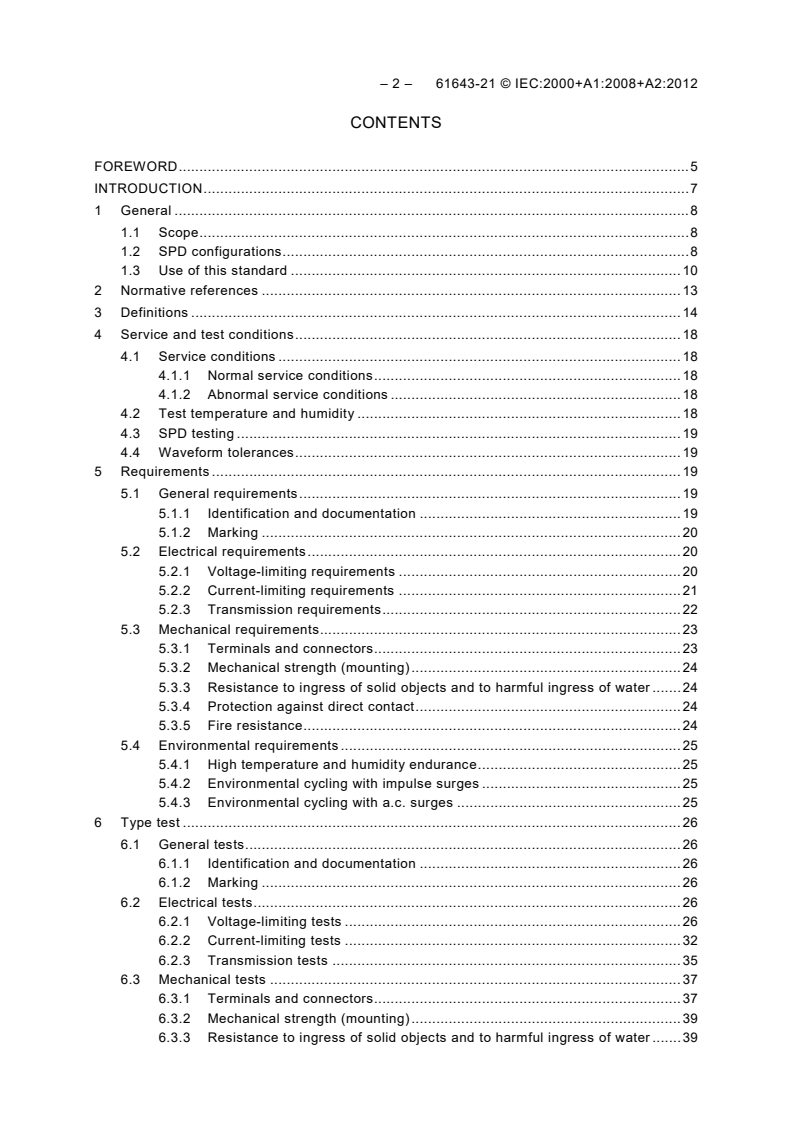
IEC 61643-21:2000+AMD1:2008+AMD2:2012 CSV - Low voltage surge protective devices - Part 21: Surge protective devices connected to telecommunications and signalling networks - Performance requirements and testing methods Released:7/27/2012
Overview
IEC 61643-21:2000 is an international standard published by the International Electrotechnical Commission (IEC) that specifies performance requirements and testing methods for low voltage surge protective devices (SPDs) connected to telecommunications and signalling networks. This standard applies to SPDs designed to protect electronic equipment from indirect and direct lightning effects or other transient overvoltages. It addresses devices suitable for nominal system voltages up to 1,000 V (r.m.s.) AC and 1,500 V DC.
The standard ensures that surge protective devices provide reliable protection for modern telecommunication infrastructures by defining stringent testing procedures and performance criteria. A consolidated edition incorporates amendments from 2008 and 2012, including the corrigendum of March 2001.
Key Topics
- Scope and Application: IEC 61643-21 covers SPDs used in telecommunications and signalling networks, safeguarding electronic equipment against electrical surges primarily caused by lightning strikes or switching transients.
- SPD Configurations: The standard details various configurations of surge protective devices, including single-terminal and multi-terminal setups, tailored for network protection needs.
- Performance Requirements: Defines electrical, mechanical, and environmental requirements such as voltage and current limiting capacity, durability under harsh conditions, fire resistance, and protection against ingress of solid objects and water.
- Testing Methods: Comprehensive testing protocols assessing voltage-limiting behavior, current-limiting capabilities, transmission characteristics (insertion loss, return loss, crosstalk), mechanical strength, and environmental endurance including humidity, temperature, and impulse surges.
- Marking and Documentation: Requirements for clear identification and documentation ensuring traceability and proper selection of SPDs.
- Environmental Durability: Tests emphasize the SPD's ability to withstand extreme humidity, temperature cycles, and electrical stress over time, crucial for telecommunications equipment reliability.
- Safety and Compliance: Protection against direct human contact and fire hazards is mandated to ensure safe installation and operation within communication infrastructures.
Applications
IEC 61643-21 standardizes surge protective devices critical for:
- Telecommunications Networks: Protects switches, routers, transmission lines, and signalling systems from transient overvoltages that can cause equipment failure or data loss.
- Signalling Systems: Ensures the integrity and reliability of signalling circuits used in infrastructure like railway signalling, emergency systems, and control networks.
- Data Centers and Communication Facilities: Helps maintain uninterrupted service and equipment longevity by mitigating harmful surges.
- Industrial and Commercial Communication Installations: Provides tailored surge protection compatible with low voltage telecommunications equipment.
- Renewable Energy Communication Networks: Ensures communication nodes and monitoring devices are safeguarded within distributed energy systems.
Related Standards
- IEC 61643 Series: Covers different aspects and categories of surge protective devices for low voltage electrical installations beyond telecommunications, such as power distribution networks.
- IEC 62305: International standard for lightning protection, which complements IEC 61643-21 by providing risk management and protection system design principles.
- ITU-T Recommendations: Telecommunication standards that address surge immunity and related test methodologies applicable to communication equipment.
- ISO/IEC 27001: While not directly related to surge protection, this standard covers information security management, emphasizing the importance of physical and electronic equipment protection protocols.
Keywords: IEC 61643-21, surge protective devices, telecommunications surge protection, lightning surge protection, low voltage SPDs, transient overvoltage, telecommunications networks safety, IEC standards telecommunications, surge protection testing methods, signalling network protection.
Relations
- Effective Date
- 10-Feb-2026
- Effective Date
- 10-Feb-2026
- Effective Date
- 10-Feb-2026
- Effective Date
- 10-Feb-2026
- Effective Date
- 10-Feb-2026
- Effective Date
- 10-Feb-2026
- Effective Date
- 10-Feb-2026
- Effective Date
- 10-Feb-2026
- Effective Date
- 05-Sep-2023
- Effective Date
- 05-Sep-2023
- Effective Date
- 05-Sep-2023
- Effective Date
- 05-Sep-2023
Buy Documents
IEC 61643-21:2000 - Low voltage surge protective devices - Part 21: Surge protective devices connected to telecommunications and signalling networks - Performance requirements and testing methods Released:9/29/2000
IEC 61643-21:2000+AMD1:2008 CSV - Low voltage surge protective devices - Part 21: Surge protective devices connected to telecommunications and signalling networks - Performance requirements and testing methods Released:4/29/2009
IEC 61643-21:2000+AMD1:2008+AMD2:2012 CSV - Low voltage surge protective devices - Part 21: Surge protective devices connected to telecommunications and signalling networks - Performance requirements and testing methods Released:7/27/2012
Get Certified
Connect with accredited certification bodies for this standard

IMQ S.p.A. (Certification)
Italian electrical product certification.

SLG Prüf- und Zertifizierungs GmbH
German testing and certification body.

UL Solutions
Global safety science company with testing, inspection and certification.
Sponsored listings
Frequently Asked Questions
IEC 61643-21:2000 is a standard published by the International Electrotechnical Commission (IEC). Its full title is "Low voltage surge protective devices - Part 21: Surge protective devices connected to telecommunications and signalling networks - Performance requirements and testing methods". This standard covers: Is applicable to devices for surge protection of telecommunications and signalling networks against indirect and direct effects of lightning or other transient overvoltages. The purpose of these SPDs is to protect modern electronic equipment connected to telecommunications and signalling networks with nominal system voltags up to 1 000 V (r.m.s.) a.c. and 1 500 V d.c. The contents of the corrigendum of March 2001 have been included in this copy.
Is applicable to devices for surge protection of telecommunications and signalling networks against indirect and direct effects of lightning or other transient overvoltages. The purpose of these SPDs is to protect modern electronic equipment connected to telecommunications and signalling networks with nominal system voltags up to 1 000 V (r.m.s.) a.c. and 1 500 V d.c. The contents of the corrigendum of March 2001 have been included in this copy.
IEC 61643-21:2000 is classified under the following ICS (International Classification for Standards) categories: 29.240.10 - Substations. Surge arresters. The ICS classification helps identify the subject area and facilitates finding related standards.
IEC 61643-21:2000 has the following relationships with other standards: It is inter standard links to EN 62305-4:2011, EN 62305-4:2006, EN IEC 61010-2-201:2018, EN IEC 62305-4:2024, EN 61400-24:2010, EN 62305-3:2011, EN IEC 62305-3:2024, EN IEC 61400-24:2019, IEC 61643-21:2000/AMD1:2008, IEC 61643-21:2000/AMD2:2012, IEC 61643-21:2000/COR1:2001, IEC 61643-21:2025. Understanding these relationships helps ensure you are using the most current and applicable version of the standard.
IEC 61643-21:2000 is available in PDF format for immediate download after purchase. The document can be added to your cart and obtained through the secure checkout process. Digital delivery ensures instant access to the complete standard document.
Standards Content (Sample)
NORME CEI
INTERNATIONALE IEC
61643-21
INTERNATIONAL
Première édition
STANDARD
First edition
2000-09
Parafoudres basse tension –
Partie 21:
Parafoudres connectés aux réseaux de signaux
et de télécommunications –
Prescriptions de fonctionnement
et méthodes d’essais
Low voltage surge protective devices –
Part 21:
Surge protective devices connected to
telecommunications and signalling networks –
Performance requirements
and testing methods
Numéro de référence
Reference number
CEI/IEC 61643-21:2000
Numéros des publications Numbering
Depuis le 1er janvier 1997, les publications de la CEI As from 1 January 1997 all IEC publications are
sont numérotées à partir de 60000. issued with a designation in the 60000 series.
Publications consolidées Consolidated publications
Les versions consolidées de certaines publications de Consolidated versions of some IEC publications
la CEI incorporant les amendements sont disponibles. including amendments are available. For example,
Par exemple, les numéros d’édition 1.0, 1.1 et 1.2 edition numbers 1.0, 1.1 and 1.2 refer, respectively, to
indiquent respectivement la publication de base, la the base publication, the base publication incor-
publication de base incorporant l’amendement 1, et la porating amendment 1 and the base publication
publication de base incorporant les amendements 1 incorporating amendments 1 and 2.
et 2.
Validité de la présente publication Validity of this publication
Le contenu technique des publications de la CEI est The technical content of IEC publications is kept
constamment revu par la CEI afin qu'il reflète l'état under constant review by the IEC, thus ensuring that
actuel de la technique. the content reflects current technology.
Des renseignements relatifs à la date de reconfir- Information relating to the date of the reconfirmation
mation de la publication sont disponibles dans le of the publication is available in the IEC catalogue.
Catalogue de la CEI.
Les renseignements relatifs à des questions à l’étude et Information on the subjects under consideration and
des travaux en cours entrepris par le comité technique work in progress undertaken by the technical
qui a établi cette publication, ainsi que la liste des committee which has prepared this publication, as well
publications établies, se trouvent dans les documents ci- as the list of publications issued, is to be found at the
dessous: following IEC sources:
• «Site web» de la CEI* • IEC web site*
• Catalogue des publications de la CEI • Catalogue of IEC publications
Publié annuellement et mis à jour Published yearly with regular updates
régulièrement (On-line catalogue)*
(Catalogue en ligne)*
• Bulletin de la CEI
• IEC Bulletin
Disponible à la fois au «site web» de la CEI*
Available both at the IEC web site* and
et comme périodique imprimé
as a printed periodical
Terminologie, symboles graphiques
Terminology, graphical and letter
et littéraux
symbols
En ce qui concerne la terminologie générale, le lecteur
For general terminology, readers are referred to
se reportera à la CEI 60050: Vocabulaire Electro-
IEC 60050: International Electrotechnical Vocabulary
technique International (VEI).
(IEV).
Pour les symboles graphiques, les symboles littéraux
For graphical symbols, and letter symbols and signs
et les signes d'usage général approuvés par la CEI, le
approved by the IEC for general use, readers are
lecteur consultera la CEI 60027: Symboles littéraux à
referred to publications IEC 60027: Letter symbols to
utiliser en électrotechnique, la CEI 60417: Symboles
be used in electrical technology, IEC 60417: Graphical
graphiques utilisables sur le matériel. Index, relevé et
symbols for use on equipment. Index, survey and
compilation des feuilles individuelles, et la CEI 60617:
compilation of the single sheets and IEC 60617:
Symboles graphiques pour schémas.
Graphical symbols for diagrams.
* Voir adresse «site web» sur la page de titre.
* See web site address on title page.
NORME CEI
INTERNATIONALE IEC
61643-21
INTERNATIONAL
Première édition
STANDARD
First edition
2000-09
Parafoudres basse tension –
Partie 21:
Parafoudres connectés aux réseaux de signaux
et de télécommunications –
Prescriptions de fonctionnement
et méthodes d’essais
Low voltage surge protective devices –
Part 21:
Surge protective devices connected to
telecommunications and signalling networks –
Performance requirements
and testing methods
IEC 2000 Droits de reproduction réservés Copyright - all rights reserved
Aucune partie de cette publication ne peut être reproduite ni No part of this publication may be reproduced or utilized in
utilisée sous quelque forme que ce soit et par aucun procédé, any form or by any means, electronic or mechanical,
électronique ou mécanique, y compris la photocopie et les including photocopying and microfilm, without permission in
microfilms, sans l'accord écrit de l'éditeur. writing from the publisher.
International Electrotechnical Commission 3, rue de Varembé Geneva, Switzerland
Telefax: +41 22 919 0300 e-mail: inmail@iec.ch IEC web site http://www.iec.ch
CODE PRIX
Commission Electrotechnique Internationale
XA
PRICE CODE
International Electrotechnical Commission
Pour prix, voir catalogue en vigueur
For price, see current catalogue
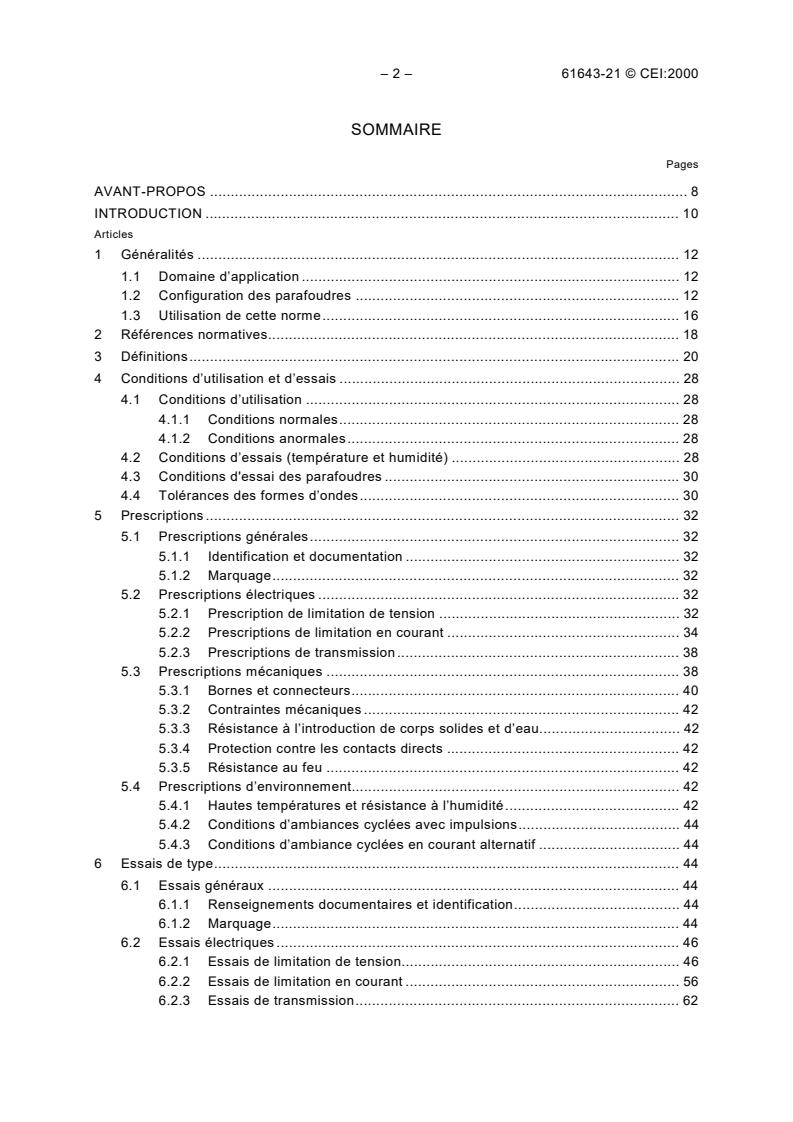
– 2 – 61643-21 © CEI:2000
SOMMAIRE
Pages
AVANT-PROPOS . 8
INTRODUCTION . 10
Articles
1 Généralités .12
1.1 Domaine d’application . 12
1.2 Configuration des parafoudres . 12
1.3 Utilisation de cette norme. 16
2 Références normatives. 18
3 Définitions. 20
4 Conditions d’utilisation et d’essais . 28
4.1 Conditions d’utilisation . 28
4.1.1 Conditions normales. 28
4.1.2 Conditions anormales. 28
4.2 Conditions d’essais (température et humidité) . 28
4.3 Conditions d'essai des parafoudres . 30
4.4 Tolérances des formes d’ondes. 30
5 Prescriptions .32
5.1 Prescriptions générales. 32
5.1.1 Identification et documentation . 32
5.1.2 Marquage. 32
5.2 Prescriptions électriques . 32
5.2.1 Prescription de limitation de tension . 32
5.2.2 Prescriptions de limitation en courant . 34
5.2.3 Prescriptions de transmission. 38
5.3 Prescriptions mécaniques . 38
5.3.1 Bornes et connecteurs. 40
5.3.2 Contraintes mécaniques . 42
5.3.3 Résistance à l’introduction de corps solides et d’eau. 42
5.3.4 Protection contre les contacts directs . 42
5.3.5 Résistance au feu . 42
5.4 Prescriptions d’environnement. 42
5.4.1 Hautes températures et résistance à l’humidité. 42
5.4.2 Conditions d’ambiances cyclées avec impulsions. 44
5.4.3 Conditions d’ambiance cyclées en courant alternatif . 44
6 Essais de type. 44
6.1 Essais généraux . 44
6.1.1 Renseignements documentaires et identification. 44
6.1.2 Marquage. 44
6.2 Essais électriques . 46
6.2.1 Essais de limitation de tension. 46
6.2.2 Essais de limitation en courant . 56
6.2.3 Essais de transmission. 62
61643-21 © IEC:2000 – 3 –
CONTENTS
Page
FOREWORD . 9
INTRODUCTION . 11
Clause
1 General. 13
1.1 Scope . 13
1.2 SPD configurations . 13
1.3 Use of this standard. 17
2 Normative references. 19
3 Definitions. 21
4 Service and test conditions . 29
4.1 Service conditions. 29
4.1.1 Normal service conditions . 29
4.1.2 Abnormal service conditions . 29
4.2 Test temperature and humidity. 29
4.3 SPD testing . 31
4.4 Waveform tolerances . 31
5 Requirements . 33
5.1 General requirements . 33
5.1.1 Identification and documentation. 33
5.1.2 Marking. 33
5.2 Electrical requirements . 33
5.2.1 Voltage-limiting requirements. 33
5.2.2 Current-limiting requirements . 35
5.2.3 Transmission requirements . 39
5.3 Mechanical requirements . 39
5.3.1 Terminals and connectors . 41
5.3.2 Mechanical strength (mounting) . 43
5.3.3 Resistance to ingress of solid objects and to harmful ingress of water . 43
5.3.4 Protection against direct contact . 43
5.3.5 Fire resistance . 43
5.4 Environmental requirements . 43
5.4.1 High temperature and humidity endurance . 43
5.4.2 Environmental cycling with impulse surges. 45
5.4.3 Environmental cycling with a.c. surges. 45
6 Type test. 45
6.1 General tests . 45
6.1.1 Identification and documentation. 45
6.1.2 Marking. 45
6.2 Electrical tests . 47
6.2.1 Voltage-limiting tests. 47
6.2.2 Current-limiting tests. 57
6.2.3 Transmission tests . 63
– 4 – 61643-21 © CEI:2000
Articles Pages
6.3 Essais mécaniques . 66
6.3.1 Bornes et connecteurs. 66
6.3.2 Contrainte mécanique (montage). 70
6.3.3 Résistance à l’introduction de corps solides et d’eau. 70
6.3.4 Protection contre les contacts directs . 70
6.3.5 Résistance au feu . 72
6.4 Essais d’environnement . 74
6.4.1 Hautes températures et résistance à l’humidité. 74
6.4.2 Conditions d’ambiance cyclées avec impulsions transitoires . 74
6.4.3 Conditions d’ambiance cyclées avec chocs en courant alternatif . 76
6.5 Essais de réception. 76
Annex A (informative) Appareils n’ayant qu’une fonction de limitation en courant. 104
Annex B (informative) Choix des essais de transmission applicables. 106
Annex C (normative) Séquence d’essai. 108
Bibliographie . 110
Figure 1 – Configurations des parafoudres. 14
Figure 2 – Circuit d’essai pour le temps de réamorçage en impulsion . 78
Figure 3 – Circuits d’essais pour l’endurance en courant alternatif et le mode
de défaut par surcharge. 80
Figure 4 – Circuit d’essai pour l’endurance aux impulsions et le mode de défaut
par surcharge . 82
Figure 5 – Circuit d’essai pour le courant assigné, résistance série, temps de réponse,
temps de réamorçage en courant, tension de coupure maximale et essai de fonctionnement. 84
Figure 6 – Circuits d’essai pour l’endurance en courant alternatif . 86
Figure 7 –Circuit d’essai pour l’endurance en impulsionnel. 88
Figure 8 –Circuit d’essai pour la perte d’insertion . 90
Figure 9 – Circuit d’essai pour le facteur d'adaptation (en réflexion) . 90
Figure 10 – Circuit d’essai pour l’affaiblissement de conversion longitudinal . 92
Figure 11 – Circuit d’essai pour le taux d’erreur binaire . 94
Figure 12 – Circuit d’essai pour la paradiaphonie . 96
Figure 13 – Circuit d’essai pour l’endurance aux hautes températures/humidités
et l’ambiance cyclée . 98
Figure 14 – Cycles A pour les essais de conditions d’ambiance avec un RH ≥ 90 % . 100
Figure 15 – Cycle B pour les essais de conditions d’ambiance . 102
Figure A.1 – Configurations des parafoudres n’ayant que des composants de limitation
de courant . 104
61643-21 © IEC:2000 – 5 –
Clause Page
6.3 Mechanical tests . 67
6.3.1 Terminals and connectors . 67
6.3.2 Mechanical strength (mounting) . 71
6.3.3 Resistance to ingress of solid objects and to harmful ingress of water . 71
6.3.4 Protection against direct contact . 71
6.3.5 Fire resistance . 73
6.4 Environmental tests . 75
6.4.1 High temperature and humidity endurance . 75
6.4.2 Environmental cycling with impulse surges. 75
6.4.3 Environmental cycling with a.c. surges. 77
6.5 Acceptance tests . 77
Annex A (informative) Devices with current-limiting components only. 105
Annex B (informative) Selection of applicable transmission tests. 107
Annex C (normative) Test sequence. 109
Bibliography . 111
Figure 1 – SPD configurations. 15
Figure 2 – Test circuits for impulse reset time . 79
Figure 3 – Test circuits for a.c. durability and overstressed fault mode . 81
Figure 4 – Test circuits for impulse durability and overstressed fault mode. 83
Figure 5 – Test circuits for rated current, series resistance, response time,
current reset time, maximum interrupting voltage and operating duty test. 85
Figure 6 – Test circuits for a.c. durability. 87
Figure 7 – Test circuits for impulse durability. 89
Figure 8 – Test circuits for insertion loss . 91
Figure 9 – Test circuit for return loss . 91
Figure 10 – Test circuits for longitudinal balance. 93
Figure 11 – Test circuit for bit error ratio test. 95
Figure 12 – Test circuit for near-end crosstalk. 97
Figure 13 – Test circuits for high temperature/humidity endurance and
environmental cycling.99
Figure 14 – Environmental cycling schedule A with RH ≥ 90 %. 101
Figure 15 – Environmental cycling B . 103
Figure A.1 – Configurations of devices with current-limiting component(s) only . 105
– 6 – 61643-21 © CEI:2000
Pages
Tableau 1 – Exigences générales des parafoudres . 18
Tableau 2 – Tolérances pour les formes d’ondes A/B. 30
Tableau 3 – Formes d’ondes de courant et de tension pour la tension de
limitation impulsionnelle. 48
Tableau 4 – Sources de tensions et de courant, pour les essais de réamorçage
sur impulsion. . 50
Tableau 5 – Valeurs préférentielles du courant, pour l’essai d’endurance
en courant alternatif. . 52
Tableau 6 – Courants d’essai pour le temps de réponse. 56
Tableau 7 – Valeurs préférentielles, pour le courant d’essai de fonctionnement. 60
Tableau 8 – Valeurs préférentielles pour courants alternatifs. 60
Tableau 9 – Valeurs préférentielles de courants impulsionnels . 62
Tableau 10 – Paramètres normalisés pour la figure 8. 62
Tableau 11 – Valeurs d’impédances pour l’essai d’affaiblissement
de conversion longitudinal . 64
Tableau 12 – Durée pour l’essai de TEB . 66
Tableau 13 – Sections connectables de conducteurs en cuivre, pour des bornes
à vis ou sans vis . 68
Tableau 14 – Forces de traction (bornes sans vis) . 68
Tableau 15 – Valeurs préférentielles de périodes pour l’essai de hautes températures
et de résistance à l’humidité . 74
Tableau 16 – Valeurs préférentielles des temps et températures pour les essais
de conditions d’ambiance cyclées . 76
Tableau B.1 – Essais applicables au parafoudre pour plusieurs systèmes de transmission . 106
Tableau C.1 – Séquence d’essai du tableau 1. 108
61643-21 © IEC:2000 – 7 –
Page
Table 1 – General SPD requirements . 19
Table 2 – Waveform tolerances . 31
Table 3 – Voltage and current waveforms for impulse-limiting voltage . 49
Table 4 – Source voltages and currents for impulse reset test. 51
Table 5 – Preferred values of currents for a.c. durability test . 53
Table 6 – Test currents for response time . 57
Table 7 – Preferred values of current for operating duty tests. 61
Table 8 – Preferred values of a.c. test currents . 61
Table 9 – Preferred values of impulse current . 63
Table 10 – Standard parameters for figure 8 . 63
Table 11 – Impedance values for longitudinal balance test . 65
Table 12 – Test times for BER test . 67
Table 13 – Connectable cross-sectional areas of copper conductors for screw-type
terminals or screwless-type terminals. 69
Table 14 – Pulling force (screwless terminals). 69
Table 15 – Preferred values of test-time duration for high temperature and
humidity endurance .75
Table 16 – Preferred values of temperature and duration for environmental cycling tests . 77
Table B.1 – Applicable SPD tests for several transmission systems . 107
Table C.1 – Testing sequence for table 1 . 109
– 8 – 61643-21 © CEI:2000
COMMISSION ÉLECTROTECHNIQUE INTERNATIONALE
––––––––––––––
PARAFOUDRES BASSE TENSION –
Partie 21: Parafoudres connectés aux réseaux de signaux
et de télécommunications –
Prescriptions de fonctionnement et méthodes d’essais
AVANT-PROPOS
1) La CEI (Commission Electrotechnique Internationale) est une organisation mondiale de normalisation composée
de l'ensemble des comités électrotechniques nationaux (Comités nationaux de la CEI). La CEI a pour objet de
favoriser la coopération internationale pour toutes les questions de normalisation dans les domaines de
l'électricité et de l'électronique. A cet effet, la CEI, entre autres activités, publie des Normes internationales.
Leur élaboration est confiée à des comités d'études, aux travaux desquels tout Comité national intéressé par le
sujet traité peut participer. Les organisations internationales, gouvernementales et non gouvernementales, en
liaison avec la CEI, participent également aux travaux. La CEI collabore étroitement avec l'Organisation
Internationale de Normalisation (ISO), selon des conditions fixées par accord entre les deux organisations.
2) Les décisions ou accords officiels de la CEI concernant les questions techniques représentent, dans la mesure
du possible, un accord international sur les sujets étudiés, étant donné que les Comités nationaux intéressés
sont représentés dans chaque comité d’études.
3) Les documents produits se présentent sous la forme de recommandations internationales. Ils sont publiés
comme normes, spécifications techniques, rapports techniques ou guides et agréés comme tels par les Comités
nationaux.
4) Dans le but d'encourager l'unification internationale, les Comités nationaux de la CEI s'engagent à appliquer de
façon transparente, dans toute la mesure possible, les Normes internationales de la CEI dans leurs normes
nationales et régionales. Toute divergence entre la norme de la CEI et la norme nationale ou régionale
correspondante doit être indiquée en termes clairs dans cette dernière.
5) La CEI n’a fixé aucune procédure concernant le marquage comme indication d’approbation et sa responsabilité
n’est pas engagée quand un matériel est déclaré conforme à l’une de ses normes.
6) L’attention est attirée sur le fait que certains des éléments de la présente Norme internationale peuvent faire
l’objet de droits de propriété intellectuelle ou de droits analogues. La CEI ne saurait être tenue pour
responsable de ne pas avoir identifié de tels droits de propriété et de ne pas avoir signalé leur existence.
La Norme internationale CEI 61643-21 a été établie par le sous-comité 37A: Dispositifs de
protection basse tension contre les surtensions, du comité d'études 37 de la CEI: Parafoudres.
Le texte de cette norme est issu des documents suivants:
FDIS Rapport de vote
37A/101/FDIS 37A/104/RVD
Le rapport de vote indiqué dans le tableau ci-dessus donne toute information sur le vote ayant
abouti à l'approbation de cette norme.
Cette publication a été rédigée selon les Directives ISO/CEI, Partie 3.
Les annexes A et B sont données uniquement à titre d'information.
L'annexe C fait partie intégrante de cette norme.
Le contenu du corrigendum de mars 2001 a été pris en considération dans cet exemplaire.
Le comité a décidé que le contenu de cette publication ne sera pas modifié avant 2002-07.
A cette date, la publication sera
• reconduite;
• supprimée;
• remplacée par une édition révisée, ou
• amendée.
61643-21 © IEC:2000 – 9 –
INTERNATIONAL ELECTROTECHNICAL COMMISSION
–––––––––––
LOW VOLTAGE SURGE PROTECTIVE DEVICES –
Part 21: Surge protective devices connected to
telecommunications and signalling networks –
Performance requirements and testing methods
FOREWORD
1) The IEC (International Electrotechnical Commission) is a worldwide organization for standardization comprising
all national electrotechnical committees (IEC National Committees). The object of the IEC is to promote
international co-operation on all questions concerning standardization in the electrical and electronic fields. To
this end and in addition to other activities, the IEC publishes International Standards. Their preparation is
entrusted to technical committees; any IEC National Committee interested in the subject dealt with may
participate in this preparatory work. International, governmental and non-governmental organizations liaising
with the IEC also participate in this preparation. The IEC collaborates closely with the International
Organization for Standardization (ISO) in accordance with conditions determined by agreement between the
two organizations.
2) The formal decisions or agreements of the IEC on technical matters express, as nearly as possible, an
international consensus of opinion on the relevant subjects since each technical committee has representation
from all interested National Committees.
3) The documents produced have the form of recommendations for international use and are published in the form
of standards, technical specifications, technical reports or guides and they are accepted by the National
Committees in that sense.
4) In order to promote international unification, IEC National Committees undertake to apply IEC International
Standards transparently to the maximum extent possible in their national and regional standards. Any
divergence between the IEC Standard and the corresponding national or regional standard shall be clearly
indicated in the latter.
5) The IEC provides no marking procedure to indicate its approval and cannot be rendered responsible for any
equipment declared to be in conformity with one of its standards.
6) Attention is drawn to the possibility that some of the elements of this International Standard may be the subject
of patent rights. The IEC shall not be held responsible for identifying any or all such patent rights.
International Standard IEC 61643-21 has been prepared by subcommittee 37A: Low-voltage
surge protective devices, of IEC technical committee 37: Surge arresters.
The text of this standard is based on the following documents:
FDIS Report on voting
37A/101/FDIS 37A/104/RVD
Full information on the voting for the approval of this standard can be found in the report on
voting indicated in the above table.
This publication has been drafted in accordance with the ISO/IEC Directives, Part 3.
Annexes A and B are for information only.
Annex C forms an integral part of this standard.
The contents of the corrigendum of March 2001 have been included in this copy.
The committee has decided that the contents of this publication will remain unchanged
until 2002-07. At this date, the publication will be
• reconfirmed;
• withdrawn;
• replaced by a revised edition, or
• amended.
– 10 – 61643-21 © CEI:2000
INTRODUCTION
La présente Norme internationale se propose de répertorier les exigences relatives aux
dispositifs de protection contre les surtensions, appelés parafoudres et utilisés dans la
protection des systèmes de télécommunications et de transmission de signaux, par exemple
données, voix et circuits d’alarme en basse tension. Tous ces systèmes peuvent être exposés
aux effets de la foudre et aux défauts des réseaux de distribution d’énergie électrique, soit par
contact direct, soit par induction. Ces effets peuvent soumettre le système à des surtensions
et/ou des surintensités, dont les niveaux sont suffisamment hauts pour l’endommager. Les
parafoudres sont construits pour procurer une protection contre les surtensions et
éventuellement les surintensités dues à la foudre et aux défauts des lignes de distribution
d’énergie. Cette norme décrit les essais et les exigences définissant des méthodes pour tester
les parafoudres et déterminer leurs performances.
Les parafoudres, concernés par cette norme internationale, peuvent comporter des
composants de protection contre les surtensions seulement ou une combinaison de
composants de protection contre les surtensions et contre les surintensités. Les protections,
contenant seulement des composants contre les surintensités, ne sont pas concernées par la
présente norme. Cependant, des dispositifs, n’ayant que des composants de protection contre
les surintensités, sont couverts par l’annexe A.
Un parafoudre peut contenir plusieurs composants de protection contre les surtensions et
contre les surintensités. Tous les parafoudres sont essayés, comme une «boîte noire», à
savoir que c’est le nombre de bornes du parafoudre qui détermine la procédure d’essai et non
pas le nombre de composants du parafoudre. Les configurations des parafoudres sont décrites
en 1.2. Pour les parafoudres à lignes multiples, chaque ligne peut être essayée indépendamment
des autres, mais il peut apparaître aussi le besoin d’essayer toutes les lignes simultanément.
Cette norme concerne une large gamme de conditions d’essais et d’exigences ; l’utilisation de
certaines d’entre elles est à la discrétion de l’utilisateur. La façon d'utiliser cette norme en
fonction des différents modèles de parafoudres est décrite en 1.3. Bien qu'il s'agisse d'une
norme de performances et que certaines qualités soient exigées des parafoudres, les taux
d’échec et leur interprétation sont du ressort de l’utilisateur. La sélection et les principes
1)
d’application seront traités dans la CEI 61643-22 .
S'il est admis que le parafoudre n’a qu’un seul composant, il faut qu'il respecte les
prescriptions de la norme correspondante ainsi que celles de la présente norme.
––––––––––
1)
A l'étude.
61643-21 © IEC:2000 – 11 –
INTRODUCTION
The purpose of this International Standard is to identify the requirements for Surge Protective
Devices (SPDs) used in protecting telecommunication and signalling systems, for example,
low-voltage data, voice, and alarm circuits. All of these systems may be exposed to the
effects of lightning and power line faults, either through direct contact or induction. These
effects may subject the system to overvoltages or overcurrents or both, whose levels are
sufficiently high to harm the system. SPDs are intended to provide protection against
overvoltages and overcurrents caused by lightning and power line faults. This standard
describes tests and requirements which establish methods for testing SPDs and determining
their performance.
The SPDs addressed in this International Standard may contain overvoltage protection
components only, or a combination of overvoltage and overcurrent protection components.
Protection devices containing overcurrent protection components only are not within the
coverage of this standard. However, devices with only overcurrent protection components are
covered in annex A.
An SPD may comprise several overvoltage and overcurrent protection components. All SPDs
are tested on a "black box" basis, i.e., the number of terminals of the SPD determines the
testing procedure, not the number of components in the SPD. The SPD configurations are
described in 1.2. In the case of multiple line SPDs, each line may be tested independently of
the others, but there may also be a need to test all lines simultaneously.
This standard covers a wide range of testing conditions and requirements; the use of some of
these is at the discretion of the user. How the requirements of this standard relate to the
different types of SPD is described in 1.3. Whilst this is a performance standard and certain
capabilities are demanded of the SPDs, failure rates and their interpretation are left to the
1)
user. Selection and application principles will be covered in IEC 61643-22 .
If the SPD is known to be a single component device, it has to meet the requirements of the
relevant standard as well as those in this standard.
–––––––––––
1)
Under consideration.
– 12 – 61643-21 © CEI:2000
PARAFOUDRES BASSE TENSION –
Partie 21: Parafoudres connectés aux réseaux de signaux
et de télécommunications –
Prescriptions de fonctionnement et méthodes d’essais
1 Généralités
1.1 Domaine d’application
La présente Norme internationale est applicable aux dispositifs de protection (parafoudres)
contre les effets directs et indirects de la foudre ou des autres surtensions transitoires, pour
les réseaux de télécommunications et de transmission de signaux.
Ces parafoudres sont destinés à protéger les équipements électroniques modernes, connectés
aux réseaux de télécommunications et de transmission de signaux, ayant une tension nominale
de fonctionnement jusqu’à 1 000 V (efficace) en courant alternatif et 1 500 V en courant
continu.
1.2 Configuration des parafoudres
Les configurations des parafoudres décrites dans cette norme sont représentées à la figure 1.
Chaque configuration de parafoudre est composée d'un ou de plusieurs composants limiteurs
de tension et peut inclure des composants limiteurs de courant.
61643-21 © IEC:2000 – 13 –
LOW VOLTAGE SURGE PROTECTIVE DEVICES –
Part 21: Surge protective devices connected to
telecommunications and signalling networks –
Performance requirements and testing methods
1 General
1.1 Scope
This International Standard is applicable to devices for surge protection of telecommunications
and signalling networks against indirect and direct effects of lightning or other transient
overvoltages.
The purpose of these SPDs is to protect modern electronic equipment connected to
telecommunications and signalling networks with nominal system voltages up to 1 000 V
(r.m.s.) a.c. and 1 500 V d.c.
1.2 SPD configurations
The SPD configurations described in this standard are shown in figure 1. Each SPD
configuration is composed of one or more voltage-limiting components and may include
current-limiting components.
– 14 – 61643-21 © CEI:2000
X1
V
X2
IEC 1297/2000
Figure 1a – Parafoudre à 2 bornes
X1
X1 V, I Y1
V C
C X2
IEC 1298/2000 IEC 1299/2000
Figure 1b – Parafoudre à 3 bornes Figure 1c – Parafoudre à 3 bornes
X1 Y1
V, I
X2 Y2
X1 Y1
V, I
X2 Y2
C
IEC 1300/2000 IEC 1301/2000
Figure 1d – Parafoudre à 4 bornes Figure 1e – Parafoudre à 5 bornes
X1 Y1
X2 Y2
V, I
Xn Yn
a
C
IEC 1302/2000
a
La borne commune C peut ne pas exister
Figure 1f – Parafoudre multiborne
Légende
V composant limiteur de tension
V, I composants limiteurs de tension ou combinaison de composants limiteurs de tension et limiteurs de
courant
X1, X2.Xn bornes de lignes
Y1, Y2…Yn bornes de lignes protégées
C borne commune
Figure 1 – Configurations des parafoudres
61643-21 © IEC:2000 – 15 –
X1
V
X2
IEC 1297/2000
Figure 1a – Two-terminal SPD
X1
X1 V, I Y1
V C
C X2
IEC 1298/2000 IEC 1299/2000
Figure 1b – Three-terminal SPD Figure 1c – Three-terminal SPD
X1 Y1
V, I
X2 Y2
X1 Y1
V, I
X2 Y2
C
IEC 1300/2000 IEC 1301/2000
Figure 1d – Four-terminal SPD Figure 1e – Five-terminal SPD
X1 Y1
X2 Y2
V, I
Xn Yn
a
C
IEC 1302/2000
a
The common terminal C may not be provided
Figure 1f – Multi-terminal SPD
Key
V voltage-limiting component
V, I voltage-limiting components or a combination of voltage-limiting and current-limiting components
X1, X2.Xn line terminals
Y1, Y2…Yn protected line terminals
C common terminal
Figure 1 – SPD configurations
– 16 – 61643-21 © CEI:2000
1.3 Utilisation de cette norme
Cette norme traite de 2 types fondamentaux de parafoudres.
Le premier type contient au moins un composant limiteur de tension et ne contient aucun
composant limiteur de courant à l'intérieur du parafoudre. Toutes les configurations de
parafoudres de la figure 1 lui sont applicables. Ce type de parafoudre doit satisfaire aux
exigences de 5.1, 5.2.1 et 5.3 (voir tableau 1). Cependant, si un parafoudre contient un
composant linéaire entre les bornes de lignes et les bornes de lignes protégées – comme aux
figures 1b, 1d, 1e et 1f, il doit aussi satisfaire aux exigences applicables du 5.2.2.
Le deuxième type contient à la fois des composants limiteurs de tension et des composants
limiteurs de courant à l’intérieur du parafoudre. Les configurations de parafoudres des figures
1b, 1d, 1e et 1f lui sont applicables. Ce type de parafoudre doit satisfaire au moins aux
exigences de 5.1, 5.2.1, 5.2.2 et 5.3 (voir tableau 1). Les configurations de parafoudres ne
contenant que des composants limiteurs de courant sont données à l’annexe A.
Il se peut que les parafoudres aient à satisfaire à d’autres exigences, selon leurs applications.
Ces exigences supplémentaires sont décrites en 5.2.3 et en 5.4 (voir tableau 1).
Le paragraphe 5.2.3 traite de quelques essais de transmission auxquels les parafoudres
peuvent avoir à se conformer, selon leurs applications en télécommuni
...
IEC 61643-21
Edition 1.1 2009-04
INTERNATIONAL
STANDARD
NORME
INTERNATIONALE
Low voltage surge protective devices –
Part 21: Surge protective devices connected to telecommunications and
signalling networks – Performance requirements and testing methods
Parafoudres basse tension –
Partie 21: Parafoudres connectés aux réseaux de signaux et de
télécommunications – Prescriptions de fonctionnement et méthodes d’essais
All rights reserved. Unless otherwise specified, no part of this publication may be reproduced or utilized in any form or by
any means, electronic or mechanical, including photocopying and microfilm, without permission in writing from either IEC or
IEC's member National Committee in the country of the requester.
If you have any questions about IEC copyright or have an enquiry about obtaining additional rights to this publication,
please contact the address below or your local IEC member National Committee for further information.
Droits de reproduction réservés. Sauf indication contraire, aucune partie de cette publication ne peut être reproduite
ni utilisée sous quelque forme que ce soit et par aucun procédé, électronique ou mécanique, y compris la photocopie
et les microfilms, sans l'accord écrit de la CEI ou du Comité national de la CEI du pays du demandeur.
Si vous avez des questions sur le copyright de la CEI ou si vous désirez obtenir des droits supplémentaires sur cette
publication, utilisez les coordonnées ci-après ou contactez le Comité national de la CEI de votre pays de résidence.
IEC Central Office
3, rue de Varembé
CH-1211 Geneva 20
Switzerland
Email: inmail@iec.ch
Web: www.iec.ch
About the IEC
The International Electrotechnical Commission (IEC) is the leading global organization that prepares and publishes
International Standards for all electrical, electronic and related technologies.
About IEC publications
The technical content of IEC publications is kept under constant review by the IEC. Please make sure that you have the
latest edition, a corrigenda or an amendment might have been published.
ƒ Catalogue of IEC publications: www.iec.ch/searchpub
The IEC on-line Catalogue enables you to search by a variety of criteria (reference number, text, technical committee,…).
It also gives information on projects, withdrawn and replaced publications.
ƒ IEC Just Published: www.iec.ch/online_news/justpub
Stay up to date on all new IEC publications. Just Published details twice a month all new publications released. Available
on-line and also by email.
ƒ Electropedia: www.electropedia.org
The world's leading online dictionary of electronic and electrical terms containing more than 20 000 terms and definitions
in English and French, with equivalent terms in additional languages. Also known as the International Electrotechnical
Vocabulary online.
ƒ Customer Service Centre: www.iec.ch/webstore/custserv
If you wish to give us your feedback on this publication or need further assistance, please visit the Customer Service
Centre FAQ or contact us:
Email: csc@iec.ch
Tel.: +41 22 919 02 11
Fax: +41 22 919 03 00
A propos de la CEI
La Commission Electrotechnique Internationale (CEI) est la première organisation mondiale qui élabore et publie des
normes internationales pour tout ce qui a trait à l'électricité, à l'électronique et aux technologies apparentées.
A propos des publications CEI
Le contenu technique des publications de la CEI est constamment revu. Veuillez vous assurer que vous possédez
l’édition la plus récente, un corrigendum ou amendement peut avoir été publié.
ƒ Catalogue des publications de la CEI: www.iec.ch/searchpub/cur_fut-f.htm
Le Catalogue en-ligne de la CEI vous permet d’effectuer des recherches en utilisant différents critères (numéro de référence,
texte, comité d’études,…). Il donne aussi des informations sur les projets et les publications retirées ou remplacées.
ƒ Just Published CEI: www.iec.ch/online_news/justpub
Restez informé sur les nouvelles publications de la CEI. Just Published détaille deux fois par mois les nouvelles
publications parues. Disponible en-ligne et aussi par email.
ƒ Electropedia: www.electropedia.org
Le premier dictionnaire en ligne au monde de termes électroniques et électriques. Il contient plus de 20 000 termes et
définitions en anglais et en français, ainsi que les termes équivalents dans les langues additionnelles. Egalement appelé
Vocabulaire Electrotechnique International en ligne.
ƒ Service Clients: www.iec.ch/webstore/custserv/custserv_entry-f.htm
Si vous désirez nous donner des commentaires sur cette publication ou si vous avez des questions, visitez le FAQ du
Service clients ou contactez-nous:
Email: csc@iec.ch
Tél.: +41 22 919 02 11
Fax: +41 22 919 03 00
IEC 61643-21
Edition 1.1 2009-04
INTERNATIONAL
STANDARD
NORME
INTERNATIONALE
Low voltage surge protective devices –
Part 21: Surge protective devices connected to telecommunications and
signalling networks – Performance requirements and testing methods
Parafoudres basse tension –
Partie 21: Parafoudres connectés aux réseaux de signaux et de
télécommunications – Prescriptions de fonctionnement et méthodes d’essais
INTERNATIONAL
ELECTROTECHNICAL
COMMISSION
COMMISSION
ELECTROTECHNIQUE
PRICE CODE
INTERNATIONALE
CS
CODE PRIX
ICS 29.240; 29.240.10 ISBN 2-8318-9836-6
– 2 – 61643-21 © IEC:2000+A1:2008
CONTENTS
FOREWORD.5
INTRODUCTION.7
1 General .8
1.1 Scope.8
1.2 SPD configurations.8
1.3 Use of this standard .10
2 Normative references .13
3 Definitions .14
4 Service and test conditions.17
4.1 Service conditions .17
4.1.1 Normal service conditions.17
4.1.2 Abnormal service conditions .18
4.2 Test temperature and humidity .18
4.3 SPD testing .18
4.4 Waveform tolerances.19
5 Requirements .19
5.1 General requirements.19
5.1.1 Identification and documentation .19
5.1.2 Marking .19
5.2 Electrical requirements.20
5.2.1 Voltage-limiting requirements .20
5.2.2 Current-limiting requirements .21
5.2.3 Transmission requirements.22
5.3 Mechanical requirements.22
5.3.1 Terminals and connectors.23
5.3.2 Mechanical strength (mounting).24
5.3.3 Resistance to ingress of solid objects and to harmful ingress of water .24
5.3.4 Protection against direct contact.24
5.3.5 Fire resistance.24
5.4 Environmental requirements .24
5.4.1 High temperature and humidity endurance.24
5.4.2 Environmental cycling with impulse surges .25
5.4.3 Environmental cycling with a.c. surges .25
6 Type test .25
6.1 General tests.25
6.1.1 Identification and documentation .25
6.1.2 Marking .25
6.2 Electrical tests.26
6.2.1 Voltage-limiting tests .26
6.2.2 Current-limiting tests .32
6.2.3 Transmission tests .35
6.3 Mechanical tests .37
6.3.1 Terminals and connectors.37
6.3.2 Mechanical strength (mounting).39
6.3.3 Resistance to ingress of solid objects and to harmful ingress of water .39
6.3.4 Protection against direct contact.39
61643-21 © IEC:2000+A1:2008 – 3 –
6.3.5 Fire resistance.40
6.4 Environmental tests.41
6.4.1 High temperature and humidity endurance.41
6.4.2 Environmental cycling with impulse surges .41
6.4.3 Environmental cycling with a.c. surges .42
6.5 Acceptance tests.42
Annex A (informative) Devices with current-limiting components only .56
Annex B (Void) .57
Annex C (Void) .58
Annex D (informative) Measurement accuracy .59
Annex E (informative) Determination of let-through current (I ).60
p
Bibliography.63
Figure 1 – SPD configurations .9
Figure 16 – Examples of multi-line SPDs with a common protective element.28
Figure 2 – Test circuits for impulse reset time.43
Figure 3 – Test circuits for a.c. durability and overstressed fault mode .44
Figure 4 – Test circuits for impulse durability and overstressed fault mode .45
Figure 5 – Test circuits for rated current, series resistance, response time,
current reset time, maximum interrupting voltage and operating duty test .46
Figure 6 – Test circuits for a.c. durability .47
Figure 7 – Test circuits for impulse durability .48
Figure 8 – Test circuits for insertion loss.49
Figure 9 – Test circuit for return loss .49
Figure 10 – Test circuits for longitudinal balance .50
Figure 11 – Test circuit for bit error ratio test .51
Figure 12 – Test circuit for near-end crosstalk .52
Figure 13 – Test circuits for high temperature/humidity endurance
and environmental cycling.53
Figure 14 – Environmental cycling schedule A with RH ≥ 90 % .54
Figure 15 – Environmental cycling B .55
Figure A.1 – Configurations of devices with current-limiting component(s) only.56
Figure E.1 – Determination of differential mode let-through current.60
Figure E.2 – Determination of common mode let-through current .61
Figure E.3 – Determination of differential mode let-through current.61
Figure E.4 – Determination of differential mode let-through current.61
Figure E.5 – Determination of common mode max. let-through current .61
Figure E.6 – Determination of common mode max. let-through current
at multi-terminal SPDs .62
– 4 – 61643-21 © IEC:2000+A1:2008
Table 1 – General SPD requirements.11
Table 2 – Waveform tolerances.19
Table 3 – Voltage and current waveforms for impulse-limiting voltage.27
Table 4 – Source voltages and currents for impulse reset test .29
Table 5 – Preferred values of currents for a.c. durability test .30
Table 6 – Test currents for response time.32
Table 7 – Preferred values of current for operating duty tests .34
Table 8 – Preferred values of a.c. test currents.34
Table 9 – Preferred values of impulse current.35
Table 10 – Standard parameters for figure 8 .35
Table 11 – Impedance values for longitudinal balance test.36
Table 12 – Test times for BER test .37
Table 13 – Connectable cross-sectional areas of copper conductors
for screw-type terminals or screwless-type terminals .38
Table 14 – Pulling force (screwless terminals) .38
Table 15 – Preferred values of test-time duration for high temperature
and humidity endurance.41
Table 16 – Preferred values of temperature and duration for environmental cycling tests.42
61643-21 © IEC:2000+A1:2008 – 5 –
INTERNATIONAL ELECTROTECHNICAL COMMISSION
–––––––––––
LOW VOLTAGE SURGE PROTECTIVE DEVICES –
Part 21: Surge protective devices connected to telecommunications
and signalling networks –
Performance requirements and testing methods
FOREWORD
1) The International Electrotechnical Commission (IEC) is a worldwide organization for standardization comprising
all national electrotechnical committees (IEC National Committees). The object of IEC is to promote
international co-operation on all questions concerning standardization in the electrical and electronic fields. To
this end and in addition to other activities, IEC publishes International Standards, Technical Specifications,
Technical Reports, Publicly Available Specifications (PAS) and Guides (hereafter referred to as “IEC
Publication(s)”). Their preparation is entrusted to technical committees; any IEC National Committee interested
in the subject dealt with may participate in this preparatory work. International, governmental and non-
governmental organizations liaising with the IEC also participate in this preparation. IEC collaborates closely
with the International Organization for Standardization (ISO) in accordance with conditions determined by
agreement between the two organizations.
2) The formal decisions or agreements of IEC on technical matters express, as nearly as possible, an international
consensus of opinion on the relevant subjects since each technical committee has representation from all
interested IEC National Committees.
3) IEC Publications have the form of recommendations for international use and are accepted by IEC National
Committees in that sense. While all reasonable efforts are made to ensure that the technical content of IEC
Publications is accurate, IEC cannot be held responsible for the way in which they are used or for any
misinterpretation by any end user.
4) In order to promote international uniformity, IEC National Committees undertake to apply IEC Publications
transparently to the maximum extent possible in their national and regional publications. Any divergence
between any IEC Publication and the corresponding national or regional publication shall be clearly indicated in
the latter.
5) IEC provides no marking procedure to indicate its approval and cannot be rendered responsible for any
equipment declared to be in conformity with an IEC Publication.
6) All users should ensure that they have the latest edition of this publication.
7) No liability shall attach to IEC or its directors, employees, servants or agents including individual experts and
members of its technical committees and IEC National Committees for any personal injury, property damage or
other damage of any nature whatsoever, whether direct or indirect, or for costs (including legal fees) and
expenses arising out of the publication, use of, or reliance upon, this IEC Publication or any other IEC
Publications.
8) Attention is drawn to the Normative references cited in this publication. Use of the referenced publications is
indispensable for the correct application of this publication.
9) Attention is drawn to the possibility that some of the elements of this IEC Publication may be the subject of
patent rights. IEC shall not be held responsible for identifying any or all such patent rights.
International Standard IEC 61643-21 has been prepared by subcommittee 37A: Low-voltage
surge protective devices, of IEC technical committee 37: Surge arresters.
This consolidated version of IEC 61643-21 consists of the first edition (2000) [documents
37A/101/FDIS and 37A/104/RVD], its amendment 1 (2008) [documents 37A/200/FDIS and
37A/201/RVD] and its corrigendum of March 2001.
The technical content is therefore identical to the base edition and its amendment and has
been prepared for user convenience.
It bears the edition number 1.1.
A vertical line in the margin shows where the base publication has been modified by
amendment 1.
– 6 – 61643-21 © IEC:2000+A1:2008
The committee has decided that the contents of the base publication and its amendments will
remain unchanged until the maintenance result date indicated on the IEC web site under
"http://webstore.iec.ch" in the data related to the specific publication. At this date,
the publication will be
• reconfirmed,
• withdrawn,
• replaced by a revised edition, or
• amended.
61643-21 © IEC:2000+A1:2008 – 7 –
INTRODUCTION
The purpose of this International Standard is to identify the requirements for Surge Protective
Devices (SPDs) used in protecting telecommunication and signalling systems, for example,
low-voltage data, voice, and alarm circuits. All of these systems may be exposed to the
effects of lightning and power line faults, either through direct contact or induction. These
effects may subject the system to overvoltages or overcurrents or both, whose levels are
sufficiently high to harm the system. SPDs are intended to provide protection against
overvoltages and overcurrents caused by lightning and power line faults. This standard
describes tests and requirements which establish methods for testing SPDs and determining
their performance.
The SPDs addressed in this International Standard may contain overvoltage protection
components only, or a combination of overvoltage and overcurrent protection components.
Protection devices containing overcurrent protection components only are not within the
coverage of this standard. However, devices with only overcurrent protection components are
covered in annex A.
An SPD may comprise several overvoltage and overcurrent protection components. All SPDs
are tested on a "black box" basis, i.e., the number of terminals of the SPD determines the
testing procedure, not the number of components in the SPD. The SPD configurations are
described in 1.2. In the case of multiple line SPDs, each line may be tested independently of
the others, but there may also be a need to test all lines simultaneously.
This standard covers a wide range of testing conditions and requirements; the use of some of
these is at the discretion of the user. How the requirements of this standard relate to the
different types of SPD is described in 1.3. Whilst this is a performance standard and certain
capabilities are demanded of the SPDs, failure rates and their interpretation are left to the
user. Selection and application principles are covered in IEC 61643-22.
If the SPD is known to be a single component device, it has to meet the requirements of the
relevant standard as well as those in this standard.
– 8 – 61643-21 © IEC:2000+A1:2008
LOW VOLTAGE SURGE PROTECTIVE DEVICES –
Part 21: Surge protective devices connected to telecommunications
and signalling networks –
Performance requirements and testing methods
1 General
1.1 Scope
This International Standard is applicable to devices for surge protection of telecommunications
and signalling networks against indirect and direct effects of lightning or other transient
overvoltages.
The purpose of these SPDs is to protect modern electronic equipment connected to
telecommunications and signalling networks with nominal system voltages up to 1 000 V
(r.m.s.) a.c. and 1 500 V d.c.
1.2 SPD configurations
The SPD configurations described in this standard are shown in figure 1. Each SPD
configuration is composed of one or more voltage-limiting components and may include
current-limiting components.
61643-21 © IEC:2000+A1:2008 – 9 –
X1
SPD
(V)
X2
IEC 549/08
Figure 1a – Two-terminal SPD
X1
SPD SPD
X1 Y1
C
(V, I)
(V)
C X2
IEC 550/08 IEC 551/08
Figure 1b – Three-terminal SPD Figure 1c – Three-terminal SPD
X1 Y1
SPD
(V, I)
X2 Y2
X1 Y1
SPD
(V, I)
Y2
X2
C
IEC 552/08
IEC 553/08
Figure 1d – Four-terminal SPD Figure 1e – Five-terminal SPD
Y1
X1
X2
Y2
SPD
(V, I )
Yn
Xn
a
C
IEC 554/08
a
The common terminal C may not be provided.
Figure 1f – Multi-terminal SPD
Key
V voltage-limiting component
V, I voltage-limiting components or a combination of voltage-limiting and current-limiting components
X1, X2.Xn line terminals
Y1, Y2…Yn protected line terminals
C common terminal
Figure 1 – SPD configurations
– 10 – 61643-21 © IEC:2000+A1:2008
1.3 Use of this standard
This standard considers two basic types of SPD.
The first type of SPD contains at least one voltage-limiting component and no current-limiting
component(s) in a housing. All the SPD configurations of figure 1 can be of this type. These
SPDs shall satisfy the requirements of 5.1, 5.2.1 and 5.3 (see table 1). The SPDs shown in
figures 1b, 1d, 1e and 1f may contain a linear component between the line terminal and
the corresponding protected line terminal. These SPDs shall also satisfy the applicable
requirements of 5.2.2.
The second type of SPD contains both voltage-limiting and current-limiting components in a
housing. SPD configurations shown in figures 1b, 1d, 1e, and 1f are applicable for SPDs with
both voltage-limiting and current-limiting components. This type of SPD shall satisfy the
requirements of 5.1, 5.2.1, 5.2.2 and 5.3 (see table 1). Configurations of protective devices
having only current-limiting components are covered in annex A.
SPDs may need to satisfy additional requirements depending on the application. The
additional requirements are described in 5.2.3 and 5.4 (see table 1).
Subclause 5.2.3 provides transmission tests that SPDs may need to conform to, depending on
their communication and signalling application. Selection of the applicable transmission tests
from 5.2.3 shall be made, based on the intended application of the SPDs. Table 1 provides
general guidance on how to select the applicable transmission tests.
Subclause 5.4 provides the environmental requirements when the SPDs are intended only for
use in uncontrolled environments as described in 4.1. SPDs shall satisfy these requirements
after an agreement between the user and the manufacturer. Table 1 provides examples of
what requirements different types of SPD shall satisfy.
61643-21 © IEC:2000+A1:2008 – 11 –
Table 1 – General SPD requirements
Test Sub-
Requirement – Test Type of SPD
series clause
1 General test 6.1
Identification and
documentation 6.1.1 A A A A A A
Marking 6.1.2 A A A A A A
Transmission tests 6.2.3
Capacitance 6.2.3.1 A O O O A O
Insertion loss 6.2.3.2 O A A A O A
Return loss 6.2.3.3 O O O A O O
Longitudinal balance 6.2.3.4 O O O A O O
Bit Error Ratio (BER) 6.2.3.5 O O O O O O
Near-end crosstalk (NEXT) 6.2.3.6 O O O A O O
Mechanical tests 6.3
Terminals and connectors 6.3.1 A A A A A A
General testing procedure 6.3.1.1 A A A A A A
Terminals with screws 6.3.1.2 A A A A A A
Screwless terminals 6.3.1.3 A A A A A A
Insulating pierced
connections 6.3.1.4 A A A A A A
Pull-out-test on SPD
terminals designed for
single-core conductors 6.3.1.4.1 A A A A A A
Pull-out-test on SPD
terminals designed for multi-
core cables and cords 6.3.1.4.2 A A A A A A
Mechanical strength
(mounting) 6.3.2 A A A A A A
Resistance to ingress of
solid objects and to harmful
ingress of water 6.3.3 A A A A A A
Protection against direct
contact 6.3.4 A A A A A A
Fire resistance 6.3.5 A A A A A A
SPD with only voltage-
limiting function
SPD with both voltage-
limiting and current-
limiting functions
SPD with voltage-
limiting function and
linear component
between its terminals
SPD having both
voltage-limiting and
current-limiting
functions with enhanced
transmission
capabilities
SPD having only
voltage-limiting function
but intended for use in
extended range
environment
SPD having both
voltage-limiting and
current-limiting
functions but intends for
use in extended range
environment
– 12 – 61643-21 © IEC:2000+A1:2008
Table 1 (continued)
Test
Sub-
4 Requirement – Test Type of SPD
series clause
Environmental tests 6.4
High temperature and
6.4.1 O O O O A A
humidity endurance
Environmental cycling with
impulse surges 6.4.2 O O O O A A
Environmental cycling with
a.c. surges 6.4.3 O O O O A A
2 Voltage limiting tests 6.2.1
Maximum continuous
operating voltage (Uc) 6.2.1.1 A A A A A A
Insulation resistance 6.2.1.2 A A A A A A
Impulse durability for
voltage limiting function 6.2.1.6 A A A A A A
Impulse-limiting voltage 6.2.1.3 A A A A A A
Impulse reset switching
types 6.2.1.4 A A A A A A
AC durability for voltage
limiting function 6.2.1.5 O O O O O O
Blind spot test multi stage
SPD 6.2.1.8 A A A A A A
Overstressed fault mode 6.2.1.7 A A A A A A
3 Current limiting tests 6.2.2
Rated current 6.2.2.1 N.A. A A A N.A. A
Series resistance 6.2.2.2 N.A. A A A N.A. A
A
Current response time 6.2.2.3 N.A. A N.A. A N.A.
A
Current reset time 6.2.2.4 N.A. A N.A. A N.A.
Maximum interrupting A
voltage 6.2.2.5 N.A. A N.A. A N.A.
A
Operating duty test 6.2.2.6 N.A. A N.A. A N.A.
AC durability for current A
1 3
limiting function 6.2.2.7 N.A. A N.A. A N.A.
Impulse durability for A
1 3
current limiting function 6.2.2.8 N.A. A N.A. A N.A.
4 Acceptance tests 6.5 O O O O O O
A Applicable.
N.A. Not applicable.
O Optional.
For each category of test impulse a new set of samples can be used.
It is admissible to measure the impulse-limiting voltage 6.2.1.3 while testing impulse durability 4.2.1.6.
Test not applicable if there is a linear component between its terminals.
Each test series is carried out on three samples.
SPD with only voltage-
limiting function
SPD with both voltage-
limiting and current-
limiting functions
SPD with voltage-
limiting function and
linear component
between its terminals
SPD having both
voltage-limiting and
current-limiting
functions with enhanced
transmission
capabilities
SPD having only
voltage-limiting function
but intended for use in
extended range
environment
SPD having both
voltage-limiting and
current-limiting
functions but intends for
use in extended range
environment
61643-21 © IEC:2000+A1:2008 – 13 –
2 Normative references
The following referenced documents are indispensable for the application of this document.
For dated references, only the edition cited applies. For undated references, the latest edition
of the referenced document (including any amendments) applies.
IEC 60050(702):1992, International Electrotechnical Vocabulary – Chapter 702: Oscillations,
signals and related devices
IEC 60050(726):1982, International Electrotechnical Vocabulary – Chapter 726: Transmission
lines and waveguides
IEC 60060-1:1989, High-voltage test techniques – Part 1: General definitions and test
requirements
IEC 60068-2-30:1980, Environmental testing – Part 2: Tests – Test Db and guidance: Damp
heat, cyclic (12 + 12-hour cycle)
IEC 60529, Degrees of protection provided by enclosures (IP code)
IEC 60695-2-1/1:1994, Fire hazard testing – Part 2: Test methods – Section 1/sheet 1: Glow-
wire end-product test and guidance
IEC 60950:1999, Safety of information technology equipment
IEC 60999-1:1999, Connecting devices – Electrical copper conductors – Safety requirements
for screw-type and screwless-type clamping units – Part 1: General requirements and
2 2
particular requirements for clamping units for conductors from 0,2 mm up to 35 mm
(included)
IEC 61000-4-5, Electromagnetic compatibility (EMC) – Part 4: Testing and measurement
techniques – Section 5 – Surge immunity test
IEC 61083-1, Digital recorders for measurements in high voltage impulse tests – Part 1:
Requirements for digital recorders
IEC 61180-1:1992, High-voltage test techniques for low-voltage equipment – Part 1:
Definitions, test and procedure requirements
IEC 61643-1, Surge protective devices connected to low-voltage power distribution systems –
Part 1: Performance requirements and testing methods
IEC 61643-22:2004, Low-voltage surge protective devices – Part 22: Surge protection devices
connected to telecommunications and signalling networks – Selection and application
principles
ITU-T Recommendation K.30:1993, Positive temperature coefficient (PTC) thermistors
ITU-T Recommendation K.55:2002, Overvoltage and overcurrent requirements for insulation
displacement connectors (IDC) terminations
ITU-T Recommendation K.65:2004, Overvoltage and overcurrent requirements for termination
modules with contacts for test ports or SPDs
ITU-T Recommendation O.9:1999, Measuring arrangements to assess the degree of
unbalance about earth
– 14 – 61643-21 © IEC:2000+A1:2008
3 Definitions
For the purpose of this part of IEC 61643, the following definitions apply.
3.1
model number
code, either applied to the SPD or included in its documentation, that is used to identify the
SPD
3.2
preferred values
values for the parameters listed in the tables for the various tests, preferred in the sense that
their use promotes uniformity and provides a means of comparison among various protective
devices. They also provide a common engineering language beneficial to the user and
manufacturer of surge protectors used in telecommunications and signalling networks.
However, specific applications may require values other than the preferred values of the
tables
3.3
overstressed fault mode
mode 1 condition wherein the voltage-limiting part of the SPD has been disconnected. The
voltage-limiting function is no longer present, but the line is still operable
mode 2 condition wherein the voltage-limiting part of the SPD has been short-circuited by a
very low impedance within the SPD. The line is inoperable, but the equipment is still protected
by a short circuit
mode 3 situation wherein the SPD has undergone an internal open circuit on the network
side of the voltage-limiting part of the SPD. The line is inoperable but the equipment is still
protected by an open line
3.4
protection
application of methods and means to prevent the propagation of stressful electrical energy
beyond a designed interface
3.5
current response time
time required for a current-limiting component to operate at a specified current and a
specified temperature
3.6
maximum continuous operating voltage U
c
maximum voltage (d.c. or r.m.s.) which may be continuously applied to SPD terminals without
causing any degradation in the transmission characteristics of the SPD
3.7
maximum interrupting voltage
maximum voltage (d.c. or r.m.s.) that can be applied to the current-limiting components of an
SPD without degradation of the SPD. This voltage may be equal to the U of the SPD or may
c
be a higher value depending on the arrangement of the current-limiting component(s) within
the SPD
61643-21 © IEC:2000+A1:2008 – 15 –
3.8
surge protective device
SPD
device that restricts the voltage of a designated port or ports, caused by a surge, when it
exceeds a predetermined level
NOTE 1 Secondary functions may be incorporated, such as a current-limiting to restrict a terminal current.
NOTE 2 Typically the protective circuit has at least one non-linear voltage-limiting surge protective component.
NOTE 3 An SPD is a complete assembly, having terminals to connect to the circuit conductors.
3.9
voltage limiting
action of the SPD that causes all voltages exceeding a predetermined value to be reduced
3.10
current limiting
action of an SPD, containing at least one non-linear current-limiting component, that causes
currents exceeding a predetermined value to be restricted
3.11
non-resettable current limiting
action of an SPD that limits current only one time
3.12
resettable current limiting
action of an SPD that limits current and can be manually reset after operating
3.13
self-resetting current limiting
action of an SPD that limits current and will self-reset after the disturbing current is removed
3.14
voltage clamping type SPD
SPD that has high shunt impedance and will have a continuous reduction in impedance with
increasing current in response to a voltage surge exceeding the threshold level of the SPD
NOTE Examples of components used in voltage clamping type SPDs: varistors (e.g. MOV) and avalanche
breakdown diodes (ABD).
3.15
voltage switching type SPD
SPD that has a high shunt impedance and will have a sudden and large reduction in
impedance in response to a voltage surge exceeding the threshold level of the SPD
NOTE Examples of components used in voltage switching type SPDs: air gaps, gas discharge tubes (GDT) and
thyristor surge suppressors (TSS).
3.16
voltage protection level U
p
parameter that characterizes the performance of the SPD in limiting the voltage across its
terminals. This value of voltage is greater than the highest measured value of impulse-limiting
voltage and is specified by the manufacturer
3.17
multi-stage SPD
SPD which has more than one voltage-limiting component. These voltage-limiting components
may or may not be electrically separated by a series component. The voltage-limiting
components may be either switching or clamping types
– 16 – 61643-21 © IEC:2000+A1:2008
3.18
blind spot
situation where voltages above the maximum continuous operating voltage U may cause
c
incomplete operation of the SPD. Incomplete operation of the SPD means not all of the stages
in a multi-stage SPD have operated during the impulse test. This may result in overstressing
of components in the SPD
3.19
a.c. durability
characteristic of an SPD which allows it to conduct alternating current of a specific magnitude
and duration for a specified number of times
3.20
impulse durability
characteristic of an SPD which allows it to conduct impulse current of a specified waveform
and peak value for a specified number of times
3.21
current reset time
time required for a self-resettable current limiter to revert to its normal or quiescent state
3.22
rated current
maximum current a current-limiting SPD can conduct continuously with no change in the
impedance of the current-limiting components
NOTE This is also applicable to linear series components.
3.23
insulation resistance
resistance between designated terminals of an SPD when U is applied to those terminals
c
3.24
return loss
modulus of the reciprocal of the reflection factor, generally expressed in decibels (dB)
NOTE When impedances can be defined, the return loss in dB is given by the formula:
20 log MOD [(Z +Z )/(Z –Z )]
10 1 2 1 2
where Z is the characteristic impedance of the transmission line ahead of the discontinuity, or the impedance of
the source, and Z is the impedance after the discontinuity or load impedance seen from the junction between the
source and the load [IEV 702-07-25, modified]
3.25
bit error ratio (BER)
ratio of the number of bit errors to the total number of bits transmitted in a given time interval
3.26
insertion loss
loss resulting from the insertion of an SPD into a transmission system. It is the ratio of the
power delivered to that part of the system following the SPD, before insertion of the SPD, to
the power delivered to that same part after insertion of the SPD. The insertion loss is
generally expressed in decibels [IEV 726-06-07, modified]
3.27
near-end crosstalk (NEXT)
crosstalk that is propagated in a disturbed channel in the direction opposite to the direction of
propagation of the current in the disturbing channel. The terminal of the disturbed channel at
which the near-end crosstalk is present is ordinarily near to, or coincides with, the energized
terminal of the disturbing channel
61643-21 © IEC:2000+A1:2008 – 17 –
3.28
longitudinal balance (analogue voice frequency circuits)
electrical symmetry of the two wires comprising a pair with respect to ground
3.29
longitudinal balance (data transmission)
measure of the similarity of impedance to ground (or common) for the two or more conductors
of a balanced circuit. This term is used to express the degree of susceptibility to common
mode interference
3.30
longitudinal balance (communication and control cables)
ratio of the disturbing common mode (longitudinal) r.m.s. voltage (V ) to ground and the
s
resulting differential mode (metallic) r.m.s. voltage (V ) of the SPD under test, expressed in
m
decibels (dB)
NOTE The longitudinal balance in dB is given by the formula:
20 log V /V
10 s m
where V and V are measured at the same frequency.
s m
3.31
longitudinal balance (telecommunications)
ratio of the disturbing common mode (longitudinal) voltage V and the resulting differential
s
mode (metallic) voltage V of the SPD under test, expressed in decibels (dB)
m
3.32
surge (telecommunications)
temporary excessive voltage or current, or both, coupled on a telecommunication line, from an
external electrical source
NOTE 1 Typical electrical sources are lightning and AC/DC power systems.
NOTE 2 Electrical source coupling can be one or more of the following; electric, magnetic, electromagnetic,
conductive.
4 Service and test conditions
4.1 Service conditions
4.1.1 Normal service conditions
4.1.1.1 Air pressure and altitude
Air pressure is 80 kPa to 106 kPa. These values represent an altitude of +2 000 m to –500 m
respectively.
4.1.1.2 Ambient temperature
• normal range: –5 °C to +40 °C
NOTE 1 This range normally addresses SPDs for indoor use. This corresponds to code AB4 in IEC 60364-5-51.
• extended range: –40 °C to +70 °C
NOTE 2 This range normally addresses SPDs for outdoor use in non weather-protected locations, class 3K7 in
IEC 60721-3-3.
• storage range: –40 °C to +70 °C
NOTE 3 All values beyond will be specified by the manufacturer.
– 18 – 61643-21 © IEC:2000+A1:2008
4.1.1.3 Relative humidity
• normal range: 5 % to 95 %
NOTE 1 This range normally addresses SPDs for indoor use. This corresponds to code AB4 in IEC 60364-5-51.
• extended range: 5 % to 100 %
NOTE 2 This range normally addresses SPDs for outdoor use in non weather-protected locations (e.g. SPD is
contained in a weather proofed enclosure).
4.1.2 Abnormal service conditions
Exposure of the SPD to abnormal service conditions may require special consideration in the
design or application of the SPD, and shall be called to the attention of the manufacturer.
4.2 Test tempe
...
IEC 61643-21 ®
Edition 1.2 2012-07
CONSOLIDATED VERSION
INTERNATIONAL
STANDARD
NORME
INTERNATIONALE
Low voltage surge protective devices –
Part 21: Surge protective devices connected to telecommunications and
signalling networks – Performance requirements and testing methods
Parafoudres basse tension –
Partie 21: Parafoudres connectés aux réseaux de signaux et de
télécommunications – Prescriptions de fonctionnement et méthodes d’essais
All rights reserved. Unless otherwise specified, no part of this publication may be reproduced or utilized in any form
or by any means, electronic or mechanical, including photocopying and microfilm, without permission in writing from
either IEC or IEC's member National Committee in the country of the requester.
If you have any questions about IEC copyright or have an enquiry about obtaining additional rights to this publication,
please contact the address below or your local IEC member National Committee for further information.
Droits de reproduction réservés. Sauf indication contraire, aucune partie de cette publication ne peut être reproduite ni
utilisée sous quelque forme que ce soit et par aucun procédé, électronique ou mécanique, y compris la photocopie et les
microfilms, sans l'accord écrit de la CEI ou du Comité national de la CEI du pays du demandeur.
Si vous avez des questions sur le copyright de la CEI ou si vous désirez obtenir des droits supplémentaires sur cette
publication, utilisez les coordonnées ci-après ou contactez le Comité national de la CEI de votre pays de résidence.
IEC Central Office Tel.: +41 22 919 02 11
3, rue de Varembé Fax: +41 22 919 03 00
CH-1211 Geneva 20 info@iec.ch
Switzerland www.iec.ch
About the IEC
The International Electrotechnical Commission (IEC) is the leading global organization that prepares and publishes
International Standards for all electrical, electronic and related technologies.
About IEC publications
The technical content of IEC publications is kept under constant review by the IEC. Please make sure that you have the
latest edition, a corrigenda or an amendment might have been published.
Useful links:
IEC publications search - www.iec.ch/searchpub Electropedia - www.electropedia.org
The advanced search enables you to find IEC publications The world's leading online dictionary of electronic and
by a variety of criteria (reference number, text, technical electrical terms containing more than 30 000 terms and
committee,…). definitions in English and French, with equivalent terms in
It also gives information on projects, replaced and additional languages. Also known as the International
withdrawn publications. Electrotechnical Vocabulary (IEV) on-line.
IEC Just Published - webstore.iec.ch/justpublished Customer Service Centre - webstore.iec.ch/csc
Stay up to date on all new IEC publications. Just Published If you wish to give us your feedback on this publication
details all new publications released. Available on-line and or need further assistance, please contact the
also once a month by email. Customer Service Centre: csc@iec.ch.
A propos de la CEI
La Commission Electrotechnique Internationale (CEI) est la première organisation mondiale qui élabore et publie des
Normes internationales pour tout ce qui a trait à l'électricité, à l'électronique et aux technologies apparentées.
A propos des publications CEI
Le contenu technique des publications de la CEI est constamment revu. Veuillez vous assurer que vous possédez
l’édition la plus récente, un corrigendum ou amendement peut avoir été publié.
Liens utiles:
Recherche de publications CEI - www.iec.ch/searchpub Electropedia - www.electropedia.org
La recherche avancée vous permet de trouver des Le premier dictionnaire en ligne au monde de termes
publications CEI en utilisant différents critères (numéro de électroniques et électriques. Il contient plus de 30 000
référence, texte, comité d’études,…). termes et définitions en anglais et en français, ainsi que
Elle donne aussi des informations sur les projets et les les termes équivalents dans les langues additionnelles.
publications remplacées ou retirées. Egalement appelé Vocabulaire Electrotechnique
International (VEI) en ligne.
Just Published CEI - webstore.iec.ch/justpublished
Service Clients - webstore.iec.ch/csc
Restez informé sur les nouvelles publications de la CEI.
Just Published détaille les nouvelles publications parues. Si vous désirez nous donner des commentaires sur
Disponible en ligne et aussi une fois par mois par email. cette publication ou si vous avez des questions
contactez-nous: csc@iec.ch.
IEC 61643-21 ®
Edition 1.2 2012-07
CONSOLIDATED VERSION
INTERNATIONAL
STANDARD
NORME
INTERNATIONALE
Low voltage surge protective devices –
Part 21: Surge protective devices connected to telecommunications and
signalling networks – Performance requirements and testing methods
Parafoudres basse tension –
Partie 21: Parafoudres connectés aux réseaux de signaux et de
télécommunications – Prescriptions de fonctionnement et méthodes d’essais
INTERNATIONAL
ELECTROTECHNICAL
COMMISSION
COMMISSION
ELECTROTECHNIQUE
INTERNATIONALE
ICS 29.240; 29.240.10 ISBN 978-2-8322-0295-1
– 2 – 61643-21 © IEC:2000+A1:2008+A2:2012
CONTENTS
FOREWORD . 5
INTRODUCTION . 7
1 General . 8
1.1 Scope . 8
1.2 SPD configurations . 8
1.3 Use of this standard . 10
2 Normative references . 13
3 Definitions . 14
4 Service and test conditions . 18
4.1 Service conditions . 18
4.1.1 Normal service conditions . 18
4.1.2 Abnormal service conditions . 18
4.2 Test temperature and humidity . 18
4.3 SPD testing . 19
4.4 Waveform tolerances . 19
5 Requirements . 19
5.1 General requirements . 19
5.1.1 Identification and documentation . 19
5.1.2 Marking . 20
5.2 Electrical requirements . 20
5.2.1 Voltage-limiting requirements . 20
5.2.2 Current-limiting requirements . 21
5.2.3 Transmission requirements . 22
5.3 Mechanical requirements . 23
5.3.1 Terminals and connectors . 23
5.3.2 Mechanical strength (mounting) . 24
5.3.3 Resistance to ingress of solid objects and to harmful ingress of water . 24
5.3.4 Protection against direct contact . 24
5.3.5 Fire resistance . 24
5.4 Environmental requirements . 25
5.4.1 High temperature and humidity endurance . 25
5.4.2 Environmental cycling with impulse surges . 25
5.4.3 Environmental cycling with a.c. surges . 25
6 Type test . 26
6.1 General tests . 26
6.1.1 Identification and documentation . 26
6.1.2 Marking . 26
6.2 Electrical tests . 26
6.2.1 Voltage-limiting tests . 26
6.2.2 Current-limiting tests . 32
6.2.3 Transmission tests . 35
6.3 Mechanical tests . 37
6.3.1 Terminals and connectors . 37
6.3.2 Mechanical strength (mounting) . 39
6.3.3 Resistance to ingress of solid objects and to harmful ingress of water . 39
61643-21 © IEC:2000+A1:2008+A2:2012 – 3 –
6.3.4 Protection against direct contact . 40
6.3.5 Fire resistance . 40
6.4 Environmental tests . 41
6.4.1 High temperature and humidity endurance . 41
6.4.2 Environmental cycling with impulse surges . 41
6.4.3 Environmental cycling with a.c. surges . 42
6.5 Acceptance tests . 42
Annex A (informative) Devices with current-limiting components only . 57
Annex B (Void) . 58
Annex C (Void) . 59
Annex D (informative) Measurement accuracy . 60
Annex E (informative) Determination of let-through current (I ) . 61
p
Annex F (informative) Basic configurations for measuring U . 64
p
Annex G (informative) Special resistibility in telecommunication systems . 65
Bibliography . 66
Figure 1 – SPD configurations . 9
Figure 2 – Test circuits for impulse reset time . 43
Figure 3 – Test circuits for a.c. durability and overstressed fault mode . 44
Figure 4 – Test circuits for impulse durability and overstressed fault mode . 45
Figure 5 – Test circuits for rated current, series resistance, response time,
current reset time, maximum interrupting voltage and operating duty test . 46
Figure 6 – Test circuits for a.c. durability . 47
Figure 7 – Test circuits for impulse durability . 48
Figure 8 – Test circuits for insertion loss . 49
Figure 9 – Test circuit for return loss . 49
Figure 10 – Test circuits for longitudinal balance . 50
Figure 11 – Test circuit for bit error ratio test . 51
Figure 12 – Test circuit for near-end crosstalk . 52
Figure 13 – Test circuits for high temperature/humidity endurance
and environmental cycling. 53
Figure 14 – Environmental cycling schedule A with RH ≥ 90 % . 54
Figure 15 – Environmental cycling B . 55
Figure 16 – Examples of multi-terminal SPDs with a common current path . 56
Figure A.1 – Configurations of devices with current-limiting component(s) only . 57
Figure E.1 – Determination of differential mode let-through current . 61
Figure E.2 – Determination of common mode let-through current . 62
Figure E.3 – Determination of differential mode let-through current . 62
Figure E.4 – Determination of differential mode let-through current . 62
Figure E.5 – Determination of common mode max. let-through current . 62
Figure E.6 – Determination of common mode max. let-through current
at multi-terminal SPDs . 63
Figure F.1 – Differential Mode U measurement of Figure 1 SPDs . 64
p
Figure F.2 – ITU-T test setup for SPD Common Mode U measurement to C terminal . 64
p
– 4 – 61643-21 © IEC:2000+A1:2008+A2:2012
Table 1 – General SPD requirements . 11
Table 2 – Waveform tolerances. 19
Table 3 – Voltage and current waveforms for impulse-limiting voltage
and impulse durability . 28
Table 4 – Source voltages and currents for impulse reset test . 29
Table 5 – Preferred values of currents for a.c. durability test . 30
Table 6 – Test currents for response time . 33
Table 7 – Preferred values of current for operating duty tests . 34
Table 8 – Preferred values of a.c. test currents . 34
Table 9 – Preferred values of impulse current . 35
Table 10 – Standard parameters for figure 8 . 36
Table 11 – Impedance values for longitudinal balance test. 37
Table 12 – Test times for BER test . 37
Table 13 – Connectable cross-sectional areas of copper conductors
for screw-type terminals or screwless-type terminals . 38
Table 14 – Pulling force (screwless terminals) . 39
Table 15 – Preferred values of test-time duration for high temperature
and humidity endurance . 41
Table 16 – Preferred values of temperature and duration for environmental cycling tests . 42
61643-21 © IEC:2000+A1:2008+A2:2012 – 5 –
INTERNATIONAL ELECTROTECHNICAL COMMISSION
–––––––––––
LOW VOLTAGE SURGE PROTECTIVE DEVICES –
Part 21: Surge protective devices connected to telecommunications
and signalling networks –
Performance requirements and testing methods
FOREWORD
1) The International Electrotechnical Commission (IEC) is a worldwide organization for standardization comprising
all national electrotechnical committees (IEC National Committees). The object of IEC is to promote
international co-operation on all questions concerning standardization in the electrical and electronic fields. To
this end and in addition to other activities, IEC publishes International Standards, Technical Specifications,
Technical Reports, Publicly Available Specifications (PAS) and Guides (hereafter referred to as “IEC
Publication(s)”). Their preparation is entrusted to technical committees; any IEC National Committee interested
in the subject dealt with may participate in this preparatory work. International, governmental and non-
governmental organizations liaising with the IEC also participate in this preparation. IEC collaborates closely
with the International Organization for Standardization (ISO) in accordance with conditions determined by
agreement between the two organizations.
2) The formal decisions or agreements of IEC on technical matters express, as nearly as possible, an international
consensus of opinion on the relevant subjects since each technical committee has representation from all
interested IEC National Committees.
3) IEC Publications have the form of recommendations for international use and are accepted by IEC National
Committees in that sense. While all reasonable efforts are made to ensure that the technical content of IEC
Publications is accurate, IEC cannot be held responsible for the way in which they are used or for any
misinterpretation by any end user.
4) In order to promote international uniformity, IEC National Committees undertake to apply IEC Publications
transparently to the maximum extent possible in their national and regional publications. Any divergence
between any IEC Publication and the corresponding national or regional publication shall be clearly indicated in
the latter.
5) IEC itself does not provide any attestation of conformity. Independent certification bodies provide conformity
assessment services and, in some areas, access to IEC marks of conformity. IEC is not responsible for any
services carried out by independent certification bodies.
6) All users should ensure that they have the latest edition of this publication.
7) No liability shall attach to IEC or its directors, employees, servants or agents including individual experts and
members of its technical committees and IEC National Committees for any personal injury, property damage or
other damage of any nature whatsoever, whether direct or indirect, or for costs (including legal fees) and
expenses arising out of the publication, use of, or reliance upon, this IEC Publication or any other IEC
Publications.
8) Attention is drawn to the Normative references cited in this publication. Use of the referenced publications is
indispensable for the correct application of this publication.
9) Attention is drawn to the possibility that some of the elements of this IEC Publication may be the subject of
patent rights. IEC shall not be held responsible for identifying any or all such patent rights.
This consolidated version of the official IEC Standard and its amendments has been prepared
for user convenience.
IEC 61643-21 edition 1.2 contains the first edition (2000) [documents 37A/101/FDIS and
37A/104/RVD], its amendment 1 (2008) [documents 37A/200/FDIS and 37A/201/RVD], its
amendment 2 (2012) [documents 37A/236/FDIS and 37A/237/RVD] and its corrigendum of
March 2001.
A vertical line in the margin shows where the base publication has been modified by
amendments 1 and 2.
International Standard IEC 61643-21 has been prepared by subcommittee 37A: Low-voltage surge
protective devices, of IEC technical committee 37: Surge arresters.
– 6 – 61643-21 © IEC:2000+A1:2008+A2:2012
The committee has decided that the contents of the base publication and its amendments will
remain unchanged until the stability date indicated on the IEC web site under
"http://webstore.iec.ch" in the data related to the specific publication. At this date, the
publication will be
• reconfirmed,
• withdrawn,
• replaced by a revised edition, or
• amended.
61643-21 © IEC:2000+A1:2008+A2:2012 – 7 –
INTRODUCTION
The purpose of this International Standard is to identify the requirements for Surge Protective
Devices (SPDs) used in protecting telecommunication and signalling systems, for example,
low-voltage data, voice, and alarm circuits. All of these systems may be exposed to the
effects of lightning and power line faults, either through direct contact or induction. These
effects may subject the system to overvoltages or overcurrents or both, whose levels are
sufficiently high to harm the system. SPDs are intended to provide protection against
overvoltages and overcurrents caused by lightning and power line faults. This standard
describes tests and requirements which establish methods for testing SPDs and determining
their performance.
The SPDs addressed in this International Standard may contain overvoltage protection
components only, or a combination of overvoltage and overcurrent protection components.
Protection devices containing overcurrent protection components only are not within the
coverage of this standard. However, devices with only overcurrent protection components are
covered in annex A.
An SPD may comprise several overvoltage and overcurrent protection components. All SPDs
are tested on a "black box" basis, i.e., the number of terminals of the SPD determines the
testing procedure, not the number of components in the SPD. The SPD configurations are
described in 1.2. In the case of multiple line SPDs, each line may be tested independently of
the others, but there may also be a need to test all lines simultaneously.
This standard covers a wide range of testing conditions and requirements; the use of some of
these is at the discretion of the user. How the requirements of this standard relate to the
different types of SPD is described in 1.3. Whilst this is a performance standard and certain
capabilities are demanded of the SPDs, failure rates and their interpretation are left to the
user. Selection and application principles are covered in IEC 61643-22.
If the SPD is known to be a single component device, it has to meet the requirements of the
relevant standard as well as those in this standard.
– 8 – 61643-21 © IEC:2000+A1:2008+A2:2012
LOW VOLTAGE SURGE PROTECTIVE DEVICES –
Part 21: Surge protective devices connected to telecommunications
and signalling networks –
Performance requirements and testing methods
1 General
1.1 Scope
This International Standard is applicable to devices for surge protection of telecommunications
and signalling networks against indirect and direct effects of lightning or other transient
overvoltages.
The purpose of these SPDs is to protect modern electronic equipment connected to
telecommunications and signalling networks with nominal system voltages up to 1 000 V
(r.m.s.) a.c. and 1 500 V d.c.
1.2 SPD configurations
The SPD configurations described in this standard are shown in figure 1. Each SPD
configuration is composed of one or more voltage-limiting components and may include
current-limiting components.
61643-21 © IEC:2000+A1:2008+A2:2012 – 9 –
X1
SPD
(V)
X2
IEC 549/08
Figure 1a – Two-terminal SPD
X1
SPD SPD
X1 Y1
C
(V, I)
(V)
C X2
IEC 550/08 IEC 551/08
Figure 1b – Three-terminal SPD Figure 1c – Three-terminal SPD
X1 Y1
SPD
(V, I)
X2 Y2
X1 Y1
SPD
(V, I)
Y2
X2
C
IEC 552/08 IEC 553/08
Figure 1d – Four-terminal SPD Figure 1e – Five-terminal SPD
X1 Y1
X2
Y2
SPD
(V, I )
Yn
Xn
a
C
IEC 554/08
a
The common terminal C may not be provided.
Figure 1f – Multi-terminal SPD
Key
V voltage-limiting component
V, I voltage-limiting components or a combination of voltage-limiting and current-limiting components
X1, X2.Xn line terminals
Y1, Y2…Yn protected line terminals
C common terminal
Figure 1 – SPD configurations
– 10 – 61643-21 © IEC:2000+A1:2008+A2:2012
1.3 Use of this standard
This standard considers two basic types of SPD.
The first type of SPD contains at least one voltage-limiting component and no current-limiting
component(s) in a housing. All the SPD configurations of figure 1 can be of this type. These
SPDs shall satisfy the requirements of 5.1, 5.2.1 and 5.3 (see table 1). The SPDs shown in
figures 1b, 1d, 1e and 1f may contain a linear component between the line terminal and
the corresponding protected line terminal. These SPDs shall also satisfy the applicable
requirements of 5.2.2.
The second type of SPD contains both voltage-limiting and current-limiting components in a
housing. SPD configurations shown in figures 1b, 1d, 1e, and 1f are applicable for SPDs with
both voltage-limiting and current-limiting components. This type of SPD shall satisfy the
requirements of 5.1, 5.2.1, 5.2.2 and 5.3 (see table 1). Configurations of protective devices
having only current-limiting components are covered in annex A.
SPDs may need to satisfy additional requirements depending on the application. The
additional requirements are described in 5.2.3 and 5.4 (see table 1).
Subclause 5.2.3 provides transmission tests that SPDs may need to conform to, depending on
their communication and signalling application. Selection of the applicable transmission tests
from 5.2.3 shall be made, based on the intended application of the SPDs. Table 1 provides
general guidance on how to select the applicable transmission tests.
Subclause 5.4 provides the environmental requirements when the SPDs are intended only for
use in uncontrolled environments as described in 4.1. SPDs shall satisfy these requirements
after an agreement between the user and the manufacturer. Table 1 provides examples of
what requirements different types of SPD shall satisfy.
61643-21 © IEC:2000+A1:2008+A2:2012 – 11 –
Table 1 – General SPD requirements
Test Sub-
Requirement – Test Type of SPD
d
series clause
General test 6.1
Identification and
documentation 6.1.1 A A A A A A
Marking 6.1.2 A A A A A A
Transmission tests
6.2.3
Capacitance 6.2.3.1 A O O O A O
Insertion loss 6.2.3.2 O A A A O A
Return loss 6.2.3.3 O O O A O O
Longitudinal balance 6.2.3.4 O O O A O O
Bit Error Ratio (BER) 6.2.3.5 O O O O O O
Near-end crosstalk
(NEXT) 6.2.3.6 O O O A O O
Mechanical tests 6.3
Terminals and connectors 6.3.1 A A A A A A
General testing procedure 6.3.1.1 A A A A A A
Terminals with screws 6.3.1.2 A A A A A A
Screwless terminals 6.3.1.3 A A A A A A
Insulating pierced
connections 6.3.1.4 A A A A A A
Pull-out-test on SPD
terminals designed for
single-core conductors 6.3.1.4.1 A A A A A A
Pull-out-test on SPD
terminals designed for
multi-core cables and
cords 6.3.1.4.2 A A A A A A
Mechanical strength
(mounting) 6.3.2 A A A A A A
SPD with only voltage-
limiting function
SPD with both voltage-
limiting and current-
limiting functions
SPD with voltage-limiting
function and linear
component between its
terminals
SPD having both voltage-
limiting and current-
limiting functions with
enhanced transmission
capabilities
SPD having only voltage-
limiting function but
intended for use in
extended range
environment
SPD having both voltage-
limiting and current-
limiting functions but
intends for use in
extended range
environment
– 12 – 61643-21 © IEC:2000+A1:2008+A2:2012
Table 1 (continued)
Test Sub-
Requirement – Test Type of SPD
d
series clause
Resistance to ingress of
solid objects and to
harmful ingress of water 6.3.3 A A A A A A
Protection against direct
contact 6.3.4 A A A A A A
Fire resistance 6.3.5 A A A A A A
Environmental tests 6.4
High temperature and
humidity endurance 6.4.1 O O O O A A
Environmental cycling
with impulse surges 6.4.2 O O O O A A
Environmental cycling
with AC surges 6.4.3 O O O O A A
2 Voltage limiting tests 6.2.1
Maximum continuous
operating voltage (Uc) 6.2.1.1 A A A A A A
Insulation resistance 6.2.1.2 A A A A A A
Impulse durability for
a
voltage limiting function 6.2.1.6 A A A A A A
b
Impulse-limiting voltage 6.2.1.3 A A A A A A
Impulse reset switching
types 6.2.1.4 A A A A A A
AC durability for voltage
a
limiting function 6.2.1.5 O O O O O O
Blind spot test multi stage
SPD 6.2.1.8 A A A A A A
Overstressed fault mode 6.2.1.7 O O O O O O
3 Current limiting tests 6.2.2
.e e
Rated current 6.2.2.1 A A A A A A
Series resistance 6.2.2.2 N.A. A A A N.A. A
c c
Current response time 6.2.2.3 N.A. A N.A. A N.A. A
c c
Current reset time 6.2.2.4 N.A. A N.A. A N.A. A
Maximum interrupting
c c
voltage 6.2.2.5 N.A. A N.A. A N.A. A
c c
Operating duty test 6.2.2.6 N.A. A N.A. A N.A. A
AC durability for current
a c c
limiting function 6.2.2.7 N.A. A N.A. A N.A. A
Impulse durability for
a c c
current limiting function 6.2.2.8 N.A. A N.A. A N.A. A
4 Acceptance tests 6.5 O O O O O O
SPD with only voltage-
limiting function
SPD with both voltage-
limiting and current-
limiting functions
SPD with voltage-limiting
function and linear
component between its
terminals
SPD having both voltage-
limiting and current-
limiting functions with
enhanced transmission
capabilities
SPD having only voltage-
limiting function but
intended for use in
extended range
environment
SPD having both voltage-
limiting and current-
limiting functions but
intends for use in
extended range
environment
61643-21 © IEC:2000+A1:2008+A2:2012 – 13 –
Table 1 (continued)
A Applicable.
N.A. Not applicable.
O Optional.
a
For each category of test impulse a new set of samples can be used.
b
It is admissible to measure the impulse-limiting voltage 6.2.1.3 while testing impulse durability 6.2.1.6.
c
Test not applicable if there is a linear component between its terminals.
d
Each test series is carried out on three samples.
e
Applicable only for 4/5 terminal SPD (see fig. 1d and 1e)
2 Normative references
The following referenced documents are indispensable for the application of this document.
For dated references, only the edition cited applies. For undated references, the latest edition
of the referenced document (including any amendments) applies.
IEC 60050(702):1992, International Electrotechnical Vocabulary – Chapter 702: Oscillations,
signals and related devices
IEC 60050(726):1982, International Electrotechnical Vocabulary – Chapter 726: Transmission
lines and waveguides
IEC 60060-1:1989, High-voltage test techniques – Part 1: General definitions and test
requirements
IEC 60068-2-30:1980, Environmental testing – Part 2: Tests – Test Db and guidance: Damp
heat, cyclic (12 + 12-hour cycle)
IEC 60529, Degrees of protection provided by enclosures (IP code)
IEC 60695-2-1/1:1994, Fire hazard testing – Part 2: Test methods – Section 1/sheet 1: Glow-
wire end-product test and guidance
IEC 60950:1999, Safety of information technology equipment
IEC 60999-1, Connecting devices – Electrical copper conductors – Safety requirements for
screw-type and screwless-type clamping units – Part 1: General requirements and particular
2 2
requirements for clamping units for conductors from 0,2 mm up to 35 mm (included)
IEC 61000-4-5, Electromagnetic compatibility (EMC) – Part 4: Testing and measurement
techniques – Section 5 – Surge immunity test
IEC 61083-1, Digital recorders for measurements in high voltage impulse tests – Part 1:
Requirements for digital recorders
IEC 61180-1:1992, High-voltage test techniques for low-voltage equipment – Part 1:
Definitions, test and procedure requirements
IEC 61643-1, Surge protective devices connected to low-voltage power distribution systems –
Part 1: Performance requirements and testing methods
IEC 61643-11:2011, Surge protective devices connected to low-voltage power distribution
systems – Part 1: Performance requirements and testing methods
– 14 – 61643-21 © IEC:2000+A1:2008+A2:2012
IEC 61643-22:2004, Low-voltage surge protective devices – Part 22: Surge protection devices
connected to telecommunications and signalling networks – Selection and application
principles
ITU-T Recommendation K.44: 2011, Resistibility tests for telecommunication equipment
exposed to overvoltages and overcurrents – Basic Recommendation
ITU-T Recommendation K.55:2002, Overvoltage and overcurrent requirements for insulation
displacement connectors (IDC) terminations
ITU-T Recommendation K.82, Characteristics and ratings of solid-state, self-restoring
overcurrent protectors for the protection of telecommunications installations
ITU-T Recommendation O.9:1999, Measuring arrangements to assess the degree of
unbalance about earth
3 Definitions
For the purpose of this part of IEC 61643, the following definitions apply.
3.1
model number
code, either applied to the SPD or included in its documentation, that is used to identify the
SPD
3.2
preferred values
values for the parameters listed in the tables for the various tests, preferred in the sense that
their use promotes uniformity and provides a means of comparison among various protective
devices. They also provide a common engineering language beneficial to the user and
manufacturer of surge protectors used in telecommunications and signalling networks.
However, specific applications may require values other than the preferred values of the
tables
3.3
overstressed fault mode
mode 1 condition wherein the voltage-limiting part of the SPD has been disconnected. The
voltage-limiting function is no longer present, but the line is still operable
mode 2 condition wherein the voltage-limiting part of the SPD has been short-circuited by a
very low impedance within the SPD. The line is inoperable, but the equipment is still protected
by a short circuit
mode 3 situation wherein the SPD has undergone an internal open circuit on the network
side of the voltage-limiting part of the SPD. The line is inoperable but the equipment is still
protected by an open line
3.4
protection
application of methods and means to prevent the propagation of stressful electrical energy
beyond a designed interface
3.5
current response time
time required for a current-limiting component to operate at a specified current and a
specified temperature
61643-21 © IEC:2000+A1:2008+A2:2012 – 15 –
3.6
maximum continuous operating voltage U
c
maximum voltage (d.c. or r.m.s.) which may be continuously applied to SPD terminals without
causing any degradation in the transmission characteristics of the SPD
3.7
maximum interrupting voltage
maximum voltage (d.c. or r.m.s.) that can be applied to the current-limiting components of an
SPD without degradation of the SPD. This voltage may be equal to the U of the SPD or may
c
be a higher value depending on the arrangement of the current-limiting component(s) within
the SPD
3.8
surge protective device
SPD
device that restricts the voltage of a designated port or ports, caused by a surge, when it
exceeds a predetermined level
NOTE 1 Secondary functions may be incorporated, such as a current-limiting to restrict a terminal current.
NOTE 2 Typically the protective circuit has at least one non-linear voltage-limiting surge protective component.
NOTE 3 An SPD is a complete assembly, having terminals to connect to the circuit conductors.
3.9
voltage limiting
action of the SPD that causes all voltages exceeding a predetermined value to be reduced
3.10
current limiting
action of an SPD, containing at least one non-linear current-limiting component, that causes
currents exceeding a predetermined value to be restricted
3.11
total discharge current I
Total
current which flows through the earthing terminal (common terminal C) of a multi-terminal
SPD during the total discharge current test.
NOTE This may also be called “Total surge current”.
3.12
resettable current limiting
action of an SPD that limits current and can be manually reset after operating
3.13
self-resetting current limiting
action of an SPD that limits current and will self-reset after the disturbing current is removed
3.14
voltage clamping type SPD
SPD that has high shunt impedance and will have a continuous reduction in impedance with
increasing current in response to a voltage surge exceeding the threshold level of the SPD
NOTE Examples of components used in voltage clamping type SPDs: varistors (e.g. MOV) and avalanche
breakdown diodes (ABD).
3.15
voltage switching type SPD
SPD that has a high shunt impedance and will have a sudden and large reduction in
impedance in response to a voltage surge exceeding the threshold level of the SPD
NOTE Examples of components used in voltage switching type SPDs: air gaps, gas discharge tubes (GDT) and
thyristor surge suppressors (TSS).
– 16 – 61643-21 © IEC:2000+A1:2008+A2:2012
3.16
voltage protection level U
p
parameter that characterizes the performance of the SPD in limiting the voltage across its
terminals. This value of voltage is greater than the highest measured value of impulse-limiting
voltage and is specified by the manufacturer
3.17
multi-stage SPD
SPD which has more than one voltage-limiting component. These voltage-limiting components
may or may not be electrically separated by a series component. The voltage-limiting
components may be either switching or clamping types
3.18
blind spot
situation where voltages above the maximum continuous operating voltage U may cause
c
incomplete operation of the SPD. Incomplete operation of the SPD means not all of the stages
in a multi-stage SPD have operated during the impulse test. This may result in overstressing
of components in the SPD
3.19
a.c. durability
characteristic of an SPD which allows it to conduct alternating current of a specific magnitude
and duration for a specified number of times
3.20
impulse durability
characteristic of an SPD which allows it to conduct impulse current of a specified waveform
and peak value for a specified number of times
3.21
current reset time
time required for a self-resettable current limiter to revert to its normal or quiescent state
3.22
rated current
maximum current a current-limiting SPD can conduct continuously with no change in the
impedance of the current-limiting components
NOTE This is also applicable to linear series components.
3.23
insulation resistance
resistance between designated terminals of an SPD when U is applied to those terminals
c
3.24
return loss
modulus of the reciprocal of the reflection factor, generally expressed in decibels (dB)
NOTE When impedances can be defined, the return loss in dB is given by the formula:
20 log MOD [(Z +Z )/(Z –Z )]
10 1 2 1 2
where Z is the characteristic impedance of the transmission line ahead of the discontinuity, or the impedance of
the source, and Z is the impedance after the discontinuity or load impedance seen from the junction between the
source and the load [IEV 702-07-25, modified]
3.25
bit error ratio (BER)
ratio of the number of bit errors to the total number of bits transmitted in a given time interval
61643-21 © IEC:2000+A1:2008+A2:2012 – 17 –
3.26
insertion loss
loss resulting from the insertion of an SPD into a transmission system. It is the ratio of the
power delivered to that part of the system following the SPD, before insertion of the SPD, to
the power delivered to that same part after insertion of the SPD. The insertion loss is
generally expressed in decibels [IEV 726-06-07, modified]
3.27
near-end crosstalk (NEXT)
crosstalk that is propagated in a disturbed channel in the direction opposite to the direction of
propagation of the current in the disturbing channel. The terminal of the disturbed channel at
which the near-end crosstalk is present is ordinarily near to, or coincides with, the energized
terminal of the disturbing channel
3.28
longitudinal balance (analogue voice frequency circuits)
electrical symmetry of the two wires comprising a pair with respect to ground
3.29
longitudinal balance (data transmission)
measure of the similarity of impedance to ground (or common) for the two or more conductors
of a balanced circuit. This term is used to express the degree of susceptibility to common
mode interference
3.30
longitudinal balance (communication and control cables)
ratio of the disturbing common mode (longitudinal) r.m.s. voltage (V ) to ground and the
s
resulting differential mode (metallic) r.m.s. voltage (V ) of the SPD under test, expressed in
m
decibels (dB)
NOTE The longitudinal balance in dB is given by the formula:
20 log V /V
10 s m
where V and V are measured at the same frequency.
s m
3.31
longitudinal balance (telecommunications)
ratio of the disturbing common mode (longitudinal) voltage V and the resulting differential
s
mode (metallic) voltage V of the SPD under test, expressed in decibels (dB)
m
3.32
surge (telecommuni
...