


IEC 60194-2:2017
(Main)Printed boards design, manufacture and assembly - Vocabulary - Part 2: Common usage in electronic technologies as well as printed board and electronic assembly technologies
Printed boards design, manufacture and assembly - Vocabulary - Part 2: Common usage in electronic technologies as well as printed board and electronic assembly technologies
IEC 60194-2:2017(E) covers terms and definitions related to printed board and electronic assembly technologies as well as other electronic technologies.
This first edition, together with IEC 60194-1, will cancel and replace IEC 60194:2015. This edition constitutes a technical revision.
This edition includes the following significant technical changes with respect to IEC 60194:2015:
a) exclusion of 32 general terms better served by other TCs;
b) exclusion of 47 terms no longer used by the electronics assembly industry;
c) inclusion of 13 new terms related with device embedded substrate technology;
d) removal of identification codes for terms as well as annexes.
General Information
- Status
- Published
- Publication Date
- 12-Dec-2017
- Technical Committee
- TC 91 - Electronics assembly technology
- Drafting Committee
- WG 5 - TC 91/WG 5
- Current Stage
- DELPUB - Deleted Publication
- Start Date
- 12-Feb-2025
- Completion Date
- 30-Dec-2022
Relations
- Effective Date
- 05-Sep-2023
- Effective Date
- 05-Sep-2023
Overview
IEC 60194-2:2017 - Printed boards design, manufacture and assembly - Vocabulary (Part 2) is an IEC vocabulary standard that defines terms and definitions commonly used in printed board, electronic assembly, and other electronic technologies. Published by IEC TC 91 (Electronics assembly technology) as Edition 1.0 (2017), this document, together with IEC 60194-1, cancels and replaces IEC 60194:2015 and constitutes a technical revision of the vocabulary set.
Key editorial changes in this edition:
- Exclusion of 32 general terms better handled by other technical committees
- Removal of 47 terms no longer used by the electronics assembly industry
- Addition of 13 new terms related to device embedded substrate technology
- Removal of identification codes for terms and removal of annexes
Key topics
This part of IEC 60194 provides authoritative terminology across the life cycle of printed boards and assemblies:
- Alphabetical terms and definitions covering A to Z (examples include abrasive trimming, accelerated ageing/test, active device, area array package, assembly, anisotropy)
- Device and package vocabulary, e.g., ball grid array (BGA), flip chip, chip-on-board (COB), bumped die, area/ pin grid arrays (illustrated in the standard)
- Reliability and test terms, e.g., accelerated test, acceleration factor, acceptance inspection, acceptance quality level (AQL)
- Materials and processes, e.g., adhesives, all-metal packages, anisotropy
- Measurement and data terms, e.g., accuracy, amplitude, ambient
- Inclusion of new terminology for embedded device substrate technologies
Because the publication is a vocabulary standard, it contains no normative references and focuses on clear, standardized definitions to ensure consistent use of terms across standards, technical documentation and industry practice.
Applications
IEC 60194-2 is a practical reference for:
- Standardizing technical documents, datasheets and specifications for printed circuit boards (PCBs) and electronic assemblies
- Supporting cross-disciplinary communication between design, manufacturing, test, and quality teams
- Training materials and glossaries used in electronics assembly education and supplier onboarding
- Harmonizing terminology in standards development and procurement contracts
Who should use it
- PCB and electronic assembly designers and engineers
- Manufacturing and process engineers
- Test, reliability and quality assurance professionals
- Technical writers, standards developers and procurement/specification authors
- Educators and trainers in electronics manufacturing
Related standards
- IEC 60194-1 (companion part)
- IEC 60194:2015 (superseded by Parts 1 and 2)
Keywords: IEC 60194-2, printed boards vocabulary, electronic assembly terminology, PCB terminology, electronics assembly standard, device embedded substrate.

Frequently Asked Questions
IEC 60194-2:2017 is a standard published by the International Electrotechnical Commission (IEC). Its full title is "Printed boards design, manufacture and assembly - Vocabulary - Part 2: Common usage in electronic technologies as well as printed board and electronic assembly technologies". This standard covers: IEC 60194-2:2017(E) covers terms and definitions related to printed board and electronic assembly technologies as well as other electronic technologies. This first edition, together with IEC 60194-1, will cancel and replace IEC 60194:2015. This edition constitutes a technical revision. This edition includes the following significant technical changes with respect to IEC 60194:2015: a) exclusion of 32 general terms better served by other TCs; b) exclusion of 47 terms no longer used by the electronics assembly industry; c) inclusion of 13 new terms related with device embedded substrate technology; d) removal of identification codes for terms as well as annexes.
IEC 60194-2:2017(E) covers terms and definitions related to printed board and electronic assembly technologies as well as other electronic technologies. This first edition, together with IEC 60194-1, will cancel and replace IEC 60194:2015. This edition constitutes a technical revision. This edition includes the following significant technical changes with respect to IEC 60194:2015: a) exclusion of 32 general terms better served by other TCs; b) exclusion of 47 terms no longer used by the electronics assembly industry; c) inclusion of 13 new terms related with device embedded substrate technology; d) removal of identification codes for terms as well as annexes.
IEC 60194-2:2017 is classified under the following ICS (International Classification for Standards) categories: 31.180 - Printed circuits and boards; 31.190 - Electronic component assemblies. The ICS classification helps identify the subject area and facilitates finding related standards.
IEC 60194-2:2017 has the following relationships with other standards: It is inter standard links to IEC 60194:2015, IEC 60194-2:2025. Understanding these relationships helps ensure you are using the most current and applicable version of the standard.
IEC 60194-2:2017 is available in PDF format for immediate download after purchase. The document can be added to your cart and obtained through the secure checkout process. Digital delivery ensures instant access to the complete standard document.
Standards Content (Sample)
IEC 60194-2 ®
Edition 1.0 2017-12
INTERNATIONAL
STANDARD
colour
inside
Printed boards design, manufacture and assembly – Vocabulary –
Part 2: Common usage in electronic technologies as well as printed board and
electronic assembly technologies
All rights reserved. Unless otherwise specified, no part of this publication may be reproduced or utilized in any form
or by any means, electronic or mechanical, including photocopying and microfilm, without permission in writing from
either IEC or IEC's member National Committee in the country of the requester. If you have any questions about IEC
copyright or have an enquiry about obtaining additional rights to this publication, please contact the address below or
your local IEC member National Committee for further information.
IEC Central Office Tel.: +41 22 919 02 11
3, rue de Varembé Fax: +41 22 919 03 00
CH-1211 Geneva 20 info@iec.ch
Switzerland www.iec.ch
About the IEC
The International Electrotechnical Commission (IEC) is the leading global organization that prepares and publishes
International Standards for all electrical, electronic and related technologies.
About IEC publications
The technical content of IEC publications is kept under constant review by the IEC. Please make sure that you have the
latest edition, a corrigenda or an amendment might have been published.
IEC Catalogue - webstore.iec.ch/catalogue Electropedia - www.electropedia.org
The stand-alone application for consulting the entire The world's leading online dictionary of electronic and
bibliographical information on IEC International Standards, electrical terms containing 20 000 terms and definitions in
Technical Specifications, Technical Reports and other English and French, with equivalent terms in 16 additional
documents. Available for PC, Mac OS, Android Tablets and languages. Also known as the International Electrotechnical
iPad. Vocabulary (IEV) online.
IEC publications search - www.iec.ch/searchpub IEC Glossary - std.iec.ch/glossary
The advanced search enables to find IEC publications by a 65 000 electrotechnical terminology entries in English and
variety of criteria (reference number, text, technical French extracted from the Terms and Definitions clause of
committee,…). It also gives information on projects, replaced IEC publications issued since 2002. Some entries have been
and withdrawn publications. collected from earlier publications of IEC TC 37, 77, 86 and
CISPR.
IEC Just Published - webstore.iec.ch/justpublished
Stay up to date on all new IEC publications. Just Published IEC Customer Service Centre - webstore.iec.ch/csc
details all new publications released. Available online and If you wish to give us your feedback on this publication or
also once a month by email. need further assistance, please contact the Customer Service
Centre: csc@iec.ch.
IEC 60194-2 ®
Edition 1.0 2017-12
INTERNATIONAL
STANDARD
colour
inside
Printed boards design, manufacture and assembly – Vocabulary –
Part 2: Common usage in electronic technologies as well as printed board and
electronic assembly technologies
INTERNATIONAL
ELECTROTECHNICAL
COMMISSION
ICS 31.180; 31.190 ISBN 978-2-8322-5133-1
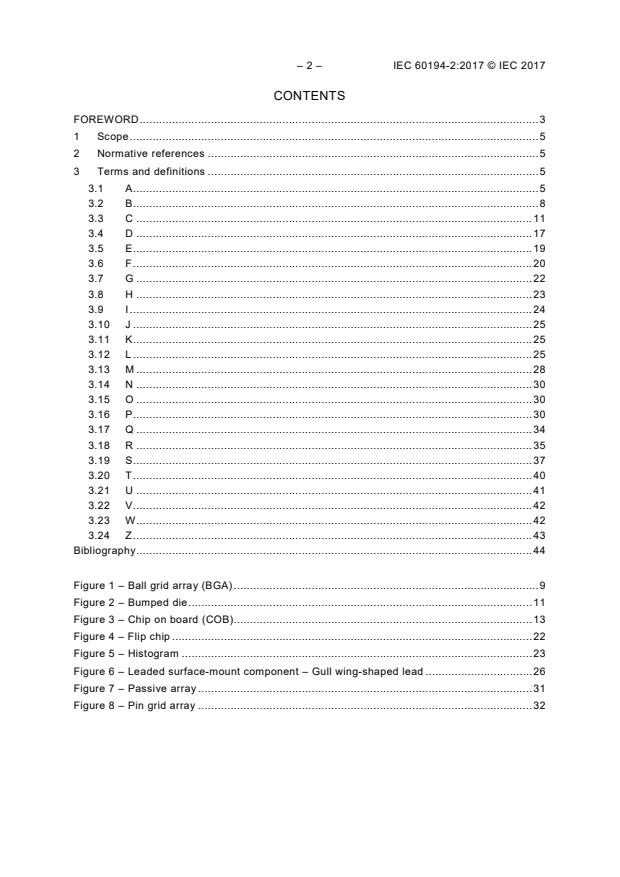
– 2 – IEC 60194-2:2017 © IEC 2017
CONTENTS
FOREWORD . 3
1 Scope . 5
2 Normative references . 5
3 Terms and definitions . 5
3.1 A . 5
3.2 B . 8
3.3 C . 11
3.4 D . 17
3.5 E . 19
3.6 F . 20
3.7 G . 22
3.8 H . 23
3.9 I . 24
3.10 J . 25
3.11 K . 25
3.12 L . 25
3.13 M . 28
3.14 N . 30
3.15 O . 30
3.16 P . 30
3.17 Q . 34
3.18 R . 35
3.19 S . 37
3.20 T . 40
3.21 U . 41
3.22 V . 42
3.23 W . 42
3.24 Z . 43
Bibliography . 44
Figure 1 – Ball grid array (BGA) . 9
Figure 2 – Bumped die . 11
Figure 3 – Chip on board (COB) . 13
Figure 4 – Flip chip . 22
Figure 5 – Histogram . 23
Figure 6 – Leaded surface-mount component – Gull wing-shaped lead . 26
Figure 7 – Passive array . 31
Figure 8 – Pin grid array . 32
INTERNATIONAL ELECTROTECHNICAL COMMISSION
____________
PRINTED BOARDS DESIGN, MANUFACTURE
AND ASSEMBLY – VOCABULARY –
Part 2: Common usage in electronic technologies as well
as printed board and electronic assembly technologies
FOREWORD
1) The International Electrotechnical Commission (IEC) is a worldwide organization for standardization comprising
all national electrotechnical committees (IEC National Committees). The object of IEC is to promote
international co-operation on all questions concerning standardization in the electrical and electronic fields. To
this end and in addition to other activities, IEC publishes International Standards, Technical Specifications,
Technical Reports, Publicly Available Specifications (PAS) and Guides (hereafter referred to as "IEC
Publication(s)"). Their preparation is entrusted to technical committees; any IEC National Committee interested
in the subject dealt with may participate in this preparatory work. International, governmental and non-
governmental organizations liaising with the IEC also participate in this preparation. IEC collaborates closely
with the International Organization for Standardization (ISO) in accordance with conditions determined by
agreement between the two organizations.
2) The formal decisions or agreements of IEC on technical matters express, as nearly as possible, an international
consensus of opinion on the relevant subjects since each technical committee has representation from all
interested IEC National Committees.
3) IEC Publications have the form of recommendations for international use and are accepted by IEC National
Committees in that sense. While all reasonable efforts are made to ensure that the technical content of IEC
Publications is accurate, IEC cannot be held responsible for the way in which they are used or for any
misinterpretation by any end user.
4) In order to promote international uniformity, IEC National Committees undertake to apply IEC Publications
transparently to the maximum extent possible in their national and regional publications. Any divergence
between any IEC Publication and the corresponding national or regional publication shall be clearly indicated in
the latter.
5) IEC itself does not provide any attestation of conformity. Independent certification bodies provide conformity
assessment services and, in some areas, access to IEC marks of conformity. IEC is not responsible for any
services carried out by independent certification bodies.
6) All users should ensure that they have the latest edition of this publication.
7) No liability shall attach to IEC or its directors, employees, servants or agents including individual experts and
members of its technical committees and IEC National Committees for any personal injury, property damage or
other damage of any nature whatsoever, whether direct or indirect, or for costs (including legal fees) and
expenses arising out of the publication, use of, or reliance upon, this IEC Publication or any other IEC
Publications.
8) Attention is drawn to the Normative references cited in this publication. Use of the referenced publications is
indispensable for the correct application of this publication.
9) Attention is drawn to the possibility that some of the elements of this IEC Publication may be the subject of
patent rights. IEC shall not be held responsible for identifying any or all such patent rights.
International Standard IEC 60194-2 has been prepared by IEC technical committee 91:
Electronics assembly technology.
This first edition, together with IEC 60194-1, will cancel and replace IEC 60194:2015. This
edition constitutes a technical revision.
This edition includes the following significant technical changes with respect to
IEC 60194:2015:
a) exclusion of 32 general terms better served by other TCs;
b) exclusion of 47 terms no longer used by the electronics assembly industry;
c) inclusion of 13 new terms related with device embedded substrate technology;
d) removal of identification codes for terms as well as annexes.
– 4 – IEC 60194-2:2017 © IEC 2017
The text of this International Standard is based on the following documents:
CDV Report on voting
91/1442/CDV 91/1473/RVC
Full information on the voting for the approval of this International Standard can be found in
the report on voting indicated in the above table.
This document has been drafted in accordance with the ISO/IEC Directives, Part 2.
The committee has decided that the contents of this document will remain unchanged until the
stability date indicated on the IEC website under "http://webstore.iec.ch" in the data related to
the specific document. At this date, the document will be
• reconfirmed,
• withdrawn,
• replaced by a revised edition, or
• amended.
A bilingual version of this publication may be issued at a later date.
IMPORTANT – The 'colour inside' logo on the cover page of this publication indicates
that it contains colours which are considered to be useful for the correct
understanding of its contents. Users should therefore print this document using a
colour printer.
PRINTED BOARDS DESIGN, MANUFACTURE
AND ASSEMBLY – VOCABULARY –
Part 2: Common usage in electronic technologies as well
as printed board and electronic assembly technologies
1 Scope
This part of IEC 60194 covers terms and definitions related to printed board and electronic
assembly technologies as well as other electronic technologies.
2 Normative references
There are no normative references in this document.
3 Terms and definitions
For the purposes of electronics assembly technology, the terms and definitions in 3.1 to 3.24
apply.
ISO and IEC maintain terminological databases for use in standardization at the following
addresses:
• IEC Electropedia: available at http://www.electropedia.org/
• ISO Online browsing platform: available at http://www.iso.org/obp
3.1 A
3.1.1
abrasive trimming
adjustment of the value of a film component by notching it with a finely adjusted stream of an
abrasive material against the resistor surface
3.1.2
accelerated ageing
accelerated life test
test in which the parameters such as voltage and temperature are increased above normal
operating values to obtain observable or measurable deterioration in a relatively short period
of time
3.1.3
accelerated test
test to check the life expectancy of an electronic component or electronic assembly in a short
period of time by applying a physically severe condition(s) to the unit under test
3.1.4
acceleration factor
AF
ratio of stress in reliability testing to the normal operating condition
– 6 – IEC 60194-2:2017 © IEC 2017
3.1.5
acceptance inspection
inspection that determines conformance of a product to design specifications as
the basis for acceptance
3.1.6
acceptance quality level
AQL
number of defects (in %) within a population (lot) at which the lot has the chance to be
accepted with an acceptance probability of about 90 % when testing a sample
3.1.7
acceptance tests
tests deemed necessary to determine the acceptability of a product as agreed to by both
purchaser and vendor
3.1.8
accuracy
degree to which the result of a measurement or calculation agrees with the true value
3.1.9
active device
electronic component whose basic character changes while operating on an applied signal
Note 1 to entry: This includes diodes, transistors, thyristors, and integrated circuits that are used for the
rectification, amplification, switching, etc., of analogue or digital circuits in either monolithic or hybrid form.
3.1.10
add-on component
discrete or integrated packaged or chip components that are attached to a film circuit in order
to complete the circuit's function
3.1.11
adhesive
non-metallic materials that can join solids by surface bonding and internal strength (adhesion
and cohesion)
Note 1 to entry: In surface mounting, an epoxy adhesive is used to adhere SMDs to the substrate.
[SOURCE: IEC 60050-212:2010, 212-15-44]
3.1.12
all metal package
hybrid circuit package made solely of metal, without glass or ceramic
3.1.13
allowable temperature
temperature range in which an electronic circuit or component can perform its intended
functions
3.1.14
alphanumerical, adj
pertaining to data that contain the letters of an alphabet, the decimal digits, and may contain
control characters, special characters and the space character
3.1.15
alpha particle
He nucleus generated from a nuclear decay that is capable of generating hole-electron pairs
in microelectronic devices and switching cells, causing soft errors in some devices
3.1.16
alternating current
AC
electric current that is a periodic function of time with a zero direct component or, by
extension, a negligible direct component
Note 1 to entry: For the qualifier AC, see IEC 60050-151.
[SOURCE: IEC 60050-131:2002, 131-11-24]
3.1.17
ambient
surrounding environment coming into contact with the system or component in question
3.1.18
amplitude
maximum value of a voltage of an alternating voltage within one period
3.1.19
analogue circuit
electrical circuit that provides a continuous relationship between its input and output
3.1.20
anisotropy
condition for a substance having differing values for properties, such as permittivity,
depending on the direction within the material
3.1.21
anode
electrode capable of emitting positive charge carriers to and/or receiving negative charge
carriers from the medium of lower conductivity
Note 1 to entry: The direction of electric current is from the external circuit, through the anode, to the medium of
lower conductivity.
Note 2 to entry: In some cases (e.g. electrochemical cells), the term "anode" is applied to one or another
electrode, depending on the electric operating condition of the device. In other cases (e.g. electronic tubes and
semiconductor devices), the term "anode" is assigned to a specific electrode.
[SOURCE: IEC 60050-151:2001, 151-13-02]
3.1.22
application-specific integrated circuit
ASIC
integrated circuit designed for specific applications
[SOURCE: IEC 60050-521:2002, 521-11-18]
3.1.23
area array package
package that has terminations arranged in a grid on the bottom of the package and contained
within the package outline
3.1.24
assembly
assembled board
number of parts, subassemblies or combinations thereof joined together
Note 1 to entry: This term can be used in conjunction with other terms listed herein, for example, "printed board
assembly".
– 8 – IEC 60194-2:2017 © IEC 2017
3.1.25
attenuation
decrease of the energy of an electromagnetic wave during its propagation, represented
quantitatively by the ratio of the power flux densities at two specified points
Note 1 to entry: Attenuation is generally expressed in decibels.
[SOURCE: IEC 60050-705:1995, 705-02-05]
3.2 B
3.2.1
backfill
filling a hybrid circuit package with a dry inert gas prior to hermetic sealing
3.2.2
backplane
backpanel
interconnection device used to provide point-to-point electrical interconnections
Note 1 to entry: It is usually a printed board that has discrete wiring terminals on one side and connector
receptacles on the other side.
3.2.3
backward crosstalk
near-end crosstalk
noise induced into an adjacent line, as seen at that end of the adjacent line which is closest to
the signal source, when this line has been placed near an active line
Note 1 to entry: See also "forward crosstalk".
3.2.4
balanced transmission line
transmission line that has distributed inductance, capacitance, resistance, and conductance
elements that are equally distributed between its conductors
3.2.5
ball
raised metal (or other conductive material) feature on a package substrate used to facilitate
bonding to the next level of interconnect
3.2.6
ball grid array
BGA
surface-mount package wherein the bumps for terminations are formed in a grid on the bottom
of a package
SEE: Figure 1.
IEC
Figure 1 – Ball grid array (BGA)
3.2.7
barcode
linear arrangement of bars and spaces in a predetermined pattern
3.2.8
barcode marking
identification code consisting of a pattern of vertical bars whose width and spacing identifies
the item marked
3.2.9
barcode symbol
print of photographically reproduced barcode composed of parallel bars and spaces of various
widths
Note 1 to entry: A barcode symbol contains a leading quiet zone, a start character, data characters, a stop
character, and a trailing quiet zone; in some cases, a check character is included.
3.2.10
bare die
unpackaged discrete semiconductor or integrated circuit with pads on the upper surface
suitable for interconnection to the substrate or package
3.2.11
base film
film that is the base material for the flexible printed wiring board and on the
surface of which the conductive pattern can be formed
Note 1 to entry: When the heat resistance is required, polyimide film is mostly used, and polyester film is usually
used when the heat resistance is not required.
3.2.12
base material
substrate
insulating material upon which a conductive pattern may be formed
Note 1 to entry: The base material may be rigid or flexible, or both. It may be a dielectric or insulated metal sheet.
3.2.13
base material thickness
thickness of the base material excluding conductive foil or material deposited on the surfaces
– 10 – IEC 60194-2:2017 © IEC 2017
3.2.14
base plane
plane that includes the lowest point of the mounting surface of the package, except for
packages using stand-offs
3.2.15
basic specification
BS
document that describes the common elements for a set, family or group of products,
materials, or services
3.2.16
bending resistance
ability of a material to withstand repeated bending to specified parameters without producing
cracks and breaks in excess of the specification allowance
3.2.17
bias
filling yarn that is off-square with the warp ends of a fabric
3.2.18
bipolar device
device in which both majority and minority carriers are present
Note 1 to entry: Bipolar and metal-oxide semiconductor (MOS) are the two most common device types.
3.2.19
bond
interconnection that performs a permanent electrical and/or mechanical function
3.2.20
bond pads
metallised areas on the die that are used for temporary or permanent electrical connection
(bonding)
3.2.21
bond strength
pull strength
force perpendicular to a board's surface required to separate two adjacent layers of the board
Note 1 to entry: Bond strength is expressed as force per unit area.
3.2.22
bonding pad
area of metallization on an integrated circuit die that permits connection of fine wires or
a circuit element to the die
3.2.23
bonding wire
gold or aluminium wire used for making electrical connections between lands, lead frames,
and terminals
3.2.24
bow
warp
filling yarn that lies in an arc across the width of a fabric
3.2.25
break-down voltage
voltage at which the insulation between two conductors ruptures
3.2.26
bridging
unintentional formation of a conductive path between conductors
3.2.27
bulk packaging
method for packaging loose parts, into a bag or case
3.2.28
bumped die
semiconductor die with raised metal features that facilitate inner-lead bonding
SEE: Figure 2.
Bumped lead
Bumped die
IEC
Figure 2 – Bumped die
3.2.29
burn-in
process of electrically stressing a device at an elevated temperature, for a sufficient
amount of time to cause the failure of marginal devices (infant mortality)
3.2.30
burn-in
burn-in at high temperatures that simulates the effects of actual or simulated
operating conditions
3.2.31
burn-in
burn-in at high temperatures with unvarying voltage, either forward or reverse bias
3.3 C
3.3.1
capacitance
measure of the ability of two adjacent conductors separated by an insulator to hold a charge
when a voltage is impressed between them
[SOURCE: IEC 60050-131:2008, 131-12-13]
3.3.2
capacitive coupling
electrical interaction between two conductors that is caused by the capacitance between them
– 12 – IEC 60194-2:2017 © IEC 2017
3.3.3
ceramic dual in-line package
CERDIP
dual in-line package that has a package body of ceramic material and is hermetically sealed
by a glass
Note 1 to entry: See also "dual in-line package".
3.3.4
ceramic pin grid array
ceramic PGA
pin grid array package (PGA) made of a ceramic material, hermetically sealed by metal, with
leads formed on a grid extending from the bottom of the package
3.3.5
ceramic quad flat package
CQFP
quad flat package (QPF) made of a ceramic material, hermetically sealed by metal, with leads
extending from all four sides
3.3.6
certification
verification that specified training or testing has been performed and that required proficiency
or parameter values have been attained
3.3.7
characteristic impedance
quantity defined for a mode of propagation at a given frequency in a specific uniform
transmission line or uniform waveguide by one of the three following relations:
Z = S/|I|
Z = |U| /S
= U / I
Z
where
Z is the complex characteristic impedance,
S is the complex power, and
U and I are the values, usually complex, respectively of a voltage and a current
conventionally defined for each type of mode by analogy with transmission line equations.
EXAMPLE 1 For a parallel-wire transmission line, U and I can be uniquely defined and the three equations are
consistent. If the transmission line is lossless, the characteristic impedance is real.
EXAMPLE 2 For a waveguide, the conventional definitions for U and I depend on the type of mode and generally
lead to three different values of the characteristic impedance.
EXAMPLE 3 For a circular waveguide in the dominant mode ТЕ11, U = RMS voltage along the diameter where the
magnitude of the electric field strength vector is a maximum, I = the r.m.s. longitudinal current.
EXAMPLE 4 For a rectangular waveguide in the dominant mode TE10, U = the RMS voltage between midpoints of
the two conductor faces normal to the electric field strength vector, I = the RMS longitudinal current following on
one surface normal to the electric field strength vector.
[SOURCE: IEC 60050-726:1982, 726-07-01]
3.3.8
chemical vapour deposition
process in which vapours and gases react chemically to produce deposits at the surface of a
substrate
[SOURCE: IEC 60050-841:2004, 841-22-07]
3.3.9
chip
SEE: "die".
Note 1 to entry: Common parlance for die.
3.3.10
chip carrier
low-profile, usually square, surface-mount component semiconductor package whose die
cavity or die mounting area is a large fraction of the package size and whose external
connections are usually on all four sides of the package
Note 1 to entry: It can be leaded or leadless.
3.3.11
chip-on-board
COB
printed board assembly technology that places unpackaged semiconductor dice and
interconnects them by wire bonding or similar attachment techniques
SEE: Figure 3.
Encapsulant
(glob top)
I/O pitch
translation
(substrate)
Wire bonds
Die attach
IEC
Figure 3 – Chip on board (COB)
Note 1 to entry: The silicon area density is usually smaller than the density of the printed board.
Note 2 to entry: A mounting and attachment technique where the die is mounted onto a substrate, often a printed-
circuit board.
3.3.12
chip-on-flex
COF
semiconductor chip mounted directly onto a flexible printed board
– 14 – IEC 60194-2:2017 © IEC 2017
3.3.13
chip-on-glass
COG
assembly technology that uses an unpackaged semiconductor die mounted directly on a glass
substrate such as a glass plate for liquid crystal displays (LCD)
3.3.14
chip scale package
CSP
generic term for packaging technologies that result in a packaged part that is only marginally
larger than the internal die
3.3.15
circuit
number of electrical elements and devices that have been interconnected to perform a desired
electrical function
3.3.16
CMOS
complementary metal-oxide semiconductor
fabrication technology that results in the creation of both NMOS and PMOS FET devices
3.3.17
coaxial cable
cable in the form of a central wire surrounded by a conductor tubing or sheathing that serves
as a shield and return
3.3.18
compensation circuit
electrical circuit that alters the functioning of another circuit to which it is applied to achieve a
desired performance
3.3.19
component
individual part or combination of parts that, when together, perform (a) design function(s)
Note 1 to entry: See also "discrete component".
3.3.20
component mounting site
location on a packaging and interconnecting structure (P&I) that consists of a land pattern and
conductor fan-out to additional lands for testing, or vias that are associated with the mounting
of a single component
3.3.21
compression seal
tight joint made between a component package and its leads that is formed as heated metal
cools and shrinks around a glass insulator
3.3.22
computer-aided design
CAD
interactive use of computer systems, programs, and procedures in the design process
wherein the decision-making activity rests with the human operator and a computer provides
the data manipulation function
3.3.23
conditioning
subjection of a specimen for a specified duration to specific climatic conditions (usually a
specified temperature and a specified relative humidity) or to an atmosphere of specified
relative humidity or to complete immersion in water or other liquid
[SOURCE: IEC 60050-212:2010, 212-12-01]
3.3.24
conductance
for a resistive two-terminal element or two-terminal circuit with terminals A and B, quotient of
the electric current i in the element or circuit by the voltage u (IEC 60050-131:2013, 131-
AB
11-56) between the terminals
i
G=
u
AB
where the electric current is taken to be positive if its direction is from A to B and negative if
its direction is from B to A
Note 1 to entry: The conductance of an element or circuit is the inverse of its resistance.
Note 2 to entry: The term "conductance" is also a short term for "conductance to alternating current" (IEC 60050-
131:2013, 131-12-53).
Note 3 to entry: The coherent SI unit of conductance is siemens, S.
[SOURCE: IEC 60050-131:2013, 131-12-06]
3.3.25
conductive ink
liquid medium with a suspended powder of an electrically conductive material
3.3.26
conductive medium
material with a suspended powder of an electrically conductive material
3.3.27
conductive pattern
conductor pattern
configuration formed by the electrically conductive material of a printed board
[SOURCE: IEC 60050-541:1990, 541-01-04]
3.3.28
conductivity
ability of a substance or material to conduct electricity
3.3.29
conductivity
ability of a substance or material to conduct heat
– 16 – IEC 60194-2:2017 © IEC 2017
3.3.30
conductor
trace
conductor line
conductor path
conductor track
line
electrical path
track
single conductive path in a conductive pattern
[SOURCE: IEC 60050-541:1990, 541-01-20]
3.3.31
constraining core
supporting plane that is internal to a packaging and interconnecting structure
3.3.32
controlled collapse soldering
controlled collapse
technique for soldering a component (i.e., flip chip, chip scale
package, BGA) to a substrate, where the component connection surface tension forces of the
liquid solder support the weight of the component and controls the height of the joint
3.3.33
coplanar leads
flat beam leads of a component package that have been formed so that they can
simultaneously contact one plane of a base material
3.3.34
corona
electrical discharge brought on by the ionization of a liquid surrounding a conductor, which
occurs when the potential gradient exceeds a certain value, but conditions are insufficient to
cause complete electrical breakdown or arcing
3.3.35
creel
device used as a yarn package rack to hold warp ends for a section beam
3.3.36
critical defect
anomaly specified as being unacceptable
3.3.37
crosstalk
spurious signal
undesirable transfer of electrical energy between neighbouring conductors (coupling) by
mutual inductance and capacitance
Note 1 to entry: See also "backward crosstalk" and "forward crosstalk".
3.3.38
cupping
condition of a ball grid array package after reflow where the corners turn up and away
from the printed board laminate surface
Note 1 to entry: This condition in the worst case causes the balls on the outside row to be in tension and the balls
in the centre to be in compression.
Note 2 to entry: Opposite of "doming ".
3.3.39
current
flow or movement of electrons in a conductor as the result of a voltage difference between the
ends of the conductive path
3.3.40
current-carrying capacity
maximum electrical current that can be carried continuously by a conductor, under specified
conditions, without causing objectable degradation of electrical and mechanical properties of
the product
3.3.41
customer detail specification
CDS
document that establishes the specific requirements, identified in a detailed specification, in
order to tailor these to meet the needs of a custom product, material, or service
3.4 D
3.4.1
damage
result of an event that degrades a product, for example a component, printed board, or
module, beyond the form, fit and function limits of the governing document
3.4.2
data capture
automatic collection of information from a given machine or other information source
3.4.3
database
comprehensive collection of information that is structured in such a way that some or all of its
data may be used to create queries about related items contained within it
3.4.4
dead-bug, adj
orientation of a package with the terminations facing up
3.4.5
decoupling
absorption of noise pulses in power supply lines, which are generated by switching logic
devices, so as to prevent the lines from disturbing other logic devices in the same
power-supply circuit
3.4.6
defect
non-conformance or other risk factors as identified by the manufacturer
Note 1 to entry: A process and/or material non-conformance that could result in a reduction of functional
capability, design life or reliability.
3.4.7
degradation
undesired departure in the operational performance of any device, equipment or system from
its intended performance
Note 1 to entry: The term "degradation" can apply to temporary or permanent failure.
[SOURCE: IEC 60050-161:1990, 161-01-19]
– 18 – IEC 60194-2:2017 © IEC 2017
3.4.8
detail specification
detailed written description of a part or a process
3.4.9
dice
two or more die
3.4.10
dicing
separating of semi-conductor wafers into individual die
3.4.11
die
chip
leadless device
separated part (or whole) of a wafer intended to perform a function or functions in a device
[SOURCE: IEC 60050-521:2002, 521-05-30]
3.4.12
die bonding
attachment of a die to base material
3.4.13
die device
bare die, with or without connection structures, or a minimally packaged die
3.4.14
dielectric strength
maximum voltage that a dielectric can withstand under specified conditions without a voltage
breakdown
Note 1 to entry: Dielectric strength is usually expressed as volts per unit dimension.
3.4.15
digital circuit
electrical circuit that provides two (binary) or three distinct relationships (states) between its
input and output
3.4.16
direct current
DC
electric current that is time-independent or, by extension, periodic current, the direct
component of which is of primary importance
Note 1 to entry: For the qualifier DC, see IEC 60050-151.
[SOURCE: IEC 60050-131:2002, 131-11-22]
3.4.17
discrete component
separate part of a printed board assembly that performs a circuit function (for example, a
resistor, a capacitor, a transistor)
3.4.18
doming
condition of a ball grid array package after reflow where the corners turn down and
toward the printed board laminate surface
Note 1 to entry: This condition in the worst case causes the balls on the outside row to be compressed and the
balls in the centre to be in tension.
Note 2 to entry: Opposite of "cupping BGA".
3.4.19
doping
addition of a specific impurity to a slice of silicon monocrystal to alter the conductivity of the
crystal in a specified manner in order to produce semiconductor devices from this crystal
3.4.20
double-sided assembly
packaging and interconnecting structure with components mounted on both the primary and
secondary sides
Note 1 to entry: See also "single-sided assembly".
3.4.21
dry pack
container that maintains the moisture content of the packages of die devices within specified
limits
3.4.22
dual in-line package
DIP
basically rectangular component package that has a row of leads extending from each of the
longer sides of its body that are formed at right angles to a plane and parallel to the base of
its body
3.5 E
3.5.1
edge-transmission attenuation
loss of a logic signal's switching-edge sharpness that has been caused by the absorption of
the highest-frequency components by the transmission line
Note 1 to entry: See also "attenuation".
3.5.2
electrical characteristics
distinguishing electrical traits or properties of a component or assembly
3.5.3
electromagnetic compatibility
EMC
ability of a device to function properly in its operating environment without causing
electromagnetic interference to other equipment, or itself being susceptible to external
interference
3.5.4
electromagnetic interference
EMI
degradation of the performance of a piece of equipment, transmission channel or system
caused by an electromagnetic disturbance
Note 1 to entry: In French, the terms "perturbation électromagnétique" and "brouillage électromagnétique"
designate respectively the cause and the effect, and should not be used indiscriminately.
Note 2 to entry: In English, the terms "electromagnetic disturbance" and "electromagnetic interference" designate
respectively the cause and the effect, but they are often used indiscriminately.
[SOURCE: IEC 60050-161:1990, 161-01-06]
– 20 – IEC 60194-2:2017 © IEC 2017
3.5.5
electrostatic discharge
ESD
transfer of electric charge between bodies of different electrostatic potential in proximity or
through direct contact
[SOURCE: IEC 60050-161:1990, 161-01-22]
3.6 F
3.6.1
farad
unit of electrical capacitance
3.6.2
far-end crosstalk
SEE: "forward crosstalk".
3.6.3
fault
condition that causes a device or circuit to fail to operate in a proper manner
3.6.4
film conductor
conductor formed in place on a base material by depositing a conductive material using
screening, plating or evaporating techniques
3.6.5
film network
electrical network composed of thin-film and/or thick-film components on a base material
3.6.6
final inspection
delivery inspection
evaluation of quality characteristics relating to a standard, specification, or design drawing
prior to shipping to the customer
3.6.7
final seal
manufacturing process that completes the enclosure of a microcircuit so that further internal
processing cannot be performed without removing a lid or otherwise disassembling the
package
3.6.8
fine leak
/s at 1 atm of differential air pressure
leak in a sealed package that is less than 0,000 01 cm
3.6.9
fine pitch QFP
quad flat pack (QFP) package whose lead pitch centres at 0,635 mm or less
3.6.10
flat pack
rectangular component package that has a row of leads extending from each of the longer
sides of its body that are parallel to the base of its body
3.6.11
flexible double-sided printed board
double-sided flexible printed wiring board
double-sided printed board using a flexible base material only
[SOURCE: IEC 60050-541:1990, 541-01-14]
3.6.12
flexible material interconnect construction
FMIC
integration of passive and active components with mechanical components (including
switches and connectors) on a flexible or thin base material, i.e., flexible printed board, in
order to produce an electronic assembly
3.6.13
flexible multilayer printed board
multilayer printed board using a flexible base material only
Note 1 to entry: Different areas of the flexible multilayer printed board may have different numbers of layers and
different thicknesses and consequently different flexibility.
[SOURCE: IEC 60050-541:1990, 541-01-05]
3.6.14
flexible printed board
printed board using a flexible base material only
Note 1 to entry: It can be partially provided with electrically non-functional stiffeners and/or coverlayers.
[SOURCE: IEC 60050-541:1990, 541-01-12]
3.6.15
flexible printed circuit
patterned arrangement of printed circuitry and components that uses a flexible base material
with or without a flexible coverlayer
3.6.16
flexible printed wiring
patterned arrangement of printed wiring that uses a flexible base material with or without
flexible coverlayer
3.6.17
flexible single-sided printed board
single-sided printed board using a flexible base material only
[SOURCE: IEC 60050-541:1990, 541-01-13]
3.6.18
flex-rigid double-sided printed board
SEE: "rigid-flex double-sided printed board".
3.6.19
flex-rigid printed board
SEE: "rigid-flex printed board".
3.6.20
flip chip
leadless monolithic circuit element structure that electrically and mechanically interconnects
to a printed board by conductive bumps
– 22 – IEC 60194-2:2017 © IEC 2017
SEE: Figure 4.
Plated copper
Underfill 97/3 or 95/5 Sn/Pb solder
conductor
epoxy
IC
BT substrate Thermal via Eutectic solder ball
IEC
Figure 4 – Flip chip
3.6.21
forward crosstalk
far-end crosstalk
noise induced into a adjacent line, as seen at the end of the adjacent line that is the farthest
from the signal source, because the adjacent line has been placed next to an active line
Note 1 to entry: See also "backward crosstalk".
3.6.22
frequency
number of cycles (hertz) or completed alterations per second
3.6.23
fully additive process
fully electroless process
additive process wherein the entire thickness of electrically isolated conductors is obtained by
the use of electroless deposition
Note 1 to entry: See also: "semi-additive process".
3.7 G
3.7.1
generic specification
GS
document that describes as many general requirements as possible, per
...
Questions, Comments and Discussion
Ask us and Technical Secretary will try to provide an answer. You can facilitate discussion about the standard in here.
Loading comments...