


IEC TR 60755:2008
(Main)General requirements for residual current operated protective devices
General Information
- Abstract
The requirements of this technical report apply to residual current operated protective devices (hereinafter referred to as "residual current devices" (RCD)) for rated voltages not exceeding 440 V a.c., intended primarily for protection against shock hazard. They are intended to be used by technical committees when drafting product standards and apply only if they are incorporated or are referred to in the relevant standards. This report is not intended to be used as a stand-alone standard, for example, for certification. IEC 60755 has been revised in order to align the previous version with the latest editions of IEC 61008, IEC 61009, IEC 62423 and IEC 60947-2. This second edition of IEC 60755 cancels and replaces the first edition published in 1983.
- Status
- Replaced
- Publication Date
- 29-Jan-2008
- Technical Committee
- SC 23E - Circuit-breakers and similar equipment for household use
- Drafting Committee
- WG 2 - TC 23/SC 23E/WG 2
- Current Stage
- DELPUB - Deleted Publication
- Start Date
- 02-Nov-2017
- Completion Date
- 28-Aug-2026
Relations
- Replaced By
IEC 60755:2017 - General safety requirements for residual current operated protective devices - Effective Date
- 05-Sep-2023
- Effective Date
- 10-Feb-2026
- Effective Date
- 10-Feb-2026
- Effective Date
- 10-Feb-2026
- Effective Date
- 10-Feb-2026
- Effective Date
- 10-Feb-2026
- Effective Date
- 10-Feb-2026
- Effective Date
- 10-Feb-2026
- Effective Date
- 10-Feb-2026
- Effective Date
- 10-Feb-2026
- Effective Date
- 10-Feb-2026
- Referred By
EN 61851-1:2011 - Electric vehicle conductive charging system - Part 1: General requirements - Effective Date
- 10-Feb-2026
- Effective Date
- 10-Feb-2026
Get Certified
Connect with accredited certification bodies for this standard

IMQ S.p.A. (Certification)
Italian electrical product certification.

SLG Prüf- und Zertifizierungs GmbH
German testing and certification body.

UL Solutions
Global safety science company with testing, inspection and certification.
Sponsored listings
Frequently Asked Questions
IEC TR 60755:2008 is a technical report published by the International Electrotechnical Commission (IEC). Its full title is "General requirements for residual current operated protective devices". This standard covers: The requirements of this technical report apply to residual current operated protective devices (hereinafter referred to as "residual current devices" (RCD)) for rated voltages not exceeding 440 V a.c., intended primarily for protection against shock hazard. They are intended to be used by technical committees when drafting product standards and apply only if they are incorporated or are referred to in the relevant standards. This report is not intended to be used as a stand-alone standard, for example, for certification. IEC 60755 has been revised in order to align the previous version with the latest editions of IEC 61008, IEC 61009, IEC 62423 and IEC 60947-2. This second edition of IEC 60755 cancels and replaces the first edition published in 1983.
The requirements of this technical report apply to residual current operated protective devices (hereinafter referred to as "residual current devices" (RCD)) for rated voltages not exceeding 440 V a.c., intended primarily for protection against shock hazard. They are intended to be used by technical committees when drafting product standards and apply only if they are incorporated or are referred to in the relevant standards. This report is not intended to be used as a stand-alone standard, for example, for certification. IEC 60755 has been revised in order to align the previous version with the latest editions of IEC 61008, IEC 61009, IEC 62423 and IEC 60947-2. This second edition of IEC 60755 cancels and replaces the first edition published in 1983.
IEC TR 60755:2008 is classified under the following ICS (International Classification for Standards) categories: 29.120.50 - Fuses and other overcurrent protection devices. The ICS classification helps identify the subject area and facilitates finding related standards.
IEC TR 60755:2008 has the following relationships with other standards: It is inter standard links to IEC 60755:2017, EN IEC 62840-2:2019, EN IEC 62040-1:2019, EN 61008-1:2012, EN 60974-9:2010, EN 62606:2013, EN 62109-1:2010, EN IEC 62485-2:2018, EN 61557-11:2009, EN 62040-1:2008, EN 62446:2009, EN 61851-1:2011, EN 62477-1:2012. Understanding these relationships helps ensure you are using the most current and applicable version of the standard.
IEC TR 60755:2008 is available in PDF format for immediate download after purchase. The document can be added to your cart and obtained through the secure checkout process. Digital delivery ensures instant access to the complete standard document.
Standards Content (Sample)
IEC/TR 60755
Edition 2.0 2008-01
TECHNICAL
REPORT
RAPPORT
TECHNIQUE
General requirements for residual current operated protective devices
Exigences générales pour les dispositifs de protection à courant différentiel
résiduel
IEC/TR 60755:2008
All rights reserved. Unless otherwise specified, no part of this publication may be reproduced or utilized in any form or by
any means, electronic or mechanical, including photocopying and microfilm, without permission in writing from either IEC or
IEC's member National Committee in the country of the requester.
If you have any questions about IEC copyright or have an enquiry about obtaining additional rights to this publication,
please contact the address below or your local IEC member National Committee for further information.
Droits de reproduction réservés. Sauf indication contraire, aucune partie de cette publication ne peut être reproduite
ni utilisée sous quelque forme que ce soit et par aucun procédé, électronique ou mécanique, y compris la photocopie
et les microfilms, sans l'accord écrit de la CEI ou du Comité national de la CEI du pays du demandeur.
Si vous avez des questions sur le copyright de la CEI ou si vous désirez obtenir des droits supplémentaires sur cette
publication, utilisez les coordonnées ci-après ou contactez le Comité national de la CEI de votre pays de résidence.
IEC Central Office
3, rue de Varembé
CH-1211 Geneva 20
Switzerland
Email: inmail@iec.ch
Web: www.iec.ch
About the IEC
The International Electrotechnical Commission (IEC) is the leading global organization that prepares and publishes
International Standards for all electrical, electronic and related technologies.
About IEC publications
The technical content of IEC publications is kept under constant review by the IEC. Please make sure that you have the
latest edition, a corrigenda or an amendment might have been published.
ƒ Catalogue of IEC publications: www.iec.ch/searchpub
The IEC on-line Catalogue enables you to search by a variety of criteria (reference number, text, technical committee,…).
It also gives information on projects, withdrawn and replaced publications.
ƒ IEC Just Published: www.iec.ch/online_news/justpub
Stay up to date on all new IEC publications. Just Published details twice a month all new publications released. Available
on-line and also by email.
ƒ Electropedia: www.electropedia.org
The world's leading online dictionary of electronic and electrical terms containing more than 20 000 terms and definitions
in English and French, with equivalent terms in additional languages. Also known as the International Electrotechnical
Vocabulary online.
ƒ Customer Service Centre: www.iec.ch/webstore/custserv
If you wish to give us your feedback on this publication or need further assistance, please visit the Customer Service
Centre FAQ or contact us:
Email: csc@iec.ch
Tel.: +41 22 919 02 11
Fax: +41 22 919 03 00
A propos de la CEI
La Commission Electrotechnique Internationale (CEI) est la première organisation mondiale qui élabore et publie des
normes internationales pour tout ce qui a trait à l'électricité, à l'électronique et aux technologies apparentées.
A propos des publications CEI
Le contenu technique des publications de la CEI est constamment revu. Veuillez vous assurer que vous possédez
l’édition la plus récente, un corrigendum ou amendement peut avoir été publié.
ƒ Catalogue des publications de la CEI: www.iec.ch/searchpub/cur_fut-f.htm
Le Catalogue en-ligne de la CEI vous permet d’effectuer des recherches en utilisant différents critères (numéro de référence,
texte, comité d’études,…). Il donne aussi des informations sur les projets et les publications retirées ou remplacées.
ƒ Just Published CEI: www.iec.ch/online_news/justpub
Restez informé sur les nouvelles publications de la CEI. Just Published détaille deux fois par mois les nouvelles
publications parues. Disponible en-ligne et aussi par email.
ƒ Electropedia: www.electropedia.org
Le premier dictionnaire en ligne au monde de termes électroniques et électriques. Il contient plus de 20 000 termes et
définitions en anglais et en français, ainsi que les termes équivalents dans les langues additionnelles. Egalement appelé
Vocabulaire Electrotechnique International en ligne.
ƒ Service Clients: www.iec.ch/webstore/custserv/custserv_entry-f.htm
Si vous désirez nous donner des commentaires sur cette publication ou si vous avez des questions, visitez le FAQ du
Service clients ou contactez-nous:
Email: csc@iec.ch
Tél.: +41 22 919 02 11
Fax: +41 22 919 03 00
IEC/TR 60755
Edition 2.0 2008-01
TECHNICAL
REPORT
RAPPORT
TECHNIQUE
General requirements for residual current operated protective devices
Exigences générales pour les dispositifs de protection à courant différentiel
résiduel
INTERNATIONAL
ELECTROTECHNICAL
COMMISSION
COMMISSION
ELECTROTECHNIQUE
PRICE CODE
INTERNATIONALE
W
CODE PRIX
ICS : 29.120.50 ISBN 2-8318-9577-4
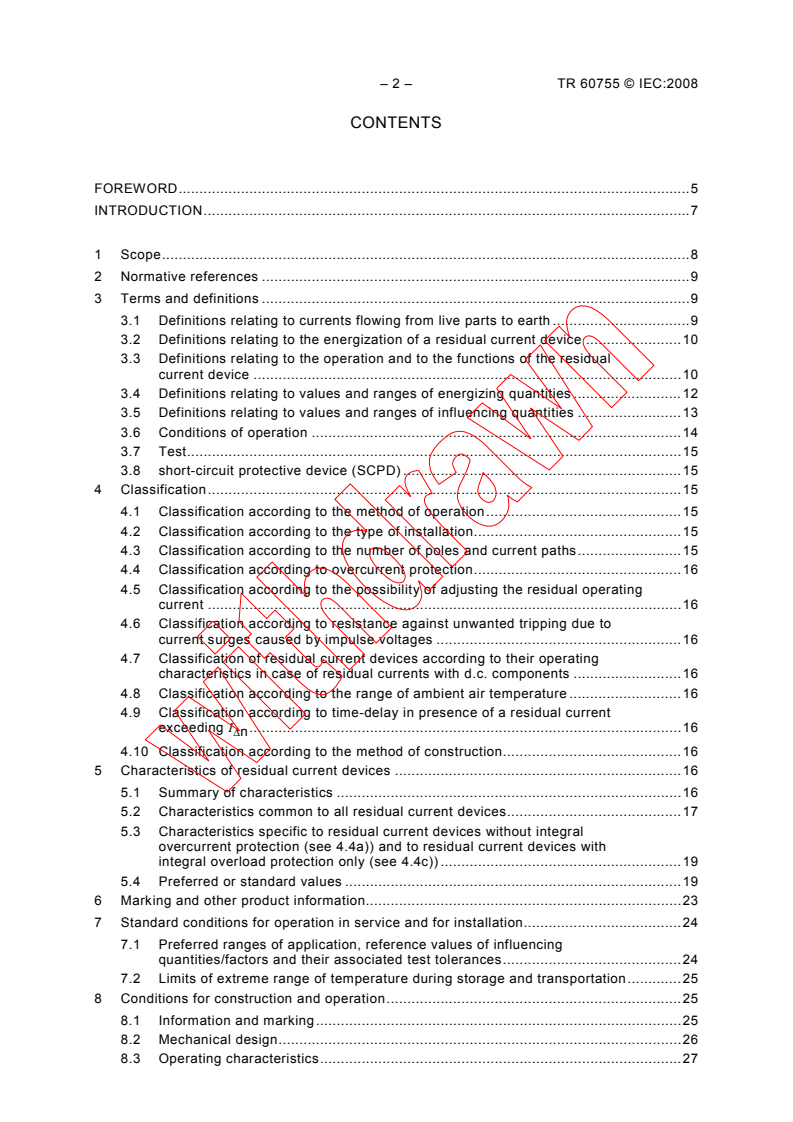
– 2 – TR 60755 © IEC:2008
CONTENTS
FOREWORD.5
INTRODUCTION.7
1 Scope.8
2 Normative references .9
3 Terms and definitions .9
3.1 Definitions relating to currents flowing from live parts to earth .9
3.2 Definitions relating to the energization of a residual current device .10
3.3 Definitions relating to the operation and to the functions of the residual
current device .10
3.4 Definitions relating to values and ranges of energizing quantities .12
3.5 Definitions relating to values and ranges of influencing quantities .13
3.6 Conditions of operation .14
3.7 Test.15
3.8 short-circuit protective device (SCPD) .15
4 Classification.15
4.1 Classification according to the method of operation.15
4.2 Classification according to the type of installation.15
4.3 Classification according to the number of poles and current paths.15
4.4 Classification according to overcurrent protection.16
4.5 Classification according to the possibility of adjusting the residual operating
current .16
4.6 Classification according to resistance against unwanted tripping due to
current surges caused by impulse voltages .16
4.7 Classification of residual current devices according to their operating
characteristics in case of residual currents with d.c. components .16
4.8 Classification according to the range of ambient air temperature .16
4.9 Classification according to time-delay in presence of a residual current
exceeding I .16
Δn
4.10 Classification according to the method of construction.16
5 Characteristics of residual current devices .16
5.1 Summary of characteristics .16
5.2 Characteristics common to all residual current devices.17
5.3 Characteristics specific to residual current devices without integral
overcurrent protection (see 4.4a)) and to residual current devices with
integral overload protection only (see 4.4c)) .19
5.4 Preferred or standard values .19
6 Marking and other product information.23
7 Standard conditions for operation in service and for installation.24
7.1 Preferred ranges of application, reference values of influencing
quantities/factors and their associated test tolerances.24
7.2 Limits of extreme range of temperature during storage and transportation.25
8 Conditions for construction and operation.25
8.1 Information and marking.25
8.2 Mechanical design.26
8.3 Operating characteristics.27
TR 60755 © IEC:2008 – 3 –
8.4 Test device.29
8.5 Temperature rise.29
8.6 Resistance to humidity .30
8.7 Dielectric properties .30
8.8 Limiting value of non-operation in case of balanced load and unbalanced
load.30
8.9 EMC compliance and unwanted tripping .30
8.10 Behaviour of residual current devices in case of overcurrent conditions .30
8.11 Resistance of the insulation against impulse voltages .30
8.12 Mechanical and electrical endurance.30
8.13 Resistance to mechanical shock.31
8.14 Reliability .31
8.15 Condition for reclosing a reset residual current device (3.3.13) .31
8.16 Protection against electric shock .31
8.17 Resistance to heat .31
8.18 Resistance to abnormal heat and to fire .31
8.19 Behaviour of residual current device within ambient temperature range.31
8.20 Behaviour of residual current device after exposure to extreme temperatures
during storage and transportation .32
9 Guidance for type tests.32
Annex A (informative) .33
Annex B.36
Bibliography.38
Figure A.1 – Diagram for all the short-circuit tests .34
Figure A.2 – Detail of impedance Z or Z .35
Figure B.1 – Possible load and fault currents according to the different electronic
circuits.36
Table 1 – Standard values of maximum break time of non-time-delay type RCDs for
a.c. residual current .21
Table 2 – Standard values of maximum break time of non-time-delay type RCDs for
half-wave pulsating d.c. residual current .21
Table 3 – Standard values of maximum break time of non-time-delay type RCDs for
residual direct currents which result from rectifying circuits and/or smooth d.c. residual
current .21
Table 4 – Acceptable alternative standard values of maximum break times for RCD
with a rated residual current of 6mA and non-time-delay type intended to be used in
bi-phase system 120V with middle point .21
Table 5 – Standard values of break time for a.c. residual current for time-delay type
residual current devices .22
Table 6 – Standard values of break time for pulsating d.c. residual current for time-
delay type residual current devices .22
Table 7 – Standard values of break time for smooth d.c. residual current for time-delay
type residual current devices .23
Table 8 – Tripping current ranges for type B RCDs at frequencies which differ from the
rated frequency 50/60 Hz.23
Table 9 – Values of influencing quantities .25
Table 10 – Tripping current limits.27
– 4 – TR 60755 © IEC:2008
Table 11 – Tripping current limitsÈ.27
Table 12 – Tripping current limits.28
Table 13 – List of minimum requirements to be checked or tested .32
TR 60755 © IEC:2008 – 5 –
INTERNATIONAL ELECTROTECHNICAL COMMISSION
____________
GENERAL REQUIREMENTS FOR RESIDUAL CURRENT OPERATED
PROTECTIVE DEVICES
FOREWORD
1) The International Electrotechnical Commission (IEC) is a worldwide organization for standardization comprising
all national electrotechnical committees (IEC National Committees). The object of IEC is to promote
international co-operation on all questions concerning standardization in the electrical and electronic fields. To
this end and in addition to other activities, IEC publishes International Standards, Technical Specifications,
Technical Reports, Publicly Available Specifications (PAS) and Guides (hereafter referred to as “IEC
Publication(s)”). Their preparation is entrusted to technical committees; any IEC National Committee interested
in the subject dealt with may participate in this preparatory work. International, governmental and non-
governmental organizations liaising with the IEC also participate in this preparation. IEC collaborates closely
with the International Organization for Standardization (ISO) in accordance with conditions determined by
agreement between the two organizations.
2) The formal decisions or agreements of IEC on technical matters express, as nearly as possible, an international
consensus of opinion on the relevant subjects since each technical committee has representation from all
interested IEC National Committees.
3) IEC Publications have the form of recommendations for international use and are accepted by IEC National
Committees in that sense. While all reasonable efforts are made to ensure that the technical content of IEC
Publications is accurate, IEC cannot be held responsible for the way in which they are used or for any
misinterpretation by any end user.
4) In order to promote international uniformity, IEC National Committees undertake to apply IEC Publications
transparently to the maximum extent possible in their national and regional publications. Any divergence
between any IEC Publication and the corresponding national or regional publication shall be clearly indicated in
the latter.
5) IEC provides no marking procedure to indicate its approval and cannot be rendered responsible for any
equipment declared to be in conformity with an IEC Publication.
6) All users should ensure that they have the latest edition of this publication.
7) No liability shall attach to IEC or its directors, employees, servants or agents including individual experts and
members of its technical committees and IEC National Committees for any personal injury, property damage or
other damage of any nature whatsoever, whether direct or indirect, or for costs (including legal fees) and
expenses arising out of the publication, use of, or reliance upon, this IEC Publication or any other IEC
Publications.
8) Attention is drawn to the Normative references cited in this publication. Use of the referenced publications is
indispensable for the correct application of this publication.
9) Attention is drawn to the possibility that some of the elements of this IEC Publication may be the subject of
patent rights. IEC shall not be held responsible for identifying any or all such patent rights.
The main task of IEC technical committees is to prepare International Standards. However, a
technical committee may propose the publication of a technical report when it has collected
data of a different kind from that which is normally published as an International Standard, for
example “state of the art”.
IEC 60755, which is a technical report, has been prepared by subcommittee 23E: Circuit-
breakers and similar equipment for household use, of IEC technical committee 23: Electrical
accessories.
The text of this technical report is based on the following documents:
DTR Report on voting
23E/635/DTR 23E/640/RVC
Full information on the voting for the approval of this technical report can be found in the
report on voting indicated in the above table.
– 6 – TR 60755 © IEC:2008
This second edition of IEC 60755 cancels and replaces the first edition published in 1983, its
first amendment published in 1988 and its second amendment published in 1992.
It constitutes a technical revision.
IEC 60755 has been revised in order to align the previous version with the latest editions of
IEC 61008, IEC 61009, IEC 62423 and IEC 60947-2.
This publication has been drafted in accordance with the ISO/IEC Directives, Part 2.
The committee has decided that the contents of this publication will remain unchanged until
the maintenance result date indicated on the IEC web site under “http://webstore.iec.ch” in the
data related to the specific publication. At this date, the publication will be
• reconfirmed,
• withdrawn,
• replaced by a revised edition or
• amended.
TR 60755 © IEC:2008 – 7 –
INTRODUCTION
Residual current devices are primarily intended to give protection against the risk of
dangerous, and possibly lethal, electric shocks and to provide protection against fire hazards
due to a persistent earth fault current.
This technical report specifies the operational characteristics for these devices; details of how
they should be installed to provide the desired level of protection are specified in the various
parts of IEC 60364.
This technical report is intended for use by technical committees in the preparation of
standards for residual current devices. It is not intended to be used as a stand-alone
standard, for example, for certification.
It has been prepared by subcommittee 23E in accordance with its pilot function for residual
current devices.
There are two basic conditions of protection against the risk of electric shock: fault protection
(indirect contact) and basic protection (direct contact).
Fault protection implies that the device is used to prevent dangerous voltages persisting on
accessible installation metalwork, which are earthed but become live under earth fault
conditions.
Under such conditions, the risk arises not from the user making direct contact with a live
conductive part but from making contact with earthed metalwork, which itself is in contact with
a live conductive part.
The primary or basic function of residual current devices is to give fault protection, but, with
devices of adequate sensitivity (i.e., units having operating residual currents not exceeding
30 mA), there is the additional benefit that, should other methods of protection fail, the device
will give a high degree of protection to a user making direct contact with a live conductive
part.
The operating characteristics given in this technical report are therefore based on
requirements, which themselves are based on the information contained in IEC 60479.
These devices also provide protection against the risk of fire resulting from earth fault
currents which can persist for lengthy periods without operating the overcurrent protective
device.
– 8 – TR 60755 © IEC:2008
GENERAL REQUIREMENTS FOR RESIDUAL CURRENT OPERATED
PROTECTIVE DEVICES
1 Scope
The requirements of this technical report apply to residual current operated protective devices
(hereinafter referred to as “residual current devices” (RCD)) for rated voltages not exceeding
440 V a.c., intended primarily for protection against shock hazard. They are intended to be
used by technical committees when drafting product standards and apply only if they are
incorporated or are referred to in the relevant standards. This report is not intended to be
used as a stand-alone standard, for example, for certification.
NOTE 1 This technical report may also be used as a guide for residual current devices of rated voltages up to
1 000 V, a.c.
It applies to
– a single device which detects a residual current (see 3.3.2), compares it to a reference
value (see 3.3.3) and opens the protected circuit when the residual current exceeds this
reference value (see 3.3.4);
– an association of devices, each one of them performing separately one or two of the
above-mentioned functions, but acting together in order to accomplish all three functions.
Particular requirements may be necessary for devices intended for accomplishing only
one or two of the above three functions.
This report applies for conditions as stated in Clause 7. For other conditions, additional
requirements may be necessary.
Residual current devices are intended to protect persons and livestock against harmful effects
of electric shock due to contact with exposed conductive parts by automatic disconnection of
supply in accordance with IEC 61140 and IEC 60364-4-41.
NOTE 2 In this context “harmful effects” include the risk of occurrence of heart fibrillation.
In accordance with IEC 60364-5-53, residual current devices with a rated residual operating
current not exceeding 300 mA may also be used to provide protection against fire hazards
due to a persistent earth fault current.
In accordance with IEC 60364-4-41, residual current devices with a rated residual operating
current not exceeding 30 mA may also be used for additional protection in case of failure of
the basic protective provisions or carelessness of the user of the installation or equipment.
For residual current devices performing additional functions, this technical report applies
together with the relevant standard covering the additional functions; for example, when
residual current devices incorporate a circuit-breaker it should comply with the relevant
circuit-breaker standard.
Supplementary or particular requirements may be necessary, for example, for
– residual current devices intended for use by uninstructed persons;
– socket-outlets, plugs, adapters and couplers incorporating residual current devices.
This technical report states
– the definitions of terms used for residual current devices (Clause 3) ;
– the classification of residual current devices (Clause 4);
– the characteristics of residual current devices (Clause 5);
– the preferred values of the operating and influencing quantities (5.4);
TR 60755 © IEC:2008 – 9 –
– the marking and information to be provided for residual current devices (Clause 6);
– the standard conditions for installation and operation in service (Clause 7);
– the requirements for construction and operation (Clause 8);
– the list of minimum requirements to be tested (Clause 9).
NOTE 3 Devices having a residual current function for specific purposes other than those mentioned above (for
example, motor protection) are not covered by this technical report.
2 Normative references
The following referenced documents are indispensable for the application of this document.
For dated references, only the edition cited applies. For undated references, the latest edition
of the referenced document (including any amendments) applies.
IEC 60038, IEC standard voltages
IEC 60050-411:1996, International Electrotechnical Vocabulary – Part 411: Rotating machines
IEC 60050-426:1990, International Electrotechnical Vocabulary – Part 426: Electrical
apparatus for explosive atmospheres
IEC 60050-441:1984, International Electrotechnical Vocabulary – Part 441: Switchgear,
controlgear and fuses
IEC 60050-442:1998, International Electrotechnical Vocabulary – Part 442: Electrical
acccessories
IEC 60050-471:2007, International Electrotechnical Vocabulary – Part 471: Insulators
IEC 60364-4-41, Low-voltage electrical installations – Part 4-41: Protection for safety –
Protection against electric shock
IEC 60364-5-53, Electrical installations of buildings – Part 5-53: Selection and erection of electrical
equipment – Isolation, switching and control
IEC 60998-1, Connecting devices for low-voltage circuits for household and similar purposes – Part
1: General requirements
IEC 61140, Protection against electric shock – Common aspects for installation and equipment
3 Terms and definitions
For the purposes of this document, definitions given in IEC 60050-411, IEC 60050-426, IEC
60050-441, IEC 60050-442 and IEC 60050-471, as well as the following, apply.
3.1 Definitions relating to currents flowing from live parts to earth
3.1.1
earth fault current
current flowing to earth due to an insulation fault
3.1.2
earth leakage current
current flowing from the live parts of the installation to earth in the absence of an insulation
fault
– 10 – TR 60755 © IEC:2008
3.1.3
pulsating direct current
current of pulsating wave form which assumes, in each period of the rated power frequency,
the value 0 or a value not exceeding 0,006 A d.c. during one single interval of time, expressed
in angular measure, of at least 150°
3.1.4
current delay angle α
time, expressed in angular measure, by which the starting instant of the current conduction is
delayed by phase control
3.1.5
smooth direct current
direct current which is ripple-free
NOTE A current is considered to be ripple-free when the coefficient of ripple is below 10 %.
3.2 Definitions relating to the energization of a residual current device
3.2.1
residual current I
Δ
vector sum of the instantaneous values of the current flowing in the main circuit of the
residual current device (expressed as r.m.s. value)
3.2.2
residual operating current
value of residual current which causes the residual current device to operate under specified
conditions
3.2.3
residual non-operating current
value of residual current at which and below which the residual current device does not
operate under specified conditions
3.3 Definitions relating to the operation and to the functions of the residual current
device
3.3.1
residual current device (RCD)
mechanical switching device or association of devices designed to make, carry and break
currents under normal service conditions and to cause the opening of the contacts when the
residual current attains a given value under specified conditions
3.3.2
detection
function consisting in sensing the presence of a residual current
3.3.3
evaluation
function consisting in giving to the residual current device the possibility to operate, when the
detected residual current exceeds a specified reference value
3.3.4
interruption
function consisting in bringing automatically the main contacts of the residual current device
from the closed position into the open position, thereby interrupting the current(s) flowing
through them
TR 60755 © IEC:2008 – 11 –
3.3.5
switching device
device designed to make or to break the current in one or more electric circuits
[IEV 442-01-46]
3.3.6
trip-free mechanism of a residual current device
mechanism, the moving contacts of which return to and remain in the open position when the
opening operation is initiated after the initiation of the closing operation, even if the closing
command is maintained
NOTE To ensure proper breaking of the current which may have been established, it may be necessary that the
contacts momentarily reach the closed position.
[IEV 441-16-31, modified]
3.3.7
residual current device without integral overcurrent protection
residual current device not designed to perform the functions of protection against overloads
and/or short circuits
3.3.8
residual current device with integral overcurrent protection
residual current device designed to perform the functions of protection against overloads
and/or short circuits
NOTE This definition includes residual current devices intended to be coupled to a circuit breaker (r.c. units, see
3.3.9)
3.3.9
r.c. unit
device performing simultaneously the functions of detection of the residual current and of
comparison of the value of this current with the residual operating value and incorporating the
means of operating the tripping mechanism of a circuit-breaker with which it is designed to be
assembled or associated
3.3.10
break-time of a residual current device
time which elapses between the instant the residual operating current is attained and the
instant of arc extinction in all poles
3.3.11
limiting non-actuating time
maximum time during which the residual operating current can be applied to the residual
current device without causing it to operate
3.3.12
time-delay residual current device
residual current device specially designed to attain a predetermined value of limiting non-
actuating time, corresponding to a given value of residual current
3.3.13
reset residual current device
residual current device which should be intentionally reset prior to reclosing by a means
different from the operation means to be able to be reclosed and to operate again
3.3.14
test device
device incorporated in the residual current device simulating the residual current conditions
for the operation of the residual current device under specified conditions
– 12 – TR 60755 © IEC:2008
3.4 Definitions relating to values and ranges of energizing quantities
3.4.1
non-operating overcurrent
3.4.1.1
limiting value of the non-operating over-current in the case of a single-phase load
maximum value of a single-phase overcurrent which, in the absence of a residual current, can
flow through a residual current device (whatever the number of poles) without causing it to
operate
NOTE 1 In the case of an overcurrent in the main circuit, unwanted tripping may occur in the absence of residual
current, due to asymmetry existing in the detecting device itself.
NOTE 2 In the case of a residual current device with integral overcurrent protection, the limiting value of the non-
operating current may be determined by the overcurrent protection means.
3.4.1.2
limiting value of the non-operating current in the case of a balanced load
maximum value of the current which, in the absence of a residual current, can flow through a
residual current device with a balanced load (whatever the number of poles) without causing it
to operate
NOTE 1 In the case of an overcurrent in the main circuit, unwanted tripping may occur in the absence of residual
current, due to asymmetry existing in the detecting device itself.
NOTE 2 In the case of a residual current device with integral overcurrent protection, the limiting value of the non-
operating current may be determined by the overcurrent protection means.
3.4.2
residual short-circuit withstand current
maximum value of the residual current for which the operation of the residual current device is
assured under specified conditions and above which that device may undergo irreversible
alterations
3.4.3
limiting thermal value of the short-time current
highest value of current (r.m.s.) which the device is capable of carrying for a specified short
period and under specified conditions without undergoing, by heating effect, permanent
deterioration of its characteristics
3.4.4
prospective current
current that would flow in the circuit, if each main current path of the residual current device
and of the overcurrent protective device (if any) were replaced by a conductor of negligible
impedance
NOTE The prospective current may be qualified in the same manner as an actual current, for example,
prospective breaking current, prospective peak current, prospective residual current, etc.
[IEV 442-01-47, modified]
3.4.5
making capacity
value of the a.c. component of a prospective current that a residual current device is capable
of making at a stated voltage under prescribed conditions of use and behaviour
[IEV 442-01-48, modified]
3.4.6
breaking capacity
value of the a.c. component of a prospective current that a residual current device is capable
of breaking at a stated voltage under prescribed conditions of use and behaviour
[IEV 442-01-49, modified]
TR 60755 © IEC:2008 – 13 –
3.4.7
residual making and breaking capacity
value of the a.c. component of a residual prospective current which a residual current device
can make, carry for its opening time and break under specified conditions of use and
behaviour
[IEV 442-05-27, modified]
3.4.8
conditional short-circuit current
value of the a.c. component of a prospective current, which a residual current device without
integral short-circuit protection, but protected by a suitable short-circuit protective device
(hereafter referred to as an SCPD) in series, can withstand under specified conditions of use
and behaviour
[IEV 442-05-28, modified]
3.4.9
conditional residual short-circuit current
value of the a.c. component of a residual prospective current which a residual current device,
without integral short-circuit protection but protected by a suitable SCPD in series, can
withstand under specified conditions of use and behaviour
[IEV 442-05-22, modified]
3.4.10
I t (Joule integral)
integral of the square of the current, over a given time interval (t , t ):
o 1
t
Iti= dt
∫
t
[IEV 441-18-23, modified]
3.4.11
recovery voltage
voltage which appears across the supply terminals of the residual current device after the
breaking of the current
[IEV 442-01-05, modified]
NOTE This voltage may be considered as comprising two successive intervals of time, one during which a
transient voltage exists, followed by a second one during which power-frequency voltage alone exists.
3.4.12
transient recovery voltage
recovery voltage during the time in which it has a significant transient character
NOTE 1 The transient voltage may be oscillatory or non-oscillatory or a combination of these depending on the
characteristics of the circuit and of the residual current device. It includes the voltage shift of the neutral of a
polyphase circuit.
NOTE 2 The transient recovery voltages in three-phase circuits is, unless otherwise stated that across the first
pole to clear because this voltage is generally higher than that which appears across each of the other two poles.
3.4.13
power-frequency recovery voltage
recovery voltage after the transient voltage phenomena have subsided
3.5 Definitions relating to values and ranges of influencing quantities
3.5.1
influencing quantity
any quantity likely to modify the specified operation of a residual current device
– 14 – TR 60755 © IEC:2008
3.5.2
reference value of an influencing quantity
value of an influencing quantity to which the manufacturer’s stated characteristics are referred
3.5.3
reference conditions of influencing quantities
collectively, reference values of all influencing quantities
3.5.4
range of an influencing quantity
range of values of an influencing quantity within which, under specified conditions, the
residual current devices meets the specified requirements
[IEV 446-14-06, modified]
3.5.5
extreme range of an influencing quantity
range of values of an influencing quantity within which the residual current device suffers only
spontaneously reversible changes, during which condition the residual current device may not
comply with the requirements of this report
[IEV 446-14-08, modified]
3.5.6
ambient air temperature
temperature, determined under prescribed conditions of the air surrounding the residual
current device
[IEV 441-11-13, modified]
NOTE For an enclosed residual current device, this is the air outside the enclosure.
3.6 Conditions of operation
3.6.1
operation
transfer of the moving contact(s) from the open position to the closed position or vice versa
NOTE If distinction is necessary, an operation in the electrical sense (for example, make or break) is referred to
as a switching operation and an operation in the mechanical sense (for example, close or open) is referred to as a
mechanical operation.
3.6.2
closing operation
operation by which the residual current device is brought from the open position to the closed
position
3.6.3
opening operation
operation by which the residual current device is brought from the closed position to the open
position
[IEV 441-16-09]
3.6.4
operating cycle
succession of operations from one position to another and back to the first position
[IEV 441-16-02, modified]
3.6.5
sequence of operation
succession of specified operations with specified time intervals
[IEV 441-16-03, modified]
TR 60755 © IEC:2008 – 15 –
3.6.6
clearance
shortest distance in air between two conductive parts
NOTE For the purpose of determining a clearance to accessible parts, the accessible surface of insulating
enclosure should be considered conductive as if it was covered by a metal foil wherever it can be touched by hand
or by the standard test finger according to IEC 60529.
[IEV 441-17-31, modified]
3.6.7
creepage distance
shortest distance along the surface of an insulating material between two conductive parts
NOTE For the purpose of determining a creepage distance to accessible parts, the accessible surface of
insulating enclosure should be considered conductive as if it was covered by a metal foil wherever it can be
touched by a hand or a standard test finger according to IEC 60529.
[IEV 471-01-04, modified]
3.7 Test
3.7.1
type test
test of one or more devices made to a certain design to show that the design meets certain
requirements
[IEV 426-05-01, modified]
3.7.2
routine test
test to which each individual device is subjected during and/or after manufacture to ascertain
whether it complies with certain criteria
[IEV 411-53-02, modified]
3.8 short-circuit protective device (SCPD)
device, specified by the manufacturer, which should be installed in the circuit in series with
the residual current device in order to protect it against short-circuit currents only
4 Classification
The correct use of residual current devices corresponding to the classifications of this clause
is subject to installation rules (for example, according to IEC 60364).
4.1 Classification according to the method of operation
Classification is given in the relevant product standard.
4.2 Classification according to the type of installation
− Residual current devices for fixed installation and fixed wiring.
− Residual current devices for mobile installation and/or corded connection of the device
itself to the supply.
4.3 Classification according to the number of poles and current paths
− Single-pole residual current devices with two current paths.
− Two-pole residual current devices.
− Two-pole residual current devices with three current paths.
− Three-pole residual current devices.
− Three-pole residual current devices with four current paths.
– 16 – TR 60755 © IEC:2008
− Four-pole residual current devices.
4.4 Classification according to overcurrent protection
a) Residual current devices without integral overcurrent protection.
b) Residual current devices with integral overcurrent protection.
c) Residual current devices with integral overload protection only.
d) Residual current devices with integral short-circuit protection only.
4.5 Classification according to the possibility of adjusting the residual operating
current
− Residual current devices with one fixed rated residual operating current.
− Residual current devices whose rated residual operating current is adjustable in fixed
steps.
− Residual current devices whose rated residual operating current is continuously
adjustable.
4.6 Classification according to resistance against unwanted tripping due to current
surges caused by impulse voltages
− With normal resistance to unwanted tripping.
− With increased resistance to unwanted tripping.
4.7 Classification of residual current devices according to their operating
characteristics in case of residual currents with d.c. components
− Type AC residual current devices.
− Type A residual current devices.
− Type B residual curren
...