

IEC 62873-3-3:2022
(Main)Residual current operated circuit-breakers for household and similar use - Part 3-3: Specific requirements for devices with screw-type terminals for external untreated aluminium conductors and with aluminium screw-type terminals for use with copper or with aluminium conductors
General Information
- Abstract
IEC 62873-3-3:2022 applies to devices equipped with screw-type terminals of copper - or of alloys containing at least 58 % of copper (if worked cold) or at least 50 % of copper (if worked otherwise), or of other metal or suitably coated metal, no less resistant to corrosion than copper and having mechanical properties no less suitable – for use with untreated aluminium conductors, or with screw-type terminals of aluminium material for use with copper or aluminium conductors. This second edition cancels and replaces the first edition published in 2016. This edition constitutes a technical revision. This edition includes the following significant technical changes with respect to the previous edition:
- Modification of scope to address other devices in addition to RCDs;
- Modification of Clause 8 so that IEC 62873-3-3 can be referred to by other product standards in addition to those for RCDs;
- Modification of 9.1 so that IEC 62873-3-3 can be referred to by other product standards in addition to those for RCDs.
- Status
- Published
- Publication Date
- 06-Nov-2022
- Technical Committee
- SC 23E - Circuit-breakers and similar equipment for household use
- Drafting Committee
- WG 2 - TC 23/SC 23E/WG 2
- Current Stage
- PPUB - Publication issued
- Start Date
- 07-Nov-2022
- Completion Date
- 02-Dec-2022
Buy Documents
IEC 62873-3-3:2022 - Residual current operated circuit-breakers for household and similar use - Part 3-3: Specific requirements for devices with screw-type terminals for external untreated aluminium conductors and with aluminium screw-type terminals for use with copper or with aluminium conductors Released:11/7/2022
IEC 62873-3-3:2022 RLV - Residual current operated circuit-breakers for household and similar use - Part 3-3: Specific requirements for devices with screw-type terminals for external untreated aluminium conductors and with aluminium screw-type terminals for use with copper or with aluminium conductors Released:11/7/2022
Overview
IEC 62873-3-3:2022 is the International Electrotechnical Commission (IEC) specification that sets specific requirements for residual current operated circuit-breakers (RCDs) and other devices equipped with screw‑type terminals designed for use with untreated aluminium conductors and with aluminium screw‑type terminals for use with copper or aluminium conductors. This second edition (2022) is a technical revision of the 2016 edition and extends the scope so the document can be referenced by product standards beyond RCDs.
Keywords: IEC 62873-3-3:2022, RCDs, residual current operated circuit-breakers, screw-type terminals, aluminium conductors, aluminium terminals.
Key topics and technical requirements
- Scope and applicability: Applies to devices with screw-type terminals made of copper, copper‑rich alloys (≥58% Cu if worked cold, ≥50% Cu if worked otherwise), or suitably coated metals; also covers terminals manufactured from aluminium material for use with copper or aluminium conductors. Excludes DC applications and flexible aluminium conductors (currently under consideration).
- Construction and marking: Requirements for mechanical design, terminal identification and product information to ensure safe installation and maintenance.
- Connectable conductors and cross-sections: Rules for which aluminium and copper conductor sizes and types may be securely connected to specified terminals (includes treated vs untreated conductor definitions).
- Testing requirements: Includes a range of tests such as current cycling, temperature measurement, mechanical and torque tests, and tests to verify corrosion resistance and long‑term connection stability.
- Test arrangements and acceptance criteria: Defined test loops, equalizers, busbar arrangements and measurement procedures to validate terminal performance under load and thermal stress.
- Interoperability with product standards: Designed to be used together with product standards (e.g., IEC 61008‑1, IEC 61009‑1) and as a normative reference for other device standards.
Practical applications
- Ensures reliable electrical connections when using untreated aluminium conductors in household and similar installations.
- Prevents connection failures caused by thermal cycling, galvanic corrosion or improper torque practices.
- Provides standardized test methods for manufacturers and test laboratories to demonstrate compliance and durable contact performance.
- Enables product standard writers to reference a harmonized set of terminal requirements for devices that must accept aluminium conductors.
Who should use this standard
- Manufacturers of RCDs, RCBOs and related protective devices with screw‑type terminals.
- Design and application engineers specifying terminals for installations where aluminium conductors are used.
- Test laboratories and conformity assessment bodies performing type testing and certification.
- Standards writers and regulatory authorities referencing terminal requirements in product standards.
Related standards
- IEC 62873 series (general framework for residual current operated circuit-breakers)
- IEC 61008‑1 (RCCBs) and IEC 61009‑1 (RCBOs) - for combined application with IEC 62873-3-3:2022
For product development, certification or installation guidance involving aluminium conductors, IEC 62873-3-3:2022 is the authoritative reference for terminal design, testing and safe use.
Relations
- Effective Date
- 05-Sep-2023
Buy Documents
IEC 62873-3-3:2022 - Residual current operated circuit-breakers for household and similar use - Part 3-3: Specific requirements for devices with screw-type terminals for external untreated aluminium conductors and with aluminium screw-type terminals for use with copper or with aluminium conductors Released:11/7/2022
IEC 62873-3-3:2022 RLV - Residual current operated circuit-breakers for household and similar use - Part 3-3: Specific requirements for devices with screw-type terminals for external untreated aluminium conductors and with aluminium screw-type terminals for use with copper or with aluminium conductors Released:11/7/2022
Get Certified
Connect with accredited certification bodies for this standard

IMQ S.p.A. (Certification)
Italian electrical product certification.

SLG Prüf- und Zertifizierungs GmbH
German testing and certification body.

UL Solutions
Global safety science company with testing, inspection and certification.
Sponsored listings
Frequently Asked Questions
IEC 62873-3-3:2022 is a standard published by the International Electrotechnical Commission (IEC). Its full title is "Residual current operated circuit-breakers for household and similar use - Part 3-3: Specific requirements for devices with screw-type terminals for external untreated aluminium conductors and with aluminium screw-type terminals for use with copper or with aluminium conductors". This standard covers: IEC 62873-3-3:2022 applies to devices equipped with screw-type terminals of copper - or of alloys containing at least 58 % of copper (if worked cold) or at least 50 % of copper (if worked otherwise), or of other metal or suitably coated metal, no less resistant to corrosion than copper and having mechanical properties no less suitable – for use with untreated aluminium conductors, or with screw-type terminals of aluminium material for use with copper or aluminium conductors. This second edition cancels and replaces the first edition published in 2016. This edition constitutes a technical revision. This edition includes the following significant technical changes with respect to the previous edition: - Modification of scope to address other devices in addition to RCDs; - Modification of Clause 8 so that IEC 62873-3-3 can be referred to by other product standards in addition to those for RCDs; - Modification of 9.1 so that IEC 62873-3-3 can be referred to by other product standards in addition to those for RCDs.
IEC 62873-3-3:2022 applies to devices equipped with screw-type terminals of copper - or of alloys containing at least 58 % of copper (if worked cold) or at least 50 % of copper (if worked otherwise), or of other metal or suitably coated metal, no less resistant to corrosion than copper and having mechanical properties no less suitable – for use with untreated aluminium conductors, or with screw-type terminals of aluminium material for use with copper or aluminium conductors. This second edition cancels and replaces the first edition published in 2016. This edition constitutes a technical revision. This edition includes the following significant technical changes with respect to the previous edition: - Modification of scope to address other devices in addition to RCDs; - Modification of Clause 8 so that IEC 62873-3-3 can be referred to by other product standards in addition to those for RCDs; - Modification of 9.1 so that IEC 62873-3-3 can be referred to by other product standards in addition to those for RCDs.
IEC 62873-3-3:2022 is classified under the following ICS (International Classification for Standards) categories: 29.120.50 - Fuses and other overcurrent protection devices. The ICS classification helps identify the subject area and facilitates finding related standards.
IEC 62873-3-3:2022 has the following relationships with other standards: It is inter standard links to IEC 62873-3-3:2016. Understanding these relationships helps ensure you are using the most current and applicable version of the standard.
IEC 62873-3-3:2022 is available in PDF format for immediate download after purchase. The document can be added to your cart and obtained through the secure checkout process. Digital delivery ensures instant access to the complete standard document.
Standards Content (Sample)
IEC 62873-3-3 ®
Edition 2.0 2022-11
INTERNATIONAL
STANDARD
Residual current operated circuit-breakers for household and similar use –
Part 3-3: Specific requirements for devices with screw-type terminals for
external untreated aluminium conductors and with aluminium screw-type
terminals for use with copper or with aluminium conductors
All rights reserved. Unless otherwise specified, no part of this publication may be reproduced or utilized in any form
or by any means, electronic or mechanical, including photocopying and microfilm, without permission in writing from
either IEC or IEC's member National Committee in the country of the requester. If you have any questions about IEC
copyright or have an enquiry about obtaining additional rights to this publication, please contact the address below or
your local IEC member National Committee for further information.
IEC Secretariat Tel.: +41 22 919 02 11
3, rue de Varembé info@iec.ch
CH-1211 Geneva 20 www.iec.ch
Switzerland
About the IEC
The International Electrotechnical Commission (IEC) is the leading global organization that prepares and publishes
International Standards for all electrical, electronic and related technologies.
About IEC publications
The technical content of IEC publications is kept under constant review by the IEC. Please make sure that you have the
latest edition, a corrigendum or an amendment might have been published.
IEC publications search - webstore.iec.ch/advsearchform IEC Products & Services Portal - products.iec.ch
The advanced search enables to find IEC publications by a Discover our powerful search engine and read freely all the
variety of criteria (reference number, text, technical publications previews. With a subscription you will always
committee, …). It also gives information on projects, replaced have access to up to date content tailored to your needs.
and withdrawn publications.
Electropedia - www.electropedia.org
IEC Just Published - webstore.iec.ch/justpublished
The world's leading online dictionary on electrotechnology,
Stay up to date on all new IEC publications. Just Published
containing more than 22 300 terminological entries in English
details all new publications released. Available online and
and French, with equivalent terms in 19 additional languages.
once a month by email.
Also known as the International Electrotechnical Vocabulary
(IEV) online.
IEC Customer Service Centre - webstore.iec.ch/csc
If you wish to give us your feedback on this publication or
need further assistance, please contact the Customer Service
Centre: sales@iec.ch.
IEC 62873-3-3 ®
Edition 2.0 2022-11
INTERNATIONAL
STANDARD
Residual current operated circuit-breakers for household and similar use –
Part 3-3: Specific requirements for devices with screw-type terminals for
external untreated aluminium conductors and with aluminium screw-type
terminals for use with copper or with aluminium conductors
INTERNATIONAL
ELECTROTECHNICAL
COMMISSION
ICS 29.120.50 ISBN 978-2-8322-6004-3
– 2 – IEC 62873-3-3:2022 © IEC 2022
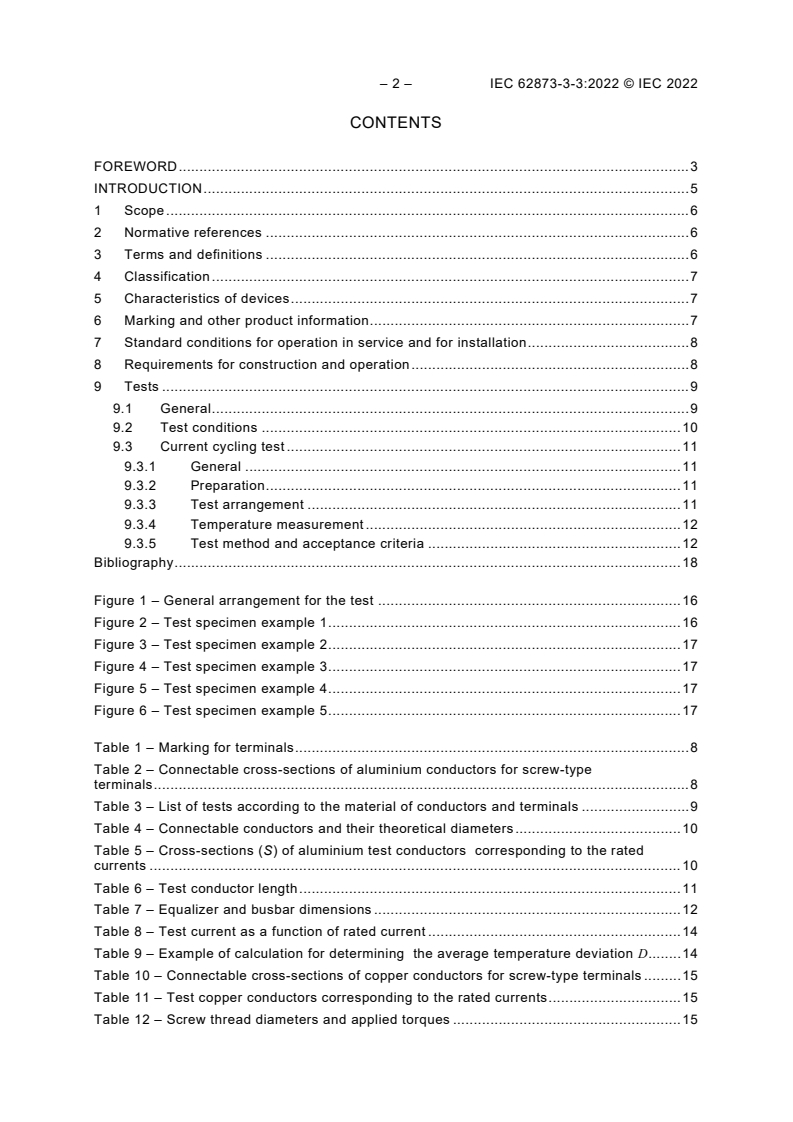
CONTENTS
FOREWORD . 3
INTRODUCTION . 5
1 Scope . 6
2 Normative references . 6
3 Terms and definitions . 6
4 Classification . 7
5 Characteristics of devices . 7
6 Marking and other product information . 7
7 Standard conditions for operation in service and for installation . 8
8 Requirements for construction and operation . 8
9 Tests . 9
9.1 General . 9
9.2 Test conditions . 10
9.3 Current cycling test . 11
9.3.1 General . 11
9.3.2 Preparation . 11
9.3.3 Test arrangement . 11
9.3.4 Temperature measurement . 12
9.3.5 Test method and acceptance criteria . 12
Bibliography . 18
Figure 1 – General arrangement for the test . 16
Figure 2 – Test specimen example 1 . 16
Figure 3 – Test specimen example 2 . 17
Figure 4 – Test specimen example 3 . 17
Figure 5 – Test specimen example 4 . 17
Figure 6 – Test specimen example 5 . 17
Table 1 – Marking for terminals . 8
Table 2 – Connectable cross-sections of aluminium conductors for screw-type
terminals . 8
Table 3 – List of tests according to the material of conductors and terminals . 9
Table 4 – Connectable conductors and their theoretical diameters . 10
Table 5 – Cross-sections (S) of aluminium test conductors corresponding to the rated
currents . 10
Table 6 – Test conductor length . 11
Table 7 – Equalizer and busbar dimensions . 12
Table 8 – Test current as a function of rated current . 14
Table 9 – Example of calculation for determining the average temperature deviation D. 14
Table 10 – Connectable cross-sections of copper conductors for screw-type terminals . 15
Table 11 – Test copper conductors corresponding to the rated currents . 15
Table 12 – Screw thread diameters and applied torques . 15
INTERNATIONAL ELECTROTECHNICAL COMMISSION
____________
RESIDUAL CURRENT OPERATED CIRCUIT-BREAKERS
FOR HOUSEHOLD AND SIMILAR USE –
Part 3-3: Specific requirements for devices with screw-type terminals for
external untreated aluminium conductors and with aluminium screw-type
terminals for use with copper or with aluminium conductors
FOREWORD
1) The International Electrotechnical Commission (IEC) is a worldwide organization for standardization comprising
all national electrotechnical committees (IEC National Committees). The object of IEC is to promote international
co-operation on all questions concerning standardization in the electrical and electronic fields. To this end and
in addition to other activities, IEC publishes International Standards, Technical Specifications, Technical Reports,
Publicly Available Specifications (PAS) and Guides (hereafter referred to as “IEC Publication(s)”). Their
preparation is entrusted to technical committees; any IEC National Committee interested in the subject dealt with
may participate in this preparatory work. International, governmental and non-governmental organizations liaising
with the IEC also participate in this preparation. IEC collaborates closely with the International Organization for
Standardization (ISO) in accordance with conditions determined by agreement between the two organizations.
2) The formal decisions or agreements of IEC on technical matters express, as nearly as possible, an international
consensus of opinion on the relevant subjects since each technical committee has representation from all
interested IEC National Committees.
3) IEC Publications have the form of recommendations for international use and are accepted by IEC National
Committees in that sense. While all reasonable efforts are made to ensure that the technical content of IEC
Publications is accurate, IEC cannot be held responsible for the way in which they are used or for any
misinterpretation by any end user.
4) In order to promote international uniformity, IEC National Committees undertake to apply IEC Publications
transparently to the maximum extent possible in their national and regional publications. Any divergence between
any IEC Publication and the corresponding national or regional publication shall be clearly indicated in the latter.
5) IEC itself does not provide any attestation of conformity. Independent certification bodies provide conformity
assessment services and, in some areas, access to IEC marks of conformity. IEC is not responsible for any
services carried out by independent certification bodies.
6) All users should ensure that they have the latest edition of this publication.
7) No liability shall attach to IEC or its directors, employees, servants or agents including individual experts and
members of its technical committees and IEC National Committees for any personal injury, property damage or
other damage of any nature whatsoever, whether direct or indirect, or for costs (including legal fees) and
expenses arising out of the publication, use of, or reliance upon, this IEC Publication or any other IEC
Publications.
8) Attention is drawn to the Normative references cited in this publication. Use of the referenced publications is
indispensable for the correct application of this publication.
9) Attention is drawn to the possibility that some of the elements of this IEC Publication may be the subject of patent
rights. IEC shall not be held responsible for identifying any or all such patent rights.
IEC 62873-3-3 has been prepared by subcommittee 23E: Circuit breakers and similar
equipment for household use, of IEC technical committee 23: Electrical accessories. It is an
International Standard.
This second edition cancels and replaces the first edition published in 2016. This edition
constitutes a technical revision.
This edition includes the following significant technical changes with respect to the previous
edition:
a) Modification of scope to address other devices in addition to RCDs;
b) Modification of Clause 8 so that IEC 62873-3-3 can be referred to by other product standards
in addition to those for RCDs;
– 4 – IEC 62873-3-3:2022 © IEC 2022
c) Modification of 9.1 so that IEC 62873-3-3 can be referred to by other product standards in
addition to those for RCDs.
The text of this International Standard is based on the following documents:
Draft Report on voting
23E/1274/FDIS 23E/1306/RVD
Full information on the voting for its approval can be found in the report on voting indicated in
the above table.
The language used for the development of this International Standard is English.
A list of all parts of the IEC 62873 series published under the general title Residual current
operated circuit-breakers for household and similar use can be found on the IEC website.
The following differing practices of a less permanent nature exist in the countries indicated
below:
– NOTE 2 of Clause 1: the use of aluminium screw-type terminals for use with copper
conductors is not allowed (Austria, Australia and Germany);
– NOTE 2 of Clause 1: terminals for aluminium conductors only are not allowed (Austria and
Germany);
– NOTE 2 of Clause 1: the use of aluminium conductors is not allowed for final circuits in
household and similar installations e.g. offices, shops (Spain);
– NOTE 2 of Clause 1: the minimum cross-sectional area for aluminium conductors is 16 mm
(Denmark).
This document was drafted in accordance with ISO/IEC Directives, Part 2, and developed in
accordance with ISO/IEC Directives, Part 1 and ISO/IEC Directives, IEC Supplement, available
at www.iec.ch/members_experts/refdocs. The main document types developed by IEC are
described in greater detail at www.iec.ch/standardsdev/publications.
The committee has decided that the contents of this document will remain unchanged until the
stability date indicated on the IEC website under webstore.iec.ch in the data related to the
specific document. At this date, the document will be
• reconfirmed,
• withdrawn,
• replaced by a revised edition, or
• amended.
INTRODUCTION
This document is part of the IEC 62873 series described in the outline document IEC 62873-1.
– 6 – IEC 62873-3-3:2022 © IEC 2022
RESIDUAL CURRENT OPERATED CIRCUIT-BREAKERS
FOR HOUSEHOLD AND SIMILAR USE –
Part 3-3: Specific requirements for devices with screw-type terminals for
external untreated aluminium conductors and with aluminium screw-type
terminals for use with copper or with aluminium conductors
1 Scope
This part of IEC 62873 applies to devices equipped with screw-type terminals of copper – or of
alloys containing at least 58 % of copper (if worked cold) or at least 50 % of copper (if worked
otherwise), or of other metal or suitably coated metal, no less resistant to corrosion than copper
and having mechanical properties no less suitable – for use with untreated aluminium
conductors, or with screw-type terminals of aluminium material for use with copper or aluminium
conductors.
This document does not cover the use of aluminium conductors or aluminium terminals for DC
applications.
Flexible aluminium conductors are not covered by this document.
NOTE 1 Flexible aluminium conductors are under consideration.
This document cannot be used alone but it is intended to be applied together with the applicable
product standard.
In this document, copper-clad and nickel-clad aluminium conductors are considered as
aluminium conductors.
NOTE 2 In AT, AU and DE, the use of aluminium screw-type terminals for use with copper conductors is not allowed.
– In AT and DE, terminals for aluminium conductors only are not allowed;
– In ES, the use of aluminium conductors is not allowed for final circuits in household and similar installations e.g.
offices, shops;
– In DK, the minimum cross-sectional area for aluminium conductors is 16 mm .
2 Normative references
The following documents are referred to in the text in such a way that some or all of their content
constitutes requirements of this document. For dated references, only the edition cited applies.
For undated references, the latest edition of the referenced document (including any
amendments) applies.
IEC 62873-2, Residual current operated circuit-breakers for household and similar use – Part 2:
Residual current devices (RCDs) – Vocabulary
3 Terms and definitions
For the purposes of this document, the terms and definitions given in IEC 62873-2 and the
following apply.
ISO and IEC maintain terminological databases for use in standardization at the following
addresses:
• ISO Online browsing platform: available at https://www.iso.org/obp
• IEC Electropedia: available at http://www.electropedia.org/
3.1
treated conductor
contact area of a conductor that has had its oxide layer on the outside strands scraped away
and/or has had a compound added to improve connectability and/or prevent corrosion
3.2
untreated conductor
unprepared conductor
conductor which has been cut and the insulation of which has been removed for insertion into
a terminal
Note 1 to entry: A conductor, the shape of which is arranged for introduction into a terminal or the strands of which
are twisted to consolidate the end, is considered to be an unprepared conductor.
[SOURCE: IEC 60050-442:1998, 442-01-26]
3.3
equalizer
arrangement used in the test loop to ensure an equipotentiality point and uniform current density
in a stranded conductor, without adversely affecting the temperature of the conductor(s)
3.4
reference conductor
continuous length of the same type and size conductor as that used in the terminal unit under
test and connected in the same series circuit, which enables the reference temperature and,
if required, reference resistance to be determined
3.5
stability factor
Sf
measure of temperature stability of a terminal unit during the current cycling test
4 Classification
Clause 4 of the product standard applies.
5 Characteristics of devices
Clause 5 of the product standard applies.
6 Marking and other product information
In addition to Clause 6 of the product standard, the following requirements apply.
The terminal marking defined in Table 1 shall be marked on the product, near the terminals.
The other information concerning the number of conductors, the screw torque values (if different
from the product standard) the type of conductor (solid or stranded) and the cross-sections shall
be indicated on the product.
– 8 – IEC 62873-3-3:2022 © IEC 2022
Table 1 – Marking for terminals
Conductor types accepted Marking
Copper only None
Aluminium only Al
Aluminium and copper Al/Cu
The manufacturer shall state in his catalogue that, for the clamping of an aluminium conductor,
the tightening torque sha
...
IEC 62873-3-3 ®
Edition 2.0 2022-11
REDLINE VERSION
INTERNATIONAL
STANDARD
colour
inside
Residual current operated circuit-breakers for household and similar use –
Part 3-3: Specific requirements for RCDs devices with screw-type terminals for
external untreated aluminium conductors and with aluminium screw-type
terminals for use with copper or with aluminium conductors
All rights reserved. Unless otherwise specified, no part of this publication may be reproduced or utilized in any form
or by any means, electronic or mechanical, including photocopying and microfilm, without permission in writing from
either IEC or IEC's member National Committee in the country of the requester. If you have any questions about IEC
copyright or have an enquiry about obtaining additional rights to this publication, please contact the address below or
your local IEC member National Committee for further information.
IEC Secretariat Tel.: +41 22 919 02 11
3, rue de Varembé info@iec.ch
CH-1211 Geneva 20 www.iec.ch
Switzerland
About the IEC
The International Electrotechnical Commission (IEC) is the leading global organization that prepares and publishes
International Standards for all electrical, electronic and related technologies.
About IEC publications
The technical content of IEC publications is kept under constant review by the IEC. Please make sure that you have the
latest edition, a corrigendum or an amendment might have been published.
IEC publications search - webstore.iec.ch/advsearchform IEC Products & Services Portal - products.iec.ch
The advanced search enables to find IEC publications by a Discover our powerful search engine and read freely all the
variety of criteria (reference number, text, technical publications previews. With a subscription you will always
committee, …). It also gives information on projects, replaced have access to up to date content tailored to your needs.
and withdrawn publications.
Electropedia - www.electropedia.org
IEC Just Published - webstore.iec.ch/justpublished
The world's leading online dictionary on electrotechnology,
Stay up to date on all new IEC publications. Just Published
containing more than 22 300 terminological entries in English
details all new publications released. Available online and
and French, with equivalent terms in 19 additional languages.
once a month by email.
Also known as the International Electrotechnical Vocabulary
(IEV) online.
IEC Customer Service Centre - webstore.iec.ch/csc
If you wish to give us your feedback on this publication or
need further assistance, please contact the Customer Service
Centre: sales@iec.ch.
IEC 62873-3-3 ®
Edition 2.0 2022-11
REDLINE VERSION
INTERNATIONAL
STANDARD
colour
inside
Residual current operated circuit-breakers for household and similar use –
Part 3-3: Specific requirements for RCDs devices with screw-type terminals for
external untreated aluminium conductors and with aluminium screw-type
terminals for use with copper or with aluminium conductors
INTERNATIONAL
ELECTROTECHNICAL
COMMISSION
ICS 29.120.50 ISBN 978-2-8322-6044-9
– 2 – IEC 62873-3-3:2022 RLV © IEC 2022
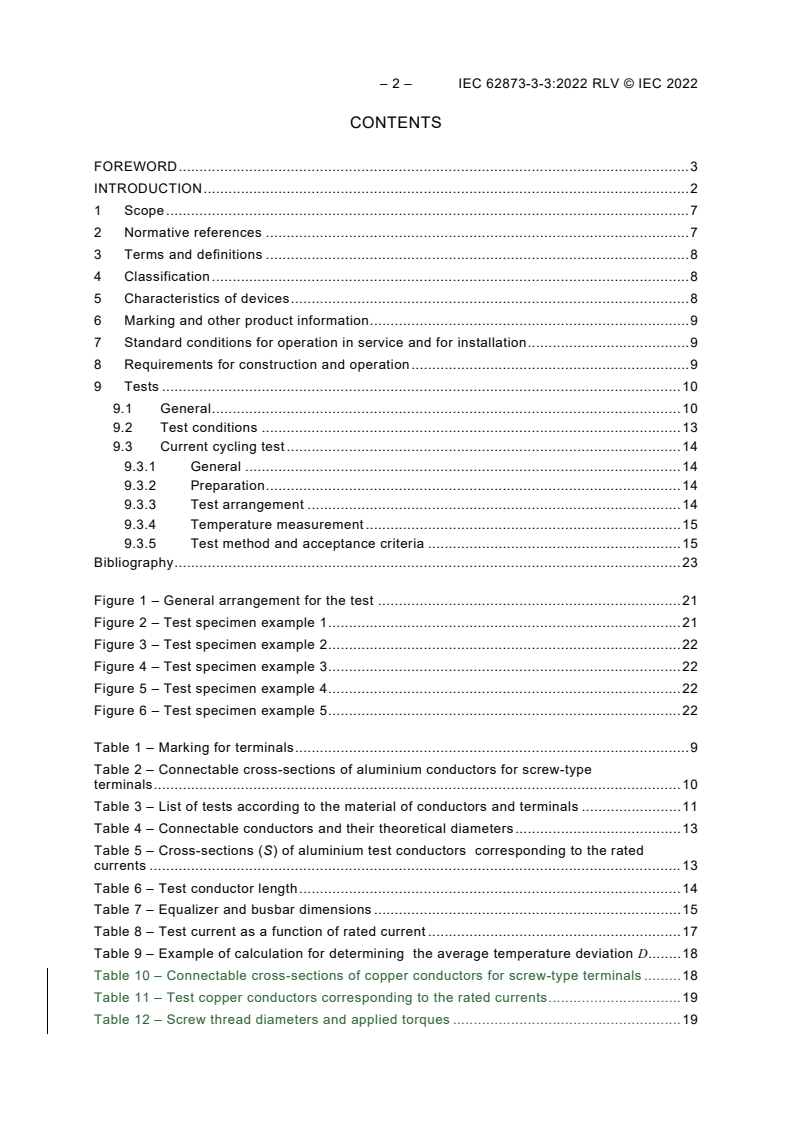
CONTENTS
FOREWORD . 3
INTRODUCTION . 2
1 Scope . 7
2 Normative references . 7
3 Terms and definitions . 8
4 Classification . 8
5 Characteristics of devices . 8
6 Marking and other product information . 9
7 Standard conditions for operation in service and for installation . 9
8 Requirements for construction and operation . 9
9 Tests . 10
9.1 General . 10
9.2 Test conditions . 13
9.3 Current cycling test . 14
9.3.1 General . 14
9.3.2 Preparation . 14
9.3.3 Test arrangement . 14
9.3.4 Temperature measurement . 15
9.3.5 Test method and acceptance criteria . 15
Bibliography . 23
Figure 1 – General arrangement for the test . 21
Figure 2 – Test specimen example 1 . 21
Figure 3 – Test specimen example 2 . 22
Figure 4 – Test specimen example 3 . 22
Figure 5 – Test specimen example 4 . 22
Figure 6 – Test specimen example 5 . 22
Table 1 – Marking for terminals . 9
Table 2 – Connectable cross-sections of aluminium conductors for screw-type
terminals . 10
Table 3 – List of tests according to the material of conductors and terminals . 11
Table 4 – Connectable conductors and their theoretical diameters . 13
Table 5 – Cross-sections (S) of aluminium test conductors corresponding to the rated
currents . 13
Table 6 – Test conductor length . 14
Table 7 – Equalizer and busbar dimensions . 15
Table 8 – Test current as a function of rated current . 17
Table 9 – Example of calculation for determining the average temperature deviation D. 18
Table 10 – Connectable cross-sections of copper conductors for screw-type terminals . 18
Table 11 – Test copper conductors corresponding to the rated currents . 19
Table 12 – Screw thread diameters and applied torques . 19
INTERNATIONAL ELECTROTECHNICAL COMMISSION
____________
RESIDUAL CURRENT OPERATED CIRCUIT-BREAKERS
FOR HOUSEHOLD AND SIMILAR USE –
Part 3-3: Specific requirements for RCDs devices with screw-type
terminals for external untreated aluminium conductors and with
aluminium screw-type terminals for use with copper
or with aluminium conductors
FOREWORD
1) The International Electrotechnical Commission (IEC) is a worldwide organization for standardization comprising
all national electrotechnical committees (IEC National Committees). The object of IEC is to promote international
co-operation on all questions concerning standardization in the electrical and electronic fields. To this end and
in addition to other activities, IEC publishes International Standards, Technical Specifications, Technical Reports,
Publicly Available Specifications (PAS) and Guides (hereafter referred to as “IEC Publication(s)”). Their
preparation is entrusted to technical committees; any IEC National Committee interested in the subject dealt with
may participate in this preparatory work. International, governmental and non-governmental organizations liaising
with the IEC also participate in this preparation. IEC collaborates closely with the International Organization for
Standardization (ISO) in accordance with conditions determined by agreement between the two organizations.
2) The formal decisions or agreements of IEC on technical matters express, as nearly as possible, an international
consensus of opinion on the relevant subjects since each technical committee has representation from all
interested IEC National Committees.
3) IEC Publications have the form of recommendations for international use and are accepted by IEC National
Committees in that sense. While all reasonable efforts are made to ensure that the technical content of IEC
Publications is accurate, IEC cannot be held responsible for the way in which they are used or for any
misinterpretation by any end user.
4) In order to promote international uniformity, IEC National Committees undertake to apply IEC Publications
transparently to the maximum extent possible in their national and regional publications. Any divergence between
any IEC Publication and the corresponding national or regional publication shall be clearly indicated in the latter.
5) IEC itself does not provide any attestation of conformity. Independent certification bodies provide conformity
assessment services and, in some areas, access to IEC marks of conformity. IEC is not responsible for any
services carried out by independent certification bodies.
6) All users should ensure that they have the latest edition of this publication.
7) No liability shall attach to IEC or its directors, employees, servants or agents including individual experts and
members of its technical committees and IEC National Committees for any personal injury, property damage or
other damage of any nature whatsoever, whether direct or indirect, or for costs (including legal fees) and
expenses arising out of the publication, use of, or reliance upon, this IEC Publication or any other IEC
Publications.
8) Attention is drawn to the Normative references cited in this publication. Use of the referenced publications is
indispensable for the correct application of this publication.
9) Attention is drawn to the possibility that some of the elements of this IEC Publication may be the subject of patent
rights. IEC shall not be held responsible for identifying any or all such patent rights.
This redline version of the official IEC Standard allows the user to identify the changes made to
the previous edition IEC 62873-3-3:2016. A vertical bar appears in the margin wherever a change
has been made. Additions are in green text, deletions are in strikethrough red text.
– 4 – IEC 62873-3-3:2022 RLV © IEC 2022
IEC 62873-3-3 has been prepared by subcommittee 23E: Circuit breakers and similar
equipment for household use, of IEC technical committee 23: Electrical accessories. It is an
International Standard.
This second edition cancels and replaces the first edition published in 2016. This edition
constitutes a technical revision.
This edition includes the following significant technical changes with respect to the previous
edition:
a) Modification of scope to address other devices in addition to RCDs;
b) Modification of Clause 8 so that IEC 62873-3-3 can be referred to by other product standards
in addition to those for RCDs;
c) Modification of 9.1 so that IEC 62873-3-3 can be referred to by other product standards in
addition to those for RCDs.
The text of this International Standard is based on the following documents:
Draft Report on voting
23E/1274/FDIS 23E/1306/RVD
Full information on the voting for its approval can be found in the report on voting indicated in
the above table.
The language used for the development of this International Standard is English.
A list of all parts of the IEC 62873 series published under the general title Residual current
operated circuit-breakers for household and similar use can be found on the IEC website.
The following differing practices of a less permanent nature exist in the countries indicated
below:
– NOTE 2 of Clause 1: the use of aluminium screw-type terminals for use with copper
conductors is not allowed (Austria, Australia and Germany);
– NOTE 2 of Clause 1: terminals for aluminium conductors only are not allowed (Austria and
Germany);
– NOTE 2 of Clause 1: the use of aluminium conductors is not allowed for final circuits in
household and similar installations e.g. offices, shops (Spain);
– NOTE 2 of Clause 1: the minimum cross-sectional area for aluminium conductors is 16 mm
(Denmark).
This document was drafted in accordance with ISO/IEC Directives, Part 2, and developed in
accordance with ISO/IEC Directives, Part 1 and ISO/IEC Directives, IEC Supplement, available
at www.iec.ch/members_experts/refdocs. The main document types developed by IEC are
described in greater detail at www.iec.ch/standardsdev/publications.
The committee has decided that the contents of this document will remain unchanged until the
stability date indicated on the IEC website under webstore.iec.ch in the data related to the
specific document. At this date, the document will be
• reconfirmed,
• withdrawn,
• replaced by a revised edition, or
• amended.
IMPORTANT – The "colour inside" logo on the cover page of this document indicates that it
contains colours which are considered to be useful for the correct understanding of its
contents. Users should therefore print this document using a colour printer.
– 6 – IEC 62873-3-3:2022 RLV © IEC 2022
INTRODUCTION
This document is part of the IEC 62873 series described in the outline document IEC 62873-1.
RESIDUAL CURRENT OPERATED CIRCUIT-BREAKERS
FOR HOUSEHOLD AND SIMILAR USE –
Part 3-3: Specific requirements for RCDs devices with screw-type
terminals for external untreated aluminium conductors and with
aluminium screw-type terminals for use with copper
or with aluminium conductors
1 Scope
This part of IEC 62873 applies to RCDs devices equipped with screw-type terminals of copper
– or of alloys containing at least 58 % of copper (if worked cold) or at least 50 % of copper (if
worked otherwise), or of other metal or suitably coated metal, no less resistant to corrosion
than copper and having mechanical properties no less suitable – for use with untreated
aluminium conductors, or with screw-type terminals of aluminium material for use with copper
or aluminium conductors.
This part of IEC 62873 cannot be used alone but it is intended to be applied together with an
RCD product standard (IEC 61008-1 or IEC 61009-1) if an RCD is equipped with screw-type
terminals for external untreated aluminium conductors and with aluminium screw-type terminals
for use with copper or with aluminium conductors.
This document does not cover the use of aluminium conductors or aluminium terminals for DC
applications.
Flexible aluminium conductors are not covered by this document.
NOTE 1 Flexible aluminium conductors are under consideration.
This document cannot be used alone but it is intended to be applied together with the applicable
product standard.
In this document, copper-clad and nickel-clad aluminium conductors are considered as
aluminium conductors.
NOTE 2 In AT, AU and DE, the use of aluminium screw-type terminals for use with copper conductors is not allowed.
– In AT and DE, terminals for aluminium conductors only are not allowed;
– In ES, the use of aluminium conductors is not allowed for final circuits in household and similar installations e.g.
offices, shops;
– In DK, the minimum cross-sectional area for aluminium conductors is 16 mm .
2 Normative references
The following documents are referred to in the text in such a way that some or all of their content
constitutes requirements of this document. For dated references, only the edition cited applies.
For undated references, the latest edition of the referenced document (including any
amendments) applies.
IEC 61008-1, Residual current operated circuit-breakers without integral overcurrent protection
for household and similar uses (RCCBs) – Part 1: General rules
IEC 61009-1, Residual current operated circuit-breakers with integral overcurrent protection for
household and similar uses (RCBOs) – Part 1: General rules
– 8 – IEC 62873-3-3:2022 RLV © IEC 2022
IEC 62873-2, Residual current operated circuit-breakers for household and similar use – Part 2:
Residual current devices (RCDs) – Vocabulary
3 Terms and definitions
For the purposes of this document, the terms and definitions given in IEC 62873-2 and the
following apply.
ISO and IEC maintain terminological databases for use in standardization at the following
addresses:
• ISO Online browsing platform: available at https://www.iso.org/obp
• IEC Electropedia: available at http://www.electropedia.org/
3.1
treated conductor
contact area of a conductor that has had its oxide layer on the outside strands scraped away
and/or has had a compound added to improve connectability and/or prevent corrosion
3.2
untreated conductor
unprepared conductor
conductor which has been cut and the insulation of which has been removed for insertion into
a terminal
Note 1 to entry: A conductor, the shape of which is arranged for introduction into a terminal or the strands of which
are twisted to consolidate the end, is considered to be an unprepared conductor.
[SOURCE: IEC 60050-442:1998, 442-01-26]
3.3
equalizer
arrangement used in the test loop to ensure an equipotentiality point and uniform current density
in a stranded conductor, without adversely affecting the temperature of the conductor(s)
3.4
reference conductor
continuous length of the same type and size conductor as that used in the terminal unit under
test and connected in the same series circuit, which enables the reference temperature and,
if required, reference resistance to be determined
3.5
stability factor
Sf
measure of temperature stability of a terminal unit during the current cycling test
4 Classification
Clause 4 of the RCD product standard applies.
5 Characteristics of RCDs devices
Clause 5 of the RCD product standard applies.
6 Marking and other product information
In addition to Clause 6 of the RCD product standard, the following requirements apply.
The terminal marking defined in Table 1 shall be marked on the RCD product, near the
terminals.
The other information concerning the number of conductors, the screw torque values (if different
from Table 11 of the RCD product standard) the type of conductor (solid or stranded) and the
cross-sections shall be indicated on the RCD product.
NOTE Tables 6, 10, 11 (in IEC 61008-1:2010) and Tables 8, 13, 14 (in IEC 61009-1:2010) have been replaced by
the harmonized new numbers: 9, 10 and 11.
Table 1 – Marking for terminals
Conductor types accepted Marking
Copper only None
Aluminium only Al
Aluminium and copper Al/Cu
The manufacturer shall state in his catalogue that, for the clamping of an aluminium conductor,
the tightening torque shall be applied with appropriate means.
7 Standard conditions for operation in service and for installation
Clause 7 of the RCD product standard applies.
8 Requirements for construction and operation
Clause 8 of the RCD product standard applies, with the following exceptions:
The following text is added at the end of 8.1.5.2 of the RCD product standard:
The requirements of Clause 8 of this document apply in addition to Clause 8 of the product
standard.
For the connection of aluminium conductors, RCDs products shall be provided with screw-type
terminals allowing the connection of conductors having nominal cross-sections as shown in
Table 2.
Terminals for the connection of aluminium conductors and terminals of aluminium for the
connection of copper or aluminium conductors shall have mechanical strength adequate to
withstand the tests of 9.4 of the RCD product standard reliability of screws, current-carrying
parts and connections of the product standard, with the test conductors tightened with the
torque indicated in Table 12 of this document, or with the torque specified by the manufacturer,
which shall never not be lower than that specified in Table 11 of the RCD product standard
Table 12 of this document.
– 10 – IEC 62873-3-3:2022 RLV © IEC 2022
Table 2 – Connectable cross-sections of aluminium
conductors for screw-type terminals
a b
Rated current Range of nominal cross-sections to be clamped
A
mm
Up to and including 25 10
Above 25 up to and including 32 10 to 16
Above 32 up to and including 50 10 to 25
Above 50 up to and including 80 10 to 35
Above 80 up to and including 100 16 to 50
Above 100 up to and including 125 25 to 70
a
It is required that, for current ratings up to and including 50 A, terminals be designed to clamp solid conductors
as well as rigid stranded conductors; the use of flexible conductors is permitted. Nevertheless, it is permitted
that terminals for conductors having cross-sections up to 10 mm be designed to clamp solid conductors only.
b
Maximum wire sizes of RCD product standard, increased according to Table D.2 of IEC 61545:1996.
Compliance is checked by inspection, by measurement and by fitting in turn one conductor of
the smallest and one of the largest cross-section areas as specified.
8.1.5.4 of the RCD product standard is replaced by the following text:
8.1.5.4 Terminals shall allow the conductors to be connected without special preparation. This
requirement applies for any rating of the terminal, whatever is stated in the product standard.
Compliance is checked by inspection and the tests of Clause 9.
9 Tests
9.1 General
Clause 9 of the RCD product standard applies, with the following modifications/additions:
For the tests which are influenced by the material of the terminal and the type of conductor that
can be connected, the test conditions of Table 3 are applied.
Additionally, the test of 9.3 is carried out on terminals separated from the RCD product.
Table 3 – List of tests according to the material of conductors and terminals
a
Material of terminals Material according
Al
a
to 8.1.4.4
Material of conductor Al Cu Al
(Table 1)
Use Tables 2 and 5 of this Use Tables 24 and 25 of the Use Tables 2 and 5 of this
standard RCD product standard standard
9.4 Reliability of Use Table 2 of this Use Tables 24, 25 and 26 of Use Table 2 of this
screws standard and Table 26 of the RCD product standard standard and Table 26 of
the RCD product standard the RCD product standard
b
Use Table 2 of this Use Tables 24, 25 and 26 of Use Table 2 of this
9.5.1 Pull-out test
standard and Table 26 of the RCD product standard standard and Table 26 of
the RCD product standard the RCD product standard
9.5.2 Damage of the Use Table 2 of this Use Tables 24, 25 and 26 of Use Table 2 of this
conductor standard and Table 26 of the RCD product standard standard and Table 26 of
the RCD product standard the RCD product standard
9.5.3 Insertion of the Use Table 5 of this Use Table 25 of the RCD Use Table 5 of this
conductor standard product standard standard
9.8 Temperature rise Use Table 5 of this Use Table 25 of the RCD Use Table 5 of this
standard product standard standard
9.22 Verification of Use Table 5 of this Use Table 25 of the RCD Use Table 5 of this
reliability standard product standard standard
9.2 Cycling test Use Table 26 of the RCD Use Table 26 of the RCD Use Table 26 of the RCD
product standard product standard product standard
a
Use test sequences A and B and number of samples defined in Annex A. For RCDs which are able to be
connected to Al or Cu conductors, the test sequences and number of samples have to be doubled (one for the
Cu conductor and one for the Al conductor).
b 2
For the pull-out test in 9.5.1, the value for 70 mm wire is under consideration.
– 12 – IEC 62873-3-3:2022 RLV © IEC 2022
a a
Material of terminals
Copper or copper alloy Aluminium
Material of conductor Al Cu Al
(Table 1)
Use Table 2 and Table 5 Use Table 10 and Table 11 Use Table 2 and Table 5
of this document of this document of this document
9.3 Cycling test Use Table 12 of this Use Table 12 of this Use Table 12 of this
document document document
Reliability of screws Use Table 2 and Table 12 Use Table 10 and Table 12 Use Table 2 and Table 12
(according to the of this document of this document of this document
product standard)
Pull-out test Use Table 2 and Table 12 Use Table 10 and Table 12 Use Table 2 and Table 12
(according to the of this document of this document of this document
b
product standard)
Damage of the Use Table 2 and Table 12 Use Table 10 and Table 12 Use Table 2 and Table 12
conductor (according of this document of this document of this document
to the product
standard)
Insertion of the Use Table 2 and Table 12 Use Table 10 and Table 12 Use Table 2 and Table 12
conductor (according of this document of this document of this document
to the product
standard)
Temperature-rise Use Table 5 of this Use Table 11 of this Use Table 5 of this
(according to the document document document
product standard)
Verification of Use Table 5 of this Use Table 11 of this Use Table 5 of this
reliability (according to document document document
the product standard)
a
For products which are able to be connected to Al and Cu conductors, the test sequences and number of
samples have to be repeated (one for the Cu conductor and one for the Al conductor)
b
The value of the pulling force for aluminium conductors with a cross section of 70 mm² shall be 285 N.
The dimensions of connectable conductors are given in Table 4.
Table 4 – Connectable conductors and their theoretical diameters
Metric AWG
Flexible Flexible
Rigid Rigid
(copper only) (copper only)
b
Classes
Class B
a
S Solid Stranded S Solid I, K, M
a
stranded
stranded
2 2
Ø mm Ø mm Ø mm Gauge Ø mm Ø mm Gauge mm
mm mm
1,0 1,2 1,4 1,0 1,5 18 1,07 1,23 18 1,28
1,5 1,5 1,7 1,5 1,8 16 1,35 1,55 16 1,50
c
2,5 1,9 2,2 2,5 14 1,71 1,95 14 2,08
2,3
c
4,0 2,4 2,7 4,0 12 2,15 2,45 12 2,70
2,9
c
6,0 2,9 3,3 4,0 10 2,72 3,09
2,9
10,0 3,7 4,2 6,0 3,9 8 3,43 3,89 10 3,36
16,0 4,6 5,3 10,0 5,1 6 4,32 4,91 8 4,32
25,0 6,6 16,0 6,3 4 5,45 6,18 6 5,73
35,0 7,9 25,0 7,8 2 6,87 7,78 4 7,25
1 7,72 8,85
50,0 9,1 35 9,2 0 8,51 9,64 12,08
70,0 12,0 50 12 00 9,266 10,64
NOTE Diameters of the largest rigid and flexible conductors are based on Table 1 of IEC 60228:2004, Table 1
and, for AWG conductors, on ASTM B 172-01a17.
a
Nominal diameter + 5 %.
b
Largest diameter + 5 % for any of the three classes I, K, M.
c
Dimensions for class 5 flexible conductors only, according to IEC 60228.
9.2 Test conditions
Subclause 9.2 of the RCD product standard applies The test conditions of the product standard
apply, except that the Al conductors to be connected are taken from Table 5.
Table 5 – Cross-sections (S) of aluminium test conductors
corresponding to the rated currents
S I
n
A
mm
10 I ≤ 32
n
16 32 < I ≤ 50
n
25 50 < I ≤ 63
n
35 63 < I ≤ 80
n
50 80 < I ≤ 100
n
70 100 < I ≤ 125
n
– 14 – IEC 62873-3-3:2022 RLV © IEC 2022
9.3 Current cycling test
9.3.1 General
This test verifies the stability of the screw-type terminal by comparing the temperature
performance with that of the reference conductor maximum allowed temperature for its product
standard under accelerated cycling conditions.
This test is carried out on separate terminals.
9.3.2 Preparation
The test is performed on four specimens, each one made by a couple of terminals, assembled
in a manner which represents the use of the terminals in the RCD product (see examples shown
in Figure 2 to Figure 6). The screw-type terminals which have been removed from the product
shall be attached to the conducting parts of the same cross-section, shape, metal and finish as
that on which they are mounted on the product. The screw-type terminals shall be fixed to the
conducting parts in the same manner (position, torque, etc.) as on the product. If one specimen
fails during the test, four other specimens shall be tested and no other failures are admitted.
9.3.3 Test arrangement
The general arrangement of the samples shall be as shown in Figure 1.
90 % of the value of torque stated by the manufacturer or, if not stated, selected in Table 11 of
the RCD product standard Table 12 shall be used for the test specimens.
For a range of devices of different current ratings having identical design, the test is carried out
with conductors according to Table 5 or Table 11, as applicable, corresponding to its maximum
current rating. The length of the test conductor from the point of entry to the screw-type terminal
specimens to the equalizer (see 3.3) shall be as in Table 6.
Table 6 – Test conductor length
Conductor cross-section Conductor wire size Minimum conductor length
AWG mm
mm
S ≤ 10,0 ≤ 8 200
16,0 ≤ S ≤ 25,0 6 to 3 300
35,0 ≤ S ≤ 70,0 2 to 00 460
Test conductors are connected in series with a reference conductor of the same cross-section.
The length of the reference conductor shall be approximately at least twice the length of the
test conductor.
Each free end of the test and reference conductor(s) not connected to a screw-type terminal
specimen shall be welded or brazed to a short length of an equalizer of the same material as
the conductor and of cross-section not greater than that given in Table 7. All strands of the
conductor shall be welded or brazed to make an electrical connection with the equalizer.
Tool-applied compression type terminations without welding may be used for the equalizer if
acceptable to the manufacturer and if the same performance is provided.
Table 7 – Equalizer and busbar dimensions
Maximum cross-section
Range of test current
mm
A Al Cu
0 to 50 45 45
51 to 125 105 85
126 to 225 185 155
The separation between the test and reference conductors shall be at least 150 mm.
The test specimen shall be suspended either horizontally or vertically in free air by supporting
the equalizer or busbar by non-conductive supports so as not to subject the screw-type terminal
to a tensile load. Thermal barriers shall be installed midway between the conductors and shall
extend 25 mm ± 5 mm widthways and 150 mm ± 10 mm lengthways beyond the screw-type
terminals (see Figure 1). Thermal barriers are not required provided the specimens are
separated by at least 450 mm. The specimens shall be located at least 600 mm from the floor,
wall or ceiling.
The test specimens shall be located in a substantially vibration-free and draught-free
environment and at an ambient temperature between 20 °C and 25 °C 15 °C and 35 °C. Once
the test is started, the maximum permissible variation is ±1 K provided the range limitation is
not exceeded.
9.3.4 Temperature measurement
Temperature measurements are made by means of thermocouples, using a wire having a cross-
section of not more than 0,07 mm (approximately 30 AWG).
For screw-type terminals, the thermocouple shall be located on the conductor entry side of the
screw-type terminal, close to the contact interface.
For the reference conductor, the thermocouples shall be located midway between the ends
of the conductor, and under its insulation.
Positioning of the thermocouples shall not damage the screw-type terminal or the reference
conductor.
NOTE 1 Drilling of a small hole and subsequent fastening of the thermocouple is an acceptable method, provided
that the performance is not affected and that it is agreed by the manufacturer.
The ambient air temperature shall be measured with two thermocouples in such a manner as
to achieve an average and stable reading in the vicinity of the test loop without undue external
influence. The thermocouples shall be located in a horizontal plane intersecting the specimens,
at a minimum distance of 600 mm from them.
NOTE 2 A satisfactory method for achieving a stable measurement is, for example, to attach the thermocouple to
unplated copper plates approximately 50 mm × 50 mm, having a thickness between 6 mm and 10 mm.
9.3.5 Test method and acceptance criteria
NOTE 1 Evaluation of performance is based on both the limit of screw-type terminal temperature rise and the
temperature variation during the test.
The test loop shall be subjected to 500 cycles of 1 h current-on and 1 h current-off, starting at
an alternating current equal to 1,12 times the test current value determined in Table 8. Near
the end of each current-on period of the first 24 cycles, the current shall subsequently be
adjusted to raise the temperature of the reference conductor to 75 °C each terminal to a
– 16 – IEC 62873-3-3:2022 RLV © IEC 2022
minimum of t °C. Nevertheless the reference conductor temperature shall not be lower than
75 °C.
t °C = maximum temperature rise allowed by the relevant product standard + 35 °C.
EXAMPLE For IEC 61008-1, t °C = 65K + 35 °C = 100 °C
th
At the 25 cycle, the test current shall be adjusted for the last time and the stable temperature
shall be recorded as the first measurement. There shall be no further adjustment of the test
current for the remainder of the test.
Temperatures shall be recorded for at least one cycle of each working day, and after
approximately 25, 50, 75, 100, 125, 175, 225, 275, 350, 425, and 500 cycles.
The temperature shall be measured during the last 5 min of the current-on time. If the size of
the set of test specimens or the speed of the data acquisition system is such that not all
measurements can be completed within 5 min, the current-on time shall be extended as
necessary to complete such measurements.
After the first 25 cycles, the current-off time may be reduced to a time 5 min longer than the
time necessary for all terminal assemblies to cool down to a temperature between ambient
and T + 5 K during the current-off period. Forced-air cooling may be employed
temperature T
a a
to reduce the off time, if acceptable to the manufacturer. In that case, it shall be applied to the
entire test loop and the resulting temperature of the forced air shall not be lower than the
ambient air temperature.
The stability factor Sf for each of the 11 temperature measurements is to be determined by
subtracting the average temperature deviation D from the 11 values of the temperature
deviation d.
The temperature deviation d for the 11 individual temperature measurements is obtained by
subtracting the associated reference conductor temperature from the screw-type terminal
temperature.
NOTE 2 The value of d is positive if the screw-type temperature is higher than that of the reference conductor and
negative if it is lower.
For each screw-type terminal:
– the temperature rise shall not exceed 110 K;
– the stability factor Sf shall not exceed ±10 °C K.
An example of calculation for one screw-type terminal is given in Table 9.
Table 8 – Test current as a function of rated current
Metric sizes AWG
Rated current Al conductor Test current Rated current Al conductor Test current
size size
A mm A A No. A
– – – 0 < I ≤ 15 – 30
n
– – – 15 < I ≤ 25 – 40
n
– – – 25 < I ≤ 40 8 53
n
10 60 6 69
0 < I ≤ 32 40 < I ≤ 50
n n
16 79 4 99
32 < I ≤ 50 50 < I ≤ 65
n n
25 99 3 110
50 < I ≤ 65 65 < I ≤ 75
n n
35 137 2 123
65 < I ≤ 80 75 < I ≤ 90
n n
50 171 1 152
80 < I ≤100 90 < I ≤ 100
n n
70 190 0 190
100 < I ≤ 125 100 < I ≤ 120
n n
Metric sizes
Al Cu
Rated current Rated current
size size
Test Current Test Current
A A
2 2
mm A mm A
0 < I ≤ 6
- - - 1 18.5
n
6 < I ≤ 13
- - - 1,5 22
n
13 < I ≤ 20
- - - 2,5 30
n
20 < I ≤ 25
- - - 4 40
n
0 < I ≤ 32 25 < I ≤ 32
10 60 6 54
n n
32 < I ≤ 50 32 < I ≤ 50
16 79 10 75
n n
50 < I ≤ 65 50 < I ≤ 63
25 99 16 100
n n
65 < I ≤ 80 63 < I ≤ 80
35 137 25 130
n n
80 < I ≤ 100 80 < I ≤ 100
50 171 35 183
n n
100 < I ≤ 125 100 < I ≤ 125
70 190 50 228
n n
– 18 – IEC 62873-3-3:2022 RLV © IEC 2022
Table 9 – Example of calculation for determining
the average temperature deviation D
Temperatures
Temperature Stability
deviation factor
Temperature Cycle Screw-type Reference
d = a – b Sf = d – D
measurement number terminal a conductor b
°C °C K K
1 25 79 78 1 0,18
2 50 80 77 3 2,18
3 75 78 78 0 −0,82
4 100 76 77 −1 −1,82
5 125 77 77 0 −0,82
6 175 78 77 1 0,18
7 225 79 76 3 2,18
8 275 78 76 2 1,18
9 350 77 78 −1 −1,82
10 425 77 79 −2 −2,82
11 500 81 78 3 2,18
d
∑ 9
Average temperature deviation D = = = 0,82 , where n is the number of measurements.
n 11
Table 10 – Connectable cross-sections of copper conductors for screw-type terminals
a b
Rated current Range of nominal cross-section to be clamped
A
mm
c
Rigid (solid or stranded )
Greater than Up to and including Flexible conductors
conductors
– 13 1 to 2,5 1 to 2,5
13 16 1 to 4 1 to 4
16 25 1,5 to 6 1,5 to 6
25 32 2,5 to 10 2,5 to 6
32 50 4 to 16 4 to 10
50 80 10 to 25 10 to 16
100 16 to 35 16 to 25
100 125 25 to 50 25 to 35
a
A range of PCBMs having the same fundamental design and having the same design and construction of
terminals, the terminals are fitted with copper conductors of the smallest cross-section for the minimum rated
current and largest cross-section for the maximum rated current, as specified, solid and stranded, as
applicable.
b
It is required that, for current ratings up to and including 50 A, terminals be designed to clamp solid conductors
as well as rigid stranded conductors. Nevertheless, it is permitted that terminals for conductors having cross-
2 2
sections from 1 mm up to 6 mm be designed to clamp solid conductors only.
c 2 2
Rigid stranded conductors shall be used for conductors having cross-sections from 1,5 mm up to 50 mm
and shall be in compliance with Class 2 of IEC 60228, related to stranded conductors for single-core.
Table 11 – Test copper conductors corresponding to the rated currents
Rated current 6 13 20 25 32 50 63 80 100
I I ≤ < I ≤ < I ≤ < I ≤ < I ≤ < I ≤ < I ≤ < I ≤ < I ≤ < I ≤
n n n n n n n n n n n
A 6 13 20 25 32 50 63 80 100 125
S
1 1,5 2,5 4 6 10 16 25 35 50
mm
Table 12 – Screw thread diameters and applied torques
Nominal diameter of thread Torque
mm Nm
Greater than Up to and including I II III
– 2,8 0,2 0,4 0,4
2,8 3,0 0,25
0,5 0,5
3,0 3,2 0,3 0,6 0,6
3,2 3,6 0,4 0,8 0,8
3,6 4,1 0,7 1,2 1,2
4,1 4,7 0,8 1,8 1,8
4,7 5,3 0,8 2,0
2,0
5,3 6,0 1,2 2,5 3,0
6,0 8,0 2,5 3,5 6,0
8,0 10,0 – 4,0 10,0
– 20 – IEC 62873-3-3:2022 RLV © IEC 2022
Busbar
Supply lead
Weld
Test conductor
Thermal barrier
(4 places)
75 mm min.
150 mm min.
TC
TC
TC
TC Test specimen
Test specimen
75 mm min.
TC TC TC TC
150 mm min.
Weld
Equalizer bar
Reference
Supply lead
conductor
Equalizers
150 mm min.
TC Thermocouple
IEC
Dimensions in millimetres
Key
TC Thermocouple
Figure 1 – General arrangement for the test
NOTE The conducting part can be bolted, soldered or welded.
Figure 2 – Test specimen example 1
– 22 – IEC 62873-3-3:2022 RLV © IEC 2022
Figure 3 – Test specimen example 2 Figure 4 – Test specimen example 3
Figure 5 – Test specimen example 4 Figure 6 – Test specimen example 5
Bibliography
IEC 60050-442, International Electrotechnical Vocabulary – Part 442: Electrical accessories
(available at www.electropedia.org)
IEC 60228, Conductors of insulated cables
IEC 60364-5-52:2009, Low-voltage electrical installations – Part 5-52: Selection and erection
of electrical equipment – Wiring systems
IEC 60364-5-54:2011, Low-voltage electrical installations – Part 5-54: Selection and erection
of electrical equipment – Earthing arrangements and protective conductors
IEC 60898-1, Electrical accessories – Circuit-breakers for overcurrent protection for household
and similar installations – Part 1: Circuit-breakers for a.c. operation
IEC 60998-1, Connecting devices for low-voltage circuits for household and similar purposes –
Part 1: General requirements
IEC 60998-2-2, Connecting devices for low-voltage circuits for household and similar purposes
– Part 2-2: Particular requirements for connecting devices as separate entities with screwless-
type clamping units
IEC 60999 (all parts), Connecting devices – Electrical copper conductors – Safety requirements
for screw-type and screwless-type clamping units
IEC 61008-1:2010, Residual current operated circuit-breakers without integral overcurrent
protection for household and similar uses (RCCBs) – Part 1: General rules
IEC 61008-1:2010/AMD1:2012
IEC 61008-1:2010/AMD2:2013
IEC 61009-1:2010, Residual current operated circuit-breakers with integral overcurrent
protection for household and similar uses (RCBOs) – Part 1: General rules
IEC 61009-1:2010/AMD1:2012
IEC 61009-1:2010/AMD2:2013
IEC 61545:1996, Connecting devices – Devices for the connection of aluminium conductors in
clamping units of any material and copper conductors in aluminium bodied clamping units
IEC 62020-1, Electrical accessories – Residual current monitors (RCMs) – Part 1: RCMs for
household and similar uses
IEC 62606, General requirements for arc fault detection devices
IEC 62873-1, Residual current operated circuit-breakers for household and similar use –
Part 1: Outline of Blocks and Modules for Residual Current Device standards
IEC 63052, Power frequency overvoltage protective devices (POPs) for household and similar
applications
ASTM B172-1017, Standard Specification for Rope-Lay-Stranded Cop
...