

IEC 60268-3:2000
(Main)Sound system equipment - Part 3: Amplifiers
General Information
- Abstract
Applies to analogue amplifiers and the analogue parts of digital/analogue amplifiers that form part of a sound system for professional or household applications. Specifies the characteristics to be included in specifications of amplifiers and the corresponding methods of measurement.
- Status
- Published
- Publication Date
- 29-Aug-2000
- Technical Committee
- TC 100 - Audio, video and multimedia systems and equipment
- Drafting Committee
- MT 60268-3 - TC 100/MT 60268-3
- Current Stage
- DELPUB - Deleted Publication
- Start Date
- 23-Apr-2013
- Completion Date
- 28-Aug-2026
Buy Documents
IEC 60268-3:2000 - Sound system equipment - Part 3: Amplifiers Released:8/30/2000
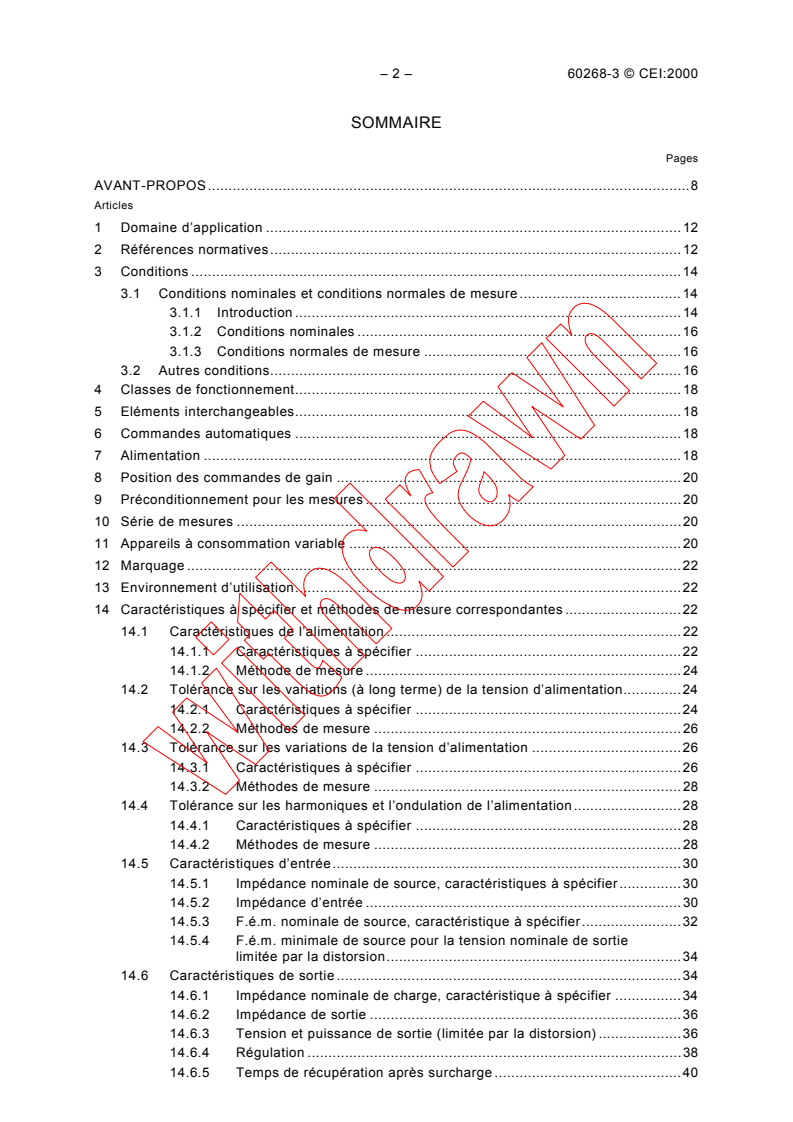
IEC 60268-3:2000 - Sound system equipment - Part 3: Amplifiers Released:8/30/2000
Overview
IEC 60268-3:2000 - Sound system equipment, Part 3: Amplifiers - is the International Electrotechnical Commission standard that defines which characteristics should appear in amplifier specifications and the corresponding methods of measurement. It applies to analogue amplifiers and the analogue portions of hybrid digital/analogue amplifiers used in professional and household sound systems. The document is part of the IEC 60268 audio-equipment series and is intended to ensure consistent, reproducible test procedures and meaningful product data.
Key Topics
The standard covers a comprehensive set of technical topics and required measurement methods, including:
- Power supply characteristics: rated conditions, tolerance to voltage/frequency variations, harmonics and ripple.
- Input characteristics: input impedance, rated source e.m.f., and minimum source levels for rated output.
- Output characteristics: rated load impedance, output source impedance, distortion-limited output voltage/power, regulation and overload behavior.
- Limiting and protection: overload/short-term and long-term maximum output, temperature-limited output power, and protection circuits (including d.c. offset protection).
- Performance metrics: gain (voltage/e.m.f.), gain-frequency and phase-frequency response, amplitude non-linearity, total harmonic distortion (THD), harmonic components, modulation and intermodulation distortion (including dynamic intermodulation).
- Noise and hum: measurement and specification methods for audible interference and background noise.
- Balanced interfaces and multi-channel concerns: balanced input/output balance, common-mode limits, cross-talk, channel gain/phase differences, and separation.
- Operational and physical: sustaining time for rated output, pre-conditioning, measurement conditions, marking, dimensions and mass.
- Informative Annex A on balanced interfaces and figures/tables illustrating measurement arrangements.
Applications and Who Uses It
IEC 60268-3 is used by:
- Manufacturers of audio amplifiers to create consistent product specifications and to design for measurable performance.
- Test laboratories and QA teams for standardized performance verification and acceptance testing.
- Product managers and procurement specialists who need objective data to compare amplifiers.
- Audio system designers and integrators (live sound, studios, installed sound) to select amplifiers that meet system requirements.
- Standards and compliance engineers who document interoperability and safety-related behavior tied to measured audio performance.
Using this standard helps ensure predictable amplifier behavior, consistent datasheet claims (THD, power, noise), and repeatable test methods across professional and consumer audio markets.
Related Standards
- IEC 60268-1 - General definitions and considerations for sound system equipment.
- IEC 60268-2 - Microphones (related parts of the IEC 60268 series).
Relations
- Effective Date
- 05-Sep-2023
Buy Documents
IEC 60268-3:2000 - Sound system equipment - Part 3: Amplifiers Released:8/30/2000
IEC 60268-3:2000 - Sound system equipment - Part 3: Amplifiers Released:8/30/2000
Get Certified
Connect with accredited certification bodies for this standard

ANCE
Mexican certification and testing association.

Intertek Slovenia
Intertek testing, inspection, and certification services in Slovenia.

LNE (Laboratoire National de Métrologie et d'Essais)
French national laboratory for metrology and testing.
Sponsored listings
Frequently Asked Questions
IEC 60268-3:2000 is a standard published by the International Electrotechnical Commission (IEC). Its full title is "Sound system equipment - Part 3: Amplifiers". This standard covers: Applies to analogue amplifiers and the analogue parts of digital/analogue amplifiers that form part of a sound system for professional or household applications. Specifies the characteristics to be included in specifications of amplifiers and the corresponding methods of measurement.
Applies to analogue amplifiers and the analogue parts of digital/analogue amplifiers that form part of a sound system for professional or household applications. Specifies the characteristics to be included in specifications of amplifiers and the corresponding methods of measurement.
IEC 60268-3:2000 is classified under the following ICS (International Classification for Standards) categories: 33.160.10 - Amplifiers. The ICS classification helps identify the subject area and facilitates finding related standards.
IEC 60268-3:2000 has the following relationships with other standards: It is inter standard links to IEC 60268-3:2013. Understanding these relationships helps ensure you are using the most current and applicable version of the standard.
IEC 60268-3:2000 is available in PDF format for immediate download after purchase. The document can be added to your cart and obtained through the secure checkout process. Digital delivery ensures instant access to the complete standard document.
Standards Content (Sample)
INTERNATIONAL IEC
STANDARD
60268-3
Third edition
2000-08
Sound system equipment –
Part 3:
Amplifiers
Equipements pour systèmes électroacoustiques –
Partie 3:
Amplificateurs
Reference number
Publication numbering
As from 1 January 1997 all IEC publications are issued with a designation in the
60000 series. For example, IEC 34-1 is now referred to as IEC 60034-1.
Consolidated editions
The IEC is now publishing consolidated versions of its publications. For example,
edition numbers 1.0, 1.1 and 1.2 refer, respectively, to the base publication, the
base publication incorporating amendment 1 and the base publication incorporating
amendments 1 and 2.
Further information on IEC publications
The technical content of IEC publications is kept under constant review by the IEC,
thus ensuring that the content reflects current technology. Information relating to
this publication, including its validity, is available in the IEC Catalogue of
publications (see below) in addition to new editions, amendments and corrigenda.
Information on the subjects under consideration and work in progress undertaken
by the technical committee which has prepared this publication, as well as the list
of publications issued, is also available from the following:
• IEC Web Site (www.iec.ch)
• Catalogue of IEC publications
The on-line catalogue on the IEC web site (www.iec.ch/catlg-e.htm) enables
you to search by a variety of criteria including text searches, technical
committees and date of publication. On-line information is also available on
recently issued publications, withdrawn and replaced publications, as well as
corrigenda.
• IEC Just Published
This summary of recently issued publications (www.iec.ch/JP.htm) is also
available by email. Please contact the Customer Service Centre (see below) for
further information.
• Customer Service Centre
If you have any questions regarding this publication or need further assistance,
please contact the Customer Service Centre:
Email: custserv@iec.ch
Tel: +41 22 919 02 11
Fax: +41 22 919 03 00
INTERNATIONAL IEC
STANDARD
60268-3
Third edition
2000-08
Sound system equipment –
Part 3:
Amplifiers
Equipements pour systèmes électroacoustiques –
Partie 3:
Amplificateurs
IEC 2000 Copyright - all rights reserved
No part of this publication may be reproduced or utilized in any form or by any means, electronic or
mechanical, including photocopying and microfilm, without permission in writing from the publisher.
International Electrotechnical Commission 3, rue de Varembé Geneva, Switzerland
Telefax: +41 22 919 0300 e-mail: inmail@iec.ch IEC web site http://www.iec.ch
Commission Electrotechnique Internationale
PRICE CODE
XA
International Electrotechnical Commission
For price, see current catalogue
– 2 – 60268-3 © IEC:2000(E)
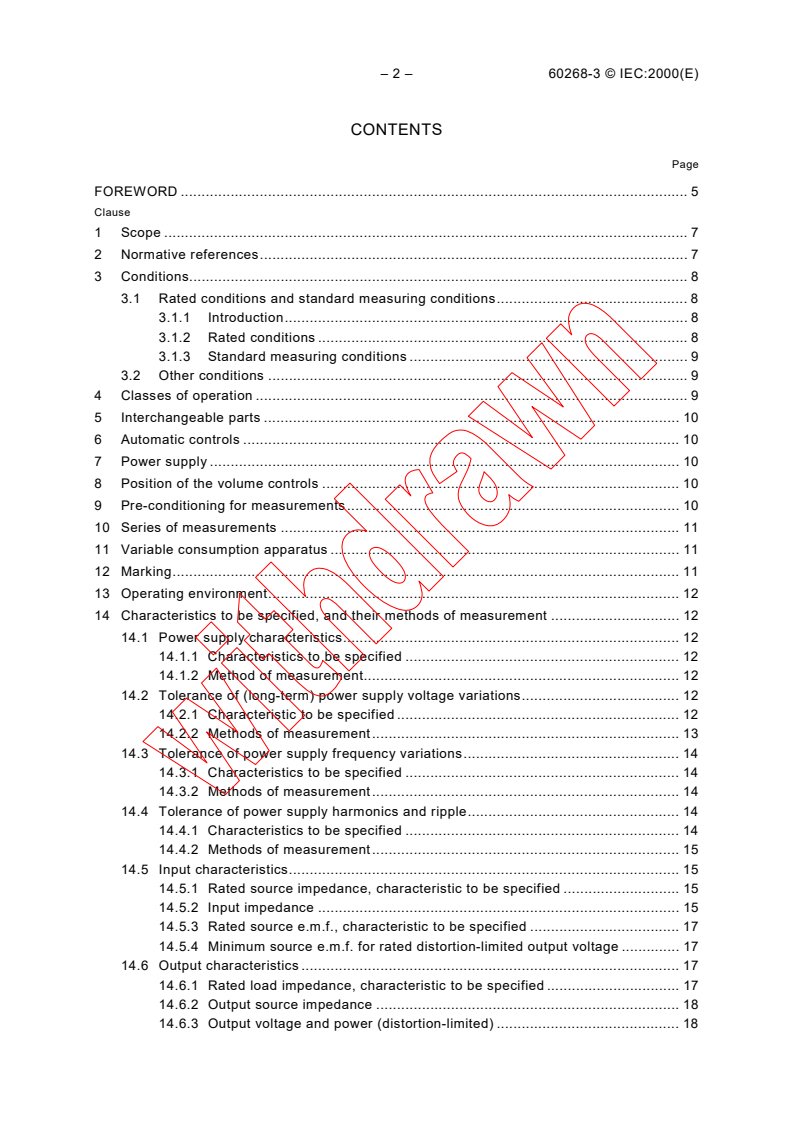
CONTENTS
Page
FOREWORD . 5
Clause
1 Scope . 7
2 Normative references. 7
3 Conditions. 8
3.1 Rated conditions and standard measuring conditions. 8
3.1.1 Introduction. 8
3.1.2 Rated conditions . 8
3.1.3 Standard measuring conditions . 9
3.2 Other conditions . 9
4 Classes of operation . 9
5 Interchangeable parts . 10
6 Automatic controls . 10
7 Power supply . 10
8 Position of the volume controls . 10
9 Pre-conditioning for measurements. 10
10 Series of measurements . 11
11 Variable consumption apparatus . 11
12 Marking. 11
13 Operating environment. 12
14 Characteristics to be specified, and their methods of measurement . 12
14.1 Power supply characteristics. 12
14.1.1 Characteristics to be specified . 12
14.1.2 Method of measurement. 12
14.2 Tolerance of (long-term) power supply voltage variations. 12
14.2.1 Characteristic to be specified . 12
14.2.2 Methods of measurement. 13
14.3 Tolerance of power supply frequency variations. 14
14.3.1 Characteristics to be specified . 14
14.3.2 Methods of measurement. 14
14.4 Tolerance of power supply harmonics and ripple. 14
14.4.1 Characteristics to be specified . 14
14.4.2 Methods of measurement. 15
14.5 Input characteristics. 15
14.5.1 Rated source impedance, characteristic to be specified . 15
14.5.2 Input impedance . 15
14.5.3 Rated source e.m.f., characteristic to be specified . 17
14.5.4 Minimum source e.m.f. for rated distortion-limited output voltage . 17
14.6 Output characteristics . 17
14.6.1 Rated load impedance, characteristic to be specified . 17
14.6.2 Output source impedance . 18
14.6.3 Output voltage and power (distortion-limited) . 18
60268-3 © IEC:2000(E) – 3 –
Clause Page
14.6.4 Regulation . 20
14.6.5 Overload restoring time. 20
14.7 Limiting characteristics . 20
14.7.1 Overload source e.m.f. 20
14.7.2 Short-term maximum output voltage and power. 21
14.7.3 Long-term maximum output voltage and power . 22
14.7.4 Temperature-limited output power. 23
14.8 Characteristics of protection circuits . 23
14.8.1 Introduction. 23
14.8.2 Protection against potentially damaging combinations of output voltage
and current . 24
14.8.3 Characteristics of d.c. offset protection circuits . 25
14.9 Sustaining-time for rated (distortion-limited) output voltage or power . 26
14.9.1 Introduction. 26
14.9.2 Characteristic to be specified . 27
14.9.3 Method of measurement. 27
14.10 Gain. 28
14.10.1 Voltage gain and e.m.f. gain . 28
14.10.2 Maximum e.m.f. gain. 28
14.10.3 Attenuation characteristic of the volume control . 28
14.10.4 Attenuation characteristic of balance controls for
multi-channel equipment. 29
14.11 Response. 29
14.11.1 Gain-frequency response. 29
14.11.2 Gain-limited effective frequency range . 30
14.11.3 Distortion-limited effective frequency range . 30
14.11.4 Phase-frequency response . 30
14.12 Amplitude non-linearity. 31
14.12.1 Introduction . 31
14.12.2 Rated total harmonic distortion . 31
14.12.3 Total harmonic distortion under standard measuring conditions . 31
14.12.4 Total harmonic distortion as a function of amplitude and frequency. 32
14.12.5 Harmonic distortion of the nth order under standard
measuring conditions . 32
14.12.6 Harmonic distortion of the nth order as a function of amplitude
and frequency. 33
14.12.7 Modulation distortion of the nth order. 34
14.12.8 Difference-frequency distortion of the nth order . 35
14.12.9 Dynamic intermodulation distortion (DIM). 37
14.12.10 Total difference frequency distortion . 38
14.12.11 Weighted total harmonic distortion . 40
14.13 Noise . 40
14.13.1 Characteristic to be specified. 40
14.13.2 Method of measurement . 41
14.14 Hum . 41
14.14.1 Introduction . 41
14.14.2 Characteristics to be specified . 41
14.14.3 Method of measurement . 42
– 4 – 60268-3 © IEC:2000(E)
Clause Page
14.15 Balanced inputs and outputs . 42
14.15.1 Balance of the input. 42
14.15.2 Overload (distortion-limited) peak-to-peak common-mode input voltage. 43
14.15.3 Balance of the output. 44
14.16 Cross-talk and separation in multi-channel amplifiers. 45
14.16.1 Characteristics to be specified . 45
14.16.2 Method of measurement . 45
14.17 Gain and phase differences between channels in multi-channel amplifiers . 46
14.17.1 Gain difference . 46
14.17.2 Phase difference. 47
14.18 Dimensions and mass, characteristics to be specified . 47
Annex A (informative) Balanced interfaces . 53
Bibliography . 54
Figure 1 – Arrangements for measuring input impedance . 48
Figure 2 – Oscillogram when measuring overload restoring time . 49
Figure 3 – Protection against potentially damaging combinations of output voltage
and current. 50
Figure 4 – Arrangement for combining two input signals. 51
Figure 5 – Frequency spectrum below 30 kHz of the signal for measuring dynamic
intermodulation distortion . 51
Figure 6 – Arrangement for measuring the balance of a balanced input. 52
Figure 7 – Arrangement for measuring the internal impedance balance of a
balanced output. 52
Figure 8 – Arrangement for measuring the voltage symmetry of a balanced output. 52
Table 1 – Different rated total harmonic distortion and rated distortion-limited
output power specifications for the same amplifier. 27
Table 2 – Distortion components due to dynamic intermodulation distortion falling
in the frequency range up to 20 kHz . 37
60268-3 © IEC:2000(E) – 5 –
INTERNATIONAL ELECTROTECHNICAL COMMISSION
____________
SOUND SYSTEM EQUIPMENT –
Part 3: Amplifiers
FOREWORD
1) The IEC (International Electrotechnical Commission) is a worldwide organization for standardization comprising
all national electrotechnical committees (IEC National Committees). The object of the IEC is to promote
international co-operation on all questions concerning standardization in the electrical and electronic fields. To
this end and in addition to other activities, the IEC publishes International Standards. Their preparation is
entrusted to technical committees; any IEC National Committee interested in the subject dealt with may
participate in this preparatory work. International, governmental and non-governmental organizations liaising
with the IEC also participate in this preparation. The IEC collaborates closely with the International
Organization for Standardization (ISO) in accordance with conditions determined by agreement between the
two organizations.
2) The formal decisions or agreements of the IEC on technical matters express, as nearly as possible, an
international consensus of opinion on the relevant subjects since each technical committee has representation
from all interested National Committees.
3) The documents produced have the form of recommendations for international use and are published in the form
of standards, technical specifications, technical reports or guides and they are accepted by the National
Committees in that sense.
4) In order to promote international unification, IEC National Committees undertake to apply IEC International
Standards transparently to the maximum extent possible in their national and regional standards. Any
divergence between the IEC Standard and the corresponding national or regional standard shall be clearly
indicated in the latter.
5) The IEC provides no marking procedure to indicate its approval and cannot be rendered responsible for any
equipment declared to be in conformity with one of its standards.
6) Attention is drawn to the possibility that some of the elements of this International Standard may be the subject
of patent rights. The IEC shall not be held responsible for identifying any or all such patent rights.
International Standard IEC 60268-3 has been prepared by subcommittee 100C: Audio, video
and multimedia subsystems and equipment, of IEC technical committee 100: Audio, video and
multimedia systems and equipment.
This third edition cancels and replaces the second edition published in 1988, amendment 1
(1990) and amendment 2 (1991), and constitutes a technical revision.
The text of this standard is based on the following documents:
FDIS Report on voting
100C/147/FDIS 100C/165/RVD
Full information on the voting for the approval of this standard can be found in the report on
voting indicated in the above table.
This publication has been drafted in accordance with the ISO/IEC Directives, Part 3.
This part of IEC 60268 shall be used in conjunction with IEC 60268-1 (1985) and IEC 60268-2
(1987).
– 6 – 60268-3 © IEC:2000(E)
Annex A is for information only.
The committee has decided that the contents of this publication will remain unchanged until
2005. At this date, the publication will be
reconfirmed;
withdrawn;
replaced by a revised edition, or
amended.
A bilingual version of this standard may be issued at a later date.
60268-3 © IEC:2000(E) – 7 –
SOUND SYSTEM EQUIPMENT –
Part 3: Amplifiers
1 Scope
This part of IEC 60268 applies to analogue amplifiers, and the analogue parts of
analogue/digital amplifiers, which form part of a sound system for professional or household
applications. It specifies the characteristics which should be included in specifications of
amplifiers and the corresponding methods of measurement.
1)
NOTE The methods of measurement for digital amplifiers and similar equipment are given in IEC 61606. [6]
In general, the specified methods of measurement are those which are seen to be most
directly related to the characteristics. This does not exclude the use of other methods which
give equivalent results.
In general, the methods are based on the simplest measuring equipment which can provide
useful results. This does not exclude the use of more complex equipment which can give
higher accuracy and/or allow automatic measurement and recording of results.
Rated conditions and standard measuring conditions are specified in order to allow
measurements to be reliably repeated.
2 Normative references
The following normative documents contain provisions which, through reference in this text,
constitute provisions of this part of IEC 60268. For dated references, subsequent
amendments to, or revisions of, any of these publications do not apply. However, parties to
agreements based on this part of IEC 60268 are encouraged to investigate the possibility of
applying the most recent editions of the normative documents indicated below. For undated
references, the latest edition of the normative document referred to applies. Members of IEC
and ISO maintain registers of currently valid International Standards.
IEC 60065:1998, Audio, video and similar electronic apparatus – Safety requirements
IEC 60268-1:1985, Sound system equipment – Part 1: General
IEC 60268-2:1987, Sound system equipment – Part 2: Explanation of general terms and
calculation methods
Amendment 1 (1991)
IEC 60417-1:1998, Graphical symbols for use on equipment – Part 1: Overview and application
IEC 61000-4-17:1999, Electromagnetic Compatibility (EMC) – Part 4-17: Testing and
measurement techniques – Ripple on d.c. input power port immunity test – Basic EMC
Publication
IEC 61000-4-29, Electromagnetic Compatibility (EMC) – Part 4-29: Testing and measurement
techniques – Voltage dips, short interrruptions and voltage variations on d.c. input power
2)
ports, immunity tests – Basic EMC Publication
––––––––––––
1)
Numbers in square brackets refer to the bibliography.
2)
To be published.
– 8 – 60268-3 © IEC:2000(E)
IEC 61938:1996, Audio, video and audiovisual systems – Interconnections and matching
values – Preferred matching values of analogue signals
3 Conditions
3.1 Rated conditions and standard measuring conditions
3.1.1 Introduction
For convenience in specifying how amplifiers shall be set up for measurement, sets of
conditions are specified in this standard, under the titles of rated conditions and standard
measuring conditions.
A full explanation of the term "rated" is given in IEC 60268-2.
The rated conditions for amplifiers are:
– rated power supply voltage;
– rated source impedance;
– rated source e.m.f.;
– rated load impedance;
– rated total harmonic distortion, or rated (distortion-limited) output voltage or power;
– rated mechanical and climatic conditions.
NOTE 1 Total harmonic distortion and (distortion-limited) output voltage or power are interdependent. Both cannot
be taken as rated conditions simultaneously because normally a given sample amplifier produces less than rated
total harmonic distortion at rated output voltage or power.
NOTE 2 If the power supply frequency is critical, it is also a rated condition.
To obtain the correct conditions for measurements, the values for the above-mentioned rated
conditions shall be taken from the manufacturer's specification. These values themselves are
not subject to measurement but they constitute the basis for measuring the other characteristics.
Methods of measurement for these other characteristics are given in this standard and the
manufacturer is either required or permitted to state 'rated values' for these characteristics in
the specification of the equipment. These include
– rated voltage gain;
– rated distortion limited output voltage or power (when not adopted as a rated condition);
– rated signal-to-noise ratio;
– rated equivalent noise source e.m.f.
3.1.2 Rated conditions
An amplifier, considered as a four-terminal network with regard to a specified pair of input
terminals and a specified pair of output terminals, shall be understood to be working under
rated conditions when the following conditions are fulfilled:
a) the amplifier is connected to its rated power supply;
b) the source e.m.f. is connected in series with the rated source impedance to the input
terminals;
NOTE For an amplifier having several identical channels, the input signal should be applied simultaneously to all
corresponding pairs of input terminals.
c) the output terminals are terminated with the rated load impedance;
d) the terminals which are not used during the measurement are terminated, if necessary, as
specified by the manufacturer;
60268-3 © IEC:2000(E) – 9 –
e) the source e.m.f. is a sinusoidal voltage equal to the rated source e.m.f. at an appropriate
frequency. Unless there is a special reason to the contrary, this frequency shall be the
standard reference frequency of 1 000 Hz according to IEC 60268-1.
Such a reason could be that the standard reference frequency is outside or near the limit
of the effective frequency range of the amplifier;
f) the volume control, if any, is set to such a position that the rated distortion-limited output
voltage appears at the output terminals;
g) the tone controls, if any, are set to a specified position to give the specified frequency
response, generally the flat frequency response;
h) the balance control(s), if any, is (are) set to the mechanical central position;
i) the rated mechanical and climatic conditions according to IEC 60268-1 are complied with.
Amplifiers for which the rated distortion-limited output power exceeds the rated temperature-
limited output power are likely to be subject to overheating when operated under rated
conditions for an extended period of time. For these amplifiers, rated conditions shall be
maintained for no longer than can be tolerated by the amplifier.
3.1.3 Standard measuring conditions
These are obtained by bringing the amplifier under rated conditions (see 3.1.2) and then
reducing the source e.m.f. to a level of –10 dB referred to the rated source e.m.f.
3.2 Other conditions
If supplementary data of the amplifier are presented, applying to other than the rated or
standard measuring conditions, for example at different frequencies or at different settings of
controls, then the conditions shall be fully defined in the presentation. These conditions shall,
if possible, be chosen according to the recommendations made in the relevant clauses of this
standard.
The procedures for supplementary measurements may be derived from the measurement
procedures given for the standard conditions. If special precautions are necessary to ensure
accuracy, these shall be indicated together with the measurement procedure involved.
4 Classes of operation
Class A: in which the current in each active device supplying the load current is greater than
zero throughout each cycle of the signal for all values of load current up to and including the
value determined by the rated output power or voltage and the rated load impedance.
Class B: in which the current in each active device supplying the load current is equal to
zero for exactly one-half of each cycle of load current.
NOTE In common usage, the term Class B is extended to the case where current flows for slightly more than one
half-cycle.
Class AB: in which the current in at least one of the active devices supplying the load
current is zero for some part of each cycle of load current for some range of values of load
current not exceeding the value defined by the rated output power or voltage and the rated
load impedance.
NOTE At sufficiently low signal levels, a Class AB amplifier usually operates in Class A.
Class D: in which the current in each active device supplying the load is switched from zero
to a maximum value by a carrier signal, modulation of which conveys the useful signal.
NOTE Other classes of operation have been commercialized but no formal definitions of such classes have been
submitted for standardization.
– 10 – 60268-3 © IEC:2000(E)
5 Interchangeable parts
For type measurements, interchangeable parts shall have characteristics as close as is
reasonably practicable to the mean characteristics specified for these parts.
For measurements on a particular sample, the interchangeable parts supplied with that
amplifier shall be used.
6 Automatic controls
The amplifier may contain automatic control circuits such as limiters, compressors, expanders
and electronic fader circuits. These circuits make certain characteristics of the amplifier
dependent either on a signal passing through the amplifier itself or on an external control
signal. When measuring the characteristics of such an amplifier, the automatic control circuits
shall be disabled, except when measuring their characteristics.
7 Power supply
Measurements shall be made with the amplifier connected to rated power supply. Care shall
be taken to maintain the power supply voltage at the rated value during the measurement. If
the manufacturer claims power supply voltage tolerances exceeding ±10 %, then the
characteristics to be specified shall also be stated for the upper and lower limits of these
tolerances.
Additional measurements may be made at the upper and lower limits claimed as tolerable for
the power supply voltage, the power supply frequency and the a.c. power supply harmonics or
the d.c. power supply ripple.
Warning – The power supply voltage tolerances specified by the manufacturer shall not
be exceeded.
8 Position of the volume controls
If a characteristic is measured at only one position of the volume control, the control shall be
at the position corresponding to rated conditions (see 3.1.2), unless a maximum or minimum
position of the control is inherent in the characteristic to be measured.
If the characteristic is to be measured for several settings of the volume control, then
the position for rated conditions shall be included, other preferred settings being maximum,
and –3 dB, –6 dB, –10 dB, –20 dB and –40 dB with respect to the setting for rated conditions.
Volume controls belonging to channels not being measured shall, if possible, be put in the
minimum position, unless otherwise stated.
9 Pre-conditioning for measurements
Before beginning measurements on an amplifier, it shall be operated under approximately
standard measuring conditions for a period of 1 h, or as specified by the manufacturer.
Before operating the amplifier the manufacturer's instructions concerning initial operation
should be studied.
60268-3 © IEC:2000(E) – 11 –
The amplifier is then brought under standard measuring conditions (see 3.1.3). Due to internal
heating, the output voltage may subsequently vary with time. Unless excessive, this effect is
ignored during the pre-conditioning period. When the pre-conditioning period is over, the
amplifier shall be brought under rated conditions or standard measuring conditions, as
required.
10 Series of measurements
If a series of measurements is made, the amplifier should preferably be maintained under
standard measuring conditions in the periods between measurements.
If the amplifier has to be put out of operation for an extended period between measurements,
then pre-conditioning according to clause 9 shall be repeated before each set of
measurements, unless this can be shown to be unnecessary.
11 Variable consumption apparatus
Sound system equipment shall be considered as variable consumption apparatus if it contains
one or more power amplifiers operating in the Class AB or Class B modes, in which the d.c.
power supply for the output stages is either electronically regulated by means of series
control elements or is not regulated.
1)
NOTE 1 Variable consumption apparatus is defined in IEC 60065, fourth edition (1976) as 'apparatus in which
the power consumption can vary more than 15 % due to changes in load impedances of the output circuit or in
signal parameters', but no definition appears in the fifth (1985) or sixth (1998) editions.
NOTE 2 Where the d.c. supply is regulated by shunt control elements, the power consumption is usually, if not
always, substantially constant. The apparatus, however, behaves in some respects as a variable consumption
apparatus, and, in particular, the text of 14.7.4.1 still applies.
All the measurements contained in this standard may be performed on variable consumption
apparatus, in most cases with no special problems. However, certain problems may occur in
the measurement of hum and rated distortion-limited output power, and some additional
measurements are valuable in assessing the performance of such apparatus (see the note of
14.6.3.1 and item c) of 14.14.3).
12 Marking
Principles for marking the terminals and controls are given in IEC 60268-1.
Marking may concern
– personal safety and prevention of spread of fire, in the sense of IEC 60065,
– safety in case of faulty connections,
– indications relating to normal operation, according to IEC 60417.
Marking can neither prevent incorrect operation nor provide complete operating instructions. It
therefore has to be considered in conjunction with adequate means for preventing dangerous
or faulty operation, and with the directions for use included in the user's instructions. Care
should be taken that marking is unambiguous and as clearly understandable as possible.
Terminals for the interconnection of equipment, which are inaccessible without the use of a
tool when the equipment has been installed, shall be clearly and unambiguously identified
with respect to the manufacturer's instructions for installation. It may be assumed that these
instructions are to be read by adequately skilled personnel.
––––––––––––
1)
IEC 60065:1976, Safety requirements for mains operated electronic and related apparatus for household and
similar general use
– 12 – 60268-3 © IEC:2000(E)
13 Operating environment
Measurements, especially those including temperature measurements, shall be carried out
with the amplifier mounted in a situation similar to that in which it is to be used. Restrictions
on mounting and special ventilation requirements shall be stated by the manufacturer and
form part of the rated conditions (see 3.1.2). See also IEC 60065 or other appropriate IEC
safety standard.
14 Characteristics to be specified, and their methods of measurement
14.1 Power supply characteristics
14.1.1 Characteristics to be specified
The following information shall (except where indicated as optional) be stated by the
manufacturer in the locations indicated, for each pair of terminals to be connected to the
power supply and for each position of the power supply voltage selector, if any:
a) the type of power supply (d.c. or a.c.); on the equipment and in the specification
b) the rated power supply voltage (this is a rated condition, see 3.1.2); on the equipment and
in the specification
c) the power supply frequency or range of frequencies (this may be a rated condition, see
3.1.2); on the equipment and in the specification
d) the power drawn, under rated conditions, expressed in watts; on the equipment and in the
specification
e) for variable consumption apparatus (see clause 11), the power drawn from the power
supply may optionally be expressed as a function of output voltage or power from zero to
the rated value, with specified load impedances, including the rated load impedance. This
characteristic is particularly of value for equipment which may be operated from batteries.
It may be presented as a graph.
NOTE If, in items d) or e) above, the apparent power drawn is significantly greater than the true power, the
apparent power should be stated in addition.
14.1.2 Method of measurement
a) The amplifier is brought under rated conditions.
b) The power drawn from the power supply is measured in watts by means of a wattmeter:
1) with rated source e.m.f., see 14.5.3;
2) with the source e.m.f. according to standard measuring conditions;
3) for variable consumption apparatus, at various values of output voltage or power from
zero to the rated value.
14.2 Tolerance of (long-term) power supply voltage variations
14.2.1 Characteristic to be specified
The tolerance of power supply voltage variation, such that, for any power supply voltage
within the stated limits:
a) the upper limit of working voltage is not exceeded for any condition of normal operation;
this applies particularly to such components as semiconductor devices and electrolytic
capacitors;
b) the tolerances of the heater voltage of electronic tubes used in the amplifier are not
exceeded;
60268-3 © IEC:2000(E) – 13 –
c) the maximum permissible temperature is not exceeded in any component when the
amplifier works under standard measuring conditions – except as regards power supply
voltage – for an extended period of time;
d) neither output nor gain is subject to excessive variations;
e) the signal-to-hum ratio is not reduced by more than 3 dB with respect to the rated value.
Amplifiers designed to take their power supply from the mains are generally not subject to
power supply variations exceeding ±10 %. Such variations do not generally require a special
design of amplifier.
Amplifiers designed to take their power supply from batteries or small converters may be
subject to larger variations of power supply voltage, which may be due to changing load, the
temperature of batteries or the gradual decrease of battery voltage during life or discharge.
The rated value shall be stated by the manufacturer in the specification. If the manufacturer
states that the amplifier tolerates power supply voltage variations not exceeding ±10 %, then
compliance with requirements a), b) and c) is considered to be within the scope of normal
amplifier design. Compliance with requirements d) and e) shall be checked.
If the manufacturer states that the amplifier will tolerate power supply voltage variations
exceeding ± 10 %, the specification shall give details of any special means for compensating
such variations and the proper working of these means shall be checked if possible.
Compliance with requirements a) to e) shall be checked.
14.2.2 Methods of measurement
14.2.2.1 Temperature
a) The amplifier is brought under standard measuring conditions. If a rated temperature-
limited output power is given, the source e.m.f. shall be adjusted so that this value of
output power is obtained.
b) The power supply voltage is adjusted to the upper limit stated by the manufacturer and the
source e.m.f. readjusted, if necessary, to restore the output power to the value specified in
item a).
c) The amplifier shall be capable of working continuously under these conditions for at least
4 h without any component exceeding the maximum permissible temperature.
14.2.2.2 Variations of output and gain
a) The amplifier is brought under rated conditions, the total harmonic distortion being
measured by the method given in 14.12.3.2.
b) The source e.m.f. E and the output voltage U are measured.
s 2
c) The power supply voltage is varied step by step over the range specified by
the manufacturer. For each value of the power supply voltage chosen, the source e.m.f. E
s
is readjusted to obtain the initial total harmonic distortion, and the source e.m.f. E ' and
s
the output voltage U ' are measured.
NOTE Over the range of permitted supply voltage, both E ' and U ' are usually substantially proportional to the
s 2
power supply voltage, where no voltage regulation is provided.
14.2.2.3 Hum
a) The signal-to-hum ratio is measured as indicated in 14.14.
b) The power supply voltage is varied step by step over the range specified by the
manufacturer. For each value of the power supply voltage chosen, the hum voltage at the
output is measured and the signal-to-hum ratio computed. It is expressed as the ratio in
decibels of the rated output voltage to the measured hum voltage.
– 14 – 60268-3 © IEC:2000(E)
14.3 Tolerance of power supply frequency variations
14.3.1 Characteristics to be specified
The tolerance of power supply frequency variation, such that, for any power supply frequency
within the stated limits:
a) the maximum permissible temperature is not exceeded in any component when the
amplifier is under standard measuring conditions – except as regards power supply
frequency – for at least 4 h;
b) the output voltage and the total harmonic distortion of the amplifier are not subject to
significant variations;
c) the signal-to-hum ratio is not reduced by more than 3 dB with respect to the rated value.
The manufacturer shall state the rated value in the specification.
Compliance with requirement a) is considered to be within the scope of normal amplifier
design.
NOTE Increase in temperature of components may occur, particularly in the power supply portion, at the lower
end of the power supply frequency range.
14.3.2 Methods of measurement
14.3.2.1 Variations of output voltage and total harmonic distortion
a) The amplifier is brought under rated conditions, the total harmonic distortion being
measured by the method given in 14.12.4.2.
b) The source e.m.f. E and the output voltage U are measured.
s 2
c) The power supply frequency is varied step by step over the range specified by the
manufacturer. For each value of the power supply frequency chosen, the output voltage
U ' and the total harmonic distortion are measured.
d) Neither the voltage U ' nor the total harmonic distortion shall be subject to significant
variations within the specified power supply frequency range.
14.3.2.2 Hum
The method of measurement is as given in 14.2.2.3, except that the power supply frequency
is varied instead of the power supply voltage.
NOTE The worst signal-to-hum ratio is generally found at the lower limit of power supply frequency.
14.4 Tolerance of power supply harmonics and ripple
14.4.1 Characteristics to be specified
a) The tolerance of power supply harmonics, such that, within the stated tolerance range
1) the variations of the rectified power supply voltage due to changes in the peak-to-
r.m.s. ratio of power supply voltage do not exceed the variation due to the permissible
power supply voltage variations specified according to 2.2.1;
2) the signal-to-hum ratio is not reduced by more than 3 dB with respect to the rated
value.
Requirement 1) implies that the tolerance of a.c. power supply harmonics does not exceed the
smallest tolerance, either positive or negative, specified for the power supply voltage
according to 14.2.1.
60268-3 © IEC:2000(E) – 15 –
b) The tolerance of ripple on the d.c. power supply, such that, within the stated tolerance
range
1) the variations of the power supply voltage do not exceed the variation due to the
permissible power supply voltage variations specified according to 14.2.1;
2) the signal-to-noise ratio is not reduced by more than 3 dB with respect to the rated
value.
The manufacturer may optionally state these tolerance ranges in the specification.
14.4.2 Methods of measurement
a) Power supply harmonics
See the future IEC 61000-4-13. [5]
b) Ripple
See IEC 61000-4-17.
c) Voltage dips, short interruptions and voltage variations
See IEC 61000-4-29.
14.5 Input characteristics
14.5.1 Rated source impedance, characteristic to be specified
The internal impedance, stated by the manufacturer in the specification, of the source
supplying the signal to the amplifier.
Unless otherwise specified, the rated source impedance is assumed to be a constant pure
resistance.
NOTE The manufacturer may also give the range of source impedances which is considered tolerable in practice.
If the rated source impedance is not stated by the manufacturer, the appropriate impedance
specified in IEC 61938 shall be used.
14.5.2 Input impedance
14.5.2.1 Characteristics to be specified
The internal impedance measured between the input terminals:
a) under standard measuring conditions; the rated value shall be stated in the specification
b) at other signal frequencies; this may optionally be stated in the specification, except where
the variation with frequency may be important (such as for inputs for magnetic tape heads
or pick-ups for analogue disc records), in which case sufficient additional data shall be
given.
14.5.2.2 Methods of measurement
In the methods given in 14.5.2.2.1 and 14.5.2.2.2 the modulus of the input impedance is
measured. If more information is required (such as the values of the components of an
equivalent circuit representing the input impedance
...
IEC 60268-3
Edition 3.0 2000-08
INTERNATIONAL
STANDARD
NORME
INTERNATIONALE
Sound system equipment –
Part 3: Amplifiers
Equipements pour systèmes électroacoustiques –
Partie 3: Amplificateurs
All rights reserved. Unless otherwise specified, no part of this publication may be reproduced or utilized in any form or by
any means, electronic or mechanical, including photocopying and microfilm, without permission in writing from either IEC or
IEC's member National Committee in the country of the requester.
If you have any questions about IEC copyright or have an enquiry about obtaining additional rights to this publication,
please contact the address below or your local IEC member National Committee for further information.
Droits de reproduction réservés. Sauf indication contraire, aucune partie de cette publication ne peut être reproduite
ni utilisée sous quelque forme que ce soit et par aucun procédé, électronique ou mécanique, y compris la photocopie
et les microfilms, sans l'accord écrit de la CEI ou du Comité national de la CEI du pays du demandeur.
Si vous avez des questions sur le copyright de la CEI ou si vous désirez obtenir des droits supplémentaires sur cette
publication, utilisez les coordonnées ci-après ou contactez le Comité national de la CEI de votre pays de résidence.
IEC Central Office
3, rue de Varembé
CH-1211 Geneva 20
Switzerland
Email: inmail@iec.ch
Web: www.iec.ch
About the IEC
The International Electrotechnical Commission (IEC) is the leading global organization that prepares and publishes
International Standards for all electrical, electronic and related technologies.
About IEC publications
The technical content of IEC publications is kept under constant review by the IEC. Please make sure that you have the
latest edition, a corrigenda or an amendment might have been published.
ƒ Catalogue of IEC publications: www.iec.ch/searchpub
The IEC on-line Catalogue enables you to search by a variety of criteria (reference number, text, technical committee,…).
It also gives information on projects, withdrawn and replaced publications.
ƒ IEC Just Published: www.iec.ch/online_news/justpub
Stay up to date on all new IEC publications. Just Published details twice a month all new publications released. Available
on-line and also by email.
ƒ Electropedia: www.electropedia.org
The world's leading online dictionary of electronic and electrical terms containing more than 20 000 terms and definitions
in English and French, with equivalent terms in additional languages. Also known as the International Electrotechnical
Vocabulary online.
ƒ Customer Service Centre: www.iec.ch/webstore/custserv
If you wish to give us your feedback on this publication or need further assistance, please visit the Customer Service
Centre FAQ or contact us:
Email: csc@iec.ch
Tel.: +41 22 919 02 11
Fax: +41 22 919 03 00
A propos de la CEI
La Commission Electrotechnique Internationale (CEI) est la première organisation mondiale qui élabore et publie des
normes internationales pour tout ce qui a trait à l'électricité, à l'électronique et aux technologies apparentées.
A propos des publications CEI
Le contenu technique des publications de la CEI est constamment revu. Veuillez vous assurer que vous possédez
l’édition la plus récente, un corrigendum ou amendement peut avoir été publié.
ƒ Catalogue des publications de la CEI: www.iec.ch/searchpub/cur_fut-f.htm
Le Catalogue en-ligne de la CEI vous permet d’effectuer des recherches en utilisant différents critères (numéro de référence,
texte, comité d’études,…). Il donne aussi des informations sur les projets et les publications retirées ou remplacées.
ƒ Just Published CEI: www.iec.ch/online_news/justpub
Restez informé sur les nouvelles publications de la CEI. Just Published détaille deux fois par mois les nouvelles
publications parues. Disponible en-ligne et aussi par email.
ƒ Electropedia: www.electropedia.org
Le premier dictionnaire en ligne au monde de termes électroniques et électriques. Il contient plus de 20 000 termes et
définitions en anglais et en français, ainsi que les termes équivalents dans les langues additionnelles. Egalement appelé
Vocabulaire Electrotechnique International en ligne.
ƒ Service Clients: www.iec.ch/webstore/custserv/custserv_entry-f.htm
Si vous désirez nous donner des commentaires sur cette publication ou si vous avez des questions, visitez le FAQ du
Service clients ou contactez-nous:
Email: csc@iec.ch
Tél.: +41 22 919 02 11
Fax: +41 22 919 03 00
IEC 60268-3
Edition 3.0 2000-08
INTERNATIONAL
STANDARD
NORME
INTERNATIONALE
Sound system equipment –
Part 3: Amplifiers
Equipements pour systèmes électroacoustiques –
Partie 3: Amplificateurs
INTERNATIONAL
ELECTROTECHNICAL
COMMISSION
COMMISSION
ELECTROTECHNIQUE
PRICE CODE
INTERNATIONALE
XA
CODE PRIX
ICS 33.160.10 ISBN 2-8318-5567-5
– 2 – 60268-3 © CEI:2000
SOMMAIRE
Pages
AVANT-PROPOS.8
Articles
1 Domaine d’application.12
2 Références normatives.12
3 Conditions.14
3.1 Conditions nominales et conditions normales de mesure.14
3.1.1 Introduction.14
3.1.2 Conditions nominales.16
3.1.3 Conditions normales de mesure .16
3.2 Autres conditions.16
4 Classes de fonctionnement.18
5 Eléments interchangeables.18
6 Commandes automatiques.18
7 Alimentation.18
8 Position des commandes de gain .20
9 Préconditionnement pour les mesures .20
10 Série de mesures .20
11 Appareils à consommation variable .20
12 Marquage.22
13 Environnement d’utilisation.22
14 Caractéristiques à spécifier et méthodes de mesure correspondantes .22
14.1 Caractéristiques de l’alimentation .22
14.1.1 Caractéristiques à spécifier .22
14.1.2 Méthode de mesure.24
14.2 Tolérance sur les variations (à long terme) de la tension d’alimentation.24
14.2.1 Caractéristiques à spécifier .24
14.2.2 Méthodes de mesure.26
14.3 Tolérance sur les variations de la tension d’alimentation .26
14.3.1 Caractéristiques à spécifier .26
14.3.2 Méthodes de mesure.28
14.4 Tolérance sur les harmoniques et l’ondulation de l’alimentation.28
14.4.1 Caractéristiques à spécifier .28
14.4.2 Méthodes de mesure.28
14.5 Caractéristiques d’entrée.30
14.5.1 Impédance nominale de source, caractéristiques à spécifier.30
14.5.2 Impédance d’entrée.30
14.5.3 F.é.m. nominale de source, caractéristique à spécifier.32
14.5.4 F.é.m. minimale de source pour la tension nominale de sortie
limitée par la distorsion.34
14.6 Caractéristiques de sortie.34
14.6.1 Impédance nominale de charge, caractéristique à spécifier .34
14.6.2 Impédance de sortie.36
14.6.3 Tension et puissance de sortie (limitée par la distorsion) .36
14.6.4 Régulation.38
14.6.5 Temps de récupération après surcharge .40
60268-3 © IEC:2000 – 3 –
CONTENTS
Page
FOREWORD.9
Clause
1 Scope.13
2 Normative references.13
3 Conditions.15
3.1 Rated conditions and standard measuring conditions.15
3.1.1 Introduction.15
3.1.2 Rated conditions.17
3.1.3 Standard measuring conditions .17
3.2 Other conditions.17
4 Classes of operation.19
5 Interchangeable parts.19
6 Automatic controls.19
7 Power supply.19
8 Position of the volume controls.21
9 Pre-conditioning for measurements .21
10 Series of measurements .21
11 Variable consumption apparatus.21
12 Marking.23
13 Operating environment .23
14 Characteristics to be specified, and their methods of measurement.23
14.1 Power supply characteristics.23
14.1.1 Characteristics to be specified .23
14.1.2 Method of measurement.25
14.2 Tolerance of (long-term) power supply voltage variations .25
14.2.1 Characteristic to be specified .25
14.2.2 Methods of measurement.27
14.3 Tolerance of power supply frequency variations.27
14.3.1 Characteristics to be specified .27
14.3.2 Methods of measurement.29
14.4 Tolerance of power supply harmonics and ripple .29
14.4.1 Characteristics to be specified .29
14.4.2 Methods of measurement.29
14.5 Input characteristics.31
14.5.1 Rated source impedance, characteristic to be specified .31
14.5.2 Input impedance .31
14.5.3 Rated source e.m.f., characteristic to be specified .33
14.5.4 Minimum source e.m.f. for rated distortion-limited output voltage .35
14.6 Output characteristics.35
14.6.1 Rated load impedance, characteristic to be specified .35
14.6.2 Output source impedance .37
14.6.3 Output voltage and power (distortion-limited) .37
14.6.4 Regulation.39
14.6.5 Overload restoring time.41
– 4 – 60268-3 © CEI:2000
Articles Pages
14.7 Caractéristiques limites.40
14.7.1 F.é.m. limite de source .40
14.7.2 Tension et puissance maximale de sortie à court terme .42
14.7.3 Tension et puissance de sortie maximale à long terme .42
14.7.4 Puissance de sortie limitée par la température.46
14.8 Caractéristiques des circuits de protection.46
14.8.1 Introduction.46
14.8.2 Protection contre les combinaisons potentiellement dangereuses
de tension et de courant de sortie.48
14.8.3 Caractéristiques des circuits de protection de décalage continu.50
14.9 Temps de maintien pour une tension ou une puissance nominale
de sortie limitée par la distorsion .52
14.9.1 Introduction.52
14.9.2 Caractéristiques à spécifier .56
14.9.3 Méthode de mesure.56
14.10 Gain.56
14.10.1 Gain de tension et gain de f.é.m. .56
14.10.2 Gain maximal de f.é.m. .56
14.10.3 Caractéristique d’affaiblissement de la commande de gain .58
14.10.4 Caractéristique d’affaiblissement des commandes d’équilibrage
pour des matériels multivoies .58
14.11 Réponse.60
14.11.1 Réponse amplitude-fréquence.60
14.11.2 Domaine utile de fréquences limité par le gain.62
14.11.3 Domaine utile de fréquences limité par la distorsion .62
14.11.4 Réponse phase-fréquence.62
14.12 Non-linéarité d’amplitude.64
14.12.1 Introduction.64
14.12.2 Distorsion harmonique totale nominale .64
14.12.3 Distorsion harmonique totale dans les conditions normales
de mesure .64
14.12.4 Distorsion harmonique totale en fonction de l’amplitude et
de la fréquence.66
14.12.5 Distorsion harmonique d’ordre n dans les conditions normales
de mesure .66
14.12.6 Distorsion harmonique d’ordre n en fonction de l’amplitude
et de la fréquence.68
14.12.7 Distorsion de modulation d’ordre n (pour n = 2 ou n = 3).70
14.12.8 Distorsion par différence de fréquence d’ordre n (pour n = 2 ou 3).72
14.12.9 Distorsion d’intermodulation dynamique (DIM) .76
14.12.10 Distorsion totale par différence de fréquence.80
14.12.11 Distorsion harmonique totale pondérée.82
14.13 Bruit.82
14.13.1 Caractéristique à spécifier .82
14.13.2 Méthode de mesure.84
14.14 Ronflement.86
14.14.1 Introduction.86
14.14.2 Caractéristiques à spécifier .86
14.14.3 Méthode de mesure.86
60268-3 © IEC:2000 – 5 –
Clause Page
14.7 Limiting characteristics.41
14.7.1 Overload source e.m.f.41
14.7.2 Short-term maximum output voltage and power .43
14.7.3 Long-term maximum output voltage and power .43
14.7.4 Temperature-limited output power.47
14.8 Characteristics of protection circuits .47
14.8.1 Introduction.47
14.8.2 Protection against potentially damaging combinations of
output voltage and current .49
14.8.3 Characteristics of d.c. offset protection circuits .51
14.9 Sustaining-time for rated (distortion-limited) output voltage or power .53
14.9.1 Introduction.53
14.9.2 Characteristic to be specified.57
14.9.3 Method of measurement.57
14.10 Gain.57
14.10.1 Voltage gain and e.m.f. gain .57
14.10.2 Maximum e.m.f. gain.57
14.10.3 Attenuation characteristic of the volume control .59
14.10.4 Attenuation characteristic of balance controls for
multi-channel equipment.59
14.11 Response.61
14.11.1 Gain-frequency response.61
14.11.2 Gain-limited effective frequency range.63
14.11.3 Distortion-limited effective frequency range .63
14.11.4 Phase-frequency response.63
14.12 Amplitude non-linearity.65
14.12.1 Introduction.65
14.12.2 Rated total harmonic distortion .65
14.12.3 Total harmonic distortion under standard measuring conditions .65
14.12.4 Total harmonic distortion as a function of amplitude and frequency.67
14.12.5 Harmonic distortion of the nth order under standard
measuring conditions .67
14.12.6 Harmonic distortion of the nth order as a function of amplitude
and frequency.69
14.12.7 Modulation distortion of the nth order (where n = 2 or n = 3) .71
14.12.8 Difference-frequency distortion of the nth order
(where n = 2 or n = 3) .73
14.12.9 Dynamic intermodulation distortion (DIM).77
14.12.10 Total difference frequency distortion .81
14.12.11 Weighted total harmonic distortion .83
14.13 Noise.83
14.13.1 Characteristic to be specified.83
14.13.2 Method of measurement.85
14.14 Hum.87
14.14.1 Introduction.87
14.14.2 Characteristics to be specified .87
14.14.3 Method of measurement.87
– 6 – 60268-3 © CEI:2000
Articles Pages
14.15 Entrées et sorties symétriques.88
14.15.1 Symétrie de l’entrée.88
14.15.2 Tension d’entrée en mode commun crête à crête de surcharge
(limitée par la distorsion) .90
14.15.3 Symétrie de la sortie.90
14.16 Diaphonie et séparation des amplificateurs multivoies .94
14.16.1 Caractéristiques à spécifier .94
14.16.2 Méthode de mesure.94
14.17 Différence de gain et différence de phases entre voies dans
les amplificateurs multivoies .96
14.17.1 Différence de gain.96
14.17.2 Différence de phase.98
14.18 Dimensions et masse, caractéristiques à spécifier .98
Annexe A (informative) Interfaces symétriques .110
Bibliographie.112
Figure 1 – Montage pour les mesures de l’impédance d’entrée .100
Figure 2 – Oscillogramme pendant les mesures du temps de récupération
après surcharge.102
Figure 3 – Protection contre les combinaisons potentiellement dangereuses de tension
et de courant de sortie .104
Figure 4 – Montage pour combiner deux signaux d’entrée .106
Figure 5 – Spectre de fréquences en dessous de 30 kHz pour le signal de mesure
de la distorsion d’intermodulation dynamique.106
Figure 6 – Montage pour la mesure de la symétrie d’une entrée symétrique .108
Figure 7 – Montage pour la mesure de la symétrie interne d’une sortie symétrique .108
Figure 8 – Montage pour la mesure de la symétrie de tension d’une sortie symétrique.108
Tableau 1 – Différentes spécifications relatives à la distorsion harmonique totale et
à la puissance nominale de sortie limitée par la distorsion concernant
le même amplificateur.54
Tableau 2 – Composantes de la distorsion due à la distorsion d’intermodulation
dynamique existant dans la bande de fréquences jusqu’à 20 kHz .76
60268-3 © IEC:2000 – 7 –
Clause Page
14.15 Balanced inputs and outputs.89
14.15.1 Balance of the input.89
14.15.2 Overload (distortion-limited) peak-to-peak common-mode
input voltage.91
14.15.3 Balance of the output.91
14.16 Cross-talk and separation in multi-channel amplifiers .95
14.16.1 Characteristics to be specified .95
14.16.2 Method of measurement.95
14.17 Gain and phase differences between channels in multi-channel amplifiers.97
14.17.1 Gain difference .97
14.17.2 Phase difference.99
14.18 Dimensions and mass, characteristics to be specified.99
Annex A (informative) Balanced interfaces.111
Bibliography.113
Figure 1 – Arrangements for measuring input impedance.101
Figure 2 – Oscillogram when measuring overload restoring time.103
Figure 3 – Protection against potentially damaging combinations of output voltage
and current .105
Figure 4 – Arrangement for combining two input signals .107
Figure 5 – Frequency spectrum below 30 kHz of the signal for measuring dynamic
intermodulation distortion.107
Figure 6 – Arrangement for measuring the balance of a balanced input .109
Figure 7 – Arrangement for measuring the internal impedance balance
of a balanced output .109
Figure 8 – Arrangement for measuring the voltage symmetry of a balanced output .109
Table 1 – Different rated total harmonic distortion and rated distortion-limited
output power specifications for the same amplifier .55
Table 2 – Distortion components due to dynamic intermodulation distortion falling
in the frequency range up to 20 kHz.77
– 8 – 60268-3 © CEI:2000
COMMISSION ÉLECTROTECHNIQUE INTERNATIONALE
––––––––––––––
ÉQUIPEMENTS POUR SYSTÈMES ÉLECTROACOUSTIQUES –
Partie 3: Amplificateurs
AVANT-PROPOS
1) La Commission Electrotechnique Internationale (CEI) est une organisation mondiale de normalisation
composée de l'ensemble des comités électrotechniques nationaux (Comités nationaux de la CEI). La CEI a
pour objet de favoriser la coopération internationale pour toutes les questions de normalisation dans les
domaines de l'électricité et de l'électronique. A cet effet, la CEI – entre autres activités – publie des Normes
internationales, des Spécifications techniques, des Rapports techniques, des Spécifications accessibles au
public (PAS) et des Guides (ci-après dénommés "Publication(s) de la CEI"). Leur élaboration est confiée à des
comités d'études, aux travaux desquels tout Comité national intéressé par le sujet traité peut participer. Les
organisations internationales, gouvernementales et non gouvernementales, en liaison avec la CEI, participent
également aux travaux. La CEI collabore étroitement avec l'Organisation Internationale de Normalisation (ISO),
selon des conditions fixées par accord entre les deux organisations.
2) Les décisions ou accords officiels de la CEI concernant les questions techniques représentent, dans la mesure
du possible, un accord international sur les sujets étudiés, étant donné que les Comités nationaux de la CEI
intéressés sont représentés dans chaque comité d’études.
3) Les Publications de la CEI se présentent sous la forme de recommandations internationales et sont agréées
comme telles par les Comités nationaux de la CEI. Tous les efforts raisonnables sont entrepris afin que la CEI
s'assure de l'exactitude du contenu technique de ses publications; la CEI ne peut pas être tenue responsable
de l'éventuelle mauvaise utilisation ou interprétation qui en est faite par un quelconque utilisateur final.
4) Dans le but d'encourager l'uniformité internationale, les Comités nationaux de la CEI s'engagent, dans toute la
mesure possible, à appliquer de façon transparente les Publications de la CEI dans leurs publications
nationales et régionales. Toutes divergences entre toutes Publications de la CEI et toutes publications
nationales ou régionales correspondantes doivent être indiquées en termes clairs dans ces dernières.
5) La CEI n’a prévu aucune procédure de marquage valant indication d’approbation et n'engage pas sa
responsabilité pour les équipements déclarés conformes à une de ses Publications.
6) Tous les utilisateurs doivent s'assurer qu'ils sont en possession de la dernière édition de cette publication.
7) Aucune responsabilité ne doit être imputée à la CEI, à ses administrateurs, employés, auxiliaires ou
mandataires, y compris ses experts particuliers et les membres de ses comités d'études et des Comités
nationaux de la CEI, pour tout préjudice causé en cas de dommages corporels et matériels, ou de tout autre
dommage de quelque nature que ce soit, directe ou indirecte, ou pour supporter les coûts (y compris les frais
de justice) et les dépenses découlant de la publication ou de l'utilisation de cette Publication de la CEI ou de
toute autre Publication de la CEI, ou au crédit qui lui est accordé.
8) L'attention est attirée sur les références normatives citées dans cette publication. L'utilisation de publications
référencées est obligatoire pour une application correcte de la présente publication.
9) L’attention est attirée sur le fait que certains des éléments de la présente Publication de la CEI peuvent faire
l’objet de droits de propriété intellectuelle ou de droits analogues. La CEI ne saurait être tenue pour
responsable de ne pas avoir identifié de tels droits de propriété et de ne pas avoir signalé leur existence.
La Norme internationale CEI 60268-3 a été établie par le comité d'études 100 de la CEI:
Systèmes et appareils audio, vidéo et multimédia.
Cette troisième édition annule et remplace la seconde édition parue en 1988, l’amendement 1
(1990) ainsi que l’amendement 2 (1991). Elle constitue une révision technique.
Cette version bilingue, publiée en 2001-01, correspond à la version anglaise.
Le texte anglais de cette norme est basé sur les documents 100C/147/FDIS et
100C/165/RVD. Le rapport de vote 100C/165/RVD donne toute information sur le vote ayant
abouti à l’approbation de cette norme.
La version française de cette norme n’a pas été soumise au vote.
Cette publication a été rédigée selon les Directives ISO/CEI, Partie 3.
La présente partie de la CEI 60268 doit être utilisée conjointement avec les normes
CEI 60268-1 (1985) et CEI 60268-2 (1987).
60268-3 © IEC:2000 – 9 –
INTERNATIONAL ELECTROTECHNICAL COMMISSION
____________
SOUND SYSTEM EQUIPMENT –
Part 3: Amplifiers
FOREWORD
1) The International Electrotechnical Commission (IEC) is a worldwide organization for standardization comprising
all national electrotechnical committees (IEC National Committees). The object of IEC is to promote
international co-operation on all questions concerning standardization in the electrical and electronic fields. To
this end and in addition to other activities, IEC publishes International Standards, Technical Specifications,
Technical Reports, Publicly Available Specifications (PAS) and Guides (hereafter referred to as “IEC
Publication(s)”). Their preparation is entrusted to technical committees; any IEC National Committee interested
in the subject dealt with may participate in this preparatory work. International, governmental and non-
governmental organizations liaising with the IEC also participate in this preparation. IEC collaborates closely
with the International Organization for Standardization (ISO) in accordance with conditions determined by
agreement between the two organizations.
2) The formal decisions or agreements of IEC on technical matters express, as nearly as possible, an international
consensus of opinion on the relevant subjects since each technical committee has representation from all
interested IEC National Committees.
3) IEC Publications have the form of recommendations for international use and are accepted by IEC National
Committees in that sense. While all reasonable efforts are made to ensure that the technical content of IEC
Publications is accurate, IEC cannot be held responsible for the way in which they are used or for any
misinterpretation by any end user.
4) In order to promote international uniformity, IEC National Committees undertake to apply IEC Publications
transparently to the maximum extent possible in their national and regional publications. Any divergence
between any IEC Publication and the corresponding national or regional publication shall be clearly indicated in
the latter.
5) IEC provides no marking procedure to indicate its approval and cannot be rendered responsible for any
equipment declared to be in conformity with an IEC Publication.
6) All users should ensure that they have the latest edition of this publication.
7) No liability shall attach to IEC or its directors, employees, servants or agents including individual experts and
members of its technical committees and IEC National Committees for any personal injury, property damage or
other damage of any nature whatsoever, whether direct or indirect, or for costs (including legal fees) and
expenses arising out of the publication, use of, or reliance upon, this IEC Publication or any other IEC
Publications.
8) Attention is drawn to the Normative references cited in this publication. Use of the referenced publications is
indispensable for the correct application of this publication.
9) Attention is drawn to the possibility that some of the elements of this IEC Publication may be the subject of
patent rights. IEC shall not be held responsible for identifying any or all such patent rights.
International Standard IEC 60268-3 has been prepared by IEC technical committee 100:
Audio, video and multimedia systems and equipment.
This third edition cancels and replaces the second edition published in 1988, amendment 1
(1990) and amendment 2 (1991), and constitutes a technical revision.
This bilingual version, published in 2001-01, corresponds to the English version.
The text of this standard is based on the following documents:
FDIS Report on voting
100C/147/FDIS 100C/165/RVD
Full information on the voting for the approval of this standard can be found in the report on
voting indicated in the above table.
This publication has been drafted in accordance with the ISO/IEC Directives, Part 3.
This part of IEC 60268 shall be used in conjunction with IEC 60268-1 (1985) and IEC 60268-2
(1987).
– 10 – 60268-3 © CEI:2000
L’annexe A est donnée uniquement à titre d’information.
Le comité a décidé que le contenu de cette publication ne sera pas modifié avant 2005. A
cette date, la publication sera
• reconduite;
• supprimée;
• remplacée par une édition révisée, ou
• amendée.
60268-3 © IEC:2000 – 11 –
Annex A is for information only.
The committee has decided that the contents of this publication will remain unchanged until
2005. At this date, the publication will be
• reconfirmed;
• withdrawn;
• replaced by a revised edition, or
• amended.
– 12 – 60268-3 © CEI:2000
ÉQUIPEMENTS POUR SYSTÈMES ÉLECTROACOUSTIQUES –
Partie 3: Amplificateurs
1 Domaine d’application
La présente partie de la CEI 60268 s’applique aux amplificateurs analogiques et aux parties
analogiques des amplificateurs analogiques/numériques, qui font partie d’un système
électroacoustique destiné à des applications professionnelles ou grand public. Elle spécifie
les caractéristiques qu’il convient d’inclure dans les spécifications des amplificateurs, ainsi
que les méthodes de mesure correspondantes.
NOTE Les méthodes de mesure destinées aux amplificateurs numériques et aux matériels similaires sont
1)
données dans la CEI 61606 [6] .
Les méthodes de mesure spécifiées sont en général celles qui se rapportent le plus
directement aux caractéristiques. Elles n’excluent pas l’utilisation d’autres méthodes donnant
des résultats équivalents.
Les méthodes sont en général basées sur le matériel de mesure le plus simple pouvant
conduire à des résultats utiles. Elles n’excluent pas l’utilisation de matériel plus complexe
pouvant donner une meilleure précision et/ou autorisant des mesures et des enregistrements
de résultats automatiques.
Les conditions nominales et les conditions normales de mesure sont spécifiées pour
permettre de répéter de manière fiable les mesures.
2 Références normatives
Les documents normatifs suivants contiennent des dispositions qui, par suite de la référence
qui y est faite, constituent des dispositions valables pour la présente partie de la CEI 60268.
Pour les références datées, les amendements ultérieurs ou les révisions de ces publications
ne s’appliquent pas. Toutefois, les parties prenantes aux accords fondés sur la présente
partie de la CEI 60268 sont invitées à rechercher la possibilité d'appliquer les éditions les
plus récentes des documents normatifs indiqués ci-après. Pour les références non datées, la
dernière édition du document normatif en référence s’applique. Les membres de la CEI et de
l'ISO possèdent le registre des Normes internationales en vigueur.
CEI 60065:1998, Appareils audio, vidéo et appareils électroniques analogues – Exigences de
sécurité
CEI 60268-1:1985, Equipements pour systèmes électroacoustiques – Première partie:
Généralités
CEI 60268-2:1987, Equipements pour systèmes électroacoustiques – Deuxième partie:
Explication des termes généraux et méthodes de calcul
Amendement 1 (1991)
CEI 60417-1:1998, Symboles graphiques utilisables sur le matériel – Partie 1: Vue
d’ensemble et application
CEI 61000-4-17:1999, Compatibilité électromagnétique (CEM) – Partie 4-17: Techniques
d’essai et de mesure – Essai d’immunité à l’ondulation résiduelle sur entrée de puissance à
courant continu – Publication fondamentale en CEM
––––––––––––
1)
Les numéros entre crochets font référence à la bibliographie.
60268-3 © IEC:2000 – 13 –
SOUND SYSTEM EQUIPMENT –
Part 3: Amplifiers
1 Scope
This part of IEC 60268 applies to analogue amplifiers, and the analogue parts of
analogue/digital amplifiers, which form part of a sound system for professional or household
applications. It specifies the characteristics which should be included in specifications of
amplifiers and the corresponding methods of measurement.
1)
NOTE The methods of measurement for digital amplifiers and similar equipment are given in IEC 61606. [6]
In general, the specified methods of measurement are those which are seen to be most
directly related to the characteristics. This does not exclude the use of other methods which
give equivalent results.
In general, the methods are based on the simplest measuring equipment which can provide
useful results. This does not exclude the use of more complex equipment which can give
higher accuracy and/or allow automatic measurement and recording of results.
Rated conditions and standard measuring conditions are specified in order to allow
measurements to be reliably repeated.
2 Normative references
The following normative docu
...