

IEC TR 63122-2:2019
(Main)Smart television - Part 2: Framework of integrated service on smart television
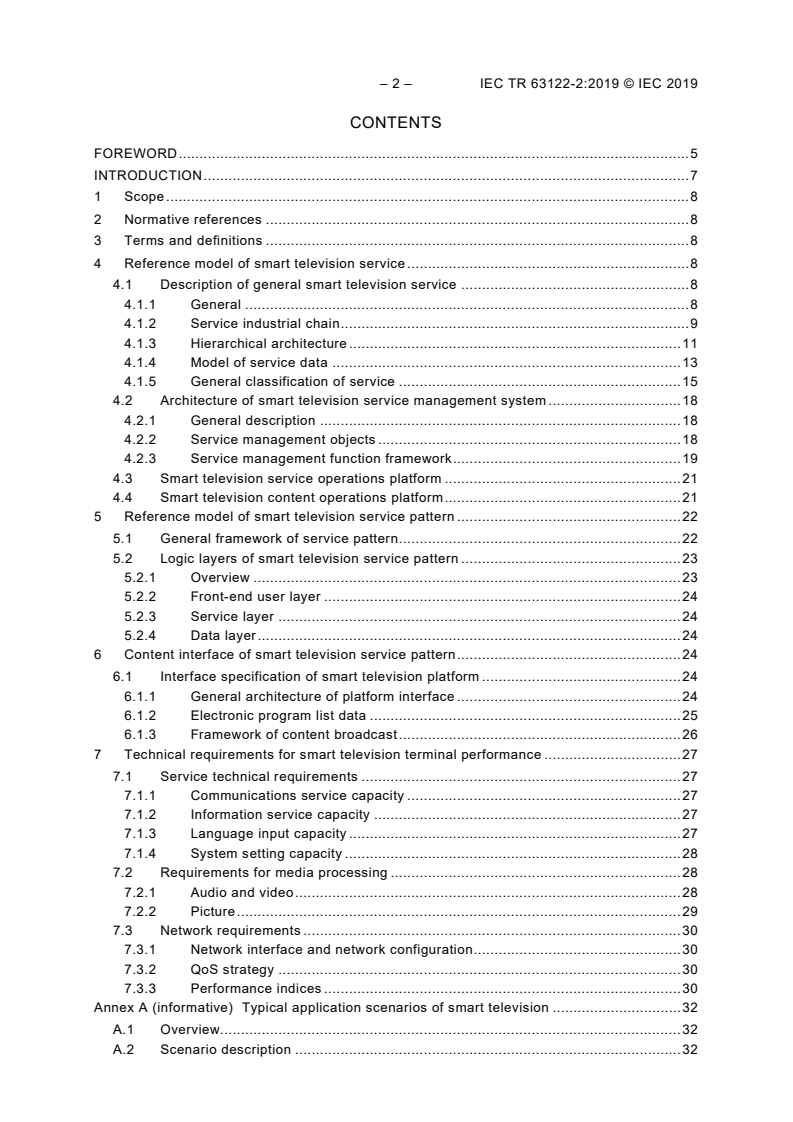
General Information
- Abstract
IEC TR 63122-2:2019 specifies the service pattern conceptual model and standardized demand of smart television, illustrates the terms and related to smart television, and describes service reference model of smart television, the reference model of the service pattern as well as interfaces between various platforms.
- Status
- Published
- Publication Date
- 10-Dec-2019
- Technical Committee
- TA 1 - Terminals for audio, video and data services and content
- Drafting Committee
- PT 63122 - TC 100/TA 1/PT 63122
- Current Stage
- PPUB - Publication issued
- Start Date
- 11-Dec-2019
- Completion Date
- 09-Jan-2020
Overview
IEC TR 63122-2:2019 - Smart television: Part 2 - Framework of integrated service on smart television defines a conceptual and reference framework for integrated services on smart TVs. The technical report specifies a service pattern conceptual model, standardizes service requirements for smart television, clarifies terms and relationships, and describes reference models for services, service patterns, and the interfaces between platforms (operations, content and terminal platforms).
Keywords: smart television, integrated service, service pattern, reference model, platform interfaces, IEC TR 63122-2:2019.
Key topics and technical requirements
The report organizes technical guidance across architecture, management, interfaces and terminal performance. Major topics include:
- Service reference model and industrial chain - conceptual model for how operators, content providers, app stores and terminal vendors interact.
- Hierarchical architecture and service data model - classification and data structures for smart TV services.
- Service management system - objects, functions and the management framework for operating and maintaining smart TV services.
- Operations and content platforms - architectures for service operations platforms and content operations platforms, including electronic programme list handling and content broadcast frameworks.
- Service pattern framework - logic layers (user front-end, service, data) and interface specifications for integrating services across platforms.
- Terminal technical requirements - functional expectations for media processing (audio, video, picture formats), communications and information service capacity, language input, network interfaces, QoS strategies and performance indices.
- Informative annexes - typical application scenarios (home office, public media, gaming), interaction modes (remote control, voice, touch), multi-screen interaction and DLNA references, and an application store service model.
Note: The report includes tables and figures listing supported media formats, parameter categories and interface architectures but does not replace implementation specifications.
Practical applications and users
Who uses IEC TR 63122-2:2019:
- TV manufacturers and firmware architects designing smart TV platforms and UI/service integration.
- Platform operators and content providers planning content distribution, EPG (electronic programme guide) and app store services.
- System integrators and software developers implementing service management, multi-screen and DLNA-based features.
- Network engineers defining QoS and network interface requirements for media-rich services.
- Standards bodies and regulators referencing a common framework for interoperability and service classification.
Practical uses:
- Guiding architecture decisions for integrated smart TV services.
- Specifying interfaces between content, operations and terminal platforms to improve interoperability.
- Informing product requirements for terminal performance and media handling.
Related standards
- Other parts of the IEC 63122 series (smart television family) and IEC TC 100 work on audio/video/multimedia systems provide complementary guidance and normative references for implementation.
Get Certified
Connect with accredited certification bodies for this standard

ANCE
Mexican certification and testing association.

Intertek Slovenia
Intertek testing, inspection, and certification services in Slovenia.

LNE (Laboratoire National de Métrologie et d'Essais)
French national laboratory for metrology and testing.
Sponsored listings
Frequently Asked Questions
IEC TR 63122-2:2019 is a technical report published by the International Electrotechnical Commission (IEC). Its full title is "Smart television - Part 2: Framework of integrated service on smart television". This standard covers: IEC TR 63122-2:2019 specifies the service pattern conceptual model and standardized demand of smart television, illustrates the terms and related to smart television, and describes service reference model of smart television, the reference model of the service pattern as well as interfaces between various platforms.
IEC TR 63122-2:2019 specifies the service pattern conceptual model and standardized demand of smart television, illustrates the terms and related to smart television, and describes service reference model of smart television, the reference model of the service pattern as well as interfaces between various platforms.
IEC TR 63122-2:2019 is classified under the following ICS (International Classification for Standards) categories: 33.160.25 - Television receivers. The ICS classification helps identify the subject area and facilitates finding related standards.
IEC TR 63122-2:2019 is available in PDF format for immediate download after purchase. The document can be added to your cart and obtained through the secure checkout process. Digital delivery ensures instant access to the complete standard document.
Standards Content (Sample)
IEC TR 63122-2 ®
Edition 1.0 2019-12
TECHNICAL
REPORT
colour
inside
Smart television –
Part 2: Framework of integrated service on smart television
All rights reserved. Unless otherwise specified, no part of this publication may be reproduced or utilized in any form
or by any means, electronic or mechanical, including photocopying and microfilm, without permission in writing from
either IEC or IEC's member National Committee in the country of the requester. If you have any questions about IEC
copyright or have an enquiry about obtaining additional rights to this publication, please contact the address below or
your local IEC member National Committee for further information.
IEC Central Office Tel.: +41 22 919 02 11
3, rue de Varembé info@iec.ch
CH-1211 Geneva 20 www.iec.ch
Switzerland
About the IEC
The International Electrotechnical Commission (IEC) is the leading global organization that prepares and publishes
International Standards for all electrical, electronic and related technologies.
About IEC publications
The technical content of IEC publications is kept under constant review by the IEC. Please make sure that you have the
latest edition, a corrigendum or an amendment might have been published.
IEC publications search - webstore.iec.ch/advsearchform Electropedia - www.electropedia.org
The advanced search enables to find IEC publications by a The world's leading online dictionary on electrotechnology,
variety of criteria (reference number, text, technical containing more than 22 000 terminological entries in English
committee,…). It also gives information on projects, replaced and French, with equivalent terms in 16 additional languages.
and withdrawn publications. Also known as the International Electrotechnical Vocabulary
(IEV) online.
IEC Just Published - webstore.iec.ch/justpublished
Stay up to date on all new IEC publications. Just Published IEC Glossary - std.iec.ch/glossary
details all new publications released. Available online and 67 000 electrotechnical terminology entries in English and
once a month by email. French extracted from the Terms and Definitions clause of
IEC publications issued since 2002. Some entries have been
IEC Customer Service Centre - webstore.iec.ch/csc collected from earlier publications of IEC TC 37, 77, 86 and
If you wish to give us your feedback on this publication or CISPR.
need further assistance, please contact the Customer Service
Centre: sales@iec.ch.
IEC TR 63122-2 ®
Edition 1.0 2019-12
TECHNICAL
REPORT
colour
inside
Smart television –
Part 2: Framework of integrated service on smart television
INTERNATIONAL
ELECTROTECHNICAL
COMMISSION
ICS 33.160.25 ISBN 978-2-8322-7695-2
– 2 – IEC TR 63122-2:2019 © IEC 2019
CONTENTS
FOREWORD . 5
INTRODUCTION . 7
1 Scope . 8
2 Normative references . 8
3 Terms and definitions . 8
4 Reference model of smart television service . 8
4.1 Description of general smart television service . 8
4.1.1 General . 8
4.1.2 Service industrial chain . 9
4.1.3 Hierarchical architecture . 11
4.1.4 Model of service data . 13
4.1.5 General classification of service . 15
4.2 Architecture of smart television service management system . 18
4.2.1 General description . 18
4.2.2 Service management objects . 18
4.2.3 Service management function framework . 19
4.3 Smart television service operations platform . 21
4.4 Smart television content operations platform . 21
5 Reference model of smart television service pattern . 22
5.1 General framework of service pattern . 22
5.2 Logic layers of smart television service pattern . 23
5.2.1 Overview . 23
5.2.2 Front-end user layer . 24
5.2.3 Service layer . 24
5.2.4 Data layer . 24
6 Content interface of smart television service pattern . 24
6.1 Interface specification of smart television platform . 24
6.1.1 General architecture of platform interface . 24
6.1.2 Electronic program list data . 25
6.1.3 Framework of content broadcast . 26
7 Technical requirements for smart television terminal performance . 27
7.1 Service technical requirements . 27
7.1.1 Communications service capacity . 27
7.1.2 Information service capacity . 27
7.1.3 Language input capacity . 27
7.1.4 System setting capacity . 28
7.2 Requirements for media processing . 28
7.2.1 Audio and video . 28
7.2.2 Picture . 29
7.3 Network requirements . 30
7.3.1 Network interface and network configuration . 30
7.3.2 QoS strategy . 30
7.3.3 Performance indices . 30
Annex A (informative) Typical application scenarios of smart television . 32
A.1 Overview. 32
A.2 Scenario description . 32
A.2.1 Home office scenario . 32
A.2.2 Public media scenario . 32
A.2.3 Game entertainment scenario . 32
A.3 Interactive mode . 32
A.4 Discovery mode . 33
A.5 Connection mode . 33
Annex B (informative) Typical smart interaction mode of smart television . 34
B.1 Overview. 34
B.2 Description of interaction mode . 34
B.2.1 Interaction via remote control . 34
B.2.2 Interaction via voice . 34
B.2.3 Interaction via smart touch . 34
Annex C (informative) Model for general service context of smart television . 36
C.1 Overview. 36
C.2 Definition of model . 36
C.3 Classification of general service context of smart television . 37
Annex D (informative) Service model of smart television application store . 38
D.1 Overview. 38
D.2 Features . 38
D.3 Model of service industrial chain . 38
Annex E (informative) Typical technical application of smart television . 40
E.1 Multi-screen interaction technology . 40
E.2 DLNA technology . 40
Annex F (informative) Classified identity of smart television programme list . 42
Bibliography . 44
Figure 1 – Model of service industrial chain . 10
Figure 2 – Model of hierarchical architecture. 11
Figure 3 – Smart television service classification . 16
Figure 4 – Relation model of service management objects . 18
Figure 5 – Architecture of service management system . 19
Figure 6 – Service operations platform . 21
Figure 7 – Content operations platform . 22
Figure 8 – Framework of service pattern . 23
Figure 9 – Service pattern framework . 24
Figure 10 – General architecture of platform interface . 25
Figure 11 – Content broadcast of smart television. 26
Figure C.1 – Definition of context model . 36
Figure D.1 – Architecture of application store . 39
Figure E.1 – Multi-screen interaction . 40
Table 1 – Category grouping . 13
Table 2 – Electronic programme list . 26
Table 3 – Format of audio and video media . 28
Table 4 – Audio parameters and indices . 28
– 4 – IEC TR 63122-2:2019 © IEC 2019
Table 5 – Video file parameters (played locally) . 29
Table 6 – Video file parameters (played online) . 29
Table 7 – Picture format . 29
Table 8 – Type of picture files and parameters . 30
Table A.1 – Home office scenario . 32
Table A.2 – Public media scenario . 32
Table A.3 – Game entertainment scenario . 32
Table C.1 – Classified code of programme list content . 37
Table E.1 – DLNA functional components . 41
Table E.2 – Supported formats . 41
Table F.1 – Classified code of programme list content . 42
INTERNATIONAL ELECTROTECHNICAL COMMISSION
____________
SMART TELEVISION –
Part 2: Framework of integrated service on smart television
FOREWORD
1) The International Electrotechnical Commission (IEC) is a worldwide organization for standardization comprising
all national electrotechnical committees (IEC National Committees). The object of IEC is to promote
international co-operation on all questions concerning standardization in the electrical and electronic fields. To
this end and in addition to other activities, IEC publishes International Standards, Technical Specifications,
Technical Reports, Publicly Available Specifications (PAS) and Guides (hereafter referred to as “IEC
Publication(s)”). Their preparation is entrusted to technical committees; any IEC National Committee interested
in the subject dealt with may participate in this preparatory work. International, governmental and non-
governmental organizations liaising with the IEC also participate in this preparation. IEC collaborates closely
with the International Organization for Standardization (ISO) in accordance with conditions determined by
agreement between the two organizations.
2) The formal decisions or agreements of IEC on technical matters express, as nearly as possible, an international
consensus of opinion on the relevant subjects since each technical committee has representation from all
interested IEC National Committees.
3) IEC Publications have the form of recommendations for international use and are accepted by IEC National
Committees in that sense. While all reasonable efforts are made to ensure that the technical content of IEC
Publications is accurate, IEC cannot be held responsible for the way in which they are used or for any
misinterpretation by any end user.
4) In order to promote international uniformity, IEC National Committees undertake to apply IEC Publications
transparently to the maximum extent possible in their national and regional publications. Any divergence
between any IEC Publication and the corresponding national or regional publication shall be clearly indicated in
the latter.
5) IEC itself does not provide any attestation of conformity. Independent certification bodies provide conformity
assessment services and, in some areas, access to IEC marks of conformity. IEC is not responsible for any
services carried out by independent certification bodies.
6) All users should ensure that they have the latest edition of this publication.
7) No liability shall attach to IEC or its directors, employees, servants or agents including individual experts and
members of its technical committees and IEC National Committees for any personal injury, property damage or
other damage of any nature whatsoever, whether direct or indirect, or for costs (including legal fees) and
expenses arising out of the publication, use of, or reliance upon, this IEC Publication or any other IEC
Publications.
8) Attention is drawn to the Normative references cited in this publication. Use of the referenced publications is
indispensable for the correct application of this publication.
9) Attention is drawn to the possibility that some of the elements of this IEC Publication may be the subject of
patent rights. IEC shall not be held responsible for identifying any or all such patent rights.
The main task of IEC technical committees is to prepare International Standards. However, a
technical committee may propose the publication of a technical report when it has collected
data of a different kind from that which is normally published as an International Standard, for
example "state of the art".
IEC/TR 63122-2, which is a technical report, has been prepared by subcommittee TA 1:
Terminals for audio, video and data services and contents, of IEC technical committee 100:
Audio, video and multimedia systems and equipment.
The text of this technical report is based on the following documents:
Enquiry draft Report on voting
100/2904/DTR 100/3054/RVDTR
Full information on the voting for the approval of this technical report can be found in the
report on voting indicated in the above table.
– 6 – IEC TR 63122-2:2019 © IEC 2019
This document has been drafted in accordance with the ISO/IEC Directives, Part 2.
A list of all the parts in the IEC 63122 series, published under the general title Smart
television, can be found on the IEC website.
The committee has decided that the contents of this document will remain unchanged until the
stability date indicated on the IEC website under "http://webstore.iec.ch" in the data related to
the specific document. At this date, the document will be
• reconfirmed,
• withdrawn,
• replaced by a revised edition, or
• amended.
A bilingual version of this publication may be issued at a later date.
IMPORTANT – The 'colour inside' logo on the cover page of this publication indicates
that it contains colours which are considered to be useful for the correct
understanding of its contents. Users should therefore print this document using a
colour printer.
INTRODUCTION
This Technical Report is formulated based on the current state of the industrialization of smart
television and regards open innovation, vertical integration of chain and in-depth incorporation
of technology and service as fundamental principles. The intention of this document is to
strengthen the innovation of smart television in terms of technology, service mode and system
mechanism, to advance compatibility of smart television products, and to speed up the
expansion of the application market, thereby putting forward a relevant conceptual model and
standardized demand for smart television. This document applies to guide service operations
and service mode implementation of smart television.
– 8 – IEC TR 63122-2:2019 © IEC 2019
SMART TELEVISION –
Part 2: Framework of integrated service on smart television
1 Scope
This part of IEC 63122 specifies the service pattern conceptual model and standardized
demand of smart television, illustrates the terms and related to smart television, and
describes service reference model of smart television, the reference model of the service
pattern as well as interfaces between various platforms.
2 Normative references
There are no normative references in this document.
3 Terms and definitions
For the purposes of this document, the following terms and definitions apply.
ISO and IEC maintain terminological databases for use in standardization at the following
addresses:
• IEC Electropedia: available at http://www.electropedia.org/
• ISO Online browsing platform: available at http://www.iso.org/obp
3.1
smart television service
general designation of many services provided to users through networks that support live
broadcast of interactive television programmes, on-demand multimedia content and various
interactive application programs
3.2
smart television service operation platform
platform built, maintained and managed by the service provider in the mode of smart
television partnership operations and which is responsible for the electronic programme list
service, content distribution, etc.
3.3
operations and maintenance support system
service management platform interacted with service management system is used to complete
business service information inquiry and related management.
4 Reference model of smart television service
4.1 Description of general smart television service
4.1.1 General
This document specifies various service industry models, various service descriptions and
management system frameworks for smart television services, and offers technical guidance
and standard specifications for the development and progress of smart television services.
This document also specifies data models and technical definitions of smart television
services and puts forward a technical specification for the purpose of further specifying a
reference model of smart television services. A smart television terminal that supports general
services needs to meet the following requirements.
1 2
• System: by installing a smart operating system, such as Android™ or iOS™ , a user may
freely install and uninstall application programs provided by third-party service providers
and voluntarily select to accept or expand services, etc.; the user may extend the
functions of a traditional television with installed programs, realize somatosensory games,
software downloads and installation, multi-screen interaction and voice operation, thereby
conducting service for intensive users across regions. The system has a relatively high
reliability and availability.
• Openness: openness and consistence in terms of service capacity, service size, network
size, user access mode, service access mode and device interconnection. An open
platform allows infinite extension of content and applications.
• Mode of delivery: a smart television service may be delivered through smart interactive
means, such as voice control and gesture interaction. Such means are important for
service improvement and expansion. It can realize integration and interaction of
information, entertainment, application and message on the television screen.
4.1.2 Service industrial chain
General smart television service offers the following features.
• One-way interactive information flow: allows the user to search and interact with
information, including data flows mainly consisting of audio-video and allows the user to
control information mainly containing smart interaction, transformation of traditional one-
way viewing into two-way interaction mode, and provide the content along with the
appropriate service mode. See Annex B for the typical smart interaction model.
• Provision of streaming service: content cache, distribution and storage. Underpinning
"content first", smart home entertainment terminals are becoming the new focus of the
development trend of smart television. In consideration of the high level of popularization
and development of traditional television, consumption of new smart television is aimed at
providing users with funded content services. Current smart television terminals are in
strict compliance with the principle of high-level integration between hardware and content
in terms of interaction mode, multi-screen interaction and application content download.
See Annex E for the typical technical application of smart television.
• Provision of enriched and diversified video/audio resources, entertainment application
platforms and content services: smart television developers are encouraged to actively
build a unique ecological system, and launch novel content based on consumption habits
and actual demand for smart television, thereby creating an ecological system and profit
mode truly exclusive to smart television.
Based on the current development of smart television, the industrial chain of smart television
services mainly consists of the following components as shown in Figure 1.
___________
Android is the trademark of a product supplied by Google. This information is given for the convenience of
users of this document and does not constitute an endorsement by IEC of the product named. Equivalent
products may be used if they can be shown to lead to the same results.
iOS is the trademark of a product supplied by Apple. This information is given for the convenience of users of
this document and does not constitute an endorsement by IEC of the product named. Equivalent products may
be used if they can be shown to lead to the same results.
– 10 – IEC TR 63122-2:2019 © IEC 2019
Figure 1 – Model of service industrial chain
• Content provider: the content provider is mainly responsible for the production of content
for smart television terminals and the development of various application programs. It
provides the content as produced and developed to the service operator. The content
provider is the production origin of the entire service industrial chain and integrate the
content into a uniform platform of the service operator to allow the content to be used by
end user terminals by reaching consumers via smart television terminals. The content
provider has the following main responsibilities:
1) to provide new distribution channels for the content provider;
2) to request that the content be protected rather than being illegally disseminated and
used;
3) to ensure that the operations of audio/video content are manageable and billable;
4) to ensure that the operations of installable application programs are manageable and
billable.
• Service operator: the service operator is mainly responsible for the integration and
operations of the content. It also integrates various contents on its own platform and
reaches end consumers via the network of the network operator to offer appropriate
services and applications to users. The service operator has the responsibilities described
below:
1) to ensure normal operations of the service and carry out service management;
2) to guarantee such processes as content review and release and carry out content
management;
3) to guarantee user management and carry out account management for users, such as
account opening and cancellation;
4) to guarantee a certified authorization and billing mechanism during service use to
prevent illegal use of the service;
5) to safeguard the operations of the smart television terminal and carry out terminal
management;
6) to provide the user with a uniform service portal navigation;
7) to ensure that the network operator provides a transmission network with QoS
guarantee;
8) to ensure that the content provider provides audio/video content that follows the review
conducted by the national authority;
9) to ensure that the content provider provides installable application programs that
follows the review conducted by the national authority.
• Network operator: the network operator is mainly responsible for using its own network to
transmit the content and service provided by the smart television service operator to end
user terminals, and obtaining earnings. The network operator understands the operating
condition of the network from the point of the network and clarifies the operating condition
of the network from the point of service. The network operator includes an infrastructure
operator and an access network operator. The former includes telecommunications, radio
and television, satellite, etc. The latter includes cable, wireless and satellite network
access operator. The network operator has main responsibilities described below:
1) to satisfy the requirements for high availability, high reliability and quick
troubleshooting and restoration;
2) to satisfy the requirements for network manageability;
3) to satisfy the requirements for random distribution and random on-demand for a large
number of users;
4) to satisfy the requirements for interconnectivity among various network operators;
5) to provide a sufficient QoS guarantee for user service implementation;
6) to provide a sufficient safety guarantee for user service implementation;
7) to provide the method for monitoring content safety and appropriate network
monitoring points.
• End-user terminal: an end-user terminal has access to the network and enjoys smart
television service via smart television terminals such as smart televisions, large-screen
media systems and large-screen news release systems. The demands of an end-user
terminal include:
1) powerful hardware configuration, open operating system and open application program
platform;
2) interactive experience of audio/video content and smart television application program;
3) response time of operation equivalent to that of radio and television;
4) long-term consistent, stable QoS;
5) that the system may guarantee the safety of user information;
6) enrichment of application program and film/television content;
7) enriched, smart apps store;
8) simple and easy human-machine interoperability, high-accuracy of smart interaction,
response time within acceptable range;
9) simple and clear user interface and inspiring smart human-machine interface;
10) that the system may guarantee the billing accuracy and the diversity of rates and the
user may obtain the bill via multiple means.
4.1.3 Hierarchical architecture
4.1.3.1 General description
The hierarchical architecture for a general smart television service mainly consists of the
parts described in 4.1.3.2 to 4.1.3.5. Interconnection between different layers may be realized
by the calling mode of functional modules of loose coupling. Intra-layer may also adopt the
structure of a functional module. See Figure 2.
Figure 2 – Model of hierarchical architecture
– 12 – IEC TR 63122-2:2019 © IEC 2019
4.1.3.2 Access layer
The access layer of a general smart television service uses IP as its basic protocol. It
includes broadband access network, urban area network and a backbone network, as well as
related control management functions. The access layer can be capable of ensuring sufficient
bandwidth and a certain transmission quality and be provided with the following capacities:
• access to the end-user terminal and certification of network layer;
• delivery of each service information stream to the destination end as required by the
previous layer;
• calling up network resources as per specific attribute requirements of each service to
ensure the function and performance of the service;
• satisfying the special requirements of the streaming media service for access layer;
• satisfying the network access requirements for the installation of application programs;
• monitoring of network administration functions and system equipment.
4.1.3.3 Management control layer
Being responsible for the service execution and control, the management control layer may
accept the bottom-layer network function of the access layer and provide service to the
application layer. It has the following functions:
• distribution and storage management of media content data, and content management of
application program data;
• service subscription and service statistics collection;
• realization of hierarchical level networking and internal load balance mechanism of
streaming server;
• provision of streaming service capability to the end user and support and service to end-
user applications;
• information maintenance of various services, i.e. one or more content combination.
• packaging of service capacity of the access layer, providing interface to the previous
application layer;
• provision of interface with such external systems as the billing system, user management
system and network management system.
4.1.3.4 Application layer
By calling up various capacities of the management control layer, the application layer
provides end-user terminals and content providers with various services. For instance, video
on demand applications and video-based broadcast remote education applications need a
basic streaming service capacity, although the service package pattern and service
processing logic representation between both applications are different. The application layer
needs to use the capacity provided by the service layer and execute application customization
and service deployment as required by the operator. It may offer the following features:
• providing the user with a uniform interface and carrying out operations such as service
ordering and data inquiry;
• acquiring content metadata and content pricing strategy provided by the content provider.
4.1.3.5 Interactive layer
The layer directly connecting the end-user terminal is located at the top end of the
hierarchical architecture, mainly providing customer-facing interaction with the user. End-user
terminals may have access to the network via such access means as ADSL, LAN and WLAN,
realize relevant services and offer the following features:
• processing user entry, identifying user's intention and getting user's feedback;
• processing two-way interactive data services and transmitting data to application level.
4.1.4 Model of service data
4.1.4.1 Service metadata
Smart television service metadata is used to describe the basic data specification in general
smart television services, satisfying activities of all stages that the users demand, and
describing service subscription and execution with such basic data, allowing a set of common
definitions and standards to describe simple and complicated services as well as breadth and
depth of a service. Metadata contained in this document consists of various elements, each
with unique attributes, i.e.
NAME: Name of service
TYPE: Type of service
CLIENT: Service client
BILLING: Billing for service implementation
IDENTIFIER: Unique identifier of service
VERSION: Data version that generates service
REGISTRATION AUTHORITHY: Service authorization agency
CP/SP DESCRIPTION: Content provider (CP) and service provider(SP) of the service
LANGUAGE: Language description
DEFINITION: Description of service concept and implication
OBLIGATION: Type of service obligation
DATATYPE: Data type reflected in service data
COMMENT: Comment of element application
All elements are divided into three groups, shown in Table 1 by the category and scope of the
content as described:
1) description of service content;
2) description of intellectual property; and
3) description of external attribute.
Table 1 – Category grouping
Description of service content Description of intellectual Description of external attribute
property
Title Creator Data
Subject Operator Type
Description Contributor Identifier
Source Rights Client
Language Billing
Coverage
Description of service element:
– 14 – IEC TR 63122-2:2019 © IEC 2019
• Title
Label: "Title"
Service name given by the service content creator or publisher.
• Creator
Label: "Creator"
Main creation entity of service content, including name of a person, organization or some
kind of service.
• Subject and keywords
Label: "Subject"
Subject of service content, usually descriptive subject word or keyword, or classification
code.
• Billing strategy
Label: "Billing"
Billing of service implementation, mainly pricing strategy for end-user terminal.
• Description
Label: "Description"
Text description of service content, including brief introduction to audio-video content,
description or comment of main functions of application program, etc.
• Client
Label: "Client"
Description of main service implementation object. For specific attributes, see the detailed
description below.
• Operator
Label: "Operator"
Operator responsible for service. Generally, the name of an institution.
• Other contributors
Label: "Contributors"
Significant contributing entities not listed in the element Creator while contributing to
providing service.
• Date
Label: "Date"
Date having any association with service. The format YYYY-MM-DD specified in ISO 8601
is recommended. For instance, 2013-11-20 represents November 20, 2013.
• Service type
Label: "Type"
Inherent attribute, form or type of service service content, such as live broadcast, video on
demand, video chat, online novel, etc. For improved interoperability, a service type value
may be chosen from the service type list.
• Identifier
Label: "Identifier"
String or number used to solely identify the service. For instance, generic unique identifier,
such as URL, URN or DOI, existing in network resource identifier contained in online
audio-video service.
• Language
Label: "Language"
Language of service content. It is recommended that the content of this field comply with
the provisions of RFC1766, i.e. en, de, es, fi, fr, ja, th, and zh (ISO 639), etc.
• Coverage
Label: "Coverage"
Time-spatial characteristic of service content. Spatial scope refers to physical area,
derived from location name or full name of normative thesaurus. Time range refers to
service service type rather than the time when service is generated (represented by Date).
Time description (generally a time range) adopts the same format as Date, i.e. date and
time format based on ISO 8601 W3C technical specification.
• Rights management
Label: "Rights"
Statement of rights management, or an identifier directing to a statement of rights
management, or an identifier directing to the server providing rights management
information content of the service.
Description of client elements:
• Title
Label: "Title"
Name of specific client.
• Identifier
Label: "Identifier"
String or number used to solely identify client information.
• Description
Label: "Description"
Describe information relating to the client and that relating to client account.
4.1.5 General classification of service
4.1.5.1 General description
Classification of a general smart television service is shown in Figure 3. Specifically, a
general service may be classified into basic audio/video playing service and application-based
service. See Annex C for the model for general service context.
– 16 – IEC TR 63122-2:2019 © IEC 2019
Figure 3 – Smart television service classification
Figure 3 gives a general clear description of different smart television services; 4.1.5.2 gives
a more detailed functional description.
4.1.5.2 Basic audio/video playing service
• Live broadcast: similar to ordinary radio and television, it delivers same video/audio
stream to multiple users on the smart television platform provided that the user joins a
certain broadcast channel before using the broadcast service. External television signal
sources include satellite television, cable television, DVB; the content of streaming media
is determined by the broadcast service provider. Programmes offered for live broadcast
may be of standard definition or high definition. The content is continuous without a clear
beginning and ending. Supported by the transmission network, the system can provide
users with a live broadcast service through combined broadcasts to improve the usage
efficiency of bandwidth as much as possible: without support of combined broadcast in the
network, the system may serve the users via a single broadcast.
• Radio: radio mainly includes conventional radio and web radio. The former delivers voice
information via radio waves or wires to allow end user terminals to receive with a receiver
incorporated in smart television. The latter, a web streaming media, establishes a radio
server on Internet sites to disseminate the program through specific software to allow end
user terminals to install and run the radio-receiving software on smart televisions to
connect to these sites and listen to radio programmes.
• Video on demand: video on demand, a type of point-to-point play, allows a single user to
play video/audio streaming as needed. Video on demand services enable the users to
freely allocate their own time and enjoy the programmes that they want to watch. In
addition, with various classification and search methods, the user may find the
programmes that he/she wants to watch as soon as possible. By access to the terminal for
browsing and searching content in stock, a user may play on-demand appropriate
programmes as per his/her demand and preferences. Following submitting requests via
the smart television terminal, a user may browse various programmes provided by the
operator.
4.1.5.3 Application-based service
With application-based smart television services, an end-user terminal may realize a user
service through installing a specific application program offered in an app store. Such a
service mainly includes the following applications and services.
• Information service application: mainly includes user-requested information, advertising
tweeting, video inserts and rolling subtitles, etc. Information service application includes:
1) news information, government announcements;
2) weather forecasts;
3) educational programmes;
4) medical information;
5) film information;
6) stock exchange;
7) tourism information, etc.
• Interactive game application: mainly includes local games for smart television and web-
based online games. It focuses on smart
...