

IEC 61162-1:2016
(Main)Maritime navigation and radiocommunication equipment and systems - Digital interfaces - Part 1: Single talker and multiple listeners
General Information
- Abstract
IEC 61162-1:2016 contains the requirements for data communication between maritime electronic instruments, navigation and radiocommunication equipment when interconnected via an appropriate system. This part of IEC 61162 is intended to support one-way serial data transmission from a single talker to one or more listeners. These data are in printable ASCII form and may include information such as position, speed, depth, frequency allocation, etc. Typical messages may be from about 11 to a maximum of 79 characters in length and generally require transmission no more rapidly than one message per second. The electrical definitions in this standard are not intended to accommodate high-bandwidth applications such as radar or video imagery, or intensive database or file transfer applications. Since there is no provision for guaranteed delivery of messages and only limited error checking capability, this standard should be used with caution in all safety applications. For applications where a faster transmission rate is necessary, reference should be made to IEC 61162-2. For applications to shore based equipment of the automatic identification system (AIS) reference should be made to the IEC 62320 series. This fifth edition cancels and replaces the fourth edition published in 2010, and constitutes a technical revision. This edition includes the following significant technical changes with respect to the previous edition:
- new identifiers have been added to Table 4;
- the sentences CBR and MEB have been removed as they are now solely used by AIS shore based equipment;
- new sentences ACN, ALC, ALF, ARC, EPV, HCR, HRM, MOB, NSR, RLM, RRT, SM1, SM2, SM3, SM4, SMB, SPW and TRL have been added;
- revisions have been made to ABK, ABM, GNS, NAK, NRM, RMC, ROR and TTD;
- the methods of testing in Annex B have been revised.
- Status
- Published
- Publication Date
- 30-Aug-2016
- Technical Committee
- TC 80 - Maritime navigation and radiocommunication equipment and systems
- Drafting Committee
- WG 6 - TC 80/WG 6
- Current Stage
- DELPUB - Deleted Publication
- Start Date
- 04-Apr-2024
- Completion Date
- 03-Jan-2022
Buy Documents
IEC 61162-1:2016 - Maritime navigation and radiocommunication equipment and systems - Digital interfaces - Part 1: Single talker and multiple listeners Released:8/31/2016
IEC 61162-1:2016 RLV - Maritime navigation and radiocommunication equipment and systems - Digital interfaces - Part 1: Single talker and multiple listeners Released:8/31/2016
IEC 61162-1:2016 - Maritime navigation and radiocommunication equipment and systems - Digital interfaces - Part 1: Single talker and multiple listeners Released:8/31/2016
Overview
IEC 61162-1:2016 - Maritime navigation and radiocommunication equipment and systems - Digital interfaces - Part 1: Single talker and multiple listeners defines one-way serial data communication for connected maritime instruments and radio/navigation equipment. It standardizes printable ASCII sentence formats (typical messages 11–79 characters, generally ≤1 message/s) to convey information such as position, speed, depth, frequency allocation and similar navigational data. The electrical definitions are for low-bandwidth serial links and are not intended for high-bandwidth applications (radar, video, large file transfers). Due to limited error checking and no guaranteed delivery, use in safety-critical systems is cautioned.
Key topics and requirements
- Data transmission model: Single talker, multiple listeners (one-way serial).
- Data format protocol: Character sets, fields, sentence structure, checksum, sequential identifiers, multi-sentence messages, timing and error handling.
- Message constraints: Printable ASCII, typical length 11–79 characters, transmission rate generally no faster than one message per second.
- Electrical and hardware specs: Interconnecting wire, conductor and shielding requirements, connectors, talker drive and listener receive circuits, electrical isolation and maximum bus voltage.
- Error handling: Limited error detection and handling mechanisms - not suitable where guaranteed delivery is required.
- Document updates (Edition 5 highlights):
- New identifiers added to the sentence table.
- Several new sentences added (e.g., ACN, ALC, MOB, NSR, RRT, TRL, etc.).
- Removal of certain AIS shore-only sentences (CBR, MEB).
- Revisions to existing sentences (ABK, ABM, GNS, NAK, NRM, RMC, ROR, TTD).
- Revised test methods in Annex B.
Applications and who uses it
IEC 61162-1 is used to ensure interoperability of marine electronics and to standardize low-bandwidth data exchange between devices such as navigation instruments, radios and shipboard sensors. Typical users:
- Marine electronics manufacturers and designers
- Shipyards and system integrators
- Marine system installers and maintenance engineers
- Ship operators and fleet technical teams seeking predictable instrument data flows
- Test laboratories and conformity assessment bodies
Practical benefits include simplified cabling and integration, consistent data formats for logging and display, and predictable behavior for listeners across vendor equipment.
Related standards
- IEC 61162-2 - for higher-rate multi-transmitter systems (faster transmission requirements)
- IEC 62320 series - for shore-based AIS applications and longer-range AIS data exchange
Keywords: IEC 61162-1, maritime navigation standard, digital interfaces, single talker multiple listeners, serial data transmission, ASCII sentences, marine equipment interoperability.
Relations
- Effective Date
- 05-Sep-2023
- Effective Date
- 05-Sep-2023
- Effective Date
- 05-Sep-2023
Buy Documents
IEC 61162-1:2016 - Maritime navigation and radiocommunication equipment and systems - Digital interfaces - Part 1: Single talker and multiple listeners Released:8/31/2016
IEC 61162-1:2016 RLV - Maritime navigation and radiocommunication equipment and systems - Digital interfaces - Part 1: Single talker and multiple listeners Released:8/31/2016
IEC 61162-1:2016 - Maritime navigation and radiocommunication equipment and systems - Digital interfaces - Part 1: Single talker and multiple listeners Released:8/31/2016
Get Certified
Connect with accredited certification bodies for this standard

DNV
DNV is an independent assurance and risk management provider.

Lloyd's Register
Lloyd's Register is a global professional services organisation specialising in engineering and technology.

FSC International
Forest Stewardship Council certification.
Sponsored listings
Frequently Asked Questions
IEC 61162-1:2016 is a standard published by the International Electrotechnical Commission (IEC). Its full title is "Maritime navigation and radiocommunication equipment and systems - Digital interfaces - Part 1: Single talker and multiple listeners". This standard covers: IEC 61162-1:2016 contains the requirements for data communication between maritime electronic instruments, navigation and radiocommunication equipment when interconnected via an appropriate system. This part of IEC 61162 is intended to support one-way serial data transmission from a single talker to one or more listeners. These data are in printable ASCII form and may include information such as position, speed, depth, frequency allocation, etc. Typical messages may be from about 11 to a maximum of 79 characters in length and generally require transmission no more rapidly than one message per second. The electrical definitions in this standard are not intended to accommodate high-bandwidth applications such as radar or video imagery, or intensive database or file transfer applications. Since there is no provision for guaranteed delivery of messages and only limited error checking capability, this standard should be used with caution in all safety applications. For applications where a faster transmission rate is necessary, reference should be made to IEC 61162-2. For applications to shore based equipment of the automatic identification system (AIS) reference should be made to the IEC 62320 series. This fifth edition cancels and replaces the fourth edition published in 2010, and constitutes a technical revision. This edition includes the following significant technical changes with respect to the previous edition: - new identifiers have been added to Table 4; - the sentences CBR and MEB have been removed as they are now solely used by AIS shore based equipment; - new sentences ACN, ALC, ALF, ARC, EPV, HCR, HRM, MOB, NSR, RLM, RRT, SM1, SM2, SM3, SM4, SMB, SPW and TRL have been added; - revisions have been made to ABK, ABM, GNS, NAK, NRM, RMC, ROR and TTD; - the methods of testing in Annex B have been revised.
IEC 61162-1:2016 contains the requirements for data communication between maritime electronic instruments, navigation and radiocommunication equipment when interconnected via an appropriate system. This part of IEC 61162 is intended to support one-way serial data transmission from a single talker to one or more listeners. These data are in printable ASCII form and may include information such as position, speed, depth, frequency allocation, etc. Typical messages may be from about 11 to a maximum of 79 characters in length and generally require transmission no more rapidly than one message per second. The electrical definitions in this standard are not intended to accommodate high-bandwidth applications such as radar or video imagery, or intensive database or file transfer applications. Since there is no provision for guaranteed delivery of messages and only limited error checking capability, this standard should be used with caution in all safety applications. For applications where a faster transmission rate is necessary, reference should be made to IEC 61162-2. For applications to shore based equipment of the automatic identification system (AIS) reference should be made to the IEC 62320 series. This fifth edition cancels and replaces the fourth edition published in 2010, and constitutes a technical revision. This edition includes the following significant technical changes with respect to the previous edition: - new identifiers have been added to Table 4; - the sentences CBR and MEB have been removed as they are now solely used by AIS shore based equipment; - new sentences ACN, ALC, ALF, ARC, EPV, HCR, HRM, MOB, NSR, RLM, RRT, SM1, SM2, SM3, SM4, SMB, SPW and TRL have been added; - revisions have been made to ABK, ABM, GNS, NAK, NRM, RMC, ROR and TTD; - the methods of testing in Annex B have been revised.
IEC 61162-1:2016 is classified under the following ICS (International Classification for Standards) categories: 47.020.70 - Navigation and control equipment. The ICS classification helps identify the subject area and facilitates finding related standards.
IEC 61162-1:2016 has the following relationships with other standards: It is inter standard links to IEC 61162-1:2010/COR1:2013, IEC 61162-1:2010, IEC 61162-1:2024. Understanding these relationships helps ensure you are using the most current and applicable version of the standard.
IEC 61162-1:2016 is available in PDF format for immediate download after purchase. The document can be added to your cart and obtained through the secure checkout process. Digital delivery ensures instant access to the complete standard document.
Standards Content (Sample)
IEC 61162-1 ®
Edition 5.0 2016-08
INTERNATIONAL
STANDARD
colour
inside
Maritime navigation and radiocommunication equipment and systems – Digital
interfaces –
Part 1: Single talker and multiple listeners
All rights reserved. Unless otherwise specified, no part of this publication may be reproduced or utilized in any form
or by any means, electronic or mechanical, including photocopying and microfilm, without permission in writing from
either IEC or IEC's member National Committee in the country of the requester. If you have any questions about IEC
copyright or have an enquiry about obtaining additional rights to this publication, please contact the address below or
your local IEC member National Committee for further information.
IEC Central Office Tel.: +41 22 919 02 11
3, rue de Varembé Fax: +41 22 919 03 00
CH-1211 Geneva 20 info@iec.ch
Switzerland www.iec.ch
About the IEC
The International Electrotechnical Commission (IEC) is the leading global organization that prepares and publishes
International Standards for all electrical, electronic and related technologies.
About IEC publications
The technical content of IEC publications is kept under constant review by the IEC. Please make sure that you have the
latest edition, a corrigenda or an amendment might have been published.
IEC Catalogue - webstore.iec.ch/catalogue Electropedia - www.electropedia.org
The stand-alone application for consulting the entire The world's leading online dictionary of electronic and
bibliographical information on IEC International Standards, electrical terms containing 20 000 terms and definitions in
Technical Specifications, Technical Reports and other English and French, with equivalent terms in 15 additional
documents. Available for PC, Mac OS, Android Tablets and languages. Also known as the International Electrotechnical
iPad. Vocabulary (IEV) online.
IEC publications search - www.iec.ch/searchpub IEC Glossary - std.iec.ch/glossary
The advanced search enables to find IEC publications by a 65 000 electrotechnical terminology entries in English and
variety of criteria (reference number, text, technical French extracted from the Terms and Definitions clause of
committee,…). It also gives information on projects, replaced IEC publications issued since 2002. Some entries have been
and withdrawn publications. collected from earlier publications of IEC TC 37, 77, 86 and
CISPR.
IEC Just Published - webstore.iec.ch/justpublished
Stay up to date on all new IEC publications. Just Published IEC Customer Service Centre - webstore.iec.ch/csc
details all new publications released. Available online and If you wish to give us your feedback on this publication or
also once a month by email. need further assistance, please contact the Customer Service
Centre: csc@iec.ch.
IEC 61162-1 ®
Edition 5.0 2016-08
INTERNATIONAL
STANDARD
colour
inside
Maritime navigation and radiocommunication equipment and systems – Digital
interfaces –
Part 1: Single talker and multiple listeners
INTERNATIONAL
ELECTROTECHNICAL
COMMISSION
ICS 47.020.70 ISBN 978-2-8322-3594-2
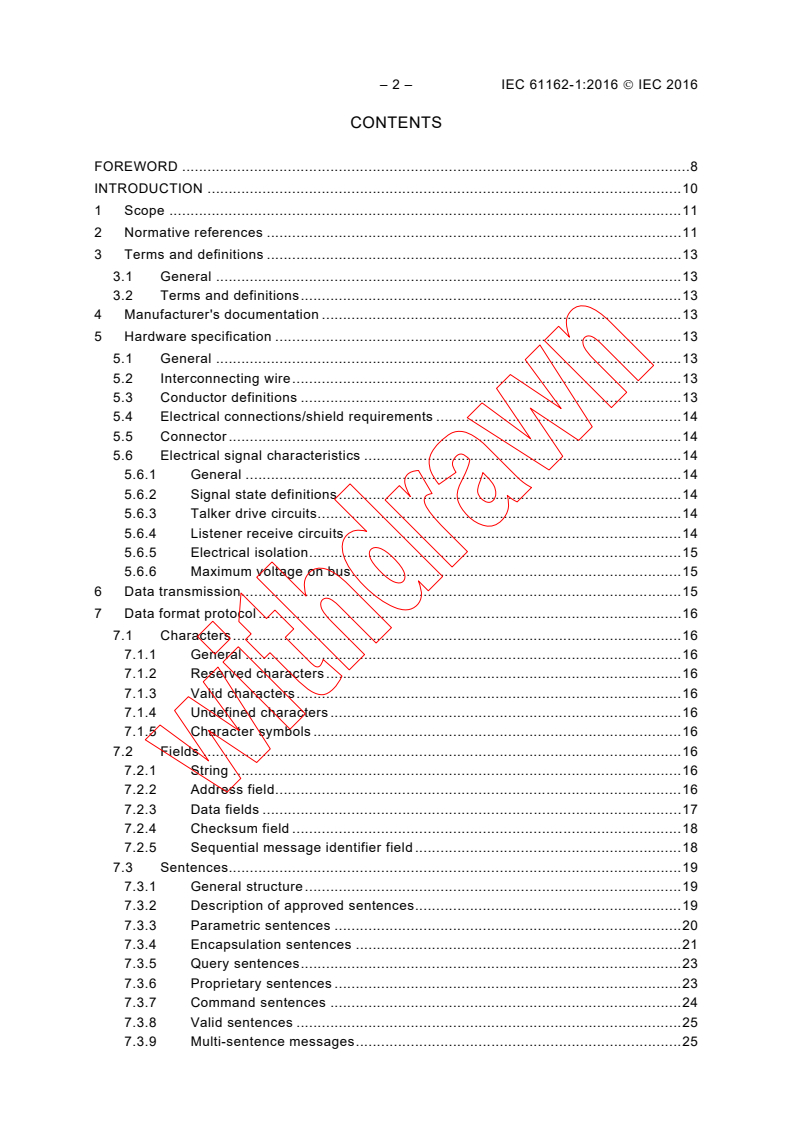
– 2 – IEC 61162-1:2016 IEC 2016
CONTENTS
FOREWORD .8
INTRODUCTION . 10
1 Scope . 11
2 Normative references . 11
3 Terms and definitions . 13
3.1 General . 13
3.2 Terms and definitions . 13
4 Manufacturer's documentation . 13
5 Hardware specification . 13
5.1 General . 13
5.2 Interconnecting wire . 13
5.3 Conductor definitions . 13
5.4 Electrical connections/shield requirements . 14
5.5 Connector . 14
5.6 Electrical signal characteristics . 14
5.6.1 General . 14
5.6.2 Signal state definitions . 14
5.6.3 Talker drive circuits . 14
5.6.4 Listener receive circuits . 14
5.6.5 Electrical isolation . 15
5.6.6 Maximum voltage on bus . 15
6 Data transmission . 15
7 Data format protocol . 16
7.1 Characters . 16
7.1.1 General . 16
7.1.2 Reserved characters . 16
7.1.3 Valid characters . 16
7.1.4 Undefined characters . 16
7.1.5 Character symbols . 16
7.2 Fields . 16
7.2.1 String . 16
7.2.2 Address field . 16
7.2.3 Data fields . 17
7.2.4 Checksum field . 18
7.2.5 Sequential message identifier field . 18
7.3 Sentences. 19
7.3.1 General structure . 19
7.3.2 Description of approved sentences . 19
7.3.3 Parametric sentences . 20
7.3.4 Encapsulation sentences . 21
7.3.5 Query sentences . 23
7.3.6 Proprietary sentences . 23
7.3.7 Command sentences . 24
7.3.8 Valid sentences . 25
7.3.9 Multi-sentence messages . 25
7.3.10 Sentence transmission timing . 25
7.3.11 Additions to approved sentences . 25
7.4 Error detection and handling . 26
7.5 Handling of deprecated sentences. 26
8 Data content . 26
8.1 Character definitions . 26
8.2 Field definitions . 28
8.3 Approved sentences . 32
8.3.1 General format . 32
8.3.2 AAM – Waypoint arrival alarm . 32
8.3.3 ABK – AIS addressed and binary broadcast acknowledgement . 32
8.3.4 ABM – AIS addressed binary and safety related message . 33
8.3.5 ACA – AIS channel assignment message . 34
8.3.6 ACK – Acknowledge alarm . 36
8.3.7 ACN – Alert command . 36
8.3.8 ACS – AIS channel management information source . 37
8.3.9 AIR – AIS interrogation request . 37
8.3.10 AKD – Acknowledge detail alarm condition . 38
8.3.11 ALA – Report detailed alarm condition . 39
8.3.12 ALC – Cyclic alert list . 40
8.3.13 ALF – Alert sentence . 41
8.3.14 ALR – Set alarm state . 43
8.3.15 APB – Heading/track controller (autopilot) sentence B . 43
8.3.16 ARC – Alert command refused . 44
8.3.17 BBM – AIS broadcast binary message . 45
8.3.18 BEC – Bearing and distance to waypoint – Dead reckoning . 46
8.3.19 BOD – Bearing origin to destination . 46
8.3.20 BWC – Bearing and distance to waypoint – Great circle . 46
8.3.21 BWR – Bearing and distance to waypoint – Rhumb line . 46
8.3.22 BWW – Bearing waypoint to waypoint . 47
8.3.23 CUR – Water current layer – Multi-layer water current data . 47
8.3.24 DBT – Depth below transducer . 48
8.3.25 DDC – Display dimming control . 48
8.3.26 DOR – Door status detection . 49
8.3.27 DPT – Depth . 50
8.3.28 DSC – Digital selective calling information. 50
8.3.29 DSE – Expanded digital selective calling . 51
8.3.30 DTM – Datum reference . 51
8.3.31 EPV – Command or report equipment property value . 52
8.3.32 ETL – Engine telegraph operation status . 54
8.3.33 EVE – General event message . 55
8.3.34 FIR – Fire detection . 55
8.3.35 FSI – Frequency set information . 56
8.3.36 GBS – GNSS satellite fault detection . 57
8.3.37 GEN – Generic binary information . 58
8.3.38 GFA – GNSS fix accuracy and integrity . 59
8.3.39 GGA – Global positioning system (GPS) fix data . 60
8.3.40 GLL – Geographic position – Latitude/longitude . 61
– 4 – IEC 61162-1:2016 IEC 2016
8.3.41 GNS – GNSS fix data . 61
8.3.42 GRS – GNSS range residuals . 64
8.3.43 GSA – GNSS DOP and active satellites . 65
8.3.44 GST – GNSS pseudorange noise statistics . 67
8.3.45 GSV – GNSS satellites in view . 68
8.3.46 HBT – Heartbeat supervision sentence . 69
8.3.47 HCR – Heading correction report . 70
8.3.48 HDG – Heading, deviation and variation . 70
8.3.49 HDT – Heading true . 71
8.3.50 HMR – Heading monitor receive . 71
8.3.51 HMS – Heading monitor set . 72
8.3.52 HRM – heel angle, roll period and roll amplitude measurement device . 72
8.3.53 HSC – Heading steering command . 73
8.3.54 HSS – Hull stress surveillance systems . 73
8.3.55 HTC – Heading/track control command; HTD – Heading /track control
data . 73
8.3.56 LR1 – AIS long-range reply sentence 1 . 75
8.3.57 LR2 – AIS long-range reply sentence 2 . 75
8.3.58 LR3 – AIS long-range reply sentence 3 . 76
8.3.59 LRF – AIS long-range function . 76
8.3.60 LRI – AIS long-range interrogation . 77
8.3.61 MOB – Man over board notification . 78
8.3.62 MSK – MSK receiver interface . 80
8.3.63 MSS – MSK receiver signal status . 80
8.3.64 MTW – Water temperature . 80
8.3.65 MWD – Wind direction and speed . 80
8.3.66 MWV – Wind speed and angle . 81
8.3.67 NAK – Negative acknowledgement . 81
8.3.68 NRM – NAVTEX receiver mask . 82
8.3.69 NRX – NAVTEX received message . 83
8.3.70 NSR – Navigation status report . 85
8.3.71 OSD – Own ship data. 86
8.3.72 POS – Device position and ship dimensions report or configuration
command . 87
8.3.73 PRC – Propulsion remote control status . 88
8.3.74 RLM – Return link message . 89
8.3.75 RMA – Recommended minimum specific LORAN-C data . 90
8.3.76 RMB – Recommended minimum navigation information . 90
8.3.77 RMC – Recommended minimum specific GNSS data . 91
8.3.78 ROR – Rudder order status . 92
8.3.79 ROT – Rate of turn. 93
8.3.80 RRT – Report route transfer . 93
8.3.81 RPM – Revolutions . 94
8.3.82 RSA – Rudder sensor angle . 94
8.3.83 RSD – Radar system data . 94
8.3.84 RTE – Routes . 95
8.3.85 SFI – Scanning frequency information . 96
8.3.86 SMI – SafetyNET Message, All Ships/NavArea . 96
8.3.87 SM2 – SafetyNET Message, Coastal Warning Area . 98
8.3.88 SM3 – SafetyNET Message, Circular Area address . 100
8.3.89 SM4 – SafetyNET Message, Rectangular Area Address . 102
8.3.90 SMB – IMO SafetyNET Message Body . 105
8.3.91 SPW – Security password sentence . 106
8.3.92 SSD – AIS ship static data . 107
8.3.93 STN – Multiple data ID . 107
8.3.94 THS – True heading and status . 108
8.3.95 TLB – Target label . 108
8.3.96 TLL – Target latitude and longitude . 108
8.3.97 TRC – Thruster control data . 109
8.3.98 TRL – AIS transmitter-non-functioning log . 110
8.3.99 TRD – Thruster response data . 111
8.3.100 TTD – Tracked target data . 111
8.3.101 TTM – Tracked target message . 113
8.3.102 TUT – Transmission of multi-language text . 114
8.3.103 TXT – Text transmission . 115
8.3.104 UID – User identification code transmission . 116
8.3.105 VBW – Dual ground/water speed . 116
8.3.106 VDM – AIS VHF data-link message . 117
8.3.107 VDO – AIS VHF data-link own-vessel report . 118
8.3.108 VDR – Set and drift . 118
8.3.109 VER – Version . 119
8.3.110 VHW – Water speed and heading . 119
8.3.111 VLW – Dual ground/water distance . 120
8.3.112 VPW – Speed measured parallel to wind . 120
8.3.113 VSD – AIS voyage static data . 120
8.3.114 VTG – Course over ground and ground speed . 121
8.3.115 WAT – Water level detection . 121
8.3.116 WCV – Waypoint closure velocity . 122
8.3.117 WNC – Distance waypoint to waypoint . 123
8.3.118 WPL – Waypoint location . 123
8.3.119 XDR – Transducer measurements . 123
8.3.120 XTE – Cross-track error, measured . 124
8.3.121 XTR – Cross-track error, dead reckoning. 125
8.3.122 ZDA – Time and date . 125
8.3.123 ZDL – Time and distance to variable point . 125
8.3.124 ZFO – UTC and time from origin waypoint . 125
8.3.125 ZTG – UTC and time to destination waypoint . 126
9 Applications. 126
9.1 Example parametric sentences . 126
9.1.1 General . 126
9.1.2 Example 1 – LORAN-C latitude/longitude . 126
9.1.3 Example 2 – LORAN-C arrival alarm . 126
9.1.4 Example 3 – Proprietary sentence . 127
9.1.5 Example 4 – RMA examples . 127
9.1.6 Example 5 – FSI examples . 128
9.1.7 Example 6 – MSK/MSS examples . 128
9.1.8 Example 7 – DSC and DSE sentences . 128
– 6 – IEC 61162-1:2016 IEC 2016
9.1.9 Example 8 – FIR, DOR and WAT sentences . 129
9.2 Example encapsulation sentences . 129
9.3 Examples of receiver diagrams. 130
Annex A (informative) Glossary . 131
Annex B (normative) Guidelines for methods of testing and required test results . 138
B.1 General . 138
B.2 Definition of environmental conditions for the tests . 138
B.3 Examination of the manufacturer's documentation . 138
B.4 Test of hardware . 139
B.4.1 Interface units . 139
B.4.2 Input circuit test . 139
B.4.3 Check of electrical isolation . 139
B.4.4 Maximum input voltage test . 139
B.4.5 Test arrangement for performance tests according to IEC 60945 . 139
B.4.6 Test under maximum interface workload . 139
B.4.7 Test for correct parsing of sentences . 140
B.4.8 Test under long term conditions . 141
B.4.9 Protocol test of the interface of the EUT . 141
Annex C (normative) Six-bit binary field conversion . 147
Annex D (normative) Alarm system fields . 150
Annex E (informative) Example of use of FIR, DOR and WAT sentences . 159
E.1 Example of the use of system status messages . 159
E.2 Use of system division codes . 159
E.3 Send complete status . 160
E.4 Change measurement point status . 161
E.5 Point status change during a status update . 161
E.6 Failure in a sub-system . 161
E.7 Status updates when a sub-system is in fault . 162
E.8 Signal a correction of a sub-system fault . 162
Annex F (informative) Example encapsulation sentence . 163
F.1 Example encapsulation sentence . 163
F.2 AIS VHF data-link message VDM sentence encapsulation example . 163
F.3 Background discussion – Encapsulation coding . 163
F.4 Decoding the encapsulated string . 165
F.5 Conversion from symbols to binary bits . 165
F.6 Organising the binary message data . 166
F.7 Interpreting the decoded binary strings . 166
Bibliography . 169
Figure 1 – Listener receive circuit . 15
Figure 2 – Data transmission format. 15
Figure 3 – Example 1, J-FET, N channel, opto-isolator based listener circuit . 130
Figure 4 – Example 2, NPN opto-isolator based listener circuit . 130
Figure C.1 – 6-bit binary code converted to valid IEC 61162-1 character . 148
Figure C.2 – Valid IEC 61162-1 character converted to 6-bit binary code . 149
Figure E.1 – Example system diagram . 160
Figure F.1 – Message data format . 164
Figure F.2 – Work sheet for decoding and interpreting encapsulated string . 168
Table 1 – Reserved characters . 26
Table 2 – Valid characters . 26
Table 3 – Character symbol . 27
Table 4 – Talker identifier mnemonics . 28
Table 5 – Field type summary . 31
Table B.1 – Example – Special characters . 140
Table B.2 – Example – Parsing . 140
Table B.3 – Example – Future extensions . 141
Table B.4 – Example – Data string GGA sent by the EUT to the test receiver (listener) . 142
Table B.5 – Example – Checksum data sent . 143
Table B.6 – Example – Data string GNS received by the EUT . 144
Table B.7 – Example – Checksum data received . 145
Table B.8 – Example – Break of data line . 146
Table B.9 – Example – Receiving interval . 146
Table B.10 – Example – Talker ID . 146
Table C.1 – Six-bit binary field conversion table . 147
Table D.1 – System alarm fields. 150
Table F.1 – Example message from ITU-R M.1371 . 167
– 8 – IEC 61162-1:2016 IEC 2016
INTERNATIONAL ELECTROTECHNICAL COMMISSION
____________
MARITIME NAVIGATION AND RADIOCOMMUNICATION
EQUIPMENT AND SYSTEMS – DIGITAL INTERFACES –
Part 1: Single talker and multiple listeners
FOREWORD
1) The International Electrotechnical Commission (IEC) is a worldwide organization for standardization comprising
all national electrotechnical committees (IEC National Committees). The object of IEC is to promote
international co-operation on all questions concerning standardization in the electrical and electronic fields. To
this end and in addition to other activities, IEC publishes International Standards, Technical Specifications,
Technical Reports, Publicly Available Specifications (PAS) and Guides (hereafter referred to as “IEC
Publication(s)”). Their preparation is entrusted to technical committees; any IEC National Committee interested
in the subject dealt with may participate in this preparatory work. International, governmental and non-
governmental organizations liaising with the IEC also participate in this preparation. IEC collaborates closely
with the International Organization for Standardization (ISO) in accordance with conditions determined by
agreement between the two organizations.
2) The formal decisions or agreements of IEC on technical matters express, as nearly as possible, an
international consensus of opinion on the relevant subjects since each technical committee has representation
from all interested IEC National Committees.
3) IEC Publications have the form of recommendations for international use and are accepted by IEC National
Committees in that sense. While all reasonable efforts are made to ensure that the technical content of IEC
Publications is accurate, IEC cannot be held responsible for the way in which they are used or for any
misinterpretation by any end user.
4) In order to promote international uniformity, IEC National Committees undertake to apply IEC Publications
transparently to the maximum extent possible in their national and regional publications. Any divergence
between any IEC Publication and the corresponding national or regional publication shall be clearly indicated in
the latter.
5) IEC itself does not provide any attestation of conformity. Independent certification bodies provide conformity
assessment services and, in some areas, access to IEC marks of conformity. IEC is not responsible for any
services carried out by independent certification bodies.
6) All users should ensure that they have the latest edition of this publication.
7) No liability shall attach to IEC or its directors, employees, servants or agents including individual experts and
members of its technical committees and IEC National Committees for any personal injury, property damage or
other damage of any nature whatsoever, whether direct or indirect, or for costs (including legal fees) and
expenses arising out of the publication, use of, or reliance upon, this IEC Publication or any other IEC
Publications.
8) Attention is drawn to the Normative references cited in this publication. Use of the referenced publications is
indispensable for the correct application of this publication.
9) Attention is drawn to the possibility that some of the elements of this IEC Publication may be the subject of
patent rights. IEC shall not be held responsible for identifying any or all such patent rights.
International Standard IEC 61162-1 has been prepared by IEC technical committee 80:
Maritime navigation and radiocommunication equipment and systems.
This fifth edition cancels and replaces the fourth edition published in 2010, and constitutes a
technical revision.
This edition includes the following significant technical changes with respect to the previous
edition:
• new identifiers have been added to Table 4;
• the sentences CBR and MEB have been removed as they are now solely used by AIS
shore based equipment:
• new sentences ACN, ALC, ALF, ARC, EPV, HCR, HRM, MOB, NSR, RLM, RRT, SM1,
SM2, SM3, SM4, SMB, SPW and TRL have been added;
• revisions have been made to ABK, ABM, GNS, NAK, NRM, RMC, ROR and TTD;
• the methods of testing in Annex B have been revised.
The text of this standard is based on the following documents:
FDIS Report on voting
80/799/FDIS 80/806/RVD
Full information on the voting for the approval of this standard can be found in the report on
voting indicated in the above table.
A list of all parts in the IEC 61162 series, published under the general title Maritime
navigation and radiocommunication equipment and systems – Digital interface, can be found
on the IEC website.
This publication has been drafted in accordance with the ISO/IEC Directives, Part 2.
The committee has decided that the contents of this publication will remain unchanged until
the stability date indicated on the IEC website under "http://webstore.iec.ch" in the data
related to the specific publication. At this date, the publication will be
• reconfirmed,
• withdrawn,
• replaced by a revised edition, or
• amended.
A bilingual version of this publication may be issued at a later date.
IMPORTANT – The 'colour inside' logo on the cover page of this publication indicates
that it contains colours which are considered to be useful for the correct
understanding of its contents. Users should therefore print this document using a
colour printer.
– 10 – IEC 61162-1:2016 IEC 2016
INTRODUCTION
IEC 61162 Maritime navigation and radiocommunication equipment and systems – Digital
interfaces consists of 5 parts which specify digital interfaces for application in marine
navigation, radiocommunication and system integration, as follows:
Part 1: Single talker and multiple listeners;
Part 2: Single talker and multiple listeners, high speed transmission;
Part 3: Multiple talkers and multiple listeners – Serial data instrument network;
Part 450: Multiple talkers and multiple listeners – Ethernet interconnection;
Part 460: Multiple talkers and multiple listeners – Ethernet interconnection – Safety and
security
IEC technical committee 80 interface standards are developed with input from manufacturers,
private and government organisations and equipment operators. The information is intended
to meet the needs of users at the time of publication, but users should recognise that as
applications and technology change, interface standards should change as well. Users of this
standard are advised to immediately inform the IEC of any perceived inadequacies therein.
The first edition of IEC 61162-1 was published in 1995. The second edition published in 2000
removed some sentences which were no longer in use, added some new sentences and
included details of the ship equipment defined in IMO resolutions together with appropriate
sentences for communication between them. This information was subsequently removed
from the third edition when it became the practice to specify the sentence formatters in the
individual standards for equipment.
The third edition published in 2007 introduced a re-arrangement of the text and new
sentences particularly to support the Automatic Identification System and the Voyage Data
Recorder. The third edition also introduced a further type of start of sentence delimiter. The
conventional delimiter “$” was retained for the conventional sentences which are now called
parametric sentences. The new delimiter “!” identifies sentences that conform to special
purpose encapsulation.
The fourth edition removed some sentences which were not in use, added some new
sentences for new applications and made some corrections and additions. In particular the
sentences of relevance to satellite navigation receivers were expanded to facilitate the
description of new satellite systems.
This fifth edition also removes some sentences which are no longer in use, adds some new
sentences for new applications and makes some corrections and additions.
Liaison has been maintained with NMEA and this edition has been aligned where appropriate
with NMEA 0183 version 4.10.
MARITIME NAVIGATION AND RADIOCOMMUNICATION
EQUIPMENT AND SYSTEMS – DIGITAL INTERFACES –
Part 1: Single talker and multiple listeners
1 Scope
This part of IEC 61162 contains the requirements for data communication between maritime
electronic instruments, navigation and radiocommunication equipment when interconnected
via an appropriate system.
This part of IEC 61162 is intended to support one-way serial data transmission from a single
talker to one or more listeners. These data are in printable ASCII form and may include
information such as position, speed, depth, frequency allocation, etc. Typical messages may
be from about 11 to a maximum of 79 characters in length and generally require transmission
no more rapidly than one message per second.
The electrical definitions in this standard are not intended to accommodate high-bandwidth
applications such as radar or video imagery, or intensive database or file transfer
applications. Since there is no provision for guaranteed delivery of messages and only limited
error checking capability, this standard should be used with caution in all safety applications.
For applications where a faster transmission rate is necessary, reference should be made to
IEC 61162-2.
For applications to shore based equipment of the automatic identification system (AIS)
reference should be made to the IEC 62320 series.
2 Normative references
The following documents, in whole or in part, are normatively referenced in this document
and are indispensable for its application. For dated references, only the edition cited applies.
For undated references, the latest edition of the referenced document (including any
amendments) applies.
IEC 60945:2002, Maritime navigation and radiocommunication equipment and systems –
General requirements – Methods of testing and required test results
IEC 61097-6, Global maritime distress and safety system (GMDSS) – Part 6: Narrowband
direct-printing telegraph equipment for the reception of navigational and meteorological
warnings and urgent information to ships (NAVTEX)
IEC 61108 (all parts), Maritime navigation and radiocommunication equipment and systems
– Global navigation satellite systems (GNSS)
IEC 61162 (all parts), Maritime navigation and radiocommunication equipment and systems
– Digital interface
IEC 61162-2:1998, Maritime navigation and radiocommunication equipment and systems –
Digital interfaces – Part 2: Single talker and multiple listeners, high-speed transmission
– 12 – IEC 61162-1:2016 IEC 2016
IEC 61174, Maritime navigation and radiocommunication equipment and systems –
Electronic chart display and information system (ECDIS) – Operational and performance
requirements, methods of testing and required test results
IEC 61924-2:2012, Maritime navigation and radiocommunication equipment and systems –
Integrated navigation systems – Part 2: Modular structure for INS – Operational and
performance requirements, methods of testing and required test results
IEC 61996 (all parts), Maritime navigation and radiocommunication equipment and systems
– Shipborne voyage data recorder (VDR)
ISO/IEC 8859 (all parts), Information technology – 8-bit single-byte coded graphic character
sets
ISO/IEC 8859-1:1998, Information technology – 8-bit single-byte coded graphic character
sets – Part 1: Latin alphabet No.1
ISO/IEC 10646, Information technology – Universal Coded Character Set (UCS)
...
IEC 61162-1 ®
Edition 5.0 2016-08
REDLINE VERSION
INTERNATIONAL
STANDARD
colour
inside
Maritime navigation and radiocommunication equipment and systems – Digital
interfaces –
Part 1: Single talker and multiple listeners
All rights reserved. Unless otherwise specified, no part of this publication may be reproduced or utilized in any form
or by any means, electronic or mechanical, including photocopying and microfilm, without permission in writing from
either IEC or IEC's member National Committee in the country of the requester. If you have any questions about IEC
copyright or have an enquiry about obtaining additional rights to this publication, please contact the address below or
your local IEC member National Committee for further information.
IEC Central Office Tel.: +41 22 919 02 11
3, rue de Varembé Fax: +41 22 919 03 00
CH-1211 Geneva 20 info@iec.ch
Switzerland www.iec.ch
About the IEC
The International Electrotechnical Commission (IEC) is the leading global organization that prepares and publishes
International Standards for all electrical, electronic and related technologies.
About IEC publications
The technical content of IEC publications is kept under constant review by the IEC. Please make sure that you have the
latest edition, a corrigenda or an amendment might have been published.
IEC Catalogue - webstore.iec.ch/catalogue Electropedia - www.electropedia.org
The stand-alone application for consulting the entire The world's leading online dictionary of electronic and
bibliographical information on IEC International Standards, electrical terms containing 20 000 terms and definitions in
Technical Specifications, Technical Reports and other English and French, with equivalent terms in 15 additional
documents. Available for PC, Mac OS, Android Tablets and languages. Also known as the International Electrotechnical
iPad. Vocabulary (IEV) online.
IEC publications search - www.iec.ch/searchpub IEC Glossary - std.iec.ch/glossary
The advanced search enables to find IEC publications by a 65 000 electrotechnical terminology entries in English and
variety of criteria (reference number, text, technical French extracted from the Terms and Definitions clause of
committee,…). It also gives information on projects, replaced IEC publications issued since 2002. Some entries have been
and withdrawn publications. collected from earlier publications of IEC TC 37, 77, 86 and
CISPR.
IEC Just Published - webstore.iec.ch/justpublished
Stay up to date on all new IEC publications. Just Published IEC Customer Service Centre - webstore.iec.ch/csc
details all new publications released. Available online and If you wish to give us your feedback on this publication or
also once a month by email. need further assistance, please contact the Customer Service
Centre: csc@iec.ch.
IEC 61162-1 ®
Edition 5.0 2016-08
REDLINE VERSION
INTERNATIONAL
STANDARD
colour
inside
Maritime navigation and radiocommunication equipment and systems – Digital
interfaces –
Part 1: Single talker and multiple listeners
INTERNATIONAL
ELECTROTECHNICAL
COMMISSION
ICS 47.020.70 ISBN 978-2-8322-3605-5
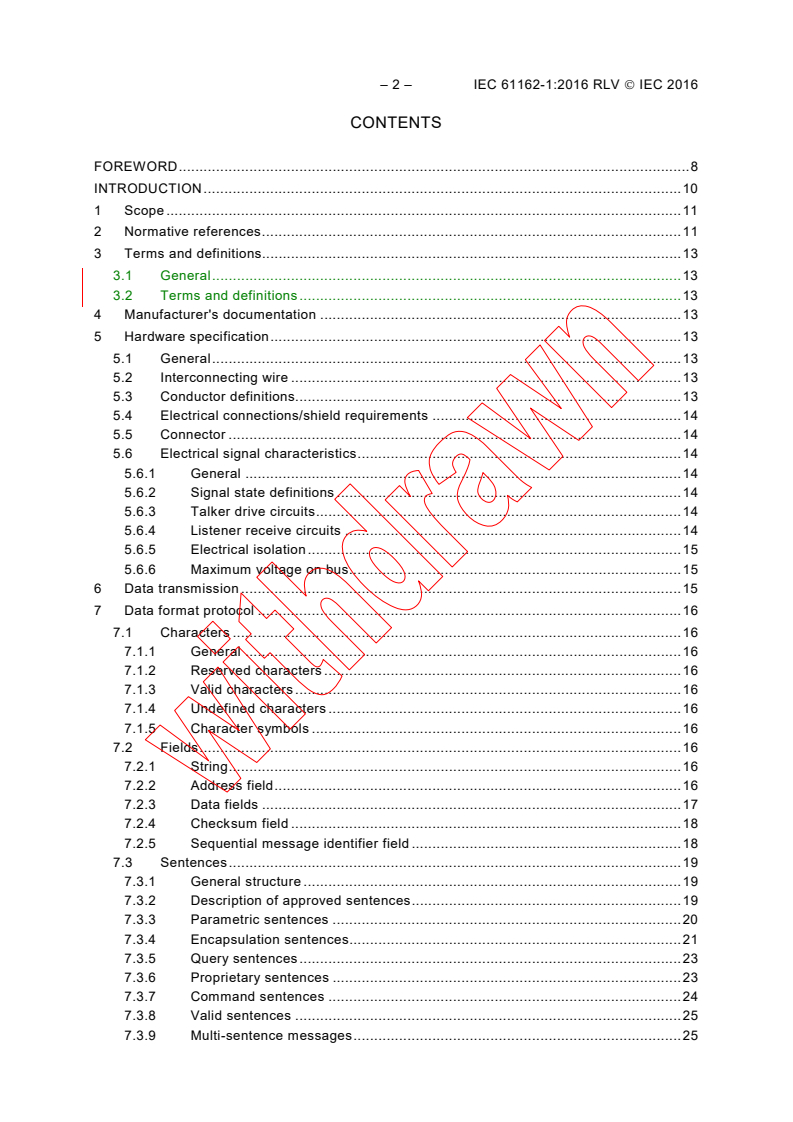
– 2 – IEC 61162-1:2016 RLV © IEC 2016
CONTENTS
FOREWORD . 8
INTRODUCTION . 10
1 Scope . 11
2 Normative references . 11
3 Terms and definitions. 13
3.1 General . 13
3.2 Terms and definitions . 13
4 Manufacturer's documentation . 13
5 Hardware specification . 13
5.1 General . 13
5.2 Interconnecting wire . 13
5.3 Conductor definitions. 13
5.4 Electrical connections/shield requirements . 14
5.5 Connector . 14
5.6 Electrical signal characteristics . 14
5.6.1 General . 14
5.6.2 Signal state definitions . 14
5.6.3 Talker drive circuits . 14
5.6.4 Listener receive circuits . 14
5.6.5 Electrical isolation . 15
5.6.6 Maximum voltage on bus . 15
6 Data transmission . 15
7 Data format protocol . 16
7.1 Characters . 16
7.1.1 General . 16
7.1.2 Reserved characters . 16
7.1.3 Valid characters . 16
7.1.4 Undefined characters . 16
7.1.5 Character symbols . 16
7.2 Fields . 16
7.2.1 String . 16
7.2.2 Address field . 16
7.2.3 Data fields . 17
7.2.4 Checksum field . 18
7.2.5 Sequential message identifier field . 18
7.3 Sentences . 19
7.3.1 General structure . 19
7.3.2 Description of approved sentences . 19
7.3.3 Parametric sentences . 20
7.3.4 Encapsulation sentences. 21
7.3.5 Query sentences . 23
7.3.6 Proprietary sentences . 23
7.3.7 Command sentences . 24
7.3.8 Valid sentences . 25
7.3.9 Multi-sentence messages . 25
7.3.10 Sentence transmission timing . 25
7.3.11 Additions to approved sentences . 25
7.4 Error detection and handling . 26
7.5 Handling of deprecated sentences . 26
8 Data content . 26
8.1 Character definitions . 26
8.2 Field definitions . 28
8.3 Approved sentences . 32
8.3.1 General format . 32
8.3.2 AAM – Waypoint arrival alarm . 32
8.3.3 ABK – AIS addressed and binary broadcast acknowledgement . 32
8.3.4 ABM – AIS addressed binary and safety related message . 33
8.3.5 ACA – AIS channel assignment message . 34
8.3.6 ACK – Acknowledge alarm . 36
8.3.7 ACN – Alert command . 36
8.3.8 ACS – AIS channel management information source . 37
8.3.9 AIR – AIS interrogation request . 37
8.3.10 AKD – Acknowledge detail alarm condition . 38
8.3.11 ALA – Report detailed alarm condition . 39
8.3.12 ALC – Cyclic alert list . 40
8.3.13 ALF – Alert sentence . 41
8.3.14 ALR – Set alarm state . 43
8.3.15 APB – Heading/track controller (autopilot) sentence B . 43
8.3.16 ARC – Alert command refused . 44
8.3.17 BBM – AIS broadcast binary message . 45
8.3.18 BEC – Bearing and distance to waypoint – Dead reckoning. 46
8.3.19 CBR – Configure broadcast rates for AIS AtoN station message
command .
8.3.19 BOD – Bearing origin to destination . 46
8.3.20 BWC – Bearing and distance to waypoint – Great circle . 46
8.3.21 BWR – Bearing and distance to waypoint – Rhumb line . 47
8.3.22 BWW – Bearing waypoint to waypoint . 47
8.3.23 CUR – Water current layer – Multi-layer water current data . 49
8.3.24 DBT – Depth below transducer . 49
8.3.25 DDC – Display dimming control . 49
8.3.26 DOR – Door status detection . 50
8.3.27 DPT – Depth . 51
8.3.28 DSC – Digital selective calling information . 51
8.3.29 DSE – Expanded digital selective calling . 52
8.3.30 DTM – Datum reference . 53
8.3.31 EPV – Command or report equipment property value . 54
8.3.32 ETL – Engine telegraph operation status . 55
8.3.33 EVE – General event message . 56
8.3.34 FIR – Fire detection . 56
8.3.35 FSI – Frequency set information . 57
8.3.36 GBS – GNSS satellite fault detection . 58
8.3.37 GEN – Generic binary information . 60
8.3.38 GFA – GNSS fix accuracy and integrity . 61
8.3.39 GGA – Global positioning system (GPS) fix data . 62
– 4 – IEC 61162-1:2016 RLV © IEC 2016
8.3.40 GLL – Geographic position – Latitude/longitude . 62
8.3.41 GNS – GNSS fix data . 63
8.3.42 GRS – GNSS range residuals . 65
8.3.43 GSA – GNSS DOP and active satellites . 67
8.3.44 GST – GNSS pseudorange noise statistics . 69
8.3.45 GSV – GNSS satellites in view . 70
8.3.46 HBT – Heartbeat supervision sentence . 71
8.3.47 HCR – Heading correction report . 72
8.3.48 HDG – Heading, deviation and variation . 72
8.3.49 HDT – Heading true . 73
8.3.50 HMR – Heading monitor receive . 73
8.3.51 HMS – Heading monitor set . 74
8.3.52 HRM – heel angle, roll period and roll amplitude measurement device . 74
8.3.53 HSC – Heading steering command . 75
8.3.54 HSS – Hull stress surveillance systems . 75
8.3.55 MEB – Message input for broadcast command .
8.3.55 HTC – Heading/track control command; HTD – Heading /track control
data . 75
8.3.56 LR1 – AIS long-range reply sentence 1 . 77
8.3.57 LR2 – AIS long-range reply sentence 2 . 77
8.3.58 LR3 – AIS long-range reply sentence 3 . 78
8.3.59 LRF – AIS long-range function . 78
8.3.60 LRI – AIS long-range interrogation . 79
8.3.61 MOB – Man over board notification . 82
8.3.62 MSK – MSK receiver interface . 83
8.3.63 MSS – MSK receiver signal status . 83
8.3.64 MTW – Water temperature . 84
8.3.65 MWD – Wind direction and speed . 84
8.3.66 MWV – Wind speed and angle . 84
8.3.67 NAK – Negative acknowledgement . 84
8.3.68 NRM – NAVTEX receiver mask . 85
8.3.69 NRX – NAVTEX received message . 86
8.3.70 NSR – Navigation status report . 88
8.3.71 OSD – Own ship data . 89
8.3.72 POS – Device position and ship dimensions report or configuration
command . 90
8.3.73 PRC – Propulsion remote control status . 91
8.3.74 RLM – Return link message . 92
8.3.75 RMA – Recommended minimum specific LORAN-C data . 93
8.3.76 RMB – Recommended minimum navigation information . 93
8.3.77 RMC – Recommended minimum specific GNSS data . 94
8.3.78 ROR – Rudder order status . 95
8.3.79 ROT – Rate of turn. 96
8.3.80 RRT – Report route transfer . 96
8.3.81 RPM – Revolutions . 97
8.3.82 RSA – Rudder sensor angle . 97
8.3.83 RSD – Radar system data . 97
8.3.84 RTE – Routes . 98
8.3.85 SFI – Scanning frequency information . 99
8.3.86 SMI – SafetyNET Message, All Ships/NavArea . 99
8.3.87 SM2 – SafetyNET Message, Coastal Warning Area . 101
8.3.88 SM3 – SafetyNET Message, Circular Area address . 103
8.3.89 SM4 – SafetyNET Message, Rectangular Area Address . 105
8.3.90 SMB – IMO SafetyNET Message Body . 107
8.3.91 SPW – Security password sentence . 109
8.3.92 SSD – AIS ship static data . 110
8.3.93 STN – Multiple data ID . 110
8.3.94 THS – True heading and status . 111
8.3.95 TLB – Target label . 111
8.3.96 TLL – Target latitude and longitude . 111
8.3.97 TRC – Thruster control data . 112
8.3.98 TRL – AIS transmitter-non-functioning log . 113
8.3.99 TRD – Thruster response data . 114
8.3.100 TTD – Tracked target data . 114
8.3.101 TTM – Tracked target message . 116
8.3.102 TUT – Transmission of multi-language text. 117
8.3.103 TXT – Text transmission . 118
8.3.104 UID – User identification code transmission . 119
8.3.105 VBW – Dual ground/water speed . 119
8.3.106 VDM – AIS VHF data-link message . 120
8.3.107 VDO – AIS VHF data-link own-vessel report . 121
8.3.108 VDR – Set and drift . 121
8.3.109 VER – Version . 122
8.3.110 VHW – Water speed and heading . 122
8.3.111 VLW – Dual ground/water distance . 123
8.3.112 VPW – Speed measured parallel to wind . 123
8.3.113 VSD – AIS voyage static data . 123
8.3.114 VTG – Course over ground and ground speed . 124
8.3.115 WAT – Water level detection . 124
8.3.116 WCV – Waypoint closure velocity . 125
8.3.117 WNC – Distance waypoint to waypoint . 126
8.3.118 WPL – Waypoint location . 126
8.3.119 XDR – Transducer measurements . 126
8.3.120 XTE – Cross-track error, measured . 127
8.3.121 XTR – Cross-track error, dead reckoning . 128
8.3.122 ZDA – Time and date . 128
8.3.123 ZDL – Time and distance to variable point . 128
8.3.124 ZFO – UTC and time from origin waypoint . 128
8.3.125 ZTG – UTC and time to destination waypoint . 129
9 Applications . 129
9.1 Example parametric sentences . 129
9.1.1 General . 129
9.1.2 Example 1 – LORAN-C latitude/longitude . 129
9.1.3 Example 2 – LORAN-C arrival alarm . 129
9.1.4 Example 3 – Proprietary sentence . 130
9.1.5 Example 4 – RMA examples. 130
9.1.6 Example 5 – FSI examples . 131
9.1.7 Example 6 – MSK/MSS examples . 131
– 6 – IEC 61162-1:2016 RLV © IEC 2016
9.1.8 Example 7 – DSC and DSE sentences . 131
9.1.9 Example 8 – FIR, DOR and WAT sentences . 132
9.2 Example encapsulation sentences . 132
9.3 Examples of receiver diagrams . 133
Annex A (informative) Glossary . 134
Annex B (normative) Guidelines for methods of testing and required test results . 141
B.1 General . 141
B.2 Definition of environmental conditions for the tests . 141
B.3 Examination of the manufacturer's documentation . 141
B.4 Test of hardware . 142
B.4.1 Interface units . 142
B.4.2 Ability of the input circuits to work with limited current .
B.4.2 Input circuit test . 142
B.4.3 Check of electrical isolation . 142
B.4.4 Ability of input circuits to withstand maximum voltage on the bus
Maximum input voltage test . 142
B.4.5 Test arrangement for performance tests according to IEC 60945 . 142
B.4.6 Test under maximum interface workload . 143
B.4.7 Test against corrupted data at an interface .
B.4.7 Test for correct parsing of sentences . 143
B.4.8 Test under long term conditions . 144
B.4.9 Protocol test of the interface of the EUT . 144
B.4.10 Test for correct use of special characters starting a sentence .
B.4.11 Test for correct parsing of received sentences .
B.4.12 Test for future extension of received sentences .
Annex C (normative) Six-bit binary field conversion . 153
Annex D (normative) Alarm system fields . 156
Annex E (informative) Example of use of FIR, DOR and WAT sentences . 165
E.1 Example of the use of system status messages . 165
E.2 Use of system division codes. 165
E.3 Send complete status . 166
E.4 Change measurement point status . 167
E.5 Point status change during a status update . 167
E.6 Failure in a sub-system . 167
E.7 Status updates when a sub-system is in fault . 168
E.8 Signal a correction of a sub-system fault . 168
Annex F (informative) Example encapsulation sentence. 169
F.1 Example encapsulation sentence . 169
F.2 AIS VHF data-link message VDM sentence encapsulation example . 169
F.3 Background discussion – Encapsulation coding . 169
F.4 Decoding the encapsulated string . 171
F.5 Conversion from symbols to binary bits . 171
F.6 Organising the binary message data . 172
F.7 Interpreting the decoded binary strings . 172
Bibliography . 176
Figure 1 – Listener receive circuit . 15
Figure 2 – Data transmission format . 15
Figure 3 – Example 1, J-FET, N channel, opto-isolator based listener circuit . 133
Figure 4 – Example 2, NPN opto-isolator based listener circuit . 133
Figure C.1 – 6-bit binary code converted to valid IEC 61162-1 character . 154
Figure C.2 – Valid IEC 61162-1 character converted to 6-bit binary code . 155
Figure E.1 – Example system diagram . 166
Figure F.1 – Message data format . 170
Figure F.2 – Work sheet for decoding and interpreting encapsulated string . 175
Table 1 – Reserved characters . 26
Table 2 – Valid characters . 27
Table 3 – Character symbol . 28
Table 4 – Talker identifier mnemonics . 29
Table 5 – Field type summary . 31
Table B.1 – Example – Special characters . 143
Table B.2 – Example – Parsing . 144
Table B.3 – Example – Data string GGA received by the EUT .
Table B.3 – Example – Future extensions . 144
Table B.4 – Example – Data string GGA sent by the EUT to the test receiver (listener) . 146
Table B.5 – Example – Checksum data sent . 147
Table B.6 – Example – Data string GNS received by the EUT . 149
Table B.7 – Example – Checksum data received . 151
Table B.8 – Example – Break of data line . 151
Table B.9 – Example – Receiving interval . 151
Table B.10 – Example – Talker ID . 152
Table C.1 – Six-bit binary field conversion table . 153
Table D.1 – System alarm fields . 156
Table F.1 – Example message from ITU-R M.1371 . 173
– 8 – IEC 61162-1:2016 RLV IEC 2016
INTERNATIONAL ELECTROTECHNICAL COMMISSION
____________
MARITIME NAVIGATION AND RADIOCOMMUNICATION
EQUIPMENT AND SYSTEMS – DIGITAL INTERFACES –
Part 1: Single talker and multiple listeners
FOREWORD
1) The International Electrotechnical Commission (IEC) is a worldwide organization for standardization comprising
all national electrotechnical committees (IEC National Committees). The object of IEC is to promote
international co-operation on all questions concerning standardization in the electrical and electronic fields. To
this end and in addition to other activities, IEC publishes International Standards, Technical Specifications,
Technical Reports, Publicly Available Specifications (PAS) and Guides (hereafter referred to as “IEC
Publication(s)”). Their preparation is entrusted to technical committees; any IEC National Committee interested
in the subject dealt with may participate in this preparatory work. International, governmental and non-
governmental organizations liaising with the IEC also participate in this preparation. IEC collaborates closely
with the International Organization for Standardization (ISO) in accordance with conditions determined by
agreement between the two organizations.
2) The formal decisions or agreements of IEC on technical matters express, as nearly as possible, an international
consensus of opinion on the relevant subjects since each technical committee has representation from all
interested IEC National Committees.
3) IEC Publications have the form of recommendations for international use and are accepted by IEC National
Committees in that sense. While all reasonable efforts are made to ensure that the technical content of IEC
Publications is accurate, IEC cannot be held responsible for the way in which they are used or for any
misinterpretation by any end user.
4) In order to promote international uniformity, IEC National Committees undertake to apply IEC Publications
transparently to the maximum extent possible in their national and regional publications. Any divergence
between any IEC Publication and the corresponding national or regional publication shall be clearly indicated in
the latter.
5) IEC itself does not provide any attestation of conformity. Independent certification bodies provide conformity
assessment services and, in some areas, access to IEC marks of conformity. IEC is not responsible for any
services carried out by independent certification bodies.
6) All users should ensure that they have the latest edition of this publication.
7) No liability shall attach to IEC or its directors, employees, servants or agents including individual experts and
members of its technical committees and IEC National Committees for any personal injury, property damage or
other damage of any nature whatsoever, whether direct or indirect, or for costs (including legal fees) and
expenses arising out of the publication, use of, or reliance upon, this IEC Publication or any other IEC
Publications.
8) Attention is drawn to the Normative references cited in this publication. Use of the referenced publications is
indispensable for the correct application of this publication.
9) Attention is drawn to the possibility that some of the elements of this IEC Publication may be the subject of
patent rights. IEC shall not be held responsible for identifying any or all such patent rights.
This redline version of the official IEC Standard allows the user to identify the changes
made to the previous edition. A vertical bar appears in the margin wherever a change
has been made. Additions are in green text, deletions are in strikethrough red text.
International Standard IEC 61162-1 has been prepared by IEC technical committee 80:
Maritime navigation and radiocommunication equipment and systems.
This fifth edition cancels and replaces the fourth edition published in 2010, and constitutes a
technical revision.
This edition includes the following significant technical changes with respect to the previous
edition:
• new identifiers have been added to Table 4;
• the sentences CBR and MEB have been removed as they are now solely used by AIS shore
based equipment:
• new sentences ACN, ALC, ALF, ARC, EPV, HCR, HRM, MOB, NSR, RLM, RRT, SM1, SM2,
SM3, SM4, SMB, SPW and TRL have been added;
• revisions have been made to ABK, ABM, GNS, NAK, NRM, RMC, ROR and TTD;
• the methods of testing in Annex B have been revised.
The text of this standard is based on the following documents:
FDIS Report on voting
80/799/FDIS 80/806/RVD
Full information on the voting for the approval of this standard can be found in the report on
voting indicated in the above table.
A list of all parts in the IEC 61162 series, published under the general title Maritime navigation
and radiocommunication equipment and systems – Digital interface, can be found on the IEC
website.
This publication has been drafted in accordance with the ISO/IEC Directives, Part 2.
The committee has decided that the contents of this publication will remain unchanged until the
stability date indicated on the IEC website under "http://webstore.iec.ch" in the data related to
the specific publication. At this date, the publication will be
• reconfirmed,
• withdrawn,
• replaced by a revised edition, or
• amended.
A bilingual version of this publication may be issued at a later date.
IMPORTANT – The 'colour inside' logo on the cover page of this publication indicates
that it contains colours which are considered to be useful for the correct understanding
of its contents. Users should therefore print this document using a colour printer.
– 10 – IEC 61162-1:2016 RLV © IEC 2016
INTRODUCTION
IEC 61162 Maritime navigation and radiocommunication equipment and systems – Digital
interfaces consists of 4 5 parts which specify digital interfaces for application in marine
navigation, radiocommunication and system integration, as follows:
Part 1: Single talker and multiple listeners;
Part 2: Single talker and multiple listeners, high speed transmission;
Part 3: Multiple talkers and multiple listeners – Serial data instrument network;
Part 450: Multiple talkers and multiple listeners – Ship systems Ethernet interconnection;
Part 460: Multiple talkers and multiple listeners – Ethernet interconnection – Safety and
security
IEC technical committee 80 interface standards are developed with input from manufacturers,
private and government organisations and equipment operators. The information is intended to
meet the needs of users at the time of publication, but users should recognise that as
applications and technology change, interface standards should change as well. Users of this
standard are advised to immediately inform the IEC of any perceived inadequacies therein.
The first edition of IEC 61162-1 was published in 1995. The second edition published in 2000
removed some sentences which were no longer in use, added some new sentences and
included details of the ship equipment defined in IMO resolutions together with appropriate
sentences for communication between them. This information was subsequently removed from
the third edition when it became the practice to specify the sentence formatters in the individual
standards for equipment.
The third edition published in 2007 introduced a re-arrangement of the text and new sentences
particularly to support the Automatic Identification System and the Voyage Data Recorder. The
third edition also introduced a further type of start of sentence delimiter. The conventional
delimiter “$” was retained for the conventional sentences which are now called parametric
sentences. The new delimiter “!” identifies sentences that conform to special purpose
encapsulation.
The fourth edition removes removed some sentences which are were not in use, adds added
some new sentences for new applications and makes made some corrections and additions. In
particular the sentences of relevance to satellite navigation receivers have been were
expanded to facilitate the description of new satellite systems.
This fifth edition also removes some sentences which are no longer in use, adds some new
sentences for new applications and makes some corrections and additions.
Liaison has been maintained with NMEA and this edition has been aligned where appropriate
with NMEA 0183 version 4.00 4.10.
MARITIME NAVIGATION AND RADIOCOMMUNICATION
EQUIPMENT AND SYSTEMS – DIGITAL INTERFACES –
Part 1: Single talker and multiple listeners
1 Scope
This part of IEC 61162 contains the requirements for data communication between maritime
electronic instruments, navigation and radiocommunication equipment when interconnected via
an appropriate system.
This part of IEC 61162 is intended to support one-way serial data transmission from a single
talker to one or more listeners. These data are in printable ASCII form and may include
information such as position, speed, depth, frequency allocation, etc. Typical messages may be
from about 11 to a maximum of 79 characters in length and generally require transmission no
more rapidly than one message per second.
The electrical definitions in this standard are not intended to accommodate high-bandwidth
applications such as radar or video imagery, or intensive database or file transfer applications.
Since there is no provision for guaranteed delivery of messages and only limited error checking
capability, this standard should be used with caution in all safety applications.
For applications where a faster transmission rate is necessary, reference should be made to
IEC 61162-2.
For applications to shore based equipment of the automatic identification system (AIS)
reference should be made to the IEC 62320 series.
2 Normative references
The following documents, in whole or in part, are normatively referenced in this document and
are indispensable for its application. For dated references,
...
IEC 61162-1 ®
Edition 5.0 2016-08
INTERNATIONAL
STANDARD
NORME
INTERNATIONALE
colour
inside
Maritime navigation and radiocommunication equipment and systems – Digital
interfaces –
Part 1: Single talker and multiple listeners
Matériels et systèmes de navigation et de radiocommunication maritimes –
Interfaces numériques –
Partie 1: Emetteur unique et récepteurs multiples
All rights reserved. Unless otherwise specified, no part of this publication may be reproduced or utilized in any form
or by any means, electronic or mechanical, including photocopying and microfilm, without permission in writing from
either IEC or IEC's member National Committee in the country of the requester. If you have any questions about IEC
copyright or have an enquiry about obtaining additional rights to this publication, please contact the address below or
your local IEC member National Committee for further information.
Droits de reproduction réservés. Sauf indication contraire, aucune partie de cette publication ne peut être reproduite
ni utilisée sous quelque forme que ce soit et par aucun procédé, électronique ou mécanique, y compris la photocopie
et les microfilms, sans l'accord écrit de l'IEC ou du Comité national de l'IEC du pays du demandeur. Si vous avez des
questions sur le copyright de l'IEC ou si vous désirez obtenir des droits supplémentaires sur cette publication, utilisez
les coordonnées ci-après ou contactez le Comité national de l'IEC de votre pays de résidence.
IEC Central Office Tel.: +41 22 919 02 11
3, rue de Varembé info@iec.ch
CH-1211 Geneva 20 www.iec.ch
Switzerland
About the IEC
The International Electrotechnical Commission (IEC) is the leading global organization that prepares and publishes
International Standards for all electrical, electronic and related technologies.
About IEC publications
The technical content of IEC publications is kept under constant review by the IEC. Please make sure that you have the
latest edition, a corrigenda or an amendment might have been published.
IEC Catalogue - webstore.iec.ch/catalogue Electropedia - www.electropedia.org
The stand-alone application for consulting the entire The world's leading online dictionary of electronic and
bibliographical information on IEC International Standards, electrical terms containing 21 000 terms and definitions in
Technical Specifications, Technical Reports and other English and French, with equivalent terms in 16 additional
documents. Available for PC, Mac OS, Android Tablets and languages. Also known as the International Electrotechnical
iPad. Vocabulary (IEV) online.
IEC publications search - webstore.iec.ch/advsearchform IEC Glossary - std.iec.ch/glossary
The advanced search enables to find IEC publications by a 67 000 electrotechnical terminology entries in English and
variety of criteria (reference number, text, technical French extracted from the Terms and Definitions clause of
committee,…). It also gives information on projects, replaced IEC publications issued since 2002. Some entries have been
and withdrawn publications. collected from earlier publications of IEC TC 37, 77, 86 and
CISPR.
IEC Just Published - webstore.iec.ch/justpublished
Stay up to date on all new IEC publications. Just Published IEC Customer Service Centre - webstore.iec.ch/csc
details all new publications released. Available online and If you wish to give us your feedback on this publication or
also once a month by email. need further assistance, please contact the Customer Service
Centre: sales@iec.ch.
A propos de l'IEC
La Commission Electrotechnique Internationale (IEC) est la première organisation mondiale qui élabore et publie des
Normes internationales pour tout ce qui a trait à l'électricité, à l'électronique et aux technologies apparentées.
A propos des publications IEC
Le contenu technique des publications IEC est constamment revu. Veuillez vous assurer que vous possédez l’édition la
plus récente, un corrigendum ou amendement peut avoir été publié.
Catalogue IEC - webstore.iec.ch/catalogue Electropedia - www.electropedia.org
Application autonome pour consulter tous les renseignements
Le premier dictionnaire en ligne de termes électroniques et
bibliographiques sur les Normes internationales,
électriques. Il contient 21 000 termes et définitions en anglais
Spécifications techniques, Rapports techniques et autres
et en français, ainsi que les termes équivalents dans 16
documents de l'IEC. Disponible pour PC, Mac OS, tablettes
langues additionnelles. Egalement appelé Vocabulaire
Android et iPad.
Electrotechnique International (IEV) en ligne.
Recherche de publications IEC -
Glossaire IEC - std.iec.ch/glossary
webstore.iec.ch/advsearchform
67 000 entrées terminologiques électrotechniques, en anglais
La recherche avancée permet de trouver des publications IEC et en français, extraites des articles Termes et Définitions des
en utilisant différents critères (numéro de référence, texte, publications IEC parues depuis 2002. Plus certaines entrées
comité d’études,…). Elle donne aussi des informations sur les antérieures extraites des publications des CE 37, 77, 86 et
projets et les publications remplacées ou retirées. CISPR de l'IEC.
IEC Just Published - webstore.iec.ch/justpublished Service Clients - webstore.iec.ch/csc
Restez informé sur les nouvelles publications IEC. Just Si vous désirez nous donner des commentaires sur cette
Published détaille les nouvelles publications parues. publication ou si vous avez des questions contactez-nous:
Disponible en ligne et aussi une fois par mois par email. sales@iec.ch.
IEC 61162-1 ®
Edition 5.0 2016-08
INTERNATIONAL
STANDARD
NORME
INTERNATIONALE
colour
inside
Maritime navigation and radiocommunication equipment and systems – Digital
interfaces –
Part 1: Single talker and multiple listeners
Matériels et systèmes de navigation et de radiocommunication maritimes –
Interfaces numériques –
Partie 1: Emetteur unique et récepteurs multiples
INTERNATIONAL
ELECTROTECHNICAL
COMMISSION
COMMISSION
ELECTROTECHNIQUE
INTERNATIONALE
ICS 47.020.70 ISBN 978-2-8322-5356-4
– 2 – IEC 61162-1:2016 IEC 2016
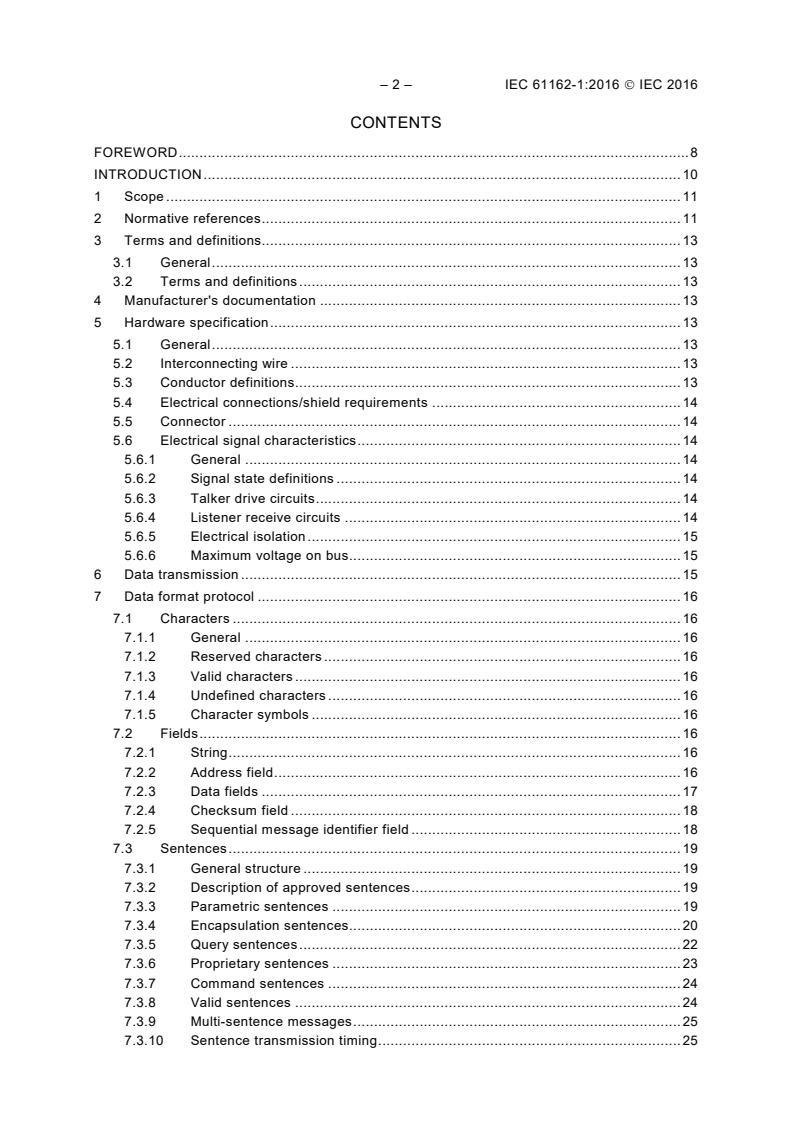
CONTENTS
FOREWORD . 8
INTRODUCTION . 10
1 Scope . 11
2 Normative references . 11
3 Terms and definitions. 13
3.1 General . 13
3.2 Terms and definitions . 13
4 Manufacturer's documentation . 13
5 Hardware specification . 13
5.1 General . 13
5.2 Interconnecting wire . 13
5.3 Conductor definitions. 13
5.4 Electrical connections/shield requirements . 14
5.5 Connector . 14
5.6 Electrical signal characteristics . 14
5.6.1 General . 14
5.6.2 Signal state definitions . 14
5.6.3 Talker drive circuits . 14
5.6.4 Listener receive circuits . 14
5.6.5 Electrical isolation . 15
5.6.6 Maximum voltage on bus . 15
6 Data transmission . 15
7 Data format protocol . 16
7.1 Characters . 16
7.1.1 General . 16
7.1.2 Reserved characters . 16
7.1.3 Valid characters . 16
7.1.4 Undefined characters . 16
7.1.5 Character symbols . 16
7.2 Fields . 16
7.2.1 String . 16
7.2.2 Address field . 16
7.2.3 Data fields . 17
7.2.4 Checksum field . 18
7.2.5 Sequential message identifier field . 18
7.3 Sentences . 19
7.3.1 General structure . 19
7.3.2 Description of approved sentences . 19
7.3.3 Parametric sentences . 19
7.3.4 Encapsulation sentences. 20
7.3.5 Query sentences . 22
7.3.6 Proprietary sentences . 23
7.3.7 Command sentences . 24
7.3.8 Valid sentences . 24
7.3.9 Multi-sentence messages . 25
7.3.10 Sentence transmission timing . 25
7.3.11 Additions to approved sentences . 25
7.4 Error detection and handling . 25
7.5 Handling of deprecated sentences . 25
8 Data content . 26
8.1 Character definitions . 26
8.2 Field definitions . 28
8.3 Approved sentences . 31
8.3.1 General format . 31
8.3.2 AAM – Waypoint arrival alarm . 31
8.3.3 ABK – AIS addressed and binary broadcast acknowledgement . 31
8.3.4 ABM – AIS addressed binary and safety related message . 32
8.3.5 ACA – AIS channel assignment message . 33
8.3.6 ACK – Acknowledge alarm . 35
8.3.7 ACN – Alert command . 35
8.3.8 ACS – AIS channel management information source . 36
8.3.9 AIR – AIS interrogation request . 36
8.3.10 AKD – Acknowledge detail alarm condition . 37
8.3.11 ALA – Report detailed alarm condition . 38
8.3.12 ALC – Cyclic alert list . 39
8.3.13 ALF – Alert sentence . 40
8.3.14 ALR – Set alarm state . 42
8.3.15 APB – Heading/track controller (autopilot) sentence B . 42
8.3.16 ARC – Alert command refused . 43
8.3.17 BBM – AIS broadcast binary message . 44
8.3.18 BEC – Bearing and distance to waypoint – Dead reckoning. 45
8.3.19 BOD – Bearing origin to destination . 45
8.3.20 BWC – Bearing and distance to waypoint – Great circle . 45
8.3.21 BWR – Bearing and distance to waypoint – Rhumb line . 45
8.3.22 BWW – Bearing waypoint to waypoint . 46
8.3.23 CUR – Water current layer – Multi-layer water current data . 46
8.3.24 DBT – Depth below transducer . 47
8.3.25 DDC – Display dimming control . 47
8.3.26 DOR – Door status detection . 48
8.3.27 DPT – Depth . 49
8.3.28 DSC – Digital selective calling information . 49
8.3.29 DSE – Expanded digital selective calling . 50
8.3.30 DTM – Datum reference . 50
8.3.31 EPV – Command or report equipment property value . 51
8.3.32 ETL – Engine telegraph operation status . 52
8.3.33 EVE – General event message . 53
8.3.34 FIR – Fire detection . 54
8.3.35 FSI – Frequency set information . 55
8.3.36 GBS – GNSS satellite fault detection . 56
8.3.37 GEN – Generic binary information . 57
8.3.38 GFA – GNSS fix accuracy and integrity . 58
8.3.39 GGA – Global positioning system (GPS) fix data . 59
8.3.40 GLL – Geographic position – Latitude/longitude . 59
8.3.41 GNS – GNSS fix data . 60
8.3.42 GRS – GNSS range residuals . 62
– 4 – IEC 61162-1:2016 IEC 2016
8.3.43 GSA – GNSS DOP and active satellites . 64
8.3.44 GST – GNSS pseudorange noise statistics . 66
8.3.45 GSV – GNSS satellites in view . 67
8.3.46 HBT – Heartbeat supervision sentence . 68
8.3.47 HCR – Heading correction report . 69
8.3.48 HDG – Heading, deviation and variation . 69
8.3.49 HDT – Heading true . 70
8.3.50 HMR – Heading monitor receive . 70
8.3.51 HMS – Heading monitor set . 71
8.3.52 HRM – heel angle, roll period and roll amplitude measurement device . 71
8.3.53 HSC – Heading steering command . 72
8.3.54 HSS – Hull stress surveillance systems . 72
8.3.55 HTC – Heading/track control command; HTD – Heading /track control
data . 72
8.3.56 LR1 – AIS long-range reply sentence 1 . 74
8.3.57 LR2 – AIS long-range reply sentence 2 . 74
8.3.58 LR3 – AIS long-range reply sentence 3 . 75
8.3.59 LRF – AIS long-range function . 75
8.3.60 LRI – AIS long-range interrogation . 76
8.3.61 MOB – Man over board notification . 77
8.3.62 MSK – MSK receiver interface . 79
8.3.63 MSS – MSK receiver signal status . 79
8.3.64 MTW – Water temperature . 79
8.3.65 MWD – Wind direction and speed . 79
8.3.66 MWV – Wind speed and angle . 80
8.3.67 NAK – Negative acknowledgement . 80
8.3.68 NRM – NAVTEX receiver mask . 81
8.3.69 NRX – NAVTEX received message . 82
8.3.70 NSR – Navigation status report . 84
8.3.71 OSD – Own ship data . 85
8.3.72 POS – Device position and ship dimensions report or configuration
command . 86
8.3.73 PRC – Propulsion remote control status . 87
8.3.74 RLM – Return link message . 88
8.3.75 RMA – Recommended minimum specific LORAN-C data . 89
8.3.76 RMB – Recommended minimum navigation information . 89
8.3.77 RMC – Recommended minimum specific GNSS data . 90
8.3.78 ROR – Rudder order status . 91
8.3.79 ROT – Rate of turn. 92
8.3.80 RRT – Report route transfer . 92
8.3.81 RPM – Revolutions . 93
8.3.82 RSA – Rudder sensor angle . 93
8.3.83 RSD – Radar system data . 93
8.3.84 RTE – Routes . 94
8.3.85 SFI – Scanning frequency information . 95
8.3.86 SMI – SafetyNET Message, All Ships/NavArea . 95
8.3.87 SM2 – SafetyNET Message, Coastal Warning Area . 97
8.3.88 SM3 – SafetyNET Message, Circular Area address . 99
8.3.89 SM4 – SafetyNET Message, Rectangular Area Address . 101
8.3.90 SMB – IMO SafetyNET Message Body . 104
8.3.91 SPW – Security password sentence . 105
8.3.92 SSD – AIS ship static data . 106
8.3.93 STN – Multiple data ID . 106
8.3.94 THS – True heading and status . 107
8.3.95 TLB – Target label . 107
8.3.96 TLL – Target latitude and longitude . 107
8.3.97 TRC – Thruster control data . 108
8.3.98 TRL – AIS transmitter-non-functioning log . 109
8.3.99 TRD – Thruster response data . 110
8.3.100 TTD – Tracked target data . 110
8.3.101 TTM – Tracked target message . 112
8.3.102 TUT – Transmission of multi-language text. 113
8.3.103 TXT – Text transmission . 114
8.3.104 UID – User identification code transmission . 115
8.3.105 VBW – Dual ground/water speed . 115
8.3.106 VDM – AIS VHF data-link message . 116
8.3.107 VDO – AIS VHF data-link own-vessel report . 117
8.3.108 VDR – Set and drift . 117
8.3.109 VER – Version . 118
8.3.110 VHW – Water speed and heading . 118
8.3.111 VLW – Dual ground/water distance . 119
8.3.112 VPW – Speed measured parallel to wind . 119
8.3.113 VSD – AIS voyage static data . 119
8.3.114 VTG – Course over ground and ground speed . 120
8.3.115 WAT – Water level detection . 120
8.3.116 WCV – Waypoint closure velocity . 121
8.3.117 WNC – Distance waypoint to waypoint . 122
8.3.118 WPL – Waypoint location . 122
8.3.119 XDR – Transducer measurements . 122
8.3.120 XTE – Cross-track error, measured . 123
8.3.121 XTR – Cross-track error, dead reckoning . 124
8.3.122 ZDA – Time and date . 124
8.3.123 ZDL – Time and distance to variable point . 124
8.3.124 ZFO – UTC and time from origin waypoint . 124
8.3.125 ZTG – UTC and time to destination waypoint . 125
9 Applications . 125
9.1 Example parametric sentences . 125
9.1.1 General . 125
9.1.2 Example 1 – LORAN-C latitude/longitude . 125
9.1.3 Example 2 – LORAN-C arrival alarm . 125
9.1.4 Example 3 – Proprietary sentence . 126
9.1.5 Example 4 – RMA examples. 126
9.1.6 Example 5 – FSI examples . 127
9.1.7 Example 6 – MSK/MSS examples . 127
9.1.8 Example 7 – DSC and DSE sentences . 127
9.1.9 Example 8 – FIR, DOR and WAT sentences . 128
9.2 Example encapsulation sentences . 128
9.3 Examples of receiver diagrams . 128
– 6 – IEC 61162-1:2016 IEC 2016
Annex A (informative) Glossary . 130
Annex B (normative) Guidelines for methods of testing and required test results . 137
B.1 General . 137
B.2 Definition of environmental conditions for the tests . 137
B.3 Examination of the manufacturer's documentation . 137
B.4 Test of hardware . 138
B.4.1 Interface units . 138
B.4.2 Input circuit test . 138
B.4.3 Check of electrical isolation . 138
B.4.4 Maximum input voltage test . 138
B.4.5 Test arrangement for performance tests according to IEC 60945 . 138
B.4.6 Test under maximum interface workload . 138
B.4.7 Test for correct parsing of sentences . 139
B.4.8 Test under long term conditions . 140
B.4.9 Protocol test of the interface of the EUT . 140
Annex C (normative) Six-bit binary field conversion . 146
Annex D (normative) Alarm system fields . 149
Annex E (informative) Example of use of FIR, DOR and WAT sentences . 158
E.1 Example of the use of system status messages . 158
E.2 Use of system division codes. 158
E.3 Send complete status . 159
E.4 Change measurement point status . 160
E.5 Point status change during a status update . 160
E.6 Failure in a sub-system . 160
E.7 Status updates when a sub-system is in fault . 161
E.8 Signal a correction of a sub-system fault . 161
Annex F (informative) Example encapsulation sentence. 162
F.1 Example encapsulation sentence . 162
F.2 AIS VHF data-link message VDM sentence encapsulation example . 162
F.3 Background discussion – Encapsulation coding . 162
F.4 Decoding the encapsulated string . 164
F.5 Conversion from symbols to binary bits . 164
F.6 Organising the binary message data . 165
F.7 Interpreting the decoded binary strings . 165
Bibliography . 168
Figure 1 – Listener receive circuit . 15
Figure 2 – Data transmission format . 15
Figure 3 – Example 1, J-FET, N channel, opto-isolator based listener circuit . 129
Figure 4 – Example 2, NPN opto-isolator based listener circuit . 129
Figure C.1 – 6-bit binary code converted to valid IEC 61162-1 character . 147
Figure C.2 – Valid IEC 61162-1 character converted to 6-bit binary code . 148
Figure E.1 – Example system diagram . 159
Figure F.1 – Message data format . 163
Figure F.2 – Work sheet for decoding and interpreting encapsulated string . 167
Table 1 – Reserved characters . 26
Table 2 – Valid characters . 26
Table 3 – Character symbol . 27
Table 4 – Talker identifier mnemonics . 28
Table 5 – Field type summary . 30
Table B.1 – Example – Special characters . 139
Table B.2 – Example – Parsing . 139
Table B.3 – Example – Future extensions . 140
Table B.4 – Example – Data string GGA sent by the EUT to the test receiver (listener) . 141
Table B.5 – Example – Checksum data sent . 141
Table B.6 – Example – Data string GNS received by the EUT . 143
Table B.7 – Example – Checksum data received . 144
Table B.8 – Example – Break of data line . 145
Table B.9 – Example – Receiving interval . 145
Table B.10 – Example – Talker ID . 145
Table C.1 – Six-bit binary field conversion table . 146
Table D.1 – System alarm fields . 149
Table F.1 – Example message from ITU-R M.1371 . 166
– 8 – IEC 61162-1:2016 IEC 2016
INTERNATIONAL ELECTROTECHNICAL COMMISSION
____________
MARITIME NAVIGATION AND RADIOCOMMUNICATION
EQUIPMENT AND SYSTEMS – DIGITAL INTERFACES –
Part 1: Single talker and multiple listeners
FOREWORD
1) The International Electrotechnical Commission (IEC) is a worldwide organization for standardization comprising
all national electrotechnical committees (IEC National Committees). The object of IEC is to promote
international co-operation on all questions concerning standardization in the electrical and electronic fields. To
this end and in addition to other activities, IEC publishes International Standards, Technical Specifications,
Technical Reports, Publicly Available Specifications (PAS) and Guides (hereafter referred to as “IEC
Publication(s)”). Their preparation is entrusted to technical committees; any IEC National Committee interested
in the subject dealt with may participate in this preparatory work. International, governmental and non-
governmental organizations liaising with the IEC also participate in this preparation. IEC collaborates closely
with the International Organization for Standardization (ISO) in accordance with conditions determined by
agreement between the two organizations.
2) The formal decisions or agreements of IEC on technical matters express, as nearly as possible, an international
consensus of opinion on the relevant subjects since each technical committee has representation from all
interested IEC National Committees.
3) IEC Publications have the form of recommendations for international use and are accepted by IEC National
Committees in that sense. While all reasonable efforts are made to ensure that the technical content of IEC
Publications is accurate, IEC cannot be held responsible for the way in which they are used or for any
misinterpretation by any end user.
4) In order to promote international uniformity, IEC National Committees undertake to apply IEC Publications
transparently to the maximum extent possible in their national and regional publications. Any divergence
between any IEC Publication and the corresponding national or regional publication shall be clearly indicated in
the latter.
5) IEC itself does not provide any attestation of conformity. Independent certification bodies provide conformity
assessment services and, in some areas, access to IEC marks of conformity. IEC is not responsible for any
services carried out by independent certification bodies.
6) All users should ensure that they have the latest edition of this publication.
7) No liability shall attach to IEC or its directors, employees, servants or agents including individual experts and
members of its technical committees and IEC National Committees for any personal injury, property damage or
other damage of any nature whatsoever, whether direct or indirect, or for costs (including legal fees) and
expenses arising out of the publication, use of, or reliance upon, this IEC Publication or any other IEC
Publications.
8) Attention is drawn to the Normative references cited in this publication. Use of the referenced publications is
indispensable for the correct application of this publication.
9) Attention is drawn to the possibility that some of the elements of this IEC Publication may be the subject of
patent rights. IEC shall not be held responsible for identifying any or all such patent rights.
International Standard IEC 61162-1 has been prepared by IEC technical committee 80:
Maritime navigation and radiocommunication equipment and systems.
This bilingual version (2018-02) corresponds to the English version, published in 2016-08.
This fifth edition cancels and replaces the fourth edition published in 2010, and constitutes a
technical revision.
This edition includes the following significant technical changes with respect to the previous
edition:
• new identifiers have been added to Table 4;
• the sentences CBR and MEB have been removed as they are now solely used by AIS shore
based equipment:
• new sentences ACN, ALC, ALF, ARC, EPV, HCR, HRM, MOB, NSR, RLM, RRT, SM1, SM2,
SM3, SM4, SMB, SPW and TRL have been added;
• revisions have been made to ABK, ABM, GNS, NAK, NRM, RMC, ROR and TTD;
• the methods of testing in Annex B have been revised.
The text of this standard is based on the following documents:
FDIS Report on voting
80/799/FDIS 80/806/RVD
Full information on the voting for the approval of this standard can be found in the report on
voting indicated in the above table.
The French version of this standard has not been voted upon.
A list of all parts in the IEC 61162 series, published under the general title Maritime navigation
and radiocommunication equipment and systems – Digital interface, can be found on the IEC
website.
This publication has been drafted in accordance with the ISO/IEC Directives, Part 2.
The committee has decided that the contents of this publication will remain unchanged until the
stability date indicated on the IEC website under "http://webstore.iec.ch" in the data related to
the specific publication. At this date, the publication will be
• reconfirmed,
• withdrawn,
• replaced by a revised edition, or
• amended.
IMPORTANT – The 'colour inside' logo on the cover page of this publication indicates
that it contains colours which are considered to be useful for the correct understanding
of its contents. Users should therefore print this document using a colour printer.
– 10 – IEC 61162-1:2016 IEC 2016
INTRODUCTION
IEC 61162 Maritime navigation and radiocommunication equipment and systems – Digital
interfaces consists of 5 parts which specify digital interfaces for application in marine
navigation, radiocommunication and system integration, as follows:
Part 1: Single talker and multiple listeners;
Part 2: Single talker and multiple listeners, high speed transmission;
Part 3: Multiple talkers and multiple listeners – Serial data instrument network;
Part 450: Multiple talkers and multiple listeners – Ethernet interconnection;
Part 460: Multiple talkers and multiple listeners – Ethernet interconnection – Safety and
security
IEC technical committee 80 interface standards are developed with input from manufacturers,
private and government organisations and equipment operators. The information is intended to
meet the needs of users at the time of publication, but users should recognise that as
applications and technology change, interface standards should change as well. Users of this
standard are advised to immediately inform the IEC of any perceived inadequacies therein.
The first edition of IEC 61162-1 was published in 1995. The second edition published in 2000
removed some sentences which were no longer in use, added some new sentences and
included details of the ship equipment defined in IMO resolutions together with appropriate
sentences for communication between them. This information was subsequently removed from
the third edition when it became the practice to specify the sentence formatters in the individual
standards for equipment.
The third edition published in 2007 introduced a re-arrangement of the text and new sentences
particularly to support the Automatic Identification System and the Voyage Data Recorder. The
third edition also introduced a further type of start of sentence delimiter. The conventional
delimiter “$” was retained for the conventional sentences which are now called parametric
sentences. The new delimiter “!” identifies sentences that conform to special purpose
encapsulation.
The fourth edition removed some sentences which were not in use, added some new
sentences for new applications and made some corrections and additions. In particular the
sentences of relevance to satellite navigation receivers were expanded to facilitate the
description of new satellite systems.
This fifth edition also removes some sentences which are no longer in use, adds some new
sentences for new applications and makes some corrections and additions.
Liaison has been maintained with NMEA and this edition has been aligned where appropriate
with NMEA 0183 version 4.10.
MARITIME NAVIGATION AND RADIOCOM
...