

IEC GUIDE 107:2009
(Main)Electromagnetic compatibility - Guide to the drafting of electromagnetic compatibility publications
General Information
- Abstract
IEC Guide 107:2009 is mandatory and describes procedures for the drafting of IEC publications, which relate wholly or partly to electromagnetic compatibility (EMC). They should be applied when preparing new electromagnetic compatibility publications or EMC clauses as well as when revising existing publications. These procedures should be followed in order to ensure that the resulting publications are consistent with each other and current practice, and to avoid overlapping document scopes. This third edition cancels and replaces the second edition, published in 1998. This guide has been revised in order to align with the second edition of Guide 108, which states: "For safety and EMC standards the principles of this guide are addressed by the specific technical provisions of IEC Guides 104 and 107 respectively."
- Status
- Published
- Publication Date
- 10-Feb-2009
- Technical Committee
- ACEC - ADVISORY COMMITTEE ON ELECTROMAGNETIC COMPATIBILITY
- Current Stage
- DELPUB - Deleted Publication
- Start Date
- 15-Jul-2014
- Completion Date
- 28-Aug-2026
Overview
IEC GUIDE 107:2009, titled Electromagnetic Compatibility – Guide to the Drafting of Electromagnetic Compatibility Publications, is a mandatory standard developed by the International Electrotechnical Commission (IEC). It provides comprehensive procedures and guidelines for drafting IEC publications concerning electromagnetic compatibility (EMC), whether fully or partially addressed. This guide is essential for professionals preparing new EMC publications, clauses, or revising existing standards.
The main objective of IEC GUIDE 107:2009 is to ensure consistency, clarity, and coherence across all electromagnetic compatibility documentation within the IEC framework. It also aims to prevent overlaps in document scopes, thereby streamlining the development of standards related to EMC.
This third edition replaces the previous 1998 version, aligning its provisions with IEC Guide 108 and related IEC Guides 104 and 107 to harmonize the approach to both safety and EMC standards.
Key Topics
EMC Definitions and Terms: The guide incorporates specific terminology such as electromagnetic disturbance, emission, immunity, and compatibility levels, providing clarity to all stakeholders. It adopts definitions from IEC 60050(161) - the International Electrotechnical Vocabulary for EMC.
Drafting Procedures: It details procedures to be applied when preparing or revising EMC publications, emphasizing the importance of a unified approach to drafting that aligns with international best practices.
Types of EMC Publications:
- Basic EMC publications – foundational horizontal standards covering fundamental EMC principles.
- Generic EMC standards – applicable across various product families.
- Product family EMC standards – targeted at specific groups of products.
- Product EMC standards – tailored to unique individual products.
Emission Limits and Immunity Requirements: IEC GUIDE 107 outlines requirements for controlling electromagnetic emissions and ensuring equipment immunity for optimal EMC performance.
Scope Consistency and Overlap Avoidance: The guide offers strategies to define clear scopes for individual publications to reduce contradictions and duplication in EMC standards.
Development and Updating of EMC Standards: The guide provides structured processes for the ongoing development, revision, and harmonization of EMC publications.
Liaison with Other Organizations: It underscores coordination with external bodies such as CISPR (International Special Committee on Radio Interference) and alignment with ISO/IEC Directives to maintain global coherence in EMC standardization.
Applications
IEC GUIDE 107:2009 is indispensable for standardization professionals, technical committees, and organizations involved in EMC activities, including:
Drafting and revising EMC standards across multiple industries such as telecommunications, industrial automation, consumer electronics, and healthcare equipment.
Ensuring that EMC clauses and documentation comply with international norms and maintain equivalence across national and regional standards.
Supporting manufacturers and test laboratories by guiding the preparation of harmonized EMC testing and measurement standards.
Facilitating regulatory bodies' understanding of EMC requirements and their incorporation into product certification processes.
Assisting in defining emission and immunity thresholds that help achieve electromagnetic compatibility in dense electromagnetic environments.
Related Standards
IEC 60050(161): International Electrotechnical Vocabulary (IEV) – Chapter 161: Electromagnetic Compatibility, providing essential definitions used in IEC GUIDE 107.
IEC Guide 108: Guidelines for ensuring the coherence of IEC publications – Application of horizontal standards, complementing IEC GUIDE 107 by addressing harmonization principles across IEC documents.
IEC Guides 104 and 107: Provide technical provisions particularly relevant for safety and EMC standards ensuring standardized treatment within the IEC system.
ISO/IEC Directives: The framework establishing rules for IEC publication development, ensuring compatibility with international standardization practices.
CISPR: The International Special Committee on Radio Interference, whose procedures and standards are referenced within IEC GUIDE 107 for EMC standard drafting alignment.
IEC GUIDE 107:2009 remains a critical international tool for systematically developing high-quality, coherent, and harmonized electromagnetic compatibility standards that meet the evolving demands of global electrical and electronic industries.
Relations
- Effective Date
- 05-Sep-2023
- Effective Date
- 05-Sep-2023
Get Certified
Connect with accredited certification bodies for this standard

ANCE
Mexican certification and testing association.

Intertek Slovenia
Intertek testing, inspection, and certification services in Slovenia.

LNE (Laboratoire National de Métrologie et d'Essais)
French national laboratory for metrology and testing.
Sponsored listings
Frequently Asked Questions
IEC GUIDE 107:2009 is a guide published by the International Electrotechnical Commission (IEC). Its full title is "Electromagnetic compatibility - Guide to the drafting of electromagnetic compatibility publications". This standard covers: IEC Guide 107:2009 is mandatory and describes procedures for the drafting of IEC publications, which relate wholly or partly to electromagnetic compatibility (EMC). They should be applied when preparing new electromagnetic compatibility publications or EMC clauses as well as when revising existing publications. These procedures should be followed in order to ensure that the resulting publications are consistent with each other and current practice, and to avoid overlapping document scopes. This third edition cancels and replaces the second edition, published in 1998. This guide has been revised in order to align with the second edition of Guide 108, which states: "For safety and EMC standards the principles of this guide are addressed by the specific technical provisions of IEC Guides 104 and 107 respectively."
IEC Guide 107:2009 is mandatory and describes procedures for the drafting of IEC publications, which relate wholly or partly to electromagnetic compatibility (EMC). They should be applied when preparing new electromagnetic compatibility publications or EMC clauses as well as when revising existing publications. These procedures should be followed in order to ensure that the resulting publications are consistent with each other and current practice, and to avoid overlapping document scopes. This third edition cancels and replaces the second edition, published in 1998. This guide has been revised in order to align with the second edition of Guide 108, which states: "For safety and EMC standards the principles of this guide are addressed by the specific technical provisions of IEC Guides 104 and 107 respectively."
IEC GUIDE 107:2009 is classified under the following ICS (International Classification for Standards) categories: 33.100.01 - Electromagnetic compatibility in general. The ICS classification helps identify the subject area and facilitates finding related standards.
IEC GUIDE 107:2009 has the following relationships with other standards: It is inter standard links to IEC GUIDE 107:2014, IEC GUIDE 107:1998. Understanding these relationships helps ensure you are using the most current and applicable version of the standard.
IEC GUIDE 107:2009 is available in PDF format for immediate download after purchase. The document can be added to your cart and obtained through the secure checkout process. Digital delivery ensures instant access to the complete standard document.
Standards Content (Sample)
IEC GUIDE 107 ®
Edition 3.0 2009-02
GUIDE
GUIDE
Electromagnetic compatibility – Guide to the drafting of electromagnetic
compatibility publications
Compatibilité électromagnétique – Guide pour la rédaction des publications sur
la compatibilité électromagnétique
All rights reserved. Unless otherwise specified, no part of this publication may be reproduced or utilized in any form or by
any means, electronic or mechanical, including photocopying and microfilm, without permission in writing from either IEC or
IEC's member National Committee in the country of the requester.
If you have any questions about IEC copyright or have an enquiry about obtaining additional rights to this publication,
please contact the address below or your local IEC member National Committee for further information.
Droits de reproduction réservés. Sauf indication contraire, aucune partie de cette publication ne peut être reproduite
ni utilisée sous quelque forme que ce soit et par aucun procédé, électronique ou mécanique, y compris la photocopie
et les microfilms, sans l'accord écrit de la CEI ou du Comité national de la CEI du pays du demandeur.
Si vous avez des questions sur le copyright de la CEI ou si vous désirez obtenir des droits supplémentaires sur cette
publication, utilisez les coordonnées ci-après ou contactez le Comité national de la CEI de votre pays de résidence.
IEC Central Office
3, rue de Varembé
CH-1211 Geneva 20
Switzerland
Email: inmail@iec.ch
Web: www.iec.ch
About the IEC
The International Electrotechnical Commission (IEC) is the leading global organization that prepares and publishes
International Standards for all electrical, electronic and related technologies.
About IEC publications
The technical content of IEC publications is kept under constant review by the IEC. Please make sure that you have the
latest edition, a corrigenda or an amendment might have been published.
ƒ Catalogue of IEC publications: www.iec.ch/searchpub
The IEC on-line Catalogue enables you to search by a variety of criteria (reference number, text, technical committee,…).
It also gives information on projects, withdrawn and replaced publications.
ƒ IEC Just Published: www.iec.ch/online_news/justpub
Stay up to date on all new IEC publications. Just Published details twice a month all new publications released. Available
on-line and also by email.
ƒ Electropedia: www.electropedia.org
The world's leading online dictionary of electronic and electrical terms containing more than 20 000 terms and definitions
in English and French, with equivalent terms in additional languages. Also known as the International Electrotechnical
Vocabulary online.
ƒ Customer Service Centre: www.iec.ch/webstore/custserv
If you wish to give us your feedback on this publication or need further assistance, please visit the Customer Service
Centre FAQ or contact us:
Email: csc@iec.ch
Tel.: +41 22 919 02 11
Fax: +41 22 919 03 00
A propos de la CEI
La Commission Electrotechnique Internationale (CEI) est la première organisation mondiale qui élabore et publie des
normes internationales pour tout ce qui a trait à l'électricité, à l'électronique et aux technologies apparentées.
A propos des publications CEI
Le contenu technique des publications de la CEI est constamment revu. Veuillez vous assurer que vous possédez
l’édition la plus récente, un corrigendum ou amendement peut avoir été publié.
ƒ Catalogue des publications de la CEI: www.iec.ch/searchpub/cur_fut-f.htm
Le Catalogue en-ligne de la CEI vous permet d’effectuer des recherches en utilisant différents critères (numéro de référence,
texte, comité d’études,…). Il donne aussi des informations sur les projets et les publications retirées ou remplacées.
ƒ Just Published CEI: www.iec.ch/online_news/justpub
Restez informé sur les nouvelles publications de la CEI. Just Published détaille deux fois par mois les nouvelles
publications parues. Disponible en-ligne et aussi par email.
ƒ Electropedia: www.electropedia.org
Le premier dictionnaire en ligne au monde de termes électroniques et électriques. Il contient plus de 20 000 termes et
définitions en anglais et en français, ainsi que les termes équivalents dans les langues additionnelles. Egalement appelé
Vocabulaire Electrotechnique International en ligne.
ƒ Service Clients: www.iec.ch/webstore/custserv/custserv_entry-f.htm
Si vous désirez nous donner des commentaires sur cette publication ou si vous avez des questions, visitez le FAQ du
Service clients ou contactez-nous:
Email: csc@iec.ch
Tél.: +41 22 919 02 11
Fax: +41 22 919 03 00
IEC GUIDE 107 ®
Edition 3.0 2009-02
GUIDE
GUIDE
Electromagnetic compatibility – Guide to the drafting of electromagnetic
compatibility publications
Compatibilité électromagnétique – Guide pour la rédaction des publications sur
la compatibilité électromagnétique
INTERNATIONAL
ELECTROTECHNICAL
COMMISSION
COMMISSION
ELECTROTECHNIQUE
PRICE CODE
INTERNATIONALE
T
CODE PRIX
ICS 33.100 ISBN 978-2-88910-787-2
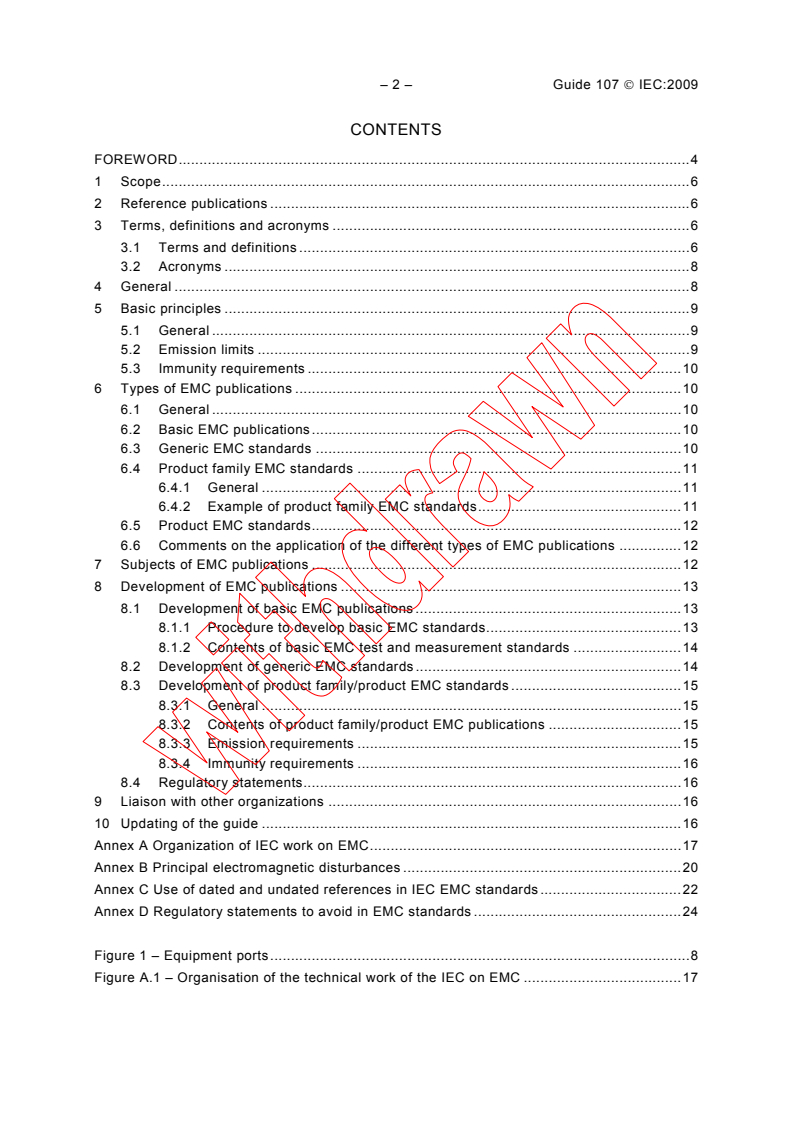
– 2 – Guide 107 © IEC:2009
CONTENTS
FOREWORD.4
1 Scope.6
2 Reference publications .6
3 Terms, definitions and acronyms .6
3.1 Terms and definitions .6
3.2 Acronyms .8
4 General .8
5 Basic principles .9
5.1 General .9
5.2 Emission limits .9
5.3 Immunity requirements .10
6 Types of EMC publications .10
6.1 General .10
6.2 Basic EMC publications.10
6.3 Generic EMC standards .10
6.4 Product family EMC standards .11
6.4.1 General .11
6.4.2 Example of product family EMC standards.11
6.5 Product EMC standards.12
6.6 Comments on the application of the different types of EMC publications .12
7 Subjects of EMC publications .12
8 Development of EMC publications .13
8.1 Development of basic EMC publications .13
8.1.1 Procedure to develop basic EMC standards.13
8.1.2 Contents of basic EMC test and measurement standards .14
8.2 Development of generic EMC standards.14
8.3 Development of product family/product EMC standards .15
8.3.1 General .15
8.3.2 Contents of product family/product EMC publications .15
8.3.3 Emission requirements .15
8.3.4 Immunity requirements .16
8.4 Regulatory statements.16
9 Liaison with other organizations .16
10 Updating of the guide .16
Annex A Organization of IEC work on EMC.17
Annex B Principal electromagnetic disturbances .20
Annex C Use of dated and undated references in IEC EMC standards.22
Annex D Regulatory statements to avoid in EMC standards .24
Figure 1 – Equipment ports.8
Figure A.1 – Organisation of the technical work of the IEC on EMC .17
Guide 107 © IEC:2009 – 3 –
Table 1 – Overview of the subjects of EMC publications .13
Table B.1 – Principal electromagnetic disturbances .21
– 4 – Guide 107 © IEC:2009
INTERNATIONAL ELECTROTECHNICAL COMMISSION
____________
ELECTROMAGNETIC COMPATIBILITY –
GUIDE TO THE DRAFTING OF ELECTROMAGNETIC
COMPATIBILITY PUBLICATIONS
FOREWORD
1) The International Electrotechnical Commission (IEC) is a worldwide organization for standardization comprising
all national electrotechnical committees (IEC National Committees). The object of IEC is to promote
international co-operation on all questions concerning standardization in the electrical and electronic fields. To
this end and in addition to other activities, IEC publishes International Standards, Technical Specifications,
Technical Reports, Publicly Available Specifications (PAS) and Guides (hereafter referred to as “IEC
Publication(s)”). Their preparation is entrusted to technical committees; any IEC National Committee interested
in the subject dealt with may participate in this preparatory work. International, governmental and non-
governmental organizations liaising with the IEC also participate in this preparation. IEC collaborates closely
with the International Organization for Standardization (ISO) in accordance with conditions determined by
agreement between the two organizations.
2) The formal decisions or agreements of IEC on technical matters express, as nearly as possible, an international
consensus of opinion on the relevant subjects since each technical committee has representation from all
interested IEC National Committees.
3) IEC Publications have the form of recommendations for international use and are accepted by IEC National
Committees in that sense. While all reasonable efforts are made to ensure that the technical content of IEC
Publications is accurate, IEC cannot be held responsible for the way in which they are used or for any
misinterpretation by any end user.
4) In order to promote international uniformity, IEC National Committees undertake to apply IEC Publications
transparently to the maximum extent possible in their national and regional publications. Any divergence
between any IEC Publication and the corresponding national or regional publication shall be clearly indicated in
the latter.
5) IEC itself does not provide any attestation of conformity. Independent certification bodies provide conformity
assessment services and, in some areas, access to IEC marks of conformity. IEC is not responsible for any
services carried out by independent certification bodies.
6) All users should ensure that they have the latest edition of this publication.
7) No liability shall attach to IEC or its directors, employees, servants or agents including individual experts and
members of its technical committees and IEC National Committees for any personal injury, property damage or
other damage of any nature whatsoever, whether direct or indirect, or for costs (including legal fees) and
expenses arising out of the publication, use of, or reliance upon, this IEC Publication or any other IEC
Publications.
8) Attention is drawn to the Normative references cited in this publication. Use of the referenced publications is
indispensable for the correct application of this publication.
9) Attention is drawn to the possibility that some of the elements of this IEC Publication may be the subject of
patent rights. IEC shall not be held responsible for identifying any or all such patent rights.
This third edition of IEC Guide 107 has been prepared, in accordance with ISO/IEC
Directives, Part 1, Annex A, by the Advisory Committee on Electromagnetic Compatibility
(ACEC). This is a mandatory guide in accordance with SMB Decision 136/8.
This third edition cancels and replaces the second edition, published in 1998.
This guide has been revised in order to align with the second edition of Guide 108, which
states: “For safety and EMC standards the principles of this guide are addressed by the
specific technical provisions of IEC Guides 104 and 107 respectively.”
Guide 107 © IEC:2009 – 5 –
The text of this IEC Guide is based on the following documents:
Four months' vote Report on voting
C/1526/DV C/1558/RV
Full information on the voting for the approval of this Guide can be found in the report on
voting indicated in the above table.
This publication has been drafted in accordance with the ISO/IEC Directives, Part 2.
– 6 – Guide 107 © IEC:2009
ELECTROMAGNETIC COMPATIBILITY –
GUIDE TO THE DRAFTING OF ELECTROMAGNETIC
COMPATIBILITY PUBLICATIONS
1 Scope
This guide describes procedures for the drafting of IEC publications, which relate wholly or
partly to electromagnetic compatibility (EMC). They should be applied when preparing new
electromagnetic compatibility publications or EMC clauses as well as when revising existing
publications.
These procedures should be followed in order to ensure that the resulting publications are
consistent with each other and current practice, and to avoid overlapping document scopes.
This guide has been revised in order to align with the second edition of Guide 108, which
states: “For safety and EMC standards the principles of this guide are addressed by the
specific technical provisions of IEC Guides 104 and 107 respectively.”
2 Reference publications
Technical committees should consult the following reference documents when preparing EMC
publications or EMC clauses.
IEC 60050(161), International Electrotechnical Vocabulary (IEV) – Chapter 161:
Electromagnetic compatibility
ISO/IEC Directives – Supplement – Procedures specific to IEC, Annex K (normative):
Organization, rules and procedures of the International Special Committee on Radio
Interference (CISPR)
IEC Guide 108, Guidelines for ensuring the coherency of IEC publications – Application of
horizontal standards
3 Terms, definitions and acronyms
3.1 Terms and definitions
For the purposes of this guide, the following definitions, together with those in IEC
60050(161), apply.
3.1.1
electromagnetic compatibility
EMC
ability of an equipment or system to function satisfactorily in its electromagnetic environment
without introducing intolerable electromagnetic disturbances to anything in that environment
[IEV 161-01-07]
3.1.2
EMC committees
CISPR and TC 77 are referred to as EMC committees in this guide
Guide 107 © IEC:2009 – 7 –
3.1.3
(electromagnetic) compatibility level
the specified electromagnetic disturbance level used as a reference level for co-ordination in
the setting of emission and immunity limits
NOTE 1 By convention, the compatibility level is chosen so that there is only a small probability that it will be
exceeded by the actual disturbance level. However electromagnetic compatibility is achieved only if emission and
immunity levels are controlled such that, at each location, the disturbance level resulting from the cumulative
emissions is lower than the immunity level for each device, equipment and system situated at this same location.
NOTE 2 The compatibility level may be phenomenon, time or location dependent.
[IEV 161-03-10]
3.1.4
electromagnetic disturbance
any electromagnetic phenomenon which may degrade the performance of a device,
equipment or system, or adversely affect living or inert matter
NOTE An electromagnetic disturbance may be an electromagnetic noise, an unwanted signal or a change in the
propagation medium itself.
[IEV 161-01-05]
3.1.5
(electromagnetic) emission
phenomenon by which electromagnetic energy emanates from a source
[IEV 161-01-08]
3.1.6
electromagnetic environment
the totality of electromagnetic phenomena existing at a given location
[IEV 161-01-01]
3.1.7
electromagnetic interference
EMI
degradation of the performance of an equipment, transmission channel or system caused by
an electromagnetic disturbance
NOTE In English, the terms “electromagnetic disturbance” and “electromagnetic interference” designate
respectively the cause and the effect, but they are often used indiscriminately.
[IEV 161-01-06]
3.1.8
high frequency
frequency above 9 kHz
NOTE This is a special definition used in IEC EMC publications.
3.1.9
horizontal standard
standard on fundamental principles, concepts, terminology or technical characteristics,
relevant to a number of technical committees and of crucial importance to ensure the
coherence of the corpus of standardization documents
NOTE In the context of this guide, basic EMC standards have the same status as horizontal standards.
3.1.10
immunity (to a disturbance)
ability of a device, equipment or system to perform without degradation in the presence of an
electromagnetic disturbance
[IEV 161-01-20]
– 8 – Guide 107 © IEC:2009
3.1.11
low frequency
frequency up to and including 9 kHz
NOTE This is a special definition used in IEC EMC publications.
3.1.12
port
particular interface of the equipment which couples this equipment with or is influenced by the
external electromagnetic environment
NOTE Examples of ports of interest are shown in Figure 1. The enclosure port is the physical boundary of the
apparatus (e.g. enclosure). The enclosure port provides for radiated and electrostatic discharge (ESD) energy
transfer, whereas the other ports provide for conducted energy transfer.
Enclosure port
Signal/control port
AC power port
EQUIPMENT
DC power port Functional earth port
IEC 246/09
Figure 1 – Equipment ports
3.2 Acronyms
CENELEC European Committee for Electrotechnical Standardization
CIGRE International Conference on Large High Voltage Electric Systems
CISPR International Special Committee on Radio Interference
EMC Electromagnetic Compatibility
ESD Electrostatic Discharge
HEMP High-altitude Electromagnetic Pulse
HPEM High-power Electromagnetics
IEEE Institute of Electrical and Electronic Engineers
ISO International Organization for Standardization
ITU International Telecommunication Union
OIML International Organization of Legal Metrology
PLT Power Line Telecommunications
SMB Standardization Management Board
4 General
Aspects of EMC and methods to achieve it have developed over a long period of time and are
fairly complex subjects. Many IEC technical committees are concerned with general aspects
or with particular aspects relating to specific products.
Work related to EMC has been carried out over many years in the IEC by the International
special committee on radio interference (CISPR). The CISPR was set up in 1934 as a joint
committee of international organizations including the IEC, but became later a special
committee under the sponsorship of the IEC. The scope of the CISPR is given in Annex A.
TC 77 was organized in 1974 as a technical committee of the IEC to cover various aspects of
EMC with the emphasis on dealing with standards. The scope of TC 77 is also given in
Annex A.
Guide 107 © IEC:2009 – 9 –
CISPR and TC 77 will be referred to in this guide as EMC committees, and the organization of
the IEC work on EMC is given in Annex A.
In the context of this guide, EMC covers radiated and conducted phenomena over the whole
frequency range from 0 Hz to 400 GHz (and possibly to higher frequencies) and relates to
phenomena listed in Table B.1.
The task of the EMC committees in the IEC includes standardization relating to electrical and
electronic equipment, to public and industrial electricity supply systems, and also to
radiocommunication and telecommunications. This may be done in liaison with the relevant
specialized organizations.
EMC requirements have economic and social impact, and this should be recognized in the
development of any standards, which might affect the performance of equipment. Both
inadequate electromagnetic compatibility and the imposition of unnecessary requirements
should be avoided.
EMC work in IEC may also have implications for safety, particularly the effects of
electromagnetic disturbances on the functional safety of equipment. Direct effects on
biological materials are not included, but the measurement of fields, which may produce such
effects, is included.
5 Basic principles
5.1 General
The advisory committee on EMC (ACEC) advises the Standardization Management Board
(SMB) with regard to the coordination of IEC work relating to EMC matters in order to avoid
duplication and conflict in IEC standards. This coordination shall relate primarily to
electromagnetic emission, coupling and immunity to disturbances. ACEC will maintain a close
liaison with technical committees dealing with EMC matters including product committees and
EMC committees. ACEC reports to the SMB with recommendations to resolve conflicts as
needed. ACEC is also responsible for updating IEC Guide 107.
5.2 Emission limits
TC 77 and CISPR are EMC committees having responsibility for developing emission limits
and emission measurement requirements to achieve EMC. These committees shall take into
consideration the needs (e.g., practicality and cost effectiveness with respect to measurement
methods) of the product committees.
CISPR is responsible for emissions above 9 kHz, and TC 77 for emissions at and below
9 kHz. To ensure uniformity and to maintain control of the electromagnetic environment,
product committees shall use the emission limits developed by EMC committees by making
reference to the standards of EMC committees. Product committees are not free to set their
own emission limits since there would be no guarantee that acceptable compatibility levels or
disturbance levels would be respected.
CISPR and TC 77 are also responsible for the generic emission standards that may be
applied to those products for which a separate product emission standard is not deemed
necessary.
When the EMC standards developed by EMC committees are not considered suitable for a
particular product or electromagnetic environment, product committees shall seek the
assistance and advice of the EMC committees for any change in the emission limits and/or
measurement requirements.
– 10 – Guide 107 IEC:2009
5.3 Immunity requirements
TC 77 has the responsibility for developing the basic EMC standards for immunity of products.
If product committees intend to require immunity to particular disturbances, they shall refer to
these basic EMC immunity standards for the specification of test techniques. They are
responsible for defining the relevant performance criteria and selecting the appropriate
immunity test levels for their products, taking into account the expected electromagnetic
environment. It is noted that TC 77 is available to the product committees to provide advice
and support in the setting of immunity levels. TC 77 has the responsibility for developing
generic immunity standards, which should be used as a guide by the product committees.
6 Types of EMC publications
6.1 General
EMC publications and standards developed by the IEC including CISPR and other
standardization bodies can broadly be placed in four categories, which are described in the
following subclauses. Lists of current EMC publications defined below are available on the
EMC Zone of the IEC web site under http://www.iec.ch/zone/emc.
N0TE Many standards were produced before these categories were developed and therefore standards exist
which do not completely conform to these categories.
6.2 Basic EMC publications
Basic EMC publications give the fundamental principles, concepts, terminology or technical
characteristics for the achievement of EMC and should be used as reference documents by
product committees.
Basic EMC publications
a) may be standards, technical specifications or technical reports;
b) are general and hence are not dedicated to EMC for specific product families or products;
c) may concern in particular (but not exclusively):
1) terminology
2) descriptions of electromagnetic phenomena
3) specification of compatibility levels
4) general requirements for the limitation of emission of disturbances
5) recommendations for test levels with regard to the immunity of the equipment
6) measurement and test equipment
7) measurement techniques, test techniques and their applicability
8) descriptions and classification of the electromagnetic environment
d) should not include prescribed limits and specific performance criteria. These are covered
by the generic, product family or product standards;
e) shall be identified on the front page by the indication "BASIC EMC PUBLICATION”.
6.3 Generic EMC standards
Generic EMC standards are designed to apply, for a defined electromagnetic environment, to
products for which no dedicated product family EMC/product EMC standards exist. They
specify a set of essential requirements, test procedures and generalized performance criteria
applicable to such products or systems operating in this electromagnetic environment.
Product committees should determine if the tests, test levels and performance criteria for the
particular electromagnetic environment covered in a generic EMC standard are adequate for
their products before developing a separate product EMC standard.
Guide 107 © IEC:2009 – 11 –
Generic EMC standards
a) do not include detailed measurement and test methods, etc., but refer for that purpose to
the basic EMC standards;
b) provide requirements and tests related to emission and immunity, possibly in separate
documents;
c) specify a limited number of essential emission and immunity tests, maximum emission
levels as well as minimum immunity test levels, in order to achieve a technical/economical
optimum;
d) shall be identified on the front page by the indication "GENERIC EMC STANDARD".
6.4 Product family EMC standards
6.4.1 General
A product family, for EMC, is a group of similar products for which the same standards can be
applied.
Product family EMC standards define specific emission and immunity requirements as well as
measurement and test procedures dedicated to particular product families. They indicate the
relevant installation and operating conditions. They also give precise performance criteria,
taking into account the purpose of the equipment.
It is recommended that product committees consult the relevant generic EMC standards for
their electromagnetic environment of interest and consider whether those test methods and
levels are adequate for their purposes; if so, the appropriate generic EMC standard should be
referenced. If a product family EMC standard is developed, maintained or revised, the product
committees should apply the basic EMC standards to the extent practicable.
Product family EMC standards
a) may take either the form of a separate publication or the form of one dedicated clause in a
comprehensive product family standard, although a separate publication is preferred;
b) shall refer to the basic EMC standards for instrumentation, measurement and/or test
methods, and test set-ups;
c) should not deviate from the basic EMC standards; if a deviation is needed in exceptional
cases, a justification shall be given in the product family EMC standard.
NOTE The work for the development of product family EMC standards may be carried out by EMC committees,
product committees or other relevant committees. Two kinds of product family standards for EMC should be
considered:
a) Product family standards with a very wide field of application covering several product committees, in
particular standards relating to emission of disturbances produced by numerous kinds of equipment, e.g.:
– conducted disturbances in the mains network produced by non-linear loads;
– radio frequency disturbances produced by industrial or household equipment.
In view of the necessity of coordinating a great number of product committees, such types of product family
standards are developed by TC 77 or CISPR.
b) Specific product family standards.
Normally the relevant product committees are responsible for the development of these standards. If it is
unclear which committee should be responsible for this work, then ACEC may recommend a committee to
carry out the work. Where a product committee does not have the relevant expertise or capacity, it should
request ACEC to ask another committee to undertake the work, or to assist them with it.
6.4.2 Example of product family EMC standards
The following main product families have been identified for EMC (the list is not exhaustive):
a) multimedia equipment including:
– radio and TV receivers and associated equipment;
– information technology equipment (ITE);
– 12 – Guide 107 IEC:2009
– telecommunication equipment (as far as it is within the scope of the IEC);
– power line telecommunications (PLT) terminal equipment;
b) household and commercial equipment (other than ITE);
c) industrial-process measurement and control equipment (other than ITE);
d) traffic and transportation equipment;
e) utilities equipment (electricity, gas, water, etc.);
f) medical equipment;
g) measuring and test equipment;
h) equipment connected to the HV, MV and LV public mains networks.
Further information can be obtained by consulting the product family EMC publications
prepared by EMC committees.
6.5 Product EMC standards
Product EMC standards relate to a particular type of product for which specific conditions
should be considered. The same rules apply as for the product family EMC standards.
Examples of product EMC standards may be found in the IEC EMC Zone
http://www.iec.ch/zone/emc.
6.6 Comments on the application of the different types of EMC publications
The differences in the applications between these four different types of standards should be
noted.
a) Basic EMC standards relate to general information, to the disturbing phenomena and to
measurement or test techniques.
b) Generic EMC standards specify a number of disturbances and tests, applicable to
products operating in a given electromagnetic environment. They can be applied to
1) product families/products operating in the given electromagnetic environment when
there are no specific EMC standards for these products;
2) product families/products when the responsible product committee considers the
requirements of the generic EMC standards sufficient for their products.
Product family/product EMC standards take into account their relevant electromagnetic
environment and installation conditions for determination of appropriate phenomena, test
levels and performance criteria. This should be done by also taking into consideration the
relevant generic EMC standards for the selection of their tests, test levels and performance
criteria. Where a product family/product EMC standard specifies less stringent test values for
a phenomenon or if a phenomenon is only partially covered (e.g. the product family/product
EMC standard only covers a subset of the recommended frequency range), either a
justification or a reference to the relevant requirement in another EMC standard shall be given
in the product family/product EMC standard. Since a product family/product EMC standard
usually gives more specific requirements, it is generally considered that it takes precedence
over the corresponding generic EMC standard.
7 Subjects of EMC publications
Table 1 below outlines what could be typical subjects of EMC publications. This list should not
be considered as exhaustive and should be adapted by product committees as appropriate.
Guide 107 © IEC:2009 – 13 –
Table 1 – Overview of the subjects of EMC publications
General
Scope
Terminology, definitions
Fundamental principles
Environment
Description of the electromagnetic phenomena
Sources and effects of the electromagnetic phenomena
Levels of occurrence – Statistical distribution
Compatibility levels
Classification of the electromagnetic environments
Structure of the equipment
Ports
Emission
Limits
Immunity
Test levels
Performance criteria
Measurement techniques
Instrumentation and procedures
Testing techniques (emission and immunity)
Instrumentation and procedures
Installation guidelines
Mitigation methods and devices
Product safety aspects
Measurement techniques and procedures
8 Development of EMC publications
8.1 Development of basic EMC publications
The following procedures should be followed for the development of basic EMC publications.
8.1.1 Procedure to develop basic EMC standards
Basic EMC publications (as described in 6.2) are the responsibility of the following
committees:
a) TC 77: "Electromagnetic compatibility" and its subcommittees;
b) CISPR, particularly CISPR subcommittee A: "Radio interference measurements and
statistical methods".
When developing basic EMC standards, the following steps should be applied.
1) When a product committee sees the need for a basic EMC standard, it should formally
request, normally by means of a new work item proposal (NP), the appropriate EMC
committee for their consideration of the matter.
2) If a product committee comes to the conclusion that a basic EMC standard is not
completely suitable for the product committee's intended application, it should submit to
the committee having developed the basic EMC standard a formal proposal for
amendments, together with technical reasons.
3) If the EMC committee responsible for the basic EMC standard considers the proposed
amendment or the proposed new subject to be not sufficiently general, the product
committee may introduce, in its own publication, the necessary amendments to the
wording of the basic EMC publication, or the needed specification. Such amendments
should be indicated in the foreword of the product publication (6.1.3 of Part 2 of the
ISO/IEC directives). In addition, it is recommended that a cross-reference to the foreword
be given in the relevant clause of the publication.
– 14 – Guide 107 © IEC:2009
4) When it is not clear which EMC committee is appropriate, the product committee should
ask ACEC for a recommendation for decision by the SMB. When an item has a
commonality of interest between CISPR and TC 77, the work should be done in
cooperation and a joint task force may be established for this purpose.
5) In all cases, the members of ACEC should be informed by means of the NP of the
intended basic EMC publication by the Central Office.
6) All NPs and subsequent documents concerning a basic EMC publication should include an
indication that the proposed publication is intended to be designated as a basic EMC
publication.
8.1.2 Contents of basic EMC test and measurement standards
As far as possible, the contents of basic EMC standards for tests and measurements should
cover the following items (in one or several documents):
1 Scope
2 Normative references
3 Definitions
4 General considerations
5 Range of test levels for immunity standards
6 Test equipment (including calibration)
7 Test set-up
8 Test procedure (including uncertainties)
9 Evaluation of test results
10 Test report
Annexes as appropriate (e.g. rationales for the specifications).
8.2 Development of generic EMC standards
Generic EMC standards, because of their general nature, are the responsibility of the EMC
committees.
Generic EMC standards relate to particular electromagnetic environments of general
importance, such as:
– residential and commercial;
– industrial;
– power stations/substations.
NOTE Some electromagnetic environments may be described by technical specifications in their first editions.
The type of electromagnetic environment should be clarified by examples of relevant sites
(e.g. households, shops, workshops).
The EMC generic standards should specify only essential phenomena to be considered and
the relevant tests. However, they should include the most important requirements concerning
both emission and immunity
a) in the low frequency range;
b) in the high frequency range.
In view of the possibly wide field of application, generic EMC standards may not always be
readily applied to specific products, hence the development of product family or product EMC
standards may be necessary.
Guide 107 © IEC:2009 – 15 –
8.3 Development of product family/product EMC standards
8.3.1 General
Secretaries of product committees should consult with the Secretariat of ACEC (IEC Central
Office) before starting work on publications involving EMC or revising existing publications. In
this process they should inform the Central Office of the type of publication to be prepared or
revised and confirm that its content will be in line with the concepts contained in 8.3.2 to
8.3.3.
The Central Office will review the proposal for conformance or refer it to ACEC for evaluation.
Meanwhile, the product committee can proceed with the development of its project. Cases
where there is some uncertainty will be considered by correspondence, if possible, or
discussed at the next meeting of ACEC.
If issues arise in this process that are not resolvable in ACEC, ACEC will refer the matter to
the SMB for final resolution.
8.3.2 Contents of product family/product EMC publications
The EMC requirements for a particular product family/product can either form a separate
publication or can be a separate clause in a general product-related standard, although a
separate publication is preferred. In the latter case, all the EMC requirements shall be
grouped in one clause in order to allow easy reference.
It is recommended that separate product family/product publications include the following 10
items. Where EMC clauses form part of a product standard, items 2 to 4 should be modified in
order to consider EMC issues, and items 6 to 10 and appropriate annexes should be included.
1 Scope (the range of products covered by the standard should be clearly identified)
2 Normative references (dated or undated, see Annex C)
3 Definitions (as far as possible the definitions of IEC 60050(161) should be used)
4 General considerations
5 Product description
6 Operating conditions
7 Test equipment (justification if special)
8 Test set-up and conditions during testing (justification if special)
9 Emission limits (see 5.2 and 8.3.3)
10 Immunity requirements and performance criteria (see 5.3).
8.3.3 Emission requirements
For emission requirements, a normative reference shall be given to the standard developed
by the appropriate EMC committee. General information regarding dated or undated
references is given in Annex C, but for this particular use undated references are preferred.
If a product committee wishes to publish the figures for the EMC limits relevant to their
product in their product standard, then this may be included as an informative annex. These
limits should not be altered in any way, without the agreement of the appropriate originating
committee, either IEC TC 77 or CISPR. The following statement should be included in the
annex.
"These limits have been copied for information only without alteration from . (publication)".
– 16 – Guide 107 © IEC:2009
8.3.4 Immunity requirements
The specification of immunity requirements and tests is the responsibility of the product
committee. The following procedure is recommended:
a) identify the relevant electromagnetic disturbances for the product considered and the
electromagnetic environments where it operates in order to specify the relevant tests (see
Annex B);
b) choose test levels from the values recommended in EMC environment classification
publications and in coordination with the levels suggested in the corresponding basic
immunity standards, so as to allow the use of standardized test equipment. Consider
whether test levels of generic standards are appropriate. Deviations from these
recommended values should be documented;
c) similarly, the number and duration of the immunity tests should be specified on the basis
of the relevant basic EMC standard;
d) the performance criteria should be specified in detail and precisely. These should be set
taking into account what the users may reasonably expect.
8.4 Regulatory statements
During the preparation of EMC standards, regulatory statements should be avoided. See
Annex D for additional information.
9 Liaison with other organizations
Technical committees and subcommittees should take account of EMC activities in other
relevant international, regional and professional organizations such as ISO, EURELECTRIC,
CIGRE, ITU, OIML, CENELEC, IEEE, etc. In particular, the technical committees should
consider the possibility of adoption by the IEC of EMC documents of such organizations using
the current procedures of the IEC (NP, etc.).
10 Updating of the guide
In order to allow for the updating of this guide, all users are invited to submit comments to
IEC Central Office
ACEC Secretariat
3, rue de Varembé
1211 Geneva 20
Switzerland
Guide 107 © IEC:2009 – 17 –
Annex A
Organization of IEC work on EMC
A.1 Overall organization
Figure A.1 shows the organization of the work on EMC in the IEC.
STANDARDIZATION
MANAGEMENT
BOARD
A C E C
Product
TC 77 CISPR
committees
Basic, generic,
Product standards
product standards
Liaisons
CIGRE
CENELEC ISO ITU Others
EURELECTRIC
IEC 247/09
Figure A.1 – Organisation of the technical work of the IEC on EMC
The main tasks of these committees are outlined below:
A.2 ACEC
ACEC, the advisory committee on electromagnetic compatibility, is responsible for:
a) coordinating the EMC work of IEC technical committees;
b) advising the IEC on the allocation of EMC tasks to the appropriate committees;
c) avoiding duplication of efforts in the field of EMC;
d) preventi
...