

IEC SRD 63417:2025
(Main)Guidance and plan to develop smart energy ontologies
General Information
- Abstract
IEC SRD 63417:2025 provides guidance and a plan to develop smart energy ontologies and other domain-based ontologies within smart energy to achieve semantic interoperability through various standards, generic and specific ontologies projects. This includes but is not limited to the following.
• Assessment of a selection of existing ontologies for the purpose of smart energy applications:
– identification of developed ontologies within the energy sectors;
– limitations, best practices, and lessons learned;
– use and reuse of existing ontologies in the smart energy domain;
– cross-domain semantic interoperability support and link to other ontologies.
• Guidance and plan for smart energy ontologies development and usage including:
– key principles to map or transform existing reference models to the IEC ontology framework;
– definition of governance best practices for ontologies applied to process the smart energy domain;
– guidance for developing or extending a smart energy ontology.
Domain-based ontologies have been developed for semantic interoperability in a specific domain but the interaction of semantically equivalent objects in different ontologies has not been defined. This document helps users and ontology developers to define the complete relationship in different domains and different ontologies for the purpose of smart energy applications.
- Status
- Published
- Publication Date
- 18-Jun-2025
- Technical Committee
- SyC Smart Energy - Smart Energy
- Drafting Committee
- WG 6 - SyC Smart Energy/WG 6
- Current Stage
- PPUB - Publication issued
- Start Date
- 19-Jun-2025
- Completion Date
- 16-May-2025
Overview
IEC SRD 63417:2025 - Guidance and plan to develop smart energy ontologies - is a Systems Reference Deliverable from the IEC Smart Energy committee that defines a practical roadmap to achieve semantic interoperability across the smart energy ecosystem. The document provides an assessment of existing ontologies, recommended development practices, governance advice and a framework to map reference models to an IEC ontology architecture. It targets domain-based ontologies (e.g., grid, buildings, electromobility) and cross-domain links to enable machine-understandable data exchange in smart grids, digital twins and IoT-enabled energy systems.
Key topics
- Assessment of existing ontologies: inventory, limitations, reuse opportunities and lessons learned (examples in the SRD include SAREF4ENER, IEC CIM, SARGON, InterConnect).
- Semantic interoperability concepts: definitions, ontology structure, ontology-based reasoning and the four layers of interoperability.
- Ontology languages & tooling: coverage of RDF/RDFS, OWL, SHACL, SPARQL, SKOS, DCAT, XKOS and schema.org for publishing and validating ontologies.
- Mapping & transformation: key principles for mapping reference models to the IEC ontology framework and articulating semantically equivalent objects across ontologies.
- Governance & lifecycle: best practices for ontology governance, validation/evaluation, publication, maintenance and versioning.
- Use cases & framework: cross-domain use cases (CGMES, energy in buildings, electromobility, InterConnect) and a proposed smart energy ontology framework with requirements and processes.
Applications
IEC SRD 63417:2025 is directly applicable where consistent, machine-readable semantics are required across heterogeneous energy systems:
- Utilities and Transmission/Distribution System Operators for shared grid models and market interfaces (semantic data exchange, CGMES/CIM integration).
- Smart building and energy management platform providers to harmonize device and meter semantics.
- Electric mobility and charging network integrators to enable interoperable EV charging data exchange.
- Digital twin and IoT solution architects using ontologies to integrate telemetry, assets and operational models.
- Standards bodies and ontology developers implementing governance, mapping and publication pipelines.
Practical benefits include reduced integration costs, improved automated reasoning and analytics, more reliable data sharing across vendors and domains, and accelerated deployment of smart grid and digital twin solutions.
Related standards
- IEC Common Information Model (CIM)
- SAREF / SAREF4ENER
- IEC Interface Reference Model (IRM)
- Standards and vocabularies: RDF, OWL, SHACL, SPARQL, SKOS, DCAT
Keywords: IEC SRD 63417:2025, smart energy ontologies, semantic interoperability, ontology governance, SAREF4ENER, IEC CIM, RDF/OWL, smart grid, digital twin.
Get Certified
Connect with accredited certification bodies for this standard

IMQ S.p.A. (Certification)
Italian electrical product certification.

SLG Prüf- und Zertifizierungs GmbH
German testing and certification body.

UL Solutions
Global safety science company with testing, inspection and certification.
Sponsored listings
Frequently Asked Questions
IEC SRD 63417:2025 is a standardization document published by the International Electrotechnical Commission (IEC). Its full title is "Guidance and plan to develop smart energy ontologies". This standard covers: IEC SRD 63417:2025 provides guidance and a plan to develop smart energy ontologies and other domain-based ontologies within smart energy to achieve semantic interoperability through various standards, generic and specific ontologies projects. This includes but is not limited to the following. • Assessment of a selection of existing ontologies for the purpose of smart energy applications: – identification of developed ontologies within the energy sectors; – limitations, best practices, and lessons learned; – use and reuse of existing ontologies in the smart energy domain; – cross-domain semantic interoperability support and link to other ontologies. • Guidance and plan for smart energy ontologies development and usage including: – key principles to map or transform existing reference models to the IEC ontology framework; – definition of governance best practices for ontologies applied to process the smart energy domain; – guidance for developing or extending a smart energy ontology. Domain-based ontologies have been developed for semantic interoperability in a specific domain but the interaction of semantically equivalent objects in different ontologies has not been defined. This document helps users and ontology developers to define the complete relationship in different domains and different ontologies for the purpose of smart energy applications.
IEC SRD 63417:2025 provides guidance and a plan to develop smart energy ontologies and other domain-based ontologies within smart energy to achieve semantic interoperability through various standards, generic and specific ontologies projects. This includes but is not limited to the following. • Assessment of a selection of existing ontologies for the purpose of smart energy applications: – identification of developed ontologies within the energy sectors; – limitations, best practices, and lessons learned; – use and reuse of existing ontologies in the smart energy domain; – cross-domain semantic interoperability support and link to other ontologies. • Guidance and plan for smart energy ontologies development and usage including: – key principles to map or transform existing reference models to the IEC ontology framework; – definition of governance best practices for ontologies applied to process the smart energy domain; – guidance for developing or extending a smart energy ontology. Domain-based ontologies have been developed for semantic interoperability in a specific domain but the interaction of semantically equivalent objects in different ontologies has not been defined. This document helps users and ontology developers to define the complete relationship in different domains and different ontologies for the purpose of smart energy applications.
IEC SRD 63417:2025 is classified under the following ICS (International Classification for Standards) categories: 29.020 - Electrical engineering in general. The ICS classification helps identify the subject area and facilitates finding related standards.
IEC SRD 63417:2025 is available in PDF format for immediate download after purchase. The document can be added to your cart and obtained through the secure checkout process. Digital delivery ensures instant access to the complete standard document.
Standards Content (Sample)
IEC SRD 63417 ®
Edition 1.0 2025-06
SYSTEMS REFERENCE
DELIVERABLE
Guidance and plan to develop smart energy ontologies
ICS 29.020 ISBN 978-2-8327-0488-2
All rights reserved. Unless otherwise specified, no part of this publication may be reproduced or utilized in any form or
by any means, electronic or mechanical, including photocopying and microfilm, without permission in writing from either
IEC or IEC's member National Committee in the country of the requester. If you have any questions about IEC copyright
or have an enquiry about obtaining additional rights to this publication, please contact the address below or your local
IEC member National Committee for further information.
IEC Secretariat Tel.: +41 22 919 02 11
3, rue de Varembé info@iec.ch
CH-1211 Geneva 20 www.iec.ch
Switzerland
About the IEC
The International Electrotechnical Commission (IEC) is the leading global organization that prepares and publishes
International Standards for all electrical, electronic and related technologies.
About IEC publications
The technical content of IEC publications is kept under constant review by the IEC. Please make sure that you have the
latest edition, a corrigendum or an amendment might have been published.
IEC publications search - IEC Products & Services Portal - products.iec.ch
webstore.iec.ch/advsearchform Discover our powerful search engine and read freely all the
The advanced search enables to find IEC publications by a
publications previews, graphical symbols and the glossary.
variety of criteria (reference number, text, technical With a subscription you will always have access to up to date
committee, …). It also gives information on projects, content tailored to your needs.
replaced and withdrawn publications.
Electropedia - www.electropedia.org
IEC Just Published - webstore.iec.ch/justpublished The world's leading online dictionary on electrotechnology,
Stay up to date on all new IEC publications. Just Published containing more than 22 500 terminological entries in English
details all new publications released. Available online and and French, with equivalent terms in 25 additional languages.
once a month by email. Also known as the International Electrotechnical Vocabulary
(IEV) online.
IEC Customer Service Centre - webstore.iec.ch/csc
If you wish to give us your feedback on this publication or
need further assistance, please contact the Customer
Service Centre: sales@iec.ch.
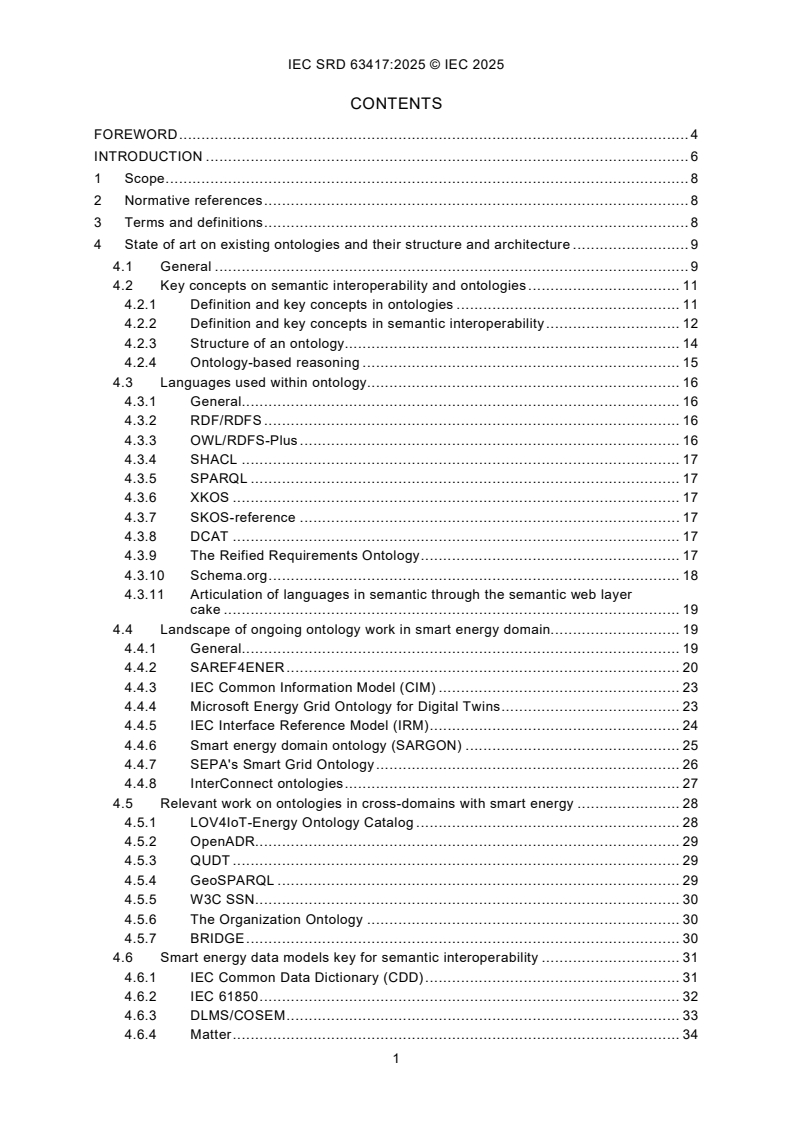
CONTENTS
FOREWORD . 4
INTRODUCTION . 6
1 Scope . 8
2 Normative references . 8
3 Terms and definitions . 8
4 State of art on existing ontologies and their structure and architecture . 9
4.1 General . 9
4.2 Key concepts on semantic interoperability and ontologies . 11
4.2.1 Definition and key concepts in ontologies . 11
4.2.2 Definition and key concepts in semantic interoperability . 12
4.2.3 Structure of an ontology. 14
4.2.4 Ontology-based reasoning . 15
4.3 Languages used within ontology . 16
4.3.1 General. 16
4.3.2 RDF/RDFS . 16
4.3.3 OWL/RDFS-Plus . 16
4.3.4 SHACL . 17
4.3.5 SPARQL . 17
4.3.6 XKOS . 17
4.3.7 SKOS-reference . 17
4.3.8 DCAT . 17
4.3.9 The Reified Requirements Ontology . 17
4.3.10 Schema.org . 18
4.3.11 Articulation of languages in semantic through the semantic web layer
cake . 19
4.4 Landscape of ongoing ontology work in smart energy domain. 19
4.4.1 General. 19
4.4.2 SAREF4ENER . 20
4.4.3 IEC Common Information Model (CIM) . 23
4.4.4 Microsoft Energy Grid Ontology for Digital Twins . 23
4.4.5 IEC Interface Reference Model (IRM) . 24
4.4.6 Smart energy domain ontology (SARGON) . 25
4.4.7 SEPA's Smart Grid Ontology . 26
4.4.8 InterConnect ontologies . 27
4.5 Relevant work on ontologies in cross-domains with smart energy . 28
4.5.1 LOV4IoT-Energy Ontology Catalog . 28
4.5.2 OpenADR. 29
4.5.3 QUDT . 29
4.5.4 GeoSPARQL . 29
4.5.5 W3C SSN . 30
4.5.6 The Organization Ontology . 30
4.5.7 BRIDGE . 30
4.6 Smart energy data models key for semantic interoperability . 31
4.6.1 IEC Common Data Dictionary (CDD) . 31
4.6.2 IEC 61850 . 32
4.6.3 DLMS/COSEM . 33
4.6.4 Matter . 34
4.6.5 KNX . 35
4.7 Graphical representation and visualization of ontologies . 37
4.8 Future trends . 37
5 Smart energy cross-domain use cases involving ontology . 38
5.1 Common Grid model, ENTSO-E – CGMES . 38
5.1.1 Use cases description . 38
5.1.2 Use of the ontology . 38
5.1.3 Benefit to implement it . 39
5.2 Illustration on energy management in buildings . 39
5.2.1 Use cases description . 39
5.2.2 Use of the ontology . 39
5.2.3 Benefit to implement it. . 40
5.3 Illustration in electromobility . 40
5.3.1 Use cases description . 40
5.3.2 Use of the ontology . 41
5.3.3 Benefit of implementing it . 42
5.4 InterConnect . 42
5.4.1 Use cases description . 42
5.4.2 Use of the ontology . 43
5.4.3 Benefit of implementing it . 44
6 Proposal for a smart energy ontology framework . 44
6.1 Smart energy ontology framework . 44
6.1.1 General. 44
6.1.2 Requirements . 45
6.1.3 Processes on validation or evaluation of an ontology . 46
6.1.4 Governance requirements . 46
6.2 Guidance and best practices to build such a framework . 47
6.2.1 General. 47
6.2.2 Ontological requirements specification . 48
6.2.3 Ontology implementation . 49
6.2.4 Ontology publication . 49
6.2.5 Ontology maintenance . 49
7 Conclusion and recommendation for standardization work on smart energy
ontology in the IEC . 49
Bibliography . 51
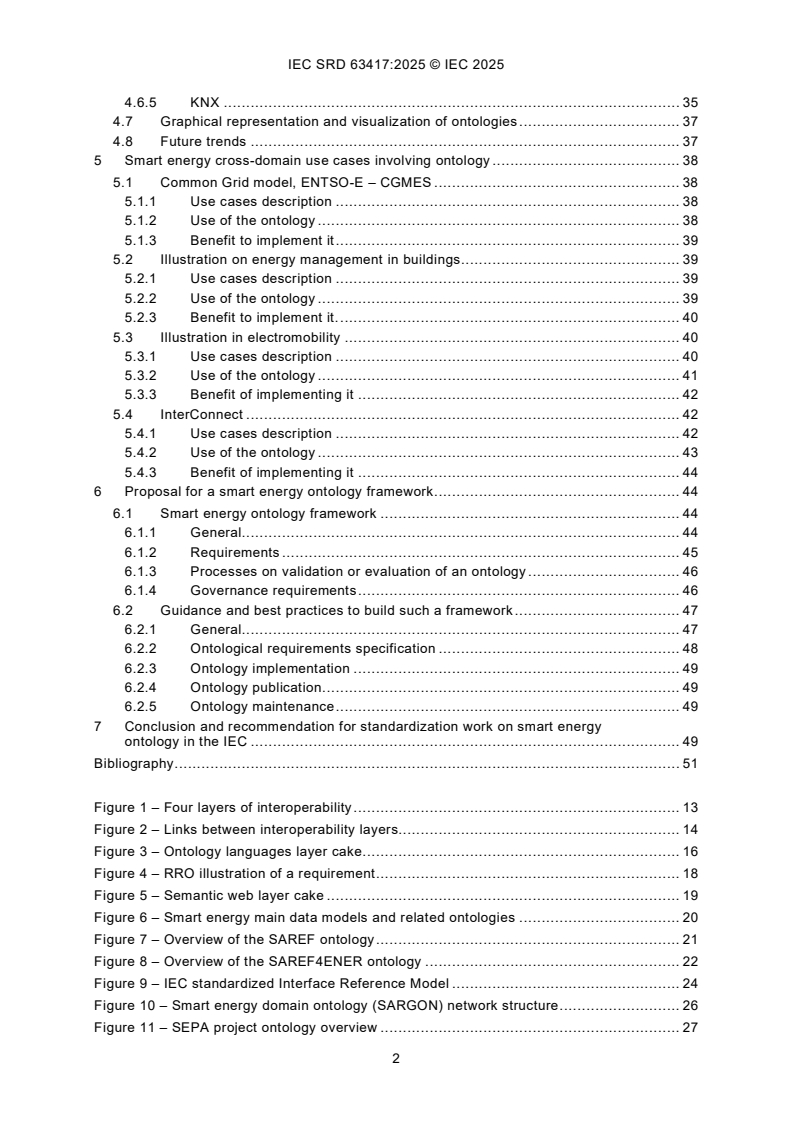
Figure 1 – Four layers of interoperability . 13
Figure 2 – Links between interoperability layers. 14
Figure 3 – Ontology languages layer cake . 16
Figure 4 – RRO illustration of a requirement . 18
Figure 5 – Semantic web layer cake . 19
Figure 6 – Smart energy main data models and related ontologies . 20
Figure 7 – Overview of the SAREF ontology . 21
Figure 8 – Overview of the SAREF4ENER ontology . 22
Figure 9 – IEC standardized Interface Reference Model . 24
Figure 10 – Smart energy domain ontology (SARGON) network structure . 26
Figure 11 – SEPA project ontology overview . 27
Figure 12 – Ontology Catalog for Energy . 28
Figure 13 – GeoSPARQL vocabulary . 29
Figure 14 – European energy data exchange reference architecture DERA 3.0 . 31
Figure 15 – DLMS main data models . 34
Figure 16 – HBES elements . 36
Figure 17 – Main KIM source . 36
Figure 18 – Main KIM ontology classes . 37
Figure 19 – CIM-CGMES usage illustration . 38
Figure 20 – Energy in buildings scenario with semantic interoperability problems . 39
Figure 21 – Semantic interoperability problems solved without using SEN ontology . 40
Figure 22 – Semantic interoperability problems solved using SEN . 40
Figure 23 – Electromobility scenario with semantic interoperability problems . 41
Figure 24 – Semantic interoperability problems solved without using SEN . 41
Figure 25 – Semantic interoperability problems solved using SEN . 42
Figure 26 – InterConnect ontologies extending SAREF ontologies . 43
Figure 27 – Subset of the SAREF-compliant sensor dictionary applied to energy . 44
Figure 28 – LOT Base methodology workflow . 48
Figure 29 – FIESTA IoT ontology federation . 50
Table 1 – Ontology best practices: check list summary . 46
INTERNATIONAL ELECTROTECHNICAL COMMISSION
____________
Guidance and plan to develop smart energy ontologies
FOREWORD
1) The International Electrotechnical Commission (IEC) is a worldwide organization for standardization comprising
all national electrotechnical committees (IEC National Committees). The object of IEC is to promote international
co-operation on all questions concerning standardization in the electrical and electronic fields. To this end and
in addition to other activities, IEC publishes International Standards, Technical Specifications, Technical Reports,
Publicly Available Specifications (PAS) and Guides (hereafter referred to as "IEC Publication(s)"). Their
preparation is entrusted to technical committees; any IEC National Committee interested in the subject dealt with
may participate in this preparatory work. International, governmental and non-governmental organizations liaising
with the IEC also participate in this preparation. IEC collaborates closely with the International Organization for
Standardization (ISO) in accordance with conditions determined by agreement between the two organizations.
2) The formal decisions or agreements of IEC on technical matters express, as nearly as possible, an international
consensus of opinion on the relevant subjects since each technical committee has representation from all
interested IEC National Committees.
3) IEC Publications have the form of recommendations for international use and are accepted by IEC National
Committees in that sense. While all reasonable efforts are made to ensure that the technical content of IEC
Publications is accurate, IEC cannot be held responsible for the way in which they are used or for any
misinterpretation by any end user.
4) In order to promote international uniformity, IEC National Committees undertake to apply IEC Publications
transparently to the maximum extent possible in their national and regional publications. Any divergence between
any IEC Publication and the corresponding national or regional publication shall be clearly indicated in the latter.
5) IEC itself does not provide any attestation of conformity. Independent certification bodies provide conformity
assessment services and, in some areas, access to IEC marks of conformity. IEC is not responsible for any
services carried out by independent certification bodies.
6) All users should ensure that they have the latest edition of this publication.
7) No liability shall attach to IEC or its directors, employees, servants or agents including individual experts and
members of its technical committees and IEC National Committees for any personal injury, property damage or
other damage of any nature whatsoever, whether direct or indirect, or for costs (including legal fees) and
expenses arising out of the publication, use of, or reliance upon, this IEC Publication or any other IEC
Publications.
8) Attention is drawn to the Normative references cited in this publication. Use of the referenced publications is
indispensable for the correct application of this publication.
9) IEC draws attention to the possibility that the implementation of this document may involve the use of (a)
patent(s). IEC takes no position concerning the evidence, validity or applicability of any claimed patent rights in
respect thereof. As of the date of publication of this document, IEC had not received notice of (a) patent(s), which
may be required to implement this document. However, implementers are cautioned that this may not represent
the latest information, which may be obtained from the patent database available at https://patents.iec.ch. IEC
shall not be held responsible for identifying any or all such patent rights.
IEC 63417 has been prepared by IEC systems committee Smart Energy. It is a Systems
Reference Deliverable (SRD).
The text of this Systems Reference Deliverable is based on the following documents:
Draft Report on voting
SyCSmartEnergy/289/DTS SyCSmartEnergy/295/RVDTS
Full information on the voting for its approval can be found in the report on voting indicated in
the above table.
The language used for the development of this Systems Reference Deliverable is English.
This document was drafted in accordance with ISO/IEC Directives, Part 2, and developed in
accordance with ISO/IEC Directives, Part 1 and ISO/IEC Directives, IEC Supplement, available
at www.iec.ch/members_experts/refdocs. The main document types developed by IEC are
described in greater detail at www.iec.ch/publications.
The committee has decided that the contents of this document will remain unchanged until the
stability date indicated on the IEC website under webstore.iec.ch in the data related to the
specific document. At this date, the document will be
• reconfirmed,
• withdrawn, or
• revised.
INTRODUCTION
The smart energy and smart grid domains have undergone tremendous change as a result of
different work on energy grids, markets, and services modelization and data exchanges.
Information and knowledge on this domain are now shared in broad, public and standardized
models. As a result, the challenge of knowledge representation and sharing is even more
prominent. Any user such as software agents, intelligent devices, artificial intelligence, edge
computing capabilities or people, is liable to use, create, and exchange information in large-
scale ecosystems with a variety data models, exchange protocols and information modelling
standards. To address this challenge, the smart energy community is looking into languages
and frameworks for ensuring interoperability at the knowledge level between several
ecosystems of users. The semantic web and its recent technological advancement for
characterizing and preserving knowledge on the web as an architecture of computer-
interpretable structured information is an inspiration to do so.
Semantic web technology is used to create knowledge domains and generates meaning from a
hierarchy of data classification. It is an expansion of the current web in which knowledge is
given a clear and unambiguous meaning via ontologies. Because they give structured
vocabularies a formal specification of shared concepts, ontologies are crucial for achieving
interoperability in large domains such as smart energy involving several ecosystems working
on different standards and data models for exchanging information. Ontologies help to solve
the issues caused by semantic heterogeneity by offering a common understanding of a
particular area of interest. However, matching ontologies continue to be the biggest obstacle to
data integration and interoperability. Ontologies can be used to address interoperability
problems at the application level; as a result, ontologies have been utilized to express the
capabilities of the services. Ontologies, which specify the semantics of the symbolic
representations employed in communication, similarly enhance user interaction.
A substantial emphasis is placed on the work and technology development in semantic web
languages, sensors and computing, graphs, and models, and linking and integration
approaches. The Internet of Things, semantic web services, ontology mapping, building
information modelling, bioinformatics, education, and e-learning, and semantic web languages
are the main domains of development of the semantic web and interoperability field. Smart
energy businesses functioning in a more-and-more digital environment today need more
automation, interoperability, and data governance in their day-to-day operations. While the
semantic web and interoperability research have attracted a lot of interest and made major
improvements, there are few works available that address those concepts for the whole smart
energy domain. This document's goal is to examine this knowledge gap by reviewing and
analysing the existing ontology and semantic interoperability work in the domain and propose
a framework and best practice for future standardization work in the domain.
So numerous ontologies are being developed to provide semantic interoperability solutions to
many domains. From domestic IoT to industry, chemistry, biotechnologies or medical sector,
many domains are working to ensure semantic interoperability of the knowledge and data they
accumulate. These works can reach very different degrees of maturity, from research thesis
works to the implementation of industrial services based on semantic interoperability between
data models enabled by an ontology. The smart energy domain is not left behind when it comes
to these works. There have been many studies among semantic interoperability in power grid
and energy ontology and different ontologies have been developed to improve energy data
interoperability. Choosing a reference ontology which meets the requirement and covers the
large domains in smart energy systems is a big challenge as not all ontologies represent the
same energy data domains and at the same level of data details. This heterogeneity results in
interoperability issues in implementation of these ontologies. One of the several challenges to
build a unified ontology for the smart energy domain is to identify semantically equivalent
objects in already existing ontologies of the domain. Therefore, the determination of a method
of unification or facilitating the necessary interoperability for smart energy is key to go one step
beyond the major innovations and improvements achieved in the past decade.
The approach proposed in this document is to build a framework for the selection, evaluation
and analysis of pre-existing ontologies that are wholly or partially applicable to the smart energy
domain, thus facilitating the identification of a federation of reference ontologies that can be
used in this domain. This framework allows to identify overlaps and gaps not covered by these
ontologies, to evaluate their quality, their maintainability, their ease of use and the associated
extension needs, thus facilitating through normative work the emergence of an interoperable
set of ontologies for the smart energy domain.
This publication provides a framework: guidance, evaluation criterion, best practices, and key
issues to address, to develop a smart energy ontology federating established ontologies of the
smart energy domain through semantic interoperability.
.
1 Scope
This document provides guidance and a plan to develop smart energy ontologies and other
domain-based ontologies within smart energy to achieve semantic interoperability through
various standards, generic and specific ontologies projects. This includes but is not limited to
the following.
• Assessment of a selection of existing ontologies for the purpose of smart energy
applications:
– identification of developed ontologies within the energy sectors;
– limitations, best practices, and lessons learned;
– use and reuse of existing ontologies in the smart energy domain;
– cross-domain semantic interoperability support and link to other ontologies.
• Guidance and plan for smart energy ontologies development and usage including:
– key principles to map or transform existing reference models to the IEC ontology
framework;
– definition of governance best practices for ontologies applied to process the smart
energy domain;
– guidance for developing or extending a smart energy ontology.
Domain-based ontologies have been developed for semantic interoperability in a specific
domain but the interaction of semantically equivalent objects in different ontologies has not
been defined. This document helps users and ontology developers to define the complete
relationship in different domains and different ontologies for the purpose of smart energy
applications.
2 Normative references
The following documents are referred to in the text in such a way that some or all of their content
constitutes requirements of this document. For dated references, only the edition cited applies.
For undated references, the latest edition of the referenced document (including any
amendments) applies.
ISO/IEC 21838-1:2021, Information technology – Top-level ontologies (TLO) – Part 1:
Requirements
ISO/IEC 21838-2:2021, Information technology – Top-level ontologies (TLO) – Part 2: Basic
Formal Ontology (BFO)
ISO/IEC 21823-3:2021, Internet of Things (IoT) – Interoperability for IoT systems – Part 3:
Semantic interoperability
3 Terms and definitions
For the purposes of this document, the following terms and definitions apply.
ISO and IEC maintain terminology databases for use in standardization at the following
addresses:
• IEC Electropedia: available at https://www.electropedia.org/
• ISO Online browsing platform: available at https://www.iso.org/obp
3.1
ontology
specification of concrete or abstract things, and the relationships among them, in a prescribed
domain of knowledge
Note 1 to entry: The specification should be computer processable.
Note 2 to entry: Compare with definitions given in references [1], [2], [3].
[SOURCE: ISO/IEC 19763-3:2020 [4], 3.1.1.1 – Note 2 to entry has been added.]
3.2
Smart energy Grid Architecture Model
SGAM
architecture model tool applying to the smart energy grid
[SOURCE: IEC SRD 63200:2021 [5], 3.1.16]
3.3
SGAM domain
set of roles involved in the energy industry, considering that the whole industry is partitioned
into five business domains: (Bulk) Generation, Transmission, Distribution, DER (Distributed
Energy Resources) and Customer Premises
[SOURCE: IEC SRD 63200:2021 [5], 3.1.17]
3.4
semantic interoperability
interoperability so that the meaning of the data model within the context of a subject area is
understood by the participating systems
[SOURCE: ISO/IEC 19941:2017 [7], 3.1.5, modified – In the term, "data" has been deleted.]
3.5
semantic vocabulary
standardized, structured, and human- and machine-readable set of terms conforming to
semantic web technology like Resource Description Framework (RDF)
4 State of art on existing ontologies and their structure and architecture
4.1 General
The promise of ontologies is to give individuals and application systems a common
understanding of a topic that can be communicated. As a key solution for achieving semantic
interoperability, ontologies can bring value to smart energy through several technology enablers
such as complex information exchanges through multiple domains, AI based solutions and
digital twin solutions. It will always be necessary to translate between distinct formats and
representations that developed independently in any area where older software systems are
required to interoperate. Cataloguing existing relevant ontologies for the domain, incorporating
them in a landscape for communication and learning purposes, and analysing them will help
smart energy stakeholders and smart energy standardization stakeholders reference, build,
extend and standardize the key ontologies to achieve semantic interoperability.
Clause 4 describes the state of the art on existing ontologies linked to the smart energy domain
and their structure and architecture.
The term ontology describes a specification of a common conceptualization. A
conceptualization is a process of forming concepts (or objects or ideas) that have a special
purpose and links between them. It provides a set of concepts and categories in a subject area
or domain knowledge that shows their properties and the relationships that unite them. Hence,
ontologies are means that precisely make it possible to structure concepts and relations in a
form that can be used by a computer program. Those relations between concepts are often
based on logical representation.
An ontology is developed for the following purposes:
• to share common understanding of the structure of information among people or software
agents;
• to enable reuse of domain knowledge;
• to make domain assumptions explicit;
• to separate domain knowledge from the operational knowledge;
• to analyse domain knowledge.
Some specific literature contains many definitions of an ontology at differing degrees of
maturity. Research on ontology has a close link to Internet of Things (IoT), which is a wide
domain dispersed across many vertical fields such as smart energy. A semantic layer can be
helpful in addressing the challenge of heterogeneity in information and data representation from
two energy devices.
Ontology itself does not contribute directly to a system function or characteristic, such as
reliability or flexibility. However, it is an important key for systems life cycle engineering and
designing system level information exchanges, supported by creation of new data models, or
achieving harmonization between existing data models, which are required for proper
coordination and communication between actors of different domains. Power system will
possibly function differently in future due to economic, environmental and other regulation
aspects. However, requirement of digital communication and data models will be generic.
The following are benefits of smart energy ontology.
• It supports common understanding of terms used within smart energy: Terms and definitions
in power grid are domain-specific and can cause misunderstanding between systems of
different domains. A common language enables precise interpretation of exchanged
messages and supports semantic transformation all along the product and systems life
cycle.
• It supports interaction between different existing data models that are used in the smart
energy domain: There are required standards and standardized data models for different
domain-specific systems but not a common architecture for semantic interoperability
between these data models in smart energy.
• It supports the integration of new energy sectors within the smart energy domain. In general,
the expansion of the smart energy domain does not influence the ontology. Thus, smart
energy ontology is designed in a modular way.
• It supports system-based design and engineering: The number of designing systems and
the systems-of-systems in smart grid are increasing and thereby the complexity of
interaction between these systems. Smart energy ontology will improve project efficiency
and help mitigate risks from the specification stage of products, and the systems life cycle
itself.
• Having a smart energy ontology will facilitate cross-sector interoperability (interoperability
between smart energy domain and other domains like smart manufacturing, smart cities,
health, mobility, etc.).
There have been many studies among semantic interoperability in power grid and energy
ontology and different ontologies have been developed to improve energy data interoperability.
However, choosing a reference ontology which meets the requirement and covers the large
domains in smart energy systems is a big challenge as not all ontologies represent the same
energy data domains and at the same level of data details. This heterogeneity causes
interoperability issues in implementation of these ontologies. Therefore, a capacity to aggregate
or to do mapping between existing ontologies for smart energy is required for common
understanding and efficient implementations.
This document provides for the purpose of smart energy applications an inventory and
assessment of existing ontologies. Domain-based ontologies have been developed for semantic
interoperability in a specific domain but the interaction of semantically equivalent objects in
different ontologies has not been defined. This document helps users and ontology developers
to define the complete relationship in different domains and different ontologies.
The existing developed ontologies presented by ontology developers will be detected and
assessed against defined requirements. Users will interact by means of a user interface, which
is an application for grid users, ontology engineers and ontology provider to share or use
information. Assessment is an important activity of the process as it must analyse ontologies
for their qualification and the relevance of the content. Indexation considers data properties and
annotations for better search and mapping result in the core unified ontology. It even uses
mapping for use cases and SGAM for providing full information on semantic interoperability of
the data.
Use cases for a smart energy ontology are still to be defined precisely. Hereafter is a list of
some generic use cases already anticipated, although it is not an exhaustive list.
• Knowledge sharing – lookup, transfer (download and upload) and re-use of datasets and
design patterns.
• Adaptation – possible to adopt it in real system.
• Benchmarking – compare datasets and design patterns suitability for some study.
• Collaborative studies – mapping of inputs and results of several studies into a pivot format.
• Cross-domain research – lookup of datasets and design patterns on related domains.
4.2 Key concepts on semantic interoperability and ontologies
4.2.1 Definition and key concepts in ontologies
Subclause 4.2 explores the articulation between ontologies, languages, information models,
lexicon, and taxonomy. It starts by describing and exemplifying each term and then links them
to an ontology. Then it describes the objectives of an ontology and explains how an ontology is
structured and how an ontology can help to achieve semantic interoperability.
Semantics is the study of meaning. Lexicon, glossary, languages, and taxonomy all define a
collection of terms that are associated with a set of related information or a knowledge domain.
A lexicon or language is a collection of words of terms and phrases associated with a knowledge
domain. It does not include a definition or an explanation about how terms are related or a
prioritization of significance.
A glossary is a lexicon with glosses added. It includes a single definition applicable to the
knowledge domain only.
A taxonomy lacks the definition of a glossary, but the terms are organized in a hierarchical tree
according to how they relate to one another. Hypernymy is frequently used in this relationship.
For example, if a car is a vehicle, then vehicle is a hypernym of car and car is a hyponym of
vehicle.
An hypernymy (or "is-a" relationship) organizes terms by category and orders them. For
instance, a tiger is a cat, a cat is a mammal, and a mammal is a vertebrate. Attributes possessed
by a concept higher in a taxonomy are also held by its sub-concepts. For example, an attribute
of a vertebrate is possessing a spinal cord. Therefore, as a subtree of vertebrate, tigers have
a spinal cord. This classification of concepts and then the ability to infer based on category
memberships is at the root of an ontology.
An ontology includes relationships as hypernymy, just like a taxonomy. An ontology can have
hypernymy relationships from several overlapping taxonomies. Using the same example as
before, an ontology can be organized by class, a tiger is a mammal, and by order, a tiger is a
carnivore. Ontologies include additional types of relationships that are often binary. They
describe a relationship between two concepts or entities. These relationships are commonly
written as either xRy or in predicate form. In the first, x and y are entities and R is a relationship.
For example, a tiger is an animal. In the predicate form, the example would be is-a tiger, animal.
This form is consistent with logic representations. Other binary relations commonly used in
ontology are part-whole, property and value. In the former example, the following can be
included in the ontology: paw part tiger or colour property tiger and orange value colour.
An ontology is designed for the purpose of enabling knowledge sharing and reuse. It enables
data to be easily findable, available, interoperable and reusable. An ontology has four
objectives:
The first objective in constructing ontologies is to provide people and software agents with a
common understanding of the structure of information. For instance, the CIM-based Digital
Twins Definition Language ontology allows contextual interpretation of data just by specifying
the properties of various grid elements and the relations between them. Others can expand this
open-source repository for their solutions and contribute with their experience and learning to
the repository for the benefit of everyone else.
A second objective is the ability to enable the reuse of domain knowledge. For instance, there
is a need for time to be represented in models for many different domains. This illustration
incorporates notions of time intervals, points in time or relative measures of time. An ontology
is made to be easily reused or adapted using existing ontology. Therefore, an ontology can be
developed based on one or several former ontologies.
A third objective is to effectively modify the domain assumptions underlying an implementation
by making them explicit. Assumptions about the world are hard coded in programming language
code, making them difficult to not just find and comprehend but also difficult to change.
Additionally, clear definitions of domain knowledge are helpful for new users, for whom it is
important to understand what the terms used in the domain mean.
A fourth objective is to distinguish between operational knowledge and domain knowledge.
Configuring a product from its components in accordance with a specification can be achieved
easily. A program can be implemented independently from the products and components
themselves.
4.2.2 Definition and key concepts in semantic interoperability
The European Interoperability Framework (EIF) [8] is a set of recommendations which specify
how administrations, businesses and citizens communicate with each other within the European
Union and across Member State borders.
One of the deliveries is the interoperability model that applies to all digital public services and
should be considered as an integral element of the interoperability-by-design paradigm.
___________
Numbers in square brackets refer to the Bibliography.
It includes the four layers of interoperability: legal, organizational, semantic and technical, as
shown in Figure 1.
Figure 1 – Four layers of interoperability
Legal interoperability is about ensuring that organizations operating under different legal
frameworks, policies and strategies are able to work together. In the European Electricity
domain, this would be related to network codes and guidelines [9].
Organizational interoperability refers to the way in which business processes, responsibilities,
and expectations achieve commonly agreed and mutually beneficial goals. In practice, this
means documenting and integrating or aligning business processes and relevant information
exchanged. Organizational interoperability also aims to meet the requirements of the user
community by making services available, easily identifiable, accessible and user focused.
Semantic interoperability ensures that the precise format and meaning of exchanged data and
information is preserved and understood throughout exchanges between parties, in other words
"what is sent is what is understood". In the EIF, semantic interoperability covers both semantic
and syntactic aspects.
• The semantic aspect refers to the meaning of data elements and the relationship between
them. It includes developing vocabularies and schemas to describe data exchanges and
ensures that data elements are understood in the same way by all communicating parties.
• The syntactic aspect refers to describing the exact format of the information to be exchanged
in terms of grammar and format.
Technical interoperability covers the applications and infrastructures linking systems and
services. Aspects of technical interoperability include interface specifications, interconnection
services, data integration services, data presentation and exchange, and secure communication
protocols.
Figure 2 shows how these interoperability layers are linked.
Figure 2 – Links between interoperability layers
Semantic interoperability "means enabling different agents, services, and applications to
exchange information, data and knowledge in a meaningful way" [18], whereas interoperability
is "the ability of two or more systems or components to exchange data and use information" [6].
...