


IEC TR 62778:2014
(Main)Application of IEC 62471 for the assessment of blue light hazard to light sources and luminaires
General Information
- Abstract
IEC/TR 62778:2014 brings clarification and guidance concerning the assessment of blue light hazard of all lighting products which have the main emission in the visible spectrum (380 nm to 780 nm). By optical and spectral calculations, it is shown what the photobiological safety measurements as described in IEC 62471 tell us about the product and, if this product is intended to be a component in a higher level lighting product, how this information can be transferred from the component product (e.g. the LED package, the LED module, or the lamp) to the higher level lighting product (e.g. the luminaire). This second edition cancels and replaces the first edition published in 2012. This edition constitutes a technical revision. This edition includes the following significant technical change with respect to the previous edition: inclusion of the photobiological assessment of LED arrays (Annex D). The contents of the corrigendum of July 2014 have been included in this copy.
- Status
- Withdrawn
- Publication Date
- 26-Jun-2014
- Withdrawal Date
- 25-May-2023
- Technical Committee
- SC 34A - Electric light sources
- Drafting Committee
- WG 6 - TC 34/WG 6
- Current Stage
- WPUB - Publication withdrawn
- Start Date
- 30-May-2023
- Completion Date
- 26-May-2023
Buy Documents


IEC TR 62778:2014 - Application of IEC 62471 for the assessment of blue light hazard to light sources and luminaires
IEC TR 62778:2014 - Application of IEC 62471 for the assessment of blue light hazard to light sources and luminaires Released:6/27/2014
Relations
- Effective Date
- 25-Aug-2026
- Effective Date
- 25-Aug-2026
- Effective Date
- 25-Aug-2026
- Effective Date
- 10-Feb-2026
- Effective Date
- 10-Feb-2026
- Effective Date
- 10-Feb-2026
- Effective Date
- 10-Feb-2026
- Effective Date
- 10-Feb-2026
- Effective Date
- 10-Feb-2026
- Effective Date
- 10-Feb-2026
- Effective Date
- 05-Sep-2023
- Effective Date
- 05-Sep-2023
Buy Documents
IEC TR 62778:2014 - Application of IEC 62471 for the assessment of blue light hazard to light sources and luminaires
IEC TR 62778:2014 - Application of IEC 62471 for the assessment of blue light hazard to light sources and luminaires Released:6/27/2014
Get Certified
Connect with accredited certification bodies for this standard

IMQ S.p.A. (Certification)
Italian electrical product certification.

SLG Prüf- und Zertifizierungs GmbH
German testing and certification body.

UL Solutions
Global safety science company with testing, inspection and certification.
Sponsored listings
Frequently Asked Questions
IEC TR 62778:2014 is a technical report published by the International Electrotechnical Commission (IEC). Its full title is "Application of IEC 62471 for the assessment of blue light hazard to light sources and luminaires". This standard covers: IEC/TR 62778:2014 brings clarification and guidance concerning the assessment of blue light hazard of all lighting products which have the main emission in the visible spectrum (380 nm to 780 nm). By optical and spectral calculations, it is shown what the photobiological safety measurements as described in IEC 62471 tell us about the product and, if this product is intended to be a component in a higher level lighting product, how this information can be transferred from the component product (e.g. the LED package, the LED module, or the lamp) to the higher level lighting product (e.g. the luminaire). This second edition cancels and replaces the first edition published in 2012. This edition constitutes a technical revision. This edition includes the following significant technical change with respect to the previous edition: inclusion of the photobiological assessment of LED arrays (Annex D). The contents of the corrigendum of July 2014 have been included in this copy.
IEC/TR 62778:2014 brings clarification and guidance concerning the assessment of blue light hazard of all lighting products which have the main emission in the visible spectrum (380 nm to 780 nm). By optical and spectral calculations, it is shown what the photobiological safety measurements as described in IEC 62471 tell us about the product and, if this product is intended to be a component in a higher level lighting product, how this information can be transferred from the component product (e.g. the LED package, the LED module, or the lamp) to the higher level lighting product (e.g. the luminaire). This second edition cancels and replaces the first edition published in 2012. This edition constitutes a technical revision. This edition includes the following significant technical change with respect to the previous edition: inclusion of the photobiological assessment of LED arrays (Annex D). The contents of the corrigendum of July 2014 have been included in this copy.
IEC TR 62778:2014 is classified under the following ICS (International Classification for Standards) categories: 29.140.01 - Lamps in general. The ICS classification helps identify the subject area and facilitates finding related standards.
IEC TR 62778:2014 has the following relationships with other standards: It is inter standard links to EN 13272-2:2019, EN 17673:2022, EN 13272-1:2019, EN 62931:2017, EN 62776:2015, EN IEC 60598-1:2024, EN 62838:2016, EN 62560:2012/A1:2015, EN 62031:2008/A2:2015, EN IEC 62031:2020, IEC 62778/COR1:2014, IEC TR 62778:2012. Understanding these relationships helps ensure you are using the most current and applicable version of the standard.
IEC TR 62778:2014 is available in PDF format for immediate download after purchase. The document can be added to your cart and obtained through the secure checkout process. Digital delivery ensures instant access to the complete standard document.
Standards Content (Sample)
IEC TR 62778 ®
Edition 2.0 2014-06
TECHNICAL
REPORT
colour
inside
Application of IEC 62471 for the assessment of blue light hazard to light sources
and luminaires
All rights reserved. Unless otherwise specified, no part of this publication may be reproduced or utilized in any form
or by any means, electronic or mechanical, including photocopying and microfilm, without permission in writing from
either IEC or IEC's member National Committee in the country of the requester. If you have any questions about IEC
copyright or have an enquiry about obtaining additional rights to this publication, please contact the address below or
your local IEC member National Committee for further information.
IEC Central Office Tel.: +41 22 919 02 11
3, rue de Varembé Fax: +41 22 919 03 00
CH-1211 Geneva 20 info@iec.ch
Switzerland www.iec.ch
About the IEC
The International Electrotechnical Commission (IEC) is the leading global organization that prepares and publishes
International Standards for all electrical, electronic and related technologies.
About IEC publications
The technical content of IEC publications is kept under constant review by the IEC. Please make sure that you have the
latest edition, a corrigenda or an amendment might have been published.
IEC Catalogue - webstore.iec.ch/catalogue Electropedia - www.electropedia.org
The stand-alone application for consulting the entire The world's leading online dictionary of electronic and
bibliographical information on IEC International Standards, electrical terms containing more than 30 000 terms and
Technical Specifications, Technical Reports and other definitions in English and French, with equivalent terms in 14
documents. Available for PC, Mac OS, Android Tablets and additional languages. Also known as the International
iPad. Electrotechnical Vocabulary (IEV) online.
IEC publications search - www.iec.ch/searchpub IEC Glossary - std.iec.ch/glossary
The advanced search enables to find IEC publications by a More than 55 000 electrotechnical terminology entries in
variety of criteria (reference number, text, technical English and French extracted from the Terms and Definitions
committee,…). It also gives information on projects, replaced clause of IEC publications issued since 2002. Some entries
and withdrawn publications. have been collected from earlier publications of IEC TC 37,
77, 86 and CISPR.
IEC Just Published - webstore.iec.ch/justpublished
Stay up to date on all new IEC publications. Just Published IEC Customer Service Centre - webstore.iec.ch/csc
details all new publications released. Available online and If you wish to give us your feedback on this publication or
also once a month by email. need further assistance, please contact the Customer Service
Centre: csc@iec.ch.
IEC TR 62778 ®
Edition 2.0 2014-06
TECHNICAL
REPORT
colour
inside
Application of IEC 62471 for the assessment of blue light hazard to light sources
and luminaires
INTERNATIONAL
ELECTROTECHNICAL
COMMISSION
PRICE CODE
W
ICS 29.140 ISBN 978-2-8322-1615-6
– 2 – IEC TR 62778:2014 © IEC 2014
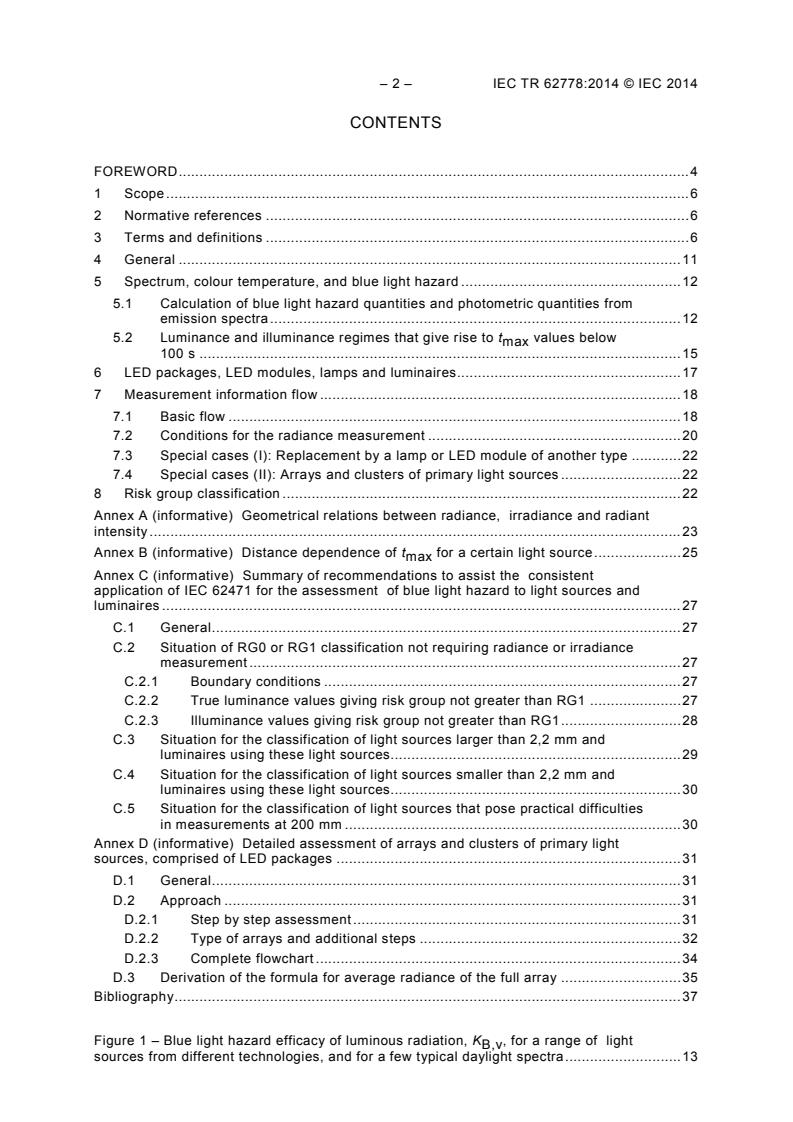
CONTENTS
FOREWORD . 4
1 Scope . 6
2 Normative references . 6
3 Terms and definitions . 6
4 General . 11
5 Spectrum, colour temperature, and blue light hazard . 12
5.1 Calculation of blue light hazard quantities and photometric quantities from
emission spectra . 12
5.2 Luminance and illuminance regimes that give rise to t values below
max
100 s . 15
6 LED packages, LED modules, lamps and luminaires . 17
7 Measurement information flow . 18
7.1 Basic flow . 18
7.2 Conditions for the radiance measurement . 20
7.3 Special cases (I): Replacement by a lamp or LED module of another type . 22
7.4 Special cases (II): Arrays and clusters of primary light sources . 22
8 Risk group classification . 22
Annex A (informative) Geometrical relations between radiance, irradiance and radiant
intensity . 23
Annex B (informative) Distance dependence of t for a certain light source . 25
max
Annex C (informative) Summary of recommendations to assist the consistent
application of IEC 62471 for the assessment of blue light hazard to light sources and
luminaires . 27
C.1 General . 27
C.2 Situation of RG0 or RG1 classification not requiring radiance or irradiance
measurement . 27
C.2.1 Boundary conditions . 27
C.2.2 True luminance values giving risk group not greater than RG1 . 27
C.2.3 Illuminance values giving risk group not greater than RG1 . 28
C.3 Situation for the classification of light sources larger than 2,2 mm and
luminaires using these light sources. 29
C.4 Situation for the classification of light sources smaller than 2,2 mm and
luminaires using these light sources. 30
C.5 Situation for the classification of light sources that pose practical difficulties
in measurements at 200 mm . 30
Annex D (informative) Detailed assessment of arrays and clusters of primary light
sources, comprised of LED packages . 31
D.1 General . 31
D.2 Approach . 31
D.2.1 Step by step assessment . 31
D.2.2 Type of arrays and additional steps . 32
D.2.3 Complete flowchart . 34
D.3 Derivation of the formula for average radiance of the full array . 35
Bibliography . 37
Figure 1 – Blue light hazard efficacy of luminous radiation, K , for a range of light
B,v
sources from different technologies, and for a few typical daylight spectra . 13
Figure 2 – Comparison between the curves involved in calculating K (the photopic
B,v
eye sensitivity curve and the blue light spectral weighting function) and the CIE 1931 Y
and Z curves involved in calculating the CIE 1931 x, y colour coordinates . 14
Figure 3 – Correlation plot between the quantity (1 – x – y)/y, calculated from the CIE
1931 x, y colour coordinates, and the value of K , for all the spectra analysed to
B,v
generate Figure 1 . 15
.
Figure 4 – Estimate of the luminance level where L = 10 000 W/(m sr), border
B
between RG1 (t > 100 s) and RG2 (t < 100 s) in the large source regime, as a
max max
function of CCT . 16
Figure 5 – Estimate of the illuminance level where E = 1 W/m , border between RG1
B
(t > 100 s) and RG2 (t < 100 s) in the small source regime, as a function of
max max
CCT 16
Figure 6 – Relation of illuminance E, distance d and intensity I . 20
Figure 7 – Flow chart from the primary light source (in blue) to the luminaire based on
this light source (in amber) . 21
Figure A.1 – Schematic image of the situation considered in Annex A . 23
Figure B.1 – General appearance of t as a function of viewing distance d, for any
max
light source with homogeneous luminance L and diameter D . 26
Figure C.1 – Luminance values from Table C.1 in relation to the RG1/RG2 border as
function of correlated colour temperature . 28
Figure C.2 – Illuminance values from Table C.2 in relation to the RG1/RG2 border as
function of correlated colour temperature . 29
Figure D.1 – Examples of secondary lenses with identical light distribution and
alignment . 32
Figure D.2 – Examples of LED arrays with bare LED packages . 33
Figure D.3 – Evaluation whether one or more LED elements fall in 11 mrad field of
view at distance d . 33
Figure D.4 – Complete flowchart of the detailed assessment of arrays and clusters of
primary light sources . 35
Table 1 – Correlation between exposure time and risk group . 10
Table C.1 – Luminance values giving risk group not greater than RG1 . 28
Table C.2 – Illuminance values giving risk group not greater than RG1 . 29
Table D.1 – Applicability of steps 1 to 6 . 31
– 4 – IEC TR 62778:2014 © IEC 2014
INTERNATIONAL ELECTROTECHNICAL COMMISSION
____________
APPLICATION OF IEC 62471 FOR THE ASSESSMENT OF
BLUE LIGHT HAZARD TO LIGHT SOURCES AND LUMINAIRES
FOREWORD
1) The International Electrotechnical Commission (IEC) is a worldwide organization for standardization comprising
all national electrotechnical committees (IEC National Committees). The object of IEC is to promote
international co-operation on all questions concerning standardization in the electrical and electronic fields. To
this end and in addition to other activities, IEC publishes International Standards, Technical Specifications,
Technical Reports, Publicly Available Specifications (PAS) and Guides (hereafter referred to as “IEC
Publication(s)”). Their preparation is entrusted to technical committees; any IEC National Committee interested
in the subject dealt with may participate in this preparatory work. International, governmental and non-
governmental organizations liaising with the IEC also participate in this preparation. IEC collaborates closely
with the International Organization for Standardization (ISO) in accordance with conditions determined by
agreement between the two organizations.
2) The formal decisions or agreements of IEC on technical matters express, as nearly as possible, an international
consensus of opinion on the relevant subjects since each technical committee has representation from all
interested IEC National Committees.
3) IEC Publications have the form of recommendations for international use and are accepted by IEC National
Committees in that sense. While all reasonable efforts are made to ensure that the technical content of IEC
Publications is accurate, IEC cannot be held responsible for the way in which they are used or for any
misinterpretation by any end user.
4) In order to promote international uniformity, IEC National Committees undertake to apply IEC Publications
transparently to the maximum extent possible in their national and regional publications. Any divergence
between any IEC Publication and the corresponding national or regional publication shall be clearly indicated in
the latter.
5) IEC itself does not provide any attestation of conformity. Independent certification bodies provide conformity
assessment services and, in some areas, access to IEC marks of conformity. IEC is not responsible for any
services carried out by independent certification bodies.
6) All users should ensure that they have the latest edition of this publication.
7) No liability shall attach to IEC or its directors, employees, servants or agents including individual experts and
members of its technical committees and IEC National Committees for any personal injury, property damage or
other damage of any nature whatsoever, whether direct or indirect, or for costs (including legal fees) and
expenses arising out of the publication, use of, or reliance upon, this IEC Publication or any other IEC
Publications.
8) Attention is drawn to the Normative references cited in this publication. Use of the referenced publications is
indispensable for the correct application of this publication.
9) Attention is drawn to the possibility that some of the elements of this IEC Publication may be the subject of
patent rights. IEC shall not be held responsible for identifying any or all such patent rights.
The main task of IEC technical committees is to prepare International Standards. However, a
technical committee may propose the publication of a technical report when it has collected
data of a different kind from that which is normally published as an International Standard, for
example "state of the art".
IEC TR 62778, which is a technical report, has been prepared by subcommittee 34A: Lamps,
of IEC technical committee 34: Lamps and related equipment.
This second edition cancels and replaces the first edition published in 2012. This edition
constitutes a technical revision.
This edition includes the following significant technical change with respect to the previous
edition: inclusion of the photobiological assessment of LED arrays (Annex D).
The text of this technical report is based on the following documents:
Enquiry draft Report on voting
34A/1737/DTR 34A/1758/RVC
Full information on the voting for the approval of this technical report can be found in the
report on voting indicated in the above table.
This publication has been drafted in accordance with the ISO/IEC Directives, Part 2.
The committee has decided that the contents of this publication will remain unchanged until
the stability date indicated on the IEC web site under "http://webstore.iec.ch" in the data
related to the specific publication. At this date, the publication will be
• reconfirmed,
• withdrawn,
• replaced by a revised edition, or
• amended.
A bilingual version of this publication may be issued at a later date.
The contents of the corrigendum of July 2014 have been included in this copy.
IMPORTANT – The 'colour inside' logo on the cover page of this publication indicates
that it contains colours which are considered to be useful for the correct
understanding of its contents. Users should therefore print this document using a
colour printer.
– 6 – IEC TR 62778:2014 © IEC 2014
APPLICATION OF IEC 62471 FOR THE ASSESSMENT OF
BLUE LIGHT HAZARD TO LIGHT SOURCES AND LUMINAIRES
1 Scope
This Technical Report brings clarification and guidance concerning the assessment of blue
light hazard of all lighting products which have the main emission in the visible spectrum
(380 nm to 780 nm). By optical and spectral calculations, it is shown what the photobiological
safety measurements as described in IEC 62471 tell us about the product and, if this product
is intended to be a component in a higher level lighting product, how this information can be
transferred from the component product (e.g. the LED package, the LED module, or the lamp)
to the higher level lighting product (e.g. the luminaire).
A summary of recommendations to assist the consistent application of IEC 62471 to light
sources and luminaires for the assessment of blue light hazard is given in Annex C.
NOTE It is expected that HID and LED product safety standards will make reference to this Technical Report.
2 Normative references
The following documents, in whole or in part, are normatively referenced in this document and
are indispensable for its application. For dated references, only the edition cited applies. For
undated references, the latest edition of the referenced document (including any
amendments) applies.
IEC 60050 (all parts), International Electrotechnical Vocabulary (available at
).
IEC 62471:2006, Photobiological safety of lamps and lamp systems
CIE S 017/E:2011, ILV: International Lighting Vocabulary
3 Terms and definitions
For the purposes of this document, the terms and definitions given in IEC 62471:2006,
CIE S 017/E:2011 and IEC 60050-845 as well as the following apply.
3.1
blue light hazard efficacy of luminous radiation
K
B,v
quotient of blue light hazard quantity to the corresponding photometric quantity
Note 1 to entry: Blue light hazard efficacy of luminous radiation is expressed in W/lm.
Note 2 to entry: The quantity Φ (λ) in the formula below can be replaced by L (λ) or E (λ).
λ λ λ
Φ (λ)⋅B(λ )⋅ dλ
λ
∫
K =
B,v
K ⋅ Φ (λ )⋅V(λ )⋅ dλ
m λ
∫
where K = 683 lm/W.
m
Note 3 to entry: K = L /L = E /E.
B,v B B
3.2
blue light hazard efficiency of radiation
η
B
ratio of blue light hazard quantity to the corresponding radiometric quantity
Note 1 to entry: The quantity Φ (λ) in the formula below can be replaced by L (λ) or E (λ).
λ λ λ
(λ )⋅B(λ )⋅dλ
λ
∫
=
B
(λ )⋅dλ
λ
∫
3.3
correlated colour temperature
CCT
temperature of the Planckian radiator having the chromaticity nearest the chromaticity
associated with the given spectral distribution on a diagram where the (CIE 1931 standard
observer based) u’, 2/3 v’ coordinates of the Planckian locus and the test stimulus are
depicted
Note 1 to entry: Correlated colour temperature is expressed in kelvin (K).
Note 2 to entry: The concept of correlated colour temperature should not be used if the chromaticity of the test
2 2 −2
source differs more than from the Planckian radiator, where
ΔC=[(u'−u' ) + (v'−v' ) ] =5×10
t p t p
u’ , v’ refer to the test source, u’ , v’ to the Planckian radiator.
t t p p
Note 3 to entry: Correlated colour temperature can be calculated by a simple minimum search computer program
that searches for that Planckian temperature that provides the smallest chromaticity difference between the test
chromaticity and the Planckian locus, or e.g. by a method recommended by Robertson, A. R. “Computation of
correlated color temperature and distribution temperature”, J. Opt. Soc. Am. 58, 1528-1535, 1968. (Note that the
values in some of the tables in this reference are not up-to-date).
[SOURCE: CIE S 017/E:2011, 17-258, modified — T is not referenced.]
cp
3.4
illuminance
E
quotient of the luminous flux dΦ incident on an element of the surface containing the point, by
the area dA of that element
Note 1 to entry: Illuminance is expressed in lm/m or lx.
[SOURCE: IEC 60050-845:1987, 845.01.38, modified — The second half of the definition is
omitted.]
3.5
blue light weighted irradiance
E
B
irradiance spectrally weighted with the blue light spectral weighting function as defined in
IEC 62471
Note 1 to entry: Blue light weighted irradiance is expressed in W/m .
3.6
threshold illuminance
E
thr
threshold illuminance value, below which the light source can never give rise to an exposure
time t < 100 s, regardless of the light source’s L value
max B
Note 1 to entry: The threshold illuminance can be calculated by taking the E value for t = 100 s, which is
B max
E = 1 W/m , and dividing E by the K value corresponding to the spectrum of the light source.
B B B,v
η
Φ
Φ
– 8 – IEC TR 62778:2014 © IEC 2014
Note 2 to entry: Threshold illuminance is expressed in lm/m or lx.
3.7
etendue
geometrical property of a collection of light rays in an optical system, given by the integral
over all positions in a plane that these light rays pass through and over all directions into
which they travel
Note 1 to entry: It takes the form of a product of area and solid angle. It can be seen as a volume in phase space.
Basic physical conservation laws, related to the ‘second law of thermodynamics’, dictate that optical components
that change only the direction of light (lenses, reflectors, all beam shaping optics) can never decrease the etendue
for a given packet of flux.
Note 2 to entry: Etendue is expressed in m sr.
3.8
irradiance
E
e
quotient of the radiant flux dΦ incident on an element of the surface containing the point, by
e
the area dA of that element
Note 1 to entry: Irradiance (at a point of a surface) is expressed in W/m .
Note 2 to entry: The spectral power distribution of the irradiance, as a function of wavelength, is denoted by
E (λ).
λ
Note 3 to entry: For the purposes of this Technical Report, it is important to mention that when E (λ) is known, it
λ
can be converted to illuminance (E) when weighted with the CIE 1924 photopic eye sensitivity spectrum V(λ), and
to blue light weighted irradiance (E ) when weighted with the blue light spectral weighting function as defined in
B
IEC 62471.
[SOURCE: IEC 60050-845:1987, 845.01.37, modified — Notes 2 and 3 to entry are
introduced.]
3.9
luminance
L
quantity defined by the formula
d
L=
dA⋅cosθ⋅ dΩ
where dΦ is the luminous flux transmitted by an elementary beam passing through the given
point and propagating in the solid angle dΩ containing the given direction; dA is the area of a
section of that beam containing the given point; θ is the angle between the normal to that
section and the direction of the beam
Note 1 to entry: Luminance (in a given direction, at a given point of a real or imaginary surface) is expressed in
cd/m .
[SOURCE: IEC 60050-845:1987, 845.01.35, modified — “L” instead of “L ” is used. The note
V
is deleted.]
3.10
blue light weighted radiance
L
B
radiance spectrally weighted with the blue light spectral weighting function as defined in
IEC 62471
.
Note 1 to entry: Blue light weighted radiance is expressed in W/(m sr).
3.11
light source
any product that produces light
Φ
EXAMPLE LED package, LED module, lamp, luminaire
3.12
luminaire
apparatus which distributes, filters or transforms the light transmitted from one or more lamps
and which includes, except the lamps themselves, all the parts necessary for fixing and
protecting the lamps and, where necessary, circuit auxiliaries together with the means for
connecting them to the electric supply
[SOURCE: IEC 60050-845:1987, 845.10.01, modified — Notes 1 and 2 are deleted.]
3.13
luminaire optics
all luminaire components that modify the spatial and directional characteristics of the radiation
emitted by the primary light source inside the luminaire
3.14
primary light source
surface or object emitting light produced by a transformation of energy
Note 1 to entry: For the purpose of this Technical Report, it may refer to an LED package, an LED module, or a
lamp.
[SOURCE: IEC 60050-845:1987, 845.07.01, modified — A new note to entry is added.]
3.15
radiance
L
e
quantity defined by the formula
dΦ
e
L =
e
dA⋅cosθ⋅ dΩ
where dΦ is the radiant flux transmitted by an elementary beam passing through the given
e
point and propagating in the solid angle dΩ containing the given direction; dA is the area of a
section of that beam containing the given point; θ is the angle between the normal to that
section and the direction of the beam.
Note 1 to entry: Radiance (in a given direction, at a given point of real or imaginary surface) is expressed in
.
W/(m sr).
Note 2 to entry: The spectral power distribution of the radiance, as a function of wavelength, is denoted by L (λ).
λ
Note 3 to entry: For the purposes of this document, it is important to mention, that when L (λ) is known, it can be
λ
converted to luminance (L) when weighted with the CIE 1924 photopic eye sensitivity spectrum V(λ), and to blue
light weighted radiance (L ) when weighted with the blue light spectral weighting function as defined in IEC 62471.
B
[SOURCE: IEC 60050-845:1987, 845.01.34, modified — Notes to entry 1 to 5 are deleted and
new notes to entry are introduced.]
3.16
risk group
RG
risk classification when the product, at the relevant evaluation position, gives rise to a certain
t value, according to Table 1, as defined in IEC 62471
max
– 10 – IEC TR 62778:2014 © IEC 2014
Table 1 – Correlation between exposure time and risk group
Risk group number Risk group name Corresponding t range
max
s
RG0 Exempt > 10 000
RG1 Low risk 100 to10 000
RG2 Moderate risk 0,25 to100
RG3 High risk
< 0,25
3.17
maximum permissible exposure time
t
max
maximum permissible exposure time as calculated using the relevant formulae in 4.3.3 and
4.3.4 of IEC 62471:2006
3.18
true luminance
luminance value as obtained by integrating the equation as given in the definition of
luminance, over a certain area of a light source, such that only the light emitting surface (or
part of it) is included in the integration, and no dark surface area surrounding the light
emitting part of the light source
Note 1 to entry: When a luminance measurement is performed over a certain field of view, it will only give a true
luminance value when the field of view underfills the light emitting part of the light source.
3.19
true radiance
radiance value as obtained by integrating the equation as given in the definition of radiance ,
over a certain area of a light source, such that only the light emitting surface (or part of it) is
included in the integration, and no dark surface area surrounding the light emitting part of the
light source
Note 1 to entry: When a radiance measurement is performed over a certain field of view, it will only give a true
radiance value when the field of view underfills the light emitting part of the light source.
3.20
LED package
one single electrical component encapsulating principally one or more LED dies, possibly with
optical elements and thermal, mechanical, and electrical interfaces
Note 1 to entry: The component does not include the control unit of the controlgear, does not include a cap, and
is not connected directly to the supply voltage.
Note 2 to entry: An LED package is a discrete component and part of the LED module. For a schematic build-up
of an LED package, see Annex A of IEC 62504 .
3.21
secondary optics
optics that are not part of the LED package itself
3.22
threshold distance
d
thr
distance from the light source at which the illuminance produced by that light source is equal
to the E value for that light source
thr
___________
To be published.
4 General
IEC 62471 is a comprehensive horizontal standard, describing all potential health hazards
associated with artificial optical radiation, from the ultraviolet, visible, and infrared portions of
the spectrum. This Technical Report deals exclusively with the hazard described in 4.3.3 and
4.3.4 of IEC 62471:2006. This hazard is called the retinal blue light hazard, as it is an effect
mainly induced by the blue portion of the visible spectrum, which has its potentially damaging
effects on the retina. The effects are described in Clause A.3 of the same standard.
Because the effect takes place on the retina, it is a function not only of the total amount of
light that reaches the eye, but also of the size of the light source that produced this light.
Larger light sources are imaged onto a larger portion of the retina, and therefore produce a
lower irradiance on the retina than smaller light sources producing the same amount of light in
the direction of the viewer’s eye. Subclause 4.3.3 of IEC 62471:2006 takes this into account
by relating the maximum permissible exposure time, t , to the radiance of the light source.
max
.
sr) ) is a quantity describing the radiometric intensity, which is the
Radiance (unit: W/(m
radiation power emitted into a certain direction, divided by the apparent area of the light
source when viewed from that same direction. In an imaging system, such as the eye, the
local irradiance on the image plane (which for the eye is on the retina) is proportional to the
radiance of the source.
Only when the light source is too small to be imaged sharply, or when it is so small that it will
never be fixated on the same portion of the retina for so long that it can produce any damage,
the radiance value is not the appropriate value. In this case, 4.3.4 of IEC 62471:2006 shall be
applied, where the irradiance on the pupil is used as a value proportional to the effective
irradiance on the retina.
The question whether a light source is “large”, such that 4.3.3 shall be applied, or “small”,
such that 4.3.4 shall be applied, depends on the size of the light source as well as on the
viewing distance. The subtended angle of the light source is used as discriminating quantity.
When the time needed to produce damage is longer than 10 s, IEC 62471 states that the
limiting subtended angle for a light source to be large or small is 0,011 rad. For light sources
just on the edge between large and small, t can be calculated either way (using its
max
radiance according to 4.3.3 and using the irradiance according to 4.3.4), which will produce
the same result within about 5 %. The deviation of 5 % is caused by rounding of the
.
conversion factors used to convert the radiometric quantity to t
max
In the context of IEC 62471, “light source” means any product used to produce light. In real
life, there is a hierarchy of lighting products, where light source is generally used to describe
the constituent component of the lighting product that actually produces the light. Since some
of the other components of the lighting product, most notably the luminaire optics, may
change the radiation characteristics of the primary light source, it is important to know
whether and how a photobiological assessment of the primary light source can be transferred
to the product using this primary light source as light generating component.
Next to this, IEC 62471 makes a statement about risk classification of products. Because the
t values as calculated in 4.3 of IEC 62471:2006 are determined both by the product itself
max
and by the distance from which it is viewed, these cannot in themselves be used to determine
a unique risk classification for a product. For this reason, IEC 62471:2006, Clause 6 states
the standard conditions where photobiological safety shall be evaluated to determine risk
classification of the products. For lamps intended for general lighting service (GLS), as
defined in 3.11 of the same standard, the hazard values shall be reported at a distance which
produces an illuminance of 500 lx, but not at a distance less than 200 mm. For all other light
sources, including pulsed lamp sources, the hazard values shall be reported at a distance of
200 mm. Examples of these non-GLS light sources are given in the same 3.11 and include
lamps for such uses as film projection, sun-tanning, and industrial processes. In some cases,
the same lamp may be used in both GLS and special applications and in such cases should
be evaluated and rated for the intended applications. At the evaluation distance, t is
max
determined, and when it falls below 100 s, the product is classified as risk group 2 (RG2) and
a cautionary labelling is required.
– 12 – IEC TR 62778:2014 © IEC 2014
It is important to assess carefully what information these two different evaluation conditions
can give that are relevant to the assessment of the risk in the actual application. While 500 lx
is a typical value for illuminance in a wide range of lighting applications, there are undeniably
some applications where the illuminance at the viewer’s position is higher than 500 lx. What
then does a risk classification at 500 lx tell us? On the other hand, setting the evaluation
distance to 200 mm for all light sources will lead to exaggerated risk assessment for high-
power light sources used in applications where people will never be within short range of the
operating light sources; examples are road lighting and stadium lighting; this aside from the
practical problems of measuring such a light source at this short distance, which will damage
any standard optical measurement equipment.
Although IEC 62471 guides towards the 500 lx measurement for GLS situations, in practice
illumination to a level of 500 lx does not necessarily represent an appropriate exposure
scenario, illumination levels both above and below 500 lx being very common. Therefore this
Technical Report recommends measurements at 200 mm, 0,011 rad, with determination of the
RG1/2 boundary condition where appropriate.
This report will investigate the following two matters: (a) transferring the photobiological
safety information from a light source component to a higher level lighting product based on
this component; (b) making recommendations about measurement distance and risk group
classification. It will base these recommendations on an analysis of the quantities relevant to
blue light hazard, through spectral calculations and optical considerations.
5 Spectrum, colour temperature, and blue light hazard
5.1 Calculation of blue light hazard quantities and photometric quantities from
emission spectra
In order to determine blue light hazard, a measurement of either radiance or irradiance is
performed on the light source.
In a radiance measurement, care is taken that the detector measures a signal proportional to
the radiance of the source. This can be accomplished by making an image of the source using
imaging optics, and placing a detector or detector array in the image plane. Alternatively, it
can be performed by placing a diaphragm with a specified opening close to the light source,
such that only the light from a known portion of the surface area of the source hits the
detector. The radiance can then be calculated from the detector signal when all relevant
geometrical parameters are known (diaphragm size, diaphragm distance to the light source
and to the detector).
In an irradiance measurement, no imaging optics or diaphragms are placed between light
source and detector, and the total amount of radiation that was emitted from the source into
the reception aperture of the detector is measured.
In order to determine the blue light weighted radiance or irradiance, both measurements shall
record not just the total radiation power, but also the spectral power distribution of the
radiation falling on the detector. The spectral power distribution is then multiplied with the
blue light spectral weighting function, as defined by Table 4.2 and Figure 4.2 of
IEC 62471:2006. If the original measurement is a radiance measurement, the resulting
quantity is the blue light weighted radiance L . If the original measurement is an irradiance
B
measurement, the resulting quantity is the blue light weighted irradiance E .
B
It is important to note that there is a close relationship between these blue light weighted
quantities and two corresponding photometric quantities with which many lighting designers
and lighting product engineers are familiar with. The blue light weighted radiance L is closely
B
related to the luminance L (unit: cd/m ). The blue light weighted irradiance E is closely
B
related to the illuminance E (unit: lx).
Luminance L is in principle determined from the same spectral radiance measurement that
produced the L value, but in the case of L the spectrum is multiplied with the CIE 1924
B
photopic eye sensitivity curve V(λ). For any given spectrum, L will be proportional to L.
B
In a similar way, the illuminance E is determined from a spectral irradiance measurement, and
so for any given spectrum, E will be proportional to E.
B
It is important to realize that the calculations are numerically the same, regardless of whether
the spectrum was determined by an irradiance measurement or a radiance measurement.
Therefore, for any given spectrum, the proportionality factor between L and L is equal to the
B
proportionality factor between E and E. This proportionality factor is called the blue light
B
hazard efficacy of luminous radiation, and is denoted by the symbol K . It is given in units of
B,v
W/lm.
When K is determined for a range of different light source spectra, an interesting
B,v
observation occurs, see Figure 1. For all white light sources, regardless of whether they are
based on incandescent, high-intensity discharge, fluorescent, or LED technology, a strong
correlation is seen between K and the correlated colour temperature (CCT) of the
B,v
spectrum. Even daylight, though strictly speaking not subject to IEC 62471, which deals only
with artificial light sources, follows the same trend.
0,001 6
0,001 4
0,001 2
0,001 0
0,000 8
Halogen and incandescent
Fluorescent
0,000 6
HID
0,000 4
LED
0,000 2 Daylight
0 2 000 4 000 6 000 8 000 10 000 12 000 14 000 16 000
Correlated colour temperature (K)
IEC 1114/12
NOTE K is displayed against the correlated colour temperature of the light source spectrum to reveal the strong
B,v
correlation between CCT and K .
B,v
Figure 1 – Blue light hazard efficacy of luminous radiation, K , for a range of
B,v
light sources from different technologies, and for a few typical daylight spectra
This can be understood from the following observation (see Figure 2). The photopic eye
sensitivity curve is, by definition, equal to the CIE 1931 Y curve. The blue light spectral
weighting function has good congruence with the CIE 1931 Z curve. These are two of the
curves used to determine the colour point (x, y) of a certain spectrum. Because of this it is
expected that K correlates with Z/Y. From the definition of the
B,v
CIE 1931 x, y coordinates through
X
x=
(1)
X+Y+ Z
K (W/Im)
B,v
– 14 – IEC TR 62778:2014 © IEC 2014
and
Y
y=
(2)
X+Y+ Z
it can easily be derived that
Z 1− x− y
=
(3)
Y y
Figure 3 shows for all the studied spectra the correlation between K and (1 – x – y)/y.
B,v
Although not perfect, the quantity (1 – x – y)/y which can be calculated from the colour
coordinates alone, without knowing the details of the spectrum, can give an estimate of the
K value to within 15 % accuracy.
B,v
It should be pointed out that this 15 % accuracy does not reflect a measurement accuracy, but
it is the expected uncertainty when correlating colour point to the value of K without
B,v
knowing any other details of the spectrum. A full spectral measurement will always produce
an accurate value of K .
B,v
1,2
CIE Y = eye sensibility
1,0
Blue light hazard
0,8
CIE Z /scale to 1)
0,6
0,4
0,2
0,0
300 400 500 600 700 800
Wavelength (nm)
IEC 1115/12
NOTE All curves scaled to maximum 1.
Figure 2 – Comparison between the curves involved in calculating K (the photopic
B,v
eye sensitivity curve and the blue light spectral weighting function) and the CIE 1931 Y
and Z curves involved in calculating the CIE 1931 x, y colour coordinates
The blue light hazard efficacy of luminous radiation (K ) is a useful value for calculations
B,v
involving white light sources. For coloured sources, e.g. blue LED packages, that have their
flux specified in watts rather than lumens, it is more useful to use the blue light hazard
efficiency of radiation (η ), which is a dimensionless number.
B
Weight factor
0,001 6
0,001 4
0,001 2
0,001 0
0,000 8
Halogen and incandescent
Fluorescent
0,000 6
HID
0,000 4
LED
0,000 2
Daylight
0,000 0,500 1,000 1,500 2,000
(1 – x – y)
y
IEC 1116/12
Figure 3 – Correlation plot between the quantity (1 – x – y)/y,
calculated from the CIE 1931 x, y colour coordinates, and the
value of K , for all the spectra analysed to generate Figure 1
B,v
5.2 Luminance and illuminance regimes that give rise to t values below 100 s
max
Using the quantity K , one can now investigate what luminance and illuminance values
B,v
possibly give rise to t values that would require labelling, according to IEC 62471. For blue
max
light hazard, the threshold value from where labelling is required is 100 s. The label should
state a cautionary warning not to stare into the light source.
Note that this threshold value still does not give rise to any sizeable risk of eye injury,
because of the innate aversion response that causes people and animals alike to close or
avert the eyes away from a bright light source, which evolved to prevent eye damage from
direct viewing of the sun. For comparison, t for the sun, if it should fall under IEC 62471,
max
would be around 1 s.
t = 100 s is reached:
max
.
– in the case of a large source, for L = 10 000 W/(m sr) (4.3.3 of IEC 62471:2006);
B
– in the case of a small source, for E = 1 W/m (4.3.4 of IEC 62471:2006).
B
Using the estimated K values for all CCTs, the curves as shown in Figure 4 and Figure 5
B,v
can be generated. With these two curves, an estimate can be made if a certain situation
(combination of light source and viewing distance) i
...
IEC TR 62778 ®
Edition 2.0 2014-06
TECHNICAL
REPORT
colour
inside
Application of IEC 62471 for the assessment of blue light hazard to light sources
and luminaires
All rights reserved. Unless otherwise specified, no part of this publication may be reproduced or utilized in any form
or by any means, electronic or mechanical, including photocopying and microfilm, without permission in writing from
either IEC or IEC's member National Committee in the country of the requester. If you have any questions about IEC
copyright or have an enquiry about obtaining additional rights to this publication, please contact the address below or
your local IEC member National Committee for further information.
IEC Central Office Tel.: +41 22 919 02 11
3, rue de Varembé Fax: +41 22 919 03 00
CH-1211 Geneva 20 info@iec.ch
Switzerland www.iec.ch
About the IEC
The International Electrotechnical Commission (IEC) is the leading global organization that prepares and publishes
International Standards for all electrical, electronic and related technologies.
About IEC publications
The technical content of IEC publications is kept under constant review by the IEC. Please make sure that you have the
latest edition, a corrigenda or an amendment might have been published.
IEC Catalogue - webstore.iec.ch/catalogue Electropedia - www.electropedia.org
The stand-alone application for consulting the entire The world's leading online dictionary of electronic and
bibliographical information on IEC International Standards, electrical terms containing more than 30 000 terms and
Technical Specifications, Technical Reports and other definitions in English and French, with equivalent terms in 14
documents. Available for PC, Mac OS, Android Tablets and additional languages. Also known as the International
iPad. Electrotechnical Vocabulary (IEV) online.
IEC publications search - www.iec.ch/searchpub IEC Glossary - std.iec.ch/glossary
The advanced search enables to find IEC publications by a More than 55 000 electrotechnical terminology entries in
variety of criteria (reference number, text, technical English and French extracted from the Terms and Definitions
committee,…). It also gives information on projects, replaced clause of IEC publications issued since 2002. Some entries
and withdrawn publications. have been collected from earlier publications of IEC TC 37,
77, 86 and CISPR.
IEC Just Published - webstore.iec.ch/justpublished
Stay up to date on all new IEC publications. Just Published IEC Customer Service Centre - webstore.iec.ch/csc
details all new publications released. Available online and If you wish to give us your feedback on this publication or
also once a month by email. need further assistance, please contact the Customer Service
Centre: csc@iec.ch.
IEC TR 62778 ®
Edition 2.0 2014-06
TECHNICAL
REPORT
colour
inside
Application of IEC 62471 for the assessment of blue light hazard to light sources
and luminaires
INTERNATIONAL
ELECTROTECHNICAL
COMMISSION
PRICE CODE
W
ICS 29.140 ISBN 978-2-8322-1615-6
– 2 – IEC TR 62778:2014 © IEC 2014
CONTENTS
FOREWORD . 4
1 Scope . 6
2 Normative references . 6
3 Terms and definitions . 6
4 General . 11
5 Spectrum, colour temperature, and blue light hazard . 12
5.1 Calculation of blue light hazard quantities and photometric quantities from
emission spectra . 12
5.2 Luminance and illuminance regimes that give rise to t values below
max
100 s . 15
6 LED packages, LED modules, lamps and luminaires . 17
7 Measurement information flow . 18
7.1 Basic flow . 18
7.2 Conditions for the radiance measurement . 20
7.3 Special cases (I): Replacement by a lamp or LED module of another type . 22
7.4 Special cases (II): Arrays and clusters of primary light sources . 22
8 Risk group classification . 22
Annex A (informative) Geometrical relations between radiance, irradiance and radiant
intensity . 23
Annex B (informative) Distance dependence of t for a certain light source . 25
max
Annex C (informative) Summary of recommendations to assist the consistent
application of IEC 62471 for the assessment of blue light hazard to light sources and
luminaires . 27
C.1 General . 27
C.2 Situation of RG0 or RG1 classification not requiring radiance or irradiance
measurement . 27
C.2.1 Boundary conditions . 27
C.2.2 True luminance values giving risk group not greater than RG1 . 27
C.2.3 Illuminance values giving risk group not greater than RG1 . 28
C.3 Situation for the classification of light sources larger than 2,2 mm and
luminaires using these light sources. 29
C.4 Situation for the classification of light sources smaller than 2,2 mm and
luminaires using these light sources. 30
C.5 Situation for the classification of light sources that pose practical difficulties
in measurements at 200 mm . 30
Annex D (informative) Detailed assessment of arrays and clusters of primary light
sources, comprised of LED packages . 31
D.1 General . 31
D.2 Approach . 31
D.2.1 Step by step assessment . 31
D.2.2 Type of arrays and additional steps . 32
D.2.3 Complete flowchart . 34
D.3 Derivation of the formula for average radiance of the full array . 35
Bibliography . 37
Figure 1 – Blue light hazard efficacy of luminous radiation, K , for a range of light
B,v
sources from different technologies, and for a few typical daylight spectra . 13
Figure 2 – Comparison between the curves involved in calculating K (the photopic
B,v
eye sensitivity curve and the blue light spectral weighting function) and the CIE 1931 Y
and Z curves involved in calculating the CIE 1931 x, y colour coordinates . 14
Figure 3 – Correlation plot between the quantity (1 – x – y)/y, calculated from the CIE
1931 x, y colour coordinates, and the value of K , for all the spectra analysed to
B,v
generate Figure 1 . 15
.
Figure 4 – Estimate of the luminance level where L = 10 000 W/(m sr), border
B
between RG1 (t > 100 s) and RG2 (t < 100 s) in the large source regime, as a
max max
function of CCT . 16
Figure 5 – Estimate of the illuminance level where E = 1 W/m , border between RG1
B
(t > 100 s) and RG2 (t < 100 s) in the small source regime, as a function of
max max
CCT 16
Figure 6 – Relation of illuminance E, distance d and intensity I . 20
Figure 7 – Flow chart from the primary light source (in blue) to the luminaire based on
this light source (in amber) . 21
Figure A.1 – Schematic image of the situation considered in Annex A . 23
Figure B.1 – General appearance of t as a function of viewing distance d, for any
max
light source with homogeneous luminance L and diameter D . 26
Figure C.1 – Luminance values from Table C.1 in relation to the RG1/RG2 border as
function of correlated colour temperature . 28
Figure C.2 – Illuminance values from Table C.2 in relation to the RG1/RG2 border as
function of correlated colour temperature . 29
Figure D.1 – Examples of secondary lenses with identical light distribution and
alignment . 32
Figure D.2 – Examples of LED arrays with bare LED packages . 33
Figure D.3 – Evaluation whether one or more LED elements fall in 11 mrad field of
view at distance d . 33
Figure D.4 – Complete flowchart of the detailed assessment of arrays and clusters of
primary light sources . 35
Table 1 – Correlation between exposure time and risk group . 10
Table C.1 – Luminance values giving risk group not greater than RG1 . 28
Table C.2 – Illuminance values giving risk group not greater than RG1 . 29
Table D.1 – Applicability of steps 1 to 6 . 31
– 4 – IEC TR 62778:2014 © IEC 2014
INTERNATIONAL ELECTROTECHNICAL COMMISSION
____________
APPLICATION OF IEC 62471 FOR THE ASSESSMENT OF
BLUE LIGHT HAZARD TO LIGHT SOURCES AND LUMINAIRES
FOREWORD
1) The International Electrotechnical Commission (IEC) is a worldwide organization for standardization comprising
all national electrotechnical committees (IEC National Committees). The object of IEC is to promote
international co-operation on all questions concerning standardization in the electrical and electronic fields. To
this end and in addition to other activities, IEC publishes International Standards, Technical Specifications,
Technical Reports, Publicly Available Specifications (PAS) and Guides (hereafter referred to as “IEC
Publication(s)”). Their preparation is entrusted to technical committees; any IEC National Committee interested
in the subject dealt with may participate in this preparatory work. International, governmental and non-
governmental organizations liaising with the IEC also participate in this preparation. IEC collaborates closely
with the International Organization for Standardization (ISO) in accordance with conditions determined by
agreement between the two organizations.
2) The formal decisions or agreements of IEC on technical matters express, as nearly as possible, an international
consensus of opinion on the relevant subjects since each technical committee has representation from all
interested IEC National Committees.
3) IEC Publications have the form of recommendations for international use and are accepted by IEC National
Committees in that sense. While all reasonable efforts are made to ensure that the technical content of IEC
Publications is accurate, IEC cannot be held responsible for the way in which they are used or for any
misinterpretation by any end user.
4) In order to promote international uniformity, IEC National Committees undertake to apply IEC Publications
transparently to the maximum extent possible in their national and regional publications. Any divergence
between any IEC Publication and the corresponding national or regional publication shall be clearly indicated in
the latter.
5) IEC itself does not provide any attestation of conformity. Independent certification bodies provide conformity
assessment services and, in some areas, access to IEC marks of conformity. IEC is not responsible for any
services carried out by independent certification bodies.
6) All users should ensure that they have the latest edition of this publication.
7) No liability shall attach to IEC or its directors, employees, servants or agents including individual experts and
members of its technical committees and IEC National Committees for any personal injury, property damage or
other damage of any nature whatsoever, whether direct or indirect, or for costs (including legal fees) and
expenses arising out of the publication, use of, or reliance upon, this IEC Publication or any other IEC
Publications.
8) Attention is drawn to the Normative references cited in this publication. Use of the referenced publications is
indispensable for the correct application of this publication.
9) Attention is drawn to the possibility that some of the elements of this IEC Publication may be the subject of
patent rights. IEC shall not be held responsible for identifying any or all such patent rights.
The main task of IEC technical committees is to prepare International Standards. However, a
technical committee may propose the publication of a technical report when it has collected
data of a different kind from that which is normally published as an International Standard, for
example "state of the art".
IEC TR 62778, which is a technical report, has been prepared by subcommittee 34A: Lamps,
of IEC technical committee 34: Lamps and related equipment.
This second edition cancels and replaces the first edition published in 2012. This edition
constitutes a technical revision.
This edition includes the following significant technical change with respect to the previous
edition: inclusion of the photobiological assessment of LED arrays (Annex D).
The text of this technical report is based on the following documents:
Enquiry draft Report on voting
34A/1737/DTR 34A/1758/RVC
Full information on the voting for the approval of this technical report can be found in the
report on voting indicated in the above table.
This publication has been drafted in accordance with the ISO/IEC Directives, Part 2.
The committee has decided that the contents of this publication will remain unchanged until
the stability date indicated on the IEC web site under "http://webstore.iec.ch" in the data
related to the specific publication. At this date, the publication will be
• reconfirmed,
• withdrawn,
• replaced by a revised edition, or
• amended.
A bilingual version of this publication may be issued at a later date.
The contents of the corrigendum of July 2014 have been included in this copy.
IMPORTANT – The 'colour inside' logo on the cover page of this publication indicates
that it contains colours which are considered to be useful for the correct
understanding of its contents. Users should therefore print this document using a
colour printer.
– 6 – IEC TR 62778:2014 © IEC 2014
APPLICATION OF IEC 62471 FOR THE ASSESSMENT OF
BLUE LIGHT HAZARD TO LIGHT SOURCES AND LUMINAIRES
1 Scope
This Technical Report brings clarification and guidance concerning the assessment of blue
light hazard of all lighting products which have the main emission in the visible spectrum
(380 nm to 780 nm). By optical and spectral calculations, it is shown what the photobiological
safety measurements as described in IEC 62471 tell us about the product and, if this product
is intended to be a component in a higher level lighting product, how this information can be
transferred from the component product (e.g. the LED package, the LED module, or the lamp)
to the higher level lighting product (e.g. the luminaire).
A summary of recommendations to assist the consistent application of IEC 62471 to light
sources and luminaires for the assessment of blue light hazard is given in Annex C.
NOTE It is expected that HID and LED product safety standards will make reference to this Technical Report.
2 Normative references
The following documents, in whole or in part, are normatively referenced in this document and
are indispensable for its application. For dated references, only the edition cited applies. For
undated references, the latest edition of the referenced document (including any
amendments) applies.
IEC 60050 (all parts), International Electrotechnical Vocabulary (available at
).
IEC 62471:2006, Photobiological safety of lamps and lamp systems
CIE S 017/E:2011, ILV: International Lighting Vocabulary
3 Terms and definitions
For the purposes of this document, the terms and definitions given in IEC 62471:2006,
CIE S 017/E:2011 and IEC 60050-845 as well as the following apply.
3.1
blue light hazard efficacy of luminous radiation
K
B,v
quotient of blue light hazard quantity to the corresponding photometric quantity
Note 1 to entry: Blue light hazard efficacy of luminous radiation is expressed in W/lm.
Note 2 to entry: The quantity Φ (λ) in the formula below can be replaced by L (λ) or E (λ).
λ λ λ
Φ (λ)⋅B(λ )⋅ dλ
λ
∫
K =
B,v
K ⋅ Φ (λ )⋅V(λ )⋅ dλ
m λ
∫
where K = 683 lm/W.
m
Note 3 to entry: K = L /L = E /E.
B,v B B
3.2
blue light hazard efficiency of radiation
η
B
ratio of blue light hazard quantity to the corresponding radiometric quantity
Note 1 to entry: The quantity Φ (λ) in the formula below can be replaced by L (λ) or E (λ).
λ λ λ
(λ )⋅B(λ )⋅dλ
λ
∫
=
B
(λ )⋅dλ
λ
∫
3.3
correlated colour temperature
CCT
temperature of the Planckian radiator having the chromaticity nearest the chromaticity
associated with the given spectral distribution on a diagram where the (CIE 1931 standard
observer based) u’, 2/3 v’ coordinates of the Planckian locus and the test stimulus are
depicted
Note 1 to entry: Correlated colour temperature is expressed in kelvin (K).
Note 2 to entry: The concept of correlated colour temperature should not be used if the chromaticity of the test
2 2 −2
source differs more than from the Planckian radiator, where
ΔC=[(u'−u' ) + (v'−v' ) ] =5×10
t p t p
u’ , v’ refer to the test source, u’ , v’ to the Planckian radiator.
t t p p
Note 3 to entry: Correlated colour temperature can be calculated by a simple minimum search computer program
that searches for that Planckian temperature that provides the smallest chromaticity difference between the test
chromaticity and the Planckian locus, or e.g. by a method recommended by Robertson, A. R. “Computation of
correlated color temperature and distribution temperature”, J. Opt. Soc. Am. 58, 1528-1535, 1968. (Note that the
values in some of the tables in this reference are not up-to-date).
[SOURCE: CIE S 017/E:2011, 17-258, modified — T is not referenced.]
cp
3.4
illuminance
E
quotient of the luminous flux dΦ incident on an element of the surface containing the point, by
the area dA of that element
Note 1 to entry: Illuminance is expressed in lm/m or lx.
[SOURCE: IEC 60050-845:1987, 845.01.38, modified — The second half of the definition is
omitted.]
3.5
blue light weighted irradiance
E
B
irradiance spectrally weighted with the blue light spectral weighting function as defined in
IEC 62471
Note 1 to entry: Blue light weighted irradiance is expressed in W/m .
3.6
threshold illuminance
E
thr
threshold illuminance value, below which the light source can never give rise to an exposure
time t < 100 s, regardless of the light source’s L value
max B
Note 1 to entry: The threshold illuminance can be calculated by taking the E value for t = 100 s, which is
B max
E = 1 W/m , and dividing E by the K value corresponding to the spectrum of the light source.
B B B,v
η
Φ
Φ
– 8 – IEC TR 62778:2014 © IEC 2014
Note 2 to entry: Threshold illuminance is expressed in lm/m or lx.
3.7
etendue
geometrical property of a collection of light rays in an optical system, given by the integral
over all positions in a plane that these light rays pass through and over all directions into
which they travel
Note 1 to entry: It takes the form of a product of area and solid angle. It can be seen as a volume in phase space.
Basic physical conservation laws, related to the ‘second law of thermodynamics’, dictate that optical components
that change only the direction of light (lenses, reflectors, all beam shaping optics) can never decrease the etendue
for a given packet of flux.
Note 2 to entry: Etendue is expressed in m sr.
3.8
irradiance
E
e
quotient of the radiant flux dΦ incident on an element of the surface containing the point, by
e
the area dA of that element
Note 1 to entry: Irradiance (at a point of a surface) is expressed in W/m .
Note 2 to entry: The spectral power distribution of the irradiance, as a function of wavelength, is denoted by
E (λ).
λ
Note 3 to entry: For the purposes of this Technical Report, it is important to mention that when E (λ) is known, it
λ
can be converted to illuminance (E) when weighted with the CIE 1924 photopic eye sensitivity spectrum V(λ), and
to blue light weighted irradiance (E ) when weighted with the blue light spectral weighting function as defined in
B
IEC 62471.
[SOURCE: IEC 60050-845:1987, 845.01.37, modified — Notes 2 and 3 to entry are
introduced.]
3.9
luminance
L
quantity defined by the formula
d
L=
dA⋅cosθ⋅ dΩ
where dΦ is the luminous flux transmitted by an elementary beam passing through the given
point and propagating in the solid angle dΩ containing the given direction; dA is the area of a
section of that beam containing the given point; θ is the angle between the normal to that
section and the direction of the beam
Note 1 to entry: Luminance (in a given direction, at a given point of a real or imaginary surface) is expressed in
cd/m .
[SOURCE: IEC 60050-845:1987, 845.01.35, modified — “L” instead of “L ” is used. The note
V
is deleted.]
3.10
blue light weighted radiance
L
B
radiance spectrally weighted with the blue light spectral weighting function as defined in
IEC 62471
.
Note 1 to entry: Blue light weighted radiance is expressed in W/(m sr).
3.11
light source
any product that produces light
Φ
EXAMPLE LED package, LED module, lamp, luminaire
3.12
luminaire
apparatus which distributes, filters or transforms the light transmitted from one or more lamps
and which includes, except the lamps themselves, all the parts necessary for fixing and
protecting the lamps and, where necessary, circuit auxiliaries together with the means for
connecting them to the electric supply
[SOURCE: IEC 60050-845:1987, 845.10.01, modified — Notes 1 and 2 are deleted.]
3.13
luminaire optics
all luminaire components that modify the spatial and directional characteristics of the radiation
emitted by the primary light source inside the luminaire
3.14
primary light source
surface or object emitting light produced by a transformation of energy
Note 1 to entry: For the purpose of this Technical Report, it may refer to an LED package, an LED module, or a
lamp.
[SOURCE: IEC 60050-845:1987, 845.07.01, modified — A new note to entry is added.]
3.15
radiance
L
e
quantity defined by the formula
dΦ
e
L =
e
dA⋅cosθ⋅ dΩ
where dΦ is the radiant flux transmitted by an elementary beam passing through the given
e
point and propagating in the solid angle dΩ containing the given direction; dA is the area of a
section of that beam containing the given point; θ is the angle between the normal to that
section and the direction of the beam.
Note 1 to entry: Radiance (in a given direction, at a given point of real or imaginary surface) is expressed in
.
W/(m sr).
Note 2 to entry: The spectral power distribution of the radiance, as a function of wavelength, is denoted by L (λ).
λ
Note 3 to entry: For the purposes of this document, it is important to mention, that when L (λ) is known, it can be
λ
converted to luminance (L) when weighted with the CIE 1924 photopic eye sensitivity spectrum V(λ), and to blue
light weighted radiance (L ) when weighted with the blue light spectral weighting function as defined in IEC 62471.
B
[SOURCE: IEC 60050-845:1987, 845.01.34, modified — Notes to entry 1 to 5 are deleted and
new notes to entry are introduced.]
3.16
risk group
RG
risk classification when the product, at the relevant evaluation position, gives rise to a certain
t value, according to Table 1, as defined in IEC 62471
max
– 10 – IEC TR 62778:2014 © IEC 2014
Table 1 – Correlation between exposure time and risk group
Risk group number Risk group name Corresponding t range
max
s
RG0 Exempt > 10 000
RG1 Low risk 100 to10 000
RG2 Moderate risk 0,25 to100
RG3 High risk
< 0,25
3.17
maximum permissible exposure time
t
max
maximum permissible exposure time as calculated using the relevant formulae in 4.3.3 and
4.3.4 of IEC 62471:2006
3.18
true luminance
luminance value as obtained by integrating the equation as given in the definition of
luminance, over a certain area of a light source, such that only the light emitting surface (or
part of it) is included in the integration, and no dark surface area surrounding the light
emitting part of the light source
Note 1 to entry: When a luminance measurement is performed over a certain field of view, it will only give a true
luminance value when the field of view underfills the light emitting part of the light source.
3.19
true radiance
radiance value as obtained by integrating the equation as given in the definition of radiance ,
over a certain area of a light source, such that only the light emitting surface (or part of it) is
included in the integration, and no dark surface area surrounding the light emitting part of the
light source
Note 1 to entry: When a radiance measurement is performed over a certain field of view, it will only give a true
radiance value when the field of view underfills the light emitting part of the light source.
3.20
LED package
one single electrical component encapsulating principally one or more LED dies, possibly with
optical elements and thermal, mechanical, and electrical interfaces
Note 1 to entry: The component does not include the control unit of the controlgear, does not include a cap, and
is not connected directly to the supply voltage.
Note 2 to entry: An LED package is a discrete component and part of the LED module. For a schematic build-up
of an LED package, see Annex A of IEC 62504 .
3.21
secondary optics
optics that are not part of the LED package itself
3.22
threshold distance
d
thr
distance from the light source at which the illuminance produced by that light source is equal
to the E value for that light source
thr
___________
To be published.
4 General
IEC 62471 is a comprehensive horizontal standard, describing all potential health hazards
associated with artificial optical radiation, from the ultraviolet, visible, and infrared portions of
the spectrum. This Technical Report deals exclusively with the hazard described in 4.3.3 and
4.3.4 of IEC 62471:2006. This hazard is called the retinal blue light hazard, as it is an effect
mainly induced by the blue portion of the visible spectrum, which has its potentially damaging
effects on the retina. The effects are described in Clause A.3 of the same standard.
Because the effect takes place on the retina, it is a function not only of the total amount of
light that reaches the eye, but also of the size of the light source that produced this light.
Larger light sources are imaged onto a larger portion of the retina, and therefore produce a
lower irradiance on the retina than smaller light sources producing the same amount of light in
the direction of the viewer’s eye. Subclause 4.3.3 of IEC 62471:2006 takes this into account
by relating the maximum permissible exposure time, t , to the radiance of the light source.
max
.
sr) ) is a quantity describing the radiometric intensity, which is the
Radiance (unit: W/(m
radiation power emitted into a certain direction, divided by the apparent area of the light
source when viewed from that same direction. In an imaging system, such as the eye, the
local irradiance on the image plane (which for the eye is on the retina) is proportional to the
radiance of the source.
Only when the light source is too small to be imaged sharply, or when it is so small that it will
never be fixated on the same portion of the retina for so long that it can produce any damage,
the radiance value is not the appropriate value. In this case, 4.3.4 of IEC 62471:2006 shall be
applied, where the irradiance on the pupil is used as a value proportional to the effective
irradiance on the retina.
The question whether a light source is “large”, such that 4.3.3 shall be applied, or “small”,
such that 4.3.4 shall be applied, depends on the size of the light source as well as on the
viewing distance. The subtended angle of the light source is used as discriminating quantity.
When the time needed to produce damage is longer than 10 s, IEC 62471 states that the
limiting subtended angle for a light source to be large or small is 0,011 rad. For light sources
just on the edge between large and small, t can be calculated either way (using its
max
radiance according to 4.3.3 and using the irradiance according to 4.3.4), which will produce
the same result within about 5 %. The deviation of 5 % is caused by rounding of the
.
conversion factors used to convert the radiometric quantity to t
max
In the context of IEC 62471, “light source” means any product used to produce light. In real
life, there is a hierarchy of lighting products, where light source is generally used to describe
the constituent component of the lighting product that actually produces the light. Since some
of the other components of the lighting product, most notably the luminaire optics, may
change the radiation characteristics of the primary light source, it is important to know
whether and how a photobiological assessment of the primary light source can be transferred
to the product using this primary light source as light generating component.
Next to this, IEC 62471 makes a statement about risk classification of products. Because the
t values as calculated in 4.3 of IEC 62471:2006 are determined both by the product itself
max
and by the distance from which it is viewed, these cannot in themselves be used to determine
a unique risk classification for a product. For this reason, IEC 62471:2006, Clause 6 states
the standard conditions where photobiological safety shall be evaluated to determine risk
classification of the products. For lamps intended for general lighting service (GLS), as
defined in 3.11 of the same standard, the hazard values shall be reported at a distance which
produces an illuminance of 500 lx, but not at a distance less than 200 mm. For all other light
sources, including pulsed lamp sources, the hazard values shall be reported at a distance of
200 mm. Examples of these non-GLS light sources are given in the same 3.11 and include
lamps for such uses as film projection, sun-tanning, and industrial processes. In some cases,
the same lamp may be used in both GLS and special applications and in such cases should
be evaluated and rated for the intended applications. At the evaluation distance, t is
max
determined, and when it falls below 100 s, the product is classified as risk group 2 (RG2) and
a cautionary labelling is required.
– 12 – IEC TR 62778:2014 © IEC 2014
It is important to assess carefully what information these two different evaluation conditions
can give that are relevant to the assessment of the risk in the actual application. While 500 lx
is a typical value for illuminance in a wide range of lighting applications, there are undeniably
some applications where the illuminance at the viewer’s position is higher than 500 lx. What
then does a risk classification at 500 lx tell us? On the other hand, setting the evaluation
distance to 200 mm for all light sources will lead to exaggerated risk assessment for high-
power light sources used in applications where people will never be within short range of the
operating light sources; examples are road lighting and stadium lighting; this aside from the
practical problems of measuring such a light source at this short distance, which will damage
any standard optical measurement equipment.
Although IEC 62471 guides towards the 500 lx measurement for GLS situations, in practice
illumination to a level of 500 lx does not necessarily represent an appropriate exposure
scenario, illumination levels both above and below 500 lx being very common. Therefore this
Technical Report recommends measurements at 200 mm, 0,011 rad, with determination of the
RG1/2 boundary condition where appropriate.
This report will investigate the following two matters: (a) transferring the photobiological
safety information from a light source component to a higher level lighting product based on
this component; (b) making recommendations about measurement distance and risk group
classification. It will base these recommendations on an analysis of the quantities relevant to
blue light hazard, through spectral calculations and optical considerations.
5 Spectrum, colour temperature, and blue light hazard
5.1 Calculation of blue light hazard quantities and photometric quantities from
emission spectra
In order to determine blue light hazard, a measurement of either radiance or irradiance is
performed on the light source.
In a radiance measurement, care is taken that the detector measures a signal proportional to
the radiance of the source. This can be accomplished by making an image of the source using
imaging optics, and placing a detector or detector array in the image plane. Alternatively, it
can be performed by placing a diaphragm with a specified opening close to the light source,
such that only the light from a known portion of the surface area of the source hits the
detector. The radiance can then be calculated from the detector signal when all relevant
geometrical parameters are known (diaphragm size, diaphragm distance to the light source
and to the detector).
In an irradiance measurement, no imaging optics or diaphragms are placed between light
source and detector, and the total amount of radiation that was emitted from the source into
the reception aperture of the detector is measured.
In order to determine the blue light weighted radiance or irradiance, both measurements shall
record not just the total radiation power, but also the spectral power distribution of the
radiation falling on the detector. The spectral power distribution is then multiplied with the
blue light spectral weighting function, as defined by Table 4.2 and Figure 4.2 of
IEC 62471:2006. If the original measurement is a radiance measurement, the resulting
quantity is the blue light weighted radiance L . If the original measurement is an irradiance
B
measurement, the resulting quantity is the blue light weighted irradiance E .
B
It is important to note that there is a close relationship between these blue light weighted
quantities and two corresponding photometric quantities with which many lighting designers
and lighting product engineers are familiar with. The blue light weighted radiance L is closely
B
related to the luminance L (unit: cd/m ). The blue light weighted irradiance E is closely
B
related to the illuminance E (unit: lx).
Luminance L is in principle determined from the same spectral radiance measurement that
produced the L value, but in the case of L the spectrum is multiplied with the CIE 1924
B
photopic eye sensitivity curve V(λ). For any given spectrum, L will be proportional to L.
B
In a similar way, the illuminance E is determined from a spectral irradiance measurement, and
so for any given spectrum, E will be proportional to E.
B
It is important to realize that the calculations are numerically the same, regardless of whether
the spectrum was determined by an irradiance measurement or a radiance measurement.
Therefore, for any given spectrum, the proportionality factor between L and L is equal to the
B
proportionality factor between E and E. This proportionality factor is called the blue light
B
hazard efficacy of luminous radiation, and is denoted by the symbol K . It is given in units of
B,v
W/lm.
When K is determined for a range of different light source spectra, an interesting
B,v
observation occurs, see Figure 1. For all white light sources, regardless of whether they are
based on incandescent, high-intensity discharge, fluorescent, or LED technology, a strong
correlation is seen between K and the correlated colour temperature (CCT) of the
B,v
spectrum. Even daylight, though strictly speaking not subject to IEC 62471, which deals only
with artificial light sources, follows the same trend.
0,001 6
0,001 4
0,001 2
0,001 0
0,000 8
Halogen and incandescent
Fluorescent
0,000 6
HID
0,000 4
LED
0,000 2 Daylight
0 2 000 4 000 6 000 8 000 10 000 12 000 14 000 16 000
Correlated colour temperature (K)
IEC 1114/12
NOTE K is displayed against the correlated colour temperature of the light source spectrum to reveal the strong
B,v
correlation between CCT and K .
B,v
Figure 1 – Blue light hazard efficacy of luminous radiation, K , for a range of
B,v
light sources from different technologies, and for a few typical daylight spectra
This can be understood from the following observation (see Figure 2). The photopic eye
sensitivity curve is, by definition, equal to the CIE 1931 Y curve. The blue light spectral
weighting function has good congruence with the CIE 1931 Z curve. These are two of the
curves used to determine the colour point (x, y) of a certain spectrum. Because of this it is
expected that K correlates with Z/Y. From the definition of the
B,v
CIE 1931 x, y coordinates through
X
x=
(1)
X+Y+ Z
K (W/Im)
B,v
– 14 – IEC TR 62778:2014 © IEC 2014
and
Y
y=
(2)
X+Y+ Z
it can easily be derived that
Z 1− x− y
=
(3)
Y y
Figure 3 shows for all the studied spectra the correlation between K and (1 – x – y)/y.
B,v
Although not perfect, the quantity (1 – x – y)/y which can be calculated from the colour
coordinates alone, without knowing the details of the spectrum, can give an estimate of the
K value to within 15 % accuracy.
B,v
It should be pointed out that this 15 % accuracy does not reflect a measurement accuracy, but
it is the expected uncertainty when correlating colour point to the value of K without
B,v
knowing any other details of the spectrum. A full spectral measurement will always produce
an accurate value of K .
B,v
1,2
CIE Y = eye sensibility
1,0
Blue light hazard
0,8
CIE Z /scale to 1)
0,6
0,4
0,2
0,0
300 400 500 600 700 800
Wavelength (nm)
IEC 1115/12
NOTE All curves scaled to maximum 1.
Figure 2 – Comparison between the curves involved in calculating K (the photopic
B,v
eye sensitivity curve and the blue light spectral weighting function) and the CIE 1931 Y
and Z curves involved in calculating the CIE 1931 x, y colour coordinates
The blue light hazard efficacy of luminous radiation (K ) is a useful value for calculations
B,v
involving white light sources. For coloured sources, e.g. blue LED packages, that have their
flux specified in watts rather than lumens, it is more useful to use the blue light hazard
efficiency of radiation (η ), which is a dimensionless number.
B
Weight factor
0,001 6
0,001 4
0,001 2
0,001 0
0,000 8
Halogen and incandescent
Fluorescent
0,000 6
HID
0,000 4
LED
0,000 2
Daylight
0,000 0,500 1,000 1,500 2,000
(1 – x – y)
y
IEC 1116/12
Figure 3 – Correlation plot between the quantity (1 – x – y)/y,
calculated from the CIE 1931 x, y colour coordinates, and the
value of K , for all the spectra analysed to generate Figure 1
B,v
5.2 Luminance and illuminance regimes that give rise to t values below 100 s
max
Using the quantity K , one can now investigate what luminance and illuminance values
B,v
possibly give rise to t values that would require labelling, according to IEC 62471. For blue
max
light hazard, the threshold value from where labelling is required is 100 s. The label should
state a cautionary warning not to stare into the light source.
Note that this threshold value still does not give rise to any sizeable risk of eye injury,
because of the innate aversion response that causes people and animals alike to close or
avert the eyes away from a bright light source, which evolved to prevent eye damage from
direct viewing of the sun. For comparison, t for the sun, if it should fall under IEC 62471,
max
would
...