

IEC TS 62443-1-1:2009
(Main)Industrial communication networks - Network and system security - Part 1-1: Terminology, concepts and models
General Information
- Abstract
IEC/TS 62443-1-1:2009(E) is a technical specification which defines the terminology, concepts and models for Industrial Automation and Control Systems (IACS) security. It establishes the basis for the remaining standards in the IEC 62443 series.
- Status
- Published
- Publication Date
- 29-Jul-2009
- Technical Committee
- TC 65 - Industrial-process measurement, control and automation
- Drafting Committee
- WG 10 - TC 65/WG 10
- Current Stage
- PPUB - Publication issued
- Start Date
- 30-Jul-2009
- Completion Date
- 15-Sep-2009
Buy Documents
IEC TS 62443-1-1:2009 - Industrial communication networks - Network and system security - Part 1-1: Terminology, concepts and models
IEC TS 62443-1-1:2009 - Industrial communication networks - Network and system security - Part 1-1: Terminology, concepts and models Released:7/30/2009
Overview
IEC TS 62443-1-1:2009 - "Industrial communication networks - Network and system security - Part 1‑1: Terminology, concepts and models" is a foundational technical specification for Industrial Automation and Control Systems (IACS) security. This IEC technical specification defines common terminology, high‑level concepts and reference models used across the IEC 62443 series. It establishes the conceptual basis for risk assessment, architecture, lifecycle and programmatic approaches to securing industrial networks (including SCADA and process control systems).
Key topics and requirements
IEC/TS 62443‑1‑1:2009 organizes essential concepts and models that practitioners must understand before applying detailed requirements. Key topics include:
- Terminology and definitions for IACS security to ensure consistent communication across stakeholders.
- Security objectives and foundational requirements that align industrial goals (safety, availability, integrity) with cybersecurity controls.
- Defence‑in‑depth and security context models that guide layered protection of control networks.
- Threat‑risk assessment concepts: asset identification, vulnerabilities, threats, potential impacts and countermeasures.
- Security zones and conduits model for segmenting assets and defining permitted interactions between zones.
- Security levels (SL) and the lifecycle for assessing, implementing and maintaining required SL(achieved).
- Asset and reference models, including examples for SCADA and process manufacturing, to support architecture and design decisions.
- Security program maturity and policy guidance covering enterprise and operational policies, procedures and lifecycle considerations.
Note: IEC TS 62443‑1‑1 focuses on terminology, concepts and models rather than prescriptive technical controls; it sets the framework used by the rest of the IEC 62443 family.
Applications and who uses it
IEC TS 62443‑1‑1:2009 is used by organizations that design, operate or secure industrial control systems:
- Asset owners / operators (utilities, manufacturing, oil & gas) for program planning and risk communication.
- Control systems engineers and system integrators for architecture and segmentation decisions.
- Cybersecurity teams and risk assessors for aligning industrial risk assessments with IACS concepts.
- Vendors and product developers to ensure device and system designs conform to industry models.
- Auditors and consultants as a common reference when mapping requirements from higher‑level standards into IACS contexts.
Practical uses include establishing zone/conduit architectures, scoping risk assessments, defining security policies, and educating stakeholders on industrial cybersecurity terminology and concepts.
Related standards
- IEC 62443 series (other parts covering system, component and organizational requirements)
- ISA/IEC 62443 (industry collaboration)
- Complementary information security standards (e.g., ISO/IEC 27001) for enterprise governance integration
Keywords: IEC TS 62443-1-1:2009, IACS security, industrial communication networks, terminology concepts models, security zones and conduits, threat-risk assessment, defence in depth, SCADA security.
Buy Documents
IEC TS 62443-1-1:2009 - Industrial communication networks - Network and system security - Part 1-1: Terminology, concepts and models
IEC TS 62443-1-1:2009 - Industrial communication networks - Network and system security - Part 1-1: Terminology, concepts and models Released:7/30/2009
Get Certified
Connect with accredited certification bodies for this standard

BSI Group
BSI (British Standards Institution) is the business standards company that helps organizations make excellence a habit.

DVS-ZERT GmbH
German welding certification society.

NYCE
Mexican standards and certification body.
Sponsored listings
Frequently Asked Questions
IEC TS 62443-1-1:2009 is a technical specification published by the International Electrotechnical Commission (IEC). Its full title is "Industrial communication networks - Network and system security - Part 1-1: Terminology, concepts and models". This standard covers: IEC/TS 62443-1-1:2009(E) is a technical specification which defines the terminology, concepts and models for Industrial Automation and Control Systems (IACS) security. It establishes the basis for the remaining standards in the IEC 62443 series.
IEC/TS 62443-1-1:2009(E) is a technical specification which defines the terminology, concepts and models for Industrial Automation and Control Systems (IACS) security. It establishes the basis for the remaining standards in the IEC 62443 series.
IEC TS 62443-1-1:2009 is classified under the following ICS (International Classification for Standards) categories: 25.040.40 - Industrial process measurement and control; 33.040.40 - Data communication networks; 35.040.01 - Information coding in general. The ICS classification helps identify the subject area and facilitates finding related standards.
IEC TS 62443-1-1:2009 is available in PDF format for immediate download after purchase. The document can be added to your cart and obtained through the secure checkout process. Digital delivery ensures instant access to the complete standard document.
Standards Content (Sample)
IEC/TS 62443-1-1 ®
Edition 1.0 2009-07
TECHNICAL
SPECIFICATION
colour
inside
Industrial communication networks – Network and system security –
Part 1-1: Terminology, concepts and models
IEC/TS 62443-1-1:2009(E)
All rights reserved. Unless otherwise specified, no part of this publication may be reproduced or utilized in any form or by
any means, electronic or mechanical, including photocopying and microfilm, without permission in writing from either IEC or
IEC's member National Committee in the country of the requester.
If you have any questions about IEC copyright or have an enquiry about obtaining additional rights to this publication,
please contact the address below or your local IEC member National Committee for further information.
Droits de reproduction réservés. Sauf indication contraire, aucune partie de cette publication ne peut être reproduite
ni utilisée sous quelque forme que ce soit et par aucun procédé, électronique ou mécanique, y compris la photocopie
et les microfilms, sans l'accord écrit de la CEI ou du Comité national de la CEI du pays du demandeur.
Si vous avez des questions sur le copyright de la CEI ou si vous désirez obtenir des droits supplémentaires sur cette
publication, utilisez les coordonnées ci-après ou contactez le Comité national de la CEI de votre pays de résidence.
IEC Central Office
3, rue de Varembé
CH-1211 Geneva 20
Switzerland
Email: 0Hinmail@iec.ch
Web: 1Hwww.iec.ch
About IEC publications
The technical content of IEC publications is kept under constant review by the IEC. Please make sure that you have the
latest edition, a corrigenda or an amendment might have been published.
ƒ Catalogue of IEC publications: 2Hwww.iec.ch/searchpub
The IEC on-line Catalogue enables you to search by a variety of criteria (reference number, text, technical committee,…).
It also gives information on projects, withdrawn and replaced publications.
ƒ IEC Just Published: 3Hwww.iec.ch/online_news/justpub
Stay up to date on all new IEC publications. Just Published details twice a month all new publications released. Available
on-line and also by email.
ƒ Electropedia: 4Hwww.electropedia.org
The world's leading online dictionary of electronic and electrical terms containing more than 20 000 terms and definitions
in English and French, with equivalent terms in additional languages. Also known as the International Electrotechnical
Vocabulary online.
ƒ Customer Service Centre: 5Hwww.iec.ch/webstore/custserv
If you wish to give us your feedback on this publication or need further assistance, please visit the Customer Service
Centre FAQ or contact us:
Email: 6Hcsc@iec.ch
Tel.: +41 22 919 02 11
Fax: +41 22 919 03 00
IEC/TS 62443-1-1 ®
Edition 1.0 2009-07
TECHNICAL
SPECIFICATION
colour
inside
Industrial communication networks – Network and system security –
Part 1-1: Terminology, concepts and models
INTERNATIONAL
ELECTROTECHNICAL
COMMISSION
PRICE CODE
XC
ICS 25.040.40; 33.040.040; 35.040 ISBN 978-2-88910-710-0
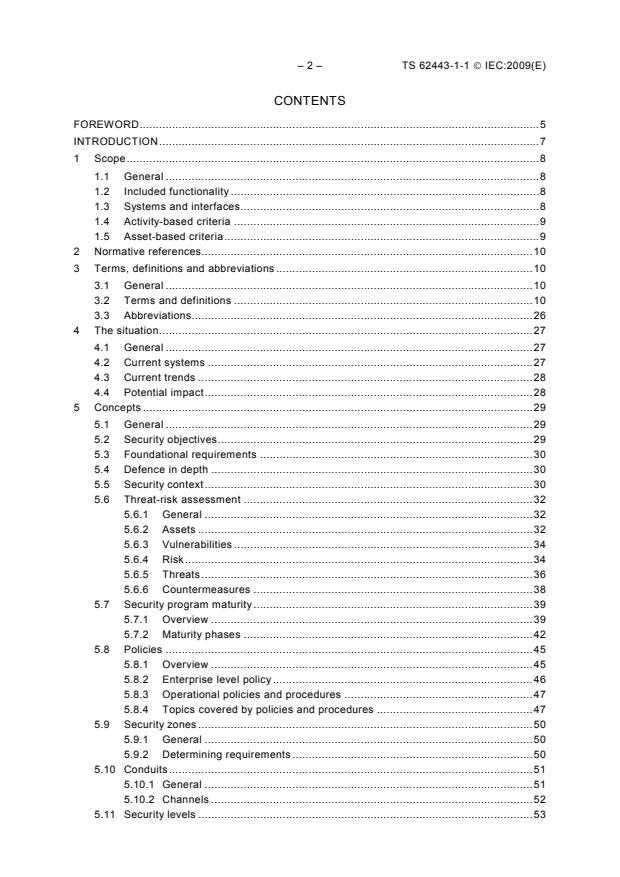
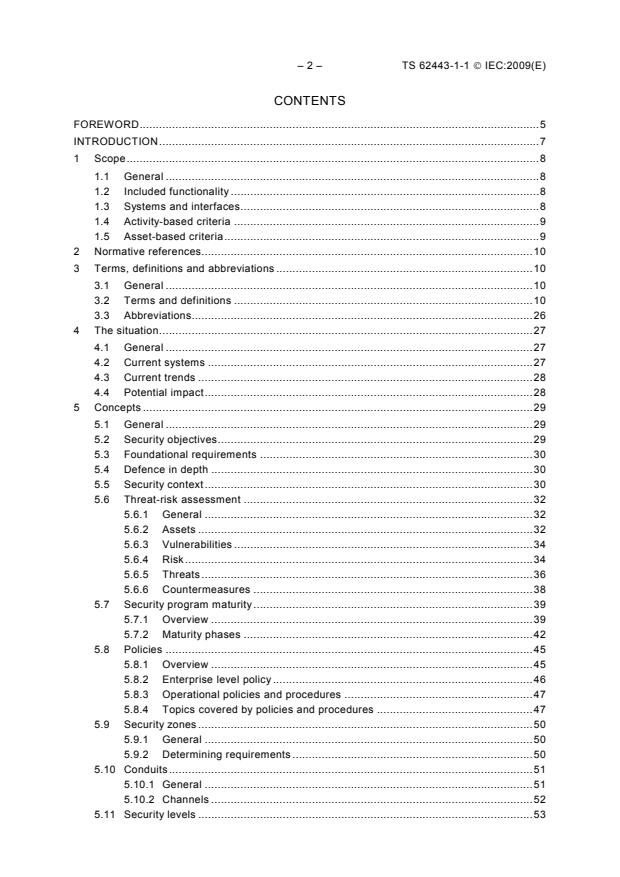
– 2 – TS 62443-1-1 © IEC:2009(E)
CONTENTS
FOREWORD.5
INTRODUCTION.7
1 Scope.8
1.1 General .8
1.2 Included functionality .8
1.3 Systems and interfaces.8
1.4 Activity-based criteria .9
1.5 Asset-based criteria.9
2 Normative references.10
3 Terms, definitions and abbreviations .10
3.1 General .10
3.2 Terms and definitions .10
3.3 Abbreviations.26
4 The situation.27
4.1 General .27
4.2 Current systems .27
4.3 Current trends .28
4.4 Potential impact.28
5 Concepts .29
5.1 General .29
5.2 Security objectives.29
5.3 Foundational requirements .30
5.4 Defence in depth .30
5.5 Security context.30
5.6 Threat-risk assessment .32
5.6.1 General .32
5.6.2 Assets .32
5.6.3 Vulnerabilities .34
5.6.4 Risk.34
5.6.5 Threats.36
5.6.6 Countermeasures .38
5.7 Security program maturity.39
5.7.1 Overview .39
5.7.2 Maturity phases .42
5.8 Policies .45
5.8.1 Overview .45
5.8.2 Enterprise level policy .46
5.8.3 Operational policies and procedures .47
5.8.4 Topics covered by policies and procedures .47
5.9 Security zones .50
5.9.1 General .50
5.9.2 Determining requirements .50
5.10 Conduits.51
5.10.1 General .51
5.10.2 Channels .52
5.11 Security levels .53
TS 62443-1-1 © IEC:2009(E) – 3 –
5.11.1 General .53
5.11.2 Types of security levels.53
5.11.3 Factors influencing SL(achieved) of a zone or conduit .55
5.11.4 Impact of countermeasures and inherent security properties of
devices and systems.57
5.12 Security level lifecycle.57
5.12.1 General .57
5.12.2 Assess phase .58
5.12.3 Develop and implement phase .59
5.12.4 Maintain phase .60
6 Models .61
6.1 General .61
6.2 Reference models .62
6.2.1 Overview .62
6.2.2 Reference model levels.63
6.3 Asset models.65
6.3.1 Overview .65
6.3.2 Enterprise.68
6.3.3 Geographic sites.68
6.3.4 Area .68
6.3.5 Lines, units, cells, vehicles.68
6.3.6 Supervisory control equipment .68
6.3.7 Control equipment .68
6.3.8 Field I/O network .69
6.3.9 Sensors and actuators .69
6.3.10 Equipment under control .69
6.4 Reference architecture .69
6.5 Zone and conduit model.69
6.5.1 General .69
6.5.2 Defining security zones .70
6.5.3 Zone identification .70
6.5.4 Zone characteristics.74
6.5.5 Defining conduits .76
6.5.6 Conduit characteristics.77
6.6 Model relationships.79
Bibliography .81
Figure 1 – Comparison of objectives between IACS and general IT systems .29
Figure 2 – Context element relationships .31
Figure 3 – Context model .31
Figure 4 – Integration of business and IACS cybersecurity.40
Figure 5 – Cybersecurity level over time .40
Figure 6 – Integration of resources to develop the CSMS.41
Figure 7 – Conduit example.52
Figure 8 – Security level lifecycle.58
Figure 9 – Security level lifecycle – Assess phase .59
Figure 10 – Security level lifecycle – Implement phase .60
Figure 11 – Security level lifecycle – Maintain phase.61
– 4 – TS 62443-1-1 © IEC:2009(E)
Figure 12 – Reference model for IEC 62443 standards .62
Figure 13 – SCADA reference model .63
Figure 14 – Process manufacturing asset model example.66
Figure 15 – SCADA system asset model example.67
Figure 16 – Reference architecture example.69
Figure 17 – Multiplant zone example .71
Figure 18 – Separate zones example.72
Figure 19 – SCADA zone example.73
Figure 20 – SCADA separate zones example.74
Figure 21 – Enterprise conduit.77
Figure 22 – SCADA conduit example.78
Figure 23 – Model relationships.80
Table 1 – Types of loss by asset type .33
Table 2 – Security maturity phases.43
Table 3 – Concept phase .43
Table 4 – Functional analysis phase .43
Table 5 – Implementation phase.44
Table 6 – Operations phase .44
Table 7 – Recycle and disposal phase.45
Table 8 – Security levels .53
TS 62443-1-1 © IEC:2009(E) – 5 –
INTERNATIONAL ELECTROTECHNICAL COMMISSION
____________
INDUSTRIAL COMMUNICATION NETWORKS –
NETWORK AND SYSTEM SECURITY –
Part 1-1: Terminology, concepts and models
FOREWORD
1) The International Electrotechnical Commission (IEC) is a worldwide organization for standardization comprising
all national electrotechnical committees (IEC National Committees). The object of IEC is to promote
international co-operation on all questions concerning standardization in the electrical and electronic fields. To
this end and in addition to other activities, IEC publishes International Standards, Technical Specifications,
Technical Reports, Publicly Available Specifications (PAS) and Guides (hereafter referred to as “IEC
Publication(s)”). Their preparation is entrusted to technical committees; any IEC National Committee interested
in the subject dealt with may participate in this preparatory work. International, governmental and non-
governmental organizations liaising with the IEC also participate in this preparation. IEC collaborates closely
with the International Organization for Standardization (ISO) in accordance with conditions determined by
agreement between the two organizations.
2) The formal decisions or agreements of IEC on technical matters express, as nearly as possible, an international
consensus of opinion on the relevant subjects since each technical committee has representation from all
interested IEC National Committees.
3) IEC Publications have the form of recommendations for international use and are accepted by IEC National
Committees in that sense. While all reasonable efforts are made to ensure that the technical content of IEC
Publications is accurate, IEC cannot be held responsible for the way in which they are used or for any
misinterpretation by any end user.
4) In order to promote international uniformity, IEC National Committees undertake to apply IEC Publications
transparently to the maximum extent possible in their national and regional publications. Any divergence
between any IEC Publication and the corresponding national or regional publication shall be clearly indicated in
the latter.
5) IEC provides no marking procedure to indicate its approval and cannot be rendered responsible for any
equipment declared to be in conformity with an IEC Publication.
6) All users should ensure that they have the latest edition of this publication.
7) No liability shall attach to IEC or its directors, employees, servants or agents including individual experts and
members of its technical committees and IEC National Committees for any personal injury, property damage or
other damage of any nature whatsoever, whether direct or indirect, or for costs (including legal fees) and
expenses arising out of the publication, use of, or reliance upon, this IEC Publication or any other IEC
Publications.
8) Attention is drawn to the Normative references cited in this publication. Use of the referenced publications is
indispensable for the correct application of this publication.
9) Attention is drawn to the possibility that some of the elements of this IEC Publication may be the subject of
patent rights. IEC shall not be held responsible for identifying any or all such patent rights.
The main task of IEC technical committees is to prepare International Standards. In
exceptional circumstances, a technical committee may propose the publication of a technical
specification when
• the required support cannot be obtained for the publication of an International Standard,
despite repeated efforts, or
• the subject is still under technical development or where, for any other reason, there is the
future but no immediate possibility of an agreement on an International Standard.
Technical specifications are subject to review within three years of publication to decide
whether they can be transformed into International Standards.
IEC 62443-1-1, which is a technical specification, has been prepared by IEC technical
committee 65: Industrial-process measurement, control and automation.
This technical specification is derived from the corresponding US ANSI/S99.01.01 standard.
– 6 – TS 62443-1-1 © IEC:2009(E)
The text of this technical specification is based on the following documents:
Enquiry draft Report on voting
65/423/DTS 65/432A/RVC
Full information on the voting for the approval of this technical specification can be found in the
report on voting indicated in the above table.
This publication has been drafted in accordance with the ISO/IEC Directives, Part 2.
A list of all parts of the IEC 62433 series, published under the general title Industrial
communication networks – Network and system security, can be found on the IEC website.
The committee has decided that the contents of this publication will remain unchanged until the
maintenance result date indicated on the IEC web site under "http://webstore.iec.ch" in the data
related to the specific publication. At this date, the publication will be
• transformed into an International standard,
• reconfirmed,
• withdrawn,
• replaced by a revised edition, or
• amended.
A bilingual version of this publication may be issued at a later date.
NOTE The revision of this technical specification will be synchronized with the other parts of the IEC 62443 series.
IMPORTANT – The “colour inside” logo on the cover page of this publication indicates
that it contains colours which are considered to be useful for the correct understanding
of its contents. Users should therefore print this publication using a colour printer.
TS 62443-1-1 © IEC:2009(E) – 7 –
INTRODUCTION
The subject of this technical specification is security for industrial automation and control
systems. In order to address a range of applications (i.e., industry types), each of the terms in
this description have been interpreted very broadly.
The term “Industrial Automation and Control Systems” (IACS), includes control systems used in
manufacturing and processing plants and facilities, building environmental control systems,
geographically dispersed operations such as utilities (i.e., electricity, gas, and water), pipelines
and petroleum production and distribution facilities, and other industries and applications such
as transportation networks, that use automated or remotely controlled or monitored assets.
The term “security” is considered here to mean the prevention of illegal or unwanted
penetration, intentional or unintentional interference with the proper and intended operation, or
inappropriate access to confidential information in IACS. Cybersecurity which is the particular
focus of this technical specification, includes computers, networks, operating systems,
applications and other programmable configurable components of the system.
The audience for this technical specification includes all users of IACS (including facility
operations, maintenance, engineering, and corporate components of user organizations),
manufacturers, suppliers, government organizations involved with, or affected by, control
system cybersecurity, control system practitioners, and security practitioners. Because mutual
understanding and cooperation between information technology (IT) and operations,
engineering, and manufacturing organizations is important for the overall success of any
security initiative, this technical specification is also a reference for those responsible for the
integration of IACS and enterprise networks.
Typical questions addressed by this technical specification include:
a) What is the general scope of application for IACS security?
b) How can the needs and requirements of a security system be defined using consistent
terminology?
c) What are the basic concepts that form the foundation for further analysis of the activities,
system attributes, and actions that are important to provide electronically secure control
systems?
d) How can the components of an IACS be grouped or classified for the purpose of defining
and managing security?
e) What are the different cybersecurity objectives for control system applications?
f) How can these objectives be established and codified?
Each of these questions is addressed in detail in subsequent clauses of this technical
specification.
– 8 – TS 62443-1-1 © IEC:2009(E)
INDUSTRIAL COMMUNICATION NETWORKS –
NETWORK AND SYSTEM SECURITY –
Part 1-1: Terminology, concepts and models
1 Scope
1.1 General
This part of the IEC 62443 series is a technical specification which defines the terminology,
concepts and models for Industrial Automation and Control Systems (IACS) security. It
establishes the basis for the remaining standards in the IEC 62443 series.
To fully articulate the systems and components the IEC 62443 series address, the range of
coverage may be defined and understood from several perspectives, including the following:
a) range of included functionality;
b) specific systems and interfaces;
c) criteria for selecting included activities;
d) criteria for selecting included assets.
Each of these is described in the following subclauses:
1.2 Included functionality
The scope of this technical specification can be described in terms of the range of functionality
within an organization’s information and automation systems. This functionality is typically
described in terms of one or more models.
This technical specification focuses primarily on industrial automation and control, as described
in a reference model (see Clause 6). Business planning and logistics systems are not explicitly
addressed within the scope of this technical specification, although the integrity of data
exchanged between business and industrial systems is considered.
Industrial automation and control includes the supervisory control components typically found in
process industries. It also includes SCADA (Supervisory Control and Data Acquisition) systems
that are commonly used by organizations that operate in critical infrastructure industries. These
include the following:
a) electricity transmission and distribution;
b) gas and water distribution networks;
c) oil and gas production operations;
d) gas and liquid transmission pipelines.
This is not an exclusive list. SCADA systems may also be found in other critical and non-critical
infrastructure industries.
1.3 Systems and interfaces
In encompassing all IACS, this technical specification covers systems that can affect or
influence the safe, secure, and reliable operation of industrial processes. They include, but are
not limited to:
TS 62443-1-1 © IEC:2009(E) – 9 –
a) Industrial control systems and their associated communications networks , including
distributed control systems (DCSs), programmable logic controllers (PLCs), remote terminal
units (RTUs), intelligent electronic devices, SCADA systems, networked electronic sensing
and control, metering and custody transfer systems, and monitoring and diagnostic
systems. (In this context, industrial control systems include basic process control system
and Safety-Instrumented System (SIS) functions, whether they are physically separate or
integrated.)
b) Associated systems at level 3 or below of the reference model described in Clause 6.
Examples include advanced or multivariable control, online optimizers, dedicated
equipment monitors, graphical interfaces, process historians, manufacturing execution
systems, pipeline leak detection systems, work management, outage management, and
electricity energy management systems.
c) Associated internal, human, network, software, machine or device interfaces used to
provide control, safety, manufacturing, or remote operations functionality to continuous,
batch, discrete, and other processes.
1.4 Activity-based criteria
IEC 62443-2-1 provides criteria for defining activities associated with manufacturing
operations. A similar list has been developed for determining the scope of this technical
specification. A system should be considered to be within the range of coverage of the
IEC 62443 series if the activity it performs is necessary for any of the following:
a) predictable operation of the process;
b) process or personnel safety;
c) process reliability or availability;
d) process efficiency;
e) process operability;
f) product quality;
g) environmental protection;
h) regulatory compliance;
i) product sales or custody transfer.
1.5 Asset-based criteria
The coverage of this technical specification includes those systems in assets that meet any of
the following criteria, or whose security is essential to the protection of other assets that meet
these criteria:
a) The asset has economic value to a manufacturing or operating process.
b) The asset performs a function necessary to operation of a manufacturing or operating
process.
c) The asset represents intellectual property of a manufacturing or operating process.
d) The asset is necessary to operate and maintain security for a manufacturing or operating
process.
e) The asset is necessary to protect personnel, contractors, and visitors involved in a
manufacturing or operating process.
f) The asset is necessary to protect the environment.
___________
The term “communications networks” includes all types of communications media, including various types of
wireless communications. A detailed description of the use of wireless communications in industrial automation
systems is beyond the scope of this technical specification. Wireless communication techniques are specifically
mentioned only in situations where their use or application may change the nature of the security applied or
required.
To be published.
– 10 – TS 62443-1-1 © IEC:2009(E)
g) The asset is necessary to protect the public from events caused by a manufacturing or
operating process.
h) The asset is a legal requirement, especially for security purposes of a manufacturing or
operating process.
i) The asset is needed for disaster recovery.
j) The asset is needed for logging security events.
This range of coverage includes systems whose compromise could result in the endangerment
of public or employees health or safety, loss of public confidence, violation of regulatory
requirements, loss or invalidation of proprietary or confidential information, environmental
contamination, and/or economic loss or impact on an entity or on local or national security.
2 Normative references
The following referenced documents are indispensable for the application of this document. For
dated references, only the edition cited applies. For undated references, the latest edition of
the referenced document (including any amendments) applies.
IEC 62264-1, Enterprise-control system integration – Part 1: Models and terminology
ISO/IEC 15408-1, Information technology – Security techniques – Evaluation criteria for IT
security – Part 1: Introduction and general model
3 Terms, definitions and abbreviations
3.1 General
Wherever possible, definitions have been adapted from those used in established industry
sources. Some definitions have been adapted from more generic definitions used in the IT
industry.
3.2 Terms and definitions
For the purposes of this document, the following terms and definitions apply
3.2.1
access
ability and means to communicate with or otherwise interact with a system in order to use
system resources
NOTE Access may involve physical access (authorization to be allowed physically in an area, possession of a
physical key lock, PIN code, or access card or biometric attributes that allow access) or logical access
(authorization to log in to a system and application, through a combination of logical and physical means).
3.2.2
access control
protection of system resources against unauthorized access; a process by which use of system
resources is regulated according to a security policy and is permitted by only authorized
entities (users, programs, processes, or other systems) according to that policy [10]
[RFC 2828, modified]
___________
Numbers in square brackets refer to the Bibliography.
TS 62443-1-1 © IEC:2009(E) – 11 –
3.2.3
accountability
property of a system (including all of its system resources) that ensures that the actions of a
system entity may be traced uniquely to that entity, which can be held responsible for its
actions [10]
3.2.4
application
software program that performs specific functions initiated by a user command or a process
event and that can be executed without access to system control, monitoring, or administrative
privileges
3.2.5
area
subset of a site’s physical, geographic, or logical group of assets
NOTE An area may contain manufacturing lines, process cells, and production units. Areas may be connected to
each other by a site local area network and may contain systems related to the operations performed in that area.
3.2.6
asset
physical or logical object owned by or under the custodial duties of an organization, having
either a perceived or actual value to the organization
NOTE In the case of industrial automation and control systems the physical assets that have the largest directly
measurable value may be the equipment under control.
3.2.7
association
cooperative relationship between system entities, usually for the purpose of transferring
information between them [10]
3.2.8
assurance
attribute of a system that provides grounds for having confidence that the system operates in
such a way that the system security policy is enforced
3.2.9
attack
assault on a system that derives from an intelligent threat — i.e., an intelligent act that is a
deliberate attempt (especially in the sense of a method or technique) to evade security services
and violate the security policy of a system [10]
NOTE There are different commonly recognized classes of attack:
• An "active attack" attempts to alter system resources or affect their operation.
• A "passive attack" attempts to learn or make use of information from the system but does not affect system
resources.
• An "inside attack" is an attack initiated by an entity inside the security perimeter (an "insider") – i.e., an entity
that is authorized to access system resources but uses them in a way not approved by those who granted the
authorization.
• An "outside attack" is initiated from outside the perimeter, by an unauthorized or illegitimate user of the system
(including an insider attacking from outside the security perimeter). Potential outside attackers range from
amateur pranksters to organized criminals, international terrorists, and hostile governments.
3.2.10
attack tree
formal, methodical way of finding ways to attack the security of a system
– 12 – TS 62443-1-1 © IEC:2009(E)
3.2.11
audit
independent review and examination of records and activities to assess the adequacy of
system controls, to ensure compliance with established policies and operational procedures,
and to recommend necessary changes in controls, policies, or procedures (see 3.2.100)
NOTE There are three forms of audit
• External audits are conducted by parties who are not employees or contractors of the organization.
• Internal audit are conducted by a separate organizational unit dedicated to internal auditing.
• Controls self-assessments are conducted by peer members of the process automation function.
3.2.12
authenticate
verify the identity of a user, user device, or other entity, or the integrity of data stored,
transmitted, or otherwise exposed to unauthorized modification in an information system, or to
establish the validity of a transmission
3.2.13
authentication
security measure designed to establish the validity of a transmission, message, or originator, or
a means of verifying an individual's authorization to receive specific categories of information
3.2.14
authorization
right or permission that is granted to a system entity to access a system resource [10]
3.2.15
automated vehicle
mobile device that includes a control system allowing it to operate either autonomously or
under remote control
3.2.16
availability (performance)
ability of an item to be in a state to perform a required function under given conditions at a
given instant or over a given time interval, assuming that the required external resources are
provided
NOTE 1 This ability depends on the combined aspects of the reliability performance, the maintainability
performance and the maintenance support performance.
NOTE 2 Required external resources, other than maintenance resources do not affect the availability performance
of the item.
NOTE 3 In French the term "disponibilité" is also used in the sense of "instantaneous availability".”
3.2.17
border
edge or boundary of a physical or logical security zone
3.2.18
botnet
collection of software robots, or bots, which run autonomously
NOTE A botnet's originator can control the group remotely, possibly for nefarious purposes.
3.2.19
boundary
software, hardware, or other physical barrier that limits access to a system or part of a system
TS 62443-1-1 © IEC:2009(E) – 13 –
3.2.20
channel
specific communication link established within a communication conduit (see 3.2.27 )
3.2.21
ciphertext
data that has been transformed by encryption so that its semantic information content (i.e., its
meaning) is no longer intelligible or directly available
3.2.22
client
device or application receiving or requesting services or information from a server application
[11]
3.2.23
communication path
logical connection between a source and one or more destinations, which could be devices,
physical processes, data items, commands, or programmatic interfaces
NOTE The communication path is not limited to wired or wireless networks, but includes other means of
communication such as memory, procedure calls, state of physical plant, portable media, and human interactions.
3.2.24
communication security
a) measures that implement and assure security services in a communication system,
particularly those that provide data confidentiality and data integrity and that authenticate
communicating entities
b) state that is reached by applying security services, in particular, state of data confidentiality,
integrity, and successfully authenticated communications entities [10]
NOTE This phrase is usually understood to include cryptographic algorithms and key management methods and
processes, devices that implement them, and the life-cycle management of keying material and devices. However,
cryptographic algorithms and key management methods and processes may not be applicable to some control
system applications.
3.2.25
communication system
arrangement of hardware, software, and propagation media to allow the transfer of messages
from one application to another [9]
3.2.26
compromise
unauthorized disclosure, modification, substitution, or use of information (including plaintext
cryptographic keys and other critical security parameters) [12]
3.2.27
conduit
logical grouping of communication assets that protects the security of the channels it contains
NOTE This is analogous to the way that a physical conduit protects cables from physical damage.
3.2.28
confidentiality
assurance that information is not disclosed to unauthorized individuals, processes, or devices
– 14 – TS 62443-1-1 © IEC:2009(E)
3.2.29
control center
central location used to operate a set of assets
NOTE 1 Infrastructure industries typically use one or more control centers to supervise or coordinate their
operations. If there are multiple control centers (for example, a backup center at a separate site), they are typically
connected together via a wide area network. The control center contains the SCADA system, host computers and
associated operator display devices plus ancillary information systems such as an historian.
NOTE 2 In some industries the term “control room” may be more commonly used.
3.2.30
control equipment
class that includes distributed control systems, programmable logic controllers, SCADA
systems, associated operator interface consoles, and field sensing and control devices used to
manage and control the process
NOTE The term also includes fieldbus networks where control logic and algorithms are executed on intelligent
electronic devices that coordinate actions with each other, as well as systems used to monitor the process and the
systems used to maintain the process.
3.2.31
control network
time-critical network that is typically connected to equipment that controls physical processes
(see 3.2.97)
NOTE The control network can be subdivided into zones and there can be multiple separate control networks
within one company or site.
3.2.32
cost
value of impact to an organization or person that can be measured
3.2.33
countermeasure
action, device, procedure, or technique that reduces a threat, a vulnerability, or an attack by
eliminating or preventing it, by minimizing the harm it can cause, or by discovering and
reporting it so that corrective action can be taken [10]
NOTE The term “control” is also used to describe this concept in some contexts. The term countermeasure has
been chosen for this document to avoid confusion with the term “control” in the context of process control.
3.2.34
cryptographic algorithm
algorithm based upon the science of cryptography, including encryption algorithms,
cryptographic hash algorithms, digital signature algorithms, and key agreement algorithms
3.2.35
cryptographic key
input parameter that varies the transformation performed by a cryptographic algorithm [10]
NOTE Usually shortened to "key".
TS 62443-1-1 © IEC:2009(E) – 15 –
3.2.36
cybersecurity
actions required to preclude unauthorized use of, denial of service to, modifications to,
disclosure of, loss of revenue from, or destruction of critical systems or informational assets
NOTE The objective is to reduce the risk of causing personal injury or endangering public health, losing public or
consumer confidence, disclosing sensitive assets, failing to protect business assets or failing to comply with
regulations. These concepts are applied to any system in the production process and include both stand-alone and
networked components. Communications between systems may be either through internal messaging or by any
human or machine interfaces that authenticate, operate, control, or exchange data with any of these control
systems. Cybersecurity includes the concepts of identification, authentication, accountability, authorization,
availability, and privacy.
3.2.37
data confidentiality
property that information is not made available or disclosed to any unauthorized system entity,
including unauthorized individuals, entities, or processes [8]
3.2.38
data integrity
property that data has not been changed, destroyed, or lost in an unauthorized or accidental
manner [10]
NOTE This term deals with constancy of and confidence
...
IEC/TS 62443-1-1 ®
Edition 1.0 2009-07
TECHNICAL
SPECIFICATION
colour
inside
Industrial communication networks – Network and system security –
Part 1-1: Terminology, concepts and models
IEC/TS 62443-1-1:2009(E)
All rights reserved. Unless otherwise specified, no part of this publication may be reproduced or utilized in any form or by
any means, electronic or mechanical, including photocopying and microfilm, without permission in writing from either IEC or
IEC's member National Committee in the country of the requester.
If you have any questions about IEC copyright or have an enquiry about obtaining additional rights to this publication,
please contact the address below or your local IEC member National Committee for further information.
Droits de reproduction réservés. Sauf indication contraire, aucune partie de cette publication ne peut être reproduite
ni utilisée sous quelque forme que ce soit et par aucun procédé, électronique ou mécanique, y compris la photocopie
et les microfilms, sans l'accord écrit de la CEI ou du Comité national de la CEI du pays du demandeur.
Si vous avez des questions sur le copyright de la CEI ou si vous désirez obtenir des droits supplémentaires sur cette
publication, utilisez les coordonnées ci-après ou contactez le Comité national de la CEI de votre pays de résidence.
IEC Central Office
3, rue de Varembé
CH-1211 Geneva 20
Switzerland
Email: 0Hinmail@iec.ch
Web: 1Hwww.iec.ch
About IEC publications
The technical content of IEC publications is kept under constant review by the IEC. Please make sure that you have the
latest edition, a corrigenda or an amendment might have been published.
ƒ Catalogue of IEC publications: 2Hwww.iec.ch/searchpub
The IEC on-line Catalogue enables you to search by a variety of criteria (reference number, text, technical committee,…).
It also gives information on projects, withdrawn and replaced publications.
ƒ IEC Just Published: 3Hwww.iec.ch/online_news/justpub
Stay up to date on all new IEC publications. Just Published details twice a month all new publications released. Available
on-line and also by email.
ƒ Electropedia: 4Hwww.electropedia.org
The world's leading online dictionary of electronic and electrical terms containing more than 20 000 terms and definitions
in English and French, with equivalent terms in additional languages. Also known as the International Electrotechnical
Vocabulary online.
ƒ Customer Service Centre: 5Hwww.iec.ch/webstore/custserv
If you wish to give us your feedback on this publication or need further assistance, please visit the Customer Service
Centre FAQ or contact us:
Email: 6Hcsc@iec.ch
Tel.: +41 22 919 02 11
Fax: +41 22 919 03 00
IEC/TS 62443-1-1 ®
Edition 1.0 2009-07
TECHNICAL
SPECIFICATION
colour
inside
Industrial communication networks – Network and system security –
Part 1-1: Terminology, concepts and models
INTERNATIONAL
ELECTROTECHNICAL
COMMISSION
PRICE CODE
XC
ICS 25.040.40; 33.040.040; 35.040 ISBN 978-2-88910-710-0
– 2 – TS 62443-1-1 © IEC:2009(E)
CONTENTS
FOREWORD.5
INTRODUCTION.7
1 Scope.8
1.1 General .8
1.2 Included functionality .8
1.3 Systems and interfaces.8
1.4 Activity-based criteria .9
1.5 Asset-based criteria.9
2 Normative references.10
3 Terms, definitions and abbreviations .10
3.1 General .10
3.2 Terms and definitions .10
3.3 Abbreviations.26
4 The situation.27
4.1 General .27
4.2 Current systems .27
4.3 Current trends .28
4.4 Potential impact.28
5 Concepts .29
5.1 General .29
5.2 Security objectives.29
5.3 Foundational requirements .30
5.4 Defence in depth .30
5.5 Security context.30
5.6 Threat-risk assessment .32
5.6.1 General .32
5.6.2 Assets .32
5.6.3 Vulnerabilities .34
5.6.4 Risk.34
5.6.5 Threats.36
5.6.6 Countermeasures .38
5.7 Security program maturity.39
5.7.1 Overview .39
5.7.2 Maturity phases .42
5.8 Policies .45
5.8.1 Overview .45
5.8.2 Enterprise level policy .46
5.8.3 Operational policies and procedures .47
5.8.4 Topics covered by policies and procedures .47
5.9 Security zones .50
5.9.1 General .50
5.9.2 Determining requirements .50
5.10 Conduits.51
5.10.1 General .51
5.10.2 Channels .52
5.11 Security levels .53
TS 62443-1-1 © IEC:2009(E) – 3 –
5.11.1 General .53
5.11.2 Types of security levels.53
5.11.3 Factors influencing SL(achieved) of a zone or conduit .55
5.11.4 Impact of countermeasures and inherent security properties of
devices and systems.57
5.12 Security level lifecycle.57
5.12.1 General .57
5.12.2 Assess phase .58
5.12.3 Develop and implement phase .59
5.12.4 Maintain phase .60
6 Models .61
6.1 General .61
6.2 Reference models .62
6.2.1 Overview .62
6.2.2 Reference model levels.63
6.3 Asset models.65
6.3.1 Overview .65
6.3.2 Enterprise.68
6.3.3 Geographic sites.68
6.3.4 Area .68
6.3.5 Lines, units, cells, vehicles.68
6.3.6 Supervisory control equipment .68
6.3.7 Control equipment .68
6.3.8 Field I/O network .69
6.3.9 Sensors and actuators .69
6.3.10 Equipment under control .69
6.4 Reference architecture .69
6.5 Zone and conduit model.69
6.5.1 General .69
6.5.2 Defining security zones .70
6.5.3 Zone identification .70
6.5.4 Zone characteristics.74
6.5.5 Defining conduits .76
6.5.6 Conduit characteristics.77
6.6 Model relationships.79
Bibliography .81
Figure 1 – Comparison of objectives between IACS and general IT systems .29
Figure 2 – Context element relationships .31
Figure 3 – Context model .31
Figure 4 – Integration of business and IACS cybersecurity.40
Figure 5 – Cybersecurity level over time .40
Figure 6 – Integration of resources to develop the CSMS.41
Figure 7 – Conduit example.52
Figure 8 – Security level lifecycle.58
Figure 9 – Security level lifecycle – Assess phase .59
Figure 10 – Security level lifecycle – Implement phase .60
Figure 11 – Security level lifecycle – Maintain phase.61
– 4 – TS 62443-1-1 © IEC:2009(E)
Figure 12 – Reference model for IEC 62443 standards .62
Figure 13 – SCADA reference model .63
Figure 14 – Process manufacturing asset model example.66
Figure 15 – SCADA system asset model example.67
Figure 16 – Reference architecture example.69
Figure 17 – Multiplant zone example .71
Figure 18 – Separate zones example.72
Figure 19 – SCADA zone example.73
Figure 20 – SCADA separate zones example.74
Figure 21 – Enterprise conduit.77
Figure 22 – SCADA conduit example.78
Figure 23 – Model relationships.80
Table 1 – Types of loss by asset type .33
Table 2 – Security maturity phases.43
Table 3 – Concept phase .43
Table 4 – Functional analysis phase .43
Table 5 – Implementation phase.44
Table 6 – Operations phase .44
Table 7 – Recycle and disposal phase.45
Table 8 – Security levels .53
TS 62443-1-1 © IEC:2009(E) – 5 –
INTERNATIONAL ELECTROTECHNICAL COMMISSION
____________
INDUSTRIAL COMMUNICATION NETWORKS –
NETWORK AND SYSTEM SECURITY –
Part 1-1: Terminology, concepts and models
FOREWORD
1) The International Electrotechnical Commission (IEC) is a worldwide organization for standardization comprising
all national electrotechnical committees (IEC National Committees). The object of IEC is to promote
international co-operation on all questions concerning standardization in the electrical and electronic fields. To
this end and in addition to other activities, IEC publishes International Standards, Technical Specifications,
Technical Reports, Publicly Available Specifications (PAS) and Guides (hereafter referred to as “IEC
Publication(s)”). Their preparation is entrusted to technical committees; any IEC National Committee interested
in the subject dealt with may participate in this preparatory work. International, governmental and non-
governmental organizations liaising with the IEC also participate in this preparation. IEC collaborates closely
with the International Organization for Standardization (ISO) in accordance with conditions determined by
agreement between the two organizations.
2) The formal decisions or agreements of IEC on technical matters express, as nearly as possible, an international
consensus of opinion on the relevant subjects since each technical committee has representation from all
interested IEC National Committees.
3) IEC Publications have the form of recommendations for international use and are accepted by IEC National
Committees in that sense. While all reasonable efforts are made to ensure that the technical content of IEC
Publications is accurate, IEC cannot be held responsible for the way in which they are used or for any
misinterpretation by any end user.
4) In order to promote international uniformity, IEC National Committees undertake to apply IEC Publications
transparently to the maximum extent possible in their national and regional publications. Any divergence
between any IEC Publication and the corresponding national or regional publication shall be clearly indicated in
the latter.
5) IEC provides no marking procedure to indicate its approval and cannot be rendered responsible for any
equipment declared to be in conformity with an IEC Publication.
6) All users should ensure that they have the latest edition of this publication.
7) No liability shall attach to IEC or its directors, employees, servants or agents including individual experts and
members of its technical committees and IEC National Committees for any personal injury, property damage or
other damage of any nature whatsoever, whether direct or indirect, or for costs (including legal fees) and
expenses arising out of the publication, use of, or reliance upon, this IEC Publication or any other IEC
Publications.
8) Attention is drawn to the Normative references cited in this publication. Use of the referenced publications is
indispensable for the correct application of this publication.
9) Attention is drawn to the possibility that some of the elements of this IEC Publication may be the subject of
patent rights. IEC shall not be held responsible for identifying any or all such patent rights.
The main task of IEC technical committees is to prepare International Standards. In
exceptional circumstances, a technical committee may propose the publication of a technical
specification when
• the required support cannot be obtained for the publication of an International Standard,
despite repeated efforts, or
• the subject is still under technical development or where, for any other reason, there is the
future but no immediate possibility of an agreement on an International Standard.
Technical specifications are subject to review within three years of publication to decide
whether they can be transformed into International Standards.
IEC 62443-1-1, which is a technical specification, has been prepared by IEC technical
committee 65: Industrial-process measurement, control and automation.
This technical specification is derived from the corresponding US ANSI/S99.01.01 standard.
– 6 – TS 62443-1-1 © IEC:2009(E)
The text of this technical specification is based on the following documents:
Enquiry draft Report on voting
65/423/DTS 65/432A/RVC
Full information on the voting for the approval of this technical specification can be found in the
report on voting indicated in the above table.
This publication has been drafted in accordance with the ISO/IEC Directives, Part 2.
A list of all parts of the IEC 62433 series, published under the general title Industrial
communication networks – Network and system security, can be found on the IEC website.
The committee has decided that the contents of this publication will remain unchanged until the
maintenance result date indicated on the IEC web site under "http://webstore.iec.ch" in the data
related to the specific publication. At this date, the publication will be
• transformed into an International standard,
• reconfirmed,
• withdrawn,
• replaced by a revised edition, or
• amended.
A bilingual version of this publication may be issued at a later date.
NOTE The revision of this technical specification will be synchronized with the other parts of the IEC 62443 series.
IMPORTANT – The “colour inside” logo on the cover page of this publication indicates
that it contains colours which are considered to be useful for the correct understanding
of its contents. Users should therefore print this publication using a colour printer.
TS 62443-1-1 © IEC:2009(E) – 7 –
INTRODUCTION
The subject of this technical specification is security for industrial automation and control
systems. In order to address a range of applications (i.e., industry types), each of the terms in
this description have been interpreted very broadly.
The term “Industrial Automation and Control Systems” (IACS), includes control systems used in
manufacturing and processing plants and facilities, building environmental control systems,
geographically dispersed operations such as utilities (i.e., electricity, gas, and water), pipelines
and petroleum production and distribution facilities, and other industries and applications such
as transportation networks, that use automated or remotely controlled or monitored assets.
The term “security” is considered here to mean the prevention of illegal or unwanted
penetration, intentional or unintentional interference with the proper and intended operation, or
inappropriate access to confidential information in IACS. Cybersecurity which is the particular
focus of this technical specification, includes computers, networks, operating systems,
applications and other programmable configurable components of the system.
The audience for this technical specification includes all users of IACS (including facility
operations, maintenance, engineering, and corporate components of user organizations),
manufacturers, suppliers, government organizations involved with, or affected by, control
system cybersecurity, control system practitioners, and security practitioners. Because mutual
understanding and cooperation between information technology (IT) and operations,
engineering, and manufacturing organizations is important for the overall success of any
security initiative, this technical specification is also a reference for those responsible for the
integration of IACS and enterprise networks.
Typical questions addressed by this technical specification include:
a) What is the general scope of application for IACS security?
b) How can the needs and requirements of a security system be defined using consistent
terminology?
c) What are the basic concepts that form the foundation for further analysis of the activities,
system attributes, and actions that are important to provide electronically secure control
systems?
d) How can the components of an IACS be grouped or classified for the purpose of defining
and managing security?
e) What are the different cybersecurity objectives for control system applications?
f) How can these objectives be established and codified?
Each of these questions is addressed in detail in subsequent clauses of this technical
specification.
– 8 – TS 62443-1-1 © IEC:2009(E)
INDUSTRIAL COMMUNICATION NETWORKS –
NETWORK AND SYSTEM SECURITY –
Part 1-1: Terminology, concepts and models
1 Scope
1.1 General
This part of the IEC 62443 series is a technical specification which defines the terminology,
concepts and models for Industrial Automation and Control Systems (IACS) security. It
establishes the basis for the remaining standards in the IEC 62443 series.
To fully articulate the systems and components the IEC 62443 series address, the range of
coverage may be defined and understood from several perspectives, including the following:
a) range of included functionality;
b) specific systems and interfaces;
c) criteria for selecting included activities;
d) criteria for selecting included assets.
Each of these is described in the following subclauses:
1.2 Included functionality
The scope of this technical specification can be described in terms of the range of functionality
within an organization’s information and automation systems. This functionality is typically
described in terms of one or more models.
This technical specification focuses primarily on industrial automation and control, as described
in a reference model (see Clause 6). Business planning and logistics systems are not explicitly
addressed within the scope of this technical specification, although the integrity of data
exchanged between business and industrial systems is considered.
Industrial automation and control includes the supervisory control components typically found in
process industries. It also includes SCADA (Supervisory Control and Data Acquisition) systems
that are commonly used by organizations that operate in critical infrastructure industries. These
include the following:
a) electricity transmission and distribution;
b) gas and water distribution networks;
c) oil and gas production operations;
d) gas and liquid transmission pipelines.
This is not an exclusive list. SCADA systems may also be found in other critical and non-critical
infrastructure industries.
1.3 Systems and interfaces
In encompassing all IACS, this technical specification covers systems that can affect or
influence the safe, secure, and reliable operation of industrial processes. They include, but are
not limited to:
TS 62443-1-1 © IEC:2009(E) – 9 –
a) Industrial control systems and their associated communications networks , including
distributed control systems (DCSs), programmable logic controllers (PLCs), remote terminal
units (RTUs), intelligent electronic devices, SCADA systems, networked electronic sensing
and control, metering and custody transfer systems, and monitoring and diagnostic
systems. (In this context, industrial control systems include basic process control system
and Safety-Instrumented System (SIS) functions, whether they are physically separate or
integrated.)
b) Associated systems at level 3 or below of the reference model described in Clause 6.
Examples include advanced or multivariable control, online optimizers, dedicated
equipment monitors, graphical interfaces, process historians, manufacturing execution
systems, pipeline leak detection systems, work management, outage management, and
electricity energy management systems.
c) Associated internal, human, network, software, machine or device interfaces used to
provide control, safety, manufacturing, or remote operations functionality to continuous,
batch, discrete, and other processes.
1.4 Activity-based criteria
IEC 62443-2-1 provides criteria for defining activities associated with manufacturing
operations. A similar list has been developed for determining the scope of this technical
specification. A system should be considered to be within the range of coverage of the
IEC 62443 series if the activity it performs is necessary for any of the following:
a) predictable operation of the process;
b) process or personnel safety;
c) process reliability or availability;
d) process efficiency;
e) process operability;
f) product quality;
g) environmental protection;
h) regulatory compliance;
i) product sales or custody transfer.
1.5 Asset-based criteria
The coverage of this technical specification includes those systems in assets that meet any of
the following criteria, or whose security is essential to the protection of other assets that meet
these criteria:
a) The asset has economic value to a manufacturing or operating process.
b) The asset performs a function necessary to operation of a manufacturing or operating
process.
c) The asset represents intellectual property of a manufacturing or operating process.
d) The asset is necessary to operate and maintain security for a manufacturing or operating
process.
e) The asset is necessary to protect personnel, contractors, and visitors involved in a
manufacturing or operating process.
f) The asset is necessary to protect the environment.
___________
The term “communications networks” includes all types of communications media, including various types of
wireless communications. A detailed description of the use of wireless communications in industrial automation
systems is beyond the scope of this technical specification. Wireless communication techniques are specifically
mentioned only in situations where their use or application may change the nature of the security applied or
required.
To be published.
– 10 – TS 62443-1-1 © IEC:2009(E)
g) The asset is necessary to protect the public from events caused by a manufacturing or
operating process.
h) The asset is a legal requirement, especially for security purposes of a manufacturing or
operating process.
i) The asset is needed for disaster recovery.
j) The asset is needed for logging security events.
This range of coverage includes systems whose compromise could result in the endangerment
of public or employees health or safety, loss of public confidence, violation of regulatory
requirements, loss or invalidation of proprietary or confidential information, environmental
contamination, and/or economic loss or impact on an entity or on local or national security.
2 Normative references
The following referenced documents are indispensable for the application of this document. For
dated references, only the edition cited applies. For undated references, the latest edition of
the referenced document (including any amendments) applies.
IEC 62264-1, Enterprise-control system integration – Part 1: Models and terminology
ISO/IEC 15408-1, Information technology – Security techniques – Evaluation criteria for IT
security – Part 1: Introduction and general model
3 Terms, definitions and abbreviations
3.1 General
Wherever possible, definitions have been adapted from those used in established industry
sources. Some definitions have been adapted from more generic definitions used in the IT
industry.
3.2 Terms and definitions
For the purposes of this document, the following terms and definitions apply
3.2.1
access
ability and means to communicate with or otherwise interact with a system in order to use
system resources
NOTE Access may involve physical access (authorization to be allowed physically in an area, possession of a
physical key lock, PIN code, or access card or biometric attributes that allow access) or logical access
(authorization to log in to a system and application, through a combination of logical and physical means).
3.2.2
access control
protection of system resources against unauthorized access; a process by which use of system
resources is regulated according to a security policy and is permitted by only authorized
entities (users, programs, processes, or other systems) according to that policy [10]
[RFC 2828, modified]
___________
Numbers in square brackets refer to the Bibliography.
TS 62443-1-1 © IEC:2009(E) – 11 –
3.2.3
accountability
property of a system (including all of its system resources) that ensures that the actions of a
system entity may be traced uniquely to that entity, which can be held responsible for its
actions [10]
3.2.4
application
software program that performs specific functions initiated by a user command or a process
event and that can be executed without access to system control, monitoring, or administrative
privileges
3.2.5
area
subset of a site’s physical, geographic, or logical group of assets
NOTE An area may contain manufacturing lines, process cells, and production units. Areas may be connected to
each other by a site local area network and may contain systems related to the operations performed in that area.
3.2.6
asset
physical or logical object owned by or under the custodial duties of an organization, having
either a perceived or actual value to the organization
NOTE In the case of industrial automation and control systems the physical assets that have the largest directly
measurable value may be the equipment under control.
3.2.7
association
cooperative relationship between system entities, usually for the purpose of transferring
information between them [10]
3.2.8
assurance
attribute of a system that provides grounds for having confidence that the system operates in
such a way that the system security policy is enforced
3.2.9
attack
assault on a system that derives from an intelligent threat — i.e., an intelligent act that is a
deliberate attempt (especially in the sense of a method or technique) to evade security services
and violate the security policy of a system [10]
NOTE There are different commonly recognized classes of attack:
• An "active attack" attempts to alter system resources or affect their operation.
• A "passive attack" attempts to learn or make use of information from the system but does not affect system
resources.
• An "inside attack" is an attack initiated by an entity inside the security perimeter (an "insider") – i.e., an entity
that is authorized to access system resources but uses them in a way not approved by those who granted the
authorization.
• An "outside attack" is initiated from outside the perimeter, by an unauthorized or illegitimate user of the system
(including an insider attacking from outside the security perimeter). Potential outside attackers range from
amateur pranksters to organized criminals, international terrorists, and hostile governments.
3.2.10
attack tree
formal, methodical way of finding ways to attack the security of a system
– 12 – TS 62443-1-1 © IEC:2009(E)
3.2.11
audit
independent review and examination of records and activities to assess the adequacy of
system controls, to ensure compliance with established policies and operational procedures,
and to recommend necessary changes in controls, policies, or procedures (see 3.2.100)
NOTE There are three forms of audit
• External audits are conducted by parties who are not employees or contractors of the organization.
• Internal audit are conducted by a separate organizational unit dedicated to internal auditing.
• Controls self-assessments are conducted by peer members of the process automation function.
3.2.12
authenticate
verify the identity of a user, user device, or other entity, or the integrity of data stored,
transmitted, or otherwise exposed to unauthorized modification in an information system, or to
establish the validity of a transmission
3.2.13
authentication
security measure designed to establish the validity of a transmission, message, or originator, or
a means of verifying an individual's authorization to receive specific categories of information
3.2.14
authorization
right or permission that is granted to a system entity to access a system resource [10]
3.2.15
automated vehicle
mobile device that includes a control system allowing it to operate either autonomously or
under remote control
3.2.16
availability (performance)
ability of an item to be in a state to perform a required function under given conditions at a
given instant or over a given time interval, assuming that the required external resources are
provided
NOTE 1 This ability depends on the combined aspects of the reliability performance, the maintainability
performance and the maintenance support performance.
NOTE 2 Required external resources, other than maintenance resources do not affect the availability performance
of the item.
NOTE 3 In French the term "disponibilité" is also used in the sense of "instantaneous availability".”
3.2.17
border
edge or boundary of a physical or logical security zone
3.2.18
botnet
collection of software robots, or bots, which run autonomously
NOTE A botnet's originator can control the group remotely, possibly for nefarious purposes.
3.2.19
boundary
software, hardware, or other physical barrier that limits access to a system or part of a system
TS 62443-1-1 © IEC:2009(E) – 13 –
3.2.20
channel
specific communication link established within a communication conduit (see 3.2.27 )
3.2.21
ciphertext
data that has been transformed by encryption so that its semantic information content (i.e., its
meaning) is no longer intelligible or directly available
3.2.22
client
device or application receiving or requesting services or information from a server application
[11]
3.2.23
communication path
logical connection between a source and one or more destinations, which could be devices,
physical processes, data items, commands, or programmatic interfaces
NOTE The communication path is not limited to wired or wireless networks, but includes other means of
communication such as memory, procedure calls, state of physical plant, portable media, and human interactions.
3.2.24
communication security
a) measures that implement and assure security services in a communication system,
particularly those that provide data confidentiality and data integrity and that authenticate
communicating entities
b) state that is reached by applying security services, in particular, state of data confidentiality,
integrity, and successfully authenticated communications entities [10]
NOTE This phrase is usually understood to include cryptographic algorithms and key management methods and
processes, devices that implement them, and the life-cycle management of keying material and devices. However,
cryptographic algorithms and key management methods and processes may not be applicable to some control
system applications.
3.2.25
communication system
arrangement of hardware, software, and propagation media to allow the transfer of messages
from one application to another [9]
3.2.26
compromise
unauthorized disclosure, modification, substitution, or use of information (including plaintext
cryptographic keys and other critical security parameters) [12]
3.2.27
conduit
logical grouping of communication assets that protects the security of the channels it contains
NOTE This is analogous to the way that a physical conduit protects cables from physical damage.
3.2.28
confidentiality
assurance that information is not disclosed to unauthorized individuals, processes, or devices
– 14 – TS 62443-1-1 © IEC:2009(E)
3.2.29
control center
central location used to operate a set of assets
NOTE 1 Infrastructure industries typically use one or more control centers to supervise or coordinate their
operations. If there are multiple control centers (for example, a backup center at a separate site), they are typically
connected together via a wide area network. The control center contains the SCADA system, host computers and
associated operator display devices plus ancillary information systems such as an historian.
NOTE 2 In some industries the term “control room” may be more commonly used.
3.2.30
control equipment
class that includes distributed control systems, programmable logic controllers, SCADA
systems, associated operator interface consoles, and field sensing and control devices used to
manage and control the process
NOTE The term also includes fieldbus networks where control logic and algorithms are executed on intelligent
electronic devices that coordinate actions with each other, as well as systems used to monitor the process and the
systems used to maintain the process.
3.2.31
control network
time-critical network that is typically connected to equipment that controls physical processes
(see 3.2.97)
NOTE The control network can be subdivided into zones and there can be multiple separate control networks
within one company or site.
3.2.32
cost
value of impact to an organization or person that can be measured
3.2.33
countermeasure
action, device, procedure, or technique that reduces a threat, a vulnerability, or an attack by
eliminating or preventing it, by minimizing the harm it can cause, or by discovering and
reporting it so that corrective action can be taken [10]
NOTE The term “control” is also used to describe this concept in some contexts. The term countermeasure has
been chosen for this document to avoid confusion with the term “control” in the context of process control.
3.2.34
cryptographic algorithm
algorithm based upon the science of cryptography, including encryption algorithms,
cryptographic hash algorithms, digital signature algorithms, and key agreement algorithms
3.2.35
cryptographic key
input parameter that varies the transformation performed by a cryptographic algorithm [10]
NOTE Usually shortened to "key".
TS 62443-1-1 © IEC:2009(E) – 15 –
3.2.36
cybersecurity
actions required to preclude unauthorized use of, denial of service to, modifications to,
disclosure of, loss of revenue from, or destruction of critical systems or informational assets
NOTE The objective is to reduce the risk of causing personal injury or endangering public health, losing public or
consumer confidence, disclosing sensitive assets, failing to protect business assets or failing to comply with
regulations. These concepts are applied to any system in the production process and include both stand-alone and
networked components. Communications between systems may be either through internal messaging or by any
human or machine interfaces that authenticate, operate, control, or exchange data with any of these control
systems. Cybersecurity includes the concepts of identification, authentication, accountability, authorization,
availability, and privacy.
3.2.37
data confidentiality
property that information is not made available or disclosed to any unauthorized system entity,
including unauthorized individuals, entities, or processes [8]
3.2.38
data integrity
property that data has not been changed, destroyed, or lost in an unauthorized or accidental
manner [10]
NOTE This term deals with constancy of and confidence
...