

IEC 61892-7:2007
(Main)Mobile and fixed offshore units - Electrical installations - Part 7: Hazardous areas
General Information
- Abstract
This part of IEC 61892 contains provisions for hazardous areas classification and choice of electrical installation in hazardous areas in mobile and fixed offshore units, including pipeline, pumping or 'pigging' stations, compressor stations and exposed location single buoy moorings, used in the offshore petroleum industry for drilling, processing and for storage purposes. This edition includes the following significant technical changes with respect to the previous edition: a) the clauses regarding area classification have been updated based on changes in IEC 60079 10; b) the clauses regarding emergency shut down have been updated, based on current industry practice; c) the clauses regarding installation have been updated based on changes in IEC 60079-14; d) a new clause regarding ventilation of battery compartment for valve regulated batteries has been added.
- Status
- Published
- Publication Date
- 20-Nov-2007
- Current Stage
- DELPUB - Deleted Publication
- Start Date
- 11-Dec-2014
- Completion Date
- 28-Aug-2026
Overview
IEC 61892-7:2007 - part of the IEC 61892 series - provides requirements for hazardous areas classification and the selection, installation and operation of electrical equipment in hazardous areas on mobile and fixed offshore units. It covers offshore petroleum facilities used for drilling, processing and storage, including pipelines, pumping/pigging stations, compressor stations and exposed single buoy moorings. Edition 2.0 (2007) updates area classification and installation guidance to align with changes in IEC 60079-10 and IEC 60079-14, revises emergency shut-down provisions to reflect current industry practice, and adds ventilation requirements for valve-regulated (VRLA) battery compartments.
Key topics and technical requirements
- Area classification (Zones 0, 1, 2): guidance on identifying sources of release, zone types and extent for mobile and fixed units.
- Electrical systems and protection: power sources, distribution, earth-fault detection and measures to prevent dangerous sparking.
- Equipment selection: choosing apparatus suitable for zone classification, gas/vapour ignition temperatures, temperature classes and apparatus grouping.
- Types of protection: intrinsic safety (i), flameproof enclosures (d), increased safety (e), pressurization (p) and mixed protection schemes.
- Installation and wiring: requirements for cable systems, conduits, joints, wiring traversing hazardous areas, special provisions for zone 0 wiring and intrinsically safe circuits.
- Ventilation: ventilation of rooms, pressurized spaces and a new clause addressing ventilation of battery compartments (VRLA and vented batteries).
- Emergency shut-down and operational safety: updated procedures for ESD and ignition source control on mobile and fixed production units.
- Inspection, maintenance and documentation: area classification records, drawings, data sheets and maintenance/inspection regimes.
Practical applications and users
Who uses IEC 61892-7:
- Offshore electrical and instrument (E&I) engineers specifying and installing equipment for drilling rigs, FPSOs, production platforms, floating storage units, pipeline and compressor stations.
- Safety engineers and asset operators implementing hazardous area classification and emergency shutdown strategies.
- Third‑party inspectors, classification societies and regulators verifying compliance with offshore electrical safety requirements.
- Contractors and OEMs selecting certified explosion-protected equipment and designing ventilation and cable-entry systems.
Practical benefits:
- Ensures consistent hazardous area classification and equipment selection for explosion protection.
- Reduces ignition risk through prescriptive installation, ventilation and maintenance practices.
- Aligns offshore installations with IEC 60079-series best practice for explosive atmospheres.
Related standards
- IEC 60079-10 (area/explosion risk classification)
- IEC 60079-14 (installation of explosive atmosphere electrical systems)
- Other parts of IEC 61892 series for offshore electrical installations
Keywords: IEC 61892-7, hazardous areas classification, offshore electrical installations, explosion protection, intrinsic safety, flameproof, battery ventilation, IEC 60079-10, IEC 60079-14.
Relations
- Effective Date
- 05-Sep-2023
- Effective Date
- 05-Sep-2023
Get Certified
Connect with accredited certification bodies for this standard

DNV
DNV is an independent assurance and risk management provider.

Lloyd's Register
Lloyd's Register is a global professional services organisation specialising in engineering and technology.

FSC International
Forest Stewardship Council certification.
Sponsored listings
Frequently Asked Questions
IEC 61892-7:2007 is a standard published by the International Electrotechnical Commission (IEC). Its full title is "Mobile and fixed offshore units - Electrical installations - Part 7: Hazardous areas". This standard covers: This part of IEC 61892 contains provisions for hazardous areas classification and choice of electrical installation in hazardous areas in mobile and fixed offshore units, including pipeline, pumping or 'pigging' stations, compressor stations and exposed location single buoy moorings, used in the offshore petroleum industry for drilling, processing and for storage purposes. This edition includes the following significant technical changes with respect to the previous edition: a) the clauses regarding area classification have been updated based on changes in IEC 60079 10; b) the clauses regarding emergency shut down have been updated, based on current industry practice; c) the clauses regarding installation have been updated based on changes in IEC 60079-14; d) a new clause regarding ventilation of battery compartment for valve regulated batteries has been added.
This part of IEC 61892 contains provisions for hazardous areas classification and choice of electrical installation in hazardous areas in mobile and fixed offshore units, including pipeline, pumping or 'pigging' stations, compressor stations and exposed location single buoy moorings, used in the offshore petroleum industry for drilling, processing and for storage purposes. This edition includes the following significant technical changes with respect to the previous edition: a) the clauses regarding area classification have been updated based on changes in IEC 60079 10; b) the clauses regarding emergency shut down have been updated, based on current industry practice; c) the clauses regarding installation have been updated based on changes in IEC 60079-14; d) a new clause regarding ventilation of battery compartment for valve regulated batteries has been added.
IEC 61892-7:2007 is classified under the following ICS (International Classification for Standards) categories: 47.020.60 - Electrical equipment of ships and of marine structures. The ICS classification helps identify the subject area and facilitates finding related standards.
IEC 61892-7:2007 has the following relationships with other standards: It is inter standard links to IEC 61892-7:1997, IEC 61892-7:2014. Understanding these relationships helps ensure you are using the most current and applicable version of the standard.
IEC 61892-7:2007 is available in PDF format for immediate download after purchase. The document can be added to your cart and obtained through the secure checkout process. Digital delivery ensures instant access to the complete standard document.
Standards Content (Sample)
IEC 61892-7
Edition 2.0 2007-11
INTERNATIONAL
STANDARD
Mobile and fixed offshore units – Electrical installations –
Part 7: Hazardous areas
All rights reserved. Unless otherwise specified, no part of this publication may be reproduced or utilized in any form
or by any means, electronic or mechanical, including photocopying and microfilm, without permission in writing from
either IEC or IEC's member National Committee in the country of the requester.
If you have any questions about IEC copyright or have an enquiry about obtaining additional rights to this publication,
please contact the address below or your local IEC member National Committee for further information.
IEC Central Office
3, rue de Varembé
CH-1211 Geneva 20
Switzerland
Email: inmail@iec.ch
Web: www.iec.ch
About the IEC
The International Electrotechnical Commission (IEC) is the leading global organization that prepares and publishes
International Standards for all electrical, electronic and related technologies.
About IEC publications
The technical content of IEC publications is kept under constant review by the IEC. Please make sure that you have the
latest edition, a corrigenda or an amendment might have been published.
ƒ Catalogue of IEC publications: www.iec.ch/searchpub
The IEC on-line Catalogue enables you to search by a variety of criteria (reference number, text, technical committee,…).
It also gives information on projects, withdrawn and replaced publications.
ƒ IEC Just Published: www.iec.ch/online_news/justpub
Stay up to date on all new IEC publications. Just Published details twice a month all new publications released. Available
on-line and also by email.
ƒ Electropedia: www.electropedia.org
The world's leading online dictionary of electronic and electrical terms containing more than 20 000 terms and definitions
in English and French, with equivalent terms in additional languages. Also known as the International Electrotechnical
Vocabulary online.
ƒ Customer Service Centre: www.iec.ch/webstore/custserv
If you wish to give us your feedback on this publication or need further assistance, please visit the Customer Service
Centre FAQ or contact us:
Email: csc@iec.ch
Tel.: +41 22 919 02 11
Fax: +41 22 919 03 00
IEC 61892-7
Edition 2.0 2007-11
INTERNATIONAL
STANDARD
Mobile and fixed offshore units – Electrical installations –
Part 7: Hazardous areas
INTERNATIONAL
ELECTROTECHNICAL
COMMISSION
PRICE CODE
XA
ICS 47.020.60 ISBN 2-8318-9393-3
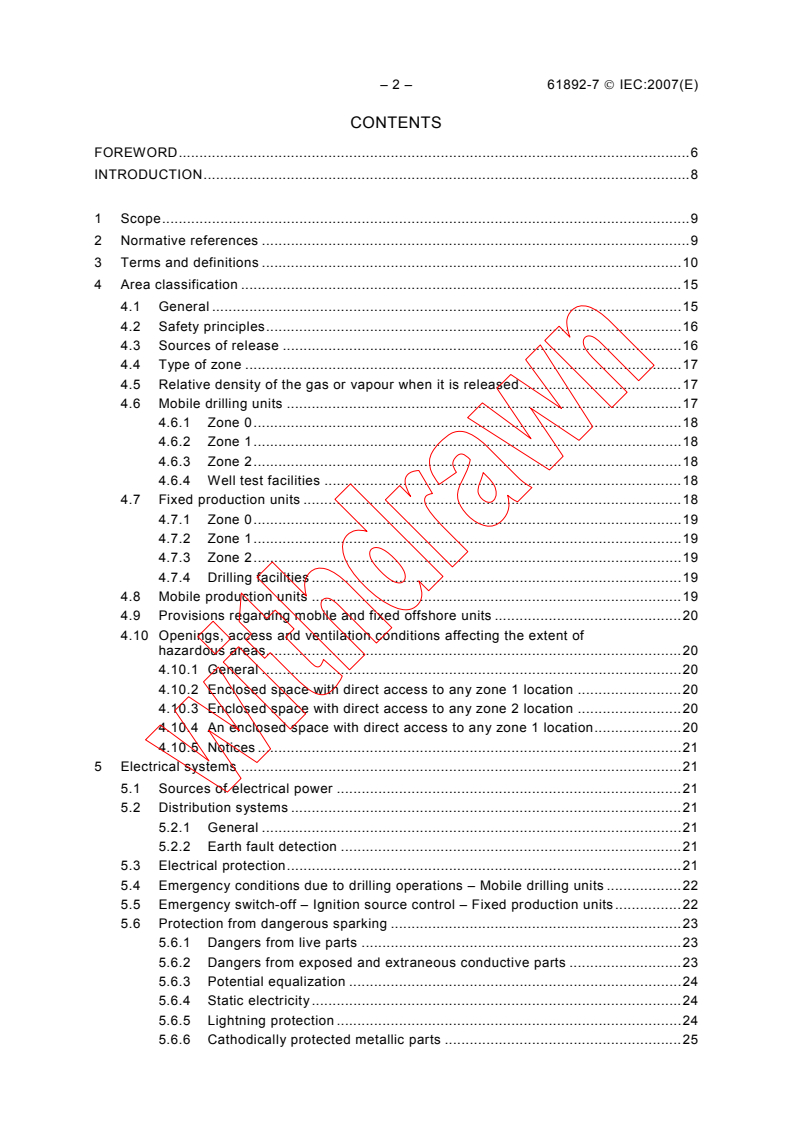
– 2 – 61892-7 © IEC:2007(E)
CONTENTS
FOREWORD.6
INTRODUCTION.8
1 Scope.9
2 Normative references .9
3 Terms and definitions .10
4 Area classification .15
4.1 General .15
4.2 Safety principles.16
4.3 Sources of release .16
4.4 Type of zone .17
4.5 Relative density of the gas or vapour when it is released.17
4.6 Mobile drilling units .17
4.6.1 Zone 0.18
4.6.2 Zone 1.18
4.6.3 Zone 2.18
4.6.4 Well test facilities .18
4.7 Fixed production units .18
4.7.1 Zone 0.19
4.7.2 Zone 1.19
4.7.3 Zone 2.19
4.7.4 Drilling facilities .19
4.8 Mobile production units .19
4.9 Provisions regarding mobile and fixed offshore units .20
4.10 Openings, access and ventilation conditions affecting the extent of
hazardous areas.20
4.10.1 General .20
4.10.2 Enclosed space with direct access to any zone 1 location .20
4.10.3 Enclosed space with direct access to any zone 2 location .20
4.10.4 An enclosed space with direct access to any zone 1 location.20
4.10.5 Notices .21
5 Electrical systems .21
5.1 Sources of electrical power .21
5.2 Distribution systems .21
5.2.1 General .21
5.2.2 Earth fault detection .21
5.3 Electrical protection.21
5.4 Emergency conditions due to drilling operations – Mobile drilling units .22
5.5 Emergency switch-off – Ignition source control – Fixed production units.22
5.6 Protection from dangerous sparking .23
5.6.1 Dangers from live parts .23
5.6.2 Dangers from exposed and extraneous conductive parts .23
5.6.3 Potential equalization .24
5.6.4 Static electricity .24
5.6.5 Lightning protection .24
5.6.6 Cathodically protected metallic parts .25
61892-7 © IEC:2007(E) – 3 –
5.6.7 Electromagnetic radiation .25
5.7 Danger from rotating parts.25
6 Electrical equipment .25
6.1 General .25
6.2 Selection of electrical apparatus.25
6.2.1 Selection with respect to area classification.25
6.2.2 Selection with respect to ignition temperature of the gas or vapour.25
6.2.3 Selection according to apparatus grouping .26
6.2.4 External influences .26
6.2.5 Ambient temperature .27
6.3 Electrical apparatus in hazardous areas .27
6.3.1 Equipment for zone 0 .27
6.3.2 Equipment for zone 1 .27
6.3.3 Equipment for zone 2 .27
6.3.4 Apparatus with multiple types of protection.28
6.4 Selection of apparatus not available in accordance with IEC standards .28
6.5 Portable apparatus .28
7 Installation.29
7.1 General .29
7.2 Selection of apparatus.29
7.3 Wiring system – General .29
7.4 Connections .30
7.5 Unused openings .30
7.6 Circuits traversing a hazardous area .30
7.7 Unused cores .30
7.8 Cable surface temperature .30
7.9 Jointing .30
7.10 Cable wiring systems .31
7.11 Conduit systems.31
7.12 Mixed systems .32
7.13 Apparatus in hazardous areas .33
7.14 Wiring system in zone 0 .33
7.15 Intrinsically safe electrical installations.34
7.16 Simple apparatus .35
7.17 Verification of intrinsically safe circuits .36
7.18 Additional requirements for type of protection “d” – Flameproof enclosures .36
7.18.1 General .36
7.18.2 Solid obstacles .36
7.18.3 Protection of flameproof joints .36
7.18.4 Cable entry system.37
7.19 Additional requirements for type of protection “e” – Increased safety.39
7.19.1 Cable entry for Ex e equipment .39
7.19.2 Cage induction motors – Overload protection .39
7.19.3 Motors – Varying frequency and voltage .40
7.20 Additional requirements for type of pressurization “p” – Pressurized
apparatus .40
7.20.1 General .40
7.20.2 Ducting.41
– 4 – 61892-7 © IEC:2007(E)
7.20.3 Action to be taken on failure of pressurization – Apparatus without an
internal source of release .41
7.20.4 Purging.42
7.21 Resistance-heating devices.43
8 Ventilation .43
8.1 General .43
8.2 Ventilation of spaces containing electrical apparatus.44
8.3 Ventilation and operation of rooms or buildings protected by pressurization .44
8.4 Values of overpressure and of protective gas flow.45
8.5 Failure of the pressurization .45
8.6 Ventilation of battery compartments .46
8.6.1 Stationary batteries – Vented and valve regulated types.46
8.6.2 Hermetically sealed lead-acid batteries .48
8.6.3 Fans and ducts.49
8.7 Ventilation of other hazardous spaces .49
9 Inspection and maintenance .49
9.1 General .49
9.2 Inspection .49
9.3 Isolation of apparatus.50
9.4 Precautions concerning the use of ignition sources .50
9.5 Maintenance.50
9.6 Qualifications of personnel .50
10 Documentation .50
10.1 Area classification .50
10.2 Drawings, data sheets and tables.51
10.3 Ventilation .51
10.4 Apparatus.51
10.4.1 Apparatus for use in zone 0 or zone 1 .51
10.4.2 Apparatus for use in zone 2.51
10.5 Installation – General .52
10.5.1 Installations of rooms or buildings protected by pressurization .52
10.5.2 Installation of electrical apparatus and electrical systems with the
type of protection "i" .52
10.6 Maintenance.52
10.7 Administration of the documentation.52
Annex A (informative) Examples of sources of release – Process plant.53
Bibliography.59
Figure 1 – Examples of mixed wiring systems .33
Figure 2 – Selection chart for cable entry devices into flameproof enclosures for cables
complying with item b) of 7.18.4.3.38
Figure C.1 – Preferred symbols for hazardous area zones .58
Table 1 – Relationship between the temperature classes, surface temperatures and
ignition temperatures .26
61892-7 © IEC:2007(E) – 5 –
Table 2 – Minimum distance of obstacles from the flameproof flange joints related to
the gas/vapour subgroup of the hazardous area .36
Table 3 – Use of spark and particle barrier .41
Table 4 – Action to be taken when the pressurization with protective gas fails for
electrical apparatus without an internal source of release .42
Table 5 – Summary of protective measures to be taken in the event of failure of
pressurization .46
Table 6 – Values for current I when charging with constant current / constant voltage
chargers .48
Table C.1 – Hazardous area classification data sheet – Part I: Flammable material list
and characteristics – Sheet: 1/1.56
Table C.2 – Hazardous area classification data sheet – Part II: List of sources of
release – Sheet: 1/1.57
– 6 – 61892-7 © IEC:2007(E)
INTERNATIONAL ELECTROTECHNICAL COMMISSION
___________
MOBILE AND FIXED OFFSHORE UNITS –
ELECTRICAL INSTALLATIONS –
Part 7: Hazardous areas
FOREWORD
1) The International Electrotechnical Commission (IEC) is a worldwide organization for standardization comprising
all national electrotechnical committees (IEC National Committees). The object of IEC is to promote
international co-operation on all questions concerning standardization in the electrical and electronic fields. To
this end and in addition to other activities, IEC publishes International Standards, Technical Specifications,
Technical Reports, Publicly Available Specifications (PAS) and Guides (hereafter referred to as “IEC
Publication(s)”). Their preparation is entrusted to technical committees; any IEC National Committee interested
in the subject dealt with may participate in this preparatory work. International, governmental and non-
governmental organizations liaising with the IEC also participate in this preparation. IEC collaborates closely
with the International Organization for Standardization (ISO) in accordance with conditions determined by
agreement between the two organizations.
2) The formal decisions or agreements of IEC on technical matters express, as nearly as possible, an international
consensus of opinion on the relevant subjects since each technical committee has representation from all
interested IEC National Committees.
3) IEC Publications have the form of recommendations for international use and are accepted by IEC National
Committees in that sense. While all reasonable efforts are made to ensure that the technical content of IEC
Publications is accurate, IEC cannot be held responsible for the way in which they are used or for any
misinterpretation by any end user.
4) In order to promote international uniformity, IEC National Committees undertake to apply IEC Publications
transparently to the maximum extent possible in their national and regional publications. Any divergence
between any IEC Publication and the corresponding national or regional publication shall be clearly indicated in
the latter.
5) IEC provides no marking procedure to indicate its approval and cannot be rendered responsible for any
equipment declared to be in conformity with an IEC Publication.
6) All users should ensure that they have the latest edition of this publication.
7) No liability shall attach to IEC or its directors, employees, servants or agents including individual experts and
members of its technical committees and IEC National Committees for any personal injury, property damage or
other damage of any nature whatsoever, whether direct or indirect, or for costs (including legal fees) and
expenses arising out of the publication, use of, or reliance upon, this IEC Publication or any other IEC
Publications.
8) Attention is drawn to the Normative references cited in this publication. Use of the referenced publications is
indispensable for the correct application of this publication.
9) Attention is drawn to the possibility that some of the elements of this IEC Publication may be the subject of
patent rights. IEC shall not be held responsible for identifying any or all such patent rights.
International Standard IEC 61892-7 has been prepared by IEC technical committee 18:
Electrical installations of ships and of mobile and fixed offshore units.
This second edition cancels and replaces the first edition published in 1997. This edition
constitutes a technical revision.
This edition includes the following significant technical changes with respect to the previous
edition:
a) the clauses regarding area classification have been updated based on changes in
IEC 60079-10;
b) the clauses regarding emergency shut down have been updated, based on current
industry practice;
c) the clauses regarding installation have been updated based on changes in IEC 60079-14;
d) a new clause regarding ventilation of battery compartment for valve regulated batteries
has been added.
61892-7 © IEC:2007(E) – 7 –
The text of this standard is based on the following documents:
FDIS Report on voting
18/1066/FDIS 18/1072/RVD
Full information on the voting for the approval of this standard can be found in the report on
voting indicated in the above table.
This publication has been drafted in accordance with the ISO/IEC Directives, Part 2.
A list of all parts of the IEC 61892 series, under the general title Mobile and fixed offshore
units – Electrical installations, can be found on the IEC website.
The committee has decided that the contents of this publication will remain unchanged until
the maintenance result date indicated on the IEC web site under "http://webstore.iec.ch" in
the data related to the specific publication. At this date, the publication will be
• reconfirmed;
• withdrawn;
• replaced by a revised edition, or
• amended.
A bilingual version of this publication may be issued at a later date.
– 8 – 61892-7 © IEC:2007(E)
INTRODUCTION
IEC 61892 forms a series of International Standards intended to ensure safety in the design,
selection, installation, maintenance and use of electrical equipment for the generation,
storage, distribution and utilization of electrical energy for all purposes in offshore units which
are used for the exploration or production of petroleum resources.
This part of IEC 61892 also incorporates and co-ordinates, as far as possible, existing rules
and forms a code of interpretation, where applicable, of the requirements laid down by the
International Maritime Organization, and constitutes a guide for future regulations which may
be prepared and a statement of practice for offshore unit owners, constructors and
appropriate organizations.
This standard is based on equipment and practices which are in current use, but it is not
intended in any way to impede development of new or improved techniques.
The ultimate aim has been to produce a set of International Standards exclusively for the
offshore petroleum industry.
61892-7 © IEC:2007(E) – 9 –
MOBILE AND FIXED OFFSHORE UNITS –
ELECTRICAL INSTALLATIONS –
Part 7: Hazardous areas
1 Scope
This part of IEC 61892 contains provisions for hazardous areas classification and choice of
electrical installation in hazardous areas in mobile and fixed offshore units, including pipeline,
pumping or 'pigging' stations, compressor stations and exposed location single buoy
moorings, used in the offshore petroleum industry for drilling, processing and for storage
purposes.
It applies to all installations, whether permanent, temporary, transportable or hand-held, to
a.c. installations up to and including 35 000 V and d.c. installations up to and including
750 V.(a.c. and d.c. voltages are nominal values).
This standard does not apply to electrical installations in rooms used for medical purposes, or
in tankers.
2 Normative references
The following referenced documents are indispensable for the application of this document.
For dated references, only the edition cited applies. For undated references, the latest edition
of the referenced document (including any amendments) applies.
IEC 60079-0:2007, Explosive atmospheres – Part 0: Equipment – General requirements
IEC 60079-1:2007, Explosive atmospheres – Part 1: Equipment protection by flameproof
enclosure “d”
IEC 60079-2:2007, Explosive atmospheres – Part 2: Equipment protection by pressurized
enclosure “p”
IEC 60079-5:2007, Explosive atmospheres – Part 5: Equipment protection by powder
filling “q”
IEC 60079-6:2007, Explosive atmospheres – Part 6: Equipment protection by oil immersion
“o”
IEC 60079-7:2006, Explosive atmospheres – Part 7: Equipment protection by increased
safety “e”
IEC 60079-10, Electrical apparatus for explosive gas atmospheres – Part 10: Classification of
hazardous areas
IEC 60079-11:2006, Explosive atmospheres – Part 11: Equipment protection by intrinsic
safety "i"
IEC 60079-14:2002, Electrical apparatus for explosive gas atmospheres – Part 14: Electrical
installations in hazardous areas (other than mines)
– 10 – 61892-7 © IEC:2007(E)
IEC 60079-15:2005, Electrical apparatus for explosive gas atmospheres – Part 15:
Construction, test and marking of type of protection “n” electrical apparatus
IEC 60079-18:2004, Electrical apparatus for explosive gas atmospheres – Part 18:
Construction, test and marking of type of protection encapsulation “m” electrical apparatus
IEC 60079-20, Electrical apparatus for explosive gas atmospheres – Part 20: Data for
flammable gases and vapours, relating to the use of electrical apparatus
IEC 60079-26:2006, Explosive atmospheres – Part 26: Equipment with equipment protection
level (EPL) Ga
IEC 61892-1, Mobile and fixed offshore units – Electrical installations – Part 1: General
requirements and conditions
IEC 61892-2, Mobile and fixed offshore units – Electrical installations – Part 2: System design
IEC 61892-3, Mobile and fixed offshore units – Electrical installations – Part 3: Equipment
IEC 61892-4, Mobile and fixed offshore units – Electrical installations – Part 4: Cables
IEC 61892-5, Mobile and fixed offshore units – Electrical installations – Part 5: Mobile units
IEC 61892-6, Mobile and fixed offshore units – Electrical installations – Part 6: Installation
IMO MODU code: Code for the construction and equipment of mobile offshore drilling units
3 Terms and definitions
For the purposes of this document the terms and definitions given in IEC 61892-1 through
IEC 61892-6 and the following apply.
3.1
appropriate authority
governmental body and/or classification society with whose rules a unit is required to comply
3.2
area classification
assessed division of a facility into hazardous and non-hazardous areas, and the subdivision of
the hazardous areas into zones
3.3
enclosed area
any room or enclosure within which, in the absence of artificial ventilation, the ventilation will
be limited and any flammable atmosphere will not be dispersed naturally
3.4
enclosure
all the walls which surround the live parts of electrical apparatus including doors, covers,
cable entries, rods, spindles and shafts, ensuring the protection of the electrical apparatus
3.5
explosive atmosphere
mixture with air, under atmospheric conditions, of flammable substances in the form of gas,
vapour, mist or dust, in which, after ignition, combustion spreads throughout the unconsumed
mixture
61892-7 © IEC:2007(E) – 11 –
[IEV 426-02-02, modified]
3.6
explosive gas atmosphere
mixture with air, under atmospheric conditions, of flammable substances in the form of gas or
vapour in which, after ignition, combustion spreads throughout the unconsumed mixture
[IEV 426-02-03, modified]
NOTE Although a mixture which has a concentration above the upper explosive limit (UEL) is not an explosive
gas atmosphere, it can readily become so and, in certain cases for area classification purposes, it is advisable to
consider it as an explosive gas atmosphere.
3.7
hazardous area
area in which an explosive gas atmosphere is present, or may be expected to be present, in
quantities such as to require special precautions for the construction, installation and use of
apparatus
[IEV 426-03-01, modified]
3.8
non-hazardous area
area in which an explosive gas atmosphere is not expected to be present in quantities such
as to require special precautions for the construction, installation and use of apparatus
[IEV 426-03-02, modified]
3.9
zones
hazardous areas are classified into zones based upon the frequency of the occurrence and
duration of an explosive gas atmosphere, as follows:
3.10
zone 0
place in which an explosive atmosphere consisting of a mixture with air of flammable
substances in the form of gas, vapour or mist is present continuously or for long periods or
frequently
[IEV 426-03-03, modified]
NOTE The MODU code definition is “Zone 0: in which an explosive gas/air mixture is continuously present or
present for long periods.”
3.11
zone 1
place in which an explosive atmosphere consisting of a mixture with air of flammable
substances in the form of gas, vapour or mist is likely to occur in normal operation
occasionally
[IEV 426-03-04, modified]
NOTE The MODU code definition is “Zone 1: in which an explosive gas/air mixture is likely to occur in normal
operation.”
3.12
zone 2
place in which an explosive atmosphere consisting of a mixture with air of flammable
substances in the form of gas, vapour or mist is not likely to occur in normal operation but, if it
does occur, will persist for a short period only
[IEV 426-03-05, modified]
– 12 – 61892-7 © IEC:2007(E)
NOTE 1 In this definition, the word "persist" means the total time for which the flammable atmosphere will exist.
This will normally comprise the total of the duration of the release, plus the time taken for the flammable
atmosphere to disperse after the release has stopped.
NOTE 2 Indications of the frequency of the occurrence and duration may be taken from codes relating to specific
industries or applications.
NOTE 3 The MODU code definition is “Zone 2: in which an explosive gas/air mixture is not likely to occur, or in
which such a mixture, if it does occur, will only exist for a short time.”
3.13
source of release
point or location from which a flammable gas, vapour, or liquid may be released into the
atmosphere in such a way that an explosive gas atmosphere could be formed
[IEV 426-03-06, modified]
3.14
grades of release
there are three basic grades of release, as listed below in order of decreasing frequency and
likelihood of the explosive gas atmosphere being present:
a) continuous grade;
b) primary grade;
c) secondary grade.
A source of release may give rise to any one of these grades of release, or to a combination
of more than one
3.15
continuous grade of release
release which is continuous or is expected to occur frequently or for long periods
3.16
primary grade of release
release which can be expected to occur periodically or occasionally during normal operation
3.17
secondary grade of release
release which is not expected to occur in normal operation and, if it does occur, is likely to do
so only infrequently and for short periods
3.18
release rate
quantity of flammable gas or vapour emitted per unit time from the source of release
3.19
normal operation
situation when the equipment is operating within its design parameters
NOTE 1 Minor releases of flammable material may be part of normal operation. For example, releases from seals
which rely on wetting by the fluid which is being pumped are considered to be minor releases.
NOTE 2 Failures (such as the breakdown of pump seals, flange gaskets or spillages caused by accidents) which
involve urgent repair or shutdown are not considered to be part of normal operation nor are they considered to be
catastrophic.
NOTE 3 Normal operation includes start-up and shutdown conditions.
3.20
air lock
compartment connecting two different environments, usually at different pressures, that
enables personnel to transfer from one environment to the other
61892-7 © IEC:2007(E) – 13 –
3.21
ventilation
movement of air and its replacement with fresh air due to the effects of wind, temperature
gradients, or artificial means (for example, fans or extractors)
3.22
explosive limits
NOTE The terms "explosive limit" and "flammable limit" are equivalent. IEC 60079-20 and IEC 61779-1 use the
term "flammable limit" whilst all the other standards use the more widely accepted term "explosive limit".
3.23
lower explosive limit
concentration of flammable gas or vapour in air, below which the gas atmosphere is not
explosive
[IEV 426-02-09, modified]
3.24
upper explosive limit
concentration of flammable gas or vapour in air, above which the gas atmosphere is not
explosive
[IEV 426-02-10, modified]
3.25
relative density of a gas or a vapour
density of a gas or a vapour relative to the density of air at the same pressure and at the
same temperature (air is equal to 1,0)
3.26
flammable material (flammable substance)
material which is flammable of itself, or is capable of producing a flammable gas, vapour or
mist
3.27
flammable liquid
liquid capable of producing a flammable vapour under any foreseeable operating conditions
3.28
flammable gas or vapour
gas or vapour which, when mixed with air in certain proportions, will form an explosive gas
atmosphere
3.29
flashpoint
lowest liquid temperature at which, under certain standardized conditions, a liquid gives off
vapours in a quantity such as to be capable of forming an ignitable vapour/air mixture
[IEV 426-02-14]
3.30
boiling point
temperature of a liquid boiling at an ambient pressure of 101,3 kPa (1 013 mbar)
NOTE The initial boiling point that should be used for liquid mixtures is to indicate the lowest value of the boiling
point for the range of liquids present, as determined in a standard laboratory distillation without fractionation.
– 14 – 61892-7 © IEC:2007(E)
3.31
vapour pressure
pressure exerted when a solid or liquid is in equilibrium with its own vapour. It is a function of
the substance and of the temperature
3.32
ignition temperature
lowest temperature of a heated surface at which, under specified conditions, the ignition of a
flammable substance in the form of a gas or vapour mixture with air will occur
[IEV 426-02-01, modified]
NOTE IEC 60079-4 and IEC 60079-4A standardize a method for the determination of this temperature.
3.33
extent of zone
distance in any direction from the source of release to the point where the gas/air mixture has
been diluted by air to a value below the lower explosive limit
3.34
exposed conductive part
conductive part which can readily be touched and which may become alive under fault
conditions.
NOTE Typical exposed conductive parts are walls of enclosures, operating handles, etc.
3.35
extraneous conductive part
conductive part not forming a part of the electrical installation and liable to propagate a
potential, including earth potential
3.36
inspection
action comprising careful scrutiny of an item carried out either without dismantling, or with the
addition of partial dismantling as required, supplemented by means such as measurement, in
order to arrive at a reliable conclusion as to the condition of an item
3.37
gas-tight door
solid, close fitting door designed to resist the passage of gas under normal atmospheric
conditions
3.38
maintenance
combination of any actions carried out to retain an item in or restore it to, conditions in which
it is able to meet the requirements of the relevant specification and perform its required
functions
3.39
natural ventilation
movement of air and its replacement with fresh air due to the effects of wind and/or
temperature gradients
3.40
opening
any aperture, door, window or non-gas-tight fixed panel
61892-7 © IEC:2007(E) – 15 –
3.41
purging
passing of sufficient volume of protective gas through a pressurized room or enclosure and its
ducts before the application of voltage to the apparatus to reduce any explosive gas
atmosphere to a concentration well below the lower explosive limit
3.42
room or building
enclosure (or enclosures) provided with doors, cable ducts, conduits, etc. containing electrical
apparatus and of sufficient size to permit the entry of a person who may be expected to work
or remain inside the enclosure for a prolonged period
3.43
semi-enclosed
semi-enclosed locations are locations where natural conditions of ventilation are notably
different from those on open decks due to the presence of structures such as roofs,
windbreaks and bulkheads and which are so arranged that the dispersion of gas may not
occur
3.44
sheltered or obstructed open area
area within or adjoining an open area, which may include a partially open building or
structure, where owing to obstruction natural ventilation may be less than in a true open area,
and this may enlarge the extent of the hazard zone
3.45
valve regulated cell
a secondary cell which is closed under normal conditions but has an arrangement which
allows the escape of gas if the internal pressure exceeds a predetermined value. The cell
cannot normally receive addition to the electrolyte
4 Area classification
4.1 General
All mobile and fixed offshore units shall be assessed with regard to any potential explosive
gas atmosphere in accordance with the provisions set out below. The results shall be
documented in area classification drawings to allow the proper selection of all electrical
components to be installed.
The general principles for area classification are given in IEC 60079-10. This standard gives
an interpretation of the principles when used for area classification of mobile and fixed
offshore units.
Area classification shall be carried out at an early stage of planning, before any construction
work starts and confirmed before start-up of the installation. Reviews should be carried out
during the life of the installation.
The area classification should be carried out by those who have knowledge of the properties
of flammable materials, the process and the equipment, in consultation with, as appropriate,
safety, electrical, mechanical and other engineering personnel.
NOTE 1 Analysis and classification of the environment where explosive gas may occur should be carried out in
accordance with the IMO MODU code for the Construction and Equipment of Mobile Offshore Drilling Units (for
mobile drilling units) or, IEC 60079-10 (for fixed offshore units).
NOTE 2 Further guidance for area classification given in any National Codes of Practice or similar publications
may be adopted, provided they reduce the level of safety below that specified by the IMO MODU code or
IEC 60079-10.
NOTE 3 For documentation of requirements for area classification, see 10.1.
– 16 – 61892-7 © IEC:2007(E)
NOTE 4 Examples of source of release are given in Annex A.
NOTE 5 A schematic approach to the classification of hazardous areas is given in Annex B.
NOTE 6 Examples of data sheets for use during area classification study are given in Annex C.
4.2 Safety principles
Installations in which flammable materials are handled or stored should be designed,
operated and maintained so that any releases of flammable material, and consequently the
extent of hazardous areas, are kept to a minimum, whether in normal operation or otherwise,
with regard to frequency, duration and quantity.
It is important to examine those parts of process equipment and systems from which release
of flammable material may arise and to consider modifying the design to minimize the
likelihood and frequency of such releases and the quantity and rate of release of material.
These fundamental considerations should be examined at an early stage of the design
development of any process plant and should also receive prime attention in carrying out the
area classification study.
In the case of maintenance activities other than those of normal operation, the extent of the
zone may be affected but it is expected that this would be dealt with by a permit-to-work
system.
In a situation in which there may be an explosive gas atmosphere, the following steps should
be taken
a) eliminate the likelihood of an explosive gas atmosphere occurring around the source of
ignition, or
b) eliminate the source of ignition.
Where this is not possible, protective measures, process equipment, systems and procedures
should be selected and prepared so that the likelihood of the coincidence of a) and b) is so
small as to be acceptable. Such measures may be used singly, if they are recognized as
being highly reliable, or in combination to achieve an equivalent level of safety.
4.3 Sources of release
The basic elements for establishing the hazardous zone types are the identification of the
source of release and the determination of the grade of release.
Since an explosive gas atmosphere c
...