

IEC TS 63066:2017
(Main)Low-voltage docking connectors for removable energy storage units
General Information
- Abstract
IEC TS 63066:2017(E) applies to docking connectors (hereinafter referred to as accessories) incorporated in or fixed to electrical equipment, intended to connect removable energy storage units to a dedicated electric power conversion unit, to an energy consuming unit or to another energy storage unit.
- Status
- Replaced
- Publication Date
- 21-Mar-2017
- Technical Committee
- SC 23H - Plugs, Socket-outlets and Couplers for industrial and similar applications, and for Electric Vehicles
- Drafting Committee
- PT 63066 - TC 23/SC 23H/PT 63066
Overview
IEC TS 63066:2017 is an IEC Technical Specification for low-voltage docking connectors for removable energy storage units. It defines requirements for accessories (docking connectors) that are incorporated in or fixed to electrical equipment to connect removable energy storage units (such as batteries) to a dedicated power conversion unit, an energy-consuming unit, or another energy storage unit. Edition 1.0 was published March 2017. This TS addresses design, safety, testing and environmental performance for low-voltage connector interfaces used in modular and removable energy storage systems.
Key Topics and Technical Requirements
The specification covers a comprehensive set of technical topics and test requirements relevant to docking connectors:
- Scope and definitions for low-voltage docking connectors and related accessories.
- General construction and design requirements including dimensions, marking and type classification.
- Electrical safety: protection against electric shock, insulation resistance, dielectric strength and conditional short-circuit current tests.
- Earthing and terminals: provisions for earthing, screw and current-carrying part requirements, terminations.
- Mechanical requirements: mechanical endurance, strength, mating/unmating cycles and interlocks.
- Thermal and electrical performance: temperature rise, electrical endurance, contact resistance.
- Climatic and environmental testing: dry heat, damp heat, thermal change, salt stress and corrosion resistance; environmental performance classes (including an informative annex for vehicle classes).
- Misalignment and mechanical severities: defined misalignment tolerances, operation with misalignments and dynamic mechanical severities.
- Electromagnetic compatibility (EMC) considerations and testing expectations.
- Annexes and examples: test cycle details and accessory examples illustrating practical designs.
Applications
IEC TS 63066 is intended for use wherever removable energy storage units are connected via low-voltage docking connectors, including:
- Battery swap systems and modular battery packs
- Portable energy storage modules for stationary storage or microgrids
- Electric vehicles and light commercial vehicles (informative vehicle environmental classes included)
- Consumer and industrial equipment using removable battery modules The standard helps ensure safe, reliable electrical and mechanical interfaces between batteries and host equipment.
Who uses this standard
- Connector and accessory manufacturers designing low-voltage docking interfaces
- Battery and energy storage system (ESS) OEMs and integrators
- Test laboratories and certification bodies performing safety and environmental testing
- Vehicle manufacturers and design engineers developing removable-battery systems
Related standards
IEC TS 63066 should be used alongside other IEC standards covering connector safety, battery systems, EMC and product-specific safety requirements. Consult relevant IEC publications for detailed conformity and certification pathways.
Keywords: IEC TS 63066, low-voltage docking connectors, removable energy storage units, connector standards, electrical safety, mechanical endurance, climatic testing, battery swap systems.
Relations
- Effective Date
- 05-Sep-2023
Get Certified
Connect with accredited certification bodies for this standard

IMQ S.p.A. (Certification)
Italian electrical product certification.

SLG Prüf- und Zertifizierungs GmbH
German testing and certification body.

UL Solutions
Global safety science company with testing, inspection and certification.
Sponsored listings
Frequently Asked Questions
IEC TS 63066:2017 is a technical specification published by the International Electrotechnical Commission (IEC). Its full title is "Low-voltage docking connectors for removable energy storage units". This standard covers: IEC TS 63066:2017(E) applies to docking connectors (hereinafter referred to as accessories) incorporated in or fixed to electrical equipment, intended to connect removable energy storage units to a dedicated electric power conversion unit, to an energy consuming unit or to another energy storage unit.
IEC TS 63066:2017(E) applies to docking connectors (hereinafter referred to as accessories) incorporated in or fixed to electrical equipment, intended to connect removable energy storage units to a dedicated electric power conversion unit, to an energy consuming unit or to another energy storage unit.
IEC TS 63066:2017 is classified under the following ICS (International Classification for Standards) categories: 29.120.30 - Plugs, socket-outlets, couplers. The ICS classification helps identify the subject area and facilitates finding related standards.
IEC TS 63066:2017 has the following relationships with other standards: It is inter standard links to IEC 63066:2026. Understanding these relationships helps ensure you are using the most current and applicable version of the standard.
IEC TS 63066:2017 is available in PDF format for immediate download after purchase. The document can be added to your cart and obtained through the secure checkout process. Digital delivery ensures instant access to the complete standard document.
Standards Content (Sample)
IEC TS 63066 ®
Edition 1.0 2017-03
TECHNICAL
SPECIFICATION
Low-voltage docking connectors for removable energy storage units
All rights reserved. Unless otherwise specified, no part of this publication may be reproduced or utilized in any form
or by any means, electronic or mechanical, including photocopying and microfilm, without permission in writing from
either IEC or IEC's member National Committee in the country of the requester. If you have any questions about IEC
copyright or have an enquiry about obtaining additional rights to this publication, please contact the address below or
your local IEC member National Committee for further information.
IEC Central Office Tel.: +41 22 919 02 11
3, rue de Varembé Fax: +41 22 919 03 00
CH-1211 Geneva 20 info@iec.ch
Switzerland www.iec.ch
About the IEC
The International Electrotechnical Commission (IEC) is the leading global organization that prepares and publishes
International Standards for all electrical, electronic and related technologies.
About IEC publications
The technical content of IEC publications is kept under constant review by the IEC. Please make sure that you have the
latest edition, a corrigenda or an amendment might have been published.
IEC Catalogue - webstore.iec.ch/catalogue Electropedia - www.electropedia.org
The stand-alone application for consulting the entire The world's leading online dictionary of electronic and
bibliographical information on IEC International Standards, electrical terms containing 20 000 terms and definitions in
Technical Specifications, Technical Reports and other English and French, with equivalent terms in 16 additional
documents. Available for PC, Mac OS, Android Tablets and languages. Also known as the International Electrotechnical
iPad. Vocabulary (IEV) online.
IEC publications search - www.iec.ch/searchpub IEC Glossary - std.iec.ch/glossary
The advanced search enables to find IEC publications by a 65 000 electrotechnical terminology entries in English and
variety of criteria (reference number, text, technical French extracted from the Terms and Definitions clause of
committee,…). It also gives information on projects, replaced IEC publications issued since 2002. Some entries have been
and withdrawn publications. collected from earlier publications of IEC TC 37, 77, 86 and
CISPR.
IEC Just Published - webstore.iec.ch/justpublished
Stay up to date on all new IEC publications. Just Published IEC Customer Service Centre - webstore.iec.ch/csc
details all new publications released. Available online and If you wish to give us your feedback on this publication or
also once a month by email. need further assistance, please contact the Customer Service
Centre: csc@iec.ch.
IEC TS 63066 ®
Edition 1.0 2017-03
TECHNICAL
SPECIFICATION
Low-voltage docking connectors for removable energy storage units
INTERNATIONAL
ELECTROTECHNICAL
COMMISSION
ICS 29.120.30 ISBN 978-2-8322-4124-0
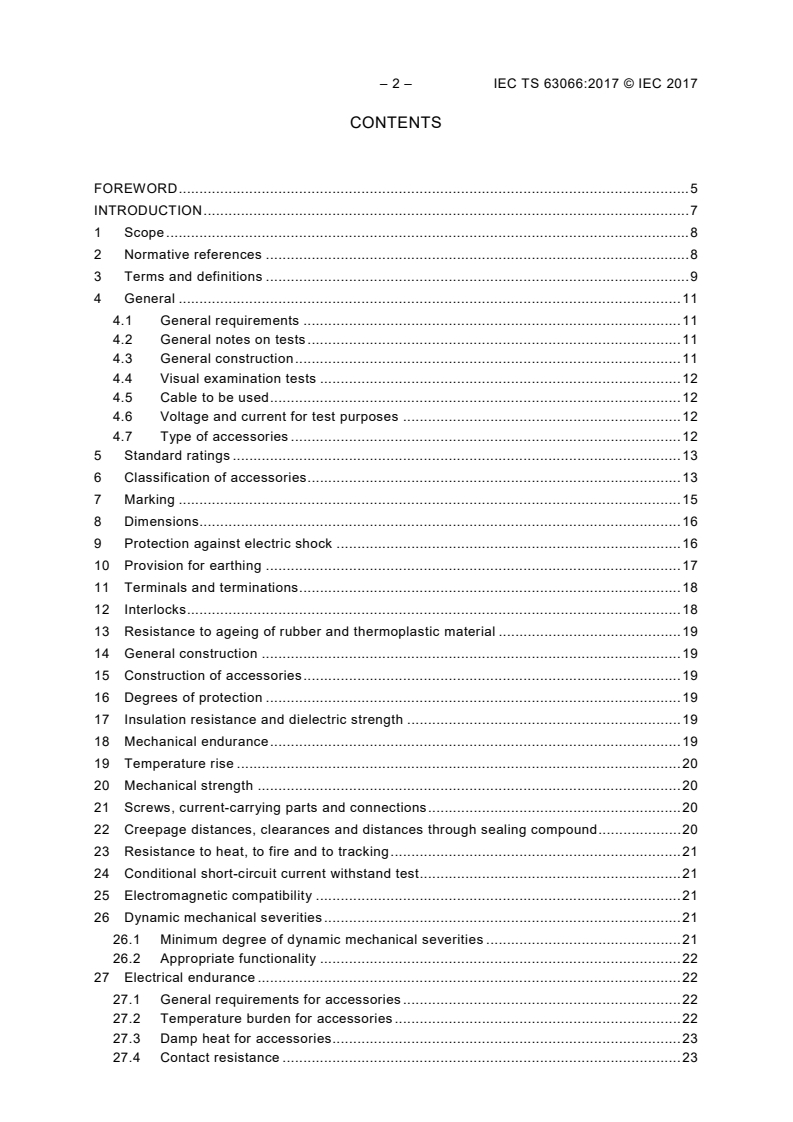
– 2 – IEC TS 63066:2017 © IEC 2017
CONTENTS
FOREWORD . 5
INTRODUCTION . 7
1 Scope . 8
2 Normative references . 8
3 Terms and definitions . 9
4 General . 11
4.1 General requirements . 11
4.2 General notes on tests . 11
4.3 General construction . 11
4.4 Visual examination tests . 12
4.5 Cable to be used . 12
4.6 Voltage and current for test purposes . 12
4.7 Type of accessories . 12
5 Standard ratings . 13
6 Classification of accessories . 13
7 Marking . 15
8 Dimensions. 16
9 Protection against electric shock . 16
10 Provision for earthing . 17
11 Terminals and terminations . 18
12 Interlocks . 18
13 Resistance to ageing of rubber and thermoplastic material . 19
14 General construction . 19
15 Construction of accessories . 19
16 Degrees of protection . 19
17 Insulation resistance and dielectric strength . 19
18 Mechanical endurance . 19
19 Temperature rise . 20
20 Mechanical strength . 20
21 Screws, current-carrying parts and connections . 20
22 Creepage distances, clearances and distances through sealing compound . 20
23 Resistance to heat, to fire and to tracking . 21
24 Conditional short-circuit current withstand test . 21
25 Electromagnetic compatibility . 21
26 Dynamic mechanical severities . 21
26.1 Minimum degree of dynamic mechanical severities . 21
26.2 Appropriate functionality . 22
27 Electrical endurance . 22
27.1 General requirements for accessories . 22
27.2 Temperature burden for accessories . 22
27.3 Damp heat for accessories . 23
27.4 Contact resistance . 23
28 Climatic endurance for contacts . 23
28.1 General requirements for contacts . 23
28.2 Thermal change for contacts . 24
28.3 Dry heat for contacts . 24
28.4 Corrosion resistance for contacts . 24
28.5 Damp heat for contacts . 24
28.6 Functionality for contacts . 24
28.7 Shocks for contacts . 24
29 Climatic endurance for bodies . 25
29.1 General requirements for bodies . 25
29.2 Dry heat for bodies . 25
29.3 Cold resistance for bodies. 25
29.4 Cold temperatures for bodies . 25
30 Salt stress endurance . 26
30.1 General requirements for accessories . 26
30.2 Salt stress resistance . 26
31 Operation with misalignments . 26
31.1 Misalignment at normal operation . 26
31.2 Misalignment after unmating . 30
31.3 Misalignment by terminated wires . 30
31.4 Mating process effected by misalignment . 30
32 Environmental conditions . 31
Annex A (normative) Test cycle electric endurance . 33
Annex B (informative) Environmental performance classes for vehicles . 34
Annex C (informative) Examples for accessories on the market . 35
C.1 General . 35
C.2 Accessory example 1 . 35
C.3 Accessory example 2 . 38
C.4 Accessory example 3 . 42
C.5 Accessory example 4 . 44
C.6 Accessory example 5 . 46
C.7 Accessory example 6 . 48
Bibliography . 50
Figure 1 – Diagram showing the use of the accessories . 11
Figure 2 – Orthogonal misalignment – front view . 27
Figure 3 – Angular misalignment – side view . 27
Figure 4 – Angular misalignment – top view . 27
Figure C.1 – Layout of accessory example 1 . 36
Figure C.2 – Accessory example 1 Type A . 37
Figure C.3 – Accessory example 1 Type B . 38
Figure C.4 – Layout of accessory example 2 . 39
Figure C.5 – Accessory example 2 Type A . 40
Figure C.6 – Accessory example 2 Type B . 41
Figure C.7 – Accessory example 3 Type A . 43
Figure C.8 – Accessory example 3 Type B . 44
– 4 – IEC TS 63066:2017 © IEC 2017
Figure C.9 – Drawings for accessory example 4 Type A . 45
Figure C.10 – Drawings for accessory example 4 Type B . 46
Figure C.11 – Drawings for accessory example 5 Type A . 47
Figure C.12 – Drawings for accessory example 5 Type B . 48
Figure C.13 – Drawings for accessory example 6 Type A . 49
Figure C. 14 – Drawings for accessory example 6 Type B . 49
Table 1 – General design and usage of accessories . 12
Table 2 – Preferred rated currents . 13
Table 3 – Short-time test currents . 18
Table 4 – Mechanical endurance . 20
Table 5 – Dimensions of misalignments . 28
Table 6 – Combinations of misalignments . 29
Table 7 – Environmental performance classes . 31
Table 8 – Severities for environmental performance classes . 32
Table B.1 – Severities for environmental performance classes for vehicles . 34
Table C.1 – Parameters for accessory example 1 . 36
Table C.2 – Parameters for accessory example 2 . 39
Table C.3 – Parameters for accessory example 3 . 42
Table C.4 – Parameters for accessory example 4 . 45
Table C.5 – Parameters for accessory example 5 . 47
Table C.6 – Parameters for accessory example 6 . 48
INTERNATIONAL ELECTROTECHNICAL COMMISSION
____________
LOW-VOLTAGE DOCKING CONNECTORS
FOR REMOVABLE ENERGY STORAGE UNITS
FOREWORD
1) The International Electrotechnical Commission (IEC) is a worldwide organization for standardization comprising
all national electrotechnical committees (IEC National Committees). The object of IEC is to promote
international co-operation on all questions concerning standardization in the electrical and electronic fields. To
this end and in addition to other activities, IEC publishes International Standards, Technical Specifications,
Technical Reports, Publicly Available Specifications (PAS) and Guides (hereafter referred to as “IEC
Publication(s)”). Their preparation is entrusted to technical committees; any IEC National Committee interested
in the subject dealt with may participate in this preparatory work. International, governmental and non-
governmental organizations liaising with the IEC also participate in this preparation. IEC collaborates closely
with the International Organization for Standardization (ISO) in accordance with conditions determined by
agreement between the two organizations.
2) The formal decisions or agreements of IEC on technical matters express, as nearly as possible, an international
consensus of opinion on the relevant subjects since each technical committee has representation from all
interested IEC National Committees.
3) IEC Publications have the form of recommendations for international use and are accepted by IEC National
Committees in that sense. While all reasonable efforts are made to ensure that the technical content of IEC
Publications is accurate, IEC cannot be held responsible for the way in which they are used or for any
misinterpretation by any end user.
4) In order to promote international uniformity, IEC National Committees undertake to apply IEC Publications
transparently to the maximum extent possible in their national and regional publications. Any divergence
between any IEC Publication and the corresponding national or regional publication shall be clearly indicated in
the latter.
5) IEC itself does not provide any attestation of conformity. Independent certification bodies provide conformity
assessment services and, in some areas, access to IEC marks of conformity. IEC is not responsible for any
services carried out by independent certification bodies.
6) All users should ensure that they have the latest edition of this publication.
7) No liability shall attach to IEC or its directors, employees, servants or agents including individual experts and
members of its technical committees and IEC National Committees for any personal injury, property damage or
other damage of any nature whatsoever, whether direct or indirect, or for costs (including legal fees) and
expenses arising out of the publication, use of, or reliance upon, this IEC Publication or any other IEC
Publications.
8) Attention is drawn to the Normative references cited in this publication. Use of the referenced publications is
indispensable for the correct application of this publication.
9) Attention is drawn to the possibility that some of the elements of this IEC Publication may be the subject of
patent rights. IEC shall not be held responsible for identifying any or all such patent rights.
The main task of IEC technical committees is to prepare International Standards. In
exceptional circumstances, a technical committee may propose the publication of a technical
specification when
• the required support cannot be obtained for the publication of an International Standard,
despite repeated efforts, or
• the subject is still under technical development or where, for any other reason, there is the
future but no immediate possibility of an agreement on an International Standard.
Technical specifications are subject to review within three years of publication to decide
whether they can be transformed into International Standards.
IEC TS 63066, which is a technical specification, has been prepared by subcommittee 23H:
Plugs, socket-outlets and couplers for industrial and similar applications, and for electric
vehicles, of IEC technical committee 23: Electrical accessories.
– 6 – IEC TS 63066:2017 © IEC 2017
The text of this technical specification is based on the following documents:
Enquiry draft Report on voting
23H/372/DTS 23H/361/RVC
Full information on the voting for the approval of this technical specification can be found in
the report on voting indicated in the above table.
This document has been drafted in accordance with the ISO/IEC Directives, Part 2.
In this document, the following print types are used:
• requirements proper: in roman type;
• test specifications: in italic type;
• explanatory matter: in smaller roman type.
The committee has decided that the contents of this document will remain unchanged until the
stability date indicated on the IEC website under "http://webstore.iec.ch" in the data related to
the specific document. At this date, the document will be
• reconfirmed,
• withdrawn,
• replaced by a revised edition, or
• amended.
A bilingual version of this publication may be issued at a later date.
INTRODUCTION
Pluggable energy storage technology has a large demand and perspective in certain areas.
With the advent of electric vehicles, energy storage units for renewable energy and other
applications, guidance is needed to ensure safe and reliable operation, interoperability,
environmental protection and energy efficiency. The industry needs such a document to
promote the technology development and popularization of pluggable energy storage
technology.
Compared to other accessories, several specific items are considered. The mating process
may not have haptic support by the operator to find the correct position between the two parts
of the connector. The mating process may have a mechanical feed which precludes the
finding of the correct position between the two parts of the connector. To overcome these
issues, the design of the accessories may consist partly of moveable parts to compensate a
mechanical feed and tolerances.
– 8 – IEC TS 63066:2017 © IEC 2017
LOW-VOLTAGE DOCKING CONNECTORS
FOR REMOVABLE ENERGY STORAGE UNITS
1 Scope
This document applies to docking connectors (hereinafter referred to as accessories)
incorporated in or fixed to electrical equipment, intended to connect removable energy
storage units to a dedicated electric power conversion unit, to an energy consuming unit or to
another energy storage unit.
These accessories are intended for DC and may include an earth contact and/or optional
auxiliary contacts for signaling and data. These accessories have a rated current of up to
800 A and rated operating voltages not exceeding 1 000 V DC.
These accessories are not suitable for mating or unmating under load. These accessories are
intended to be installed by instructed persons (IEC 60050-195:1998, 195-04-02) or skilled
persons (IEC 60050-195:1998, 195-04-01) only.
The list of preferred ratings is not intended to exclude other ratings.
This document applies to accessories for use under environmental conditions as described in
Clause 32.
These accessories are intended to be connected to current carrying parts in copper or copper
alloy only, plated or not plated.
This document also applies to accessories intended to be used at extra-low voltage.
In locations where special conditions prevail, for example on board vehicles, additional
requirements may apply.
These accessories are intended to be used with a specific charging system.
NOTE For conditions other than operation, additional requirements could be applicable, for instance IEC 62133
and the UN Recommendations on the Transport of Dangerous Goods section 38.338.3.
2 Normative references
Clause 3 of IEC 60309-1:1999, IEC 60309-1:1999/AMD1:2005 and
IEC 60309-1:1999/AMD2:2012 applies, except as follows:
Addition of the following new references:
IEC 60068-2-1, Environmental testing – Part 2-1: Tests – Test A: Cold
IEC 60068-2-2, Environmental testing – Part 2-2: Tests – Test B: Dry heat
IEC 60068-2-14, Environmental testing – Part 2-14: Tests – Test N: Change of temperature
—————————
In some countries, the term ground is used instead of earth.
IEC 60068-2-30, Environmental testing – Part 2-30: Tests – Test Db: Damp heat, cyclic
(12 h + 12 h cycle)
IEC 60068-2-38, Environmental testing – Part 2-38: Tests – Test Z/AD: Composite
temperature/humidity cyclic test
IEC 60068-2-52, Environmental testing – Part 2: Tests – Test Kb: Salt mist, cyclic (sodium
chloride solution)
IEC 60068-2-60, Environmental testing – Part 2-60: Tests – Test Ke: Flowing mixed gas
corrosion test
IEC 60309-1:1999, Plugs, socket-outlets and couplers for industrial purposes – Part 1:
General requirements
IEC 60309-1:1999/AMD1:2005
IEC 60309-1:1999/AMD2:2012
IEC 60352 (all parts), Solderless connections
IEC 60417, Graphical symbols for use on equipment (available at http://www.graphical-
symbols.info/equipment)
IEC 61140:2016, Protection against electric shock – Common aspects for installation and
equipment
IEC 61373:2010, Railway applications – Rolling stock equipment – Shock and vibration tests
ISO/IEC TR 29106:2007, Information technology – Generic cabling – Introduction to the MICE
environmental classification
ISO/IEC TR 29106:2007/AMD1:2012
3 Terms and definitions
Clause 2 of IEC 60309-1:1999, IEC 60309-1:1999/AMD1:2005 and
IEC 60309-1:1999/AMD2:2012 applies, except as follows:
Addition of the following new terms and definitions:
3.1
docking connector
accessory where the two complementary accessories are equipped with guiding means
allowing their connection without the haptic support of an operator
3.2
unmated condition
position of the accessory without any contact between both parts
3.3
mated condition
service condition and position where the two parts of the accessory are in a position as
described in the relevant standard sheet
3.4
guiding means
mechanical structure intended to ensure the proper alignment of the two complementary
accessories before their mating
– 10 – IEC TS 63066:2017 © IEC 2017
3.5
energy storage unit
unit, which includes accessories, multiple batteries or other chargeable cells arranged in a
way to store electrical energy
Note 1 to entry: This may also include supporting means for charging, storage, interlocking and discharging.
3.6
removable energy storage unit
energy storage unit, which can be easily detached and inserted into a rack to establish the
electrical connection with an accessory
3.7
rack
mechanical structure intended to incorporate one or more removable energy storage units
3.8
electric power conversion unit
device converting electric energy from one form to another, converting between AC and DC,
or changing the voltage or frequency, or a combination of these
3.9
shutter
movable part incorporated into an accessory arranged to automatically shield at least the live
contacts when the complementary accessory is withdrawn
[SOURCE: IEC 60884-1:2002/AMD2:2013, 3.27, modified – 'socket-outlet' and 'plug' are
replaced by 'accessory', 'automatically' is deleted and 'complementary' is added]
3.10
superordinate system
overall technical system as a set of components or systems with relationships between the
components or systems and between their attributes
IEC
Key
A docking accessories type A
B complementary docking accessories type B
C removable energy storage units
D rack
E guiding means
Figure 1 – Diagram showing the use of the accessories
4 General
Clause 4 of IEC 60309-1:1999, IEC 60309-1:1999/AMD1:2005 and
IEC 60309-1:1999/AMD2:2012 applies, except as follows:
4.1 General requirements
Replacement of the fourth paragraph with:
Accessories shall have a minimum degree of protection as indicated in Table 8, test variable
TV1.
4.2 General notes on tests
Subclause 4.2 of IEC 60309-1:1999, IEC 60309-1:1999/AMD1:2005 and
IEC 60309-1:1999/AMD2:2012 applies.
4.3 General construction
Different possibilities for the movement, adjustment and mating of components and
accessories are stated in Table 1.
– 12 – IEC TS 63066:2017 © IEC 2017
Table 1 – General design and usage of accessories
Case Accessory Type A Accessory Type B Removable
energy storage
unit
Possibility of Self-adjustment to Possibility of Self-adjustment to Possibility of
movement relative the nominal movement relative the nominal movement
to the structure of position of the to the structure of position of the relative to the
the rack or movable part after the removable movable part after rack
removable energy disconnecting energy storage unit disconnecting
storage unit
1 Not movable No Not movable No Not movable
2 Not movable No Not movable No Movable
3 Not movable No Movable No Not movable
4 Not movable No Movable Yes Not movable
5 Movable Yes Not movable No Not movable
6 Movable No Not movable No Not movable
NOTE Other combinations are not excluded.
Annex C shows examples of accessories.
4.4 Visual examination tests
If required by a test and unless otherwise specified, visual examination tests shall be
performed with the naked eye. The following characteristics shall be checked:
• quality of assembling before test;
• marking;
• materials;
• marks of corrosion;
• colour, change of colour after the test;
• impurities, contamination, particles of abrasion after the test;
• damages, holes, cracks;
• damaged and loosened parts;
• status and location of lubrication and glues.
No noticeable problems shall occur which could impair normal operation or show a deviation
from this standard.
4.5 Cable to be used
Unless otherwise specified by the manufacturer, the following stranded cable shall be used for
the power contacts: H07V.
4.6 Voltage and current for test purposes
As deviation from the referred test standards, tests may be performed with AC or DC.
4.7 Type of accessories
Requirements mentioned for accessories called plug or inlet are applicable for accessories
Type B.
Requirements mentioned for accessories called socket outlet or connector are applicable for
accessories Type A.
5 Standard ratings
Clause 5 of IEC 60309-1:1999, IEC 60309-1:1999/AMD1:2005 and
IEC 60309-1:1999/AMD2:2012 applies, except as follows:
5.2 Replacement:
Preferred rated currents are given in Table 2.
Table 2 – Preferred rated currents
Rated current
A
Additional subclause:
5.3 Rated current for data, communication and control circuit purposes is 2 A.
Rated voltage for data, communication and control circuit purposes is 30 V or less according
the manufacturer's specification.
6 Classification of accessories
6.1 Accessories are classified according to degree of protection as tested in Clause 16.
6.2 Accessories are classified according to earthing facilities:
• accessories without earthing contact;
• accessories with earthing contact.
6.3 Accessories are classified according to the method of connecting the cable:
• rewirable accessories;
• non-rewirable accessories.
6.4 Accessories are classified according to interlocking facilities:
• accessories without interlock;
• accessories with mechanical interlock (with latching device);
– 14 – IEC TS 63066:2017 © IEC 2017
• accessories with electrical interlock (without latching device);
• accessories with latching device and electrical interlock.
6.5 Accessories are classified according to the type of terminals:
• screw type terminals;
• screwless type terminals;
• insulation piercing terminals.
6.6 Accessories are classified according to the type of conductors for screwless type and
insulation piercing terminals
• for solid conductors only;
• for rigid (both solid and stranded) conductors only;
• for rigid (both solid and stranded) and flexible conductors.
6.7 Accessories are classified according to accessibility to live parts when unmated:
• accessories providing for less than IPXXB;
• accessories providing for IPXXB;
• accessories providing for IPXXD.
6.8 Accessories are classified according to locking facilities:
• non-lockable accessories;
• lockable accessories.
6.9 Accessories are classified according to the presence of shutter(s):
• accessories without shutter(s);
• acccessories with shutter(s).
6.10 Accessories are classified according to their environmental performance class
in Table 7:
• accessories tested for use in environmental performance class C;
• accessories tested for use in environmental performance class O;
• accessories tested for use in environmental performance class I;
• accessories tested for use in environmental performance class X.
• accessories tested for use in environmental performance class R;
• accessories tested for use in environmental performance class T.
6.11 Accessories are classified according to the case of use according Table 1:
• accessories intended for use in case 1;
• accessories intended for use in case 2;
• accessories intended for use in case 3;
• accessories intended for use in case 4;
• accessories intended for use in case 5;
• accessories intended for use in case 6;
• accessories intended for use in other cases.
6.12 Accessories are classified according to the type defined in Figure 1:
• accessories of Type A;
• accessories of Type B.
7 Marking
7.1 Accessories shall be marked with:
• rated current(s) in amperes;
• rated operating voltage(s) or range(s) in volts;
• either the name or trade mark of the manufacturer or of the responsible vendor;
• type reference, which may be a catalogue number;
• degree of protection;
• symbol indicating the position of the earthing contact or the means used for
interchangeability, if any.
NOTE Optionally, the insulation voltage can be marked.
Compliance is checked by inspection.
7.2 When symbols are used, they shall be as follows:
A amperes
V volts
direct current IEC 60417-5031 (2002-10)
(preferred) protective earth; IEC 60417-5019 (2006-08)
protective ground
and or earth; ground IEC 60417-5017 (2006-08)
Plus; positive polarity IEC 60417-5005 (2002-10)
Minus; negative polarity IEC 60417-5006 (2002-10)
IPXX (relevant figures) degree of protection according to IEC 60529
Compliance is checked by inspection.
7.3 The marking for either the name or trade mark of the manufacturer or the responsible
vendor and the type reference, catalogue number or designation shall also be in a place
which is visible before installation of the accessory.
The marking for the maximum rated operating voltage range and rated current shall be in a
place which is visible before installation of the accessory. The marking for either the name or
trademark of the manufacturer or the responsible vendor and the type reference, catalogue
number or designation shall be in a place which is visible before installation of the accessory.
It need not be visible after installation.
– 16 – IEC TS 63066:2017 © IEC 2017
Compliance is checked by inspection.
7.4 For rewirable accessories, the contacts shall be indicated by the following symbols:
• the symbols + and – and the symbol for protective earth if any;
• other contacts as indicated in the relevant standard sheet.
These symbols shall be placed close to the relevant terminals; they shall not be placed on
screws, removable washers or other removable parts.
Compliance is checked by inspection.
For rewirable accessories, wiring instructions shall be provided.
Compliance is checked by inspection.
7.5 Pre-wired accessories shall be provided with information to identify the conductors at
the loose end.
Compliance is checked by inspection.
8 Dimensions
Clause 8 of IEC 60309-1:1999, IEC 60309-1:1999/AMD1:2005 and
IEC 60309-1:1999/AMD2:2012 applies, except as follows:
8.3 Replacement of the last paragraph with the following:
Compliance is checked by inspection and the following manual test:
Insertion of the appropriate accessory is tested for 1 min with a force of 150 N for accessories
with a rated current not exceeding 16 A, or 250 N for other accessories.
Where the use of elastomeric or thermoplastic material is likely to influence the result of the
test, it is carried out at an ambient temperature of (50 ± 2) °C, both the accessories being
conditioned at this temperature.
9 Protection against electric shock
Clause 9 of IEC 60309-1:1999, IEC 60309-1:1999/AMD1:2005 and
IEC 60309-1:1999/AMD2:2012 applies except as follows:
9.1 Replacement:
Live contacts, when they are wired as in normal use, and when they are in partial or complete
engagement with the complementary accessories, shall not be accessible.
This requirement does not apply to contacts and conductors used for signal, data,
communication and control circuits operated according to IEC 61140:2016, 5.2.6.
In addition, it shall not be possible to make contact between live contacts and any other
conductive part which is accessible. This shall be ensured by the superordinate systems
where the accessories are embedded.
If the accessory is rated as having accessibility to live parts less than IPXXB, additional
measures by the superordinate system according to IEC 61140:2016, 5.2 shall be introduced,
except 5.2.6 and 5.2.8.
The measures to check the compliance are part of the intended standard for the
superordinate system.
Compliance is checked by inspection and, if necessary, by a test on the sample wired as in
normal use.
The standard test finger (IEC 60309-1:1999, IEC 60309-1:1999/AMD1:2005 and
IEC 60309-1:1999/AMD2:2012, Figure 2) is applied in every possible position, an electrical
indicator, with a voltage not less than 40 V, being used to show contact with the relevant part.
There shall be no contact.
9.2 Replacement:
The contact sequence during the connection process shall be:
• guiding means (if any),
• earth contact PE (if any),
• power, signal, control contacts and screening (if any),
• the contact which establishes the communication shall mate at the latest in order to
release the current flow.
The unmating process applies in the reversed order.
10 Provision for earthing
Clause 10 of IEC 60309-1:1999, IEC 60309-1:1999/AMD1:2005 and
IEC 60309-1:1999/AMD2:2012 applies, except as follows:
10.3 Replacement:
Protective earthing contacts shall comply with the test requirements in either 10.3 a) or
10.3 b) to 10.3 d), as specified by the manufacturer.
a) Protective earthing contacts shall be capable of carrying a current equal to that specified
for the phase contacts without overheating.
Compliance is checked by the test of Clause 19.
b) The assembly of mating accessories with protective earthing contacts shall carry the
current specified in Table 3 for the time specified in Table 3. The current shall be based
on the minimum size equipment protective earthing conductor for the current rating of the
accessory. The components in the protective earthing path shall not crack, break, or melt.
– 18 – IEC TS 63066:2017 © IEC 2017
Table 3 – Short-time test currents
Rating of the Minimum size for protective earthing Time Test current
accessory copper conductor
equal or less
A mm AWG s A
16 4 12 4 470
32 6 10 4 750
63 10 8 4 1 180
125 16 6 6 1 530
250 25 4 6 2 450
400 35 2 6 3 900
800 50 1 6 4 900
NOTE For accessories' ratings less than 10 A in Table 3, test current is based on the smallest size equipment
protective earthing conductor permitted or can be determined by linear approximation of rated current (or 120 A
per 1 mm ), whichever is greater.
c) The mating accessories shall be mounted and assembled as intended. A protective
earthing conductor of the minimum intended size, not less than 0,6 m long, shall be
connected to the protective earthing terminal of each accessory, with the terminals
employed to hold the conductor tightened using a torque as specified by the manufacturer.
Accessories of type A and B shall be wired with the minimum allowable size copper
conductor. The test current shall be passed through the mating accessories and protective
earthing wires in series.
d) After having carried the current specified in 10.3 b), continuity shall exist on the test
assembly when measured between the protective earthing conductors. Any indicating
device such as an ohmmeter, battery-and-buzzer combination, or the like, may be used to
determine whether continuity exists.
Compliance is checked by inspection and test.
11 Terminals and terminations
Clause 11 of IEC 60309-1:1999, IEC 60309-1:1999/AMD1:2005 and
IEC 60309-1:1999/AMD2:2012 applies, except as follows:
Additional subclause:
11.8 For other terminations, the relevant tests from IEC 60352 series applies.
12 Interlocks
Clause 12 of IEC 60309-1:1999, IEC 60309-1:1999/AMD1:2005 and
IEC 60309-1:1999/AMD2:2012 applies.
13 Resistance to ageing of rubber and thermoplastic material
Clause 13 of IEC 60309-1:1999, IEC 60309-1:1999/AMD1:2005 and
IEC 60309-1:1999/AMD2:2012 applies.
14 General construction
Clause 14 of IEC 60309-1:1999, IEC 60309-1:1999/AMD1:2005 and
IEC 60309-1:1999/AMD2:2012 applies.
15 Construction of accessories
Clause 15 of IEC 60309-1:1999, IEC 60309-1:1999/AMD1:2005 and
IEC 60309-1:1999/AMD2:2012 applies to accessories type A, except as follows: Subclauses
15.1, 15.3, 15.7 and 15.8 do not apply.
Clause 17 of IEC IEC 60309-1:1999, IEC 60309-1:1999/AMD1:2005 and
IEC 60309-1:1999/AMD2:2012 applies to accessories type B.
16 Degrees of protection
Clause 18 of IEC 60309-1:1999, IEC 60309-1:1999/AMD1:2005 and
IEC 60309-1:1999/AMD2:2012 applies with the complementary accessory in engagement.
Accessories shall have the minimum degrees of protection as indicated in Table 8, test
variable TV1.
The degree of protection shall apply to accessories in complete engagement only. The
requirements for other conditions depend on the superordinate system.
Compliance is checked by the appropriate tests of IEC 60309-1:1999,
IEC 60309-1:1999/AMD1:2005 and IEC 60309-1:1999/AMD2:2012, Clause 18.
17 Insulation resistance and dielectric strength
Clause 19 of IEC 60309-1:1999, IEC 60309-1:1999/AMD1:2005 and
IEC 60309-1:1999/AMD2:2012 applies.
18 Mechanical endurance
Accessories shall withstand, without excessive wear or other harmful effect, the mechanical,
stress occurring in normal use.
Type A and Type B accessories are mated and unmated at a rate of 7,5 strokes per minute.
After each 500 strokes, contacts pins, if any, are wiped with a piece of dry cloth or the
equivalent dry cleaning maintenance operation is performed, as stated in the manufacturer’s
instructions.
During the test, the contacts of t
...