


IEC 61993-1:1999
(Main)Maritime navigation and radiocommunication equipment and systems - Part 1: Shipborne automatic transponder system installation using VHF digital selective calling (DSC) techniques - Operational and performance requirements, methods of testing and required test results
General Information
- Abstract
IEC 61993-1:1999 Specifies the performance requirements, technical characteristics, operational requirements, methods of testing and required test results for shipborne automatic transponder system installations using VHF digital selective calling (DSC) techniques.
- Status
- Withdrawn
- Publication Date
- 27-Apr-1999
- Withdrawal Date
- 30-Dec-2018
- Technical Committee
- TC 80 - Maritime navigation and radiocommunication equipment and systems
- Drafting Committee
- WG 8 - TC 80/WG 8
- Current Stage
- WPUB - Publication withdrawn
- Start Date
- 02-Jan-2019
- Completion Date
- 31-Dec-2018
Buy Documents
IEC 61993-1:1999 - Maritime navigation and radiocommunication equipment and systems - Part 1: Shipborne automatic transponder system installation using VHF digital selective calling (DSC) techniques - Operational and performance requirements, methods of testing and required test results Released:4/28/1999

IEC 61993-1:1999 - Maritime navigation and radiocommunication equipment and systems - Part 1: Shipborne automatic transponder system installation using VHF digital selective calling (DSC) techniques - Operational and performance requirements, methods of testing and required test results Released:4/28/1999
Buy Documents
IEC 61993-1:1999 - Maritime navigation and radiocommunication equipment and systems - Part 1: Shipborne automatic transponder system installation using VHF digital selective calling (DSC) techniques - Operational and performance requirements, methods of testing and required test results Released:4/28/1999
IEC 61993-1:1999 - Maritime navigation and radiocommunication equipment and systems - Part 1: Shipborne automatic transponder system installation using VHF digital selective calling (DSC) techniques - Operational and performance requirements, methods of testing and required test results Released:4/28/1999
Get Certified
Connect with accredited certification bodies for this standard

DNV
DNV is an independent assurance and risk management provider.

Lloyd's Register
Lloyd's Register is a global professional services organisation specialising in engineering and technology.

FSC International
Forest Stewardship Council certification.
Sponsored listings
Frequently Asked Questions
IEC 61993-1:1999 is a standard published by the International Electrotechnical Commission (IEC). Its full title is "Maritime navigation and radiocommunication equipment and systems - Part 1: Shipborne automatic transponder system installation using VHF digital selective calling (DSC) techniques - Operational and performance requirements, methods of testing and required test results". This standard covers: IEC 61993-1:1999 Specifies the performance requirements, technical characteristics, operational requirements, methods of testing and required test results for shipborne automatic transponder system installations using VHF digital selective calling (DSC) techniques.
IEC 61993-1:1999 Specifies the performance requirements, technical characteristics, operational requirements, methods of testing and required test results for shipborne automatic transponder system installations using VHF digital selective calling (DSC) techniques.
IEC 61993-1:1999 is classified under the following ICS (International Classification for Standards) categories: 47.020.70 - Navigation and control equipment. The ICS classification helps identify the subject area and facilitates finding related standards.
IEC 61993-1:1999 is available in PDF format for immediate download after purchase. The document can be added to your cart and obtained through the secure checkout process. Digital delivery ensures instant access to the complete standard document.
Standards Content (Sample)
INTERNATIONAL
IEC
STANDARD
61993-1
First edition
1999-04
Maritime navigation and radiocommunication
equipment and systems –
Part 1:
Shipborne automatic transponder system
installation using VHF digital selective
calling (DSC) techniques –
Operational and performance requirements,
methods of testing and required test results
Matériels et systèmes de navigation et
de radiocommunication maritimes –
Partie 1:
Installation de systèmes de répondeur automatique
de bord de navires utilisant des techniques d’appel sélectif
numérique en ondes métriques – Exigences d’exploitation
et de fonctionnement, méthodes d’essai et résultats
d’essai exigés
Reference number
Numbering
As from 1 January 1997 all IEC publications are issued with a designation in the
60000 series.
Consolidated publications
Consolidated versions of some IEC publications including amendments are
available. For example, edition numbers 1.0, 1.1 and 1.2 refer, respectively, to the
base publication, the base publication incorporating amendment 1 and the base
publication incorporating amendments 1 and 2.
Validity of this publication
The technical content of IEC publications is kept under constant review by the IEC,
thus ensuring that the content reflects current technology.
Information relating to the date of the reconfirmation of the publication is available
in the IEC catalogue.
Information on the subjects under consideration and work in progress undertaken by
the technical committee which has prepared this publication, as well as the list of
publications issued, is to be found at the following IEC sources:
• IEC web site*
• Catalogue of IEC publications
Published yearly with regular updates
(On-line catalogue)*
• IEC Bulletin
Available both at the IEC web site* and as a printed periodical
Terminology, graphical and letter symbols
For general terminology, readers are referred to IEC 60050: International
Electrotechnical Vocabulary (IEV).
For graphical symbols, and letter symbols and signs approved by the IEC for
general use, readers are referred to publications IEC 60027: Letter symbols to be
used in electrical technology, IEC 60417: Graphical symbols for use on equipment.
Index, survey and compilation of the single sheets and IEC 60617: Graphical symbols
for diagrams.
* See web site address on title page.
INTERNATIONAL
IEC
STANDARD
61993-1
First edition
1999-04
Maritime navigation and radiocommunication
equipment and systems –
Part 1:
Shipborne automatic transponder system
installation using VHF digital selective
calling (DSC) techniques –
Operational and performance requirements,
methods of testing and required test results
Matériels et systèmes de navigation et
de radiocommunication maritimes –
Partie 1:
Installation de systèmes de répondeur automatique
de bord de navires utilisant des techniques d’appel sélectif
numérique en ondes métriques – Exigences d’exploitation
et de fonctionnement, méthodes d’essai et résultats
d’essai exigés
IEC 1999 Copyright - all rights reserved
No part of this publication may be reproduced or utilized in any form or by any means, electronic or
mechanical, including photocopying and microfilm, without permission in writing from the publisher.
International Electrotechnical Commission 3, rue de Varembé Geneva, Switzerland
Telefax: +41 22 919 0300 e-mail: inmail@iec.ch IEC web site http: //www.iec.ch
Commission Electrotechnique Internationale
PRICE CODE
W
International Electrotechnical Commission
For price, see current catalogue
– 2 – 61993-1 © IEC(E):1999
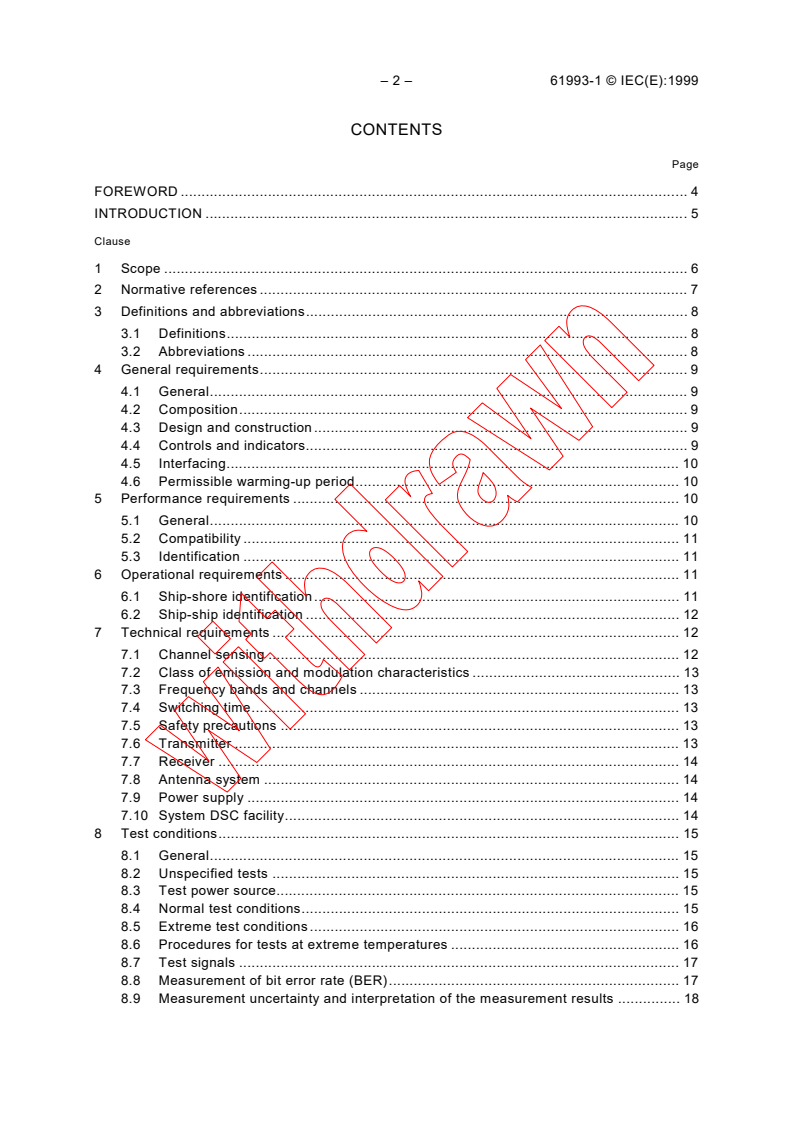
CONTENTS
Page
FOREWORD . 4
INTRODUCTION .5
Clause
1 Scope . 6
2 Normative references . 7
3 Definitions and abbreviations. 8
3.1 Definitions. 8
3.2 Abbreviations . 8
4 General requirements. 9
4.1 General. 9
4.2 Composition. 9
4.3 Design and construction. 9
4.4 Controls and indicators. 9
4.5 Interfacing. 10
4.6 Permissible warming-up period. 10
5 Performance requirements . 10
5.1 General. 10
5.2 Compatibility . 11
5.3 Identification . 11
6 Operational requirements . 11
6.1 Ship-shore identification. 11
6.2 Ship-ship identification . 12
7 Technical requirements . 12
7.1 Channel sensing . 12
7.2 Class of emission and modulation characteristics . 13
7.3 Frequency bands and channels . 13
7.4 Switching time. 13
7.5 Safety precautions . 13
7.6 Transmitter . 13
7.7 Receiver . 14
7.8 Antenna system . 14
7.9 Power supply . 14
7.10 System DSC facility. 14
8 Test conditions. 15
8.1 General. 15
8.2 Unspecified tests . 15
8.3 Test power source. 15
8.4 Normal test conditions. 15
8.5 Extreme test conditions . 16
8.6 Procedures for tests at extreme temperatures . 16
8.7 Test signals . 17
8.8 Measurement of bit error rate (BER). 17
8.9 Measurement uncertainty and interpretation of the measurement results . 18
61993-1 © IEC(E):1999 – 3 –
9 Environmental tests. 18
9.1 Introduction. 18
9.2 Temperature tests. 18
9.3 Vibration . 19
9.4 Corrosion. 19
9.5 Rain. 19
10 Performance tests . 19
10.1 General. 19
10.2 Compatibility . 20
10.3 Identification . 20
11 Operational tests. 20
11.1 Ship-shore identification. 20
11.2 Ship-ship identification . 20
12 Technical tests.21
12.1 Sensing capability . 21
12.2 Switching time. 21
13 Transmitter tests . 22
13.1 Frequency error . 22
13.2 Carrier power . 22
13.3 Frequency deviation . 23
13.4 Sensitivity of the modulator . 23
13.5 Modulation index . 24
13.6 Adjacent channel power . 24
13.7 Conducted spurious emissions conveyed to the antenna. 25
13.8 Transient frequency behaviour of the transmitter . 25
14 Receiver tests .27
14.1 Calling sensitivity . 27
14.2 Dynamic range. 27
14.3 Co-channel rejection . 27
14.4 Adjacent channel selectivity. 28
14.5 Blocking immunity . 28
14.6 Intermodulation response . 29
14.7 Conducted spurious emissions into the antenna . 29
15 Other tests . 29
15.1 Antenna system . 29
15.2 Power supply . 29
15.3 Compass safe distance . 30
16 Safety precautions . 30
17 EMC emissions . 30
18 EMC immunity. 30
Annex A (informative) Relationship between bit error rate (BER) input and symbol error
rate (SER) output . 32
Annex B (normative) Power measuring receiver specification . 36
Annex C (informative) Description of the operation of the system . 38
Figures
1 Test set-up for measuring transient frequency behaviour. 30
2 Storage oscilloscope view t , t and t . 31
1 2 3
– 4 – 61993-1 © IEC(E):1999
INTERNATIONAL ELECTROTECHNICAL COMMISSION
–––––––––––
MARITIME NAVIGATION AND RADIOCOMMUNICATION EQUIPMENT
AND SYSTEMS –
Part 1: Shipborne automatic transponder system installation
using VHF digital selective calling (DSC) techniques –
Operational and performance requirements,
methods of testing and required test results
FOREWORD
1) The IEC (International Electrotechnical Commission) is a worldwide organization for standardization comprising
all national electrotechnical committees (IEC National Committees). The object of the IEC is to promote
international co-operation on all questions concerning standardization in the electrical and electronic fields. To
this end and in addition to other activities, the IEC publishes International Standards. Their preparation is
entrusted to technical committees; any IEC National Committee interested in the subject dealt with may
participate in this preparatory work. International, governmental and non-governmental organizations liaising
with the IEC also participate in this preparation. The IEC collaborates closely with the International Organization
for Standardization (ISO) in accordance with conditions determined by agreement between the two
organizations.
2) The formal decisions or agreements of the IEC on technical matters express, as nearly as possible, an
international consensus of opinion on the relevant subjects since each technical committee has representation
from all interested National Committees.
3) The documents produced have the form of recommendations for international use and are published in the form
of standards, technical reports or guides and they are accepted by the National Committees in that sense.
4) In order to promote international unification, IEC National Committees undertake to apply IEC International
Standards transparently to the maximum extent possible in their national and regional standards. Any
divergence between the IEC Standard and the corresponding national or regional standard shall be clearly
indicated in the latter.
5) The IEC provides no marking procedure to indicate its approval and cannot be rendered responsible for any
equipment declared to be in conformity with one of its standards.
6) Attention is drawn to the possibility that some of the elements of this International Standard may be the subject
of patent rights. The IEC shall not be held responsible for identifying any or all such patent rights.
International Standard IEC 61993-1 has been prepared by IEC technical committee 80:
Maritime navigation and radiocommunication equipment and systems.
The text of this standard is based on the following documents:
FDIS Report on voting
80/212/FDIS 80/222/RVD
Full information on the voting for the approval of this standard can be found in the report on
voting indicated in the above table.
Annex B is an integral part of the standard.
Annexes A and C are for information only.
A bilingual version of this standard may be issued at a later date.
61993-1 © IEC(E):1999 – 5 –
INTRODUCTION
In 1995 the IMO instigated work on the development of performance standards for a shipborne
automatic identification system (AIS) using VHF digital selective calling (DSC) techniques.
These performance standards were developed into a draft resolution which was expected to be
adopted by the IMO Maritime Safety Committee. However, there were objections to this on the
grounds that some requirements for AIS were not met by the draft resolution.
The outcome has been that IMO has now developed further performance standards for a
“Universal AIS” as a resolution which was adopted by the IMO Maritime Safety Committee in
May 1998 as MSC. 74(69) annex 3.
During this period, some countries have gone ahead and implemented operational systems
based upon the original IMO draft performance standards for AIS. There is therefore a need for
a technical testing standard for such equipment.
At their plenary meeting in September 1997, technical committee 80 came to the following
decisions:
– a draft technical standard which had been prepared on the basis of the original IMO
performance standards would go ahead with the reference 61993-1, but would not directly
refer to any IMO resolution for AIS;
– work would commence at the earliest opportunity on preparing a technical standard for a
“Universal AIS” based rigorously upon the IMO resolution MSC.74(69) and a new
recommendation ITU-R M.1371. This standard would have the reference 61993-2.
– 6 – 61993-1 © IEC(E):1999
MARITIME NAVIGATION AND RADIOCOMMUNICATION EQUIPMENT
AND SYSTEMS –
Part 1: Shipborne automatic transponder system installation
using VHF digital selective calling (DSC) techniques –
Operational and performance requirements,
methods of testing and required test results
1 Scope
This part of IEC 61993 specifies the performance requirements, technical characteristics,
operational requirements, methods of testing and required test results for shipborne automatic
transponder system installations using VHF digital selective calling (DSC) techniques and is
associated with IEC 60945. When a requirement in this standard is different from IEC 60945,
the requirement in this standard shall take precedence.
The shipborne transponder installation is intended to assist in the efficient operation of ship-
reporting systems and vessel traffic services (VTS) by enabling operators to identify, poll and
automatically locate and track ships when they are approaching, entering and sailing within the
limits of a ship-reporting system.
The system may also be used for the identification of ships by a ship and ships by aircraft. A
description of the system is given in annex C.
This standard
– incorporates the technical characteristics included in ITU-R Recommendation M.825 for
transponder systems using DSC and the technical characteristics included in ITU-R
Recommendation M.489 for VHF radiotelephone equipment;
– incorporates the technical characteristics of DSC equipment and the operational
procedures for its use contained in Recommendations ITU-R M.493 and ITU-R M.541;
– incorporates applicable parts of the performance standards of IMO Resolution A.803 for
shipborne VHF radio installations;
– takes account of IMO Resolution A.694 for general requirements; and
– conforms with the International Telecommunication Union (ITU) Radio Regulations where
applicable.
This standard for a transponder system is not intended to meet the requirements for a
universal automatic identification system (AIS), as detailed in IMO Resolution MSC.74(69)
annex 3.
NOTE – All text in this standard whose meaning complies with that in the normative references, namely IMO
Resolution A.803(19) and ITU-R Recommendations M.825, M.489, M.493 and M.541 is followed by a reference to
the source (number of IMO Resolution or ITU-R Recommendation and paragraph number) in brackets.
61993-1 © IEC(E):1999 – 7 –
2 Normative references
The following normative documents contain provisions which, through reference in this text,
constitute provisions of this part of IEC 61993. For dated references, subsequent amendments
to, or revisions of, any of these publications do not apply. However parties to agreements
based on this part of IEC 61993 are encouraged to investigate the possibility of applying the
most recent editions of the normative documents indicated below. For undated references, the
latest edition of the normative documents referred to applies. Members of IEC and ISO
maintain registers of currently valid International Standards.
IEC 60945:1996, Maritime navigation and radiocommunication equipment and systems –
General requirements, methods of testing and required test results
IEC 61097-3:1994, Global maritime distress and safety system (GMDSS) – Part 3: Digital
selective calling (DSC) equipment – Operational and performance requirements, methods of
testing and required testing results
IEC 61097-7:1996, Global maritime distress and safety system (GMDSS) – Part 7: Shipborne
VHF radiotelephone transmitter and receiver – Operational and performance requirements,
methods of testing and required test results
IEC 61162 (all parts), Maritime navigation and radiocommunicaation equipment and systems –
Digital interfaces
IMO International Convention for Safety of Life at Sea (SOLAS) 1974, as amended
IMO Resolution A.694:1991, General requirements for shipborne radio equipment forming part
of the global maritime distress and safety system (GMDSS) and for electronic navigational aids
IMO Resolution A.803:1995, Performance standards for shipborne VHF radio installations
capable of voice communication and digital selective calling
IMO MSC.74(69):1998, annex 3 – Performance standards for an Universal shipborne automatic
identification system (AIS)
ITU Radio Regulations:1997
ITU-R Recommendation M.489-2:1995, Technical characteristics of VHF radiotelephone
equipment operating in the maritime mobile service in channels spaced by 25 kHz
ITU-R Recommendation M.493-9:1997, Digital selective-calling system for use in the maritime
mobile service
ITU-R Recommendation M.541-8:1997, Operational procedures for the use of digital selective
calling (DSC) equipment in the maritime mobile service
ITU-R Recommendation M.825-2:1997, Characteristics of a transponder system using digital
selective-calling techniques for use with vessel traffic services and ship-to-ship identification
ITU-R Recommendation M.1371:1998, Technical characteristics for a universal shipborne
automatic identification system using time division multiple access in the VHF maritime mobile
band
ITU-T Recommendation V.11:1996, Electrical characteristics for balanced double-current
interchange circuits operating at data signalling rates up to 10 Mbit/s
ITU-T Recommendation V.24:1996, List of definitions for interchange circuits between data
terminal equipment (DTE) and data circuit-terminating equipment (DCE)
– 8 – 61993-1 © IEC(E):1999
ITU-T Recommendation V.28:1993, Electrical characteristics for unbalanced double-current
interchange circuits
3 Definitions and abbreviations
3.1 Definitions
For the purpose of this standard, the following definitions apply.
3.1.1
status
navigational status of the ship as expressed by the second digit 1-7 of the two-digit symbols to
indicate other ships (table 3 of Recommendation ITU-R M.825)
3.1.2
performance check
quick test under normal test conditions of the transmitter frequency error to 13.1, the transmitter
output power to 13.2 (high power only) and the receiver calling sensitivity to 14.1, with standard
test signal number 2 applied at a level of +12 dBμV. For results required, see 9.1.2
3.1.3
sensor
device which provides information to the system such as position, course and speed
3.2 Abbreviations
BER Bit error rate
DCE Data circuit-terminating equipment
DSC Digital selective calling
DTE Data terminal equipment
ECDIS Electronic chart display and information system
EMC Electromagnetic compatibility
e.m.f. Electromotive force
EUT Equipment under test
GMDSS Global maritime distress and safety system
GPS Global positioning system
IEC International Electrotechnical Commission
IMO International Maritime Organization
ITU International Telecommunication Union
ITU-R ITU Radiocommunication sector (formerly CCIR)
ITU-T ITU Standardization sector (formerly CCITT)
MMSI Maritime mobile service identity
p.t.t. press-to-transmit
r.m.s. root-mean-square
SOLAS Safety of Life at Sea (International convention for the)
UTC Universal time co-ordinated
VHF Very high frequency
VTS Vessel traffic services
61993-1 © IEC(E):1999 – 9 –
4 General requirements
4.1 General
4.1.1 Requirements contained in clause 4 cannot be verified by repeatable measurements.
The manufacturer shall declare that compliance to these requirements is achieved and shall
provide relevant documentation. The declaration(s), documentation and, when necessary, the
equipment shall be checked.
The system shall have a high level of availability, shall enable operators to obtain
4.1.2
information from the ship automatically, whenever practicable, and require a minimum of
involvement of ship's personnel, thus reducing the burden of communication on board ships.
4.1.3 The system installation, in addition to meeting the requirements of the Radio
1)
Regulations, the relevant ITU-R recommendations and the general requirements set out in
IMO A.694, as detailed in IEC 60945, shall comply with the following requirements and the
requirements contained in clauses 5 and 6 of this standard.
4.2 Composition
The installation shall comprise of at least
4.2.1
– a transmitter/receiver including antenna;
– a digital selective calling facility;
– a dedicated DSC watchkeeping facility to maintain watch on the designated calling
frequency except during periods when the installation is required to operate on working
channels in accordance with instructions from shore-based stations;
– an electronic position-fixing system capable of providing horizontal accuracy of 100 m (95 %);
– means to input and receive information;
– means for the automatic change to a working channel on request of the shore-based
interrogating station.
4.2.2 The manufacturer shall declare the composition of the equipment and also the relevant
category to IEC 60945 for each unit.
4.3 Design and construction
The installation shall operate continuously while underway or at anchor. The equipment
4.3.1
shall be designed for continuous operation.
4.3.2 The system functions may be performed by separate units appropriately interconnected
or be integrated with a radio transmitter and/or receiver.
NOTE – "Integrated" means that the system function is physically integrated into a radio transmitter and/or receiver
so that the system functions can only be tested by RF measurements.
4.4 Controls and indicators
4.4.1 The installation shall be provided with visual indication to show
– the equipment is switched on;
– the transponder function is disabled;
– the equipment is being interrogated; and
– the equipment is transmitting;
– loss of external data.
–––––––
1)
Recommendations ITU-R M.825, M.493, M.541
– 10 – 61993-1 © IEC(E):1999
4.5 Interfacing
4.5.1 To enable a user display of information for example at a radar or ECDIS, the system
shall be provided with a serial interface conforming to IEC 61162.
4.5.2 Interfaces for external sensors providing data for the system shall conform to
IEC 61162.
4.5.3 As a minimum, the system shall be capable of operating with the sentences GGA, GLL,
VBW, VTG, DSI, and DSR of IEC 61162.
4.5.4 When the installation comprises an external watch receiver, input terminals for AF, or
alternatively DSC signals at logic level, the interfaces shall be as follows.
4.5.4.1 AF terminals for DSC signals shall have input and output impedance of 600 Ω,
symmetrical and free of earth, with a closed-circuit level adjustable to 0,775 V (r.m.s.) ± 10 dB
for connection to AF terminals of external radio equipment.
4.5.4.2 Alternatively, terminals for DSC signals at logic levels shall have the electrical
characteristics compatible with Recommendation ITU-T V.11. The B-state shall be the logic "0",
and the Y-state shall be the logic "1".
4.5.4.3 Additionally, terminals for DSC signals may be provided with characteristics as
defined in ITU-T Recommendations V.24 and V.28.
4.6 Permissible warming-up period
The installation shall be operational within 1 min of switching on.
NOTE – Sensors used with the system shall meet the requirements of their individual product standards (for
example, IEC 61108-1 for GPS which permits 30 min to operation when there is no valid almanac data available).
5 Performance requirements
5.1 General
5.1.1 The system shall provide for calls of the category safety using DSC. (825/6.1)
5.1.2 Means shall be provided to automatically record all periods when the installation is non-
functioning. It shall not be possible for the user to alter any information recorded by this device.
5.1.3 The last 10 times when the equipment is non-functioning for more than 15 min shall be
recorded in UTC time and duration in a non-volatile memory. Means shall be provided to
recover this data.
5.1.4 The installation shall be capable of receiving and processing all calls transmitted by an
interrogating station.
5.1.5 The installation may not be required to process DSC type calls which are not AIS calls;
however, such calls shall not affect correct system operation.
5.1.6 The installation shall be capable of operating on single-frequency channels or on single-
or two-frequency channels.
61993-1 © IEC(E):1999 – 11 –
5.1.7 The installation shall be capable of automatically transmitting a response. An automatic
response shall be transmitted to any interrogation containing one or more of the symbols 101,
102, 103, 108, 109, 111, 112 and 116.
5.1.8 When an automatic response is required but the requested information is not available,
the relevant symbol shall be followed by the symbol 126. Symbol 126 shall also be transmitted
for null-fields in the DSI sentence of IEC 61162.
5.2 Compatibility
5.2.1 Where the installation is combined with other VHF installations, in accordance with ITU
Radio Regulations Article 61, interrogating transmissions shall have priority over all
communications other than those of a higher priority as prescribed in that article. Facilities
shall be provided to disable the installation for communications of higher priority.
5.2.2 Such facilities shall be adequately protected from inadvertent operation and the times of
disabling recorded in conformity with 5.1.2. Continuous watch on the designated calling
frequency (Channel 70) shall be maintained irrespective of the frequency being used for
communications by the installation.
5.2.3 In a combined installation, the system is permitted to operate the transmitter for the
duration of a DSC call for system purposes provided that after the transmission the VHF
installation returns automatically to its previous settings. Interrogations containing symbol
number 101 to table 4 of Recommendation ITU-R M.825 shall cause the system to respond on
the VHF channel indicated for any following symbols in the interrogating message. The system
shall then return to channel 70 operation. If symbol number 101 is followed by symbol number
102, all subsequent position reports shall be made on the indicated VHF channel. These
position reports will not normally be acknowledged by the originator of the request.
5.3 Identification
For the purpose of ship identification, the appropriate MMSI shall be used.
6 Operational requirements
6.1 Ship-shore identification
6.1.1 To enable shore-based authorities to identify the ship, the following information, which it
shall not be possible for the user to change, shall be programmed in a secure manner into the
installation:
– ship’s MMSI;
– ship’s name (symbol number 115 to table 4 of ITU-R M.825);
– ship’s length (symbol number 124 to table 4 of ITU-R M.825); and
– type of ship (symbols numbers 50-55, 58, 59, 69, 79, 89 and 99 to table 3 of ITU-R M.825).
6.1.2 The following information shall be programmed into the installation automatically, either
from integral equipment or from suitable sensor sources:
– ship’s position (symbol number 100 to table 4 of ITU-R M.825);
– course of ship over ground (symbol number 119 to table 4 of ITU-R M.825); and
– speed of ship over ground (symbol number 120 to table 4 of Recommendation ITU-R
M.825).
NOTE – Where external sensors are used, these shall be protected against de-activation by the user.
– 12 – 61993-1 © IEC(E):1999
6.1.3 Facilities shall be provided to enable the user to readily programme additional
2)
information into the installation in accordance with the relevant ITU-R Recommendation .
6.1.4 The additional information shall include at least
– draught (symbol number 123 to table 4 of ITU-R M.825);
– next port of call (symbol number 121 to table 4 of ITU-R M.825);
– destination (symbol number 114 to table 4 of ITU-R M.825);
– entering or leaving VTS (symbols numbers 105 and 107 to table 4 of ITU-R M.825); and
– status (applicable second digit 1-7 of symbols to indicate other ships to table 3 of ITU-R M.825).
6.1.5 Where facilities to programme additional information are not integral to the system they
shall be provided to the installation via a serial interface complying to IEC 61162.
6.2 Ship-ship identification
6.2.1 For ship-to-ship identification purposes, the installation shall not allow the user to
transmit interrogation messages addressed to a group of ships other than to a numerical
geographic address no larger than 0,5 square nautical miles in area.
6.2.2 To enhance identification, the installation shall provide facilities to use other forms of
address so as to add either course or ship type to the geographic address, in accordance with
ITU-R M.825, in any interrogation message.
6.2.3 The installation shall permit the user to obtain, in addition to the ship's MMSI, the
following information from addressed ships for identification purposes:
– position (symbol number 100 to table 4 of ITU-R M.825);
– course over ground (symbol number 119 to table 4 of ITU-R M.825);
– speed (symbol number 120 to table 4 of ITU-R M.825); and
– ship's name and call sign (symbol number 115 to table 4 of ITU-R M.825). (8.3)
6.2.4 It shall not be possible for the user to obtain additional information from other ships by
use of the installation.
6.2.5 Means shall be provided to prevent more than three call attempts from the system in
any period of 15 min.
6.2.6 Ship-to-ship interrogation shall be at low transmitting power, in the range of between
0,1 W and 1 W.
7 Technical requirements
7.1 Channel sensing
7.1.1 Provision shall be made for sensing the VHF channel 70 used for digital selective calling
purposes to determine the presence of a signal, for automatically preventing the transmission
of a transponder call until the channel is free.
–––––––
2)
Recommendation ITU-R M.825
61993-1 © IEC(E):1999 – 13 –
7.2 Class of emission and modulation characteristics
7.2.1 Class of emission shall comply with appendix 19 of the Radio Regulations. (803/3.4)
7.2.2 The class of emission shall be phase modulation G2B for DSC signalling. (489/1.1.1
and 1.1.3)
7.3 Frequency bands and channels
7.3.1 The equipment shall be capable of operating as follows:
– in the band 156,3 MHz to 156,875 MHz on single-frequency channels as specified in
appendix S18 to the Radio Regulations including at least 156,525 MHz (channel 70); and
– in the band 156,025 MHz to 157,425 MHz for transmitting and the band 160,625 MHz to
162,025 MHz for receiving on two-frequency channels as specified in appendix S18 to the
Radio Regulations. (803/3.2)
7.3.2 Where duplex or semi-duplex systems are in use, the performance of the equipment
shall continue to comply with the requirements of this standard. (489/1.1.4)
7.3.3 The equipment shall be designed to operate satisfactorily with a channel separation of
25 kHz in accordance with appendix S18 of the Radio Regulations.
7.4 Switching time
7.4.1 Change of frequency shall be capable of being made as rapidly as possible, but in any
event within 5 s. (803/4.1.1)
7.4.2 The time taken to switch from the transmit to the receive conditions, and vice versa,
shall not exceed 0,3 s. (803/4.1.2)
7.5 Safety precautions
7.5.1 The installation, when operating, shall not be damaged by the effects of open-circuited
or short-circuited antenna terminals.
7.5.2 The equipment shall not be able to transmit during channel switching operation.
(803/4.1.7)
7.5.3 Operation of the transmit/receive (p.t.t.) control shall not cause unwanted emissions.
(803/4.1.8)
7.6 Transmitter
7.6.1 The frequency tolerance for ship station transmitters shall not exceed 10 parts in 10 .
(489/1.2.1) For practical reasons, the frequency error shall be within ±1,5 kHz.
7.6.2 The transmitter output power shall be between 6 W and 25 W.
7.6.3 Provision shall be made for reducing the transmitter output power to a value of between
0,1 W and 1 W. However, this reduction of the power is optional on channel 70. (803/7.2)
7.6.4 The frequency deviation shall not exceed ±5 kHz. Deviation limiting circuits shall be so
employed that the maximum frequency deviation attainable shall be independent of the input
audio frequency. The frequency deviation corresponding to 100 % modulation shall approach
±5 kHz as nearly as practicable. (489/1.2.5)
– 14 – 61993-1 © IEC(E):1999
7.6.5 Spurious emissions on discrete frequencies, when measured in an artificial antenna as
described in 8.7.5, shall be in accordance with the provisions of appendix S3 of the Radio
Regulations. (489/1.2.2)
The power of any conducted spurious emission on any discrete frequency shall not exceed
0,25 μW in the frequency range 9 kHz to 1 GHz and 1 μW in the frequency range 1 GHz to
2 GHz.
7.7 Receiver
7.7.1 With a DSC modulated input signal having a level of 1 μV e.m.f. to its associated VHF
receiver, the DSC transponder installation shall be capable of decoding the received message
–2
with a maximum permissible output character error rate of 10 . (See annex A for the rationale
for using BER measurements.)
7.7.2 The immunity to interference of the receiver shall be such that the wanted signal is not
seriously affected by unwanted signals.
7.7.3 The co-channel rejection ratio shall be between –8 dB and 0 dB.
7.7.4 The adjacent channel selectivity shall be at least 70 dB. (489/1.3.2)
7.7.5 The blocking immunity shall be 90 dB.
7.7.6 The intermodulation response ratio shall be 65 dB. (489/1.3.4)
7.7.7 The power of any conducted spurious emission, measured at the antenna terminals,
shall not exceed 2,0 nW at any discrete frequency in the frequency range 9 kHz to 2 GHz.
(489/1.3.5)
7.8 Antenna system
The VHF antenna or antennas shall be vertically polarized and, as far as practicable, be omni-
directional in the horizontal plane. The installation shall be suitable for efficient radiation and
reception of signals at the operating frequencies.
7.9 Power supply
7.9.1 The installation shall be powered from the ship's main source of electrical energy. In
addition, it shall be possible to operate the installation from an alternative source of electrical
energy.
7.9.2 All sensors necessary for the satisfactory operation of the installation shall be capable
of operating from an alternative source of supply, preferably that used for the installation itself.
7.10 System DSC facility
The system DSC facility shall conform to the provisions of the relevant ITU-R
3)
recommendations pertaining to the DSC system . (803/11.1)
–––––––
3)
Recommendations ITU-R M.493, M.541, M.825
61993-1 © IEC(E):1999 – 15 –
8 Test conditions
8.1 General
4)
8.1.1 An EUT which has been tested and certified to comply with IEC 61097-3 for DSC
4)
equipment and IEC 61097-7 for VHF equipment needs to be tested only to 10 and 11 of this
standard.
8.1.2 Testing shall be carried out under normal test conditions and also, where stated, under
extreme test conditions as specified in IEC 60945, of dry heat and the upper limit of supply
voltage applied simultaneously and low temperature and the lower limit of supply voltage
applied simultaneously. Electrical power shall be applied to the equipment only during electrical
tests and performance checks.
8.1.3 Before tests to verify whether the EUT meets all requirements of this standard, the EUT
shall be subjected to a duration test of transmitting standard test call No. 1 (see 8.7.1 ) at 15 s
intervals for the duration of 2 h.
8.1.4 Environmental tests shall be carried out before tests to verify whether the equipment
under test (EUT) meets all the technical requirements. Where electrical tests are required,
these shall be done with normal test voltage as specified in IEC 60945 unless otherwise stated.
8.1.5 When the system DSC function is integrated with a radiotelephone the EUT shall be
provided with an accessible test point at the receiver analogue or digital signal output.
8.1.6 In each test item indicated below, the related requirement can be identified by referring
to the text with clause number in brackets.
8.2 Unspecified tests
Requirements contained in clause 4 of this standard for which no test is specified shall be
checked by examination of the equipment, the manufacturing drawings or other relevant
documents. The result of the examination shall be stated in the test report.
8.3 Test power source
During each test the EUT shall be supplied from a test power source, capable of producing
normal and extreme test voltages as specified in 8.4.2 and 8.5.2. For the purposes of tests, the
voltage of the power supply shall be measured at the input terminals of the equipment. If the
equipment is provided with a power cable permanently connected, the test voltage shall be that
measured at the point of connection of the power cable to the equipment. During tests, the test
power source voltages shall be maintained within a tolerance of ± 3 % relative to the voltage at
the beginning of each test.
8.4 Normal test conditions
8.4.1 Normal temperature and humidity
The normal temperature and h
...
IEC 61993-1 ®
Edition 1.0 1999-04
INTERNATIONAL
STANDARD
NORME
INTERNATIONALE
Maritime navigation and radiocommunication equipment and systems –
Part 1: Shipborne automatic transponder system installation using VHF digital
selective calling (DSC) techniques – Operational and performance requirements,
methods of testing and required test results
Matériels et systèmes de navigation et de radiocommunication maritimes –
Partie 1: Installation de systèmes de répondeur automatique de bord de navires
utilisant des techniques d’appel sélectif numérique en ondes métriques –
Exigences d’exploitation et de fonctionnement, méthodes d’essai et résultats
d’essai exigés
Copyright © 1999 IEC, Geneva, Switzerland
All rights reserved. Unless otherwise specified, no part of this publication may be reproduced or utilized in any form
or by any means, electronic or mechanical, including photocopying and microfilm, without permission in writing from
either IEC or IEC's member National Committee in the country of the requester.
If you have any questions about IEC copyright or have an enquiry about obtaining additional rights to this publication,
please contact the address below or your local IEC member National Committee for further information.
Droits de reproduction réservés. Sauf indication contraire, aucune partie de cette publication ne peut être reproduite ni
utilisée sous quelque forme que ce soit et par aucun procédé, électronique ou mécanique, y compris la photocopie et les
microfilms, sans l'accord écrit de la CEI ou du Comité national de la CEI du pays du demandeur.
Si vous avez des questions sur le copyright de la CEI ou si vous désirez obtenir des droits supplémentaires sur cette
publication, utilisez les coordonnées ci-après ou contactez le Comité national de la CEI de votre pays de résidence.
IEC Central Office Tel.: +41 22 919 02 11
3, rue de Varembé Fax: +41 22 919 03 00
CH-1211 Geneva 20 info@iec.ch
Switzerland www.iec.ch
About the IEC
The International Electrotechnical Commission (IEC) is the leading global organization that prepares and publishes
International Standards for all electrical, electronic and related technologies.
About IEC publications
The technical content of IEC publications is kept under constant review by the IEC. Please make sure that you have the
latest edition, a corrigenda or an amendment might have been published.
Useful links:
IEC publications search - www.iec.ch/searchpub Electropedia - www.electropedia.org
The advanced search enables you to find IEC publications The world's leading online dictionary of electronic and
by a variety of criteria (reference number, text, technical electrical terms containing more than 30 000 terms and
committee,…). definitions in English and French, with equivalent terms in
It also gives information on projects, replaced and additional languages. Also known as the International
withdrawn publications. Electrotechnical Vocabulary (IEV) on-line.
IEC Just Published - webstore.iec.ch/justpublished Customer Service Centre - webstore.iec.ch/csc
Stay up to date on all new IEC publications. Just Published If you wish to give us your feedback on this publication
details all new publications released. Available on-line and or need further assistance, please contact the
also once a month by email. Customer Service Centre: csc@iec.ch.
A propos de la CEI
La Commission Electrotechnique Internationale (CEI) est la première organisation mondiale qui élabore et publie des
Normes internationales pour tout ce qui a trait à l'électricité, à l'électronique et aux technologies apparentées.
A propos des publications CEI
Le contenu technique des publications de la CEI est constamment revu. Veuillez vous assurer que vous possédez
l’édition la plus récente, un corrigendum ou amendement peut avoir été publié.
Liens utiles:
Recherche de publications CEI - www.iec.ch/searchpub Electropedia - www.electropedia.org
La recherche avancée vous permet de trouver des Le premier dictionnaire en ligne au monde de termes
publications CEI en utilisant différents critères (numéro de électroniques et électriques. Il contient plus de 30 000
référence, texte, comité d’études,…). termes et définitions en anglais et en français, ainsi que
Elle donne aussi des informations sur les projets et les les termes équivalents dans les langues additionnelles.
publications remplacées ou retirées. Egalement appelé Vocabulaire Electrotechnique
International (VEI) en ligne.
Just Published CEI - webstore.iec.ch/justpublished
Service Clients - webstore.iec.ch/csc
Restez informé sur les nouvelles publications de la CEI.
Just Published détaille les nouvelles publications parues. Si vous désirez nous donner des commentaires sur
Disponible en ligne et aussi une fois par mois par email. cette publication ou si vous avez des questions
contactez-nous: csc@iec.ch.
IEC 61993-1 ®
Edition 1.0 1999-04
INTERNATIONAL
STANDARD
NORME
INTERNATIONALE
Maritime navigation and radiocommunication equipment and systems –
Part 1: Shipborne automatic transponder system installation using VHF digital
selective calling (DSC) techniques – Operational and performance requirements,
methods of testing and required test results
Matériels et systèmes de navigation et de radiocommunication maritimes –
Partie 1: Installation de systèmes de répondeur automatique de bord de navires
utilisant des techniques d’appel sélectif numérique en ondes métriques –
Exigences d’exploitation et de fonctionnement, méthodes d’essai et résultats
d’essai exigés
INTERNATIONAL
ELECTROTECHNICAL
COMMISSION
COMMISSION
ELECTROTECHNIQUE
PRICE CODE
INTERNATIONALE
CODE PRIX W
ICS 47.020.70 ISBN 978-2-83220-620-1
– 2 – 61993-1 © IEC:1999
CONTENTS
FOREWORD . 4
INTRODUCTION . 5
1 Scope . 6
2 Normative references. 7
3 Definitions and abbreviations . 8
3.1 Definitions . 8
3.2 Abbreviations . 8
4 General requirements . 9
4.1 General . 9
4.2 Composition . 9
4.3 Design and construction . 9
4.4 Controls and indicators . 9
4.5 Interfacing . 10
4.6 Permissible warming-up period . 10
5 Performance requirements . 10
5.1 General . 10
5.2 Compatibility . 11
5.3 Identification . 11
6 Operational requirements . 11
6.1 Ship-shore identification . 11
6.2 Ship-ship identification . 12
7 Technical requirements . 12
7.1 Channel sensing . 12
7.2 Class of emission and modulation characteristics . 13
7.3 Frequency bands and channels . 13
7.4 Switching time . 13
7.5 Safety precautions . 13
7.6 Transmitter . 13
7.7 Receiver . 14
7.8 Antenna system . 14
7.9 Power supply . 14
7.10 System DSC facility . 14
8 Test conditions . 15
8.1 General . 15
8.2 Unspecified tests . 15
8.3 Test power source . 15
8.4 Normal test conditions . 15
8.5 Extreme test conditions . 16
8.6 Procedures for tests at extreme temperatures . 16
8.7 Test signals . 17
8.8 Measurement of bit error rate (BER) . 17
8.9 Measurement uncertainty and interpretation of the measurement results . 18
9 Environmental tests . 18
9.1 Introduction . 18
9.2 Temperature tests . 18
61993-1 © IEC:1999 – 3 –
9.3 Vibration . 19
9.4 Corrosion . 19
9.5 Rain . 19
10 Performance tests . 19
10.1 General . 19
10.2 Compatibility . 20
10.3 Identification . 20
11 Operational tests . 20
11.1 Ship-shore identification . 20
11.2 Ship-ship identification . 20
12 Technical tests . 21
12.1 Sensing capability . 21
12.2 Switching time . 21
13 Transmitter tests . 22
13.1 Frequency error . 22
13.2 Carrier power. 22
13.3 Frequency deviation . 23
13.4 Sensitivity of the modulator . 23
13.5 Modulation index . 24
13.6 Adjacent channel power . 24
13.7 Conducted spurious emissions conveyed to the antenna . 25
13.8 Transient frequency behaviour of the transmitter . 25
14 Receiver tests . 27
14.1 Calling sensitivity . 27
14.2 Dynamic range . 27
14.3 Co-channel rejection . 27
14.4 Adjacent channel selectivity . 28
14.5 Blocking immunity . 28
14.6 Intermodulation response. 29
14.7 Conducted spurious emissions into the antenna . 29
15 Other tests. 30
15.1 Antenna system . 30
15.2 Power supply . 30
15.3 Compass safe distance . 30
16 Safety precautions . 30
17 EMC emissions . 30
18 EMC immunity . 30
Annex A (informative) Relationship between bit error rate (BER) input and symbol error
rate (SER) output . 32
Annex B (normative) Power measuring receiver specification . 35
Annex C (informative) Description of operation of the system . 37
Figure 1 – Test set-up for measuring transient frequency behaviour . 30
Figure 2 – Storage oscilloscope view t , t and t . 31
1 2 3
– 4 – 61993-1 © IEC:1999
INTERNATIONAL ELECTROTECHNICAL COMMISSION
____________
MARITIME NAVIGATION AND RADIOCOMMUNICATION
EQUIPMENT AND SYSTEMS –
Part 1: Shipborne automatic transponder system installation
using VHF digital selective calling (DSC) techniques –
Operational and performance requirements,
methods of testing and required test results
FOREWORD
1) The IEC (International Electrotechnical Commission) is a worldwide organization for standardization comprising
all national electrotechnical committees (IEC National Committees). The object of the IEC is to promote
international co-operation on all questions concerning standardization in the electrical and electronic fields. To
this end and in addition to other activities, the IEC publishes International Standards. Their preparation is
entrusted to technical committees; any IEC National Committee interested in the subject dealt with may
participate in this preparatory work. International, governmental and non-governmental organizations liaising
with the IEC also participate in this preparation. The IEC collaborates closely with the International Organization
for Standardization (ISO) in accordance with conditions determined by agreement between the two
organizations.
2) The formal decisions or agreements of the IEC on technical matters express, as nearly as possible, an
international consensus of opinion on the relevant subjects since each technical committee has representation
from all interested National Committees.
3) The documents produced have the form of recommendations for international use and are published in the form
of standards, technical reports or guides and they are accepted by the National Committees in that sense.
4) In order to promote international unification, IEC National Committees undertake to apply IEC International
Standards transparently to the maximum extent possible in their national and regional standards. Any
divergence between the IEC Standard and the corresponding national or regional standard shall be clearly
indicated in the latter.
5) The IEC provides no marking procedure to indicate its approval and cannot be rendered responsible for any
equipment declared to be in conformity with one of its standards.
6) Attention is drawn to the possibility that some of the elements of this International Standard may be the subject
of patent rights. The IEC shall not be held responsible for identifying any or all such patent rights.
International Standard IEC 61993-1 has been prepared by IEC technical committee 80:
Maritime navigation and radiocommunication equipment and systems.
This bilingual version (2013-01) corresponds to the monolingual English version, published in
1999-04.
The text of this standard is based on the following documents:
FDIS Report on voting
80/212/FDIS 80/222/RVD
Full information on the voting for the approval of this standard can be found in the report on
voting indicated in the above table.
The French version of this standard has not been voted upon.
Annex B is an integral part of the standard.
Annexes A and C are for information only.
61993-1 © IEC:1999 – 5 –
INTRODUCTION
In 1995 the IMO instigated work on the development of performance standards for a shipborne
automatic identification system (AIS) using VHF digital selective calling (DSC) techniques.
These performance standards were developed into a draft resolution which was expected to be
adopted by the IMO Maritime Safety Committee. However, there were objections to this on the
grounds that some requirements for AIS were not met by the draft resolution.
The outcome has been that IMO has now developed further performance standards for a
“Universal AIS” as a resolution which was adopted by the IMO Maritime Safety Committee in
May 1998 as MSC. 74(69) annex 3.
During this period, some countries have gone ahead and implemented operational systems
based upon the original IMO draft performance standards for AIS. There is therefore a need for
a technical testing standard for such equipment.
At their plenary meeting in September 1997, technical committee 80 came to the following
decisions:
– a draft technical standard which had been prepared on the basis of the original IMO
performance standards would go ahead with the reference 61993-1, but would not directly
refer to any IMO resolution for AIS;
– work would commence at the earliest opportunity on preparing a technical standard for a
“Universal AIS” based rigorously upon the IMO resolution MSC.74(69) and a new
recommendation ITU-R M.1371. This standard would have the reference 61993-2.
– 6 – 61993-1 © IEC:1999
MARITIME NAVIGATION AND RADIOCOMMUNICATION
EQUIPMENT AND SYSTEMS –
Part 1: Shipborne automatic transponder system installation
using VHF digital selective calling (DSC) techniques –
Operational and performance requirements,
methods of testing and required test results
1 Scope
This part of IEC 61993 specifies the performance requirements, technical characteristics,
operational requirements, methods of testing and required test results for shipborne automatic
transponder system installations using VHF digital selective calling (DSC) techniques and is
associated with IEC 60945. When a requirement in this standard is different from IEC 60945,
the requirement in this standard shall take precedence.
The shipborne transponder installation is intended to assist in the efficient operation of ship-
reporting systems and vessel traffic services (VTS) by enabling operators to identify, poll and
automatically locate and track ships when they are approaching, entering and sailing within the
limits of a ship-reporting system.
The system may also be used for the identification of ships by a ship and ships by aircraft. A
description of the system is given in annex C.
This standard
– incorporates the technical characteristics included in ITU-R Recommendation M.825 for
transponder systems using DSC and the technical characteristics included in ITU-R
Recommendation M.489 for VHF radiotelephone equipment;
– incorporates the technical characteristics of DSC equipment and the operational
procedures for its use contained in Recommendations ITU-R M.493 and ITU-R M.541;
– incorporates applicable parts of the performance standards of IMO Resolution A.803 for
shipborne VHF radio installations;
– takes account of IMO Resolution A.694 for general requirements; and
– conforms with the International Telecommunication Union (ITU) Radio Regulations where
applicable.
This standard for a transponder system is not intended to meet the requirements for a
universal automatic identification system (AIS), as detailed in IMO Resolution MSC.74(69)
annex 3.
NOTE All text in this standard whose meaning complies with that in the normative references, namely IMO
Resolution A.803(19) and ITU-R Recommendations M.825, M.489, M.493 and M.541 is followed by a reference to
the source (number of IMO Resolution or ITU-R Recommendation and paragraph number) in brackets.
61993-1 © IEC:1999 – 7 –
2 Normative references
The following normative documents contain provisions which, through reference in this text,
constitute provisions of this part of IEC 61993. For dated references, subsequent amendments
to, or revisions of, any of these publications do not apply. However parties to agreements
based on this part of IEC 61993 are encouraged to investigate the possibility of applying the
most recent editions of the normative documents indicated below. For undated references, the
latest edition of the normative documents referred to applies. Members of IEC and ISO
maintain registers of currently valid International Standards.
IEC 60945:1996, Maritime navigation and radiocommunication equipment and systems –
General requirements, methods of testing and required test results
IEC 61097-3:1994, Global maritime distress and safety system (GMDSS) – Part 3: Digital
selective calling (DSC) equipment – Operational and performance requirements, methods of
testing and required testing results
IEC 61097-7:1996, Global maritime distress and safety system (GMDSS) – Part 7: Shipborne
VHF radiotelephone transmitter and receiver – Operational and performance requirements,
methods of testing and required test results
IEC 61162 (all parts), Maritime navigation and radiocommunicaation equipment and systems –
Digital interfaces
IMO International Convention for Safety of Life at Sea (SOLAS) 1974, as amended
IMO Resolution A.694:1991, General requirements for shipborne radio equipment forming part
of the global maritime distress and safety system (GMDSS) and for electronic navigational aids
IMO Resolution A.803:1995, Performance standards for shipborne VHF radio installations
capable of voice communication and digital selective calling
IMO MSC.74(69):1998, annex 3 – Performance standards for an Universal shipborne automatic
identification system (AIS)
ITU Radio Regulations:1997
ITU-R Recommendation M.489-2:1995, Technical characteristics of VHF radiotelephone
equipment operating in the maritime mobile service in channels spaced by 25 kHz
ITU-R Recommendation M.493-9:1997, Digital selective-calling system for use in the maritime
mobile service
ITU-R Recommendation M.541-8:1997, Operational procedures for the use of digital selective
calling (DSC) equipment in the maritime mobile service
ITU-R Recommendation M.825-2:1997, Characteristics of a transponder system using digital
selective-calling techniques for use with vessel traffic services and ship-to-ship identification
ITU-R Recommendation M.1371:1998, Technical characteristics for a universal shipborne
automatic identification system using time division multiple access in the VHF maritime mobile
band
ITU-T Recommendation V.11:1996, Electrical characteristics for balanced double-current
interchange circuits operating at data signalling rates up to 10 Mbit/s
ITU-T Recommendation V.24:1996, List of definitions for interchange circuits between data
terminal equipment (DTE) and data circuit-terminating equipment (DCE)
– 8 – 61993-1 © IEC:1999
ITU-T Recommendation V.28:1993, Electrical characteristics for unbalanced double-current
interchange circuits
3 Definitions and abbreviations
3.1 Definitions
For the purpose of this standard, the following definitions apply.
3.1.1
status
navigational status of the ship as expressed by the second digit 1-7 of the two-digit symbols to
indicate other ships (table 3 of Recommendation ITU-R M.825)
3.1.2
performance check
quick test under normal test conditions of the transmitter frequency error to 13.1, the
transmitter output power to 13.2 (high power only) and the receiver calling sensitivity to 14.1,
with standard test signal number 2 applied at a level of +12 dBµV. For results required, see
9.1.2
3.1.3
sensor
device which provides information to the system such as position, course and speed
3.2 Abbreviations
BER Bit error rate
DCE Data circuit-terminating equipment
DSC Digital selective calling
DTE Data terminal equipment
ECDIS Electronic chart display and information system
EMC Electromagnetic compatibility
e.m.f. Electromotive force
EUT Equipment under test
GMDSS Global maritime distress and safety system
GPS Global positioning system
IEC International Electrotechnical Commission
IMO International Maritime Organization
ITU International Telecommunication Union
ITU-R ITU Radiocommunication sector (formerly CCIR)
ITU-T ITU Standardization sector (formerly CCITT)
MMSI Maritime mobile service identity
p.t.t. press-to-transmit
r.m.s. root-mean-square
SOLAS Safety of Life at Sea (International convention for the)
UTC Universal time co-ordinated
VHF Very high frequency
VTS Vessel traffic services
61993-1 © IEC:1999 – 9 –
4 General requirements
4.1 General
4.1.1 Requirements contained in clause 4 cannot be verified by repeatable measurements.
The manufacturer shall declare that compliance to these requirements is achieved and shall
provide relevant documentation. The declaration(s), documentation and, when necessary, the
equipment shall be checked.
4.1.2 The system shall have a high level of availability, shall enable operators to obtain
information from the ship automatically, whenever practicable, and require a minimum of
involvement of ship's personnel, thus reducing the burden of communication on board ships.
4.1.3 The system installation, in addition to meeting the requirements of the Radio
1)
Regulations, the relevant ITU-R recommendations and the general requirements set out in
IMO A.694, as detailed in IEC 60945, shall comply with the following requirements and the
requirements contained in clauses 5 and 6 of this standard.
4.2 Composition
4.2.1 The installation shall comprise of at least
– a transmitter/receiver including antenna;
– a digital selective calling facility;
– a dedicated DSC watchkeeping facility to maintain watch on the designated calling
frequency except during periods when the installation is required to operate on working
channels in accordance with instructions from shore-based stations;
– an electronic position-fixing system capable of providing horizontal accuracy of 100 m (95 %);
– means to input and receive information;
– means for the automatic change to a working channel on request of the shore-based
interrogating station.
4.2.2 The manufacturer shall declare the composition of the equipment and also the relevant
category to IEC 60945 for each unit.
4.3 Design and construction
4.3.1 The installation shall operate continuously while underway or at anchor. The equipment
shall be designed for continuous operation.
4.3.2 The system functions may be performed by separate units appropriately interconnected
or be integrated with a radio transmitter and/or receiver.
NOTE "Integrated" means that the system function is physically integrated into a radio transmitter and/or receiver
so that the system functions can only be tested by RF measurements.
4.4 Controls and indicators
4.4.1 The installation shall be provided with visual indication to show
– the equipment is switched on;
– the transponder function is disabled;
– the equipment is being interrogated; and
– the equipment is transmitting;
– loss of external data.
______________
1)
Recommendations ITU-R M.825, M.493, M.541
– 10 – 61993-1 © IEC:1999
4.5 Interfacing
4.5.1 To enable a user display of information for example at a radar or ECDIS, the system
shall be provided with a serial interface conforming to IEC 61162.
4.5.2 Interfaces for external sensors providing data for the system shall conform to
IEC 61162.
4.5.3 As a minimum, the system shall be capable of operating with the sentences GGA, GLL,
VBW, VTG, DSI, and DSR of IEC 61162.
4.5.4 When the installation comprises an external watch receiver, input terminals for AF, or
alternatively DSC signals at logic level, the interfaces shall be as follows.
4.5.4.1 AF terminals for DSC signals shall have input and output impedance of 600 Ω,
symmetrical and free of earth, with a closed-circuit level adjustable to 0,775 V (r.m.s.) ± 10 dB
for connection to AF terminals of external radio equipment.
4.5.4.2 Alternatively, terminals for DSC signals at logic levels shall have the electrical
characteristics compatible with Recommendation ITU-T V.11. The B-state shall be the logic "0",
and the Y-state shall be the logic "1".
4.5.4.3 Additionally, terminals for DSC signals may be provided with characteristics as
defined in ITU-T Recommendations V.24 and V.28.
4.6 Permissible warming-up period
The installation shall be operational within 1 min of switching on.
NOTE Sensors used with the system shall meet the requirements of their individual product standards (for
example, IEC 61108-1 for GPS which permits 30 min to operation when there is no valid almanac data available).
5 Performance requirements
5.1 General
5.1.1 The system shall provide for calls of the category safety using DSC. (825/6.1)
5.1.2 Means shall be provided to automatically record all periods when the installation is non-
functioning. It shall not be possible for the user to alter any information recorded by this device.
5.1.3 The last 10 times when the equipment is non-functioning for more than 15 min shall be
recorded in UTC time and duration in a non-volatile memory. Means shall be provided to
recover this data.
5.1.4 The installation shall be capable of receiving and processing all calls transmitted by an
interrogating station.
5.1.5 The installation may not be required to process DSC type calls which are not AIS calls;
however, such calls shall not affect correct system operation.
5.1.6 The installation shall be capable of operating on single-frequency channels or on single-
or two-frequency channels.
61993-1 © IEC:1999 – 11 –
5.1.7 The installation shall be capable of automatically transmitting a response. An automatic
response shall be transmitted to any interrogation containing one or more of the symbols 101,
102, 103, 108, 109, 111, 112 and 116.
5.1.8 When an automatic response is required but the requested information is not available,
the relevant symbol shall be followed by the symbol 126. Symbol 126 shall also be transmitted
for null-fields in the DSI sentence of IEC 61162.
5.2 Compatibility
5.2.1 Where the installation is combined with other VHF installations, in accordance with ITU
Radio Regulations Article 61, interrogating transmissions shall have priority over all
communications other than those of a higher priority as prescribed in that article. Facilities
shall be provided to disable the installation for communications of higher priority.
5.2.2 Such facilities shall be adequately protected from inadvertent operation and the times of
disabling recorded in conformity with 5.1.2. Continuous watch on the designated calling
frequency (Channel 70) shall be maintained irrespective of the frequency being used for
communications by the installation.
5.2.3 In a combined installation, the system is permitted to operate the transmitter for the
duration of a DSC call for system purposes provided that after the transmission the VHF
installation returns automatically to its previous settings. Interrogations containing symbol
number 101 to table 4 of Recommendation ITU-R M.825 shall cause the system to respond on
the VHF channel indicated for any following symbols in the interrogating message. The system
shall then return to channel 70 operation. If symbol number 101 is followed by symbol number
102, all subsequent position reports shall be made on the indicated VHF channel. These
position reports will not normally be acknowledged by the originator of the request.
5.3 Identification
For the purpose of ship identification, the appropriate MMSI shall be used.
6 Operational requirements
6.1 Ship-shore identification
6.1.1 To enable shore-based authorities to identify the ship, the following information, which it
shall not be possible for the user to change, shall be programmed in a secure manner into the
installation:
– ship’s MMSI;
– ship’s name (symbol number 115 to table 4 of ITU-R M.825);
– ship’s length (symbol number 124 to table 4 of ITU-R M.825); and
– type of ship (symbols numbers 50-55, 58, 59, 69, 79, 89 and 99 to table 3 of ITU-R M.825).
6.1.2 The following information shall be programmed into the installation automatically, either
from integral equipment or from suitable sensor sources:
– ship’s position (symbol number 100 to table 4 of ITU-R M.825);
– course of ship over ground (symbol number 119 to table 4 of ITU-R M.825); and
– speed of ship over ground (symbol number 120 to table 4 of Recommendation ITU-R
M.825).
NOTE Where external sensors are used, these shall be protected against de-activation by the user.
– 12 – 61993-1 © IEC:1999
6.1.3 Facilities shall be provided to enable the user to readily programme additional
2)
information into the installation in accordance with the relevant ITU-R Recommendation .
6.1.4 The additional information shall include at least
– draught (symbol number 123 to table 4 of ITU-R M.825);
– next port of call (symbol number 121 to table 4 of ITU-R M.825);
– destination (symbol number 114 to table 4 of ITU-R M.825);
– entering or leaving VTS (symbols numbers 105 and 107 to table 4 of ITU-R M.825); and
– status (applicable second digit 1-7 of symbols to indicate other ships to table 3 of ITU-R
M.825).
6.1.5 Where facilities to programme additional information are not integral to the system they
shall be provided to the installation via a serial interface complying to IEC 61162.
6.2 Ship-ship identification
6.2.1 For ship-to-ship identification purposes, the installation shall not allow the user to
transmit interrogation messages addressed to a group of ships other than to a numerical
geographic address no larger than 0,5 square nautical miles in area.
6.2.2 To enhance identification, the installation shall provide facilities to use other forms of
address so as to add either course or ship type to the geographic address, in accordance with
ITU-R M.825, in any interrogation message.
6.2.3 The installation shall permit the user to obtain, in addition to the ship's MMSI, the
following information from addressed ships for identification purposes:
– position (symbol number 100 to table 4 of ITU-R M.825);
– course over ground (symbol number 119 to table 4 of ITU-R M.825);
– speed (symbol number 120 to table 4 of ITU-R M.825); and
– ship's name and call sign (symbol number 115 to table 4 of ITU-R M.825). (8.3)
6.2.4 It shall not be possible for the user to obtain additional information from other ships by
use of the installation.
6.2.5 Means shall be provided to prevent more than three call attempts from the system in
any period of 15 min.
6.2.6 Ship-to-ship interrogation shall be at low transmitting power, in the range of between
0,1 W and 1 W.
7 Technical requirements
7.1 Channel sensing
7.1.1 Provision shall be made for sensing the VHF channel 70 used for digital selective calling
purposes to determine the presence of a signal, for automatically preventing the transmission
of a transponder call until the channel is free.
______________
2)
Recommendation ITU-R M.825
61993-1 © IEC:1999 – 13 –
7.2 Class of emission and modulation characteristics
7.2.1 Class of emission shall comply with appendix 19 of the Radio Regulations. (803/3.4)
7.2.2 The class of emission shall be phase modulation G2B for DSC signalling. (489/1.1.1
and 1.1.3)
7.3 Frequency bands and channels
7.3.1 The equipment shall be capable of operating as follows:
– in the band 156,3 MHz to 156,875 MHz on single-frequency channels as specified in
appendix S18 to the Radio Regulations including at least 156,525 MHz (channel 70); and
– in the band 156,025 MHz to 157,425 MHz for transmitting and the band 160,625 MHz to
162,025 MHz for receiving on two-frequency channels as specified in appendix S18 to the
Radio Regulations. (803/3.2)
7.3.2 Where duplex or semi-duplex systems are in use, the performance of the equipment
shall continue to comply with the requirements of this standard. (489/1.1.4)
7.3.3 The equipment shall be designed to operate satisfactorily with a channel separation of
25 kHz in accordance with appendix S18 of the Radio Regulations.
7.4 Switching time
7.4.1 Change of frequency shall be capable of being made as rapidly as possible, but in any
event within 5 s. (803/4.1.1)
7.4.2 The time taken to switch from the transmit to the receive conditions, and vice versa,
shall not exceed 0,3 s. (803/4.1.2)
7.5 Safety precautions
7.5.1 The installation, when operating, shall not be damaged by the effects of open-circuited
or short-circuited antenna terminals.
7.5.2 The equipment shall not be able to transmit during channel switching operation.
(803/4.1.7)
7.5.3 Operation of the transmit/receive (p.t.t.) control shall not cause unwanted emissions.
(803/4.1.8)
7.6 Transmitter
7.6.1 The frequency tolerance for ship station transmitters shall not exceed 10 parts in 10 .
(489/1.2.1) For practical reasons, the frequency error shall be within ±1,5 kHz.
7.6.2 The transmitter output power shall be between 6 W and 25 W.
7.6.3 Provision shall be made for reducing the transmitter output power to a value of between
0,1 W and 1 W. However, this reduction of the power is optional on channel 70. (803/7.2)
7.6.4 The frequency deviation shall not exceed ±5 kHz. Deviation limiting circuits shall be so
employed that the maximum frequency deviation attainable shall be independent of the input
audio frequency. The frequency deviation corresponding to 100 % modulation shall approach
±5 kHz as nearly as practicable. (489/1.2.5)
– 14 – 61993-1 © IEC:1999
7.6.5 Spurious emissions on discrete frequencies, when measured in an artificial antenna as
described in 8.7.5, shall be in accordance with the provisions of appendix S3 of the Radio
Regulations. (489/1.2.2)
The power of any conducted spurious emission on any discrete frequency shall not exceed
0,25 µW in the frequency range 9 kHz to 1 GHz and 1 µW in the frequency range 1 GHz to
2 GHz.
7.7 Receiver
7.7.1 With a DSC modulated input signal having a level of 1 µV e.m.f. to its associated VHF
receiver, the DSC transponder installation shall be capable of decoding the received message
–2
with a maximum permissible output character error rate of 10 . (See annex A for the rationale
for using BER measurements.)
7.7.2 The immunity to interference of the receiver shall be such that the wanted signal is not
seriously affected by unwanted signals.
7.7.3 The co-channel rejection ratio shall be between –8 dB and 0 dB.
7.7.4 The adjacent channel selectivity shall be at least 70 dB. (489/1.3.2)
7.7.5 The blocking immunity shall be 90 dB.
7.7.6 The intermodulation response ratio shall be 65 dB. (489/1.3.4)
7.7.7 The power of any conducted spurious emission, measured at the antenna terminals,
shall not exceed 2,0 nW at any discrete frequency in the frequency range 9 kHz to 2 GHz.
(489/1.3.5)
7.8 Antenna system
The VHF antenna or antennas shal
...