

IEC 62634:2011
(Main)Radio data system (RDS) - Receiver products and characteristics - Methods of measurement
General Information
- Abstract
IEC 62634:2011 describes how to measure minimum RDS receiver performance requirements which concern three RDS receiver product categories. It should be noted that there are also RDS receiver products on the market that significantly out-perform the minimum RDS receiver performance requirements quoted. Methods and algorithms to achieve automatic programme service-following by means of AF lists are customer- and manufacturer-specific, and are therefore not covered in this standard. It cancels and replaces IEC 60315-9, published in 1996, and constitutes a technical revision. This edition includes the following significant technical changes with respect to IEC 60315-9:
- use of state-of-the-art measuring methods based on today's RDS products;
- provision of realistic performance targets;
- is complementary to RDS standard IEC 62106 (2009);
- it covers the challenging RDS receiving conditions "weak signal", "adjacent channel" and "strong signal" to verify the required RDS sensitivity and selectivity for three different RDS product categories.
- Status
- Published
- Publication Date
- 27-Jun-2011
- Technical Committee
- TC 100 - Audio, video and multimedia systems and equipment
- Current Stage
- DELPUB - Deleted Publication
- Start Date
- 30-Mar-2015
- Completion Date
- 28-Aug-2026
IEC 62634:2011 Overview
IEC 62634:2011 is an international standard published by the International Electrotechnical Commission (IEC) that defines methods of measurement for Radio Data System (RDS) receiver products and their characteristics. This standard primarily addresses the minimum performance requirements for three distinct RDS receiver product categories, aiming to harmonize testing methods and provide realistic performance targets based on the capabilities of modern RDS receivers.
Replacing the earlier IEC 60315-9 (1996), IEC 62634:2011 reflects advances in measurement technologies and RDS product performance. The document is complementary to IEC 62106:2009-the main RDS specification for FM broadcasting-and covers challenging signal environments such as weak signals, adjacent channels, and strong signals. It is designed for manufacturers, testing laboratories, and developers involved in RDS receiver design and evaluation.
Key Topics Covered
RDS Receiver Categories
- Category 1: High-ohmic input impedance (e.g., portable devices)
- Category 2: 50 Ω input impedance (e.g., car radios optimized for active antenna)
- Category 3: 75 Ω input impedance (e.g., car radios using rod antennas or home receivers)
Measurement Methods and Parameters
- RDS Sensitivity: Establishing minimum signal levels at which the RDS data is reliably decoded
- Data Acquisition: Time measurements for RDS synchronization and Program Identification (PI) detection
- Large Signal Capabilities: Receiver performance under strong desired signals and adjacent high-level unwanted signals
- Selectivity: Ability to operate correctly in the presence of adjacent channel interference at ±100 kHz and ±200 kHz offsets
- Dynamic Performance Evaluations: Assessment of handling traffic announcements (TA/TP), regionalization, and dynamic channel changes
Standardized Measurement Setup
The standard defines coupling and matching circuits tailored to the three RDS product categories, along with prescribed signal types and levels for testing.
Practical Applications
IEC 62634:2011 is essential for:
RDS Receiver Manufacturers
Providing clear and internationally agreed test methods enables manufacturers to validate the performance of RDS tuners and receiver modules, ensuring compliance with minimum requirements and facilitating product differentiation based on sensitivity and selectivity.Quality Assurance and Certification
Test laboratories rely on the prescribed measurement methods to perform standardized testing, ensuring product reliability and consistent performance in real-world FM broadcasting environments.Automotive and Consumer Electronics
Car radios, portable devices, and home receivers benefit from RDS functionality tested according to IEC 62634, which helps deliver robust RDS data decoding-even under challenging signal conditions, enhancing features such as traffic messaging, station identification, and seamless frequency switching using Alternative Frequency (AF) lists.Broadcast Equipment Manufacturers
Ensuring that transmitted RDS signals meet receiver expectations helps broadcasters maintain high service quality, improving user experience with features like traffic announcements and program service follow-on.
Related Standards and References
IEC 62106:2009 - Radio Data System (RDS) Specification
Defines the core RDS protocol and data structure for FM sound broadcasting, while IEC 62634 complements it with measurement procedures.ISO 14819 Series - Traffic Message Channel (TMC)
Focuses on RDS-based traffic information services, relevant for dynamic RDS performance testing as outlined in IEC 62634.NRSC-4-A (USA) - RBDS (Radio Broadcast Data System) Standard
The US counterpart standard to RDS, referenced in IEC 62634 for complementary testing approaches.IEC 60315-9 (1996)
The superseded standard replaced by IEC 62634, providing legacy context on RDS receiver testing methods.
Summary
IEC 62634:2011 serves as a vital framework for testing and evaluating RDS receiver performance across different product categories. Its detailed methods for measuring sensitivity, selectivity, and response to challenging signal conditions help maintain product integrity and optimize user experience. For manufacturers, broadcasters, and test labs, adherence to IEC 62634 ensures consistent, high-quality RDS functionality aligned with international best practices in radio data broadcasting.
Relations
- Effective Date
- 05-Sep-2023
Get Certified
Connect with accredited certification bodies for this standard

ANCE
Mexican certification and testing association.

Intertek Slovenia
Intertek testing, inspection, and certification services in Slovenia.

LNE (Laboratoire National de Métrologie et d'Essais)
French national laboratory for metrology and testing.
Sponsored listings
Frequently Asked Questions
IEC 62634:2011 is a standard published by the International Electrotechnical Commission (IEC). Its full title is "Radio data system (RDS) - Receiver products and characteristics - Methods of measurement". This standard covers: IEC 62634:2011 describes how to measure minimum RDS receiver performance requirements which concern three RDS receiver product categories. It should be noted that there are also RDS receiver products on the market that significantly out-perform the minimum RDS receiver performance requirements quoted. Methods and algorithms to achieve automatic programme service-following by means of AF lists are customer- and manufacturer-specific, and are therefore not covered in this standard. It cancels and replaces IEC 60315-9, published in 1996, and constitutes a technical revision. This edition includes the following significant technical changes with respect to IEC 60315-9: - use of state-of-the-art measuring methods based on today's RDS products; - provision of realistic performance targets; - is complementary to RDS standard IEC 62106 (2009); - it covers the challenging RDS receiving conditions "weak signal", "adjacent channel" and "strong signal" to verify the required RDS sensitivity and selectivity for three different RDS product categories.
IEC 62634:2011 describes how to measure minimum RDS receiver performance requirements which concern three RDS receiver product categories. It should be noted that there are also RDS receiver products on the market that significantly out-perform the minimum RDS receiver performance requirements quoted. Methods and algorithms to achieve automatic programme service-following by means of AF lists are customer- and manufacturer-specific, and are therefore not covered in this standard. It cancels and replaces IEC 60315-9, published in 1996, and constitutes a technical revision. This edition includes the following significant technical changes with respect to IEC 60315-9: - use of state-of-the-art measuring methods based on today's RDS products; - provision of realistic performance targets; - is complementary to RDS standard IEC 62106 (2009); - it covers the challenging RDS receiving conditions "weak signal", "adjacent channel" and "strong signal" to verify the required RDS sensitivity and selectivity for three different RDS product categories.
IEC 62634:2011 is classified under the following ICS (International Classification for Standards) categories: 33.060.20 - Receiving and transmitting equipment. The ICS classification helps identify the subject area and facilitates finding related standards.
IEC 62634:2011 has the following relationships with other standards: It is inter standard links to IEC 62634:2015. Understanding these relationships helps ensure you are using the most current and applicable version of the standard.
IEC 62634:2011 is available in PDF format for immediate download after purchase. The document can be added to your cart and obtained through the secure checkout process. Digital delivery ensures instant access to the complete standard document.
Standards Content (Sample)
IEC 62634 ®
Edition 1.0 2011-06
INTERNATIONAL
STANDARD
NORME
INTERNATIONALE
Radio data system (RDS) – Receiver products and characteristics – Methods of
measurement
Système de radiodiffusion de données – Caractéristiques et méthodes de
mesure des récepteurs RDS
All rights reserved. Unless otherwise specified, no part of this publication may be reproduced or utilized in any form or by
any means, electronic or mechanical, including photocopying and microfilm, without permission in writing from either IEC or
IEC's member National Committee in the country of the requester.
If you have any questions about IEC copyright or have an enquiry about obtaining additional rights to this publication,
please contact the address below or your local IEC member National Committee for further information.
Droits de reproduction réservés. Sauf indication contraire, aucune partie de cette publication ne peut être reproduite
ni utilisée sous quelque forme que ce soit et par aucun procédé, électronique ou mécanique, y compris la photocopie
et les microfilms, sans l'accord écrit de la CEI ou du Comité national de la CEI du pays du demandeur.
Si vous avez des questions sur le copyright de la CEI ou si vous désirez obtenir des droits supplémentaires sur cette
publication, utilisez les coordonnées ci-après ou contactez le Comité national de la CEI de votre pays de résidence.
IEC Central Office
3, rue de Varembé
CH-1211 Geneva 20
Switzerland
Email: inmail@iec.ch
Web: www.iec.ch
About the IEC
The International Electrotechnical Commission (IEC) is the leading global organization that prepares and publishes
International Standards for all electrical, electronic and related technologies.
About IEC publications
The technical content of IEC publications is kept under constant review by the IEC. Please make sure that you have the
latest edition, a corrigenda or an amendment might have been published.
Catalogue of IEC publications: www.iec.ch/searchpub
The IEC on-line Catalogue enables you to search by a variety of criteria (reference number, text, technical committee,…).
It also gives information on projects, withdrawn and replaced publications.
IEC Just Published: www.iec.ch/online_news/justpub
Stay up to date on all new IEC publications. Just Published details twice a month all new publications released. Available
on-line and also by email.
Electropedia: www.electropedia.org
The world's leading online dictionary of electronic and electrical terms containing more than 20 000 terms and definitions
in English and French, with equivalent terms in additional languages. Also known as the International Electrotechnical
Vocabulary online.
Customer Service Centre: www.iec.ch/webstore/custserv
If you wish to give us your feedback on this publication or need further assistance, please visit the Customer Service
Centre FAQ or contact us:
Email: csc@iec.ch
Tel.: +41 22 919 02 11
Fax: +41 22 919 03 00
A propos de la CEI
La Commission Electrotechnique Internationale (CEI) est la première organisation mondiale qui élabore et publie des
normes internationales pour tout ce qui a trait à l'électricité, à l'électronique et aux technologies apparentées.
A propos des publications CEI
Le contenu technique des publications de la CEI est constamment revu. Veuillez vous assurer que vous possédez
l’édition la plus récente, un corrigendum ou amendement peut avoir été publié.
Catalogue des publications de la CEI: www.iec.ch/searchpub/cur_fut-f.htm
Le Catalogue en-ligne de la CEI vous permet d’effectuer des recherches en utilisant différents critères (numéro de référence,
texte, comité d’études,…). Il donne aussi des informations sur les projets et les publications retirées ou remplacées.
Just Published CEI: www.iec.ch/online_news/justpub
Restez informé sur les nouvelles publications de la CEI. Just Published détaille deux fois par mois les nouvelles
publications parues. Disponible en-ligne et aussi par email.
Electropedia: www.electropedia.org
Le premier dictionnaire en ligne au monde de termes électroniques et électriques. Il contient plus de 20 000 termes et
définitions en anglais et en français, ainsi que les termes équivalents dans les langues additionnelles. Egalement appelé
Vocabulaire Electrotechnique International en ligne.
Service Clients: www.iec.ch/webstore/custserv/custserv_entry-f.htm
Si vous désirez nous donner des commentaires sur cette publication ou si vous avez des questions, visitez le FAQ du
Service clients ou contactez-nous:
Email: csc@iec.ch
Tél.: +41 22 919 02 11
Fax: +41 22 919 03 00
IEC 62634 ®
Edition 1.0 2011-06
INTERNATIONAL
STANDARD
NORME
INTERNATIONALE
Radio data system (RDS) – Receiver products and characteristics – Methods of
measurement
Système de radiodiffusion de données – Caractéristiques et méthodes de
mesure des récepteurs RDS
INTERNATIONAL
ELECTROTECHNICAL
COMMISSION
COMMISSION
ELECTROTECHNIQUE
PRICE CODE
INTERNATIONALE
CODE PRIX Q
ICS 33.060.20 ISBN 978-2-88912-503-6
– 2 – 62634 IEC:2011
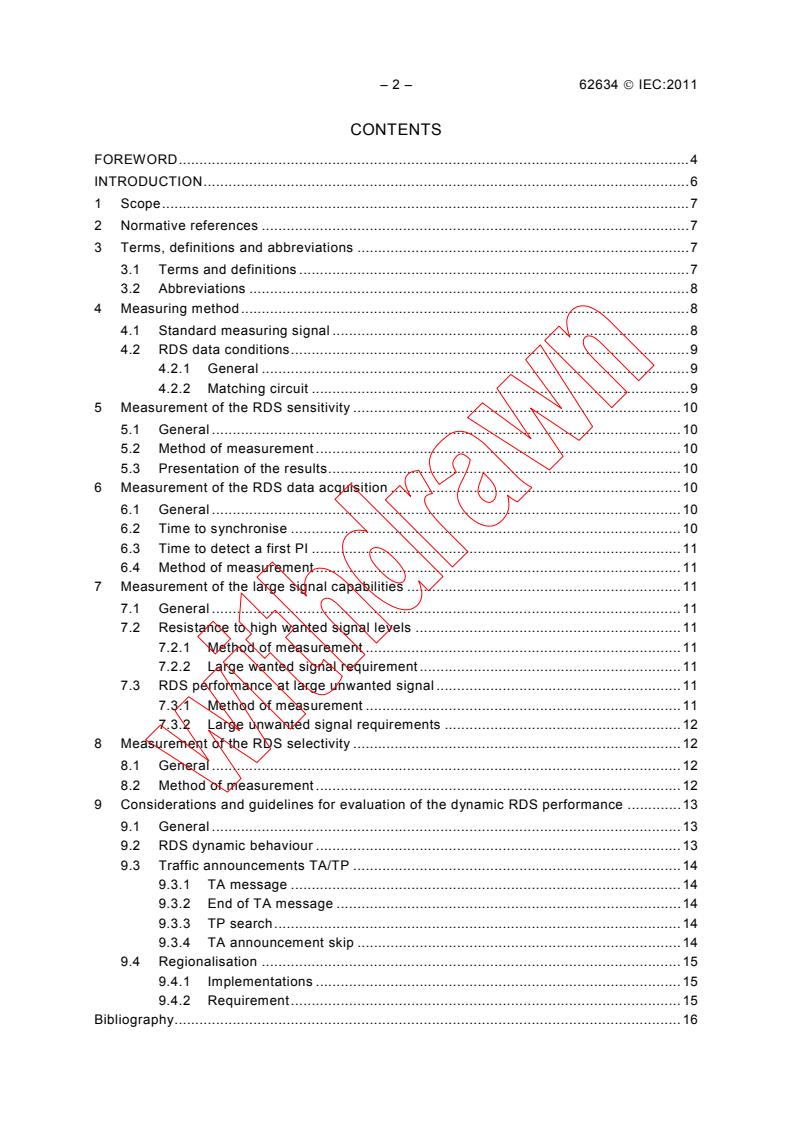
CONTENTS
FOREWORD . 4
INTRODUCTION . 6
1 Scope . 7
2 Normative references . 7
3 Terms, definitions and abbreviations . 7
3.1 Terms and definitions . 7
3.2 Abbreviations . 8
4 Measuring method . 8
4.1 Standard measuring signal . 8
4.2 RDS data conditions . 9
4.2.1 General . 9
4.2.2 Matching circuit . 9
5 Measurement of the RDS sensitivity . 10
5.1 General . 10
5.2 Method of measurement . 10
5.3 Presentation of the results . 10
6 Measurement of the RDS data acquisition . 10
6.1 General . 10
6.2 Time to synchronise . 10
6.3 Time to detect a first PI . 11
6.4 Method of measurement . 11
7 Measurement of the large signal capabilities . 11
7.1 General . 11
7.2 Resistance to high wanted signal levels . 11
7.2.1 Method of measurement . 11
7.2.2 Large wanted signal requirement . 11
7.3 RDS performance at large unwanted signal . 11
7.3.1 Method of measurement . 11
7.3.2 Large unwanted signal requirements . 12
8 Measurement of the RDS selectivity . 12
8.1 General . 12
8.2 Method of measurement . 12
9 Considerations and guidelines for evaluation of the dynamic RDS performance . 13
9.1 General . 13
9.2 RDS dynamic behaviour . 13
9.3 Traffic announcements TA/TP . 14
9.3.1 TA message . 14
9.3.2 End of TA message . 14
9.3.3 TP search . 14
9.3.4 TA announcement skip . 14
9.4 Regionalisation . 15
9.4.1 Implementations . 15
9.4.2 Requirement . 15
Bibliography . 16
62634 IEC:2011 – 3 –
Figure 1 – Coupling circuit . 9
Figure 2 – Matching circuits for RDS product devices with three different input
impedances . 9
Table 1 – Presentation of the measurement result . 12
Table 2 – AF example . 15
– 4 – 62634 IEC:2011
INTERNATIONAL ELECTROTECHNICAL COMMISSION
____________
RADIO DATA SYSTEM (RDS) –
RECEIVER PRODUCTS AND CHARACTERISTICS –
METHODS OF MEASUREMENT
FOREWORD
1) The International Electrotechnical Commission (IEC) is a worldwide organization for standardization comprising
all national electrotechnical committees (IEC National Committees). The object of IEC is to promote
international co-operation on all questions concerning standardization in the electrical and electronic fields. To
this end and in addition to other activities, IEC publishes International Standards, Technical Specifications,
Technical Reports, Publicly Available Specifications (PAS) and Guides (hereafter referred to as “IEC
Publication(s)”). Their preparation is entrusted to technical committees; any IEC National Committee interested
in the subject dealt with may participate in this preparatory work. International, governmental and non-
governmental organizations liaising with the IEC also participate in this preparation. IEC collaborates closely
with the International Organization for Standardization (ISO) in accordance with conditions determined by
agreement between the two organizations.
2) The formal decisions or agreements of IEC on technical matters express, as nearly as possible, an international
consensus of opinion on the relevant subjects since each technical committee has representation from all
interested IEC National Committees.
3) IEC Publications have the form of recommendations for international use and are accepted by IEC National
Committees in that sense. While all reasonable efforts are made to ensure that the technical content of IEC
Publications is accurate, IEC cannot be held responsible for the way in which they are used or for any
misinterpretation by any end user.
4) In order to promote international uniformity, IEC National Committees undertake to apply IEC Publications
transparently to the maximum extent possible in their national and regional publications. Any divergence
between any IEC Publication and the corresponding national or regional publication shall be clearly indicated in
the latter.
5) IEC itself does not provide any attestation of conformity. Independent certification bodies provide conformity
assessment services and, in some areas, access to IEC marks of conformity. IEC is not responsible for any
services carried out by independent certification bodies.
6) All users should ensure that they have the latest edition of this publication.
7) No liability shall attach to IEC or its directors, employees, servants or agents including individual experts and
members of its technical committees and IEC National Committees for any personal injury, property damage or
other damage of any nature whatsoever, whether direct or indirect, or for costs (including legal fees) and
expenses arising out of the publication, use of, or reliance upon, this IEC Publication or any other IEC
Publications.
8) Attention is drawn to the Normative references cited in this publication. Use of the referenced publications is
indispensable for the correct application of this publication.
9) Attention is drawn to the possibility that some of the elements of this IEC Publication may be the subject of
patent rights. IEC shall not be held responsible for identifying any or all such patent rights.
International Standard IEC 62634 has been prepared by technical area 1: Terminals for audio,
video and data services and content, of IEC technical committee 100: Audio, video and
multimedia systems and equipment.
International Standard IEC 62634 cancels and replaces IEC 60315-9, published in 1996, and
constitutes a technical revision.
This edition includes the following significant technical changes with respect to IEC 60315-9:
– use of state-of-the-art measuring methods based on today’s RDS products,
– provision of realistic performance targets,
– is complementary to RDS standard IEC 62106 (2009),
– it covers the challenging RDS receiving conditions “weak signal”, “adjacent channel” and
“strong signal” to verify the required RDS sensitivity and selectivity for three different RDS
product categories.
62634 IEC:2011 – 5 –
The text of this standard is based on the following documents:
FDIS Report on voting
100/1813/FDIS 100/1850/RVD
Full information on the voting for the approval of this standard can be found in the report on
voting indicated in the above table.
This publication has been drafted in accordance with the ISO/IEC Directives, Part 2.
The committee has decided that the contents of this publication will remain unchanged until
the stability date indicated on the IEC web site under "http://webstore.iec.ch" in the data
related to the specific publication. At this date, the publication will be
• reconfirmed,
• withdrawn,
• replaced by a revised edition, or
• amended.
– 6 – 62634 IEC:2011
INTRODUCTION
This International Standard gives commonly agreed measuring methods to complement the
RDS standard IEC 62106 (2009) and the RBDS standard (NRSC-4-A) in the USA.
The RDS measuring methods presented here are directed at all manufacturers of RDS
receiver products, and in particular tuner modules with embedded RDS functionality, including
TMC (see ISO 14819 series of standards).
62634 IEC:2011 – 7 –
RADIO DATA SYSTEM (RDS) –
RECEIVER PRODUCTS AND CHARACTERISTICS –
METHODS OF MEASUREMENT
1 Scope
This International Standard describes how to measure minimum RDS receiver performance
requirements which concern three RDS receiver product categories. However, it should be
noted that there are also RDS receiver products on the market that significantly out-perform
the minimum RDS receiver performance requirements quoted.
Methods and algorithms to achieve automatic programme service-following by means of AF
lists are, however, very customer- and manufacturer-specific, and are therefore not covered in
this standard.
2 Normative references
The following referenced documents are indispensable for the application of this document.
For dated references, only the edition cited applies. For undated references, the latest edition
of the referenced document (including any amendments) applies.
IEC 62106:2009, Specification of the radio data system (RDS) for VHF/FM sound
broadcasting in the frequency range from 87,5 MHz to 108,0 MHz
3 Terms, definitions and abbreviations
3.1 Terms and definitions
For the purpose of this document, the following terms and definitions apply.
3.1.1
RDS product category 1
RDS receiver product with high-ohmic input impedance (e.g.for portable devices)
3.1.2
RDS product category 2
RDS receiver product with 50 Ω input impedance (e.g.car radio optimized for active antenna)
3.1.3
RDS product category 3
RDS receiver product with 75 Ω input impedance (e.g. car radio optimized for rod antenna or
home receiver)
3.1.4
RDS reception
the signal at which the RDS signal is received with 50 % non-corrected error-free blocks; in
practice, the level at which the TP bit is immediately detected
3.1.5
large signal behaviour
capability of the RDS receiver to fulfil its function at or in the neighbourhood of strong FM
signals
– 8 – 62634 IEC:2011
3.1.6
RDS selectivity
capability of the RDS receiver to cope with adjacent signals at both sides of the tuning
frequency: ± 100 kHz, ± 200 kHz
3.2 Abbreviations
For the purpose of this document, the following abbreviations apply.
AF Alternative Frequency
dBμV Signal level in μV; 0 dBμV = 1 μV, 6 dBμV = 2 μV, 20 dBμV = 10 μV
EON Enhanced Other Networks information
FM Frequency Modulation
GUI Graphic User Interface
IPR Intellectual Property Rights
PI Programme Identification
PND Personal Navigation Device
PS Programme Service name
PTY Programme TYpe
RDS Radio Data System
RBDS USA Radio Data System
S+100 Unwanted signal, +100 kHz offset from the wanted signal
S−100 Unwanted signal, −100 kHz offset from the wanted signal
TA/TP Traffic Announcement/Traffic Programme
TMC Traffic Message Channel
4 Measuring method
4.1 Standard measuring signal
Unless otherwise stated, the following measuring signal shall be applied.
• Tuning Frequency 97,1 MHz
• Signal input level V 60 dBµV
i
• Deviation Δf 22,5 kHz
• Modulation frequency F 1 kHz
mod
• Pilot 19 kHz deviation 6,75 kHz
• Modulation method L = R
• Deviation RDS carrier Δf 2 kHz
RDS
• De-emphasis 50 µs (USA: 75 µs)
Where an unwanted signal will be added, for RDS car radio selectivity measurements, this will
be done with the coupling circuit shown in Figure 1. The circuit shows how to couple two
generators with 50 Ω output so that the total output impedance remains 50 Ω. Depending on
the input impedance, one of the matching circuits shown in Figure 2 should be applied in
addition.
—————————
See NRSC-4-A, RBDS standard cited in the Bibliography.
62634 IEC:2011 – 9 –
50 Ω 16,7 Ω
16,7 Ω
Car radio
G
V1
EMF
50 Ω 16,7 Ω
50 Ω
G
V2
EMF
IEC 1097/11
Coupling circuit to be used to add the unwanted signal V2 for two signal measurements of
EMF
an RDS product.
Figure 1 – Coupling circuit
4.2 RDS data conditions
4.2.1 General
The RDS data shall consist of an appropriate PI code, a PS name, one or more AFs and
chosen values for, e.g. TP (=1), DI (=0000), TA (=0), PTY (=00001) and M/S (=1), with a
maximum repetition rate for group type 0A of four groups per second. Use group type A only.
4.2.2 Matching circuit
For the three types of RDS product devices (modules for portable devices, car radio and
home receiver), the matching circuit is given in Figure 2.
RDS RDS
product product
50 Ω 50 Ω
R R
i i
G G
50 Ω
x kΩ
V V V V
EMF i EMF i
RDS device with RDS device with
high input impedance
50 Ω input impedance
RDS
product
50 Ω 10 Ω 45 Ω
R
i
G
60 Ω
75 Ω
V V
EMF i
RDS device with
75 Ω input impedance
IEC 1098/11
Figure 2 – Matching circuits for RDS product devices
with three different input impedances
– 10 – 62634 IEC:2011
RF generators have a characteristic impedance of 50 Ω. For a device with an input impedance
of 50 Ω, no additional matching circuit is needed. The antenna input signal V is then
i
V − 6 dB. In case of a category 1 device like a PND, which generally has a high input
EMF
impedance, V is then almost equal to the generator voltage V . When the input impedance
i EMF
cannot be ignored in relation to the 50 Ω generator impedance, the correction shall be
calculated separately.
Example: For a device with 2 kΩ input impedance this will give V = V × 2 000/(2 000 + 50)
i EMF
and in dBµV this yields V dBµV = V dBµV − 0,2 dBµV.
i EMF
5 Measurement of the RDS sensitivity
5.1 General
The lowest FM input signal is determined for which RDS reception is obtained.
5.2 Method of measurement
The receiver and the signal source are operated under standard measuring conditions,
according to 4.1.
a) When a GUI is available, which is capable of measuring good and bad blocks, then a
reading of 50 % good blocks is an accurate result for the sensitivity measurement. The
ratio should be calculated over at least 2 000 receivable blocks.
b) A good alternative in the case, where a GUI and statistical read-out is not available to
measure the level of correctly received RDS blocks, is the TP flag.
Turn the signal level up until 50 % error free RDS blocks are received. Alternatively, turn the
signal level up until the TP flag lights up. Repeat this three times and take the average value
of these three observations.
NOTE If the TP flag cannot be displayed, then the complete PS can be used instead. However, care should be
taken that a new programme service name is entered into the RDS encoder each time a new measurement is done.
The new programme service name shall differ from the previous one in all eight characters.
5.3 Presentation of the results
The result is presented in dBµV
Minimum receiver sensitivity requirement: RDS product category 1 21 dBµV
RDS product category 2 18 dBµV
RDS product category 3 18 dBµV
6 Measurement of the RDS data acquisition
6.1 General
Particularly for tuner modules or circuits with RDS fully integrated for mobile use, it is
important to know the time to synchronize after a re-tune. Strongly related to this is the time
to receive the PI code for the first time.
6.2 Time to synchronise
When tuned to an FM-RDS station, it is important to have RDS synchronisation immediately.
62634 IEC:2011 – 11 –
Taking into account the synchronising time of the system and the recognition of at least two
consecutive RDS blocks, the time to synchronise RDS shall be maximum 120 ms, 80 % over
100 measurements.
6.3 Time to detect a first PI
In addition to the time to synchronise, it is often required to specify the time to detect the PI
code for the first time. There is a fixed relationship between both, the PI code is present in
block A of all groups and in block C’ of the B groups. The maximum time shall not exceed
180 ms. A value of 160 ms shall not be exceeded in 80 % over 100 measurements.
6.4 Method of measurement
The tuner module or receiver and the signal source are operated under standard measuring
conditions, according to 4.1.
The RDS monitor program on the PC screen shall provide the information of time needed to
synchronise. Tune from a frequency higher and a frequency lower than the wanted frequency
of 97,1 MHz. (Tuning should be from both sides of the wanted frequency, because the
behaviour can be different). Read out the value for the time needed to synchronise and the
time needed to read the PI code.
Repeat this at least 100 times. 80 % of the results shall then be below the minimum
requirements.
The following minimum requirements apply.
• Time to synchronise 120 ms
• Time to PI detection 160 ms
7 Measurement of the large signal capabilities
7.1 General
The two issues to be dealt with are the following.
a) The product shall be resistant to high signal levels of the wanted frequency.
b) RDS decoding shall work correctly in the presence of strong FM signals other than the
wanted one.
7.2 Resistance to high wanted signal levels
7.2.1 Method of measurement
The tuner module or receiver and the signal source are operated under standard measuring
conditions, according to 4.1; turn the input signal level up until 120 dBµV.
7.2.2 Large wanted signal requirement
No defects shall occur.
7.3 RDS performance at large unwanted signal
7.3.1 Method of measurement
The tuner module or receiver and the signal source are operated under standard measuring
conditions according to 4.1. In addition, one of the signals according to Table 1 is added.
– 12 – 62634 IEC:2011
Table 1 – Presentation of the measurement result
Wanted frequency Unwanted frequency Result
97,1 MHz 91,1 MHz ____ dBµV
RDS sensitivity level
+6 dB
103,1 MHz ____ dBµV
The wanted and unwanted signals are applied simultaneously by means of a combining
network in accordance with 4.1. Adjust the RF level of the wanted frequency to the RDS
sensitivity level (50 % correct RDS blocks) without the unwanted signal. Add 6 dB to this level.
Adjust the unwanted strong signal until the RDS sensitivity level of 50 % correct blocks is
reached again.
7.3.2 Large unwanted signal requirements
The following are minimum large unwanted signal requirements:
• RDS product category 1 RDS reception at 50 % correct blocks 60 dBµV
• RDS product category 2 and 3 RDS reception at 50 % correct blocks 88 dBµV
8 Measurement of the RDS selectivity
8.1 General
RDS selectivity: The capability of the RDS receiver to cope with adjacent signals at both sides
of the tuning frequency: ± 100 kHz, ± 200 kHz.
8.2 Method of measurement
The wanted and unwanted signals are applied simultaneously by means of a combining
network in accordance with Figure 1. Adjust the RF level of the wanted frequency without the
unwanted signal to the RDS sensitivity level (50 % correct RDS blocks).
Add 6 dB to this level.
Add the unwanted frequency: Tuned wanted frequency with a distance of ± 100 kHz,
± 200 kHz
Deviation Δf 22,5 kHz
Modulation frequency F 1 kHz
mod
Modulation method L = R
De-emphasis 50 µs (USA: 75 µs)
Check the RDS reception. Adjust the unwanted signal until the RDS sensitivity level of 50 %
error-free blocks is reached again.
The level of the unwanted signal related to the wanted signal in dB is presented as
S+100, S-100, S+200, S-200 RDS selectivity.
The following are minimum RDS selectivity requirements:
62634 IEC:2011 – 13 –
• RDS product category 1: S ± 100 2 dB, S ± 200 32 dB
• RDS product category 2: S ± 100 4 dB, S ± 200 50 dB
• RDS product category 3: S ± 100 4 dB, S ± 200 50 dB
9 Considerations and guidelines for evaluation of the dynamic RDS
performance
9.1 General
The issues in this clause are highly significant for a well performing RDS product, mostly car
radios. However, clear performance values and levels cannot be given, because of
manufacturer and/or customer specific implementations. Therefore a set of general
considerations and guidelines is given here with the view to help to evaluate the dynamic
RDS performance in the products concerned.
9.2 RDS dynamic behaviour
An ideal RDS radio switches in time inaudibly over to an alternative frequency (AF) with the
best audio quality. Variations in sound should not occur.
Car radio manufacturers have developed algorithms to achieve this in the best possible way.
Therefore objective criteria or switching levels will not be specified, as they are often subject
to IPR. In this standard a few key criteria are nevertheless given, which will need to be taken
into account, where applicable, in order to ensure a proper dynamic behaviour of the RDS
product.
a) Signal level of an AF in relation to the tuned frequency.
b) Multipath distortion: Distortion of the audio, caused by reflections, like in mountainous
areas.
c) Noise: Unwanted signals in higher parts of the audio spectrum, generally coming from
adjacent FM channels.
d) RDS reception: The number of correctly received RDS blocks; valid for the tuned
frequency only. This is also relevant for TMC reception.
A radio will receive either single (Method A) or multiple (Method B) AF list(s). The order, in
which these AFs are stored and used, is manufacturer specific. Important is, however, that the
radio checks these AFs at certain intervals, to identify their quality, taking those first three
criteria mentioned above into account. All modern tuners nowadays offer the possibility of
doing these AF checks in an almost “inaudible” way. When the overall signal quality of an AF
from the list becomes better than the currently tuned frequency, then the radio shall switch to
this better AF.
Correct processing of the PI code: Before releasing the audio of the new frequency however,
first a PI check shall be made in order to verify that the new frequency carries indeed the
same wanted radio programme.
Manufacturers of car radios have developed and optimized over the years algorithms to adapt
the dynamic RDS performance to most challenging receiving conditions. We have to consider
here mountainous areas, tunnel roads and areas with a poor coverage. Quite often the AF
lists are exceeding 25 AF or sometimes even 30 AFs.
RDS car radios that are capable to cope with these complex receiving conditions, can well
make the difference in comparison to more average or poor and not so well performing radios.
The car industry has been deeply involved in evaluating this process.
Simulations on the bench may give only a first impression and show, if the most basic
functions will work properly. However, the real dynamic RDS performance at these
– 14 – 62634 IEC:2011
challenging conditions can only be validated at critical locations and on the roads, where such
critical receiving conditions then really occur.
A simple bench test can start with only two or three generators with programmable AF lists, to
make sure that the radio will at least “recognise” each generator, when tuned to just one of
them. By varying the signal level or introducing multipath or noise distortion to the tuned
frequency (= generator), the radio shall look for the best alternative frequency (= one of the
other generators) and then switch accordingly.
9.3 Traffic announcements TA/TP
9.3.1 TA message
The following customer requirements apply.
• The radio shall detect a Traffic announcement (TA) on the tuned programme (TP) or one
of the cross-linked programmes via EON. The radio shall switch to the TA message from
any source currently in use.
• During a TA, the display indication and the volume level are either product specific or
customer adjustable.
9.3.2 End of TA message
After the TA message, the radio shall return to the previous status.
When, during the traffic message, RDS synchronization is lost, the radio shall return to the
previous situation within a fixed period. A practical value is 2 min.
9.3.3 TP search
When a TP or TP/EON search is started, it will be done according to the following criteria.
The radio stops at the first station, which corresponds to TP = 1 being present in all groups or
TP/EON being signalled in the type 0A group.
According to the following status of the TP and TA flags in the 0A group, i.e. TP = 1 and TA =
0, or TP = 0 and TA = 1 or TP = 1 and TA = 1, a traffic announcement is currently on air, or
not.
NOTE A TP search action can typically be initiated in 3 different ways:
a) the user switches on the TP or TP/EON function and the radio is currently not tuned to a TP or TP/EON station;
b) the user starts a search action while the TP or TP/EON function is active;
c) the radio is tuned to a TP or TP/EON station and the RF signal level drops below the RDS synchronization level
AND the current audio source is not the radio, but, for instance, a CD or MP3 or….
If in case c) the audio source is radio, the search action may not be automatically initiated by the radio itself as
the audio quality may well be at an acceptable level when RDS synchronization is lost. When this situation
occurs it might be very confusing to the customer if the radio would start a search action while the audio quality
is still at an acceptable level.
9.3.4 TA announcement skip
A current TA message can be interrupted at customer request. The next TA message will,
however, be passed on, when the TA receiving mode remains on.
62634 IEC:2011 – 15 –
9.4 Regionalisation
9.4.1 Implementations
Regional services use PI codes that are identical in the first, third and fourth-nibbles, but have
different second-nibbles in the range 4 to F (Region 1 to 12). Broadcasters may split during
certain periods of the day their supra-regional network into a maximum of 12 regional
networks. In Austria, Germany and Switzerland this regionalisation feature is very widely used.
The PI code structure will be x3yz, and when regionalized, the second PI segment may
change then from 3 into 4 to F. Often the PS name also changes dynamically, to communicate
the regional status to the listener, i.e. BAYERN1 becomes BR1 MUN, when regional.
Another public broadcaster in Germany uses the concept of regionalisation completely static,
i.e. the area codes in the second PI segment are kept as one value from the code range 4 to
F and the PS name also remains unchanged and refers to the region. In this configuration
there can be a supra-regional common radio programme for certain hours of the day, without
using the supra-regional code 3 at all in the second PI segment.
AF method B lists give all AFs in frequency pairs, with the parent frequency in ascending or
descending order, indicating then also the regional variants for that radio tuned programme.
The tuning frequency is given in the header of the list. Table 2 illustrates this issue.
Table 2 – AF example
F F
1 2
# 11 89,3 Total number (11) of frequencies for tuning frequency (89,3)
F > F hence 99,5 is an AF of tuned 89,3 and is the same programme
89,3 99,5
2 1
F > F hence 101,7 is an AF of tuned 89,3 and is the same programme
89,3 101,7
2 1
F > F hence 88,7 is an AF of tuned 89,3 and is the same programme
88,7 89,3
2 1
F < F hence 102,5 is an AF of the regional programme variant for tuned 89,3
102,5 89,3
2 1
F < F hence 89,1 is an AF of the regional programme variant for tuned 89,5
89,5 89,1
2 1
9.4.2 Requirement
Although various product and customer specific implementations may exist, RDS radios shall
manage and store PI codes and dynamically change their structure into regional programme
variants in a proper way.
The AF list shall be structured in such a way that a distinction is given between the AFs
belonging really to the same supra-regional PI and the ones belonging to the associated
programmes, whose PI differs then only in the second PI segment.
– 16 – 62634 IEC:2011
Bibliography
IEC 60315-9:1996, Methods of measurement on radio receivers for various classes of
emission – Part 9: Measurements of the characteristics relevant to radio data system (RDS)
reception
ISO 14819 (all parts), Traffic and Traveller Information (TTI) – TTI Messages via Traffic
Message Coding
NRSC-4-A, National Radio Systems Committee: United States RBDS standard – Specification
of the radio broadcast data system (RBDS)
Kopitz, D. and Marks,B., RDS – The Radio Data System, published by Artech House
Publishers, Boston and London, 1999, ISBN 0-89006-744-9
____________
– 18 – 62634 CEI:2011
SOMMAIRE
AVANT-PROPOS . 20
INTRODUCTION . 22
1 Domaine d'application . 23
2 Références normatives . 23
3 Termes, définitions et abréviations . 23
3.1 Termes et définitions . 23
3.2 Abréviations . 24
4 Méthode de mesure . 24
4.1 Signal normalisé pour les mesures . 24
4.2 Conditions pour les données RDS . 25
4.2.1 Généralités . 25
4.2.2 Circuit d’adaptation. 25
5 Sensibilité RDS . 26
5.1 Généralités. 26
5.2 Méthode de mesure . 26
5.3 Présentation des résultats . 27
6 Acquisition de données RDS . 27
6.1 Généralités. 27
6.2 Temps de synchronisation . 27
6.3 Temps nécessaire à la détection d’un premier code PI . 27
6.4 Méthode de mesure . 27
7 Comportement en signal fort. 28
7.1 Généralités. 28
7.2 Résistance aux niveaux forts du signal utile . 28
7.2.1 Méthode de mesure . 28
7.2.2 Exigence pour un signal fort de signal utile . 28
7.3 Performance RDS à un signal perturbateur de niveau fort . 28
7.3.1 Méthode de mesure . 28
7.3.2 Exigences vis-à-vis d'un perturbateur de niveau fort . 28
8 Sélectivité RDS . 29
8.1 Généralités. 29
8.2 Méthode de mesure . 29
9 Remarques sur les performances dynamiques du RDS et indications sur leur
évaluation . 29
9.1 Généralités. 29
9.2 Comportement dynamique RDS . 29
9.3 Flashs d’informations routières TA/TP . 30
9.3.1 Message d’informations routières . 30
9.3.2 Fin de message TA . 31
9.3.3 Recherche de TP . 31
9.3.4 Saut d’un flash TA . 31
9.4 Régionalisation . 31
9.4.1 Mises en œuvre . 31
9.4.2 Exigence . 32
Figure 1 – Circuit de couplage . 25
62634 CEI:2011 – 19 –
Figure 2 – Circuits d’adaptation pour les trois catégories de récepteurs . 26
Tableau 1 – Présentation du résultat de mesure . 28
Tableau 2 – Exemple d’AF . 32
– 20 – 62634 CEI:2011
COMMISSION ÉLECTROTECHNIQUE INTERNATIONALE
____________
SYSTÈME DE RADIODIFFUSION DE DONNÉES –
CARACTÉRISTIQUES ET MÉTHODES DE MESURE
DES RÉCEPTEURS RDS
AVANT-PROPOS
1) La Commission Electrotechnique Internationale (CEI) est une organisation mondiale de normalisation
composée de l'ensemble des comités électrotechniques nationaux (Comités nationaux de la CEI). La CEI a
pour objet de favoriser la coopération internationale pour toutes les questions de normalisation dans les
domaines de l'électricité et de l'électronique. A cet effet, la CEI – entre autres activités – publie des Normes
internationales, des Spécifications techniques, des Rapports techniques, des Spécifications accessibles au
public (PAS) et des Guides (ci-après dénommés "Publication(s) de la CEI"). Leur élaboration est confiée à des
comités d'études, aux travaux desquels tout Comité national intéressé par le sujet traité peut participer. Les
organisations internationales, gouvernementales et non gouvernementales, en liaison avec la CEI, par
...