

IEC 62571:2011
(Main)Digital audiobook file format and player requirements
General Information
- Abstract
IEC 62571:2011 defines requirements and provides recommendations to publishers, software developers, content providers, and hardware manufacturers for the data structure, usability requirements, playback systems and delivery systems for audiobooks in digital file format. It should be noted that throughout this International Standard, the term audiobook is defined as any audio file or collection of audio files of primarily spoken word content that are played in a linear or specified order. Therefore, spoken word audio with occasional music, a narration of newspaper articles, or other similar spoken word audio is assimilated to audiobooks in this standard. This bilingual version (2011-07) replaces the English version.
- Status
- Published
- Publication Date
- 28-Mar-2011
- Technical Committee
- TC 100 - Audio, video and multimedia systems and equipment
- Current Stage
- PPUB - Publication issued
- Start Date
- 29-Mar-2011
- Completion Date
- 31-May-2011
Buy Documents
IEC 62571:2011 - Digital audiobook file format and player requirements Released:3/29/2011


IEC 62571:2011 - Digital audiobook file format and player requirements Released:3/29/2011
Overview
IEC 62571:2011 - Digital audiobook file format and player requirements defines requirements and recommendations for creating, packaging and delivering digital audiobooks. Intended for publishers, software developers, content providers and hardware manufacturers, the standard specifies the data structures, usability and playback behaviors needed to ensure interoperable audiobook files and conformant players. The term “audiobook” in this standard covers primarily spoken‑word audio (including narration with occasional music or news-read formats). This 2011 bilingual edition replaces the earlier English version.
Key topics
The standard organizes technical requirements into structured elements and profiles; major topics include:
- File structure and containers - Definitions for audiobook headers, book records, levels and extendable structures (fixed/variable chunks, offsets and tags) that make up a conformant digital audiobook file.
- Playlist and TOC (Table of Contents) - How playlists, track entries and hierarchical levels map to linear playback and navigation.
- Metadata and identifiers - Use of UUIDs, ISBN/ISSN/DOI, Dublin Core and MPV‑Audiobook profile metadata to support discovery, rights and cataloguing.
- MPV audiobook profiles and XML schemas - MPV‑Audiobook manifest rules, namespaces and how MPV‑Music profiles may be reused for audiobook assets.
- Playback and player requirements - Functional and conformance requirements for players (seek, resume, bookmarks, background/foreground playback, playlist handling).
- Interoperability with other specifications - Mapping and comparisons to CEA‑2003‑C and use of MPV core extensions for audiobook contexts.
- Usability and delivery systems - Recommendations for user interaction, accessibility and delivery mechanisms across platforms and devices.
Practical applications and users
IEC 62571 is practical for anyone building audiobook ecosystems:
- Publishers and content producers - to package audiobooks with standardized metadata, TOCs and identifiers for broad distribution.
- Software developers (players, platforms) - to implement playback features, bookmarking, metadata parsing and MPV manifest support for compatibility.
- Content delivery and distribution services - to validate file structure and ensure consistent behavior across devices and apps.
- Hardware manufacturers (media players, e‑readers) - to ensure device firmware supports required playback semantics and file formats.
- Libraries, accessibility services and aggregators - to maintain discoverability, accessibility and reliable user navigation.
Related standards
- MPV (MPV‑Music / MPV‑Core) profiles and XML schemas referenced in the standard.
- CEA‑2003‑C mapping noted for binary-to-XML tag comparisons.
- Dublin Core metadata for descriptive elements.
Keywords: IEC 62571:2011, digital audiobook file format, audiobook player requirements, MPV audiobook, audiobook metadata, playback systems, delivery systems.
Buy Documents
IEC 62571:2011 - Digital audiobook file format and player requirements Released:3/29/2011
IEC 62571:2011 - Digital audiobook file format and player requirements Released:3/29/2011
Get Certified
Connect with accredited certification bodies for this standard

BSI Group
BSI (British Standards Institution) is the business standards company that helps organizations make excellence a habit.

NYCE
Mexican standards and certification body.

ANCE
Mexican certification and testing association.
Sponsored listings
Frequently Asked Questions
IEC 62571:2011 is a standard published by the International Electrotechnical Commission (IEC). Its full title is "Digital audiobook file format and player requirements". This standard covers: IEC 62571:2011 defines requirements and provides recommendations to publishers, software developers, content providers, and hardware manufacturers for the data structure, usability requirements, playback systems and delivery systems for audiobooks in digital file format. It should be noted that throughout this International Standard, the term audiobook is defined as any audio file or collection of audio files of primarily spoken word content that are played in a linear or specified order. Therefore, spoken word audio with occasional music, a narration of newspaper articles, or other similar spoken word audio is assimilated to audiobooks in this standard. This bilingual version (2011-07) replaces the English version.
IEC 62571:2011 defines requirements and provides recommendations to publishers, software developers, content providers, and hardware manufacturers for the data structure, usability requirements, playback systems and delivery systems for audiobooks in digital file format. It should be noted that throughout this International Standard, the term audiobook is defined as any audio file or collection of audio files of primarily spoken word content that are played in a linear or specified order. Therefore, spoken word audio with occasional music, a narration of newspaper articles, or other similar spoken word audio is assimilated to audiobooks in this standard. This bilingual version (2011-07) replaces the English version.
IEC 62571:2011 is classified under the following ICS (International Classification for Standards) categories: 33.160.60 - Multimedia systems and teleconferencing equipment; 35.240.30 - IT applications in information, documentation and publishing. The ICS classification helps identify the subject area and facilitates finding related standards.
IEC 62571:2011 is available in PDF format for immediate download after purchase. The document can be added to your cart and obtained through the secure checkout process. Digital delivery ensures instant access to the complete standard document.
Standards Content (Sample)
IEC 62571 ®
Edition 1.0 2011-03
INTERNATIONAL
STANDARD
Digital audiobook file format and player requirements
All rights reserved. Unless otherwise specified, no part of this publication may be reproduced or utilized in any form
or by any means, electronic or mechanical, including photocopying and microfilm, without permission in writing from
either IEC or IEC's member National Committee in the country of the requester.
If you have any questions about IEC copyright or have an enquiry about obtaining additional rights to this publication,
please contact the address below or your local IEC member National Committee for further information.
IEC Central Office
3, rue de Varembé
CH-1211 Geneva 20
Switzerland
Email: inmail@iec.ch
Web: www.iec.ch
About the IEC
The International Electrotechnical Commission (IEC) is the leading global organization that prepares and publishes
International Standards for all electrical, electronic and related technologies.
About IEC publications
The technical content of IEC publications is kept under constant review by the IEC. Please make sure that you have the
latest edition, a corrigenda or an amendment might have been published.
Catalogue of IEC publications: www.iec.ch/searchpub
The IEC on-line Catalogue enables you to search by a variety of criteria (reference number, text, technical committee,…).
It also gives information on projects, withdrawn and replaced publications.
IEC Just Published: www.iec.ch/online_news/justpub
Stay up to date on all new IEC publications. Just Published details twice a month all new publications released. Available
on-line and also by email.
Electropedia: www.electropedia.org
The world's leading online dictionary of electronic and electrical terms containing more than 20 000 terms and definitions
in English and French, with equivalent terms in additional languages. Also known as the International Electrotechnical
Vocabulary online.
Customer Service Centre: www.iec.ch/webstore/custserv
If you wish to give us your feedback on this publication or need further assistance, please visit the Customer Service
Centre FAQ or contact us:
Email: csc@iec.ch
Tel.: +41 22 919 02 11
Fax: +41 22 919 03 00
IEC 62571 ®
Edition 1.0 2011-03
INTERNATIONAL
STANDARD
Digital audiobook file format and player requirements
INTERNATIONAL
ELECTROTECHNICAL
COMMISSION
PRICE CODE
XD
ICS 33.160.60; 35.240.30 ISBN 978-2-88912-426-8
– 2 – 62571 IEC:2011(E)
CONTENTS
FOREWORD . 7
1 Scope . 9
2 Normative references . 9
3 General . 9
4 MultiAudio audiobook extensions . 11
4.1 Table of contents . 11
4.2 Description . 14
4.2.1 General . 14
4.2.2 Tag.Identifier . 14
4.2.3 Tag.OrdinalNumber . 14
4.2.4 Tag.Reserved . 14
4.2.5 Tag.Length . 14
4.2.6 Data . 14
5 Audiobook extendable structure (AB_ExtStruct) . 15
5.1 General . 15
5.2 Tag . 15
5.3 Offset to extra data. 15
5.4 Fixed length chunk (AB_FixedChunk) . 15
5.4.1 General . 15
5.4.2 Example . 16
5.5 Variable length chunk (AB_VariableChunk) . 16
5.5.1 General . 16
5.5.2 Example . 17
5.6 Extra data . 18
6 Audiobook header (AB_Header) . 18
6.1 General . 18
6.2 Tag . 18
6.3 AB_Header fixed chunk . 18
6.3.1 General . 18
6.3.2 Tag . 19
6.3.3 Audiobook specification major version . 19
6.3.4 Audiobook specification minor version . 19
6.3.5 Number of audiobooks (N_Bk) . 19
6.3.6 Offset to playlist indexes . 19
6.4 AB_Header variable chunk . 19
6.4.1 General . 19
6.4.2 Tag . 19
6.4.3 Playlist indexes . 20
6.5 AB_Header extra data . 20
7 Audiobook book (AB_Book) . 20
7.1 General . 20
7.2 Tag . 21
7.3 AB_Book fixed chunk . 21
7.3.1 General . 21
7.3.2 Tag . 22
62571 IEC:2011(E) – 3 –
7.3.3 Text format . 22
7.3.4 Flags . 22
7.3.5 TOC_Playlist index . 22
7.3.6 Offset to book title . 22
7.3.7 Offset to author . 22
7.3.8 Offset to narrator . 22
7.3.9 Offset to copyright statement . 22
7.3.10 Offset to audiobook UUID . 22
7.3.11 Offset to book ISBN identifier . 23
7.3.12 Offset to book ISSN identifier . 23
7.3.13 Offset to book DOI identifier . 23
7.3.14 Offset to book index number . 23
7.3.15 Offset to book shelf number . 23
7.3.16 Offset to book part number . 23
7.3.17 Offset to other identifier . 23
7.3.18 Offset to first audiobook level . 23
7.3.19 Offset to playlist content location identifier . 23
7.4 AB_Book variable chunk . 24
7.4.1 General . 24
7.4.2 Tag . 24
7.4.3 Book title . 24
7.4.4 Author . 25
7.4.5 Narrator . 25
7.4.6 Copyright Statement . 25
7.4.7 Book UUID . 25
7.4.8 Book ISBN Identifier . 25
7.4.9 Book ISSN Identifier . 25
7.4.10 Book DOI Identifier . 26
7.4.11 Book index number . 26
7.4.12 Book shelf number . 26
7.4.13 Book part number . 26
7.4.14 Other identifier . 26
7.4.15 First audiobook level . 26
7.4.16 Playlist content location identifier . 27
7.5 AB_Book extra data. 27
8 Audiobook level (AB_Level) . 27
8.1 General . 27
8.2 Tag . 28
8.3 AB_Level fixed chunk . 28
8.3.1 General . 28
8.3.2 Tag . 28
8.3.3 Text format . 29
8.3.4 Flags . 29
8.3.5 Number of sub-levels . 29
8.3.6 Level number . 29
8.3.7 TOC_TrackEntry index . 29
8.3.8 Offset to sub-level chunk . 29
8.3.9 Offset to level name . 29
8.3.10 Offset to level description . 29
– 4 – 62571 IEC:2011(E)
8.3.11 Book time offset . 29
8.3.12 Time start offset . 29
8.3.13 Time duration . 30
8.3.14 Offset to parent AB_Level . 30
8.3.15 Offset to previous AB_Level . 30
8.3.16 Offset to next AB_Level . 30
8.4 AB_Level variable chunk . 30
8.4.1 General . 30
8.4.2 Tag . 30
8.4.3 Level name . 31
8.4.4 Level description . 31
8.4.5 Sub-level chunk . 31
8.5 AB_Level extra data . 31
9 MPV audiobook profiles . 31
9.1 General . 31
9.2 XML schema namespace identifier . 32
9.3 Use of MPV-Music profile identifier . 32
9.4 Audiobook file . 33
9.5 Audiobook profile metadata . 33
9.6 MPV audiobook profile metadata . 35
9.7 Dublin core metadata usage . 39
9.8 Audiobook profile using MPV-Music playlists . 41
9.8.1 General . 41
9.8.2 Number of playlists per MPV file . 42
9.8.3 Metadata usage . 42
9.8.4 Background usage . 43
9.8.5 Foreground usage . 44
9.8.6 Related and rendition assets . 44
9.9 Groups of assets in playlists . 44
9.10 MPV-Audiobook schema details . 47
9.10.1 XML schema definition . 47
9.10.2 Audiobook metadata usage definitions . 52
9.11 Audiobook level class identifiers . 52
9.12 Audiobook BOOKMARK.AUB . 54
9.13 MPV-Audiobook-Level metadata using . 61
9.14 Music and Stills Asset . 61
9.15 MPV-Audiobook extensions to MPV-Core . 64
9.15.1 Audiobook manifest file types and extensions . 64
9.15.2 Audiobook manifest MIME media type . 64
9.16 Media types and file formats . 65
9.17 MPV-Audiobook and CEA-2003-C . 65
9.18 CEA-2003-C binary to XML formats – Tag comparison . 65
10 Conforming player and digital audiobook file format structure requirements . 66
10.1 General . 66
10.2 Player Requirements . 66
10.3 Digital audiobook file format structure requirements . 67
11 Player and digital audiobook file format structure functionality recommendations . 67
11.1 General . 67
62571 IEC:2011(E) – 5 –
11.2 Player functionality recommendations . 67
11.3 Digital audiobook file format structure functionality recommendations . 68
12 Digital audiobook file format structures and data constraints . 68
13 Additional production options . 68
13.1 ID3 tagging within MP3 files . 68
13.2 M3U playlists . 69
13.3 DAISY production options . 69
14 Certification . 69
Annex A (informative) Audiobook structure examples . 70
Annex B (normative) Encoding types and identifiers . 82
Annex C (informative) Use case and implementation examples: Spoken word audio . 83
Bibliography . 104
Figure A.1 – AB_Level structure organization in AB_Book variable length chunk area . 74
Figure A.2 – View of an audiobook AB_Level hierarchy . 76
Figure C.1 – Example 1 INDEX.AUB . 88
Figure C.2 – Example 1 TOC.MUM . 89
Figure C.3 – Example 2 INDEX.AUB . 94
Figure C.4 – Example 3 INDEX.AUB . 99
Figure C.5 – Example 4 INDEX.AUB . 103
Table 1 – Table of contents data structure . 12
Table 2 – Audiobook MultiAudio chunk format . 14
Table 3 – AB_ExtStruct format . 15
Table 4 – Example—AB_FixedChunk structure . 16
Table 5 – Example—AB_FixedChunk structure revised . 16
Table 6 – Example—AB_FixedChunk fields . 17
Table 7 – Example—AB_VariableChunk data . 17
Table 8 – AB_Header format . 18
Table 9 – AB_Header fixed chunk format . 18
Table 10 – AB_Header variable chunk format . 19
Table 11 – AB_Book format . 21
Table 12 – AB_Book fixed chunk format . 21
Table 13 – AB_Book variable chunk format . 24
Table 14 – AB_Level structure required field settings . 26
Table 15 – Playlist content location identifier field settings . 27
Table 16 – AB_Section format . 28
Table 17 – AB_Level fixed chunk format . 28
Table 18 – AB_Level variable chunk format . 30
Table 19 – Schema namespace identifier . 32
Table 20 – MPV-Music profile identifier . 32
Table 21 – MPV audiobook profile properties . 34
Table 22 – MPV audiobook profile metadata . 35
Table 23 – Dublin Core metadata (DC-NMF) . 40
– 6 – 62571 IEC:2011(E)
Table 24 – Metadata properties usage . 42
Table 25 – CEA-2003-C binary and XML formats – Tag comparison . 65
Table 26 – Examples of ID3 tags . 69
Table A.1 – Sample table of contents . 70
Table A.2 – Table of contents file structure . 71
Table A.3 – File 1 TOC_TrackEntry structure . 71
Table A.4 – File 2 TOC_TrackEntry structure . 71
Table A.5 – File 3 TOC_TrackEntry structure . 71
Table A.6 – File 4 TOC_TrackEntry structure . 72
Table A.7 – Table of contents with file time offsets . 72
Table A.8 – Example TOC_Playlist structure . 72
Table A.9 – Example AB_Book structure . 73
Table A.10 – AB_Level structure at Level 0 (audiobook) . 77
Table A.11 – AB_Level at Level 1 (chapter) . 77
Table A.12 – AB_Level at Level 1 (chapter) . 78
Table A.13 – AB_Level at Level 1 (chapter) . 78
Table A.14 – AB_Level at Level 2 (section) . 79
Table A.15 – AB_Level at Level 2 (section) . 79
Table A.16 – AB_Level at Level 2 (section) . 80
Table A.17 – AB_Level at Level 2 (section) . 80
Table A.18 – AB_Level at Level 3 (subsection) . 81
Table A.19 – AB_Level at Level 3 (subsection) . 81
Table B.1 – Hex representation and interpretation . 82
62571 IEC:2011(E) – 7 –
INTERNATIONAL ELECTROTECHNICAL COMMISSION
____________
DIGITAL AUDIOBOOK FILE FORMAT
AND PLAYER REQUIREMENTS
FOREWORD
1) The International Electrotechnical Commission (IEC) is a worldwide organization for standardization comprising
all national electrotechnical committees (IEC National Committees). The object of IEC is to promote
international co-operation on all questions concerning standardization in the electrical and electronic fields. To
this end and in addition to other activities, IEC publishes International Standards, Technical Specifications,
Technical Reports, Publicly Available Specifications (PAS) and Guides (hereafter referred to as “IEC
Publication(s)”). Their preparation is entrusted to technical committees; any IEC National Committee interested
in the subject dealt with may participate in this preparatory work. International, governmental and non-
governmental organizations liaising with the IEC also participate in this preparation. IEC collaborates closely
with the International Organization for Standardization (ISO) in accordance with conditions determined by
agreement between the two organizations.
2) The formal decisions or agreements of IEC on technical matters express, as nearly as possible, an international
consensus of opinion on the relevant subjects since each technical committee has representation from all
interested IEC National Committees.
3) IEC Publications have the form of recommendations for international use and are accepted by IEC National
Committees in that sense. While all reasonable efforts are made to ensure that the technical content of IEC
Publications is accurate, IEC cannot be held responsible for the way in which they are used or for any
misinterpretation by any end user.
4) In order to promote international uniformity, IEC National Committees undertake to apply IEC Publications
transparently to the maximum extent possible in their national and regional publications. Any divergence
between any IEC Publication and the corresponding national or regional publication shall be clearly indicated in
the latter.
5) IEC itself does not provide any attestation of conformity. Independent certification bodies provide conformity
assessment services and, in some areas, access to IEC marks of conformity. IEC is not responsible for any
services carried out by independent certification bodies.
6) All users should ensure that they have the latest edition of this publication.
7) No liability shall attach to IEC or its directors, employees, servants or agents including individual experts and
members of its technical committees and IEC National Committees for any personal injury, property damage or
other damage of any nature whatsoever, whether direct or indirect, or for costs (including legal fees) and
expenses arising out of the publication, use of, or reliance upon, this IEC Publication or any other IEC
Publications.
8) Attention is drawn to the Normative references cited in this publication. Use of the referenced publications is
indispensable for the correct application of this publication.
9) Attention is drawn to the possibility that some of the elements of this IEC Publication may be the subject of
patent rights. IEC shall not be held responsible for identifying any or all such patent rights.
International Standard IEC 62571 has been prepared by technical area 10: Multimedia e-
publishing and e-book, of IEC technical committee 100: Audio, video and multimedia systems
and equipment.
The text of this standard is based on the following documents:
CDV Report on voting
100/1543/CDV 100/1629/RVC
Full information on the voting for the approval of this standard can be found in the report on
voting indicated in the above table.
This publication has been drafted in accordance with the ISO/IEC Directives, Part 2.
– 8 – 62571 IEC:2011(E)
The committee has decided that the contents of this publication will remain unchanged until
the stability date indicated on the IEC web site under "http://webstore.iec.ch" in the data
related to the specific publication. At this date, the publication will be
• reconfirmed,
• withdrawn,
• replaced by a revised edition, or
• amended.
A bilingual version of this publication may be issued at a later date.
62571 IEC:2011(E) – 9 –
DIGITAL AUDIOBOOK FILE FORMAT
AND PLAYER REQUIREMENTS
1 Scope
This International Standard defines requirements and provides recommendations to
publishers, software developers, content providers, and hardware manufacturers for the data
structure, usability requirements, playback systems and delivery systems for audiobooks in
digital file format. It should be noted that throughout this International Standard, the term
audiobook is defined as any audio file or collection of audio files of primarily spoken word
content that are played in a linear or specified order. Therefore, spoken word audio with
occasional music, a narration of newspaper articles, or other similar spoken word audio is
assimilated to audiobooks in this standard.
2 Normative references
The following referenced documents are indispensable for the application of this document.
For dated references, only the edition cited applies. For undated references, the latest edition
of the referenced document (including any amendments) applies.
ISO/IEC 11578:1996, Information technology – Open Systems Interconnection – Remote
Procedure Call (RPC)
ISO 639-1, Codes for the representation of names of languages – Part 1: Alpha-2 code
ISO 3166-1, Codes for the representation of names of countries and their subdivisions –
Part 1: Country codes
ISO 9660:1988, Information processing – Volume and file structure of CD-ROM for
information interchange
3 General
This International Standard defines the audiobook file format structure for digital audiobook
media. Goals in creating this International Standard include compatibility with music industry
and multimedia standards as well as effectively presenting and navigating an audiobook. This
International Standard is a compilation standard that straddles early binary architectures
represented by earlier versions of CEA-2003 , and newer XML architectures represented by
the Optical Storage Technology Association’s (OSTA) MusicPhotoVideo™ ((MPV). A
conforming playback system and conforming audiobook content provides a wonderful and
highly functional reading and listening experience. The goal of this International Standard is
to create a broad, extensible standard for audiobook publishers, audiobook device
manufacturers, and audiobook software developers in order to create the best listening
experience for the audiobook consumer. An overview follows.
OSTA MultiAudio defines a binary file be placed in the root of the file format structure on a
CD/MP3. The TOC.MAU serves as the table of contents for the associated MP3 files on a
—————————
See Bibliography.
MusicPhotoVideo is the trade name of a program supplied by the Optical Storage Technology Association. This
information is given for the convenience of users of this document and does not constitute an endorsement by
IEC of the program named.
– 10 – 62571 IEC:2011(E)
compliant CD/MP3. Conforming MultiAudio players read this file to obtain the information the
player needs to present the content to the listener.
OSTA MPV defines an eXtensible Markup Language (XML) schema to be placed in the root of
the file format structure. The INDEX.AUB serves as the table of contents for the associated
audiobook files, regardless of media, codec, or delivery type. Conforming MPV players read
this file to obtain the information the player needs to present the content to the listener.
Audiobooks conforming to this standard MUST utilize the audiobook-specific file
extension, .AUB. In addition, audiobooks conforming to this standard may utilize the same
MPV file extension specified by the MPV Music Profile, .MUM, in order to create additional
compatibility for MPV-compliant players that do not recognize the audiobook extension.
Similarly, while OSTA MPV was primarily designed for the music industry and CD-ROM media,
it provides "extensions" for enhancing the format. This International Standard "extends" OSTA
MPV to support audiobooks and does not require a specific media or content delivery system.
The audiobook extensions are defined as the MultiAudio binary “TOC.MAU” for CD/MP3
audiobooks, and the MPV XML “INDEX.AUB” for all digital audiobooks.
Therefore, throughout this International Standard, “digital audiobook file format structure” is
used to describe the entire audiobook content, regardless of media or method of delivery.
“Delivery system” is used to represent any system used for playback of the content, whether it
is actual physical media or another type of delivery system, such as downloaded or streaming
content. This International Standard defines required MPV data and audiobook-specific Extra
Data requirements. The conforming player, by reading the INDEX.AUB or TOC.MAU, is
presented with the data needed to effectively navigate and play the content in the manner the
publisher intended. Conforming players and conforming audio content shall meet the
requirements contained in Clause 11. In addition, conforming players and conforming audio
content are encouraged, but not required, to conform to the recommendations of Clause 11.
The player identifies and reads the INDEX.AUB or TOC.MAU file in the root of the digital
audiobook file format structure. A conforming player recognizes the audiobook identifier in the
OSTA MPV Extra Data field, and processes the audiobook data as defined in Clauses 4
through 7 accordingly. OSTA MPV provides specific identifiers to tell the player the type of
encoded audio file that is in use. OSTA MPV also provides an “unknown” identifier, which
signals the device to determine the type of encoding used. Once an audiobook and its
encoding method have been detected, the playback system can reference navigational points
and informational fields and present them to the listener. Excessive delays in playback or
moving to the next portion of the audiobook should be minimized; excessive delays are not
acceptable according to this standard.
One or more audiobooks may reside on the system, but if there is more than one audiobook,
they shall each reside in separate directories within the digital audiobook file format structure.
The MPV file contains one or more "playlists" for each audiobook. The playlist identifies the
correct linear reading order of the files to be played for each book, and the location of the
digital audiobook files. A simple digital audiobook file format structure residing on physical
media may need only one playlist; a more complex digital audiobook file format structure that
includes choices of delivery, such as local and streaming, may have multiple playlists to
coincide with each method of delivery.
Navigational levels are defined by the content publisher within the INDEX.AUB or TOC.MAU
file, and may be as simple or as complex as desired. Extra Data fields identify the levels and
“time offsets” to navigational points within files or file locations. Pointers to the “parent” and
“child” locations are also defined within Extra Data fields. In this manner, an unlimited amount
of levels and navigation points may be identified. Within the binary TOC.MAU file, Level 0
navigation is the top level; for example, the audiobook itself, or a collection of several
audiobooks contained in separate folders. Level 1 navigation is the first level of nested
pointers defined, and is required for compliance. In a very simple example, a digital
audiobook file format structure could contain one audiobook comprised of one digital file.
Each of the chapter locations are defined as Level 1 navigation points within the TOC.MAU.
62571 IEC:2011(E) – 11 –
The conforming player is able to present the user with Level 1 navigation by moving to each
of the defined offsets.
More complex digital audiobook file format structures can be achieved by nesting levels within
the INDEX.AUB. A digital audiobook file format structure can contain several layers or levels,
with offsets to the next navigation point, parent level, and child level. As a more complex
example, a digital audiobook file format structure could contain two audiobooks, each in a
separate folder and comprised of ten chapters each, with each chapter encoded as a separate
digital file. Navigation would include pointers to each separate audiobook, and enable the
player to choose between one or the other. Navigation markers would point to the beginning
of each chapter, allowing navigation from chapter to chapter within the audiobook. Nested
levels would point to pages within the chapters.
NOTE 1 Books, chapters and pages are used as level name examples; however, there is no naming requirement
for levels in order to be compliant with this International Standard.
The only constraint on the audio publisher is to encode MP3 files with a "fixed bit rate"
because variable bit rate encoding makes it impossible for low-powered players to calculate
the data offset from the time offset.
NOTE 2 Audiobook content providers are strongly encouraged to name the audio files using an ASCII collated
sequence. This means that the unaware player would still play the audio files in order and the navigation from file
to file would be whatever design the audio publisher chose for structuring the files, that is one chapter per file
would yield chapter navigation; one section per file would yield section navigation. The correct linear reading order
would then most likely be preserved.
There is audiobook-specific content, such as title, author, and narrator, as well as time
information that allows players to calculate elapsed time and time remaining. Extra Data fields
associated with each file provide the player with this information so that it can be presented to
the listener. Additional enhancements are encouraged, but not required with Level Class
Identifiers and the separate Bookmark.AUB file for rewriteable media. The Level Class
Identifiers will allow a playback device to handle distinct audiobook levels in customized ways,
depending on the type of content, or sub-grouping, of those levels. The Bookmark.AUB file
contains provisions for both an autoresume point, as well as user-defined bookmarking
capabilities, and is encouraged for transfer from one device to another of such. Playback
device designers may also consider incorporating multi-user enhancements with bookmarking
capabilities.
For a player that reads binary files, Clauses 4 to 8 detail the MultiAudio audiobook extensions,
headers, playlists and levels in the MultiAudio format. For a player that is capable of reading
XML, Clause 10 discusses in detail the MPV schema for audiobooks in the MPV format. For
players that read both binary files and XML schema, the XML should be used.
4 MultiAudio audiobook extensions
4.1 Table of contents
This clause defines audiobook extended data structures based on OSTA MultiAudio.
The data structure for the table of contents shall be as defined in Table 1.
– 12 – 62571 IEC:2011(E)
Table 1 – Table of contents data structure
Clause /
Description
Subclause
4.2 Description
Table 2 Audiobook MultiAudio Chunk
4.2.2 Tag.Identifier
4.2.3 Tag.OrdinalNumber
4.2.4 Tag.Reserved
4.2.5 Tag.Length
4.2.6 Tag.Data
5 Audiobook Extendable Structure (AB_ExtStruct)
5.2 Tag
5.3 Offset to Extra Data
5.4 Fixed Length Chunk (AB_FixedChunk)
5.4.2 Example
5.5 Variable Length Chunk (AB_VariableChunk)
5.5.2 Example
5.6 Extra Data
6 Audiobook Header (AB_Header)
6.2 Tag
6.3 AB_Header Fixed Chunk
6.3.2 Tag
6.3.3 Audiobook Spec Major Version
6.3.4 Audiobook Spec Minor Version
6.3.5 Number of Audiobooks
6.3.6 Offset to Playlist Indexes
6.4 AB_Header Variable Chunk
6.4.2 Tag
6.4.3 Playlist Indexes
6.5 Extra Data
7 Audiobook (AB_Book)
7.2 Tag
7.3 AB_Book Fixed Chunk
7.3.2 Tag
7.3.3 Text Format
7.3.4 Flags
7.3.5 TOC_Playlist Index
7.3.6 Offset to Book Title
7.3.7 Offset to Author
7.3.8 Offset to Narrator
7.3.9 Offset to Copyright Statement
7.3.10 Offset to Audiobook UUIDs
7.3.11 Offset to Book ISBN Identifier
62571 IEC:2011(E) – 13 –
Table 1 (Continued)
Clause
Description
Subclause
7.3.12 Offset to Book ISSN Identifier
7.3.13 Offset to Book DOI Identifier
7.3.14 Offset to Book Index Number
7.3.15 Offset to Book Shelf Number
7.3.16 Offset to Book Part Number
7.3.17 Offset to Other Identifier
7.3.18 Offset to First Audiobook Level
7.3.19 Offset to Playlist Content Location Identifier
7.4 AB_Book Variable
...
IEC 62571 ®
Edition 1.0 2011-03
INTERNATIONAL
STANDARD
NORME
INTERNATIONALE
Digital audiobook file format and player requirements
Exigences relatives au format de fichier de livre audio et aux lecteurs
All rights reserved. Unless otherwise specified, no part of this publication may be reproduced or utilized in any form or by
any means, electronic or mechanical, including photocopying and microfilm, without permission in writing from either IEC or
IEC's member National Committee in the country of the requester.
If you have any questions about IEC copyright or have an enquiry about obtaining additional rights to this publication,
please contact the address below or your local IEC member National Committee for further information.
Droits de reproduction réservés. Sauf indication contraire, aucune partie de cette publication ne peut être reproduite
ni utilisée sous quelque forme que ce soit et par aucun procédé, électronique ou mécanique, y compris la photocopie
et les microfilms, sans l'accord écrit de la CEI ou du Comité national de la CEI du pays du demandeur.
Si vous avez des questions sur le copyright de la CEI ou si vous désirez obtenir des droits supplémentaires sur cette
publication, utilisez les coordonnées ci-après ou contactez le Comité national de la CEI de votre pays de résidence.
IEC Central Office
3, rue de Varembé
CH-1211 Geneva 20
Switzerland
Email: inmail@iec.ch
Web: www.iec.ch
About the IEC
The International Electrotechnical Commission (IEC) is the leading global organization that prepares and publishes
International Standards for all electrical, electronic and related technologies.
About IEC publications
The technical content of IEC publications is kept under constant review by the IEC. Please make sure that you have the
latest edition, a corrigenda or an amendment might have been published.
Catalogue of IEC publications: www.iec.ch/searchpub
The IEC on-line Catalogue enables you to search by a variety of criteria (reference number, text, technical committee,…).
It also gives information on projects, withdrawn and replaced publications.
IEC Just Published: www.iec.ch/online_news/justpub
Stay up to date on all new IEC publications. Just Published details twice a month all new publications released. Available
on-line and also by email.
Electropedia: www.electropedia.org
The world's leading online dictionary of electronic and electrical terms containing more than 20 000 terms and definitions
in English and French, with equivalent terms in additional languages. Also known as the International Electrotechnical
Vocabulary online.
Customer Service Centre: www.iec.ch/webstore/custserv
If you wish to give us your feedback on this publication or need further assistance, please visit the Customer Service
Centre FAQ or contact us:
Email: csc@iec.ch
Tel.: +41 22 919 02 11
Fax: +41 22 919 03 00
A propos de la CEI
La Commission Electrotechnique Internationale (CEI) est la première organisation mondiale qui élabore et publie des
normes internationales pour tout ce qui a trait à l'électricité, à l'électronique et aux technologies apparentées.
A propos des publications CEI
Le contenu technique des publications de la CEI est constamment revu. Veuillez vous assurer que vous possédez
l’édition la plus récente, un corrigendum ou amendement peut avoir été publié.
Catalogue des publications de la CEI: www.iec.ch/searchpub/cur_fut-f.htm
Le Catalogue en-ligne de la CEI vous permet d’effectuer des recherches en utilisant différents critères (numéro de référence,
texte, comité d’études,…). Il donne aussi des informations sur les projets et les publications retirées ou remplacées.
Just Published CEI: www.iec.ch/online_news/justpub
Restez informé sur les nouvelles publications de la CEI. Just Published détaille deux fois par mois les nouvelles
publications parues. Disponible en-ligne et aussi par email.
Electropedia: www.electropedia.org
Le premier dictionnaire en ligne au monde de termes électroniques et électriques. Il contient plus de 20 000 termes et
définitions en anglais et en français, ainsi que les termes équivalents dans les langues additionnelles. Egalement appelé
Vocabulaire Electrotechnique International en ligne.
Service Clients: www.iec.ch/webstore/custserv/custserv_entry-f.htm
Si vous désirez nous donner des commentaires sur cette publication ou si vous avez des questions, visitez le FAQ du
Service clients ou contactez-nous:
Email: csc@iec.ch
Tél.: +41 22 919 02 11
Fax: +41 22 919 03 00
IEC 62571 ®
Edition 1.0 2011-03
INTERNATIONAL
STANDARD
NORME
INTERNATIONALE
Digital audiobook file format and player requirements
Exigences relatives au format de fichier de livre audio et aux lecteurs
INTERNATIONAL
ELECTROTECHNICAL
COMMISSION
COMMISSION
ELECTROTECHNIQUE
PRICE CODE
INTERNATIONALE
CODE PRIX XE
ICS 33.160.60; 35.240.30 ISBN 978-2-88912-603-3
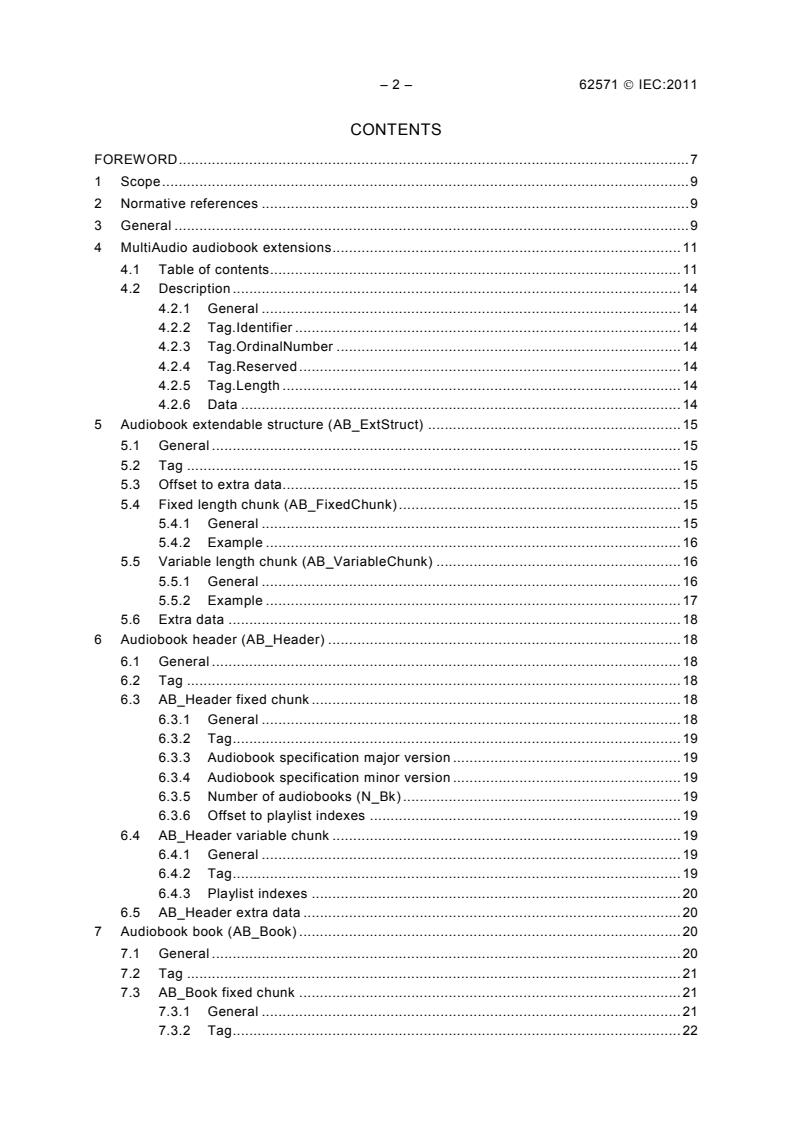
– 2 – 62571 IEC:2011
CONTENTS
FOREWORD . 7
1 Scope . 9
2 Normative references . 9
3 General . 9
4 MultiAudio audiobook extensions . 11
4.1 Table of contents . 11
4.2 Description . 14
4.2.1 General . 14
4.2.2 Tag.Identifier . 14
4.2.3 Tag.OrdinalNumber . 14
4.2.4 Tag.Reserved . 14
4.2.5 Tag.Length . 14
4.2.6 Data . 14
5 Audiobook extendable structure (AB_ExtStruct) . 15
5.1 General . 15
5.2 Tag . 15
5.3 Offset to extra data. 15
5.4 Fixed length chunk (AB_FixedChunk) . 15
5.4.1 General . 15
5.4.2 Example . 16
5.5 Variable length chunk (AB_VariableChunk) . 16
5.5.1 General . 16
5.5.2 Example . 17
5.6 Extra data . 18
6 Audiobook header (AB_Header) . 18
6.1 General . 18
6.2 Tag . 18
6.3 AB_Header fixed chunk . 18
6.3.1 General . 18
6.3.2 Tag . 19
6.3.3 Audiobook specification major version . 19
6.3.4 Audiobook specification minor version . 19
6.3.5 Number of audiobooks (N_Bk) . 19
6.3.6 Offset to playlist indexes . 19
6.4 AB_Header variable chunk . 19
6.4.1 General . 19
6.4.2 Tag . 19
6.4.3 Playlist indexes . 20
6.5 AB_Header extra data . 20
7 Audiobook book (AB_Book) . 20
7.1 General . 20
7.2 Tag . 21
7.3 AB_Book fixed chunk . 21
7.3.1 General . 21
7.3.2 Tag . 22
62571 IEC:2011 – 3 –
7.3.3 Text format . 22
7.3.4 Flags . 22
7.3.5 TOC_Playlist index . 22
7.3.6 Offset to book title . 22
7.3.7 Offset to author . 22
7.3.8 Offset to narrator . 22
7.3.9 Offset to copyright statement . 22
7.3.10 Offset to audiobook UUID . 22
7.3.11 Offset to book ISBN identifier . 23
7.3.12 Offset to book ISSN identifier . 23
7.3.13 Offset to book DOI identifier . 23
7.3.14 Offset to book index number . 23
7.3.15 Offset to book shelf number . 23
7.3.16 Offset to book part number . 23
7.3.17 Offset to other identifier . 23
7.3.18 Offset to first audiobook level . 23
7.3.19 Offset to playlist content location identifier . 23
7.4 AB_Book variable chunk . 24
7.4.1 General . 24
7.4.2 Tag . 24
7.4.3 Book title . 24
7.4.4 Author . 25
7.4.5 Narrator . 25
7.4.6 Copyright Statement . 25
7.4.7 Book UUID . 25
7.4.8 Book ISBN Identifier . 25
7.4.9 Book ISSN Identifier . 25
7.4.10 Book DOI Identifier . 26
7.4.11 Book index number . 26
7.4.12 Book shelf number . 26
7.4.13 Book part number . 26
7.4.14 Other identifier . 26
7.4.15 First audiobook level . 26
7.4.16 Playlist content location identifier . 27
7.5 AB_Book extra data. 27
8 Audiobook level (AB_Level) . 27
8.1 General . 27
8.2 Tag . 28
8.3 AB_Level fixed chunk . 28
8.3.1 General . 28
8.3.2 Tag . 28
8.3.3 Text format . 29
8.3.4 Flags . 29
8.3.5 Number of sub-levels . 29
8.3.6 Level number . 29
8.3.7 TOC_TrackEntry index . 29
8.3.8 Offset to sub-level chunk . 29
8.3.9 Offset to level name . 29
8.3.10 Offset to level description . 29
– 4 – 62571 IEC:2011
8.3.11 Book time offset . 29
8.3.12 Time start offset . 29
8.3.13 Time duration . 30
8.3.14 Offset to parent AB_Level . 30
8.3.15 Offset to previous AB_Level . 30
8.3.16 Offset to next AB_Level . 30
8.4 AB_Level variable chunk . 30
8.4.1 General . 30
8.4.2 Tag . 30
8.4.3 Level name . 31
8.4.4 Level description . 31
8.4.5 Sub-level chunk . 31
8.5 AB_Level extra data . 31
9 MPV audiobook profiles . 31
9.1 General . 31
9.2 XML schema namespace identifier . 32
9.3 Use of MPV-Music profile identifier . 32
9.4 Audiobook file . 33
9.5 Audiobook profile metadata . 33
9.6 MPV audiobook profile metadata . 35
9.7 Dublin core metadata usage . 39
9.8 Audiobook profile using MPV-Music playlists . 41
9.8.1 General . 41
9.8.2 Number of playlists per MPV file . 42
9.8.3 Metadata usage . 42
9.8.4 Background usage . 43
9.8.5 Foreground usage . 44
9.8.6 Related and rendition assets . 44
9.9 Groups of assets in playlists . 44
9.10 MPV-Audiobook schema details . 47
9.10.1 XML schema definition . 47
9.10.2 Audiobook metadata usage definitions . 52
9.11 Audiobook level class identifiers . 52
9.12 Audiobook BOOKMARK.AUB . 54
9.13 MPV-Audiobook-Level metadata using . 61
9.14 Music and Stills Asset . 61
9.15 MPV-Audiobook extensions to MPV-Core . 64
9.15.1 Audiobook manifest file types and extensions . 64
9.15.2 Audiobook manifest MIME media type . 64
9.16 Media types and file formats . 65
9.17 MPV-Audiobook and CEA-2003-C . 65
9.18 CEA-2003-C binary to XML formats – Tag comparison . 65
10 Conforming player and digital audiobook file format structure requirements . 66
10.1 General . 66
10.2 Player Requirements . 66
10.3 Digital audiobook file format structure requirements . 67
11 Player and digital audiobook file format structure functionality recommendations . 67
11.1 General . 67
62571 IEC:2011 – 5 –
11.2 Player functionality recommendations . 67
11.3 Digital audiobook file format structure functionality recommendations . 68
12 Digital audiobook file format structures and data constraints . 68
13 Additional production options . 68
13.1 ID3 tagging within MP3 files . 68
13.2 M3U playlists . 69
13.3 DAISY production options . 69
14 Certification . 69
Annex A (informative) Audiobook structure examples . 70
Annex B (normative) Encoding types and identifiers . 82
Annex C (informative) Use case and implementation examples: Spoken word audio . 83
Bibliography . 104
Figure A.1 – AB_Level structure organization in AB_Book variable length chunk area . 74
Figure A.2 – View of an audiobook AB_Level hierarchy . 76
Figure C.1 – Example 1 INDEX.AUB . 88
Figure C.2 – Example 1 TOC.MUM . 89
Figure C.3 – Example 2 INDEX.AUB . 94
Figure C.4 – Example 3 INDEX.AUB . 99
Figure C.5 – Example 4 INDEX.AUB . 103
Table 1 – Table of contents data structure . 12
Table 2 – Audiobook MultiAudio chunk format . 14
Table 3 – AB_ExtStruct format . 15
Table 4 – Example—AB_FixedChunk structure . 16
Table 5 – Example—AB_FixedChunk structure revised . 16
Table 6 – Example—AB_FixedChunk fields . 17
Table 7 – Example—AB_VariableChunk data . 17
Table 8 – AB_Header format . 18
Table 9 – AB_Header fixed chunk format . 18
Table 10 – AB_Header variable chunk format . 19
Table 11 – AB_Book format . 21
Table 12 – AB_Book fixed chunk format . 21
Table 13 – AB_Book variable chunk format . 24
Table 14 – AB_Level structure required field settings . 26
Table 15 – Playlist content location identifier field settings . 27
Table 16 – AB_Section format . 28
Table 17 – AB_Level fixed chunk format . 28
Table 18 – AB_Level variable chunk format . 30
Table 19 – Schema namespace identifier . 32
Table 20 – MPV-Music profile identifier . 32
Table 21 – MPV audiobook profile properties . 34
Table 22 – MPV audiobook profile metadata . 35
Table 23 – Dublin Core metadata (DC-NMF) . 40
– 6 – 62571 IEC:2011
Table 24 – Metadata properties usage . 42
Table 25 – CEA-2003-C binary and XML formats – Tag comparison . 65
Table 26 – Examples of ID3 tags . 69
Table A.1 – Sample table of contents . 70
Table A.2 – Table of contents file structure . 71
Table A.3 – File 1 TOC_TrackEntry structure . 71
Table A.4 – File 2 TOC_TrackEntry structure . 71
Table A.5 – File 3 TOC_TrackEntry structure . 71
Table A.6 – File 4 TOC_TrackEntry structure . 72
Table A.7 – Table of contents with file time offsets . 72
Table A.8 – Example TOC_Playlist structure . 72
Table A.9 – Example AB_Book structure . 73
Table A.10 – AB_Level structure at Level 0 (audiobook) . 77
Table A.11 – AB_Level at Level 1 (chapter) . 77
Table A.12 – AB_Level at Level 1 (chapter) . 78
Table A.13 – AB_Level at Level 1 (chapter) . 78
Table A.14 – AB_Level at Level 2 (section) . 79
Table A.15 – AB_Level at Level 2 (section) . 79
Table A.16 – AB_Level at Level 2 (section) . 80
Table A.17 – AB_Level at Level 2 (section) . 80
Table A.18 – AB_Level at Level 3 (subsection) . 81
Table A.19 – AB_Level at Level 3 (subsection) . 81
Table B.1 – Hex representation and interpretation . 82
62571 IEC:2011 – 7 –
INTERNATIONAL ELECTROTECHNICAL COMMISSION
____________
DIGITAL AUDIOBOOK FILE FORMAT
AND PLAYER REQUIREMENTS
FOREWORD
1) The International Electrotechnical Commission (IEC) is a worldwide organization for standardization comprising
all national electrotechnical committees (IEC National Committees). The object of IEC is to promote
international co-operation on all questions concerning standardization in the electrical and electronic fields. To
this end and in addition to other activities, IEC publishes International Standards, Technical Specifications,
Technical Reports, Publicly Available Specifications (PAS) and Guides (hereafter referred to as “IEC
Publication(s)”). Their preparation is entrusted to technical committees; any IEC National Committee interested
in the subject dealt with may participate in this preparatory work. International, governmental and non-
governmental organizations liaising with the IEC also participate in this preparation. IEC collaborates closely
with the International Organization for Standardization (ISO) in accordance with conditions determined by
agreement between the two organizations.
2) The formal decisions or agreements of IEC on technical matters express, as nearly as possible, an international
consensus of opinion on the relevant subjects since each technical committee has representation from all
interested IEC National Committees.
3) IEC Publications have the form of recommendations for international use and are accepted by IEC National
Committees in that sense. While all reasonable efforts are made to ensure that the technical content of IEC
Publications is accurate, IEC cannot be held responsible for the way in which they are used or for any
misinterpretation by any end user.
4) In order to promote international uniformity, IEC National Committees undertake to apply IEC Publications
transparently to the maximum extent possible in their national and regional publications. Any divergence
between any IEC Publication and the corresponding national or regional publication shall be clearly indicated in
the latter.
5) IEC itself does not provide any attestation of conformity. Independent certification bodies provide conformity
assessment services and, in some areas, access to IEC marks of conformity. IEC is not responsible for any
services carried out by independent certification bodies.
6) All users should ensure that they have the latest edition of this publication.
7) No liability shall attach to IEC or its directors, employees, servants or agents including individual experts and
members of its technical committees and IEC National Committees for any personal injury, property damage or
other damage of any nature whatsoever, whether direct or indirect, or for costs (including legal fees) and
expenses arising out of the publication, use of, or reliance upon, this IEC Publication or any other IEC
Publications.
8) Attention is drawn to the Normative references cited in this publication. Use of the referenced publications is
indispensable for the correct application of this publication.
9) Attention is drawn to the possibility that some of the elements of this IEC Publication may be the subject of
patent rights. IEC shall not be held responsible for identifying any or all such patent rights.
International Standard IEC 62571 has been prepared by technical area 10: Multimedia e-
publishing and e-book, of IEC technical committee 100: Audio, video and multimedia systems
and equipment.
This bilingual version (2011-07) replaces the English version.
The text of this standard is based on the following documents:
CDV Report on voting
100/1543/CDV 100/1629/RVC
Full information on the voting for the approval of this standard can be found in the report on
voting indicated in the above table.
This publication has been drafted in accordance with the ISO/IEC Directives, Part 2.
– 8 – 62571 IEC:2011
The committee has decided that the contents of this publication will remain unchanged until
the stability date indicated on the IEC web site under "http://webstore.iec.ch" in the data
related to the specific publication. At this date, the publication will be
• reconfirmed,
• withdrawn,
• replaced by a revised edition, or
• amended.
62571 IEC:2011 – 9 –
DIGITAL AUDIOBOOK FILE FORMAT
AND PLAYER REQUIREMENTS
1 Scope
This International Standard defines requirements and provides recommendations to
publishers, software developers, content providers, and hardware manufacturers for the data
structure, usability requirements, playback systems and delivery systems for audiobooks in
digital file format. It should be noted that throughout this International Standard, the term
audiobook is defined as any audio file or collection of audio files of primarily spoken word
content that are played in a linear or specified order. Therefore, spoken word audio with
occasional music, a narration of newspaper articles, or other similar spoken word audio is
assimilated to audiobooks in this standard.
2 Normative references
The following referenced documents are indispensable for the application of this document.
For dated references, only the edition cited applies. For undated references, the latest edition
of the referenced document (including any amendments) applies.
ISO/IEC 11578:1996, Information technology – Open Systems Interconnection – Remote
Procedure Call (RPC)
ISO 639-1, Codes for the representation of names of languages – Part 1: Alpha-2 code
ISO 3166-1, Codes for the representation of names of countries and their subdivisions –
Part 1: Country codes
ISO 9660:1988, Information processing – Volume and file structure of CD-ROM for
information interchange
3 General
This International Standard defines the audiobook file format structure for digital audiobook
media. Goals in creating this International Standard include compatibility with music industry
and multimedia standards as well as effectively presenting and navigating an audiobook. This
International Standard is a compilation standard that straddles early binary architectures
represented by earlier versions of CEA-2003 , and newer XML architectures represented by
the Optical Storage Technology Association’s (OSTA) MusicPhotoVideo™ ((MPV). A
conforming playback system and conforming audiobook content provides a wonderful and
highly functional reading and listening experience. The goal of this International Standard is
to create a broad, extensible standard for audiobook publishers, audiobook device
manufacturers, and audiobook software developers in order to create the best listening
experience for the audiobook consumer. An overview follows.
OSTA MultiAudio defines a binary file be placed in the root of the file format structure on a
CD/MP3. The TOC.MAU serves as the table of contents for the associated MP3 files on a
—————————
See Bibliography.
MusicPhotoVideo is the trade name of a program supplied by the Optical Storage Technology Association. This
information is given for the convenience of users of this document and does not constitute an endorsement by
IEC of the program named.
– 10 – 62571 IEC:2011
compliant CD/MP3. Conforming MultiAudio players read this file to obtain the information the
player needs to present the content to the listener.
OSTA MPV defines an eXtensible Markup Language (XML) schema to be placed in the root of
the file format structure. The INDEX.AUB serves as the table of contents for the associated
audiobook files, regardless of media, codec, or delivery type. Conforming MPV players read
this file to obtain the information the player needs to present the content to the listener.
Audiobooks conforming to this standard MUST utilize the audiobook-specific file
extension, .AUB. In addition, audiobooks conforming to this standard may utilize the same
MPV file extension specified by the MPV Music Profile, .MUM, in order to create additional
compatibility for MPV-compliant players that do not recognize the audiobook extension.
Similarly, while OSTA MPV was primarily designed for the music industry and CD-ROM media,
it provides "extensions" for enhancing the format. This International Standard "extends" OSTA
MPV to support audiobooks and does not require a specific media or content delivery system.
The audiobook extensions are defined as the MultiAudio binary “TOC.MAU” for CD/MP3
audiobooks, and the MPV XML “INDEX.AUB” for all digital audiobooks.
Therefore, throughout this International Standard, “digital audiobook file format structure” is
used to describe the entire audiobook content, regardless of media or method of delivery.
“Delivery system” is used to represent any system used for playback of the content, whether it
is actual physical media or another type of delivery system, such as downloaded or streaming
content. This International Standard defines required MPV data and audiobook-specific Extra
Data requirements. The conforming player, by reading the INDEX.AUB or TOC.MAU, is
presented with the data needed to effectively navigate and play the content in the manner the
publisher intended. Conforming players and conforming audio content shall meet the
requirements contained in Clause 11. In addition, conforming players and conforming audio
content are encouraged, but not required, to conform to the recommendations of Clause 11.
The player identifies and reads the INDEX.AUB or TOC.MAU file in the root of the digital
audiobook file format structure. A conforming player recognizes the audiobook identifier in the
OSTA MPV Extra Data field, and processes the audiobook data as defined in Clauses 4
through 7 accordingly. OSTA MPV provides specific identifiers to tell the player the type of
encoded audio file that is in use. OSTA MPV also provides an “unknown” identifier, which
signals the device to determine the type of encoding used. Once an audiobook and its
encoding method have been detected, the playback system can reference navigational points
and informational fields and present them to the listener. Excessive delays in playback or
moving to the next portion of the audiobook should be minimized; excessive delays are not
acceptable according to this standard.
One or more audiobooks may reside on the system, but if there is more than one audiobook,
they shall each reside in separate directories within the digital audiobook file format structure.
The MPV file contains one or more "playlists" for each audiobook. The playlist identifies the
correct linear reading order of the files to be played for each book, and the location of the
digital audiobook files. A simple digital audiobook file format structure residing on physical
media may need only one playlist; a more complex digital audiobook file format structure that
includes choices of delivery, such as local and streaming, may have multiple playlists to
coincide with each method of delivery.
Navigational levels are defined by the content publisher within the INDEX.AUB or TOC.MAU
file, and may be as simple or as complex as desired. Extra Data fields identify the levels and
“time offsets” to navigational points within files or file locations. Pointers to the “parent” and
“child” locations are also defined within Extra Data fields. In this manner, an unlimited amount
of levels and navigation points may be identified. Within the binary TOC.MAU file, Level 0
navigation is the top level; for example, the audiobook itself, or a collection of several
audiobooks contained in separate folders. Level 1 navigation is the first level of nested
pointers defined, and is required for compliance. In a very simple example, a digital
audiobook file format structure could contain one audiobook comprised of one digital file.
Each of the chapter locations are defined as Level 1 navigation points within the TOC.MAU.
62571 IEC:2011 – 11 –
The conforming player is able to present the user with Level 1 navigation by moving to each
of the defined offsets.
More complex digital audiobook file format structures can be achieved by nesting levels within
the INDEX.AUB. A digital audiobook file format structure can contain several layers or levels,
with offsets to the next navigation point, parent level, and child level. As a more complex
example, a digital audiobook file format structure could contain two audiobooks, each in a
separate folder and comprised of ten chapters each, with each chapter encoded as a separate
digital file. Navigation would include pointers to each separate audiobook, and enable the
player to choose between one or the other. Navigation markers would point to the beginning
of each chapter, allowing navigation from chapter to chapter within the audiobook. Nested
levels would point to pages within the chapters.
NOTE 1 Books, chapters and pages are used as level name examples; however, there is no naming requirement
for levels in order to be compliant with this International Standard.
The only constraint on the audio publisher is to encode MP3 files with a "fixed bit rate"
because variable bit rate encoding makes it impossible for low-powered players to calculate
the data offset from the time offset.
NOTE 2 Audiobook content providers are strongly encouraged to name the audio files using an ASCII collated
sequence. This means that the unaware player would still play the audio files in order and the navigation from file
to file would be whatever design the audio publisher chose for structuring the files, that is one chapter per file
would yield chapter navigation; one section per file would yield section navigation. The correct linear reading order
would then most likely be preserved.
There is audiobook-specific content, such as title, author, and narrator, as well as time
information that allows players to calculate elapsed time and time remaining. Extra Data fields
associated with each file provide the player with this information so that it can be presented to
the listener. Additional enhancements are encouraged, but not required with Level Class
Identifiers and the separate Bookmark.AUB file for rewriteable media. The Level Class
Identifiers will allow a playback device to handle distinct audiobook levels in customized ways,
depending on the type of content, or sub-grouping, of
...