

IEC 62680-1-3:2026
(Main)Universal Serial Bus interfaces for data and power - Part 1-3: Common components - USB Type-C® cable and connector specification
General Information
- Abstract
IEC 62680-1-3:2026, this specification, defines the USB Type-C® receptacles, plug and cables.
The USB Type-C Cable and Connector Specification is guided by the following principles:
- Enable new and exciting host and device form-factors where size, industrial design and style are important parameters
- Work seamlessly with existing USB host and device silicon solutions
- Enhance ease of use for connecting USB devices with a focus on minimizing user confusion for plug and cable orientation
The USB Type-C Cable and Connector Specification defines a receptacle, plug, cable, and detection mechanisms that are compatible with existing USB interface electrical and functional specifications. This specification covers the following aspects that are needed to produce and use this new USB cable/connector solution in newer platforms and devices, and that interoperate with existing platforms and devices:
- USB Type-C receptacles, including electro-mechanical definition and performance requirements
- USB Type-C plugs and cable assemblies, including electro-mechanical definition and performance requirements
- USB Type-C to legacy cable assemblies and adapters
- USB Type-C-based device detection and interface configuration, including support for legacy connections
- USB Power Delivery optimized for the USB Type-C connector.
IEC 62680-1-3:2026 cancels and replaces the sixth edition published in 2024 and constitutes an editorial revision. This standard is the USB-IF publication Universal Serial Bus Type-C Cable and Connector Specification Revision 2.4. New release primarily includes incorporation of all approved ECNs as of the revision date plus editorial clean-up.
- Status
- Published
- Publication Date
- 10-Feb-2026
- Technical Committee
- TA 18 - Multimedia home systems and applications for end-user networks
- Drafting Committee
- MT 62680-1-3 - TC 100/TA 18/MT 62680-1-3
- Current Stage
- PPUB - Publication issued
- Start Date
- 11-Feb-2026
- Completion Date
- 16-Feb-2026
Buy Documents
IEC 62680-1-3:2026 - Universal Serial Bus interfaces for data and power - Part 1-3: Common components - USB Type-C® cable and connector specification/11/2026
IEC 62680-1-3:2026 - Interfaces de bus universel en série pour les données et l'alimentation électrique - Partie 1-3: Composants communs - Spécification des câbles et des connecteurs USB Type-C®/11/2026
IEC 62680-1-3:2026 - Universal Serial Bus interfaces for data and power - Part 1-3: Common components - USB Type-C® cable and connector specification/11/2026
Overview
IEC 62680-1-3:2026 is the internationally recognized standard published by the IEC that defines the technical requirements for USB Type-C® cable and connector interfaces. This seventh edition details the electro-mechanical specifications for USB Type-C receptacles, plugs, and cable assemblies. The standard's primary aim is to enhance user convenience and support modern device design, ensuring compatibility with both current and legacy USB technologies.
This specification is guided by key design principles: enabling slim, high-performance device form factors; maintaining seamless operation with existing USB components; and reducing user confusion by supporting reversible plug orientation. IEC 62680-1-3:2026 supersedes the 2024 edition, incorporating all approved editorial changes and technical updates as of Revision 2.4 of the USB-IF Universal Serial Bus Type-C Cable and Connector Specification.
Key Topics
IEC 62680-1-3:2026 covers several essential aspects of the USB Type-C ecosystem:
- USB Type-C Receptacles and Plugs
- Electro-mechanical definitions, mechanical performance requirements, and robust mating cycles.
- Cable Assemblies
- Specifications for standard USB Type-C-to-Type-C cables, as well as cable assemblies connecting Type-C to legacy USB connectors (e.g., USB Standard-A, Standard-B, Micro-B).
- Adapter Assemblies
- Requirements and guidance for USB Type-C to legacy adapters, supporting backward compatibility with older USB hardware.
- Connection and Detection Mechanisms
- Mechanisms for detecting cable orientation, device attachment, and initial power/data relationships.
- USB Power Delivery Optimization
- Enhanced support for power transfer, optimized for the high-capacity needs of USB Type-C devices.
- Device and Interface Configuration
- Guidelines for configuring USB Type-C ports, ensuring interoperability with legacy USB devices.
Applications
This standard is essential for a broad range of stakeholders and use-cases in the electronics industry:
- Device Manufacturers
- Enables the design of laptops, smartphones, tablets, and other devices with reliable and future-proof USB Type-C ports.
- Ensures product compatibility and maximum device interoperability.
- Cable and Accessory Providers
- Provides criteria for manufacturing compliant USB Type-C cables, adapters, and hubs.
- Industrial and Commercial Platforms
- Supports integration of USB Type-C into docking stations, charging boards, displays, and digital workstations.
- End Users
- Facilitates easy, reversible connections and universal charging/data transfer, simplifying the user experience.
- Testing and Certification Organizations
- Supplies reference requirements for evaluation of USB Type-C components and devices for standards compliance and safety.
Related Standards
IEC 62680-1-3:2026 is part of the broader IEC 62680 series, which addresses Universal Serial Bus (USB) interfaces for data and power across multiple device types and usage scenarios. Closely related standards and references include:
- IEC 62680-1-1: USB Basic Protocol Specifications
- IEC 62680-1-2: USB Power Delivery
- IEC 62680-2: USB On-The-Go and Embedded Host
- USB Implementers Forum (USB-IF) Specifications
- USB4 and USB 3.2/2.0 specifications for signal, bandwidth, and interoperability
These standards collectively ensure universal compatibility, safety, and performance across the wide ecosystem of USB-enabled devices and accessories.
IEC 62680-1-3:2026 remains the definitive global resource for organizations seeking to implement USB Type-C connectivity solutions. By adhering to this standard, manufacturers and integrators support innovation, minimize interoperability issues, and satisfy end user expectations for robust, convenient power and data connections.
Relations
- Effective Date
- 26-Oct-2025
Buy Documents
IEC 62680-1-3:2026 - Universal Serial Bus interfaces for data and power - Part 1-3: Common components - USB Type-C® cable and connector specification/11/2026
IEC 62680-1-3:2026 - Interfaces de bus universel en série pour les données et l'alimentation électrique - Partie 1-3: Composants communs - Spécification des câbles et des connecteurs USB Type-C®/11/2026
IEC 62680-1-3:2026 - Universal Serial Bus interfaces for data and power - Part 1-3: Common components - USB Type-C® cable and connector specification/11/2026
Get Certified
Connect with accredited certification bodies for this standard

BSI Group
BSI (British Standards Institution) is the business standards company that helps organizations make excellence a habit.

NYCE
Mexican standards and certification body.

ANCE
Mexican certification and testing association.
Sponsored listings
Frequently Asked Questions
IEC 62680-1-3:2026 is a standard published by the International Electrotechnical Commission (IEC). Its full title is "Universal Serial Bus interfaces for data and power - Part 1-3: Common components - USB Type-C® cable and connector specification". This standard covers: IEC 62680-1-3:2026, this specification, defines the USB Type-C® receptacles, plug and cables. The USB Type-C Cable and Connector Specification is guided by the following principles: - Enable new and exciting host and device form-factors where size, industrial design and style are important parameters - Work seamlessly with existing USB host and device silicon solutions - Enhance ease of use for connecting USB devices with a focus on minimizing user confusion for plug and cable orientation The USB Type-C Cable and Connector Specification defines a receptacle, plug, cable, and detection mechanisms that are compatible with existing USB interface electrical and functional specifications. This specification covers the following aspects that are needed to produce and use this new USB cable/connector solution in newer platforms and devices, and that interoperate with existing platforms and devices: - USB Type-C receptacles, including electro-mechanical definition and performance requirements - USB Type-C plugs and cable assemblies, including electro-mechanical definition and performance requirements - USB Type-C to legacy cable assemblies and adapters - USB Type-C-based device detection and interface configuration, including support for legacy connections - USB Power Delivery optimized for the USB Type-C connector. IEC 62680-1-3:2026 cancels and replaces the sixth edition published in 2024 and constitutes an editorial revision. This standard is the USB-IF publication Universal Serial Bus Type-C Cable and Connector Specification Revision 2.4. New release primarily includes incorporation of all approved ECNs as of the revision date plus editorial clean-up.
IEC 62680-1-3:2026, this specification, defines the USB Type-C® receptacles, plug and cables. The USB Type-C Cable and Connector Specification is guided by the following principles: - Enable new and exciting host and device form-factors where size, industrial design and style are important parameters - Work seamlessly with existing USB host and device silicon solutions - Enhance ease of use for connecting USB devices with a focus on minimizing user confusion for plug and cable orientation The USB Type-C Cable and Connector Specification defines a receptacle, plug, cable, and detection mechanisms that are compatible with existing USB interface electrical and functional specifications. This specification covers the following aspects that are needed to produce and use this new USB cable/connector solution in newer platforms and devices, and that interoperate with existing platforms and devices: - USB Type-C receptacles, including electro-mechanical definition and performance requirements - USB Type-C plugs and cable assemblies, including electro-mechanical definition and performance requirements - USB Type-C to legacy cable assemblies and adapters - USB Type-C-based device detection and interface configuration, including support for legacy connections - USB Power Delivery optimized for the USB Type-C connector. IEC 62680-1-3:2026 cancels and replaces the sixth edition published in 2024 and constitutes an editorial revision. This standard is the USB-IF publication Universal Serial Bus Type-C Cable and Connector Specification Revision 2.4. New release primarily includes incorporation of all approved ECNs as of the revision date plus editorial clean-up.
IEC 62680-1-3:2026 is classified under the following ICS (International Classification for Standards) categories: 33.120.20 - Wires and symmetrical cables; 33.120.30 - RF connectors; 35.200 - Interface and interconnection equipment. The ICS classification helps identify the subject area and facilitates finding related standards.
IEC 62680-1-3:2026 has the following relationships with other standards: It is inter standard links to IEC 62680-1-3:2024. Understanding these relationships helps ensure you are using the most current and applicable version of the standard.
IEC 62680-1-3:2026 is available in PDF format for immediate download after purchase. The document can be added to your cart and obtained through the secure checkout process. Digital delivery ensures instant access to the complete standard document.
Standards Content (Sample)
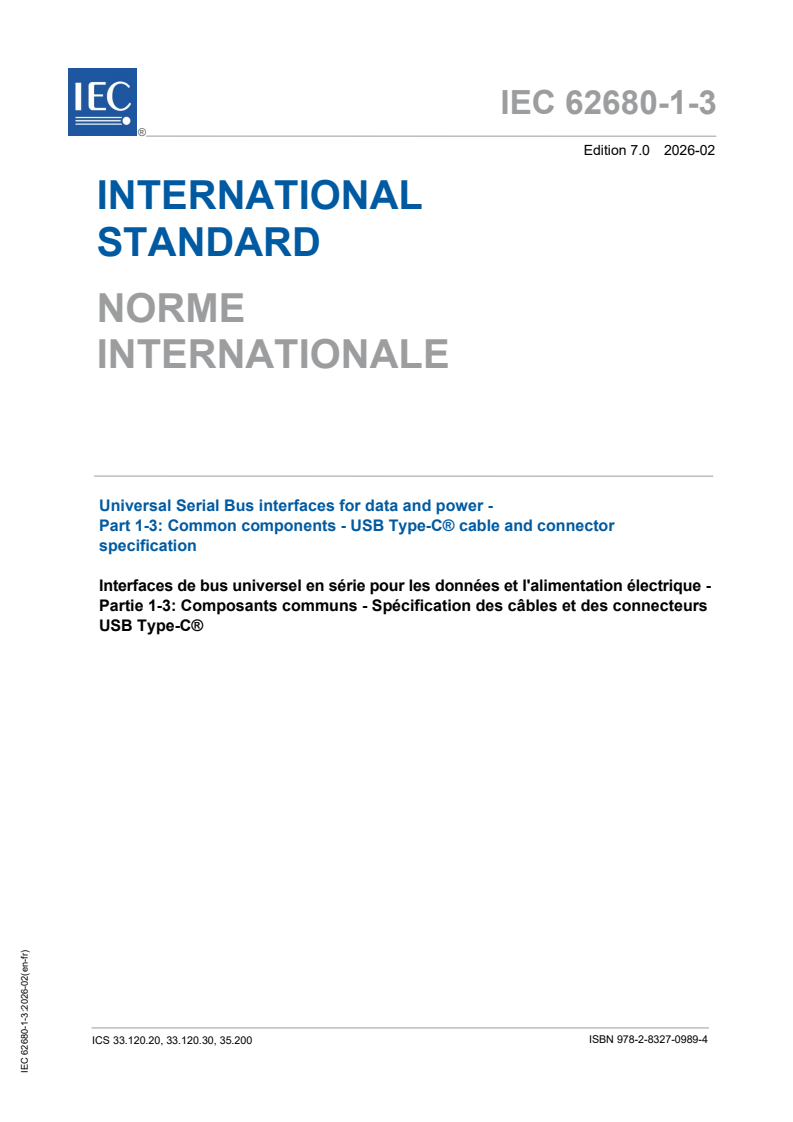
IEC 62680-1-3 ®
Edition 7.0 2026-02
INTERNATIONAL
STANDARD
Universal Serial Bus interfaces for data and power -
Part 1-3: Common components - USB Type-C® cable and connector
specification
ICS 33.120.20; 33.120.30; 35.200 ISBN 978-2-8327-0989-4
All rights reserved. Unless otherwise specified, no part of this publication may be reproduced or utilized in any form or
by any means, electronic or mechanical, including photocopying and microfilm, without permission in writing from either
IEC or IEC's member National Committee in the country of the requester. If you have any questions about IEC copyright
or have an enquiry about obtaining additional rights to this publication, please contact the address below or your local
IEC member National Committee for further information.
IEC Secretariat Tel.: +41 22 919 02 11
3, rue de Varembé info@iec.ch
CH-1211 Geneva 20 www.iec.ch
Switzerland
About the IEC
The International Electrotechnical Commission (IEC) is the leading global organization that prepares and publishes
International Standards for all electrical, electronic and related technologies.
About IEC publications
The technical content of IEC publications is kept under constant review by the IEC. Please make sure that you have the
latest edition, a corrigendum or an amendment might have been published.
IEC publications search - IEC Products & Services Portal - products.iec.ch
webstore.iec.ch/advsearchform Discover our powerful search engine and read freely all the
The advanced search enables to find IEC publications by a publications previews, graphical symbols and the glossary.
variety of criteria (reference number, text, technical With a subscription you will always have access to up to date
committee, …). It also gives information on projects, content tailored to your needs.
replaced and withdrawn publications.
Electropedia - www.electropedia.org
The world's leading online dictionary on electrotechnology,
IEC Just Published - webstore.iec.ch/justpublished
Stay up to date on all new IEC publications. Just Published containing more than 22 500 terminological entries in English
details all new publications released. Available online and and French, with equivalent terms in 25 additional languages.
once a month by email. Also known as the International Electrotechnical Vocabulary
(IEV) online.
IEC Customer Service Centre - webstore.iec.ch/csc
If you wish to give us your feedback on this publication or
need further assistance, please contact the Customer
Service Centre: sales@iec.ch.
INTERNATIONAL ELECTROTECHNICAL COMMISSION
____________
Universal Serial Bus interfaces for data and power -
Part 1-3: Common components - USB Type-C® cable and connector
specification
FOREWORD
1) The International Electrotechnical Commission (IEC) is a worldwide organization for standardization comprising all
national electrotechnical committees (IEC National Committees). The object of IEC is to promote international co-
operation on all questions concerning standardization in the electrical and electronic fields. To this end and in addition
to other activities, IEC publishes International Standards, Technical Specifications, Technical Reports, Publicly
Available Specifications (PAS) and Guides (hereafter referred to as "IEC Publication(s)"). Their preparation is
entrusted to technical committees; any IEC National Committee interested in the subject dealt with may participate in
this preparatory work. International, governmental and non-governmental organizations liaising with the IEC also
participate in this preparation. IEC collaborates closely with the International Organization for Standardization (ISO)
in accordance with conditions determined by agreement between the two organizations.
2) The formal decisions or agreements of IEC on technical matters express, as nearly as possible, an international
consensus of opinion on the relevant subjects since each technical committee has representation from all interested
IEC National Committees.
3) IEC Publications have the form of recommendations for international use and are accepted by IEC National
Committees in that sense. While all reasonable efforts are made to ensure that the technical content of IEC
Publications is accurate, IEC cannot be held responsible for the way in which they are used or for any misinterpretation
by any end user.
4) In order to promote international uniformity, IEC National Committees undertake to apply IEC Publications
transparently to the maximum extent possible in their national and regional publications. Any divergence between any
IEC Publication and the corresponding national or regional publication shall be clearly indicated in the latter.
5) IEC itself does not provide any attestation of conformity. Independent certification bodies provide conformity
assessment services and, in some areas, access to IEC marks of conformity. IEC is not responsible for any services
carried out by independent certification bodies.
6) All users should ensure that they have the latest edition of this publication.
7) No liability shall attach to IEC or its directors, employees, servants or agents including individual experts and members
of its technical committees and IEC National Committees for any personal injury, property damage or other damage
of any nature whatsoever, whether direct or indirect, or for costs (including legal fees) and expenses arising out of
the publication, use of, or reliance upon, this IEC Publication or any other IEC Publications.
8) Attention is drawn to the Normative references cited in this publication. Use of the referenced publications is
indispensable for the correct application of this publication.
9) IEC draws attention to the possibility that the implementation of this document may involve the use of (a) patent(s).
IEC takes no position concerning the evidence, validity or applicability of any claimed patent rights in respect thereof.
As of the date of publication of this document, IEC had received notice of (a) patent(s), which may be required to
implement this document. However, implementers are cautioned that this may not represent the latest information,
which may be obtained from the patent database available at https://patents.iec.ch. IEC shall not be held responsible
for identifying any or all such patent rights.
IEC 62680-1-3 has been prepared by technical area 18: Multimedia home systems and applications
for end-user networks, of IEC technical committee 100: Audio, video and multimedia systems and
equipment. It is an International Standard.
The text of this standard was prepared by the USB Implementers Forum (USB-IF). The structure
and editorial rules used in this publication reflect the practice of the organization which submitted
it.
The text of this International Standard is based on the following documents:
Draft Report on voting
100/4332/CDV 100/4381/RVC
Full information on the voting for its approval can be found in the report on voting indicated in the
above table.
A list of all parts in the IEC 62680 series, published under the general title Universal serial bus
interfaces for data and power, can be found on the IEC website.
The committee has decided that the contents of this document will remain unchanged until the
stability date indicated on the IEC website under webstore.iec.ch in the data related to the specific
document. At this date, the document will be
• reconfirmed,
• withdrawn, or
• revised.
Universal Serial Bus
Type-C Cable and Connector
Specification
Release 2.4
October 2024
Apple Inc., HP Inc., Intel Corporation, Microsoft Corporation,
Renesas, STMicroelectronics, and Texas Instruments
All rights reserved. ®
NOTE: Adopters may only use the USB Type-C cable and connector to implement USB or third-party
functionality as expressly described in this Speci�ication; all other uses are prohibited.
LIMITED COPYRIGHT LICENSE: The USB 3.0 Promoters grant a conditional copyright license under the
copyrights embodied in the USB Type-C Cable and Connector Speci�ication to use and reproduce the
Speci�ication for the sole purpose of, and solely to the extent necessary for, evaluating whether to implement
the Speci�ication in products that would comply with the speci�ication. Without limiting the foregoing, use of
the Speci�ication for the purpose of �iling or modifying any patent application to target the Speci�ication or
USB compliant products is not authorized. Except for this express copyright license, no other rights or
licenses are granted, including without limitation any patent licenses. In order to obtain any additional
intellectual property licenses or licensing commitments associated with the Speci�ication a party must
execute the USB 3.0 Adopters Agreement. NOTE: By using the Speci�ication, you accept these license terms on
your own behalf and, in the case where you are doing this as an employee, on behalf of your employer.
INTELLECTUAL PROPERTY DISCLAIMER
THIS SPECIFICATION IS PROVIDED TO YOU "AS IS" WITH NO WARRANTIES WHATSOEVER, INCLUDING ANY
WARRANTY OF MERCHANTABILITY, NON-INFRINGEMENT, OR FITNESS FOR ANY PARTICULAR PURPOSE.
THE AUTHORS OF THIS SPECIFICATION DISCLAIM ALL LIABILITY, INCLUDING LIABILITY FOR
INFRINGEMENT OF ANY PROPRIETARY RIGHTS, RELATING TO USE OR IMPLEMENTATION OF
INFORMATION IN THIS SPECIFICATION. THE PROVISION OF THIS SPECIFICATION TO YOU DOES NOT
PROVIDE YOU WITH ANY LICENSE, EXPRESS OR IMPLIED, BY ESTOPPEL OR OTHERWISE, TO ANY
INTELLECTUAL PROPERTY RIGHTS.
All implementation examples and reference designs contained within this Speci�ication are included as part of
the limited patent license for those companies that execute the USB 3.0 Adopters Agreement.
® ® ®
USB Type-C , USB-C and USB4 are trademarks of the Universal Serial Bus Implementers Forum (USB-IF).
DisplayPort™ is a trademark of VESA. All product names are trademarks, registered trademarks, or service
marks of their respective owners.
Thunderbolt™ is a trademark of Intel Corporation. You may only use the Thunderbolt™ trademark or logo in
conjunction with products designed to this speci�ication that complete proper certi�ication and executing a
Thunderbolt™ trademark license – see https://www.usb.org/compliance for further information.
Contents
Speci�ication Editor . 20
Speci�ication Work Group Contributors . 20
Pre-Release Draft Industry Reviewing Companies That Provided Feedback . 28
Revision History . 29
1 Introduction . 30
1.1 Purpose . 30
1.2 Scope . 30
1.3 Related Documents . 30
1.4 Conventions . 31
1.4.1 Precedence . 31
1.4.2 Keywords . 31
1.4.3 Numbering. 32
1.5 Terms and Abbreviations . 32
2 Overview . 38
2.1 Introduction . 38
2.2 USB Type-C Receptacles, Plugs and Cables . 39
2.3 Con�iguration Process . 40
2.3.1 Source-to-Sink Attach/Detach Detection . 41
2.3.2 Plug Orientation/Cable Twist Detection . 41
2.3.3 Initial Power (Source-to-Sink) Detection and Establishing the Data (Host-to-Device) Relationship
2.3.4 USB Type-C VBUS Current Detection and Usage . 42
2.3.5 USB PD Communications. 42
2.3.6 Functional Extensions . 43
2.4 VBUS . 43
2.5 VCONN . 43
2.6 Hubs . 44
3 Mechanical . 45
3.1 Overview . 45
3.1.1 Compliant Connectors . 45
3.1.2 Compliant Cable Assemblies . 45
3.1.3 Compliant USB Type-C to Legacy Cable Assemblies . 46
3.1.4 Compliant USB Type-C to Legacy Adapter Assemblies . 47
3.2 USB Type-C Connector Mating Interfaces . 47
3.2.1 Interface De�inition. 47
3.2.2 Reference Designs . 71
3.2.3 Pin Assignments and Descriptions . 78
3.3 Cable Construction and Wire Assignments . 79
3.3.1 Cable Construction (Informative) . 79
3.3.2 Wire Assignments . 81
3.3.3 Wire Gauges and Cable Diameters (Informative) . 82
3.4 Standard USB Type-C Cable Assemblies . 84
3.4.1 USB Full-Featured Type-C Cable Assembly . 84
3.4.2 USB 2.0 Type-C Cable Assembly . 86
3.4.3 USB Type-C Captive Cable Assembly . 86
3.4.4 USB Type-C Thumb Drive Assembly . 87
3.5 Legacy Cable Assemblies . 87
3.5.1 USB Type-C to USB 3.1 Standard-A Cable Assembly . 88
3.5.2 USB Type-C to USB 2.0 Standard-A Cable Assembly . 89
3.5.3 USB Type-C to USB 3.1 Standard-B Cable Assembly . 90
3.5.4 USB Type-C to USB 2.0 Standard-B Cable Assembly . 91
3.5.5 USB Type-C to USB 2.0 Mini-B Cable Assembly . 92
3.5.6 USB Type-C to USB 3.1 Micro-B Cable Assembly . 93
3.5.7 USB Type-C to USB 2.0 Micro-B Cable Assembly . 94
3.6 Legacy Adapter Assemblies. 94
3.6.1 USB Type-C to USB 3.1 Standard-A Receptacle Adapter Assembly . 94
3.6.2 USB Type-C to USB 2.0 Micro-B Receptacle Adapter Assembly . 96
3.7 Electrical Characteristics . 96
3.7.1 Raw Cable (Informative) . 97
3.7.2 USB Type-C to USB Type-C Passive Cable Assemblies . 98
3.7.3 Mated Connector (Informative – USB 3.2 Gen2 and USB4 Gen2). 120
3.7.4 Receptacle Connector SI Requirements and Testing (Normative – USB4 Gen3/Gen4) . 124
3.7.5 USB Type-C to USB Legacy Cable Assemblies (Normative) . 126
3.7.6 USB Type-C to USB Legacy Adapter Assemblies (Normative) . 130
3.7.7 Shielding Effectiveness Requirements (Normative) . 133
3.7.8 DC Electrical Requirements (Normative). 135
3.8 Mechanical and Environmental Requirements (Normative) . 138
3.8.1 Mechanical Requirements . 138
3.8.2 Environmental Requirements . 143
3.9 Docking Applications (Informative) . 144
3.10 Implementation Notes and Design Guides . 145
3.10.1 EMC Management (Informative) . 145
3.10.2 Stacked and Side-by-Side Connector Physical Spacing (Informative) . 148
3.10.3 Cable Mating Considerations (Informative) . 148
3.11 Extended Power Range (EPR) Cables . 150
3.11.1 Electrical Requirements . 150
3.11.2 EPR Cable Identi�ication Requirements . 150
4 Functional . 151
4.1 Signal Summary . 151
4.2 Signal Pin Descriptions . 151
4.2.1 USB 3.2/USB4 Pins . 151
4.2.2 USB 2.0 Pins . 152
4.2.3 Auxiliary Signal Pins . 152
4.2.4 Power and Ground Pins . 152
4.2.5 Con�iguration Pins . 152
4.3 Sideband Use (SBU) . 152
4.4 Power and Ground. 153
4.4.1 IR Drop . 153
4.4.2 VBUS . 154
4.4.3 VCONN . 155
4.5 Con�iguration Channel (CC) . 160
4.5.1 Architectural Overview . 160
4.5.2 CC Functional and Behavioral Requirements . 172
4.5.3 USB Port Interoperability Behavior . 208
4.6 Power . 226
4.6.1 Power Requirements during USB Suspend . 227
4.6.2 VBUS Power Provided Over a USB Type-C Cable . 228
4.7 USB Hubs . 233
4.8 Power Sourcing and Charging . 234
4.8.1 DFP as a Power Source . 234
4.8.2 Non-USB Charging Methods . 236
4.8.3 Sinking Host . 237
4.8.4 Sourcing Device . 237
4.8.5 Charging a System with a Dead Battery . 237
4.8.6 USB Type-C Multi-Port Chargers . 237
4.9 Electronically Marked Cables . 241
4.9.1 Parameter Values . 242
4.9.2 Active Cables . 242
4.10 VCONN-Powered Accessories (VPAs) and VCONN-Powered USB Devices (VPDs) . 243
4.10.1 VCONN-Powered Accessories (VPAs) . 243
4.10.2 VCONN-Powered Devices (VPDs) . 243
4.11 Parameter Values . 245
4.11.1 Termination Parameters . 245
4.11.2 Timing Parameters . 247
4.11.3 Voltage Parameters . 251
5 USB4 Discovery and Entry . 258
5.1 Overview of the Discovery and Entry Process . 258
5.2 USB4 Functional Requirements . 259
5.2.1 USB4 Host Functional Requirements . 259
5.2.2 USB Device Functional Requirements . 259
5.2.3 USB4 Alternate Mode Support . 259
5.3 USB4 Power Requirements . 260
5.3.1 Source Power Requirements . 260
5.3.2 Sink Power Requirements . 260
5.3.3 Device Power Management Requirements . 260
5.4 USB4 Discovery and Entry Flow Requirements . 261
5.4.1 USB Type-C Initial Connection . 261
5.4.2 USB Power Delivery Contract . 261
5.4.3 USB4 Discovery and Entry Flow . 261
5.4.4 USB4 Post-Entry Operation . 267
5.5 USB4 Hub Connection Requirements. 267
5.5.1 USB4 Hub Port Initial Connection Requirements . 267
5.5.2 USB4 Hub UFP and Host Capabilities Discovery . 267
5.5.3 Hub DFP Connection Requirements . 268
5.5.4 Hub Ports Connection Behavior Flow Examples . 269
5.5.5 Connecting to Downstream USB4 Hubs . 275
5.5.6 Fallback Functional Requirements for USB4 Hubs . 275
5.6 USB4 Device Connection Requirements . 276
5.6.1 Fallback Mapping of USB4 Peripheral Functions of USB Device Class Types . 276
5.7 Parameter Values . 277
5.7.1 Timing Parameters . 277
6 Active Cables . 278
6.1 General Speci�ications for All Active Cables . 278
6.1.1 Discovering Active Cable Characteristics . 278
6.1.2 Electrical Requirements . 280
6.1.3 Mechanical Requirements . 312
6.2 Additional Speci�ications for Copper and Hybrid-Optical Active Cables . 313
6.2.1 Active Cable Block Diagram . 314
6.2.2 USB4 Asymmetric Mode Support . 314
6.2.3 Active Cable USB PD Requirements . 314
6.2.4 Active Cable Behaviors in Response to USB PD Events . 314
6.2.5 Active Cable Power Requirements . 315
6.3 Additional Speci�ications for Optically Isolated Active Cables . 315
6.3.1 OIAC Block Diagrams . 316
6.3.2 OIAC Limitations and General Requirements . 318
6.3.3 OIAC Cable Power Requirements . 319
6.3.4 OIAC USB PD Requirements . 319
6.3.5 OIAC Connection Flow and State Diagrams . 329
6.3.6 Additional Electrical Requirements for OIAC . 348
6.3.7 Additional Mechanical Requirements for OIAC . 351
A Liquid Corrosion Mitigation Mode . 352
A.1 Overview . 352
A.2 Detail . 352
A.3 Liquid Detection Methods . 354
A.3.1 Liquid Measurement Method . 354
A.3.2 Pulsed Measurement Method . 354
A.3.3 Impedance Measurement Method . 355
A.4 Liquid Detection Pins in the Connector . 358
B Debug Accessory Mode . 361
B.1 Overview . 361
B.2 Functional . 361
B.2.1 Signal Summary . 361
B.2.2 Port Interoperability . 362
B.2.3 Debug Accessory Mode Entry . 362
B.2.4 Connection State Diagrams. 362
B.2.5 DTS Port Interoperability Behaviors . 371
B.2.6 Orientation Detection. 380
B.3 Security/Privacy Requirements . 380
C USB Type-C Digital Audio . 381
C.1 Overview . 381
C.2 USB Type-C Digital Audio Speci�ications . 381
D Thermal Design Considerations for Active Cables . 382
D.1 Introduction . 382
D.2 Model . 382
D.2.1 Assumptions . 382
D.2.2 Model Architecture . 383
D.2.3 Heat Sources . 383
D.2.4 Heat Flow . 384
D.3 USB 3.2 Single-Lane Active Cable . 385
D.3.1 USB 3.2 Single-Lane Active Cable Design Considerations . 385
D.4 Dual-Lane Active Cables. 388
D.4.1 USB 3.2 Dual-Lane Active Cable Design Consi
...
IEC 62680-1-3 ®
Edition 7.0 2026-02
NORME
INTERNATIONALE
Interfaces de bus universel en série pour les données et l'alimentation électrique -
Partie 1-3: Composants communs - Spécification des câbles et des connecteurs
USB Type-C®
ICS 33.120.20; 33.120.30; 35.200 ISBN 978-2-8327-0989-4
Droits de reproduction réservés. Sauf indication contraire, aucune partie de cette publication ne peut être reproduite ni
utilisée sous quelque forme que ce soit et par aucun procédé, électronique ou mécanique, y compris la photocopie et
les microfilms, sans l'accord écrit de l'IEC ou du Comité national de l'IEC du pays du demandeur. Si vous avez des
questions sur le copyright de l'IEC ou si vous désirez obtenir des droits supplémentaires sur cette publication, utilisez
les coordonnées ci-après ou contactez le Comité national de l'IEC de votre pays de résidence.
IEC Secretariat Tel.: +41 22 919 02 11
3, rue de Varembé info@iec.ch
CH-1211 Geneva 20 www.iec.ch
Switzerland
A propos de l'IEC
La Commission Electrotechnique Internationale (IEC) est la première organisation mondiale qui élabore et publie des
Normes internationales pour tout ce qui a trait à l'électricité, à l'électronique et aux technologies apparentées.
A propos des publications IEC
Le contenu technique des publications IEC est constamment revu. Veuillez vous assurer que vous possédez l’édition la
plus récente, un corrigendum ou amendement peut avoir été publié.
Recherche de publications IEC - IEC Products & Services Portal - products.iec.ch
webstore.iec.ch/advsearchform Découvrez notre puissant moteur de recherche et consultez
La recherche avancée permet de trouver des publications gratuitement tous les aperçus des publications, symboles
IEC en utilisant différents critères (numéro de référence, graphiques et le glossaire. Avec un abonnement, vous aurez
texte, comité d’études, …). Elle donne aussi des toujours accès à un contenu à jour adapté à vos besoins.
informations sur les projets et les publications remplacées
ou retirées. Electropedia - www.electropedia.org
Le premier dictionnaire d'électrotechnologie en ligne au
IEC Just Published - webstore.iec.ch/justpublished monde, avec plus de 22 500 articles terminologiques en
Restez informé sur les nouvelles publications IEC. Just anglais et en français, ainsi que les termes équivalents
dans 25 langues additionnelles. Egalement appelé
Published détaille les nouvelles publications parues.
Disponible en ligne et une fois par mois par email. Vocabulaire Electrotechnique International (IEV) en ligne.
Service Clients - webstore.iec.ch/csc
Si vous désirez nous donner des commentaires sur cette
publication ou si vous avez des questions contactez-
nous: sales@iec.ch.
COMMISSION ÉLECTROTECHNIQUE INTERNATIONALE
____________
Interfaces de bus universel en série pour les données
et l'alimentation électrique -
Partie 1-3: Composants communs - Spécification
des câbles et des connecteurs USB Type-C®
AVANT-PROPOS
1) La Commission Électrotechnique Internationale (IEC) est une organisation mondiale de normalisation composée de
l'ensemble des comités électrotechniques nationaux (Comités nationaux de l'IEC). L'IEC a pour objet de favoriser la
coopération internationale pour toutes les questions de normalisation dans les domaines de l'électricité et de
l'électronique. À cet effet, l'IEC – entre autres activités – publie des Normes internationales, des Spécifications
techniques, des Rapports techniques, des Spécifications accessibles au public (PAS) et des Guides (ci-après
dénommés "Publication(s) de l'IEC"). Leur élaboration est confiée à des comités d'études, aux travaux desquels tout
Comité national intéressé par le sujet traité peut participer. Les organisations internationales, gouvernementales et
non gouvernementales, en liaison avec l'IEC, participent également aux travaux. L'IEC collabore étroitement avec
l'Organisation Internationale de Normalisation (ISO), selon des conditions fixées par accord entre les deux
organisations.
2) Les décisions ou accords officiels de l'IEC concernant les questions techniques représentent, dans la mesure du
possible, un accord international sur les sujets étudiés, étant donné que les Comités nationaux de l'IEC intéressés
sont représentés dans chaque comité d'études.
3) Les Publications de l'IEC se présentent sous la forme de recommandations internationales et sont agréées comme
telles par les Comités nationaux de l'IEC. Tous les efforts raisonnables sont entrepris afin que l'IEC s'assure de
l'exactitude du contenu technique de ses publications; l'IEC ne peut pas être tenue responsable de l'éventuelle
mauvaise utilisation ou interprétation qui en est faite par un quelconque utilisateur final.
4) Dans le but d'encourager l'uniformité internationale, les Comités nationaux de l'IEC s'engagent, dans toute la mesure
possible, à appliquer de façon transparente les Publications de l'IEC dans leurs publications nationales et régionales.
Toutes divergences entre toutes Publications de l'IEC et toutes publications nationales ou régionales
correspondantes doivent être indiquées en termes clairs dans ces dernières.
5) L'IEC elle-même ne fournit aucune attestation de conformité. Des organismes de certification indépendants
fournissent des services d'évaluation de conformité et, dans certains secteurs, accèdent aux marques de conformité
de l'IEC. L'IEC n'est responsable d'aucun des services effectués par les organismes de certification indépendants.
6) Tous les utilisateurs doivent s'assurer qu'ils sont en possession de la dernière édition de cette publication.
7) Aucune responsabilité ne doit être imputée à l'IEC, à ses administrateurs, employés, auxiliaires ou mandataires, y
compris ses experts particuliers et les membres de ses comités d'études et des Comités nationaux de l'IEC, pour tout
préjudice causé en cas de dommages corporels et matériels, ou de tout autre dommage de quelque nature que ce
soit, directe ou indirecte, ou pour supporter les coûts (y compris les frais de justice) et les dépenses découlant de la
publication ou de l'utilisation de cette Publication de l'IEC ou de toute autre Publication de l'IEC, ou au crédit qui lui
est accordé.
8) L'attention est attirée sur les références normatives citées dans cette publication. L'utilisation de publications
référencées est obligatoire pour une application correcte de la présente publication.
9) L'IEC attire l'attention sur le fait que la mise en application du présent document peut entraîner l'utilisation d'un ou
de plusieurs brevets. L'IEC ne prend pas position quant à la preuve, à la validité et à l'applicabilité de tout droit de
brevet revendiqué à cet égard. À la date de publication du présent document, l'IEC avait reçu notification qu'un ou
plusieurs brevets pouvaient être nécessaires à sa mise en application. Toutefois, il y a lieu d'avertir les responsables
de la mise en application du présent document que des informations plus récentes sont susceptibles de figurer dans
la base de données de brevets, disponible à l'adresse https://patents.iec.ch. L'IEC ne saurait être tenue pour
responsable de ne pas avoir identifié de tels droits de brevets.
L'IEC 62680-1-3 a été établie par le domaine technique 18: Systèmes multimédias domestiques et
applications pour réseaux d'utilisateurs finaux, du comité d'études 100 de l'IEC: Systèmes et
équipements audio, vidéo et services de données. Il s'agit d'une Norme internationale.
Le texte de la présente norme a été établi par l'USB Implementers Forum (USB-IF). Les règles
structurelles et éditoriales utilisées dans la présente publication reflètent les pratiques en vigueur
au sein de l'organisme responsable de sa soumission.
Le texte de cette Norme internationale est issu des documents suivants:
Projet Rapport de vote
100/4332/CDV 100/4381/RVC
Le rapport de vote indiqué dans le tableau ci-dessus donne toute information sur le vote ayant
abouti à son approbation.
Une liste de toutes les parties de la série IEC 62680, publiées sous le titre général Interfaces de
bus universel en série pour les données et l'alimentation électrique, se trouve sur le site web de
l'IEC.
Le comité a décidé que le contenu de ce document ne sera pas modifié avant la date de stabilité
indiquée sur le site web de l'IEC sous webstore.iec.ch dans les données relatives au document
recherché. À cette date, le document sera
• reconduit,
• supprimé, ou
• révisé.
Bus universel en série
Câbles et connecteurs de
Type-C
Spécifications
Version 2.4
Octobre 2024
Apple Inc., HP Inc., Intel Corporation, Microsoft Corporation,
Renesas, STMicroelectronics, and Texas Instruments
All rights reserved. ®
NOTE: Les adoptants ne peuvent utiliser que les câbles et connecteurs USB Type-C pour mettre en œuvre
une fonctionnalité USB ou tierce, comme cela est expressément décrit dans la présente spéci�ication; toutes
les autres utilisations sont interdites.
LICENCE LIMITEÉE DE DROITS D'AUTEUR: Les Promoteurs de l'USB 3.0 délivrent une licence conditionnelle de
droits d'auteur sous les droits inclus dans la spéci�ication des câbles et connecteurs USB Type-C a�in d'utiliser
et de reproduire la Spéci�ication dans le seul but, et uniquement si cela est nécessaire, d'évaluer la pertinence
de la mise en œuvre de la Spéci�ication aux produits avec des produits conformes à la spéci�ication.
Nonobstant ce qui précède, l'utilisation de la Spéci�ication en vue de déposer ou de modi�ier une demande de
brevet relative à la Spéci�ication ou à des produits conformes USB n'est pas autorisée. Hormis cette licence
explicite de droits d'auteur, aucun autre droit ou licence n'est accordé, ce sans limitation des licences de
brevets. Pour obtenir d'autres licences de propriété intellectuelle ou des engagements concernant les droits
associés à la Spéci�ication, une partie doit exécuter l'accord des adoptants de l'USB 3.0. NOTE: En utilisant la
Spéci�ication, vous acceptez les termes de cette licence en votre nom et, si vous le faites en qualité d'employé,
au nom de votre employeur.
DEÉNI DE RESPONSABILITEÉ CONCERNANT LA PROPRIEÉTEÉ INTELLECTUELLE
LA PREÉSENTE SPEÉCIFICATION VOUS EST FOURNIE "EN L'EÉTAT", SANS GARANTIE D'AUCUNE SORTE, Y
COMPRIS TOUTE GARANTIE DE QUALITEÉ MARCHANDE, DE NON-VIOLATION OU D'ADEÉQUATION AÀ UN
USAGE PARTICULIER. LES AUTEURS DE LA PREÉSENTE SPEÉCIFICATION DEÉCLINENT TOUTE
RESPONSABILITEÉ, Y COMPRIS TOUTE RESPONSABILITEÉ RELATIVE AÀ LA VIOLATION DE DROITS DE
PROPRIEÉTEÉ, EN CE QUI CONCERNE L'UTILISATION OU LA MISE EN ŒUVRE DES INFORMATIONS
CONTENUES DANS LA PREÉSENTE SPEÉCIFICATION. LA MISE AÀ DISPOSITION DE LA PREÉSENTE
SPEÉCIFICATION N'IMPLIQUE L'OCTROI D'AUCUNE LICENCE, EXPRESSE OU IMPLICITE, PAR PERCLUSION OU
AUTRE, SUR AUCUN DROIT DE PROPRIEÉTEÉ INTELLECTUELLE.
L'ensemble des exemples de mises en œuvre et des conceptions de référence contenus dans la présente
Spéci�ication est inclus dans le cadre de la licence de brevet limitée pour les sociétés qui appliquent l'accord
des adoptants de l'USB 3.0.
® ® ®
USB Type-C , USB-C et USB4 sont des marques de l'Universal Serial Bus Implementers Forum (USB-IF).
DisplayPort™ est une marque de VESA. Tous les noms de produits sont des marques, des marques déposées
ou des marques de service de leurs propriétaires respectifs.
Thunderbolt™ est une marque commerciale d'Intel Corporation. La marque ou le logo Thunderbolt™ ne peut
être utilisé qu'avec des produits conçus selon cette spéci�ication, qui ont reçu la certi�ication appropriée et
sont utilisés dans le cadre d'une licence de la marque Thunderbolt™ – voir https://www.usb.org/compliance
pour plus d'informations.
Sommaire
AVANT-PROPOS . 1
EÉditeur de la spéci�ication . 21
Contributeurs du groupe de travail de la spéci�ication . 21
Sociétés du secteur qui ont apporté leurs commentaires au stade révision de la version initiale . 29
Historique des révisions . 30
1 Introduction . 31
1.1 Objet . 31
1.2 Domaine d'application . 31
1.3 Documents connexes. 32
1.4 Conventions . 32
1.4.1 Ordre de priorité . 32
1.4.2 Mots-clés . 32
1.4.3 Numérotation . 33
1.5 Termes et abréviations . 33
2 Vue d'ensemble . 40
2.1 Introduction . 40
2.2 Fiches, embases et câbles USB Type-C . 41
2.3 Processus de con�iguration . 42
2.3.1 Détection des branchements/débranchements entre la source et le destinataire . 43
2.3.2 Détection de l'orientation de la �iche ou des câbles torsadés . 43
2.3.3 Détection de l'alimentation initiale (source-destinataire) et établissement de la relation avec les
données (hôte-dispositif) . 43
2.3.4 Détection et utilisation du courant VBUS USB Type-C . 44
2.3.5 Communications USB PD. 45
2.3.6 Extensions fonctionnelles . 45
2.4 VBUS . 45
2.5 VCONN . 46
2.6 Hubs . 46
3 Mécanique . 47
3.1 Vue d'ensemble . 47
3.1.1 Connecteurs conformes . 47
3.1.2 Ensembles câble-connecteurs conformes . 47
3.1.3 Ensembles câble-connecteurs USB Type-C vers existant conformes . 48
3.1.4 Ensembles adaptateurs USB Type-C vers existant conformes . 49
3.2 Interfaces de couplage des connecteurs USB Type-C . 50
3.2.1 Dé�inition de l'interface . 50
3.2.2 Schémas de référence . 76
3.2.3 Affectation des broches et descriptions . 86
3.3 Construction des câbles et affectation des �ils . 88
3.3.1 Construction des câbles (informative) . 88
3.3.2 Affectation des �ils . 90
3.3.3 Calibres de �il et diamètres de câble (informatifs) . 91
3.4 Ensembles câble-connecteurs USB Type-C normalisés . 93
3.4.1 Ensemble câble-connecteurs USB Type-C Complet . 93
3.4.2 Ensemble câble-connecteurs USB 2.0 Type-C . 95
3.4.3 Ensemble câble-connecteurs captif USB Type-C . 95
3.4.4 Ensemble USB Type-C . 96
3.5 Ensembles câble-connecteurs existants . 96
3.5.1 Ensemble câble-connecteurs USB Type-C vers USB 3.1 Standard-A . 97
3.5.2 Ensemble câble-connecteurs USB Type-C vers USB 2.0 Standard-A . 98
3.5.3 Ensemble câble-connecteurs USB Type-C vers USB 3.1 Standard-B. 99
3.5.4 Ensemble câble-connecteurs USB Type-C vers USB 2.0 Standard-B. 100
3.5.5 Ensemble câble-connecteurs USB Type-C vers USB 2.0 Mini-B . 101
3.5.6 Ensemble câble-connecteurs USB Type-C vers USB 3.1 Micro-B . 103
3.5.7 Ensemble câble-connecteurs USB Type-C vers USB 2.0 Micro-B . 104
3.6 Ensembles adaptateurs existants . 105
3.6.1 Ensemble adaptateur USB Type-C vers embase USB 3.1 Standard-A . 105
3.6.2 Ensemble adaptateur USB Type-C vers embase USB 2.0 Micro-B. 106
3.7 Caractéristiques électriques . 107
3.7.1 Câble brut (informatif) . 108
3.7.2 Ensembles câble-connecteurs passifs USB Type-C vers USB Type-C . 109
3.7.3 Connecteur couplé (informatif – USB 3.2 Gen2 et USB4 Gen2) . 134
3.7.4 Exigences SI et essais de l'embase (normatifs – USB4 Gen3/Gen4) . 140
3.7.5 Ensembles câble-connecteurs USB Type-C vers USB existant (normatifs) . 142
3.7.6 Ensembles adaptateurs USB Type-C vers USB existants (normatifs) . 146
3.7.7 Exigences relatives à l'ef�icacité de l'écrantage (normatives) . 149
3.7.8 Exigences électriques en courant continu (normatives) . 151
3.8 Exigences mécaniques et environnementales (normatives) . 155
3.8.1 Exigences mécaniques . 155
3.8.2 Exigences environnementales . 162
3.9 Applications d'accueil (informatives) . 163
3.10 Notes relatives à la mise en œuvre et guides de conception . 164
3.10.1 Gestion de la CEM (informative) . 164
3.10.2 Espacement physique des connecteurs empilés et adjacents (informatif) . 167
3.10.3 Remarques sur le couplage des câbles (informatives) . 167
3.11 Câbles EPR (Extended Power Range) . 169
3.11.1 Exigences électriques . 169
3.11.2 Exigences d'identi�ication du câble EPR . 169
4 Fonctionnel . 170
4.1 Récapitulatif des signaux . 170
4.2 Description des broches de signal . 170
4.2.1 Broches USB 3.2/USB4 . 170
4.2.2 Broches USB 2.0 . 171
4.2.3 Broches de signal auxiliaire . 171
4.2.4 Broches d'alimentation et de masse . 171
4.2.5 Broches de con�iguration . 171
4.3 Utilisation en bande latérale (SBU) . 171
4.4 Alimentation et masse . 172
4.4.1 Chute de tension ohmique . 172
4.4.2 VBUS . 173
4.4.3 VCONN . 175
4.5 Canal de con�iguration (CC) . 180
4.5.1 Vue d'ensemble de l'architecture . 180
4.5.2 Exigences fonctionnelles et comportementales des broches CC . 195
4.5.3 Comportement d'interopérabilité des ports USB . 237
4.6 Alimentation . 262
4.6.1 Exigences relatives à l'alimentation pendant la veille USB . 262
4.6.2 Alimentation de la VBUS par câble USB Type-C . 263
4.7 Hubs USB . 270
4.8 Alimentation et charge . 270
4.8.1 DFP comme source d'alimentation . 271
4.8.2 Méthodes de charge non USB. 273
4.8.3 Hôte destinataire . 273
4.8.4 Dispositif d'alimentation . 274
4.8.5 Charge d'un système avec une batterie déchargée . 274
4.8.6 Chargeurs multiports USB Type-C . 274
4.9 Câbles avec marquage électronique . 278
4.9.1 Valeurs de paramètres . 280
4.9.2 Câbles actifs . 280
4.10 Accessoires alimentés par VCONN (VPA) et dispositifs USB alimentés par VCONN (VPD) . 281
4.10.1 Accessoires alimentés par VCONN (VPA) . 281
4.10.2 Dispositifs alimentés par VCONN (VPD) . 281
4.11 Valeurs de paramètres . 283
4.11.1 Paramètres de terminaison . 283
4.11.2 Paramètres de temporisation . 285
4.11.3 Paramètres de tension . 289
5 Découverte et mise en service USB4 . 297
5.1 Vue d'ensemble du processus de découverte et de mise en service . 297
5.2 Exigences fonctionnelles concernant l'USB4 . 298
5.2.1 Exigences fonctionnelles concernant les hôtes USB4 . 298
5.2.2 Exigences fonctionnelles concernant les dispositifs USB . 298
5.2.3 Prise en charge du mode alternatif USB4 . 298
5.3 Exigences d'alimentation USB4 . 299
5.3.1 Exigences d'alimentation de la source . 299
5.3.2 Exigences d'alimentation du destinataire . 299
5.3.3 Exigences relatives à la gestion de l'alimentation d'un dispositif. 300
5.4 Exigences relatives au processus de découverte et de mise en service de l'USB4 . 300
5.4.1 Connexion USB Type-C initiale . 300
5.4.2 Contrat d'alimentation USB . 301
5.4.3 Processus de découverte et de mise en service de l'USB4 . 301
5.4.4 Fonctionnement après mise en service de l'USB4 . 308
5.5 Exigences relatives à la connexion des hubs USB4 . 308
5.5.1 Exigences relatives à la connexion initiale des ports d'un hub USB4 . 308
5.5.2 Découverte des capacités de l'hôte et de l'UFP d'un hub USB4 . 309
5.5.3 Exigences relatives à la connexion au DFP d'un hub . 310
5.5.4 Exemples de processus de comportement de connexion des ports d'un hub . 310
5.5.5 Connexion aux hubs USB4 en aval. 319
5.5.6 Exigences fonctionnelles concernant le repli des hubs USB4 . 319
5.6 Exigences relatives à la connexion des dispositifs USB4 . 319
5.6.1 Mise en correspondance de repli des fonctions périphériques USB4 vers les types de classes de
dispositifs USB . 319
5.7 Valeurs de paramètres . 320
5.7.1 Paramètres de temporisation . 320
6 Câbles actifs . 321
6.1 Spéci�ications générales applicables à tous les câbles actifs . 321
6.1.1 Découverte des caractéristiques d'un câble actif . 321
6.1.2 Exigences électriques . 323
6.1.3 Exigences mécaniques . 364
6.2 Spéci�ications supplémentaires pour les câbles actifs cuivre et optiques hybrides . 366
6.2.1 Schéma fonctionnel d'un câble actif . 366
6.2.2 Prise en charge du mode asymétrique USB4. 367
6.2.3 Exigences relatives aux câbles actifs USB PD . 367
6.2.4 Comportements des câbles actifs en réponse aux événements USB PD . 367
6.2.5 Exigences d'alimentation des câbles actifs . 368
6.3 Spéci�ications supplémentaires pour les câbles actifs à isolation optique . 368
6.3.1 Schémas fonctionnels des câbles OIAC . 369
6.3.2 Limitations et exigences générales concernant les câbles OIAC . 371
6.3.3 Exigences d'alimentation des câbles OIAC . 373
6.3.4 Exigences relatives à l'USB PD d'un OIAC . 373
6.3.5 Processus et diagrammes d'états de connexion des câbles OIAC . 386
6.3.6 Exigences électriques supplémentaires applicables aux câbles OIAC . 411
6.3.7 Exigences mécaniques supplémentaires applicables aux câbles OIAC . 415
A Mode inhibition de corrosion liquide . 416
A.1 Vue d'ensemble . 416
A.2 Description . 417
A.3 Méthodes de détection de liquide . 418
A.3.1 Méthode de mesure des liquides . 419
A.3.2 Méthode de mesure par impulsions . 419
A.3.3 Méthode de mesure de l'impédance . 420
A.4 Broches de détection de liquide dans le connecteur. 423
B Mode accessoire de débogage . 426
B.1 Vue d'ensemble . 426
B.2 Fonctionnel . 426
B.2.1 Récapitulatif des signaux . 427
B.2.2 Interopérabilité des ports . 427
B.2.3 Entrée en mode accessoire de débogage . 427
B.2.4 Diagrammes d'états de connexion . 428
B.2.5 Comportements d'interopérabilité des ports d'un DTS . 437
B.2.6 Détection de l'orientation . 447
B.3 Exigences de sécurité/con�identialité . 448
C Audio numérique USB Type-C . 449
C.1 Vue d'ensemble . 449
C.2 Spéci�ications USB Type-C audio numérique . 449
D Considérations relatives à la conception thermique des câbles actifs . 451
D.1 Introduction . 451
D.2 Modèle . 451
D.2.1 Hypothèses . 451
D.2.2 Architecture du modèle . 452
D.2.3 Sources de chaleur.
...
IEC 62680-1-3 ®
Edition 7.0 2026-02
INTERNATIONAL
STANDARD
NORME
INTERNATIONALE
Universal Serial Bus interfaces for data and power -
Part 1-3: Common components - USB Type-C® cable and connector
specification
Interfaces de bus universel en série pour les données et l'alimentation électrique -
Partie 1-3: Composants communs - Spécification des câbles et des connecteurs
USB Type-C®
ICS 33.120.20, 33.120.30, 35.200 ISBN 978-2-8327-0989-4
All rights reserved. Unless otherwise specified, no part of this publication may be reproduced or utilized in any form or
by any means, electronic or mechanical, including photocopying and microfilm, without permission in writing from either
IEC or IEC's member National Committee in the country of the requester. If you have any questions about IEC copyright
or have an enquiry about obtaining additional rights to this publication, please contact the address below or your local
IEC member National Committee for further information.
Droits de reproduction réservés. Sauf indication contraire, aucune partie de cette publication ne peut être reproduite ni
utilisée sous quelque forme que ce soit et par aucun procédé, électronique ou mécanique, y compris la photocopie et
les microfilms, sans l'accord écrit de l'IEC ou du Comité national de l'IEC du pays du demandeur. Si vous avez des
questions sur le copyright de l'IEC ou si vous désirez obtenir des droits supplémentaires sur cette publication, utilisez
les coordonnées ci-après ou contactez le Comité national de l'IEC de votre pays de résidence.
IEC Secretariat Tel.: +41 22 919 02 11
3, rue de Varembé info@iec.ch
CH-1211 Geneva 20 www.iec.ch
Switzerland
About the IEC
The International Electrotechnical Commission (IEC) is the leading global organization that prepares and publishes
International Standards for all electrical, electronic and related technologies.
About IEC publications
The technical content of IEC publications is kept under constant review by the IEC. Please make sure that you have the
latest edition, a corrigendum or an amendment might have been published.
IEC publications search - IEC Products & Services Portal - products.iec.ch
webstore.iec.ch/advsearchform Discover our powerful search engine and read freely all the
The advanced search enables to find IEC publications by a publications previews, graphical symbols and the glossary.
variety of criteria (reference number, text, technical With a subscription you will always have access to up to date
committee, …). It also gives information on projects, content tailored to your needs.
replaced and withdrawn publications.
Electropedia - www.electropedia.org
IEC Just Published - webstore.iec.ch/justpublished The world's leading online dictionary on electrotechnology,
Stay up to date on all new IEC publications. Just Published containing more than 22 500 terminological entries in English
details all new publications released. Available online and and French, with equivalent terms in 25 additional languages.
once a month by email. Also known as the International Electrotechnical Vocabulary
(IEV) online.
IEC Customer Service Centre - webstore.iec.ch/csc
If you wish to give us your feedback on this publication or
need further assistance, please contact the Customer
Service Centre: sales@iec.ch.
A propos de l'IEC
La Commission Electrotechnique Internationale (IEC) est la première organisation mondiale qui élabore et publie des
Normes internationales pour tout ce qui a trait à l'électricité, à l'électronique et aux technologies apparentées.
A propos des publications IEC
Le contenu technique des publications IEC est constamment revu. Veuillez vous assurer que vous possédez l’édition la
plus récente, un corrigendum ou amendement peut avoir été publié.
Recherche de publications IEC - IEC Products & Services Portal - products.iec.ch
webstore.iec.ch/advsearchform Découvrez notre puissant moteur de recherche et consultez
La recherche avancée permet de trouver des publications gratuitement tous les aperçus des publications, symboles
IEC en utilisant différents critères (numéro de référence, graphiques et le glossaire. Avec un abonnement, vous aurez
texte, comité d’études, …). Elle donne aussi des toujours accès à un contenu à jour adapté à vos besoins.
informations sur les projets et les publications remplacées
ou retirées. Electropedia - www.electropedia.org
Le premier dictionnaire d'électrotechnologie en ligne au
IEC Just Published - webstore.iec.ch/justpublished monde, avec plus de 22 500 articles terminologiques en
Restez informé sur les nouvelles publications IEC. Just anglais et en français, ainsi que les termes équivalents
Published détaille les nouvelles publications parues. dans 25 langues additionnelles. Egalement appelé
Disponible en ligne et une fois par mois par email. Vocabulaire Electrotechnique International (IEV) en ligne.
Service Clients - webstore.iec.ch/csc
Si vous désirez nous donner des commentaires sur cette
publication ou si vous avez des questions contactez-
nous: sales@iec.ch.
INTERNATIONAL ELECTROTECHNICAL COMMISSION
____________
Universal Serial Bus interfaces for data and power -
Part 1-3: Common components - USB Type-C® cable and connector
specification
FOREWORD
1) The International Electrotechnical Commission (IEC) is a worldwide organization for standardization comprising all
national electrotechnical committees (IEC National Committees). The object of IEC is to promote international co-
operation on all questions concerning standardization in the electrical and electronic fields. To this end and in addition
to other activities, IEC publishes International Standards, Technical Specifications, Technical Reports, Publicly
Available Specifications (PAS) and Guides (hereafter referred to as "IEC Publication(s)"). Their preparation is
entrusted to technical committees; any IEC National Committee interested in the subject dealt with may participate in
this preparatory work. International, governmental and non-governmental organizations liaising with the IEC also
participate in this preparation. IEC collaborates closely with the International Organization for Standardization (ISO)
in accordance with conditions determined by agreement between the two organizations.
2) The formal decisions or agreements of IEC on technical matters express, as nearly as possible, an international
consensus of opinion on the relevant subjects since each technical committee has representation from all interested
IEC National Committees.
3) IEC Publications have the form of recommendations for international use and are accepted by IEC National
Committees in that sense. While all reasonable efforts are made to ensure that the technical content of IEC
Publications is accurate, IEC cannot be held responsible for the way in which they are used or for any misinterpretation
by any end user.
4) In order to promote international uniformity, IEC National Committees undertake to apply IEC Publications
transparently to the maximum extent possible in their national and regional publications. Any divergence between any
IEC Publication and the corresponding national or regional publication shall be clearly indicated in the latter.
5) IEC itself does not provide any attestation of conformity. Independent certification bodies provide conformity
assessment services and, in some areas, access to IEC marks of conformity. IEC is not responsible for any services
carried out by independent certification bodies.
6) All users should ensure that they have the latest edition of this publication.
7) No liability shall attach to IEC or its directors, employees, servants or agents including individual experts and members
of its technical committees and IEC National Committees for any personal injury, property damage or other damage
of any nature whatsoever, whether direct or indirect, or for costs (including legal fees) and expenses arising out of
the publication, use of, or reliance upon, this IEC Publication or any other IEC Publications.
8) Attention is drawn to the Normative references cited in this publication. Use of the referenced publications is
indispensable for the correct application of this publication.
9) IEC draws attention to the possibility that the implementation of this document may involve the use of (a) patent(s).
IEC takes no position concerning the evidence, validity or applicability of any claimed patent rights in respect thereof.
As of the date of publication of this document, IEC had received notice of (a) patent(s), which may be required to
implement this document. However, implementers are cautioned that this may not represent the latest information,
which may be obtained from the patent database available at https://patents.iec.ch. IEC shall not be held responsible
for identifying any or all such patent rights.
IEC 62680-1-3 has been prepared by technical area 18: Multimedia home systems and applications
for end-user networks, of IEC technical committee 100: Audio, video and multimedia systems and
equipment. It is an International Standard.
The text of this standard was prepared by the USB Implementers Forum (USB-IF). The structure
and editorial rules used in this publication reflect the practice of the organization which submitted
it.
The text of this International Standard is based on the following documents:
Draft Report on voting
100/4332/CDV 100/4381/RVC
Full information on the voting for its approval can be found in the report on voting indicated in the
above table.
A list of all parts in the IEC 62680 series, published under the general title Universal serial bus
interfaces for data and power, can be found on the IEC website.
The committee has decided that the contents of this document will remain unchanged until the
stability date indicated on the IEC website under webstore.iec.ch in the data related to the specific
document. At this date, the document will be
• reconfirmed,
• withdrawn, or
• revised.
Universal Serial Bus
Type-C Cable and Connector
Specification
Release 2.4
October 2024
Apple Inc., HP Inc., Intel Corporation, Microsoft Corporation,
Renesas, STMicroelectronics, and Texas Instruments
All rights reserved. ®
NOTE: Adopters may only use the USB Type-C cable and connector to implement USB or third-party
functionality as expressly described in this Speci�ication; all other uses are prohibited.
LIMITED COPYRIGHT LICENSE: The USB 3.0 Promoters grant a conditional copyright license under the
copyrights embodied in the USB Type-C Cable and Connector Speci�ication to use and reproduce the
Speci�ication for the sole purpose of, and solely to the extent necessary for, evaluating whether to implement
the Speci�ication in products that would comply with the speci�ication. Without limiting the foregoing, use of
the Speci�ication for the purpose of �iling or modifying any patent application to target the Speci�ication or
USB compliant products is not authorized. Except for this express copyright license, no other rights or
licenses are granted, including without limitation any patent licenses. In order to obtain any additional
intellectual property licenses or licensing commitments associated with the Speci�ication a party must
execute the USB 3.0 Adopters Agreement. NOTE: By using the Speci�ication, you accept these license terms on
your own behalf and, in the case where you are doing this as an employee, on behalf of your employer.
INTELLECTUAL PROPERTY DISCLAIMER
THIS SPECIFICATION IS PROVIDED TO YOU "AS IS" WITH NO WARRANTIES WHATSOEVER, INCLUDING ANY
WARRANTY OF MERCHANTABILITY, NON-INFRINGEMENT, OR FITNESS FOR ANY PARTICULAR PURPOSE.
THE AUTHORS OF THIS SPECIFICATION DISCLAIM ALL LIABILITY, INCLUDING LIABILITY FOR
INFRINGEMENT OF ANY PROPRIETARY RIGHTS, RELATING TO USE OR IMPLEMENTATION OF
INFORMATION IN THIS SPECIFICATION. THE PROVISION OF THIS SPECIFICATION TO YOU DOES NOT
PROVIDE YOU WITH ANY LICENSE, EXPRESS OR IMPLIED, BY ESTOPPEL OR OTHERWISE, TO ANY
INTELLECTUAL PROPERTY RIGHTS.
All implementation examples and reference designs contained within this Speci�ication are included as part of
the limited patent license for those companies that execute the USB 3.0 Adopters Agreement.
® ® ®
USB Type-C , USB-C and USB4 are trademarks of the Universal Serial Bus Implementers Forum (USB-IF).
DisplayPort™ is a trademark of VESA. All product names are trademarks, registered trademarks, or service
marks of their respective owners.
Thunderbolt™ is a trademark of Intel Corporation. You may only use the Thunderbolt™ trademark or logo in
conjunction with products designed to this speci�ication that complete proper certi�ication and executing a
Thunderbolt™ trademark license – see https://www.usb.org/compliance for further information.
Contents
Speci�ication Editor . 20
Speci�ication Work Group Contributors . 20
Pre-Release Draft Industry Reviewing Companies That Provided Feedback . 28
Revision History . 29
1 Introduction . 30
1.1 Purpose . 30
1.2 Scope . 30
1.3 Related Documents . 30
1.4 Conventions . 31
1.4.1 Precedence . 31
1.4.2 Keywords . 31
1.4.3 Numbering. 32
1.5 Terms and Abbreviations . 32
2 Overview . 38
2.1 Introduction . 38
2.2 USB Type-C Receptacles, Plugs and Cables . 39
2.3 Con�iguration Process . 40
2.3.1 Source-to-Sink Attach/Detach Detection . 41
2.3.2 Plug Orientation/Cable Twist Detection . 41
2.3.3 Initial Power (Source-to-Sink) Detection and Establishing the Data (Host-to-Device) Relationship
2.3.4 USB Type-C VBUS Current Detection and Usage . 42
2.3.5 USB PD Communications. 42
2.3.6 Functional Extensions . 43
2.4 VBUS . 43
2.5 VCONN . 43
2.6 Hubs . 44
3 Mechanical . 45
3.1 Overview . 45
3.1.1 Compliant Connectors . 45
3.1.2 Compliant Cable Assemblies . 45
3.1.3 Compliant USB Type-C to Legacy Cable Assemblies . 46
3.1.4 Compliant USB Type-C to Legacy Adapter Assemblies . 47
3.2 USB Type-C Connector Mating Interfaces . 47
3.2.1 Interface De�inition. 47
3.2.2 Reference Designs . 71
3.2.3 Pin Assignments and Descriptions . 78
3.3 Cable Construction and Wire Assignments . 79
3.3.1 Cable Construction (Informative) . 79
3.3.2 Wire Assignments . 81
3.3.3 Wire Gauges and Cable Diameters (Informative) . 82
3.4 Standard USB Type-C Cable Assemblies . 84
3.4.1 USB Full-Featured Type-C Cable Assembly . 84
3.4.2 USB 2.0 Type-C Cable Assembly . 86
3.4.3 USB Type-C Captive Cable Assembly . 86
3.4.4 USB Type-C Thumb Drive Assembly . 87
3.5 Legacy Cable Assemblies . 87
3.5.1 USB Type-C to USB 3.1 Standard-A Cable Assembly . 88
3.5.2 USB Type-C to USB 2.0 Standard-A Cable Assembly . 89
3.5.3 USB Type-C to USB 3.1 Standard-B Cable Assembly . 90
3.5.4 USB Type-C to USB 2.0 Standard-B Cable Assembly . 91
3.5.5 USB Type-C to USB 2.0 Mini-B Cable Assembly . 92
3.5.6 USB Type-C to USB 3.1 Micro-B Cable Assembly . 93
3.5.7 USB Type-C to USB 2.0 Micro-B Cable Assembly . 94
3.6 Legacy Adapter Assemblies. 94
3.6.1 USB Type-C to USB 3.1 Standard-A Receptacle Adapter Assembly . 94
3.6.2 USB Type-C to USB 2.0 Micro-B Receptacle Adapter Assembly . 96
3.7 Electrical Characteristics . 96
3.7.1 Raw Cable (Informative) . 97
3.7.2 USB Type-C to USB Type-C Passive Cable Assemblies . 98
3.7.3 Mated Connector (Informative – USB 3.2 Gen2 and USB4 Gen2). 120
3.7.4 Receptacle Connector SI Requirements and Testing (Normative – USB4 Gen3/Gen4) . 124
3.7.5 USB Type-C to USB Legacy Cable Assemblies (Normative) . 126
3.7.6 USB Type-C to USB Legacy Adapter Assemblies (Normative) . 130
3.7.7 Shielding Effectiveness Requirements (Normative) . 133
3.7.8 DC Electrical Requirements (Normative). 135
3.8 Mechanical and Environmental Requirements (Normative) . 138
3.8.1 Mechanical Requirements . 138
3.8.2 Environmental Requirements . 143
3.9 Docking Applications (Informative) . 144
3.10 Implementation Notes and Design Guides . 145
3.10.1 EMC Management (Informative) . 145
3.10.2 Stacked and Side-by-Side Connector Physical Spacing (Informative) . 148
3.10.3 Cable Mating Considerations (Informative) . 148
3.11 Extended Power Range (EPR) Cables . 150
3.11.1 Electrical Requirements . 150
3.11.2 EPR Cable Identi�ication Requirements . 150
4 Functional . 151
4.1 Signal Summary . 151
4.2 Signal Pin Descriptions . 151
4.2.1 USB 3.2/USB4 Pins . 151
4.2.2 USB 2.0 Pins . 152
4.2.3 Auxiliary Signal Pins . 152
4.2.4 Power and Ground Pins . 152
4.2.5 Con�iguration Pins . 152
4.3 Sideband Use (SBU) . 152
4.4 Power and Ground. 153
4.4.1 IR Drop . 153
4.4.2 VBUS . 154
4.4.3 VCONN . 155
4.5 Con�iguration Channel (CC) . 160
4.5.1 Architectural Overview . 160
4.5.2 CC Functional and Behavioral Requirements . 172
4.5.3 USB Port Interoperability Behavior . 208
4.6 Power . 226
4.6.1 Power Requirements during USB Suspend . 227
4.6.2 VBUS Power Provided Over a USB Type-C Cable . 228
4.7 USB Hubs . 233
4.8 Power Sourcing and Charging . 234
4.8.1 DFP as a Power Source . 234
4.8.2 Non-USB Charging Methods . 236
4.8.3 Sinking Host . 237
4.8.4 Sourcing Device . 237
4.8.5 Charging a System with a Dead Battery . 237
4.8.6 USB Type-C Multi-Port Chargers . 237
4.9 Electronically Marked Cables . 241
4.9.1 Parameter Values . 242
4.9.2 Active Cables . 242
4.10 VCONN-Powered Accessories (VPAs) and VCONN-Powered USB Devices (VPDs) . 243
4.10.1 VCONN-Powered Accessories (VPAs) . 243
4.10.2 VCONN-Powered Devices (VPDs) . 243
4.11 Parameter Values . 245
4.11.1 Termination Parameters . 245
4.11.2 Timing Parameters . 247
4.11.3 Voltage Parameters . 251
5 USB4 Discovery and Entry . 258
5.1 Overview of the Discovery and Entry Process . 258
5.2 USB4 Functional Requirements . 259
5.2.1 USB4 Host Functional Requirements . 259
5.2.2 USB Device Functional Requirements . 259
5.2.3 USB4 Alternate Mode Support . 259
5.3 USB4 Power Requirements . 260
5.3.1 Source Power Requirements . 260
5.3.2 Sink Power Requirements . 260
5.3.3 Device Power Management Requirements . 260
5.4 USB4 Discovery and Entry Flow Requirements . 261
5.4.1 USB Type-C Initial Connection . 261
5.4.2 USB Power Delivery Contract . 261
5.4.3 USB4 Discovery and Entry Flow . 261
5.4.4 USB4 Post-Entry Operation . 267
5.5 USB4 Hub Connection Requirements. 267
5.5.1 USB4 Hub Port Initial Connection Requirements . 267
5.5.2 USB4 Hub UFP and Host Capabilities Discovery . 267
5.5.3 Hub DFP Connection Requirements . 268
5.5.4 Hub Ports Connection Behavior Flow Examples . 269
5.5.5 Connecting to Downstream USB4 Hubs . 275
5.5.6 Fallback Functional Requirements for USB4 Hubs . 275
5.6 USB4 Device Connection Requirements . 276
5.6.1 Fallback Mapping of USB4 Peripheral Functions of USB Device Class Types . 276
5.7 Parameter Values . 277
5.7.1 Timing Parameters . 277
6 Active Cables . 278
6.1 General Speci�ications for All Active Cables . 278
6.1.1 Discovering Active Cable Characteristics . 278
6.1.2 Electrical Requirements . 280
6.1.3 Mechanical Requirements . 312
6.2 Additional Speci�ications for Copper and Hybrid-Optical Active Cables . 313
6.2.1 Active Cable Block Diagram . 314
6.2.2 USB4 Asymmetric Mode Support . 314
6.2.3 Active Cable USB PD Requirements . 314
6.2.4 Active Cable Behaviors in Response to USB PD Events . 314
6.2.5 Active Cable Power Requirements . 315
6.3 Additional Speci�ications for Optically Isolated Active Cables . 315
6.3.1 OIAC Block Diagrams . 316
6.3.2 OIAC Limitations and General Requirements . 318
6.3.3 OIAC Cable Power Requirements . 319
6.3.4 OIAC USB PD Requirements . 319
6.3.5 OIAC Connection Flow and State Diagrams . 329
6.3.6 Additional Electrical Requirements for OIAC . 348
6.3.7 Additional Mechanical Requirements for OIAC . 351
A Liquid Corrosion Mitigation Mode . 352
A.1 Overview . 352
A.2 Detail . 352
A.3 Liquid Detection Methods . 354
A.3.1 Liquid Measurement Method . 354
A.3.2 Pulsed Measurement Method . 354
A.3.3 Impedance Measurement Method . 355
A.4 Liquid Detection Pins in the Connector . 358
B Debug Accessory Mode . 361
B.1 Overview . 361
B.2 Functional . 361
B.2.1 Signal Summary . 361
B.2.2 Port Interoperability . 362
B.2.3 Debug Accessory Mode Entry . 362
B.2.4 Connection State Diagrams. 362
B.2.5 DTS Port Interoperability Behaviors . 371
B.2.6 Orientation Detection. 380
B.3 Security/Privacy Requirements .
...